Just International

Governor Cuomo, the Virus, the Nakba and Me

By Rima Najjar

To me, an American-Palestinian, the world tainted by the corona virus is analogous to Israel tainted by the evil it contains.

Every day for the past few days, I have been listening to New York Governor Cuomo give his daily briefing on the virus. His words resonate with me eerily transforming themselves to advice on how to handle Israel’s cruel manifestation in Palestine as a Zionist Jewish apartheid colonial state. As talk of “re-opening” the New York increases in volume, so does my feverish imagination.

For those who don’t know, the Arabic word “Fateh” [فتح], the name of the Palestinian National Liberation Movement, which is the political bloc now dominating the Palestinian Authority in the occupied West Bank, means “opening”. It also carries the meaning of “conquering”. What’s more, “Fateh” and “key” [مفتاح], that profoundly indicative word of Palestinian longing for return, have the same linguistic root in Arabic. Hence, all these unbidden associations in my mind as I listen to Cuomo.

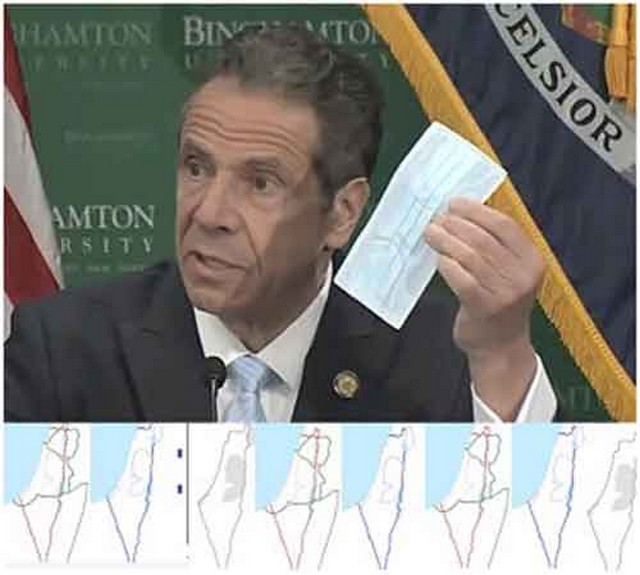
Every day, I wait for Cuomo’s briefing impatiently and watch while perched, tense and hyper-alert, at the edge of my seat, mesmerized by the shifting lines of his charts that, I swear, often morph into the outline of the map of Palestine.

My mind automatically sucks in Cuomo’s words and echoes them back at the TV in an altered form. I am Muslim, but the dynamic gripping me is one akin to the relationship between a pastor and his congregation at a black church. Cuomo calls and I respond, sometimes aloud. I hold back from hollering and shouting at his image, so as not to scare my family.

I take in every word of his sane, hopeful message — facts, not “facts on the ground”; science, not myths; let’s learn from our mistakes. Yes!

I translate his sentences into something else, like this: After decades of land theft, when will Palestinians be finally in control of their destiny and not subject to the whims of Israel and the international community? You tell me how Israel behaves today; I will tell you how Palestinians will be resisting a year from now.

The Zionist virus that is the Jewish state of Israel has yet to be stamped out. Hot-spot outbreaks have been with us since the Nakba of 1948. Currently, they are in the form of Israel’s horrifying annexation of parts of the West Bank, preying on the most vulnerable of peoples. We need to look for solutions that make things better for the Palestinian people. We need to reimagine the status quo and pose such a solution.

“In the first phase, we had to figure out what we are dealing with because we had no idea.” Yes, we had no idea — just intimations of unbelievable cruelty and diabolical greed! In 1947–48, we really had little idea. Remember, Palestine was 80% agrarian then — not the sophisticated community of Basle, Switzerland, where the plot for our dispossession was hatched at the First Zionist Conference in 1897.

“In the first phase, stabilize, control the damage,” says Cuomo. It turns out the key (here is that word again!) is information.

“I worked hard every day to make sure they knew the facts. ‘Trust the people’ — Lincoln, right? An informed public will keep this country safe. True, and that’s exactly what happened here,” Cuomo continues.

Funny Cuomo should say that, because, just the other day, a Palestinian friend on Facebook, Imad Jibawi, was saying something similar. He was commenting on a Zoom discussion I had posted titled “What do we do now?” conducted by Hani al-Masri, Director General of Masarat — The Palestinian Center for Policy Research & Strategic Studies (Masri is also a Policy Advisor for Al-Shabaka).

Imad Jibawi wondered:

“What is it that would drive the Palestinian people to the streets to protest by the thousands? Is it the annexation of Jerusalem? No; is it annexation of the Jordan Valley? No; is it Israel’s new settlements, then? No.

Why is that so?

I think the answer is in the question: Who is it mainly that we expect to take to the streets? They are those who are primarily under 30 — i.e., the Oslo generation.

These Palestinians were born and brought up in the reality of the Palestinian Authority, a government, ministries, VIPs, jobs, loans, etc.

[Preserving that] has been the national project for which our people sacrificed for years. People’s very livelihoods are now the red lines, holding them back. Their concerns are the teachers’ movement, the social security movement, the “we want to live” movement.

The question that concerns the political class as a whole is this: What next? What to do? The answer is: We start with our ABCs all over again. The first lesson is: Who are the Palestinians? What are the borders of the homeland of Palestine? The second lesson is: Who is our enemy? And what do we want?

Wanted: a new national awareness ….” [my translation from Arabic]

But then, as I continued to listen to Cuomo, I realized that, even though he and Jibawi are appealing to people to act collectively in their best interests by looking to themselves, rather than to their governments, there is a fundamental difference.

Cuomo is invoking security of health, family and livelihood as a raison d’etre for a certain set of collective behaviors, whereas what Jibawi is pushing for, necessarily given the Palestinian condition, is a revolutionary national consciousness that calls for a sacrifice of the very same things Cuomo is protecting for New Yorkers.

To Jibawi, the ideal of home and hearth (job security, health care, education, etc., as provided currently by the Palestinian Authority and the Oslo regime) must be superseded by the ideal of liberty, justice and equality for a people under occupation, who have escaped Israel’s genocide so far, but who continue to be dispossessed, brutally subjugated and oppressed by a vicious, powerful judeo-fascist entity and its allies.

Cuomo says, “I don’t know when government became so political. It all became about rhetoric rather than actual competence, but it happened somewhere along the way that government could not handle the situation. People had to get engaged; people had to be informed and that’s the new thing I did. They got engaged because it mattered — this is not an abstract issue we are talking about people’s lives and people’s health and the health of their children.”

They’ll get engaged, because it matters. For both Palestinians and New Yorkers, these are not abstract issues. Far from it. In our case, all you have to do to realize the concreteness is to tune in to the daily news of thievery and savagery in their myriad forms the Israeli regime inflicts on the Palestinian people.

Many ask, if not the Palestinian Authority, if not the status quo of self-government for the Palestinians in the West Bank and Gaza, what then? My answer is this: First, hard as it is for many, we must find the will and steadfastness to effect an insurrection to continue the interrupted Palestinian revolution, returning to the political and community structures that sprang up to further the first intifada. We need a supreme manifestation of popular resistance against both the Palestinian Authority and Israel in all of occupied Palestine from the river to the sea with aid from Palestinians in exile.

Cuomo is right! “No government can impose any of these things … Stay in the house. Close every school. Close every bus. State government can’t enforce that. People had to understand the facts people had to engage in governing themselves in a way they hadn’t in decades … We are tough, smart, united, disciplined and loving” — even if our governments aren’t. We are samidoun.

Amen to that! Hallelujah!

Rima Najjar is a Palestinian whose father’s side of the family comes from the forcibly depopulated village of Lifta on the western outskirts of Jerusalem.

13 May 2020

Source: countercurrents.org

India-A Decaying Civilization

By Javeed Ahmad Raina

India is the cradle of the human race, the birthplace of human speech, the mother of history, the grandmother of legend, and the great-grandmother of tradition…Mark Twain

India has ever been the land of peace and harmony. It has been a heaven for co-existence, brotherhood and religious tolerance. The country managed to sustain secular values in the face of striking, ethnic, linguistic and religious diversity. The country is well-known for vibrant democracy, independent judiciary, rich literature, secular ethos and cultural diversity. Historians, poets and travelogue writers have frequently praised this ancient land of mystic majesty. The American born poet T. S Eliot calls India as the land of “Shantih (Peace)”. He saw hope and re-generation in the Indian culture amidst the barbarism and disillusionment of the modern West. Similarly, the German poet Johann Wolfgang Von Goethe, in his collection of lyric poems, West-Eastern Diwan, expresses disdain towards the spiritual bankruptcy of the West and believes that the East is the seat of spiritual power. The spirit of Eastern culture was best represented by India.

These secular principles were further preserved by the country’s constitution. The modern constitution of free India promoted compassion and self-control, because it believes that everyone was one with each other, and therefore, everyone should share and help in each other. The very idea of India invoked in the constitution is one of secularism, freedom and sagacity. It is due to these ideals that the Indian constitution does not insist on a single language or religion but embraces diversity of languages, cultures and customs. It was due to these distinctive features that various regions liberally aligned with the main domain of India.

But, over the course of time, the beautiful soul of India has been defaced. The land has been battered by a tsunami of religious hatred. The country is lamenting on the loss of its soul. The very word, India, has come to represent repression of marginal sections- Muslims, Christians and Dalits. Even, the ordinary Indians have serious reservations with the idea of new majoritarian India. The transformation of a great democracy into seemingly anarchy and apathy should be a grave concern for all of us. This un-wanted transition has not only disfigured the image of country, it has also fractured the muti-cultural heritage of the nation. The land which used to attract people from diverse faiths has turned into the land of despair.

The multicultural heritage of the country is slowly losing a common ground that used to hold different ethnic communities together. The harmony that once existed between different communities, regardless of the religious differences has been torn apart. The feelings of goodwill and pride towards the motherland are now replaced with bitterness and contempt. The very land once used to stand as a rock for communal harmony, a gathering of everything and everybody, but now it provokes the feelings of disgust and dissatisfaction in the saner voices. The historians no longer record the famous legends of the country. They have no means to do so, because the very land is in lament for the loss of its incredible inclusiveness.

The beautiful soul of the country is tormented by the unruly collaborators- despotic leaders, sellout media and ultra nationalists. The sheer egoism of politicians, the deceptive mass media and the self-serving regimes have collectively betrayed the nation. They have manipulated and misguided the masses. They, re-write history, impose majoritarian ideology, erode identity and enforce vilifying narratives. They, in the long process cultured a class of people who exclude everything from their exclusive design, including those very Indian in colour and blood. In all these years, the mainstream media in particular acted as the right arm of tyranny by enforcing majoritarian ideology. The vibrant democracy is fast shrinking in the direction of Hobbes’ leviathan, the rule by absolute sovereign. The land of Saints and Sufi’s has slowly changed into the land of religious extremism. This land does not inspire us anymore; this land only inspires lament and dirges!

Postscript: India is not, as people keep calling it, an underdeveloped country, but rather, in the context of its history and cultural heritage, a highly developed one in an advanced state of decay. Shashi Tharoor

Javeed Ahmad Raina is a school teacher and can be mailed at: javeedahmadraina44@gmail.com

14 May 2020

Source: countercurrents.org

Arabs, UN Must Move to Swiftly Protect the Status of Palestinian Refugees

By Dr Ramzy Baroud

‘Heinous racism,’ is how the Geneva-based Euro-Mediterranean Human Rights Monitor described a recent decision by Lebanese authorities to bar Palestinian refugee expats from returning to Lebanon.

Lebanon’s restrictions on its ever-diminishing population of Palestinian refugees is nothing new. However, this event is particularly alarming as it may be linked to a long-term official policy regarding the residency status of Palestinian refugees in this Arab country.

Many were taken aback by a recent Lebanese government’s order to its embassy in the United Arab Emirates, instructing it to prevent Palestinian refugees from returning to their homes in Lebanon.

Tariq Hajjar, a legal advisor to the Euro-Med Monitor said in a statement that “the circular includes heinous racial discrimination against Palestinian refugees holding Lebanese travel documents.”

Hajjar rightly insisted that “the holder of this document should receive similar treatment to the Lebanese citizen.”

Indeed they should, as has been the practice for many years. Otherwise, there is no other place where these refugees can possibly go, considering that Lebanon has been their home for decades, starting in 1948 when Israel forcefully expelled nearly a million Palestinians from their historic homeland.

Refugees, regardless of their race, ethnicity or religion, should be treated with respect and dignity, no matter the political complexity of their host countries. Palestinian refugees in Lebanon cannot be made an exception.

Last April, the Palestinian Association for Human Rights called on the United Nations to provide financial assistance to Lebanon’s Palestinian refugees, indicating that due to the coronavirus pandemic, a whopping 90 percent of all Palestinian refugees in Lebanon have lost their jobs.

Under discriminatory Lebanese laws, Palestinian refugees are not allowed to practice 72 types of jobs that are available to Lebanese nationals. This is merely one of many other such restrictions. Thus, employed Palestinian refugees in Lebanon (the vast majority of whom are now unemployed) have been competing within a very limited work market.

A large number of those refugees have been employed at the various projects operated by the United Nations Relief and Works Agency (UNRWA).

Many of those who were lucky enough to receive university degrees opted to leave the country altogether, mostly working in the teaching, engineering, banking, and medical sectors in Arab Gulf countries.

However, due to the coronavirus, the severe financial hardship suffered by UNRWA and to new Lebanese government regulations, all doors are now being shut in the face of Palestinian refugees.

For thousands of those refugees, the only remaining option is sailing the high seas in search for a better refugee status in Europe. Yet, sadly, tens of thousands of those refugees are now living a miserable life in European camps, or stranded in Turkey. Hundreds drowned while undertaking these perilous journeys.

According to a recent survey by the Lebanese Central Administration of Statistics, conducted jointly with the Palestinian Central Bureau of Statistics, only 175,000 (from nearly half a million) Palestinian refugees still reside in Lebanon.

That said, the Palestinian refugee tragedy in Lebanon is only a facet in a much larger ailment that is unique to the Palestinian refugee experience.

Syria’s Palestinian refugees arrived in the country in waves, starting with the Zionist ethnic cleansing of Palestine during the ‘Nakba’, or Catastrophe. Others fled the Golan Heights after the Israeli invasion in 1967. Many more fled Lebanon during the Israeli 1982 invasion.

The relatively safe Syrian haven was ruptured during the ongoing Syria war started in 2011. UNRWA’s mission, which allowed it to provide the nearly half a million Palestinian refugees in Syria with direct support was made nearly impossible because of the destructive war, and the fact that hundreds of thousands of Palestinians either fled the country or became internally displaced.

The devastating impact of the Syrian war on Palestinian refugees was almost an exact copy of what had transpired earlier during the Israeli invasion of Lebanon in 1982 and the American invasion of Iraq in 2003.

In the case of Iraq, where most of the country’s 35,000 refugees fled, the Palestinian refugee crisis was particularly compounded. While Palestinians enjoyed a permanent residence status (though no ownership rights) in Iraq before the war, they were still not recognized as refugees as per international standards, since UNRWA does not operate in Iraq. Post-2003 Iraqi governments exploited this fact to the fullest, leading to the displacement the country’s Palestinian population.

Since its advent, the US Administration of President Donald Trump has waged a financial war on the Palestinians, including the cutting of all aids to UNRWA. This infamous act has added layers of suffering to the existing hardships of refugees.

On May 5, UNRWA, somberly declared that it only has enough cash to sustain its operations until the end of the month.

The truth is that, long before Trump targeted the UN agency, UNRWA has functioned for over 70 years with an inherent vulnerability.

UNRWA was established exclusively with a UN mandate that provided the organization with a “separate and special status” to assist Palestinian refugees.

Arab governments, at the time, were keen for UNRWA to maintain this ‘special status’ based on their belief that lumping Palestinian refugees with the burgeoning world refugee crisis (resulting mostly from War World II) would downgrade the urgency of the Palestinian plight.

However, while that logic may have applied successfully in the immediate years following the ‘Nakba’, it proved costly in later years, as the status and definition of what constitute a Palestinian refugee remained historically linked to UNRWA’s scope of operations.

This became clear during the US invasion of Iraq in 2003, but, especially, since the start of political upheavals and subsequent wars in the Middle East in the last decade.

This is precisely why the US and Israel are keen on dismantling UNRWA, because, according to their logic, if UNRWA ceases to operate, the Palestinian refugee ceases to exist with any status that makes him/her unique.

Such precarious reality calls for an urgent and creative solution that should be spearheaded by Arab countries, UN-registered NGOs, and friends of Palestine everywhere.

What is needed today is a UN-adopted formula that would allow the legal status of Palestinian refugees under international law to remain active regardless of UNRWA’s scope of operation, while providing Palestinian refugees with the material and financial support required for them to live with dignity until the Right of Return, in accordance to UN Resolution 194 of 1948, is finally enforced.

For the rights of Palestinian refugees to be maintained and for the Lebanon, Iraq, and Syria scenarios not to be repeated, the Arab League must work within the framework of international law – as determined by the UN General Assembly – to safeguard the Palestinian refugees’ legal status which is currently under an unprecedented attack.

Palestinian refugees must not have to choose between forfeiting their legal and unalienable right in their own homeland and accepting a life of perpetual degradation and uncertainty.

Ramzy Baroud is a journalist and the Editor of The Palestine Chronicle.

14 May 2020

Source: countercurrents.org

U.S. is leading the global spending on nuclear weapons, says ICAN report

By Countercurrents Collective

The world’s nuclear powers are increasingly streaming money into their nuclear arsenals, and the U.S. is leading the trend, says a new report.

The U.S. has also exited a major arms control treaty and deployed a new tactical weapon.

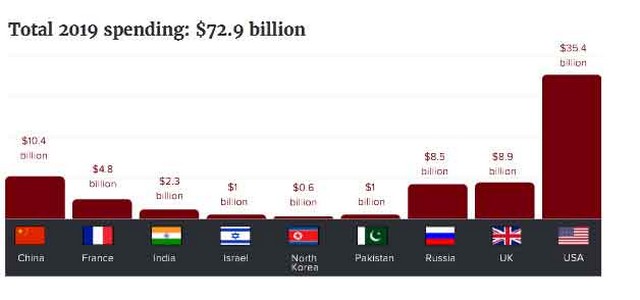
The report – Enough is Enough: 2019 Global Nuclear Weapons Spending (May 2020) – by the International Campaign to Abolish Nuclear Weapons (ICAN) said: Nine nuclear-armed nations spent an estimated $72.9 billion on their 13,000-plus atomic weapons in 2019. At $35.4 billion in spending, the U.S. accounts for nearly half the global total.

The ICAN pointed out, all this money spent for nuclear armaments have done nothing to protect any of these countries from Covid-19.

“It’s clear now more than ever that nuclear weapons do not provide security for the world in the midst of a global pandemic, particularly when there are documented deficits of healthcare supplies and exhausted medical professionals,” said Alicia Sanders-Zakre, the lead author of the report.

The ICAN estimates that the nine nuclear-armed countries’ nuclear spending in 2019, equals $138,699 every minute of 2019, and a $7.1 billion increase from 2018.

The report said:

These estimates (rounded to one decimal point) include nuclear warhead and nuclear-capable delivery systems operating costs and development where these expenditures are publically available and are based on a reasonable percentage of total military spending on nuclear weapons when more detailed budget data is not available.

The ICAN has urged all nuclear-armed states to be transparent about nuclear weapons expenditures to allow for more accurate reporting on global nuclear expenditures and better government accountability.

It said:

Due to lack of reliable and consistent information, these estimates do not include the costs to remediate the environment contaminated by nuclear weapons or to compensate victims of nuclear weapon use and testing, although these are also important markers of the added financial and human cost of nuclear weapons.

A 2011 Global Zero cost estimate, which added “unpaid/deferred environmental and health costs, missile defenses assigned to defend against nuclear weapons, nuclear threat reduction and incident management” found that this “full” cost of global nuclear arsenals was over 50% higher than just the cost of nuclear weapons system maintenance and development.

U.S.: $35.4 billion

The report said:

The United States has 5,800 nuclear weapons, which it can launch from land-based missiles, submarines and aircraft. The Department of Energy’s National Nuclear Security Administration (NNSA) and the Department of Defense divide responsibilities for the nation’s nuclear weapons. The NNSA is responsible for the research, development, production and dismantlement of the nuclear warheads themselves, while the Department of Defense manages the development of warhead delivery systems, such as missiles, aircraft, and submarines. The Department of Defense also manages the deployment of nuclear weapons once they are fully produced. This figure combines Department of Defense and NNSA enacted funding for nuclear weapons in 2019. NNSA spent $11.1 billion in 2019 on weapons activities. The Defense Department requested $24 billion for nuclear weapons systems in fiscal year 2019, including $11 billion for nuclear force sustainment and operations, $7 billion for replacement programs, and $6 billion for nuclear command, control, and communications. Congress added another $319 million to the Defense Department’s request in the 2019 National Defense Authorization Act, bringing enacted Defense Department spending on nuclear weapons to $24.3 billion. Adding $11.1 billion to $24.3 billion results in a total of $35.4 billion spent on nuclear weapons in the United States in 2019. This is roughly five per cent of total U.S. military spending in 2019. The United States spent $67,352 every minute of 2019 on nuclear weapons. The United States spent $29.6 billion in 2018 on nuclear weapons, $19 billion requested for the Department of Defense and $10.6 billion enacted for the NNSA.

China: $10.4 billion

The report said:

China has 320 nuclear weapons and can launch nuclear weapons from land-based missiles, aircraft and submarines.

The Stockholm International Peace Research Institute (SIPRI) estimated that in 2019 China spent $261.082 billion on military expenditures. Four per cent of $261.082 billion is $10.4 billion, our estimate for Chinese nuclear spending in 2019. This means China spent $19,786 every minute of 2019 on nuclear weapons. Based on this methodology, China spent $10 billion in 2018 on nuclear weapons.

UK: $8.9 billion

The report said:

The United Kingdom (UK) has 195 nuclear weapons, which it can launch from submarines. It cooperates closely with the United States to produce its nuclear warheads and loans its Trident II (D-5) submarine-launched ballistic missiles from the United States. Its primary nuclear weapon costs, therefore, consist of nuclear operating costs and the development of the Dreadnought-class submarine to replace its current Vanguard-class nuclear submarine. A 2016 Campaign for Nuclear Disarmament report calculated that the overall cost to replace the UK nuclear submarine program will be £205 billion.

A 2018 BASIC report calculated that annual UK nuclear operating costs are £2 billion and reported that the United Kingdom is scheduled to spend £5.2 billion on its Dreadnought development program from 2018-2019. The Dreadnought program costs include£1.8 billion for the submarines, £1.4 billion for the missiles and warheads, £790 million for propulsion systems and £220 million in management costs. There is little public information about what is included in £2 billion operating costs for the UK nuclear arsenal. Adding those two components together leads to an estimated £7.2 billion spent on nuclear weapons in the United Kingdom in 2019, or $8.9 billion. £7.2 billion is 19 per cent of 2019 United Kingdom defense spending, estimated at £38.093 billion. This means the United Kingdom spent $16,933 every minute on nuclear weapons in 2019. Based on this methodology, the UK also spent about $8.9 billion in 2018 on nuclear weapons.

Russia: $8.5 billion

Russia has 6,370 nuclear weapons, which it can launch from land-based missiles, submarines and aircraft. A 2018 SIPRI report found that Russian spending to maintain and develop new nuclear warheads and delivery systems has in recent years (in 2010 and 2016) cost about 13 per cent of total defense expenditures. SIPRI estimated Russian nuclear spending at $65.103 billion in 2019. 13 percent of $65.103 billion is $8.5 billion, our estimate for Russian nuclear spending in 2019. This means Russia spent $16,172 every minute on nuclear weapons in 2019. Based on this methodology, Russia spent $8 billion in 2018 on nuclear weapons.

France: $4.8 billion

France has 290 nuclear weapons and can launch nuclear weapons from aircraft and submarines. The 2019 French military programming law allocated €4.45 billion for “dissuasion” or nuclear deterrence. The law does not break down the costs within this line item, but does state that it includes the annual costs for French nuclear warheads, modernization of its nuclear-capable cruise missiles, submarine-launched missiles and submarines. Notably not included in the deterrence budget are costs associated with the Rafale aircraft, which can be used to launch nuclear weapons. Given that these costs are not publicly available, our estimate assumes that the deterrence budget covers the bulk of French nuclear spending and does not include the costs of the Rafale. €4.45 billion converted to USD is $4.8 billion. France spent roughly 15 per cent of its total military budget (€30.249 billion) on nuclear weapons in 2019.11 This means France spent $9,132 on nuclear weapons every minute in 2019. France spent €4.04 billion ($4.4 billion) in 2018 on nuclear weapons.

India: $2.3 billion

The report said:

India is estimated to have 150 nuclear weapons, can launch nuclear weapons from land-based missiles and likely from aircraft, and is developing a submarine-launched nuclear capability. While little is known about Indian nuclear weapon spending, a October 2016 Stimson Center report shed some light on Indian nuclear spending by looking at parliamentary oversight documents and creating a methodology to calculate annual spending on nuclear weapons. The report notes that a 2016 Indian parliamentary report stated that India spent 46% of the Defence Research and Development Organisation (DRDO)’s budget on its nuclear-capable delivery systems. Given that about half of the U.S. nuclear budget goes to nuclear delivery systems, the Stimson Center report assumed that India’s total nuclear spending would be about twice what it spent on nuclear-capable delivery systems. ICAN’s research thus followed the Stimson Center’s methodology by taking 46% of the 2019-2020 DRDO budget (19,021.02 crore Indian rupees) to get 8749.669 crore Indian rupees and doubling it to reach 17,499.3384 crore Indian rupees. A crore is 10 million, so 17,499 crore is 174.990 billion Indian rupees. Converted into USD this total is $2.3 billion, our estimate for Indian nuclear spending in 2019. This is roughly three per cent of the $71.125 billion India spent on its military in 2019. India spent $4,376 every minute of 2019 on nuclear weapons. Based on this methodology, India spent $2.1 billion in 2018 on nuclear weapons.

Pakistan: $1 billion

The report said:

Pakistan is estimated to have 160 nuclear weapons and can launch them from land-based missiles and aircraft and is developing the ability to launch them from submarines. Analysts in the past decade have estimated that Pakistan spends about ten per cent of its total military spending on its nuclear arsenal, which appeared to be confirmed by a parliamentary report in 2016 revealing that Pakistan spent 9.8 per cent of its official military budget on nuclear weapons that year. Ten per cent of Pakistan’s 2019 military spending ($10.256 billion) is $1 billion, our estimate for Pakistani nuclear spending in 2019. This means Pakistan spent $1,903 spent every minute on nuclear weapons in 2019. Based on this methodology, Pakistan spent $1.2 billion in 2018 on nuclear weapons.

Israel: $1 billion

The report said:

Israel is estimated to have 90 nuclear weapons and is believed to be able to launch nuclear weapons from land-based missiles, submarines and aircraft. There is no reliable public information about Israeli nuclear spending, given that it publicly denies possessing nuclear weapons. Therefore, ICAN used an average percentage (five per cent) of what nuclear-armed countries spend on nuclear weapons out of total military spending. The Stockholm International Peace Research Institute estimated that in 2019 Israel spent $20.465 billion on its military. Five per cent of $20.465 billion is 1 billion, our estimate for Israeli nuclear spending in 2019. This means Israel spent $1,903 every minute on nuclear weapons in 2019. Based on this methodology, Israel spent $1 billion in 2018 on nuclear weapons.

The report’s Conclusion part said:

“The nuclear-armed states spent nearly three-quarters of one hundred billion dollars in 2019 on building and maintaining nuclear warheads and delivery systems. The incalculable human and environmental costs of nuclear weapons only add to this shocking figure. From 2018 to 2019, there was an estimated $7.1 billion increase in nuclear weapon spending, and these totals will only continue to rise in the next decade according to documented nuclear weapon programs and budgets in several nuclear-armed countries.

“Nuclear weapon spending is always a choice, and an opportunity cost.”

The report questioned:

“Will citizens and leaders choose to continue to throw away $73 billion on nuclear weapons, or will they join the majority of the world’s countries in choosing to ban these weapons of mass destruction all together?

According to the latest figures from the Stockholm International Peace Research Institute (SIPRI), the U.S. contributed the lion’s share of the world’s $7.1 billion increase in nuclear expenditures between 2018 and 2019, with $5.8 billion in additional spending. This is actually higher than the U.S. share of global military spending, which amounted to 38 percent in 2019.

According to ICAN’s report Russia, which ICAN estimated had more warheads than the U.S., spent $8.5 billion on them in 2019. Russia’s spending is a quarter of the nuclear expenditure by the U.S. Russia is trailing China ($10.5 billion) and the UK ($8.9 billion).

Alarmed by U.S. efforts to bolster its nuclear arsenal, some experts in China have called for a drastic nuclear build-up of their own, in order to pressure the U.S. to the negotiating table.

Fears of medium-range ballistic missiles in Europe triggering a global nuclear war led to the 1987 INF arms control treaty, which banned such weapons from the continent – but U.S. President Donald Trump’s administration exited the treaty last year. Officially, the U.S. claimed Russia had been violating the treaty, but the U.S. provided no evidence in support of the claim. U.S. officials further argued the INF was obsolete anyway, because it did not apply to other nuclear powers, such as China.

Earlier this year, the U.S. Navy fielded new low-yield warheads for submarine-launched missiles, arguing in a series of position papers that this made nuclear war less likely because it would inject uncertainty into Russian efforts to “escalate to deescalate,” a concept apparently based not in actual Russian doctrine but in Western Cold War-era military fiction.

While ICAN noted that their figures are estimates based on a consistent methodology, the true cost of nuclear weapons would have to include the expenses of compensating the victims of testing and cleaning up the environmental contamination.

14 May 2020

Source: countercurrents.org

Israel put itself in a corner

By Sam Bahour

Anyone following the Israeli-Palestinian conflict is sitting on the edge of their seat waiting to see if the new Israeli coalition government currently being formed will act on the green light the Trump administration has given it for additional acts of annexation of parts of the West Bank. Another act of annexation or not, Israel has already lost.

Secretary of State Mike Pompeo’s 16-hour trip to Israel last week raised red flags for some. Could it be that the Israeli Prime Minister Netanyahu, drunk on power and impunity, was taking Trump’s “Deal of the Century” and implementing it faster than the U.S. administration desires? Clearly, the world did not buy any part of Trump’s “Peace to Prosperity” fiasco — not the Palestinians, not the Arab states, not the EU, and not many Israelis and devoted supporters of Israel as well.

The New York Times’ David M. Halbfinger and Lara Jakes reported that “If the United States, with President Trump’s peace proposal, gave Mr. Netanyahu a green light on annexation, it may have now changed to yellow.” They went on to note that “A key, officials and experts said, was in the timing. [Pompeo’s trip] came on the eve of Israel’s seating its new government, one that appears divided over the immediacy of annexing about 30 percent of the occupied West Bank.”

Big words
From the Palestinian side, Prime Minister Mohammad Shtayyeh said that President Mahmoud Abbas will chair a meeting of the leadership on Saturday to take the appropriate decision.” Speaking about the new Israeli government about to be sworn in Shtayyeh said, “we will listen to its political program that calls for annexation of Palestinian lands and the imposition of [Israeli] sovereignty over the settlements.” The assumption here being if such a political program is announced the Palestinians will act without waiting until July 1, the date the Israeli coalition parties agreed to before implementing further annexation.

Such bravado statements have become commonplace in Palestine, but this time around the Palestinian public’s feeling is that the Palestinian leadership is finally acknowledging that it has reached the end of the Oslo Accords rope and may be in a hurry to finally act, so as not to be hung by that rope once Israel formally lets go.

The European Union, that underwrote most of the past 25 years of U.S. failures in the Middle East Peace Process, is also up in arms about Israel’s possible annexation moves. Hugh Lovatt, a policy fellow with the Middle East and North Africa programme at the European Council on Foreign Relations, wrote “West Bank annexation will bring an end to the EU’s cherished two-state solution. International norms and the EU’s own laws will now need to underpin post-annexation relations with Israel.” He goes on noting that, “Annexation — whether it starts with one settlement block or most of Area C — will cross a threshold which will be almost impossible to reverse back on. The full repercussions that such a move will trigger may be slow in coming, but they are real. This will challenge EU credibility and relevance. It will also undermine the fundamentals of the international rules-based order — in particular, the prohibition on the acquisition of territory through force.” He speculates that post-annexation, “Palestinians [will] live under an increasingly explicit system of apartheid.” It is no wonder that the EU, for the first time, is speaking about possible economic sanctions on Israel if they proceed with any form of annexation.

So what?
Whether it is a political survival tactic of a Palestinian leadership fearing total irrelevance, the EU’s supreme concern with being compliant with their own laws, or pro-Israel organizations and many Israelis who are shocked that their hollow motto of an Israel that is “Jewish and democratic” is rapidly unraveling for all to see, they all miss the point. It is past time that all stakeholders take note that the Palestinian struggle for freedom, independence and return home of refugees are the issues. Until these are addressed head-on for the just case they constitute, the conflict will not end. If annexation happens, yet again, it makes sense for Palestinians to remain on track in their long-haul struggle and not play into the U.S.-Israel annexation game. Other than the U.S., a longtime accomplice in this ongoing crime against Palestinians, no other meaningful country will recognize Israeli annexation.

Cornered
In his full-court press to stay out of jail on the three corruption indictments Netanyahu he is facing, he is taking Israel down a very deep hole, one they may never exit. If annexation proceeds, as most expect it will, albeit incrementally as is Israel’s trademark, its rogue status around the world will continue to deepen in places unexpected — think Jordan, Egypt, and EU. Worse yet, for Israel, is its flagrant racism, structural discrimination, and blatant disregard for a rules-based world will be publicly visible for all to see.

Sam Bahour is a Palestinian-American business consultant from Ramallah/Al-Bireh in Occupied Palestine.

16 May 2020

Source: palestineupdates.com

Slapping Israeli Apartheid – Sentencing of Yifat Doron (Excerpts)

By Jonathan Ofir

More than two years ago, the young Palestinian resistance icon Ahed Tamimi shook the world with a slap to an Israeli occupation soldier in Nabi Saleh. During Ahed’s sentencing hearing, Israeli peace activist Yifat Doron slapped the chief military prosecutor. It came out of her as a spontaneous reaction to oppression: “The way I see it, this was in reaction to seeing my friend in distress,” Doron said. Last week, Doron was sentenced to eight months prison, plus a fine of 3,000 Shekels and probation entailing a potential 4 months to 3 years prison if she would be convicted of additional ‘violent offenses’. The case was of course held at a civilian court – the Jerusalem Magistrates Court – not the military court in which Palestinians are tried. Then 16-year-old Ahed Tamimi’s slapping of a soldier occupying her village and backyard in December 2017, shortly after her cousin Mohammed was shot in the head, became famous as a symbol of courage and defiance. Haaretz columnist Gideon Levy opined that “she slapped the soldier who invaded her home, and slapped the occupation, which deserves far more than slaps.” More representative was centrist journalist Ben Caspit, who was enraged, and insidious: “In the case of the girls, we should exact a price at some other opportunity, in the dark, without witnesses and cameras,” he wrote.

Ahed and her mother Nariman were both sentenced to eight months prison, Nariman for assisting in filming the event. Then Yifat Doron ended up doing pretty much the same act as Ahed, in March 2018, during the sentencing. She slapped Lt. Col. Issam Hamad, the military prosecutor at the Ofer military court. Doron was not kept in prison for months up to her trial, as Ahed had been (Ahed was kept in detention for three months up to her trial). Israeli ‘ethicist’ Asa Kasher, known as the author of the Israeli army’s ‘ethics code’, opined that Ahed should indeed remain in prison, because she might, God forbid, slap again.

“Who are you to judge her?!” shouted Doron when she slapped Hamad. It was not a personal, singular slap – it was precisely a slap to a whole system. Doron is unrepentant, as she stated to the court this month: “I will never regret the fact that I stood alongside my friends and acted according to my moral compass. It is a badge of honor to join a list of women whom I respect and admire who have been convicted of violent crimes in the Zionist court.” Doron did not even want a lawyer: “Because the arrest happened in a political context, I have no interest in entering into all kinds of legal arguments,” she said of her decision. “I’m going to represent myself politically – I understand politics.” And she has stood firm all the time. It’s as if everything that the military and the state were saying about her actions, were a confirmation of her own activism.

Attorney Efrat Filzer, who represented the military prosecution, claimed that the assault on Hamad “was not accidental,” and was done because he is the head of the military prosecution in the West Bank. “The very act against him is in fact a challenge to the entire military system… “The purpose here is to undermine and delegitimize the legal system.” Doron was challenging a whole system. Her slap may have been spontaneous, but it wasn’t accidental. Her purpose, to undermine the Apartheid system, is clear. The Magistrates Court judge Aharon Cohen wrote: “It is an error to treat the case before us as a routine one in which one person attacks another. The act must be viewed in the broader context as one that seeks to undermine the principles of government in the occupied territories and is intended to damage them.” Once again, obviously, Doron is an activist seeking to dismantle the Israeli Apartheid system. Of course she seeks to damage the “principles of government in the occupied territories”.

Doron was essentially saying that the court should come at her with whatever it has. She did not offer conventional defense entailing apology or repentance. Doron will not be transferred to a prison of an occupying power in contravention of the 4th Geneva Conventions, as is routinely done to Palestinians. Still, the length of time seems to suggest an attempt to match that of Ahed’s. Doron has said that “we are not punished the same way the Palestinians are for the same actions”.

The judge tried to persuade Doron to accept a penalty of community service, which she refused. The military attorney actually requested 10 to 20 months prison. But it ended up with those 8 months. Doron is only emboldened by the notion of solidarity with these oppressed people. There are people who accept imprisonment peacefully, like many of my Palestinian friends…prison is simply a part of these Palestinians’ lives.

Doron is taking a noble stance of solidarity with the oppressed, and this does not come easy, also for the privileged Jews – eight months in prison is not nothing, it’s a heavy price to pay. She knows that she is representing the oppressed, and she has to reject her inherent and systemic privileges to arrive at a place which to some degree represents what Palestinians have to face when they resist. She knows that this is still somewhat symbolic – she will not be gunned down– unlike the hundreds of protesters in Gaza. Doron let the state prosecution slap itself in its own self-righteous, hypocritical face. The Israeli state was on political trial.

15 May 2020

Source: palestineupdates.com

UK government covers up PPE shortages leading to health care worker deaths

By Alice Summers

Inquests into the deaths of National Health Service (NHS) workers from COVID-19 will be barred from addressing government failures in providing adequate personal protective equipment (PPE).

Mark Lucraft QC, the chief coroner for England and Wales, issued guidance at the end of April stating that “an inquest would not be a satisfactory means of deciding whether adequate general policies and arrangements were in place for provision of PPE to healthcare workers.”

An inquest into the death of an NHS medical worker for coronavirus may be held if there is “reason to suspect that some human failure contributed to the person being infected with the virus,” Lucraft stated. The coroner investigating the death “may need to consider whether any failures of precautions in a particular workplace caused the deceased to contract the virus and so contributed to death.”

Members of the clinical staff wearing Personal Protective Equipment PPE care for a patient with coronavirus in the intensive care unit at the Royal Papworth Hospital in Cambridge, England, Tuesday May 5, 2020. (Neil Hall/Pool via AP)

But, “an inquest is not the right forum for addressing concerns about high-level government or public policy,” he said (emphasis added).

The official guidance indicates that the government is set on covering up its failure to properly equip NHS staff, even as deaths among health and social care workers continue to soar. As of 9 a.m. on May 7, at least 195 health and social care workers had died of COVID-19, according to Nursing Notes.

An investigation is already underway into the death of Dr. Peter Tun, a doctor specialising in brain conditions, who died of COVID-19 only weeks after asking hospital management to provide him and his team with PPE. His requests were ignored, as there were not currently any confirmed or suspected coronavirus cases in his unit. It is unclear whether the investigation will look into the availability of PPE at the time of Dr. Tun’s death.

While many medical personnel have consistently reported that they have been forced to work without suitable protective equipment, hospital management has attacked those who protest against their conditions, repeatedly insisting that there was sufficient PPE available.

After a frontline nurse at the Royal Bournemouth Hospital wrote a letter to the World Socialist Web Site describing the appalling conditions they faced at work, hospital management and the Royal College of Nursing union attacked the nurse’s claims in the local newspaper. The Bournemouth Daily Echo quoted them stating there was no shortage of PPE and that existing guidelines on PPE were fit for purpose because they met Public Health England (PHE) guidelines.

The frontline nurse responded, “Current guidance from PHE is that full PPE for nurses and doctors is only necessary if you are treating COVID-19 patients in ICU and patients having Aerosol Generating Procedures (AGP). They state that full PPE is not necessary when we are treating COVID-19 patients elsewhere in the hospital. As I wrote, these instructions from the UK government are in breach of World Health Organisation (WHO) guidelines.”

One example cited was that “WHO recommends health workers wear a medical mask, gown, gloves and eye protection (goggles or face shield) when providing direct care to COVID-19 patients. But PHE guidelines replace the gown with a flimsy apron, and eye protection can be worn based on a risk assessment.”

The reality is that systematic underfunding, privatisation efforts and “efficiency savings” have left the NHS perilously ill-equipped to cope with the COVID-19 pandemic, with many hospitals lacking supplies of even the most basic PPE. Between 2013 and 2016, Tory cuts to the NHS reduced PPE stockpiles by 40 percent.

Widespread public anger at the government’s failure to provide protective equipment to health care workers grew after a BBC Panorama documentary at the end of April, “Has the Government Failed the NHS?,” exposed the criminal lack of preparedness to face the pandemic and the government’s attempts to cover this up. As the WSWS commented:

“Using documents from within the NHS supply chain, the investigation rips apart ministers’ claims to have provided 1 billion items of PPE in March and April. More than half of these items are surgical gloves, with each individual glove counted as a separate piece of PPE in most cases. The second largest stock of items is for plastic aprons, described by one Accident and Emergency doctor as ‘What you’d expect a dinner lady to wear…it does nothing.’ Items like cleaning equipment, waste bags, detergent and paper towels are also counted as PPE in the official figures.”

A study by the British Medical Association (BMA) revealed that around half of medical professionals have had to source their own PPE for personal or departmental use. Fifty-seven percent of GPs (general practitioners) and 34 percent of hospital doctors have had to buy their own equipment to protect themselves at work, according to the survey of 16,000 doctors.

The BMA survey revealed that 65 percent of doctors felt only partly, or not at all, protected from COVID-19 in their workplaces. This has had a severe impact on the mental health of medical workers, with one in four reporting increased levels of mental distress, including depression, anxiety and burnout.

Deborah Coles, the director of the charity Inquest, condemned the chief coroner’s instructions not to look into PPE shortages, saying, “Bereaved families legitimately ask whether failures in the provision of safety equipment played a part in the deaths of their loved ones.

“It follows that coroners should, where appropriate, examine this question. In the absence of a public inquiry inquests will play a vital role in identifying systemic failings in the protection of frontline workers. This scrutiny is key to learning lessons and holding people to account in order to prevent future deaths.”

Confirming the government’s disregard for the lives of health care workers, lawyers advising the Department of Health and Social Care (DHSC) have recommended the inclusion of “no responsibility” clauses in the government’s compensation plan to the bereaved families of NHS workers.

At the end of April, Health Secretary Matt Hancock announced that a meagre £60,000 would be paid to the families of health care workers killed by COVID-19. This will do nothing to make up for the huge emotional and financial loss to their relatives. The inclusion of “no responsibility” clauses makes clear that this minimal payout is an attempt to buy the silence and compliance of families who have lost loved ones and to head off any future legal action against the authorities. Any payment would come with a legal warning that “the government accepts no liability for the death.”

According to Paul Joseph, lecturer in Health Care Law and Ethics at Swansea University, writing in The Conversation, compensation claims will likely require the signing of a settlement agreement, which would be worded to settle any current claims, or which resolve all future claims that could be brought against the DHSC. These are typically included as a long addendum (often around 10 pages) at the end of the document signed by the payment claimant.

While the government has stated that their “no liability” clauses would not explicitly prevent those who receive the £60,000 payment from pursuing further legal action, the legal warning lays the groundwork to fight any negligence cases brought against the government for its handling of the coronavirus pandemic.

While these “death-in-service” payments will likely cost the government less than £10 million, payouts to families who win a negligence case against the government could run into the hundreds of millions. Legal experts told openDemocracy that just the costs of fighting liability claims could be as high as £100 million.

In a further vindictive move, the bereaved families of frontline NHS staff will not automatically receive the payment but will have to apply and undergo a “verification process” conducted by NHS Business Services Authority to assess if they meet eligibility criteria. According to the DHSC, an “occupational and situational” test will have to be passed, and families will need to be able to prove that their deceased relative had been working with coronavirus patients in the 14 days before their symptoms emerged and that coronavirus was the cause of death.

Originally published by WSWS.org

8 May 2020

Source: countercurrents.org

COVID 19: Australia’s Anti-China Rhetoric Risks its Economic Recovery

By M Adil Khan

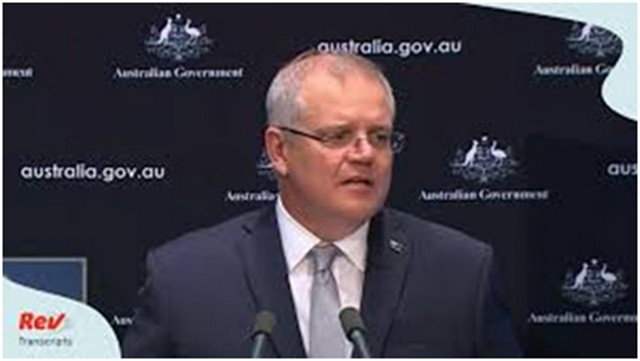
Mr. Scott Morrison, the Prime Minister of Australia ought to be applauded for his remarkable leadership for mobilisation of best scientific advice and for pursuing coherent federal/state policies and enlisting trust and cooperation of ordinary Australians, in tackling the COVID 19 crisis so successfully – spread of the deadly virus in most parts of the country has almost come to a halt. Government is slowly lifting containment restrictions and bringing the country to some sort of normalcy, mainly the social side of it.

However, as we all know that the pandemic’s economic fallouts – results of shutdowns and social distancing and postponement of international trade – have been staggering. According to the latest estimate job and business losses have been costing Australia’s economy approximately AUD 4.0 billion a week and 8 per cent of adult Australians, more than 1.6 million people are out of work and counting.[1]

Getting the economy back on track, a daunting task, is Australia’s immediate priority and to get the economy back to its pre-COVID level or at least to a reasonable level, re-opening of exports to pre-COVID major markets is a must. This means kick-starting Australia’s trade with its largest international trading partner, China – exports to China that reached $123.3 billion in 2019, constitute approximately 30% of all Australia’s exports[2].

In the context of the above it is only normal that Australia re-connects and revives its trade with China the soonest. On the contrary, first announced by Australia’s Home Minister Mr. Peter Dutton and later backed by Mr. Morrison, Australia’s Prime Minister their recent out-of-the blue demand for an international COVID 19 probe against China, Australia’s largest trading partner has come as a big surprise and shocked many[3].

Indeed, at a time when the whole world is still convulsing and looking for global cooperation to address multiple challenges the pandemic has thrust upon every country including Australia, experts are somewhat puzzled by Australia’s sudden China phobic adrenal outburst.

UN Secretary General Antonio Guterres who fully understands the gravity of the situation and appreciates the importance of global unity against the pandemic, suggests, “To prevail against the pandemic today, we will need heightened solidarity’’ and at the same time, he also expressed his concern that instead of cooperation there is now a “tsunami of hate and xenophobia, scapegoating and scare-mongering” and thus appealed for an all-out effort “to end hate speech globally.”[4]

Furthermore, Morrison government’s reference to “weapons inspectors” type investigation for the proposed China probe has also raised eyebrows about the real motive behind the proposed probe for it brought back bad memories from the past where findings of weapon inspectors that ran contrary to the expectations of its sponsors, were responded with unilateral bombings of the accused, without the international mandate.

Having said all these, it is also undeniable that the pandemic has indeed raised many questions that beget answering. For example, it is important to know where the virus originated, how did it originate, whether all parties played their due roles in alerting each other to help averting its spread and what made some countries do better than others in stemming the scourge etc. etc. Indeed, lessons that we would learn from the proposed study would greatly help us to prepare ourselves for better management of similar crisis in future.

But at a time when the pandemic is still raging, this may not be the most appropriate time to go for a probe nor engage in blame game.

World needs to focus on the pandemic and beat the disease and pull economies up first, together and should a study be done, it should be done as a global study and not focused on any country and/or agency and be of scientific nature and furthermore, must be done with the mandate and under the supervision of the UN General Assembly, the world body[5].

So, why Mr. Morrison decided to single out China and demand a probe at this juncture when the pandemic is still raging, and his China dependent economy is in a dire strait?

Australia has a long history of operating as hegemonic America’s “deputy sheriff” in the region.[6] Since WAR II and from Vietnam War to the so-called “War on terror” Australia has been an enthusiastic partner in America’s wars though and thanks to the efforts of some of Australia’s Labor Party Prime Ministers who took initiatives to balance the position and aggressively integrated Australia with Asia mainly economically and especially through strengthening trade ties with China, made a noble effort to reposition the country in a more balanced manner and these balancing acts greatly helped Australia’s economy to leap forward.

Goings have been good until US began to see China as a challenge to its monopoly in economic and military power in the world and looked to Australia for support to confront, which Morrison government readily provided. Therefore, there is every reason to believe that Morrison government’s demand for China probe that has come on the heels of Mr. Trump’s similar accusations that the virus is man-made and originated at a Lab in Wuhan, China, a claim which WHO has dismissed as “insane” has little or nothing to do with solving COVID 19’s epidemiological conundrum but to push, on behalf of US a geopolitical agenda in the region.

In fact, Mr. Trump’s own experts have also contradicted him[7] and China in turn has rejected these allegations as, “bare-faced lies.”[8]

In the meantime, China has also responded to Australia probe appeal by saying, “Australian lawmakers were acting as the mouthpiece of Trump”[9] and furthermore, China has extended its anger by threatening to stop importing Australia’s barley which is worth AUD 1.5 billion annually and this would sink hundreds of farmers who depend on China market for their survival.[10]

If geopolitics is the motivation and there are indications that this indeed is the case, it is obvious that Mr. Morrison and his government is somewhat short-sighted.

Signs are that once the pandemic is over, every country, big and small, rich and poor would emerge weaker, just that some countries would be less weak than others and furthermore, that some would do better than others, in recovery – both in health as well as in economy.

Therefore, in this ensuing trajectory of changes one thing is certain which is that world order would shift both politically as well as economically and the economic order which has been shifting already even before the pandemic would shift even more in the post COVID 19 days and in the process, present post War II hegemonic order led by US which is basically made up of a bunch of bullies, manipulators of bullies, lapdogs of bullies and the bullied, would also shift.

The likely scenario is that current heavy weights of the world would be weakened, institutionalised inequities would loosen and there would be new kids in the block where current equilibrium of unequal world order would mutate to something less domineering and more balanced.[11]

Australia needs to be aware of these ensuing alterations and adjust its foreign relations accordingly to ensure that its policy fundamentals – both domestic and international, political and economic – are right, for failure to do so would translate into what Confucius once said, “if your fundamentals are not right, you are like a blind person, would not know where to put your hands and feet on.”

In case security is Australia’s main concern then what it needs to do is get over the post War II cold war mindset and stop treating the region as its enemy and seeking its security from outside. Instead, Australia should seek its security not from but within the region and in order to do this it must shun the idea of seeing itself as the “deputy sheriff” of a power which is in decline.

It would be sad to see Australia, a country that has so successfully abated the spread of COVID 19 and managed the health aspects of the crisis so effectively, throw away its economic recovery opportunities by leaning to a world order which is on a death row.

Australia needs to wake up to the real world and get its policy fundamentals, both domestic and international especially the latter, right to ensure that its mission of economic recovery also experiences similar success as that of its health.

Author is Professor of Development Practice, University of Queensland, Australia and former senior policy manager of the UN

[1] https://www.dfat.gov.au/about-us/publications/trade-investment/trade-at-a-glance/trade-investment-at-a-glance-2019/Pages/default

[2] https://www.dfat.gov.au/about-us/publications/trade-investment/trade-at-a-glance/trade-investment-at-a-glance-2019/Pages/default

[3]

[4] https://www.theguardian.com/world/2020/may/08/global-report-china-open-to-cooperate-with-who-on-virus-origin-as-trump-repeats-lab-claim

[5] In fact, China has always given agreed to “cooperate” with such global study of scientic nature and not as “accused”: https://www.theguardian.com/world/2020/may/08/global-report-china-open-to-cooperate-with-who-on-virus-origin-as-trump-repeats-lab-claim

[6] The “deputy sheriff” phrase was first coined in 1999 by the then Australian Prime Mr Howard to express his government’s desire to pursue military role, if needed, in US hegemonic project in Asia Pacific.

[7] https://www.abc.net.au/radio/programs/am/donald-trump-steps-up-covid-19-blame-game-with-china/12204424; https://edition.cnn.com/2020/05/03/politics/mike-pompeo-china-coronavirus-supplies/index.html

[8] https://www.scmp.com/news/china/diplomacy/article/3081951/us-politicians-are-telling-barefaced-lies-china-says-after

[9] https://www.scmp.com/news/asia/australasia/article/3081020/australia-wants-international-probe-coronavirus-origins

[10] https://www.abc.net.au/news/2020-05-10/coronavirus-china-australia-trade-tension-barley-tariff/12232426

[11] https://countercurrents.org/2020/04/covid-19-changing-dynamics-shifting-world Deep in crisis, economically badly wounded and trenched, is this the best time to throw stones at your most important trading partner?

M. Adil Khan is a former UN senior policy manager and currently, an Honourary Professor, School of Social Science, University of Queensland, Australia

10 May 2020

Source: countercurrents.org

Crisis bites Saudi Arabia: VAT tripled and state allowances cut

By Countercurrents Collective

Saudi Arabia announced a slew of austerity measures to cope with the fiscal impact of the coronavirus pandemic and oil price rout, tripling its value-added tax (VAT) and cutting allowances for government workers.

The steps taken to shore up revenue and rationalize spending are valued at about 100 billion riyals ($26.6 billion) in total, according to the official Saudi Press Agency.

“While the measures that were taken today may be painful, they are necessary and beneficial to protect fiscal and economic stability in the short and long term,” Finance minister Mohammed Al-Jadaan said in a statement on Saudi Press Agency.

He said non-oil revenues were affected by the suspension and decline in economic activity, while spending had risen due to unplanned strains on the healthcare sector and the initiatives taken to support the economy.

“All these challenges have cut state revenues, pressured public finances to a level that is hard to deal with going forward without affecting the overall economy in the medium to long term, which requires more spending cuts and measures to support non-oil revenues stability,” he added.

Already under a strict curfew to contain the spread of the coronavirus pandemic, the world’s largest oil exporter is facing a simultaneous crisis caused by the oil price rout and global crude production cuts to help balance the market. The price of Brent crude crashed by more than 50% in March, contributing to a record $27 billion monthly drop in the Saudi central bank’s net foreign assets.

The government announced the new austerity measures overnight, shortly after the dawn call to prayer that marks the beginning of the daily fast for the Islamic holy month of Ramadan.

The VAT, introduced in 2018, will be increased to 15% from 5% starting July 1.

Beginning in June, the government will end a monthly cost-of-living allowance paid to government workers.

The allowance was granted in 2018 after complaints from citizens about the financial impact of austerity measures taken during the last oil price rout.

A committee will study the salaries and benefits given by government entities outside the civil service umbrella – where employees are often paid significantly more than typical state employees – and give its recommendations within 30 days

Shortly before the measures were announced, King Salman ordered a payment of 1.85 billion riyals to be distributed to state welfare recipients to mark the occasion of Ramadan. The payments will include 1,000 riyals for each family and 500 riyals for each dependent.

The austerity measures introduced on Monday comes as spending outstripped income, pushing the kingdom into a $9 billion budget deficit in the first quarter.

The central bank’s foreign reserves fell in March at their fastest rate in at least 20 years and to their lowest since 2011.

Oil revenues in the first three months of the year fell 24% from a year earlier to $34 billion, pulling total revenues down 22%.

Some operational and capital spending will be canceled or delayed.

Spending will be reduced on some programs under Crown Prince Mohammed bin Salman’s “Vision 2030” economic transformation plan.

In a country that has no elections and where political legitimacy rests partly on distribution of oil revenue, the ability of citizens to adapt to reforms aimed at reducing oil dependence and improving self-reliance is crucial for stability.

On social media, some Saudis appeared prepared to accept austerity measures, posting pictures of, and pledging support to, Crown Prince Mohammed bin Salman who said in 2017 that the kingdom may go back to austerity measures if it passes through another critical stage.

When the kingdom last stared down the crash in crude, it wielded reserves that peaked at over $735 billion in 2014. The stockpile was down by over a third just three years later, channeled almost entirely toward deficit spending.

Saudi Arabia may now be blowing through its reserves at the fastest pace in at least two decades, but the government is barely using the holdings to cover fiscal needs. Following its debut in international bond markets in 2016, borrowing covered most of the budget deficit in the first quarter.

With its buffers already fragile and the economy waylaid by the coronavirus, Saudi Arabia is looking to scale back spending and rely more on debt.

March’s drop of over 5% in the central bank’s net foreign assets still brought the stockpile to just $464 billion, the lowest since 2011.

“It’s a very critical situation for Saudi Arabia,” said Monica Malik, chief economist at Abu Dhabi Commercial Bank. “Pressure will increase in the second quarter with lower oil prices and production.”

Now, as crude prices collapse again, the political implications are far-reaching: officials will need to find a way to contain the fiscal damage while still supporting the economy and jobs for Saudis. That’s increasingly urgent as a demographic bulge of young people enters the workforce.

In a recent presentation for Saudi officials, Harvard economist Ricardo Hausmann suggested that the government cut the public sector wage bill as well as “major planned investments” to help cope.

With a large portion of Saudis employed by the state, public sector salaries are the biggest chunk of government spending – 55% last quarter. That’s a 2% increase compared with the same period last year, while spending on health and social development fell 13% over the same period.

Yet slashing government salaries or firing workers are unlikely choices in the current crisis, as officials insist that supporting citizens is their top priority and roll out stimulus packages for businesses.

Meanwhile, military outlays were up 6% last quarter compared with the same period in 2019, highlighting how an end to the kingdom’s five-year war in Yemen, if it were to be negotiated, could give a small boost to the budget.

But despite the looming declines in Saudi oil revenue, Goldman Sachs says reserves may be depleted at a slower rate already this quarter, pointing to factors such as external borrowing and a likely drop in imports as a result of measures taken to contain the pandemic.

Saudi Arabia has already tapped international bond markets twice this year and has borrowed a total of $19 billion from local and international investors.

11 May 2020

Source: countercurrents.org

U.S. Policy toward Israel/Palestine in a Deglobalizing World: A Pre-Pandemic Perspective

By Richard Falk

7 May 2020 – The text below is drawn from my presentation at the TRT World Forum, 21-22 October 2019. The conference theme was ‘Globalisation in Retreat: Risks and Opportunities.’ What strikes me now is how different the world seems only six months later due to the surreal impacts of the Coronavirus Pandemic on all aspects of perception and assessment, the totality of dislocating developments, and the heightening of an existential appreciation of the precariousness of individual and collective experience and of the radical uncertainty clouding our expectations of the future. Surely my paper would read radically differently if rewritten in ways that took fuller account of intervening developments (the Trump/Kushner Plan) as well as the pandemic.

********************************

U.S. Policy toward Israel/Palestine in a Deglobalizing World

Points of Departure

This paper considers some impacts of the retreat from globalization on the evolution of Israel/Palestine relations, giving special attention to the regressive character U.S. policy toward the unresolved conflict. This retreat is a complex ongoing phenomenon, generating both risks and opportunities, which are changing through time, and the present character of these threats and opportunities will be explored here. A central feature of world order in the course of this retreat from globalization is the rise of ultra-nationalist political leadership in many important countries that has resulted in a generalized withdrawal of support from cooperative responses to global problem-solving, relying instead on transactional bargains between governments as shaped by geopolitical disparities rather than by deference to considerations of international law, diplomatic compromise, and global justice.

Despite these recent negative developments, the politics, culture, and economics of globalization should not be romanticized (Falk, 1999), or more specifically not viewed as achieving positive results in relation to the century of struggle by the Palestinian people to address their legitimate grievances. Above all, the Palestinians have endured the denial of their inalienable right of national self-determination and been victimized by the imposition of apartheid structures of control on the Palestinian people as a whole, that is, whether living under occupation or otherwise. (Falk & Tilley, 2017). The Palestinian people have been victimized by the primacy of geopolitics for more than a century, ever since the issuance of the Balfour Declaration in 1917, which has illustrated the limits of normative (legal and moral) globalization. The retreat from globalization seems to have accentuated the disregard of international law and the authority of the United Nations, highlighted in relation to Israel/Palestine by the release of the Trump/Kushner plan with the absurd claim to offer ‘the deal of the century.’(U.S. Government, 2020). Such a trend if allowed to continue does amount to a severe setback for Palestinian legitimate aspirations, but such a bleak prospect is being challenged by parallel developments.

Whether this retreat from globalization is cyclical, soon to be reversed, or a longer-term linear trend is difficult to discern at this time. Its trajectory is highly contingent on the impingement from unforeseeable political, economic, and ecological developments. It may depend on the outcome of such currently unpredictable developments as to whether the Democratic candidate selected to oppose Donald Trump will go on to win the November 2020 elections, and whether the COVID-19 virus can be contained without producing a global economic collapse. As well, it is important to interpret the depth and breadth of this retreat. It certainly reflects a populist reaction of angry frustration against various forms of inequality that led many people to feel disadvantaged by ‘neoliberal globalization,’ and a turn toward demagogic leaders who denounce such developments and point fingers at the imagined culprits, real and imagined. It has also given rise to an affirmation of nationalism as the most existentially relevant political and ideological alternative to globalism. This economistic mood of grassroots alienation also reflects hostile attitudes and disruptive adjustments that pertain to such historically conditioned challenges as global migration flows and trade tensions. Also relevant for achieving an understanding of these recent developments is whether the apparent re-bonding of peoples on the basis of nationalist, and even racist and civilizational conceptions of the outer limits of political community, is integral to the retreat or just a temporary shift in focus away from the global.

We need to keep in mind that despite these evident patterns of retreat, the world in many respects continues to be more interconnected and networked than at any time in human history, and these dynamics are continuing, perhaps even accelerating as technology advances, a largely unacknowledged new interconnections in this digitally driven form of ‘globalization-from-below.’ (Slaughter, 2004, 2019) As well, on ecological and health frontiers, climate change and the global spread of lethal disease, remind us that we cannot hope to address effectively the challenges of the contemporary world without strengthening mechanisms of global cooperation. The behavior of the United States Government in leading the retreat, withdrawing from the Paris Agreement on Climate Change and the Nuclear Program Agreement with Iran (JCPOA, 2015) help us to appreciate how dysfunctional from a world order standpoint is a generalized retreat from globalization, and more concretely, what the loss of U.S. leadership in many global policy domains has meant. Such an endorsement of globalization should not, for instance, be understood as the approval of neoliberal globalization as it unfolded after the end of the Cold War. Indeed, this largely under regulated market driven approach to economic globalization greatly contributed to various types of inequality and alienation that led many peoples throughout the world to be receptive to the appeals advanced in favor of ultra-nationalism. In other words, the ultra-nationalism of the present should not be separated from a variety of disappointments brought about by predatory capitalism (Falk, 1999).

U.S. Retreat and Israel/Palestine

The reality of retreat bears crucially on the particular conflict between Israel and Palestine as reflected in the shift of the U.S. approach from its earlier pre-Trump role as partisan intermediary to its hyperbolic identity during the Trump presidency as super-partisan deal maker. Such a shift is fully in keeping with the broader pattern of retreat from globalization, but it has some additional distinguishing features. Above all, the personality and style of Trump, as reinforced by the influence of extreme Zionists donors and Evangelical Christians who constitute powerful elements of his political base. Translated into foreign policy this has meant that undisguised pro-Israeli unilateralism has replaced the earlier American diplomatic public stance of peacemaker, which uneasily coincided with the undisguised ‘special relationship’ with Israel. This special relationship meant concretely unconditional support in all security domains, although tempered by occasional murmurs of disapproval as by calling Israel’s periodic moves to accelerate the expansion of its unlawful settlements as ‘unhelpful.’ By way of contrast, in relation to the settlement movement, which struck an Israeli dagger into the heart of the two-states approach, the presidency of George W. Bush and continued under Barack Obama, Trump’s Secretary of State, agreed to close his eyes on their unlawfulness, but only in the context of an agree peace arrangement. Mike Pompeo abandons altogether the view that the establishment of settlements violates international law without the precondition of reaching an overall agreement (Pompeo, 2020). Beyond this, even before the release of the Trump/Kushner plan, U.S. foreign policy toward Israel after Trump assumed the presidency in early 2017 exhibited a blatant form of one-sided unilateralism with regard to previously unresolved issues: appointing as his principal advisors on Israel and Middle East policy only Zionist extremists (Kushner, Friedman, Greenblatt), moving the American embassy to Jerusalem, recognizing Israeli sovereignty over the Golan Heights that were widely assumed to be occupied Syrian territory, cutting U.S. funding for UN humanitarian relief efforts in Gaza, and openly embracing Netanyahu’s racist leadership of Israel while turning his back on his Palestinian counterparts and their concerns.

Such a pattern of unilateralism is illustrative of the retreat hypothesis because it so directly undercuts not only the earlier somewhat more internationalist American approach, but also so bluntly departs from the global consensus at the UN that favored a negotiated solution that upheld Israel as a legitimate state but based its vision of peace on an agreed establishment of an independent and sovereign Palestinian state that would then be accepted as a full member of the UN. A major component of this consensus was the view that diplomacy would be relied upon to resolve the future of Jerusalem, settlements, the treatment of Palestinian refugees, the fixing of borders, and the overall arrangement of security guarantees. On all counts, Israel has recently moved with the apparent approval of Washington to resolve these issues on its own by completing its expansionist agenda. This coordinated Israel/U.S. provocative postures was dramatized by the movement of the American Embassy to Jerusalem in early 2019, an initiative overwhelmingly condemned to no avail by the UN General Assembly (UNGA Res., 2019). The Jerusalem provocation, in particular, was a direct assault on the earlier global consensus and strong Islamic that had insisted that such issues, and especially the status of Jerusalem, be settled by compromises achieved in a negotiating process so as to give both sides the sense of win/win outcomes.

In important respects, what this Trump turn represented beyond its affinity with other expressions of anti-globalization was an assessment that the Oslo diplomacy had been tried and failed, and that it was an opportune time to make a shift toward a more muscular, less consensual, geopolitics.

Daniel Pipes, long a Zionist proponent best articulated this approach on his website, Middle East Forum, months before its adoption is slightly less crude form by Trump/Kushner (Pipes, 2017). Pipes insisted that diplomacy had been tried in good faith as the means to resolve the Israel/Palestine conflict, but had failed, and it was time to try a different approach. In his view, conflicts of this sort that prove difficult to resolve by diplomacy are shown by history to be ended only through the victory of one side that then dictates the terms of peace, with the losing side being compelled to surrender its political objectives. Without a glimmer of surprise, it was Pipes’ view that objective analysis identified Israel as the winner, Palestine the loser. Yet despite this, the conflict dragged on because the Palestinian leadership with its head in the clouds refused to accept this reality. The task of Israel, with U.S. backing, was to intensify coercion until Palestine sees the light and surrenders, and a new normal can be established. Trump/Kushner use a twisted language of ‘peace’ rather than the transparency of a ‘victory’ to set forth their conception of the end-game in the long struggle. The substance of the plan legitimizes Israel’s territorial and security ambitions and offers the Palestinians what is called ‘a state,’ but is in fact ‘a statelet’ that is nothing more than ‘a Bantustan,’ a shorthand reference to South African way of setting up totally subordinates political entities subject to the rigors of its apartheid structures of control. To encourage the Palestinians to swallow the Kool Aid of the deal of the century, the Palestinians are threatened with unnamed dire consequences if they reject, and enticed with sugar-coated offers of economic development assistance if they accept.

It is too early to gauge whether Palestine’s immediate rejection of the Trump/Kushner/Netanyahu victory approach will prevail. This undoubtedly depends on whether such an outcome is endorsed by the Israeli and American election results in 2020, especially the latter. If Netanyahu and Trump both win, then the Palestinian Authority will likely experience coercive pressures to give up their political ambitions, and opt for a more normalized economic and social life as the best result they can hope for. What is striking from the perspective of the globalization hypothesis is the willingness of the U.S. to depart so unconditionally from the global consensus to support Israel in a manner that seems not only anti-internationalist, but also in all likelihood works against its broader and longer term strategic national interests in the Middle East, which cannot count on the indefinite repression of fiercely pro-Palestinian sentiments among Arab populations. As such, this path to ‘peace’ compounds the retreat from globalization with a costly challenge to stability in the region. This imprudent posture is domestically driven by narrowly parochial interests as epitomized by AIPAC lobbying leverage and Zionist donor pressures on the American political process (Mearcheimer & Walt, 2003). Although these features of the American political scene antedated Trump, his presidency has accentuated their relevance.

With respect to the U.S. approach to Israel/Palestine it might not have assumed such an extreme form without the specificity of the Trump election. In other words, retreat from globalization would likely have been present whoever was the Republican nominee in 2016 and even likely, in the event that Hillary Clinton had been elected. Yet the anticipated retreat would have taken place in those circumstances of new American political leadership without breaking the continuity of approach to Israel and the conflict in the radical manner adopted by Trump. The American retreat might have emphasized anti-migrant, economic nationalism, and confrontation with Russia to a greater extent, and possibly less drastic withdrawals from globalist engagements in the security domain. That is even with American leaders other than Trump accepting the politics of retreat, it seems rather likely that policy toward Israel and Palestine would have displayed only minor changes from the Bush/Obama years, probably becoming even more reluctant to criticize Israel on settlement expansion than was Obama’s willingness to break with his own practice by allowing the 2016 criticism of Israel by the Security Council to reach a decision, abstaining rather than as on prior occasions, using its veto to shield Israel from formal censure even if it stood alone in doing so. It is never possible to be very confident about ‘what if’ conjectures, but nevertheless it seems highly unlikely that had a different president been voted into office in 2016 the approach to Palestinian grievances would have abandoned diplomacy and opted so openly for coercion and unilateralism. (Falk, 2017)

What likely would have occurred with the Republican alternatives to Trump in 2016 but not so if Clinton had won is a retreat from what might be called ‘normative globalization,’ which is the most obvious common anti-globalization stance being taken across the globe. What this normative dimension of retreat entails is a general lessening of confidence in and respect for the UN and international law, and a declining reliance on global approaches to problem-solving, whether the subject-matter is trade relations, human rights, migrant flow, or climate change.

In such a transactional atmosphere, problem-solving with respect to international conflict resolution relies heavily on coercive diplomacy among states and the geopolitical priorities of dominant states. The effect could be to sharpen geopolitical tensions between the U.S. and China, U.S. and Russia, and possibly give rise to a new Cold War, with regional military confrontations and dangerous escalation dangers. In this set of circumstances, the emergence of autocratic and ultra-nationalist leadership would lead to more pragmatic relationships reflecting geopolitical priorities rather than normative affinities based on shared values and world order commitments.

Risks Associated with Trump’s Version of Retreat from Globalization

Superficially, and in the short run, Israel has been a beneficiary of this U.S. shift in diplomatic posture, but there are secondary effects and contingencies that may yet turn out to be favorable to the Palestinian struggle. More concretely, this means that the United States no longer seeks to act in general accord with the international consensus that has been shaped over the decades at the UN and elsewhere, which although reflecting a pro-Israel bias, endorsed the view that this conflict could only be resolved by some sort of negotiated accommodation between Israelis and Palestinians that set the terms and established a process for achieving a sustainable peace.

Of course, this shift in U.S. policy reflected several converging factors that resulted in the Trump presidency of which a retreat from the UN consensus and rule-governed global diplomacy was only one element. Other factors included the influence exerted by Zionist donors in American domestic politics and by Trump family members, the softening of the attitudes of Arab governments toward Israel, the reduced Western dependence on Middle Eastern oil, and the heightening of tensions with Iran. Yet the retreat from globalization is of the greatest importance as explaining the disregard of the international consensus exhibited at the UN that had somewhat constrained earlier U.S. policy, yet these limits should not be overstated as they did not prevent the continuous erosion of Palestinian rights and expectations as measured by the rules and principles of international law. That is, despite U.S. global leadership, and endorsement of globalization, in relation to Israel/Palestine an incremental coercive diplomacy that favored Israel was what led to a steady deterioration of the Palestinian position. In this respect the super-partisanship of the Trump presidency removed the pretenses and inconsistencies of normative globalization that had not materially helped the Palestinian side, while covering up the one-sided support of Israel’s political zero-sum agenda. Does this greater clarity give Palestinians new opportunities as well as pose more severe challenges?

The United States has for more than 25 years claimed the role of indispensable intermediary in working toward a negotiated peace arrangement between Israel and Palestine. Such a role reflected its global leadership status that was without challenge after the Cold War ended in the early 1990s, as well as Israel’s insistence that if negotiations were ever to occur, they had to be conducted within a framework presided over by the United States. The U.S. status as global leader also corresponded with a renewed emphasis on the Middle East (and East Asia) given the altered historical circumstance. This meant replacing Europe as the strategic site of geopolitical struggle in a globalizing world. The importance of the Middle East for the United States reflected four interrelated concerns: access to the regional oil reserves at affordable prices; ensuring Israeli security; containing the spread of political Islam in the aftermath of the Iranian Revolution (1979); avoiding any further proliferation of nuclear weapons in the region.

Given these realities there existed a strong diplomatic incentive on the part of the United States to find a solution to the Palestinian struggle that would alleviate pro-Palestinian pressures without appearing to weaken the ideological and strategic special relationship between the United States and Israel. After years of frustration on the diplomatic terrain, the Oslo Framework of Principles, agreed upon in 1993, seemed to provide a credible path to compromise and peace, consisting of the regional normalization of Israel as a legitimate state within agreed borders and the establishment of a Palestinian state based on 1967 borders, with Jerusalem as the joint capital of the two states, the satisfaction of Israeli security concerns, some kind of compensation as a substitute for the repatriation of Palestinian refugees, and the legalization of most of Israel unlawful encroachments (separation wall, settlements, road network, security zones) on formerly occupied Palestine. This peace dynamic, although sharply favorable to Israel, was viewed as the most realistic political compromise that could be achieved. Its adoption by the most affected parties also silenced most opposition in international arenas.

This new dynamic was celebrated as a major breakthrough, launched with theatrical fanfare by the dramatic handshake on the White House lawn. The famous 1993 picture of the Israeli leader, Yitzhak Rabin, shaking hands with the PLO leader, Yasir Arafat, and a smiling U.S. President, Bill Clinton standing in between, was the iconic climax of choosing this delusionary path to peace. These delusions were challenged two years later by the assassination of Rabin, and even more by the rightward drift of Israeli politics and the growing influence of the settler movement, but the diplomacy dragged on and on, and even the Palestinians seemed lulled to inaction as the diplomacy continued wending its way through a labyrinth without an exit.

What is most relevant to the focus adopted here is that this diplomatic approach under U.S. auspices was superficially respectful toward the international consensus on how to address the conflict—that is, by diplomacy that was framed as negotiations between the parties, and was understood to seek compromises on the main issues in contention (territory, settlements, refugees, Jerusalem, security). This outlook, supported by bipartisanship in the United States, meaning overwhelming Congressional support and a continuity of approach whether the president was a Democrat or Republican. This Oslo peace process seemed consistent with American foreign policy of ‘liberal internationalism’ that persisted throughout the Cold War, and endured until 9/11 occurred, and being finally discarded by Trump. The Trump orientation may be described as militarist geopolitics and ultra-nationalist illiberalism. As applied to Israel/Palestine this means the Pipes victory scenario presented as diktat with scant interest in enticing Palestinian acceptance. As such, with irony, this most pro-Israeli of all American presidents has ironically fractured Jewish support for Israel, alienating not only progressive Jews but also many liberal Zionists who believed in a negotiated two-state peace agreement (Bishara, 2020).

However, to gain a proper attitude toward the Trump stance, it is necessary to avoid an unjustified embrace of this prior American peace diplomacy. it is crucial to identify the weaknesses of an approach that claimed fairness to the Palestinians while strongly slanting the process and its intended outcome toward Israel. As with Pipes, yet skillfully disguised as a compromise, Oslo diplomacy when deconstructed reveals a weaker version of an Israeli victory scenario (Baake & Omer, 20–). By failing to mention a Palestinian right of self-determination or affirm the equality of the two sides, the Oslo framework of principles set in motion a one-sided diplomacy that gave weight to power disparities, a bias further reinforced by having an overtly partisan intermediary.

This imbalance was further accentuated by the insistence that Palestinian negotiators swallow all objections to Israeli violations of international law until the so-called ‘final status’ negotiations at the last stage of the process. Palestinians were told that objecting in the present context would jeopardize the negotiations. Israel never ceased building and expanding its network of unlawful settlements and further encroaching on the Palestinian territorial remnant by securitizing the settlements, including connections to Israel, which truly undercut the credibility of negotiations. Beyond this, what were called ‘negotiations’ were basically occasions for Israel to put forward self-serving proposals for conflict resolution on a take it or leave it basis, realizing Israeli goals and neglecting Palestinian priorities, and undoubtedly expecting the Palestinian side to reject. In this period, the two sides also sought agreement in direct secret negotiations that were similarly, yet more explicitly, weighted in Israel’s favor, and indicated that despite the willingness of the PLO to give Israel most of what it wanted by way of keeping its settlements and meeting its security concerns the their Israeli counterparts showed little interest (Palestine Papers, 2—).

Even if the two sides somehow had signed such a one-sided peace agreement it might not have produced anything more substantial than a pause in the struggle, in effect, one more periodic ceasefire, and quite likely rejected by both the Israeli and Palestinian publics. Succeeding generations of Palestinians would not be likely to accept the validity such permanent subjugation in what purports to be a post-colonial world order. The wild fires of the ethics of nationalism and the politics of self-determination would almost certainly have doomed an arrangement that left Palestinians languishing in an entity called a state, but lacking in the most elemental aspect of sovereignty, control over its own security.

Even on the Israeli side, the Oslo slant may not have satisfied the implicit Zionist agenda of recovering the whole of the Promised Land, the biblical entitlement on which Israel’s claims rest, but was temporarily and tactically acceptable as it improved overall prospects to reach such a goal. This helps explain Israeli contentment despite a diplomatic process that seemed a bridge to nowhere, and never acknowledged Jewish biblical entitlement. For Israel the Oslo process was a bridge to somewhere, allowing the country to accumulate many facts on the ground, while further structuring the kind of apartheid state needed to check Palestinian resistance, thereby ensuring the stability of an ethnically based hegemonic social, economic, and political order. For Palestine, Oslo diplomacy proved to be a political disaster despite its initial gift wrapping, as the noose of victimization tightened to the point that Palestinians became virtual strangers, or even captives, in their own homeland, slowly recognizing that when the wrappings were removed the package within was an empty box. Such a dual process of Israel’s gain and Palestine’s loss occurred while the globalization fever remained high, and this one-sided dynamic achieved its momentum years before deglobalization trends became evident.

When Trump arrived on the political scene in 2017, the de facto reality of an Israeli one-state solution coexisted with defunct governmental and UN continued adherence to a de jure vision of a two-state outcome. What Trump sought by dropping the pretense of negotiating the future for Israel and Palestine was a changed formula for ending the struggle over the sequel to the British Mandate. Even Trump did not overtly affirm the major Zionist premise of biblical entitlement, using the accepted international terminology of ‘the West Bank’ rather than the promised land language of ‘Judea and Samaria.’ The Trump/Kushner approach legitimized facts on the ground as of 2020, suspending all scrutiny of the lawlessness by which the facts were accumulated. Kushner expressed this outlook clearly in an interview the day after the White House finally released its peace plan: “I’m not looking at the world as it existed in 1967. I’m looking at the world as it exists in 2020.” As well, Trump/Kushner’s deal avoided an explicit endorsement of the analysis of Pipes based on using force to induce the Palestinian leadership to surrender its political goals and accept Israel’s victory in the long struggle between these two peoples to control the identity of the homeland in what had been a Palestinian entity during the Ottoman Empire and the British Mandate.

The other distinctive feature of the Trump approach was the explicit disregard of Palestinian rights under international law. The American Secretary of State in language rather parallel to the sentiments expressed by Kushner articulated the view that it was time to abandon the earlier U.S. official stance of regarding Israeli settlements on occupied Palestinian territory as unlawful. In Mike Pompeo’s words of explanation, “… arguments about who is right and wrong in international law will not bring peace.” On behalf of the PLO, Hanan Ashrawi articulated anger and frustration in a tone of understandable exasperation: “We cannot express horror and shock because this is a pattern, but that doesn’t make it any less horrific..total disregard of international law, what is right and just, and for peace.”

Although Ashrawi’s words resonate with attitudes toward international law pre-Trump and pre-retreat, the discontinuity is not as great as liberal internationalists contend (ICJ, 2004). All through the post-1967 period of occupation, while the settlement process and related encroachments on Palestinian rights and aspirations occurred, the Palestinians were counseled to withhold their international law objections so that the peace process might go forward, and the Israelis were lightly scolded as their expansionist dreams became building projects. In this spirit violating international law was ‘unhelpful,’ but if sustained, could gain legal acceptance as they did in 2004 when the Bush/Sharon exchange of letters (Bush/Sharon, 2004) declared that the settlement blocs would become part of Israel’s sovereign territory in any future peace arrangement.

Rhetoric matters. And this overt show of disregard for international law is an integral aspect of this broader retreat from globalization. Respect for and confidence in international law and procedures is a vital precondition for encouraging globally cooperative approaches to problems that affect the world as a whole. The proudest achievements of liberal internationalism along these lines were based on lawmaking treaties governing such disparate matters as the public order of the oceans, the development of Antarctica, and some aspects of military competition in the nuclear age. With the rise of ultra-nationalism and the decline of global leadership by the United States, world order is again reliant on the pre-1945 state-centric style of geopolitical rivalry, but facing the severe diverse challenges of global scope that threaten the world with catastrophe in the 2020s and beyond.

The main risks attributable to this interplay between the retreat from globalization and the super-partisanship of American policy toward Israel/Palestine can be summarized as follows:

  • stabilizing Israel’s apartheid state, while denying the Palestinian people basic human rights, particularly, the right of self-determination;
  • weakening respect for international law, the UN, and the authority of diplomatic resolution of international disputes;
  • expressing the transition in the American global and regional leadership roles from a liberal internationalist perspective to that of rogue superpower;
  • lending support to an outcome of the long struggle based on power rather than law or ethic, thereby establishing a very unfortunate precedent for conflict resolution in the 21st

Opportunities Resulting from the New Realities of Retreat and U.S. Hyper-Partisanship

At first glance, the situation following the release of the Trump/Kushner seems totally discouraging. It affirms the form and substance of Israel’s right-wing leadership, whether Likud or Blue/White, and reflects the dominant Zionist agenda reflecting ‘biblical entitlement’ to the whole of the promised land, either by direct or indirect sovereign control. As such it rejects a political compromise. It seems to confront Palestinians with the unhappy alternatives of political surrender or forcible resistance. Paths promising a political compromise, sovereign equality, and resting on international diplomacy seem indefinitely closed. Beyond this, the important Arab governments are silently siding with Israel, and Palestinians are without any realistic prospect of unified leadership. Given the recognition of this situation, it is difficult not to succumb to despair.

And yet, the Palestinians show no sign of regarding their struggle as ‘a lost cause.’ Resistance activity remains robust, and no element of the Palestinian leadership seems ready to sign on to the U.S. proposals, despite the temptations afforded by the offers of economic relief, which must be difficult to dismiss given the desperate plight of the 2 million Palestinians living in Gaza and the diminishing sense of national territory in the West Bank, given Israeli accelerating encroachments and Washington bright green light given expansionist ambitions and cruel, coercive tactics.

Such an unfavorable context is reinforced by the retreat from globalization. This retreat as complemented by ultra-nationalism has resulted in reduced respect for the authority of the UN, as well as weakened pressures for a genuine two-state compromise at the UN, which is itself supplemented by less willingness to challenge Israeli defiance of international humanitarian law. The utter disregard of Israeli continual reliance on excessive violence at the Gaza border is emblematic of both disregard by the media, UN, and EU for Palestinian rights and Israeli lawlessness.

Yet these developments, as paradoxical as it may sound, also have the potential to improve Palestinian prospects. There are two broad explanations. First, the earlier posture in international society had not been helpful to the Palestinian struggle for basic rights. As earlier suggested, Israel acted to undermine the core element in what was regarded as the international consensus, namely, the establishment of a viable sovereign Palestinian state with East Jerusalem as its capital. By allowing the settlement movement to go forward with subsidized government assistance and encouragement the Israeli government signaled its intention to never let go of control over ‘the promised land.’ Even if forced by geopolitical pressures to accept some kind of demilitarized Palestinian state, the obstacles involved in reversing the settlement dynamic in the West Bank and Jerusalem became more formidable with each passing month. Almost as tellingly, the internal Israeli reference points of ‘Judea and Samaria’ of the West Bank along with the unification and formal annexation of Jerusalem as the eternal capital of the Jewish people underscored the Zionist sense of biblical entitlement as the non-negotiable foundation of its claim rather than the mixture of legal, moral, and political considerations that formed the vision of both the consensus at the UN and the outlook project by ‘liberal Zionists’ in the Jewish diaspora (Khalidi, Brokers, 200-).

Secondly, the combination of releasing the Trump/Kushner plan and its embrace not only by Netanyahu, and the Likud Party, but by Gantz and Blue and White, clarifies two aspect of the overall situation that had been previously somewhat obscure: (1) present prospects of any form of political compromise to resolve the conflict by diplomacy between the parties are dead for the foreseeable future; (2) advancing the Palestinian struggle at this stage depends on sustaining the legitimacy war that uses all means available to react against Israeli lawlessness and immorality, including international judicial tribunals and the UN Human Rights Council and General Assembly (Falk, 2017), continuing various forms of Palestinian resistance to demonstrate that the struggle lives on within Palestinian society, and building momentum in global civil society by soft power means, currently most effectively expressed by the BDS Campaign.

In effect, the Palestinian struggle has shifted its center of gravity from its intergovernmental axes to that of the resistance and solidarity. In other words, the role of governments and international institutions, once dominant, is now discredited and subordinated. At some later stage of the conflict, if a balance more favorable to the protection of Palestinian rights is achieved or there is some kind of change of outlook in the United States and/or Israel, then there might again emerge a greater willingness to allow a diplomatic framework to help fashion a mutually acceptable political compromise, but with a major difference. The new diplomacy to have any chance of success in producing a sustainable peace arrangement, must proceed on the basis of the formal and existential equality of the parties, either relying on direct inter-governmental negotiations or by selecting a credibly neutral mediating framework.

This alternative more positive framework for conflict resolution not only depends on delegitimation, resistance, and solidarity, it also depends critically on a prior Israeli decision to dismantle the apartheid features of its state structures that now subordinate and victimize the Palestine people as a whole (including refugees, exiles, minority in pre-1967 Israel) on the basis of racial criteria (Falk & Tilley, 2017). Considering the similarities and dissimilarities with the South African experience is also illuminating. The changed balance achieved with respect to South African apartheid was largely achieved by resistance and solidarity initiatives, although unlike the Israel/Palestine conflict, aided by a globalized anti-apartheid campaign.

It was a soft power triumph in the end, although that the threat and reality of armed struggle was never eliminated. In the end, the white leadership made a calculated decision that their interest would be better served by accepting what a decade earlier seemed a utopian impossibility—that is, a transition to a multiracial constitutional democracy, which the demographics made clear, would means that the long victimized African majority would control the political destiny of the country. The bargain, a kind of ‘genuine deal of the century’ was a tribute to the skills of Nelson Mandela and the leadership of de Klierk, that made the white minority take their chances based on guarantees of their economic and social rights. Mandela has been criticized for allowing the white to retain their privileged economic position and social status, but without such flexibility, any transition to post-apartheid South Africa would have been violent and bloody.

Although Israeli Zionists have genuine demographic concerns given the relative size and fertility rates of the two peoples, their prospects in a secular constitutional democracy for a large share of control over the institutions of governance would remain much more favorable to Jews, provided Jews would not abandon such a post-apartheid state and Palestinians would uphold the rights of the Jews if they were to gain control over the governing process. Undoubtedly, the situation would reflect the context, including geopolitical factors and the motivations, wisdom, and skills of the leadership on both sides.

What seems clear, whether the retreat from globalization deepens or is reversed, is that the preconditions of ending Israeli apartheid and accepting commitments to the substance and spirit of equality on both sides is essential to overcoming the present approach premised on a victory scenario combined with the spirit and substance of inequality, which will add to Palestinian suffering without achieving Israeli peace and security. In these circumstances, unlikely to be altered in the near future, the present pattern of control and encroachment will continue.

A Concluding Comment

The preceding analysis leads to the conclusion that the retreat from globalization is one factor in altering the nature of the Palestinian struggle, but may not in the end affect the outcome. In the immediate setting, it seems like a major setback for the Palestinians as the Israelis have unambiguous geopolitical support for their most extravagant claims, and there is no meaning countervailing power at either the regional or global levels. Yet in the post-colonial period, a long subjugated people do not give up their dreams of political independence and their grievances of rights denied, especially in the Palestinian as long endorsed by the UN and international public opinion. One development favoring the Palestinians, and evidently worrying the Israelis, is the increasing acceptance of the view that Israel maintains an apartheid structure of control over the Palestinian people and that the Israel needs to be perceived as the last remaining significant settler colonial state. This chance of discourse has been countered by branding activists and critics as ‘anti-Semites’ although their opposition to Israel is nonviolent and unrelated to hostility to Jews as a people, but to the Israeli state as depriving the majority resident population of its rights of self-determination and its overall human rights.

Each struggle has its own features, and this is particularly true in the case of Israel/Palestine. A crucial such distinguishing feature is that Israel managed to impose its political will on Palestine with the help of British colonial support, yet able to come to independence as a powerful manifestation of anti-colonial struggle by coercing not only the Palestinians, but making life untenable for the British (Kaplan, 2019). Of course, the last stage of the struggle to establish Israel in the face of Palestinian and Arab opposition were a series of developments in Europe favorable to the Zionist project, especially the moral sympathy arising from Nazi genocidal behavior and the liberal guilt of Europe and North America arising from their failure to challenge German murderous racism. These factors led to the premature legitimation of Israel in 1948, reaching its climax by admission to the United Nations without first resolving Palestinian grievances in a satisfactory manner. Such an attempt might not have succeeded in any event as the Palestinian side refused the idea of partitioning its homeland, and the Zionist side, although outwardly ready to strike a pragmatic bargain never gave up its vision of restoring sovereignty over the biblical homeland of the Jewish people.

Finally, the retreat from globalization is too new and contingent, to serve as a basis for anticipating the future as it impacts on the Israel/Palestine struggle. As suggested, present realities suggest that the situation seems to favor Israeli ambitions, but some factors could strengthen the Palestinian position overnight, such as the rejection of Trump in the 2020 American elections, the true unification of Palestinian leadership, or the shift toward democratic populism in the Arab world as foreshadowed by the 2011 uprisings. In the event of a restored spirit of globalization an early undertaking might be renewed attention to Palestinian grievances, and a resolve to take action to complete the policy agenda of decolonization and racial equality that dominated the last decades of the prior century.

References:

Abunimah, A.(2014) The Battle for Justice in Palestine. Chicago,Il: Haymarket Books.

Bauck, P. & Omer, M. (eds) (2013)  The Oslo Accords: A Critical Assessment 1993-2013. Cairo, Egypt, American University in Cairo Press

Bishara, M. (2020) “U.S. and Israel Vote: Two ‘Racist’ Incumbents and Two Proud Jews,” https://www.aljazeera.com/indepth/opinion/israel-vote-racist-incumbents-proud-jews-200302062307608.html

“Exchange of Letters between PM Sharon and President Bush” (2004) <mfa.gov.il>

Falk, R.A. (1999) Predatory Globalization: A Critique. Cambridge, UK, Polity Press

Falk, R. A. (2014) Humanitarian Intervention and Legitimacy Wars: Seeking Peace and Justice in the 21st Century. London, UK: Routledge

Falk. R.A. & Tilley, V.Q. 2017. “Israeli Practices and the Question of Apartheid.” Beiirut, Lebanon, Economic and Social Council for West Asia (ESCWA

Falk, R.A. (2017)  Palestine Horizon: Toward a Just Peace. London,UK: Pluto Press.

Falk, R. Blog on Security Council 2016 decision on settlements

“Legal Consequences of Constructing a Wall on Occupied Palestinian Territory,” International Court of Justice, Advisory Opinion, 8 July 2004

Kaplan, A. (2018) Our American Israel: The Story of an Entangled Alliance. Cambridge, MA: Harvard University Press. )

Kattan, V. (2003) From Coexistence to Conquest: The Origins of the Arab-Israeli Conflict, 1871-1949. London, UK: Pluto Press.

Khalidi, R. (2013) Brokers of Deceit: How the U.S. Undermined Peace in the Middle East. Boston, MA: Beacon Press

Mearsheimer, J & S. Walt (2002) The Israeli Lobby and U.S. Foreign Policy. New York: Farrar, Straus, and Giroux.

Olson, P. (2011) Fast Times in Palestine: A Love Affair with a Homeless Homeland. Seal Press.

Pipes, D. (2018) “Achieving Peace Through Israeli Victory.” <www.danielpipes.org>

Said, E. W. (2000) The End of the Peace Process: Oslo and After. New York: Pantheon.

Slaughter, A-M. (2004) The New World Order. Princeton, NJ: Princeton University Press.

Slaughter, A-M. (2017) The Chessboard and the Web: Strategies of Connection in a Networked World. New Haven, CT: Yale University Press.

Swisher, C.E. (2011) The Palestine Papers The End of the Road. Chatham, UK: Hesperus Press.

UN General Assembly, Res. ES-10/L.22.  (2017) On Moving American Embassy in Israel to Jerusalem.

(2016) “Israel Settlements Without Legal Validity,” UN Security Council Res. 2334,

(2020) “Peace to Prosperity: A Vision to Improve the Lives of the Palestinian and Israeli People.” Washington, D.C.: White House.

________________________

Richard Falk is a member of the TRANSCEND Network, an international relations scholar, professor emeritus of international law at Princeton University, Distinguished Research Fellow, Orfalea Center of Global Studies, UCSB, author, co-author or editor of 60 books, and a speaker and activist on world affairs.

11 May 2020

Source: www.transcend.org