Just International

Non-Aligned Movement Virtual Summit

By Countercurrents Collective

The Non-Aligned Movement (NAM) Virtual Summit “United against COVID-19” was held on Monday, May 4, via videoconference.

Azerbaijani President Ilham Aliyev chaired the NAM summit. The meeting took place in the format of the Contact Group, which includes regional representatives.

The Republic of Azerbaijan convoked the meeting as president of the Movement for the period 2019-2022, given the need for concerted and effective responses to current global challenges.

According to AzerNews, the head of the Presidency’s Foreign Policy Affairs Department, Hikmat Hajiyev, emphasized the importance of strengthening international solidarity, and mobilizing efforts of both states and international organizations in the COVID-19 battle.

“We hope the NAM Contact Group Summit will make a significant contribution to the mobilization of efforts, strengthening solidarity and multilateralism among member countries in the fight against the new coronavirus,” stated Hikmat Hajiyev, as reported by the source.

A communiqué issued by the Coordinating Bureau of the Non-Aligned Movement, March 25, 2020, in New York, expressed “concern over the rapid spread of COVID-19, which poses a major challenge to humanity” and noted “in the face of this type of global emergency, a spirit of solidarity must be at the heart of our efforts.”

The statement added:

“At this juncture, the enactment and application of unilateral coercive measures against member states of the Movement has an impact on the capacity of states to respond efficiently to procure medical equipment and supplies to adequately treat the population of entire peoples in the face of this pandemic” and expressed the long-standing NAM principle – reaffirmed by the heads of state and government, as well as by the foreign ministers at numerous Summits and Ministerial Meetings – of “strong condemnation of the promulgation and application of unilateral coercive measures against member states of the Movement, which violates the United Nations Charter and international law.”

Another NAM communiqué released April 9, 2020, extended the organization’s full support to the World Health Organization (WHO) and the leadership of its Director General, Dr. Tedros Adhanom Ghebreyesus.

“It is time to avoid the politicization of the virus and to set aside all political ideologies and discrimination for the good of humanity; it is time for global unity and the redoubling of international solidarity and multilateral cooperation to ensure that that our common enemy, COVID-19, with serious health and socio-economic consequences, is defeated sooner rather than later,” said the document.

The President of the Republic of Cuba Miguel Díaz-Canel Bermúdez in his statement during NAM virtual summit denounced the terrorist attack with an assault rifle and over 30 rounds that struck Cuban embassy in Washington on April 30.

He demanded from the U.S. government a thorough and swift investigation, harsh sanctions and security measures and guarantees for the Cuban diplomatic missions in U.S. territory, as it must do under the 1961 Vienna Convention on Diplomatic Relations.

The Cuban President said: NAM has shown its relevance in the present situation.

He said:

COVID-19 has proven to be a global challenge. It goes beyond borders, ideologies or levels of development. Therefore, the answer to it must also be global and joint and it should put political differences aside.

It is not possible to predict exactly the extent of its consequences. The high figures of infected persons and many human deaths are showing its devastating impact in an increasingly interconnected world which, still, has not been able to make use of such interconnection for the sake of solidarity and is paying today the price for its inability to correct serious social disbalance. It should be stated openly: Had we made solidarity global, as it was done with the market, the story would have been different.

There is a lack of solidarity and cooperation. Those values cannot be replaced with profit making, which is almost the only incentive for those who worship the market while forgetting about the value of human life.

He said:

An analysis of the events that have disturbed humanity in the last four months must include the costly mistakes of neoliberal policies, which led to a downsizing of state management and capabilities, excessive privatizations and a neglect of the majorities.

This pandemic has evidenced the fragility of a fractured and excluding world. Not even those who are most fortunate and powerful would survive in the absence of those whose work create and sustain wealth.

The multiple crises it is bringing about foretell ravaging and lasting effects for the economy and all spheres of society.

The Cuban President said:

The pandemic is worsening the pressing problems in a planet riddled with deep inequalities and where 600 million people are living in dire proverty and nearly half of the population have no access to basic health services, whose management is defined by the market and not by the noble goal of saving lives.

In the meantime, global military expenditures are over 1.9 trillion dollars, of which more than 38%, or 732 billion, were appropriated in the United States in 2020.

I wish to share with you this quotation from the Commander-in-Chief of the Cuban Revolution, Fidel Castro Ruz: “Instead of spending so much in the development of increasingly sophisticiated weapons, those having resources for that should promote medical research and put the results of science at the service of humanity, thus creating tools for health and life and not for death.”

he said:

Let us call, together with the Secretary General of the United Nations, for the end of wars, including non-conventional ones, so as to safeguard the right to peace.

We reject the recent and serious military threats by the government of the United States against the sisterly Bolivarian Republic of Venezuela.

We reaffirm our solidarity with the government and the people of Nicaragua and reject measures against their right to wellbeing, security and peace.

The attempts at re-imposing the neocolonial past to Our America by publicly declaring the validity of the Monroe Doctrine are running counter the Proclamation of Latin America and the Caribbean as a Zone of Peace.

In this complex situation, the United States is attacking multilateralism and it disqualifies unjustly the role of international organizations, particularly the World Health Organization.

He said:

We must be aware that assistance from the industrialized North shall be scarce. We have to complement each other, share what we have, support ourselves mutually, and learn from successful experiences. A useful choice could be resuming in the future the annual meetings of NAM health ministers in the framework of the World Health Assembly.

Cuba is ready to share its experiences with the NAM countries, to which it is bound by historic ties of friendship.

He mentioned the ruthless tightening of the US economic, commercial and financial blockade policy aimed at bringing Cuba’s trade and access to fuels and foreign currency to a full standstill.

He said:

Through tremendous effort and sacrifice, Cuba has been able under such conditions to keep in place our universal and free public health system that has dedicated and highly qualified professionals who enjoy world prestige in spite of the crude and slanderous campaigns by powerful adversaries.

Right away, Cuba has drawn a plan including measures based on our main strengths: A well-structured State that has the responsibility to protect the health of its citizens and a society with mass involvement as to decision-making and giving solutions to its problems.

The work resulting from years of resource appropriations to develop and strengthen health services and sciences has been put to a test and the evolution of the epidemic in Cuba in the last two months is showing the good impact social investment policies may have when facing the biggest and most unexpected challenges.

In spite of the huge constraints being imposed on us by the protracted U.S. economic, commercial and financial blockade, that are posing a big daily challenge to keeping our public health system in place and facing this pandemic in particular, Cuba has ensured the right to health of the Cuban people with the involvement of society as a whole.

Scientific development has allowed us to treat different communicable diseases successfully both in Cuba and in other nations. This time, the pharmaceutical industry has expanded the manufacturing of drugs of proven efficacy to prevent and deal with COVID-19 that we have shared with other countries.

He said:

In response to requests that were made, in the last month 25 new medical brigades of Cuban health professionals have joined the efforts in 23 countries to fight the pandemic. They have joined those who have already been providing services in 59 States, many of which are NAM members.

He reiterated:

Cuba shall not give up its solidarity vocation even when, out of political reasons, the U.S. government continues attacking and obstructing the international cooperation being provided by our country, which jeopardizes access to health services for tens of millions of people.

We have a responsibility to combine our willingness and efforts to face this immense challenge.

Let us promote international cooperation and solidarity. Our endeavor shall be decisive.

Let us do it for the right of our peoples to health, peace and development, fully abiding by the founding principles of NAM. Let us do it for life.

6 May 2020

Source: countercurrents.org

100 Years of Shame: Annexation of Palestine Began in San Remo

By Dr Ramzy Baroud

One hundred years ago, representatives from a few powerful countries convened at San Remo, a sleepy town on the Italian Riviera. Together, they sealed the fate of the massive territories confiscated from the Ottoman Empire following its defeat in World War I.

It was on April 25, 1920, that the San Remo Conference Resolution was passed by the post-World War I Allied Supreme Council. Western Mandates were established over Palestine, Syria and ‘Mesopotamia’ – Iraq. The latter two were theoretically designated for provisional independence, while Palestine was granted to the Zionist movement to establish a Jewish homeland there.

“The Mandatory will be responsible for putting into effect the (Balfour) declaration originally made on November 8, 1917, by the British Government, and adopted by the other Allied Powers, in favor of the establishment in Palestine of a national home for the Jewish people,” the Resolution read.

The Resolution gave greater international recognition to Britain’s unilateral decision, three years earlier, to grant Palestine to the Zionist Federation for the purpose of establishing a Jewish homeland, in exchange for Zionist support of Britain during the Great War.

And, like Britain’s Balfour Declaration, a cursory mention was made of the unfortunate inhabitants of Palestine, whose historic homeland was being unfairly confiscated and handed over to colonial settlers.

The establishment of that Jewish State, according to San Remo, hinged on some vague ‘understanding’ that “nothing shall be done which may prejudice the civil and religious rights of existing non-Jewish communities in Palestine.”

The above addition merely served as a poor attempt at appearing politically balanced, while in reality no enforcement mechanism was ever put in place to ensure that the ‘understanding’ was ever respected or implemented.

In fact, one could argue that the West’s long engagement in the question of Israel and Palestine has followed the same San Remo prototype: where the Zionist movement (and eventually Israel) is granted its political objectives based on unenforceable conditions that are never respected or implemented.

Notice how the vast majority of United Nations Resolution pertaining to Palestinian rights are historically passed by the General Assembly, not by the Security Council, where the US is one of five veto-wielding powers, always ready to strike down any attempt at enforcing international law.

It is this historical dichotomy that led to the current political deadlock.

Palestinian leaderships, one after the other, have miserably failed at changing the stifling paradigm. Decades before the establishment of the Palestinian Authority, countless delegations, comprised those claiming to represent the Palestinian people, traveled to Europe, appealing to one government or another, pleading the Palestinian case and demanding fairness.

What has changed since then?

On February 20, the Donald Trump administration issued its own version of the Balfour Declaration, termed the ‘Deal of the Century’.

The American decision which, again, flouted international law, paves the way for further Israeli colonial annexations of occupied Palestine. It brazenly threatens Palestinians that, if they do not cooperate, they will be punished severely. In fact, they already have been, when Washington cut all funding to the Palestinian Authority and to international institutions that provide critical aid to the Palestinians.

Like in the San Remo Conference, the Balfour Declaration, and numerous other documents, Israel was asked, ever so politely but without any plans to enforce such demands, to grant Palestinians some symbolic gestures of freedom and independence.

Some may argue, and rightly so, that the ‘Deal of the Century’ and the San Remo Conference Resolution are not identical in the sense that Trump’s decision was a unilateral one, while San Remo was the outcome of political consensus among various countries – Britain, France, Italy, and others.

True, but two important points must be taken into account: firstly, the Balfour Declaration was also a unilateral decision. It took Britain’s allies three years to embrace and validate the illegal decision made by London to grant Palestine to the Zionists. The question now is, how long will it take for Europe to claim the ‘Deal of the Century’ as its own?

Secondly, the spirit of all of these declarations, promises, resolutions, and ‘deals’ is the same, where superpowers decide by virtue of their own massive influence to rearrange the historical rights of nations. In some way, the colonialism of old has never truly died.

The Palestinian Authority, like previous Palestinian leaderships, is presented with the proverbial carrot and stick. Last March, US President Donald Trump’s son-in-law, Jared Kushner, told Palestinians that if they did not return to the (non-existent) negotiations with Israel, the US would support Israel’s annexation of the West Bank.

For nearly three decades now and, certainly, since the signing of the Oslo Accords in September 1993, the PA has chosen the carrot. Now that the US has decided to change the rules of the game altogether, Mahmoud Abbas’ Authority is facing its most serious existential threat yet: bowing down to Kushner or insisting on returning to a dead political paradigm that was constructed, then abandoned, by Washington.

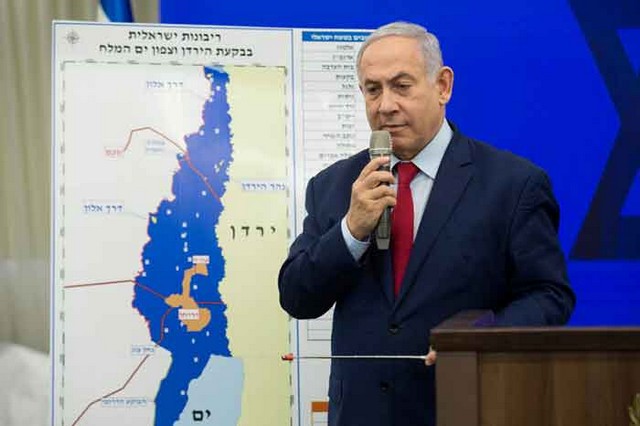
The crisis within the Palestinian leadership is met with utter clarity on the part of Israel. The new Israeli coalition government, consisting of previous rivals Israeli Prime Minister, Benjamin Netanyahu and Benny Gantz, have tentatively agreed that annexing large parts of the West Bank and the Jordan Valley is just a matter of time. They are merely waiting for the American nod.

They are unlikely to wait for long, as Secretary of State, Mike Pompeo, said on April 22 that annexing Palestinian territories is “an Israeli decision.”

Frankly, it matters little. The 21st century Balfour Declaration has already been made; it is only a matter of making it the new uncontested reality.

Perhaps, it is time for the Palestinian leadership to understand that groveling at the feet of those who have inherited the San Remo Resolution, constructing and sustaining colonial Israel, is never and has never been the answer.

Perhaps, it is time for some serious rethink.

Ramzy Baroud is a journalist and the Editor of The Palestine Chronicle.

6 May 2020

Source: countercurrents.org
The deeper roots of Chinese demonization

By Pepe Escobar

Fasten your seat belts: the US hybrid war against China is bound to go on frenetic overdrive, as economic reports are already identifying Covid-19 as the tipping point when the Asian – actually Eurasian – century truly began.

The US strategy remains, essentially, full spectrum dominance, with the National Security Strategy obsessed by the three top “threats” of China, Russia and Iran. China, in contrast, proposes a “community of shared destiny” for mankind, mostly addressing the Global South.

The predominant US narrative in the ongoing information war is now set in stone: Covid-19 was the result of a leak from a Chinese biowarfare lab. China is responsible. China lied. And China has to pay.

The new normal tactic of non-stop China demonization is deployed not only by crude functionaries of the industrial-military-surveillance-media complex. We need to dig much deeper to discover how these attitudes are deeply embedded in Western thinking – and later migrated to the “end of history” United States. (Here are sections of an excellent study, Unfabling the East: The Enlightenment’s Encounter with Asia , by Jurgen Osterhammel).

Only Whites civilized

Way beyond the Renaissance, in the 17th and 18th centuries, whenever Europe referred to Asia it was essentially about religion conditioning trade. Christianity reigned supreme, so it was impossible to think by excluding God.

At the same time the doctors of the Church were deeply disturbed that in the Sinified world a very well organized society could function in the absence of a transcendent religion. That bothered them even more than those “savages” discovered in the Americas.

As it started to explore what was regarded as the “Far East,” Europe was mired in religious wars. But at the same time it was forced to confront another explanation of the world, and that fed some subversive anti-religious tendencies across the Enlightenment sphere.

It was at this stage that learned Europeans started questioning Chinese philosophy, which inevitably they had to degrade to the status of a mere worldly “wisdom” because it escaped the canons of Greek and Augustinian thought. This attitude, by the way, still reigns today.

So we had what in France was described as chinoiseries — a sort of ambiguous admiration, in which China was regarded as the supreme example of a pagan society.

But then the Church started to lose patience with the Jesuits’ fascination with China. The Sorbonne was punished. A papal bull, in 1725, outlawed Christians who were practicing Chinese rites. It’s quite interesting to note that Sinophile philosophers and Jesuits condemned by the Pope insisted that the “real faith” (Christianity) was “prefigured” in ancient Chinese, specifically Confucianist, texts.

The European vision of Asia and the “Far East” was mostly conceptualized by a mighty German triad: Kant, Herder and Schlegel. Kant, incidentally, was also a geographer, and Herder a historian and geographer. We can say that the triad was the precursor of modern Western Orientalism. It’s easy to imagine a Borges short story featuring these three.

As much as they may have been aware of China, India and Japan, for Kant and Herder God was above all. He had planned the development of the world in all its details. And that brings us to the tricky issue of race.

Breaking away from the monopoly of religion, references to race represented a real epistemological turnaround in relation to previous thinkers. Leibniz and Voltaire, for instance, were Sinophiles. Montesquieu and Diderot were Sinophobes. None explained cultural differences by race. Montesquieu developed a theory based on climate. But that did not have a racial connotation – it was more like an ethnic approach.

The big break came via French philosopher and traveler Francois Bernier (1620-1688), who spent 13 years traveling in Asia and in 1671 published a book called La Description des Etats du Grand Mogol, de l”Indoustan, du Royaume de Cachemire, etc. Voltaire, hilariously, called him Bernier-Mogol — as he became a star telling his tales to the royal court. In a subsequent book, Nouvelle Division de la Terre par les Differentes Especes ou Races d’Homme qui l’Habitent, published in 1684, the “Mogol” distinguished up to five human races.

This was all based on the color of the skin, not on families or the climate. The Europeans were mechanically placed on top, while other races were considered “ugly.” Afterward, the division of humanity in up to five races was picked up by David Hume — always based on the color of the skin. Hume proclaimed to the Anglo-Saxon world that only whites were civilized; others were inferiors. This attitude is still pervasive. See, for instance, this pathetic diatribe recently published in Britain.

Two Asias

The first thinker to actually come up with a theory of the yellow race was Kant, in his writings between 1775 and 1785, David Mungello argues in The Great Encounter of China and the West, 1500-1800.

Kant rates the “white race” as “superior,” the “black race” as “inferior” (by the way, Kant did not condemn slavery), the “copper race” as “feeble” and the “yellow race” as intermediary. The differences between them are due to a historical process that started with the “white race,” considered the most pure and original, the others being nothing but bastards.

Kant subdivided Asia by countries. For him, East Asia meant Tibet, China and Japan. He considered China in relatively positive terms, as a mix of white and yellow races.

Herder was definitely mellower. For him, Mesopotamia was the cradle of Western civilization, and the Garden of Eden was in Kashmir, “the world’s paradise.” His theory of historical evolution became a smash hit in the West: the East was a baby, Egypt was an infant, Greece was youth. Herder’s East Asia consisted of Tibet, China, Cochinchina, Tonkin, Laos, Korea, Eastern Tartary and Japan — countries and regions touched by Chinese civilization.

Schlegel was like the precursor of a Californian 60s hippie. He was a Sanskrit enthusiast and a serious student of Eastern cultures. He said that “in the East we should seek the most elevated romanticism.” India was the source of everything, “the whole history of the human spirit.” No wonder this insight became the mantra for a whole generation of Orientalists. That was also the start of a dualist vision of Asia across the West that’s still predominant today.

So by the 18th century we had fully established a vision of Asia as a land of servitude and cradle of despotism and paternalism in sharp contrast with a vision of Asia as a cradle of civilizations. Ambiguity became the new normal. Asia was respected as mother of civilizations — value systems included — and even mother of the West. In parallel, Asia was demeaned, despised or ignored because it had never reached the high level of the West, despite its head start.

Those Oriental despots

And that brings us to The Big Guy: Hegel. Hyper well informed – he read reports by ex-Jesuits sent from Beijing — Hegel does not write about the “Far East” but only the East, which includes East Asia, essentially the Chinese world. Hegel does not care much about religion as his predecessors did. He talks about the East from the point of view of the state and politics. In contrast to the myth-friendly Schlegel, Hegel sees the East as a state of nature in the process of reaching toward a beginning of history – unlike black Africa, which he saw wallowing in the mire of a bestial state.

To explain the historical bifurcation between a stagnant world and another one in motion, leading to the Western ideal, Hegel divided Asia in two.

One part was composed by China and Mongolia: a puerile world of patriarchal innocence, where contradictions do not develop, where the survival of great empires attests to that world’s “insubstantial,” immobile and ahistorical character.

The other part was Vorderasien (“Anterior Asia”), uniting the current Middle East and Central Asia, from Egypt to Persia. This is an already historical world.

These two huge regions are also subdivided. So in the end Hegel’s Asiatische Welt (Asian world) is divided into four: first, the plains of the Yellow and Blue rivers, the high plateaus, China and Mongolia; second, the valleys of the Ganges and the Indus; third, the plains of the Oxus (today the Amur-Darya) and the Jaxartes (today the Syr-Darya), the plateaus of Persia, the valleys of the Tigris and the Euphrates; and fourth, the Nile valley.

It’s fascinating to see how in the Philosophy of History (1822-1830) Hegel ends up separating India as a sort of intermediary in historical evolution. So we have in the end, as Jean-Marc Moura showed in L’Extreme Orient selon G. W. F. Hegel, Philosophie de l’Histoire et Imaginaire Exotique, a “fragmented East, of which India is the example, and an immobile East, blocked in chimera, of which the Far East is the illustration.”

To describe the relation between East and West, Hegel uses a couple of metaphors. One of them, quite famous, features the sun: “The history of the world voyages from east to west, Europe thus absolutely being the end of history, and Asia the beginning.” We all know where tawdry “end of history” spin-offs led us.

The other metaphor is Herder’s: the East is “history’s youth” — but with China taking a special place because of the importance of Confucianist principles systematically privileging the role of the family.

Nothing outlined above is of course neutral in terms of understanding Asia. The double metaphor — using the sun and maturity — could not but comfort the West in its narcissism, later inherited from Europe by the “exceptional” US. Implied in this vision is the inevitable superiority complex, in the case of the US even more acute because legitimized by the course of history.

Hegel thought that history must be evaluated under the framework of the development of freedom. Well, China and India being ahistorical, freedom does not exist, unless brought by an initiative coming from outside.

And that’s how the famous “Oriental despotism” evoked by Montesquieu and the possible, sometimes inevitable, and always valuable Western intervention are, in tandem, totally legitimized. We should not expect this Western frame of mind to change anytime soon, if ever. Especially as China is about to be back as Number One.

Asia Times Financial is now live. Linking accurate news, insightful analysis and local knowledge with the ATF China Bond 50 Index, the world’s first benchmark cross sector Chinese Bond Indices. Read ATF now.

2 May 2020

Source: asiatimes.com

Abdullah al-Hamid: Saudi human rights advocate and ‘national hero’

By Madawi al-Rasheed

The death of Arabic professor Abdullah al-Hamid on Friday after his health deteriorated in a Saudi prison is both shocking and revealing of the Saudi government’s brutality.

Born in Buraydah in the central Qasim province, Hamid was truly a unique activist whose political trajectory dates back to the early 1990s, when he emerged as a determined and stubborn human right defender and reformer seeking constitutional change.

Hamid graduated from the Arabic language department at Riyadh University in 1971. This was followed by a doctorate from Al-Azhar University in Egypt in the field of literary criticism. In addition to teaching Arabic literature, Hamid was a renowned poet.

In 1993, he was one of the six founding members of the Committee for the Defence of Legitimate Rights (CDLR), and was arrested on 15 June. He was subsequently released and arrested three times between 1993-1996.

Prison turned out to be his second home, as in the last 27 years Hamid continued to be arrested and released. The repression that Hamid was subjected to took place under three Saudi kings: Fahd, Abdullah and Salman.

In 2009 Hamid defied the ban on civil society, and together with other colleagues and activists announced the establishment of the Saudi Association for Civil and Political Rights, known in Arabic as HASM and English as ACPRA.

After several years spent defending his political project in Saudi courts, in 2013 Hamid was sentenced to 11 years in prison, alongside a further unserved six from a previous conviction, followed by a travel ban after his release.

He died before he was released.

Bridging traditions

Unlike other Saudi civil society groups, HASM was a genuine non-governmental organisation and unsurprisingly had no royal patron. Its mission statement was to defend human and political rights and call for political reform. Its activism focused on supporting prisoners of conscience, and exposing torture in Saudi prisons.

But Hamid’s most valued contribution to this political struggle was his articulation of the centrality of rights from within the Islamic tradition. He belongs to a long tradition of Islamic reformism that the Saudi government was determined to suppress, criminalise and target in the most brutal ways, lest their discourse appealed to others.

Unlike Salafi jihadis, Hamid and his comrades insisted on jihad silmi – peaceful struggle to protect society from the excesses of power – by deploying civil resistance, demonstrations, strikes and sit-ins.

Peaceful jihad rested on risky hard work. It must be performed for the collective interest of Muslims, and should be void of personal desires to seek wealth and privilege.

Hamid’s jihad was performed by the “word”, jihad al-kalima. In several pamphlets, he explained that military jihad may be necessary to defend the country from outside threats, but that internally only peaceful jihad by the word can lead to fortifying the internal structures of justice and respect for rights.

Hamid defended the right of Saudis to stage demonstrations and proved that the Islamic concept of rahat, the peaceful crowd which assembles in the public sphere demanding rights and exposing injustice, is a central right in Islam.

This of course angered the official Salafis of the establishment, who had always called upon people to “whisper in the ear of the sultan” should they want to voice their opinion. This whispering, otherwise known as secret advice, became a trademark of official Salafis.

But Hamid proved that demonstrations are legitimate actions from within Islam that allow people to engage in politics and correct injustices. He was consequently abhorred by official religious scholars, judges and above all the ruling establishment.

His Arabic writing skills and knowledge of the Islamic tradition, coupled with his longing for a just society, allowed him to reinterpret Islamic texts and combine them with global discourse on democracy, civil society and human rights. He was a veritable Islamic intellectual and advocate.

Enduring example

Hamid’s activism ended in March 2013 when he was arrested together with more than a dozen colleagues. HASM was officially dissolved by a court ruling, and its founders lingered in prison with no royal pardon on the horizon.

The Saudi charges against Hamid represented a mix of vague statements. They included: planting the seeds of discord and strife, questioning the independence of the Saudi judiciary and the Council of Higher Ulama, describing the Saudi regime as a police state, and inciting public opinion against the security and intelligence services, and, most importantly, against the legitimate Muslim ruler of Saudi Arabia.

As the frail Hamid stood in court during his trials and defended himself in eloquent and convincing prose, he emerged as an articulate advocate of human rights.

His own defence circulated on social media with supporters absorbing a new language of rights that had been suppressed under the auspices of the official religion of the state, namely the Wahhabi Salafi tradition, its judges and scholars.

Hamid’s project will remain alive even after his death.

The language of rights and entitlement will remain as a testimony of his nuanced articulations and fierce struggle to move Saudi Arabia from an absolute monarchy to a constitutional state in which citizens and their rights are guaranteed.

Hamid framed rights in a religious language rather than imported concepts. He fused tradition with new meanings that promised respect for human rights, property and the right to defend oneself against a brutal judiciary and monarchy.

While the Saudi government provided rehabilitation centres and re-educational forums for its violent militants who carried out serious and brutal attacks between 2003 and 2009, Hamid lingered in prison simply because he proved to be more dangerous than their outright violence.

His long prison sentence reflected the government’s fear of reformist Islam and the language of peaceful resistance. The five-star militant rehabilitation centres that the regime popularised as a flagship of its anti-terrorism efforts were propaganda opportunities, while peaceful reformers were incarcerated in the infamous al-Hayr prison.

Hamid tried to break the entrenched dividing lines between ideological groups that had in the past rejected each other – Islamists and liberals, for example. He also rejected the sectarian divide between Sunnis and Shia, and endeavoured to defend all prisoners of conscience, in addition to immigrants in Saudi Arabia.

He rejected the gender inequality and regarded women as equal citizens, long before the government officially endorsed women’s rights. He strongly believed in rights for all and was a true national hero.

The journey towards a just society, transparent government and political representation in Saudi Arabia will continue even after Hamid’s death. He will be remembered as a brave, determined and stubborn reformer.

While many of his colleagues are still in prison, including economist Mohammed al-Qahtani, lawyer Waleed Abu al-Khair, and many others, the harsh and cruel prison sentence and his eventual death are reminders of how far the Saudi government can go to silence peaceful reformers – especially those who follow Hamid’s arduous and dangerous path.

Madawi al-Rasheed is visiting professor at the Middle East Institute of the London School of Economics.

24 April 2020

Source: middleeasteye.net

From Emergency to Emergence

By David Korten

The COVID-19 emergency has exposed our societies’ failure to address the needs of billions of people. Simultaneously, we are witnessing a fundamental truth about human nature: There are those among us eager to exploit the suffering of others for personal gain. We can be reassured, however, by how few of them there are. Their actions contrast starkly with the far greater numbers at all levels of society demonstrating their willingness, even eagerness, to cooperate, share, and sacrifice for the well-being of all.

The pandemic has also exposed extreme vulnerabilities in the global market economy, including its long and highly specialized linear supply chains, corporate monopolies shielded from market forces, privatized technologies, and ruthless competition without regard for its impact on people and the Earth.

This is an unprecedented opportunity to rethink how our beliefs, values, and institutions shape our relationships. We can create a world that works for everyone or face a future that no longer works for anyone.

Discussions now underway in many community, national, and global forums suggest a significant widening of what is known as the Overton Window: the range of public policies that the mainstream population is prepared to consider at a given time.

While there is an almost universal desire to move rapidly beyond the COVID emergency, the spectrum of what we want post-pandemic is broadening. Many are articulating that they do not want to simply return to business as usual. In the United States, for example, we see the need for:

• A system of health care accessible to everyone regardless of income or documentation;

• Just compensation and job security for those who do our most essential but often least-rewarded work; and

• A guarantee that if your job evaporates, you won’t starve.

At a deeper level, this emergency is reminding us that we are living with another emergency—climate change. The combination of the two emergencies is helping us awaken to the profound implications of the simple truth that we are living beings born of and nurtured by a living Earth. Our well-being depends on Earth’s well-being. Life is the goal, community is essential, and money is only a tool.

To avoid a climate catastrophe, we must use this opportunity to join in creating an economy that:

• Meets our basic needs while simultaneously healing and securing the health of the human community and Earth’s living systems; and

• Prepares us to respond rapidly and appropriately to the array of significant future emergencies likely to arise with alarming frequency.

From these insights, many additional imperatives follow, including the need to:

• Shift power from profit-maximizing corporations to self-organizing, self-reliant, life-serving communities;

• Achieve an equitable distribution of power and resources among and within these communities; and

• Limit the human use of resources to those applications (such as recycling and regenerative agriculture) that increase the well-being of people and nature while eliminating those (such as war and financial speculation) that consume massive resources to no beneficial end.

The expanding Overton Window may allow us to consider vast new possibilities. Here are two:

1. We may see growing recognition of the distinctive social benefits of shopping in locally owned stores, operated by neighbors who pay local taxes and are in business to make a decent, but modest, living serving their neighbors. This contrasts starkly with the experience of impersonal corporate chains such as Amazon.com and Walmart that are in business solely to maximize the extraction of money from our local communities while leaving as little as possible behind.

2. For those of us able to work at home and meet remotely via the web, the many benefits of doing so may make this form of working and meeting the new norm. We reduce the time devoted to long commutes in heavy traffic or sitting in crowded airports and planes. This change in our behavior carries the potential for a dramatic reduction in the need for cars and airplanes and the pollution that their production and operation create, while increasing opportunities to get to know our family and our neighbors. Better for the health of people, family, community, and Earth.

But would such changes mean lost jobs? Actually, a vast amount of work must be done. Among the needs that will become more important in a post-COVID world are:

• Converting to wind and solar energy.

• Growing nutritious food locally in ways that restore the health of the soil.

• Eliminating waste by recycling everything.

• Assuring everyone access to affordable high-speed internet.

• Caring for and educating our children.

• Preparing for the inevitable emergencies ahead.

• Providing care and housing for the homeless while helping those who can transition back to community life.

• Providing health care for everyone.

The COVID-19 crisis has imposed immense hardship on billions of people. But that hardship is dwarfed by what lies ahead if we continue on our current path. Now we must step up to prevent the collapse of the regenerative systems by which Earth creates and maintains the conditions we need to exist.

This current emergency provides the possibility for a new emergence—the birthing of a truly civil civilization dedicated to the well-being of all people and the living Earth.

DAVID KORTEN is co-founder of YES! Media, president of the Living Economies Forum, a member of the Club of Rome, and the author of influential books, including “When Corporations Rule the World” and “Change the Story, Change the Future: A Living Economy for a Living Earth.” His work builds on lessons from the 21 years he and his wife, Fran, lived and worked in Africa, Asia, and Latin America on a quest to end global poverty.

24 April 2020

Source: countercurrents.org
Four Dead in Ohio- Feeding the Beast

By Philip A Farruggio

Singer/Songwriter Neil Young wrote the song ‘ Four Dead in Ohio’ for Crosby, Stills, Nash and Young:

Four Dead In Ohio Lyrics

Tin soldiers and Nixon’s comin’.
We’re finally on our own.
This summer I hear the drummin’.
Four dead in Ohio.

Gotta get down to it.
Soldiers are gunning us down.
Should have been done long ago.
What if you knew her and
Found her dead on the ground?
How can you run when you know?

Gotta get down to it.
Soldiers are cutting us down.
Should have been done long ago.
What if you knew her and
Found her dead on the ground?
How can you run when you know?

Tin soldiers and Nixon’s comin’.
We’re finally on our own.
This summer I hear the drummin’.
Four dead in Ohio.
Four dead in Ohio.
Four dead in Ohio.
Four dead in Ohio.

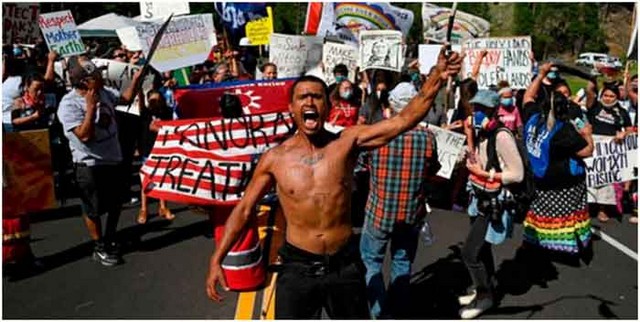
It was a beautiful Spring day in May of 1970 when four Kent State University students, protesting the illegal bombing of Cambodia and the entire Vietnam ( so called ) War, were gunned down by Ohio National Guard troops, many the same age as them. The event made national headlines and ignited a mass of students from literally hundreds of universities to go on strike. This writer was in my third or fourth year at Brooklyn College, who remembers, and I finally became outraged. Up until then, at my own admission, I only cared about playing on our soon to be first year football team, and of course, chasing woman. Oh yeah, and enjoying the pot that my friends and I smoked each and every Friday and Saturday night. I was just 20 years of age and really ‘ feeling my oats’. Yet, when the news made the daily headlines about those four kids, well, just like ME, I swayed over to the campus looking for action. A large group of us literally chased the military recruiters from our campus. No violence. Those guys probably knew deep down that the shit was gonna eventually hit the fan over this ongoing Amerikan tragedy.

The stench from the dual killings of Martin Luther King Jr. and Bobby Kennedy still filled many of our young minds two years after the fact… Or should I say facts? Two well respected leaders gunned down and by now, 1970, the conspiracy theories were holding lots of water. I had already known about The Beast, ever since, believe it or not, I read the 1967 Playboy magazine interview with New Orleans district attorney Jim Garrison about the JFK assassination. It opened my eyes to what probably happened, as compared to what my government was telling us. The more I read of that fateful day in November of ’63 the more I knew, intuitively, that The Beast was real. So, we closed down the campus, took over the school president’s office, and waited for the cops to come. That event never occurred ( to my satisfaction) and we ended the strike after a few days. There were some concessions made, nothing of major importance, but enough to make us say that ‘ We Won!’. Those four kids at Kent State didn’t bask in our glory, did they? They say, from historians looking back , that President Nixon was affected enough to start realizing that he had to get out of this mess called Vietnam. Of course, when it comes to The Beast and how it operates, it only reacts when it already has the table turned. So, Nixon waited it out until he won re-election 30 months later to then slowly use the ‘ Get out of jail free ‘ card beginning the process… of course his impeachment/resignation left it to another. Point is, the Kent State killings, coupled with the illegal bombing of another sovereign nation, slowly woke up our Moms and Dads to the truth of it all: This ( so called ) war was not worth it! I can recall, at an Easter dinner a few weeks earlier, with all my aunts and uncles present, the famous words of my father, who voted for Nixon in 1960, Goldwater in ‘ 64 and Nixon again in ’68: ” Let me make this clear. Before I see either of my two sons being sent to Vietnam, I ‘m gonna personally drive them to Canada!! And that’s that!”

Perhaps it was when a guy a few blocks away from me, Tommy L., joined the Marines and came home in a box. I didn’t know him well at all, but I knew his mom. She was our crossing guard on Ocean Ave, which was right by our church, St. Edmunds. Each Sunday after Mass we would see Mrs. L. as we crossed Ocean Ave. She always had this beautiful smile and greeted everyone with it. After her son died in the Nam, you could see how she now had what I always called ‘ The Mona Lisa smile’ from that famous DaVinci portrait. It had that look, to me, of someone who was saying ‘ If you only know what I am going through’. Then, a year later, another guy from our neighborhood, a Polish born son of my friend’s building superintendent, Vito P., was killed on some famous ( for whom?) hill in Vietnam. The last time I saw Vito was , coincidentally,at Mass in St. Edmunds. He was home on leave from the Army, standing there in his Ranger uniform, replete with beret tucked onto his shoulder. Months later we got the word. I used to see his kid brother, who I knew adored Vito, at the school yard where we played softball. He would be hanging out with characters that I would always warn him against. He ignored me, and got into glue sniffing, Quaaludes and finally horse ( heroin). Sometime later, maybe a few years after Vito’s death, his brother OD’d and died. What is it they say ‘ When the war comes home’? Well in May of 1970 it had… and transformed me into the activist anti empire and anti war writer and street corner protestor I have been since then.

And what about ‘ Feeding the beast’? Well:

1933 Germany: Reichstag fire and Enabling Laws to snuff out political parties and dissent

1964 Amerika: Gulf of Tonkin resolution based upon imaginary attack by North Vietnam on our ship

1991: Saddam Hussein encouraged by US non commitment to Kuwait to invade Kuwait over oil drilling dispute. War on Iraq followed

2001, September 11th- Twin Towers and Pentagon attacked in highly suspicious manner, leading to the Patriot Act, increased military spending and 2nd war on Iraq to follow

March 19th , 2003 – Illegal and immoral war on Iraq over WMDs to this day never found. More increases in military spending along with occupations of Iraq & Afghanistan. Hundreds of thousands of innocent civilians and NATO servicemen dead or damaged for life.

2008-09 – Subprime scam costs taxpayers trillions of dollars to bail out failed Wall Street companies.

Meanwhile, health care system is still a joke as is the needs of infrastructure throughout Amerika.

2011 Libya- USA led NATO carpet bombing of Libya, causing death , destruction and refugee crisis that has still caused havoc throughout the region and Europe.

2020 Pandemic- Trump crew ignored the crisis for almost 2 months, even denying it as a HOAX. Our economy is teetering on default as the super rich get most of the bailout. Oh, but the increased military spending survives, eating up around HALF of our federal tax revenues.

Philip A Farruggio is a contributing editor for The Greanville Post. He is also frequently posted on Global Research, Nation of Change, Cross Currents and Off Guardian sites.

23 April 2020

Source: countercurrents.org
Shoot down and destroy all Iranian gunboats that “harass our ships at sea”, Trump instructs US Navy

By Countercurrents Collective

U.S. President Donald Trump has ordered the U.S. Navy to “shoot down and destroy” Iranian gunboats, should they harass American vessels at sea. His declaration comes after a confrontation in the Persian Gulf.

“I have instructed the United States Navy to shoot down and destroy any and all Iranian gunboats if they harass our ships at sea,” the U.S. president tweeted on Wednesday morning.

A week earlier, the U.S. Navy accused the Iranian Revolutionary Guards Corps (IRGC) of “dangerous and provocative” actions, claiming that nearly a dozen Iranian vessels buzzed a group of U.S. ships in the Persian Gulf.

The U.S. Fifth Fleet later published video footage of the encounter, which showed the gunboats circling a larger U.S. ship.

Tehran brushed off the accusations, disputing the “Hollywood” scenario portrayed by the U.S.

The Iranian government considers U.S. naval activity in the gulf highly provocative. The Iranian Navy condemned the patrol as “adventurism.”

The U.S. and Iran almost came to war at the beginning of the year, when the U.S. assassinated Iranian General Qassem Soleimani with a drone strike at an airport in Baghdad, apparently in retribution for a series of Iranian-sponsored attacks on U.S. bases in Iraq.

However, tension in the Persian Gulf has been high since last summer, when the U.S. and its Western allies blamed Iran for a series of sabotage attacks on oil infrastructure in the region. U.S.-led naval patrols were stepped up, and American troops and air defense systems were sent to Saudi Arabia and the UAE.

Based in nearby Bahrain, the U.S. Fifth Fleet has been active in the gulf both before and since the flare up last year. The U.S. insists patrols are essential to protect shipping routes against Iran’s “malign behavior.”

Another media report said:

U.S. forces in the Persian Gulf have been authorized to open fire on Iranian ships if they ‘harass’ them at sea, President Donald Trump said, as tensions between Washington and Tehran escalated despite the Covid-19 pandemic.

“We’re not going to stand for it. if they do that, that’s putting our ships in danger and our great crews and sailors in danger – I’m not going to let that happen. And we will – they’ll shoot them out of the water,” Trump said on Wednesday during the daily White House press conference normally dedicated to the pandemic response.

He would not say if that meant a change to the rules of engagement (ROE) currently in effect.

Trump accused the Iranian Navy of once again harassing the U.S. naval forces currently deployed in the Persian Gulf, saying there had been an incident on Tuesday in addition to the Pentagon’s claims from last week.

That provided some context for his tweet earlier in the day, threatening to “shoot down and destroy” Iranian boats, but resulted in plenty of confusion about the rules under which U.S. warships would be allowed to open fire.

Last Wednesday, the Pentagon claimed that 11 boats of the Islamic Revolutionary Guard Corps Navy (IRGCN) “repeatedly conducted dangerous and harassing approaches” of six U.S. ships as they conducted drills with army attack helicopters “in the international waters of the North Arabian Gulf” (the U.S. name for that body of water).

The boats came within 50 yards of the expeditionary vessel USS ‘Lewis B. Puller,’ and within 10 yards of the Coast Guard cutter USCGC ‘Maui,’ the US Department of Defense said.

Tehran denounced the US claim as “false and fake stories” and released its own video of the incident, accusing the U.S. Navy of “adventurism” and failure to follow international law and maritime protocols regulating navigation in the Persian Gulf.

23 April 2020

Source: countercurrents.org

Video: COVID-19: Closing Down the Economy Is Not the Solution

By Prof Michel Chossudovsky

Millions of people have lost their jobs, and their lifelong savings. In developing countries, poverty and despair prevail.

While the lockdown is presented to public opinion as the sole means to resolving a global public health crisis, its devastating economic and social impacts are casually ignored.

The unspoken truth is that the novel coronavirus provides a pretext to powerful financial interests and corrupt politicians to precipitate the entire World into a spiral of mass unemployment, bankruptcy and extreme poverty.

This is the true picture of what is happening.

How is it implemented? The fear campaign plays a key role. The lockdown is presented to national governments as the sole solution.

The economy is the basis for the reproduction of real life.

It is also the basis for upholding public health endeavors.

This closing down operation affects production and supply lines of goods and services, investment activities, exports and imports, wholesale and retail trade, consumer spending, the closing down of schools, colleges and universities, research institutions, etc.

In turn it leads almost immediately to mass unemployment, bankruptcies of small and medium sized enterprises, a collapse in purchasing power, widespread poverty and famine.

VIDEO: COVID: Closing Down the Economy is not the Solution – Prof. Michel Chossudovsky

Michel Chossudovsky is an award-winning author, Professor of Economics (emeritus) at the University of Ottawa, Founder and Director of the Centre for Research on Globalization (CRG), Montreal, Editor of Global Research.

21 April 2020

Source: www.globalresearch.ca

U.S. oil market crashes, hundreds of U.S. oil companies could go bankrupt

By Countercurrents Collective

U.S. oil market has crashed. The price of U.S. oil turned negative for the first time in history. The U.S. oil industry is facing a doomsday scenario. Hundreds of U.S. oil companies could go bankrupt. Many U.S. oil companies took on too much debt during the good times. Some of them will not be able to survive this historic downturn.

West Texas Intermediate oil prices have gone negative in a record low for the U.S. benchmark, as the market continues to crater amid the general economic collapse.

The price of U.S. oil turned negative means oil producers are paying buyers to take the commodity off their hands over fears that storage capacity could run out in May.

Vanishing demand and a glut of supply have combined to heavily impact the U.S. benchmark fuel, with oil prices dropping from $18.27 to close at -$37.63 a barrel on Monday – down over 300 percent from the previous day’s close. It is the first time the crude oil futures contract has ever traded in the negative since the New York Mercantile Exchange started trading it in 1983.

The collapse in oil markets comes amid a generalized economic downturn, with the coronavirus pandemic plunging most of the world’s economies into a downward spiral many believe will be the deepest since the Great Depression of the 1930s.

The U.S. Department of Energy is nevertheless weighing the idea of paying domestic producers to simply leave the oil in the ground so as not to further depress prices.

With May’s futures contracts set to expire on Tuesday, investors are scrambling to unload their positions, eyeing the already-glutted market and concerned about being left with a valueless commodity.

As the futures contracts hovered at record lows, oil tankers are reportedly languishing at sea, unable to find places to store their bounty onshore. Demand for the commodity has dropped an estimated 30 percent worldwide amid the coronavirus crisis.

The coronavirus pandemic has caused oil demand to drop so rapidly that the world is running out of room to store barrels. At the same time, Russia and Saudi Arabia flooded the world with excess supply.

That double black swan has caused oil prices to collapse to levels that make it impossible for U.S. shale oil companies to make money.

U.S. crude for May delivery turned negative on Monday – something that has never happened since NYMEX oil futures began trading in 1983. It was easily the oil market’s worst day on record.

US crude for June delivery is still trading above $20 a barrel — but even that is disastrous.

“$30 is already quite bad, but once you get to $20 or even $10, it’s a complete nightmare,” said Artem Abramov, head of shale research at Rystad Energy.

Bankruptcy

In a $20 oil environment, 533 US oil exploration and production companies will file for bankruptcy by the end of 2021, according to Rystad Energy. At $10, there would be more than 1,100 bankruptcies, Rystad estimates.

Noble Energy, Halliburton, Marathon Oil and Occidental have all lost more than two-thirds of their value. Even Dow member ExxonMobil is down 38%.

Whiting Petroleum became the first domino to fall when the former shale star filed for Chapter 11 protection on April 2. But it certainly will not be the last.

“At $10, almost every US E&P company that has debt will have to file Chapter 11 or consider strategic opportunities,” Abramov said.

The most stunning part of the record low in oil prices is that it comes after Russia and Saudi Arabia agreed to end their epic price war after U.S. President Donald Trump intervened. OPEC+ agreed to cut oil production by a record amount.

Trump said the OPEC+ agreement would save countless jobs and much-needed stability to the oil patch.

“This will save hundreds of thousands of energy jobs in the United States,” Trump tweeted on April 12. “I would like to thank and congratulate President Putin of Russia and King Salman of Saudi Arabia.”

Yet crude has kept crashing, in part because those production cuts do not kick in until May. Demand continues to vanish because jets, cars and factories are sidelined by the coronavirus pandemic.

The hope in the oil industry is that Monday’s negative prices are somewhat of a fluke caused by the rolling over futures contracts.

The key will be how long oil prices stay dirt cheap. A rapid rebound in prices could allow many oil companies to avoid bankruptcy.

Buddy Clark, co-chair of the energy practice at Houston law firm Haynes and Boone, said his firm is “extremely busy” working on potential oil bankruptcies. Haynes and Boone has been forced to pull lawyers from other areas of the firm to work on the oil problem.

“I don’t think I’ve seen anything like it in my lifetime. It’s unprecedented,” said Clark, who started working in the industry in 1982.

Clark thinks that despite the further collapse in prices, there will still be only — “only” — 100 oil bankruptcies in 2020.

“It’s hard to believe that 100 bankruptcies is the optimistic view. That just shows you where we are,” Clark said.

There would probably be more bankruptcies already if it were not for the extreme volatility in oil prices. Clark said companies are having trouble drawing up restructuring plans because they do not know what the price of the commodity will be.

“Ironically, the lower price has slowed down the process,” Clark said. “A number of companies may have teed up filings but they need to go back to the drawing board.”

The dire outlook in the oil industry will make it very difficult for companies attempting to reorganize in Chapter 11 proceedings to get the required financing and support. Debtholders who would normally swap their debt for equity may not want that equity.

That means, unlike the 2014-2016 crash, some oil companies may not survive altogether.

“Chapter 11 requires financial sponsors to back you. You may see more Chapter 7 liquidations,” said Reid Morrison, US energy leader at PwC.

The nightmare scenario could present lucrative buying opportunities for the industry’s biggest players. That is because struggling oil companies, either in bankruptcy or before it, will be forced to sell off prime acreage — at fire sale prices. Exxon and Chevron, the industry’s supermajors, could be tempted to make acquisitions.

“Those with strong balance sheets will be able to take advantage of the situation,” said Morrison.

However, he noted the supermajors will be “cautious about pulling the trigger” in the next six months because they must defend their coveted dividends first.

Negative territory

Demand for oil has all but dried up as lockdowns across the world have kept people inside. As a result, oil firms have resorted to renting tankers to store the surplus supply and that has forced the price of U.S. oil into negative territory.

The severe drop on Monday was driven in part by a technicality of the global oil market. Oil is traded on its future price and May futures contracts are due to expire on Tuesday. Traders were keen to offload those holdings to avoid having to take delivery of the oil and incur storage costs.

June prices for WTI were also down, but trading at above $20 per barrel. Meanwhile, Brent Crude, the benchmark used by Europe and the rest of the world, which is already trading based on June contracts – was also weaker, down 8.9% at less than $26 a barrel.

OGUK, the business lobby for the UK’s offshore oil and gas sector, said the negative price of U.S. oil would affect firms operating in the North Sea.

The oil industry has been struggling with both tumbling demand and in-fighting among producers about reducing output.

Trump has said the government will buy oil for the country’s national reserve.

Oil rebounds in Asian trading

A Bloomberg report said:

Oil rebounded in Asian trading.

Futures in New York traded at around $1 a barrel after sinking to as low as minus $40.32 during Monday’s jaw-dropping collapse. The June contract, however, which had trading volumes more than 60 times higher, rose above $21. The spread between the two reflects the growing fear that those who take physical delivery of crude in the near future may not find any outlet or storage for those barrels as refineries curb operations.

Crude explorers shut down 13% of the American drilling fleet last week. While production cuts in the country are gaining pace, it is not happening quickly enough to avoid storage filling to maximum levels, said Paul Horsnell, head of commodities at Standard Chartered Plc.

In Asia, bankers are increasingly reluctant to give commodity traders the credit to survive as lenders grow ever more fearful about the risk of a catastrophic default.

Fund Inflow

Despite the weakness in headline prices, retail investors are continuing to plow money back into oil futures. The U.S. Oil Fund ETF saw a record $552 million come in on Friday, taking total inflows last week to $1.6 billion.

The price collapse is reverberating across the oil industry. Crude explorers shut down 13% of the American drilling fleet last week.

Goldman sees oil volatility before ‘violent rebalancing’

The oil market is set to be forced into a “violent rebalancing” over the coming weeks, according to Goldman Sachs Group Inc.

Price volatility will remain exceptionally high in the coming weeks, Goldman said in a note.

“With ultimately a finite amount of storage left to fill, production will soon need to fall sizeably to bring the market into balance, finally setting the stage for higher prices” once demand recovers, analysts including Damien Courvalin wrote in the note date April 20. “This inflection will play out in a matter of weeks, not months, with the market likely forced to balance before June.”

India stocks fall with Asian markets as growth worries intensify

A Bloomberg report said:

India’s benchmark stock gauge fell, tracking peers in Asia, as a plunge in oil prices heightened investor concerns about domestic growth.

The S&P BSE Sensex Index fell 2.8% to 30,774.23 as of 9:59 a.m. in Mumbai, and the NSE Nifty 50 Index declined by 2.7%. Asia’s third-largest economy is near a standstill amid a prolonged lockdown to prevent the spread of the coronavirus.

While India is a net importer of crude, a collapse in oil futures on Monday amid stagnant global demand exacerbated economic growth fears.

All major equity markets in Asia declined Tuesday, with the regional MSCI Asia Pacific Index dropping 1.9%.

India’s government and central bank are trying to cushion the economic effect of virus-enforced closures with fiscal and monetary policy measures. Some makers of information-technology hardware in India, farmers and industries in rural areas resumed operations from Monday even as the lockdown was extended until May 3.

“Efforts to ramp up the economy once the lockdown has been lifted may take a toll as the lack of employees as well as demand may strike down hard on industrial activity,” analysts at Motilal Oswal Financial Services Ltd. wrote in a note to clients.

With the earnings season underway, Infosys Ltd. on Monday refrained from projecting full-year revenue for the first time in years, joining a growing list of businesses around the world struggling to assess the fallout of the COVID-19. So far, four Nifty 50 members have reported quarterly results.

A hunt for any storage space turns urgent as oil glut grows

A Reuters report said:

With oil depots that normally store crude oil onshore filling to the brim and supertankers mostly taken, energy companies are desperate for more space. The alternative is to pay buyers to take their U.S. crude after futures plummeted to a negative $37 a barrel on Monday.

A topsy-turvy market that has oil prices for October delivery at $31 a barrel has oil firms anxious to sock away millions of barrels now to sell at a profit later.

While the government estimated there is available space, traders said Monday’s market drop indicated any unfilled tanks are under lease, and not available to new renters.

“The industry is really scrambling to source viable storage options,” said Stuart Porter, a manager at Adler Tank Rentals in Texas, which has shale companies lining up to potentially lease dozens of its 500-barrel steel frac tanks. The tanks can be lined up like dominos and filled at the well site by producers without a home for their oil. Converge Midstream LLC with millions of barrels of storage available in underground salt caverns outside Houston has gone from few takers to requiring one- to two-year contracts.

“Quite honestly we were struggling for business. Now that the market has changed, everyone is our friend,” said Dana Grams, chief executive of Converge Midstream.

The hunt for storage points to the magnitude of the collapse in demand for U.S. shale and the huge volume of unsold oil to refiners who are cutting purchases.

In addition to the onshore glut, there are about 160 million barrels of oil sitting on tankers waiting for buyers. At least six crude tankers carrying 2 million barrels apiece are en route to the U.S. from Saudi Arabia, adding to the alarm at the U.S. Gulf Coast.

It is not just crude looking for a place to go. State lockdowns have decimated demand for motor fuel. U.S. gasoline demand fell 32% earlier this month compared with the same time a year ago, the EIA said.

That glut is creating opportunities for some.

At Caliche Development Partners, which stores natural gas liquids in underground caverns near Houston, CEO Dave Marchese may shift his plans and open a newly completed 3-million-barrel underground salt-cavern for crude oil or gasoline.

“Gasoline has a pretty large contango right now,” he said, referring to prices five or more months ahead that are higher than current levels. But both fuels would require new pumps in its salt cavern, Marchese said, and he wants buyers to pay up for any upgrades.

Shale producer Teal Natural Resources had one of its three crude buyers cancel a purchase agreement last month, sending it shopping for frac tanks. They are not cheap, Teal CEO John Roby learned after scouring the market.

Storing a month’s worth of output would cost Teal about $20 a day per tank, or about $300,000 a month. At those rates, Teal would rather shut in wells, he said.

Shutting off wells is not for everyone, though, because it can reduce future oil recovery, and may put a producer in breach of their lease contracts.

Rentals for frac tanks have jumped from about $15 a day previously, a Texas oil marketer said.

Another oil producer, Texland Petroleum aims to sell immediately whatever crude it can this month, said its President Jim Wilkes. He is considering adding frac tanks to avoid having to pay to have his oil carried away in May.

Joshua Wade, an oil marketer in Oklahoma, is in talks to reserve about 100,000 barrels of storage for May using a combination of frac tanks, on-system pipeline storage and smaller tanks that have been dormant on pipelines.

But time is running out and costs are rising quickly.

“A lot of people have been calling me now and saying ‘I wanna go out and buy 100,000 barrels in May and put them in a frac tank,’” said Wade. “I tell them the party started about a month ago and it’s now almost over.”

21 April 2020

Source: countercurrents.org
Arab Parliaments Call for Immediate Release of Palestinian Prisoners

By IMEMC

On the eve of Palestinian Prisoners Day, the Cairo-based Arab States’ Parliaments Forum, on Thursday, called for the immediate release of all Palestinian prisoners from various Israeli prisons and detention centers, as well as halt of all Israeli violations against the Palestinian people.

In a statement, issued by the forum on the eve of Palestinian Prisoners Day, head of the forum, Mr. Mash’al Alselmy, demanded all relevant international bodies, including the United Nations, right groups and the International Committee of the Red Cross, to take the lead by ensuring full protection for Palestinian prisoners, under the spread of Coronavirus pandemic, worldwide, Israel and in the occupied Palestinian territories.

He asserted that the suffering of Palestinian people, especially those women, children, patients and elderly, inside Israeli prisons, should dictate all concerned bodies to pressure Israeli government to respect the international law, especially the Fourth Geneva Convention for the Protection of Civilian Persons, in Time of War, which he believes could be applied on current times, as Coronavirus is reported to have spread widely including Palestinian prisoners themselves.

He asserted that the suffering of Palestinian people, especially those women, children, patients and elderly, inside Israeli prisons, should dictate all concerned bodies to pressure Israeli government to respect the international law, especially the Fourth Geneva Convention for the Protection of Civilian Persons, in Time of War, which he believes could be applied on current times, as Coronavirus is reported to have spread widely including Palestinian prisoners themselves.

Alselmy held the Israeli occupation fully responsible for the lives of Palestinian prisoners, after some of them have tested positive for the Coronavirus. He believed that Israeli authorities have intentionally ignored the fact of such an infection.

Currently, there are about 5,000 Palestinian prisoners, inside Israeli more than 20 Israeli detention facilities and prisons, across the occupied West Bank and Israel. Recently, some media reports have suggested that few of those prisoners have tested positive for the deadly Coronavirus.

Noteworthy, several hundreds of those prisoners are patients with chronic diseases, while hundreds others are women and children, under the age of 18.

17 April 2020

Source: imemc.org