Just International

A Morning in Afghanistan

By Kathy Kelly

Amidst political posturing, aerial terrorism and street bombings, Afghan citizens pursue their daily work toward peace.

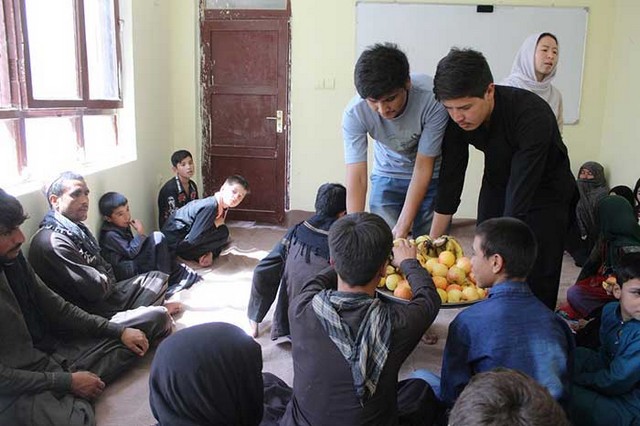
On a very warm September morning in Kabul, several dozen men, women, and children sit on the carpeted floor of a room at the Afghan Peace Volunteers’ Borderfree Center. The women cluster together. All wear burqas, but because of the heat they push the steel blue veils back, revealing their faces. Most of the men wear traditional tunics and pakol hats.

Parents and children alike listen intently to Masoma, a young Afghan woman who coordinates the Center’s “Street Kids School.” She explains the importance of steady attendance, and parents nod in agreement. Most of the 100 students come on time for their Friday classes, but a handful had recently skipped, showing up only on the day when the center distributes monthly food rations for the Street Kids families.

The previous Friday, those who had missed more than two classes prior to the food distribution day walked away empty-handed—a hard lesson, but the volunteer teachers felt they must abide by the short list of rules governing the center. Anyone who misses classes two or more times in a month won’t receive the ration.

Then Masoma’s colleague, Dr. Hakim, stands and poses two blunt requests. “Please raise your hand,” he says, “if you and your family have at least enough resources to meet your basic needs.”

About six hands are raised. Next he asks people to raise a hand if they couldn’t make ends meet. Seven hands go up. Hakim says his organization wants to help families become self-reliant so that after their children leave the Street Kids School, they will have another way to acquire essentials like beans, rice, and cooking oil.

Hakim now asks people to raise their hands if they could send one family member, like an older brother, to a three-month course on how to repair mobile phones. The idea is well-received. Notebook papers are circulated to gather parents’ names, and, if possible, mobile phone numbers. Several women seek Masoma’s help to write their names. She assures them she will stay in touch.

A tall young man, Habib, carrying a large tray of bananas and apples, politely offers fruit to each guest. Six years ago, Afghan Peace Volunteers members had befriended Habib when they met him in a busy market-place. His father had been killed when a bomb exploded in Kabul. I remember watching him work on a dusty, crowded street during a chilly afternoon shortly after he and his family had taken up residence in a miserable shack in Kabul. His little brother walked alongside him, holding his hand, while Habib carried a scale and asked people to weigh themselves on it. Habib looked forlorn and worried. The shy, anxious youngster had been regularly beaten by an uncle who tried to force him to join a militia; he now recognizes that Habib was wise to run away from the militia.

Today, Habib towers over me. Yesterday, he spoke eagerly at a small group meeting he had helped plan about ways to build caring relationships. Over the past three years, he has learned to read and write and has been at the top of his classes at a government school. He has also developed some construction skills. When I remark that several walls at the center were repaired and newly painted, Masoma smiled happily. “Habib!” she says. “He was a big help.”

A few adults linger alongside the center’s shady garden, filled with fruit trees, grapevines, herbs, and flowers. Some of the Afghan Peace Volunteers used permaculture methods to design and cultivate the space. Others recently dedicated themselves to a “renewable energy team.” Last year, the team helped forty-four families acquire solar energy. This year they hope to expand the effort.

Over the past week, young volunteers have gathered to plan for an upcoming “On the Road to Peace” conference. This will be the Afghan Peace Volunteers’ third annual gathering of participants from each of Afghanistan’s thirty-four provinces. The conference offers four days of intensive learning and discovery about cross-cultural understanding, nonviolence, and ways to abolish war.

Yesterday, Dr. Hakim and I asked for complete quiet inside the center’s “office”—a large room lined with bookcases, file cabinets, mats, and sturdy pillows. In the center of the room, a jumble of cords and power strips are connected to a solar power battery, a fan, a router, and a collection of cell phones and laptops.

Earlier, Amy Goodman of Democracy Now! had invited Dr. Hakim and me to participate in interviews regarding President Trump’s sudden decision to call off a secret meeting he claimed to have arranged between himself, Afghanistan’s President Ashraf Ghani, and representatives of the Taliban who have been meeting with United States envoy Zalmay Khalilzad. Sitting on the floor, we huddled over Dr. Hakim’s well-worn laptop waiting for Democracy Now! engineers to contact us by Skype.

Hakim and I suggested that neither Trump nor any of the negotiators in Doha were participating in a genuine peace process. Rather, it was a cruel charade, with each side seeking greater leverage by demonstrating their willingness to kill innocent people.

Many people living in Afghanistan greatly fear increased Taliban power over their cities, villages, roadways, and crumbling infrastructure. Taliban war crimes are frequently covered in global media. Less obvious to people in the U.S., but horribly real for people in Afghanistan, are acts of aerial terrorism regularly waged by the United States military.

Writing for The Daily Beast earlier this year, Andrew Quilty described how one Afghan family in the Helmand province suffered a vicious attack on their home last November. Two Taliban fighters had come to their home, insisting that Obaidullah, the householder, let them in. He pleaded with them to leave, but instead the Taliban fighters fired on a joint United States and Afghan military convoy. Shortly thereafter, a United States A-10 Warthog plane strafed Obaidullah’s home.

“Hundreds of rounds of ammunition—bullets the size of large carrots—fired by a weapon designed to disable armoured tanks, poured out of the plane’s Gatling gun,” Quilty wrote. “The two Taliban fighters had fled. Instead, Obaidullah and his fifteen-year-old son Esmatullah were killed; thirteen others suffered broken bones and shrapnel injuries from head to toe. One boy, fourteen-year-old Ehsanullah, lost both his eyes.”

In a report on civilian casualties, the United Nations Assistance Mission to Afghanistan attributed a rise in civilian deaths in 2019 to an escalation of the U.S. air war in the country. In addition, countless night raids carried out by joint U.S./Afghan forces have struck terror in families whose loved ones were killed in front of them. Ordinary Afghans whom I have met with in the past week are acutely aware of the night raids and link the gruesome pattern of killing civilians to United States trainers and the CIA.

Before Donald Trump pulled back U.S. participation, there had been nine rounds of talks, and the United States special envoy Zalmay Khalilzad was supposedly edging closer to a “peace” deal with the Taliban.

A genuine peace process would hold all warring parties accountable for crimes against humanity and would call for an immediate end to U.S. and NATO militarism in Afghanistan. It would urge the United States to humbly acknowledge the recklessness of its invasion and occupation. Reliable non-governmental parties would be asked to develop ways for Afghans to receive reparations from all countries who’ve participated in the past eighteen years of war. Those responsible for pursuing a genuine peace process would need mentors and advisors. I recommend the Afghan Peace Volunteers.

This article first appeared in The Progressive Magazine

Kathy Kelly (kathy@vcnv.org) co-coordinates Voices for Creative Nonviolence (www.vcnv.org)

Photo credit: Dr. Hakim

12 September 2019

Source: countercurrents.org

Exit John Bolton, But Will That Mean An End To His Failed Foreign Policy?

Co-Written by Kevin Zeese and Margaret Flowers

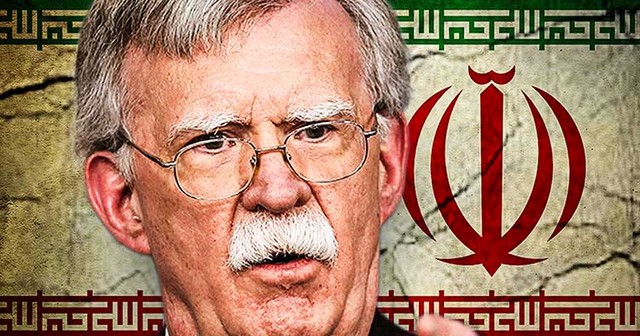
Many who oppose the aggressive foreign policy of the United States under President Donald Trump, which has resulted in record numbers of bombs dropped, regime change operations against Venezuela, Nicaragua, Iran and Hong Kong, the abusive use of unilateral coercive measures (sanctions) and record military budgets, cheered when uber-hawk, John Bolton was removed as the National Security Advisor.

Bolton undermined Trump numerous times such as when Trump wanted to get out of Syria and sought negotiations with North Korea and Iran. Bolton led Trump into regime-change operations in Nicaragua and Venezuela, both of which backfired.

The firing of Bolton is an opportunity for Trump to make a major course correction on foreign policy as the 2020 election heats up. The escalation of military aggression and regime-change actions that have occurred in the Trump era have been inconsistent with his previous campaign statements, which indicated he opposed never-ending wars, nation-building, and interventions abroad and wanted to focus on fixing problems at home in the United States.

Trump has long expressed skepticism about US foreign intervention in activities that he has labeled as “nation-building.” During the presidential election campaign, Trump criticized the war in Iraq, claiming he opposed George W. Bush’s Iraq War at the time and accused Bush of lying about the presence of weapons of mass destruction. In October 2015, he criticized US interventions saying, “We’re nation-building. We can’t do it. We have to build our own nation. We’re nation-building, trying to tell people who have [had] dictators or worse for centuries how to run their own countries.”

In December 2016, before his inauguration, Trump said that the policy of “intervention and chaos” must come to an end. He pledged to “build up our military not as an act of aggression, but as an act of prevention. In short, we seek peace through strength.”

Trump has opportunities to take another course, one that is more consistent with his rhetoric. Chairman Kim of North Korea said he was open to another meeting with President Trump on September 10, the next day, Bolton was fired. Shortly after the firing of Bolton, Secretary of State Pompeo gave the green light for Trump to meet with the President of Iran without preconditions at the United Nations General Assembly meeting in a few weeks. The firing of Bolton may not be enough, Iranian officials have refused any meeting until sanctions are lifted. After Bolton’s firing, President Hassan Rouhani said Trump “should distance itself from ‘warmongers’” after the dismissal of Bolton.

When it comes to Latin America, Trump has been silent, especially about his failed coup in Venezuela. Trump’s previous National Security Advisor, H. R. McMaster, strongly recommended to President Trump not to pursue a military option in Venezuela when Trump suggested it in 2017. He explained that Latin American governments were against foreign intervention in the region. John Bolton gave contrary advice when he dubbed Venezuela, Nicaragua, and Cuba the “Troika of Tyranny” and gave Trump bad advice by urging a strategy of escalating intervention in Venezuela, recognition of a failed coup government and military threats.

When Bolton was fired, the New York Times reported: “Mr. Trump also grew disenchanted with Mr. Bolton over the failed effort to push out President Nicolás Maduro of Venezuela. Rather than the easy victory he was led to anticipate, the president has found himself bogged down in a conflict over which he has less influence than he had assumed. The political opposition backed by the White House could not turn Venezuela’s military against Mr. Maduro and has been stuck in a stalemate for months.”

President Maduro has consistently expressed his willingness to meet with President Trump, despite the brutal economic war, military threats and recognition of the fraudulent Juan Guaido. Trump knows that Maduro is solidly in place as the president of Venezuela. US efforts to undermine his re-election in May of 2018 failed, the multiple coup efforts with Juan Guaido have failed, Venezuela exposed a series of terrorist plots the US was backing and there is little support for military intervention. In addition, because of Trump’s threats, Venezuela has strengthened its relationships with China and Russia, bringing them into Latin America in ways they have never happened before and squeezing out US interests.

John Bolton has put Trump in a trap in Venezuela. Trump has two choices: continued his failed strategy of regime change which has become a quagmire or stop interfering in the internal affairs of the sovereign nation of Venezuela. Once Trump recognizes that Venezuela is an independent nation he can have a diplomatic relationship with the country as exits between most nations. It is time to give up on the embarrassing failed Bolton strategy and pursue a new approach of non-interference and diplomacy.

For most of its history, the US and Venezuela have been allies. It has only been during the eras of Clinton through Obama and the Bolton-era during the Trump administration that the US has been in conflict with Venezuela. Trump can now reverse those mistaken policies and put the United States back on a constructive track.

Kevin Zeese and Margaret Flowers are directors of Popular Resistance

12 September 2019

Source: countercurrents.org

Thinking like Feminists: Nationalism in Contemporary Assam

Co-Written by Pooja Kalita and Prithiraj Borah

“As a woman, I have no country. As a woman, I want no country. As a woman, my country is the whole world.”

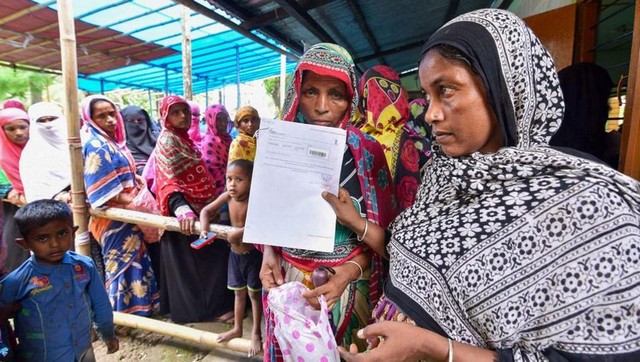
These famous words by Virginia Woolf perfectly fit the present political situation prevailing throughout the world. Assam too is no exception, as it seems to be perpetually engulfed in a discourse of creation and re-creation of the ‘other’ and the subsequent fear of the ‘other’. And most often than not, the women of these marginalised communities are at the receiving end of this dehumanizing discourse as that makes them bear the double burden of their gender as well as their belongingness to a vulnerable community. Their otherness is based on communal lines, language parameter and is class based. In recent times, the women of the ‘miyah’ and ‘adivasi’ communities are case in point. For instance, the ‘miyah’ women who are a source of cheap labour, nonetheless on the other hand, their language does not fit the ‘acceptable’ definition of Assameseness nor their attires and their religious affiliation is an issue that does not fail to evoke anxiety and threat. To think as feminist in present nationalist times is to locate this debate within the intersections of language, religion, class, caste and so on.

The imposition of homogeneity by a dominant group results in implicit and explicit violence on any form of identity. But before proceeding further, as a backdrop to this piece, we would like to cite an anecdote that occurred around two and a half years back. This was at a conference which was focusing on the ‘Northeast’ of India. In one of the presentation, an Assamese upper-caste female anthropologist dressed in a Mekhela-Chador went on to accuse the presenter of not being informed about the ‘real’ ‘Assamese’ woman. According to her, this ‘real’ ‘Assamese’ woman is defined by her ‘real’ dress and that it is the only way in which her womanhood can be defined. Of course nowhere in the presentation, it was propagated that women should give up on wearing any particular attire, including the Mekhela-Chador. But as most of us would agree, neither womanhood nor any other identity can be described in a unilateral homogenous manner. Questions of class, caste, religion, community, language, location are all intertwined to it. To one of us, her remarks seemed to be opinionated from an upper caste-class experience. Moreover, if one harps on such homogenous imagery of womanhood and a culture, it amounts to committing the same errors as the western white feminists, who regarded the ‘third’ world women as a homogenous group without taking into account any of the intersectionalties.

Such instances are not one time affairs but rather are an effect of an elitist, casteist and patriarchal dialogue on ‘real’, ‘authentic’, ‘Assameseness’ and ‘Assamese’ womanhood. The major problem of these notions is that Assameseness is understood as a given homogenous static entity. But attires, language, art, literature etc belonging to any identity are always in flux. However, the dominant cultural group most of the time disparages another culture on these notions, setting the oppressor-oppressed dialectics of othering a community into action. To this extent, the ‘other’ women, their attire, language and their lives are never considered within the mainstream Assamese imagination even though the under paid and cheap labour that they provide is indispensable to anyone who identifies themselves as part of the dominant Assamese population. On one hand, these ‘other’ women in recent times are struggling amidst their daily lives as poverty-stricken wives, mothers and manual labourers and on the other hand, the burden to prove their legitimate belongingness to Assam does not seem to end. Their sufferings borne out of the loss of life, livelihood and land seem to have no end.

But how does one define Assameseness? The idea of Assameseness is deeply rooted in the questions of the class and ethnicity and the moralising aspects of gender that are intertwined with these questions. From the colonial times there was state-sponsored consensus around the idea of homogenous identity based on ethnic lines. For instance, when the language movement had taken its grip in the tea gardens of Assam for the first time in the early 20th century, then popular newspapers like Sadiniya Axomiya and Tindiniya Axomiya had actively promoted the language debate. The language movement in the press was guided by Harendra Nath Sarma, then editor of Tinidiniya Axomiya. An article titled “Introduction of Assamese Language inside Tea Gradens” published in Tinidiniya Axomiya on 22nd February 1938.The article had put across that the labourers of Pabhoi Tea Estate in Darrang district were trying to learn ‘Assamese’ culture, rituals and language. That the migrated ‘coolies’ were trying their best to follow ‘Assamese’ culture like ‘Good Axomiya Hindus’ was considered by many as a good sign for the ‘Assamese’. It was thought that they were gradually realising how to live a ‘civilised’ life, to get up early, not to have pork and hariya (local alcohol), take bath every day and even keep their hairstyle like an ‘Assamese’ ‘Bhadra Lok’. As such, when the ‘Axomiya’ intellectuals criticise the historical cultural hegemony of Bengali ‘Bhadra Lok’, they must keep in mind the upper caste patriarchy prevalent among them too, similar in nature to their Bengali counterparts. They also reported that the ‘Assamese’ doctors, teachers and babus were trying to provide education in the ‘Assamese’ language. Thus, it is much clear that an attempt was made in the colonial times to transform the adivasi labourers to ‘Axomiya’ Hindus which was equally resisted by the educated adivasi student communities. In contemporary times too, the adivasi student unions, civil society and trade unions are countering this upper caste driven Assamese Hindu nationalism.

The ‘Axomiya’ press and media still function on the communal and patriarchal lines. The regressive media trial of Miyah poets is a recent example. Such trials that casually victimises a particular community, religion, class or gender are possible only because they operate on the basis of hard-core regionalism with a strong patriarchal undertones. It appears that this is becoming a part of the right wing masculine discourse that speaks about homogenous ‘Axom’, in the same fascist language of ‘Akhand Bharat’. Women have no place in such a discourse, except when they are needed as the sacrificial metaphors of womanhood for nation-building. The present politics of identity, belongingness and language is rendering women and mostly the women of the vulnerable communities almost indiscernible.The recent example attacking the Miyah poets in the name of ‘Assamese’ nationalism, also in 2007 the case of Laxmi Ornag who was stripped naked during broad daylight on the streets of Guwahati has become a distant memory for the Assamese consciousness.But it is not surprising as the subjective experiences of a community, class and gender are being pushed aside rendering their sufferings invisible. The ‘Axomiya’ identity gets manifested as an imperial construct, which is based on discrimination of caste, class, gender and religion. Assam is significantly composed of caste Hindus and the caste and gender insensitiveness only signifies the casteist masculine attitudes that are structurally propagated in everyday lives, but rarely acknowledged. Sadly, the Savarna homogenization logic of assimilation by and large is prevalent till date.

When there are such communities who are extremely vulnerable and exploited, we can very well imagine what happens to the women of these communities. In such a scenario, defining legitimate belongingness to a nation is an exercise of division and segregation based on gender, caste, religion and language. Nonetheless, the patriarchal construct of the idea of a nation is nothing new. The nation itself has survived while using women as its symbol. However, who pays the cost of these constructs and for whom, are questions that all of us need to ponder, especially in time when people who identify as ‘us’ are harping on a lopsided construct of the ‘authenticity’ of a community or a culture. Sadly and in the most tragic manner, the fear of the ‘other’ based on such constructs of ‘us’, ‘authenticity’, ‘tradition’ and ‘culture’ is driving the fate of Assam and its historically vulnerable communities. These renderings on ‘our women’ and ‘their women’ have survived through the patriarchal societal practices combined with state politics and parochial meaning-making of ‘culture’ and its manifestations. To reiterate, in this context, it is the women and most explicitly, the women of the historically exploited communities that suffer the most.

When the idea of what constitutes ‘Assamese’ identity is itself debated vehemently, the questions of what constitutes an ‘Assamese’ woman cannot be sidelined for the cost of making a homogenised masculine, upper-caste driven nationalist identity. Thus to think as feminists in present nationalist times is to locate this debate within the intersections of what renders legitimacy and equality to a community, culture, ethnicity and how womanhood is related to it. But, why should we think from a feminist stand at the first place? To answer this we would like to conclude with the words of feminist theorist and philosopher, Nancy Hartsock- “Feminism as a mode of analysis leads us to respect experiences and differences, to respect people enough to believe that they are in the best possible position to make their own revolution.”

Pooja Kalita is a PhD candidate with the Department of Sociology, South Asian University, New Delhi (India).

Prithiraj Borah is a PhD candidate with the Department of Humanities and Social Sciences, Indian Institute of Technology (IIT), Bombay.

10 September 2019

Source: countercurrents.org

Both Israel And Hezbollah Imagined A Horrid Black Hole And Stopped

By Andre Vltchek

There are rare moments in history, when even the most determined enemies can suddenly recognize the futility of battle. Sometimes, just for a moment or two. Sometimes, for longer. Such moments of sanity may save thousands, even millions human lives. And, such moments are not expressions of weakness or cowardice; on the contrary; they are embodiments of courage.

I want to believe that what happened at the Lebanese – Israeli border in August 2019, was precisely one of those such rare moments of sanity.

It changes nothing in terms of the big, geopolitical picture: Israel is a Western outpost in the Middle East. It is tormenting the Palestinian people, illegally occupying the Golan Heights, bombing Syria, and antagonizing Iran.

But an important point was established: there are limits! Israel will not go ‘all the way’, risking self-annihilation, and the annihilation of the entire region. This fact alone gives a fragile, but at least some hope, for a better future of this long-suffering territory.

*

What prompts me to write the above?

At the end of August, it appeared that Israel had lost its mind. It attacked, without warning, four countries simultaneously, within just 24 hours: Iraq, Palestine, Syria and Lebanon. It used drones full of explosives, as well as fighter jets.

Palestine and Syria have been attacked, regularly, for years and decades. Iraq, still de facto under US occupation, was quite a different story. There, a group of outraged lawmakers, ‘exploded’, demanding the immediate withdrawal of the US, and calling the Israeli attack a ‘declaration of war’.

Lebanon, too, did not remain silent. Israeli drones damaged the media center of Hezbollah in Beirut. They also attacked a communist Palestinian faction in the Beqaa Valley. For years, the Israeli air force has been violating Lebanese airspace, during the bombing raids of Syria. But this time it was different. This was an attack against a neighboring, sovereign state.

Even the Lebanese Prime Minister Hariri, an enemy of Hezbollah, and a man who holds double citizenship (Saudi and Lebanese), protested, asking the United States and France for protection. The President of Lebanon called it out rightly, a declaration of war.

The leader of Hezbollah, Hassan Nasrallah, went live on television, and in a chilling statement promised a ‘measured response’.

At that point, it became clear that the entire region could soon be consumed by flames.

During coverage of the event, on both Press TV and RT, I warned against the enormous danger: Israel was attacking every armed Shi’a group in the region, and was only stopping short of attacking Iran itself. A few more assaults like these, and the entire region could explode, dragging into the conflict countries like Saudi Arabia, on the side of Israel, and Iran, on the side of Syria, Palestine and Hezbollah. Realistically, that could lead to the annihilation of entire areas and nations.

*

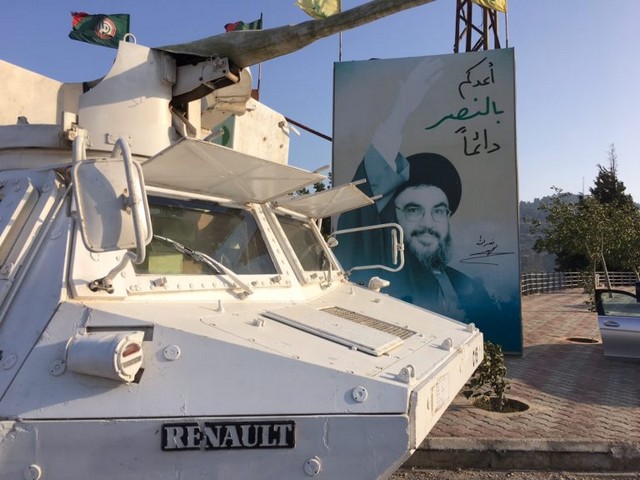
In that period of time, I drove to, and managed to enter the border region. I first arrivedat the city of Naqoura on the Mediterranean coast, and then drove all the way to the Lebanese border with the occupied Golan Heights, following the so-called Blue Line, controlled by UNIFIL.

At several places on my right, the huge Israeli border wall was now clearly visible. UNIFIL patrols consisted of armored vehicles, manned mainly by indifferent looking Indonesian soldiers. Some were taking selfies, with Israel behind them. For the United Nations, there seemed to be no urgency in the region. In fact, right after the Israeli attacks, the UN began discussing the possibility of cutting the number of UNIFIL soldiers, as well as the UNIFIL budget.

As always when visiting this border, what appeared striking to me was the proximity of Israeli and Lebanese villages; tens of meters only, in some areas.

*

What followed, was a chilling, tense silence.

Then, about one week after the Israeli attacks, Hezbollah retaliated.

I was called by a TV station, asked to analyze events. As I spoke, journalists were getting the latest news from the border.

Hezbollah fired anti-tank rockets at an Israeli vehicle patrolling near the Blue Line. It hit an Israeli tank (other reports said ‘armored vehicle’). According to Hezbollah, all Israeli soldiers inside the vehicle either died or were injured. Allegedly, among the casualties, was an Israeli top-ranking commander – described as ‘a General’.

Those who are familiar with Israeli tactics for Palestine and the Golan Heights know that Israeli ‘retaliations’ in such scenarios, include the bombing of civilian targets, and the destruction of houses or entire blocks of houses.

Entire Lebanon held its breath.

This time it became clear that Hezbollah was not going to back down. And Lebanon in general obviously has reached the point when it was ready to confront Israel, if that was what it would take to maintain its dignity.

I spoke to many Lebanese people. They were frightened, concerned, particularly if they had family and children. But they were also surprisingly calm. “If this is what fate brings, then so be it!”

Then, quickly, events became bizarre and confusing:

Israeli newspapers, including the Jerusalem Post, began quoting the Israeli Defense Forces, who were claiming that ‘Yes, an attack against Israel took place, but there were no Israeli casualties.’

Almost simultaneously, Israeli-leaked videos began appearing on YouTube and elsewhere, showing Israeli soldiers carrying injured buddies to helicopters. Later, these very clips were blocked by YouTube itself, for “violating terms and conditions”.

A few days later, the entire discussion generally stopped, at both ends.

Israel ‘retaliated’promptly. In the most peculiar way, too: it fired around one hundred rockets into Lebanon. But all the rockets landed in fields. No target was hit. Meaning: it was decided not to aim at any targets, considering the Israeli capacity to hit with great precision. More exactly: it was decided to make sure that no target would be hit. In the end, nobody was killed, and no one injured.

As I wrote above, villages, several towns and settlements are constructed right near the border line. Both Israel and Hezbollah have enormous firepower. If they wanted to, they could inflict tremendous damage and losses of lives on each other.

For some reason, they decided not to.

*

I think, this is what happened:

By attacking four countries simultaneously, Israel miscalculated. Iraq and Lebanon were not ready to accept the humiliation and barefaced attacks against their territories.

There were clear signals sent in Tel Aviv’s direction. And Netanyahu understood.

For days after the Israeli attacks, Hezbollah and Israel faced each other, in chilling defiance, separated only by a concrete wall, and by the inept UNIFIL troops. Both sides were aiming at each other great arsenals of missiles and other weaponry.

One wrong move, and the entire region could go up in flames. One tiny, erroneous move, and who knows how many lives of innocent people would be lost.

I believe, or perhaps I want to believe, that both sides suddenly imagined a huge ‘black hole’ – what of this part of the world could become. They envisioned smoke, destruction and death; inevitable if they would not decide to immediately back down.

At the last moment, they did. They backed down. I don’t know how, who made the decision first. Were they communicating, even coordinating the de-escalation?

It was what, in Asia, we call ‘saving face’.

Shots were fired. Most likely, no one died. Halas!

Was an Israeli ‘general’ killed? I don’t know. Actually, I do not want to know. I am absolutely fine with the outcome: no full war in the Middle East. For now, this is the best we can get.

Of course, this should be just the beginning. The insanity has to end. I am not convinced that it will. But what happened at the end of August 2019 clearly indicates that it could.

Unfortunately, we are living in a world when only strength guarantees survival. If
Hezbollah was not as strong as it is now, Israel would most likely not have thought twice; it would have overrun the entire Lebanon, in order to destroy its Shi’a adversary inside it.

But Hezbollah is strong.

And also, we have just learnt that there are at least some ‘boundaries’ which Israel is not willing to cross. In brief: Netanyahu is brutal, but he is not suicidal. For now, Lebanon, Israel and the rest of the Middle East, have survived. For now.

*

[First published by NEO – a journal of Russian Academy of Sciences]

Andre Vltchek is a philosopher, novelist, filmmaker and investigative journalist.

10 September 2019

Source: countercurrents.org

The Best Movie Ever Made about the Truth behind the Iraq War Is “Official Secrets”

By Jon Schwarz

31 Aug 2019 – “Official Secrets,” which opened Friday [30 Aug] in New York and Los Angeles, is the best movie ever made about how the Iraq War happened. It’s startlingly accurate, and because of that, it’s equally inspiring, demoralizing, hopeful, and enraging. Please go see it.

It’s been forgotten now, but the Iraq War and its abominable consequences — the hundreds of thousands of deaths, the rise of the Islamic State group, the nightmare oozing into Syria, arguably the presidency of Donald Trump — almost didn’t happen. In the weeks before the U.S.-led invasion on March 19, 2003, the American and British case for war was collapsing. It looked like a badly made jalopy, its engine smoking and various parts falling off as it trundled erratically down the road.

For this brief moment, the George W. Bush administration appeared to have overreached. It would be extremely tough for the U.S. to invade without the U.K., its faithful Mini-Me, at its side. But in the U.K., the idea of war without approval from the United Nations Security Council was deeply unpopular. Moreover, we now know that Peter Goldsmith, the British attorney general, had told Prime Minister Tony Blair that an Iraq resolution passed by the Security Council in November 2002 “does not authorise the use of military force without a further determination by the Security Council.” (The top lawyer at the Foreign Office, the British equivalent of the U.S. State Department, put it even more strongly: “To use force without Security Council authority would amount to the crime of aggression.”) So Blair was desperate to get a thumbs-up from the U.N. Yet to everyone’s surprise, the 15-country Security Council remained recalcitrant.

On March 1, the U.K. Observer threw a grenade into this extraordinarily fraught situation: a leaked January 31 email from a National Security Agency manager. The NSA manager was demanding a full court espionage press on the members of the Security Council — “minus US and GBR of course,” the manager jocularly said — as well as non-Security Council countries who might be producing useful chatter.

What this demonstrated was that Bush and Blair, who had both said they wanted the Security Council to hold an up or down vote on a resolution giving a legal stamp of approval for war, were bluffing. They knew they were losing. It showed that while they claimed they had to invade Iraq because they cared so much about upholding the effectiveness of the U.N., they were happy to pressure fellow U.N. members, up to and including the collection of blackmail material. It proved the NSA plan was unusual enough that, somewhere in the labyrinthine intelligence world, someone was upset enough that he or she was willing to risk going to prison for a long time.

That person was Katharine Gun.

Played craftily in “Official Secrets” by Keira Knightley, Gun was a translator at the General Communications Headquarters, the British equivalent of the NSA. On one level, “Official Secrets” is a straightforward, suspenseful drama about her. You learn how she got the email, why she leaked it, how she did it, why she soon confessed, the horrendous consequences she faced, and the unique legal strategy that forced the British government to drop all charges against her. At the time, Daniel Ellsberg said her actions were “more timely and potentially more important than the Pentagon Papers … truth-telling like this can stop a war.”

On a subtler level, the film asks this question: Why didn’t the leak make a true difference? Yes, it contributed to opposition to the U.S. and U.K. on the Security Council, which never voted on another Iraq resolution, because Bush and Blair knew they would lose. Yet Blair was able to shrug this off and obtain a vote by the British Parliament several weeks later endorsing his war.

There is one main answer to this question, both in “Official Secrets” and reality: the U.S. corporate media. “Official Secrets” helps illustrate the ideological malfeasance by the American press, which eagerly jumped on this grenade to save its foxhole buddies in the Bush administration.

It’s easy to imagine a different history than the one we’ve lived. British politicians, like American ones, are loath to criticize their intelligence agencies. But serious follow-up on the Observer story by the elite U.S. media would have generated attention from members of the U.S. Congress. This in turn would have opened up space for British members of Parliament opposed to an invasion to ask what on earth was going on. The rationale for war was disintegrating so quickly that even some modest delay could easily have become indefinite postponement. Bush and Blair both knew this, and it’s why they pushed ahead so relentlessly.

But in this world, the New York Times published literally nothing about the NSA leak between the date of its publication in the U.K. and the start of the war almost three weeks later. The Washington Post placed a single 500-word article on page A17. Its headline: “Spying Report No Shock to U.N.” The Los Angeles Times similarly ran one piece before the war, the headline of which explained, “Forgery or no, some say it’s nothing to get worked up about.” This article gave space to the former counsel of the CIA to suggest that the email was not real.

This was the most fruitful line of attack on the Observer’s story. As “Official Secrets” shows, American television was initially quite interested in putting one of the Observer reporters on air. These invitations quickly evaporated as the Drudge Report splashed claims that the email was obviously fake. Why? Because it used British spellings of words, such as “favourable,” and hence couldn’t have been written by an American.

In reality, the original leak to the Observer used American spellings, but before publication the paper’s support staff had accidentally changed them to British versions without the reporters noticing. And as usual when faced with an attack from the right-wing, television networks in the U.S. cowered in abject terror. By the time the spelling minutiae was straightened out, they’d sprinted a thousand miles away from the Observer’s scoop and had zero interest in revisiting it.

The little attention the story got was largely thanks to the journalist and activist Norman Solomon, and the organization he founded, the Institute for Public Accuracy, or IPA. Solomon had traveled to Baghdad just months before and co-written the book “Target Iraq: What the News Media Didn’t Tell You,” which came out in late January 2003.

Today, Solomon remembers that “I felt instant kinship — and, actually, what I’d describe as love — for whoever had taken the enormous risk of revealing the NSA memo. Of course, at the time I was clueless about who’d done it.” He soon penned a syndicated column titled “American Media Dodging U.N. Surveillance Story.”

Why hadn’t the paper of record covered it, Solomon asked Alison Smale, then a deputy foreign editor at the New York Times. “It’s not that we haven’t been interested,” Smale told him. The problem was that “we could get no confirmation or comment” about the NSA email from U.S. officials. But “we are still definitely looking into it,” said Smale. “It’s not that we’re not.”

The Times never mentioned Gun until January 2004, 10 months later. Even then, it didn’t appear in the news section. Instead, thanks to urging from IPA, Times columnist Bob Herbert looked into the story, and, perplexed that the news editors had passed, took it on himself.

Now, at this point you may want to collapse from despair. But don’t. Because here’s the unbelievable rest of the story — something so complex and improbable that it doesn’t appear in “Official Secrets” at all.

Why did Gun decide she had to leak the NSA email? Only recently has she revealed some of her key motivation.

“I was already very suspicious about the arguments for war,” she says via email. So she went to a bookstore and headed to the politics section and looked for something about Iraq. She bought two books and read them cover to cover that weekend. Together they “basically convinced me that there was no real evidence for this war.”

One of these books was “War Plan Iraq: Ten Reasons Against War on Iraq” by Milan Rai. The second was “Target Iraq,” the book co-authored by Solomon.

“Target Iraq” was published by Context Books, a tiny company that went bankrupt soon afterwards. It arrived in stores just weeks before Gun found it. Within days after she read it, the January 31 NSA email appeared in her inbox, and she quickly decided what she had to do.

“I was stunned to hear Katharine say that the ‘Target Iraq’ book had influenced her decision to reveal the NSA memo,” Solomon now says. “I didn’t know how to quite fathom [it].”

What does all this mean?

For journalists who care about journalism, it means that, while you may often feel that you’re shouting pointlessly into the wind, you can never predict who your work will reach and how it will affect them. The people inside giant, powerful institutions are not all supervillains in impermeable bubbles. Most are regular human beings who live in the same world as everyone else and, like everyone else, are struggling to do the right thing as they see it. Take seriously the chance that you are communicating with someone who might take action you’d never expect.

For nonjournalists and journalists alike, the lesson is also this: Be not downhearted. Both Solomon and Gun remain deeply distressed that they did everything they could imagine doing to stop the Iraq War, and it happened anyway. “I feel gratified that a book I co-wrote had such ripple effects,” says Solomon. “At the same time, I truly feel it hardly matters what I feel.”

But I think that Gun and Solomon’s sense of failure is the wrong way of looking at what they did and what others can do. The people who tried to stop the Vietnam War only succeeded after millions had died, and many of those writers and activists saw themselves as failures too. But in the 1980s, when factions of the Reagan administration wanted to conduct full-scale invasions in Latin America, they couldn’t get it off the ground because of the base of organization and knowledge created years earlier. The bitter fact that the U.S. settled for its second choice — unleashing death squads that slaughtered tens of thousands across the region — doesn’t mean that Vietnam-style carpet bombing wouldn’t have been much worse.

Likewise, Gun, Solomon and the millions of people who fought the onrushing Iraq War failed, in some sense. But anyone who was paying attention then knew that Iraq was intended as just the first step in a U.S. conquest of the entire Middle East. They didn’t prevent the Iraq War. But they, at least so far, helped prevent the Iran War.

So check out “Official Secrets” as soon as it appears in a theater near you. You will rarely see a better portrait of what it means for someone to try to make a true moral choice, even when unsure, even while terrified, even when she has no idea what will happen next.

Jon Schwarz – jon.schwarz@​theintercept.com

9 September 2019

Source: www.transcend.org

New Bases to Counter China? Indo-Pacific Is New Priority Region for the US, Pentagon

By Darius Shahtahmasebi

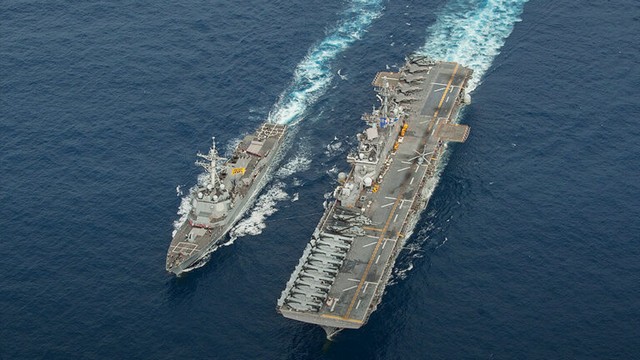
29 Aug 2019 – After devastating the Middle East through sanctions, warfare, and the backing of extremists to fight proxy wars, the Indo-Pacific region – not the Middle East – is now the Pentagon’s “priority” region.

Just this week, US Secretary of Defense Mark Esper made the call to expand base locations in the Pacific region while speaking at the Naval War College, dubbing the Indo-Pacific theatre “our priority theatre.” The remarks were clearly part of the Pentagon’s wider goal of curbing and containing China’s expanding influence throughout the region.

Esper made it evident that the US had its eye on a number of key locations in the Indo-Pacific region, in which he would be looking to invest

“more time and resources into certain regions we haven’t been to in the past.”

While it is not so apparent what those regions or locations are, there are some glaring possibilities that come to mind, including Singapore, the Philippines, Vietnam, Malaysia, Indonesia, and even some of the smaller Pacific Island nations less known to the US public such as Palau. Palau is a likely candidate, given the Western media has already applauded its “standing up to a giant” over the Taiwan question.

As the Center for a New American Security’s Eric Sayers pointed out, the issue with countries such as the Philippines is that they may restrict access to its ports depending on the nature of the dispute. With smaller nations like Palau, it is likely the US would not even have to blink in order to utilise the location to combat China.

There is no doubt that the Philippines has a dog in this fight. President Rodrigo Duterte is currently in Beijing where he is meeting with Chinese leader Xi Jinping and is expected to raise their respective claims to the South China Sea as one of the major talking points.

What will be interesting to see in the coming years is where states such as Australia and New Zealand fit into this “priority theatre.”

A recent report suggests that the US is in talks with the Australian government with the aim of formulating a deal that would see Canberra processing a large amount of rare earth materials required by the Pentagon. The antagonist in this particular narrative is again Beijing, who maintains somewhat of a monopoly over the production of rare earth materials which are utilised in lasers, radars, and even jet engines.

Speaking of Australia, an Australian thinktank also just recently warned that the US military is overstretched in the Indo-Pacific region and risks suffering a fait accompli loss to Beijing before it even has the chance to respond. The report says that China’s

“growing arsenal of accurate long-range missiles poses a major threat to almost all American, allied and partner bases, airstrips, ports and military installations in the Western Pacific.”

If anyone is still wondering why the Indo-Pacific region has all of a sudden become a “priority theatre,” it should be all but clear at this stage. It’s a priority for the US because America is on the verge of being shunted out completely. Thankfully, some analysts have been warning about these developments for some time.

Then again, I am not the only person who is bringing these issues to light. In a BBC article entitled “Is the US still Asia’s only military superpower?” defence and diplomatic correspondent Jonathan Marcus concludes that “US preeminence in the Pacific is no more.” The problem, as is often the case with Western commentators on matters involving US dominance in major geopolitical affairs, is that the issue is typically framed from the perspective of “What on earth can the US do to stop China’s rise to power?”

It just happens to be that the US will probably have to face some uncomfortable truths, particularly where the Indo-Pacific is concerned. Just last month, an Australian professor of strategic studies at the Strategic and Defence Studies Centre wrote an op-ed in the Guardian which essentially conceded that Australia will have to accept a Chinese military base in the region at some point in time. Unlike Washington’s current strategy of trying (or hoping) to outmuscle China, Professor Hugh White believes that the

“costs to us of trying to keep China out of the region might simply prove impossible to bear.”

As adversarial as Washington would want its relationship with Beijing to be, there is too much evidence that the relationship between China and the rest of the world is too intertwined to expect anything but a disaster from the current road ahead. A newly released report by the think tank China Matters just concluded that if China’s economic growth only shrunk by a few percent, Australia would potentially lose $140 billion in income and more than half a million jobs.

And it could be that if Beijing opens up this conflict on too many fronts, the Indo-Pacific region will only the tip of the iceberg. As part of its Silk Road Project, Beijing has begun snagging up states in the Balkans which will only further irk Washington, and might lead the US to do something painfully catastrophic in response.

All empires come to an end. That is an indisputable aspect of our history. Whether or not all empires will continue to fall in future of course remains to be seen, but generally speaking we base all future predictions on the back of previous experiences. How far an empire wants to bring the house down in order to avoid being overtaken by a rising power is also something which we would need to account for.

The US has nukes – a lot of them – and is slowly but surely propagating the notion that they might use them. And not just in situations when a nuclear strike is necessary to defend against another nuclear strike – just because, hey, if we are going down, we will take down the rest of the planet with us.

Darius Shahtahmasebi is a New Zealand-based legal and political analyst who focuses on US foreign policy in the Middle East, Asia and Pacific region.

9 September 2019

Source: www.transcend.org

BRICS Was Created as a Tool of Attack: Lula

By Pepe Escobar

29 Aug 2019 – In a wide-ranging, two-hour-plus, exclusive interview from a prison room in Curitiba in southern Brazil, former Brazilian president Luis Inacio Lula da Silva re-emerged for the first time, after more than 500 days in jail, and sent a clear message to the world.

Amid the 24/7 media frenzy of scripted sound bites and “fake news”, it’s virtually impossible to find a present or former head of state anywhere, in a conversation with journalists, willing to speak deep from his soul, to comment on all current political developments and relish telling stories about the corridors of power. And all that while still in prison.

The first part of this mini-series focused on the Amazon. Here, we will focus on Brazil’s relationship with BRICS and Beijing. BRICS is the grouping of major emerging economies – Brazil, Russia, India and China – that formed in 2006 and then included South Africa in their annual meetings from 2010.

My first question to Lula was about BRICS and the current geopolitical chessboard, with the US facing a Russia-China strategic partnership. As president, from 2003 to 2010, Lula was instrumental in formatting and expanding the influence of BRICS – in sharp contrast with Brazil’s current President, Jair Bolsonaro, who appears to be convinced that China is a threat.

Lula stressed that Brazil should have been getting closer to China in a mirror process of what occurred between Russia and China:

“When there was a BRICS summit here in Ceará state in Brazil, I told comrade Dilma [Rousseff, the former president] that we should organize a pact like the Russia-China pact. A huge pact giving the Chinese part of what they wanted, which was Brazil’s capacity to produce food and energy and also the capacity to have access to technological knowledge. Brazil needed a lot of infrastructure. We needed high-speed rail, many things. But in the end that did not happen.”

Lula defined his top priorities as he supported the creation of BRICS: economic autonomy, and uniting a group of nations capable of helping what the Washington consensus describes as LDCs – least developed countries.

He emphasized:

“BRICS was not created to be an instrument of defense, but to be an instrument of attack. So we could create our own currency to become independent from the US dollar in our trade relations; to create a development bank, which we did – but it is still too timid – to create something strong capable of helping the development of the poorest parts of the world.”

Lula made an explicit reference to the United States’ fears about a new currency:

“This was the logic behind BRICS, to do something different and not copy anybody. The US was very much afraid when I discussed a new currency and Obama called me, telling me, ‘Are you trying to create a new currency, a new euro?’ I said, ‘No, I’m just trying to get rid of the US dollar. I’m just trying not to be dependent.’”

One can imagine how this went down in Washington.

Obama may have been trying to warn Lula that the US ‘Deep State’ would never allow BRICS to invest in a currency or basket of currencies to bypass the US dollar. Later on, Vladimir Putin and Erdogan would warn President Dilma – before she was impeached – that Brazil would be mercilessly targeted. In the end, the leadership of the Workers’ Party was caught totally unprepared by a conjunction of sophisticated hybrid-war techniques.

One of the largest economies in the world was taken over by hardcore neoliberals, practically without any struggle. Lula confirmed it in the interview, saying:

“We should look at where we got it wrong.”

Lula also hit a note of personal disappointment. He expected much more from BRICS.

“I imagined a more aggressive BRICS, more proactive and more creative. ‘The Soviet empire has already fallen; let’s create a democratic empire.’ I think we made some advances, but we advanced slowly. BRICS should be much stronger by now.”

Lula, Obama and China

It’s easy to imagine how what has followed went down in Beijing. That explains to a great extent the immense respect Lula enjoys among the Chinese leadership. And it’s also relevant to the current global debate about what’s happening in the Amazon. Let just Lula tell the story in his own, inimitable, Garcia Marquez-tinged way.

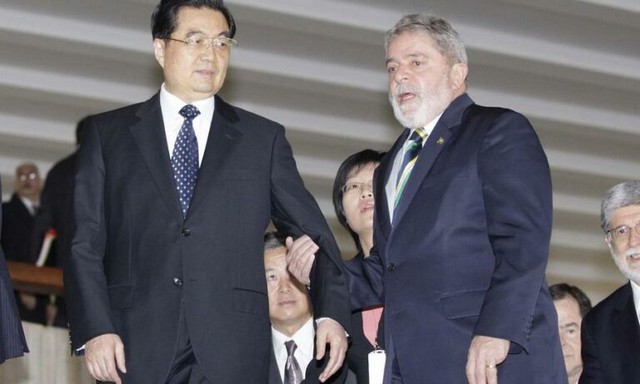
“One thing that the Chinese must remember, a lot of people were angry in Brazil when I recognized China as a market economy. Many of my friends were against it. But I said, ‘No, I want the Chinese at the negotiating table, not outside. Is there any discord? Put them inside the WTO, let’s legalize everything.’ I know that [Chinese President] Hu Jintao was much pleased.

“Another thing we did with China was at the COP-15 [Conference of Parties to the UN Framework Convention on Climate Change] in Copenhagen in 2009. Let me tell you something: I arrived at COP-15 and there was a list of people requesting audiences with me – Angela Markel, Sarkozy, Gordon Brown; Obama had already called twice – and I didn’t know why I was important. What did they all want? They all wanted us to agree, at COP-15, that China was the prime polluting evil on earth. Sarkozy came to talk to me with a cinematographic assembly line, there were 30 cameras, a real show: Lula accusing China. Then I had a series of meetings and I told them all, ‘Look, I know China is polluting. But who is going to pay for the historical pollution you perpetrated before China polluted? Where is the history commission to analyze English industrialization?’

“Then something fantastic happened. An agreement was not in sight, I wanted Sarkozy to talk to Ahmadinejad – later I’ll tell you this thing about Iran [he did, later in the interview]. Ahmadinejad did not go to our dinner, so there was no meeting. But then, we were discussing, discussing, and I told Celso [Amorim, Brazil’s Foreign Minister], ‘Look, Celso, there’s a problem, this meeting will end without an agreement, and they are going to blame Brazil, China, India, Russia. We need to find a solution.’ Then I proposed that Celso call the Chinese and set up a parallel meeting. That was between Brazil, China, India and perhaps South Africa. Russia, I think, was not there. And in this meeting, imagine our surprise when Hillary Clinton finds out about it and tries to get inside the meeting. The Chinese didn’t let her. All these Chinese, so nervous behind the door, and then comes Obama. Obama wanted to get in and the Chinese didn’t let him. China was being represented by Jiabao [Wen Jiabao, the prime minister].

“Then we let Obama in, Obama said, ‘I’m gonna sit down beside my friend Lula so I won’t be attacked here.’ So he sat by my side and started to talk about the agreement, and we said there is no agreement. And then there was this Chinese, a negotiator, he was so angry at Obama, he was standing up, speaking in Mandarin, nobody understood anything, we asked for a translation, Jiabao did not allow it, but the impression, by his gesticulation, was that the Chinese was hurling all sorts of names at Obama, he talked aggressively, pointing his finger, and Obama said, ‘He is angry.’ The Brazilian ambassador, who said she understood a little bit of Mandarin – she said he used some pretty heavy words.

“The concrete fact is that in this meeting we amassed a great deal of credibility, because we refused to blame the Chinese. I remember a plenary session where Sarkozy, Obama and myself were scheduled to speak. I was the last speaker. When I arrived at the plenary there was nothing, not a thing written on a piece of paper. I told one of my aides, please go out, prepare a few talking points for me, and when he left the room they called me to speak; they had inverted the schedule. I was very nervous. But that day I made a good speech. It got a standing ovation. I don’t know what kind of nonsense I said [laughs]. Then Obama started speaking. He didn’t have anything to say. So there was this mounting rumor in the plenary: He ended up making a speech that no one noticed. And then with Sarkozy, the same thing.

“What I had spoken about was the role of Brazil in the environmental question. I’ll get someone from the Workers’ Party to find this speech for you. The new trend in Brazil is to try to compare policies between myself and Bolsonaro. You cannot accept his line that NGOs are setting fire to the Amazon. Those burning the Amazon are his voters, businessmen, people with very bad blood, people who want to kill indigenous tribes, people who want to kill the poor.”

Pepe Escobar is a Brazilian independent geopolitical analyst.

9 September 2019

Source: www.transcend.org

From mind control to murder? How a deadly fall revealed the CIA’s darkest secrets

By Stephen Kinzer

Glass shattered high above Seventh Avenue in Manhattan before dawn on a cold November morning in 1953. Seconds later, a body hit the sidewalk. Jimmy, the doorman at the Statler hotel, was momentarily stunned. Then he turned and ran into the hotel lobby. “We got a jumper!” he shouted. “We got a jumper!”

The night manager peered up through the darkness at his hulking hotel. After a few moments, he picked out a curtain flapping through an open window. It turned out to be room 1018A. Two names were on the registration card: Frank Olson and Robert Lashbrook.

Police officers entered room 1018A with guns drawn. They saw no one. The window was open. They pushed open the door to the bathroom and found Lashbrook sitting on the toilet, head in hands. He had been sleeping, he said, and “I heard a noise and then I woke up.”

“The man that went out the window, what is his name?” one officer asked.

“Olson,” came the reply. “Frank Olson.”

“In all my years in the hotel business,” the night manager later reflected, “I never encountered a case where someone got up in the middle of the night, ran across a dark room in his underwear, avoiding two beds, and dove through a closed window with the shade and curtains drawn.”

Leaving the police officers, the night manager returned to the lobby and, on a hunch, asked the telephone operator if any calls had recently been made from room 1018A. “Yes,” she replied – and she had eavesdropped, not an uncommon practice in an era when hotel phone calls were routed through a switchboard. Someone in the room had called a number on Long Island, which was listed as belonging to Dr Harold Abramson, a distinguished physician, less well known as an LSD expert and one of the CIA’s medical collaborators.

“Well, he’s gone,” the caller had said. Abramson replied: “Well, that’s too bad.”

To the first police officers on the scene, this seemed like another of the human tragedies they saw too often: a distressed or distraught man had taken his own life. They could not have known that the dead man and the survivor were scientists who helped direct one of the US government’s most highly classified intelligence programmes.

Early the next morning, one of Olson’s close colleagues drove to Maryland to break the terrible news to the dead man’s family. He told Alice Olson and her three children that Frank “fell or jumped” to his death from a hotel window. Naturally, they were shocked, but they had no choice other than to accept what they were told. Alice did not object when told that, given the condition of her husband’s body, family members should not view it. The funeral was held with a closed casket. There the case might have ended.

Decades later, however, spectacular revelations cast Olson’s death in a completely new light. First, the CIA admitted that, shortly before he died, Olson’s colleagues had lured him to a retreat and fed him LSD without his knowledge. Then it turned out that Olson had talked about leaving the CIA – and told his wife that he had made “a terrible mistake”. Slowly, a counter-narrative emerged: Olson was disturbed about his work and wanted to quit, leading his comrades to consider him a security risk. All of this led him to room 1018A.

Frank Olson had been one of the first scientists assigned to the secret US biological warfare laboratories at Fort Detrick in Frederick, Maryland during the second world war. There Olson began working with the handful of colleagues who would accompany him throughout his clandestine career. One was Harold Abramson. Others included ex-Nazi scientists who had been brought to work on secret missions in the US. For a time they worked on aerosol technologies – ways to spray germs or toxins on enemies and to defend against such attacks. Later, Olson met with American intelligence officers who had experimented with “truth drugs” in Europe.

Olson was discharged from the army in 1944, but remained at Fort Detrick on a civilian contract and continued his research into aerobiology. Several times he visited the secluded Dugway Proving Ground in Utah, which was used for testing “living biological agents, munitions and aerosol cloud production”. He co-authored a 220-page study entitled Experimental Airborne Infections, which described experiments with “airborne clouds of highly infectious agents”.

In 1949, he travelled to the Caribbean for Operation Harness, which tested the vulnerability of animals to toxic clouds. The next year, he was part of Operation Sea Spray, in which dust engineered to float like anthrax was released near San Francisco. He regularly travelled to Fort Terry, a secret army base on Plum Island, off the eastern tip of Long Island, which was used to test toxins too deadly to be brought on to the US mainland.

This was the period when senior army and CIA officers were becoming deeply alarmed at what they feared was Soviet progress toward mastering forms of warfare based on microbes. Their alarm led to the creation of the special operations division. Rumours about its work spread through offices and laboratories. Olson learned of it over an evening game of cards with a colleague, John Schwab, who unbeknown to him, had been named the division’s first chief. Schwab invited him to join. Olson accepted immediately.

Less than a year later, Olson succeeded Schwab as chief of the special operations division. His job description was vague but tantalising: collect data “of interest to the division, with particular emphasis on the medico-biological aspects”, and coordinate his work with “other agencies conducting work of a similar or related nature”. That meant the CIA.

Olson’s speciality was “the airborne distribution of biological germs”, according to one study. “Dr Olson had developed a range of lethal aerosols in handy sized containers. They were disguised as shaving cream and insect repellants. They contained, among other agents, staph enteroxin, a crippling food poison; the even more deadly Venezuelan equine encephalomyelitis; and most deadly of all, anthrax … Further weapons he was working on included a cigarette lighter which gave out an almost instant lethal gas, a lipstick that would kill on contact with skin and a neat pocket spray for asthma sufferers that induced pneumonia.”

By the time Olson stepped down as chief of the special operations division in early 1953, complaining that the pressures of the job aggravated his ulcers, he had joined the CIA. He stayed with the division, which was officially part of the army but functioned as a CIA research station hidden within a military base. There he came to know Sidney Gottlieb and his deputy, Robert Lashbrook, the two scientists who would soon be running a top-secret CIA project codenamed MK-Ultra.

Gottlieb was the CIA’s chief poison-maker. Over two decades, he oversaw medical experiments and “special interrogation” projects in which hundreds of people were tormented and many minds were permanently shattered. During this period, there was an obsession at the CIA: there is a way to control the human mind, and if it can be found, the prize will be nothing less than global mastery. MK-Ultra was a top secret programme of experiments in mind control that used, as its basic formula, doses of LSD given to “expendables”. Gottlieb wanted to discover how much LSD a human being could take. Could there be a breaking point, he wondered – a dose so massive that it would shatter the mind and blast away consciousness, leaving a void into which new impulses or even a new personality could be implanted?

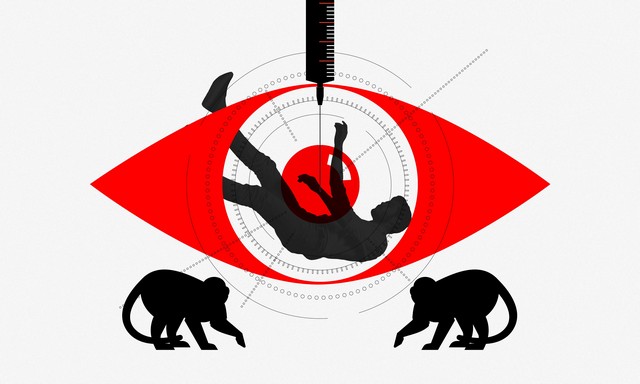
In his laboratory at Fort Detrick, Olson directed experiments that involved gassing or poisoning laboratory animals. These experiences disturbed him. “He’d come to work in the morning and see piles of dead monkeys,” his son Eric later recalled. “That messes with you. He wasn’t the right guy for that.”

Olson also saw human beings suffer. Although not a torturer himself, he observed and monitored torture sessions in several countries.

“In CIA safe-houses in Germany,” according to one study, “Olson witnessed horrific brutal interrogations on a regular basis. Detainees who were deemed ‘expendable’ – suspected spies or moles, security leaks, etc – were literally interrogated to death in experimental methods combining drugs, hypnosis and torture, to attempt to master brainwashing techniques and memory erasing.”

As Thanksgiving approached in 1953, Olson received an invitation to gather on Wednesday 18 November for a retreat at a cabin on Deep Creek Lake in western Maryland. This retreat was one in a series that Gottlieb convened every few months. Officially, it was a coming-together of two groups: four CIA scientists from the technical services staff, which ran MK-Ultra, and five army scientists from the special operations division of the chemical corps. In reality, these men worked so closely together that they comprised a single unit. They were comrades in search of cosmic secrets. It made sense for them to gather, discuss their projects and exchange ideas in a relaxed environment.

The first 24 hours at the retreat were uneventful. On Thursday evening, the group gathered for dinner and then settled back for a round of drinks. Lashbrook, Gottlieb’s deputy, produced a bottle of Cointreau and poured glasses for the company. Several, including Olson, drank heartily. After 20 minutes, Gottlieb asked if anyone was feeling odd. Several said they were. Gottlieb then told them their drinks had been spiked with LSD.

The news was not well received. Even in their altered state, the subjects could understand what had been done to them. Olson was especially upset. According to his son Eric, he became “quite agitated and was having a serious confusion with separating reality from fantasy”. Soon, though, he and the others were carried away into a hallucinatory world. Gottlieb later reported that they were “boisterous and laughing … unable to continue the meeting or engage in sensible conversations”. The next morning, they were in only slightly better shape. The meeting broke up. Olson headed back to Frederick. By the time he arrived, he was a changed man.

The next morning, 23 November, Olson showed up early at Fort Detrick. His boss, Vincent Ruwet, arrived soon after. Neither were in good shape. More than four days had passed since they had been given LSD without their knowledge. Ruwet later called it “the most frightening experience I have ever had or hope to have”.

Olson began pouring out his doubts and fears. “He appeared to be agitated, and asked me if I should fire him or he should quit,” Ruwet later recalled. Ruwet tried to calm him, assuring him that his work was excellent, and recognised as such. Slowly, Olson was persuaded that resignation was too extreme a reaction.

By this time MK-Ultra had been under way for seven months. It was one of the government’s deepest secrets, guarded by security that was, as Olson had been told when he joined the special operations division, “tighter than tight”. Barely two dozen men knew its true nature. Nine had been at Deep Creek Lake. Several of those had been surreptitiously dosed with LSD. Now one of them seemed out of control. This was no light matter for men who believed that the success or failure of MK-Ultra might determine the fate of the US, and all humanity.

Olson had spent 10 years at Fort Detrick and knew most, if not all, of the special operation division’s secrets. He had repeatedly visited Germany and brought home pictures from Heidelberg and Berlin, where the US military maintained clandestine interrogation centres. He was one of several special operations division scientists who were in France on 16 August 1951, when an entire French village, Pont-Saint-Esprit, was mysteriously seized by mass hysteria and violent delirium that afflicted more than 200 residents and caused several deaths; the cause was later determined to have been poisoning by ergot, the fungus from which LSD was derived. Perhaps most threatening of all, if US forces did indeed use biological weapons during the Korean war – for which there is circumstantial evidence but no proof – Olson would have known. The prospect that he might reveal any of what he had seen or done was terrifying.

“He was very, very open and not scared to say what he thought,” Olson’s friend and colleague Norman Cournoyer later recalled. “He did not give a damn. Frank Olson pulled no punches at any time … That’s what they were scared of, I am sure.”

Olson’s doubts deepened. In spring 1953, he visited the top-secret Microbiological Research Establishment at Porton Down in Wiltshire, where government scientists were studying the effects of sarin and other nerve gases. On 6 May, a volunteer subject, a 20-year-old soldier, was dosed with sarin there, began foaming at the mouth, collapsed into convulsions, and died an hour later. Afterward, Olson spoke about his discomfort with a psychiatrist who helped direct the research, William Sargant.

A month later, Olson was back in Germany. On that trip, according to a later reconstruction of his travels, Olson “visited a CIA safe house near Stuttgart [where] he saw men dying, often in agony, from the weapons he had made.” After stops in Scandinavia and Paris, he returned to Britain and visited Sargant again. Immediately after their meeting, Sargant wrote a report saying that Olson was “deeply disturbed over what he had seen in CIA safe houses in Germany” and “displayed symptoms of not wanting to keep secret what he had witnessed”. He sent his report to his superiors with the understanding that they would forward it to the CIA. Sargant said later: “There were common interests to protect.”

Five days after being dosed with LSD, Olson was still disoriented. Ruwet, his boss at the special operations division, called Gottlieb to report this. Gottlieb asked him to bring Olson in for a chat. At their meeting, Gottlieb later testified, Olson seemed “confused in certain areas of his thinking”. He made a quick decision: Olson must be taken to New York City and delivered to the physician most intimately tied to MK-Ultra – Harold Abramson.

Alice Olson was told that Abramson was chosen because her husband “had to see a physician who had equal security clearance so he could talk freely”.

That was partly true. Abramson was not a psychiatrist, but he was an MK-Ultra initiate. Gottlieb knew that Abramson’s first loyalty was to MK-Ultra – or, as he would have put it, to the security of the US. That made him the ideal person to probe Olson’s inner mind. Olson told Abramson that ever since the Deep Creek Lake retreat, he had been unable to work well. He could not concentrate and forgot how to spell. He could not sleep. Abramson sought to reassure Olson, who seemed to relax afterwards.

A week had passed since Olson was given LSD at Deep Creek Lake. He planned to return to his family for Thanksgiving dinner. The day after seeing Abramson, accompanied by Lashbrook and Ruwet, he boarded a flight to Washington. An MK-Ultra colleague was waiting when they landed. Ruwet and Olson got into his car for the drive to Frederick. Soon after they set off, Olson’s mood changed. He asked that the car be stopped. Olson turned to Ruwet and announced that he felt “ashamed to meet his wife and family” because he was “so mixed up”.

“What do you want me to do?” Ruwet asked.

“Just let me go. Let me go off by myself.”

“I can’t do that.”

“Well then, just turn me over to the police. They’re looking for me anyway.”

Ruwet suggested Olson return to New York for another session with Abramson. Olson agreed, so they took a taxi to Abramson’s weekend home on Long Island. Abramson spent about an hour with Olson, followed by 20 minutes with Lashbrook.

The next morning, Abramson, Lashbrook and Olson drove back to Manhattan. During a session at his Fifty-Eighth Street office, Abramson persuaded Olson that he should agree to be hospitalised as a voluntary patient at a Maryland sanatorium. Olson and Lashbrook left, registered at the Statler Hotel, and were given room 1018A.

Over dinner at the Statler, Olson told Lashbrook that he was looking forward to his hospitalisation. He mused about books he would read. Lashbrook later said he was “almost the Dr Olson I knew before the experiment”. The two returned to their room. Olson washed his socks in the sink, watched TV for a while and lay down to sleep.

At 2.25am, he went out the window.

Every secret service needs officers who specialise in cleaning up messes. In the CIA of the 1950s, those officers worked for Sheffield Edwards at the Office of Security. The cover-up he directed in the hours and days after Frank Olson died was a model of brisk efficiency.

With the calm self-assurance for which he was known at the CIA, Edwards announced how the cover-up would unfold. First, the New York police would be persuaded not to investigate, and to cooperate in misleading the press. Second, a fake career – a “legend” – would be constructed for Lashbrook, who, as the sole witness, would be questioned by investigators and could under no circumstances be recognised as working for the CIA, much less MK-Ultra. Third, the Olson family would have to be informed, placated and kept cooperative.

While Alice, at home in Maryland, was being informed of her husband’s death, Lashbrook was welcoming the CIA cavalry to room 1018A at the Statler in New York. It took the form of a single officer. In internal reports, he is called “Agent James McC”. Later, he was identified as James McCord, who would go on to become a footnote to US political history as one of the Watergate burglars. McCord had previously been an FBI agent specialising in counterintelligence. Making police investigations evaporate was one of his specialities.

As soon as Edwards called McCord before dawn on 28 November, he swung into action. He took the first morning plane to New York and arrived at the Statler about 8am. He spent an hour questioning Lashbrook and then, at about 9.30am, advised him to go to the morgue at Bellevue hospital, as the police had requested, to identify Olson’s body. While he was away, McCord minutely searched room 1018A and nearby rooms.

Shortly after noon, Lashbrook returned to the Statler, where McCord was waiting. Over the next few hours, Lashbrook made a series of telephone calls. One was to Gottlieb. When he hung up, he told McCord that Gottlieb had instructed him to go to Abramson’s office, pick up a report and take it back to Washington by hand. Lashbrook carried Abramson’s report to Washington on the midnight train. CIA security officers in New York took care of the remaining details. The investigating police detective concluded that Olson had died from multiple fractures “subsequent upon a jump or fall”. That became the official narrative.

Despite the successful cover-up, Olson’s death was a near-disaster for the CIA. It came close to threatening the very existence of MK-Ultra.

Gottlieb and his bosses at the CIA might have taken this as a moment for reflection. In light of this death, they could have reasoned, further experiments with psychoactive drugs should be stopped, at least on unwitting subjects. Instead, they proceeded as if Olson’s death had never happened.

On 12 June 1975, the Washington Post ran a story about an army scientist who had been drugged with LSD by the CIA, reacted badly and jumped out of the window of a New York hotel. This story, with its lurid mix of drugs, death and the CIA, proved irresistible. For the next several days, reporters barraged the CIA with demands to know more. The Olson family called a press conference in the family’s back yard. Alice read a statement saying that the family had decided to “file a lawsuit against the CIA, perhaps within two weeks, asking several million dollars in damages”. She insisted that her husband had “not acted irrational or sick” during the last days of his life, but was “very melancholy” and “said he was going to leave his job”.

“Since 1953, we have struggled to understand Frank Olson’s death as an inexplicable ‘suicide,’” she said. “The true nature of his death was concealed for 22 years.”

Besides announcing plans to sue the CIA, the Olson family also asked the New York police department to open a new investigation. The Manhattan district attorney, Robert Morgenthau, replied immediately, promising that his office would begin “looking into certain aspects” of the case.

Alarm bells went off at the White House after the Olson family announced its plan to sue the CIA. A lawsuit, if allowed to proceed, would give the family, as well as homicide detectives in New York, a tool they could use to force disclosure of deep secrets. President Ford’s chief of staff, Donald Rumsfeld, and his deputy, Dick Cheney, recognised the danger. Cheney warned Rumsfeld in a memo that a lawsuit might force the CIA “to disclose highly classified national security information”. To head off this disaster, he recommended that Ford make a public “expression of regret” and “express a willingness to meet personally with Mrs Olson and her children”.

Ford took his aides’ advice. He invited Alice and her three adult children to the White House. On 21 July 1975, they met in the Oval Office. It was a unique historical moment: the only time an American president has ever summoned the family of a CIA officer who died violently and apologised on behalf of the US government. Later, they met with CIA director William Colby at the agency’s HQ in Langley, Virginia. He apologised for what he called a “terrible thing” that “should never have happened”.

“Some of our people were out of control in those days,” Colby said. “They went too far. There were problems of supervision and administration.”

White House lawyers offered the Olson family $750,000 in exchange for dropping its legal claims. After some hesitation, the family accepted. Congress passed a special bill approving the payment. And that would have closed the case if Frank Olson had remained quiet in his grave.

At Olson’s funeral, Gottlieb had told grieving relatives that if they ever had questions about “what happened”, he would be happy to answer them. More than two decades later, at the end of 1984, they decided to accept his offer and called to arrange an appointment. When Alice, Eric and Nils Olson appeared at his door, his first reaction was relief.

“I’m so happy you don’t have a weapon,” Gottlieb said. “I had a dream last night that you all arrived at this door and shot me.”

Eric was taken aback. Later, he came to marvel at what he saw as Gottlieb’s manipulative power. “Before we even got through the door, we were apologising to him and reassuring him,” he said. “It was a brilliant and sophisticated way of turning the whole thing around.”

He began by telling the family what had happened at Deep Creek Lake on 19 November 1953. Olson and others were given LSD, he said, as part of an experiment to see “what would happen if a scientist were taken prisoner and drugged – would he divulge secret research and information?” Then he began musing about Olson. “Your father and I were very much alike,” he told Eric. “We both got into this because of patriotic feeling. But we both went a little too far, and we did things that we probably should not have done.”

That was as close to confession as Gottlieb ever came. He would not say what aspects of MK-Ultra went “a little too far”, or what he and Olson did that they “probably should not have done”. Nor would he entertain questions about inconsistencies in the story of Olson’s death. When Eric pressed him, he reacted sharply.

As the family were rising to leave, Gottlieb pulled Eric aside. “You are obviously very troubled by your father’s suicide,” he said. “Have you ever considered getting into a therapy group for people whose parents have committed suicide?” Eric did not follow that suggestion, but it left a deep impression on him. For years, he had been confused and depressed by the story of his father’s death. Only after meeting Gottlieb, however, did he resolve to bring his search for truth to the centre of his life.

“I didn’t have the confidence then in my scepticism to ignore his ploys, but when he made that therapy group suggestion – that was the moment when he overplayed his hand,” he said. “At that moment, I understood how much Gottlieb had a stake in defusing me. And it was also at that moment that the determination to show that he had played a role in murdering my father was born.”

Eric Olson waited another decade – until after his mother died – before taking his next step: arranging to exhume his father’s body. Several reporters stood near him as a backhoe clawed through the earth at Linden Hills cemetery in Frederick, Maryland, on 2 June 1994.

A forensic pathologist, James Starrs of George Washington University Law School, spent a month studying Olson’s body. When he was finished, he called a news conference. His tests for toxins in the body, he reported, had turned up nothing. The wound pattern, however, was curious. Starrs had found no glass shards on the victim’s head or neck, as might be expected if he had dived through a window. Most intriguingly, although Olson had reportedly landed on his back, the skull above his left eye was disfigured.

“I would venture to say that this hematoma is singular evidence of the possibility that Dr Olson was struck a stunning blow to the head by some person or instrument prior to his exiting through the window of room 1018A,” Starrs concluded. Later he was more emphatic: “I think Frank Olson was intentionally, deliberately, with malice aforethought, thrown out of that window.”

Besides conducting the autopsy, Starrs interviewed people connected to the case. One was Gottlieb. The two men met on a Sunday morning at Gottlieb’s home in Virginia. Starrs later wrote that it was “the most perplexing of all the interviews I conducted”.

Starr wrote: “I was emboldened to ask how he could so recklessly and cavalierly have jeopardised the lives of so many of his own men by the Deep Creek Lodge experiment with LSD. ‘Professor,’ he said without mincing a word, ‘you just do not understand. I had the security of this country in my hands.’ He did not say more, nor need he have done so. Nor did I, dumbfounded, offer a rejoinder. The means-end message was pellucidly clear. Risking the lives of the unwitting victims of the Deep Creek experiment was simply the necessary means to a greater good, the protection of the national security.”

Because Olson’s survivors had signed away their right to legal relief when they accepted their $750,000 compensation payment in 1975, they could not sue the CIA. Although Starr’s report and other discoveries sharpened Eric’s already powerful suspicion that foul play lay behind his father’s death, he could not prove it. Recognising that painful fact, he and his brother decided that it was finally time to reinter their father’s body. On 8 August 2002, the day before the reburial, he called reporters to his home and announced that he had reached a new conclusion about what had happened to his father.

“The death of Frank Olson on 28 November 1953 was a murder, not a suicide,” he declared. “This is not an LSD drug-experiment story, as it was represented in 1975. This is a biological warfare story. Frank Olson did not die because he was an experimental guinea pig who experienced a ‘bad trip’. He died because of concern that he would divulge information concerning a highly classified CIA interrogation program in the early 1950s, and concerning the use of biological weapons by the United States in the Korean War.”

In 2017, Stephen Saracco, a retired New York assistant district attorney who had investigated the Olson case and remained interested in it, made his first visit to the hotel room where Olson spent his final night. Looking around the room, Saracco said, raised the question of how Olson could have done it.

“If this would have been a suicide, it would have been very difficult to accomplish,” Saracco concluded. “There was motive to kill him. He knew the deepest, darkest secrets of the cold war. Would the American government kill an American citizen who was a scientist, who was working for the CIA and the army, if they thought he was a security risk? There are people who say: ‘Definitely.’”

This is an edited extract from Poisoner in Chief: Sidney Gottlieb and the CIA Search for Mind Control, published by Henry Holt & Co on 10 September and available at guardianbookshop.co.uk

6 September 2019

Source: www.theguardian.com

Can the United Nations do anything to stop the Carnage in Kashmir?

By Dr. Ghulam Nabi Fai

Kashmir is in turmoil. The government has imposed curfew, banned all public meetings, arrested more than 20,000 youth and placed the Kashmiri leadership under house arrest. Internet services have been snapped and all university examinations postponed. Barricades have been erected everywhere in the Srinagar (Capitol city) and other towns. More than 8.5 million people of Kashmir Valley are under siege since August 5, 2019.

Therefore, on behalf of the people of Jammu and Kashmir –and a territory whose status is yet to be determined under the resolutions of the United Nations – we approach the United Nations Secretary General with the appeal that he exerts his personal influence to help arrest immediately the campaign of mass slaughter and indiscriminate destruction in which the Indian occupation forces have been remorselessly engaged in our country since January 1990 in general and August 5, 2019 in particular. In this context, we would like the Secretary General to bear the following points in mind:

The acts of indiscriminate killing of unarmed civilians and assaults on innocent women and children have not been fully reported in the world press because the Indian occupation authorities barred the entry of the world media into the territory and the restriction have been imposed even on the local media on reporting any incident that takes place in the Valley of Kashmir.

Nevertheless, even the occasional reports that have appeared do afford a glimpse into the reign of terror, established by India inside the occupied territory.

Amnesty International on September 5, 2019 initiated a campaign, which says, “Nearly 8 million people in Kashmir have been living through a communication shut down since August 5. The world needs to know what’s happening. Take action and demand that the government let Kashmir speak.”

Arundhati Roy, Booker Prize winner wrote in The New York Times on August 15, 2019, “Today Kashmir is one of the most or perhaps the most densely militarized zone in the world. More than a half-million soldiers have been deployed to counter what the army itself admits is now just a handful of ‘terrorists.’ If there were any doubt earlier it should be abundantly clear by now that their real enemy is the Kashmiri people. What India has done in Kashmir over the last 30 years is unforgivable.”

The New York Times headlines on August 10, 2019 reads: “Inside Kashmir, Cut Off From the World: ‘A Living Hell of Anger and Fear.”

HUFFINGON POST wrote on August 5, 2019 that “As Kashmir Is Erased, Indian Democracy Dies In Silence.”

Michael De Dora & Aliya Iftikhar described the situation in Kashmir in CNN – Opinion on August 15, 2019: “Kashmiris have displayed admirable courage in the face of this crisis, and their voices should be heard.”

Ramachandra Guha, an Indian writer wrote in The Washington post on August 14, 2019, “India was a miracle democracy. But it’s time to downgrade its credentials.”

We must mention here that even in today’s violent world, the behavior of the Indian occupation regime in Kashmir is singular in as much as it has enjoyed total impunity. Nor a word of condemnation has been uttered by world powers; not even a call on India to cease and desist from its near-genocidal campaign. This is not merely a case of passivity and inaction; in practical effect, it amounts to an abetment and encouragement of murderous tyranny. The matter becomes even more baffling in view of the fact that Kashmir, being the subject of an international dispute, cannot even remotely be regarded as falling within India’s domestic jurisdiction. If tyranny is not condoned inside the territory of a Member State of the United Nations, is there not greater reason for the United Nations to intervene when the territory is one whose disposition is to be determined through a fair vote under the impartial auspices of the world organization?

We are mindful of the fact that the established procedures of the United Nations will not facilitate the speedy intervention that both the humanitarian and the political aspects of the situation in Kashmir call for urgently. However, the minimum that can be done to help bring relief and redress to the people of Kashmir is to dispatch a fact-finding mission headed by a statesman or diplomatist of high international standing to report expeditiously on the situation in Kashmir. Such a mission could visit all parts of Jammu & Kashmir as well as the capitols of both India and Pakistan and verify the truth of allegations from either side. The matter is much too urgent to be relegated to the routine mechanism of the Human Rights Council and the various bodies established to monitor various conventions.

An authoritative pronouncement of Mr. Antonio Guterres, the Secretary General of the United Nations (contained in the press briefing on August 8, 2019) is pertinent in this context: “The position of the United Nations on this region (Jammu & Kashmir) is governed by the Charter of the United Nations and applicable Security Council resolutions.”

Additionally, we should beg to stress the following:

Many nations have been very firm and leading supporters of peacekeeping by the United Nations. The proposition is now generally accepted that mere peace keeping – which in the case of Kashmir has meant only the stationing of a military observer Group – doesn’t serve a long-term goal unless it is accompanied by a tangible peace process. No effort to negotiate a solution of a dispute which could take into account the rights of the people of Kashmir itself is being undertaken or has been undertaken for the last three decades.

The people of Kashmir are dismayed by this total apathy on the part of the United Nations when Governments, otherwise sympathetic to human rights situations make statements to the effect that India and Pakistan must resolve the issue on the basis of the Simla Agreement, they disregard the rights and aspirations of the people of Kashmir itself. We recognize that such disregard is not deliberate. Nevertheless, it tells and encourages India to sideline the United Nations and perpetuate its occupation of Kashmir by force.

We trust that the United Nations Secretary General brings his influence to bear on both India and Pakistan to initiate a peace process with which the United Nations and as well as the leadership of the people of Jammu & Kashmir will be associated so as to ensure that the settlement arrived at will be based on the principles of justice.

Dr. Fai is the Secretary General of World Kashmir Awareness Forum and can be reached at: 1-202-607-6435 or gnfai2003@yahoo.com www.kashmirawareness.org

8 September 2019

Israel’s scramble for Africa: Selling water, weapons and lies

By Ramzy Baroud

For years, Kenya has served as Israel’s gateway to Africa. Israel has been using the strong political, economic and security relations between the two states as a way to expand its influence on the continent and turn other African nations against Palestine. Unfortunately, Israel’s strategy seems, at least on the surface, to be succeeding – Africa’s historically vocal support for the Palestinian struggle on the international arena is dwindling. The continent’s rapprochement with Israel is unfortunate, because, for decades, Africa has stood as a vanguard against all racist ideologies, including Zionism – the ideology behind Israel’s establishment on the ruins of Palestine. If Africa succumbs to Israeli enticement and pressure to fully embrace the Zionist state, the Palestinian people would lose a treasured partner in their struggle for freedom and human rights. But all is not lost.

The Long History of African Solidarity with Palestine
According to Israeli political analyst Pinhas Anbari, Israel’s “charm offensive in Africa” started after Israel failed to convince European states to support its policies vis-a-vis the Palestinians. “When Europe openly expressed its support for the establishment of a Palestinian state,” Anbara said, “Israel made a strategic decision to focus on Africa.”

But the EU’s support for a Palestinian state and occasional criticism of the illegal Jewish settlements in the Occupied Territories was not the only reason behind Israel’s decision to turn its face towards Africa. Most African countries, – like most countries in the global south – have long been voting in favor of pro-Palestinian resolutions at the United Nations General Assembly (UNGA), further contributing to Israel’s sense of isolation on the international stage. As a result, winning back Africa became a modus operandi in Israeli international affairs – “winning back” because Africa has not always been hostile to Israel and Zionism.

Ghana officially recognized Israel in 1956, just eight years after its inception, and started a trend that continued amongst African countries for years to come. By the early 1970s, Israel had established a strong position for itself on the continent. On the eve of the 1973 Israeli-Arab war, Israel had full diplomatic ties with 33 African countries. “The October War”, however, changed all of that. Back then, Arab countries, under Egyptian leadership, functioned, to some extent, with a unified political strategy. And when African countries had to choose between Israel, a country born out of Western colonial intrigues, and the Arabs, who suffered at the hands of Western colonialism as much as Africa did, they naturally chose the Arab side. One after the other, African countries began severing their ties with Israel. Soon enough, no African state other than Malawi, Lesotho and Swaziland had official diplomatic relations with Israel.

Then the continent’s solidarity with Palestine went even further. The Organization of African Unity – the precursor to the African Union – in its 12th ordinary session held in Kampala in 1975, became the first international body to recognize on a large scale the inherent racism in Israel’s Zionist ideology by adopting Resolution 77 (XII). That very resolution was cited in UNGA Resolution 3379, adopted in November of that same year, which determined that “Zionism is a form of racism and racial discrimination”. Resolution 3379 remained in effect until it was revoked by the Assembly under intense American pressure in 1991.

Regrettably, Africa’s solidarity with Palestine started to erode in the 1990s. It was in those years that the US-sponsored peace process gained serious momentum, becoming the Oslo Accords and other agreements that normalized the Israeli occupation without giving Palestinians their basic human rights. With many meetings and handshakes between beaming Israeli and Palestinian officials featuring regularly in news media, many African nations bought into the illusion that a lasting peace was finally at hand. By the late 1990s, Israel had reactivated its ties with a whopping 39 African countries. As Palestinians lost more land under Oslo, Israel gained many new vital allies in Africa and all over the world. Yet Israel’s full-fledged “scramble for Africa” – as a political ally, economic partner and a client for its “security” and weapons technologies – didn’t fully manifest until recently.

The Israeli Scramble for Africa
On July 5, 2016, Benjamin Netanyahu kick-started Israel’s scramble for Africa with a historic visit to Kenya, which made him the first Israeli prime minister to visit Africa in the last 50 years. After spending some time in Nairobi, where he attended the Israel-Kenya Economic Forum alongside hundreds of Israeli and Kenyan business leaders, he moved on to Uganda, where he met leaders from other African countries including South Sudan, Rwanda, Ethiopia and Tanzania. Within the same month, Israel announced the renewal of diplomatic ties between Israel and Guinea.

The new Israeli strategy flowed from there. More high-level visits to Africa and triumphant announcements about new joint economic ventures and investments followed. However, diplomatic and economic efforts to win over Africa soon proved insufficient for Israel’s prime minister. So, he succumbed to rewriting history to improve Israel’s standing on the continent. In June 2017, Netanyahu took part in the Economic Community of West African States (ECOWAS), held in the Liberian capital, Monrovia.

“Africa and Israel share a natural affinity,” Netanyahu claimed in his speech. “We have, in many ways, similar histories. Your nations toiled under foreign rule. You experienced horrific wars and slaughters. This is very much our history.” With these words, Netanyahu attempted not only to cover the ugly face of Zionist colonialism and deceive Africans but also rob Palestinians of their history. Despite Netanyahu’s blatant lies about “similar histories”, Israel’s charm offensive in Africa went from success to success. In January this year, for example, Chad, a Muslim-majority nation and central Africa’s geo-strategically most important country, established economic ties with Israel.

As it tried to establish itself as a partner to African nations, Israel did make some contributions that benefited Africans, such as delivering solar, water and agricultural technologies to regions in need. However, these contributions came at a significant cost. When, for example, in December 2016, Senegal co-sponsored UN Security Council Resolution 2334, which condemned the construction of illegal Jewish settlements in the occupied West Bank and East Jerusalem, Netanyahu recalled Israel’s ambassador to Dakar and swiftly canceled the Mashav drip-irrigation projects – The projects had previously been “widely promoted as a major part of Israel’s contribution to the ‘fight against poverty in Africa’. Israel not only used projects like these to punish African nations when they failed to give blind support to Israel in international forums, it also used this new relationship to turn Africa into a new market for its arms sales.

African countries such as Chad, Niger, Mali, Nigeria, and Cameroon, among others, became clients of Israel’s “counterterrorism” technologies, the same deadly tools that are actively used to suppress Palestinians in their ongoing struggle for freedom. And all this as Israel continues to champion the same racist, colonial mindset that enslaved and subjugated Africa for hundreds of years. This fact seems to have escaped African leaders who are lining up to receive Israeli handouts and support in their precarious “war on terror”. Moreover, barefaced anti-African racism that defines mainstream Israeli politics and society also seems of no consequence to the growing Israel fan club in Africa.

Many African governments, including those of Muslim-majority nations, are now giving Israel exactly what it wants – a way to break out of its isolation and legitimize its Apartheid. “Israel is making inroads into the Islamic world,” said Netanyahu during the first visit by an Israeli leader to Chad’s capital, Ndjamena, on January 20, 2019. “We are making history and we are turning Israel into a rising global power.”

Palestinians and Arabs, of course, share some of the blame in all of this for abandoning their African allies in a fruitless chase after US-Western promises of a peace that never actualized. Arab politics have massively shifted since the mid-1970s. Not only are Arab countries no longer speaking in one voice and, thus, have no unified strategy regarding Africa or anywhere else, but some Arab governments are actively plotting with Tel Aviv and Washington against Palestinians. The Bahrain economic conference, held in Manama on June 25-26, was the latest case in point.

The Palestinian leadership has itself shifted its political focus away from the global south, especially since the signing of the Oslo Accords. For decades, Africa mattered little in the limited and self-serving calculations of the Palestinian Authority. For the PA, only Washington, London, Madrid, Oslo and Paris carried any geopolitical importance – a deplorable political blunder on all accounts. But this historical mistake must be remedied before Israel’s success story denies Palestinians any leverage in Africa and throughout the rest of the global south.

Yet, despite its many successes in luring African governments to its web of allies, Israel has failed to tap into the hearts of ordinary Africans who still view the Palestinian fight for justice and freedom as an extension of their own struggle for democracy, equality and human rights. True, Israel has won the support of some of Africa’s ruling classes, but it has failed to win the African people, who remain on the side of Palestinians. Throughout my 10-day visit to their country, Kenyans from all walks of life showed me their support for Palestine in the most uplifting, authentic and natural ways.

In Nairobi, students, academics and human rights activists relate to the Palestinian people not as sympathetic outside observers of their struggle, but as their partners in a collective battle for justice, freedom and rights. Kenya’s bloody fight against British colonialism, its proud liberation war and its numerous sacrifices to win its freedom are almost a mirror image of the ongoing Palestinian struggle against another colonial and racist enemy.
Palestine will always be close to the heart of all Africans because of the painful, proud history of colonialism and resistance that we share. With that in mind, Palestinians should wake up to the fact that Israel is actively trying to rewrite their history and deprive them of the solidarity of peoples that perhaps understand their plight much better than most.

This would be a moral injustice that must not be allowed to prevail.

*Ramzy Baroud is a journalist, author and editor of The Palestine Chronicle.

4 September 2019