Just International

Protests continue in Sudan after military leaders demand Islamic law in constitution

By Countercurrents Team

Sudan is going through political turmoil as military rulers are trying to capitalize Islamic and Sharia law and lingering with transition to civilian rule while the public demanding democracy are opposing imposition of Islamic and Sharia law. At the same time, female activists are seeking half of transitional authority.

Media reports said:

Sudan’s military rulers said Tuesday that they generally agreed with proposals made by protest leaders on the structure of an interim government. But the military leaders demand Islamic Sharia and local norms as basis of new Constitution.

Protesters whose months of street demonstrations helped force longtime president Omar al-Bashir leave office last month have kept up their demands for change, calling on the military officers who took over to hand over power to civilians.

Responding to a draft constitutional document presented by a coalition of protest groups and political parties, the ruling Transitional Military Council (TMC) noted that the document omitted Sharia law.

“Our view is that Islamic Sharia and the local norms and traditions in the Republic of Sudan should be the sources of legislation,” TMC spokesperson Lieutenant General Shams El Din Kabbashi told reporters.

Sudanese protest leaders rejected the use of Islamic laws. Amged Farid, the spokesperson for the Sudanese Professionals Association, told Wednesday that the usage of Islamic law is aimed at blackmailing opposition activists.

“The insertion of Islamic and Sharia issues into this situation is an attempt to practice political blackmail,” Farid said. “We are discussing transitional arrangements, transitional institutions. This is the subject, not Sharia,” said Khaled Omar Youssef, a protest leader with the opposition Sudanese Congress Party.

“Issues like Sharia or the language of the state, those are ideological weapons the former regime kept using to divide the people on the issue of mobilization, between Muslims and non-Muslims, Arabs and non-Arabs. We are not willing to sit for this game,” he said.

Salah Aldoma, a political analyst from Sudan said that using Sharia is counter-revolutionary.

“The Sudanese revolution is against political Islam and anyone seeking the backing of Islamists in Sudan will lose popularity,” he said.

Using Sharia is “the old regime discourse” according to an activist and the whole movement is about disrupting the “old regime.”

The Declaration of Freedom and Change Forces, an alliance of activists and opposition groups, sent the military council the draft constitutional document Thursday outlining its vision for the transitional period.

Earlier Tuesday the main group spearheading protests in Sudan said that the TMC had responded to its plans for an interim government structure, and it would announce its position once it had studied the reply.

Opposition threatens wave of civil disobedience

The opposition Change and Freedom alliance is threatening to wage a campaign of “civil disobedience” if the ruling TMC refuses to swiftly hand over power to a civilian authority.

At a Wednesday news conference in the capital Khartoum, Khalid Omer Youssef, secretary-general of the Sudanese Congress Party (a component of the Change and Freedom alliance) accused the TMC of “maneuvering” to avoid relinquishing executive power.

“We have many options, including demonstrations and sit-ins, along with plans for a civil disobedience campaign,” Youssef said.

“But we would rather reach a negotiated settlement with the TMC if the latter can take the situation seriously,” he added.

On Tuesday, the TMC rejected a raft of proposals tabled by the opposition alliance.

Medani Abas Medani, a leading member of the Change and Freedom alliance, said the TMC’s continued rejection of the opposition’s proposals was “complicating the situation”.

He described the TMC’s recent statements on the role of Sharia Law as “an attempt to distract attention from the main issue — namely, the sought-for handover of power to a civilian authority”.

Medani accused the TMC of “resorting to the tactics of the former regime”.

He said that Sudan’s sprawling security apparatus was “still running the country”.

On April 11, the Sudanese army announced the “removal” of President Omar al-Bashir following months of popular protest against his 30-year rule. The TMC is now overseeing a two-year “transitional period” during which it has pledged to hold free presidential elections.

Female activists seek half of transitional authority

Sudanese women leaders affiliated with the Change and Freedom alliance have claimed women’s right to half the seats in every institution of the transitional authority.

Under the name of “Sudan Women for Change”, women leaders have recently launched a protest in front of the army headquarters in Khartoum to highlight women’s will to take part in the institutions of the transitional phase.

These female figures stressed women’s role in the success of the revolution against Al-Bashir and the way they were subjected to the repression of the security services and militias of the former regime during the last four months of protest.

“Since 1989, the women’s movement has actively participated in the opposition against Al-Bashir’s old regime, despite its repressive nature, has made great sacrifices, and does not consider its just demands as a grant to be offered by anyone,” said Nahed Jabrallah, a representative of the Alliance.

She continued: “The Sudanese women have participated in organizing demonstrations, protests, harboring revolutionaries, sit-ins, and social support. Their role has not only been limited in supporting men but also in leading the daily resistance movement.”

Jabrallah considered that “it is natural to launch a campaign aiming to achieve equal participation for women in the mechanisms of change to bring about real democratic transformations using civil mechanisms that can transform the slogans of the revolution into a real fact. We will not get involved in any compromises, and we will not tolerate any attempt of manipulation in this regard”.

She stressed that “this message, which is not only designated for the military council but all the forces engaged in the Declaration of Freedom and Change, aims to ensure a genuine democratic transition that guarantees fair participation for women.”

The parties, implicated in the Declaration on Freedom and Change, have already expressed their commitment to fair representation of women in the next phase.

Women participated in Al-Bashir’s regime with a minor symbolic representation, in limited ministries of service and social nature, such as education, care, and social security.

Sharia law must be legislation source, says army chief

The ruling military council is insisting that Sharia remain the basis of the country’s new laws.

The 10-member military council said it had “many reservations” about the suggestions made by alliance demanding democracy. The military council said the protesters demanding democracy are conspicuously silent on Islamic law.

Talks between the military and opposition remain deadlocked.

The protesters’ proposals were put to the military council the coalition of activists and opposition political groups.

On Wednesday, DFCF member Khalid Umar, a leading figure in the Sudanese Congress party, said they would continue with peaceful resistance through sit-ins and other legitimate means until their demands were met.

Lt-Gen Shamseddine Kabbashi, spokesperson for the TMC, told reporters “the declaration failed to mention the sources of legislation, and the Islamic Sharia law and tradition should be the source of legislation”.

Our view is that Islamic Sharia should be the sources of legislation,” he said.

Sudan’s constitution currently specifies that Sharia is the country’s guiding principle.

Under Bashir’s rule it was used to target women. Some women’s rights organizations say thousands of women were flogged for “indecent behavior”, according to news agency AFP.

A top military council official earlier told that they would not accept a civilian-majority transitional council – a statement that sparked widespread criticism.

Demonstrators are on the streets

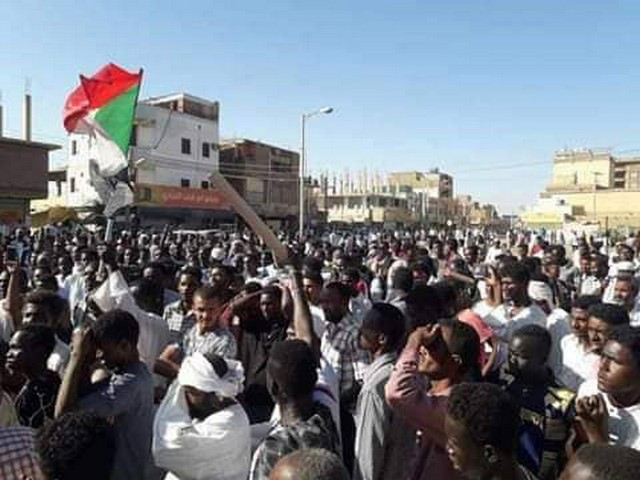
Demonstrators, however, have remained on the streets to demand that the military council hand over power — at the earliest possible date — to a civilian government.

Protest groups remain camped out in front of the army headquarters in Khartoum, calling for civilian rule.

Army threatens protesters demanding democracy

“We will deal with it firmly in accordance with the law,” Sudanese army threatened the protesters demanding democracy and civilian government.

The ruling TMC said Tuesday the army would not accept unrest in the country amidst continuous sit-in outside army headquarters in demand of a civil government.

“We will not accept chaos. We will deal with it firmly in accordance with the law,” Mohamed Hamdan Dagalo, the TMCs vice president said Tuesday. “We do not want to escalate the situation. We are committed to negotiation. After today, there will be no chaotic scenes,” he added.

A curfew and three-month emergency period were announced, which thousands of protesters defied.

Since then thousands of protesters are camping outside the army headquarters in the capital city Khartoum demanding a quick transition to a civil government.

“The military council is a copy cat of the toppled regime. The army is trying to disperse the sit-in by removing the barricades,” said the Sudanese Professionals Association (SPA), one of the leading groups of the movement. “We are calling on our people to come immediately to the sit-in area. We are calling on the revolutionaries to protect the barricades and rebuild them.”

UN support civilian-led transition

The United Nations say they are supporting a civilian-led transitional government in Sudan.

African Union

The African Union recently granted the Sudanese military council a three-month deadline to hand over power to a civilian administration; however, this was rejected by the opposition alliance.

AU Commission Chairman Moussa Faki Mahamat told reporters after meeting Monday with U.N. Secretary-General Antonio Guterres there is no question of sustaining the military council that assumed power after al-Bashir’s ouster, saying, “it is not acceptable.”

Politicians brawled at meeting with TMC

Representatives of political forces for a meeting with the TMC Wednesday over the participation of supporters Sudan’s former ruling party.

The TMC called for a second meeting in capital Khartoum all the forces that had presented their views on the transition period to meet them for a briefing on Wednesday.

Most of these forces were partners to the former government and an ally of the National Congress Party (NCP) of ousted President Omer al-Bashir. They were part of the National Dialogue Initiative and were part of successive Bashir governments.

According to some politicians who attended the meeting, the atmosphere was characterized from the outset by intense tension after the objection of a number of participants to the presence of personalities known for their support to the National Congress Party. Some led campaigns to re-elect President Omer al-Bashir in the 2020 elections.

Some participants chanted slogans against the Council and called for civil authority, forcing the military council members to shorten their interventions and leave the place.

Presence of a large number of members of the National Congress Party and its allies contributed to the spread of more tension to transform the meeting room to an arena of fierce fighting.

Video footage that was widely circulated showed that some of the participants had been kicked out of the seats and clashed with their hands in a state of chaos and tension.

Video footage also showed some of the participants threw chairs against each other and clashed with their hands among chaos and tension.

During the first week, the TMC even refused to recognize the Freedom and Changes forces as the legitimate parent of the revolution.

The Freedom and Change forces say the TMC wants to form a government with these small forces as the opposition refuses to accept its perception of the transitional structures.

Currency crisis deepens

In recent days, the bank machines have only dispensed small sums of cash – about $40 for the lucky few – until the money in the ATMs runs out.

It is not that the people at the bank have no money. They do. The issue, as everyone complains, is that the central bank has not delivered money to the retail banks and so customers have not been able to access their funds.

The crisis is not new. Many cash machines began running out of banknotes in November as the government scrambled to prevent economic collapse with a sharp devaluation and emergency austerity measures, a month before the beginning of the political crisis and protests that brought down the former dictator Omar al-Bashir on April 11.

The currency crisis has been fuelled by longer term and more complex economic problems, not least, a loss of foreign currency since Sudan lost three-quarters of its oil output when the south of the country seceded in 2011.

Now after five long months the shortage of cash is biting hard, despite the promise from Saudi Arabia and the UAE of $3bn in financial aid to help stabilize Sudan’s toxic economic crisis.

It is being felt most acutely, however, on a personal level.

The cash shortage, say some, has created unexpected problems in an economy where people have been selling what they own to get by.

Big ticket items such as house and car sales now have two prices, a cheaper one for those who can pay with ready cash and a higher price for payment by cheque because confidence in the banking system has been seriously eroded.

While some believe the money has been stolen, most of the problems are due to the chronic mismanagement of the former regime.

When the bank did move to devalue the pound by about 40%, it triggered soaring inflation that would become a major factor in the protests that brought down Bashir after three decades in power. An economic crisis has still not played out and could have yet more dramatic consequences.

9 May 2019

Source: countercurrents.org

Will the U.S. Start a War Against Iran?

By Vijay Prashad

On Sunday, May 5, U.S. National Security Adviser John Bolton announced that the USS Abraham Lincoln Carrier Strike Group and a bomber task force had begun to make their way from the Mediterranean Sea toward the coastline of Iran. Iran, Bolton said, had made “a number of troubling and escalatory indications and warnings.” He was, characteristically, not specific. It was enough that Bolton—who has a history of making hazardous statements—had made these comments from the perch of the White House in Washington, D.C. “The United States is not seeking war with the Iranian regime,” he said rather incredulously. After all, what is the arrival of a massive war fleet on the coastline of a country but a declaration of war?

On his way to Europe, U.S. Secretary of State Mike Pompeo said that the “indications and warnings” included actions by the Lebanese political formation Hezbollah. Once more, Pompeo said he would give no evidence. “I don’t want to talk about what underlays it.”

The journey of the USS Abraham Lincoln through the Red Sea comes as the U.S. government tries to tighten its sanctions regime against Iran. Any country that buys Iranian oil, the United States now says, will be liable to have sanctions placed against it. The five countries most vulnerable to further U.S. sanctions are China, India, Japan, South Korea, and Turkey. India, Japan, and South Korea have said that they would try and abide by the new, and harsh, U.S. sanctions. China and Turkey have made it clear that they will not follow the U.S. lead.

Iran’s Economy

Iran’s deputy oil minister Amir Hossein Zamaninia told Iranian state media that his ministry will oversee the sale of Iran’s oil into the “gray market.” The U.S. sanctions, Zamaninia said, are “illegal,” and therefore Iran is entitled to use all kinds of methods to circumvent them. The “gray market” includes loading tankers with Iranian oil—often sold at deep discounts—and then allowing them to alter their signals as they go out into open water. Congestion of tankers on the world’s waters makes it difficult to monitor which tanker has actually come from which port. But even if Iran sells oil on the gray market, the volumes will drop significantly, and this will impact Iran’s external revenues.

In April, the International Monetary Fund projected that Iran’s economy would likely slide downhill by 6 percent in 2019. The main reason for this continued slide is of course the U.S.-led sanctions that have whittled away at Iran’s budget and at the confidence of its people. Iran’s macroeconomic situation is hurt by large-scale budget deficits—projected to reach over $14 billion this year—and the flooding of the market with Iranian rials—so that money supplied grew by over 20 percent. Serious problems of capital flight and of tax evasion dog Iran’s prospects. Kazem Delkhosh, the deputy head of the Iranian parliament’s economic commission, estimates that about 40 percent of the country’s income is hidden from the tax authorities.

It did not help that last month Iran faced devastating floods in the country’s northeast and southwest. The damage is estimated to cost $2.5 billion. Countries that want to send financial support toward the flood victims cannot do so as a result of the U.S. sanctions on financial systems, says the Iranian Red Crescent Society. This is why in-kind aid has been the only thing that has been permitted into the country, with China sending tents and Austria sending blankets. But even in-kind aid, including from Saudi Arabia and the UAE, was blocked due to the U.S. sanctions. Iran’s Foreign Minister Javad Zarif wrote on Twitter, “Iranian Red Crescent can’t receive any funds due to illegal US sanctions. US should own up to its ECONOMIC TERRORISM.”

Tensions

On Wednesday, May 8, Iran’s President Hassan Rouhani will go on television and the radio to announce his country’s response to the U.S. withdrawal from the 2015 nuclear deal and to the harsh new sanctions’ regime.

The United States had permitted Russian and European firms to do work on Iran’s nuclear energy sector. Five waivers had been given to help four Iranian facilities—at the Bushehr nuclear power plant, the Fordow enrichment facility, the Arak nuclear complex and the Tehran Research Reactor. Pompeo allowed three waivers to be extended for 90 days (half the length of the previous waivers) but disallowed two. The two that were not renewed include one to Russia, which had swapped Iranian enriched uranium for Russian raw yellowcake, and one to companies that operate in Oman to store heavy water from Iran. Both Russia and Europe are not happy with this situation. Iran has refused to stop enrichment, which is essential to its nuclear energy program—legal under the terms of the 2015 agreement. It is likely that Rouhani will affirm Iran’s right to continue to enrich uranium for its power reactors.

Last month, Iran’s senior leader Ayatollah Ali Khamenei urged his Iraqi counterparts to “make sure that the Americans withdraw their troops from Iraq as soon as possible because expelling them has become difficult whenever they have had a long military presence in a country.” Iran and Iraq have—since the U.S. war against Iraq in 2003—deepened their ties. Close economic links, including roadways and a potential train, have made both countries dependent on each other (Iraq, despite U.S. pressure, imports Iran’s oil). Khamenei referred to the 5,200 U.S. troops who remain in Iraq. Bolton has said that these troops are there to “watch Iran,” a phrase that has been widely mocked after Trump used it earlier this year.

The war of words has escalated into dangerous territory. In April, Trump’s government called Iranian military forces “terrorists.” In response, the Iranian parliament retaliated. Defense Minister General Amir Hatami put a bill forward that would allow Iran’s government to respond to the “terrorist actions” of U.S. forces. It was not clear how Iran would respond, although the bill suggested that the response could be political and diplomatic rather than military.

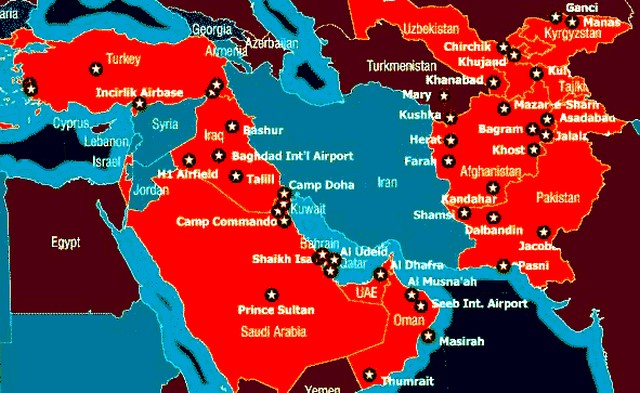
The U.S. government has said that Iran might target U.S. troops in Iraq or elsewhere in the region. These are likely the “indications and warnings” of Bolton. There are tens of thousands of U.S. troops in Afghanistan, Iraq and the Gulf. The U.S. military hardware that encircles Iran is lethal. Late last year, the Iranian government—feeling hemmed in by this military noose—proposed that it could strike U.S. forces at al-Udeid Air Base (Qatar), al-Dhafra base (United Arab Emirates) and Kandahar base (Afghanistan). “They are within our reach,” said Amirali Hajizadeh, who heads Iran’s Revolutionary Guards’ air brigade. As if to provoke Iran further, in March of this year, the United States signed a deal with Oman to use its ports at Salalah and Duqm for military purposes.

Endless Wars

In his state of the union address, Trump said, “Great nations do not fight endless wars.” The United States has tried to push a new deal in Afghanistan and has tried to withdraw from the conflict in Syria. Neither of these withdrawals will be easy.

But if the United States strikes Iran, there is no doubt that the wars from Lebanon to the border of India will become endless. There is no question that Iran—much weaker militarily than the United States—will use its advantages to strike the United States inside Afghanistan and to urge its allies to strike U.S. forces in the Gulf and across North Africa. Iran’s population is deeply patriotic and would see any U.S. strike as one against the Iranian people and not just against the Iranian government. It is unlikely that the United States will find any significant allies amongst the Iranians. A war against Iran at this time would be a war against a stretch of the world that has seen too many wars in recent times, that would like to open the door to peace. Trump—with Bolton and Pence—seek to provoke a war. These are dangerous men with a dangerous agenda.

This article was produced by Globetrotter, a project of the Independent Media Institute.

8 May 2019

Source: countercurrents.org

The Problem Is Capitalism

By George Monbiot

It is a weapon pointed at the living world. We urgently need to develop a new system.

For most of my adult life, I’ve railed against “corporate capitalism”, “consumer capitalism” and “crony capitalism”. It took me a long time to see that the problem is not the adjective, but the noun.

While some people have rejected capitalism gladly and swiftly, I’ve done so slowly and reluctantly. Part of the reason was that I could see no clear alternative: unlike some anti-capitalists, I have never been an enthusiast for state communism. I was also inhibited by its religious status. To say “capitalism is failing” in the 21st century is like saying “God is dead” in the 19th. It is secular blasphemy. It requires a degree of self-confidence I did not possess.

But as I’ve grown older, I’ve come to recognise two things. First, that it is the system, rather than any variant of the system, which drives us inexorably towards disaster. Second, that you do not have to produce a definitive alternative to say that capitalism is failing. The statement stands in its own right. But it also demands another, and different, effort to develop a new system.

Capitalism’s failures arise from two of its defining elements. The first is perpetual growth. Economic growth is the aggregate effect of the quest to accumulate capital and extract profit. Capitalism collapses without growth, yet perpetual growth on a finite planet leads inexorably to environmental calamity.

Those who defend capitalism argue that, as consumption switches from goods to services, economic growth can be decoupled from the use of material resources. Last week, a paper in the journal New Political Economy by Jason Hickel and Giorgos Kallis examined this premise. They found that while some relative decoupling took place in the 20th century (material resource consumption grew, but not as quickly as economic growth), in the 21st there has been a re-coupling: rising resource consumption has so far matched or exceeded the rate of economic growth. The absolute decoupling needed to avert environmental catastrophe (a reduction in material resource use) has never been achieved, and appears impossible while economic growth continues. Green growth is an illusion.

A system based on perpetual growth cannot function without peripheries and externalities. There must always be an extraction zone, from which materials are taken without full payment, and a disposal zone, where costs are dumped in the form of waste and pollution. As the scale of economic activity increases, until capitalism affects everything from the atmosphere to the deep ocean floor, the entire planet becomes a sacrifice zone: we all inhabit the periphery of the profit-making machine.

This drives us towards cataclysm on such a scale that most people have no means of imagining it. The threatened collapse of our life support systems is bigger by far than war, famine, pestilence or economic crisis, though it is likely to incorporate all four. Societies can recover from these apocalyptic events, but not from the loss of soil, an abundant biosphere and a habitable climate.

The second defining element is the bizarre assumption that a person is entitled to as great a share of the world’s natural wealth as their money can buy. This seizure of common goods causes three further dislocations. First, the scramble for exclusive control of non-reproducible assets, which implies either violence or legislative truncations of other people’s rights. Second, the immiseration of other people by an economy based on looting across both space and time. Third, the translation of economic power into political power, as control over essential resources leads to control over the social relations that surround them.

In the New York Times on Sunday, the Nobel economist Joseph Stiglitz sought to distinguish between good capitalism, that he called “wealth creation”, and bad capitalism, that he called “wealth grabbing” (extracting rent). I understand his distinction, but from the environmental point of view, wealth creation is wealth grabbing. Economic growth, intrinsically linked to the increasing use of material resources, means seizing natural wealth from both living systems and future generations.

To point to such problems is to invite a barrage of accusations, many of which are based on this premise: capitalism has rescued hundreds of millions of people from poverty – now you want to impoverish them again. It is true that capitalism, and the economic growth it drives, has radically improved the prosperity of vast numbers of people, while simultaneously destroying the prosperity of many others: those whose land, labour and resources were seized to fuel growth elsewhere. Much of the wealth of the rich nations was – and is – built on slavery and colonial expropriation.

Like coal, capitalism has brought many benefits. But, like coal, it now causes more harm than good. Just as we have found means of generating useful energy that are better and less damaging than coal, so we need to find means of generating human wellbeing that are better and less damaging than capitalism.

There is no going back: the alternative to capitalism is neither feudalism nor state communism. Soviet communism had more in common with capitalism than the advocates of either system would care to admit. Both systems are (or were) obsessed with generating economic growth. Both are willing to inflict astonishing levels of harm in pursuit of this and other ends. Both promised a future in which we would need to work for only a few hours a week, but instead demand endless, brutal labour. Both are dehumanising. Both are absolutist, insisting that theirs and theirs alone is the one true God.

So what does a better system look like? I don’t have a complete answer, and I don’t believe any one person does. But I think I see a rough framework emerging. Part of it is provided by the ecological civilisation proposed by Jeremy Lent, one of the greatest thinkers of our age. Other elements come from Kate Raworth’s doughnut economics and the environmental thinking of Naomi Klein, Amitav Ghosh, Angaangaq Angakkorsuaq, Raj Patel and Bill McKibben. Part of the answer lies in the notion of “private sufficiency, public luxury”. Another part arises from the creation of a new conception of justice, based on this simple principle: every generation, everywhere shall have an equal right to the enjoyment of natural wealth.

I believe our task is to identify the best proposals from many different thinkers and shape them into a coherent alternative. Because no economic system is only an economic system, but intrudes into every aspect of our lives, we need many minds from various disciplines – economic, environmental, political, cultural, social and logistical – working collaboratively to create a better way of organising ourselves, that meets our needs without destroying our home.

Our choice comes down to this. Do we stop life to allow capitalism to continue, or stop capitalism to allow life to continue?

_____________________________________________

About George Monbiot: Here are some of the things I try to fight: undemocratic power, corruption, deception of the public, environmental destruction, injustice, inequality and the misallocation of resources, waste, denial, the libertarianism which grants freedom to the powerful at the expense of the powerless, undisclosed interests, complacency.

6 May 2019

Source: www.transcend.org

‘Endless Trip to Hell’: Israel Jails Hundreds of Palestinian Boys a Year. These Are Their Testimonies

By Netta Ahituv

They’re seized in the dead of night, blindfolded and cuffed, abused and manipulated to confess to crimes they didn’t commit. Every year Israel arrests almost 1,000 Palestinian youngsters, some of them not yet 13.

It was a gloomy, typically chilly late-February afternoon in the West Bank village of Beit Ummar, between Bethlehem and Hebron. The weather didn’t deter the children of the Abu-Ayyash family from playing and frolicking outside. One of them, in a Spiderman costume, acted the part by jumping lithely from place to place. Suddenly they noticed a group of Israeli soldiers trudging along the dirt trail across the way. Instantly their expressions turned from joy to dread, and they rushed into the house. It’s not the first time they reacted like that, says their father. In fact, it’s become a pattern ever since 10-year-old Omar was arrested by troops this past December.

The 10-year-old is one of many hundreds of Palestinian children whom Israel arrests every year: The estimates range between 800 and 1,000. Some are under the age of 15; some are even preteens. A mapping of the locales where these detentions take place reveals a certain pattern: The closer a Palestinian village is to a settlement, the more likely it is that the minors residing there will find themselves in Israeli custody. For example, in the town of Azzun, west of the Karnei Shomron settlement, there’s hardly a household that hasn’t experienced an arrest. Residents say that in the past five years, more than 150 pupils from the town’s only high school have been arrested.

At any given moment, there are about 270 Palestinian teens in Israeli prisons. The most widespread reason for their arrest – throwing stones – does not tell the full story. Conversations with many of the youths, as well as with lawyers and human rights activists, including those from the B’Tselem human-rights organization, reveal a certain pattern, even as they leave many questions open: For example, why does the occupation require that arrests be violent and why is it necessary to threaten young people.

A number of Israelis, whose sensibilities are offended by the arrests of Palestinian children, have decided to mobilize and fight the phenomenon. Within the framework of an organization called Parents Against Child Detention, its approximately 100 members are active in the social networks and hold public events “in order to heighten awareness about the scale of the phenomenon and the violation of the rights of Palestinian minors, and in order to create a pressure group that will work for its cessation,” as they explain. Their target audience is other parents, whom they hope will respond with empathy to the stories of these children.

In general, there seems to be no lack of criticism of the phenomenon. In addition to B’Tselem, which monitors the subject on a regular basis, there’s been a protest from overseas, too. In 2013, UNICEF, the United Nations agency for children, assailed “the ill treatment of children who come in contact with the military detention system, [which] appears to be widespread, systematic and institutionalized.” A report a year earlier from British legal experts concluded that the conditions the Palestinian children are subjected to amount to torture, and just five months ago the Parliamentary Assembly of the Council of Europe deplored Israel’s policy of arresting underage children, declaring, “An end must be put to all forms of physical or psychological abuse of children during arrest, transit and waiting periods, and during interrogations.”

Arrest

About half of the arrests of Palestinian adolescents are made in their homes. According to the testimonies, Israel Defense Forces soldiers typically burst into the house in the middle of the night, seize the wanted youth and whisk him away (very few girls are detained), leaving the family with a document stating where he’s being taken and on what charge. The printed document is in Arabic and Hebrew, but the commander of the force typically fills out the details in Hebrew only, then hands it to parents who may not be able to read it and don’t know why their son was taken.

Attorney Farah Bayadsi asks why it’s necessary to arrest children in this manner, instead of summoning them for questioning in an orderly way. (The data show that only 12 percent of the youths receive a summons to be interrogated.)

“I know from experience that whenever someone is asked to come in for questioning, he goes,” Bayadsi notes. She is a lawyer working with Defense for Children International, a global NGO that deals with the detention of minors and promotion of their rights..

“The answer we generally get,” she says, “is that, ‘It’s done this way for security reasons.’ That means it’s a deliberate method, which isn’t intended to meet the underage youth halfway, but to cause him a lifelong trauma.”

Indeed, as the IDF Spokesman’s Unit stated to Haaretz, in response, “The majority of the arrests, of both adults and minors, are carried out at night for operational reasons and due to the desire to preserve an orderly fabric of life and execute point-specific actions wherever possible.”

About 40 percent of the minors are detained in the public sphere – usually in the area of incidents involving throwing stones at soldiers. That was the case with Adham Ahsoun, from Azzun. At the time, he was 15 and on his way home from a local grocery store. Not far away, a group of children had started throwing stones at soldiers, before running off. Ahsoun, who didn’t flee, was detained and taken to a military vehicle; once inside, he was hit by a soldier. A few children who saw what happened ran to his house to tell his mother. Grabbing her son’s birth certificate, she rushed to the entrance to the town to prove to the soldiers that he was only a child. But it was too late; the vehicle had already departed, headed to an army base nearby, where he would wait to be interrogated.

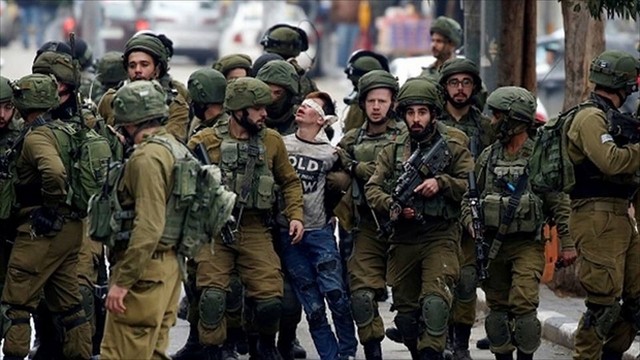
By law, soldiers are supposed to handcuff children with their hands in front, but in many cases it’s done with their hands behind them. Additionally, sometimes the minor’s hands are too small for handcuffing, as a soldier from the Nahal infantry brigade told the NGO Breaking the Silence. On one occasion, he related, his unit arrested a boy “of about 11,” but the handcuffs were too big to bind his small hands.

The next stage is the journey: The youths are taken to an army base or a police station in a nearby settlement, their eyes covered with flannelette. “When your eyes are covered, your imagination takes you to the most frightening places,” says a lawyer who represents young Palestinians. Many of those arrested don’t understand Hebrew, so that once pushed into the army vehicle they are completely cut off from what’s going on around them.

Sometimes the minor’s hands are too small for handcuffing

In most cases, the handcuffed, blindfolded youth will be moved from place to place before actually being interrogated. Sometimes he’s left outside, in the open, for a time. In addition to the discomfort and the bewilderment, the frequent moving around presents another problem: In the meantime many acts of violence, in which soldiers beat the detainees, take place and go undocumented.

Once at the army base or police station, the minor is placed, still handcuffed and blindfolded, on a chair or on the floor for a few hours, generally without being given anything to eat. The “endless trip to hell” is how Bayadsi describes this process. Memory of the incident, she adds, “is still there even years after the boy’s release. It implants in him an ongoing feeling of a lack of security, which will stay with him for his whole life.”

Testimony provided to Breaking the Silence by an IDF staff sergeant about one incident in the West Bank illustrates the situation from the other side: “It was the first night of Hanukkah. Two children were throwing stones on Highway 60, on the road. So we grabbed them and took them to the base. Their eyes were covered with flannelette, and they were handcuffed in front with plastic cuffs. They looked young, between 12 and 16 years old.”

When the soldiers gathered to light the first candle of the Hanukkah holiday, the detainees remained outside. “We’re shouting and making noise and using drums, which is a kind of company thing,” the soldier recalled, noting that he assumed the kids didn’t know Hebrew, although maybe they did understand the curses they heard. “Let’s say sharmuta [slut] and other words they might know from Arabic. How could they know we aren’t talking about them? They’ll probably thought that in another minute we were going to cook them.”

Interrogation

The nightmare can be of differing duration, the former detainees relate. Three to eight hours after the arrest, by which time the youth is tired and hungry – and sometimes in pain after being hit, frightened by threats and not even knowing why he’s there – he’s taken in for interrogation. This may be the first time the blindfold is removed and his hands freed. The process usually starts with a general question, such as, “Why do you throw stones at soldiers?” The rest is more intense – a barrage of questions and threats, aimed at getting the teen to sign a confession. In some cases, he’s promised that if he signs he’ll be given something to eat.

According to the testimonies, the interrogators’ threats are directed squarely at the boy (“You’ll spend your whole life in jail”), or at his family (“I’ll bring your mother here and kill her before your eyes”), or at the family’s livelihood (“If you don’t confess, we’ll take away your father’s permit to work in Israel – because of you, he’ll be out of work and the whole family will go hungry”).

In some cases, he’s promised that if he signs he’ll be given something to eat.

“The system shows that the intention here is more to demonstrate control than to engage in enforcement,” suggests Bayadsi. “If the boy confesses, there’s a file; if he doesn’t confess, he enters the criminal circle anyway and is seriously intimidated.”

Imprisonment

Whether the young detainee has signed a confession or not, the next stop is prison. Either Megiddo, in Lower Galilee, or Ofer, north of Jerusalem. Khaled Mahmoud Selvi was 15 when he was brought to prison in October 2017 and was told to disrobe for a body search (as in 55 percent of the cases). For 10 minutes he was made to stand naked, along with another boy, and in winter.

The months in detention, waiting for trial, and later, if they are sentenced, are spent in the youth wing of the facilities for security prisoners. “They don’t speak with their families for months and are allowed one visit a month, through glass,” Bayadsi relates.

Far fewer Palestinian girls are arrested than boys. But there is no facility specially for them, so they are held in the Sharon prison for women, together with the adults.

The trial

The courtroom is usually the place where parents have their first sight of their child, sometimes several weeks after the arrest. Tears are the most common reaction to the sight of the young detainee, who will be wearing a prison uniform and handcuffs, and with a cloud of uncertainty hovering over everything. Israel Prisons Service guards don’t allow the parents to approach the youth, and direct them to sit on the visitors’ bench. Defense counsel is paid for either by the family or by the Palestinian Authority.

At a recent remand hearing for several detainees, one boy didn’t stop smiling at the sight of his mother, while another lowered his eyes, perhaps to conceal tears. Another detainee whispered to his grandmother, who had come to visit him, “Don’t worry, tell everyone I’m fine.” The next boy remained silent and watched as his mother mouthed to him, “Omari, I love you.”

While the children and their family try to exchange a few words and looks, the proceedings move along. As though in a parallel universe.

The deal

The vast majority of trials for juveniles ends in a plea bargain – safka in Arabic, a word Palestinian children know well. Even if there is no hard evidence to implicate the boy in stone-throwing, a plea is often the preferred option. If the detainee doesn’t agree to it, the trial could last a long time and he will be held in custody until the proceedings end.

Conviction depends almost entirely on evidence from a confession, says lawyer Gerard Horton, from the British-Palestinian Military Court Watch, whose brief, according to its website, involves “monitoring the treatment of children in Israeli military detention.” According to Horton, who is based in Jerusalem, the minors will be more prone to confess if they don’t know their rights, are frightened and get no support or relief until they confess. Sometimes a detainee who does not confess will be told that he can expect to face a series of court appearances. At some stage, even the toughest youth will despair, the lawyer explains.

The IDF Spokesman’s Unit stated in response: “The minors are entitled to be represented by an attorney, like any other accused, and they have the right to conduct their defense in any way they choose. Sometimes they choose to admit to guilt within the framework of a plea bargain but if they plead not guilty, a procedure involving hearing evidence is conducted, like the proceedings conducted in [civilian courts in] Israel, at the conclusion of which a legal decision will be handed down on the basis of the evidence presented to the court. The deliberations are set within a short time and are conducted efficiently and with the rights of the accused upheld.”

Managing the community

According to data of collected by the British-Palestinian NGO, 97 percent of the youths arrested by the IDF live in relatively small locales that are no more than two kilometers away from a settlement. There are a number of reasons for this. One involves the constant friction – physical and geographical – between Palestinians, on the one hand, and soldiers and settlers. However, according to Horton, there is another, no less interesting way to interpret this figure: namely, from the perspective of an IDF commander, whose mission is to protect the settlers.

In the case of reported stone-throwing incidents, he says, the commander’s assumption is that the Palestinians involved are young, between the ages of 12 and 30, and that they come from the nearest village. Often the officer will turn to the resident collaborator in the village, who provides him with the names of a few boys.

The next move is “to enter the village at night and arrest them,” Horton continues. “And whether these youths are the ones who threw the stones or not, you have already put a scare into the whole village” – which he says is an “effective tool” for managing a community.

“When so many minors are being arrested like this, it’s clear that some of them will be innocent,” he observes. “The point is that this has to be happening all the time, because the boys grow up and new children appear on the scene. Each generation must feel the strong arm of the IDF.”

According to the IDF Spokesperson’s Unit: “In recent years, many minors, some of them very young, have been involved in violent incidents, incitement and even terrorism. In these cases, there is no alternative but to institute measures, including interrogation, detention and trial, within the limits of and according to what is stipulated by law. As part of these procedures, the IDF operates to uphold and preserve the rights of the minors. In enforcing the law against them, their age is taken into account.

“Thus, since 2014, among other measures, in certain instances, the minors are invited to the police station and are not arrested at home. In addition, proceedings relating to minors take place in the military court for juveniles, which examines the seriousness of the offense that’s attributed to the minor and the danger it poses, while taking into consideration his young age and his particular circumstances. Every allegation of violence on the part of IDF soldiers is examined, and cases in which the soldiers’ actions are found to be flawed are treated sternly.”

The Shin Bet security service stated in response: “The Shin Bet, together with the IDF and the Israel Police, operates against every element that threatens to harm Israel’s security and the country’s citizenry. The terrorist organizations make extensive use of minors and recruit them to carry out terrorist activity, and there is a general tendency to involve minors in terrorist activity as part of local initiatives.

“Interrogations of suspected terrorists are conducted by the Shin Bet under the law, and are subject to supervision and to internal and external review, including by all levels of the court system. The interrogations of minors are carried out with extra sensitivity and with consideration of their young age.”

Khaled Mahmoud Selvi, arrested at 14 (October 2017)

“I was arrested when I was 14, all the boys in the family were arrested that night. A year later, I was arrested again, with my cousin. They said I burned tires. It happened when I was sleeping. My mother woke me up. I thought it was time for school, but when I opened my eyes I saw soldiers above me. They told me to get dressed, handcuffed me and took me outside. I was wearing a short-sleeved shirt and it was cold that night. My mother begged them to let me put on a jacket, but they didn’t agree. Finally, she threw the jacket on me, but they didn’t let me put my arms in the sleeves.

“They took me to the Karmei Tzur settlement with my eyes covered, and I had the feeling that they were just driving in circles. When I walked, there was a pit in the road and they pushed me into it, and I fell. From there they took me to Etzion [police station]. There they put me in a room, and soldiers kept coming in all the time and kicking me. Someone passed by and said that if I didn’t confess, they would leave me in jail for the rest of my life.

“At 7 A.M., they told me the interrogation was starting. I asked to go to the toilet before. My eyes were covered and a soldier put a chair in front of me. I tripped. The interrogation went on for an hour. They told me that they saw me burning tires and that it interfered with air traffic. I told them it wasn’t me. I didn’t see a lawyer until the afternoon, and he asked the soldiers to bring us food. It was the first time I had eaten since being arrested the night before.

Someone passed by and said that if I didn’t confess, they would leave me in jail for the rest of my life.

“At 7 P.M., I was sent to Ofer Prison, and I remained there for six months. In that period, I was in court more than 10 times. And there was also another interrogation, because a friend of mine was told while being questioned that if he didn’t confess and inform on me, they would bring his mother and shoot her before his eyes. So he confessed and informed. I’m not angry at him. It was his first arrest, he was scared.”

Khaled Shtaiwi, arrested at 13 (November 2018)

Khaled’s story is told by his father, Murad Shatawi: “On the night he was arrested, a phone call from my nephew woke me up. He said the house was surrounded by soldiers. I got up and got dressed, because I expected them to arrest me, on account of the nonviolent demonstrations I organize on Fridays. I never imagined they’d take Khaled. They asked me for the names of my sons. I told them Mumen and Khaled. When I said Khaled, they said, ‘Yes, him. We’re here to take him.’ I was in shock, so many soldiers showed up to arrest a boy of 13.

“They handcuffed and blindfolded him and led him east on foot, toward the settlement of Kedumim, all the while cursing and hitting him a little. I saw it all from the window. They gave me a document showing that it was a legal arrest and I could come to the police station. When I got there, I saw him through a small hole in the door. He was handcuffed and blindfolded.

“He stayed like that from the moment they arrested him until 3 P.M. the next day. That’s a picture that doesn’t leave me; I don’t know how I’ll go on living with that picture in my head. He was accused of throwing stones, but after four days they released him, because he didn’t confess and there was no other evidence against him. During the trial, when the judge wanted to speak to Khaled, he had to lean forward in order to see him, because Khaled was so small.

“What was it like to see him like that? I am the father. That says it all. He hasn’t talked about it since getting out, three months ago. That’s a problem. I’m now organizing a ‘psychology day’ in the village, to help all the children here who have been arrested. Out of 4,500 people in the village, 11 children under the age of 18 have been arrested; five were under the age of 15.”

Omar Rabua Abu Ayyash, arrested at age 10 (December 2018)

Omar looks small for his age. He’s shy and quiet, and it’s hard to talk to him about the arrest, so members of his family recount the events in his place.

Omar’s mother: “It happened at 10 A.M. on Friday, when there is no school. Omar was playing in the area in front of the house, he threw pebbles at birds that were chirping in the tree. The soldiers, who were in the watchtower across the way here, picked up on what he was doing and ran toward him. He ran, but they caught him and knocked him down. He started to cry, and he wet his pants. They kicked him a few times.

“His grandmother, who lives here below, immediately went out and tried to take him from the soldiers, which caused a struggle and shouts. In the end, they left him alone and he went home and changed into dry pants. A quarter of an hour later, the soldiers came back, this time with their commander, who said he had to arrest the boy for throwing stones. When the other children in the family saw the soldiers in the house, they also wet their pants.”

Omar’s father takes up the story: “I told the commander that he was under 12 and that I had to accompany him, so I rode with him in the jeep to the Karmei Tzur settlement. There the soldiers told him not to throw stones anymore, and that if he saw other children doing it, he should tell them. From there they took him the offices of the Palestinian Authority in Hebron. The whole story took about 12 hours. They gave him a few bananas to eat during those hours. Now, whenever the children see a military jeep or soldiers, they go inside. They’ve stopped playing outside since then. Before the incident, soldiers used to come here to play soccer with the children. Now they’ve stopped coming, too.”

Tareq Shtaiwi, arrested at 14 (January 2019)

“It was around 2 P.M. I had a fever that day, so Dad sent me to my cousin next door, because that’s almost the only place in the village with a heating unit. Suddenly soldiers showed up. They saw me watching them from the window, so they fired shots at the door of the building, knocked it down and started to come upstairs. I got scared, so I ran from the second floor to the third, but they stopped me on the way and took me outside. The soldiers wouldn’t let me take my coat, even though it was cold and I was sick. They took me on foot to Kedumim, handcuffed and blindfolded. They sat me on a chair. I heard doors and windows being slammed hard, I think they were trying to scare me.

They didn’t have prisoners uniforms in my size. I was the youngest person in the prison.

“After a while, they took me from Kedumim to Ariel, and I was there for five-six hours. They accused me of throwing stones a few days earlier with my friend. I told them I hadn’t thrown any stones. In the evening they moved me to the Hawara detention building; one of the soldiers told me I would never leave there. In the morning I was moved to Megiddo Prison. They didn’t have prisoners uniforms in my size, so they gave me clothes of Palestinian children who had been there before and left them for the next in line. I was the youngest person in the prison.

“I had three court hearings, and after 12 days, at the last hearing, they told me that it was enough, that my father would pay a fine of 2,000 shekels [$525] and I was getting a three-year suspended sentence. The judge asked me what I intended to do after getting out, I told him I would go back to school and I wouldn’t go up to the third floor again. Since my arrest, my younger brother, who’s 7, has been afraid to sleep in the kids’ room and goes to sleep with our parents.”

Adham Ahsoun, arrested in October 2018, on his 15th birthday

“On my 15th birthday, I went to the store in the village center to buy a few things. Around 7:30 in the evening, soldiers entered the village and children started to throw stones at them. On the way home with my bag, they caught me. They took me to the entrance of the village and put me in a jeep. One of the soldiers started to hit me. Then they put plastic handcuffs on me and covered my eyes and took me like that to the military base in Karnei Shomron. I was there for about an hour. I couldn’t see a thing, but I had the feeling that a dog was sniffing me. I was afraid. From there they took me to another military base and left me there for the night. They didn’t give me anything to eat or drink.

“In the morning, they moved me to the interrogation facility in Ariel. The interrogator told me that the soldiers caught me throwing stones. I told him that I hadn’t thrown stones, that I was on my way home from the store. So he called the soldiers into the interrogation room. They said, ‘He’s lying, we saw him, he was throwing stones.’ I told him that I really hadn’t thrown stones, but he threatened to arrest my mother and father. I panicked. I asked him, ‘What do you want from me?’ He said he wanted me to sign that I threw stones at soldiers, so I signed. The whole time I didn’t see or talk to a lawyer.

“My plea bargain was that I would confess and get a five-month jail sentence. Afterward, they gave me one-third off for good behavior. I got out after three months and a fine of 2,000 shekels. In jail I tried to catch up with the material I missed in school. The teachers told me they would only take into account the grades of the second semester, so it wouldn’t hurt my chances of being accepted for engineering studies in university.”

Muhmen Teet, arrested at 13 (November 2017)

“At 3 A.M., I heard knocking on the door. Dad came into the room and said there were soldiers in the living room and wanted us to show ID cards. The commanding officer told my father that they were taking me to Etzion for questioning. Outside, they handcuffed and blindfolded me and put me in a military vehicle. We went to my cousin’s house; they also arrested him. From there we went to Karmei Tzur and waited, handcuffed and blindfolded, until the morning.

“In the morning, they only took my cousin for interrogation, not me. After his interrogation, they took us to Ofer Prison. After a day there, they took us back to Etzion and said they were going to interrogate me. Before the interrogation, they took me into a room, where there was a soldier who slapped me. After he hit me in one room, he took me to the interrogation room. The interrogator said I was responsible for burning tires, and because of that the grove near the house caught fire. I said it wasn’t me, and I signed a document that the interrogator gave me. The document was also printed in Arabic, but the interrogator filled it out in Hebrew. I was taken back to Ofer Prison.

“I had seven hearings in court, because at the first hearing I said I hadn’t intended to confess, I just didn’t understand what I signed and it wasn’t true. So they sent me back for another interrogation. Again I didn’t confess. Then they sent me to interrogation another time and again I didn’t confess. That’s what it was like in three interrogations. In the end, my lawyer did a deal with the prosecutor that if I confessed in court – which I did – and my family would pay 4,000 shekels, they would release me.

“I’m a good student, I like soccer, both playing and watching it. Since the arrest I hardly wander around outside.”

Khalil Zaakiq, arrested at age 13 (January 2019)

“Around 2 A.M. someone knocked on the door. I woke up and saw a lot of soldiers in the house. They said we should all sit in the living room sofa and not move. The commander called Uday, my big brother, told him to get dressed and informed him that he was under arrest. It was the third time they arrested him. My father was also once under arrest. Suddenly they told me to put my shoes on too and go with them.

“They took us out of the house and tied our hands and covered our eyes. We went like that on foot to the base in Karmei Tzur. There they sat me on the floor with hands tied and eyes covered for around three hours. At about 5 A.M., they moved us to Etzion. On the way there in the jeep they hit us, they slapped me. In Etzion, I was sent to be checked by a doctor. He asked if I had been beaten and I said yes. He didn’t do anything, only checked my blood pressure and said I could stand up to an interrogation.

“My interrogation started at 8 A.M.. They asked me to tell them which children throw stones. I said I didn’t know, so the interrogator gave me a slap. The interrogation went on for four hours. Afterward, they put me into a dark room for 10 minutes and then took me back to the interrogation room, but now they only fingerprinted me and put me into a detention cell for an hour. After an hour, Uday and I were moved to Ofer Prison. I didn’t sign a confession, neither about myself nor about others.

“I got out after nine days, because I wasn’t guilty of anything. My parents had to pay 1,000 shekels for bail. My little brother, who is 10, has been really afraid ever since. Whenever someone knocks at the door, he wets his pants.”

________________________________________________

Netta Ahituv – Haaretz Contributor

6 May 2019

Source: www.transcend.org

US-Backed Saudi Regime Beheads 37 Political Prisoners

By Bill Van Auken

The monarchical dictatorship of Saudi Arabia announced on Tuesday [23 Apr] that it had carried out another killing spree, publicly executing 37 people in the cities of Riyadh, Medina and Mecca, as well as in central Qassim Province and in the kingdom’s Eastern Province.

One of the headless corpses was then crucified and left hanging in public as a hideous warning to anyone who would even contemplate opposing the absolute power of the ruling royal family admired by Pres. Trump.

The regime announced that those who were brought into public squares to be decapitated with swords had been punished “for adopting terrorist and extremist thinking and for forming terrorist cells to corrupt and destabilize security.”

In Saudi Arabia, an antiterrorism law adopted in 2017 defines as a “terrorist” anyone “disturbing public order,” “shaking the security of the community and the stability of the State” or “exposing its national unity to danger.” The law essentially provides the death penalty for anyone daring to criticize the Saudi monarchy or its de facto ruler, Crown Prince Mohammed bin Salman.

Under bin Salman, the Trump administration’s closest ally in the Arab world, the number of executions has doubled. While last year, the regime beheaded 149 people, it has already chopped off the heads of 105 people in 2019.

It is known that at least 33 of the 37 put to death this week were Saudi Shias. In the case of 14 of them, their alleged “crimes” stemmed from the mass protests that swept Saudi Arabia’s predominantly Shiite Eastern Province in 2011, expressing popular demands for democratic reforms and an end to the discrimination and oppression of the Shiite population at the hands of a Sunni monarchy, whose rule is bound up with the official, state-sponsored religious doctrine of Wahhabism, an ultraconservative Sunni sect.

Another 11 were accused of spying for Iran.

None of these individuals were allowed to speak to lawyers during investigations that were carried out by means of torture. They were denied visits from their families and kept in solitary confinement during these ordeals, and were sentenced to death in sham mass trials that lacked even a modicum of due process.

The barbaric mass state murders carried out by the regime in Riyadh constituted a calculated political act driven by both domestic and international objectives. Its immediate aim is to intimidate the Shia minority, which constitutes approximately 15 percent of the population and is concentrated in the Eastern Province, a key oil-producing region.

At least three of those put to death were minors at the time of their alleged offenses, making their executions a flagrant violation of international law barring the death penalty for children.

Abdulkarim al-Hawaj, was 16 when he was arrested and charged with participating in demonstrations and using social media to incite opposition to the monarchy. He also was alleged to have helped make banners with slogans denouncing the regime. He was convicted based on a confession extracted through torture, including electric shocks and being held with his hands chained above his head.

Salman Qureish was arrested just after his 18th birthday for alleged crimes that took place when he was a juvenile. Denied his basic legal rights, he was sentenced to death in a mass trial.

Mujtaba al-Sweikat was 17 when he was arrested at King Fahd International Airport, grabbed as he prepared to board a plane to the United States to begin life as a student at Western Michigan University. He was severely tortured and beaten, including on the soles of his feet, until he provided his torturers with a confession.

The faculty at Western Michigan University issued a statement in 2017 in response to the news of al-Sweikat’s imprisonment:

“As academics and teachers, we take pride in defending the rights of all people, wherever they may be in the world, to speak freely and debate openly without hindrance or fear. We publicly declare our support for Mujtaba’a and the 13 others facing imminent execution. No one should face beheading for expressing beliefs in public protests.

“Mujtaba’a showed great promise as an applicant for English language and pre-finance studies. He was arrested at the airport gates as he readied to board a plane to visit our campus. We were unaware that at the moment we were ready to welcome him, he was locked away, beaten and tortured and made to ‘confess’ to acts for which he was condemned to death.”

The Saudi regime, headed by its de facto ruler Prince Mohammed bin Salman, ignored this protest along with others from United Nations and human rights organizations, convinced that it enjoys absolute impunity based upon the support it enjoys from Washington.

The bloodbath organized by the Saudi regime on Tuesday was the largest since 2016, when it beheaded 47 men in a single day, including the prominent Shia cleric Sheikh Nimr Baqral-Nimr, a leading spokesman for Saudi Arabia’s oppressed Shiite minority. The state killings touched off angry protests in the region, including in Tehran, where crowds stormed the Saudi embassy. The furor was seized upon by Riyadh as the pretext for breaking diplomatic relations with Tehran and escalating its anti-Iranian campaign throughout the Middle East.

Since then, relentless repression in the Eastern Province has been joined with the near-genocidal war that is being waged by Saudi-led forces against Yemen, claiming the lives of at least 80,000 Yemenis and leaving more than 24 million people—80 per cent of the population—in need of humanitarian assistance, many of them on the brink of starvation.

The Sunni monarchy views the rise of the Houthi rebels in Yemen as a potential threat to its own internal situation, fearing that it could inspire the oppressed Shia population to revolt.

The main responsibility for the crimes of the Saudi regime rests with its principal patron, US imperialism. The savage monarchy in Saudi Arabia, with its public beheadings, is not merely some remnant of feudal backwardness. It is rather the direct product of US imperialist intervention in the Middle East, from the concessions secured by Texaco and Standard Oil in the 1930s and 1940s to the current massive arms sales that make the Saudi monarchy today’s number one customer of the US military-industrial complex.

Washington has responded to the mass beheadings in Saudi Arabia with a deafening silence. While the day before the beheadings were announced, the State Department issued a statement in connection with its severe tightening of punishing sanctions against Iran, demanding that it “respect the rights of its people,” there was no such appeal to Riyadh, much less any condemnation of minors having their heads chopped off in public squares.

The Pentagon and the CIA are full partners in the Saudi monarchy’s repression at home, just as the US has provided the bombs and targeting information, along with the midair refueling of Saudi bombers, that have made possible the criminal war against Yemen.

While the savage state murder and dismemberment of the dissident Saudi journalist Jamal Khashoggi at the monarchy’s consulate in Istanbul last October touched off a brief flurry of recriminations against Saudi Arabia, this heinous crime has largely been forgotten.

While Riyadh is going through the motions of a trial of 15 state officials charged with carrying out the gruesome killing, no action is being taken against Crown Prince bin Salman, who ordered the killing, or his senior adviser, Saud al-Qahtani, who reportedly supervised the torture, murder and dismemberment of Khashoggi via a Skype connection from Riyadh.

Barely a year ago, Crown Prince bin Salman was feted as a “reformer” by the US government, Harvard and MIT, as well as a host of US billionaires, from Bill Gates to Jeff Bezos and Oprah Winfrey.

With the media’s attention to the Khashoggi murder grown cold, this myth is once again being revived, even in the face of the mass beheadings. The day after the executions, top Wall Street financiers took the stage with regime representatives at a financial conference sponsored by the monarchy in Riyadh.

BlackRock CEO Larry Fink, HSBC CEO John Flint and JPMorgan’s Chief Operating Officer Daniel Pinto were all present, along with Morgan Stanley’s Asia managing director, Chin Chou, all of them anxious to cash in on a proposed initial public offering (IPO) by its national oil giant Aramco.

BlackRock’s Fink brushed off a question about the mass executions, stating, “The fact that there are issues in the press does not tell me I must run away from a place. In many cases it tells me I should run to and invest because what we are most frightened of are things that we don’t talk about.”

The executions in Saudi Arabia provide an appropriate prism for viewing the entire US policy in the Middle East. The bloodbath is a manifestation of the predatory aims pursued by US imperialism in the region. Washington’s defense of and reliance upon this ultrareactionary regime exposes all of the pretexts given for successive US military interventions, from the so-called “war on terrorism” to the supposed promotion of “democracy” and “human rights.”

In the end, a US foreign policy that is founded upon a strategic alliance with the House of Saud will inevitably prove to be a house of cards that will come crashing down with the revival of the class struggle in the Middle East, the United States and internationally.

______________________________________

Bill Van Auken | WSWS – TRANSCEND Media Service

6 May 2019

Source: www.transcend.org

The Complete Mercenary [Terrorist?]: How Erik Prince Used the Rise of Trump to Make an Improbable Comeback

By Matthew Cole

When Erik Prince arrived at the Four Seasons resort in the Seychelles in January 2017 for his now-famous meetings with a Russian banker and UAE ruler Mohammed bin Zayed, he was in the middle of an unexpected comeback. The election of Donald Trump had given the disgraced Blackwater founder a new opportunity to prove himself. After years of trying and failing to peddle a sweeping vision of mercenary warfare around the world, Erik Prince was back in the game.

Bin Zayed had convened a group of close family members and advisers at the luxurious Indian Ocean resort for a grand strategy session in anticipation of the new American administration. On the agenda were discussions of new approaches for dealing with the civil wars in Yemen, Syria, and Libya, the threat of the Islamic State, and the United Arab Emirates’ longstanding rivalry with Iran. Under bin Zayed’s leadership, the UAE had used its oil wealth to become one of the world’s largest arms purchasers and the third largest importer of U.S. weapons. A new American president meant new opportunities for the tiny Gulf nation to exert its outsized military and economic influence in the Gulf region and beyond.

Prince was no stranger to the Emiratis. He had known bin Zayed, the crown prince of Abu Dhabi and de facto ruler of the UAE, since 2009, when he sold the sheikh on creating an elite counterterrorism unit. That deal ended badly for Prince, but Trump’s election had recalibrated his usefulness. As a prominent Trump supporter and close associate of Steve Bannon, not to mention the brother of incoming cabinet member Betsy DeVos, Prince was invited to the meeting as an unofficial adviser to the incoming administration.

Prince’s meeting with a Putin intimate shortly before Trump’s inauguration has drawn intense interest from Congress, the Mueller investigation, and the press.

When Prince joined the Emirati royals and other government officials on a deck overlooking the Indian Ocean, bin Zayed made it clear to everyone there that “Erik was his guy,” said a source close to the Emirati rulers, who was briefed by some of those in attendance. Prince, in bin Zayed’s view, had built and established an elite ground force that bin Zayed had deployed to wars in Syria and Yemen, the first foreign conflicts in his young country’s history. It was because of Prince, bin Zayed said, that the Emiratis had no terrorists in their country. Prince had solved their problem with Somali pirates. “He let his court know that they owed Erik a favor,” the source said.

Part of that favor apparently involved facilitating an introduction to Kirill Dmitriev, CEO of an $8 billion Russian sovereign wealth fund and a close associate of President Vladimir Putin. Prince repeatedly and under oath in testimony to Congress denied that his meeting with Dmitriev had anything to do with the Trump administration, describing it as no more than a chance encounter over a beer.

“We were talking about the endless war and carnage in Iraq and Syria,” Prince told the House Intelligence Committee. “If Franklin Roosevelt can work with Joseph Stalin after the Ukraine terror famine, after killing tens of millions of his own citizens, we can certainly at least cooperate with the Russians in a productive way to defeat the Islamic State.”

Although the UAE has been a very good customer of U.S. arms dealers, bin Zayed had grown frustrated with the Obama administration’s refusal to work with Russia to end the war in Syria. Russia was actively courting the UAE, and from bin Zayed’s perspective Russia was a key player that couldn’t be ignored, according to a current and a former U.S. intelligence official. Trump’s public infatuation with Putin and his apparent eagerness to improve relations with Russia gave the UAE a chance to play dealmaker and diminish Iran’s position in the Middle East, starting with the war in Syria.

Prince’s 30-minute meeting with a Putin intimate shortly before Trump’s inauguration has drawn intense interest from Congress, the Mueller investigation, and the press. The Mueller report established that the meeting was a pre-arranged attempt to establish a backchannel between Russia and the incoming Trump administration and has led House Intelligence Committee chair Adam Schiff to make a criminal referral to the Justice Department for perjury. Yet the focus on Russian interference with the 2016 presidential election has deflected scrutiny from what the meeting reveals about Prince’s unique role in the world of covert services.

Blackwater made Prince an infamous symbol of U.S. foreign policy hubris, but America’s most famous mercenary has moved on. Although he continues to dream of deploying his military services in the world’s failed states, and persists in hawking a crackpot scheme of privatizing the U.S. war in Afghanistan, Prince has diversified his portfolio. No longer satisfied with contracting out former special forces operators to the State Department and Pentagon, Prince is now attempting to offer an entire supply chain of warfare and conflict. He wants to be able to skim a profitable cut from each stage of a hostile operation, whether it be overt or covert, foreign or domestic. His offerings range from the traditional mercenary toolkit, military hardware and manpower, to cellphone surveillance technology and malware, to psychological operations and social media manipulation in partnership with shadowy operations like James O’Keefe’s Project Veritas.

This account is based on interviews with more than a dozen of Prince’s former colleagues and peers, as well as court records, emails, and internal documents provided to The Intercept. An examination of Prince’s time working with the UAE in particular reveals suspicious financial transactions at a moment when his personal finances were under stress and his mercenary ventures were failing. The picture that emerges is one of a man desperately trying to avoid U.S. tax and weapons trafficking laws even as he offers military services, without a license, in no fewer than 15 countries around the world.

Prince’s former and current associates describe him as a visionary, a brilliant salesman with remarkable insight into the future of warfare, who is nonetheless so shady and incompetent that he fails at almost every enterprise he attempts. And yet he endures. Prince is thus, in many ways, an emblematic figure for the Trump era.

Suitcases Full of Cash

Prince’s partnership with bin Zayed got underway, fittingly, with a slapstick moment in early 2010, when two of Prince’s men, a veteran of the Canadian special forces and a Lebanese fixer, were ordered by Emirati security officials to meet at an Abu Dhabi intersection. There, a few government employees helped Prince’s men load the trunk of a Chevy Impala with more than half a dozen carry-on suitcases, most worn and with busted wheels. The two drove back to their hotel, Le Méridian, where they unloaded the bags, returned to their room, and summoned their immediate supervisor, a former Navy SEAL who had known Prince in the military, telling the American that they had a problem. Their new company, Reflex Responses, often called R2 for short, was so new it didn’t yet have a bank account or even an office with a safe.

When the former SEAL entered their hotel room, the contents of the suitcases had been largely removed, much of it dumped onto a bed: bricks of new, sequential $100 bills, in $10,000 stacks, each bound by a green and white band. The three men counted each stack, measuring the height to be sure that they all had 100 $100 bills, until they tallied it all: roughly $13 million. For the first two weeks of the program, the hotel room, always occupied by a security guard or a company employee, served as the Reflex Responses vault. Hotel staff were not allowed to clean the room, and by the time R2 opened a bank account and deposited the money, the room was covered in empty whiskey bottles and ashtrays overflowing with cigarette butts.

Prince had arrived in the UAE at a low moment. The Obama administration had made clear in its first months that it would not welcome new Blackwater contracts. The company had become infamous after Blackwater security contractors shot and killed 17 Iraqi civilians and wounded dozens more in Baghdad’s Nisour Square in 2007. By 2010, Prince had changed Blackwater’s name and sold the company, ceasing to work on any U.S. government contracts. As Prince negotiated a settlement with the Justice Department for a series of Blackwater arms trafficking violations, then-CIA Director Leon Panetta discovered a secret assassination program involving Blackwater operatives that former Vice President Dick Cheney had hidden from Congress. Prince was bitter, blaming the Obama administration for leaking his CIA role and comparing himself to exposed CIA operative Valerie Plame. Prince couldn’t understand why the American public viewed him as a villain. “He was genuinely upset,” said a former colleague who discussed the public scrutiny of Blackwater. “He kept asking, ‘Why do they hate me?’”

A converted Catholic raised by Christian fundamentalists and the scion of a Midwestern auto-parts fortune would seem to be an unlikely ally to the Muslim crown prince of a tiny, oil-rich Arab kingdom, but from their first meeting in 2009, Prince and bin Zayed hit it off. Almost immediately it was clear they shared common enemies: Islamic militants and, especially, Iran. Prince was introduced to bin Zayed after pitching a two-page schematic of a light attack airplane — an agricultural crop duster modified with surveillance and laser-guided munitions — to the Emirati government as the Blackwater sale to a private equity group was being negotiated. When the Emirati ambassador to the U.S., Yousef Al Otaiba, learned that Prince’s legal problems with the Justice Department would mean that he wouldn’t be able to be involved in building, selling, or brokering armed aircraft, the Emirati government approached another aviation manufacturer to help establish an entire air wing of armored and weaponized crop dusters. In exchange for Prince bowing out of the deal quietly, Otaiba introduced him to bin Zayed explicitly in order to find another role in which he could assist the UAE government.

Bin Zayed was determined to bolster the UAE’s sphere of influence and project power in the Middle East. Despite Prince’s tarnished reputation, bin Zayed saw in him a glimpse of the future. It didn’t hurt that “Erik could sell you your own hat,” according to one former associate. The former SEAL and self-described CIA “asset” saw in bin Zayed a willing buyer who shared his desire to play soldier. Prince sold bin Zayed on the idea of creating a half-billion-dollar program in which he would train, equip, and lead an elite cadre of foreign soldiers called the Security Support Group that would serve as a presidential guard for the Emirati monarchies and help quell any internal unrest. Bin Zayed insisted that Prince use non-Muslim ex-soldiers, according to two senior advisers who helped build the unit, telling him that he did not believe Muslim soldiers could be trusted to kill other Muslims. Eventually, Prince also sold bin Zayed on the creation of an armed aviation wing, a team to protect the Emirates from a weapons of mass destruction attack, and a separate force to combat Somali piracy.

One indication of both Prince and R2’s growing value to bin Zayed was that Prince became a favored foreign policy and military adviser, joining bin Zayed’s inner sanctum. Prince told his colleagues at R2 that bin Zayed, whom Prince often referred to as “the boss,” gave him ownership of two side-by-side villas in Abu Dhabi, which were originally worth $10 million each. The wealthy enclave was built as a luxury community, each villa with a private beach, and quickly housed several foreign embassies. Prince’s neighboring houses sat at the end of a residential peninsula and had expansive views of central Abu Dhabi across a sea channel, a pool, and beachfront in the Persian Gulf. Prince built a dock for his sailboat, which has a Blackwater logo across the port side.

Despite Prince’s tarnished reputation, bin Zayed saw in him a glimpse of the future. The former SEAL and self-described CIA “asset” saw in bin Zayed a willing buyer who shared his desire to play soldier.

The $13 million in the suitcases was an advance on $110 million the UAE gave Prince to get Reflex Responses off the ground. The deal gave Prince and his team a guaranteed 15 percent profit margin on whatever the company spent in addition to salaries. Prince had long tried to own a piece of each part of the foreign conflict supply chain: planes, ships, vehicles, weapons, intelligence, men, and logistics. Reflex Responses gave him a blank check to do just that.

Structurally, Reflex Responses became a model for how Prince masks his involvement in selling or providing military services, which was a necessity given that he’s unlikely to obtain an arms trafficking license under the U.S. State Department’s International Traffic in Arms Regulations (ITAR). Officially, Prince was never an R2 employee. He officially worked for a company called Assurance Management Consultants, which shared a floor in an Abu Dhabi office tower with Reflex, where he oversaw the entire military program. It was Prince who hired and installed Reflex’s senior management, according to people directly involved in the effort. And it was Prince who recruited and hired the subcontractors who fulfilled Reflex’s contractual requirements. Prince flew to South America, where he helped oversee the recruitment of former Colombian soldiers who served as both hired guns and a training cadre for the fledgling Emirati security force.

Prince’s approach to management created problems almost immediately, issues that would arise again and again in his various projects. In what would become a pattern, Prince’s American colleagues at Reflex were troubled by his directives about ITAR regulations. Prince argued to his lawyers that because Reflex was an Emirati company, working on an Emirati government contract, he was not required to have an ITAR license from the State Department to sell military services. “We’d tell him, ‘No, that’s not how it works. You’re an American,’” said one of Prince’s former colleagues involved in Reflex Responses. “It was stupid, honestly. There was a way to do it legally and make lots of money, but Erik didn’t care. When Erik wakes up in the morning, Erik does whatever he feels like doing. I always assumed that’s how it is when your father is a billionaire.”

In response to a request for comment, a Prince spokesperson stated: “Mr. Prince at all times relied upon the advice of counsel, including both in-house compliance counsel and outside experts, to ensure compliance with ITAR and other laws.”

Prince also hid his financial interest in subcontractors working with R2. Six months into the project, senior executives discovered that Prince had an arrangement with Thor Global, the company that he’d insisted Reflex use to hire the Colombian soldiers. On paper, Thor Global was wholly owned by Robert Owens, a former aide to Oliver North during the Iran-Contra affair, but Prince received a substantial amount of the money R2 paid Thor Global, according to court documents and two former Prince colleagues familiar with the arrangement. “I asked Erik if the crown prince knew he was self-dealing,” said one of the former colleagues. “Erik wouldn’t answer.”

Prince had long tried to own a piece of each part of the foreign conflict supply chain: planes, ships, vehicles, weapons, intelligence, men, and logistics. Reflex Responses gave him a blank check to do just that.

Owens’s involvement and connection to North is not incidental. Prince and North are friends, and Prince has told others over the years that he greatly admires the former Marine officer and Reagan National Security Council staffer, who was convicted on three felony counts during the Iran-Contra scandal. (The convictions were reversed in 1991.)

A former colleague said it took him some time to recognize that Prince generally works to control the entire supply chain of any mercenary or security contract. “Everything he does, he skims,” said the former colleague, who has known Prince for two decades and described how Prince generally operates as a military services provider. “He will run a contract through two companies and then dictate that those two companies have to subcontract out to another eight companies. What he doesn’t disclose is that he owns all or part of those eight companies and will take 25 percent from each company. Then, he can use those same eight entities to make the money disappear.”

After Prince’s first team of U.S. executives quit, he brought in another former SEAL and a former CIA officer. That team conducted audits and quickly discovered financial problems. “There was massive embezzlement going on inside R2,” said a third former employee with direct knowledge of the company’s finances. “Overbilling, false billing, missing cash — millions were gone.”

According to four former Reflex employees and consultants, the alleged graft and embezzlement ran through two of Prince’s lieutenants, who handled logistics and administration for R2. The first was a former Blackwater employee who told colleagues at Reflex that he’d done intelligence work in the Middle East for the Pentagon’s intelligence agency. Internal R2 documents list him as the first employee of the company. Several of Prince’s colleagues confronted him about the missing money and his lieutenants’ conduct, but Prince rebuffed any effort to remove them. Contacted by The Intercept for comment, Prince’s lieutenant denied that he had ever embezzled or stolen money and denied ever working for R2. He said that he had worked for Assurance Management and occasionally “consulted” for R2.

Prince did not respond on the record to questions about the financial improprieties.

While money was disappearing from Reflex Responses’s accounts as a result of these financial shenanigans, Somali pirates were engaging in a more traditional form of robbery off the Horn of Africa, harming UAE shipping interests. Prince had a solution: a sea, air, and land battalion to eradicate the pirates. He established a group for this purpose within Reflex Responses known as Special Projects and hired a former South African special forces officer named Lafras Luitingh, who also worked for Executive Outcomes, a private military company comprised mainly of apartheid-era South African soldiers.

Together, Prince and Luitingh created the Puntland Maritime Police Force in northeastern Somalia, in a semiautonomous region home to the most active Somali pirates. A United Nations monitoring team subsequently documented extensive violations of the U.N. arms embargo of Somalia, including falsifying export paperwork for small arms and attacks that left civilian casualties by Luitingh’s company, Saracen, a subcontractor on the project. The two-year program resulted in “an elite force outside any legal framework … answerable only to the Puntland presidency,” according to a U.N. investigation into the PMPF. Both Prince and the UAE denied involvement, but one source with knowledge of the operation witnessed Emirati intelligence officers providing a suitcase with millions of dollars in $100 bills to Luitingh for his payroll. Citing Prince’s involvement in the police force, the U.N. report said, “This externally financed assistance programme has remained the most brazen violation of the arms embargo by a private security company.”

Although Prince and the UAE’s involvement was meant to be largely clandestine, Prince sought publicity for the program, according to a person with direct knowledge. Prince arranged for a February 2012 Fox News segment from North, then a military analyst for Fox News, who embedded with the PMPF in Puntland and explicitly reported that the UAE was behind the fledgling military unit. The media attention enraged the Emirati government, according to one of Prince’s former colleagues who worked with him at the time, and blamed him for the unwanted publicity.

The program’s lack of legal legitimacy was perhaps the least troubling legacy of Prince’s vision, however. The program shut down shortly after a South African mercenary was murdered by one of the local soldiers hired to fight the pirates during one of the first operations the Puntland force conducted. According to a contemporaneously filmed documentary of the anti-piracy effort, the killer was a relative of a pirate targeted by the unit. The unit had been infiltrated from the beginning, a failure of basic counterintelligence, which a former CIA officer, who was also involved, readily admitted in on-camera interviews. The U.N. would later report “credible” allegations of human rights violations stemming from corporal punishment, which led to severe injuries and a death at the South African-run PMPF camp.

Robert Young Pelton, an author who worked for Prince on the Somalia project and helped write Prince’s autobiography (and recently lost a civil suit against Prince over a contract dispute), said Prince’s efforts were “delusional. He operates with a 12-year-old’s mindset of war. He’s romanticized the South African mercenaries who fought those ugly wars.” Pelton said when Prince first showed him a map with plans for the security force, he realized that Prince had never been to Somalia. Pelton said Prince told him that the idea for an anti-piracy force came from reading “The Pirate Coast,” a book detailing a secret American operation in 1805 to end piracy off the coast of Libya.

As with the Security Support Group, the anti-piracy force suffered from mismanagement. According to two individuals who worked on the program, at least $50 million meant for the anti-piracy force had gone missing by the time the Emirates decided to stop funding the effort. Among the items that were never returned or accounted for were several aircraft, including at least one cargo plane and two helicopters, as well as several ships. Before he was asked by the Emirates to end his involvement in the program, Prince brought in a former intelligence operative to conduct an audit of the PMPF program. The American identified $38 million in cash that the UAE had delivered to Luitingh, for which the former South African mercenaries refused to provide accounting or receipts. “I told Erik, ‘[Luitingh] and the South Africans couldn’t account for $38 million,’” said a former Prince employee. “Erik wasn’t upset at all. He just said, ‘I’m sure they are just saving it for a rainy day.’” Luitingh did not respond to multiple requests for comment.

“When Erik wakes up in the morning, Erik does whatever he feels like doing. I always assumed that’s how it is when your father is a billionaire.”

Over a six month period beginning in late 2011, after the New York Times exposed Prince’s involvement with the UAE’s Security Support Group and the deployment of the anti-piracy force, bin Zayed gradually removed Prince from his multiple projects for the government. The parting of ways came as a result of the unwanted media exposure, U.N. pressure, and ongoing financial audits. The UAE shut down Reflex Responses and rolled what they wanted to keep into new companies with new management.

As his private military ventures with the UAE stumbled, Prince shifted to private equity, establishing an investment fund focused on African natural resources called Frontier Resource Group. But Prince’s income dried up after the UAE stopped funding him and he began having cash-flow problems. One of his personal bankers grew alarmed as Prince cashed out Treasury bonds to fund Frontier Resource. According to tax, banking, and internal business documents obtained by The Intercept, Prince at the time was worth less than $100 million, and much of his wealth was tied up in real estate and fixed-income investments. One of Prince’s creditors, Michigan’s Huntington Bank, refused a request for a $6 million increase on a $17.5 million line of credit, according to emails and other documents obtained by The Intercept. In turning Prince down, the bank reduced his line of credit by $2.5 million.

In late 2011, the Emirati government asked one of Prince’s former colleagues, Reno Alberto, if he would take over Prince’s aviation contract. Alberto was a former Navy SEAL who Prince originally hired to help save the Reflex Responses project. An Emirati general offered Alberto the job on two conditions: Reflex Responses needed to be shuttered so that a new corporate entity could take its place, and Prince could not be involved. Alberto agreed and created a new, temporary holding company called Vulcan Management. Vulcan would take the roughly $100 million resulting from the liquidation of R2 and hold it until a new entity could be established to create a wing of armed helicopters for the UAE air force.

Prince soon came calling on Alberto, however, claiming that a portion of the roughly $100 million left over from Reflex Responses was his and that any future contract for Alberto was a consequence of Prince’s efforts and therefore should result in him receiving a percentage. Prince claimed repeatedly to Alberto that bin Zayed had directed that some of the leftover R2 funding be paid to him. Prince and his business adviser Dorian Barak arranged to structure the payout as a loan from Alberto’s Vulcan Management to one of Prince’s holding companies in Bermuda. Barak, on behalf of Prince, requested that the loan be divided into 10 transactions, which Prince could then call on Vulcan to pay out as needed. Prince told several other colleagues that he felt he was owed upwards of $40 million for his effort in getting bin Zayed to create the SSG and establish R2. Alberto, who stood to make millions in his new venture, reluctantly agreed to pay his former boss through a loan.

On July 26, 2012, Barak emailed Prince, informing him that a wire transfer of approximately $5.9 million was sent by Vulcan, according to an email obtained by The Intercept. The money was wired to Prince’s Frontier Resource bank account in Abu Dhabi.

“That was fast. Well done,” Prince responded.

Prince pitched Frontier Resource to potential investors as a $500 million private equity fund. Fund documents state that Prince would provide 10 percent of the funding. In late 2011 and early 2012, as FRG tried to get off the ground, Prince had soft commitments from investors in the UAE, including bin Zayed’s brother Sheikh Tahnoon bin Zayed, the Emirati national security adviser. But by the time he’d taken his first draw of the Vulcan loan, Prince was toxic, and the outside financial commitments had withered and disappeared. Sheikh Tahnoon, however, appears to have invested at least $5 million, according to internal Frontier Resource documents provided to The Intercept.

Then, in October 2012, Prince directed Alberto and Vulcan to make a second wire transfer. This one, however, was not sent to Prince or his companies. According to documents reviewed by The Intercept, and confirmed by a person with direct knowledge of the transaction, more than $9 million was wired to Zafra Group, the company Sheikh Tahnoon had originally created to invest in Prince’s Frontier Resource. It is unclear why Prince wanted the Vulcan money routed to Zafra Group, but he told Vulcan that the payment had been ordered by “the boss,” according to the person with direct knowledge of the transaction. In effect, Prince had steered UAE government money meant for an armed helicopter wing to one his fund’s investors, a senior member of the Emirati royal family.

When Prince asked for $10 million in the third installment, Alberto refused and subsequently told Prince that no more installments would be paid. According to a person with knowledge of the dispute, Alberto learned that no one in the Emirati royal family had ordered the payments to Prince.

The loan to Prince, which has not been previously reported, was not repaid to Vulcan, and the entire $15 million was written off as a loss by the company in subsequent years, according to a person with direct knowledge of the transaction. Prince did report the $5.9 million payment as a loan on his personal tax returns that year.

The Intercept sent Prince a detailed list of questions for this article. In response, a Prince spokesperson stated that “Vulcan Management’s loan, which was made in connection with FRG’s investment activity, was at all times fully disclosed to both FRG’s auditors and the IRS.” Prince would not comment for the record about the circumstances of the loan, or why he directed the $9 million payment to Zafra.

A New Frontier

Over the next several years, as his speculations in African natural resources turned into losers time and again, Prince looked to China for new funds, creating Frontier Services Group with an investment banker and former Marine named Gregg Smith. For Smith, the business model seemed simple enough: Frontier Resource would find undervalued, distressed assets, and Frontier Services would transport the materials out of Africa. Smith says he saw the potential of a logistics company to move freight and natural resources across Africa, where the Chinese were increasingly active. “We wanted to start a straightforward logistics company,” Smith said recently. “Trucks and planes and that’s it.”

Prince had other ideas, as did some Chinese investors, who made it clear that they wanted a “Blackwater China.” Although Frontier Services attracted a $110 million investment from a Hong Kong tycoon named Johnson Ko and the China International Trust Investment Corporation, a state-owned investment company, Prince’s investment fund lost money, and several projects ended in a total loss, according to three people with knowledge of Prince’s investment portfolio. Instead, Prince would end up directing FSG to purchase companies that Prince had a financial interest in — as well as services from such companies — in an effort to salvage his private-equity fund’s investment. In total, according to documents, FSG spent $8.5 million on Prince-connected businesses. And as he had with Thor Global and Reflex Responses, Prince failed to disclose his financial interest to the FSG board prior to most of the transactions. The board eventually passed a resolution prohibiting undisclosed self-dealing.

For two years, beginning in 2013, while Frontier Services executives ran a legitimate logistics and aviation company, Prince was traveling around Africa pitching paramilitary services under the Frontier Services banner. As reported by The Intercept, Prince proposed creating counterterrorism forces, a private air force, and a “black ops” program for Nigeria to defeat Boko Haram. He made a similar pitch to President Salva Kiir Mayardit of South Sudan to help him defeat rebels there. There were meetings and proposals for Libya, Cameroon, and Kurdish Iraq, none of which found a buyer. Although Prince failed to sell an entire paramilitary force, he did make money across the continent and the Middle East “advising” countries on how to fight wars. According to one of his closest colleagues, over a roughly five-year period, including his time as chair of the board of FSG, Prince earned as much as $10 million from his meetings. Prince’s efforts were nothing if not ambitious. “Erik was trying to create a private JSOC,” said a former senior military officer who discussed many of Prince’s ideas with him. Since he left Blackwater, Prince has sold or pitched his war supply chain in no fewer than 15 countries, nearly all of them with majority Muslim populations.

Since he left Blackwater, Prince has sold or pitched his war supply chain in no fewer than 15 countries, nearly all of them in countries with majority Muslim populations.

Prince tried to hawk surveillance products and services as well. In 2014, he demonstrated for some of his Frontier Services colleagues cellphone geolocation software that he said he had licensed from an Israeli company. At a strip mall diner in Washington, D.C., Prince pulled out a laptop and punched in a cellphone number. The program identified the most recent cell tower the phone had connected with, allowing the user to locate the target within 300 meters and revealing the last 10 calls the targeted user made. Prince, according to one person who discussed the software with him, believed his time at Frontier Services had “cleaned” his image up with the U.S. government enough that he approached both the CIA and the Pentagon, offering to run the software in counterterrorism operations. He was rebuffed. Later, he and one of his deputies claimed that they sold the program to the Saudi and Emirati air forces to locate bombing targets in Yemen.

In 2015, Prince became involved in the ongoing conflict between Azerbaijan and Armenia over the disputed area of Nagorno-Karabakh. Azerbaijan spent hundreds of millions of dollars equipping and training their small military. Prince was brought in by a former Russian weapons supplier to help create a training force. Prince would ultimately be kicked off the contract after his business partners accused him of wildly padding the proposed contract by adding a series of unnecessary expenditures that would have been provided by companies to which Prince had financial ties. In an effort to smooth over Prince’s anger at being fired, the Russian weapons supplier offered him $5 million, according to three people with direct knowledge of the offer. Prince agreed to take the money but insisted the payment be made through a complex series of loans between companies that Barak would set up. When his Russian colleague refused the terms and offered a simple check made out to Prince for the total amount, Prince walked away from the deal, according to a person with direct knowledge of the incident.

In response to questions from The Intercept, a Prince spokesperson stated: “FSG contemplated a logistics, construction, and aviation support project in Azerbaijan, but neither FSG nor Erik Prince ever moved forward with it, and neither FSG nor Mr. Prince was ever offered money to abandon the project.”

As The Intercept has reported previously, when Frontier Services Group discovered that Prince had secretly modified two crop dusters to be used as light attack aircraft, and had used an Austrian company he’d secretly purchased a stake in, FSG hired the law firm King & Spalding to conduct an investigation to determine whether Prince had violated arms trafficking laws. (Prince attempted to sell the two weaponized aircraft to Azerbaijan as part of their buildup — another potential violation of ITAR). The attorneys, supervised by current FBI Director Christopher Wray, concluded that Prince had likely violated U.S. law in his effort to sell the crop dusters. In 2016, FSG disclosed the ITAR violations to the Justice Department, which opened an investigation.

The Rise of Trump

Although Prince’s turn in Africa as a mercenary was a bust, he was somewhat successful at recasting himself as a globetrotting businessman through Frontier Services Group. The 2016 presidential election and the rise of Donald Trump now promised a full-scale rehabilitation. The potential for a Republican administration would be an opportunity for new U.S. government contracts and, possibly, something even more lucrative. After Trump had clinched the Republican nomination, Prince told his Chinese business and government contacts that if Trump won, he would be the next secretary of defense.

Prince’s family has a history of supporting right-wing and conservative causes. Edgar Prince, Erik’s father, was a major financial contributor to former President Gerald Ford, and in recent years, the family has supported Mike Pence, first as a member of Congress and later as Indiana governor. While in Congress, Pence helped Prince navigate Capitol Hill in the aftermath of the killing of four Blackwater contractors in Fallujah in 2004. Prince became an enthusiastic Trump supporter. By Election Day, Prince had donated $250,000 to Trump’s 2016 election effort.

During the campaign, Prince solidified his relationship with Steve Bannon, appearing on his Breitbart radio show on SiriusXM less than a month before Bannon formally joined the Trump campaign. Four days before the 2016 election, Prince went on Bannon’s show and smeared Hillary Clinton, claiming without evidence that a New York City police investigation into former Rep. Anthony Weiner had uncovered extensive criminal activity by the Democratic presidential candidate. Prince claimed that the Obama administration had suppressed the investigation implicating Clinton using “Stalinist tactics.”

In apparent coordination with Trump’s advisers, Prince had also begun exploring the world of domestic information warfare. In August 2016, according to the New York Times, Prince brokered a meeting at Trump Tower between George Nader, an aide to bin Zayed, Donald Trump Jr., and Joel Zamel, the owner of Psy-Group, an Israeli private intelligence company that specialized in manipulating elections using social media accounts and untraceable websites. The Trump campaign apparently passed on the offer. Prince already had familiarity with private Israeli intelligence companies through Dorian Barak. Several years earlier, Prince had been offered a financial stake in what was then a fledgling company called Black Cube, run by former Mossad officers. The company gained notoriety during the #MeToo movement when a firm representing Hollywood producer Harvey Weinstein hired Black Cube to help stop publication of an account of his abuses. Black Cube hired an operative who used false identities to approach actress Rose McGowan, as well as a reporter looking into the multitude of sexual misconduct and assault allegations against Weinstein.

Prince declined to invest in Black Cube, but appears to have liked the idea of selling a service that provided undercover operatives. During the 2016 election, he became involved with James O’Keefe and Project Veritas, a group of conservative provocateurs who specialize is using hidden-camera footage and secret recordings. O’Keefe, a protégé of the conservative firebrand Andrew Breitbart, describes himself as a “guerrilla journalist” and has used undercover cameras in an effort to expose purported liberal bias in political groups and the media. Trump often promoted O’Keefe’s videos and met with O’Keefe just days after he declared his candidacy. (A few weeks before that, Trump had donated $10,000 to Project Veritas through his foundation.) It is unclear if Trump’s support of Project Veritas spurred Prince’s interest in the group, but in late 2015 or early 2016, Prince arranged for O’Keefe and Project Veritas to receive training in intelligence and elicitation techniques from a retired military intelligence operative named Euripides Rubio Jr. According to a former Trump White House official who discussed the Veritas training with Rubio, the former special operative quit after several weeks of training, complaining that the Veritas group wasn’t capable of learning. Rubio did not respond to requests for comment.

“Erik was weaponizing a group that had close ties to the Trump White House.”

In the winter of 2017, Prince arranged for a former British MI6 officer to provide more surveillance and elicitation training for Veritas at his family’s Wyoming ranch, according to a person with direct knowledge of the effort. Prince was trying to turn O’Keefe and his group into domestic spies. For his part, O’Keefe posted photos on Instagram and Twitter from the Prince family ranch of himself holding a handgun with a silencer attached and wearing pseudo-military clothing. He described the ranch as a “classified location” where he was learning “spying and self-defense,” in an effort to make Project Veritas “the next great intelligence agency.”

“Erik was weaponizing a group that had close ties to the Trump White House,” said the former White House official familiar with Prince’s relationship with O’Keefe and Project Veritas.

It is unclear how much involvement Prince has with the selection of targets for O’Keefe’s stings and undercover operations, but several months after the organization received training in Wyoming, a Project Veritas operative was exposed by the Washington Post after she posed as a sexual assault victim of Roy Moore, who was then a Senate candidate in Alabama.

After Trump won the election, Prince began sending defense and intelligence policy proposals to the Trump team via Bannon, including his plan for privatizing the war in Afghanistan. The plan called for removing all U.S. troops and replacing them with a small cadre of security trainers, a small fleet of light attack aircraft, and a surge of covert CIA operations. In an attempt to appeal to Trump, Prince tweaked his proposal with a plan to secure mining concessions for Afghanistan’s vast untapped mineral resources, an idea with obvious parallels to his failed efforts in Africa. But the national security establishment was uniformly opposed and it failed to gain traction.

Armed with his beliefs about reshaping the Middle East and Afghanistan, and enjoying his new status as an unofficial adviser to the next U.S. president, Prince was invited back to Mohammed bin Zayed’s royal court.

Prince later testified before the House Intelligence Committee that his invitation was linked directly to Trump’s victory. “I think the Obama administration went out of their way to tarnish my ability to do business in the Middle East, and, with a different administration in town, [the Emiratis] probably figured that that downdraft wasn’t present anymore … so it was not a surprise that the meeting happened. And those are the kind of things we talked about, whether it’s Somalia and terrorism there or Libya, Nigeria, and of course all the places that are even closer to the UAE.”

Meanwhile, Prince’s relationship with Bannon has gone from fellow ideological traveler to business partner. According to a former Trump White House official and the former U.S. official close to the UAE royal family, Prince has teamed up with Bannon to offer a newer version of the armed crop duster to the Emirati air force. The pitch includes Israeli-made avionics and surveillance software for geolocating targets on the ground. Prince and Bannon are also offering a different package to the Emirate’s despised rival, Qatar. According to a former senior U.S. official who reviewed the proposal, Prince is currently hawking proposals for preventing social and political unrest from Qatar’s foreign laborers before and during the 2022 FIFA World Cup. The proposal specifically names Project Veritas as a partner and offers the Qatari government an ability to infiltrate the community of foreign laborers, who make up almost 90 percent of the country’s population of roughly 2.3 million. The pitch is designed to appeal to Qatari fears of a popular uprising and to fend off and neuter political dissent leading up to the soccer tournament. The proposal also offers social media monitoring and messaging — something Bannon would be familiar with from his past work for Cambridge Analytica.

In response to questions from The Intercept, Prince’s spokesperson said, “Mr. Prince supports Project Veritas’s mission of uncovering government largesse and corruption, and has allowed Project Veritas to use his family’s ranch in Wyoming. Mr. Prince has no business relationship with Steve Bannon, James O’Keefe, or Project Veritas, and has never pitched a project with Mr. Bannon to the Qatari or any other government.” Bannon would not comment.

To those who know him best, Prince’s latest proposals suggest that he sees business opportunities in services that are closer to political skullduggery than outright conflict. By marrying the two capabilities — social media manipulation and undercover surveillance by trained operatives — Prince has moved further along the spectrum of contemporary warfare. If a government won’t pay him for a heavily armed paramilitary force in a hot conflict, he appears prepared to offer services that utilize a less obvious, but perhaps more insidious, kind of weaponry.

Given his wealth and political ties, it may be that the Department of Justice will never have the political fortitude to thoroughly investigate Prince for defense brokering and trafficking violations, or to challenge his questionable ties to China’s intelligence service. But he does face legal scrutiny. The FBI is currently probing Prince’s work at Frontier Services Group, with a team assigned from the Washington field office. It is unclear whether the investigation is a continuation of the 2016 probe or stems from the Mueller investigation. Three different congressional committees are also investigating Prince, including his relationship with the Chinese government. The FBI declined to comment and would not confirm the existence of an investigation. Prince’s spokesperson stated that “other than his well-documented cooperation with the Special Counsel’s Office, Mr. Prince has had no interaction, directly or through counsel, with the FBI in years.”

Prince’s role in the Trump-Russia affair perfectly encapsulates his latest effort to refashion himself, this time as a self-appointed warrior diplomat. According to the Mueller report, Prince flew to the Seychelles a week before the inauguration, at least in part to meet with Kirill Dmitriev, who was acting as Putin’s emissary and sought a backchannel to the incoming Trump administration. But Prince repeatedly denied in his testimony that he flew to the Seychelles to meet Dmitriev. Prince also failed to disclose that he met with Dmitriev twice during his stay at the Four Seasons.

The Mueller investigation relied on the cooperation and testimony of George Nader, who arranged the meeting at bin Zayed’s behest. Nader testified that Dmitriev was “not enthusiastic” about meeting Prince. To help sell the meeting, Nader described Prince to Dmitriev as Bannon’s chosen representative for the Kremlin-directed meeting: “this guy [Prince] is designated by Steve [Bannon] to meet you!” Which suggests that Prince presented himself to Nader as an influential member of Trump’s circle. Testimony from both Bannon and Prince cast doubt on whether Prince flew to the Seychelles with Bannon’s knowledge or approval. If Bannon’s testimony is accurate, it’s quite possible that Prince oversold his influence with Trump and Trump’s inner circle to get the meeting with Dmitriev.

Although in his congressional testimony Prince described only a single interaction with Dmitriev at the resort bar, there was an earlier, longer private meeting in Nader’s villa. After the first meeting, Prince learned that an Russian aircraft carrier was moving off the coast of Libya, according to the Mueller report. Prince, who has spent years offering his paramilitary services in Libya, was incensed at the news, calling Nader to demand a second meeting with Dmitriev. Prince told Nader that he’d just checked with his “associates” and needed to convey an important message to Putin’s emissary. Prince told Mueller that he was speaking only for himself, based on his three years as a Navy SEAL. In the second meeting, Prince went off-script and warned Dmitriev that the U.S. could not accept Russian involvement in Libya.

As the report describes Dmitriev’s complaints to Nader after meeting Prince, he expected to meet a member of the Trump team who had more authority and substance: “Dmitriev told Nader that [redacted] Prince’s comments [redacted] were insulting [redacted].” As in so many other episodes involving Prince over the last decade, his involvement in the Trump-Russia political scandal is a result of his relentless ambition, combined with his snake-oil salesmanship and his ability to gain entry to rooms with genuine power, even if it quickly becomes apparent that he doesn’t belong there.

_____________________________________________________

Matthew Cole – matthew.cole@​theintercept.com

6 May 2019

Source: www.transcend.org

Australia High Court to Decide if Aboriginals without Citizenship Can Be Deported

By David Love

Australia, a country taken over by white colonizers after the Black indigenous population had lived there for 65,000 years, will now determine if Aboriginal people without Australian citizenship are aliens who are subject to deportation.

There is a case before the High Court of Australia that will establish whether an indigenous person can be considered an alien under the nation’s constitution. Two men, Daniel Love and Brendan Thoms, have filed a lawsuit in which the court will determine whether an Aboriginal Australian with at least one Australian parent — one who was born in another country, came to Australia as a young child and has only left the country briefly — and is not an Australian citizen is an alien under section 51 (xix) of the Australian Constitution. That section allows the Parliament to enact laws concerning “naturalization and aliens.”

The answer the plaintiffs have gotten is no. “For descendants of Australia’s first peoples, an indelible part of the Australian community, to be ‘aliens’ for the purposes of Australia’s Constitution, is antithetical to their indigeneity and to the social, democratic and political values which underpin and are protected by the Constitution The concept of Aboriginality is inconsistent with the concept of alienage,” the men say in their filing with the court.

Under a 2014 federal immigration law, known as a “bad character” law, deportation is mandated for people living in Australia with visas who are sentenced to at least 12 months of imprisonment. The Australian government wants to make their immigration laws even more draconian by broadening the government’s power to revoke visas of people with criminal records. The policy has increased the deportation of people who have lived in Australia most of their lives to countries such as New Zealand, Papua New Guinea or other islands in the Pacific, even when those people have no ties to the country to which they are returned. One third of the 1,300 people in immigration detention are there based on bad character, and in New Zealand, where the Australian deportation plan has been criticized, 600 people were returned in 2017.

Daniel Love, 39, is a member of the Kamilaroi people who was born in Papua New Guinea to an Aboriginal Australian father and a Papua New Guinean mother. Love is also a common law holder of native title —traditional land rights claimed by Aboriginal Australian people under the original ownership of the land. He has been a permanent resident of Australia since the age of 6, but his parents did not complete the necessary paperwork to obtain his Australian citizenship. Last year, Love was sentenced to 12 months in prison on an assault charge. The government canceled his visa and Love was placed in immigration detention. After spending seven weeks in detention, Love was released and the government revoked the cancellation of his visa.

Love sued the government for AU$200,000 (US$142,920) in compensation for false imprisonment, claiming the government illegally detained him and that he has suffered loss of appetite, sleep deprivation and anxiety. He was unable to see his five children, all of whom are Australian citizens, and feared for his safety with the prospect of being sent to a country with which he has no family connections.

Similarly, Brendan Thoms, 31, is a Gunggari man born in New Zealand to an Aboriginal Australian mother and a New Zealander father. Thoms was entitled to Australian citizenship by birth but has not acquired it, and has lived in Australia since the age of 6. He was sentenced to imprisonment of 18 months for assault causing bodily harm, and his visa was canceled because he was deemed an “unlawful non-citizen.” Thoms, who has one Australian child, remains in detention.

In its own court filings, the Commonwealth of Australia claims that whether Love or Thoms is an Aboriginal person or is a common law holder of native title is irrelevant in determining if they are aliens. Rather, the government argues that what is important is the men are not citizens and they owe allegiance to a foreign country, and that having an Australian parent or deep ties to the country is irrelevant. “Accordingly, as persons who are not Australian citizens, the Plaintiffs are, and always have been, aliens,” the government argues, adding “it was recognised that the effect of Australia’s emergence as a fully independent sovereign nation with its own distinct citizenship … that the word ‘alien’ in s 5 l(xix) of the Constitution had become synonymous with ‘non-citizen’.”

The state also claims that “Aboriginality does not prevent a person from being an alien,” particularly when that person is a citizen of a foreign country. The citizens of Papua New Guinea, the commonwealth claims, may have traditional and cultural associations with the Torres Strait Islands of Australia — which lie between Papua New Guinea and Australia — yet they are still regarded as aliens.

This case comes in a country that granted citizenship to indigenous people only relatively recently, with a 1967 referendum to include Aboriginal and Torres Strait Islander people in the national census for the first time. Prior to that time, Black people were rendered invisible and treated like animals, supposedly “discovered” by the British in 1788, although they had lived on the land for millennia. Now there is cruel irony in the fact that indigenous Black people would be regarded as aliens on land stolen from them.

6 May 2019

Source: www.transcend.org

Israel pounds Gaza, stoking fears of invasion

By Jean Shaoul

Just days after being sworn into Israel’s new parliament following the victory of his far-right bloc in last month’s elections, Prime Minister Benjamin Netanyahu authorised a massive aerial assault on Gaza’s defenceless population, targeting at least 150 sites over the weekend.

In addition, the Israel Defense Forces (IDF), the most powerful military force in the region, used artillery fire to shell 200 sites in the tiny Palestinian enclave, including residential buildings, mosques, shops and media institutions, in a campaign that is set to continue for days.

According to Gaza’s health ministry, the victims among the 16 Palestinians killed included a pregnant mother and her 14-month-old baby, as well as at least eight militants. A further 70 Palestinians were wounded in the attacks.

Israel has admitted to carrying out a targeted assassination, saying its forces killed Hamas commander Hamed al-Khoudary with an air strike on his car. Three others were injured in the attack.

The Israeli government claimed that the 34-year-old leader was responsible for transferring money from Iran to terrorist organizations in Gaza. This was the first admission of a targeted murder since 2014. It takes place under conditions where Interior Minister Gilad Erdan is calling for a return to the policy of targeted assassinations.

One of the sites in Gaza City targeted by Israeli forces is a building housing Anadolu, Turkey’s state-run news agency. Although the building was badly damaged by at least five Israeli rockets, following the firing of warning shots, there were no reports of deaths or injuries.

Turkish President Erdogan denounced the attack, which is likely to exacerbate the already tense relations between Israel and Turkey. Last month, Erdogan called Netanyahu a “tyrant” after the Israeli prime minister referred to him as a “dictator” and a “joke.”

Erdogan tweeted Sunday: “We strongly condemn Israel’s attack against Anadolu Agency’s office in Gaza. Turkey and Anadolu Agency will continue to tell the world about Israeli terrorism and atrocities in Gaza and other parts of Palestine despite such attacks.” Presidential aide Ibrahim Kalin accused Israel of striking Anadolu Agency to “cover up its new crimes.”

Turkish Foreign Minister Mevlut Cavusoglu tweeted: “Targeting of Anadolu Agency Gaza office is new example of Israel’s unrestrained aggression. Israeli violence against innocent people without distinction is a crime against humanity. Those who encourage Israel are also guilty. We will keep defending the Palestinian cause, even if alone.”

Netanyahu, who also holds the defence portfolio, said that the military would keep up its “massive strikes” on targets in the Gaza Strip in response to hundreds of rocket attacks into southern Israel from the Palestinian territory. He said, “I instructed [the military] this morning to continue its massive strikes on terror elements in the Gaza Strip and ordered [it] to reinforce the troops around the Gaza Strip with tanks, artillery and infantry forces.” He added, “Hamas is responsible not only for its attacks against Israel, but also for the Islamic Jihad’s attacks, and it is paying a very heavy price for it.”

Netanyahu’s statement has stoked fears of a ground invasion. According to Israeli media, senior defense sources say they expect the fighting to last for some time.

As usual, Israel’s patron, the United States, stood four-square behind Israel, condemning Gaza’s rocket attacks on Israel and declaring its full support for Israel’s “right to self-defence against these abhorrent attacks.”

The European Union for its part blamed the Palestinians and called for an immediate de-escalation, backing the attempts of Egypt and the United Nations to bring the Palestinians to heel. EU spokeswoman Maja Kocijancic said, “The rocket fire from Gaza towards Israel must stop immediately. A de-escalation of this dangerous situation is urgently needed to ensure that civilians’ lives are protected.” She added cynically, “Israelis and Palestinians both have the right to live in peace, security and dignity.”

The Arab regimes long ago made their peace, whether formally or de facto, with Israel, which they view as a key ally in the line-up against Iran.

This latest escalation of Israeli brutality against Gaza comes after Israeli forces killed four Palestinians in two separate incidents and injured at least 50 people taking part in last Friday’s protests near the Gaza-Israel border, which have been ongoing for more than a year. The protests are demanding the Palestinian refugees’ right of return to their homes in what is now Israel and the lifting of Israel’s criminal and inhuman blockade on Gaza.

The twelve-year siege—a collective punishment, which is banned under international law—has turned the enclave into an open-air prison for its two million inhabitants and deprived them of the most basic essentials of everyday life, including clean water, sanitation and electricity. This, as well as Israel’s three murderous wars on Gaza, which have destroyed much of its infrastructure, has wrecked the territory’s economy and made it almost uninhabitable. With the ending of US aid to the Palestinians via the UN Relief and Rehabilitation Agency (UNRRA), more than 50 percent of the population is unemployed and poverty is rampant.

Gaza’s health ministry reported that the IDF shot two people dead and killed two Hamas fighters in an air strike. The IDF said this was in response to a shooting incident on the border that left two Israeli soldiers wounded.

The IDF has killed at least 267 Palestinians in the Gaza Strip since March 30 last year and injured 29,000 more, while Israel has lost just two soldiers. Many of the Palestinians are disabled for life. The UN Independent Commission of Inquiry that investigated Israel’s actions in Gaza during the protests stated that they “may constitute war crimes or crimes against humanity,” as snipers “intentionally” shot civilians, including children, journalists and the disabled.

Tensions have also been rising because of Israel’s failure to honour the terms of a deal brokered by Egypt, which Hamas, the bourgeois clerical group that has controlled Gaza since winning elections in 2006, had hoped would lead to an easing of Israel and Egypt’s blockade on the territory, in place since 2007.

According to Hamas, there had been some relaxation in maritime controls, increasing the fishing limit from six to 15 nautical miles, but Israel reduced the limit again last Tuesday after a rocket was fired from Gaza, without causing any damage. Hamas has also accused Israel of delaying the transfer of Qatari money to pay salaries for Gaza’s cash-strapped public institutions and of failing to ease the enclave’s crippling power shortage.

On Thursday, Israel struck a Hamas military compound after it claimed that balloons carrying firebombs and explosives had been launched across the border—again without incident.

The deaths, the self-evident futility of trying to reach any accommodation with Israel, and Israel’s constant provocations prompted Palestinian militants to fire rockets at Israel, breaking the month-long truce that followed Israel’s savage bombardment of Gaza last March. While the Israeli military said its Iron Dome defence system had intercepted dozens of the rockets, some got through, killing three Israeli civilians—the first civilians to die from Gaza rocket fire since the 2014 war with Hama—and wounding several others.

As hostilities escalated over the weekend, another Israeli was killed by rocket fire. While the Israeli media made much of the 83 Israelis requiring hospital treatment, at least 62 were treated for panic attacks.

With this latest brutal attack on the Palestinians, Netanyahu is seeking to demonstrate to his far-right allies that he is the most ardent defender of Israel’s security, including that of Israel’s settlements in the occupied West Bank, East Jerusalem and the Syrian Golan. It puts paid to any notion that Israel seeks “peace” or even a modus vivendi with the Palestinians.

At the same time, Netanyahu is seeking to deflect social tensions within Israel outwards. Israel is among the most economically unequal advanced economies in the world and has the highest poverty rate of any country in the Organization for Economic Cooperation and Development (OECD). It has seen a growing wave of working class strikes and demonstrations against the soaring cost of living, as well as a mass protest of thousands of people demanding an investigation into the fatal police shooting of a mentally unstable Ethiopian-Israeli.

Originally published in WSWS.org

6 May 2019

Source: countercurrents.org

Nonviolence Charter: Progress Report 14 (April 2019)

By Robert Burrowes

Authored by Robert J Burrowes, Anita McKone and Anahata Giri

Dear Fellow Signatories of the Nonviolence Charter,

How are you all? And welcome to our most recent signatories and organizations!

This is the latest six-monthly report on progress in relation to ‘The People’s Charter to Create a Nonviolent World’ – with the Spanish translation, kindly done by Antonio Gutiérrez Rodero in Venezuela, here – together with a sample of news about Charter signatories and organizations.

Our collective effort to build a worldwide consensus against the use of violence in all contexts continues to make progress, even against rather overwhelming odds!

Our last report on 14 October 2018 was kindly published by Antonio C.S. Rosa in the TRANSCEND Media Service Weekly Digest and by Pía Figueroa at the Pressenza International Press Agency. Many thanks to both of you!

At the time of today’s report, we have signatories in 105 countries. We also have 117 organizations/networks from 37 countries, with the ‘Pressenza International Press Agency’, the most recent endorsing network. If you wish, you can see the list of organizational endorsements on the Charter website.

If you wish to see individual signatories, click on the ‘View signatures’ item in the sidebar. You can use the search facility if you want to look for a specific name.

The latest progress report article ‘Tackling the “Impossible”: Ending Violence’, showcasing the efforts of several Charter signatories, was recently distributed to many progressive news websites: it was published by a number of outlets in 13 countries, thanks to very supportive editors (several of whom are Charter signatories: special thanks to Antonio Rosa at ‘TRANSCEND’, Gifty Ayim-Korankye at ‘Ghana web Online’ and Pía Figueroa at the ‘Pressenza International Press Agency’ ). Apart from these sites, where you can read the article in English, thanks to its translation into Spanish by María Cristina Sánchez, you can read it in that language here: ‘Hacer frente a lo “imposible”: poner fin a la violencia’.

If you feel inclined to do so, you are welcome to help raise awareness of the Nonviolence Charter using whatever means are easiest for you.

And our usual invitation and reminder: You are most welcome to send us a report on your activities for inclusion in the next report. We would love to hear from you!

Anyway, here is another (inadequate) sample of reports of the activities of individuals and organizations who are your fellow Charter signatories.

To begin, we are deeply saddened to report the passing of Tom Shea, a long-time stalwart in the struggle for a better world and one of the original team of individuals who launched the Nonviolence Charter on 11 November 2011. As in the article above, at the end of this report we have included the full tribute to Tom Shea by his great friend and fellow nonviolent activist, Leonard Eiger at the Ground Zero Center for Nonviolent Action.

With much attention on Venezuela recently as it struggles to grapple with the onerous and illegal sanctions imposed on it as well as the threat of US military intervention, several Charter signatories have been acting in solidarity.

Following the 13-member peace and solidarity delegation, including Charter signatories Margaret Flowers and Kevin Zeese, that visited Venezuela in March – with an account of this delegation’s findings in Kevin and Margaret’s highly informative report ‘Venezuela: US Imperialism Is Based On Lies And Threats’ – Margaret and Kevin are now part of the Embassy Protection Collective (Colectivos Por La Paz) defending the Venezuelan Embassy in Washington DC from illegal takeover by the US government. If interested, you can sign the solidarity declaration and find out how to join the Embassy Protection Collective in this article: ‘Action: 24/7 Protection of DC Venezuelan Embassy’.

Another initiative to support our friends in Venezuela was outlined in the article ‘A Nonviolent Strategy to Defeat a US Military Invasion of Venezuela’.

Activist and eminent progressive journalist Abby Martin, creator and presenter of ‘The Empire Files’ on TeleSUR (based in Venezuela), continues her fearless telecasting of the truth in relation to vital world issues. Her recent telecasts have included this one on the situation in Venezuela, sharply contrasting the garbage published by the corporate media: ‘An Ocean of Lies on Venezuela’ which involved her interview of UN Human Rights Rapporteur Alfred de Zayas who recently wrote a report on Venezuela for the UN Human Rights Council – ‘Report of the Independent Expert on the promotion of a democratic and equitable international order on his mission to the Bolivarian Republic of Venezuela and Ecuador’ – identifying the crisis that the US ‘economic warfare’ against that country was precipitating.

Abby also interviewed Peter Phillips, professor of political sociology at Sonoma State University in the USA and another Charter signatory, about his recent book Giants: The Global Power Elite. But before giving this interview, Peter had written an article which highlighted key aspects of his book. Titled ‘Wealth Concentration Drives a New Global Imperialism’, the article will give you a superb introduction to the book, which identifies the world’s top seventeen asset management firms, such as BlackRock and J.P Morgan Chase, each with more than one trillion dollars of investment capital under management, as the ‘Giants’ of world capitalism. As of 2019, the seventeen firms collectively manage more than $US50 trillion in a self-invested network of interlocking capital that spans the globe. An invaluable book for understanding how our world works, Peter!

So if you want to watch Abby’s excellent interview of Peter, allowing him to focus on key issues, you can do so on her website: ‘Giants: Who Really Rules The World?’ Great stuff Abby and Peter.

Environmental journalist Robert Hunziker continues to fearlessly research and truthfully document the ongoing assaults that humans are inflicting on Earth’s biosphere. In two recent articles, focused on ice, Robert points out that ‘Arctic Permafrost No Longer Freezes… Even in Winter’ and discusses ‘The Blue Ocean Event and Collapsing Ecosystems’.

If you really want to grapple with climate reality, this second article of Robert’s is beyond sobering. The article outlines the content of a recent interview of Dr. Peter Wadhams, the world’s leading Arctic scientist. Robert notes that ‘Currently, the Arctic is heating up about 4 times faster than the rest of the planet… the temp difference between the Arctic and the tropics is dropping precipitously… thus, driving the jet streams less… creating meandering jet streams… in turn, producing extreme weather events throughout the Northern Hemisphere, especially in mid-latitudes where most of the world’s food is grown.’ Robert also notes that the study of ancient ice cores by a team from the British Antarctic Survey, University of Cambridge and University of Birmingham found ‘major reductions in sea ice in the Arctic’ which will crank up (via temperature amplification as a result of no Arctic sea ice) Greenland regional temperatures ‘by 16° C in less than a decade’. Thank you, Robert, for reporting what the corporate media won’t touch and even many activists find too terrifying to seriously contemplate.

In one of many older articles, Robert spelled out what is happening to the world’s rainforests and fresh water supply: ‘The world’s rainforests are under attack at a rate of 2.5 acres per second. Global warming and clear-cutting for growing palm oil and raising cattle are some of the biggest annihilators. The repercussions are devastating. For example, one of the consequences is harmful alteration of hydrological cycles for major grain-growing regions of the planet. But, that’s just the start of trouble.’ See ‘Drought-Laden Rainforests’.

Antonio Gutiérrez Rodero in Venezuela has kindly translated into Spanish two articles designed to assist parents to understand what their children need to reach their full potential: ‘Mi promesa a los niños y las niñas’ and ‘Nisteling: El arte de la escucha profunda’.

Charter signatory Tarak Kauff can’t seem to keep out of trouble! Tarak and six other members of US Veterans for Peace entered the US military base at Shannon Airport, Ireland on 17 March 2019 ‘to inspect and investigate an OMNI Air International plane on contract to the U.S. military’. Tarak and fellow veteran Ken Mayers were arrested for trespassing, despite the far greater international law violation of transiting U.S. military flights through Shannon to take troops and weapons to the illegal U.S. wars in North Africa and West Asia that have already killed up to a million children, and displaced millions of refugees. Tarak’s next court date is 8 May. You can read more about Tarak’s actions and his court, bail and jail experiences so far, along with that of fellow veteran Ken Mayers, in this article: ‘Antiwar Protesters, Tarak Kauff & Ken Mayers, Out Of Jail, Still In Ireland’.

Anyway, not one to ‘sit around’, Tarak has been actively supporting, from a distance, the ongoing activism of fellow activists in the USA, such as those involved in the Embassy Protection Collective who are staying in the Venezuelan embassy in Washington, DC to defend it against takeover by US authorities.

Dean Walker was deeply affected by watching the television program ‘The Undersea World of Jacques Cousteau’ as a child in the late 1960s and early 1970s. In his book ‘The Impossible Conversation’ he notes that ‘watching this series with its particular focus on how our human activity was impacting the planet’s oceans set a foundation for me’. He subsequently went on to a career in ‘transformation-based training’ which involved ‘the integration of very powerful curriculum with some form of engaging activity in the classroom or risk-perceived activities outside’. He worked with a wide range of audiences: corporate executives, gang kids, couples desiring more intimacy and spiritual students seeking greater peace and grace. But then, in 2014, he attended a life-changing event: a lecture by Professor Guy McPherson on ‘Abrupt Climate Change’ which outlined the range of self-reinforcing feedback loops that now have the Earth heading for a 4-10 degree Celsius temperature increase by 2026. Dean goes on to thoughtfully explain what is needed to engage meaningfully with this information. You can obtain his book on his website above.

Among her many activist commitments, Mairead Maguire continues her solidarity work in support of WikiLeaks editor Julian Assange, recently arrested and jailed by UK authorities after the corrupt ‘new’ president of Ecuador illegally rescinded Julian’s asylum. See ‘Mairead Maguire Requests Permission to Visit Assange’. Really appreciate your support for Julian, Mairead.

Professor Noam Chomsky continues, indefatigably, to present the truth about the US empire and its costs to all of us, including US citizens. You can see a compelling video on this subject here: ‘Requiem for the American Dream’.

In a recent article, Kathy Kelly points out that ‘Every War Is a War against Children’ and she evocatively documents examples of what this means for those children living in the war zones we call Yemen and Afghanistan. In an earlier article, Kathy questioned the morality of those corporations – such as Lockheed Martin, Boeing, General Dynamics and Raytheon – that profit from the killing their weapons make possible. See ‘Can We Divest from Weapons Dealers?’

Under the leadership of its Vice President, Dr. Steve Rajan, the International Association of Educators for World Peace recently made a preliminary announcement for its latest initiative ‘I Walk for Peace’, a Peace Walkathon in support of the UN International Day of Peace on 21 September 2019. Steve advises that ‘We are planning to mobilize about a million people in all the 14 states in Malaysia to take part in their own locality in celebration of the above event. If we can get the other national Chancellors to do the same, then we could create a global event. Then athletes in their respective countries could be appointed as IAEWP Peace Walkathon Ambassadors. We would be engaging the police, Armed Forces, Scouts Federation of Malaysia, The Red Cross/Crescent as well as the other uniformed enforcement agencies and public universities to participate, in the Peace Walkathon, at their own locations and states.’ Steve also continues to seek out and recruit suitable personnel for key roles in the IAEWP, recently announcing the new National Chancellor of Indonesia.

Remarkable journalist Jonathan Power continues to report what you won’t find in the corporate media. A recent article reviews a forthcoming book that exposes the underside of US foreign policy. You can read about this book in his article ‘The CIA: Surprise, Kill, Vanish’.

A 28-member US peace delegation to Iran from 25 February to 6 March 2019 included Margaret Flowers, Kevin Zeese and David Hartsough. Unfortunately, for Quaker and lifetime peace activist David, author of Waging Peace: Global Adventures of a Lifelong Activist and director of Peaceworkers, his trip didn’t go as planned. If you would like to read a compelling account of his time in Iran with some wonderful Iranians, while learning something about what it means to be on the wrong end of US sanctions, you will find it here: ‘An American Casualty of U.S. Economic Sanctions on Iran’. Glad you got the vital treatment you needed David. Plenty of work for you in this violent world of ours yet, we are sorry to remind you.

On 29 January 2019, the Supreme Court of Pakistan upheld its decision to acquit Ms. Asia Bibi, a Christian mother of five imprisoned and held in solitary confinement on death row for most of the past eight years, after she was convicted of blasphemy and sentenced to death in 2010. Two signatories have reported engagement with this shocking case. René Wadlow, President of the Association of World Citizens based in France, circulated a summary of the facts of the case with a relevant brief history of the issue of religious freedom in Pakistan. He also reported the very negative reaction to the decision within Pakistan where Ms. Bibi originally remained in prison after her acquittal on 29 October 2018 while her lawyer was forced to flee the country for his safety after demonstrations against the Supreme Court decision in the larger cities of Pakistan, with Islamist groups detrimentally focusing on the case. René called those who believe in liberty of conscience and belief to be active on the issue by sending expressions of concern to the authorities in Pakistan as well as strong statements concerning religious liberty and the need to abolish outdated laws on blasphemy. See ‘Pakistan Blasphemy Death Sentence Overturned: A One-time Event or a Trend Toward Justice?’ Pakistani High Court Advocate and Chairman of the Child Rights Committee of the Lahore Bar Association, Waheed Ahmad, also circulated the Supreme Court judgment in the case.

In another evocative reflection, Bob Koehler discusses the difference between what it means to feel (and be) connected and what it means to feel (and be) separated. He considers this question in the context of different issues that confront humanity today: the climate catastrophe, white supremacy, war. You can read Bob’s delightful account in ‘Our Wounded Planet’.

Angie Zelter reports the activities of Trident Ploughshares in the UK. A major action took place on 24 October 2018 when the Burghfield Atomic Weapons Establishment was blockaded by a group of Trident Ploughshares activists from across the UK who blocked the approach roads preventing workers from entering. Hidden in the leafy lanes of Berkshire, Burghfield A.W.E. and it’s partner facility Aldermaston are where the UK’s nuclear warheads are planned and produced before being loaded onto lorries for trucking up public roads to the Trident submarine fleet in Scotland. The Mearings which is a private road with access to the Main gate of AWE Burghfield was blocked at both ends by a car with two people locked to it. The construction gate had a line of five people locked across it with their arms in ‘lock-on’ tubes. 24 October marked 73 years since the birth of the United Nations. ‘The UK government has totally failed to have anything to do with the ground-breaking U.N. Treaty on the Prohibition of Nuclear Weapons.’ The trials for the above actions took place from 22 to 24 April 2019. ‘Trident Ploughshares continues to organize direct action against the nuclear weapons in the UK. This is increasingly important as Trump’s withdrawal from the INF Treaty puts us all in danger.’ You can read more on their website: Trident Ploughshares.

Professor Tarcisio Praciano-Pereira reports grim news from Brazil where, as he expressed it, ‘We didn’t lose the election, it was violated.’ The personal safety of those resisting the dictatorship is clearly far from guaranteed. In solidarity Tarcisio!

Daniel Dalai happily reports his return to his visionary initiative Earthgardens in Guatemala where their programs have proceeded in his absence. Providing opportunities for girls to realize and practice their inherent leadership potential, Earthgardens focuses on the preservation of natural biodiversity and the sustainable satisfaction of local needs. The Sembradores’ model of Girl Power is gaining acceptance as people realize that girls are more efficient, more concerned, and less corruptible in solving the simple problems of local needs. If you haven’t seen the beautiful Earthgardens website, with its stunning photos, you can see what these remarkable girls are doing here: Earthgardens.

In grappling with the struggle to get the core message of Earthgardens out to a wider audience, Daniel reflectively observes as follows: ‘The decision by the Russian Duma to completely separate Russia’s Web from the worldwide Internet is hugely significant. I cannot predict what result it will have in Russia, but we have found here in Guatemala that our efforts to protect biodiversity are squashed and nullified by the persistent SELL SELL SELL of international corporations. Example, Guatemala’s chief import is gasoline-powered automobiles, even as all the roads are rendered useless for hours each day by traffic jams. (Not because of conscious decisions by authorities, but because of the pressure exerted on weak-minded leaders by persistent media-based propaganda and advertising). We have found that the first absolutely necessary requirement of a new green culture is to TURN OFF the yammering blaring errors of the outgoing culture in all the media. Russia has shown it’s possible. A start. A good start, in my opinion.’

Ghanaweb Online News has evolved under the leadership of Gifty Ayim-Korankye who launched a new, bigger and mobile-friendly website to educate her audience on human rights, nonviolent strategies on war, parenting without violence, and ending violence against women and children. In addition, however: ‘I got so sick with violence against women in the news I started “Daughters Of Africa” to empower and educate women in entrepreneurship.’ The latest statistics show that 51% of African women report that being beaten by their husbands is justified if they either go out without permission, neglect the children, argue back, refuse to have sex, or burn the food. ‘Our cultural and social norms encourage these forms of violence. Poverty plays a major role as most of these women who were abused are young girls forced into early marriage without education or skills to stand on their own. As a result, they and their offspring are fully dependent on their abusers and it’s difficult for them to report any incident to their family, let alone report the abuser to authorities because, at the end of the day, they have to go back home and it can only get worse. That is why we empower these women in various types of skills to earn money to be able to care for their children and at the same time end the circle of poverty which leads to domestic violence. You can’t empower without inspiring stories of other women who have made it through difficult times so we share stories to encourage others that no matter how hard your situation is, you can make it through life without violence, in peace, unity and strength.’

Gifty also set up the Twitter feed ‘End it [violence] Now’ which continues to attract significant interest from a diverse range of people around the world. Really appreciate your commitment Gifty!

Karina Lagdameo-Santillan is from Manila in the Philippines and is currently a freelance writer and a volunteer editor for Pressenza International News Agency in Asia. A retired Creative Director and Adperson, she was also a member of the Community for Human Development for many years, a socio-cultural organization of the Humanist Movement dedicated to helping build a culture of peace, non-discrimination, and nonviolence. Karina is a longtime advocate of New Humanism and has helped organize community groups interested in addressing different forms of violence at the grassroots level, facilitated personal and social development workshops to strengthen volunteers, organized different fora and launched campaigns to raise awareness of the need to end all forms of violence.

Pía Figueroa in Chile reports progress in relation to the ‘Pressenza International Press Agency’, the latest organization to endorse the Nonviolence Charter. Pressenza continues to advance its contribution, with a journalism focused on peace and nonviolence, to a world in which all human beings have a place and their rights are fully respected, in a framework of disarmed and demilitarized societies, capable of re-establishing the ecological balance through governments of real and participatory democracy.

Since the last edition of the Nonviolence Charter Progress Report, Pía has been busy organizing the upcoming Latinamerican Humanist Forum in Santiago with the objective of ‘Building Convergences’, as its slogan points out. It will be held on 10-12 May with the participation of many grassroots and social organizations configured on more than twenty nets of NonViolent actions, inspired by the European Humanist Forum that took place in Madrid, Spain, in May 2018, in which Figueroa took place participating in the Media and Social Movements.

Last November, Pressenza celebrated 10 years, a milestone that gave us the occasion to celebrate in more than 40 places of the world.

Before that, during last October, as part of the ‘Pressenza’ team, Pía attended the Media Forum organized in the city of Chongqing, China, by CCTV+ and CGTN. After that, she stopped at New York City, establishing contact with different media partners that, like ‘Pressenza’, contribute every day with news related to the creation of a worldwide atmosphere favorable to Peace and Nonviolence.

Pakistani Canadian scholar Mahboob A. Khawaja, offered this update on the status of his son M. Momin Khawaja, a prisoner of conscience in Canada since 2004. Momin, a computer science graduate and IT entrepreneur, is an inmate at the Bath Medium Security Prison to which he was transferred from high-security last December. This enabled him to resume his interrupted university education. Recently, he was one of the major speakers at the celebration of Black History Month in the prison: the only speaker representing the Bath Institution and its multicultural population of several hundred. He highlighted the power of moral and intellectual freedom as sustainable forces to articulate One People and One Humanity without distinction.

Why was Momin imprisoned? He remains an innocent victim of the politically geared crime of ‘terrorism’, a crime he did not commit, nor was he even charged with it by the government. Yet, the judges sentenced him to a sentence of 10.5 years, which was later increased by the supreme court to Life and 24 years! We continue to appeal to human conscience for justice. During his ten years at the high-security prison, he was kept in solitary confinement continuously for three years, a clear violation of Canadian and international laws. Once in early 2012, he was attacked by another inmate with boiling water causing physical harm to almost 60-70% of his body. The scars of that tormenting experience remain fresh on his body and in his mind. Even so, Momin is true to his spirit of forgiveness, peace and human brotherhood and shares an enlightened vision of the future. Once he is allowed to leave the prison, he will serve the society with his best skills and abilities as before. You can read a fuller account of Momin’s story on his website, add comments and join illustrious individuals such as Noam Chomsky in signing the petition requesting his freedom.

Mahboob’s latest article can be read here: ‘Global Peace and Security: Why Wars on Humanity?’

Ayo Ayoola-Amale in Ghana reports the ongoing fine work of the Women’s International League for Peace and Freedom, Ghana. ‘WILPF Ghana is a member of the Campaign to Stop Killer Robots, the global coalition working to preemptively ban fully autonomous weapons. These weapons systems would lack meaningful human control over the critical functions of selecting and engaging targets. They would cross a moral frontier, create accounting gaps and trigger a host of other serious concerns.

‘WILPF Ghana recognizes how the rapid speed of technological development in the fields of artificial intelligence, life sciences and digital technology is driving the development of new military applications that could result in weapons systems that select and attack targets without further human intervention. Such lethal autonomous weapons systems raise multiple serious ethical, legal, technical, proliferation, and international security concerns. As concerns mount, we are intensifying the work to prohibit killer robots by urging Ghana to actively participate in the negotiation of a new, binding international treaty banning weapon systems that can select and attack targets without human control. Through our letters and meetings with government officials and stakeholders, we have been able to create awareness regarding the urgent need to stop killer robots. We have held Roundtable meetings / Sensitization workshops, seminars and press briefings and rallies on the future of arms control and looming threats such as killer robots.

‘WILPF Ghana was also one of the members of the global coalition of Campaign to Stop Killer Robots that participated in the conference held in March on arms control in Berlin during which Germany, Sweden and the Netherlands signed a declaration at the conference vowing to work to prevent weapons proliferation.’ The conference speakers included Jody Williams, Nobel Peace Prize Laureate, Mary Wareham, Campaign Coordinator of Human Rights Watch, Noel Sharkey, Professor of Artificial Intelligence and Robotics, and Thomas Küchenmeister, Managing Director of Facing Finance (which promotes ‘a more responsible and sustainable financial system’).

West Papuan Akouboo Amatus Douw reports that military conflict in the highlands of West Papua between the West Papua Liberation Army, the military wing of the Free West Papua Movement (OPM), and the occupying military forces of Indonesia has intensified since last year. Nevertheless, as its coordinator for negotiation, he reports that the OPM is willing to negotiate a peaceful settlement of the conflict and has called on the international community to mediate negotiations with Indonesia’s government to achieve that end. He stresses, however, that the OPM would only negotiate with the government of Indonesia through an internationally mediated process, rejecting other forms of internal ‘dialogue’ or ‘consultation’ with Jakarta, citing the farcical Act of Free Choice in 1969, involving just 1025 West Papuan men and women selected by the Indonesian military who were threatened to accept incorporation into Indonesia, and which culminated in that end. ‘That process, orchestrated by Indonesia with the support of the United States and the Netherlands via the United Nations, violated all internationally recognized principles of self-determination and was hence illegitimate.’

Apart from military operations, the humanitarian situation in West Papua continues to deteriorate with the ongoing arrival of thousands of colonial settlers (‘transmigrants’) to occupy traditional lands and marginalize Papuan owners, poor health facilities and limited educational opportunities. With demands for improvement ignored, the Indonesian government has put infrastructure, including road construction, as its priority to mainly benefit its military operations and colonial settlements.

Needless to say, the ongoing Indonesian military and police violence in West Papua results in deaths and significant numbers of displaced people as people flee their villages for the forest. Details of this humanitarian crisis are sporadic, however, because the Indonesian government has banned virtually all media and humanitarian organizations from West Papua.

Amatus has also initiated a petition, which you are invited to consider signing, titled ‘Global Campaign for United Nations Peacekeeping Mission to West Papua’.

In a recent reflection ‘Animating freedom’, Dr.Jason MacLeod has pondered what it means to ‘accompany… Indigenous struggles for decolonization’ based on his nearly 30 years of solidarity work with the people of West Papua, under Indonesian occupation, as they struggle to achieve their right to self-determination. Denied this right by three successive colonizing powers – The Netherlands, Japan and Indonesia – Jason reflects deeply on the traditional Melanesian culture of West Papua – which predates the influence of the cultures of the occupying powers by millennia – noting that whatever damage colonization has inflicted, it has not erased indigenous culture. ‘Papuan ways of knowing, being, and doing, continue.’ And so does Papuan resistance, in many forms, both violent and nonviolent.

Because Jason is not Papuan, he reflects on the importance of five principles – invitation, accountability, non-partisanship, non-interference and nonviolence – in guiding his engagement as a solidarity activist with the people of West Papua.

Separately from this recent reflection to be shared with Friends who have supported his journey, Jason reports ‘that we are developing a nonviolent campaign to disrupt and ultimately stop foreign government support for the Indonesian police and military. We are calling it #MakeWestPapuaSafe. One hope is that this [campaign] will become a vehicle for learning strategy skills.’ Hopefully, we will hear more about Jason’s deepening journey of engagement with West Papuans and this campaign in the next report.

In Afghanistan, the Afghan Peace Volunteers, mentored by Dr. Teck Young Wee (Dr. Hakim), continue their inspirational work in extraordinarily difficult circumstances to bring a green, equal and nonviolent future to Afghanistan and the world. One of Hakim’s recent articles ‘Love Letter 9: From Afghanistan, the Outrageous Abolition of War’ written to 15 year-old Inaam, drew attention to the links between those young people in Afghanistan who struggle to survive in their war-torn country and those Japanese activists, including those in Okinawa, resisting the machinery of war in that country: ‘No to US military bases in Okinawa and Afghanistan!’. Hakim’s grandfather was killed in World War II when the Japanese invaded Singapore.

Kathie Malley-Morrison, professor of psychology at Boston University who specializes in ‘peace studies and in life-span human development’ maintains her own ‘Engaging Peace’ website on which she recently posted her poignant article ‘Honor Thy Children (to save humanity)’.

John McKenna, a leading advocate of disability rights in Australia, has recently ventured into making podcasts as part of his work. To check out his initial efforts, choose from those listed here. Good on you John! Appreciate your thoughtful and fearless advocacy.

David Polden’s ‘Non-Violent Resistance Newsletter’ is published every couple of months and reports news on campaigns of nonviolent resistance in the UK and elsewhere, notably Europe and Palestine. If you would like to receive this valuable Newsletter, you can do so by contacting David at <davidtrpolden@gmail.com> and he will add you to his email list.

The International Movement for a JUST World (JUST), based in Malaysia, continues its high level of insightful engagement in world affairs. The JUST Executive Director, Askiah Adam, reports the following:

‘Given the approach we take, JUST’s struggle for peace has been to focus on imperialism and hegemony. For, without an entity that aims to dominate all of the world, peace would not be as elusive.

‘JUST, therefore, focuses on regions already in chaos and those where the empire looks to throw them into chaos, prevent growth and prosperity and, most all, disrupt national unity so that the state is unable to ward off the chaos that the empire thrives on. Our last year has included talks on the dangers of nuclear wars of any kind. Our speaker for the forum, roundtable and FB Live was Professor Dr.Michel Chossudovsky, chief editor of “Global Research”. And more recently we have been actively doing as much as we can to resist the blatant attempt at regime change in Venezuela.

‘Our President, Dr.Chandra Muzaffar, was speaker at several fora, including a recent one on Yemen and the war that has starved to death some 85,000 children. He spoke, too, of China’s alleged Uyghur problem on FB Live urging China to be more open allowing civil society groups to help prove or disprove the allegations of a million Uyghurs in concentration camps. Throughout the past year, he has remained prodigious in his observations on contemporary issues. His media statements have included comments on “The Significance of Human Duties and Responsibilities” on the occasion of the 70th anniversary of the adoption and proclamation of the Universal Declaration of Human Rights (UDHR). In another JUST press statement he asked a very pertinent question for our times, is China “A New Imperial Power”?

‘When not organizing events on peace and justice on its own, JUST works with other civil society organizations. This practice has been ongoing as in the case of the online Free Tariq Ramadan Asia Campaign, which sought the freedom of a scholar incarcerated in Paris on the basis of accusations that have proven flimsy, at best. His freedom on bail has been very satisfying for JUST as a part of a global campaign.’

Over the past 18 months, Maria Santelli and her colleagues at the Center on Conscience and War in the USA, have been engaging with the activities of The National Commission on Military, National, and Public Service to study whether ‘there continues to be a continuous or potential need for a military selective service process… and if so, whether such a system should include mandatory registration by all citizens and residents, regardless of sex.’ They will make recommendations to Congress next year. You can read more about the CCW’s relentless efforts to end the draft for everyone in the USA on their website: CCW. A long struggle hey Maria?

Joám Evans Pim, Director of the Center for Global Nonkilling (CGNK), recently defended his doctoral thesis titled ‘Verbal and Non-verbal Communication as Evolutionary Restraint Mechanisms for Nonkilling Conflict Management’ at the Åbo Akademi University in Finland. He has kindly made the Introduction to his thesis and three academic articles, including ‘Preventing violence through hip hop: an evolutionary perspective’ available to read from here: ‘Doctoral thesis on nonkilling restraint mechanisms defended in Åbo Akademi University’. We appreciate your fine scholarship Joám and look forward to hearing the final outcome of your thesis.

Commenting on the current project that she is organizing with friends, Lori Lightning outlines the rationale behind ‘Bear Bones Parenting’:

‘There’s no course or exam to pass to become a parent, and most try to figure this out once a parent, and usually in an exhausted overwhelmed state. Bedtimes, meals, chores, and healthy open communication all become a task without a trusted framework in place.

‘Based on 51 years of combined wisdom as educators, counselors, health practitioners, moms, stepmoms and foster moms, Bear Bones Parenting offers an intuitive formula to demystify the basics of parenting and a workbook with tools for reflection and wellness practices to take you actively through day to day living no matter where you are at in your life. You dedicate 15 minutes a day and in trade, top being overwhelmed. A “do it yourself” workbook filled with tools to turn life into what you envision for yourself and your family.

‘Our cast of puppets help to inspire playful reflection on our children’s temperaments and our own. The eventual creation of short videos will be easily accessible for busy parents and provide some examples of how things typically play out with temperaments and inspiration of the Bear way, which is curious, intuitive, firm and loving.

‘We hope that BBP can help reduce parental stress and frustration so there is time to connect in joy and curiosity with our children and foster their independence.’

For more information, you can contact Lori at this email address: <BearBonesParenting@gmail.com>

Anwar A. Khan was born into ‘a liberal Muslim family in Bangladesh’. As a 16-year-old college student, he participated in the ‘Bangladesh Liberation War of 1971, which resulted in the horrendous loss of life, genocide against Bangladesh’s intelligentsia and systematic rapes.’ This experience taught him the nature of the US establishment as he was ‘on the battlefield along with so many friends of mine and Indian soldiers to fight back the obnoxious nexus of the Pakistani military regime and the Whitehouse establishment’ to establish Bangladesh. Khan Bhai went on to complete a post-graduate education, before embarking on a 43-year (so far) business career, involving many different levels of corporate engagement and which took him to many countries of the world, including Venezuela in 2010 where he met both Hugo Chavez and Nicholas Maduro. He also writes regularly in his spare time and recently penned these words in solidarity with the people of Venezuela: ‘The chronicle and fulsomeness of US Meddling in Venezuela’.

But, among many other subjects, Khan Bhai has also recently written about the lax law enforcement that allowed an inferno to occur when a building in suburban Dhaka was illegally used to store chemicals that caught fire killing about 100 people and injuring many as well: ‘After Nimtali, now Chawkbazar inferno hell, a crisis of humanity’.

Once again throwing light on a conflict in a part of the world readily ignored, René Wadlow carefully explains what is taking place in the conflict between pastoralists and (settled) agriculturalists in Mali, which is reflective of such conflicts in other parts of Africa. You can see his informative article here: ‘Dogon-Peul Conflict in Mali Draws U.N. Attention to Broader Settled Agriculturalist-Pastoralists Tensions in Africa’.

Professor John Scales Avery of Denmark recently announced the publication of a new book titled We Need an Ecological Revolution which can be freely downloaded and circulated from that link. In the announcement with the same title, John outlined some basic points of his argument noting that ‘Our present crisis of civilization is unique’ and that ‘Fundamental changes are needed’ if we are to preserve life. He also notes the important learning we can do and the inspiration we can receive by studying the lives of ‘many famous nonviolent revolutionaries’ such as Gandhi. See ‘We Need an Ecological Revolution’. We continue to appreciate the enormous energy you put into this struggle, John.

In this thoughtful debunking of the fallacy that the use of atomic weapons on Japan in World War II saved lives, Professor Timothy Braatz discusses a hypothetical alternative to the use of these weapons if the US had been led by a humane President Harry Truman who abandoned the ‘unconditional surrender’ doctrine and called instead for a ceasefire in the Pacific and peace negotiations based on the notion of ‘positive peace’: the ‘nonviolent resolution of underlying conflicts that otherwise lead to war.’ You can read more about this highly credible and visionary alternative in ‘Atomic Bombs Are Not Lifesavers’.

In an insightful article explaining why hunger in India cannot be addressed simply by reducing waste in the national food system, Professor George Kent writes that ‘One has to pay attention to how the political economy of a place determines who gets what benefits and who gets what harms. This is important in understanding how countries work and also how the world as a whole work.’ You can read more in his fine article: ‘Hunger, Universal Health Care, and the Right to Food in India’.

Lily Thapa, the inspirational founder and leader of Women for Human Rights, Single Women Group (WHR) in Nepal continues her remarkable work to empower widowed women throughout Nepal, South Asia and around the world. Given that WHR focuses on Advocacy and Social Mobilization, Economic Empowerment for Sustainable Livelihood, Sustainable Peace for Human Rights and Justice, Local Governance and Institutional Development, as well as Regional and International Networking to enhance its impact, Lily’s impact is, indeed, far-reaching. For some insight into this, an article published recently will tell you much more. See ‘Nepal’s widows aren’t settling for subjugation any more’. In appreciation Lily!

Professor Richard Jackson, Director of the National Centre for Peace and Conflict Studies at the University of Otago in New Zealand, continues his work teaching, researching, writing and supervising (graduate students) in a range of disciplines including pacifism, nonviolent resistance, peace research and critical terrorism studies. You can learn more about Richard’s remarkable work at his academic website and also his personal website.

Taking up a struggle that afflicts many nations, however, see Richard’s superb account of ‘The Need to Diversify New Zealand’s War Narratives’, written in response to the four-year commemoration of World War I that concluded last November. Richard wrote: ‘In particular, historic and recent commemorations of WWI have largely failed to give a voice to, or adequately acknowledge the narratives of, the thousands of war resisters and conscientious objectors (COs), including many Māori.’ He goes on to argue that ‘The problem with the dominant war-based national identity narrative is that it excludes important voices and distorts the historical record. Aotearoa New Zealand and its people are also home to many long-standing and historic peace traditions, both indigenous and settler, which have also shaped the nation’s character and identity in important ways. Anti-militaristic, nonviolent peace traditions can be seen in the history of Moriori, Waitaha, Parihaka and other indigenous groups, as well as in conscientious objectors and war resisters, the anti-nuclear movement, local activism and many other peace groups operating today. As frequently as ordinary New Zealanders have volunteered to fight, just as many have mobilized to oppose war and violence. Arguably, Aotearoa New Zealand’s national identity today is as much defined by its pacifist and anti-nuclear traditions as it is by its involvement in past wars.’ Richard, fellow Charter signatory Professor Kevin Clements, and a group of others with the same concern established, in 2013, The Archibald Baxter Memorial Trust ‘to build a national memorial to conscientious objectors and undertake educational activities about their role in WWI and beyond.’ Despite ‘official disinterest and continuing attitudes of derision and hostility towards COs… In late 2018, the Trust has secured a site, a design and some initial funding to build the memorial which will commemorate the bravery, sacrifices, stories and voices of those who stood against the tide of war and refused, on the grounds of conscience, to fight and kill.’ Good on you Richard! A tough fight, in itself, as you well know.

Cheryl Anne in the USA continues to reflect on the state of our world, as she astutely observes what is happening around her. ‘If a tree falls in a forest and there’s no human to hear it, does it make a sound? If a million baby cows drown in a flood in Nebraska and the media doesn’t cover it, did it happen? If no one knows about Fukushima, is it real? If we feed our children highly addictive genetically modified high fructose corn syrup and heavily pesticided artificially colored chemically enriched bleached white flour from endocrine disrupting plastic bowls looking the other way, does believing the illusion that such normalcy shared by millions of consumers must be right and good make it right and good? Such is the nature of evil, invisible and long loose in the world, that its ever faithful minions, those that aspire to power and rise to claim leadership, have made the world a playground for psychopaths and narcissists instead of giraffes and toddlers. Trained to neither think nor question, consumers and human resources, once citizens and personnel, obediently believe the illusion that extinct animals will come back and children will find a way to restore the planet we were placed on by God, His serpent cast amidst us testing us for integrity, mettle, and character but instead, off we went shopping to find a good sale on stuff at the mall as advertised on screen. Does sheer willful ignorance or believing the illusion we had to trash the planet absolve us from being responsible for the consequences we collectively bequeathed on the children? Does believing it’s not our fault or there’s nothing we can do mean we don’t have to even try to refrain from buying more stuff or feed the children real food?’

Paul Buchheit continues to draw attention to the grotesque maldistribution of wealth in society by writing articles that, for example, provide some of the detail of how large corporations fail any test that might give them credibility as ‘good corporate citizens’. In this recent article, for instance, he explains how major corporations manage to not only evade tax but to actually secure tax refunds! ‘The big cheat of 2018: Corporations make billions in profits, demand tax refunds from the American public’. Not content with exposing this corporate ripoff, he also explains one way to ameliorate this grotesque inequality as he did in his book Disposable Americans: Extreme Capitalism and the Case for a Guaranteed Income.

Reflecting on John Lennon’s song ‘Gimme Some Truth’, Phillip Farruggio asks why most people these days seem to have so little interest in it. See ‘Gimme Some Truth’.

Dr.Marty Branagan at the University of New England reports that their annual Nonviolence Film Festival runs from 6-10 May at UNE’s Oorala Centre. It will feature films such as Shadow World, Prison Songs and A Simpler Way. On a lighter note, Marty’s latest novel was published recently: ‘Ever wondered what it’s like to feel so strongly about an issue that you’ll go to jail for it? This novel, based on real-life environmental blockades but set within a humorous sci-fi universe, is a journey to the center of nonviolent civil disobedience by an author who has been there repeatedly over decades. In a hilarious romp through the universe, e meet eco-pirates, space heroines, Indigenous people and farmers united against corporate greed, corrupt governments and environmental destruction.’ So check out Marty Branagan’s Locked On.

Jill Gough and our other friends at CND Cymru http://www.cndcymru.org/ continue their campaign with like-minded souls both in Wales and around the world ‘to rid Britain and the world of all weapons of mass destruction’. In the latest edition of their magazine ‘Heddwch’, which is full of news of their activities, one item highlights ‘the health risks of inhaling plutonium and uranium particles from the mud’ that is dumped from Hinkley Point nuclear power station in Cardiff Grounds, less than 2 kilometers from the capital! Unbelievable.

David Buller played the key role in establishing the ‘Australian Living Peace Museum’. While it is a work in progress, the ALPM includes galleries such as ‘Resisting Australia’s Wars’, ‘Peacemakers’, ‘Practicing Peace’ and ‘Reflections on Peace Campaigns’. Given that much of peace movement history is lost, among other benefits this initiative will help to stem the losses by allowing records to be compiled and retained as campaigns and events happen.

Leon Simweragi of the AJVDC Youth Peace group & Green Brigade in the Democratic Republic of the Congo reports as follows: ‘Indeed, we are struggling to empower disadvantaged groups – former child soldiers and women farmers – through environmental education and reforestation projects. We are calling for support for our tree-planting project in Lake Kivu Basin, Eastern DRC. We expect to plant one million trees by 2020 and we are calling for interested people to restore degraded lands in this region, which has been adversely impacted by war, other conflicts and climate change. This project will reduce poverty and fight against climate change.’ You can see more on their website: Association de Jeunes Visionnaires pour le Développement du Congo.

Vijay Mehta in the UK advises the ongoing efforts and progress of Uniting for Peace, of which he is Chair. Vijay is an author and long-time peace activist whose books include The Economics of Killing and Peace Beyond Borders. His latest book, How Not To Go To War: Establishing Departments for Peace and Peace Centres Worldwide – described in the last report – has now been published and is stirring up considerable interest keeping Vijay busy with book talks, interviews and other engagements. The book was endorsed by such luminaries as Jeremy Corbyn, Leader of the Labour Party in the UK, and His Holiness the Dalai Lama, Nobel Peace Prize Laureate in 1989, and can be accessed here: How Not To Go To War. Vijay was also interviewed about this book by fellow signatory David Swanson on ‘Talk Nation Radio’ in the USA where David noted that The Sunday Times, in its edition of 1 February 2009 described Vijay as a ‘longstanding activist for peace, development, human rights and the environment, who along with his daughter Renu Mehta has set a precedent for striving to change the world’. We appreciate your inspirational example, Vijay.

Ina Curic in Romania spent some time in Zambia recently and continues her work to create beautiful illustrated children’s books that focus on empowering children with the learning to live healthily and meaningfully, and to deal effectively with conflict in their lives. Following the publication in 2018 of Queen Rain, King Wind: The Practice of Heart Gardening and Anagrania’s Challenge: Turning Conflict into Opportunity, her most recent book due for publication shortly is Uniconn(ed). You can read more about Ina and access all of her superb books at ‘Imagine Creatively’.

Graham Peebles in the UK reflects thoughtfully on ‘A World Divided by Ideologies’ in his recent article and suggests steps that might be taken ‘to create a unified harmonious world’. Good on you Graham!

Ella Polyakova and her colleagues at the Soldiers’ Mothers of Saint-Petersburg in Russia continue their fine work to defend the rights of servicemen and conscripts by making sure that individuals are equipped with knowledge of their rights, the law and all relevant circumstances to be able to take responsibility for defending themselves from abuse.

In Hawai’i, Jim Albertini and fellow activists and associates of the Malu ‘Aina Center for Non-violent Education & Action, which organizes the weekly Hilo Peace Vigil, now in its 920th week, at the downtown post office from 3:30-5pm on Fridays, recently handed out a leaflet titled ‘War with Russia?’ explaining some of the extraordinary damage, including the heightened risk of ‘catastrophic nuclear confrontation with Russia’, caused by the whole ‘Russiagate’ episode: ‘Former CIA Director John Brennan and former Director of National Intelligence James Clapper are key figures, along with mainstream media parrots, in fueling the new demonization of Russia on behalf of the U.S. Military Industrial Complex.’ Deeply appreciate your perseverance Jim and that of your fellow activists at the Malu ‘Aina Center. As a matter of interest, has any other individual or group also undertaken a weekly event of significant length? We would love to report it next time!

Bruce Gagnon and the Global Network Against Weapons & Nuclear Power in Space is conducting another ‘bridge-building mission’ to Russia from 25 April to 10 May 2019. Bruce, who is the GN Coordinator, explained the purpose of the visit: ‘Our primary goal is to stand against the constant demonization of Russia, which is being used to justify U.S.-NATO military expansion up to Russian borders.’ GN Chair Dave Webb (of CND-UK) adds: ‘We want to see and hear for ourselves what Russia is really like. We want to meet with Russian citizens, teachers, students, political leaders, journalists and others in order to listen and ask questions, so we get unfiltered information.’ Also helping to facilitate this understanding, in a recent edition of ‘This Issue’, Bruce interviewed Russian Tanya Burkharina on the subject ‘What’s Going On In Crimea?’ If you like, you can also see a list of Bruce’s broadcast interviews at Bruce Gagnon TV.

Displaying his usual doggedness, Dr Gary G. Kohls has been relentless in his efforts to alert ‘everyone’ (from so-called ‘authorities’ to media personnel to ‘ordinary’ people) to the ongoing dangers of Big Pharma’s excessive and highly profitable promotion of over-vaccination to the staggering health cost of vast numbers of people because the risks are simply not widely or well known among those unfortunate enough to fall victim to their doctor’s scare-mongering inducement to over-vaccinate children, particularly in many western countries. In just one of his well-researched and documented but highly readable articles, Gary offers ‘A Comprehensive List of Vaccine-Associated Toxic Reactions’. In another, Gary explains ‘Why Children that Have Been Recently Vaccinated with Live Virus Vaccines Should be the Ones that Are Isolated (Rather than the Healthy Unvaccinated Ones)’. Despite the critically adverse health impacts of these vaccines, you won’t find mention of it in any corporate news outlet. Fortunately, Gary and others who work in this field are nevertheless gaining traction in the struggle to remove this health and life-threatening scourge to our children. If you would like to receive Gary’s distributions on this and other equally important health issues, you can contact him here: “Gary G. Kohls, MD” <ggkohls@mydutytowarn.org> Genuinely appreciate your commitment and tenacity, Gary.

Annette Brownlie has advised that the Independent and Peaceful Australia Network (IPAN) will conduct their annual national conference on the subject ‘Australia at the crossroads: Time for an independent foreign policy’ in Darwin from 2-4 August 2019. The subjects to be considered include why Australia needs an independent foreign policy, the extent of foreign military facilities in Australia, the impact of militarism on the environment and the costs of militarism to Australians. Among other speakers, there will be a video link with fellow signatory Abby Martin of ‘The Empire Files’.

While this interview is from a couple of years ago, it provides considerable insight into the shaping of the mind of Gary Corseri and, like many personal histories, is entertaining too! See ‘Not only neocons but “neo-liberals” see no space between the interests of the US and Israel!’ Enjoyed the read, Gary!

Professor Mazin Qumsiyeh is volunteer Director of The Palestine Institute for Biodiversity and Sustainability (PIBS) and the Palestine Museum of Natural History (PMNH) but he is also actively engaged in the Palestinian struggle for liberation from Israeli occupation. As he evocatively noted in a recent Easter reflection: ‘This is the tenth Easter I celebrate after returning to Palestine in 2008. When we native Christian Palestinians have a few moments to meditate and reflect in this season, we reflect that some 2.5 billion human beings believe in a message that originated with a Palestinian baby born in a manger here and was crucified for being the first revolutionary Palestinian to push for caring for the sick and the poor.

‘We reflect on the real message of Jesus, a message of love and coexistence. The harsh reality on the ground reminds us of our responsibility to shape a better future.

‘We are hopeful because we take a long view of history. Some 150,000 years ago, humans migrated from Africa using Palestine as the passageway to Western Asia and then the rest of the world. 12,000 years ago, this area became the center of development for agriculture (the Fertile Crescent). This was where we humans first domesticated animals like goats and donkeys and plants like wheat, barley, chickpeas, and lentils. This transformation allowed our ancestors time to evolve what we now call “civilization”. Hence, the first writings, the first music, and art, and the first thoughts of deities. From our Aramaic alphabet came the Latin, Arabic, Syriac, and Hebrew alphabets. Aramaic was the language of Jesus and much of our current Palestinian Arabic is still Aramaic words.’

Mazin continues to travel regularly, lecturing about initiatives of the museum but also about the political reality in Palestine. If you would like to volunteer to assist the museum’s projects or to donate money, books, natural history items or anything else that would be useful, you are welcome to contact Mazin and his colleagues at <info@palestinenature.org>

In March, ‘Nuclear Resister’ coordinators Felice and Jack Cohen-Joppa were at the Pacific Life Community (PLC) gathering, which concluded with the arrest of 11 activists during a blockade of Lockheed Martin in Sunnyvale, California. PLC is a network of spiritually motivated activists from the U.S. Pacific coast and other western states who are committed to nonviolent action for a nuclear-free future. In Tucson, the ‘Nuclear Resister’ continues to join with activists from Veterans for Peace and other groups for two monthly peace vigils at Raytheon Missile Systems and Davis Monthan Air Force Base.

Felice and Jack are working on issue #191 of the ‘Nuclear Resister’ newsletter, which has had the same focus since 1980: to report on anti-nuclear and anti-war resistance actions and support people who are incarcerated as a result of these acts of conscience. You can read more at Nuclear Resister and for a free sample copy send your name and postal address to “Felice & Jack Cohen-Joppa” <nukeresister@igc.org> Among those currently behind bars are U.S. Army whistleblower Chelsea Manning, who was recently sent to prison again after refusing to cooperate with a grand jury investigation into WikiLeaks; Salvatore “Turi” Vaccaro, who was sentenced to nearly a year for damaging a U.S. MUOS satellite communication station in Sicily; and Fr. Steve Kelly, SJ, Charter signatory Elizabeth McAlister and Mark Colville, who have been in jail for the past year after their nuclear disarmament action at the Trident nuclear submarine base in Kings Bay, Georgia along with the other four Kings Bay Plowshares activists who are out on bond with ankle bracelets. All seven await court decisions on pre-trial motions. You can join several Nobel peace laureates in signing a petition calling for the dismissal of charges against the Kings Bay Plowshares and for a renewal of the movement to abolish nuclear weapons: ‘The Kings Bay Plowshares 7 petition’.

Gar Smith and his fellow activists at ‘Environmentalists Against War’ continue their efforts to ‘Stop the war against the planet and all its peoples’. Making the clearcut link between war and destruction of the environment, Gar works to mobilize environmentalists to see war as a key threat to the biosphere and its inhabitants. You can see their website at Environmentalists Against War.

Tess Burrows in the UK continues her efforts to use adventure to inspire activism. Tess is ‘dedicated to the pursuit of World Peace and the healing of the Earth. I passionately believe that we are making a difference by collecting thousands of Pledges for the Environment and Messages of Peace to carry to the far corners of our planet. This is in the long-held tradition of Himalayan prayer flags which are flown high to help bring peace and harmony to all beings.’ Tess has a degree in ecological science from Edinburgh University but her early working life was as a forester growing trees on a farm in Australia. Tess returned to the UK as a single mother devoted to her three boys and experienced a life-changing moment when she knew it was time to ‘work for the Earth’. Tess has subsequently undertaken many events for charity. These have included hanging a ‘Save Antarctica from mining’ banner on the Old Man of Hoy, an intercontinental U.N. climb on the Eiger and a protest climb on Rio’s Sugar Loaf to stop street children being murdered. But so that she doesn’t get bored just climbing, Tess also cycles, runs, walks and parachutes as fundraisers for environmental, animal and educational projects. ‘I enjoy being a healer in the White Eagle tradition, an inspirational speaker and a best-selling author.’ Tess has been ‘featured in the national press as a 50 yr old living the life of a 20 yr old. Now in my 60s and blessed with four beautiful grandchildren, my claim to fame is as the first and only grandmother to race to the South Pole!’ For more, if you are not exhausted already, see her website: Tess Burrows.

Dr Maung Zarni of Burma/Myanmar perseveres in his relentless efforts to draw attention to the plight of the Rohingya in Burma as they continue to suffer the genocidal assault of the Tatmadaw, the Burmese military, with the active support of prominent Buddhist monks and the silent complicity of Aung San Suu Kyi and the local Catholic clergy, among others. In this thoughtful article, Zarni explains why the recent decision by the UN to conduct an investigation into the evidence of international crimes committed by Myanmar against the Rohingya is fatally flawed and ‘will NOT end Myanmar genocide nor will it deliver what Rohingyas as a community need’. See ‘KEY FACTS ABOUT the newly established UN-mandated International Independent Mechanism, ICC or ad hoc tribunal on Myanmar’.

Sami Awad, who is Director of the Holy Land Trust based in Bethlehem, Palestine, and many colleagues, associates and friends continue their exceptional work to create a just and peaceful Middle East. Based on principles of empathy and compassion, nonviolence, community and individuality, equality and justice, trust and respect, and spirituality, the Holy Land Trust encourages people to travel to bear witness and meet those who are marginalized, teaches in order to help build communities where love, peace, justice and equality are at their core, opens space for the healing of the historic wounds and narratives that have shaped us to live in fear, and opens up space for new visions of the future to become possible. Sami makes it clear that you are most welcome to be part of these initiatives.

Finally, as promised, here is the full tribute to Tom Shea by his great friend and fellow nonviolent activist, Leonard Eiger:

‘For Tom Shea, Peace WAS the Way

‘My dear friend and fellow Ground Zero member Tom Shea passed away peacefully in the early morning hours of April 3rd surrounding by his family.

‘Earlier in his life Tom had been a Jesuit, a high school teacher, and had started an alternative high school and Jesuit Volunteer Corp: Midwest. He had also been involved in social justice issues on the national level with the Jesuits. Ground Zero member Bernie Meyer remembers Tom with great fondness, from being a student at St. Ignatius High School in Cleveland where Tom was teaching, to resisting together at Ground Zero many years later.

‘Tom was 47 when he left Cleveland for Traverse City, Michigan in 1977. There he met his partner Darylene, and they were inseparable from then on. Together, they participated in the Nuclear Freeze movement and were part of the Michigan Peace Team. They traveled to New York for the second Conference on Disarmament in 1982. They protested both the first Gulf War and the war in Iraq. They also engaged in war tax resistance.

‘At Darylene’s suggestion, they attended a course in conflict mediation in the early ’80s at a time when there was little written on the subject. That experience led them to a course taught by Quakers at Swarthmore College in 1986. In 1990 Tom and Darylene founded the five-county Conflict Resolution Service in Northern Michigan and trained the first group of volunteer mediators. Their mission was to promote peace and civility in the community through the use of mediator guided dialogue. In the early days of the program, volunteers met in church basements and around kitchen tables to train, role play and share experiences. The would travel to the homes of people needing mediation, focusing on resolving family and neighborhood conflicts.

‘Tom and Darylene moved to Snoqualmie, Washington in 2007 to spend more time with Darylene’s children. Tom got involved in community issues and continued his war tax resistance work. You could find him every April 15th, in front of the local post office, offering tax resistance information.

‘I was still leading a social justice ministry at the Snoqualmie United Methodist Church when one day Tom called the church office and asked who was doing social justice work in the area. We connected immediately due to common work and friends. Soon, Tom and I were making the pilgrimage together across the water to Ground Zero Center for Nonviolent Action, and the rest (as they say) is history.

‘I have spent countless hours with Tom and Darylene, discussing world affairs and working together on strategies and tactics for our work with Ground Zero. Tom and Darylene have been inseparable as both life partners and co-conspirators for peace. Tom once said that Darylene is like a Jesuit herself: “Jesuits are taken as very scholarly people and she’s very scholarly.”

‘In addition to working on media and communications for Ground Zero, and planning vigils and nonviolent direct actions at the Bangor Trident nuclear submarine base, Tom put himself on the line many times, often entering the roadway blocking traffic, both on the County and Federal sides, symbolically closing the base and risking arrest. Tom also created street theatre scripts that have been used during vigils at the submarine base to entertain and educate people.

‘Robert Burrowes, who co-founded “The People’s Charter to Create a Nonviolent World”, said that, “Tom was one of the true legends in my life. A long-standing symbol of, and nonviolent fighter for, everything that could be in our world.” When all is said and done, Tom’s life can be summed by A.J Muste: “There is no way to peace. Peace is the way.”

‘We will be scattering some of Tom’s ashes (per his wishes) at Ground Zero Center during our August Hiroshima-Nagasaki weekend of remembrance and action.

‘I invite you to honor Tom’s memory by supporting the work of the National War Tax Resistance Coordinating Committee. There are many ways we can engage in war tax resistance in the context of a broad range of nonviolent strategies for social change.’

While diminished by the passing of Tom, the Ground Zero Center for Nonviolent Action continues ‘to explore the meaning and practice of nonviolence from a perspective of deep spiritual reflection, providing a means for witnessing to and resisting all nuclear weapons, especially Trident. We seek to go to the root of violence and injustice in our world and experience the transforming power of love through nonviolent direct action.’ You can read about their ongoing efforts on their website, Ground Zero, which also features a ‘Current Action Alert: Stop the “Low-Yield” Trident Warhead!’

We have no doubt that all Charter signatories will mourn the loss of a great nonviolent activist. Vale Tom Shea.

Well, as indicated above, an inadequate summary but it gives you some idea of our shared efforts.

Finally, if you or someone you know has the means and inclination to do so, any financial support for Anita and Robert to help us do this work will be much appreciated. You can see how here.

In appreciation of all of your efforts (including all of those not mentioned above)…

And don’t forget to write to us with a report on what you do!

For a world without violence; Robert, Anita and Anahata

P.S. This Charter progress report is being emailed, in a sequence of emails, to all signatories of the Nonviolence Charter for whom we have a current email address. It will also be published in the next TRANSCEND Media Service Weekly Digest.

Anita McKone, Anahata Giri and Robert J. Burrowes

Australia

Email: flametree@riseup.net

2 May 2019

Source: www.pressenza.com

Guaidó launches abortive military coup in Venezuela | Bill Van Auken

By Bill Van Auken

A coup attempt launched Tuesday morning in Venezuela, distinguished by the brazen criminality of the US government in supporting and orchestrating it, appeared to have failed miserably by nightfall.

The attempt was launched with the posting of a video by the US-backed right-wing puppet Juan Guaidó, backed by a few dozen men in military uniform outside the La Carlota air base in Caracas, calling for the military to rise up against the government of President Nicolás Maduro. While the attempt led to violent street clashes and rival demonstrations by supporters and opponents of Maduro, it provoked no significant military revolt.

Coming more than three months after Guaidó, on January 23, proclaimed himself the country’s “interim president,” an action directly coordinated with and immediately supported by Washington, Tuesday’s coup attempt took place amid flagging popular support for the right-wing opposition that has served as the political base for the US regime-change operation.

By late Tuesday, no military base had been taken by the opposition and no major figure in the Venezuelan armed forces had declared support for Guaidó. While the “interim president” had picked the La Carlota air base as the backdrop for his video, there was no indication that any personnel there were supporting his provocation. The choice of the base was determined, rather, by its proximity to the wealthiest districts of eastern Caracas, the traditional base of the right-wing opposition.

The most significant development in the launching of what Guaidó termed “Operation Liberty” was the presence by his side of Leopoldo López, the leader of the extreme right-wing political party Voluntad Popular (Popular Will) of which Guaidó is a member.

López, a scion of one of Venezuela’s most aristocratic families, has been under house arrest since 2017 after being convicted on charges of organizing a violent campaign in 2014 known as “La Salida,” or the exit, aimed at overthrowing the Maduro government. In 2002, he was one of the leaders of the abortive CIA-backed coup attempt against then-President Hugo Chávez.

The overthrow of Maduro, while ostensibly transferring the government to Guaidó, who before his self-swearing-in as “interim president” last January was virtually unknown in Venezuela, would in reality place the reins of power in the hands of López, an arch-reactionary and long-time CIA asset.

By late Tuesday afternoon, however, López and his family had sought asylum in the Chilean embassy in Caracas. Similarly, some 25 Venezuelan military personnel who had joined Guaidó’s coup attempt sought refuge in the embassy of Brazil.

Dozens of other Venezuelan soldiers told the country’s news media that they had been tricked into participating in the provocation staged outside the La Carlota air base, awakened at three in the morning and told to grab their rifles and turn out for an important event where they would receive medals.

Guaidó’s provocation triggered a Twitter storm from the top echelons of the US government signaling support for the coup on Tuesday morning.

“I am monitoring the situation in Venezuela very closely,” President Trump tweeted. “The United States stands with the People of Venezuela and their Freedom!”

Secretary of State Mike Pompeo tweeted that the United States “fully supports” the protests. Vice President Mike Pence tweeted a message to “all the freedom-loving people of Venezuela who are taking to the streets today in #operacionlibertad—Estamos con ustedes! We are with you! America will stand with you until freedom & democracy are restored.”

Right-wing governments in Latin America, including those of Jair Bolsonaro in Brazil, Iván Duque in Colombia and Mauricio Macri in Argentina, also issued statements of enthusiastic support for the coup attempt.

By Tuesday afternoon, however, Brazil’s minister of institutional security, the retired general Augusto Heleno, issued a frank assessment of the day’s actions, declaring that, while there had been “certain support from the armed forces… this didn’t reach a high level.” He added that Brazil did not see any solution to the Venezuelan crisis “in the short term.”

One clear signal of Washington’s direction of the abortive coup attempt was a meeting the day before in Washington between Pompeo and Ernesto Araújo, the foreign minister of the government of Brazil’s fascistic President Bolsonaro, the strongest Latin American ally in the US regime-change operation in Venezuela. A State Department press release said that the two had discussed “defending human rights and democracy in Venezuela.” Early on Tuesday, Araújo issued a statement declaring that it was “positive that there is a movement of the military that recognizes the constitutionality of President Juan Guaidó.”

Washington’s response to the faltering coup attempt in Venezuela was delivered by Trump’s right-wing national security adviser John Bolton in a press conference outside the White House Tuesday afternoon. He described the situation as “very delicate” and insisted, despite all evidence to the contrary, that what was taking place in Caracas was “clearly not a coup.”

Oddly, he mentioned three times the names of three high-ranking Venezuelan officials, whom he claimed had made “commitments to achieve the peaceful transfer of power” to the US puppet Guaidó, insisting that they had to “act this afternoon or this evening to bring other military forces to the side of the interim president.”

One of those named was Vladimir Padrino, Venezuela’s defense minister. In the course of the day, however, Padrino issued a statement in front of massed officers denouncing Guaidó’s action as “a cowardly terrorist act and a coup attempt on a very small scale.” Padrino declared that “80 percent of the troops who responded to this call were tricked,” adding, “We hold responsible for any bloodshed the fascist, anti-patriotic leadership.”

The second official named by Bolton was the head of Venezuela’s Supreme Court (TSJ), Maikel Moreno. During the day, the TSJ issued a statement condemning the “attempted coup against the Constitution and the laws of Venezuela on the part of a group of military deserters acting together with elements of the national right wing.”

The third official was the commander of the presidential guard, Iván Rafael Hernández Dala, who was still in the Miraflores presidential palace, which was surrounded by thousands of demonstrators opposing the coup attempt.

Bolton addressed a tweet to the three men saying it was their “last chance” to be absolved of US sanctions or “go down with the ship.” Bolton suggested that the three officials had been prevented from keeping their “commitment” by Cuba and Russia.

“The Cubans, we believe, have played a very significant role in propping Maduro up today, possibly with help from the Russians,” Bolton said.

Similarly, Secretary of State Mike Pompeo made the claim, repeated as fact by the US corporate media, that Maduro had been on the verge of fleeing to Havana on Tuesday, but had been dissuaded from going only by the Russians.

Bolton repeated the incessant threat of the Trump administration: “I will say again, as the president has said from the outset, and Nicolás Maduro and those supporting him—particularly those who are not Venezuelans—should know is, all options are on the table.”

Trump, meanwhile, stepped up US threats against Cuba, threatening to impose a “total embargo” on the island.

Washington’s regime-change operation is aimed not only at asserting unrestricted exploitation of Venezuela’s oil reserves—the largest on the planet—by US-based energy conglomerates, but also at reasserting US hegemony over all of Latin America and countering the growing challenge particularly from China, the continent’s largest source of investment, but also from Russia.

The “all options on the table” threats are increasingly directed at not just the Maduro government in Caracas, but also against US imperialism’s nuclear-armed rivals.

As for US plans in Venezuela, one indication of an escalation came with a report that Erik Prince, the billionaire head of the military contractor formerly known as Blackwater and brother of Trump’s Education Secretary Betsy DeVos, had floated a plan for sending 5,000 mercenaries recruited from among former Latin American soldiers into Venezuela to support Guaidó’s coup attempt.

While the initial coup attempt on Tuesday appears to have failed, the dangers confronting the Venezuelan working class remain intense. It cannot rely on the Maduro government, which represents one faction of Venezuela’s financial and corporate elite, having its principal pillar in the Venezuelan military and enjoying the backing of the so-called boliburguesía, a layer of corrupt officials and capitalists who have fattened off of financial speculation and government contracts.

These layers are hardly immune to the immense pressure being placed upon Caracas by US imperialism.

Should the so-called “democratic transition” promoted by Washington prove successful, it will result in the imposition of an extreme right-wing US puppet regime that will carry out a ruthless and bloody campaign of repression against the working class in the interests of Big Oil and international finance capital.

The working class in the US must oppose US intervention and reject the “democratic” pretensions of the likes of Trump, Pence, Pompeo and Bolton with the contempt they deserve. It is up to the working class of Venezuela to settle accounts with Maduro and the corrupt capitalist elements he represents, not the US military and intelligence apparatus and its right-wing puppets.

Originally published in WSWS.org

1 May 2019

Source: countercurrents.org