Just International

Venezuela – The Straw that Breaks the Empire’s Back?

By Peter Koenig

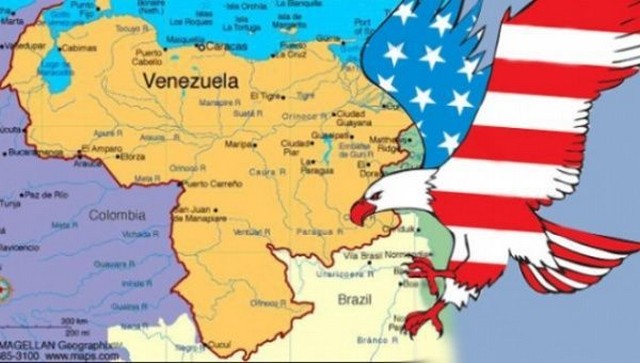
Venezuela in the limelight, on practically all the written, audio and visual mainstream media, as well as alternative media. A purposeful constant drip of outright lies and half-truths, “fake news”, as well as misleading information of all shades and hues about Venezuela is drumming our brains, slowly bending our minds towards believing that – yes, the US has a vital interest in meddling in Venezuela and bringing about “regime change”, because of primarily, the huge reserves of oil, but also of gold, coltan and other rare minerals; and, finally, simply because Washington needs full control of its “backyard”. – BUT, and yes, there is a huge BUT, as even some of the respected progressive alternative media pretend to know: Amidst all that recognition of the AngloZionist empire’s evil hands in Venezuela, their ‘but’ claims that Venezuela, specifically Presidents Chavez and now Maduro, are not blameless in their ‘economic chaos’. This distorts already the entire picture and serves the empire and all those who are hesitant because they have no clue, whom to support in this antagonistic US attempt for regime change.

For example, one alternative news article starts, “It is true that some of Venezuela’s economic problems are due to the ineptitudes of the Bolivarian government’s “socialist command” economy, but this overlooks the role played by the United States, the United Nations, and the European Union….”. Bingo, with such a low-blow beginning, the uninformed reader is already primed to ‘discount’ much of the interference by Washington and its minions. Some of the-so-called progressive writers have already been brain-smeared, by calling Nicolás Maduro a “dictator”, when in fact, there is hardly any country farther away from a dictatorship than Venezuela.

In the last 20 years and since Comandante Hugo Chavez Frias was first elected in 1998 and came to power in 1999, Venezuela had another 25 fully democratic elections, of which 6 took place in the last year and a half. They were all largely observed by the US based Carter Institute, the Latin American CELAC, some were even watched by the European Union (EU), the very vassal states that are now siding with Washington in calling President Maduro an illegitimate dictator – and instead, they support the real illegitimate, never elected, US-CIA trained and appointed, Juan Guaidó. Former President Carter once said, of all the elections he and his Institute observed, the ones in Venezuela were by far the most transparent and democratic ones. By September 2017, the Carter Center had observed 104 elections in 39 countries.

Despite this evidence, Washington-paid and corrupted AngloZionist MSM are screaming and spreading lies, ‘election fraud’; and Nicolás Maduro is illegal, a dictator, oppressing his people, depriving them of food and medication, sowing famine – he has to go. Such lies are repeated at nauseatum. In a world flooded by pyramid-dollars (fake money), the presstitute media have no money problem. Dollars, the funding source for the massive lie-propaganda, are just printed as debt, never to be repaid again. So, why worry? The same Zionists who control the media also control the western money machines, i.e. the FED, Wall Street, the BIS (Bank for International Settlement, the so-called Central bank of central banks), the European Central Bank, the Bank of England and the banks of London. The western public, armchair warriors, all the way to caviar socialists, believe these lies. That’s how our unqualified brains apparently work.

A recent independent poll found that 86% of all Venezuelans, including from the opposition, want no interference by the US and her puppet allies, but want to remain a sovereign state, deciding themselves on how to resolve their internal problem – economics and otherwise.

Let me tell you something, if Mr. Maduro would be a dictator – and all the diabolical adjectives that he is smeared with were to apply, he would have long ago stopped the western propaganda machine, which is the western controlled media in Venezuela; they control 90% of the news in Venezuela. But he didn’t and doesn’t, because he believes in freedom of speech and freedom of the ‘media’ – even if the “media” are really nothing more than abject western lie-machine presstitute. Mr. Maduro is generous enough not to close them down – which any dictator – of which there are now many in Latin America (take your pick: Argentina, Chile, Ecuador, Brazil, Colombia, Paraguay, Uruguay, Guatemala, Honduras….) would have done long ago.

From the very beginning, when Hugo Chavez was first elected in 1998, Washington attempted to topple him to bring about “régime change”. The first real coup attempt took place on 11 April 2002. Under full command by Washington, Chavez was ousted for less than 2 days, when an on-swell of people and the vast majority of the military requested his reinstatement. Chavez was brought back from his island seclusion and, thus, the directly Washington-led coup d’état was defeated (“The Revolution Will Not Be Televised”). But the pressure mounted with economic sanctions becoming ever bolder and, in the case of Venezuela, they had severe economic and humanitarian impacts because Venezuela imports close to 90% of her food and medication – still today – and most of it from the US.

Both Chavez and Maduro had very little leeway of doing differently what they have already done. Sanctions, boycotts, outside money manipulations, driving inflation to astronomical levels and constant smear propaganda, these predicaments are biting hard. The US has a firm grip on Venezuela’s dollar dependency.

Last week, Washington confiscated about US$ 23 billion of Venezuela’s reserve money in US banks, blocked them from use by the legitimate Maduro government, and, instead, handed them to their US-appointed, puppet, never elected, “president”, Juan Guaidó. – He is now able to use Venezuela’s money in his US-EU-and Lima-Group supported “shadow” government. Will he dare? – I don’t think so. However, he has already invited US petrol companies to come to Venezuela and invest in and take over the petrol industry. Of course, it will not happen, as President Maduro stays in power, firmly backed by the military.

All of this sounds like a bad joke. Did you ever hear of Juan Guaidó, before the US and her European vassals almost unanimously and obediently aped Washington in supporting him?

Likewise, the Bank of England withheld 1.2 billion dollars’ worth of Venezuelan reserve gold, refusing to respond to the Maduro Government’s request to return the gold to Caracas. Both cases represent an extreme breach of confidence. Up to now, it was ethically, commercially and financially unthinkable that reserve money and gold deposited in foreign banks would not be safe from hooligan theft – because that’s what it is, what the US is doing, stealing other countries money that was deposited in good fate in their banks.

In a recent interview with RT, President Maduro, said there was absolutely no need for “humanitarian aid”, as the UN suggested, prompted by the US. This so-called humanitarian aid has everywhere in the world only served to infiltrate ‘foreign and destabilizing’ elements into countries, just look at Syria, Libya, Iraq, Afghanistan, to name just a few. While the US$ 23 billion blocked in New York banks could have supplied Venezuela with 20 years-worth of medication for the Venezuelan people, Maduro asserted, Venezuela has enough liquidity to feed and medicate her people.

However, what this latest Trump plunder (the money and gold confiscation) does, is hammering one more nail in the western monetary system’s suicide coffin. It sends an ever-clearer signal to the rest of the world, to those that haven’t noticed yet, the AngloZionist empire cannot – I repeat – CANNOT – be trusted. Ever. And the European Union is intrinsically and “vassalically” linked to the Washington rogue state – not to be trusted either. There is virtually no circumstance under which a countries’ assets in western foreign lands – as bank deposits, or foreign investments – are safe. It will prompt a move away from the dollar system, away from the western (also entirely privately-owned) SWFT international transfer system by which sanctions can be enacted.

Indeed, the Russia and China and much of the SCO (Shanghai Organization Cooperation) members are no longer dealing in US dollars but in their own currencies. We are talking about half the world’s population broke free from the dollar hegemony. Europe has started a half-assed attempt to circumvent the dollar and SWIFT system for dealing with Iran. Europe’s special purpose vehicle, or SPV, is called INSTEX — short for Instrument in Support of Trade Exchanges. It is a project of Germany, France and the UK, suspiciously chaired by the latter, to be endorsed by all 28 EU members.

It aims in a first instance at shipping “humanitarian aid” to Iran. Similarly, to Venezuela, Iran’s foreign Minister, Javad Zarif, after learning about the details, considered the conditions of INSTEX as insulting and rejected any dealings with Europe under this system. Iran, he said, does not need “humanitarian aid”, not from Europe, not from anybody. In the meantime, what was to be expected, has already happened. The Trump Administration issued a stern warning of “sanctions” to the EU, if they would attempt to deal with Iran outside of the dollar system. Europe is likely caving in, as they always do.

Back in Venezuela, the NED (National Endowment for Democracy), the extended arm of the CIA, has for the last two decades trained funded and infiltrated ‘traitor’ agents into Venezuela, with the goal to assist the opposition to foment unrest, to carry out assassinations and other ‘false flags’, and to simply create chaos and unrest. However, some of these agents are also lodged in Venezuela’s financial institutions, as the Fifth Column, where they sabotage – often with threats – any economic policies that could rescue Venezuela from its economic predicament.

In June 2017, I was privileged to be a member of an economic advisory team to Mr. Maduro. During three days of intense discussions with government, a number of potential short- medium and long-term solutions emerged. They were well received by Mr. Maduro and his economic team. What became of these recommendations? – Well, maybe there are strong foreign-directed forces at play to prevent their implementation.

Clearly, any accusation that the Maduro Government may bear the blame for some of the economic chaos, have to be vigorously rejected. Mr. Maduro has very little space to maneuver the economy other than what he is already doing. His actions are severely limited by the ever-stronger squeeze by western claws.

With or without Venezuela’s new crypto currency, the oil-based Petro, the Venezuelan economy, including a major proportion of her imports, is strongly linked to the US dollar. With military threats and sanctions left and right, there is little that the Government can do in the immediate future to become autonomous. Yes, Russia and especially China will most likely help with balance of payment support loans, with investments in the oil industry to ease Venezuela’s US-dollar debt burden and vamp up oil production; and in the medium and longer run they may also help boosting Venezuela’s agricultural sector towards 100% food self-sufficiency.

What is the real reason, you may ask, behind Trump’s intense ‘coup d’état’ attempt – aka, Bolton, Pompeo and Elliott Abrams (the ‘regime change’ envoy), or the diabolical troika’s killer mission?

  • Is it oil and other natural riches, like gold, coltan, diamonds and many more rare minerals? Venezuela with some 301,000 MMbbl (billions of barrels) of known reserves has about 12% more hydrocarbon reserves than Saudi Arabia. Shipping from the Gulf to Texas refineries takes 40-45 days and the risk of passing through the Iran-controlled strait of Hormuz. Delivering oil from Venezuela to Texas takes some 2-4 days.
  • Is it that Venezuela committed a mortal sin when circumventing the petro-dollar, when trading her hydrocarbons, notably with China and Russia in other currencies, like the gold-convertible yuan? – Remember, Saddam Hussein and Muamar Gadhafi attempted similar dollar-escaping actions – and look what it brought them. The US-dollar hegemony depends very much on oil and gas trade in US dollars, as per an agreement of the seventies between the US and Saudi Arabia, head of OPEC.
  • Is it that Washington cannot tolerate any socialist or socialist leaning country in its “backyard”? – Cuba and Nicaragua beware!
  • Is Venezuela a crucial stepping stone to fully dominate Latin America and her resources? – And, hence, a step closer to ‘full power dominance’ of the world?
  • Or all of the above?

I believe it’s all of the above, with a strong accent on Venezuela’s abandoning the US-dollar as hydrocarbon trading currency – putting the dollar-hegemony even more at risk. Once the dollar ceases to be the main reserve currency, the US economy will slowly collapse – what it is already doing. Twenty years ago, the US-dollar dominated world reserve coffers with about 90%. Today that proportion has sunk to less than 60%. The dollar is rapidly being replaced by other currencies, notably the Chinese yuan.

Now let’s cut to the chase. – It is clear that the Trump Administration with these stupid actions of dishing out sanctions left and right, punishing allies and foes alike, if they deal with Russia, Iran, or Venezuela – and this special blunt regime change aggression in Venezuela, nominating a 35 year old US puppet, trained in the US by CIA as Venezuela’s new ‘interim president’, confiscating Venezuela’s reserve assets in New York and London, stopping importing petrol from Venezuela and punishing anybody who imports Venezuelan oil – except, of course, Russia and China. The ‘might’ of the US stops short of interfering in these non-dollar deals. With these and more ridiculous actions and military threats – Washington is actually not only isolating itself, but is accelerating the fall of the US economy. Ever more countries are seeking alternative ways of doing business with currencies and monetary systems other than the dollar-based fraudulent SWIFT, and eventually they will succeed. All they need to do is joining the China-Russia-SCO system of transfer in their local currencies and the currencies of the eastern SCO block – and dedollarization is moving a step further ahead.

Dedollarization is the key to the end of the US (dollar) hegemony, of the US economic supremacy. The arrogant Trump, plus the impunity of the unfettered diabolical and outright dumb Bolton-Pompeo-Abrams approach of military threats and intimidations, may just make Venezuela the straw that breaks the Empire’s back.

Peter Koenig is a Research Associate of the Centre for Research on Globalization.

8 February 2019

Source: countercurrents.org
Neopatrimonialism, corruption and the Palestinian Authority: Pathways to real reform

By Marwa Fatafta

Palestinians recently ranked corruption as the second largest problem they face after the economic crisis – higher than the Israeli occupation, which ranked third. Indeed, Palestinians generally view Palestinian Authority (PA) officials as a self-serving, elitist group disconnected from the Palestinian national struggle and the daily sufferings of the people. Such perceptions are fostered by the failure of the Oslo Accords, the death of the Palestinian statehood project, and the continued fragmentation of political leadership in the context of Israel’s ongoing oppressive occupation and its violations of Palestinians’ fundamental rights.1

Despite this dissatisfaction, there has been little change in the last two decades, whether at the top leadership level or within the ranks of PA institutions. What remains a constant is the ‘old guard’ maintaining a tight grip on power, rampant and systemic corruption, and the alienation of Palestinians from participation in decisions that impact their lives and future.

The present reality of the PA in no way resembles the kind of Palestinian government promised since the heady years of the Oslo Accords. As Nathan Brown observed, ‘Palestine is, in short, a model liberal democracy. Its most significant flaw is that it does not exist.’ This discrepancy between envisaged democratic leadership and reality can be explained by the neopatrimonial nature of the Palestinian political system. Neopatrimonialism is a hybrid model in which state structures, laws, and regulations are formally in place but overridden by informal politics and networks of patronage, kinship, and tribalism. Instead of being organised according to merit, public function, or administrative grades, a neopatrimonial regime finds its glue in bonds of loyalty to those at the top of the political hierarchy.

In an institutional context in which Palestinians have no mechanisms to hold their leaders accountable, Palestinian neopatrimonialism has created a situation impervious to serious change in leadership or political system. Though the PA, after the onset of the Second Intifada, began to make attempts at reform, Palestinian political structures have remained corrupt and captured by one political faction, Fatah. The assets and resources of the Palestine Liberation Organization (PLO) and the PA have been channelled toward serving the interests of the few at the expense of the majority.

The question of what can be done to remedy this crisis cannot be answered without understanding the nature of Palestinian political corruption and how it has led to the failure to serve the Palestinian people and rendered any attempt at reform useless. This policy brief examines Palestinian neopatrimonialism and corruption through a consideration of PA overreach, patronage practices, and collusion with Israel, as well as pressures from the international community. It ultimately proposes avenues for genuine reform, with the goal of building a truly democratic leadership and a governance system that represents all Palestinian people.

The PA: Overstepping its mandate

A Weakened legislature and judiciary

The two main Palestinian political bodies, the PLO and the PA, in principle should be democratic and representative as set out in the Palestinian Basic Law and the PLO’s constitution. However, the PLO has not only failed in the mission it carries in its name, but has also failed to act as the ‘sole, legitimate representative of the Palestinian people’. The PLO’s weakness can be seen in the fact that its legislative arm, the Palestinian National Council (PNC), convened in May 2018 after 22 years of inaction. The absence, during which the Oslo ‘peace process’ proved a total failure, demonstrates how the Palestinian leadership impeded the PLO from fulfillingits duty as a representative of Palestinians inside and outside the occupied territories.

The PA, on the other hand, has overstepped its role as an interim government as stipulated in the Oslo Accords, and has increasingly become an authoritarian governing force in the West Bank. Hamas has followed suit in suppressing political dissent in the Gaza Strip.

PA President Mahmoud Abbas enjoys almost absolute power as the highest executive authority – an arrangement inherited from former President Yasser Arafat, who is often credited for institutionalising the neopatrimonial regime. During his presidency, Arafat maintained power via political cooptation and suppression.

Since the 2007 shutdown of the PA’s legislative arm, the Palestinian Legislative Council (PLC), Abbas has consolidated more power by assuming the roles of both the executive and the legislative branches of government, issuing legislation through presidential decrees and often in a process that lacks transparency and proper consultation with the public.

Among Abbas’s most recent legislative decrees is the Palestinian cybercrime law of 2017. The law, despite being amended following a public outcry, allows authorities to block websites and conduct surveillance on ordinary social media users. Palestinians can be arrested for expressing their opinions and political views online and charged with ‘cybercrimes’, punishable by up to fifteen years in prison.

The executive capture of power also extends to the judiciary. In April 2017, Palestinian judges, lawyers, and prosecutors gathered in Ramallah to protest a draft amendment that would grant the Palestinian president the authority to appoint the head of the High Judicial Council and the head of a committee that oversees judges. The amendment would also allow for the early retirement of judges, opening the door for the executive to interfere and threaten judges’ independence. Under such a provision, judges would have to think twice before issuing a ruling that challenges or opposes the executive authority. In an example of such forced pressure from the executive, former Supreme Court Chief Justice Sami Sarsour signed an undated letter of resignation shortly before he was sworn in.

The constant failure to reach a reconciliation agreement between Hamas and Fatah, despite announcing a national unity government in early 2017, also speaks volumes in regard to Fatah’s power monopoly and its marginalisation of other Palestinian political actors and their constituencies. Power sharing is a prerequisite to the establishment of a solid national unity government, and requires fundamental changes to the current political setup.

Patronage and loyalty

As a result of Fatah’s control of the PA and the PLO, the Palestinian administrative and political machines run on dynamics of inclusion vs. exclusion and reward vs. punishment – fundamentally, according to loyalty. Appointments of public positions and promotions, for example, are awarded or withdrawn not on the basis of performance or professional merit but on the level of loyalty to the leadership.

For instance, holders of senior positions in the PA have invariably been appointed. Position descriptions are not publicly posted, nor are there openly established criteria for determining job scales, salaries, promotions, benefits, and bonuses. According to the Coalition for Accountability and Integrity – AMAN, the salaries and bonuses of the heads of some non-ministerial institutions have been higher than the salary of the president of the PA, whose monthly income, as stipulated by law, stands at $10 000. The appointment of freed Palestinian prisoners in the cadres of the civil workforce as compensation for their contribution to the Palestinian liberation movement is another example of the informal nature of PA positions.

Relatedly, in 2017 President Abbas forced 6 145 PA employees in Gaza into early retirement to pressure Hamas to cede control of the Strip. The number of PA employees in Gaza – both civil and security – is estimated to be around 50 000. Despite Hamas seizing control in Gaza, their salaries continue to be paid – albeit at a lower rate – to secure their loyalty to the PA. At the same time, Abbas uses government resources for political exclusion and punishment. A particularly abominable instance of this was the cutting of PA payments to Israel for electricity in Gaza, reducing the electricity supply to the Strip’s two million inhabitants to four hours a day.

Covert dealings

The dysfunction of the PLC and the PNC, two toothless legislative bodies, has resulted in the executive monopolising and signing secret negotiations and agreements. The Oslo Accords are a prime example of how the PLO executive monopolised negotiations with Israel and took decisions in the name of the Palestinian people that proved disastrous. In a similar vein, the PA’s executive ignored on numerous occasions the PLC’s decisions mandating that the leadership must immediately stop negotiations with Israel in response to its continuous oppression of the Palestinian people and the expansion of illegal settlements in the West Bank.

The PA’s clandestine signing of agreements with Israel on matters related to energy, electricity, water, and communications demonstrates how far the leadership will go in ignoring formal processes and consultation with the public. These agreements have catastrophic political, economic, social, and environmental implications. One electricity-related agreement signed between Israel and the Palestinian private sector in September 2016 settled the PA’s outstanding $550 million debt to the Israel Electric Corporation with the aim of transferring the responsibility of providing electricity in the West Bank to the PA.

The PA, which celebrated the agreement as a national victory and a step toward liberation, kept the agreement confidential despite public demands to disclose its terms. Palestinian civil society, media, and electric companies wanted to know: How will the power to distribute electricity be transferred to the PA? How will it be regulated? What are the implications? Every Palestinian citizen, as service recipients, should have the right to know of such an agreement. In the absence of basic transparency, Palestinians are denied their right to access information that impacts their daily lives and the basic services delivered to them by their government. This also impedes them from exercising any accountability over the PA.

The Red Sea-Dead Sea agreement, signed by the PA, Jordan, and Israel, was also completed in secret. Palestinian water and environment experts protested, warning that the agreement would cause irreversible environmental damage if implemented, as it will destroy what little is left of the Dead Sea’s ecosystem. Palestinians also protested the pact because it will entrench Israel’s denial of Palestinians’ rights to water, as the agreement undermines Palestinian sovereignty over the West Bank and part of the Jordan River basin. The PA, represented by the Palestinian Water Authority, excluded Palestinian experts from consultation and ignored them when they questioned the motivation behind signing such an agreement that achieves nothing for – and in fact damages – Palestinians.

This lack of transparency and accountability has translated into the misappropriation, misuse, and waste of public funds. For example, Abbas constructed a presidential palace on a 4,700 square meter parcel of land (with another 4,000 square meters for auxiliary buildings, including a helipad) to host guests and foreign delegations. He decided last year to convert the building into a national library, to the cost of $17.5 million. While a national library is a noble idea, the investment in costly infrastructure by a government who is heavily in debt and dependent on foreign aid is a testament to misplaced priorities.

International pressures and partnerships

The PA’s reliance on foreign aid has also undermined the Palestinian political system by making it accountable to international donors rather than the Palestinian people. The PA’s reform agenda and anti-corruption efforts have mostly stemmed from US and EU pressure since the outbreak of the Second Intifada, when the security situation on the ground deteriorated. The intent behind the agenda has been clear: Emphasise security over administrative reform and thus ensure the security of Israel at the expense of the security and basic civil and political freedoms of Palestinians. This has been reflected in the prioritisation of security in the PA’s budget allocations, with that sector taking twenty eight per cent of the annual budget at the expense of other, more vital sectors such as health, education, and agriculture.

In his critique of the Oslo aid model – a model based on the neoliberal policy of investing in peace – Alaa Tartir argues that the donor-driven development agenda has worsened the economic and political circumstances for Palestinians. For example, agriculture – a lost, key pillar of the Palestinian economy – received only one per cent of the PA’s annual budget between 2001 and 2005, while around eighty-five per cent went to staff salaries. Consequently, the agricultural sector’s contribution to GDP shrunk from around 13.3 per cent in 1994 to 5.9 per cent in 2011.

Palestinians have launched grassroots campaigns and union strikes, demanding better education and health services, including a massive teacher strike, a campaign against medicine shortages led by a coalition of Palestinian civil society organisations, a campaign against the electricity cuts in Gaza, and a campaign urging the PA to address medical negligence. The PA often leaves these public demands unanswered, and they are rarely reflected in its fiscal planning and public policies. As one member of the National Social Security movement, which leads the opposition to the controversial national social security law, said, ‘The government is not listening to our concerns.’ The law, which obliges private sector employees to pay seven per cent of their monthly salary and employers to pay nine per cent of salaries in exchange for social security coverage, has caused a wave of anger among Palestinians, who have protested mainly against the high monthly deductions as well as the lack of a guarantee to safeguard their money in the context of political and economic instability.

In February 2017, the PA adopted a new agenda, ‘National Policy Agenda: Citizen First 2017-2022’, that aims to prioritise the Palestinian citizen in the government’s policies, promoting accountability and transparency in managing public funds and affairs. This is a US- and EU-supported financial and administrative reform that began during the tenure of former Prime Minister Salam Fayyad; the agenda states that it is a second phase, following the previous one of building state institutions and enhancing their capacity. It proclaims that it is now time ‘to improve our citizens’ quality of life by providing high-quality public services, fostering job creation in the private sector, and protecting the vulnerable.’

The PA’s new agenda does not acknowledge that Fayyad’s state-building phase failed to lead to statehood, let alone democracy. The international donor community hailed Fayyad as the Palestinian good governance messiah as his cabinet led efforts to create a de factoPalestinian state under the Israeli occupation in the context of a major political schism between the two largest Palestinian political factions. Fayyad’s reforms did not go beyond technical and administrative parameters to ensure that whatever shakeup the cabinet made did not rock the entire boat.

The 2003 restructuring of the prime minister position itself under US and EU pressure to loosen Yasser Arafat’s executive grip is another example of how futile these structural reforms are in such a context. The prime minister’s role, decisions, and policies must be in line with Fatah and the president, as the prime minister simply implements the president’s decisions and has no political standing of his own. When Fayyad filled the position in 2007 and embarked on his reform plan, he became the target of senior Fatah officials who continuously pinned the PA’s ailments and the effects of the economic crisis on Fayyad’s policies. The international community’s strong financial and political backing of Fayyad also constituted a threat to Abbas, who did not defend his premier against the attacks of his party and challenged his authority by overruling some of his decisions.

The international community also dictates which Palestinian political figures are in power through financial and political support. This was the case when the US attempted to overturn Fayyad’s resignation, and when it withdrew funds to suffocate unwanted authority even if it was fairly and legitimately elected, such as when Hamas won the majority of seats in the 2006 legislative elections.

Any additional reforms dependent on international approval will not address the legitimacy crisis in leadership, nor will they lead to the much-needed rebirth of a united Palestinian national movement that could fulfil the aspirations of the Palestinian people. These reforms reinforce the same neopatrimonial dynamics that underlie systemic corruption in the Palestinian Authority by acting as a band aid rather than a solution that tackles corruption from the root.

Essentially, any PA effort to end the occupation and achieve independence – often the stated goal in many of these reform agendas – translates into the PA simply continuing to override the role of the PLO. By doing so, it continues to marginalise if not ignore altogether the voices of the millions of Palestinians who live in the diaspora and have a direct stake in whatever course of action the PA’s executive takes vis-à-vis the Israeli occupation and the ‘peace process’.

Out of the Quagmire

If Palestinians are serious about democratic, representative, and transparent leadership, they must end the farce of reform and build a representative and democratic system from the bottom up. Palestinians, especially the youth living in the occupied territories, in Israel, and in the diaspora, have a significant role to play in mobilising and initiating national grassroots dialogues to debate and build a common vision for future democratic Palestinian leadership. This task requires a massive effort given the existing challenges. However, the continuation of the status quo offers only a bleak future.

To ensure that a new model, whatever its shape or form, does not recycle the same neopatrimonial dynamics, three fundamental elements must be considered:

1. Decentralisation and separation of powers

To break the monopoly of one group or party, there must be a healthy political ecosystem of counterbalancing powers. The limitations of the PLO as an umbrella body representing all Palestinians invites the question of whether such a central authority infrastructure is capable of representing Palestinians everywhere. Any Palestinian governance model must be agile enough to lead and be responsive to the Palestinian polities living in different geographical, juridical, and administrative jurisdictions in the West Bank, Gaza, East Jerusalem, Israel, and the diaspora. The experience of the PA thus far suggests that a central authority, as it exists, cannot fulfill such a role.

Decentralisation of power, through empowering grassroots and local community leadership, is essential to break the existing power monopoly. The leadership and organisation during the First Intifada, albeit belonging to a different political and social context, offers one example of what a collective leadership could look like.

2. Vertical and horizontal accountability

Corruption and abuse of power thrive when those in power cannot be held to account. Any new governance model will be vulnerable to capture of power without the following parallel accountability mechanisms in place:

First: A vertical accountability line that enables the Palestinian people to question their leaders and participate in the decision making process. This is not limited to local and national elections but can extend to grassroots public committees and hearings, shadow councils, robust protection of freedom of expression and the media, and Palestinian civil society taking an active role in monitoring not only Palestinian government institutions but also the private sector and service providers.

Second: Horizontal accountability – such as an independent parliament, independent audit organisations, and so forth – is important to investigate and stop the wrongdoings of public officials.

While the current system has these institutions formally in place to some extent, the neopatrimonialism of the Palestinian political system renders these internal accountability mechanisms useless. This is why power sharing, decentralisation, and public scrutiny are important first steps to ensure that no Palestinian authority can abuse its power.

3. End impunity

To restore the Palestinian public’s trust in leadership, the impunity of the corrupt must be eliminated. Despite the various attempts and claims of the Palestinian anti-corruption committee to investigate and prosecute corrupt officials, Palestinian officials and politicians remain largely immune to any serious consequences for their actions. Impunity of the corrupt makes individuals hesitant to report corruption they witness or experience because they see no value in, or change resulting from, taking such action.

There are existing hotlines and legal centers available to Palestinians in the West Bank and Gaza to report corruption cases in a safe and confidential manner, such as the one operated by the Palestinian anti-corruption organisation, AMAN. However, encouraging Palestinians to report corruption must be accompanied by the availability of solid anti-corruption laws and an independent judiciary that can hold the corrupt to account regardless of their political, financial, or social position.

To end corruption and ensure accountability in the Palestinian context, an institutional and political overhaul, rather than limited and fragmented political and legal reforms, is necessary. The repeated patterns of Fatah’s power monopoly, systemic corruption, and informal politics, in addition to the current political stagnation, suggests that it is past time for Palestinians to build new institutions that are more democratic and more representative of their rights and needs.

* Marwa Fatafta is a Palestinian analyst based in Berlin. The MENA Regional Advisor for Transparency International, her work focuses on issues of governance, corruption, accountability and civil society in the Arab world.

7 February 2019

Source: amec.org.za

Avoiding War With Iran

By Seyed Hossein Mousavian

In his State of Union, President Trump focused his comments about the Middle East on Iran, the fight against the Islamic State (ISIS or IS), and the U.S. troop withdrawal from Syria. Despite his negative rhetoric about Iran, Trump did identify some potential common ground with the government in Tehran. The challenge for the next two years is to focus on that common ground, avoid a war between the United States and Iran, and prepare for an eventual U.S. return to the nuclear agreement with Tehran.

While Iraqi President Barham Salih hailed Iran for supporting the Iraqi nation in the fight against IS, Donald Trump singled out Iran as the world’s leading state sponsor of terror. Moreover the Iraqi president rejected a plan floated by President Trump that calls for keeping U.S. forces in Iraq to “watch” neighboring Iran, saying that the United States should not burden Iraq with its own “policy priorities.” He reiterated that Iraq and Iran play an important role in upholding peace and stability in the region.

Israeli Prime Minister Benjamin Netanyahu spoke with Trump once and Pompeo twice before Trump’s December 19 announcement of a U.S. troop withdrawal from Syria. Netanyahu lobbied very hard to keep America’s military presence in Syria to support an Israeli campaign of airstrikes aimed at threatening war with Iran. “We struck thousands of targets (in Syria) without claiming responsibility,” said Gadi Eisenkot, chief of staff of the Israel Defense Forces about Israel’s undeclared military campaign against Iran. The deputy commander of the Islamic Revolution Guards Corps (IRGC), Hossein Salami, declared that Israel will be eliminated and the entire occupied Palestinian territories will be retaken if it embarks on a new war. “The U.S. aircraft carriers would be destroyed, its air bases in the region burned, and the skies set ablaze…we have built our strength for the purpose of long, extended wars”, he said.

According to a Brown University study, U.S. wars in Afghanistan, Iraq, Yemen, Syria, and Libya have cost the $8 trillion. In addition, 480,000 people have died due to direct war violence, 244,000 civilians were killed in direct violence by other parties, and many times more have died indirectly. Over 6,950 U.S. soldiers have died and at least 7,800 US contractors killed. Last but not least, 21 million people became refugees or were displaced within their own countries.

In the State of Union, President Trump criticized long drawn-out wars. “As a candidate for president, I pledged a new approach. Great nations do not fight endless wars,” he said. Trump’s strategy is to avoid entering new wars coupled with a gradual withdrawal of U.S. forces from the Middle East. This strategy is on par with what Hillary Clinton envisioned in her 2011 Foreign Policy article, where she proposed refocusing on East Asian powers critical to U.S. national interests. America seems to realized that the current crises in the Middle East cannot be resolved any time soon, instability and terrorism will engulf the region for the years to come, and substantial financial resources, perhaps in the trillions of dollars, are required for long-term peace, stability, and reconstruction of the region.

Meanwhile, Iran since the Islamic Revolution of 1979 has always emphasized the need for U.S. troops to withdraw from the region. In this sense, Iran and the United States now share common views despite different interests. Nevertheless, this is only feasible through a safe and gradual withdrawal that could take some years to accomplish. Furthermore, it is in the interests of not only Iran and the United States, but also the entire region and the world, that a U.S. withdrawal from the region not lead to further instability and chaos in the region.

This commonality, which is also pivotal to international peace and security, has the potential to break the deadlock in the recurring confrontation between Iran and the United States. In 2001, under General Suleimani’s leadership, Iranian Quds Force played a decisive role defeating the Taliban and al-Qaeda in the war in Afghanistan. “His shrewd pragmatism has transformed the unit into a major influencer in intelligence, financial, and political spheres beyond Iran’s borders,” said Gen. Stanley McChrystal, former chief of the U.S. Joint Special Operations Command. Today, Tehran can facilitate a face-saving, safe, and reliable exit of U.S. forces from the region. Such cooperation would deescalate tensions between the two countries’ security and military forces, eliminating the possibility of another unnecessary military conflict in the region and setting the stage for a U.S. return to the nuclear deal.

However, concerns may remain about Iran’s regional influence. Therefore, it would be more prudent if the UN secretary general oversees the vacuum left behind. Moreover, UN Security Council resolution 598 requests the secretary general to examine, in consultation with Iran and Iraq and other Arab States in the Persian Gulf, measures to enhance the security and stability of the region. Based on this resolution, the UNSC can take practical steps to create a regional security and cooperation system in the Persian Gulf where Iran, Saudi Arabia, Iraq, and five other states around the Persian Gulf would take collective responsibility in the absence of U.S. forces, transforming current regional rivalries into partnerships.

Fortunately, a majority of Congress, U.S. public opinion, and even Trump himself are against a potential war with Iran. In Iran also, the majority of people and Iranian officials are against any military conflict. Nevertheless, there are influential players in key decision-making positions who view America’s current domestic turmoil as an opportunity to drag the United States into a war with Iran, and to dismember the country. Some of the heads of states of America’s regional allies, too, are working hard to realize this scenario before Trump leaves office.

The U.S. withdrawal from the Iran nuclear deal, a critical international agreement achieved only after direction negotiations between Washington and Tehran, has eliminated any chances of resolving other outstanding issues. Despite fundamental disagreements, Iran and the United States also have some mutual interests. The art of diplomacy is to find a way to set the stage for a dignified U.S. return to the nuclear deal by paving the way for the U.S.-Iranian cooperation on mutual interests.

Seyed Hossein Mousavian is Middle East Security and Nuclear Policy Specialist at Princeton University and a former Iranian diplomat.

7 February 2019

Source: lobelog.com

INTELLECTUALS AND ARTISTS IN DEFENCE OF HUMANITY UNITED STATES

The members of the Network of Intellectuals, Artists and Social Movements in Defense of Humanity (REDH), participants in the International Day for Democracy and Peace and in Solidarity with the Bolivarian Revolution held in Caracas, support the constitutional President Nicolás Maduro Moros and the Venezuelan people in the face of the ongoing coup d’état and the announced military intervention by the U.S. government, along with its satellites.

Organized in commemoration of the National Day of Dignity in February 4, 1992, this day made it possible for us to receive updated and first-hand information on the effects of the economic war, the financial and commercial blockade, the intentional and selective shortages, the induced hyperinflation and an unprecedented media attack. It was inspiring to see once again the moral strength and patriotic conscience with which the Venezuelan people are facing this difficult moment in their history.

We received very significant data showing that Venezuela does not need “humanitarian aid”. As an example, the funds held in the U.S., which amounts to about $23 billion dollars, the country could import the medicines needed by the Venezuelan people for 20 years.

The Bolivarian process is a political project that has built and delivered to the population 2.5 million modern homes in only 8 years, it has carried out a massive annual vaccination campaign and ensures that 7.6 million children are in school cannot be compared to being a “humanitarian crisis”.

President Maduro’s legitimacy is beyond question. The data of the same electoral entity that recognized the victory of the opposition in the 2015 parliamentary elections, has documented that more than 9 million people participated in the presidential election of which 67.84 percent opted for Maduro (more than 6 million votes).

We appeal to the conscience of men and women who love peace and a world order based on dialogue, respect for civilized coexistence among nations, and the principles of international law. In Venezuela, the principle of State sovereignty is defended today. The Bolivarian Republic of Venezuela is at the epicenter of the global geopolitical dispute. The aggression of U.S. imperialism is against the peoples of Our America.

We support the path of sovereignty and independence of the Bolivarian process with all our forces. We call upon all intellectuals, artists and social movements to be protagonists in the defense of the Venezuelan people against the threat posed by the attitude of surrender that characterizes the Lima Group or Cartel.

Returning to the diplomacy of peace and Latin American unity promoted by Chávez and Fidel, the REDH ratifies its unwavering commitment to the Bolivarian revolutionary process and its self-determination.

Network in Defense of Humanity

Caracas February 4, 2019

The CIA Then and Now: Old Wine in New Bottles

By Edward Curtin

“And as the flames climbed high into the night
To light the sacrificial rite
I saw Satan laughing with delight
The day the music died”

– Don McLean, “American Pie”

The Nazis had a name for their propaganda and mind-control operations: weltanschauungskrieg – “world view warfare.” As good students, they had learned many tricks of the trade from their American teachers, including Sigmund Freud’s nephew, Edward Bernays, who had honed his propagandistic skills for the United States during World War I and had subsequently started the public relations industry in New York City, an industry whose raison d’ȇtre from the start was to serve the interests of the elites in manipulating the public mind.

In 1941, U.S. Intelligence translated weltanschauungskrieg as “psychological warfare,” a phrase that fails to grasp the full dimensions of the growing power and penetration of U.S. propaganda, then and now. Of course, the American propaganda apparatus was just then getting started on an enterprise that has become the epitome of successful worldview warfare programs, a colossal beast whose tentacles have spread to every corner of the globe and whose fabrications have nestled deep within the psyches of many hundreds of millions of Americans and people around the world. And true to form in this circle game of friends helping friends, this propaganda program was ably assisted after WW II by all the Nazis secreted into the U.S. (“Operation Paperclip”) by Allen Dulles and his henchmen in the OSS and then the CIA to make sure the U.S. had operatives to carry on the Nazi legacy (see David Talbot’s The Devil’s Chessboard: Allen Dulles, The CIA, and The Rise of America’s Secret Government, an extraordinary book that will make your skin crawl with disgust).

This went along quite smoothly until some people started to question the Warren Commission’s JFK assassination story. The CIA then went on the offensive in 1967 and put out the word to all its people in the agency and throughout the media and academia to use the phrase “conspiracy theory” to ridicule these skeptics, which they have done up until the present day. This secret document – CIA Dispatch 1035-960 – was a propaganda success for many decades, marginalizing those researchers and writers who were uncovering the truth about not just President Kennedy’s murder by the national security state, but those of Malcolm X, Martin Luther King, and Robert Kennedy. Today, the tide is turning on this score, as recently more and more Americans are fed up with the lies and are demanding that the truth be told. Even the Washington Post is noting this, and it is a wave of opposition that will only grow.

The CIA Exposed – Partially

But back in the mid-1960s to the mid-1970s, some covert propaganda programs run by the CIA were “exposed.” First, the Agency’s sponsorship of the Congress of Cultural Freedom, through which it used magazines, prominent writers, academics, et al. to spread propaganda during the Cold War, was uncovered. This was an era when Americans read serious literary books, writers and intellectuals had a certain cachet, and popular culture had not yet stupefied Americans. The CIA therefore secretly worked to influence American and world opinion through the literary and intellectual elites. Frances Stonor Saunders comprehensively covers this in her 1999 book, The Cultural Cold War: The CIA And The World Of Arts And Letters, and Joel Whitney followed this up in 2016 with Finks: How the CIA Tricked the World’s Best Writers, with particular emphasis on the complicity of the CIA and the famous literary journal The Paris Review.

Then in 1975 the Church Committee hearings resulted in the exposure of abuses by the CIA, NSA, FBI, etc. In 1977 Carl Bernstein wrote a long piece for Esquire – “The CIA and the Media” – naming names of journalists and publications (The New York Times, CBS, etc.) that worked with and for the CIA in propagandizing the American people and the rest of the world. (Conveniently, this article can be read on the CIA’s website since presumably the agency has come clean, or, if you are the suspicious type, or maybe a conspiracy theorist,it is covering its deeper tracks with a “limited hangout,” defined by former CIA agent Victor Marchetti, who went rogue, as “spy jargon for a favorite and frequently used gimmick of the clandestine professionals. When their veil of secrecy is shredded and they can no longer rely on a phony cover story to misinform the public, they resort to admitting—sometimes even volunteering—some of the truth while still managing to withhold the key and damaging facts in the case. The public, however, is usually so intrigued by the new information that it never thinks to pursue the matter further.”)

Confess and Move On

By the late 1970s, it seemed as if the CIA had been caught in flagrante delicto and disgraced, had confessed its sins, done penance, and resolved to go and sin no more.Seeming, however, is the nature of the CIA’s game. Organized criminals learn to adapt to the changing times, and that is exactly what the intelligence operatives did. Since the major revelations of the late sixties and seventies – MK Ultra, engineered coups all around the world, assassinations of foreign leaders, spying on Americans, etc. – no major program of propaganda has been exposed in the mainstream media. Revealing books about certain CIA programs have been written – e.g. Douglas Valentine’s important The Phoenix Program being one – and dissenting writers, journalists, researchers, and whistle blowers (Robert Parry, Gary Webb, Julian Assange, James W. Douglass, David Ray Griffin, Edward Snowden, et al.) have connected the U.S. intelligence services to dirty deeds and specific actions, such as the American engineered coup d’état in Ukraine in 2013-14, electronic spying, and the attacks of September 11, 2001. But the propaganda has for the most part continued unabated at a powerful and esoteric cultural level, while illegal and criminal actions are carried out throughout the world in the most blatant manner imaginable, as if to say fuck you openly while insidiously infecting the general population through the mass electronic screen culture that has relegated intellectual and literary culture to a tiny minority.

Planning Ahead

Let me explain what I think has been happening.

Organizations like the CIA are obviously fallible and have made many mistakes and failed to anticipate world events. But they are also very powerful, having great financial backing, and do the bidding of their masters in banking, Wall St., finance, etc. They are the action arm of these financial elites, and are, as Douglass Valentine has written, organized criminals. They have their own military, are joined to all the armed forces, and are deeply involved in the drug trade.They control the politicians. They operate their own propaganda network in conjunction with the private mercenaries they hire for their operations. The corporate mass media take their orders, orders that need not be direct, but sometimes are, because these media are structured to do the bidding of the same elites that formed the CIA and own the media. And while their ostensible raison d’ȇtre is to provide intelligence to the nation’s civilian leaders, this is essentially a cover story for their real work that is propaganda, killing, and conducting coups d’états at home and abroad.

Because they have deep pockets, they can afford to buy all sorts of people, people who pimp for the elites. Some of these people do work that is usually done by honest academics and independent intellectuals, a dying breed, once called free-floating intellectuals. These pimps analyze political, economic, technological, and cultural trends. They come from different fields: history, anthropology, psychology, sociology, political science, cultural studies, linguistics, etc. They populate the think tanks and universities. They are often intelligent but live in bad faith, knowing they are working for those who are doing the devil’s work. But they collect their pay and go their way straight to the bank, the devil’s bank. They often belong to the Council of Foreign Relations or the Heritage Foundation. They are esteemed and esteem themselves. But they are pimps.

El Diablo

Ah, the devil! He’s their man. A man of many names, but always an impostor. These pimps know his story and how he works his magic, and this is what their paymasters want from them: ways to use the old bastard’s bag of tricks to conjure confusion, and sow fear and paranoia. And to do this slow and easy in ways no one will recognize until it is too late.

For like culture, propaganda relies on myths, symbols, and stories. Some prefer to say narratives. But nothing is more powerful. Controlling the stories is the key to powerful propaganda. The pimps can spin many a tale.

Tell people endless tales of the good guys and the bad, of how the bad are out to get you and the good to save you. Think of the use of symbols in the telling of these stories. They are crucial. The word symbol comes from a Greek word to throw together. Symbols that represent the in-group or the “good guys” are used to create social solidarity within the in-group. Stories are told to accompany the symbols; stories, narratives, or myths tell of how the good guys are fighting to hold the group together and the bad guys are trying to rip the community apart. The symbolic and its opposite – the diabolic (to throw apart) – the angels against the devils – el diablo. Very simple, very old. The aliens are out to get us. And el diablo is always the ultimate other, the man in red, the reds, the commies, the Russians, the others, immigrants, the blacks who want to move next door, Muslims, gays – take your pick. Satanic rituals. Black magic. Witchcraft.

Methods of Propaganda

Infecting minds with such symbols and stories must be done directly and indirectly, as well as short-term and long-term. Long term propaganda is like a slowly leaking water pipe that you are vaguely aware of but that rots the metal from within until the pipe can no longer resist the pressure. Drip drop, drip drop, drip drop – and the inattentive recipients of the propaganda gradually lose their mettle to resist and don’t know it, and then when an event bursts into the news – e.g. the attacks of September 11, 2001 or Russia-gate – they have been so softened that their assent is automatically given. They know without hesitation who the devil is and that he must be fought.

The purpose of the long-term propaganda is to create certain predispositions and weaknesses that can be exploited when needed. Certain events can be the triggers to induce the victims to react to suggestions. When the time is ripe, all that is needed is a slight suggestion, like a touch on the shoulder, and the hypnotized one acts in a trance. The gun goes off, and the entranced one can’t remember why (see: Sirhan Sirhan). This is the goal of mass hypnotization through long-term propaganda: confusion, memory loss, and automatic reaction to suggestion.

Intelligence Pimps and Liquid Screen Culture

When the CIA’s dirty tricks were made public in the 1970s, it is not hard to imagine that the intellectual pimps who do their long-range thinking were asked to go back to the drawing board and paint a picture of the coming decades and how business as usual could be conducted without further embarrassment. By that time it had become clear that intellectual or high culture was being swallowed by mass culture and the future belonged to electronic screen culture and images, not words. What has come to be called “post modernity” ensued, or what the sociologist Zygmunt Bauman calls “liquid modernity” and Guy Debord “the society of the spectacle.” Such developments, rooted in what Frederic Jameson has termed “the cultural logic of late capitalism,” have resulted in the fragmentation of social and personal life into pointillistic moving pictures whose dots form incoherent images that sow mass confusion and do not cohere. From the mid-1970s until today, this generalized disorientation with its flowing and eternal present of appearing and dissolving images has resulted in what is surely a transformed world, and with it, transformed worldviews. The foundations have collapsed. Meaning and coherence have become difficult to discern. Stable personality has been disassociated, memory downloaded, attention lost, the psyche materialized, sexual identity confused, the electronic mind-body interface established, and the electronic and pharmaceutical drugging of the population accomplished. Really? Yes.

Did not the intelligence agencies foresee all this? Did not they see it and plan accordingly? Did they not notice that about the time their old dirty deeds were being exposed, a movie burst onto the screen that introduced a theme familiar to them and their Nazi friends? I mean the 1973 hit, The Exorcist, wherein Satan struts his stuff, four years after Mick Jagger strut his across the stage at Altamont, singing “Sympathy for the Devil,” while shortly after a killing took place down in front of him and the 1960s were laid to rest.But during the 1970s The Exorcist and its theme of the devil’s hold on people came to life and was taken up with a religious fervor by the entertainment industry and promoted by Oprah Winfrey, Geraldo Rivera, and other media luminaries, who went about promoting el diablo’s hold on so many helpless victims. Occult, magic, and satanic themes became pop staples and would remain so up until the present day.I would suggest that readers put aside their reservations at what may seem sensational and watchthis video. Then ask yourself: what is going on here?

The CIA as Prophetic

But maybe a better question than did the CIA foresee these developments, would be to ask if it has been involved in the occult and satanic world itself, before and after the social developments of “liquid modernity.” The answer is yes. Indeed, all the characteristics of the social and cultural developments I mentioned previously in reference to post modernity have been a major part of its work before this new world emerged: “the disassociation of stable personalities, memory erasure and the implanting of false memories, materializing the psyche, confusing sexual identity, establishing the electronic mind-body interface, and electronic, hallucinogenic (the CIA introduced and spread LSD in the 1960s), and pharmaceutical drugging,” to name but a few. In anticipating these developments the CIA was at the very least predictive. Disinformation, acts of terrorism, coup d’états, assassinations flow out of a marriage to the Nazis made in hell – Talbot’s “devil’s chessboard” – but they are linked to much more. Peter Levenda, in Sinister Forces: A Grimoire of American Political Witchcraft, a trilogy on sinister forces in American history, puts it this way:

The CIA, satanic cults, and UFOs, the mythology of the late twentieth century is surprisingly coherent even though the masks change from case to case, from victim to alleged victim. The CIA, of course, does exist; their mind control programs from BLUEBIRD to ARTICHOKE to MK-ULTRA are a matter of public record. Their history of political assassinations and the overthrow of various foreign governments is also a matter of record. Satanic cults – or perhaps we should qualify that and say ‘occult secret societies’ – also exist and are a matter of public record; their attempts to contact alien forces by means of ceremonial magic and arcane ritual (including the use of some of the same drugs and other techniques as the CIA used in its mind control programs) are also well-known and documented. Some of these practitioners were – and are – well-known men and women who have not denied their involvement (such as rocket scientist Jack Parsons in the 1950s and Army Colonel and intelligence officer Michael Aquino in the 1990s). The CIA also aggressively researched American cults and secret societies in an effort to discover the source of paranormal abilities and ancient mind control mechanisms. And while the jury is still out on the question of UFOs, there is no doubt that government agencies have attempted to track, to analyze them, and to explain them away. Again this is a matter of public record, including FBI and CIA documents in addition to military records.

Skeptical readers may find this strange to consider. That would be a mistake. The web of connections is there for anyone who cares to look. For more than fifty years occult themes and rituals have been part of world view warfare. Drugs, shamanism, black magic, and the occult – staples of the CIA then and now. It is well known that Hollywood, television, and the media in general have been working closely with the intelligence agencies for a long time. Especially since 2001, films and television programs have glorified the CIA, our “good” spies, and the military. The mystification of reality has found its best friend in the electronic and internet revolution as strange and “subversive” beliefs are dangled like candy for little children. Good and evil move through the public consciousness like passing sun and shadows. Weird conspiracy theories“pop up” to titillate and obsess, and to drive out the serious findings of dedicated and disciplined writers and researchers who have discovered the truth about real government conspiracies. Sowing confusion is the name of this deadly game, and if you find yourself confused, you are in good company.

But many are catching on and realizing that what seems strange but innocent is part of a much larger effort to hypnotize the public to agree to their own destruction through the ingestion of what can only be called black magic.

The eloquent writer and brave American, Jim Garrison, the former District Attorney of New Orleans and the only person to bring a trial in the assassination of President Kennedy, put it this way in On The Trail of The Assassins, the story of his quest to solve the murder of JFK.

I knew by now that when a group of individuals gravitated toward one another for no apparent reason, or a group of individuals inexplicitly headed in the same directions as if drawn by a magnetic field, or coincidence piled upon coincidence too many times, as often as not the shadowy outlines of a covert intelligence operation were somehow becoming visible.

Rub Lucifer, the Prince of Darkness, the right way and the CIA emerges into the light.You can see its shadowy outline with your eyes wide shut. As it says on CIA headquarters: “You shall know the Truth, and the Truth will set you free.”

Edward Curtin is a writer whose work has appeared widely. He teaches sociology at Massachusetts College of Liberal Arts.

6 February 2019

Source: countercurrents.org
Venezuela: US Pursuing Humanitarian Aid Path To War

Co-Written by Kevin Zeese and Margaret Flowers

The United States has been working with oligarchs in Venezuela to remove President Maduro since he came to office in 2013 after the death of Hugo Chavez and was re-elected that year. After he won re-election to another six-year term in 2018, the regime change planners sought new strategies to remove Maduro, including an assassination attempt last August. The coup campaign escalated recently with the self-appointment of president Juan Guaido, who President Trump and US allies have recognized. Now, the ongoing coup attempt is escalating through a strategy of humanitarian intervention.

Trump has been talking openly about war to take control of Venezuela’s vast oil reserves since mid-2017. Pentagon and former administration officials, who have since been removed from office, opposed the action. Now, Trump is surrounded by neocons who share his goal of removing Maduro and taking control of the country’s natural resources. War is an option being openly considered.

The US has no excuse to legally attack Venezuela. As Defense One reports,“International law forbids ‘the threat or use of force against the territorial integrity or political independence of any state.’” There are two exceptions mentioned in the UN Charter: self-defense and authorization by the U.N. Security Council, neither of which have been met in Venezuela. Domestically, Trump would also need the US Congress to authorize an attack, which is unlikely with a Democratic-controlled House not because Democrats oppose war but because they oppose Trump.

The United States has also claimed a highly questionable right to use force for “humanitarian intervention.” For example, the US and NATO 1999 intervention in Kosovo was a humanitarian intervention that became a war.

After a long-term economic war that has sought to starve Venezuela of resources and has cost the country billions of dollars annually, the United States is now claiming there is a humanitarian crisis in Venezuela. It is moving to use this humanitarian crisis it helped to create as a path to war with Venezuela, with the help of US proxies, Colombia and Brazil. The tactic is to proclaim a humanitarian crisis in Venezuela requiring a humanitarian intervention and then to bring troops in to provide humanitarian aid as the BBC explains. Once the foot is in the door, it is simple to manufacture an excuse for conflict.

This weekend, the humanitarian intervention began to unfold when the coup president, Juan Guaido, announced the imminent distribution of humanitarian aid. Guaido announced the aid would be gathered at three points, and Venezuela’s army would be pressured to allow it into the country. The collection centers will be in Colombia, Brazil and on an island in the Caribbean. He announced aid will begin to be distributed in the coming days. He claimed the Venezuela military will have to make a decision whether or not to let this aid in to Venezuela. Guaido said he wants the people to play a supportive role by staying in the streets with demonstrations that will be announced soon.

Also over the weekend, National Security Adviser John Bolton said the US will send “critical supplies” requested by Guaido. Previously, Bolton has openly called for a military coup and sanctions to starve millions of Venezuelans into submission. On Twitter, USAID administrator Mark Green shared images of boxes embossed with the US flag en route to Venezuela.

Elliot Abrams, who has a long history of war crimes and was convicted in the Iran-Contra scandal, said the US government is considering opening a “humanitarian corridor” and has maintained contacts with Brazil and Colombia on the issue. He acknowledged that Maduro’s “cooperation” would be necessary to transport the aid to the country. El Pais reported, “The opening of this supply channel could require the participation of troops, whether Americans or from another country in the region, something that Chavism interprets as a clear threat.”

Vice President Mike Pence spoke this week about the deployment of humanitarian assistance with Carlos Vecchio, Guaidó’s ambassador to the United States, as well as Julio Borges, appointed as representative to the Lima Group. Borges will ask the Lima Group, which meets in Canada this week, for the “urgent” opening of a humanitarian corridor. Canada has played a junior role in the ongoing coup. Trudeau, who also levied economic sanctions against Venezuela, promised $53 million in humanitarian aid. Media critical of the coup have been denied access to these meetings

The United States launched this major operation in coordination with the right-wing governments of Colombia and Brazil, the most belligerent anti-Maduro allies of Guaido. The US National Security Council confirmed on Saturday that the deployment of aid has already begun. The initial aid will contain medicines, surgical supplies, and nutritional supplements. It was scheduled to come from USAID to Bogota on Monday and then be moved for storage in a collection center in the border city of Cúcuta, the main entrance route for Venezuelans migrating to Colombia. Cúcuta has a high presence of Colombian paramilitaries and smuggling mafias and is where those who attempted to assassinate Nicolas Maduro last year were trained.

One of the goals of the humanitarian aid is to divide the Venezuela militarywhich has refused to recognize Guaido. They seek to deepen the pressure on the military in order to break the solidarity of the Maduro government. TIME Magazine reports, “The aid has become something of a litmus test for the military’s backing of Maduro.” Sen. Marco Rubio (R-FL), said on Twitter that, “Military & police leaders in #Venezuela must now decide to either help food & medicine reach people, or help #Maduro instead.”

UN Secretary-General, Antonio Guterres, who has not recognized Guaido, said the United Nations “will not be part of” distributing the aid, as it wants to maintain “credibility” in order to help “find a political solution to the crisis.”

El Pais reports that “Diplomats from several Latin American countries and from the more moderate sectors of the opposition fear that this will serve as a pretext to drag the conflict into the military.” President Maduro has repeatedly rejected the entry of humanitarian aid because he knew it would provide justification for foreign intervention. He knows the US seeks Venezuela’s oil and other resources,“gold, gas, iron, diamonds, other material riches.”

Maduro called on the international community to stop the US threats of war against Venezuela. He said a war would be a blood bath, a David and Goliath struggle that would “leave Trump bloodstained.” Maduro said the Venezuelan people were prepared to defend their “sacred“ land from a US military invasion, but emphasized that he “prayed to God” such a conflict will never occur. Trump’s “military aggression” must be rejected so that “peace prevails.”

Kevin Zeese and Margaret Flowers are directors of Popular Resistance

6 February 2019

Source: countercurrents.org
Farewell to INF Treaty: Setting Multilateralization for N-Person’s Game?

By K M Seethi

The Unites States withdrawal from the Intermediate-Range Nuclear Forces (INF) Treaty (1987) and the subsequent Russian decision to quit the regime generated considerable fears and anxieties across the world about a renewed nuclear arms race and showdown. The allegations and counter-allegations in respect of the violation of the Treaty by both parties continued for several years and Washington and Moscow crossed swords over the issue on many occasions and across different fora. US President Donald Trump had indicated the possibility of Washington’s pull out in 2018, in the wake of the reports about Russian violation of the Treaty. Yet, many tend to believe that the action has been pre-planned to extend the coverage of the regime to China, in the emerging geo-strategic environs involving Russia and China. So far, the INF Treaty is a bilateral instrument between the US and Russia and many nuclear weapon powers are outside the ambit of the Treaty.

President Donald Trump in his statement said that Russia has, for long, violated the Treaty “with impunity, covertly developing and fielding a prohibited missile system that poses a direct threat” to US allies and troops abroad. He said that NATO allies also “fully support” insofar as “they understand the threat posed by Russia’s violation and the risks to arms control posed by ignoring treaty violations” Trump further claimed that Washington “has fully adhered to the INF Treaty for more than 30 years” but it “will not remain constrained by its terms while Russia misrepresents its actions.” Indicating that the US “cannot be the only country in the world unilaterally bound by this treaty, or any other,” he said that the US “will move forward with developing (its) own military response options and will work with NATO and (its) other allies and partners to deny Russia any military advantage from its unlawful conduct (US, White House 2019a).

The White House statement continues:

“Nearly 6 years of diplomacy and more than 30 meetings have failed to convince Russia to return to compliance with the INF Treaty. Enough is enough. At President Trump’s direction, the United States will suspend its obligations under the INF Treaty effective February 2, 2019. The United States will also deliver formal notice on February 2, 2019, to Russia and other Treaty Parties, that the United States will withdraw from the INF Treaty in 6 months. Only Russia’s complete and verifiable destruction of its INF-violating missiles, their launchers, and associated equipment can save the INF Treaty” (US, White House 2019b).

The White House statement accused Russia of having “produced and fielded multiple battalions of its INF-violating, nuclear-capable missile, which threaten our allies and troops in Europe and Asia.” It further warmed that Washington “will move forward with developing its own intermediate-range, conventionally-armed, ground-launched missile system. In addition, China and Iran, which are not parties to the Treaty, each possess more than 1,000 INF Treaty-range missiles” (Ibid).

In December 2018, NATO Allies had declared that Russia “developed and fielded a missile system, the 9M729, which violates the INF Treaty, and poses significant risks to Euro-Atlantic security. Allies strongly supported the finding of the United States that Russia is in material breach of its obligations under the INF Treaty and called upon Russia to urgently return to full and verifiable compliance. Since that announcement, the United States and other Allies have remained open to dialogue, and have engaged Russia on its violation, including at a NATO-Russia Council meeting on 25 January 2019. Allies regret that Russia, as part of its broader pattern of behaviour, continues to deny its INF Treaty violation, refuses to provide any credible response, and has taken no demonstrable steps toward returning to full and verifiable compliance.” It Further said that the United States “is taking this action in response to the significant risks to Euro-Atlantic security posed by Russia’s covert testing, production, and fielding of 9M729 ground-launched cruise missile systems. Allies fully support this action (NATO 2019).

Responding to the US suspending its obligations under the INF Treaty, Russian President Vladimir Putin said that “Moscow’s proposals remain on the table. Moscow issued a ‘mirror’ response to the US move by suspending its own observance of the treaty” Russian Foreign Minister Sergei Lavrov warned that “Moscow would react to military threats related to the US withdrawal from the INF Treaty “by military-technical means”, i.e. with weapons development” (Sputnik 2019). According to Russian experts, “US plans to build low-power nuclear weapons will sharply lower the threshold for the use of nuclear weapons.” Moreover, Russian Foreign Ministry charged that NATO states were “not ready for meaningful dialogue on the Mk-41 launchers, which are located in Romania, and will appear in Poland next year, in violation of the INF Treaty. These are integrated into the NATO missile defence system, so the alliance is also directly responsible for undermining the treaty”(Ibid). The Russian president said that Moscow would suspend its obligations under the INF Treaty in response to a similar decision announced by US. He reminded that “the use of target rockets and the deployment of Mk 41 launchers in Europe since 2014 by the United States is a direct violation of the Intermediate-Range Nuclear Forces Treaty” (Ibid).

INF Setting

The history of INF Treaty goes back to 1970s when the US was so exercised over the control of intermediate-range missiles emerged in the wake of Moscow’s domestic deployment of SS-20 intermediate-range missiles during the decade. The SS-20 appeared to be qualitatively improved version of Soviet nuclear forces in the European theater by providing a longer-range, multiple-warhead alternative to the earlier versions of Soviet SS-4 and SS-5 single-warhead missiles (Arms Control Association 2019).

NATO ministers responded to this with its “dual-track” strategy—a parallel drive for arms control negotiations with the deployment of intermediate-range, nuclear-armed U.S. missiles (ground-launched cruise missiles and the Pershing II) in Europe to balance the SS-20. Negotiations, however, fell through even a US missile deployments continued in the early 1980s. Efforts began to make headway when Mikhail Gorbachev became the General-Secretary of the CPSU in March 1985. Moscow and Washington held talks and negotiations in the following year(Ibid). The efforts by President Ronald Reagan and Gorbachev eventually culminated in the signing of the INF Treaty on 8 December 1987, and the treaty came into force on 1 June 1988 (US, Department of State 1987).

The ban under the regime originally applied only to US and Soviet forces, but the Treaty’s membership expanded in 1991 with a view to including successor states of the former Soviet Union. Currently, Belarus, Kazakhstan, and Ukraine, which had inspectable facilities on their territories at the time of the Soviet Union’s disintegration, joined Russia and the United States in the treaty’s implementation. Turkmenistan and Uzbekistan also possessed INF Treaty-range facilities (SS-23 operating bases) but forgo treaty meetings with the consent of the other states-parties (Arms Control Association 2019).

Thus, active states-parties to the regime were just five countries. However, many European countries also dismantled the INF Treaty-range missiles in the post-Cold war era. Germany, Hungary, Poland, and the Czech Republic dismantled their intermediate-range missiles in the decade, and Slovakia removed all of its missiles by October 2000 after extensive US pressure. On 31 May 2002, Bulgaria, the remaining possessor of intermediate-range missiles in Eastern Europe entered into an agreement with the United States to dismantle all of its INF Treaty-related missiles. Within six months, Bulgaria completed the dismantling of its missiles (Ibid).

By 31 May 2001, the States-parties’ right to carry out on-site inspection under the Treaty came to an end. Yet, the use of surveillance satellites for data gathering followed. The Treaty had set up the Special Verification Commission (SVC) to function as an implementing agency for the Treaty. It apparently addressed issues of compliance and agreeing on measures to “improve (the treaty’s) viability and effectiveness.” Insofar as the INF Treaty is of an indefinite period, states-parties could arrange the SVC at any time (Ibid). However, Article XV of the Treaty says that each party “shall, in exercising its national sovereignty, have the right to withdraw from this Treaty if it decides that extraordinary events related to the subject matter of this Treaty have jeopardized its supreme interests. It shall give notice of its decision to withdraw to the other Party six months prior to withdrawal from this Treaty. Such notice shall include a statement of the extraordinary events the notifying Party regards as having jeopardized its supreme interests” (US, Department of State 1987). It is this clause that enables both parties to pull out from the regime.

However, the INF Treaty’s protocol on missile elimination identified the specific types of ground-launched missiles to be dispensed with and the acceptable means of doing so (Ibid). Under the regime, the US was obliged to get rid of its Pershing II, Pershing IA, and Pershing IB ballistic missiles and BGM-109G cruise missiles. The Soviet Union had to eliminate its SS-20, SS-4, SS-5, SS-12, and SS-23 ballistic missiles and SSC-X-4 cruise missiles. Besides, both the US and Soviet Union were obliged to destroy all INF Treaty-related training missiles, rocket stages, launch canisters, and launchers. Nearly all missiles were done away with through different processes and procedures (Arms Control Association 2019).

Meanwhile, Russia, at least since 2000, began to raise the question of withdrawing from the Treaty arguing that the regime unjustly constrained it from having weapons that its neighbours such as China were developing and deploying. Russia also had warned that the proposed American deployment of strategic anti-ballistic missile systems in Europe might cause its withdrawal from the Treaty. Despite all this, both parties issued a statement at the United Nations General Assembly in October 2007 reaffirming their support for the Treaty and calling on all other states to join them in renouncing the missiles banned by the regime. However, the declaration of such commitments did not continue for long. During 2013-14, several reports indicated that Washington had concerns about Russia’s ‘violations’ of the Treaty. In July 2014, the State Department accused Russia of violating the accord by “producing and testing an illegal ground-launched cruise missile.” Though Russia dismissed such ‘allegations’, the US publicly stated that Russia continued to violate the Treaty. Meanwhile, press reports suggested that Russia had deployed an operational unit of the treaty-noncompliant cruise missile now known as the SSC-8. In March 2017, the Pentagon officials again confirmed that Russia had deployed a ground-launched cruise missile that “violates the spirit and intent” of the INF Treaty. The State Department’s 2017 annual assessment again pointed to Russian noncompliance with the INF Treaty for the fourth consecutive year (Ibid).

In December 2017, the Trump administration brought out an integrated strategy to offset alleged Russian violations of the Treaty. It also involved the initiation of research and development on a conventional, road-mobile, intermediate-range missile system. In October 2018 President Trump announced his intention to “terminate” the INF Treaty, pointing to “Russian noncompliance and concerns about China’s intermediate-range missile arsenal.” On 4 December 2018, the Secretary of State Mike Pompeo announced that the United States had “found Russia in “material breach” of the treaty and will suspend its treaty obligations in 60 days if Russia does not return to compliance in that time” (US, Department of State 2019). This was followed by the Trump administration’s suspension of US obligations under the Treaty and announced its plan to pullout in six months. Russian President Putin immediately thereafter announced that Russia would be officially suspending its treaty obligations as well.

The reciprocal actions, on the part of both the US and Russia, in effect wrap up a regime viewed by many as one of the most vital safeguards against nuclear confrontation. The situation makes the US-Russia relations more complicated even as issues from the immediate past remain such as Russia’s attempts to take over Crimea from Ukraine, and its alleged meddling in the 2016 US presidential elections. Experts fear that the INF-free world will help strengthen Russia’s efforts to redesign its strategic balancing in Eurasian geopolitics. Mark Fitzpatrick, Executive Director of the non-proliferation programme at the International Institute for Strategic Studies, says that “Nothing good will come out of the US withdrawal.” According to him, “The Trump administration has made a huge mistake – it’s a breakdown of arms control. It’s a breakdown of trust between US and Russia. The US will have problems with its European allies, and it will engage in a new arms race with China as well” (Al Jazeera 2019). Tom Nichols, a security expert, pointed out that it was “a provocation to menace the Europeans and to see if they could bait the Americans into walking away.” He said that the Washington’s response brought to light how ‘confused’ its nuclear arms policy was (Ibid). Observers also pointed out that most European counties, including NATO Allies would not welcome any land-based intermediate-range missiles that the US might develop. Fitzpatrick, another nuclear expert, says that the ‘real reason’ for the US withdrawal was America’s anxiety over China’s buildup of intermediate-range missiles in the Western Pacific. Reports say that China’s stock holds as much as 2,000 ballistic and cruise missiles, almost 95 per cent of which would violate the INF Treaty if Beijing were a signatory. However, the Treaty prohibits Washington from deploying short and intermediate range missiles on land near China as a deterrent (Ibid). It is not even clear if the American allies in Asia-Pacific such as Japan or South Korea would be willing to let such weapons come to the region (Ibid). However, China appealed to the US and Russia to adhere to the Treaty. It warned that “scrapping the treaty would be the beginning of the collapse of the global arms control system. It’s highly likely a new arms race will start.”

The Global Times editorial says:

“Washington has been hyping the Russian threats in recent years, but Russia’s strategic deterrence is clearly weaker than in the Soviet era. The US has also complained about China’s development of missile capabilities. This is even more unreasonable. China’s nuclear deterrence isn’t comparable to that of the US and Russia. Portraying China’s military development as part of an “arms race,” the US is creating an excuse to suppress China’s legitimate build-up of its national defense. If the treaty is abolished, security risks will be reassessed and major powers will redefine what “security” is. Overall international relations will be implicated. Such a scenario is unfavorable to an end to the nuclear crisis on the Korean Peninsula and runs the risk of a rise in conflicts in other regions. As far as China is concerned, the US intends to make the INF treaty a multilateral agreement, which may become an excuse for Washington to exert pressure on Beijing. Without the restraints of the treaty, the US may intensify its deployment of offensive missiles and anti-missile systems around China, further increasing China’s strategic security challenges. Beijing will never accept the treaty becoming a multilateral agreement. It must reject any request from the US on the issue. Instead of relying too much on land-based missiles for national security, China must diversify its strategic nuclear deterrence. It’s an urgent task” (Global Times 2 February 2019).

China had taken a similar stand even before. In the UN General Assembly meeting last year, the representative of China said the “Treaty is important, playing a crucial role in history and maintaining global stability. Maintaining the INF Treaty is highly relevant.” China said that “the countries concerned can honour their commitments and properly handle relevant issues through consultation. China opposes any unilateral act of withdrawal. Treaty multilateralization involves a host of legal issues. Many countries have their own concerns about this and do not support Treaty multilateralization (UN, General Assembly 2018).

Obviously, the Trump administration, which has been pulling out of several international treaties during the last three years, on the ground of its opposition to multilateral arrangements that ‘threaten’ the American interests, is reversing its game strategy by withdrawing from a bilateral treaty that has tremendous international implications. While Trump seeks to have promoted more and more bilateral arrangements for international trade and commerce (2-person model), he seems to be fixed for multilateral options on questions of security and strategic balancing. In any case, his game-plan has apparently the larger objective of netting China within a new package and thereby setting a new ‘level playing field’ for a N-persons’ game. The end result is, the global strategic landscape will again witness the fear of an apocalypse of MAD (Mutual Assured Destruction).

References

Al Jazeera (2019): “‘Huge mistake’: Fears of arms race as US, Russia suspend INF pact,” 3 February, https://www.aljazeera.com/news/2019/02/mistake-fears-arms-race-russia-suspend-inf-pact-190203152747235.html

Arms Control Association (2019): “The Intermediate-Range Nuclear Forces (INF) Treaty at a Glance,” 2 February , https://www.armscontrol.org/factsheets/INFtreaty

NATO (2019): “Statement on Russia’s failure to comply with the Intermediate-Range Nuclear Forces (INF) Treaty, Issued by the North Atlantic Council, Brussels, 1 February 2019,” https://www.nato.int/cps/en/natohq/news_162996.htm

Sputnik (2019): “Russia to React to US Exit From INF Treaty by Military-Technical Means – Lavrov,”

4 February , https://sputniknews.com/world/201902041072099247-russia-inf-treaty-lavrov-usa/

UN, General Assembly (2018): “General Assembly Rejects Resolution Calling for Strengthening Russian-United States Compliance with Intermediate-Range Nuclear Forces Treaty,’ 21 December, https://www.un.org/press/en/2018/ga12116.doc.htm

US, Department of State (1987): “Treaty Between The United States Of America And The Union Of Soviet Socialist Republics On The Elimination Of Their Intermediate-Range And Shorter-Range Missiles (INF Treaty), 8 December , https://www.state.gov/t/avc/trty/102360.htm

US, White House (2019a):” Statement from the President Regarding the Intermediate-Range Nuclear Forces (INF) Treaty,” 1 February, https://www.whitehouse.gov/briefings-statements/statement-president-regarding-intermediate-range-nuclear-forces-inf-treaty/

US, White House (2019b): “President Donald J. Trump to Withdraw the United States from the Intermediate-Range Nuclear Forces (INF) Treaty,” 1 February, https://www.whitehouse.gov/briefings-statements/president-donald-j-trump-withdraw-united-states-intermediate-range-nuclear-forces-inf-treaty/

The author is Dean of Social Sciences and Professor, School of International Relations and Politics, Mahatma Gandhi University, Kerala. He can be reached at kmseethimgu@gmail.com

5 February 2019

Source: countercurrents.org
Venezuela: The U.S.’s 68th Regime Change Disaster

Co-Written by Medea Benjamin & Nicolas J S Davies

In his masterpiece, Killing Hope: U.S. Military and C.I.A. Interventions Since World War II, William Blum, who died in December 2018, wrote chapter-length accounts of 55 U.S. regime change operations against countries around the world, from China (1945-1960s) to Haiti (1986-1994). Noam Chomsky’s blurb on the back of the latest edition says simply, “Far and away the best book on the topic.” We agree. If you have not read it, please do. It will give you a clearer context for what is happening in Venezuela today, and a better understanding of the world you are living in.

Since Killing Hope was published in 1995, the U.S. has conducted at least 13 more regime change operations, several of which are still active: Yugoslavia; Afghanistan; Iraq; the 3rd U.S. invasion of Haiti since WWII; Somalia; Honduras; Libya; Syria; Ukraine; Yemen; Iran; Nicaragua; and now Venezuela.

William Blum noted that the U.S. generally prefers what its planners call “low intensity conflict” over full-scale wars. Only in periods of supreme overconfidence has it launched its most devastating and disastrous wars, from Korea and Vietnam to Afghanistan and Iraq. After its war of mass destruction in Iraq, the U.S. reverted to “low intensity conflict” under Obama’s doctrine of covert and proxy war.

Obama conducted even heavier bombing than Bush II, and deployed U.S. special operations forces to 150 countries all over the world, but he made sure that nearly all the bleeding and dying was done by Afghans, Syrians, Iraqis, Somalis, Libyans, Ukrainians, Yemenis and others, not by Americans. What U.S. planners mean by “low intensity conflict” is that it is less intense for Americans.

President Ghani of Afghanistan recently revealed that a staggering 45,000 Afghan security forces have been killed since he took office in 2014, compared with only 72 U.S. and NATO troops. “It shows who has been doing the fighting,” Ghani caustically remarked. This disparity is common to every current U.S. war.

This does not mean that the U.S. is any less committed to trying to overthrowing governments that reject and resist U.S. imperial sovereignty, especially if those countries contain vast oil reserves. It’s no coincidence that two of the main targets of current U.S. regime change operations are Iran and Venezuela, two of the four countries with the largest liquid oil reserves in the world (the others being Saudi Arabia and Iraq).

In practice, “low intensity conflict” involves four tools of regime change: sanctions or economic warfare; propaganda or “information warfare”; covert and proxy war; and aerial bombardment. In Venezuela, the U.S. has used the first and second, with the third and fourth now “on the table” since the first two have created chaos but so far not toppled the government.

The U.S. government has been opposed to Venezuela’s socialist revolution since the time Hugo Chavez was elected in 1998. Unbeknownst to most Americans, Chavez was well loved by poor and working class Venezuelans for his extraordinary array of social programs that lifted millions out of poverty. Between 1996 and 2010, the level of extreme poverty plummeted from 40% to 7%. The government also substantially improved healthcare and education, cutting infant mortality by half, reducing the malnutrition rate from 21% to 5% of the population and eliminating illiteracy. These changes gave Venezuela the lowest level of inequality in the region, based on its Gini coefficient.

Since Chavez’ death in 2013, Venezuela has descended into an economic crisis stemming from a combination of government mismanagement, corruption, sabotage and the precipitous fall in the price of oil. The oil industry provides 95% of Venezuela’s exports, so the first thing Venezuela needed when prices crashed in 2014 was international financing to cover huge shortfalls in the budgets of both the government and the national oil company. The strategic objective of U.S. sanctions is to exacerbate the economic crisis by denying Venezuela access to the U.S.-dominated international financial system to roll over existing debt and obtain new financing.

The blocking of Citgo’s funds in the U.S. also deprives Venezuela of a billion dollars per year in revenue that it previously received from the export, refining and retail sale of gasoline to American drivers. Canadian economist Joe Emersberger has calculated that the new sanctions Trump unleashed in 2017 cost Venezuela $6 billion in just their first year. In sum, U.S. sanctions are designed to “make the economy scream” in Venezuela, exactly as President Nixon described the goal of U.S. sanctions against Chile after its people elected Salvador Allende in 1970.

Alfred De Zayas visited Venezuela as a UN Rapporteur in 2017 and wrote an in-depth report for the UN. He criticized Venezuela’s dependence on oil, poor governance and corruption, but he found that “economic warfare” by the U.S. and its allies were seriously exacerbating the crisis. “Modern-day economic sanctions and blockades are comparable with medieval sieges of towns,” De Zayas wrote. “Twenty-first century sanctions attempt to bring not just a town, but sovereign countries to their knees.” He recommended that the International Criminal Court should investigate U.S. sanctions against Venezuela as crimes against humanity. In a recent interview with the Independent newspaper in the U.K., De Zayas reiterated that U.S. sanctions are killing Venezuelans.

Venezuela’s economy has shrunk by about half since 2014, the greatest contraction of a modern economy in peacetime. The World Health Organization (WHO) reported that the average Venezuelan lost an incredible 24 lb. in body weight in 2017.

Mr. De Zayas’ successor as UN Rapporteur, Idriss Jazairy, issued a statement on January 31st, in which he condemned “coercion” by outside powers as a “violation of all norms of international law.” “Sanctions which can lead to starvation and medical shortages are not the answer to the crisis in Venezuela,” Mr. Jazairy said, “…precipitating an economic and humanitarian crisis…is not a foundation for the peaceful settlement of disputes.”

While Venezuelans face poverty, preventable diseases, malnutrition and open threats of war by U.S. officials, those same U.S. officials and their corporate sponsors are looking at an almost irresistible gold mine if they can bring Venezuela to its knees: a fire sale of its oil industry to foreign oil companies and the privatization of many other sectors of its economy, from hydroelectric power plants to iron, aluminum and, yes, actual gold mines. This is not speculation. It is what the U.S.’s new puppet, Juan Guaido, has reportedly promised his American backers if they can overthrow Venezuela’s elected government and install him in the presidential palace.

Oil industry sources have reported that Guaido has “plans to introduce a new national hydrocarbons law that establishes flexible fiscal and contractual terms for projects adapted to oil prices and the oil investment cycle… A new hydrocarbons agency would be created to offer bidding rounds for projects in natural gas and conventional, heavy and extra-heavy crude.”

The U.S. government claims to be acting in the best interests of the Venezuelan people, but over 80 percent of Venezuelans, including many who don’t support Maduro, are opposed to the crippling economic sanctions, while 86% oppose U.S. or international military intervention.

This generation of Americans has already seen how our government’s endless sanctions, coups and wars have only left country after country mired in violence, poverty and chaos. As the results of these campaigns have become predictably catastrophic for the people of each country targeted, the American officials promoting and carrying them out have a higher and higher bar to meet as they try to answer the obvious question of an increasingly skeptical U.S. and international public:

“How is Venezuela (or Iran or North Korea) different from Iraq, Afghanistan, Libya, Syria and at least 63 other countries where U.S. regime change operations have led only to long-lasting violence and chaos?”

Mexico, Uruguay, the Vatican and many other countries are committed to diplomacy to help the people of Venezuela resolve their political differences and find a peaceful way forward. The most valuable way that the U.S. can help is to stop making the Venezuelan economy and people scream (on all sides), by lifting its sanctions and abandoning its failed and catastrophic regime change operation in Venezuela. But the only things that will force such a radical change in U.S. policy are public outrage, education and organizing, and international solidarity with the people of Venezuela.

Medea Benjamin, co-founder of Global Exchange and CODEPINK: Women for Peace, is the author of the new book, Inside Iran: The Real History and Politics of the Islamic Republic of Iran.

Nicolas J S Davies is the author of Blood On Our Hands: the American Invasion and Destruction of Iraq and of the chapter on “Obama At War” in Grading the 44th President: A Report Card on Barack Obama’s First Term as a Progressive Leader.

5 February 2019

Source: countercurrents.org
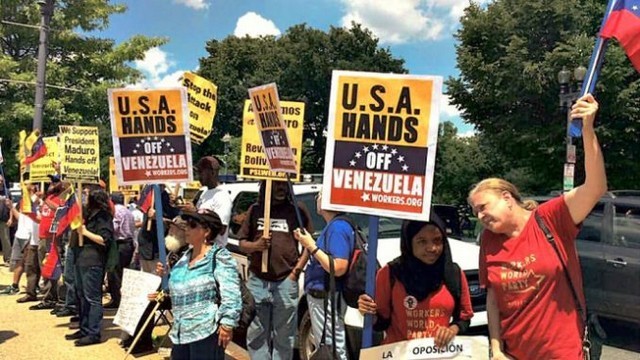
Iran’s Islamic Revolution at 40 -setting the stage for a New World Order.

By Firoz Osman

Forty years ago a momentous event took place when the Shah of the Pahlavi dynasty, installed by the CIA, fled Iran, ushering in the Iranian Islamic Revolution led by Ayatollah Ruhollah Khomeini on February 1, 1979.

Western countries and Israel, who had dominated and exploited the oil-rich region through the puppet Arab regimes they installed and protected, felt vulnerable and in danger.

Iran closed the Apartheid SA embassy and halted its oil supplies, 90% of which SA imported from Iran. And within three weeks Iran severed relations with Israel, handing over the embassy to the Palestinian Liberation Organisation (PLO), and welcoming Yasser Arafat as the first foreign dignitary.

This unexpected, unanticipated and popular revolution sent shockwaves regionally and globally because it was based on Islamic values and principles. It was not just another palace coup in which one set of elite grabbed power from another.

Iran fearlessly spoke out against American and British hegemony, and the Zionist occupation of Palestinian and its holy lands, regarding Israel as a cancer implanted into the heart of the Arab and Islamic world.

They pledged their support to liberate all of Palestine, forming the Resistance Axis with Syria, Hizbullah of Lebanon, and the Palestinian Islamic Jihad and Hamas.

The dominant powers reaction was predictable. The West, Israel and the Arab despotic regimes implemented strangulating embargoes and a series of counter-revolutionary, state-sponsored acts of terrorism and sabotage against the people and the nation of Iran.

Iraq’s Saddam Hussein invaded Iran, armed with Western weapons including chemical weapons, all financed by the Gulf Sheikhdoms. The war lasted eight years at a cost of a million lives.

The Mojahidin-e Khalgh Organisation (MKO), a Western-backed terror outfit, bombed the headquarters of the Islamic Republican Party and other installations killing 1200 leading figures of the Revolution.

The USA, Saudi Arabia and Israel continue to threaten Iran with unprovoked aggression, killing Iranian scientists, provoking protests and engineering instability. Iran is falsely accused of developing nuclear weapons and of posing a “threat” to world peace and stability.

Iran has not attacked or threatened to attack any country. In fact, Iran is surrounded by hostile U.S. forces and is confronting the menace of Israel’s nuclear missiles and U.S. warships. Iran anticipated that the destabilization of Syria and Lebanon was a step towards attacking Iran itself.

The Pentagon, 16 major U.S. intelligence agencies, the National Intelligence Estimate (N.I.E.) and the IAEA confirmed that Iran is not developing nuclear weapons and poses no military threat. Yet, Iran is subjected to sanctions and threatened with military aggression by the U.S. and Israel.

It is déjà vu in Iraq, using the same false propaganda campaign to rally world opinion for war against Iran. The hype about the threat posed by Iraq’s nonexistence “Weapons of Mass Destruction” (WMD) is replaced by the hype about the threat posed by Iran’s nuclear bomb.

Iran has watched the Western -orchestrated destruction, destabilization and regime change in Afghanistan, Iraq, Libya, Egypt, Lebanon and Syria, primarily to maintain Western hegemony over the oil supplies and to protect the Zionist entity.

The West and its surrogates have always played the divisive sectarian and tribal card to maintain the inter- Muslim conflict, in this case within the Sunni-Shi’a framework, in order to weaken Iran and its strategic allies.

The war on Syria is a proxy war against Iran. Both Syria and Iran are on the U.S. list of “rogue states” that are targeted for military intervention. Hence, an attack on Syria is an attack on Iran.

The removal of the current Syrian government of Bashar al-Assad will isolate Iran and allows the U.S. and Israel to consolidate their dominance of the region and intensify their aggression against Iran.

Iran is targeted because it stands in the trench of resistance to Western hegemony and Israel’s occupation of Arab and Islamic lands and holy places. Should the Iranians accept Israel’s regional dominance, it will be embraced as a cherished friend and lavished with economic favors.

Iran has not only survived but flourished, without the protection of America. Iran has remained fiercely independent, stoically defending its rights, and succeeded in developing and achieving incredible scientific progress in spite of the illegal Western embargo.

Israel, the West and the Saudis, having failed to secure a surrender from Syria, Hizbullah, Hamas or Islamic Jihad, have now planned a conference in Warsaw, Poland, specifically targeting Iran and its allies.

Mike Pompeo, USA Secretary of State, has called for a summit on 14 February, to form a “Sunni Arab Nato” to spearhead the attack on the Resistance Axis.

So, the challenge for genuine freedom and independence remain. However, there can be little doubt that Iran’s Islamic revolution 40 years ago was a turning point in contemporary history, altering the dynamics of the Middle East and setting the stage for a new world order.

Dr Firoz Osman is an Executive Member of the Media Review Network, an advocacy group based in Johannesburg.

22 January 2019

Gaza Rallies for Caracas: On the West’s Dangerous Game in Venezuela

Co-Written by Ramzy Baroud & Romana Rubeo

Hundreds of Palestinians took to the streets of besieged Gaza to show their support of the democratically-elected government of Venezuela and it’s legitimate leader, President Nicolas Maduro.

Venezuela is struggling to defeat a coup attempt that is supported by the United States, Israel and many Western governments.

The relationship between Venezuela and Palestine has been particularly strong under the presidencies of late Venezuelan leader, Hugo Chavez and current president Maduro. Neither leader has missed an opportunity to show their solidarity towards the Palestinian people, a fact that has always irked Tel Aviv and its western benefactors.

The Gaza rallies, however, were more than a display of gratitude towards a country that had enough courage to break off ties with Israel following the latter’s 2008-9 war on Gaza – a bloody campaign known as “Operation Cast Lead”. Thousands of Palestinians were killed in that one-sided war. No Arab government that has diplomatic ties with Israel severed its relations with Tel Aviv. While Caracas – over 10 thousand kilometers away – did. Then, former President Chavez, accused Israel of “state terrorism”.

But there is more to Palestinian solidarity with Venezuela than this recent history. Palestinians have experienced decades-long collective trauma from US-funded Israeli colonialism and military occupation. The US has imposed itself as an ‘honest peace broker’ as a way to mask its political interference and meddling in the Middle East, while fully and blindly supporting Israeli aggressions.

While the Venezuelan people have every right to protest their government, demanding greater accountability and economic solutions to the crushing poverty facing the country, no one has the right to meddle in the affairs of Venezuela or any other sovereign country anywhere.

We must remember that the US government has hardly ever been a source of stability in South America, certainly not since the Monroe Doctrine of 1823. Since then, the US has done more than mere meddling, but outright political and military interventions, supporting various coups that toppled or attempted to overthrow democratically-elected governments.

What is underway in Caracas is a repeat of that sad and tragic history.

The unhealthy relationship between the US and its southern neighbors took an even darker turn when, in 1904, then US President Theodore Roosevelt declared the “right” of his country to hold “international police power” in Latin America. Since then, the entire region has been Washington’s business.

Always looking for opportunities to exploit, Washington now sees a chance to undermine Venezuela and its elected government.

The Venezuelan people are dealing with overwhelming poverty and a very unstable social situation. Hyperinflation and the crumbling of the country’s oil industries led to a dramatic economic downturn, with about 10% of the population fleeing the country. Poor policy choices led to an escalation of the already endemic corruption, to a significant weakening of local production and increasing devaluation of the country’s currency.

However, consensus around president Maduro’s socialist government is still broad, as witnessed by their victory in the 2018 presidential election.

Despite the presence of about 150 international observers from 30 countries and international organizations, which declared that the last Venezuelan election was transparent, domestic opponents, supported by the US and its western and regional allies denounced it as “fraud foretold”, even before Maduro delivered his victory speech.

The US and its Western allies are frustrated by the fact that despite its economic problems, most Venezuelans remained united around Chavez, and now Maduro, who are perceived, especially by the poorer classes, as independent national leaders fighting against constant US destabilization and neocolonialism.

The world order is vastly changing, but US ruling elites refuse to change. While speaking about Washington’s need to “protect democracy” in Venezuela, US National Security Advisor, the infamous Israel supporter, John Bolton admitted that the coup in Venezuela is an opportunity to exploit the country’s oil and natural resources.

“It will make a big difference to the United States economically”, Bolton told Fox News in an interview this week, “if we could have American oil companies invest in and produce the oil capabilities in Venezuela.”

Tragically, the US boycott against Venezuela forced the country to sell its gold in return for valuable currency, as well as consumer goods, food and medicinal products. The coup is meant to completely push Caracas to its knees.

Western predators are all moving in, each party playing the role entrusted of them, as if history is repeating itself. Bank of England (BoE) has blocked Maduro’s officials from withdrawing $1.2 billion worth of Venezuela’s gold. Worse, brazen interference from foreign countries is becoming so pronounced that UK foreign office minister, Sir Alan Duncan has suggested that the BoE grant access to the gold reserves to the self-proclaimed opposition leader Juan Guaido.

Germany, and France and Spain gave Venezuela’s Maduro an ultimatum: the President has eight days to call elections, otherwise they’ll recognize Guaido as president. On January 31, the European Parliament recognized Guaido as a de facto leader of Venezuela in complete disregard of the democratic rights of the Venezuelan people.

Yet, as odd as this may seem to some, Maduro still enjoys greater legitimacy in his country than Donald Trump or Emmanuel Macron do in the US and France respectively. Yet, no entity is threatening to intervene in France, for example on behalf of the ‘Yellow Vests’, who have protested in their hundreds of thousands for weeks, demanding an end to Macon’s rule.

It is doubly important that Venezuela doesn’t collapse before this US-led sinister campaign because of the rising far-right powers in South and Latin America, namely the upsurge of reactionary forces in Brazil.

If Venezuela’s political order disintegrates, others, too will become target: Bolivia, Cuba, and even Mexico.

Since the US partial withdrawal from Iraq in December 2011, and the Obama Administration’s ‘pivot to Asia’, to challenge the inevitable dominance of China, US policy makers have been keen on staging a comeback in South America as well. More recently, the just-departed US ambassador to the UN, Nikki Haley was instrumental in shaping the aggressive US policy towards Venezuela.

Now that the country is struggling with extreme poverty – itself resulting from the manipulation of oil prices – the US sees an opportunity to make its move, and reclaim its destructive, domineering role in that part of the world. The election in Brazil of far-right leader, Jair Bolsonaro, who wants to “make Brazil great again’ is tipping the balance in favor of reactionary forces in the whole region.

But the plot against Venezuela is also an opportunity for those who want to challenge the old order, to tell the US government ‘enough is enough’; that the age of coups and blood-soaked interventions should be behind us, and that South America must not be subjugated again.

As Palestinians have fought Israeli tyranny for years, Venezuelans will continue to fight foreign tyranny and unlawful political and military interventions as well. And with true and tangible global solidarity, both nations will prevail – sooner or later.

– Ramzy Baroud is a journalist, author and editor of Palestine Chronicle.

– Romana Rubeo is a writer and freelance translator based in Italy.

4 February 2019

Source: countercurrents.org