By Glenn Greenwald
22 May 2019 – Among the planet’s significant political figures, no one is quite like Lula. Born into extreme poverty, illiterate until the age of 10, forced to quit school at the age of 12 to work as a shoe shiner, losing a finger at his factory job at 19, and then becoming a labor activist, union leader, and founder of a political party devoted to a defense of laborers (the Workers’ Party, or PT), Lula has always been, in all respects, the exact opposite of the rich, dynastic, oligarch-loyal, aristocratic prototype that has traditionally wielded power in Brazil.
That’s precisely what makes Lula’s rise to power, and his incomparable success once he obtained it, so extraordinary. And that’s what, to this very day, makes him so worth listening to regarding the world’s most complex and pressing political questions: As the ascension of right-wing nationalism and populism at times seems unstoppable, Lula is one of the world’s very few political figures of the last several decades able to figure out how to win national elections in a large country based on left-wing populism in the best sense of that term.
So unlikely was Lula’s rise to power that he ran for president, and lost, three times before finally being elected by an overwhelming margin in 2002 and then reelected by an even larger margin in 2006. His eight-year presidency, despite being marred by corruption scandals long endemic to Brazilian politics, was a stunning testament to the power of politics to improve the lives of people and transform a country: implementation of innovative social programs that lifted millions of Brazilians out of poverty and created opportunities and hope for a huge segment of the population which, for generations, had none.
So bold and charismatic was Lula’s leadership that it not only transformed the lives of millions but also the perception of Brazil itself: both domestically and globally. Brazil was awarded the World Cup and then became the first South American country to host the Olympics. Tens of millions of Brazilians who resigned themselves to eternal, inescapable deprivation began to believe for the first time that a brighter future was possible. When Obama saw him at the G-20 summit in 2008, he anointed Lula “my man,” adding: “He’s the most popular politician on Earth.”
Obama was right: By the time he left office in 2010, Lula had an approval rating of 86 percent. And in a highly patriarchal country, he chose as his successor a little-known PT minister, Dilma Rousseff, who in 2010 was, with Lula’s vehement support, comfortably elected as the country’s first female president and then reelected in 2014. Somehow, a pro-worker leftist party founded by an impoverished labor leader became the dominant political force — winning four consecutive national elections and restoring Brazil’s belief in itself — in an oil-rich country long notorious for its extreme inequality of all types.
But then, just as quickly and dramatically as Lula built these successes, everything fell apart: for Lula, for Dilma, for PT and, most tragically, for Brazil. During Dilma’s presidency, the economy collapsed, millions returned to unemployment and poverty, an epidemic of street violence emerged, Dilma’s approval ratings dropped to near single-digits, she was impeached during her second term under highly dubious circumstances, and a routine investigation of money laundering through a car wash in the mid-sized Brazilian town of Curitiba quickly exploded into a massive corruption scandal. Aptly referred to as Operation Car Wash, or Lava Jato, it implicated and sent to prison Brazil’s richest and most powerful figures, including the billionaire funders of multiple parties, PT’s leaders, and, finally in March 2018, Lula himself.
Lula’s criminal conviction on corruption charges last year came under highly suspicious circumstances. All year long, polls showed him as the clear front-runner for the 2018 presidential race. After anti-PT forces finally succeeded with Dilma’s impeachment in doing what they spent 16 years trying with futility to accomplish at the ballot box — removing PT from power — it seemed that Lula’s 2018 return to presidency was virtually inevitable and that only one instrument existed for preventing it: quickly convicting him of a felony which, under Brazilian law, would render him ineligible to run as a candidate.
And that’s precisely what happened. While Lula faced a variety of allegations of large-scale, complex corruption schemes, Lava Jato prosecutors instead selected one of the smallest and simplest cases against him that had long been regarded as trivial but which enabled a conviction to be quickly obtained: accusations that he received a modest-sized “triplex” in exchange for helping a construction company secure contracts. The judge who presided over the Lava Jato investigations and became heralded as an anti-corruption icon around the world, Sérgio Moro, quickly convicted Lula and sentenced him to almost 10 years in prison, a conviction upheld in early 2018 by an appeals court that mildly increased Lula’s prison term.
Ever since, Lula has been held in a makeshift prison cell inside a Federal Police building in Curitiba, thanks to a 6-5 Supreme Court ruling that he could be imprisoned pending his final appeal. An electoral court then barred Lula’s candidacy for president. Barring Lula from running as a candidate paved the way for the election of the far-right extremist Jair Bolsonaro, who defeated Lula’s handpicked replacement from PT, the little-known and charisma-challenged former mayor of São Paulo, Fernando Haddad, by a wide margin.
In a transaction that even anti-Lula crusaders found highly distasteful, the judge who found Lula guilty and cleared the path for Bolsonaro’s ascension to the presidency — Judge Moro — thereafter accepted a position in Bolsonaro’s government that has been described as a “Super Justice Minister”: a newly designed position consolidating powers under Moro that had previously been dispersed among various agencies. It rendered Judge Moro — less than a year after putting Lula in prison and thus removing Bolsonaro’s key obstacle — one of the most powerful men in Brazil.
Beyond his imprisonment, Lula has recently suffered a series of deep personal and political tragedies. In 2017, his wife of 43 years, Marisa, suddenly died of a stroke at the age of 66. In January, his brother died of cancer, but judicial permission to attend his funeral arrived too late. In March of this year, Lula’s 7-year-old grandson died of meningitis. All the while, Lula has had to watch the growth and progress of Brazil to which he has devoted his entire life being reversed, unraveled, and trampled upon by a far-right extremist spouting hatred for an endless number of marginalized groups, while Bolsonaro’s Chicago-trained, Pinochet-admiring economics minister prepares to sell off and privatize national resources, including those in the Amazon, to the highest bidder.
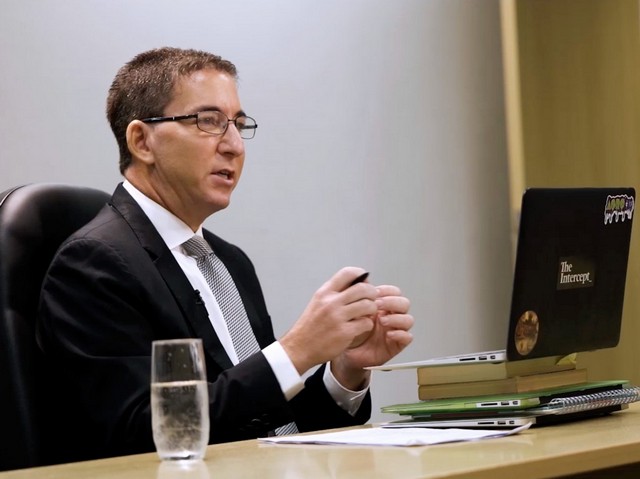
Throughout the election of 2018, the Intercept Brazil, and me personally, relentlessly sought judicial permission to interview Lula from prison, as did several other outlets. Even as the country’s most violent and dangerous criminals were permitted to be interviewed in prison, our requests to interview Lula were systematically denied by a judiciary clearly petrified of Lula’s singular ability to persuade the electorate. Only after the election was complete and Bolsonaro’s victory secure did the Brazilian judiciary suddenly begin granting authorizations for him to be interviewed. We were granted one hour with him alone, and I traveled to Curitiba last week to conduct the interview.
Despite the intense personal tragedies and harsh political defeats he has suffered, I encountered a Lula who was remarkably similar to the one I interviewed in 2016: intense, energetic, charismatic, combative, and highly insightful. I confronted him with numerous criticisms about his own conduct and that of his party — including policies many believed helped lead the way to Bolsonaro’s victory — but also used the opportunity to ask one of the only world leaders with a proven track record of winning with real leftist politics what the international left must do if it has any chance of stopping the inexorably growing nationalistic right-wing movement sweeping the democratic world.
We present the entire one-hour interview with very few edits so that the full vibrancy of our exchange can be seen. It was a sweeping discussion with one of the world’s most incisive political minds, involving a wide range of issues, some of which were about Bolsonaro and Brazil, but most of which were about the dangers the planet faces from collective threats and global political changes around the world. The complete transcript is below.
[https://www.youtube.com/watch?v=93MgeyNqc_k]
Read the full interview:
Glenn Greenwald: Good morning, Mr. President. It’s good to see you again, and thank you for the interview. This interview is for a Brazilian audience as well as for an international audience. Everyone outside Brazil already knows that you think you’ve been unjustly sentenced, a point we’ll get back to in a moment. But many people have also been asking me how you’ve been treated in prison, and you’ve said many times that the authorities here are humane and professional. Is this still the case?
Luiz Inácio Lula da Silva: I don’t know what humanitarian treatment in a prison means. I’m locked up, and I’m in solitary confinement — and it really is solitary, because most of the time I’m completely alone. I meet with my lawyers, and that’s it. And with my family once a week. I don’t know whether to consider this decent. What allows me to endure all of this without loathing it, and with a brighter outlook, is knowing that there are millions and millions of Brazilians living in freedom who, even so, are in worse conditions than I am. At least I have the opportunity to have lunch, to have dinner, you know?
But Brazil is the country you ran for eight years, and there are plenty of people in jail. How do you compare your treatment here to the treatment common prisoners receive in common prisons?
Take the Brazilians who have to live in stilt houses above swamps: They’re living as second-class citizens. A citizen who has to live in a single 9-square-meter room, who has to have lunch, dinner, has to cook, make love, go to the bathroom, and do everything within those 9 square meters — they’re not living any better than I am here. That’s why I’m less concerned about my own situation and more concerned with that of millions of people …
I get it, but are you being abused or tortured? That’s what people want to know.
No, listen: We’ve been fighting for many years to end torture. These days, torture has more sophisticated forms. It’s based on plea bargaining, on the thousands of lies told simultaneously over and over, and people imprisoned for two or three years until they say what the prosecutor or police commissioner wants to hear. I could cite the example of [Antonio] Palocci’s plea bargain, where he’s lying in the most unbelievable manner. Or take Leo [Pinheiro], for example, who’s in prison and lying through his teeth to get out. The secret is to talk about Lula. This has been going on for five years. You know that I’m here even though neither the judge, the prosecutor, or the Federal Police commissioner who launched the investigation have any proof against me. They know that the apartment isn’t mine, they know that the ranch isn’t mine, but they keep up these lies …
So are they mistreating people in order to elicit accusations against others?
Yes, and it continues to this day. I joke with my lawyers that I’d like to plea bargain and denounce Sérgio Moro, denounce the TRF4 [the 4th Regional Federal Court], to be a whistleblower against the commissioner that launched that deceitful investigation, I’d like to denounce [Deltan] Dallagnol. I’d love to, you know, but nobody would accept my plea bargain. Let’s see if you arrange for my whistleblowing to see the light of day, Glenn, because I need to make something clear. There’s this phrase by an English philosopher, that the curse of the first lie you tell is that you spend the rest of your life telling more lies to justify the first one. Do you remember when I went for my first deposition with Moro? I said to his face, “You’re condemned to condemn me,” given the huge amount of lies they’ve told, you know, in this agreement between Operation Car Wash and the Brazilian press. Because Operation Car Wash would be nothing without press coverage. But it’s a collusion between media, television, radio, and newspapers, where the press editors get the material before even the lawyers do. Before the defense lawyers received any news, the press already had. Thanks to this collusion, you’ve woven a gigantic lie. Every day, every hour I keep wondering, will GloboNews ever use the Jornal Nacional to say, “We made a mistake with Lula’s case”?
In the interview that we did in 2016, you harshly criticized Operation Car Wash, insisting that it was selective and an operation dedicated to destroying PT — as you said just now. But Operation Car Wash went on to imprison Eduardo Cunha, who led the impeachment process against Dilma, and also Michel Temer, who became president after Dilma’s impeachment (though he’s been released, he then went back, was released again, but at least he’s on trial), and also Sérgio Cabral, the governor of the state of Rio de Janeiro. And now they’re aggressively going after Aécio Neves, Dilma’s center-right opponent in 2014. After all this, can you really say that Operation Car Wash was launched to destroy PT?
Glenn, let me tell you something: Operation Car Wash has been selective most of the time it’s been running. You’re a foreign journalist, so you can investigate impartially. Check out who made donations to PSDB [the Brazilian Social Democracy Party], and who made donations to PT. How much did PSDB receive, and how much did PT receive? And what about other parties? Conduct a thorough study, an impartial one, and figure out why only [João] Vaccari of PT was sentenced for campaign finances. What about the other treasurers from the other parties??
But isn’t Aécio on trial?
But Aécio isn’t a campaign treasurer. I’m talking about campaign finances to show you that there’s been a focus on going after PT from the outset. Why? Because they needed to take out PT from the government, and since they didn’t manage to do so over the course of nearly four elections, they needed to create clear ways to stir up hatred of PT. Historically in Brazil, and I think the whole world over, this kind of loathing increases once you accuse someone of corruption.
Listen, let me be crystal clear: I think if someone steals, they should go to jail, whether they’re PT or not, whether they’re Catholic or evangelical, you know? You steal, you go to jail. If the sentence has been pronounced, if the facts have been established, and if it’s been proven that you stole, you must go to jail. This is the kind of lawful state we want to establish. Now, I want to challenge the people who imprisioned me to show the world a single shred of evidence against me. I’m not asking for anything else.
But do you agree that Operation Car Wash is going after other politicians, including your opponents from the center-right?
Glenn, Operation Car Wash has been gradually changing into a political operation that benefits whoever participates in it. I’ll give you a tip-off here, a bit of whistleblowing that you can help investigate: Not long ago, we found out that there was an agreement made by the U.S. Department of Justice with what Dallagnol was handling for the Federal Public Ministry, for Operation Car Wash, to the tune of $600 million.
From the U.S.?
From the U.S. And afterwards, it surfaced that Sérgio Moro had authorized another agreement to the tune of $1.6 billion from Odebrecht, here in Brazil. We also know that there are other monetary agreements funding Operation Car Wash, but right now we don’t have access to the figures. In fact, PT is demanding that the leader of the House of Representatives get the Federal Savings Bank involved to help us find out who’s made agreements with Operation Car Wash. Because in fact, any time someone makes an agreement like this involving hundreds of millions of dollars, they’re trying to build a political machine, they’re setting up a racket..
All right, well, I promise you that we’re working on these issues, and investigating these …
Just let me finish, Glenn, I don’t want to stop in the middle of saying …
Go ahead.
The only thing I really want, the only thing, is that my case be judged objectively. I don’t want anything else. I want the judges at some point to care about having hard evidence, either from the side of the prosecution or from the defendants. Did you know I had 73 witnesses but that Dallagnol didn’t even show up to the hearings? He made up that deceitful PowerPoint presentation and then vanished. The only person he talks to is Miriam Leitão from Rede Globo news, and once in a while, he grants an interview. He’s probably going around now on lecture tours to make money. Anyway, I don’t want his beliefs to be the last word. I want evidence to be the last word. If he can prove that I own what he says I own, that shouldn’t cost him anything. In the meantime, I’ve been completely demoralized in the face of public opinion.
We won’t be able to settle this right now. You’ve got your accusations, but it’s a question of evidence …
Listen: When PT denounced the foundation that was set up with these funds, Dallagnol went to Caixa Economica [federal bank] to try sign a document and take over the foundation. Let’s put it this way: I’m being convicted without any foundation, without any dollars behind me, without any funds, and he’s walking free, trying to seize $2.5 billion. We denounced him to the National Justice Council. But who’s going to judge the case? The Council, which consists of, you know who? 8 members of the Federal Public Ministry. So what do you think the result will be? Is there any doubt?
During the 2018 elections, we spent a year trying to get an interview with you, like other journalists, but nobody was authorized to interview you, even though some of the most violent people behind bars in the country, including Nem, the head drug trafficker in Rio de Janeiro, were interviewed in prison. But now that the elections are over and Bolsonaro has won, all of a sudden the courts are allowing some journalists, like Folha de São Paulo, El País, and Kennedy Alencar for the BBC to interview you. How would you explain this?
I have no doubt, Glenn, that everything that’s happened in connection with Operation Car Wash has been to prevent Lula from running for president. Nowadays I’m certain of this, the same way that I’m certain that the U.S. Department of Justice is behind this, and the same way that I’m certain …
Is there evidence of that?
Sorry?
Is there evidence? Is there proof?
I can only have strong beliefs, you know, about everything. The same way that I’m absolutely certain that it’s interest in the petroleum resources of Brazil’s pre-salt layer that’s behind everything that’s happened to me and Dilma. Namely, the coup against Dilma, my imprisonment, the accusations. You see, Operation Car Wash could have had an important role in punishing the businessmen — if they’re guilty — and allowing the businesses to keep on creating jobs, paying salaries. They could have kept Petrobras from going broke, from being sold, from being divvied up as it is. Anyway, I’m very glad that today they’ve allowed this interview, and I’m grateful to you all for demanding this in the courts. I should have been allowed to have interviews before the elections.
Well, we requested the interview a long time ago, before the elections.
I know. And I’m grateful that you requested one. But it was denied. First, Minister of the Supreme Court [Ricardo] Lewandowski allowed it, but then it was vetoed by [Dias] Toffoli, I think, as president of the Supreme Court. I knew that it was a game they were playing, and that the game was: Let’s prevent Lula from competing in the elections. Why? Because the worst nightmare of the Brazilian elite is Lula returning to the presidency. But why exactly, if they made so much money during my presidency?
Yes, and isn’t it true, for example, that bank profits went through the roof during your presidency?
I don’t know if they went through the roof, but they grew significantly.
They did, didn’t they?
But the truth is that the poor ascended a whole rung on the economic ladder. And as the lower classes began to go to university, to go out to the theater, to go out to eat at restaurants, to travel more by airplane, this began to bother part of the elite.
But the upper classes also saw great improvements during your presidency. So why would this upper class, who profited so much while you were president, be so against your return to office?
It’s because this isn’t just an economic question; it’s a cultural issue. One has to remember that it was only a little over a hundred years ago that slavery was legally abolished, and that it continues in the minds of many. That’s why the greatest victims of police violence are black, that’s why those who are black earn 50 percent less than those who are white, and that’s why black women earn less than white women. That’s why those who are black have a lower average level of schooling than those who are white. Why? Because slavery is still prevalent deep within people’s consciousness. It’s a harsh thing to say, but it’s true. And this doesn’t change overnight. If we think about civil rights in the U.S., things began to change in the 1960s, but how many people had to die, including Martin Luther King Jr., in order to guarantee that black people would be treated with dignity? Really, I think deep down, it’s not an economic question. It’s set of a cultural, political, and sociological issues.
Well, let’s talk about some cultural issues. Your government was responsible, for example, for approving the changes in drug laws in 2006, which were a great advance in differentiating between drug users and drug traffickers. But as a result of these laws, the number of incarcerations rose, specifically of black people and of women. Looking back, how would you judge the policies of your government, given that it led to increase incarcerations during your presidency and Dilma’s too?
Let me tell you something. Between 2003 and 2014, we rolled out a range of strategies and approved as many laws as possible to improve the system of policing in this country, to reduce the rate of corruption, and to put more criminals behind bars. If you look at anything that’s functioning well in the Ministry of Justice, you’ll realize that these advances were put in place specifically during PT’s government. Exactly then. Now listen, we didn’t manage to solve the problems of public safety in Brazil, but we did create the mechanisms, including more civil ones, for the police to act more professionally, and we equipped the Federal Police, we set up the National Police, all with the objective of getting things done. And all of this is going down the drain now. I remember when Minister of Justice Tarso Genro approved PRONASCI, the National Program for Public Safety, which was a great initative for reducing crime and helping out young adults. It no longer exists. I think what’s really needed is a series of public policies to help resolve the overall situation. What are two extremely important components?
First, take PAC, the Growth Acceleration Program. You mentioned Nem earlier, and I remember in one of his interviews with a magazine, I think it was Istoé, he said that the president who got the most criminals off the streets was Lula, because during PAC, they lost 20 percent of their crooks who instead went to go work in PAC programs. In other words, if you want to reduce violence, you shouldn’t hand out weapons; you should hand out education, jobs, salaries, opportunities, and hope.
But did this actually work during your presidency? Because for many people, the problem was that violence and crime increased during the PT government. These problems were exactly what Bolsonaro exploited in his rhetoric. Isn’t it true that the problems of …
It did not increase during the PT government. During the PT government, we enacted the greatest policies of social mobility in 500 years of Brazilian history.
But did crime increase or decrease?
It decreased, definitely. It decreased. And there’s something one has to take into account when discussing this in the context of Brazil. One thing is being serious and keeping records of every case that happens, and another thing is just making the crime rate look lower by hiding the crimes. What we emphasized was greater transparency, with the goal of avoiding the same old trend of poor people being the victims. When you can guarantee that a young person will have a job, you know, then he won’t have to steal someone’s cellphone or tennis shoes. He won’t have to kill someone to steal their jacket. This is a no-brainer. When you give a young person the opportunity to dream, to dream “I can have a job, I can go to a technical school, I can go to university,” then this young person will grab and hold on to such opportunities..
I see what you mean.
What kinds of dreams do they have today?
I’d like to turn to discussing the political situation here in Brazil and its relation to international politics, because the whole world is interested in understanding Brazil after Bolsonaro took power. In 2015 in the U.S., it was unthinkable that Trump would win the elections, and nobody believed it would happen, but he’s now president. The same thing in the U.K. with Brexit. The same thing in Europe with nationalist and far-right parties. A year ago in Brazil, nobody believed that Bolsonaro would be elected. It was unthinkable, but he won. Now I know that you believe that Bolsonaro’s victory was due to causes and factors unique to Brazil, like the media’s attack on PT, but right now, can we see Bolsonaro’s victory as part of a larger global pattern in the democratic world of far-right parties overturning center-left parties?
Well, as part of the democratic process in the whole word, shifts and alternations in power are a normal pattern. This holds in the U.S., it holds in Germany, and it holds in Brazil. In one election, the right wins, in the next one the left wins, and in the next one …
But the right-wing is gaining ground in many countries.
Now, look: We had a very extraordinary period in Latin America. The period with the most growth, the greatest distribution of wealth, and of the most social inclusion in Latin America happened between 2000 and 2014 with the elections of [Cristina] Kirchner, [Ricardo] Lagos, Lula, Evo Morales, [Hugo] Chavez, Rafael Correa — it was a golden age for Latin America. We’re now in a far-right phase that’s failing in absurd ways. Macri is a disaster for Argentina, and he was supposed to be the answer. There’s this book …
Why is this happening?
Well, there’s this book by the Mozambican writer Mia Couto, with the following phrase: “In times of terror, we choose monsters to protect us.” Now, when you create hatred within a society, when you create anti-political sentiment, when you take away any kind of hope in people or in existing institutions, then, well, anything goes. I know that Americans thought Trump had no chance. So why did he end up winning the elections? It wasn’t with Putin’s help, as everyone’s saying. It was because of the lies of fake news, just like here in Brazil.
Was that the only reason?
That’s not the only reason, it was because of unemployment, because of despair, and because of this discourse of the shrinking the government, which is always a concern in the air. You know what I mean? When Reagan and Thatcher created so-called globalization, the fad in the 1980s was to say that being modern was being globalized, and opening the economy up to the whole world and letting capital transit freely — even though people could not freely transit. Now that globalization has caused problems for developed countries, above all for the U.S., Trump found an easy line of discourse: “The U.S. is for Americans, and jobs are for Americans.”
Well, it’s not very well known that many people who voted for Obama in 2008 and 2012 then went on to vote for Trump in 2016. In Brazil, the same thing happened: Many people who voted for you and then for Dilma went on to vote for Bolsonaro. How do you explain this?
Glenn, let me share something with you: I know Hillary Clinton pretty well. It would have been very easy to find someone more popular than her. She’s not an appealing personality. Trump’s victory was due to him having the right kind of discourse for the white blue-collar workers, you know, from the automobile industry, who were unemployed. He promised the obvious: more jobs for Americans. He promised to fight the Chinese to create more jobs, and this won him the elections. Now it’s obviously possible that many people who voted for Obama voted for Trump, just like many people who voted for Lula voted for Bolsonaro, especially since Lula wasn’t running for office. If Obama was running, I don’t know if Trump would have won. Concretely, I don’t know if, even in spite of the extraordinary performance by [Fernando] Haddad — if I were to have run, would the people have voted, would PT voters have elected Bolsonaro? Concretely …
I know people who voted for you, and then for Dilma, and then for Bolsonaro.
Well, maybe if I’d been a candidate, these people wouldn’t have voted for Bolsonaro. Glenn, since you’re a journalist, you know what’s happened in Brazil. First of all, Brazil has always had politics based on a monolithic “conventional wisdom.” Fernando Henrique Cardoso had eight years of conventional wisdown that was favorable to him, I had eight years of conventional wisdom that was against me, and Dilma had favorable conventional wisdom when the press tried to create a rift between Dilma and Lula, but then that didn’t work out, so they were against her. And as soon as the idea of impeachment came about, they were 100 percent against her.
There was this climate of hatred running throughout society, trying to blame PT for all of the misfortunes of Brazil, but when the elections were on the horizon, there wasn’t a single viable right-wing candidate. (I mean, normal right-wing, because as for Bolsonaro, he’s comparable to Nero standing by while Rome burned down to the ground.) And in fact, Bolsonaro’s been in office for five months and we’ve never heard the words “growth,” “development,” “investment,” “job creation,” “distribution of wealth” — these words have simply vanished from the dictionary. The only thing you see is everyone making this gun gesture with their fingers all the time, and this is actually the same shape they used before to make an “L” for Lula. I guess Bolsonaro borrowed this gesture from when it was used in my presidential campaigns. The point is, our country is abandoned, everyone only speaks of budget cuts and welfare reform, and promising the society …
Abandoned by who? I mean, during your interview with El País, you chalked up the rise of the global right to the failures of neoliberalism. I’d like to know more about this issue of neoliberalism failing here in Brazil and internationally as well. What’s the relation between the population suffering and their sudden embrace of far-right leaders like Bolsonaro and others throughout the democratic world?
Neoliberalism, as it arose during the era of globalization, is losing ground everywhere. It’s not just losing ground to the left, but also to the right, as it lost to Hitler and to Mussolini. At the same time, we’ve had two recent examples, in Spain and Portugal, of the left coming back during the elections. And even in Germany, where Angela Merkel is a very strong politician, if she hadn’t formed coalitions with the Social Democrats, she wouldn’t be in power.
But even there, the far-right is growing.
I know, it’s growing the whole world over, and I think it’s a warning call for the left, yes. But the right-wing won’t … you can be sure that after Bolsonaro and Macri, Cristina [Fernández de Kirchner] will win the next elections. You can be certain that if Evo Morales runs for president, he’ll win in Bolivia, and that the same will happen in many countries.
I hope that Americans will have the good sense to prevent another term of Trump as president, because he’s not just a problem for the U.S., he’s a problem for the whole world. He has to learn that given the importance of the U.S. on the international stage, he can’t make impulsive decisions without reflecting on their global consequences. He can’t threaten to wage war on everyone, threatening to attack all the time. Enough is enough! We’ve had enough lies, like in Vietnam, like the lies about Iraq, like the lies about Libya.
It’s time to stop this, you know, the world needs peace, the world needs schools, the world needs more books, and not more weapons, the world needs jobs. Sometimes I get really upset thinking about the G20 meeting we had in London, the first one that Obama went to, where we reached important decisions to deal with the 2008 financial crisis, and one of the suggestions was that richer nations, in accord with the reduction in their internal consumption, could enable financial means for poorer countries to develop and to modernize, to buy newer machines, to have greater access to technology and science. But this didn’t happen, and protectionism is back.
But Mr. President, it’s a common criticism, for PT as well, that while you and Dilma have a reputation and a political past as left-wing, your form of government was neoliberal, and there are a number of examples which we’ve already discussed, like the increase in bank profits during your presidency. The same way that the Democratic Party in the U.S. is financed by Wall Street and Silicon Valley, PT was financed by the richest corporations in Brazil, such as Odebrecht, OAS, JBS, and lots of banks. You implemented a welfare reform in 2004, and Dilma implemented austerity in 2014 and went ahead with the hydroelectric dam in Belo Monte that environmental and indigenous activists were against, and you implemented tax cuts for the rich. If you think that Bolsonaro’s victory was due to the failures caused by neoliberalism, don’t you think that PT built it up?
Oh, no, no. No, Glenn, I won’t answer your question before responding to all of these things you’ve just said about PT and my government.
I don’t want you to respond to those …
It’s important to keep in mind that …
It’s a common criticism, that’s why I’m asking.
During my presidency, I never said that my government was socialist. First of all, when you win an election, you have to figure out the relations between the forces that you’ll have on your side in order to implement political decisions. It’s important to remember, Glenn, that when I was elected president of the republic with a parliament of 513 representatives, I had 91 representatives from my party. Collor and Bolsonaro, they had 50. He’s going to need, much more than I did, to construct allegiances with forces who will be amenable to approving what he wants. There’s no point in his talking of “old politics” when he’s the old politician himself! He’s been in office for 28 years. He’s the old politician, and I’m the new one. I had only been a representative for four years, and I didn’t want to be a representative anymore, and he was one for 28 years. So enough of this “old politics” nonsense. And if you want to run a country, you have to work with what you have!
I ran the country that I happened to be in. I wasn’t running France, or Germany or the U.S., I was running Brazil. And when I arrived in office, there were 54 million people dying of hunger, who couldn’t afford to eat breakfast, and I pledged that by the end of my term, every person in Brazilian would have breakfast, lunch, and dinner. I didn’t get the chance to go to college, but I made it my duty to see to it that, since I didn’t have the chance go to college, the workers would. For all these reasons, even though I’m the only president without a college degree, I wouldn’t switch places with many people who have one, you know? I’m the president who sent the highest number of students to university, who opened the most public universities, who launched the most technical schools in the history of the country, who had the largest policies of distribution of wealth, who raised the minimum wage the most, and who helped the most in settling the landless.
So how do you explain the suffering that people felt that brought Bolsonaro to office, after 14 years of PT in power?
Why did I do all those things that I just mentioned? Because I understand that if one wants to solve the problems of Brazil, we have to use the word “people.” We have to look at people and see human beings instead of just seeing numbers or debt figures. Do you want to reduce the government debt in Brazil? Grow the economy. Do you want to reduce the welfare debt? Create jobs. Why was the welfare at a surplus in 2014? Because we created 20 million jobs with regularized work contracts, and because we legally approved six million individual microenterprises. We got the economy functioning. Just talking about cuts, cuts, cuts won’t hack it; one needs to speak of growth, development, and look toward people, not toward the banks. Come on, what kind of growth can our country expect with a president who goes around saluting the American flag?
No, what I’m trying to ask is why you blame the rise of Bolsonaro and other extremists on neoliberalist ideologies. I’m trying to understand the difference in how you ran the country, how Dilma ran the country, and those ideologies. What differences do you see?
Glenn, when we started this interview, I said clearly that PT’s biggest problems come not from its errors, but its successes. Every time that a president tries to enact socially-minded policies in Latin America, they’re eventually ousted. The elite in Brazil and in other countries don’t accept economic development policies that contain social inclusion. PT managed to enact — and this is according to the U.N., not me — the greatest changes in social inclusion in the history of this country. It’s important to remember that during our mandate, it was the only time in history that the poor had a higher rate of economic upturn than the rich. The rich made gains too, but the poor at an even greater percentage. It was the only time in history, and this bothered people. You should have heard it in the Rio de Janeiro airport, in the São Paulo airport, when people said, “This airport is beginning to look like a bus station, with these poor people all around, people who have never taken a plane in their life.”
Yeah, so why is there so much anger in this country, leading to Bolsonaro’s election?
Well now, you’re giving me the opportunity to explain to the Brazilian people what happened. Let’s take the case of Bolsonaro. He had 39 percent of the total votes, not of those who went to the polls, but 39 percent of the total.
In the first round?
No, in the second round runoff. If you do the math, he had 57 percent of the votes of people who picked a candidate, but only 39 percent of the total number of voters.
But he won by a large margin.
It was a third, but yes, he won. He won the elections, but the majority of the people did not vote for him. But why did anyone vote for him? They voted for him because of that phrase I said earlier: “In times of terror, many people choose a monster to protect them.” So there were people who preferred to believe in a lie called Bolsonaro, in a man who preached hate, who preached violence, in a man who hates black people, who hates gay people, who hates poor people, in a man who said that killing was the answer, yes, they voted for him. Why? Because the opposition was PT, and PT had been demonized.
Who knows, Glenn, you know that when they ask me, I say that maybe God didn’t want me to win the elections back in 1989. Why? I lost in 1989, I lost in 1994, I lost in 1998, and I never got angry, nobody ever saw me infuriated about losing. I went back home and got ready for the next election. The hatred all started with Dilma’s victory in 2014 — no, actually with the demonstrations in 2013, and came to a head when Aécio lost, and then rants against Dilma began, and the hatred, the hatred …
They couldn’t accept this loss. But I want to ask you something important, because you just said that PT was demonized and talked about the hatred of PT. And there’s a common criticism that I often hear about your strategy in 2018, which is that you did everything possible to weaken the candidacy of Ciro Gomes of the center-left, who many think had a better chance of beating Bolsonaro than the candidate who you chose from your party, Fernando Haddad.
Because of the hate and loathing of PT in Brazil, because Haddad was unknown outside of São Paulo. And now this is for the international audience: In the first runoff, Haddad ended up in second place, while in the second runoff, Bolsonaro defeated your PT candidate by a huge margin. The critics say that you preferred to lose to Bolsonaro and maintain control over the left with PT, than to have a better chance of beating Bolsonaro if it meant letting another party, namely Ciro’s, represent the left. Is this a valid criticism?
Do you believe this?
Well, I’m asking what you think.
I’m asking if you believe this, you know why?
I’ll tell you what I know. I know that the candidate who you endorsed so that he could make it to the second round ended up losing by a large margin to Bolsonaro, and I’m asking whether this was the right strategy.
I’ll try to explain. My main strategy, my most basic strategy, goes back to 1989. In 1989, [Leonel] Brizola, who I remember fondly, thought he would win the elections. Brizola came back from exile ready to be president, but I was the one who went to the second round runoff. Did you know Brizola asked me to give up, so that he and I could support Mario Covas instead? So I said, “Brizola, if the people wanted to elect Mario Covas, they would have voted for him, so why didn’t they? How would I look for the voters who wanted me in office? Should I give up to support Mario Covas who is way behind?” Really, if the people wanted Ciro to win the second round runoff, why didn’t they vote for him in the first round?
Because you endorsed Haddad and not Ciro, and because your party also blocked his alliance with the PSB [the Brazilian Socialist Party], and gave up a possible candidacy for the governor of Pernambuco all to help the PT candidate. You’ve heard all these criticisms.
Come on, does Ciro really complain because PT had the political means to bring in PCdoB [the Communist Party of Brazil] and PSB [the Brazilian Socialist Party]? What did he want PT to do? Nothing? He wanted PT to talk to PSB, because …
You were the one who said that PT was demonized, was always under attack …
Listen, let me tell you something. Ciro’s gotten learn something, this is important in politics, and if you ever want to go into politics, then learn this: If you want someone to like you, then you’ve gotta learn to like them back. If you want someone to respect you, then you’ve got to respect people. So if Ciro really wanted PT’s support, he could have come and discussed things with PT. I’m gonna tell you a story that you might not know, that nobody’s ever told, and that Ciro never told anyone. There was a time that Mangabeira Unger came to my office and said, “Me, Haddad, and Ciro had a meeting, and we agreed that Haddad would be Ciro’s vice president.” And I said, “Mangabeira, don’t you think you should’ve discussed this with PT first?” What do you think? Mangabeira, and now this is back in 1994, I was at a dinner at his house in Boston with him, with the beloved Marco Aurelio Garcia, with his beloved wife, and he says to me, “Brizola’s gonna win the election.” I had over 20 percent of the votes, and Brizola had none, and he says, “Brizola’s gonna win.” So I said, “Why do you think so, Mangabeira?” And he says, “Because as soon as Leonel Brizola gets in front of the cameras, all of the workers will vote for him!” And I said, “Mangabeira, you must be out of it, this isn’t gonna happen.” Well, the elections came, and I don’t know if you remember what happened that year. They banned the use of outside images, and only allowed candidates to speak directly in front of the camera. So how many votes did Brizola get? He lost to Enéas Carneiro. I ran again in 1994 and had 27 percent of the votes, but there was no second round. Ciro went to the elections, and didn’t run — no, he did, and he got 11 percent of the votes. He then ran again in 2002, and got 11 percent or 12 percent, and last year he ran again. So I lost four times before winning, and Ciro has already lost three times, maybe he’ll have to lose once more. If Ciro wants to make alliances, he has to learn to have conversations, he has to learn how to convince people, and he has to assume certain programmatic commitments.
Well, Ciro will definitely hear this interview.
I think Ciro knows what kind of relationship I have with him. I’ve always had a great deal of respect for him, and I thank Ciro for working with me in my government, and I’ll tell you something else: I thought Ciro shouldn’t have even run for the House of Representatives, because I invited him instead to be the president of BNDES [the Brazilian Development Bank].
Well, this is exactly the reason that he thought he had a better chance than the candidate that you endorsed in the second round runoff. But anyway, I want to take this opportunity to talk a little bit about the challenges that the left faces internationally, because it’s really important, and you are one of the few great leaders of the left in the past twenty years, who managed to win national elections in a huge nation and to reach out to the most destitute and marginalized.
I think it’s really important to hear what you think of the problems that the left is facing worldwide, because in the majority of countries in the democratic world, including Brazil, the left is facing great difficulties in attracting support from lower socioeconomic classes, but at the same time is seeing increased support for higher classes, people with higher education, and university degrees. So I want to ask, what’s needed in order for the Brazilian left and the left worldwide to be able to reconnect with the people, as you were able to do?
Listen, during the economic crisis in 2008, I discovered that the world was lacking leadership. I went to meetings with the 20 main leaders of the world, and I realized that nobody knew what to do. I was worried, for example, about the EU, because the EU had become very bureaucratic, and it was no longer the politicians who spoke, it was the bureacrats, it was this committe and that commission, and everything was a committee or commission without the politicians deciding anything. I thought this was pretty bad, you know.
And in the U.S., Obama also had no way out. I remember calling up Obama during the automobile industry crisis and telling him my plans with the BNDES, with the Bank of Brazil, with the Caixa Economica — with three public banks that enabled us to kickstart economic growth in Brazil and prevent the crisis from strangling us. Obama regretted that in the U.S. there was no way to have such bank involvement, but there were ways to create development banks. Anyway, here’s what I think the left has to do: First, the left needs, you know … there are left-wing parties with 100 years of experience, with 150 years of experience, with 80 years, and PT has 40 years of experience, and I think PT has had a very successful experience.
Now, some folks have said that PT has gotten too far removed from the people. Listen, I would say that PT needs to take a step back but not to its origins — because you don’t govern for the sake of a party, you govern for the sake of the whole society. When you win an election, you have to govern for the sake of everyone, and of course you can choose who you want to focus on serving more or less, but you have to govern for the sake of everyone, you have to respect everyone, you have to like everyone, you have to serve everyone, and this was how I did things. I doubt, Glenn, that you’ll find any other country, during my presidency, I doubt you’ll find a mayor, a governor, or a representative from an opposition party who had anything bad to say about my government, because we treated everyone with decency.
I agree, and you left office with an 86 percent approval rate, and one of the most important aspects, in my opinion, of your political appeal was your childhood and background: that you came from poverty, that you only learned to read at age 10, and that you were a laborer at age 16, like millions of other Brazilians. I want to know whether you think it’s important for left-wing parties to be represented by people who learned about poverty not only in theory while in college, but who grew up in poverty themselves and, therefore, have that experience in their bones and can speak with credibility to the people about poverty and about their experience. Do you think that the Brazilian left, or the left internationally, can manage to do this the way you did?
Well, I think the left has many people who have studied very hard and who are serious intellectuals who can achieve this. What we need is …
But is that the same has having experienced it?
What’s really needed is to be committed to these causes. There’s no way to govern a country if … Do you remember my attitude when I won the election? Do you remember that I put every minister on a plane and took them all to the four most destitute places in Brazil? Why did I do that, anyway? I wanted [Henrique] Meirelles, a banker, and [Antonio] Palocci, a doctor, and [Luiz] Furlan, a businessman — I wanted them to see a stilt house above a swamp up close, I wanted them to see a man and woman having to defecate in the same room they eat in, I wanted them to see the vast number of young girls with two or three kids and no dad around, I wanted them to see the poverty of Jequitinhonha Valley, I wanted them to see the real world as it is, not just the world as it is in Brasilia. What the left needs is this kind of commitment.
You’re not going to manage to govern if you can’t define which part of the population it’s your priority to serve. So I might like everyone, I might like Glenn, I might like Lula, I might like anyone, but I have to choose. Does Glenn manage to eat three meals a day? Does Glenn have access to education? Does Glenn own a car? Well, then Glenn isn’t my priority. The priority are those who are downtrodden, who don’t have what Glenn has, but who need to.
But to make this happen, do you think it’s important to have candidates coming from these neighborhoods that have real poverty and that don’t seem overly academic?
No, what we have to do is prepare ourselves. I prefer that we find candidates who come from backgrounds with popular struggles in their blood, in their veins, but obviously there are many good people out there, not necessarily from poor backgrounds, who are committed to the cause of the poor.
But most important is having the candidates. Do you think this is what’s missing in Brazil?
Definitely. This is why the party … I think what’s missing is more people being involved, more women, more black people, more Indigenous people.
I’ve only got 5 minutes left, and I need to ask you …
I want to know whether you’re going to ask me about Venezuela?
Sure, but I have to ask you about something else too, or everyone will kill me, because it’s one of the greatest concerns internationally about the situation in Brazil: the Amazon — given its importance and what it represents in terms of the capacity of human beings to protect the planet, against catastrophic climate disasters. Do you think that the Amazon is under threat because of the Bolsonaro government?
I do think so, because really they have no limits. The only thing they know how to do is destroy, and they don’t give a damn about the biodiversity and ecosystems in Brazil. They just want to destroy it, and I’m concerned about this, because sustainability and the defense of the Amazon are part of the policy of national sovereignty. Brazil has nearly 16,000 kilometers of borders with 10 countries and nearly 8,000 kilometers of ocean borders. The pre-salt layer is 200 miles away from our coastline, and thus right on the limits of our territorial waters and in need of protection, and Brazil has 12 percent of the fresh water on the planet. Brazil needs to treat our borders, our people, our flora and fauna, and our biodiversity as part of the heritage of all humanity, but administered by Brazil according to our interests. We need to put science and technology at the forefront, along with pharmaceutical advances that the Amazon might contain, as a source of solutions to dozens of diseases around the world. Really, Brazil really needs to take care of all of this. I’m proud of the fact that I participated in COP 15 [2009 U.N. Climate Change Conference] in Copenhagen, when we made a commitment, and Dilma’s commitment to the agreement in Paris. In other words …
But you were also criticized by Marina Silva, who fought for environmental causes, and by now we are all more aware of the dangers that our planet faces. So with this in mind, are there things that you would have done differently?
Listen, Glenn, do you know what I figured out? I came to appreciate some of my mother’s principles only after she died. I didn’t realize how much I appreciated her. Now as for Marina having criticisms, well, Marina was the minister of the environment. She was minister for five years. She has no right to complain, she was minister! I didn’t tell her what to do; she told me which environmental policies to implement. In other words, we obviously couldn’t do everything, but I doubt that anyone else achieved as much as we did.
OK. Well, according to my interview permit, I have a little more than one minute left, so I have one question.
Aren’t you gonna cut me some slack and ask me about Venezuela? Come on.
No, I guess not, because you already discussed this with Kennedy [Alencar and the BBC], so today I really want to ask about Moro, because he’s the judge that condemned you and put you in this prison, and the one who got you disqualified for running for president. And after all that, he was appointed by Bolsonaro as his minister of justice, a choice that many people consider downright suspect, if not corrupt, while Moro’s conviction was upheld by the Supreme Court. And this week it was revealed that Bolsonaro apparently promised Moro the next seat on the Supreme Court. How do you view this new development in relation to the role Moro had in your criminal case and to the fact that you’re here in prison?
There was another disclosure yesterday, which you might not know about: The minister who convicted me during the second trial revealed yesterday night at a debate in Curitiba that she just cut-and-paste the same pronouncement from the first trial with Moro. Basically now, let me look you in the eyes with the utmost seriousness and responsibility and tell you something: Moro is a liar. Moro is a byproduct of Rede Globo news television and the media. Worse than anyone, he planned things out with the Estado de São Paulo newspaper, he visited all the communication media outlets before launching Operation Car Wash, and he wrote an article admitting that the success of any of their operations depended on the press.
A judge who depends on the media in order to make convictions is not a real judge. A judge who is making a conviction needs to go carefully through the records of the proceedings, needs to look through all the evidence, both for and against. So I’ll tell you loud and clear: He’s a liar, the commissioner who led the investigation about the apartment is a liar, and the TRF4 lied about me as well. Don’t get me wrong, I don’t enjoy saying any of this, and I know what the consequences are. What I actually want is for Moro to have to make speeches every day, because the more he talks, the more he exposes who he really is. He was not born to anything but read the penal code. As for me, I have a lifelong commitment to prove that these people are lying about me.
I’ve been locked up here for a year and two months. I’m really, you know … every day I do exercise to keep myself under control, to avoid seething with rage while watching Brazil being destroyed, while watching our national sovereignty and military officers selling out, while witnessing these nonsensical attacks — this is all a state of affairs that I can’t imagine how we arrived at. Brazil in 2008 was poised to become the fifth-largest economy in the world. Now we’ve turned into the scourge of the earth. Brazil was the country who helped strengthen Mercosul, who helped create UNASUL, helped create CELAC, helped create BRICS, helped create IBAS, established meetings between South America and the Arab world, established meetings between African countries and Latin America …
Our time is almost up …
Let me tell you something: This country is throwing away everything that’s been built up, and now is throwing away a dream with these budget cuts at universities. It’s beyond belief that they can be so ignorant. Some of them even have university degrees, so don’t they know that there is no better way to invest in the future than education? This was exactly what we built up, and this is what they’re destroying. There’s only one thing for the people to do, and that’s to react. He wasn’t elected to destroy Brazil. He wasn’t elected for this. He didn’t even participate in debates, he has no plan, he has nothing.
We need to wrap up. I want to thank you …
[As the police officer approaches Lula] I want you to know the following, I want to end with a question that you didn’t ask and that I’m gonna answer. I think it’s not right, it’s just not right, the way that Venezuela is being treated. Venezuela deserves its own sovereignty, they have the right to self-determination, and Venezuela’s problems are Venezuelans’ problem, they’re not the USA’s problems. Trump should take care of the U.S. and stop sticking his nose where he’s not wanted.
Mr. President, again, thank you so much for the interview.
Thank you.
____________________________________________________
Glenn Greenwald – glenn.greenwald@theintercept.com
27 May 2019
Source: www.transcend.org