Just International

History should not imprison the future of Kashmir

By Dr. Ghulam Nabi Fai

Human rights work in tandem with Kashmir peace initiatives. The two do not war with one another. The idea that suppression of human rights promotes peace is discredited by all history, including that of Kashmir. The denial of freedom of speech, association, religion, due process, equal justice, and self-determination in Kashmir has sabotaged peace, not boosted its chances. Ditto in the past for East Timor, Slovenia, Croatia, Bosnia, Macedonia, Kosovo, Southern Sudan and etc. The people of Kashmir no less demand dignity and respect than do other peoples.

History should not imprison the future, but neither can it be ignored in assessing the justice and morality of aspirations. A brief chronicling of Kashmir’s history will enlighten understanding of its current plight and viable solutions.

The territory was a princely state ruled over by an oppressive Maharajah at the time British India was partitioned in 1947. The partition lines were drawn with a religious eye. In cases of doubt as to the sovereignty sentiments of a region, the British held plebiscites, which were honored. The more than 500 princely states enjoyed the option of acceding to India, Pakistan, or choosing independence on August 15, 1947, the date when British sovereignty lapsed. Kashmir was one of three states that had not chosen an option at the deadline. With regard to the other two, (Junagarh and Hyderabad) which were predominately Hindu but ruled over by Muslims, India by force of arms insisted on a plebiscite. Both voted in favor of accession to India.

Kashmir presented the flipside of the issue. According to the self-determination standard for princely states promulgated by India’s Prime Minister Nehru, a plebiscite should have been held in Kashmir to determine its sovereign future. Every reasonable opinion knew that Kashmiris would then have voted either for independence or accession to Pakistan.

Knowing that self-determination for Kashmir would prove adverse to its interests, India schemed with the Maharaja to fabricate a document of accession that would save the Maharaja from toppling to indigenous insurgent forces. India also arranged for the Maharaja to invite its army to defeat the insurgency, which provoked Pakistan to rally military in their support.

India raced to the United Nations Security Council and the Council enacted resolutions in 1948 and 1949, eagerly accepted by both India and Pakistan, stipulating a self-determination plebiscite for Kashmir conducted by the United Nations. In preparation for the voting, Indian and Pakistan forces would be substantially thinned. India, however, quickly fabricated excuses for foiling self-determination by raising endless quibbles about demobilization and scaling back its military presence. The sole reason for India’s obstructionism was knowledge that Kashmiris would never vote accession to its orbit.

India thus unilaterally annexed Kashmir in the early 1950s with a special constitutional status that promised autonomy. But India gradually reneged on its promise, and Kashmir was reduced to virtually the same status as all of India’s other States.

Kashmiris, however, are exceptionally patient and accommodating. For years they struggled through peaceful and democratic means to protest their denial of self-determination. But 1987 marked the straw that broke the camel’s back. Another rigged election by India created despair, especially among the Kashmiri youth. ‘India Today’ magazine reported, “In the Amira Kadal constituency of Srinagar, Muslim United Front (MUF’s) Syed Mohammed Yusuf Shah (Alias: Syed Salahuddin) was a candidate. As the vote counting began, it was becoming clear that Yusuf Shah was winning by a landslide. His opponent, Ghulam Mohiuddin Shah, went home dejected. But he was summoned back by the electoral officials and declared the winner. When the crowds protested, the police arrived and arrested Yusuf Shah and his supporters. They were held in custody till the end of 1987.” Further, India’s ruthless suppression of peaceful dissent destroyed the moderate option, resulting in the latest uprising in 1989.

Since the 1989 uprising, more than 100,000 Kashmiris have died. Greater numbers have been tortured, mutilated, kidnapped and arbitrarily arrested. Political prisoners number in the thousands. Emergency laws were enacted. The gruesome human rights landscape in Kashmir has been confirmed by every independent human rights organization in addition to the recent report by the United Nations High Commissioner on Human Rights.

Although it is neither for Pakistan nor for India to determine the self-determination timetable for more than 22 million Kashmiris, we welcome the peace initiative between the South Asian neighbors, which include negotiations over Kashmir. We believe in the universality of human rights and human aspirations. Thus, we welcome the initiative to the extent it seeks to lift a heavy financial and military burden from the necks of Pakistan and Indian.

India’s so-called “democracy” in Kashmir resembles Myanmar’s patently bogus democracy. The recent nationwide Panchayat (local bodies) elections are emblematic. Let me review the stunning voter boycott statistics from Srinagar and its surroundings on October 15, 2018.

The Economic Times reported on October 18, 2018 that when the time for voting had ended, the turnout for the final phase of elections, which was held only for two municipal bodies in Kashmir, remained low as usual at 4.2 per cent.

These boycott figures are not aberrational but typical. They represent a stunning vote of no confidence by the Kashmiri people in their current illegal governance by India.

Kashmir’s right, however, is not self-executing. Diplomacy, perseverance, and small but gradual steps will be necessary. The following is urgent to jump start progress on human rights and peace in Kashmir:

1. India must repeal all of its draconian laws that violate human rights in Kashmir;

2. Military hostilities must cease immediately, and a scheduled withdrawal of security forces should commence;

3. All political prisoners must be released;

4. Fundamental human rights to assemble peacefully for political purposes, to freedom of speech and of association, and to freedom of religion should be recognized and honored;

5. Kashmiris should be included in all future negotiations along with India and Pakistan..

Fulfillment of this 5-point agenda would not be a dead end but a beginning of a better tomorrow.

The peace process and human rights in Kashmir cannot be separated. They will succeed or fail together. We hope we can count on the moral suasion and conscience of the world leaders to push success forward.

Dr. Fai is the Secretary General, World Kashmir Awareness Forum and can be reached at: 1-202-607-6435 or gnfai2003@yahoo.com

21 October 2018
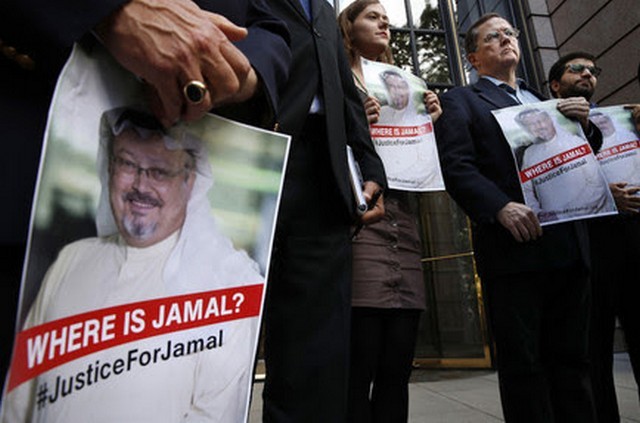
Khashoggi murder: Killing dissent even from within

By Afro-Middle East Centre (AMEC)

The gruesome murder of exiled Saudi journalist Jamal Khashoggi in the Saudi consulate in Istanbul was designed to be a clear and firm message for Saudi dissidents, and reflected the current Saudi sense of impunity. Saudi Arabia, and particularly its crown prince, Mohammed bin Salman (known as MBS), however, seemed to have miscalculated the consequences of the murder. The incident caused immediate international ructions, and increased pressure on Saudi Arabia. It is still unclear, however, whether there will be long-term consequences or whether Saudi Arabia will succeed in covering up the murder.

Khashoggi’s murder indicates MBS’s paranoia and intolerance for criticism. Khashoggi, after all, was a supporter of the country’s monarchy and an establishment figure – even if he was somewhat critical of MBS. He had been an adviser to another Saudi prince, Turki bin Faisal, former head of the Saudi intelligence service; had worked in Saudi Arabia’s London and Washington embassies; and had initially supported MBS’s ‘reform’ initiative. He was, thus, an insider who had turned his back on MBS, making him, arguably, more dangerous than a dissident. Further, even in the authoritarian monarchy that Saudi Arabia is, the man western media and politicians liked to tout as a great ‘reformer’ has deepened the levels of repression, even arresting dozens of members of the royal family in November 2017, and detaining influential religious scholars such as Salman al-Awda and human and women’s rights activists. These efforts have helped concentrate power in the crown prince’s office, as well as expanded his and the state’s coffers through large amounts of extortion money.

Khashoggi’s murder was undertaken with the brazenness with which MBS has defined himself, taking place in a consulate, with a large kill team flown in using their own passports, ignoring a Turkish camera monitoring the entrance to the consulate. This allowed Turkey to easily gain intelligence about the murder, including video and audio recordings. The attitude also reflects the sense of impunity that MBS has developed, an attitude that is justified when one considers his actions over the past three years – since being appointed deputy prime minister and minister of defence – that he has not had to account for. These include the brutal war against Yemen and the massacre of civilians – including schoolchildren; the blockade on Qatar; the kidnapping of a Lebanese prime minister, Rafik al-Hariri – and forcing him to resign; last year’s detention of members of the royal family and the extortion of substantial parts of their wealth; the weakening of the Gulf Cooperation Council; and his insulting of Palestinians and warming relations with Israel. He therefore had every reason to believe that he would escape accountability for Khashoggi’s murder as well.

Saudi Arabia had initially denied that Khashoggi has been killed, claiming he had exited the consulate. However, about ten days later, as Turkish sources leaked ever more information and because international attention and condemnation increased, the Saudis suggested that the murder was carried out by ‘rogue killers’, in an attempt to insulate MBS. They also finally acquiesced to Turkey’s request to search the consulate and the house of the consul-general. It is highly unlikely that MBS knew nothing about the murder, especially since seven of the fifteen-person hit squad are from his personal security detail. The Saudi suggestion that it was a botched interrogation is also difficult to sustain considering that autopsy and forensic specialist Salah Abdulaziz Al-Tubaigy was part of the Saudi team that arrived at the consulate and that he, it is reported, brought a bone saw with.

Khashoggi’s killing will have immediate short-term consequences for the Kingdom. It has already attracted hostility from the US senate, which in 2017 narrowly failed to halt Saudi arms sales for weapons destined to be used in Yemen. The most vocal critic is right-wing senator Lindsey Graham, a former defender of the Saudis, who said, ‘MBS is toxic. We should sanction the hell out of Saudi Arabia’. Already, twenty-one of the twenty-two-member senate foreign relations committee called for the implementation of the Global Magnitsky Human Rights Act. The administration now has four months to investigate human rights abuses relating to Khashoggi’s murder; if confirmed, the act stipulates the imposition of asset freezes and travel bans on the culprits. However, the US president, Donald Trump, has dithered between condemning the murder, defending the Saudis, insisting that arms sales to Saudi Arabia were too important to the USA to be jeopardised, and promising ‘severe punishment’. Yet, his is clearly reluctant to take any action against Saudi Arabia, only partly because of arms sales. Other factors include his own business interests with the Saudis, his obsession with Iran and the Saudi support for his anti-Iran initiative, and because MBS is a firm ally in supporting Israel. Further, it is unclear whether the US senate’s righteous indignation will continue or dissipate with midterm elections coming up and Republicans not wanting to seem divided.

The British, French and German governments issued a joint statement condemning Khashoggi’s murder and advocating an independent credible investigation; the G7 issued a similar statement. But there is no indication that this will result in any concrete action against Saudi Arabia, even if the previous image of MBS they touted – as a moderniser – becomes tarnished.
More Immediately, there has been a significant withdrawal from the Saudi ‘Future Investment Initiative’, MBS’s project to attract funds to Saudi Arabia for his economic ‘modernisation’ and liberalisation project, scheduled for later this month. Cancellations and/or high-level pullouts have come from companies such as Ford, JP Morgan Chase, Virgin Group, Blackstone and Standard Chartered; media organisations such as Fox, CNN, Bloomberg, Financial Times, and the New York Times; and senior political and economic figures such as the US treasury secretary Steven Mnuchin, the finance ministers of France and Netherlands, the trade secretary of the UK, and IMF head Christine Lagarde. Uber, which Saudi Arabia has shares in, and Fox Business Network, which was a cosponsor of the event, have also withdrawn –Fox Business also withdrew its sponsorship. These withdrawals are sufficient to threaten a collapse of the summit, disrupting MBS’s project in, at least, the short term.
Within the MENA region Saudi Arabia has received support from allies Bahrain, Egypt and the UAE, as well as from Kuwait and the Palestinian Authority, all of which have called for an investigation, but expressed their support for the kingdom. Most of these countries are dependent on Saudi largesse, while the UAE and KSA have a strong economic and military partnership and alliance against Qatar and Iran.

A significant development in the region might be Saudi relations with Turkey, which have been cool, mainly as a result of Turkey’s support of Qatar. The manner in which Turkish intelligence services and the Turkish president, Recep Tayyip Erdogan, have responded, suggest that they have calculated on pushing Saudi Arabia into a corner, as they have done, but may hope that this will force Saudi Arabia to improve relations with Turkey, on terms dictated by the latter. The current situation represents a public relations coup for Turkey and a disaster for Saudi Arabia. However the Saudis respond, Turkey will emerge in the stronger position. The Turks have also used the incident to strengthen relations with the USA, which were also strained in the recent past, releasing American pastor, Andrew Brunson, who has been in Turkish custody since 2016. Turkey will likely demand that some high-level Saudi official take the fall. They might not aim as high as MBS, however.

Within Saudi Arabia, the murder has had limited impact, and while there is concern about the possible consequences of external pressure on MBS’s standing, there is no indication yet that he will be removed from his position or disciplined in any way. This will be disappointing both for the Saudi opposition as well as dissident and disaffected members of the royal family who wait anxiously for an opportunity to hit back at the crown prince. At the moment, it seems that the worst consequence for MBS might be his father Salman instructing him to take a low profile in the immediate future while attempts are made to contain the fallout of the Khashoggi murder. MBS remains Salman’s favoured son and nominee as his successor.
It is quite likely that, in the long-term, the pressure on the kingdom will slowly dissipate as western geopolitical and economic needs come to the fore again. Many western companies will seek to benefit from the aggressive expansion of the Saudi 230-billion-dollar sovereign wealth fund (Public Investment Fund), which has recently purchased shares in renewable energy, property, and motion production companies around the world. MBS is already deploying Saudi finances to limit the fallout from the murder, releasing 100 million dollars in funding to the US State Department’s counterterrorism programme.

Trump has already said he will not suspend sales of arms to Saudi Arabia because, he claimed, Russian and Chinese companies would replace American ones. Whatever the USA decides, switching heavy weapons’ technology from American to any other is not an easy or short-term process and the Saudis and Americans will remain tied in their arms seller-buyer relationship in the medium term.

AMEC insights is a series of publicly-accessible publications, providing trenchant analyses of topical issues related to the Middle East and North Africa. If you want to be added to our mailing list, please email info@amec.org.za

19 October 2018

West Is Losing And So It Is Bashing China And Russia ‘Left And Right’ Literally

By Andre Vltchek

The insanity and vileness of Western anti-Chinese propaganda used to make some of my Chinese friends cry late at night. But things are changing. The lunacy of what is said and written about China (and Russia, of course), in the US and Europe, is now clearly reflecting frustration and the bad manners of sore losers. One could almost be inclined to pity the Western empire, if only it wasn’t so violently murderous.

The Empire’s propagandists are pitying nobody – they are now shooting like maniacs, but without any coherent plan.

Various Western ‘experts’ and journalists cannot really agree on the basics:‘what is really wrong with China’. But they are paid extremely well to find new and newer skeletons in the huge Chinese closets, and so they are constantly competing with each other, looking for the juiciest and the most scandalous stories. Often it appears that it pays to assume that absolutely everything is flawed with the most populous, and on top of it, Communist (with the ‘Chinese characteristics, of course) country on earth!

China will end extreme poverty by 2020, but do not look for cheers and applause from Berlin, Paris, London and Washington. China is far ahead of all the large countries on earth in building a so-called ‘ecological civilization’, but who is willing to notice? China is constructing public parks, boardwalks and playgrounds, the biggest on earth, but who cares? The Chinese government is introducing sweeping educational reforms, while flooding the entire nation with concert halls, museums and theatres. But that’s not worth mentioning, obviously!

Western propaganda tries to discredit China literally from both ‘left and right’, sometimes accusing it for being too Communist, but when it is suitable, even for ‘not being Communist enough’.

The New York Times ran a cover-page story on October 5, 2018, “Unlikely foe for China’s leaders: Marxists”. For this highly sarcastic piece, a reporter visited the Chinese city of Huizhou, from where he wrote about a group of over-zealous young Marxists who are demanding things to be as they were in Mao’s days:

“But the Huizhou activists represent a threat the authorities did not expect.”

Seriously? A threat? China is moving towards Communism, again, under the current leadership. We are talking about democratic, socially-oriented Communism. But let us not argue with the official U.S. newspaper. It is definitely not a pro-Communist publication, but they had to show some sympathy (by running a cover story!) to a small bunch of over-zealous ‘opposition’ Marxists, just to spread doubts among the readers, suggesting that the Chinese government is not that Red, anymore.

The next day (Saturday-Sunday edition, October 6-7, 2018), the same New York Times published two cover stories on China. One was along its usual anti- Chinese and anti-Russian conspiracy lines “Will China hack U.S. mid-terms?”, but the other basically contradicted the story from the previous day, accusing Beijing this time of cutting the wings of private companies: “Beijing is pushing back into business”, with a sub-title:

“Government flexes muscle as private companies that built economy lose ground.”

‘Wherever it can hurt China, just write it’, could be the credo of thousands of European and North American journos: ‘as long as the news about or from China is bad, really dark and negative, anything goes!’

Too much Communism, or too little… As far as the West is concerned – China can never get it right! Because… simply because it is China, because it is Asia, and because it waves the red flags.

And so,The New York Times ran two totally contradictory stories. An editorial blunder, or a pre-meditated attempt to inflict maximum damage, by kicking ‘left and right’?

*

It is, of course, fun, to follow this propaganda trend, ‘from a safe distance’ (meaning: ‘not believing a word of what it says’). But what is happening is not a joke; what is being done can actually be deadly. It can trigger, unexpectedly, a chain of events that could truly hurt China.

‘An explosion’could originate in Taiwan, in Southeast Asia, or from the PRC territory itself.

Look at Brazil, look at Venezuela! Look at all those Color Revolutions, Umbrella Revolutions, ‘Springs’ from Europe to Arab countries. And look at China itself: who triggered; who sponsored the so-called Tiananmen Square events? There is clearly enough evidence, by now, that it was not some spontaneous student rebellion.

The West has convinced several countries such as the Philippines, that they should confront China, through various territorial claims in which, honestly, almost no serious Filipino historian or political scientist is ready to believe (unless he or she paid royally from abroad). I talked directly to several top historians and political scientists in Manila, and I got a clear picture of whom and what is behind those territorial claims. I wrote about it in the past, and soon will again.

China is too big to tolerate dangerous subversions from abroad. Its leadership knows well: when the country is in disarray, hundreds of millions of human beings suffer. To preserve the nation’s territorial integrity is essential.

*

So, what is China really; in a summary?

It is a Communist (or you may call it a socialist) country with thousands of years of a great and comparatively egalitarian history. It has a mixed economy but with central planning (government tells the companies what to do, not vice-versa). It is clearly the most successful nation on earth when it comes to working on behalf of, and for the benefit of its citizens. It is also the most peaceful large nation on earth. And here are two more essential points: China is at the forefront of saving the world from the looming ecological disaster. And it has no colonies, or ‘neo’-colonies, being essentially an ‘internationalist’ state.

Its political system, economy, culture:all are diametrically different from those in the West.

China has millions of things to say about how this planet should be governed, how it should be marching forward, and what is true democracy (rule of the people).

Now honestly: does Western mainstream, which manufactures ‘public opinion’ all over the world, allows many Chinese (PRC) patriots, Communists, thinkers, to appear on television screens, or to write op-eds?

We know the answer. Almost exclusively, it is the Westerners who are, (by the Western rulers), entrusted with the tremendous task of ‘defining what China is or isn’t’. And what the entire world is or isn’t.

If China says that it is ‘socialist with Chinese characteristics’, they say ‘No!’ with their perfect Oxford accents. And their arrogance from telling the greatest civilization on earth what it actually is or isn’t, gets accepted because of the fact that most of them are white, and they speak perfect English (paradoxically, still a seal of trustworthiness, at least in certain circles).

The West never hears what the Chinese or Russians think about the world. While the Chinese and Russians are literally bombarded by what the West thinks about them.

Even Chinese people used to listen to such ‘false prophets’ from the ‘civilized West’. Now they know better. Same as the Russians know better. Same as many in Latin America know better.

The spread of Western propaganda and dogmas used to appear as a battle, an ideological combat, for Chinese and Russian brains (if not for hearts). Or at least it appeared as such, to many naïve, trusting people.

Now it is all much simpler and ‘in the open’: the battle continues, but the frontlines and goals have shifted. How?

What is taking place these days, is simply an enormous clash between Western imperialism plus its propaganda, versus the determination of the Chinese and Russian people to live their own lives the way they choose. Or to put it into even simpler terms: the battle is raging between Western imperialism on one side, and democracy with ‘Chinese and Russian characteristics’on the other.

West is bashing China and Russia ‘left and right’, literally. But it is definitely not winning!

*

[First published by NEO – New Eastern Outlook]

Andre Vltchek is a philosopher, novelist, filmmaker and investigative journalist.

19 October 2018

Source: https://countercurrents.org/2018/10/19/west-is-losing-and-so-it-is-bashing-china-and-russia-left-and-right-literally/

Weaponised Religion

By Jafar M Ramini

As surely as night follows day if you want to make all before you tremble and kneel at your feet you only have to mention religion. The fear of God and a promise of the hereafter is all that is necessary. Cynical? Yes it is, but I am not talking about myself. I am agnostic. I speak of the cynical and evil use of the bible and God to justify the Zionist theft of our land. Not just any bible, but The Schofield Bible, a heavily annotated version by an American Christian evangelist at the turn of the last century, Cyrus I Schofield, who induced generations of American evangelicals to believe that God demands their uncritical support for the modern State of Israel. When John Hagee, the founder of Christians United for Israel (CUFI), said recently that “50 million evangelical bible-believing Christians unite with five million American Jews standing together on behalf of Israel,” it was the Scofield Bible that he was talking about. This callous and inflammatory pronouncement bought the reverend a front row seat at the opening of the US Embassy in occupied Jerusalem.

At the recent Christian Media Summit in Jerusalem, a gathering of Christian journalists from around the world, Mr Benjamin Netanyahu, the propagandist and liar-in-chief for the Zionist colonial project in Palestine had this to say.

“Israel is the only country in the Middle East where the Christian community thrives and grows.”

He went on to say, “When Israel transferred control of Bethlehem to the Palestinian Authority (PA) in 1995, its Christian population was roughly 80%. Now it’s about 20%. That change happened because in the PA areas, as well as throughout the Middle East, Christians are being constricted, pressured, persecuted.”

Rubbish, said Mr Anton Salman, a Palestinian Christian, and incidentally, the Mayor of Bethlehem,

“If Mr. Netanyahu was concerned about the situation of Palestinian Christians, particularly in the Bethlehem area, he would return the 22,000 dunams (5,436 acres) of Bethlehem land illegally annexed to Israel for expansion of colonial settlements.”

He continued. “He would dismantle the annexation wall that divides Bethlehem from Jerusalem for the first time in 2000 years of Christianity and would stop imposing restrictions to Palestinian movement, including the thousands of Palestinian Christians living in exile and whose return is impossible due to the Israeli control over the Palestinian population registry.”

He went on to say, ”For example, in Jordan alone, a few kilometers away, there are at least 20,000 Palestinian Christians from the Bethlehem area that are denied family unification and even cannot enter the city, not even to celebrate Christmas, due to the Israeli military restrictions.

“We would like to remind Mr. Netanyahu that it was himself who supported the building of one of the most damaging colonial-settlements that surround Bethlehem, Jabal Abu Ghneim (Har Homa), and that in 2015 he declared that by doing so he is preventing the connection between Bethlehem and Jerusalem.”

Mayor Salmon was relentless, ”There are over 100,000 Israeli settlers surrounding Bethlehem from all sides,” he said,” reducing the area of Palestinian control over Bethlehem to less than 13% of the district, and making it impossible to plan for the future of our city.

“Furthermore, it was Mr. Netanyahu who voiced objection to declaring the Church of the Nativity and the Pilgrimage route as a World Heritage site and his policies of harassment were behind the decision of the churches to close the church of the Holy Sepulchre for three days in Jerusalem in objection to church taxation policy.”

“It is shameful that while calling himself a ‘protector of Christianity,’ he would use Christians as a tool for his Islamophobic talking points. The decrease in percentage of Christians in Bethlehem, as well as in the rest of Palestine, was provoked with the Nakba of 1948 that is still ongoing due to Israel’s colonial plans and policies that started in 1967.

“We would like to advise Mr. Netanyahu to stop using Christians as a tool to whitewash the occupation. The best he could do for a future of peace and coexistence, where the Christian community would thrive again, is to respect his obligations under international law, including Security council resolutions 478 on Jerusalem and 2334 on settlements, dismantling illegal colonial-settlements and the annexation wall surrounding Bethlehem, including in the Cremisan Valley, fully end the occupation of Palestine and allow for the return of our people to their city.”

Salman concluded with the chilling message, ”It is not the Palestinian government that prevents their return Mr. Netanyahu; It is your government.”

One question from me, Mr Netanyahu. When a Christian boy from Nazareth wants to marry a Christian girl from Bethlehem do you allow them to live together.

Brother Anton Salman, thank you. You could have added that there are many Christian churches, dotted around Palestine which have been desecrated, burned and damaged by Israeli settlers and daubed with disgusting graffiti and threats.

There is an old Palestinian proverb which goes something like this.

“ He beat me yet he was the one who cried
He beat me and then he blamed me for my beating.”

Jafar M Ramini is a Palestinian writer and political analyst, based in London, presently in Perth, Western Australia.

19 October 2018

Source: https://countercurrents.org/2018/10/19/weaponised-religion/

When It Comes to Sustainability, We’re a Society of Distracted Drivers

By Richard Heinberg

Driving is dangerous. In fact, it’s about the riskiest activity most of us engage in routinely. It requires one’s full attention—and even then, things can sometimes go horribly awry. The brakes fail. Weather turns roads to ice. A driver in the oncoming lane falls asleep. Tragedy ensues. But if we’re asleep at the wheel, the likelihood of calamity skyrockets. That’s why distracted driving is legally discouraged: no cell phones, no reading newspapers or books, no hanky-panky with the front-seat passenger. If you’re caught, there’s a hefty fine.

If you think you hear a metaphor coming, you’re right. We human beings are all, in effect, driving this planet. We’re largely responsible for whether it continues more or less as it is for another few thousand (maybe a few million) years, or tips rapidly into a condition that may not support human life, nor permit the survival of myriads of other creatures. But we’re not paying attention to the road in front of us. Instead, we’re distracted.

Our personal distractions are often compelling. Most of us need to make a living. We like to make time for family and friends. We enjoy a wide range of entertainment options.

Our collective distractions seem just as important. We want the economy to grow so that there are more jobs and higher returns on investments. We want our leaders to avert acts of terrorism, and if there are military conflicts we want our side to win. We have our political heroes and villains, and we spend time and money cheering our respective “teams.”

Thing is, if we collectively veer off the road and crash the planet, none of that matters. The text message we receive while at the wheel of a car may be really interesting, but reading it isn’t worth the risk of life and limb. Similarly, the economy, entertainment, jobs, sports, and politics are all fine and suitable objects of attention—as long as we first ensure that society’s speed and direction are safe and sane.

In fact, a few people are indeed paying attention to the road ahead. Ecologists, climate scientists, and system dynamics analysts have been monitoring society’s direction for a few decades now and have been issuing increasingly dire warnings (two of the most recent ones: the Scientists Warning and the latest IPCC climate report). What lies ahead if we don’t change direction? Rising seas. Crazy weather, including worsening storms, droughts, and floods. Massive species extinctions. Threats to agriculture. Economic ruin. In short, a high-speed crash. But the experts’ urgent calls for change are largely being ignored.

If we were indeed paying attention, what would we do differently? We would make sustainability—real sustainability, not just eco-groovy gestures—our first priority. Conserve and reuse non-renewable resources. Use renewable resources only up to their regrowth rates. Protect natural systems from pollution. Conserve biodiversity. We would aim for a truly circular and regenerative economy. If it turned out that the economy were just too big to operate within those guidelines, we would shrink it (taking some time to identify ways that cause the least harm and create the greatest benefit, and ensuring that those who have gained least from our centuries-long growth bonanza get an equitable share of our reduced budget). And if the human population were too big, we would shrink that too (again, taking time to minimize bads and maximize goods).

Yes, all of this would have personal implications. We would think about population levels when deciding whether to reproduce. We would refuse any career option that undermines the survival chances of future generations. We would refrain from investing in the extractive economy. We would think about all our daily choices—transportation, meals, clothing, housing—in terms of environmental impact.

What’s so hard about that? Really, the most difficult aspect of this shift is the initial decision to make it. And once that decision has been made, plenty of improvements to daily life would likely accompany any sacrifices we’d have to make. For example, imagine how a more mindful economy would allow people to pursue their callings instead of just chasing jobs. Or consider how leading less busy lives would allow more time to spend with loved ones. We could put health and happiness on an upward trajectory, rather than consumption of throw-away consumer goods.

Rather than sharing the distractions now capturing the attention of other drivers, we must each retrain ourselves to pay attention to the instrument panel and the road ahead of us. Abandoning old habits and making new ones requires effort. But some habits are so unwise that changing them is a life-or-death affair.

Are our distractions really so important that we’d rather risk literally everything than shift our gaze toward what really matters?

Richard Heinberg is a senior fellow at the Post Carbon Institute and the author of twelve books, including his most recent: Afterburn: Society Beyond Fossil Fuels.Previous books include: Snake Oil: How Fracking’s False Promise of Plenty Imperils Our Future; The Party’s Over: Oil, War, and the Fate of Industrial Societies; Peak Everything: Waking Up to the Century of Declines; and The End of Growth: Adapting to Our New Economic Reality.

19 October 2018

Source: https://countercurrents.org/2018/10/19/when-it-comes-to-sustainability-were-a-society-of-distracted-drivers/

Settling The Khashoggi Case Is A Difficult Matter

By moonofalabama.org

The negotiation over the Khashoggi case will be extremely difficult. The protagonists are headstrong and dangerous people. The issue could easily escalate.

The Ottoman empire ruled over much of the Arab world. The neo-Ottoman wannabe-Sultan Recep Tayyip Erdogan would like to regain that historic position for Turkey. His main competition in this are the al-Sauds. They have much more money and are strategically aligned with Israel and the United States, while Turkey under Erdogan is more or less isolated. The religious-political element of the competition is represented on one side by the Muslim Brotherhood, ‘democratic’ Islamists to which Erdogan belongs, and the Wahhabi absolutists on the other side.

There are more tactical aspects to this historic conflict. When the Saudis cut ties with Qatar it was Turkey that sent its military to prevent a Saudi invasion of the tiny but extremely rich country. This gave Erdogan the financial backing he urgently needs. In response to that the Saudis offered several $100 millions to prop up the YPK/PKK proxy force the U.S. uses to occupy north-east Syria. These Kurdish groups fight a guerrilla war within Turkey and are a threat to its unity.

The effective Saudi ruler, clown prince Mohammad bin Sultan, made a huge mistake when he ordered the abduction (or murder) of the Saudi journalist Khashoggi in Istanbul. The botched operation gave Erdogan a tool to cut the Saudis to size.

But he needs U.S. support to achieve that. The recent release of the U.S. pastor (and CIA asset) Andrew Brunson is supposed to buy him good will with U.S. President Donald Trump. But Trump build his Middle East policy on his Saudi relations. He can not go berserk on them. Some solution must be found.
Khashoggi was a rather shady guy. A ‘journalist’ who was also an operator for Saudi and U.S. intelligence services. He was an early recruit of the Muslim Brotherhood:

Khashoggi’s intellectual interests were shaped in his early 20s when he studied in the United States and was also a passionate member of the Muslim Brotherhood. The brotherhood was a secret underground fraternity that wanted to purge the Arab world of the corruption and autocratic rule it saw as a legacy of Western colonialism.

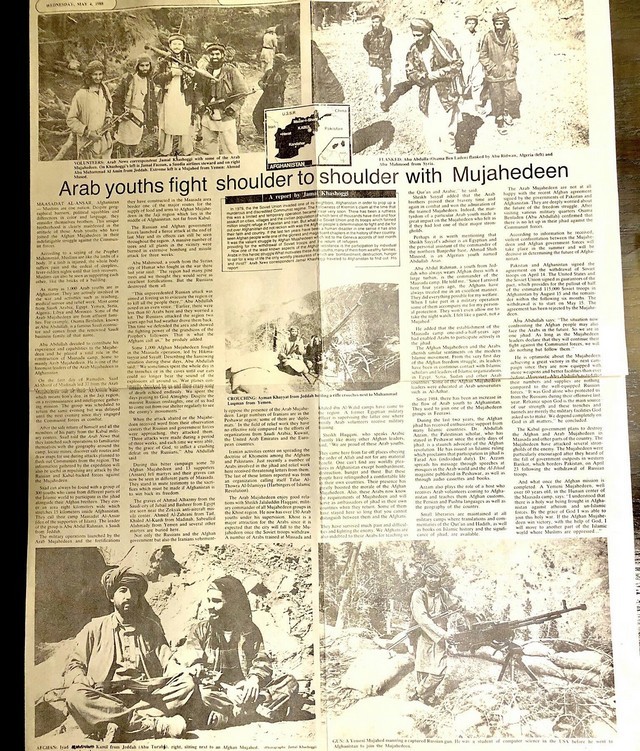
Khashoggi helped in the U.S./Saudi/Pakistani project to destabilize Afghanistan. He met and interviewed Osama bin Laden in Afghanistan and Sudan. The man with the RPG in the upper left picture is Jamal Khashoggi himself.

Khashoggi became a protege of the longtime head of Saudi intelligence, Turki Faisal Al-Saud. He was engaged in several ‘projects’ in Afghanistan, Sudan and Algeria. Khashoggi followed Turki as ‘media advisor’ when he became ambassador in London and later in Washington DC.

Jamal Khashoggi supported the Muslim Brotherhood during the ‘Arab Spring’. This was in line with Hillary Clinton/Barack Obama supported regime change program for most of the Middle East. After the fall of president Mubarak in Egypt and the election win by the Brotherhood the Saudi rulers feared to be the next in line. They started to finance counter revolutions in Egypt and elsewhere. Under the reign of King Salman and his son the suppression of all aspects of Brotherhood influence intensified. Having lost his protection Khashoggi decided to leave Saudi Arabia:

Friends helped Khashoggi obtain a visa that allowed him to stay in the United States as a permanent resident.

Fred Hiatt, the neo-conservative editor of the Washington Post, hired him. The Post published his columns against the Saudi rulers in English and Arabic.

Recently Khashoggi started a number of projects that reek of preparations for a CIA controlled color-revolution in Saudi Arabia:

Jamal Khashoggi, a prolific writer and commentator, was working quietly with intellectuals, reformists and Islamists to launch a group called Democracy for the Arab World Now. He wanted to set up a media watch organization to keep track of press freedom.

He also planned to launch an economic-focused website to translate international reports into Arabic to bring sobering realities to a population often hungry for real news, not propaganda.

Part of Khashoggi’s approach was to include political Islamists in what he saw as democracy building.

Khashoggi had incorporated his democracy advocacy group, DAWN, in January in Delaware, said Khaled Saffuri, another friend. .. The project was expected to reach out to journalists and lobby for change, representing both Islamists and liberals, said another friend, Azzam Tamimi, a prominent Palestinian-British activist and TV presenter.

Tamimi said he and Khashoggi had set up a similar pro-democracy project together in 1992 when they first met. It was called Friends of Democracy in Algeria, he said, and followed the botched elections in Algeria, which the government annulled to avert an imminent Islamist victory.

Khashoggi has an enormous number of friends in Washington DC. Mainstream journalists see him as of one of their own. Like them he does not deserve such ghastly fate. The neo-liberals as well as the neo-conservatives liked his ‘regime change’ Arab Spring support and his efforts against Saudi Arabia. Many people in Congress know him personally. They activated procedures under the Global Magnitsky Human Rights Accountability Act that will lead to sanctions against Saudi figures. Media, banks and well known personalities pulled out of a three-day financial conference in Riyadh dubbed “Davos in the Desert”.

Trump is under pressure to ‘do something’, to punish the Saudis and especially MbS.

But Trumps Middle East policy depends on Saudi Arabia and on Mohammad bin Salman personally. MbS finances the U.S. occupation in Syria. Trump’s son in law Jared Kushner build his ‘peace plan’ for Netanyahoo on Saudi endorsement. The sanctions against Iran can only be sustained if Saudi oil replaces the loss of Iranian output. Trump’s ‘Make America Great Again’ program needs the Saudi demand for U.S. weapons. He alsoneeds the Saudis to avoid utter defeat in Afghanistan. Last but not least Trump will perceive the Kashoogi issue as part of the anti-Trump campaign.

Former CIA director Brennan, an avid anti-Trumper, lobbies to dethrone Muhammad bin Salman over the case:

As someone who worked closely with the Saudis for many years, and who lived and worked as a U.S. official for five years in Saudi Arabia, I am certain that if such an operation occurred inside a Saudi diplomatic mission against a high-profile journalist working for a U.S. newspaper, it would have needed the direct authorization of Saudi Arabia’s top leadership — the crown prince.

I am confident that U.S. intelligence agencies have the capability to determine, with a high degree of certainty, what happened to Khashoggi. If he is found to be dead at the hands of the Saudi government, his demise cannot go unanswered — by the Trump administration, by Congress or by the world community. Ideally, King Salman would take immediate action against those responsible, but if he doesn’t have the will or the ability, the United States would have to act. That would include immediate sanctions on all Saudis involved; a freeze on U.S. military sales to Saudi Arabia; suspension of all routine intelligence cooperation with Saudi security services; and a U.S.-sponsored U.N. Security Council resolution condemning the murder.

The Saudis know what is coming and they are not without defenses. In response to the sanction threats they released a ‘f*** you’ statement and openly threaten that any sanctions will be responded to with some 30 painful measures:

Riyadh is the capital of its oil, and touching this would affect oil production before any other vital commodity. It would lead to Saudi Arabia’s failure to commit to producing 7.5 million barrels. If the price of oil reaching $80 angered President Trump, no one should rule out the price jumping to $100, or $200, or even double that figure.

An oil barrel may be priced in a different currency, Chinese yuan, perhaps, instead of the dollar. And oil is the most important commodity traded by the dollar today.

All of this will throw the Middle East, the entire Muslim world, into the arms of Iran, which will become closer to Riyadh than Washington.

The US will also be deprived of the Saudi market which is considered one of the top 20 economies in the world.

These are simple procedures that are part of over 30 others that Riyadh will implement directly, without flinching an eye if sanctions are imposed on it, according to Saudi sources who are close to the decision-makers.

The truth is that if Washington imposes sanctions on Riyadh, it will stab its own economy to death, even though it thinks that it is stabbing only Riyadh!

The U.S. dollar depends on the secret deal arranged in 1974 that recycles Saudi petro-dollars into U.S. treasuries. If the al-Sauds start to touch that corner stone of the relation, the U.S. will have to invade and smash their shitty country to smithereens. Mecca and Medina would be given back to the Hashemites now ruling Jordan, the Gulf coast line, which holds the oil and oil industry and is mostly inhabited by Shia, would become a state of its own. Yemen would regain its two northern provinces. The plans to do this have long been drawn.

Some solution must be found. The easiest one would be if King Salman fires the son and reinstate Muhammad bin Nayef, who MbS had dethroned, as crown prince. Nayef is the CIA’s man. But if Salman is unwilling or unable to do this, an excuse must be found for whatever happened to Khashoggi.

The Saudis asked Erdogan to accept a “joint investigation” of the Khashoggi case. This was a request to come to some solution over the issue. Rumors speak of an opening offer of $5 billion as compensation. The Saudi King dispatched the respected governor of Makkah province, Prince Khalid_bin_Faisal_Al_Saud, to Ankara to arrange a deal. The EU3, UK, France and Germany, urge both sides to use this mechanism.

The process to close the case, if both sides wish to do so, is pretty clear:

In statements [..] President Recep Tayyip Erdogan has stopped short of directly accusing the Saudis. Turkish officials have said their president has held his fire in part because he hopes that Washington will help push Saudi Arabia to acknowledge what happened to Mr. Khashoggi.

Some of Saudi Arabia’s allies in Washington acknowledge that pressure from the United States could force the kingdom to offer some account of Mr. Khashoggi’s fate — even if it is a modified version that shields the kingdom’s day-to-day ruler, Crown Prince Mohammed, from any responsibility.

Some rogue element of the Saudi state could admit to have killed Khashoggi. MbS would deny any knowledge. But fifteen of his most trusted men, those who were seen in Istanbul, would have to be punished. How would the rest of his body guard react to that?

The real problem is that both sides, Erdogan and MbS, are extremely headstrong. For both men the issue is much bigger than the Khashoggi case. The conflict has historic, strategic and very personal dimensions. That makes it difficult to find a deal.

Erdogan knows that he is extremely lucky that MbS committed this stupid act under the nose of his secret service. It gives him a tool to cut the Saudis to size. He will introduce new evidence bit by bit to increase the outrage over the case and the pressure on Saudi Arabia.

MbS on the other side will do his utmost to keep his position. He might even let his father die a sudden death should King Salman decide to fire him. Khashoggi was clearly a danger to the throne. MbS probably feels that he did the right thing and does not deserve any criticism over it. After all, abduction and, if needed, murder of dissidents in foreign countries are a long standing Saudi policy that never cause any serious uproar.

Mohammad bin Salman has one mighty ally that may help him to decrease the noise in Congress and the ‘do something’ pressure on Trump.

The Zionists already recognize that helping MbS is in their interest:

Khashoggi and the Jewish question

Eran Lerman, the vice president of the Jerusalem Institute for Strategic Studies and a former deputy national security council head, said: “It is certainly not in our interests to see the status of the Saudi government diminished in Washington.”

Lerman envisions a scenario where Jewish political organizations in Washington – such as the American Jewish Committee, which he once worked for as head of its Israel office – may actually go to Capitol Hill, as they have done in the past, and discreetly lobby for the Saudis, something that could paradoxically bring the two countries even closer together.

None of the protagonists of this geopolitical drama deserve any pity. Erdogan, Trump and MbS are thugs. Khashoggi was a willing tool in the destruction of many lives. Seeing these people at each others throat is highly entertaining.

But the conflict is also dangerous. It could escalate into something much bigger that could be painful for many people. Unfortunately there seems to be no one who could talk sense to these people and get them to bury the case. While I earlier thought that the case would be settled rather sooner than later, I now expect the conflict to go on for weeks or months while collateral damage will accumulate around it.

14 October 2018

Source: https://www.moonofalabama.org/2018/10/settling-the-khashoggi-case-will-be-a-difficult-process.html

The CIA Finger in Brazil’s Elections

By Marcelo Zero

5 Oct 2018 – The growth of Bolsonarian fascism in the final stretch of the election campaign, turbo charged by an avalanche of fake news disseminated on the internet, is not surprising. It is an old tactic developed by American and British intelligence agencies, with the goal of manipulating public opinion and influencing political processes and elections. It was used in the Ukraine, in the Arab Spring and in Brazil in 2013.

There is science behind this manipulation.

Some people think that elections are won or lost only in rigorously rational debates about policies and proposals. But things don’t really work that way. In reality, as Emory University Psychology Professor Drew Weston says in his book “The Political Brain: The Role of Emotion in Deciding the Fate of the Nation”, feelings are commonly more decisive in defining the vote.

Weston says that, based on recent studies in neuroscience on the theme, contrary to what is commonly understood, the human brain makes decisions mainly based on emotions. The voters strongly base their choices on emotional perceptions about parties and candidates. Rational analysis and empirical data normally plays a secondary role in this process.

This is why there is great manipulative power in the production of information with strong emotional content and fake news.

The documents revealed by Edward Snowden prove that the US and UK intelligence services have specialized and sophisticated departments that are dedicated to manipulating information that circulates on the internet to change the direction of public opinion. For example, the Joint Threat Research Intelligence Group of the Government Communications Headquarters (GCHQ), a British intelligence agency, has a mission and scope that includes the use of “dirty tricks” to destroy, negate, degrade and run over its enemies.

The tactics are, in short:

1. To disseminate all kinds of false information on the internet to destroy the reputation of its targets; and

2. Use social sciences and other psycho-social techniques to manipulate the online discourse and activism, with the goal of generating desirable results.

But this isn’t just any type of information. The information is chosen to cause great emotional impact, not to promote debate or rebut concrete information. One of the most common techniques is the manipulation of photos and videos, which has a strong and immediate emotional effect and tends to quickly go viral. Vice Presidential candidate Manuela D’Àvila, for example, has been the constant target of these manipulations. Fernando Haddad has also been a constant victim of absolutely false declarations and manipulated images and discourse.

The abject manipulation of images of “erotic baby bottles” that were supposedly distributed to toddlers in the São Paulo public pre-school system by the PT, is an example of how low a campaign of the kind of dirty tricks recommended by the North American and British intelligence agencies can sink.

Although this manipulation can seem very low and, to the eyes of a rational person, unbelievable, its has a great and strong penetration of the emotional political brain of vast segments of the population.

Nothing is done by accident. Before they are produced and disseminated, these crude manipulations are studied in order to provoke the greatest damage possible. They are specifically directed to internet groups which, in having little or no fact checking apparatus and strong conservatism, tend to be shocked by and believe in these grotesque manipulations.

The truth is that what is happening in Brazil today reveals a sophisticated level of manipulation, which requires training and larges sums of money. Where did all of this come from? National capital? Or could there be financial, technical and logistical resources also coming from abroad?

It is obvious that this issue requires a serious investigation that will, apparently, not happen.

National and international financial capital, as well as sectors of the productive business class, have already sided with Bolsonaro in the second round. A large part of the media oligarchies have backed him as well. The poorly denominated “center”, which is, in truth, a group of angry, coup-mongering conservatives faced with the threat of political disappearance have also started to partially adhere to Brazilian fascism, trying to survive from the political crumbs it can obtain if Bolsonaro, or “the Thing” as he is known, and Mourão, the “Aryan”, win the election.

This can be viewed as the definitive suicide of Brazilian democracy and a bet on conflict, confrontation, authoritarianism and fascism, which will cause a profound deepening of the Brazilian political and economic crises.

However, the aggravation of the political-institutional and economic crisis, which will inevitably be brought about by the victory of the proto-fascist Bolsonaro, could be useful for those who want to take over Brazil’s strategic resources and companies.

Chaos and insurgency can be useful, mainly to those who are from the outside. We see this frequently in the Middle East. Taken to its farthest extension the coup can be deepened to a “solution of power”, supported by the military and the judiciary. In this manner the door will be opened for much greater rollbacks than those achieved by Michel Temer, mainly from the point of view of national sovereignty.

From the point of view of geopolitical strategy, the promoted automatic alignment between Bolsonaro and Trump would be of great interest to the USA in the region. As we know, one current strategic priority of the USA is a great power game against China and Russia. Bolsonaro, who has already promised to donate the Alacantara rocket launching base to the Americans and to privatize everything, could serve as a focal point of US interests in the region, intervening in Venezuela and countering Russian and Chinese interests in South America.

For this reason, it seems obvious that there is a finger – or an entire hand – of foreign intelligence agencies at work, mainly North American, in the Brazilian elections. The modus operandi shown in this final stretch is identical to that used in other countries and requires technical and financial resources and a level of manipulative sophistication that the Bolsonaro campaign does not seem to have on its own.

The CIA and other agencies are here, acting in an extensive manner.

The progressive forces have to now coordinate to counter this manipulative process. The response cannot merely be to use rational argument to counter manipulative hatred. The response in the dispute for the political brain has to also be emotional.

The anti-PT, anti-left, anti-democratic, anti-human rights, and anti-equality that drives Bolsonaro and was created by coup agents and their fake media, has to be fought through a project of antagonistic feelings like hope, love, solidarity and happiness.

They are projecting a past of exclusion, violence and suffering. We have to project a future of security and realization.

Faced with a sordid campaign of defamation and manipulation, guided from abroad, our strategy should be the same as Adlai Stevenson, the great Democratic politician of the US, who said to the Republicans, “you stop lying about the Democrats and I’ll stop telling the truth about you.”

Bolsonaro, his running mate and his followers communicate through shocking statements and hate speech. This is not fake news, its easy to confirm. Therefore, all we have to do is expose them for what they are and they will melt like vampires in sunlight.

Marcelo Zero is a sociologist, international relations specialist and technical advisor to the PT Senatorial leadership.

15 October 2018

Source: https://www.transcend.org/tms/2018/10/the-cia-finger-in-brazils-elections/

My grandfather Nelson Mandela fought apartheid. I see the parallels with Israel

By Nkosi Zwelivelile

My grandfather, Nelson Rolihlahla Mandela, would have turned 100 this year. The world is marking the centenary of his birth and celebrating his leadership in the struggle to end apartheid in South Africa. But while my country has long been free from racist minority rule, the world is not yet free of the crime of apartheid.

Like Madiba and Desmond Tutu before me, I see the eerie similarities between Israel’s racial laws and policies towards Palestinians, and the architecture of apartheid in South Africa. We South Africans know apartheid when we see it. In fact, many recognise that, in some respects, Israel’s regime of oppression is even worse.

Apartheid is defined in international law as an “institutionalised regime of systematic oppression and domination by one racial group over any other”. It is about unequal racial power relations upheld by unjust laws that are intended to deny oppressed groups their rights.

The nation state law made that reality undeniable. Apartheid is the context for a litany of state crimes. Take most recently, for example, Israel’s decision to demolish the Palestinian Bedouin village of Khan al-Ahmar and evict its residents. The aim of this ethnic cleansing is to make way for illegal settlements on occupied Palestinian land.

Yet despite seven decades of apartheid, ongoing theft of Palestinian land, military occupation and massacres of unarmed protesters in Gaza – rightly called the “Palestinian Sharpeville”, after the mass killing in Transvaal in 1960 – each new generation of Palestinians continues the liberation struggle.

Young Ahed Tamimi turned 17 in prison this year, illegally incarcerated for confronting occupying soldiers in her backyard. But just as my grandfather spent 27 years in prison only to become a global icon of freedom, Ahed has become a powerful symbol of Palestinians’ resolute determination to resist. She and her family represent the courageous spirit of Palestinians everywhere who stand defiant in the face of immense brutality. I salute their bravery.

Although Ahed is now free, thousands of Palestinians – including hundreds of children – still languish in apartheid Israel’s jails. In this Nelson Mandela centennial celebration year, we should recall his avowal that “our freedom is incomplete without the freedom of the Palestinian people” and work relentlessly to demand that all Palestinians – whether living in exile, as citizens of Israel or in the occupied territories – are accorded their inalienable human rights.

For we South Africans also know that effective resistance to apartheid requires international solidarity. Just as allies around the world were vital in our struggle for freedom, the spirit of internationalism lives on in the non-violent boycott, divestment and sanctions (BDS) movement supporting the Palestinian liberation struggle.

It gave me hope to see the Labour party call for an end to UK arms sales to Israel two weeks ago. We hope that South Africa will use its standing among the Brics countries to call for an arms embargo too. This important sanction is a minimal requirement to end complicity in maintaining Israeli apartheid. It is not charitable to end complicity in crime, but a profound moral obligation.

These positive and concrete steps continue the struggle that was Mandela’s life’s work. They stand in stark contrast to the shameful attempts to erase Palestinian history (including the Nakba) – a history in which the UK, as in apartheid South Africa, was deeply complicit. They are also a powerful retort to efforts to demonise, if not criminalise, the BDS movement.

All people of conscience have not only the right but also the responsibility to express their disagreement with any state that violates human rights and international law. They have a right to freedom of expression, to speak truth to power, and to stand in solidarity with the oppressed.

History will judge the governments that fail to stand by human rights and international law or, worse, that are complicit in entrenching the denial of those rights. During her recent trip to South Africa, Theresa May tried to erase the UK government’s history of supporting apartheid. She celebrates my grandfather now that he is dead, but has not accounted for the fact that members of her own political party called for him to be hanged and labelled him a terrorist when he was alive.

International pressure was a vital component of the struggle to end apartheid in South Africa. We know it is effective in the case of Israel too, not least because of the vast sums its government spends waging a global campaign to undermine BDS.

Non-violent resistance tactics such as boycotts and ethical divestment, and applying pressure on corporations and governments, including local authorities, to end their involvement in grave human rights violations, are all time-honoured methods for supporting justice movements.

Madiba once called the question of Palestine the “greatest moral issue of our time”, yet the world remains silent. It is incumbent upon us all to do whatever we can to contribute to Palestinian freedom, justice and equality, and to fight against apartheid everywhere.

Nkosi Zwelivelile Mandela is an African National Congress MP and grandson of Nelson Mandela.

11 October 2018

Source: https://www.theguardian.com/commentisfree/2018/oct/11/grandfather-nelson-mandela-apartheid-parallels-israel-palestinian?CMP=fb_gu

That Single Line of Blood: Nassir al-Mosabeh and Mohammed al-Durrah

By Dr Ramzy Baroud

As the frail body of 12-year-old Nassir Al-Mosabeh fell to the ground on Friday, September 28, history was repeating itself in a most tragic way.

Little Nassir was not just another number, a ‘martyr’ to be exalted by equally poor refugees in Gaza, or vilified by Israel and its tireless hasbara machine. He was much more than that.

The stream of blood that poured out from his head wound on that terrible afternoon drew a line in time that travelled back 18 years.

Almost 18-years to the day separates Nassir’s recent murder and the Israeli army killing of Mohammed Al-Durrah, also 12, on September 30, 2000. Between these dates, hundreds of Palestinian children have perished in similar ways.

Reports by the rights’ group, B’tselem, are rife with statistics: 954 Palestinian children were killed between the Second Intifada in 2000 and Israel’s war on Gaza, the so-called Operation Cast Lead in 2008. In the latter war alone, 345 child were reportedly killed, in addition to another 367 child fatalities reported in Israel’s latest war, ‘Protective Edge’ of 2014.

But Mohammed and Nassir – and thousands like them – are not mere numbers; they have more in common than simply being the ill-fated victims of trigger-happy Israeli soldiers.

In that single line of blood that links Nassir al-Mosabeh and Mohammed al-Durrah, there is a narrative so compelling, yet often neglected. The two 12-year-old boys looked so much alike – small, handsome, dark skinned refugees, whose families were driven from villages that were destroyed in 1948 to make room for today’s Israel.

Young as they were, both were victims of that reality. Mohammed, died while crouching by the side of his father, Jamal, as he beseeched the Israelis to stop shooting. 18 years later, Nassir walked with thousands of his peers to the fence separating besieged Gaza from Israel, stared at the face of the snipers and chanted for a free Palestine.

Between the two boys, the entire history of Palestine can be written, not only that of victimization and violence, but also of steadfastness and honor, passed from one generation to the next.

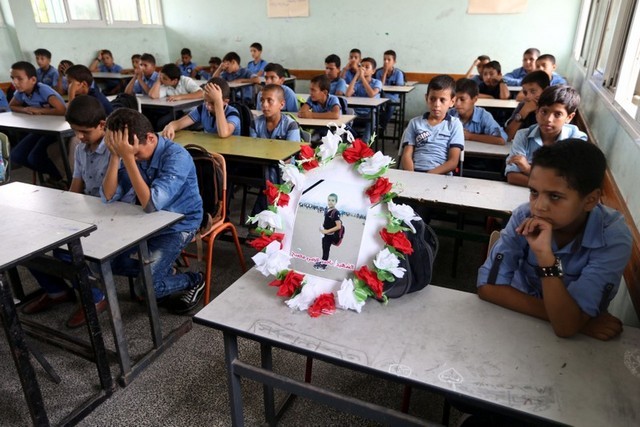
“Who will carry on with the dream,” were the words Nassir’s mother repeated, as she held a photograph of her son and wept. In the photo, Nassir is seen carrying his school bag, and a small bottle of rubbing alcohol near the fence separating Gaza and Israel.

“The dream” is a reference to the fact that Nassir wanted to be a doctor, thus his enthusiasm to help his two sisters, Dua’a and Islam, two medical volunteers at the fence.

His job was to carry the alcohol bottle and, sometimes, oxygen masks, as his sisters would rush to help the wounded, many of them Nassir’s age or even younger.

In a recent video message, the young boy – who had just celebrated the achievement of memorizing the entire Holy Quran – demonstrated in impeccable classical Arabic why a smile can be considered an act of charity.

Protesting the Israeli siege and the injustice of life in Gaza was a family affair, and Nassir played his role. His innovation of taping raw onions to his own face to counter the tears induced by the Israeli army tear gas garnered him much recognition among the protesters, who have been rallying against the siege since March 30.

So far, nearly 200 unarmed protesters have been killed while demanding an end to the 11-year long blockade and also to call for the ‘Right of Return’ for Palestinian refugees.

Nassir was the 34th child to be killed in cold-blood since the protests commenced, and will unlikely be the last to die.

When Mohammed al-Durrah was killed 18 years ago, the images of his father trying to shield his son’s body from Israeli bullets with his bare hands, left millions around the world speechless. The video, which was aired by France 2, left many with a sense of helplessness but, perhaps, the hope that the publicity that Mohammed’s televised murder had received could possibly shame Israel into ending its policy of targeting children.

Alas, that was never the case. After initially taking responsibility for killing Mohammed, a bogus Israeli army investigation concluded that the killing of Mohammed was a hoax, that Palestinians were to blame, that the France 2 journalist who shot the video was part of a conspiracy to ‘delegitimize Israel’.

Many were shocked by the degree of Israeli hubris, and the brazenness of their mouth- pieces around the western world who repeated such falsehood without any regard for morality or, even, common sense. But the Israeli discourse itself has been part of an ongoing war on Palestinian children.

Israeli and Zionist propagandists have long claimed that Palestinians teach their children to hate Jews.

The likes of Elliott Abrahms raged against Palestinian textbooks for “teaching children to value terrorism.” “That is not the way to prepare children for peace,” he wrote last year.

In July the Israeli army claimed that Palestinian children deliberately “lure IDF troops”, by staging fake riots, thus forcing them into violent confrontations.

The US-Israeli propaganda has not just targeted Palestinian fighters or factions, but has done its utmost to dehumanize, thus justify, the murder of Palestinian children as well.

“Children as young as 8 turned into bombers, shooters, stabbers,” reported one Adam Kredo in the Washington Free Beacon, citing a “new report on child terrorists and their enablers.”

This is not simply bad journalism, but part of a calculated Israeli campaign aimed at preemptively justifying the killing of children such as Nassir and Mohammed, and thousands like them.

It is that same ominous discourse that resulted in the call for genocide made by none other than Israel’s Justice Minister, Ayelet Shaked, where she also called on the slaughter of Palestinian mothers who give birth to “little snakes.”

The killing of Nassir and Mohammed should not then be viewed in the context of military operations gone awry, but in the inhuman official and media discourses that do not differentiate between a resistance fighter carrying a gun or a child carrying an onion and an oxygen mask.

Nor should we forget that Nassir al-Mosabeh and Mohammed al-Durrah are chapters in the same book, with an overlapping narrative that makes their story, although 18 years apart, one and the same.

– Ramzy Baroud is a journalist, author and editor of Palestine Chronicle.

11 October 2018

Source: https://countercurrents.org/2018/10/11/that-single-line-of-blood-nassir-al-mosabeh-and-mohammed-al-durrah/

Remodelling the Belt and Road: Pakistan picks up the torch

By Dr James M Dorsey

Pakistan, following in the footsteps of Malaysia and Myanmar, is the latest country to balk at the China and infrastructure focus of Beijing’s Belt and Road-related investments.

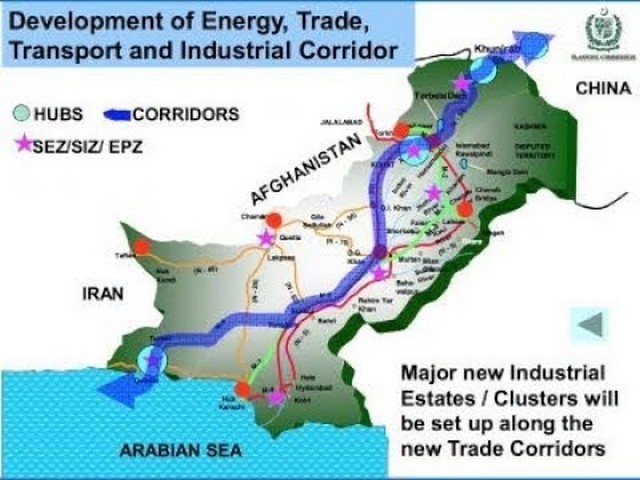
Preparing for his first visit to China as Pakistan’s prime minister, Imran Khan is insisting that the focus of the China Pakistan Economic Corridor (CPEC), a US$60 billion plus crown jewel of the Belt and Road, shift from infrastructure to agriculture, job creation and foreign investment.

“Earlier, the CPEC was only aimed at construction of motorways and highways, but now the prime minister decided that it will be used to support the agriculture sector, create more jobs and attract other foreign countries like Saudi Arabia to invest in the country,” said information minister Fawad Chaudhry.

Mr. Khan’s determination to ensure that more benefits accrue to Pakistan from Chinese investment comes at a time that various Asian and African countries worry that Belt and Road-related investments in infrastructure risk trapping them in debt and forcing them to surrender control of critical national infrastructure, and in some cases media assets.

Preceding Mr. Khan’s move, protests against the forced resettlement of eight Nepali villages persuaded CWE Investment Corporation, a subsidiary of China Three Gorges, to consider pulling out of a 750MW hydropower project.

Malaysia has suspended or cancelled US$26 billion in Chinese-funded projects while Myanmar is negotiating a significant scaling back of a Chinese-funded port project on the Bay of Bengal from one that would cost US$ 7.3 billion to a more modest development that would cost US$1.3 billion in a bid to avoid shouldering an unsustainable debt.

Fears of a debt trap started late last year when unsustainable debt forced Sri Lanka to hand China an 80% stake in Hambantota port.

Mr. Khan’s move takes on added significance given that Pakistan appears to have decided to ask the International Monetary Fund (IMF) to help it avert a financial crisis with a loan of up to US$12 billion and discussions with Saudi Arabia that could produce up to US$10 billion in investments that would be separate but associated with CPEC.

Pakistani finance minister Asad Umar is expected later this week to initiate discussions with the IMF during the fund’s annual meeting in Bali. The decision was taken after Saudi Arabia refused to delay Pakistani payments for oil imports, opting instead to build a refinery and strategic oil reserve in the CPEC port of Gwadar.

Pakistani officials see investment by Saudi Arabia as one possible way of facilitating a Pakistani request to the IMF for help. They hope that even an informal association with CPEC of Saudi Arabia, one of the United States’ closest allies in the greater Middle East, may alleviate Washington’s concern that IMF money could be used to repay Chinese debt.

Yet, even that is unlikely to prevent the IMF, backed by the United States, from demanding that the veil of secrecy be lifted that shrouds the commercial and financial terms of many CPEC-related, Chinese-funded projects, as a pre-condition for assistance from the fund.

Apparently concerned about Pakistan’s intentions, China’s deputy chief of mission in Islamabad, Lijian Zhao, insisted in an interview as well as a series of tweets that China welcomed Saudi investment and “always supported& stood behind @ Pakistan, helping #develop it’s #infrastructure& raise #living standards while creating #job.”

Mr. Lijian’s comments followed a statement last month by Chinese foreign minister Wang Ji after talks with Mr. Khan in Islamabad that appeared to indicate that China, while acknowledging Pakistani demands, would not address them immediately. Mr. Wang suggested that CPEC would only “gradually shift to industrial cooperation.”

Indications suggest further that China may be looking to Pakistan’s military to shave off the rough ends of the government’s determination to effectively renegotiate CPEC.

Pakistan’s army chief General Qamar Javed Bajwa visited Beijing in August days after commerce minister Abdul Razak Dawood suggested that the government may suspend CPEC projects for a year.

Making his comments shortly after Mr. Wang’s departure from Islamabad, Mr. Dawood also asserted that the previous government had negotiated terms that were favourable to China rather than Pakistan.

China this week, in a move likely designed as much to strengthen Pakistani counter-terrorism capabilities as a gesture towards the country’s politically influential armed forces, made Pakistan the second country after Saudi Arabia to receive killer drones and the associated technology.

The US has refused to sell its more advanced killer drones to either Saudi Arabia or Pakistan.

The Khan government’s desire to refocus CPEC tackles key issues raised by critics of the project that potentially could impact China’s plan to pacify its troubled north-western province of Xinjiang through a combination of economic development and brutal repression and re-education of its Turkic Muslim population.

The initial plan for CPEC appeared to position Pakistan as a raw materials supplier for China, an export market for Chinese products and labour, and an experimental ground for the export of the surveillance state China is rolling out in Xinjiang.

The plan envisioned Chinese state-owned companies leasing thousands of hectares of agricultural land to set up “demonstration projects” in areas ranging from seed varieties to irrigation technology. Chinese agricultural companies would be offered “free capital and loans” from various Chinese ministries as well as the China Development Bank.

The plan envisaged the Xinjiang Production and Construction Corps introducing mechanization as well as new technologies in Pakistani livestock breeding, development of hybrid varieties, and precision irrigation. Pakistan effectively would become a raw materials supplier rather than an added-value producer, a prerequisite for a sustainable textiles industry.

The plan saw the Pakistani textile sector as a supplier of materials such as yarn and coarse cloth to textile manufacturers in Xinjiang. “China can make the most of the Pakistani market in cheap raw materials to develop the textiles & garments industry and help soak up surplus labour forces in (Xinjiang’s) Kashgar,” the plan said. Chinese companies would be offered preferential treatment with regard to “land, tax, logistics and services” as well as “enterprise income tax, tariff reduction and exemption and sales tax rate” incentives.

For Mr. Khan to ensure that Pakistani agriculture benefits, the very concept of Chinese investment in Pakistani agriculture would have to renegotiated.

Similarly, Mr. Khan has yet to express an opinion on the plan’s incorporation of a full system of monitoring and surveillance that would be built in Pakistani cities to ensure law and order. The system would involve deployment of explosive detectors and scanners to “cover major roads, case-prone areas and crowded places…in urban areas to conduct real-time monitoring and 24-hour video recording.”

The surveillance aspect of the plan that identifies Pakistani politics, such as competing parties, religion, tribes, terrorists, and Western intervention” as well as security as the greatest risk to CPEC could, if unaddressed, transform Pakistani society in ways that go far beyond economic and infrastructure development.

Dr. James M. Dorsey is a senior fellow at the S. Rajaratnam School of International Studies, co-director of the University of Würzburg’s Institute for Fan Culture, and co-host of the New Books in Middle Eastern Studies podcast.

10 October 2018

Source: https://countercurrents.org/2018/10/10/remodelling-the-belt-and-road-pakistan-picks-up-the-torch/