Just International

A journalist’s disappearance may rev up a Middle East rivalry

By Ishaan Tharoor

We still do not know what has happened to Jamal Khashoggi. The Saudi journalist, who has contributed numerous articles to The Washington Post’s Global Opinions section, has not been seen since he entered the Saudi consulate in Istanbul on Tuesday afternoon to finalize papers regarding a divorce. Khashoggi is a prominent commentator, familiar to a generation of Middle East correspondents seeking insight into the intrigues of Riyadh. In recent years, he had turned into a critic of the kingdom’s leadership and relocated to Washington in a kind of self-imposed exile.

Turkish authorities insist that Khashoggi, 59, is being held in the consulate, as do his friends. “We have talked with some Turkish authorities and the police,” Turan Kislakci, an associate of Khashoggi, told my colleagues. “I think 100 percent that he is inside.”

But Saudi officials deny they have detained the journalist, claiming in an emailed statement to my colleagues that Khashoggi is not in the building.

“We were going to marry this week,” said Khashoggi’s fiancee, who spoke on the condition of anonymity, to my colleagues in Istanbul on Wednesday. She added that her spouse-to-be had been concerned about going to the consulate. “Of course he was worried. How comfortable can one be if he is not liked by his country?”

“We have been unable to reach Jamal today and are very concerned about where he may be,” said The Post’s international opinions editor, Eli Lopez, in a statement Thursday. “We are monitoring the situation closely, trying to gather more information. It would be unfair and outrageous if he has been detained for his work as a journalist and commentator.”

In Washington, analysts and former diplomats who are generally supportive of Saudi Arabia expressed their disquiet. “The only logical explanations are that the Saudi government is either keeping him in the consulate building or has kidnapped him and taken him to Saudi Arabia,” wrote Elliott Abrams, a former official in the George W. Bush administration. He warned that “the reputation of the current Saudi government will be harmed irreparably.”

Such detentions have become more conspicuous under the kingdom’s young crown prince, Mohammed bin Salman. Since taking de facto power in a shake-up last year, Mohammed has detained feminist activists and billionaire magnates alike. Saudi authorities even briefly held the sitting Lebanese prime minister in a Riyadh hotel last year. All of this came as Mohammed promised to open up Saudi Arabia’s conservative society and wean itself off of oil dependence.

Post columnist Jason Rezaian, a journalist who spent many months in unjust Iranian detention, puzzled over the nature of Mohammed bin Salman’s reforms. “Troubling developments from the community of activists inside the country, however, tell a vastly different story. Those pushing for change — whether they are women’s rights activists, journalists or ethnic minorities — report being systematically harassed by the authorities,” Rezaian wrote. “With every supposed reform comes a wave of fresh arrests, prison sentences and increasingly repressive behavior.”

The crown prince, Rezaian noted, is a frequent target of Khashoggi’s columns. “At each turning point . . . Jamal has offered readers of The Post insightful commentary and sharp criticism about the seemingly impenetrable country,” he wrote.

The geopolitical backdrop to Khashoggi’s disappearance is worth considering. Turkish President Recep Tayyip Erdogan has presided over a sweeping purge of the country’s civil society and government ever since a botched coup attempt in 2016. Yet Turkey has also become something of a sanctuary for Arab dissidents of various stripes.

In 2013, after a military coup unseated Egyptian President Mohamed Morsi and brutally crushed his Muslim Brotherhood, a host of Egyptian dissidents and Islamist politicians took up residence in Istanbul. Erdogan remains a staunch critic of Egyptian President Abdel Fattah al-Sissi, the former army officer who ousted Morsi.

Sissi has counted on the support of Saudi Arabia and the United Arab Emirates, two Gulf monarchies that have actively worked against Islamist political parties across the Arab world. In a column for The Post, Khashoggi rebuked the “intolerant hatred” shown by the Saudis and Emiratis “for any form of political Islam.” He argued “there can be no political reform and democracy in any Arab country without accepting that political Islam is a part of it.”

That’s a position welcomed by Erdogan, who once hoped his brand of religiously tinged democratic politics would be embraced by the Arab world. Instead, his rule has grown more autocratic, and the Middle East has been consumed by a series of wars and bitter geopolitical disputes. That includes the standoff between the Saudis, Emiratis and their allies on one side and Qatar on the other.

Turkey flew troops and food supplies into Qatar last year and still maintains a military base in Doha. Meanwhile, the Qataris pledged to inject some $15 billion worth of investment in Turkey’s flagging economy in August. Some analysts read Ankara’s moves — coupled with Erdogan’s overtures to Iran over the past year — as a riposte to the emergence of a U.S.-backed Middle East bloc including the Saudis, Emiratis and even Israel.

Amid the chaos of the region’s politics, Khashoggi urged the kingdom conduct itself with “ethics” and “dignity” — and therefore called on Saudi Arabia to draw down its war in Yemen.

Khashoggi also wrote about the pain of seeing friends arrested or otherwise forced into silence. “I have left my home, my family and my job, and I am raising my voice,” he wrote in his first column for The Post, where he openly worried about facing arrest if he returned. “To do otherwise would betray those who languish in prison. I can speak when so many cannot. I want you to know that Saudi Arabia has not always been as it is now. We Saudis deserve better.”

Ishaan Tharoor writes about foreign affairs for The Washington Post.

5 October 2018

Source: https://s2.washingtonpost.com/camp-rw/?e=a2hhbG1hcnhAeWFob28uY29t&s=5bb6efd6fe1ff67504b79d17

International Court of Justice strikes down US sanctions against Iran

By Alex Lantier

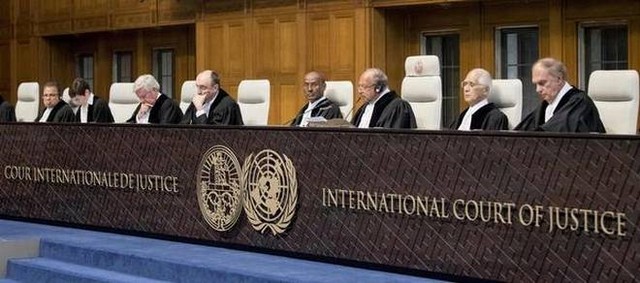
Rebuking US moves to scrap the 2015 Iranian nuclear accord, the International Court of Justice (ICJ) in The Hague unanimously ruled yesterday that Washington must let Iran use international financial payments systems to buy humanitarian supplies.

When the Obama administration imposed sanctions on Iran in 2012-2015, it tried to strangle Iran’s economy by freezing it out of all financial transactions denominated in US dollars. At its request, the Brussels-based Society for Worldwide Inter-bank Financial Telecommunication (SWIFT) network expelled Iranian banks, ending Iran’s ability to use US dollars for international purchases. Since unilaterally repudiating the 2015 accord this May, the Trump administration has made clear it plans to re-impose sanctions as part of its preparations for war with Iran.

The ICJ ruling demands that Washington not block trade in critical goods, and makes clear that the US war drive against Iran—including calls by US officials such as White House national security adviser John Bolton to re-impose SWIFT sanctions on Iran—violate international law.

Pending final adjudication of US claims against Iran, the ICJ has ordered Washington to “remove, by means of its choosing, any impediments … to the free exportation to the territory of Iran of goods required for humanitarian needs, such as (i) medicines and medical devices; and (ii) foodstuffs and agricultural commodities; as well as goods and services required for the safety of civil aviation, such as (iii) spare parts, equipment and associated services … necessary for civil aircraft.”

The ICJ adds: “To this end, the United States must ensure that licences and necessary authorizations are granted, and that payments and other transfers of funds are not subject to any restriction insofar as they relate to the goods and services referred to above.”

The Iranian foreign ministry applauded the ICJ decision, stating that it “vindicates the Islamic Republic of Iran and confirms the illegitimacy and oppressiveness” of US sanctions.

The ICJ has no mechanism or power to enforce its decision, however, and US officials immediately made clear they will defy the ICJ ruling. Calling Iranian requests “baseless,” US Secretary of State Mike Pompeo announced the termination of the 1955 Treaty of Amity between the United States and Iran, on which the ICJ ruling relied. “That is a decision that is, frankly, 39 years overdue,” Pompeo said, referring to the 39 years since the 1979 Revolution toppled the bloodstained CIA-backed regime of the Shah of Iran.

Pompeo then cynically tried to imply that the ICJ ruling is irrelevant, as Washington already makes exceptions for humanitarian goods in its sanctions. He said, “With regard to the aspects of the court’s order focusing on potential humanitarian issues, we have been clear. … Existing exceptions, authorisations and licensing policies for humanitarian-related transactions and safety of flight will remain in effect. The United States has been actively engaged on these issues without regard to any proceeding before the ICJ.”

US sanctions on Iran have had devastating humanitarian consequences, and Pompeo’s argument is a repugnant political lie. Over a span of decades, economic sanctions have been a key foreign policy tool allowing US imperialism to inflict untold suffering on innocent people in an attempt to bully and bludgeon various countries it targeted for regime change into line.

US officials have applauded sanctions against Iraq, Cuba and the former Yugoslavia even as they caused horrific losses. The UN embargo Washington imposed on Iraq after the 1991 Gulf War cut off Iraq’s access to health supplies, leading to an estimated 500,000 deaths of Iraqi children. Asked about this number on television in 1996, then-US Secretary of State Madeleine Albright infamously defended the sanctions: “A hard choice, but the price, we think the price is worth it.”

The relentless campaign by Washington to isolate Iran since the 1979 Revolution, and in particular the 2012-2015 sanctions, have taken a terrible toll.

Between 2012 and 2016, Iran’s critical oil and gas exports fell from over $9 billion to under $3 billion, shattering its economy and its access to critical food, pharmaceutical and industrial supplies.

A 2014 article on the US National Institutes of Health’s (NIH) National Center for Biotechnology Information website, titled “Sanctions against Iran: The Impact on Health Services,” explains: “Although medicine is not included in the list of the sanctions, the difficulties in holding license for export of medicine, financial transaction, and shipment as well as fear of possible US sanction by pharmaceutical companies and international banks, led to the shortage of specific drugs and medical facilities in last months. A sudden fifty percent rise in the price of drugs is another contributing factor … The impact is being felt by more than six million patients suffering from complex diseases such as hemophilia, multiple sclerosis, thalassemia, epilepsy, and various immunological disorders, as well as transplant and kidney dialysis patients and those being treated for cancer.”

And after Aseman flight 3705 crashed in Iran in February, killing all 65 aboard, the Guardian noted that at least 1,985 people have died in Iranian plane crashes since 1979: “There have been scores of plane crashes in Iran since the 1979 Islamic Revolution, mainly because western sanctions for decades limited its ability to purchase spare parts or buy new planes.”

Washington’s new sanctions have already resulted in a cut-off of vital medicines to Iran. According to Mohammad-Naeem Aminifard, a member of the Iranian parliament’s health commission, 80 important drugs are no longer available under the Iranian state’s drug insurance scheme.

An Iranian doctor working with low-income Iranians recently told the British-based Guardian, “It’s no more only about shortages in drugs for cancer or special diseases such as haemophilia or thalassemia. [N]ormal drugs … like Warfarin, which stops blood clotting, (are) becoming difficult to find, which means patients’ lives are at risk.”

The ICJ ruling undoubtedly reflects growing opposition in ruling circles internationally to US policy—including its war drive against Iran, and threats of trade war and military attack against nuclear-armed Russia and China. It came a day after US ambassador to NATO Kay Bailey Hutchison issued an unprecedented threat to bomb Russia in order to destroy cruise missiles Washington says violate the 1987 Intermediate-Range Nuclear Forces (INF) Treaty. Such an attack would set the stage for global nuclear war that could annihilate humanity.

Significantly, opposition to US policy increasingly comes from America’s imperialist “allies” in Europe and Asia. Germany, Britain and France have consistently defended the 2015 Iranian accord and, last month, signed an agreement with China, Russia and Iran to set up a so-called Special Purpose Vehicle (SPV) funding scheme, to circumvent the use of the US dollar in the Iranian oil trade. Pompeo condemned the SPV scheme, saying he was “disturbed” and “deeply disappointed” by the “counterproductive” measure.

On Tuesday, moreover, reports emerged of high-level talks on Iran between Japan’s Ministry of Foreign Affairs (MOFA) and US State Department officials in Tokyo. The MOFA stated that “both sides actively discussed the US’ re-imposition of sanctions against Iran,” and that it had reiterated its “basic principle” that Japanese corporations should not be affected by the US sanctions.

Nonetheless, the only progressive opposition to the US-led war drive comes from the millions of working people around the globe who are opposed to war, not Washington’s imperialist rivals. After a quarter century of spreading imperialist war from Iraq to Afghanistan, Libya and Syria, there can be no doubt that this growing inter-imperialist rivalry for access to oil and strategic advantage will only accelerate the drive toward all-out war across the Middle East.

Even those imperialist governments critical of US sanctions are, for their own reasons, stoking a confrontation with Iran. As France participates in the US-led proxy war for regime change in its former colony, Syria, it has already targeted Iran, a key military backer of Syrian President Bashar al-Assad. Paris has postponed sending a new ambassador to Tehran and has advised its diplomats to postpone visits to Iran.

Yesterday, the French government charged Iran’s ministry of intelligence for preparing a foiled bombing plot against a June meeting between the exiled Iranian Mujahedin-e-Khalq (MEK) and top US officials including Donald Trump’s attorney, Rudy Giuliani, in Villepinte, near Paris. In a joint statement, the French interior, economic and foreign affairs ministries said: “A planned bomb attack was foiled at Villepinte on June 30. This extremely serious attack that was to take place on our territory cannot go without a response.”

It remains unclear what evidence Paris has connecting Iranian intelligence to those it is charging: Iranian diplomat Assadollah Assadi, who was arrested in July in Germany on terror charges, a Belgian couple of Iranian origin, and three others.

It came after French police launched a major “antiterrorist operation” to shut down the Shiite Islamic Zahra-France association, which works near the Grande Synthe refugee camp. Media reported that Paris wanted to “send a message” to Iran with the crackdown.

Tehran rejected accusations they were planning a terror bombing in Villepinte and demanded the Iranian diplomat’s release. An Iranian government spokesman warned of “the evil hands of ill-wishers who seek to ruin deep-rooted ties between Iran and France as well as other influential European countries.”

Alex Lantier has written extensively for www.wsws.org, a forum for socialist views & the website for the International Committee of the Fourth International (ICFI).

4 October 2018

Source: https://countercurrents.org/2018/10/04/international-court-of-justice-strikes-down-us-sanctions-against-iran/

Israel Sold Advanced Weapons to Myanmar During anti-Rohingya Ethnic Cleansing Campaign

By Gili Cohen

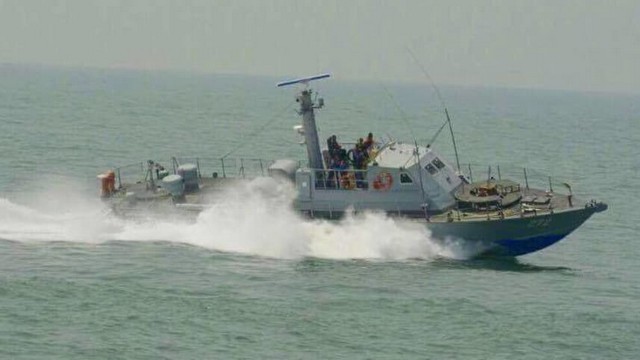
“Welcome to the Myanmar Navy,” said the caption on the Myanmar Navy’s Facebook page, in honor of the arrival of an Israeli patrol boat to Myanmar’s shore. “The Super-Dvora MK III is moving forward at 45 knots on Myanmar waters,” the post continued. The post is from April, only half a year ago, when the Myanmar (Burmese) army was already being accused of war crimes.

Although the persecution of the Muslim minority in Myanmar, the Rohingya people, has become more intense in recent months, back in November 2016 the army was already being accused of brutality against them and of torching their villages. During that period tens of thousands of Rohingyans were expelled from their homes.

The representative of the UN High Commission for Refugees in the region said then that the ultimate purpose of Myanmar’s government is “ethnic cleansing of the Muslim minority.” Since last August more than half a million Rohingyan refugees have fled to Bangladesh, and some of them have testified to methodical rape and murder by the Myanmar military.

The pictures of the two boats on the Facebook page also reveal the weapons that have been installed on them, all blue-and-white products. There’s a remote weapon station, made by Elbit Systems, which allows the firing of a heavy machine gun or cannon of up to 30 millimeters. The new patrol boats are only part of a larger transaction signed between Israel and Myanmar. The Ramta division of Israel Aerospace Industries, which manufactures the Super Dvora, is meant to transfer at least two more boats to the local military. According to some reports on the deal, these boats will be built in Myanmar with the help of Israeli technology. IAI refused to comment.

The total value of the arms deal, according to sources in the Israeli weapons industry, is estimated at tens of millions of dollars. An officer involved in the matter told Haaretz that the Myanmar naval commander visited Israel in the past year, “was impressed and wanted to learn.” It was the second visit to Israel by the naval commander in the past five years.

Israeli weapons are being sold to Myanmar despite the restrictions on weapons sales to that country. Only last month Israel refused to announce that it would stop selling weapons to Myanmar despite the UN declaration about ethnic cleansing. The Rohingya minority is now considered the most persecuted people in the world.

Israel is careful not to officially confirm that it is granting permits to Israeli weapons firms to sell weapons to Myanmar. But the visit two years ago by Myanmar’s chief of the armed forces, Gen. Min Aung Hlaing, who met with Israel’s entire top military brass, was an indication of the cooperation between the two armies. During his visit, Hlaing announced that he had purchased the Super Dvora patrol boat, and he visited the Palmahim Air Force Base and the Gaza Division. A year-and-a-half ago, a reciprocal visit to Myanmar was made by Brig. Gen. Michel Ben-Baruch, head of the Defense Ministries International Defense Cooperation Directorate. In the past, Myanmar purchased Israeli air-to-air missiles and cannons, while an Israeli company, TAR Ideal Concepts, has noted on its website that it has trained Myanmar military forces. Now the site makes no specific reference to Myanmar, referring only to Asia.

The two countries in recent years have signed a memorandum of understanding clarifying the bilateral cooperation and transfer of relevant information and intelligence. According to official reports in Myanmar, the agreement includes military training and improving security cooperation between the two countries. There is, however, no known instance of Myanmar military personnel being trained in Israel, or of Israeli officers who were involved in training Myanmar military forces.

The efforts to fully expose the Israel-Myanmar connection by attorney Eitay Mack, who is active in increasing transparency of Israeli arms exports to countries that violate human rights, have so far been unsuccessful. Last month the High Court of Justice issued a ruling in response to a petition he filed with other human rights activists against the sales, but the ruling was kept classified at the state’s request.

The Defense Ministry said in response, “In general, the Defense Ministry doesn’t typically address security export issues.”

According to a source familiar with the issue, there is currently no relationship between the Israel Defense Forces and the Myanmar army, and no uniformed personnel are involved in any cooperative venture with the Myanmar security establishment.

Gili Cohen is Haaretz newspaper’s military correspondent. Cohen, who was born in 1989, has been writing for Haaretz since 2010.

24 October 2017

Source: https://www.haaretz.com/israel-news/israel-sold-arms-to-myanmar-during-ethnic-cleansing-campaign-1.5459614

Bolsonaro’s rise is a new blow for liberal democracy

By Ishaan Tharoor

The once-unthinkable nearly became reality Sunday. Jair Bolsonaro, a far-right politician sometimes likened to President Trump, nearly won an outright majority of the vote in the first round of Brazil’s presidential election. Had he succeeded, he would have clinched the presidency. Instead, he is the clear favorite in the runoff scheduled for Oct. 28.

It wasn’t long ago that the bruising and divisive Bolsonaro, a 59-year-old ex-paratrooper, was a fringe figure with little hope of winning power in Brasilia. Even in the weeks running up to Sunday’s vote, experts suggested that the country’s political process would curb his ascent. A second round would see voters rally behind a more mainstream challenger; a national legislature stacked with opponents would force Bolsonaro to moderate his hard-line positions.

But a surge in support for Bolsonaro’s angry, anti-establishment politics also upended Brazil’s Congress, with his once-obscure Social Liberal Party running a close second to the leftist Workers’ Party of jailed former president Lula Inácio da Silva. A host of veteran politicians — two-thirds of incumbents — were swept out, while a new, upstart generation that includes celebrity YouTubers is poised to enter the country’s lower house.

Lula’s anointed successor, former Sao Paulo mayor Fernando Haddad, will struggle to close the yawning gap between him and Bolsonaro ahead of the second round. Supporters of the front-runner envision him taking the reins with solid backing from a host of centrist and right-wing parties and plenty of legislative support. “What comes out from this election is a Congress more favorable to pass Bolsonaro’s reforms,” Juliano Griebeler, a political analyst at Barral M Jorge, a business consultancy, said to Bloomberg News.

Bolsonaro got to this moment on the back of years of incendiary politicking. As we’ve already detailed, he is notorious for his outbursts of bigotry, launching diatribes against minorities, immigrants, women and LGBT Brazilians. He cast himself as the law-and-order candidate, declaring that he would give police greater license to kill criminals with impunity and make it easier for ordinary Brazilians to acquire their own firearms. As an evangelical Christian, he courted religious voters and pandered to conservative culture warriors. And he benefited from widespread anger at the country’s political class, which is engulfed in a vast corruption scandal.

“I voted for Bolsonaro because I’m tired of politicians being the same,” Maria Aparecida de Oliveira, a 63-year-old housekeeper casting her ballot in an upper-middle-class district of Sao Paulo, said to my colleagues. “Even if he is a little crazy, someone needs to bring change.”

“Brazil 2018 is an epic tale of establishment that failed to listen, ignored the issues that engaged voters most (namely crime & corruption), and didn’t take the insurgent seriously,” tweeted Brian Winter, the editor in chief of Americas Quarterly. “It’s a global story, but especially pronounced here.”

The implications of Bolsonaro’s success are huge — and, to many observers, grim. Bolsonaro has talked nostalgically of the decades when Brazil was ruled by a murderous right-wing dictatorship and hailed former military officers implicated in the torture of leftist political prisoners. He once said that the dictatorship’s greatest failing was not killing more of them.

A leading Mexican cartoonist offered a stark reaction to the Brazilian election results on Monday:

That a critical mass of Brazilians backs Bolsonaro anyway is a sign of how polarized and venomous the country’s political climate has become — a phenomenon increasingly apparent in democracies throughout the world. “It is an event of global significance, the latest chapter in an unfolding story about the destruction of liberal norms and the rise of populism,” wrote Financial Times columnist Gideon Rachman.

“If we are to take seriously the things that Bolsonaro has said in the campaign, in my opinion Brazil’s democracy is in grave peril,” Lilia Schwarcz, a prominent Brazilian historian, said to the New York Times. She added: “We used to think that rights that have been conquered were rights that had been consolidated. I’ve concluded that we were being foolish. We must continue fighting for them.”

To many Brazilians, Haddad, Bolsonaro’s opponent, seems unlikely to lead that fight. His left-wing Workers’ Party, particularly under Lula’s wildly popular administration, presided over a huge economic boom that lifted millions of Brazilians out of poverty. But key figures in its leadership were later implicated, alongside most of Brazil’s establishment, in the country’s endemic graft.

“I think Bolsonaro will carry on doing what he’s doing. I don’t think he has to change much,” Glauco Peres, a political scientist at the University of Sao Paolo, said to the Guardian. “He’ll keep hammering away at this idea of fear … that the [Workers’ Party] represents a step backwards into corruption scandals and having criminals in government.”

Unlike the larger-than-life Lula, who is still a left-wing icon, Haddad “is a shy, pragmatic economist,” wrote my colleagues Anthony Faiola and Marina Lopes. They noted that “he has tried to reassure investors that he would not pursue radical leftist policies, but many still worry he would not pass the tough reforms seen as necessary to avoid another economic crisis here.”

There is no such doubt about his opposite number. “Bolsonaro is a strange phenomenon,” Lucas de Aragao, director of Arko Advice, a political risk company in Brasilia, said to The Post. “It doesn’t have any precedent in Brazil. Even some Lula voters are turning to him. It’s happened because Brazil loves this idea of a savior, of a hero. And Bolsonaro now represents this image of a savior as much as Lula does.”

But his critics warn that such an image is only a mirage. “Brazilians can embrace the politics of division and the seductive appeal of simplistic solutions, following the path of populist authoritarians in Hungary, Poland and the Philippines,” wrote Robert Muggah, co-founder of a Rio de Janeiro-based think tank. “Alternatively, they can preserve and renew their young democracy.”

Ishaan Tharoor writes about foreign affairs for The Washington Post.

9 October 2018

Source: https://s2.washingtonpost.com/camp-rw/?e=a2hhbG1hcnhAeWFob28uY29t&s=5bbc35d6fe1ff67504b86039

Everyone washes their hands as Gaza’s economy goes into freefall

By Jonathan Cook

Nazareth: The moment long feared is fast approaching in Gaza, according to a new report by the World Bank. After a decade-long Israeli blockade and a series of large-scale military assaults, the economy of the tiny coastal enclave is in “freefall”.

At a meeting of international donors in New York on Thursday, coinciding with the annual meeting of the United Nations General Assembly, the World Bank painted an alarming picture of Gaza’s crisis. Unemployment now stands at close to 70 per cent and the economy is contracting at an ever faster rate.

While the West Bank’s plight is not yet as severe, it is not far behind, countries attending the Ad Hoc Liaison Committee were told. Gaza’s collapse could bring down the entire Palestinian banking sector.

In response, Europe hurriedly put together a €40 million aid package, but that will chiefly address Gaza’s separate humanitarian crisis – not the economic one – by improving supplies of electricity and potable water.

No one doubts the inevitable fallout from the economic and humanitarian crises gripping Gaza. The four parties to the Quartet charged with overseeing negotiations between Israel and the Palestinians – the United States, Russia, the European Union and the UN – issued a statement warning that it was vital to prevent what they termed “further escalation” in Gaza.

The Israeli military shares these concerns. It has reported growing unrest among the enclave’s two million inhabitants and believes Hamas will be forced into a confrontation to break out of the straightjacket imposed by the blockade.

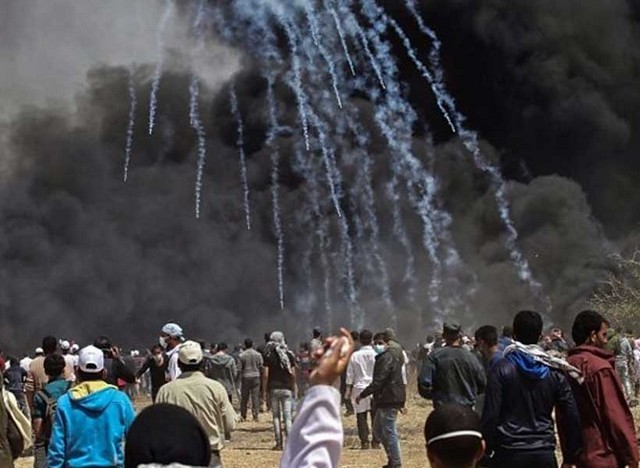
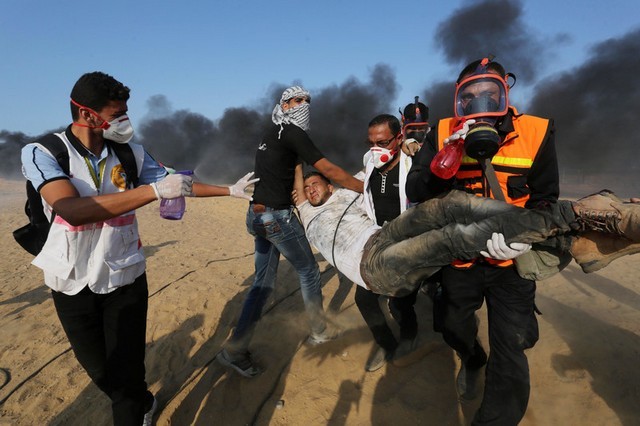
In recent weeks, mass protests along Gaza’s perimeter fence have been revived and expanded after a summer lull. On Friday, seven Palestinian demonstrators, including two children, were killed by Israeli sniper fire. Hundreds more were wounded.

Nonetheless, the political will to remedy the situation looks as atrophied as ever. No one is prepared to take meaningful responsibility for the time-bomb that is Gaza.

In fact, the main parties that could make a difference appear intent on allowing the deterioration to continue.

Israeli Prime Minister Benjamin Netanyahu has ignored repeated warnings of a threatened explosion in Gaza from his own military.

Instead, Israel is upholding the blockade as tightly as ever, preventing the flow of goods in and out of the enclave. Fishing is limited to three miles off the coast rather than the 20-mile zone agreed in the Oslo accords. Hundreds of companies are reported to have folded over the summer.

Intensifying the enclave’s troubles is the Trump administration’s recent decision to cut aid to the Palestinians, including to the United Nation’s refugee agency, UNRWA. It plays a critical role in Gaza, providing food, education and health services to nearly two-thirds of the population.

The food budget is due to run out in December, and the schools budget by the end of this month. Hundreds of thousands of hungry children with nowhere to spend their days can only fuel the protests – and the deaths.

The Palestinian Authority of Mahmoud Abbas, headquartered in the West Bank, has no incentive to help. Gaza’s slowly unfolding catastrophe is his leverage to make Hamas submit to his rule. That is why the Palestinian Authority has cut transfers to Gaza by $30 million a month.

But even if Abbas wished to help, he largely lacks the means. The US cuts were imposed primarily to punish him for refusing to play ball with US President Donald Trump’s supposed “deal of the century” peace plan.

Israel, the World Bank notes, has added to Abbas’s difficulties by refusing to transfer taxes and customs duties it collects on the PA’s behalf.

And the final implicated party, Egypt, is reticent to loosen its own chokehold on its short border with Gaza. President Abdel Fattah El Sisi opposes giving any succour either to his domestic Islamist opponents or to Hamas.

The impasse is possible only because none of the parties is prepared to make a priority of Gaza’s welfare.

That was starkly illustrated earlier in the summer when Cairo, supported by the UN, opened a back channel between Israel and Hamas in the hope of ending their mounting friction.

Hamas wanted the blockade lifted to reverse Gaza’s economic decline, while Israel wanted an end to the weekly protests and the damaging images of snipers killing unarmed demonstrators.

In addition, Netanyahu has an interest in keeping Hamas in power in Gaza, if barely, as a way to cement the geographic split with the West Bank and an ideological one with Abbas.

The talks, however, collapsed quietly in early September after Abbas objected to the Egyptians. He insisted that the Palestinian Authority be the only address for discussions of Gaza’s future. So, Cairo is yet again channelling its energies into a futile attempt at reconciling Abbas and Hamas.

At the UN General Assembly, Trump promised his peace plan would be unveiled in the next two to three months, and made explicit for the first time his support for a two-state solution, saying it would “work best”.

Netanyahu vaguely concurred, while pointing out: “Everyone defines the term ‘state’ differently.” His definition, he added, required that not one of the illegal Jewish settlements in the West Bank be removed and that any future Palestinian state be under complete Israeli security control.

Abbas is widely reported to have conceded over the summer that a Palestinian state – should it ever come into being – would be demilitarised. In other words, it would not be recognisable as a sovereign state.

Hamas has made notable compromises to its original doctrine of military resistance to secure all of historic Palestine. But it is hard to imagine it agreeing to peace on those terms. This makes a reconciliation between Hamas and Abbas currently inconceivable – and respite for the people of Gaza as far off as ever.

Jonathan Cook won the Martha Gellhorn Special Prize for Journalism.

2 October 2018

Source: https://countercurrents.org/2018/10/02/everyone-washes-their-hands-as-gazas-economy-goes-into-freefall/

Bloody Friday as Gaza marks six months of protests

By Maureen Clare Murphy

Friday marked what Gaza’s health ministry described as the single bloodiest day of the Great March of Return protests since 14 May, when Israeli occupation forces fatally injured more than 60 Palestinians.

A photo shared on social media following news of his death shows Muhammad al-Hawm, 14, taking part in the football team sponsored by his local mosque. (via Facebook)

Seven Palestinians, including two children, were slain on Friday, two days shy of the six-month anniversary of the protest launch.

The two children were identified as Nasir Azmi Musbah, 11, shot in the head east of Khan Younis, and Muhammad Nayif Yusif al-Hawm, 14, shot in the chest east of Bureij.

An adult was also killed in Bureij, in central Gaza: Muhammad Ashraf al-Awawdeh, 25, shot with a live bullet to the chest. And in southern Khan Younis, Muhammad Ali Muhammad Inshasi, 18, was shot in the stomach.

Three were killed east of Gaza City: Iyad Khalil Ahmad al-Shaer, 18, shot in the chest; Muhammad Bassam Muhammad Shakhsa, 24, shot in the head; and Muhammad Walid Haniyeh, 32, shot in the face.

More than 250 Palestinians were injured during Friday’s protests, 163 of them by live fire, including 20 children, according to the Gaza-based human rights group Al Mezan.

One paramedic and four media workers were among those injured, including journalist Haneen Mahmoud Suleiman Baroud, 23, who was hit directly in the head with a tear gas canister, Al Mezan stated.

A graphic video published by Palestinian media outlets shows the moments after a man was shot in the back of his head during protests east of Gaza City on Friday:

The man was among a group including women and children waving flags near one of the fences along the Gaza-Israel boundary.

It was not immediately clear whether the injured man was among those who had died of their wounds.

Palestinian media also published a video said to show a paramedic mourning over the body of her brother, the slain child Nasir Azmi Misbah, in a hospital morgue:

150 killed during protests

Israel’s use of deadly force against unarmed protesters on Friday is characteristic of its actions throughout the Great March of Return, during which more than 150 Palestinians have been killed, including 28 children, three persons with disabilities, three paramedics and two journalists.

In addition to those killed during protests, 52 other Palestinians in Gaza have been slain by Israeli occupation forces since 30 March and Israel is withholding the bodies of 10 of them.

Lethal fire against mass protests in Gaza is the subject of an ongoing investigation appointed by the United Nations Human Rights Council, which was told by human rights groups this week that there is no evidence that a single protester killed by Israel during the Great March of Return was armed.

Israel’s violence has also generated an unprecedented warning from the chief prosecutor of the International Criminal Court, who stated that Israeli leaders may face trial for the killings of unarmed demonstrators.

The prosecutor, Fatou Bensouda, met with Palestinian Authority foreign minister Riyad al-Maliki in New York during the UN General Assembly this week:

Gaza economy “in free fall”

The World Bank stated this week that Gaza’s economy is “in free fall” after more than a decade of blockade, successive Israeli military assaults and internal division between Palestinian factions.

The Gaza economy shrank by six percent in the first quarter of this year, “with indications of further deterioration since then.”

“The result is an alarming situation with every second person living in poverty and the unemployment rate for its overwhelmingly young population at over 70 percent,” the World Bank added.

“The economic and social situation in Gaza has been declining for over a decade but has deteriorated exponentially in recent months and has reached a critical point,” Marina Wes, director for the West Bank and Gaza, stated.

“Increased frustration is feeding into the increased tensions which have already started spilling over into unrest and setting back the human development of the region’s large youth population.”

The UN’s Middle East envoy Nickolay Mladenov told the Security Council last week that “the power crisis in Gaza is coming to a head” as the last stocks of emergency fuel to operate critical health, water and sanitation facilities delivered to Gaza run out amid electricity shortages of around 20 hours per day.

He added that essential medicines “are at critically low levels, with almost half of essential medicines at less than one-month’s supply and 40 percent completely depleted.”

Meanwhile the commissioner-general of UNRWA, the UN agency for Palestine refugees, said on Tuesday that the body has only enough funding to keep schools and clinics in operation through mid-October.

“We still need approximately $185 million to be able to ensure that all of our services, education system, health care, relief and social services and our emergency work in Syria and Gaza in particular can continue until the end of the year,” Pierre Krähenbühl added.

Two-thirds of Gaza’s population of two million are refugees from lands on the other side of the boundary with Israel. More than half of Gaza’s residents receive food aid packages from UNRWA, whose food aid budget will be exhausted by the end of the year.

Currently, the UN provides food aid packages to 1.3 million people in Gaza, up from just 130,000 in 2005.

The US announced last month that it would stop funding UNRWA after freezing $300 million in aid in January, throwing the agency into unprecedented financial crisis.

The US has also decided to cut $200 million more in bilateral aid to the West Bank and Gaza.

Meanwhile proceedings against the US were initiated at the International Court of Justice in The Hague on Friday over the relocation of its embassy from Tel Aviv to Jerusalem, which the Palestinian Authority in Ramallah says is a breach of the Vienna Convention.

Maureen Clare Murphy is the managing editor of The Electronic Intifada and lives in Chicago

29 September 2018

Source: https://countercurrents.org/2018/09/29/bloody-friday-as-gaza-marks-six-months-of-protests/

A Call for Justice and Action for Myanmar

                                                PERMANENT PEOPLES’ TRIBUNAL

Founder: LELIO BASSO (ITALY)

President:
PHILIPPE TEXIER (FRANCE)

Vicepresidents:
LUIZA ERUNDINA DE SOUSA (BRASIL)
JAVIER GIRALDO MORENO (COLOMBIA)
HELEN JARVIS (AUSTRALIA)
NELLO ROSSI (ITALY)

Secretary General:
GIANNI TOGNONI (ITALY)

A Call for Justice and Action for Myanmar

One year after the PPT Judgment on the genocide

September 2017 – September 2018

General Secretariat:

VIA DELLA DOGANA VECCHIA 5 – 00186 ROME – TEL:0039 066877774
E-mail:ppt@permanentpeoplestribunal.org www.permanentpeoplestribunal.org


1. The judgment of the Permanent Peoples’ Tribunal on Myanmar: genocide, war crimes and crimes against humanity

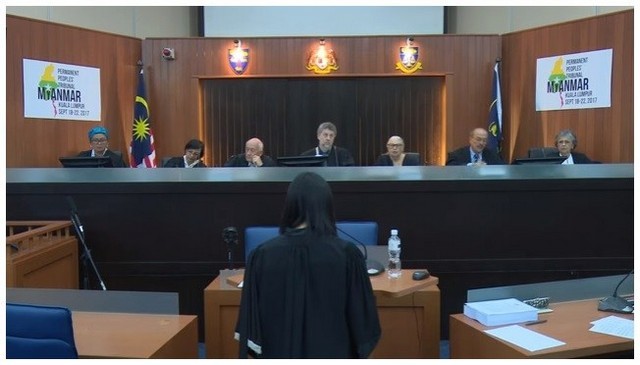
One year ago, on 22 September 2017, the Permanent Peoples’ Tribunal on Myanmar, after hearing persuasive witness and expert testimony at its session held in Kuala Lumpur, found that war crimes, crimes against humanity and genocide are being committed in Myanmar1. In recognition that its findings have continuing and ever heightened applicability, the University of Malaya Faculty of Law is now publishing that judgment, soon to be followed in Burmese, Bengali and Rohingya languages, to ensure access by the most affected communities.
This was the first and until today the only quasi-judicial judgment that genocide is being carried out against the Rohingya and that other serious and hateful crimes are committed against the other groups currently suffering persecution from the Myanmar State.

The Permanent Peoples’ Tribunal on Myanmar met at the height of the latest and most intense offensive against the Rohingya, launched on 25 August 2017 by the armed forces of Myanmar in conjunction with local militia, bringing decades-long assaults and repression to an unprecedented level. Its deliberations were suspended to listen to the speech of State Counsellor Aung San Syu Kyi to the Yangon diplomatic corps denying any persecution, a speech that was incorporated into the proceedings of the Tribunal as the defence statement and rationale, falsely attempting to justify the unfolding events as a response to the relatively low-level assaults launched by militants on military border posts.

The Tribunal viewed the situation of the Rohingya through a wider lens, responding also to requests from the Kachin community and from other Muslims in Myanmar to rule on their persecution. It found that war crimes had been and were still being committed against the Kachin; and that all three groups were being subjected to crimes against humanity and genocidal intent by the State of Myanmar. In the year since the PPT on Myanmar’s judgment, all these crimes have continued and indeed have escalated, as also against other groups, notably the Shan and Ta’ang.

2. Other voices of denunciation, protest and succour

The world’s press, researchers and humanitarian agencies have provided report after report amplifying the well-founded judgment of the Tribunal that genocidal intent against the Rohingya had already been signalled back in 1978 and was called out ever more strongly in a number of serious academic and legal reports examining the repeated pogroms of 2002, 2012 and 2016. All those warnings were disregarded by the majority of the international community, and the genocidal process continued to wreak its dreadful course.

However, in the face of the mass exodus of 2017, following calculated state-planned military escalation, the reality could no longer be denied, even though many still refuse to call it by its name, and powerful institutions refuse to take action.

The government of Bangladesh, itself a densely populated country, vulnerable to extreme climate events, has opened its doors and dug into its limited resources to help support nearly one million Rohingya refugees, but the conditions in the camps are known to all as impossible to endure for the long term. World leader after world leader have visited the camps expressing distress and sorrow, but failing to meet even the basic humanitarian needs of the refugees.
Most recently, on 27 August, the UN Independent Fact Finding Mission found “that crimes against humanity have been committed in Kachin, Rakhine and Shan States, principally by the Tatmadaw” and called for“the investigation and prosecution […] so that a competent court can determine their liability for genocide in relation to the situation in Rakhine State”

The Permanent People’s Tribunal expresses its full endorsement of the UN Fact Finding Mission’s work.

3. The Quest for Justice : Recent Steps (Backwards and Forwards)

These and other efforts to bring justice to the victims of the continuing Myanmar nightmare and to end impunity have been met by the government’s arrogant and naked denials and attempts to silence critics, to the point of convicting two journalists for daring to investigate just a single one of the massacres.

The Permanent People’s Tribunal calls upon the international community for action, now. The facts are known. We cannot accept that another genocide is being carried out under the eyes of the world in the internet age when no one can once more say: “I did not know, I did not see.”

A referral to the International Criminal Court (ICC) is the minimum judicial response for ensuring appropriate accountability of the perpetrators and those responsible for the atrocities committed in Myanmar. In this context, important steps forward were taken in the decision by Pre Trial Chamber I on 6 September that the Court may exercise jurisdiction over the alleged deportation of the Rohingya people from Myanmar to Bangladesh even though Myanmar is not a party of the ICC Rome Statute, and in the subsequent decision of the Prosecutor to open a Preliminary Investigation.

However, deportation is only one of the many crimes committed by the State of Myanmar on the Rohingya. In the absence of any hope for a Security Council referral for genocide and crimes against humanity, we support the proposal by Michelle Bachelet, the UN’s newly appointed High Commissioner for Human Rights, for action to be taken by the UN General Assembly at its 2018 session.

4. A call for action for Myanmar

As these belated decisions by the official bodies mandated by the UN begin to wend their slow course towards possible judicial rulings, it remains ever more important to continue to expand the mobilisation of consciences and to come up with feasible solutions to the crisis before it is too late. As we approach the 70th anniversary of the Universal Declaration of Human Rights, “Never again” cannot be an empty slogan behind which there is only the total subjection of international obligatory law to the weight of strictly political and unequal power.

The PPT reiterates its call for action for Myanmar, and propose an international initiative to chart a program to press for approve a minimum set of recommendations for immediate implementation, including: a realistic plan of voluntary, safe and dignified return for the Rohingya to their ancestral homeland, guaranteed through an international protection mechanism, based on the recognition and guarantee of their full rights to citizenship as nationals

of Myanmar; as well as appropriate accountability of the perpetrators and those responsible for the atrocities committed.
Such international initiative could be targeted to a meeting in Rome, where the ICC was approved 20 years ago, early in December 2018, in close coincidence with the70th anniversary of the UN Declaration and of the approval of the genocide Convention.

We see such an initiative as a way towards building an international, coordinated movement of the people based on an understanding of a fundamental diagnosis: the tragic situation in Myanmar illustrates starkly what is happening at this moment in history, not only in this place but in so many other corners of the world: the enormous difficulty, and often the failure, of international law to protect individuals from serious violation, by the State, of the peoples’ rights to life, livelihood and human dignity and the necessity of a vigilant and active international public opinion capable of undertaking the struggle for the respect of fundamental human rights.

Rome, 21 September 2018

Philippe Texier, President Helen Jarvis, Vice-president Nello Rossi, Vice-president
Gianni Tognoni, Secretary general

On the behalf of the panel of judges, session in Kuala Lumpur, Malaysia (18-22 September 2017)
Daniel Feierstein, Chair of the panel of Judges Gill Boehringer, Judge


1. http://permanentpeoplestribunal.org/wp-content/uploads/2017/11/PPT-on-Myanmar-Judgment-FINAL.pdf

Why Israel Demolishes: Khan Al-Ahmar as Representation of Greater Genocide

By Dr Ramzy Baroud

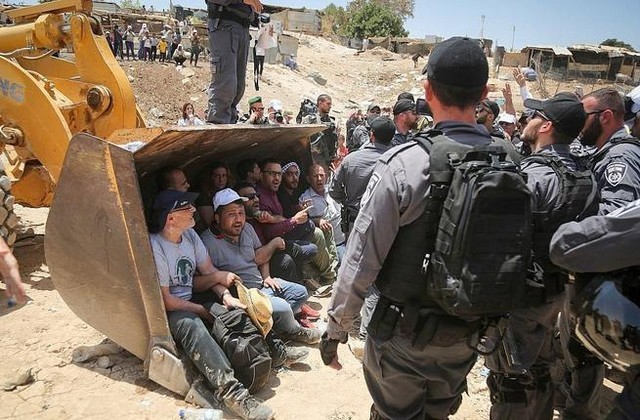
Like vultures, Israeli soldiers descended on Khan Al-Ahmar, on Sep. 14, recreating a menacing scene with which the residents of this small Palestinian village, located East of Jerusalem, are all-too familiar.

The strategic location of Khan Al-Ahmar makes the story behind the imminent Israeli demolition of the peaceful village unique amid the ongoing destruction of Palestinian homes and lives throughout besieged Gaza and Occupied West Bank.

Throughout the years, Khan Al-Ahmar, once part of an uninterrupted Palestinian physical landscape has grown increasingly isolated. Decades of Israeli colonization of East Jerusalem and the West Bank left Khan Al-Ahmar trapped between massive and vastly expanding Israeli colonial projects: Ma’aleAdumim, KfarAdumim among others.

The unfortunate village, its adjacent school and173 residents are the last obstacle facing the E1 Zone project, an Israeli plan that aims to link illegal Jewish colonies in Occupied East Jerusalem with West Jerusalem, thus cutting off East Jerusalem completely from its Palestinian environs in the West Bank.

Like the Neqab (Negev) village of Al-Araqib, whichhas been demolished by Israel and rebuilt by its residents 133 times, Khan Al-Ahmar residents are facing armed soldiers and military bulldozers with their bare chests and whatever local and international solidarity they are able to obtain.

Despite the particular circumstances and unique historical context of Khan Al-Ahmar, however, the story of this village is but a chapter in a protracted narrative of a tragedy that has extended over the course of seventy years.

It would be a mistake to discuss the destruction of Khan Al-Ahmar, or any other Palestinian village outside the larger context of demolition that has stood at the heart of Israel’s particular breed of settler colonialism.

It is true that other colonial powers used destruction of homes and properties, and the exile of whole communities as a tactic to subdue rebellious populations. The British Mandate government in Palestine used the demolition of homes as a ‘deterrence’ tactic against Palestinians who dared rebel against injustice throughout the 1920s, 30s and 40s, till Israel took over in 1948.

Yet the Israeli strategy is far more convoluted than a mere ‘deterrence’. It is now carved in the Israeli psyche that Palestine must be completely destroyed in order for Israel to exist. Therefore, Israel is engaging in a seemingly endless campaign of erasing everything Palestinian, because the latter, from an Israeli viewpoint represents an existential threat to the former.

This is precisely why Israel sees the natural demographic growth among Palestinians as an ‘existential threat’ to Israel’s ‘Jewish identity’.

This can only be justified with an irrational degree of hate and fear that has accumulated throughout generations to the point that it now forms a collective Israeli psychosis for which Palestinians continue to pay a heavy price.

The repeated destruction of Gaza is symptomatic of this Israeli psychosis.

Israel is a “country that when you fire on its citizens it responds by going wild – and this is a good thing,” was theofficial explanation offered by Tzipi Livni, the Israeli foreign minister in January 2009 to justify its country’s war on the blockaded Gaza Strip. The Israel ‘going wild’ strategy has led to the destruction of22,000 homes, schools and other facilities during one of Israel’s deadliest wars on the Strip.

A few years later, in the summer of 2014, Israel went ‘wild’ again, leading to an even greater destruction and loss of lives.

Israel’smass demolition of Palestinian homes in Gaza, and everywhere else, preceded Hamas by decades. In fact, it has nothing to do with the method of resistance that Palestinians utilize in their struggle against Israel. Israel’s demolishing of Palestine – whether the actual physical structures or the idea, history, narrative, and even street names – is an Israeli decision through and through.

A quick scan of historical facts demonstrates that Israel demolished Palestinian homes and communities in diverse political and historical contexts, where Israel’s ‘security’ was not in the least a factor.

Nearly 600 Palestinian towns, villages and localitieswere destroyed between 1947 and 1948, and nearly 800,000 Palestinians were exiled to make room for the establishment of Israel.

According to theLand Research Center(LRC), Israel had destroyed 5,000 Palestinian homes in Jerusalem alone since it occupied the city in 1967, leading to the permanent exile of nearly 70,000 people. Coupled with the fact that nearly 200,000 Jerusalemites were driven out during the Nakba, the Catastrophe’ of 1948, and the ongoing slow ethnic cleansing, the Holy City has been in a constant state of destruction since the establishment of Israel.

In fact, between 2000 and 2017, over 1,700 Palestinian homes were demolished, displacing nearly 10,000 people. This is not a policy of ‘deterrence’ but of erasure – the eradication of the very Palestinian culture.

Gaza and Jerusalem are not unique examples either. According to the Israeli Committee against House Demolitions (ICAHD’s)report last December, since 1967 “nearly 50,000 Palestinian homes and structures have been demolished – displacing hundreds of thousands of Palestinians and affecting the livelihoods of thousands of others.”

Combined with the destruction of Palestinian villages upon the establishment of Israel, and the demolition of Palestinian homes inside Israel itself, ICAHD puts the total number of homes destroyed since 1948 at more than 100,000.

In fact, as the group itself acknowledges, the figure above is quite conservative. Indeed, it is. In Gaza alone, and in the last 10 years which witnessed three major Israeli wars, nearly 50,000 homes and structures werereportedly destroyed.

So why does Israel destroy with consistency, impunity and no remorse?

It is for the same reason that it passed laws to change historic street names from Arabic to Hebrew. For the same reason it recently passed the racist Nation-state law, elevating everything Jewish and completely ignoring and downgrading the existence of the indigenous Palestinians, their language and their culture that goes back millennia.

Israel demolishes, destroys and pulverizes because in the racist mindset of Israeli rulers, there can be no room between the Sea and the River but for Jews; where the Palestinians – oppressed, colonized and dehumanized – don’t factor in the least in Israel’s ruthless calculations.

This is not just a question of Khan Al-Ahmar. It is a question of the very survival of the Palestinian people, threatened by a racist state that has been allowed to ‘go wild’ for 70 years, untamed and without repercussions.

– Ramzy Baroud is a journalist, author and editor of Palestine Chronicle.

20 September 2018

Source: https://countercurrents.org/2018/09/20/why-israel-demolishes-khan-al-ahmar-as-representation-of-greater-genocide/

Yemen’s Descent into Hell: A Saudi-American War of Terror

By Rajan Menon

It’s the war from hell, the savage one that Saudi Arabia and the United Arab Emirates, along with seven other Middle Eastern and North African states, have been waging in Yemen since March 2015, with fulsome support from the Pentagon and American weapons galore. It’s got everything. Dead children in the dozens, a never-ending air campaign that pays scant heed to civilians, famine, cholera, you name it. No wonder it’s facing mounting criticism in Congress and from human rights groups. Still, ever since President Donald Trump (like Barack Obama before him) embraced the Saudi-led coalition as this country’s righteous knight errant in the Middle East, the fight against impoverished Yemen’s Houthi rebels — who have, in turn, been typecast as Iran’s cats-paw — has only grown fiercer. Meanwhile, the al-Qaeda affiliate there continues to expand.

For years now, a relentless Saudi air campaign (quite literally fueled by the U.S. military) has hit endless civilian targets, using American smart bombs and missiles, without a peep of protest or complaint from Washington. Only a highly publicized, completely over-the-top slaughter recently forced the Pentagon to finally do a little mild finger wagging. On August 7th, an airstrike hit a school bus — with a laser-guided bomb made by Lockheed Martin — in northern Yemen, killing 51 people, 40 of them schoolchildren. Seventy-nine others were wounded, including 56 children. Soon after, a U.N. Security Council-appointed group of experts issued a report detailing numerous other egregious attacks on Yemeni civilians, including people attending weddings and funerals. Perhaps the worst among them killed 137 people and wounded 695 others at a funeral in Sana’a, Yemen’s capital, this April.

The attack on those schoolchildren and the U.N. report amplified a growing global outcry against the carnage in Yemen. In response, on August 28th, Secretary of Defense James Mattis let it be known that the Trump administration’s support for the Persian Gulf potentates’ military campaign should not be considered unreserved, that the Saudis and their allies must do “everything humanly possible to avoid any innocent loss of life.” Considering that they haven’t come close to meeting such a standard since the war started nearly five years ago and that the Trump administration clearly has no intention of reducing its support for the Saudis or their war, Mattis’s new yardstick amounted to a cruel joke — at the expense of Yemeni civilians.

The Statistics of Suffering

Some appalling numbers document the anguish Yemenis have endured. Saudi and Emirati warplanes officially have killed — and it’s considered a conservative estimate — 6,475 civilians and wounded more than 10,000 others since 2015. Targets struck have included farms, homes, marketplaces, hospitals, schools, and mosques, as well as ancient historic sites in Sana’a. And such incidents haven’t been one-off attacks. They have happened repeatedly.

By April 2018, the Saudi-led coalition had conducted 17,243 airstrikes across Yemen, hitting 386 farms, 212 schools, 183 markets, and 44 mosques. Such statistics make laughable the repeated claims of the Saudis and their allies that such “incidents” should be chalked up to understandable errors and that they take every reasonable precaution to protect innocents. Statisticscompiled by the independent Yemen Data Project make it clear that the Gulf monarchs don’t lie awake at night lamenting the deaths of Yemeni civilians.

Saudi Arabia and its partners have accused the Houthis, the rebels with whom they have been in such a deadly struggle, of also attacking Yemeni civilians, a charge Human Rights Watch has validated. Yet such a they-do-it-too defense hardly excuses the relentless bombing of non-military sites by a coalition that has overwhelming superiority in firepower. Houthi crimes pale by comparison.

And when it comes to the destruction of civilian lives and livelihoods, believe it or not, that may be the least of it. Take the naval blockade of the country by Saudi Arabia and the United Arab Emirates that cut the number of ships docking in the Houthi-controlled port of Hodeida from 129 between January and August 2014 to 21 in the same months of 2017. The result: far less food and medicine entered the country, creating a disaster for Yemenis.

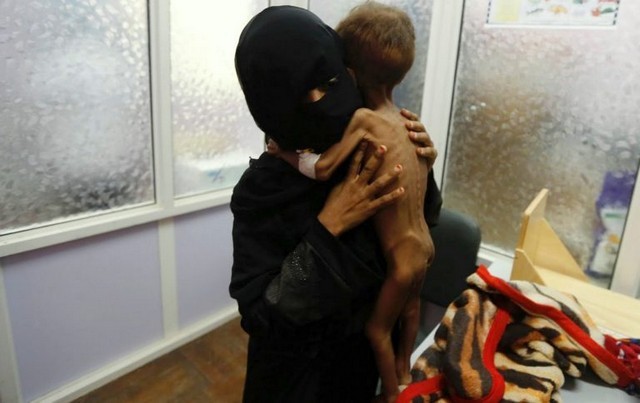
That country, the Arab world’s poorest, has long relied on imports for a staggering 85% of its food, fuel, and medicine, so when prices soared, famine spread, while hunger and malnutrition skyrocketed. Nearly 18 millionYemenis now rely on emergency food aid to survive: that’s an unbelievable 80% of the population. According to the World Bank, “8.4 million more are on the brink of famine.” In December 2017, following a barrage of bad publicity, the Saudi-Emirati blockade was eased marginally, but it had already set in motion a spiral of death.

The blockade also contributed to a cholera epidemic, which the shortage of medicines only exacerbated. According to a World Health Organization report, between April 2017 and July 2018, there were more than 1.1 million cholera cases there. At least 2,310 people died from the disease, most of them children. It is believed to be the worst cholera outbreak since statistics began to be compiled in 1949. At 800,000 cases between 2010 and 2017, Haiti held the previous record, one that the Yemenis surpassed within half a year of the first cases appearing. The prime contributors to the epidemic: drinking water contaminated by rotting garbage (uncollected because of the war), devastated sewage systems, and water filtration plants that stopped running due to lack of fuel — all the result of the horrendous bombing campaign.

Wartime economic blockades starve and sicken civilians and soldiers alike and so amount to a war crime. The Saudi-Emirati claim that the blockade’s sole purpose is to stanch the flow of Iranian arms to the Houthis is nonsense, nor can it be considered a legitimate act of self-defense, even though it was instituted after the Houthis fired ballistic missiles at the airport in the Saudi capital and the residence of that country’s monarch. (Both were shot down by Saudi air defenses and were clear responses to coalition airstrikes on Houthi-held territory that killed 136 civilians.) By the standards of international humanitarian law or simply common sense, choking off Yemen’s imports was a disproportionate response, and clairvoyance wasn’t required to foresee the calamitous consequences to follow.

True to form, President Trump’s U.N. ambassador, Nikki Haley, echoed Saudi charges that the Houthi missiles were Iranian-supplied Qiam-1s and condemned that country’s interference in Yemen. Given the scale of destruction by a foreign coalition using armaments and technical assistance provided by the United States (and Britain), her comments, in less grim circumstances, would have been laughable.

Those American-supplied weapons have included cluster munitions, which pose a particular hazard to civilians because, when dropped from a plane, their devastating bomblets often disperse over enormous areas. (Such bombs are banned under a 2008 treatysigned by 120 countries that neither Riyadh nor Washington has joined.) In May 2016, the Obama White House confirmed that it had stopped sending such weapons to Saudi Arabia, which then continued to use Brazilian-madevariants. However, other American arms have continued to flow to Saudi Arabia, while its warplanes rely on U.S. Air Force tankers for mid-air refueling (88 million pounds of fuel as of this January according to a Central Command spokeswoman), while the Saudi military has received regular intelligence information and targeting advicefrom the Pentagon since the war began. And with the advent of Donald Trump, such military involvement has only deepened: U.S. Special Operations forces are now on the Saudi-Yemen border, helping to find and attack Houthi redoubts.

In June 2018, ignoring U.S. opposition, the Saudi coalition heightened the risk to Yemeni civilians yet more by launching an offensive (“Golden Victory”) to capture the port of Hodeida. (So much for the Pentagon’s standard claim that supporting the war gives the U.S. influence over how it is waged and so limits civilian casualties.) Saudi and Emirati airpower and warships supported Emirati and Sudanese troops on the ground joined by allied Yemeni militias. The advance, however, quickly stalled in the face of Houthi resistance, though only after at least 50,000 families had fled Hodeida and basic services for the remaining 350,000 were disrupted, creating fears of a new outbreak of cholera.

The Roots of War

Yemen’s progression to its present state of perdition began as the Arab Spring’s gales swept through the Middle East in 2011, uprooting or shaking regimes from Tunisia to Syria. Street demonstrations grew against Yemen’s strongman, Ali Abdullah Saleh, and only gathered strength as he attempted to quell them. In response, he allied ever more strongly with Saudi Arabia and the United States, alienating the Houthis, whose main bastion, the governate of Saada, abuts the Saudi border. Adherents of Zaydi Islam, the Houthis played a pivotal role in creating a political movement, Ansar Allah, in 1992 to assert the interests of their community against the country’s Sunni majority. In an effort to undercut them, the Saudis have long promoted radical Sunni religious leaders in Yemen’s north, while intermittently raiding Houthi territories.

As a Houthi rebellion began, Saleh tried to make himself an even more indispensable ally of Washington in its post-9/11 anti-terrorist campaigns, notably against al-Qaeda in the Arabian Peninsula (AQAP), a growing local franchise of al-Qaeda. For good measure, he joined the Saudis in painting the Houthis little more than tools of an Iran that Washington and Riyadh both loathed. When those powers nonetheless came to see the Yemeni autocrat as a political liability, they helped oust him and transfer power to his deputy, Abdu Rabbu Mansour Hadi. Such moves failed to calm the waters, as the country started to disintegrate and Saudi-U.S. efforts to consolidate the transition from Saleh to Hadi unraveled.

Meanwhile, regular American drone strikes against AQAP angered many Yemenis. In their eyes, not only did the attacks violate Yemen’s sovereignty, they intermittently killed civilians. Hadi’s praise for the drone campaign only discredited him further. AQAP’s power continued to grow, resentment in southern Yemen rose, and criminal gangs and warlords began to operate with impunity in its cities, highlighting the Hadi government’s ineffectuality. Neoliberal economic reforms only further enriched a clutch of families that had long controlled much of Yemen’s wealth, while the economic plight of most Yemenis worsened radically. The unemployment rate was nearly 14% in 2017 (and exceeded 25% for young people), while the poverty rate rose precipitously, as did inflation.

It was a formula for disaster and when Hadi proposed a plan to create a federal system for Yemen, the Houthis were infuriated. New boundaries would, among other things, have cut their homeland off from the Red Sea coast. So they gave up on his government and girded for battle. Soon, their forces were advancing southward. In September 2014, they captured the capital, Sana’a, and proclaimed a new national government. The following March, they occupied Aden in southern Yemen and Hadi, whose government had moved there, promptly fled across the border to Riyadh. The first Saudi airstrikes against Sana’a were launched in March 2015 and Yemen’s descent to hell began.

The American Role

The commonplace rendition of the war in Yemen pits a U.S.-backed Saudi coalition against the Houthis, cast as agents of Iran and evidence of its increasing influence in the Middle East. Combatting terrorism and countering Iran became the basis for Washington’s support of the Saudi-led war. Predictably, as this cartoonish portrayal of a complicated civil war gained ground in the mainstream American media and among Beltway pundits (as well, of course, as in the Pentagon and White House), inconvenient facts were shunted aside.

Still, all these years and all those dead later, it’s worth considering some of those facts. There are, for instance, significant differences between the Houthis’ Zaydi variant of Shia Islam and the Twelver Shiism dominant in Iran — and some similarities between Zaydis and Sunnis — which makes the ubiquitous claims about a Iran-Houthi faith-based pact shaky. Moreover, Iran did not jump into the fray during the violent 2004-2010 clashes between Saleh and the Houthis and did not have longstanding ties to them either. In addition, contrary to the prevailing view in Washington, Iran is unlikely to be their main source of weaponry and support. Sheer distance and the Saudi coalition’s naval blockade have made it next to impossible for Iran to supply arms to the Houthis in the volume alleged. Besides, having pillaged various military bases during their march toward Aden, the Houthis do not lack for weaponry. Iran’s influence in Yemen has undoubtedly increased since 2015, but reducing the intricacies of that country’s internal crisis to Iranian meddling and a Tehran-led Shiite bloc expanding from Syria to the Arabian Peninsula amounts to, at best, a massive oversimplification.

The obsession of Trump and his key advisers with Iran (a remarkable number of them are Iranophobes) and The Donald’s obsession with plugging American arms makers and hawking their wares helps explain their embrace of the House of Saud and continuing support for its never-ending assault on Yemen. (Jared Kushner’s bromance with Saudi Crown Prince Mohammad bin Salman undoubtedly played a part as well.) None of that, however, explains the full-scale American backing for the Saudi-led intervention there in the Obama years. Even as his administration denounced Bashar al-Assad’s slaughter of Syrian civilians, his officials seemed unmoved by the suffering war was inflicting on Yemenis. In fact, the Obama administration offered $115 billion worth of weaponry to Riyadh, including a $1.15 billion package finalized in August 2016, when the scale of Yemen’s catastrophe was already all too obvious.

In recent years, opposition to the war in Congress has been on the rise, with Senator Bernie Sanders and Representative Ro Khanna playing prominent roles in mobilizing it. But such congressional critics had no effect on Obama’s war policy and are unlikely to sway Trump’s. They face formidable barriers. The mainstream narrative on the war remains powerful, while the Gulf monarchies continue to buy vast quantities of American weaponry. And don’t forget the impressive, money-is-no-object Saudi-Emirati lobbying operation in Washington.

That, then, is the context for the Pentagon’s gentle warning about the limits of U.S. support for the bombing campaign in Yemen and Secretary of State Mike Pompeo’s subsequent certification, as required by Congress, that the Saudis and Emiratis were taking perfectly credible action to lower civilian casualties — without which the U.S. military could not continue refueling their planes. (Mattis “endorsed and fully supported” Pompeo’s statement.) As the fifth anniversary of this appalling war approaches, American-made arms and logistical aid remain essential to it. Consider President Trump’s much-ballyhooed arms sales to the Saudis, even if they don’t total $100 billion (as he claimed): Why then would the Saudi and Emirati monarchs worry that the White House might actually do something like cutting off those lucrative sales or terminating the back-end support for their bombing campaign?

One thing is obvious: U.S. policy in Yemen won’t achieve its declared goals of defeating terrorism and rolling back Iran. After all, its drone strikes began there in 2002 under George W. Bush. Under Obama, as in Pakistan and in Afghanistan, drones became Washington’s anti-terrorist weapon of choice. There were 154 drone strikes in Yemen during the Obama years according to the most reliable high-end estimates, and civilian casualties ranged between 83 and 101. Under Trump they soared quickly, from 21 in 2016 to 131 in 2017.

The reliance on drone attacks has bolstered al-Qaeda’s narrative that the American war on terror amounts to a war on Muslims, whose lives are deemed expendable. And so many years later, in the chaos of Yemen, the group’s power and reach is only growing. The U.S.-backed, Saudi-led intervention is also likely to prove not just self-defeating but self-prophetic. It seems to be cementing an alliance between Iran and the Houthis who, though they have been pushed out of Aden, still control a big chunk of Yemen. Meanwhile, in a move that could make the war even deadlier, the Emiratis appear to be striking out on their own, supporting secession in southern Yemen. There’s not much to show on the anti-terrorism front either. Indeed, the Saudi coalition’s airstrikes and U.S. drone attacks may be moving Yemenis, enraged by the destruction of their homes and livelihoods and the deaths of loved ones, toward AQAP. In short, a war on terror has turned into a war of and for terror.

In Yemen, the United States backs a grim military intervention for which — unless you are a weapons company — it is hard to find any justification, practical or moral. Unfortunately, it is even harder to imagine President Trump or the Pentagon reaching such a conclusion and changing course.

Rajan Menon, a TomDispatch regular, is the Anne and Bernard Spitzer Professor of International Relations at the Powell School, City College of New York, and Senior Research Fellow at Columbia University’s Saltzman Institute of War and Peace Studies.

19 September 2018

Source: https://countercurrents.org/2018/09/19/yemens-descent-into-hell-a-saudi-american-war-of-terror/

Iran Hawks in Washington

By Peter Koenig

No doubt, anti-Iran propaganda out of Washington abounds. There are numerous Zionist-run think-tanks (sic) that make US Foreign Policy – and are ratcheting up anti-Iran anger in the US, but targeting especially the Iranian population at home, in Iran. The notorious chief-villain of these agencies, by the way, highly subsidized by the US State Department, and perhaps even more important, by the powerful US military-security complex, is the Foundation for the Defense of Democracy (FDD). More than fifty years ago, then President Dwight Eisenhower already warned the world about the invasive, abusive and greed-driven powers of this ever-growing war industry.

Nobody really heeded his advice, least the United States with her world hegemonic aspirations. Today we have to live with it – and recognize the dangers emanating from this war complex, that controls more than 50% of the US GDP – all associated industries and services included. If peace was to break out tomorrow – the US economy would collapse. It is, therefore, the new normal that aggressions are flying out from Washington to all those proud countries that refuse to submit themselves to the dictate of the hegemon – like Iran, Venezuela, North Korea, Syria, Russia, China, Pakistan, Cuba —- and many more. The assaults on free and independent thinking nations come in the form of verbal insults, economic sanctions, tariffs, broken international and bilateral agreements – and foremost war threats and provocations. Beware from falling into the trap.

Iran is not alone. It means – moving on and living with this western imposed system – or else…

And else, means getting out of it. Unfortunately, it does little good accusing the devil overseas, like the FDD, NED (National Endowment for Democracy) and whatever else they are called. They will not go away; they just enjoy the anger they generate. And yes, there is a clear and present danger that through Netanyahu and Trump war provocations on Iran are being launched. And yes, as long as Iran is still linked to the western monetary system, and tries hard to stay linked to it, more sanctions will follow, disastrous sanctions – but disastrous only as long as Iran is tied to the western dollar-based economy. If you, Iran, move away from this massive western monetary fraud – and this will not happen over-night – you, Iran, will gradually regain your economic autonomy and political sovereignty. This is crucial.

Fighting and arguing against senseless and totally illegal sanctions and aggressions – or even begging the west to stick to the Nuclear Deal, against Washington’s reneging on the Nuclear Deal, is a waste of time. It will achieve nothing. They, the US of A, will not give in. The Israel and war industrial complex lobbies are too strong. Counting on Europe to stick to the “Deal” is not a good strategy. Even if – for their own selfish interests – the Europeans would want to maintain the 5+1 Joint Comprehensive Plan of Action (JCPOA), first, you never know whether and when they may cave in to Washington and Israel’s pressure, and second, even if they don’t, you are still linked to the western ponzy-economy through the euro and, thus vulnerable for sanctions.

Most important, however, rather than looking outside for a culprit – i.e. in Washington or Brussels, find the solution from within. There are two major obstacles to keep in mind. The first one Iran is in the process of overcoming, it’s called embarking on an “Economy of Resistance”; the second one is more complicated but not impossible – neutralizing the Fifth Column in Iran.

Economy of Resistance – is a path to self-sufficiency, economic autonomy and political sovereignty. Iran, under the guidance of the Ayatollah, has already embarked on this de-globalizing route. President Putin said already several years ago, the sanctions were the best thing that happened to Russia after the collapse of the Soviet Union. It forced Russia to rehabilitate an rebuild her agricultural sector and modernize her industrial park. Today Russia is by far the largest wheat exporter in the world and has a cutting-edge industrial arsenal. This message, Mr. Putin, transmitted during his visit to Tehran last November face-to-face to the Ayatollah.

Following the principles of a Resistance Economy implies a gradual, but eventually radical separation from the western monetary system – and adherence to the eastern alliances, like the SCO – Shanghai Cooperation Organization, the BRICS and the Eurasia Economic Union (EEU). Iran is poised to become a member of the SCO within short. These alliances are no longer trading in UDS dollars, have their own international transfer systems – separated from the western, privately run SWIFT which is totally controlled by the US banking moguls – and therefore, SWIFT is a prime instrument to impose financial and economic sanctions, by withholding or blocking international payment transfers and blocking or confiscating assets abroad.

These eastern alliances are trading in their local currencies and in the case of China and hydrocarbons, even in gold-convertible yuans. One or several new eastern monetary systems are under consideration, including by the BRICS. An important part of the eastern alliances is President Xi’s Belt and Road Initiative (BRI) – or the new Silk Road, a massive multi-trillion yuan infrastructure and transport investments plan – spanning the world from east to west with several connecting “roads”, including maritime routes. This BRI plan, recently incorporated in China’s constitution – is the vanguard for a new economic system, based on equality and benefitting all partners – a clear departure from the western “carrot and stick” approach, i.e. ‘do as I say – or else’ – sanctions will follow.

Second, and this is the real challenge – countries like Iran, Venezuela, Russia, China – and all those nations that resist the west’s attempts to conquer, command and subdue them – have a strong so-called “Fifth Column”, open and covert infiltrated western or local and western-trained and funded ‘assets’. These people are usually embedded in the financial sector, especially the central banks and in trade related activities. They are the ‘recipients’ of the messages from the Hawks from Washington – they propagate them in Iran, bring people to the streets often by paying them – to make believe that there is a strong opposition to the government.

They control the local media, publish false economic information – unemployment, inflation – and seek tightening investment links with the west. The Fifth Columnists, or Atlantists, are helping manipulating currency exchange rates, devaluations of their country’s – Iran’s – money; they are exaggerating the impact of sanctions at home to create fear and hostility against the government – in brief, they are weaponizing public opinion against their own government. They are collaborators with Iran’s enemies.

The Fifth Columnists are a dangerous, criminal and non-transparent alliance of opponents working for foreign interests, in Iran, as well as in Russia, Venezuela, China – and where ever the Washington hegemon and its dark deep masters want to bring about regime change. Neutralizing them is a huge challenge, as their activities are deeply rooted in their countries financial system, private banking and international trade.

The best way of annihilating their nefarious impact is by applying the rules of Resistance Economy – breaking loose from the western dollar system, de-globalizing the economy, finding back to political and economic sovereignty – local production for local markets with local money and local public banking for the development of the local economy; and by trading with friendly, culturally and ideologically aligned countries. If the link to the globalized west is broken, their power is gone. Iran is on the right path – the future is in the East. The greed-driven aggressive west is committing economic and moral suicide – the west has become a sinking ship.

Peter Koenig is an economist and geopolitical analyst.

19 September 2018

Source: https://countercurrents.org/2018/09/19/iran-hawks-in-washington/