Just International

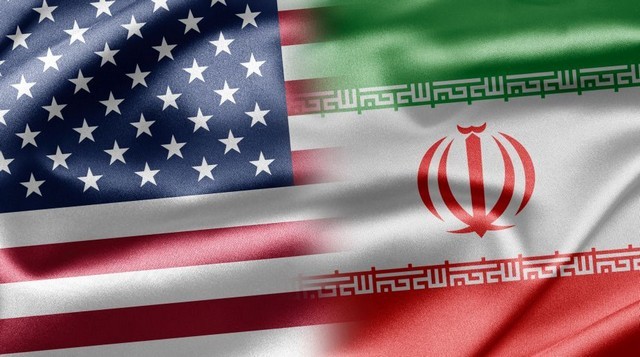
Iran: “Snapping Back” Sanctions and the Threat of War

By George Capaccio

During his State of the Union address on January 29, 2002, President George W. Bush named Iran as one of three countries forming an “axis of evil.” The other two were North Korea and Iraq. According to Bush and his neocon backers, these three nations posed a threat to our security and the security of our allies.They “sponsor terror” and are actively seeking or already in possession of weapons of mass destruction with which to “threaten world peace.”

Since the overthrow of the Shah in 1979 when the Islamic Republic of Iran was established, Iran has been a target of US destabilization efforts in the form of sanctions and support for armed opposition groups seeking regime change. (One such group—Mujahedeen Khalq, or MEK, a known terrorist group—has the blessings and backing of John Bolton, the recently appointed National Security Advisor and an avid supporter of regime change.)

In 2015 the five permanent members of the Security Council (US, UK, France, Russia, and China) and Germanyconcluded negotiations with Iran on a deal that would lift sanctions on Iran in exchange for that country’s suspension of its nuclear program. Called the Joint Comprehensive Plan of Action (JCPOA), this landmark agreement marked an easing of tensions between the parties involved and the triumph of diplomacy over force or the threat of force. And for the people of Iran, the lifting of sanctions promised relief from the poverty sanctions had caused. Washington attributes the success of negotiations to the efficacy of severe economic pressure. According to TritaParsi, former president of the National Iranian American Council (NIAC), officials in the Obama administration publicized the myth that “crippling sanctions brought the Iranian regime to its knees, forcing it to rush to the negotiating table to beg for mercy.”For Parsi, this conclusion is questionable at best. (Alert: According to the Iran Lobby website, many Iranian Americans believe Parsi is an “intellectually dishonest regime apologist and an unofficial and unregistered lobbyist for the Iranian regime.”)

In Parsi’s view, Iran’s “more conciliatory policy towards the West” reflected the influence of a “pragmatic faction with the Iranian government.” Even before Obama had imposed sanctions, Iran had offered the West its own proposals for a nuclear settlement. In the end,both sides were willing to compromise, and the result was a deal that let the world breathe a little easier—until Donald Trump in 2018 chose to scrap the deal and re-impose sanctions, despite Iran’s near-universally recognized compliance with the terms of the agreement and its obvious success in averting war.

Parsi explains: “Trump’s strategy seems designed to fail. Instead of a Plan B aimed at securing Iran’s capitulation, it appears designed to pave the way for Plan C: War.”Those who praise the role of sanctions in forcing Iran to renounce its goal of becoming a nuclear power invariably fail to consider the humanitarian consequences of a policy that seeks to cripple Iran’s economy. In Iraq, the 13-year economic embargo brought nothing but misery and death to the Iraqi people while strengthening the regime. Only after the US and UK invaded Iraq in 2003 and toppled the regime were sanctions rescinded.

Unilateral and multilateral sanctions on Iran have a three-decades-long history; they were originally implemented to resolve the standoff between Iran and the West over the issue of Iran’s nuclear program. In addition to the US, the European Union, the UN Security Council, and other countries have also imposed sanctions on Iran. The JCPOA in 2015 was welcomed as an opportunity for Iran to return to the fold of the global economy and to reinvigorate its own economy. Trump with the stroke of a pen has sabotaged that possibility and consigned the Iranian people to ever more suffering with the “snap back” of unilateral US sanctions.

So what exactly have international economic sanctions on Iran accomplished so far? Former Secretary of State and presidential contender Hillary Clinton assured the world that the only goal of sanctions was to pressure the government “without contributing to the suffering of ordinary Iranians.” Yes, there are exceptions for food and medicine and other humanitarian necessities. But former Vice President Joe Biden called them the “most crippling sanctions in the history of sanctions.” Like Iraq, Iran greatly depends on oil revenues to help keep its economy afloat. One-fifth of Iran’s export economy is dependent on oil sales. (In Iraq, before the implementation of the Oil-for-Food deal in 1996, Iraq’s economy collapsed because of the freeze on oil sales. Only government food rations prevented widespread starvation.)

Joy Gordon is the author of Invisible War, a book about the humanitarian crisis caused by Iraq sanctions. In 2013, writing about Iran, she emphasized the importance of oil to Iran’s economy and its ability to provide services to the people: “The oil industry … generates 80 percent of Iran’s income from foreign exchange. The oil industry also generates about 50% of government revenue, which impacts not only Iran’s military, but also the rest of Iran’s governmental functions, including education and health care.”

In the case of Iran, the restoration of sanctions will occur in stages. Sanctions on the export of Iranian oil and petroleum products will begin on November 5, 2018. There are already restrictions on Iran’s purchase of US currency, and its ability to trade in gold and precious metals. As a consequence of these and other restrictions, the local currency—the Iranian rial—is losing most of its purchasing power (since 2010, it has lost two-thirds of its value against the US dollar), while the price of consumer goods is doubling. On top of these changes, the cost of imported drugs has risen by 40-50%. The government’s monthly cash allowance “buys less than $4 worth of goods because the official exchange rate has not been adjusted,” according to Shashank Bengali, a Los Angeles Times South Asia correspondent.

By far, the most damaging effect of sanctions has been their impact on Iran’s healthcare system. Severely reduced oil revenues mean less money to invest in national health programs, and this decline is directly related to critical shortages of medicines, medical supplies, and medical devices. Journalist BethanMcKernan, reporting from Beirut on August 23, 2018, noted that “For ordinary Iranians, the brief optimism created by the 2015 international nuclear deal has evaporated, and many are now fearful of the future.”

For veteran administration hardliner John Bolton, “The re-imposition of sanctions, we think, is already having a significant effect on Iran’s economy and on, really, popular opinion inside Iran.” That certainly seems to be the case as millions of Iranian citizens are paying the price of American hubris. In her report, McKernan points out that “More than 80 million ordinary citizens [are] feeling the pinch as [the] rial tumbles, food prices and rent soar and supplies of vital imported medicines begin to run out.”

McKernan quotes Jamal Abdi, the current president of the National Iranian American Council, who says, “The grievous harm sanctions cause the Iranian people cannot be overstated. As the economy and unemployment levels make daily life unbearable for millions of Iranians, families are choked off from life-saving medicines and starved of critical infrastructure.” Many would likely agree with Abdi’s conclusion that sanctions on Iran amount to “collective punishment,” while the government remains immune to their impact.

In 2018 an Iranian writer with the pseudonym “Pedestrian” published an account of life under sanctions on Catapult, an online magazine. The following excerpts are from her article:

Our cities, villages, and hospitals have become embargoed regions, as our bodies are sealed in slab after slab of red tape. By adopting the seemingly neutral language of economics and law, sanctions legitimize dehumanization. It becomes acceptable to deny a people technology, medicine and aid.

As sanctions have grown harsher over the years, those suffering from rare or complicated diseases have been the first to bear the consequences. After 2010, the Iranian Blood Transfusion Organization (IBTO) which had purchased Hemophilia testing kits from European companies, had to close testing centers across the country. Europe was no longer willing to supply Iran, and IBTO could not meet demand.

Nurses and hospital staff still tell stories of drug scarcity between 2010 and 2014, as if recalling a nightmare. They’d send out parents of cancer stricken children to purchase medicine, knowing full well that they would return empty-handed. In theory, sanctions were to be waived for humanitarian aid. But in reality, as financial transactions with Iran were restricted, it became impossible to purchase pharmaceuticals and other goods.

Drugs were only available on the black market at sky-high prices. One aging caretaker at the hospital told me in 2012 that he had stressed to his wife that if he ever had an illness, she should lay him down in a corner of the house and let him die. That the costs and burden of treatment were too high to be worth it: “She should only have to pay for my burial.”

George Capaccio is a writer, performer, and activist living in Arlington, MA. During the years of US- and UK-enforced sanctions against Iraq, he traveled there numerous times, bringing in banned items, befriending families in Baghdad, and deepening his understanding of how the sanctions were impacting civilians.

19 September 2018

Source: https://countercurrents.org/2018/09/19/iran-snapping-back-sanctions-and-the-threat-of-war/
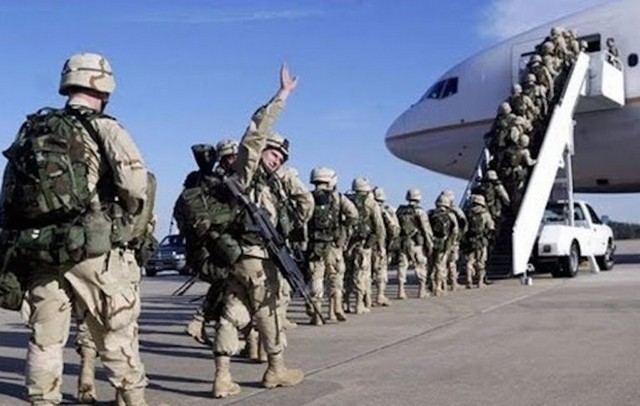
The United States of America – the Real Reason Why They Are Never Winning Their Wars

By Peter Koenig

This essay is inspired by Professor James Petras’ article, describing that the US never wins wars despite trillions of investments in her war budget and obvious military superiority https://www.globalresearch.ca/the-us-the-century-of-lost-wars/5653844

Professor Petras is of course right, the United States is currently engaged in seven bloody wars around the globe (Afghanistan, Iraq, Pakistan, Syria, Yemen, Somalia, Libya) and has not been winning one, including WWII. The question is: Why is that?

To these wars, you may want to add the totally destructive and human rights adverse war that literally slaughters unarmed civilians, including thousands of children, in an open-air prison, Gaza, the US proxy war on Palestine, carried out by Israel; plus, warmongering on Iran, Venezuela and North Korea. Let alone the new style wars – the trade wars with China, Europe, and to some extent, Mexico and Canada, as well as the war of sanctions, starting with Russia and reaching around the world – the fiefdom of economic wars also illegal by any book of international economics.

Other wars and conflicts, that were never intended to be won, include the dismantlement of Yugoslavia by the Clinton / NATO wars of the 1990s, the so-called Balkanization of Yugoslavia, ‘Balkanization’, a term now used for other empire-led partitions in the world, à la “divide to conquer”. Many of the former Yugoslav Republics are still not at peace internally and among each other. President Tito, a Maoist socialist leader was able to keep the country peacefully together and make out of Yugoslavia one of the most prosperous countries in Europe in the seventies and 1980s. How could this be allowed, socioeconomic wellbeing in a socialist country? – Never. It had to be destroyed. At the same time NATO forces advanced their bases closer to Moscow. But no war was won. Conflicts are still ongoing, “justifying” the presence of NATO, for European and US “national security”.

Then, let’s not forget the various Central American conflicts, Nicaragua, Honduras, Guatemala, the 8-year Iraq – Iran war – and many more, have created havoc and disorder, and foremost killed millions of people and weakened the countries affected. They put the population into misery and constant fear – and they keep requiring weapons to maintain internal hostilities, warfare and terror to this day.

All of these wars are totally unlawful and prohibited by any international standards of law. But the special and exceptional nation doesn’t observe them. President Trump’s bully National security Advisor, John Bolton, recently threatened the ICC and its judges with ‘sanctions’ in case the dare prosecution of Israeli and American war criminals. And the world doesn’t seem to care, and, instead, accepts the bully’s rule, afraid of the constant saber-rattling and threats being thrown out at the resisters of this world. Even the United Nations, including the 15-member Security Council, is afraid to stand up to the bully – 191 countries against 2 (US and Israel) is a no go?

None of these wars, hot wars or cold wars, has ever been won. Nor were they intended to be won. And there are no signs that future US-led wars will ever be won; irrespective of the trillions of dollars spent on them, and irrespective of the trillions to come in the future to maintain these wars and to start new ones. If we, the 191 UN member nations allow these wars to continue, that is. – Again, why is that?

The answer is simple. It is not in the interest of the United States to win any wars. The reasons are several. A won war theoretically brings peace, meaning no more weapons, no more fighting, no more destruction, no more terror and fear, no more insane profits for the war industry – but foremost, a country at peace is more difficult to manipulate and starve into submission than a country maintained at a level of constant conflict – conflict that not even a regime change will end, as we are seeing in so many cases around the world. Case in point, one of the latest ones being the Ukraine, after the US-NATO-EU instigated February 2014 Maidan coup, prepared with a long hand, in Victoria Nuland’s word, then Assistant Secretary of State, we spent more than 5 years and 5 billion dollars to bring about a regime change and democracy to the Ukraine.

Today, there is a “civil war” waging in eastern Ukraine, the Russian leaning Donbass area (about 90% Russian speaking and 75% Russian nationals), fueled by the ‘new’ Washington installed Poroshenko Nazi government. Thousands were killed, literally in cold blood by the US military-advised and assisted Kiev army, and an estimated more than 2 million fled to Russia. The total Ukraine population is about 44 million (2018 est.), with a landmass of about 604,000 km2, of which the Donbass area (Donetsk Province) is the most densely populated, counting for about 10% of population and about 27,000 km2.

Could this Kiev war of aggression end? – Yes, if the West would let go of the Donbass area which in any case will never submit to the Kiev regime and which has already requested to be incorporated into Russia. It would instantly stop the killing, the misery and destruction by western powers driven Nazi Kiev. But that’s not in the interest of the west, NATO, EU and especially not Washington – chaos and despair make for easy manipulation of people, for exploitation of this immensely rich country, both in agricultural potential – Ukraine used to be called the bread basket of Russia – and in natural resources in the ground; and for steadily advancing closer to the doorsteps of Moscow. That’s the intention.

In fact, Washington and its western EU vassal allies are relentlessly accusing Russia for meddling in the Ukraine, in not adhering to the Minsk accords. They are ‘sanctioning’ Russia for not respecting the Minsk Protocol (Ukraine, Russia, France, and Germany agreed on 11 February 2015 to a package of measures to alleviate the ongoing war in eastern Ukraine), when in fact, the complete opposite is true. The west disregards the key points of the accord – no interference. But western propaganda and deceit-media brainwash western populations into believing in the Russian evil. The only ones meddling and supplying Kiev’s Nazi Regime with weapons and “military advisors” is the west.

The going strategy is lie-propaganda, so the western public, totally embalmed with western falsehoods, believes it is always Russia. Russians, led by President Putin, are the bad guys. The media war is part of the west’s war on Russia. The idea is, never let go of an ongoing conflict – no matter the cost in lives and in money. It’s so easy. Why isn’t that addressed in many analyses that still pretend the US is losing wars instead of winning them? – Its 101 of western geopolitics.

For those who don’t know, the US State Department has clearly exposed it’s plans to guarantee world primacy to the Senate’s Foreign Relations Commission. Assistant Secretary of State, Wess Mitchell, has declared that the United States is punishing Russia, because Moscow is impeding Washington from establishing supremacy over the world. It gets as blunt as that. The US openly recognizes the reason for their fight against Russia, and that Washington would not accept anything less than a full capitulation. See French version in ZE Journal: file:///C:/Users/Peter/Downloads/ZEjournal.mobi%20-%20Non%252C%20ce%20n%E2%80%99est%20pas%20un%20complot%E2%80%A6%20juste%20une%20pathologie.pdf

The full supremacy over the world is not possible without controlling the entire landmass of Eurasia – which for now they, the US, does not dominate. Mitchell added, contrary to optimistic hypothesis of earlier administrations, Russia and China are the most serious contenders to impede materially and ideologically the supremacy of the United States in the 21st Century, in a reference to the PNAC, Plan for a New American Century.

Then Mitchell launched a bomb, “It is always of primordial interest for the United States’ national security to impede the domination of the Eurasian landmass by hostile powers.” – This clearly means that the United States will shy away from nothing in the pursuit of this goal – meaning an outright war – nuclear or other – massive killing and total destruction – to reach that goal. This explains the myriad false accusations, ranging from outright insults at the UN by a lunatic Nikki Haley, the never-ending saga of the Skripal poisoning, to Russian meddling in the 2016 US elections – and whatever else suits the political circumstances to bash Russia. And these fabricated lies come mostly from Washington and London – and the rest of the western vassals just follows.

“War is hugely profitable. It creates so much money because it’s so easy to spend money very fast. There are huge fortunes to be made. So, there is always an encouragement to promote war and keep it going, to make sure that we identify people who are ‘others’ whom we can legitimately make war upon.” Roger Waters, Co-founder of the rock band Pink Floyd

Russia today is attacked by economic and trade “sanctions”, by travel bans, by confiscated assets they have in the west. The Cold War which propagated the Soviet Union as an invasive threat to the world, was a flagrant and absolute lie from A to Z. It forced the Soviet Union, thrown into abject poverty by saving the west from Hitler during WWII – yes, it was the Soviet Union, not the US of A and her western ‘allies’ that defeated Hitler’s army – losing between 25 and 30 million people! – Imagine! – by saving Europe, the Soviet Union became unimaginably devastated and poor.

The US propaganda created the concept of the Iron Curtain which basically forbade the west to see behind this imaginary shield to find out what the USSR really was after WWII – made destitute to the bones by the second World War. Yet this Cold War and Iron Curtain propaganda managed to make the western world believe that it is under a vital threat of a USSR invasion day-in-day-out, and that Europe with NATO must be ready to fend off any imaginary attack from the Soviet Union. It forced the Soviet Union to using all her workers’ accumulated capital to arm themselves, to be able to defend themselves from any possible western aggression, instead of using these economic resources to rebuild their country, their economy, their social systems. That’s the west – the lying, utterly and constantly deceiving west. Wake up, people!!!

Here you have it, confirmed by Wess Mitchell. The US would rather pull the rest of the world with it into a bottomless and an apocalyptic abyss with its sheer military power, than to lose and not reaching her goal. That’s the unforgiving ruling of the deep state, those that have been pulling the strings behind every US president for the last 200 years. – Unless the new alliances of the East – i.e. the SCO, BRICS, Eurasian Economic Union – half the world’s population and a third of the globes economic output – are able to subdue the United States economically, we may as well we doomed.

As the seven present ongoing wars speak for themselves, chaos – no end in sight and intended – allow me to go back to a few other wars that were not won, on purpose, of course. Let’s look again at WWII and its sister wars, economic wars and conflicts. Planning of WWII started soon after the Great Depression of 1928 to 1933 – and beyond. Hitler was a ‘convenient’ stooge. War is not only hugely profitable, but it boosts and sustains the economy of just about every sector. And the major objective for the US then was eliminating the Bolshevik communist threat, the Soviet Union. Today its demonizing President Putin and, if possible, bring about regime change in Russia. That’s on top of Washington’s wish list.

In the midst of the Great Depression, in 1931, the US created the Bank for International Settlement in Basel, Switzerland, conveniently located at the border to Germany. The BIS, totally privately owned and controlled by the Rothchild clan, was officially intended for settling war compensation payments by Germany. Though, unknown to most people, Germany has paid almost no compensation for either WWI and WWII. Most of the debt was simply forgiven. Germany was an important player in Washington’s attempt to eliminating the “communist curse” of the USSR. The BIS was used by the FED via Wall Street banks to finance Hitler’s war against the Soviet Union.

As usual, the US was dancing on two weddings: Pretending to fight Hitler’s Germany, but really supporting Hitler against Moscow. Sounds familiar? – Pretending to fight ISIS and other terrorists in the Middle East and around the world, but in reality, having been instrumental in creating, training, funding and arming the terror jihadists. When WWII was won by the Soviet army at a huge human sacrifice, the US, her allies and NATO marched in – shouting victory. And to this day these are the lessons taught in western schools, by western history books, largely ignoring the tremendous credit attributable to the Soviet Union, to the Russian people.

And since the USSR was not defeated, the Cold War had to be invented – and eventually with the help of Washington stooges, Michael Gorbachev and Boris Yeltsin, the west brought down the Soviet Union – preparing the way for a unipolar world. This grandiose goal of the exceptional nation was however – and very fortunately – stopped in its slippery tracks by the ascent of Russian President Putin.

But that’s not all. For dominating Russia, Europe had to be ‘colonized’ – made into a “European Union” (EU) that was never meant to be a real union, as in the United States of America. The idea of a European Union was first planted shortly after WWII by the CIA, then taken over by the Club of Rome – and promoted through numerous conventions all the way to the Maastricht Treaty of 1992. The next logical step was to give the EU a Constitution, to make the EU into a consolidated Federation of European States, with common economic, defense and foreign relations strategies. But this was never to be.

The former French President, Giscard d’Estaing (1974 – 1981), was given the task to lead the drafting of an EU Constitution. He had strict instructions, though unknown to most, to prepare a document that would not be ratified by member states, as it would have bluntly transferred most of the EU nations sovereignty to Brussels. And so, the constitution was rejected, starting by France. Most countries didn’t even vote on the Constitution. And so, a federation of a United Europe didn’t happen. That would have been an unbeatable competition to the US, economically and militarily. NATO was eventually to take the role of unifying Europe – under the control of Washington. Today, the EU is ever more integrated into NATO.

What happened in parallel to the construct of a (non) European Union, was the European financial and economic colonization or enslavement, through the Bretton Woods Agreements in 1944. They created the World Bank, to manage the Marshall Plan, the US-sponsored European reconstruction fund, and the International Monetary Fund (IMF), to monitor and regulate the gold standard (US$ 35 / Troy Ounce), vis-à-vis the so-called convertible mostly European currencies. In fact, the Marshall Plan, denominated in US-dollars, was the first step towards a common European currency, prompted by the Nixon Administration’s exiting the gold standard in 1971, eventually leading to the Euro, a fiat currency created according to the image of the US dollar. The Euro, the little brother of the US fiat dollar, thus, became a currency, with which the European economic, financial and monetary policies are being manipulated by outside forces, i.e. the FED and Wall Street. The current President of the European Central Bank, Mario Draghi, is a former Goldman Sachs executive.

These are wars, albeit the latter ones, economic wars, being constantly waged, but not won. They create chaos, illusions, believes in lies, manipulating and mobilizing people into the direction the masters of and behind Washington want them to move. These are the same masters that have been in control of the west for the last 200 years; and unknown to the vast majority of the western population, these masters are a small group of banking and financial clans that control the western monetary system, as we know it today. It was brought into existence in 1913, by the Federal Reserve Act. These masters control the FED, Wall Street and the BIS – also called the central banks of central banks, as it – the BIS – controls all but a handful of the world’s central banks.

This fiat financial system is debt-funding wars, conflicts and proxy hostilities around the world. Debt that is largely carried in the form of US treasury bills as other countries’ reserves. The continuation of wars is crucial for the system’s survival. It’s hugely profitable. If a war was won, peace would break out – no war industry profit there, no debt-rent for banks from peace. Wars must go on – and the exceptional nation may prevail, with the world’s largest military-security budget, the deadliest weapons and a national debt, called ‘unmet obligations’ by the US General Accounting Office (GAO) – of about 150 trillion dollars – about seven and a half times the US GDP. We are living in the west in a pyramid monetary fraud – that only wars can sustain, until – yes, until, a different, honest system, based on real economic and peaceful output, will gradually replace the dollar’s hegemony and its role as a world reserve currency. It’s happening as these lines go to print. Eastern economies, like the Chinese, with China’s gold-convertible Yuan, and a national debt of only about 40% of GDP, is gradually taking over the international reserve role of the US dollar.

The US of A, therefore, will do whatever she can to continue, demonizing Russia and China, provoke them into a hot war, because dominating, and outright ‘owning’ the Eurasian landmass is the ultimate objective of the killer Empire.

Peter Koenig is an economist and geopolitical analyst.

19 September 2018

Source: https://countercurrents.org/2018/09/19/the-united-states-of-america-the-real-reason-why-they-are-never-winning-their-wars/

Europe’s Libyan Battleground

By Alessandra Bocchi

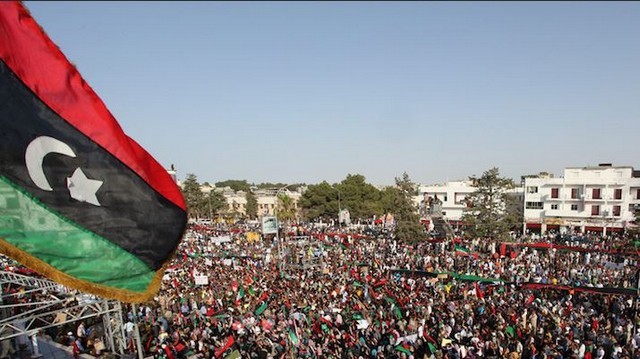
Libya was in the spotlight recently when heavy infighting between militias in Tripoli caused more than fifty deaths. On September 5 the U.N. reached a ceasefire, but the country remains deeply divided, and the conflict will not end anytime soon.

The Libyan crisis has also damaged relations between France and Italy. The two European powers have taken opposing sides in Libya’s now seven-year-long conflict and blame each other for the violence, which has been ongoing since the murder of former leader Muammar al-Gadhafi in 2011. Italy signed a historic treaty with Gadhafi in 2008, according to which Italy would compensate Libya for Italian colonialism and Libya would stop its flow of migrants—an imminent concern for Italy due to its proximity to the North African country. France backed NATO’s toppling of Gadhafi, a move Italy staunchly criticized. Since the fall of Gadhafi, Libya has descended into sectarian and tribal chaos. Its ensuing civil wars have enabled human traffickers of all kinds to operate freely, transporting hundreds of thousands of migrants into Europe and effectively creating a slave trade in Libya. In 2010, Gadhafi infamously warned that “Europe will turn black” unless he was paid to control Libya’s human trafficking problem—a problem that became a bull-blown crisis when he was deposed.

Today, France and Italy continue to support rival sides in Libya’s civil war. Libya is divided into two main governments: Italy and the U.S. back the internationally recognized Tripoli government, while France backs the eastern government led by general Khalifa Haftar, who controls most of the country. Italy recently reached a new agreement with the Tripoli government and provided it with funds to quell migration, which mainly occurs in the country’s western areas. The problem with the agreement is that the Tripoli government in the West can barely govern its own city, often bribing militias to maintain control. The eastern government has instead adopted military-style rule over the areas under its control and has almost entirely stopped human trafficking networks.

Over recent weeks, militias aligned with Haftar have attacked the Tripoli government and caused security threats to the Italian embassy, triggering top ministers from the new Italian populist government (from both the anti-establishment Five Star Movement and the anti-immigration League) to staunchly accuse France of being behind the attack. The criticism comes after months of increasing tensions between French President Emmanuel Macron and Deputy Prime Minister Matteo Salvini over the migrant crisis. These tensions culminated in a “populist meeting” between Hungarian President Viktor Orbán and Salvini, at which Macron proudly declared himself their “main rival.”

The relationship between France and Italy continues to fray. “My fear is that someone, for economic motives and selfish national interest, is putting at risk the security of North Africa and, as a result, of Europe as a whole,” said Salvini, head of the anti-immigration League party. He added: “I’m thinking of someone who waged a war that shouldn’t have been waged; someone who set election dates without discussing this with allies, with the United Nations or indeed with the Libyan people.”

Italy’s Defence Minister Elisabetta Trenta, of the Five-Star Movement, reiterated Salvini’s words on social media: “It is clearly now undeniable that Libya finds itself in this situation because someone, in 2011, put their own interests ahead of those of the Libyan people and of Europe itself.”

Despite European powers projecting their rivalries on Libya’s war, the country is mostly under the influence of Arab Gulf powers, which use it as a battleground for their own conflicts. Libya is one of many countries that descended into anarchy after the “Arab Spring” uprisings started, when Western powers backed armed rebels in overthrowing Ba’athist regimes across the Middle East and North Africa. But Libya’s conflict differs from that of other Middle Eastern countries affected by the Arab Spring. The religious vs. secular narrative isn’t a factor in North Africa, as it is in the Middle East. Syria’s conflict is the most prominent example of a proxy war between countries that back President Assad’s secular government (Iran and Russia), with those that back rebel factions, and in many cases jihadists (the United States, Israel, Qatar, and Saudi Arabia).

Instead, the proxy war in Libya is between two competing Arab Gulf powers: Qatar and Saudi Arabia. Both these countries have Wahhabist and Salafist extremist regimes, but they are longstanding rivals at home and compete with different interests abroad. Qatar backs the Muslim Brotherhood-aligned militias in Libya known as the “Islamists,” while the eastern government under Khalifa Haftar professes to be “anti-Islamist.” While Haftar is clearly fighting the Muslim Brotherhood-aligned factions in the war, his army is heavily backed by Saudi Arabia and has many Salafist leaders in its ranks, including Mahmoud Mustafa al-Werfalli, wanted for war crimes at The Hague. The supposedly anti-Islamist government of the east also issued a travel ban on women last year, which was sanctioned by a Wahhabist-Saudi cleric. In North Africa, Islamist is merely a term used to describe Qatar and its Muslim Brotherhood military wing in the region.

Libya has become a battleground for European rivals who have long supported opposing factions in the war. But as Europe’s power in North Africa diminishes, the vacuum has been filled by oil-rich Arab Gulf monarchies. Europe hasn’t woken up to this fact, but if the Libyan crisis worsens and the country falls further into the hands of Arab Gulf theocracies, another spillover effect will reach European shores.

Alessandra Bocchi is an Italian freelance journalist.

18 September 2018

Source: https://www.firstthings.com/web-exclusives/2018/09/europes-libyan-battleground

The Iran-Saudi/Arab Conflict and the Path to Peace

By http://iran.timesofnews.com

Tehran, Sept 15, IRNA- Iranian ex-diplomat and former nuclear negotiator Hossein Mousavian has reviewed the path to maintain peace with Saudi Arabia and Arab countries.

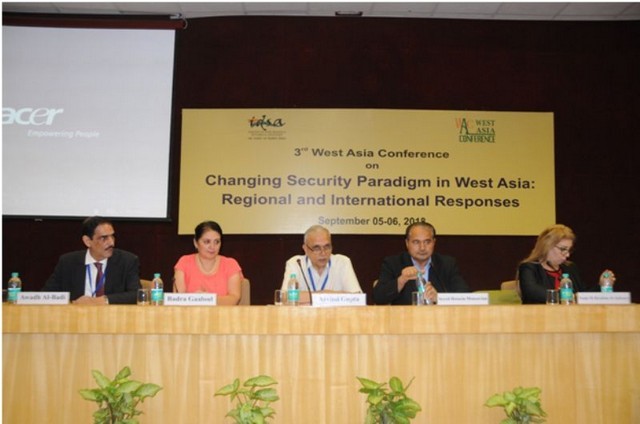
Mousavian recently addressed ‘West Asia Conference’ on Changing Security Paradigm in West Asia: Regional and International Responses which was held with the attendance of scores of resident diplomats, authors, research centers and Indian media in New Delhi.

The following is the full text of Mousavian’s speech:

The West Asia is in the midst of a historic tumult. As conflict and terrorism have spread, some historic regional powers have collapsed and the geopolitical landscape that underpinned the regional order for decades has been upended.
Among the seminal factors contributing to regional instability and the spread of radicalization have been:

1. The continuing Israeli occupation of Palestine,

2. Saddam’s invasion of Iran in 1980 and Kuwait in 1990,

3. The 2001 U.S.-led invasion of Afghanistan,

4. The 2003 U.S. invasion of Iraq,

5. The outbreak of the “Arab Spring” in 2011,

6. NATO-GCC war on Libya in 2011,

7. Orchestrating and recruiting tens of thousands of terrorists from over 80 countries to bring regime change in Syria, and

8. The 2015 Saudi-US war on Yemen.

These developments have effectively:

1. Torn up much of the Arab world;

2. Dragging major Arab powers Iraq, Libya and Syria into civil war and terrorism,

3. The collapse of U.S. regional allies in countries like Egypt and Tunisia,

4. The flow of tens of thousands of terrorists into the region and beyond,

5. The advent and spread of ISIS and other terrorist groups in the region and beyond.

As traditional Arab powers Egypt, Iraq, Libya and Syria have fallen into disarray, Saudi Arabia—today effectively led by the 33-year-old Crown Prince Mohammad bin Salman—is attempting to take the mantle of leadership over the Arab world.

The new regional power dynamic has in effect seen the formation of two major blocs, one comprised of Saudi Arabia, the United Arab Emirates (UAE), Israel, and the United States under President Donald Trump, and the other including Iran, Russia, Syria, Hezbollah, Iraq and other popularly-mobilized militias such as the Hashd Al-Sha’abi in Iraq and the Syrian Defense Forces.

While the United States and Russia are, the two most consequential global powers affecting the fate of the Middle East, at the regional level Iran and Saudi Arabia are the main actors.
Saudi Arabia has in recent years veered away from its traditionally conservative and behind-the-scenes foreign policy approach to a far more assertive and openly hostile to Iran strategy

It is a fact that Saudi-Iran have influence on crises in Yemen, Lebanon, Syria, Iraq, Bahrain, Qatar, and elsewhere in the region. However, the US, Israel and Saudi Arabia blame Iran for the discord in the Arab world and instability in the region despite the success of the Iran nuclear negotiations in alleviating international concerns of Iran’s potential pathways to nuclear weapons.

But from the Iranian point of view, the real reasons behind flailing Arab unity and the crises in the region have little to do with Iran and lie closer at:

1. Dysfunctionalities of Arab states,

2. Decades of dictatorship and corruption in Arab countries,

3. The spread of Wahhabism,

4. Arab-Arab wars such as Saddam invasion of Kuwait, GCC invasion of Libya and Saud-UAE invasion of Yemen, and

5. Riyadh’s doorstop in many cases.

For instance, the cause of Palestine which for years was the top source of angst and unity in the Arab and Muslim world, has today lost its significance to such a degree for the Saudi government pressuring Palestinians to accept maximalist Israeli demands.

In December 2017, the New York Times, citing “Palestinian, Arab, and European officials,” stated that Mohammad bin Salman had presented Palestinian President Mahmoud Abbas with “a plan that would be more tilted toward the Israelis than any ever embraced by the American government.”

On December 6, 2017 President Trump formally recognized Jerusalem as the capital of Israel, reversing nearly seven decades of American foreign policy because he was sure Bin Salman is committed to confront Iran and to push Palestinians to compel to Israeli demand.

In short, the reality is that the Arab world, led by Saudi Arabia, is seemingly on the verge of historic capitulation to Israel.

The (Persian) Gulf Cooperation Council (GCC) is for all intents and purposes now also defunct. This too is not for anything to do with Iran, but chiefly due to the smaller Persian Gulf states’ perennial fear of falling victim to hegemonic Saudi aspirations—as exemplified by Saudi Arabia effectively turning Bahrain into its own province and most recently with the Saudi-led blockade of Qatar.

Doha officials now regularly proclaim before the world that Saudi Arabia seeks to turn them into a puppet state.

The chaos that has engulfed Libya in crisis, has also had nothing to do with Iran, but is due to the regime change military operation that overthrew Muammar Gaddafi in 2011 led by NATO and U.S. Arab allies, including the UAE and Saudi Arabia.

In Yemen, the narrative of “Iran-backed” Houthis instigating a civil war is simplistic and ignores any historic context. The fact is that the Saudi assault on Yemen, has resulted in thousands of civilian deaths, triggered an unprecedented cholera epidemic, and taken the country to the edge of widespread famine in what has become the world’s worst humanitarian catastrophe.

Saudi Arabia’s regional strategy can be encapsulated into five points:

1. Endeavor to keep American military, security, political, and economic dominance over the region.

2. Ally with Israel to gain the support of the powerful international Zionist movement.

3. Confront Iran and its regional allies on all forces and instigate a U.S. war with Iran.

4. Pressure Palestinians into accepting Israeli demands, effectively eliminating the issue of Palestine and marking official recognition of Israel by the Arab world.

5. Dominate the smaller Persian Gulf states and muster an Arab coalition in the form of an “Arab NATO” or other means to isolate and confront Iran.

In response, Iran’s strategy can also be summarized in five points:

1. Resist U.S. hegemony in the Persian Gulf and improve its relations with other global powers.

2. Resist Israeli occupation and support Palestinians and resistance groups such as Hamas and Hezbollah.

3. All-out confrontation with takfiri terrorist groups, whose root ideology is Wahhabi Salafism, such as al-Qaeda, Jabhat al-Nusra, ISIS, etc.

4. Act as a counterbalance to Saudi efforts to impose hegemony over the smaller Arab Persian Gulf sheikhdoms. After the Saudi blockade of Qatar, the small state’s only access to the outside world was through its air and sea border with Iran—which Iran kept open for its use. To this end, Iran has sought to maintain normal ties with the GCC states who have no appetite for Saudi hegemony, including Oman and Kuwait.

5. Confront Israel’s strategic aim to disintegrate four Islamic countries—Iraq, Syria, Turkey, and Iran—by supporting Kurdish separatist aspirations. All four of these countries share many interests and with the resolution of the Syrian crisis, the grounds will be created for broader cooperation between then.

Given these conflicting strategies, Saudi Arabia and Iran have two choices:

The first is to continue the status quo of confrontation. The chief implications of this option will be that the unstable regional status quo will continue to deteriorate, any prospect of eliminating terrorist groups in the vein of ISIS will be diminished, sectarianism will increase, and there will be a real risk of a disastrous war that will not only engulf regional powers, but also global powers—especially the United States and Russia.

The other option is for Saudi Arabia and Iran to pursue avenues of cooperation. To do this, Riyadh and Tehran must first gain substantive and sincere understanding of each other’s security threats and concerns, and then explore mutually acceptable paths to alleviating them. The cooperation option should entail:

1. Riyadh and Tehran to openly and without preconditions enter into bilateral dialogue and put all of their security concerns and aims on the negotiations table.

2. Forums for Iranian-Arab dialogue should be convened by figures with technocratic backgrounds ranging from scientists to diplomats.

3. To decrease sectarianism in the Muslim world, Sunni-Shia dialogue forums should take place that see the participation of Sunni scholars from al-Azhar in Cairo and religious leaders from Saudi Arabia and other Sunni countries, as well as Shia clerics from the Qom and Najaf seminaries.

4. Dialogue between the six GCC states, Iraq, and Iran should take place without preconditions and at the foreign-minister level, with the aim of creating an institutionalized security and cooperation system in the Persian Gulf. The foreign ministers should hear each other’s concerns in a constructive dialogue and take steps towards producing tangible and fair solutions.

A potential model can be the Organization for Security and Cooperation in Europe (OSCE) and the EU. One foundation for immediate negotiations can be U.N. Security Council Resolution 598, which laid the basis for the end of the 1980-88 Iran-Iraq War and requests the UN secretary-general “to examine, in consultation with Iran and Iraq and with other states of the region, measures to enhance the security and stability of the region.”

Any sustainable partnership between the Persian Gulf states must address eight principles:

1. Respect for sovereignty,

2. Non-use of force,

3. Respect for borders and territorial integrity,

4. Peaceful settlement of disputes,

5. Noninterference in the internal affairs of other countries.

6. Commitment to the UN Charter and its principles,

7. Refraining from exacerbating sectarian differences and

8. Respecting each other’s political systems

Over time, a gradual process that begins with simply holding regular meetings wherein all countries can communicate their security grievances can result in more institutionalized cooperative relationships.

15 September 2018

Source: http://iran.timesofnews.com/the-iran-saudiarab-conflict-and-the-path-to-peace.html

The passing away of a Mother

By bdssouthafrica.com

The human rights and Palestine solidarity organization BDS South Africa mourns the passing away of mama Wafieh, the 76 year-old mother of senior Palestinian BDS leader, Comrade Omar Barghouti.

In a moving, personal and powerful message, titled “on loss and faith,” Comrade Omar writes:

“Today, I experienced a personal Nakba (catastrophe). I am rarely broken, but today I am….[my mother was] a feminist, an avid reader of literature and politics, an incredible cook, an unwavering supporter of popular struggles the world over against all forms of injustice, a moderate addict of Facebook (much less so of Twitter), a fan of the BDS-supporting Jewish Voice for Peace (US), a cleanliness freak, and an exceptional care giver with the biggest heart possible. That heart stopped today, for the last time.” (Below find Cde Omar Barghouti’s full letter on the passing of his mother).

Before Israel imposed a travel ban on him, Comrade Omar had previously travelled to South Africa, where he met with several Government Ministers, MPs and other officials. Last year, at its 14th National Congress, the SACP conferred a special recognition award to Barghouti. We and fellow South African activists know comrade Omar personally, and as a stalwart in the struggle for justice for all Palestinians. We now learn (through his letter, found below) that he comes from a family of resistance against oppression and determination to secure their liberation.

Like many of the heroes of our own struggle against apartheid, who did not live to see the end of Apartheid in South Africa, Cde Omar’s mother Wafieh Barghouthi, left this world without seeing the end of Israeli apartheid. She was a fighter, a resister, never a victim. Our hearts go out to Comrade Omar at the loss of his mother. It is never easy to lose a mother, and if there is one common expression that is utterly untrue in relation to the loss of a mother, then, it is that “time heals all wounds”.

In addition to our sadness at this deep personal loss, is our angerthat the Israeli Apartheid regime prevented Comrade Omar the simple decency to visit his mother during her last days (in her fight against cancer, click here). Futhermore, stooping to a level of utter cruetly, Israel is now also denying Cde Omar permission to attend his mother’s funeral in Amman. He writes: “They are trying to punish me for my role as a human rights defender in the BDS movement for Palestinian rights. They think they will break me or deter me. Little do they know that this branch comes from that tree, and that tree has its strong roots deep in the fertile ground of Palestinian identity, Palestinian quest for justice and freedom, Palestinian resistance and Palestinian insistence on life that is worth living.”

There seems no limit to the indecency of the Israeli regime. Time and time again, Israel pushes the boundaries of the cruelty that they are capable of inflicting on the Palestinian people – a people who desire nothing but freedom and justice.

We are moved but not surprised at the deep love expressed by Comrade Omar in his letter below, for love is what lies at the heart of our struggle for freedom – a love for people (all people), for freedom and justice. It is this love that inspires and drives us in our solidarity with Cde Omar, the Palestinian people struggling against Israeli apartheid and all oppressed peoples of the world.

Hamba Kahle, Comrade Wafieh! Go well, mother. Rest, for you have done your part. Your son, will pick up the spear and we will fight along with him and all the Palestinian people along with all those in solidarity with them – Jew, Christian Muslim, non-religious people – everyone who dreams of a world wherein children (including Palestinian children) are free to be children.

Our deepest love from South Africa goes out to you and your family, dear Comrade Omar.

ON LOSS AND FAITH
– Letter by Omar Barghouti on the passing away of his mother, Wafieh (14 September 2018)

Today, I experienced a personal Nakba. I am rarely broken, but today I am.

At 6:30 am, my beloved mother, Wafieh, which translates to loyal or faithful, passed away in her home in Amman, unexpectedly, swiftly, at the age of 76. She died on September 14, a day after the 25th anniversary of the Oslo Accords, without any apparent connection. Or so it seems.

My mother was born in Jerusalem in 1942, six years before the Nakba. She never cared much for Valentine’s Day, and she despised the “tacky red heart-shaped merchandise” that came along with it, but she was born on it.

They found her this morning on her kitchen floor with half a lemon in her hand, a smile on her face, and her suitcase at the door.

She was preparing her daily lemon water, to improve her immunity, as she was set to travel in a couple of hours — accompanied by my wife, Safa — to celebrate her victory over breast cancer. I was not planning to travel with them as I am still effectively under an Israeli travel ban.

When I saw her last, it was in Ramallah, a week ago. She was happy that she has recovered well and that her fingernails were finally growing normally after she had lost them all during chemotherapy. “These little victories are absolutely necessary,” she said. “They nourish our willpower to keep the good fight against the monster inside.”

Once we were discussing the concepts of victimness and resistance whether pertaining to the struggle against settler-colonialism or to cancer. She told me, “I do not see myself primarily as a victim, although I am a survivor of cancer. I see myself as a fighter who cannot relent. But I am so fortunate to have had the love and care and to be able to get medical treatment. How many sisters with cancer in Gaza are not allowed to travel for treatment and cannot get treated in Gaza either due to the fascist siege? It is beyond cruel and criminal. It’s fascist. I do not know how much longer I’ll live, but I shall dedicate my time to fight for their and their loved ones’ right to have this most fundamental right of theirs respected.”

She then went on a tirade against the Palestinian leadership for “failing to fight for our most basic rights; not just the right of return for refugees but also the right to life itself.”

Those who know my mother would know that political tirades are a genuine part of her unique and intriguing character. She was a secular Nasserite (supporter of the late Arab leader, Gamal Abdel Nasser), a feminist, an avid reader of literature and politics, an incredible cook, an unwavering supporter of popular struggles the world over against all forms of injustice, a moderate addict of Facebook (much less so of Twitter), a fan of the BDS-supporting Jewish Voice for Peace (US), a cleanliness freak, and an exceptional care giver with the biggest heart possible.

That heart stopped today, for the last time.

She was loving, responsible, fiercely independent, and quite expressive of her loathing of Zionism, religious coercion, sexism, despotic Arab regimes and, of course, the target of her daily attacks, the “hopelessly corrupt, co-opted and treacherous” Palestinian leadership.

My father, who was less intense but no less resolute in fighting for his beliefs and for our people’s rights, shared many of her opinions on politics and society, but not all.

He passed away 12 years ago.

He was among the independent founders of the Palestine Liberation Organization (PLO) in Jerusalem in 1964. Throughout his activity in the PLO in various positions (voluntary, not paid), he consistently opposed and often publicly condemned every effort by the leadership to surrender Palestinian rights.

After the Oslo Accords were signed in 1993, he publicly attacked it, considering it a form of capitulation to Israel’s settler-colonial project. My mother was 100% in agreement with him. But she did not much like the fact that he still had to meet Palestinian leaders from various political parties to explain his opposition to Oslo.

Whenever those meetings happened in their home in Amman, his assorted guests of politicians had to listen to mother’s unsolicited views. She would use the occasion of offering hospitality (she is a great cook, as I said earlier, so everyone looked forward to tasting her delicacies) to pause and offer a piece of her fearless mind.

She would usually start by reminding them how women’s voices are becoming less and less heard in the movement, to its detriment. And then she would share with them her analysis of what’s wrong with the movement, why it has strayed away from the liberation path, and what needs to be done to recover.

I’ll miss her tirades, her profound views on life, her unconditional love, her willpower, and her world-class sitt-il-hussun (a Levantine dessert of a special dough stuffed with walnut, black sesame and cinnamon, fried and dipped into a sugary syrup).

My lawyer is still trying to get me a reprieve of the de facto travel ban imposed on me so I can attend my mother’s funeral in Amman. In contempt of a 2016 court decision, the Israeli Ministry of Interior has for more than two months failed to renew my travel document, without which I cannot travel.

They are trying to punish me for my role as a human rights defender in the BDS movement for Palestinian rights. They think they will break me or deter me. Little do they know that this branch comes from that tree, and that tree has its strong roots deep in the fertile ground of Palestinian identity, Palestinian quest for justice and freedom, Palestinian resistance and Palestinian insistence on life that is worth living.

Wafieh, you have lived a life of “loyalty” and “faith” to your principles, to your people’s struggle, to your loved ones. I shall forever be faithful to your loving memory and the lessons you have taught me.

Omar

ISSUED BY KWARA KEKANA ON BEHALF OF BDS SOUTH AFRICA

15 September 2018

Source: http://www.bdssouthafrica.com/post/the-passing-away-of-a-mother-%f0%9f%92%94/

79 Percent of Right-wingers Believe Jews Are the Chosen People. Are You for Real?

By Gideon Levy

I would like to meet representatives of that absolute, decisive, arrogant and patronizing majority reflected in a recent Haaretz polland ask them: Are you guys for real? How did you come up with that? On whose say-so? Are you, the absolute majority, so sure that we are the chosen, the very best, that we are the champions, head and shoulders above the rest?

How did you come to this conclusion? I’d like to ask you, dear majority: On what basis are you convinced that we are the chosen people, that we know everything better than all the other nations; that we deserve more than everyone else; that what applies to them does not apply to us, because we are superior.

This is how a majority of Israeli Jews responded in the Haaretz-Dialog poll published last week: We are a chosen people. A majority, 56 percent, are sure of this. The figure rises to 79 percent, an overwhelming majority, among self-identified right-wingers. In a country where 76 percent of people believe in God or another higher power, perhaps that is obvious. But whereas belief in God is a private matter, the belief in a chosen people provides the outlines of policy that explains a great deal about Israel’s actions.

Let’s turn from theology to pathology. The Israeli Jews who think they belong to a chosen and select people owe an accounting to themselves and to others. It’s easy to declare that God does or doesn’t exist. No one is expecting evidence, but when the majority of a nation is convinced that it is superior to all other nations, some evidence is necessary. In Israel’s case, it’s easy to prove that it’s a case of detachment from reality, a dangerous delusion. In any event, a people that is convinced that it is chosen poses a danger to itself and its surroundings.

The Jewish people is indeed special, with a glorious and bloody history. Israeli Jews, too, have cause for pride. But when they say that they are the chosen people, it reveals their psychosis. It’s doubtful that any other nation thinks that of itself today. Israeli Jews have no grounds to think this either. In what way are we chosen? In what way are we better? And what is the Swede, the French person, the American, the Briton or the Arab supposed to think about this insufferable arrogance?

There’s no need to elaborate on Israel’s questionable morality as an occupier. Any Israeli with even a modicum of self-awareness recognizes that an occupying nation cannot be the chosen people. Nor would a bit of humility hurt when it comes to a few other characteristics of the people of Israel, before it crowns itself a light unto the nations. I recommend, for example, reading the comprehensive, horrifying analysis in Haaretz by Dan Ben-David of the country’s education system, which did not prompt the necessary outcry. Half of Israel’s children receive a Third World education.

A little modesty would also become the citizens of a state that ranks 87th in the 2018 World Press Freedom Index, below Togo and the Ivory Coast. Nor is No. 32 on Transparency International’s 2017 Corruption Perceptions Index something to celebrate. Health care is yet another area where Israel’s self-esteem should be curbed: The country ranks 28th in health-care spending, of the 36 Organization for Economic Cooperation and Development member states, and 30th in the number of hospital beds.

The behavior of Israeli tourists abroad is also not always befitting a chosen people. Perhaps Israel ranks high on an index of German submarine purchases, and maybe that’s the key to understanding the sense of superiority.

Basking in self-glorification has recently become a salient characteristic of Israel’s national character. Just regularly read the Israel Hayom daily or listen to the prime minister: How lovely we are from morning to night.

The right spreads this lie, for its own purposes. Sycophantic populism thrives not only in Israel, but it is only here that the disparity between dream and reality is so great. A chosen people? If only it were finally like all the other nations.

Gideon Levy is a Haaretz columnist and a member of the newspaper’s editorial board.

15 September 2018

Source: https://www.haaretz.com/opinion/.premium-79-percent-of-right-wingers-believe-jews-are-the-chosen-people-are-you-for-real-1.6471893?=&ts=_1537083883018

Egyptian Junta continues mass executions spree

By Abdus Sattar Ghazali

The US-client regime of Field Marshal Abdul Fattah Al-Sisi continues mass executions spree as an Egyptian kangaroo court sentences another 75 anti-government people to death.

According to Reuters report, an Egyptian kangaroo court sentenced 75 people to death on Saturday (Sept 8) including prominent opposition leaders Essam al-Erian and Mohamed Beltagi over a 2013 sit-in which ended with killing hundreds of protesters by the Egyptian security force.

The sentencing, which included jail terms for more than 600 others, concluded a mass trial of people accused of murder and inciting violence during the pro-Muslim Brotherhood protest at Rabaa Adawiya square in Cairo in 2013.

Rights groups say more than 800 protesters died in the single most deadly incident during the unrest that followed Egypt’s 2011 popular uprising against longtime President Hosni Mubarak.

Death sentences have been handed down to hundreds of Al-Sisi’s political opponents on charges such as belonging to an illegal organization or planning to carry out an attack.

The protest occurred weeks after General Abdul Fattah Al-Sisi (who later assumed the title of Field Marshal) ousted Egypt’s first freely elected head of state, president Mohamed Mursi.

“We condemn today’s verdict in the strongest terms,” Amnesty International said in a statement. “The fact that not a single police officer has been brought to account.. shows what a mockery of justice this trial was.”

Amnesty International and Human Rights Watch have both described the situation in Egypt as the worst human rights crisis in the country in decades, with the state systematically using torture, arbitrary arrests and enforced disappearances to silence political dissent.

Last year, the Egyptian government pledged to take action against Human Rights Watch after it released a damning report on state torture.

Two parliamentary groups in Algeria have called for official national and international action to halt mass executions against activists, human rights workers and political figures in Egypt.

Movement of Society for Peace; the largest political party in Algeria and Union for Development, Justice and Building said in a joint statement that lawmakers “are following with great concern the developments of the human rights situation in the Arab world; the most recent of which was the issuance of mass death sentences against political, human rights and community symbols”.

The signatories described the executions as “a flagrant attack on the right to life”, which is politically motivated “amounting to genocide or mass murder according to international law”.

UN Human Rights chief urges Egypt to overturn mass death sentences

United Nations human rights chief Michelle Bachelet has urged Egypt’s appeals court to overturn mass death sentences handed down by a lower court after what she said was an “unfair trial”.

The former Chilean president, who took office as UN High Commissioner for Human Rights earlier this month, criticised a law giving immunity from future prosecution to senior military officers.

An Egyptian court on Saturday delivered death sentences to 75 people, including prominent Islamist leaders Essam al-Erian and Mohamed Beltagi, over a 2013 sit-in that ended with security forces killing hundreds of protesters.If carried out, the sentences “would represent a gross and irreversible miscarriage of justice”, Bachelet said in a statement.

Defendants were denied the right to individual lawyers and to present evidence, while “the prosecution did not provide sufficient evidence to prove individual guilt”, she said.

“I hope that the Egyptian Court of Appeal will review this verdict and ensure that international standards of justice are respected by setting it aside,” Bachelet said.

Bachelet decried the “lethal military crackdown” saying it had led to the killing of “up to 900 mostly unarmed protesters by members of the Egyptian security forces”. The government later claimed that many protesters had been armed and that a number of police were killed, she added.

“Despite the huge death toll, no State security personnel have ever been charged in relation to the so-called ‘Rabaa massacre’,” Bachelet said.

Tellingly, a law was passed in July gives Field Marshal al-Sisi the right to name officers who are eligible for immunity from investigation of offences alleged to have been committed while Egypt’s constitution was suspended between President Mursi’s overthrow on July 3, 2013, and the reconvening of parliament on January 10, 2016.

Not surprisingly, US Secretary of State Mike Pompeo has authorised the release of $1.2 billion in military aid to Egypt, overriding previous human rights concerns that had held up funding.

“Strengthened security cooperation with Egypt is important to US national security. Secretary Pompeo determined that continuing with the obligation and expenditure of these foreign military financing (FMF), funds is important to strengthening our security cooperation with Egypt,” the State Department said in a statement.

Abdus Sattar Ghazali is the chief editor of the Journal of America (www.journalofamerica.net) email: asghazali2011 (@) gmail.com

16 September 2018

Source: https://countercurrents.org/2018/09/16/egyptian-junta-continues-mass-executions-spree/

Decoding the Pipes/Trump/Kushner ‘Deal of the Century’

By Richard Falk

11 Sep 2018 – You didn’t have to be a ‘never Trump’ loyalist to have qualms about proposing to bring peace to Palestinians and Jews by creating conditions that would produce ‘The Deal of the Century.’ And let’s be fair, if the game of nations is now played according to the rules of Madison Avenue, the phrase was a winner despite being a loser if evaluated from a problem-solving perspective. Even in the present degraded political atmosphere, to bet on an advertising slogan as a substitute for healing ideas may be a good formula for ensuring a large audience for a reality TV episode, but it is a cruel evasion when it comes to addressing the daily ordeal of the Palestinian people consigned to the victimization associated with living under the Israeli apartheid state.

What may be worse than Trump’s bombastic boasts is that here there seems to be a malevolent logic that underpins this mad proposal that springs from the ultra-Zionist imagination of Daniel Pipes. It was Pipes months ago, using the Middle East Forum as his ideational vehicle, issued a call for what he named ‘a victory caucus.’ Pipes, an intelligent and trained scholar, reasoned that the Oslo diplomatic track had failed badly as a means for ending the conflict via negotiations. He coupled this conclusion with the historical assertion that prolonged conflicts between ethnic antagonists rarely end by compromise or accommodation. They end with the victory on one side, and the acceptance of defeat by the other side.

So the trick, as Pipes came to believe, is to convince the Palestinians to accept the writing on the wall and acknowledge to themselves and the world that they have lost the battle to prevent the establishment of a Jewish state in Palestine or to bring into existence a sovereign state of their own. Pipes argues that an objective look at the diplomatic and military relation of forces in Palestine and the Middle East confirms this assessment of the political income even without factoring in the unwavering geopolitical support of the United States that provides unconditional support to Israel’s priorities with respect to the Palestinians.

With this understanding, the policy puzzle to solve for Pipes then becomes two-fold: how to convince the U.S. Government to shift from its failed promotional effort to negotiate a solution to one of helping Netanyahu’s Israel successfully impose one, and beyond this, how to exert enough additional pressure on the Palestinian situation on the ground and internationally so that their leaders will face reality and surrender their political claims once and for all, and be content with what would then be offered to them—a pledge of economic improvement in their circumstances.

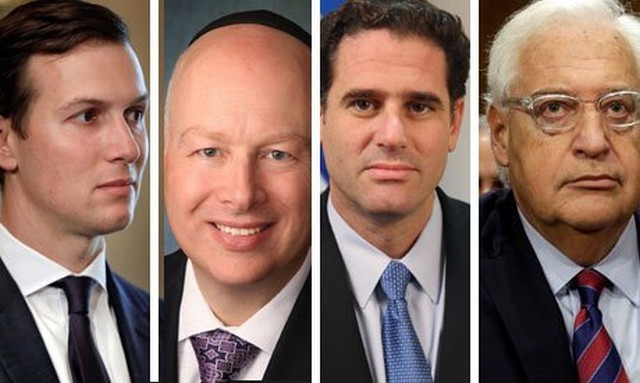
On reflection, it does not seem so surprising that such extreme supporters of Israel as the trio of Kushner, Friedman, and Greenblatt are receptive to such an approach, and might have moved in a similar direction even without the Pipes contribution that provides a coherent rationalization. Consider the steps taken by the U.S. government over the course of the past eight months and a pattern emerges that seems to be only compressible as seeking the implementation of the Victory Caucus proposal:

Moving the American Embassy from Tel Aviv to Jerusalem, attacking the UN –including withdrawing from the Human Rights Council because of its anti-Israeli bias, freezing and then cutting off essential financial aid to the UNRWA operations in Gaza and the West Bank, closing the PLO office in Washington, turning a blind eye to Israel’s crimes against humanity committed in response to the Great March of Return at the Gaza fence, threatening the International Criminal Court, and giving tacit blessing to the accelerated expansion of unlawful Israeli settlements (already surpassing 600,000 settlers). There is no other way to read this series of provocative maneuvers other than as a series of signals to the Palestinian people, and most of all to their leaders, to grasp the futility of their suffering, which will intensify more and more if they do not act sensibly, and submit to whatever Israel proposes so as to complete the Zionist Project of dominating the whole of historic Palestine, the biblical rendering of ‘the promised land’ of Jewish entitlement.

To call this kind of coercive diplomacy on an already oppressed people ‘a deal’ is a linguistic travesty. It is more a bullying ploy than a deal, which implies the semblance of a meeting of minds. It is what I have called in this and other contexts a ‘geopolitical crime’ that deserves punishment and international condemnation, not careful consideration given to a serious effort to bring peace to the two peoples. In the future such an initiative is likely to be known as ‘the attempted ultimate crime of the century.’

Putting aside sentiments of distaste for the immorality and unlawfulness of this Pipes/Trump/Kushner approach, it is important to ask the awkward question, ‘will it work?’ Given the struggles and suffering endured by the Palestinian people over the course of more than a century, it seems that the Pipes Victory Caucus, like the Trump ‘deal,’ will face scornful repudiation, likely accompanied by dramatic renewals of Palestinian resistance as complement by more militant expressions of global solidarity activities. If we take account of the heroic persistence of the Great March at the Gaza border, despite the repeated atrocities committed by IDF defenders of Israel, and of the increasing worldwide support of the BDS Campaign, it seems reasonable to conclude that the deal of the century has been rejected even before it has been revealed with all its shabby window dressing, including ideas of redrawn boundaries with neighboring countries, permanently fragmenting the Palestinian people beyond the darkest imaginings. If, a big if, the Trump trio of ‘Israel, First’ advisors is at all smart this is a deal whose detailed nature will never be revealed for public scrutiny, and whose anticipated rejection will be hidden behind a PR avalanche of denunciations of Palestinian rejectionism as responsible of killing Trump’s plan for peace.

Underneath this attempt to make the Palestinians drink such a toxic brew is a misleading reading of the flow of history in our time. The sun has set on colonialism, and no matter how much geopolitical muscle is applied, this reality cannot be overcome. This kind of geopolitical crime will doubtless intensify Palestinian suffering while it also strengthens Palestinian resolve. In these kind of decolonizing struggles it is shifts in the soft power balances that most often produces change, and not the tilting of the geopolitical scales or dominance on the battlefield. People, not states and their armed forces, are the movers and shakers of our era, with governments left on the sidelines to weep over the outcome. The European colonial powers learned this the hard way in a series of bloody wars, which they lost despite their military superiority. The United States, despite its experiences in Vietnam, Iraq, and Afghanistan has yet to grasp the limits of military power in the post-colonial world, and so it keeps inventing weapons, tactics, and doctrine without learning this indispensable lesson in the shifting nature of power.

True, Oslo diplomacy was a failure that worked to the political benefit of Israel, and was rightly abandoned. But the Trump response to this failure amount to the criminalization of diplomacy that violates the most basic precepts of international law, as spelled out in the UN Charter. It amounts to waging an aggressive war against a vulnerable and helpless people. If the UN and the leading governments watch this dismal spectacle in stony silence it can only be fervently hoped that the peoples of the world will recognize the need for radical reform to avoid a catastrophic future, not just for the Palestinians, but for all of humanity.

Richard Falk is a member of the TRANSCEND Network, an international relations scholar, professor emeritus of international law at Princeton University, author, co-author or editor of 40 books, and a speaker and activist on world affairs.

17 September 2018

Source: https://www.transcend.org/tms/2018/09/decoding-the-pipes-trump-kushner-deal-of-the-century/

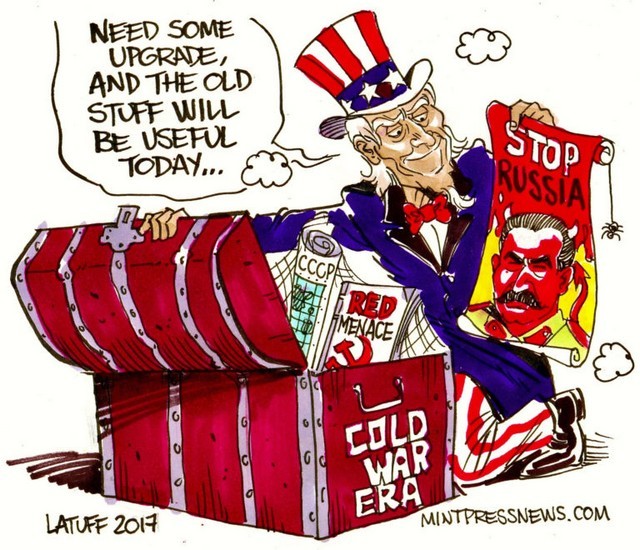
Demonization of Russia in a New Cold War Era

By Mairead Maguire

Inventing a foe to sell military ambitions: still the most dangerous of games.

13 Sep 2018 – In examining the future, we must look to the past.

As we watch the media today, we are spoon fed more and more propaganda and fear of the unknown, that we should be afraid of the unknown and have full faith that our government is keeping us safe from the unknown. But by looking at media today, those of us who are old enough will be reminded of the era of Cold War news articles, hysteria of how the Russians would invade and how we should duck and cover under tables in our kitchens for the ensuing nuclear war.

Under this mass hysteria, all Western governments were convinced that we should join Western allies to fight the unknown evil that lies to the east. Later through my travels in Russia during the height of the Cold War with a peace delegation, we were shocked by the poverty of the country and questioned how we ever were led to believe that Russia was a force to be afraid of. We talked to the Russian students who were dismayed by their absolute poverty and showed anger against NATO for leading their country into an arms race that they could not win. Many years later, when speaking to young Americans in the US, I was in disbelief about the fear the students had of Russia and their talk of invasion. This is a good example of how the unknown can cause a deep routed paranoia when manipulated by the right powers.

All military is expensive, and we can see in Europe that the countries are reluctant to expand their military spending and find it hard to justify this to their people. In looking at this scenario, we can ask ourselves what is beneficial about this hysteria and fear caused on both sides. All armies must have an enemy to deem them necessary. An enemy must be created, and the people must be convinced that there is need for action to safeguard the freedom of their country. Right now, we can see a shifting of financial power from old Western powers to the rise of the Middle East and Asia. Do we honestly believe that the Western allies are going to give up their power? My suggestion is: not easily. The old dying empires will fight tooth and nail to protect their financial interests such as the petrol dollar and the many benefits that come through their power over poverty-stricken countries.

Firstly, I must say, that I personally believe that Russia is not by any means without faults. But the amount of anti-Russian propaganda in our media today is a throwback to the Cold War era. We must ask the question: Is this leading to more arms, a bigger NATO? Possibly, to challenge large powers in the Middle East and Asia, as we see the US approaching the South China seas and NATO Naval games taking place in the Black Sea. Missile compounds are being erected in Romania, Poland and other ex-Soviet countries, while military games are set up in Scandinavia close to the Russian border to practice for a cold climate war scenario. At the same time, we see the US President arriving in Europe asking for increased military spending. At the same time the USA has increased its budget by 300 billion in one year.

The demonization of Russia is, I believe, one of the most dangerous things that are happening in our world today. The scapegoating of Russia is an inexcusable game that the West is indulging in. It is time for political leaders and each individual to move us back from the brink of catastrophe to begin to build relationships with our Russian brothers and sisters. Too long has the elite cynically gained from war while millions are moved into poverty and desperation. The people of the world have been subjected to war propaganda based on lies and misinformation and we have seen the results of invasions and occupations by NATO disguised as “humanitarian intervention” and “right to protect”. NATO has destroyed the lives of millions of people and purposely devastated their lands, causing the exodus of millions of refugees. The people around the world must not be misled yet again. I personally believe that the US, the UK and France are the most military minded countries, whose inability to use their imagination and creativity to solve conflict through dialogue and negotiation is astonishing to many people and me. In a highly militarized, dangerous world, it is important we start to humanize each other, find ways of cooperation, and build fraternity amongst the nations. The policies of demonization of political leaders as a means of preparing the way for invasions and wars must be stopped immediately and serious effort put in to the building of relationships across the world. The isolation and marginalization of countries will only lead to extremism, fundamentalism and violence.

During our visit to Moscow, we had the pleasure of attending a celebration of mass at the main Orthodox Cathedral. I was very inspired by the deep spirituality and faith of the people as they sang the entire three-hour mass. I was moved by the culture of the Russian people and I could feel that their tremendous history of suffering and persecution gave them sensitivity and passion for peace.

Surely it is time that we in Europe refuse to be put in a position where we are forced to choose between our Russian and American brothers and sisters. The enormous problems that we are faced with such as, due to climate change and wars, mass migration and movement of peoples around the world, need to be tackled as a world community. The lifting of sanctions against Russia and the setting up of programs of cooperation will help build friendships amongst the nations.

I call on all people to encourage their political leaders in the US, EU and Russia to show vision and political leadership and use their skills to build trust and work for peace and nonviolence.

Mairead Corrigan Maguire, co-founder of Peace People, is a member of the TRANSCEND Network for Peace Development Environment.

17 September 2018

Source: https://www.transcend.org/tms/2018/09/demonization-of-russia-in-a-new-cold-war-era/

Summary of the 9 July 2018 BMF Core Group Meeting, 1:00 – 6:00 p.m.

At the INEB office, Bangkok, Thailand

In attendance:


Rev. Kyoichi Sugino Religions for Peace
Tengku Ahmad Hazri JUST
Yayah Khisbiyah Muhammadiyah
Somboon Chungprampree (Moo) INEB
Edla Puoskari The Network


Key Discussions and Decisions:

Welcome and Introductions by Somboon (Moo)


Updates and Reports

JUST Updates

Peoples’ Tribunals found that Myanmar was guilty of genocide. Tribunals exhibit some reservations about charging Myanmar with “ethnic cleansing” and so did not use it. Full details are on the website. They are trying to publish the judgement collaboration with the UN in an academic law journal.

Rev Kyoichi suggests BMF should analyze and follow the numerous Amnesty International reports about crimes against humanity in Myanmar and coordinate between BMF, UN Genocide Prevention Office (USG Adama Dieng), ICC, and the Peoples’ Tribunals to submit evidence of the final verdict during the UNGA. (The Network can also help in establishing a connection with Adama Dieng’s office.)

The Network Updates

Edla commented about the refugee situation in Bangladesh (where the Network participated in a recent event) and recommended to keep an eye on the initiatives by the UN, such as the Plan of Action for Religious Leaders and Actors in Preventing Incitement to Violence that could lead to atrocity crimes.

The Network also works with ASEAN and its member states to increase their understanding on why Buddhist-Muslim relations are important. In addition, the Network coordinates a platform regionally for interfaith peacemakers to support peer-learning and their concrete actions on the ground. The Network had also closely supported activities mentioned in the report by BMF Interim Secretary.

Religions for Peace Updates

BMF could be a Human Rights organization that is pro-government, pro-Buddhist, and pro-Muslim all at the same time.

In May, RfP convened a meeting with national Buddhist leaders. Buddhists from only a few Asian countries (India, China, Japan, and Sri Lanka) are respected by Myanmar government. With this in mind, the RfP intentionally brought Sri Lankan in particular, but also Indian and Japanese reps to the delegation. While the spirit of discussion have opened up with this Buddhist leaders meeting, it is critical now to bring civilian government, military government, ethnic groups, and Muslim representatives to the table. Indonesian, Bangladeshi, and Saudi ambassadors to Myanmar are also possible sources of support. Human rights organizations are less likely to gain traction with military governments.

RfP has terminated its relationship with the Sitagu Sayadaw, but the Burmese Muslim leader has kept a relationship with him.

RfP is considering pursuing basic rights rather than citizenship rights for Rohingyas with Myanmar’s military government. Norway, Switzerland, Australia, Indonesia, US, Japanese ambassador have expressed interest is this approach.

Muhammadiyah Updates

Yayah says that this is Muhammadiyah’s first time speaking on BMF since Yogya 2015. The Muhammadiyah representative expresses large interest in coming back to the table with BMF.

Din Syamsuddin is a former chairman of Muhammadiyah

–          They’ve raised around 1.5 million US dollars through crowdfunding demonstrating that there is definitely Muslim support for interfaith-related causes in Indonesia, but it tends to be too symptom-based.

Muhammadiyah is working on concept of healing/peace building and relaying it to Indonesian leaders. The university can be opened as a place for participation as well, through Muhammadiyah.

Muhammadiyah says their organization can continue to preach tolerant Islam to combat extremism. They suggest contacting Pak Din in this regard.


INEB Updates

Engaged with Ma Ba Tha to open up intra-Buddhist dialogue in local areas through workshops, emotional healing, plastic cleaning campaigns, and other community efforts.

–          They’ve been working with around 150 nuns and monks, 100 are Ma Ba Tha monks, 15% are directly engaged in interfaith, 60% are planning to reduce participation in Ma Ba Tha, 40% want to engage in peace building

The next phase will be during the 2020 Myanmar election. INEB has submitted a proposal to the EU and are waiting for the results.

Next month, 30 political leaders from Myanmar will be hosted by INEB in Thailand.


Membership

2 main goals for BMF:

  • Increase membership from Islamic countries
  • Increase research ties


Membership Focus and Composition

Three levels:

  • core group – primary membership
  • country focus – countries in the region to engage with
  • peripheral countries – countries outside the region


BMF with its current regional focus, will not explore partnership with other international organizations (such as KAICIID and OIC) as members. However, it will focus on strengthening the connections with regionally based organizations.

Country Focus:

Pursue organizations in countries with both Buddhist and Muslim populations

  • Sri Lanka
  • Myanmar
  • Bangladesh
  • Singapore
  • Indonesia
  • Malaysia
  • Thailand
  • Cambodia
  • India
  • China


Peripheral countries:

BMF agrees to explore possibilities with:

  • Egypt
  • Pakistan
  • Tunisia
  • Iran


Please note that BMF with its current regional focus will not explore partnership with other international organizations (such as KAICIID and OIC) as members. Rather we will focus on strengthening the connections with regionally based organizations.


Activities

The Core Group expressed concerns over the narrative that is in Myanmar. They are also concerned about the impact if it spins off, into the region as well as other issues surrounding extremist Buddhist and Muslim actions. It also recognized the unique access by its members to engage in dialogue with actors who have a potential to influence the hardline narratives both among the Buddhist and Muslims and prevent them becoming mainstream.

Advocacy work with:

  • Individual country governments
  • ASEAN, UN, EU (utilize EU)
  • Buddhist and Muslim international organizations, Regional organizations
  • International Non-governmental Organizations

Education

  • Coordinating Research
  • Public Outreach through conferences, lectures, seminars
  • Dissemination/ Framework/Propagation/ Social Media!
  • Translation and Publication
  • Workshop Training

Research Ties

BMF can develop ties to Institute of Islamic Studies in Malaysia to increase intellectual/research ties. This can be coordinated with help from JUST.

Media/Social Media

  • Peace Journalists in Indonesia as an example of success projects
  • How we use social media ourselves strategically and support first movers – looking regionally
  • Engage with the media on how they frame conflicts as religious

Intra-faith and Interfaith Dialogue

  • BMF’s role should be to offer space for these dialogues
  • Project:  Identify radical groups within each community and strategize on how to bring them together
  • Propagate Inclusive Islamic literature which is what Muhammadiyah is doing

Issue-based projects to address difficult topics such as:

  • Changing demographics
  • Conversion
  • Halal-certification
  • Economic/political issues


Common Actions and Projects (within the next 2 years)

1) Religious Leaders (B-M) meeting

  • Focus on organizing high level / intellectual / linkages and connections. (Chandra’s suggestion of bringing in research components could help.)
  • Opportunity to address change in the narratives that promote radical interpretations, creating a safe space for discussing hard topics
  • Majority Buddhist country as site for the next meeting. Singapore is a possibility. They have a Museum of Diversity (at MUIS).
  • Budget of $50,000 USD (RfP will look into possible funding.)
  • Professor Imtyas Yusuf of Islamic Studies from Mahidol could be included
  • The Network (Edla) is very willing to facilitate, their priority focus Buddhist-Muslim regional dynamics at the moment.

2) B-M Education Institutions for Dialogue

The Core Group agrees that dissemination of shared values between Buddhists and Muslims is important. We are creating a platform where more sensitive and difficult challenges will be discussed, with some objective data. Possible channels are through comic books/publications and social media (informational videos).

Student exchanges between high schools or universities will help blur the boundaries. This can possibly be facilitated through Indonesian/Malaysian Muslim students and Thai Buddhist students. There must be a dialogue between Buddhist and Muslim universities

Focus should be also on transforming curriculums. Moo proposes taking Buddhist monastic leaders to visit Madrassah schools, and vice-versa. Also, synergies with existing peace curriculums/manuals of different faiths should be looked into.

3) B-M Youth Exchange

Core Group agrees that youth exchange- bringing Buddhists to madrassahs, community clean-up projects, etc., is also a priority.


New Core Members

Connecting Muslim organizations:  In Indonesia we will invite Nahdlatul Ulama and Wahid Institute. We also ask Pak Din.

Connecting Buddhist organizations:   Moo has 3 suggestions – Sri Lankan Sarvodaya, Rahula Institute from Sri Lanka and Ven Dhammasami from Myanmar.

It was decided that the Network is formally recognized as Core Group Member.


Funding

Last September it was decided that the core group would need to provide financial backing (per their ability) to be part of the core to each contribute $5,000 USD (as of our last agreement).

Secretariat will write formal letter describing what took place during this meeting, the actions and contribution request of Core Group members. It was discussed that there is flexibility on whether the contribution is made in the later months of 2018 or at the beginning of 2019.

Moo/INEB Secretariat will draft of a concept paper and budget for the agreed actions. Edla among other Core Group members will help with this.


Secretariat

A rotational schedule between the Buddhist and Muslim is most desirable.

Term Length: 2 years, beginning August 2018. It was decided that formally the term for INEB begins in August 2018.

Functions of the secretariat:

  • Represent the BMF in international conferences. (Core group members can also attend.)
  • Conduct Annual Meeting/ Managing the core group
  • Fundraising
  • Managing Media – > maintaining website and other social media
  • General Outreach/Networking – Secretariat responsible to expand awareness of BMF
  • Coordinate invitations to new members and criteria for membership

Secretariat with the BMF Core will approach the potential new Core members


Acknowledgement

The Core Group wishes to acknowledge the support of:

a. INEB for the use of their office space.

b. All members who attended and contributed