Just International

The U.S. Is Building a Drone Base in Niger That Will Cost More Than $280 Million by 2024

By Nick Turse

21 Aug 2018 – A U.S. drone base in a remote part of West Africa has garnered attention for its $100 million construction price tag. But according to new projections from the Air Force, its initial cost will soon be dwarfed by the price of operating the facility — about $30 million a year. By 2024, when the 10-year agreement for use of the base in Agadez, Niger, ends, its construction and operating costs will top a quarter-billion dollars — or around $280 million, to be more precise.

And that’s actually an undercount. The new projections from the Air Force do not include significant additional costs, such as salaries of the personnel stationed at the base or fuel for the aircraft flying out of Agadez. The facility, which is part of the expanded U.S. military footprint in Africa, is now the largest base-building effort ever undertaken by troops in the history of the U.S. Air Force, according to Richard Komurek, a spokesperson for U.S. Air Forces in Europe and Air Forces Africa.

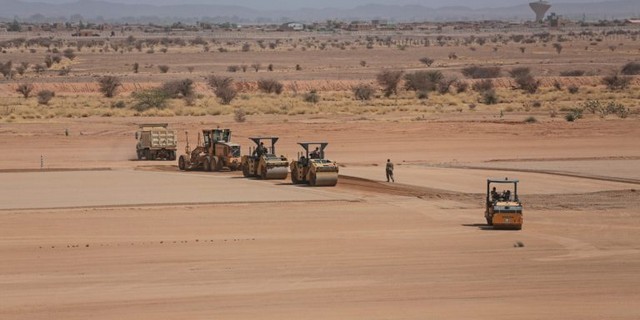
The outpost — officially a new airfield and associated facilities at Nigerien Air Base 201, or AB 201 — was once billed as a $50 million base dedicated to surveillance drones, and it was to be completed in 2016.  Now, it’s slated to be a $100 million base for armed MQ-9 Reaper drones which will finally take flight in 2019, though the construction cost is hardly the end of the tab for the facility.

“It’s probably one of the most remote U.S. military airbases ever built,” said Dan Gettinger, co-founder and co-director of the Center for the Study of the Drone at Bard College and the author of a guide to identifying drone bases from satellite imagery. “Most drone bases on the African continent are appendages to larger airports and airfields, but not Agadez. The existing infrastructure is not there. So, the scale of the project is huge.”

Air Force documents submitted to Congress in 2015 note that the U.S. “negotiated an agreement with the government of Niger to allow for the construction of a new runway and all associated pavements, facilities, and infrastructure adjacent to the Niger Armed Force’s Base Aerienne 201 (Airbase 201) south of the city of Agadez.” When the National Defense Authorization Act for fiscal year 2016 was introduced, embedded in it was a $50 million request for the construction of an “airfield and base camp at Agadez, Niger … to support operations in western Africa.”

Reporting by The Intercept found that the true cost of the airfield is double the reported sum — all of it laid out in a September 2016 article on the “$100 Million Drone Base in Africa.” Despite more recent news reports that the price tag of the base has risen to $110 million, Komurek told The Intercept that the total cost of the project has remained roughly the same, topping out at $98.5 million next year.

While the total budget hasn’t changed, the way its costs are divided has. The price of construction jumped from $50 million to $60 million due to “unanticipated effects of the austere conditions and remote location of Agadez,” including the effects of severe weather, according to Komurek. In fact, in a June 2017 letter to Rep. Charlie Dent, then a senior member of the House Appropriations Committee and chair of the Subcommittee on Military Construction, Veterans Affairs, and Related Agencies, the Defense Department justified the $10 million increase by explaining that “poor initial planning and design” led to unforeseen projects, increased costs in acquiring and delivering three aircraft shelters, and a need for new perimeter security measures.

The Agadez base is now the largest “airman-built” project in Air Force history, according to Mark Kinkade of the Air Force Installation and Mission Support Center, eclipsing construction at Al-Dhafra Air Base in the United Arab Emirates, a longtime clandestine outpost from which the U.S. flies drones and fighter aircraft. Prior to that, the record-holder was Phan Rang Air Base in South Vietnam, which had nearly 150 aircraft assigned to it in 1969.

The U.S. outpost at Agadez might be remote, but it’s far from spartan. Photographs and videos released by the military show a base with all the typical American bells and whistles. Walk through the entryway where the overhead sign reads “Welcome to Agadez: Niger’s Best Kept Secret,” look around the base, and you’ll notice the three massive hangars that each cost $1.58 million. You’ll see large satellite dishes; rows of air-conditioned Quonset hut-shaped tan tents; and an Airmen Resiliency Center that serves as both a chapel and recreation center, with Wi-Fi and bookcases filled with few books but many movies and board games. Walk out of the triple-digit heat into the climate-controlled (and cleverly named) Dezert Café, and you can watch ice hockey on a big-screen TV while chowing down on chicken or pizza or fish or cookies or potato chips, and then wash it all down with bottled water, Snapple, Sprite, Gatorade, Coke, or Dr Pepper. Each cafeteria table even comes equipped with a bottle of yellow hand sanitizer and any condiment — ketchup, mustard, steak sauce, hot sauce, Sriracha, soy sauce, Tabasco — that you could hope for.

Earlier this year, the Air Force also put out a call for contractors to provide weight room equipment for the base. The solicitation laid out how the gym will be outfitted: weight plates ranging from 2 1/2 pounds to 45 pounds, dumbbells in five-pound increments up to 100 pounds, and two “Rogue Abram GHD 2.0” or equivalent pieces of equipment. For the uninitiated, the former is what its manufacturer calls “the perfect Glute Ham Developer for any garage gym or training facility where space is at a premium.”

To keep the gym lit, the Wi-Fi on, the big screen bright, and the air conditioning running, not to mention the water potable and the troops fed, requires a significant amount of money. In 2016, the Pentagon told The Intercept that the annual cost to keep the base running would be slightly less than $13 million per year. Komurek explained, however, that those numbers were “limited” and did “not cover the same categories of sustainment costs” as the new $30 million estimate. “In addition to the initial stand-up costs of a site, there are annual operations and maintenance sustainment costs for logistical support, maintenance and security which change based on the footprint and mission set supported,” he explained by email. “The sustainment cost for AB201 is estimated to be approximately $30M per year.”

Formerly secret U.S. Africa Command planning documents, first disclosed by The Intercept in 2016, attest to the importance of Agadez for future missions by drones, also known as remotely piloted aircraft or RPAs. “The top MILCON [military construction] project for USAFRICOM is located in Agadez, Niger to construct a C-17 and MQ-9 capable airfield,” reads a 2015 planning document. “RPA presence in NW Africa supports operations against seven [Department of State]-designated foreign terrorist organizations. Moving operations to Agadez aligns persistent ISR [intelligence, surveillance, and reconnaissance] to current and emerging threats over Niger and Chad, supports French regionalization and extends range to cover Libya and Nigeria.”

Construction of the base began during the summer of 2016, and the U.S. military hoped that drones would be flying from Agadez by the end of that year. According to Komurek, construction won’t be completed until the end of this year, and aircraft will not fly from the base until 2019. “The challenge of building this enormous airfield in the middle of the dessert has resulted in the delays that we’ve seen in getting this base operational,” Gettinger told The Intercept.

In the time since construction at Agadez began, U.S. military operations in North and West Africa have dramatically increased. Since 2016, the U.S. has carried out hundreds of drone strikes targeting Al Qaeda and Islamic State militants, including two in June, in neighboring Libya. U.S. forces have also been operating alongside Nigerien forces, a fact laid bare by an October 4, 2017, ambush by ISIS in the Greater Sahara militants near the Mali border, about 600 miles from Agadez, that killed four U.S. soldiers and wounded two others.

It took just over 1 1/2 hours for the first aircraft, an unarmed “U.S. ISR platform,” to arrive at the scene of the attacks, according to Army Maj. Gen. Roger Cloutier. If the outpost at Agadez had been completed on schedule, in late 2016, could armed MQ-9 Reapers have come to the rescue of the ambushed Americans? The Intercept put that question to Gen. Tod D. Wolters, the commander of U.S. Air Forces in Europe and Air Forces Africa. The USAFE-AFAFRICA press office responded that “it would be inappropriate for us or Gen. Wolters to speculate or comment on that hypothetical scenario.”

Nick Turse is a contributing writer for The Intercept, reporting on national security and foreign policy.

27 August 2018

Source: https://www.transcend.org/tms/2018/08/the-u-s-is-building-a-drone-base-in-niger-that-will-cost-more-than-280-million-by-2024/
Israel an Enemy of Freedom-Loving People Everywhere

By Eric Zuesse

Israel is fighting constantly not only against Gazans, and against Palestinians generally; it is fighting constantly against freedom-loving people everywhere, who oppose dictatorship of any type, and in any country, on principle, irrespective of nationality.

Here’s an example showing how much of a dictatorship and enemy of democrats it is:

Anna Dressler was a ship-hand on a flotilla of two small boats launched from Palermo Italy that were manned by 34 people from 12 countries in international waters and that were seized — stolen — by Israel’s military, on 29 July 2018. They became seized because these boats were carrying medical supplies in violation of Israel’s internationally illegal blockade against food and medicine reaching the residents of Gaza. She was on the boat “Al-Awda,” which was 42 miles from Gaza at the time of seizure-theft. Israel’s troops seizing it were masked, and were armed with machine-guns.

The first video of this incident was released on August 20th.

A “Legal and Welfare Update and Appeal” dated August 14th by the Freedom Flotilla, stated that,

The two boats ‘Al Awda’ (The Return) and ‘Freedom’ were hijacked by the Israeli Occupation Forces in international waters 42 and 49 nautical miles respectively off the coast of Gaza. During their unlawful detention, crew, participants and journalists were subjected to a range of physical and emotional violence.

The captain of Al Awda was threatened with execution, 4 people were tasered, 3 people had ribs broken by the Israeli military and one person had his foot broken.

They were all taken against their will to Israel, unlawfully imprisoned and ultimately deported. The Israeli authorities have stolen the boats and the 13,000 Euros worth of medical supplies that we were carrying as gifts, as well as many of the participants’ personal belongings (including clothes, a Bible, credit cards, IDs and mobile phones). Incredibly, they have begun to take legal action to attempt to confiscate the boats.

These people had been in constant communication with their colleagues on land; so, if they’d been killed by the Israelis, it would immediately have become an international incident, enraging 12 countries. They had to be released, and thus they were. These people weren’t Palestinians; they had rights that were cared-about in other countries. Though a gangster-state, Israel recognized that these people couldn’t be simply discarded, like trash — as Palestinians are treated by Israel.

So, here’s how the journey got to that stage:

On June 27th, Ms. Dressler, writing in the third person as “she,” had posted, as “Deckhand on Freedom”, her personal background, and presented an explanation, written as impersonally as she could, as to why she was participating in this flotilla (which, though she didn’t note the fact, was manned entirely by volunteers who knew that they were placing themselves in severe jeopardy for doing this):

Anna was born in Germany and is now living in Sweden, but mostly she is out on travels and ‘projects’ around the globe. She is an activist and problem solver – a person with a diversity of professions. In 2012, she was the Project Leader for an anti-money laundering campaign. In 2015-2016, she participated in a private project working with refugees near the Macedonian border and along the Balkan route. She enjoys her freedom wholeheartedly and wants others to have the same opportunity.

On July 18th was posted, by the Freedom Flotilla, the following “Leaving For Gaza – Media Release”:

Four boats from the ‘Right to a Just Future for Palestine’ Freedom Flotilla Coalition are scheduled to leave Palermo, Sicily, to break the illegal Israeli blockade of Gaza, and to assert the Palestinian people’s right to freedom of movement and their right to a just future. …

As always, our boats carry representatives from across the world and messages of love and solidarity for those living under the inhumane, decade-old blockade – the collective punishment on the civilian Palestinian population of Gaza. Given the dire situation in Palestinian hospitals, we are also transporting some urgently needed medical supplies (#Gauze4Gaza).

This need is even more critical given the thousands of people severely wounded by Israeli snipers and tear gas in the past few months during the Great March of Return protests (see 10 July UN report on serious injuries). …

It is also encouraging to see the local welcomes we are being given, including by the Mayor of Palermo who rightly connects our campaign with the Caravana Abriendo Fronteras, who have just arrived from Spain, and similar demands for the opening of borders and freedom of movement from the City Council of Cádiz (Spain) and Naples (Italy).

Spokesperson for the International Committee for Breaking the Siege of Gaza, James Godfrey said: “This Flotilla is necessary to highlight the international community’s failure and its ongoing complicity in the illegal blockade of over two million Palestinians in Gaza, more than half of them children.”

On July 23rd, was posted “Freedom Flotilla Coalition sets sail for a just future for Palestine”, and it reported:

Freedom Flotilla leaves Palermo to break the illegal Israeli blockade of Gaza.

Three boats are sailing with boxes of medical supplies: Al Awda (The Return), a large converted fishing vessel; Freedom to Gaza, a large sailing vessel; and Falestine, a smaller sailing vessel. A fourth boat, Mairead, will not sail at this time. Another Sicilian port Messina, opened its open arms as usual with a series of wonderful community events, and we are grateful for their solidarity.

All three boats making their way to Gaza will be donated to the Union of Agricultural Work Committees, that includes a fisherman’s union that will use the boats to fish in order to feed their families.

Spokesperson for the Swedish Ship to Gaza campaign, Jeannette Escanilla, said the boats would provide important economic and training opportunities for Palestinians trapped in Gaza.

“The illegal Israeli naval blockade has devastated the Palestinian economy, and in particular has hurt the fishing industry in Gaza so these boats will provide important economic opportunities for Palestinians in Gaza, and also training opportunities in sailing, to enable them to gain better qualifications. Currently, the Israeli Occupying Force prevent Palestinians in Gaza from sailing more than a few nautical miles from shore, and routinely attack fishing and other boats from Gaza.”

On July 26th, Dressler posted “ON THE WAY TO GAZA WITH FREEDOM – ANNA DRESSLER (UNITED KINGDOM/GERMANY)”. She said:

Gaza is a zone in the world where human rights seem to be forgotten. I believe that every person can change the world, on their own way, wherever they are and in which way they can. Let’s start here, with a blockade that should never have existed, and continues, along with everyone else, man-made, disasters.

On August 4th was posted to youtube “ANNA DRESSLER – SOS”, in which, six days after the seizure, theft, and assault, by Israel, against these people and their vessels, Anna, speaking in Swedish, publicly demanded that her Government in Stockholm enforce her rights as a Swede, against the Government of Israel, and that the ships and their supplies be at least returned to their owners.

On that same date, August 4th, the Freedom Flotilla itself headlined “SOS – Just Future for Palestine”, and officially notified the foreign ministers of the 12 involved countries whose nationals’ rights had been violated by Israel in this incident. These 12 countries were: Australia, Canada, Denmark, France, Malaysia, New Zealand, Norway, Singapore, Spain, Sweden, UK, and U.S.

The following day, August 5th, Jeannette Escanilla wrote, for the Steering Committee, Ship to Gaza Sweden (her official title being “Spokesperson for the Swedish Ship to Gaza campaign”), addressed as follows:

To the Foreign Minister of Sweden; Margot Wallström

To the Prime Minister of Sweden; Stefan Löfven

Ship to Gaza’s sailing ketch “Freedom for Gaza” was approaching the coast of Gaza when it was boarded by Israeli militants on Friday 3 August on international waters, a gross violation of international law. The last reported position of the vessel before boarding was about 40 nautical miles from coast of Gaza at 20:06 (CET).

The Swedish flagged ship and its cargo of medical supplies were seized by Israel and the 12 persons onboard were abducted and led to Israel, a country they did not intend to visit.

Ship to Gaza demands that the captured crew, the ship and its and cargo will be returned to the position where they were boarded and allowed to continue their voyage on international and Palestinian waters without being interupted, in accordance with international law. In this way we can complete the purpose of the journey, which is to hand over “Freedom” as a gift to Union of Agricultural Work Committees (UAWC)*, as well as 18 boxes of medical supplies, gauzes and sutures, to the organization My Care in Gaza. The lack of healthcare in the Gaza strip is appalling.

Our long term demands are also that the eleven-year illegal and destructive blockade of the Gaza Strip is finally lifted. The Swedish government has repeatedly backed the requirement of a lifting of the blockade. We now expect that the same government, whose flag is worn by the attacked ship, will also support our specific requirements regarding crew, cargo and ships. Ship to Gaza calls on Israel and Egypt to now meet the demands of large parts of the world community, that the illegitimate and destructive blockade of the Gaza Strip will be lifted after eleven years of isolation and aggression.

There is an obvious discrepancy between that “Friday 3 August” date, which she wrote on 5 August, versus the subsequent claim in the August 20th released video, of “29 July 2018,” as being the date on which their boats were stolen. An explanation is thus needed from them, regarding that discrepancy. However, in any case, the Swedish Ship to Gaza has made public that,

Ship to Gaza has now received an answer to the open letter that we, through our chairman Jeanette Escanilla, have sent to the Swedish Minister for Foreign Affairs, Margot Wallström on August 5th.

The Minister writes:

**

Thank you for your letter dated 5th of August 2018.

The situation in Gaza is very critical. UN Secretary General Antonio Guterres has described the situation as a humanitarian crisis. Furthermore, as you wrote, the lack of medical supplies is disastrous, not least since so many people have been injured as Israeli military has been deployed in connection with demonstrations along Gaza’s border in recent months.

Sweden upholds the principle of freedom of the seas and freedom of navigation. The government has been in contact with the Israeli authorities regarding Ship to Gaza, and has expressed that the actions of the Israeli authorities in relation to the Swedish-flagged vessel Freedom and the persons onboard constitutes a breach of international law. The government has also demanded that the ship, its cargo and the persons who were aboard be released. The Swedish Embassy in Tel Aviv is monitoring the imprisoned Swedish citizens’ consular rights and visited all of them on Sunday, August the 5th.

The Swedish government will continue to work towards an end to the Israeli-Palestinian conflict and towards a fair and sustainable two-state solution in which the two states can co-exist, peacefully, side by side. Ending the isolation of Gaza and providing humanitarian aid to its people are two critical, urgent steps towards that end.

(Translated by Ship to Gaza)

The Swedish Ship to Gaza commented on that statement:

Ship to Gaza wishes to emphasize that the wording … in principle corresponds with our own demands that the crew, cargo and boat should be returned to the place where they were boarded and be allowed to continue their journey to Gaza. We are now being notified that the activists and crew is being deported from Israel. This is not in agreement with our demands or with the requests of the Swedish government.

We also want to know what the Swedish government is doing now to enforce the demands regarding our ships, cargo and crew, but even more importantly, also with regards to the blockade of the Gaza Strip.

On August 8th, Ms. Dressler posted:

Anna arrived last night at Berlin airport. Read her preliminary report of the cruel and inhumane treatment that the Israeli authorities meted out to her despite having a German passport. “…Can you then imagine how few rights Palestinians have…”

Anna’s resolve is strengthened and she declared that “We will continue to fight for freedom…”.

Please continue to demand the release of all of the Political Prisoners.

On August 13th, the Freedom Flotilla posted “SECOND MEDIA RELEASE ON MEDICAL SUPPLIES NOT REACHING GAZA” and listed, and linked, to the international laws that Israel had violated in this incident.

On August 17th, UK’s Stuart Littlewood headlined at American Herald Tribune “The UK’s Prime Minister-in-Waiting Must Zap the Circling Sharks”, and he reported on the extreme pressure that the progressive UK politician Jeremy Corbyn was facing for his not clearly taking a stand favoring Israel against the Palestinians, and he reported Corbyn’s being accused by Israel of “anti-Semitism” for that (as if it were wrong to recognize that Israel is an enemy nation; as if to recognize this is somehow against Jews or Judaism, instead of being against racist fascism in any nation, and against apartheid in any nation, and against theocracy in any nation, and against the imposition by any nation, of dictatorship — all of which presumptions are clearly lies). Littlewood noted that,

While the mainstream, including the BBC, have been sticking the knife into Corbyn, none of them (as far as I’m aware) reported a much more serious outrage – the hijacking by Israeli Occupation Forces of two vessels heading for Gaza and the violent assault, abduction and imprisonment of the 34 people from 12 countries who were on board – one of them a British consultant from the famous ‘Barts’ Hospital in London.

That is basically where things currently stand on this matter. The other governments involved (among the 12, besides Sweden), have been silent. Only Dressler’s nation has not. But no indication exists that even Sweden is following up with any demand against Israel. The underlying assumption seems to be that governments in The West (including the Sauds and their friends — all also “Western”) will continue simply to side with Israel against the Palestinians, even when their own citizens’ rights have been violated by Israel’s illegal imposition and enforcement of this illegal blockade.

Among the Governments that refused to enforce its citizens’ rights in this matter is the United States. Refusing to enforce its citizens rights that have been illegally violated by Israel, is routine for the U.S. Government to do. Ever since 1967, Israel has been supported by America, though America’s enemy, at war against Americans, and Israel has stayed that way, but the U.S. Government itself (and its news-media) has been keeping that fact, of Israel’s war against Americans — Israel’s being an enemy — a bipartisan secret from the American people (who are required, furthermore, by their Government, to pay to Israel’s Government, $3.8 billion per year, so that it can buy U.S.-made weapons from Lockheed Martin and other politically top-connected American companies — Eisenhower’s “military-industrial complex” — which are the intended beneficiaries of this coercion, by America’s Government, against America’s citizens). It’s the proven and incontrovertible reality, of the U.S. Government’s tyranny, against its own people.

Without such lies as that Israel is America’s friend instead of America’s enemy, and without such hiding of crucial facts from the public (for ‘national-security’ purposes, of course — not for billionaires’ profits), none of this could happen, and could be even credibly called ‘democracy’. This is actually a ‘democracy’ based on lies. But is that really possible, or is it instead just another lie, one to cover-up all the others? If that’s the case, then the problem is, obviously, much deeper than merely Israel versus the Palestinians, and nothing that the mainstream press publishes in The West regarding international relations can be trusted, at all, for its keeping this secret throughout the decades.

Certainly, what you are now reading, on this site, isn’t mainstream in The West. So, you are here reading Western samizdat, forbidden truths — truths that are forbidden to be published in The West. Nonetheless, all of this article is documented to be true. Just click onto a link anywhere that you doubt it. You will find that it’s all true — not just “maybe true” (like mainstream ‘news’ often is) — it is all unequivocally true. And, yet, what politician can say it? What would they be implying if they did say it? Can they say it? Apparently not.

What you’ve read here is, therefore, exposing just the visible tip, of an iceberg, of lies.

—————

Investigative historian Eric Zuesse is the author, most recently, of  They’re Not Even Close: The Democratic vs. Republican Economic Records, 1910-2010, and of  CHRIST’S VENTRILOQUISTS: The Event that Created Christianity.

24 August 2018

Source: https://countercurrents.org/2018/08/24/israel-an-enemy-of-freedom-loving-people-everywhere/

UN Report Finds ISIS Given “Breathing Space” in US-Occupied Areas of Syria

By Whitney Webb

By maintaining an ISIS pocket in the territory it occupies, the U.S. can continue to justify its illegal presence in the country for the long-term, ultimately substituting Iran for ISIS as its new regional boogeyman.

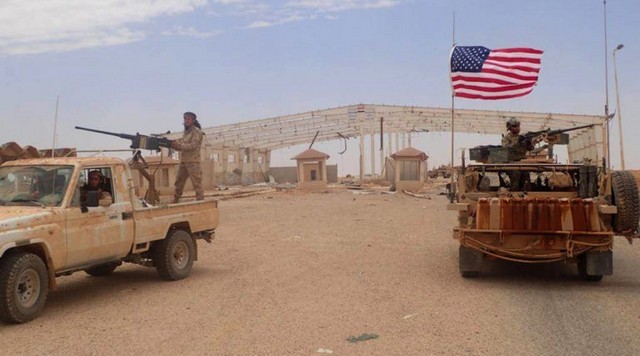
16 Aug 2018 –— A recent report from the UN Security Council’s Sanctions Monitoring Team has found that many of the places in Syria where the terror group Daesh (ISIS) continues to operate, recuperate and extract oil for profit are in areas of the country occupied by the United States.

According to the report’s executive summary:

“Islamic State in Iraq and the Levant (ISIL), having been defeated militarily in Iraq and most of the Syrian Arab Republic during 2017, rallied in early 2018 [owing to] a loss of momentum by forces fighting it in the east of the Syrian Arab Republic, which prolonged access by ISIL to resources and gave it breathing space to prepare for the next phase of its evolution into a global covert network.”

While the text itself doesn’t explicitly state who controls these areas of Syrian territory, maps of eastern Syria make it clear that the pockets of Daesh within U.S.-controlled territory have remained unchanged in size since November 2017 while the Daesh pockets in the Syrian government-controlled portion of eastern Syria have shrunk considerably since last November.

Furthermore, the UN report states that the areas where Daesh has rallied since the year began are located in “pockets of territory in the Syrian Arab Republic on the Iraqi border” where the group has mounted “attacks, including across the border into Iraq.” Again, area maps clearly show that the Daesh-controlled areas in only the U.S.-occupied portion of eastern Syria are along the Syria-Iraq border.

Notably, in the sliver of Daesh-controlled land between U.S. and Syrian government-controlled areas in the border city of Abu Kamal, when the Syrian Arab Army (SAA) has tried to attack Daesh positions in the area this year, they have been targeted by U.S. coalition airstrikes. U.S. coalition airstrikes have also attacked Syrian civilian villages in the government-controlled portion of Abu Kamal. Survivors of that attack claimed that their villages had been targeted for refusing the entry of the U.S.-backed opposition militias — such as the Qasad militia, which is largely composed of former Daesh fighters.

U.S. coalition airstrikes targeting the SAA in Abu Kamal and elsewhere in eastern Syria have also been the key cause of the “loss of momentum” of forces fighting Daesh that was cited in the UN report, as Syrian forces have declined to advance deep into U.S.-held territory in order to pursue Daesh after being bombed numerous times. In addition, the U.S.’ own bombing campaign against Daesh can hardly be called effective given that the U.S., along with their military proxy the Syrian Democratic Forces (SDF), frequently announce on social media when and where they will be bombing Daesh in eastern Syria days in advance.

Beyond eastern Syria, the report also notes that another Daesh-infested area of concern is also located farther south in the area around the al-Tanf military base, which has been occupied by the United States since 2016. The UN report raises concerns about the Rukban refugee camp, which lies within the so-called “deconfliction” zone that the U.S. has imposed on a 55-kilometer radius around al-Tanf.

The report states:

“The densely populated Rukban camp in southern Syrian Arab Republic contains some 80,000 internally displaced persons, including families of ISIL fighters, a situation which Member States fear might generate new ISIL cells.”

As with other Daesh-held areas under U.S. “protection,” the U.S. has attacked the SAA for attempting to enter the U.S.’ unilaterally-imposed “deconfliction” zone in an effort to attack Daesh militants.

Washington’s Daesh-dependent long-game

The evidence that the U.S. presence in Syria is actually helping to strengthen Daesh flies in the face of the Pentagon’s justification for the U.S.’ occupation of northeastern Syria as being necessary because the Syrian government is not strong enough to defeat Daesh on its own. However, as the recent UN report reveals, the Pentagon’s portrayal does not appear to be the reality of the situation.

As MintPress has noted in the past, this finding is hardly surprising given that the Defense Intelligence Agency report from 2012 revealed that the U.S. willingly allowed Daesh to be formed in order to destabilize the Syrian government and partition Syria through foreign military intervention. Since then, the U.S. has adapted its justifications for its presence in Syria, particularly after the failure of Daesh and foreign-funded opposition groups to depose the current government of Syria.

By maintaining a Daesh pocket in the territory it occupies, the U.S. can continue to justify its illegal presence in the country for the long-term. Indeed, just last month, the Trump administration made it clear that the U.S. military plans to stay in Syria for the long haul, substituting Iran for Daesh as its new regional boogeyman.

Whitney Webb is a MintPress contributor who has written for several news organizations in both English and Spanish; her stories have been featured on ZeroHedge, the Anti-Media, 21st Century Wire, and True Activist among others – she currently resides in Southern Chile.

20 August 2018

Source: https://www.transcend.org/tms/2018/08/un-report-finds-isis-given-breathing-space-in-us-occupied-areas-of-syria/

Hello, They Lied To You About Iran!

By Andre Vltchek

Text and Photos: Andre Vltchek

Have you ever considered the possibility that almost everything that you have been told about the world by the Western mass media is a lie and fabrication?

I am sure you have, at least lately, when the insanity of Western propaganda is becoming very clear and obvious. But what about the extent of indoctrination you were subjected to?

If you live in Europe or North America, how poisoned are you by the lies about Cuba and Venezuela, Russia and China, North Korea and yes – about Iran? Are you beyond recovery? If you see the truth, if you were confronted by reality, would you still be able to recognize it, or would you perceive it as propaganda and lies?

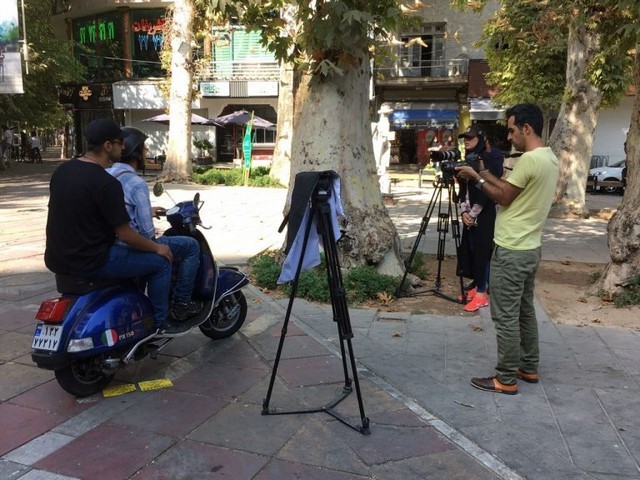
I have just left Tehran, a city with a tremendous history and culture, overflowing with museums, theatres, wonderfully kept parks dotted with modern art sculptures. It is a city with modern and fully subsidized public transportation, consisting of high-tech metro, ecological bus ways, as well as suburban trains. A city of tall trees, and quiet squares, of elegant cafes, and extremely educated and kind people.

A city that could easily be part of the ‘top ten’ cities on Earth, were it not be the capital of a country that the West is trying to ruin, first with unjust and draconian sanctions, and then, who knows, even by a militarily invasion.

What do most Westerners know about Iran; what were they told? I think the image the mass media outlets want to project is of “Iran – a radical Muslim country, some sort of Shia Saudi Arabia”, or perhaps worse. Much worse, as Saudi Arabia, the closest Arab ally of London and Washington,cannot be touched in the West, no matter what barbarity and terror it spreads all around the world.

Those who know both Jeddah and Teheran would laugh at such a comparison. Saudi Arabia, and its semi-colony Bahrain, despite their wealth from oil, are some of the most compassionless societies on the planet, misery rubbing shoulders with repulsively vulgar and extreme showing off of wealth.

Iran is in its essence a socialist country. It is internationalist, in full solidarity with many oppressed and struggling nations on our planet. No, I am not talking about Syria, Yemen or Palestine only; I am talking about Cuba and Venezuela, among many others. You did not know? It is not surprising: you are not supposed to know!

You are also expected to remain ignorant about Iran’s social system, clearly socialist. Free education and medical care, greatly subsidized public transportation and culture, huge public spaces and to some extent, strong government and at least partially, central planning.

Despite those absolutely unjust, terrible sanctions imposed, with some interruptions, from Washington and its allies, Iran is standing tall, trying as much as it can to take care of its people. And despite the terrible ordeal Iranian people are being put through, they do not cheat and do not steal. The exchange rate collapsed after Washington imposed another round of bizarre sanctions, triggering frustration, even protests. But the majority of Iranians understands who the real culprit is. And it is no secret that the so-called opposition is often financed from the West.

Most visitors do not understand anything about the local currency or exchange rates. I am no exception. I simply give taxi drivers or waiters my wallet, and they only take what is due. I checked with my Iranian colleagues: and the amount that is being taken is always fair.

Iranians do not display ‘arrogant pride’; they only show the determined, decent and patriotic pride of a nation with thousands of years of great culture which knows perfectly well that it is on the right side of history.

You were told ‘how religious Iran is’; I am sure you were. But unlike in Saudi Arabia or Indonesia, religion is not ‘being thrown into your face’ here; it is not waved as a flag. In Iran, religion is something internal, deep, which is expressed humbly and without noise. While the mosques of Jakarta broadcast, for hours a day and usingpowerful loudspeakers, entire sermons, while people are now being thrown into jail for even criticizing this brutal imposition of religion on the general public, in Tehran I could hardlyeven detect Adhan(call for prayer). Most of the local female Teheran city-dwellers only cover their hair symbolically – one third or even just a quarter, keeping most of their hair exposed.

But the West would never inflict sanctions on Indonesia or antagonize it in any other way, no matter how brutal it is to its own people: Washington, London and Canberra already ruined its socialist direction after the US-orchestrated coup of 1965. Jakarta is now an obedient, turbo capitalist, anti-Communist, West-junk-food-and-crap-entertainment-loving society. It has nothing public left. The elites have fully robbed the country on behalf of the West. Religions in Indonesia are used to uphold the pro-Western fascist regime.

Iran is totally the opposite: its interpretation of religion is ‘traditional’, as it used to be before the West managed to derail its essence in so many parts of the world. It is socialist, compassionate, spiritual and yes – internationalist.

Unlike in places like Jeddah or Jakarta, where going out to eat is now the height of cultural life (and often the only option of how to ‘enjoy the city’), Tehran offers high quality art cinemas (Iranian films are some of the greatest and most intellectual in the world), world-class museums and galleries, vast public spaces, as well as a great number of sport and amusement public facilities, including beautifully maintained parks.

You want to hang from a rope and fly over a valley, near one of the tallest TV towers on Earth – you can do it easily in Teheran. You want to see a series of the latest Chinese art films –you can, at the magnificent palace called the Cinema Museum. Or maybe Chekhov or a Tennessee Williams theatre play, if you understand some Farsi? Why not?

Of course you can sit in a horrendous traffic jam, if you are in love with your car, as you would in Riyadh or Jakarta, but you can also zip through the city in comfort and cheaply, on board the super modern metro system. You can walk on beautiful sidewalks, under tall trees, some of which grow from the clean creaks that separate driveways from pedestrian areas.

What else were you told; that you cannot look into a woman’s eyes or you will be stoned to death? Couples are holding hands everywhere in Tehran, and annoyed girls are slapping the faces of their men, teasingly and sometimes even seriously.

But would you believe it, if you saw it? Or is it too late; have you reached the point of no return?

One day, a driver who was taking me from my hotel to the Press TV television studio, exclaimed in desperation:

“Europeans who come here, even for the first time: they don’t want to learn. Even if they come to Iran for the first time, they land at the airport, get into my car, and begin preaching; teaching me about my own country! They all come with the same story, with the same criticism of Iran. There is no diversity! How can they call themselves democratic countries, if they are all thinking the same way?”

In Teheran, the diversity of thought is absolutely striking. With my colleagues and comrades, we discuss everything from the war in Yugoslavia, to Latin America and of course, Iran itself. They want to know about Russia and China. I love what I see and what I hear – when people are curious and respectful of other cultures, it is always a great start!

Iran is bleeding, suffering, but it is strong. Not everyone agrees with government policies here (although most of them do support their government), but everybody is determined to fight and defend his or her country, if it is attacked militarily or by other means.

Whenever I come here, I have this impolite urge – I want to shout at my readers: Come here and learn something! Iran is not perfect, but this is real – here, life is real and so are the people. Thanks to their culture and history, they somehow know how to separate precious stones from junk, pure thoughts from propaganda, cheap and deadly capitalism from the great strive for a much better world. If you don’t believe me, just watch their films; one masterpiece after another.

Perhaps that is why the West wants to first ruin, and then to totally destroy this country. For the West, Iran is ‘dangerous’. Iran is dangerous, even deadly,for the imperialist arrangement of the world, as China is dangerous, as Russia is, as Cuba, Venezuela, Syria and Bolivia are.

To ruin Iran will not be easy, I would even say:it could prove impossible. Its people are too smart and determined and strong. Iran is not alone; it has many friends and comrades. And even Iran’s neighbors – Turkey and Pakistan – are now quickly changing direction, away from the West.

Don’t take my word for all this. Just come and see. But do no preach: ask questions, and then, please sit, listen and learn! This country has more than 7,000 years of tremendous history. Instead of bombing it, read its poets, watch its films, and learn from its internationalist stand! And then, only then, decide, whether Iran is really your enemy, or a dear comrade and friend.

*

[First published by NEO – New Eastern Outlook]

Andre Vltchek is a philosopher, novelist, filmmaker and investigative journalist.

19 August 2018

Source: https://countercurrents.org/2018/08/19/hello-they-lied-to-you-about-iran/

Why the Calamity in Kerala is a ‘National Disaster’?

By K M Seethi

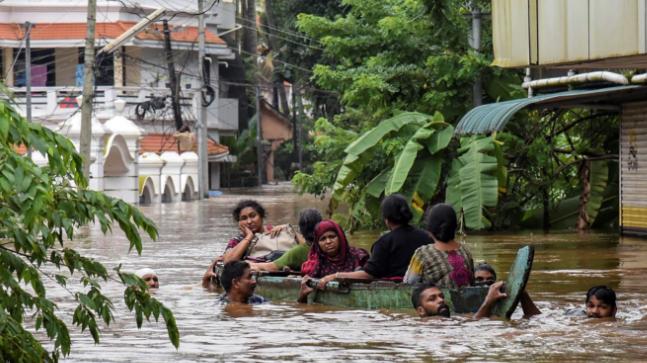
The south Indian State of Kerala has been going through a calamity of unimaginable proportions following the unexpected turn in monsoon rains which played havoc with the state’s life and livelihood. Floods and landslides were unprecedented. Displacement too witnessed massive rescue operations and relocation. Nearly a million people are directly affected. It may take several months and years to restore roads, bridges and cultivable lands. Thousands of houses were perished in the disaster. Shops and local markets were completely gutted in many districts.  Rail, road and air transport routes were paralyzed for several days.

The situation being serious, there are persistent calls for declaring it a ‘national disaster.’ Except BJP, all major political parties have made repeated pleas to the Union Government to do so. But the Modi Government is reticent on the issue so far and some of the officials even make technical arguments for not declaring it as ‘national disaster.’

Everyone knows that a mere declaration of such a calamity as ‘National’ won’t serve any purpose. It should be effectively followed up with coordinated action at different levels – from the local, national, regional to international levels.

Regarding the technicality of a declaration, it is true that the National Disaster Management regime does not call for such a conceptualisation of calamities for effective intervention and action. The only conceptualization is in regard to its nature and type. The Disaster Management Act defines a ‘disaster’ in terms of ”a catastrophe, mishap, calamity or grave occurrence in any area, arising from natural or man-made causes, or by accident or negligence which results in substantial loss of life or human suffering or damage to, and destruction of, property, or damage to, or degradation of, environment, and is of such a nature or magnitude as to be beyond the coping capacity of the community of the affected area.” It does not specifically mention the intensity in terms of its locale. However, many officials in Delhi believe that a call for a disaster as ‘national’ is an attempt to shift the onus on the Union Government in terms of burden sharing.  Hence, it is ‘political.’ This is a one-sided view, undeniably.

More than the technicalities, we need to have a collective ‘national’ mind-set in a diverse system like that of India to deal with such eventualities in states located far and wide. When we make such a declaration, it shows a collective social commitment to rescue a state from an impending collapse. It is true that even without an official declaration, other States in India have come up with generous support. However, a declaration will also help the State government seek international support from diverse sources. The reason why some GCC countries have come up with support is that the Keralites constitute a significant proportion in the GCC demographic base.

Admittedly, the central forces such as army, navy, air force, NDRF, CRPF etc have already been put in place at the disposal of the State government and they are effectively working under the State mechanism. That means, we don’t need to hand over the entire thing to the army. These are all for emergency rescue operations. And that is surely the top priority.

More than this, the second stage of ‘recovery operations’ is even vital and it needs well coordinated measures to bring the state back to normalcy. This is important for a state like Kerala which had, long back, earned international acclaim for its human development index, including life expectancy, literacy and education. Recently, even national agencies acknowledged Kerala as the top state in India in governance. Yet, even as the State’s performance in social and governance index remains high, the economy has been on a downturn path due to multiple reasons, including the reverse trends in global commodity trade. Since the demonetization and the introduction of GST regime, the economy has been struggling hard to meet even the basic requirements. This has been accelerated by the reverse trends in Kerala’s migration pay-off. Thousands and thousands of migrants are coming back to Kerala from the GCC countries every month, following the localization drive and austerity measures put in place in these countries. This would have a telling impact on the remittance scenario. The return migrants are already in distress conditions in many places.

Added to the complexity of these problems is the dwindling price of cash crops which constitute a significant percentage of the State’s agriculture sector and economy. What actually happened to the thousands and thousands of hectares of cultivable land in the wake of the disaster is known to everyone. It may take perhaps years for the people to recover their livelihood terrains. Poor and medium level farmers are the hard-hit people here. They lost their houses, farming land and local markets.

Kerala is the most dependent of all states in India for essential commodities such as rice and vegetables, medicines and other items, besides cloths, household articles, electronic and computer items, automobiles etc which sustain its social living standards. All South Indian States supply many of these essential items on a daily basis. These economies also depend on Kerala’s markets and hence they are also likely to lose ground if the state is not recovered immediately. The tragedy is that many of them have laboured for several months to make a reasonable income for the whole year through sales during the Onam season. They are literally shattered. More than 6 lakh people are already shifted to emergency camps. Nearly a million people are directly affected. Another three to four million people will have to bear the consequences at the secondary level. The number of people indirectly affected will be several millions. It’s not an exaggeration of numbers given the dependent nature of the social and economic exchange relations in Kerala.

The situation really calls for a coordinated action on the part of the State and Union Governments. The Union Government should also make an appeal to international agencies, including the UN to provide humanitarian assistance for the thousands of displaced people to restore their habitat.

The author is Professor, School of International Relations and Politics, Mahatma Gandhi University, Kerala.  The details of his profile are available @ http://kmseethi.com/ Prof Seethi can be reached at kmseethimgu@gmail.com

19 August 2018

Source: https://countercurrents.org/2018/08/19/why-the-calamity-in-kerala-is-a-national-disaster/

Jordan: Staunch Western Ally, Angry And Confused

Text and Photos: Andre Vltchek

Where precisely,is Jordan now? Is it with the West, or with the Arab world? How independent is it, really, and what future lies ahead?

Recently, in the middle of the capital city – Amman – several sleek 5-star hotel towers grew towards the sky, including the trendy “W” and Rotana. Dressed to kill women from the Gulf, wearing high heels and suggestive make up, are now sipping cappuccinos in various cafes at the posh new pedestrian area called The Boulevard. Saudi men can be seen downing pints of beer and carafes of wine. It is a scene not unlike that commonly observed in Bahrain. The Gulf now comes to Amman to escape strict regulations, to play, to be careless, to enjoy life. Some people travel here for medical treatment, staying in overpriced private hospitals which resemble 4-star hotels more than medical facilities.

But predominately, here in Amman, it is all about fashion, about food and drinks, about showing off and being seen – the entire area doesn’t have one single decent bookstore (there is only a tiny kiosk at the entrance to the Abdali Mall), art cinema or a concert hall.

Unlike Beirut, with its vibrant international art scene and thirst for knowledge, Amman’s affluent residents and visitors are obsessed with consumerism. With half-closed eyes, The Boulevard could be located in some smaller city of Texas or Georgia.

*

Just a few kilometers away, at Al-Basheer Hospital (the biggest public medical facility in the country), doctors are on strike. They are exhausted, underpaid and depressed. Only emergency cases get treated. Blood is on the floor, patients look resigned.

I get pushed away as the Health Minister makes his visit with his entourage.

Ambulances keep howling, bringing casualties.

“Quality of public medical services in this country is appalling,” I am told by one of the patients.

I talk to two Syrian ladies who are waiting here with a sick boy. One of them laments:

“We had to travel here all the way from Al-Azraq. We are not insured in this country, and even UNHCR does not help us, when we are facing medical emergencies. We went to a private clinic where a simple series of tests cost us 300 JD (US$428). We are here now. It is uncertain whether we will be treated at all. We are totally desperate.”

Soon after, a plain-clothed cop begins interrogating me. “Do I have a permit to ask questions at the hospital?” I don’t. After I leave, two police officers try to intercept me. Pretending that I don’t understand, I smile like an idiot and they let me go.

*

In Jordan, people are afraid to talk. To be precise, they do talk inside their homes and cars, or in the backrooms of their offices, but not in public. They hardly ever give their full names.

In 2018, Jordan ‘exploded’ on various occasions. In February, riots broke in the city of Al-Salt, over the proposed 60% price hike of bread, but also over the increase of electricity and fuel prices as well as the cutting of subsidies for basic goods and services.

The infamous and brutal IMF structural adjustment had been gradually implemented in Jordan, which was suffering from a stagnating economy and bizarre misappropriation of funds. In 2017, Jordan’s recorded government debt stood at $32 billion, equivalent to 95.6% of the country’s GDP.

In June, massive protests shook the capital, Amman. Protesters were demanding the change of the government. They were outraged by planned tax hikes and the rapidly declining standard of living. They also called for the end of endemic corruption among government officials.

Scores of people were arrested.

In July, the government resigned, and King Abdullah asked Omar al-Razzaz, a former World Bank economist, to form a new government.

People dispersed. They were told that they had won, but almost nothing changed.

“Let me explain: before they were, for instance, threatening to introduce a 15% tax on cars,” my driver in Amman explained. “Now what they will do is introduce a tax hike of 5% this year and 10% in 2019. Everything is the same.”

In a desperate settlement, Kufrain Village, near the River Jordan and Dead Sea, a baker at Alihsan Bakery was much more outspoken:

“We don’t trust the government: new or old. They are all the same bullshitters.

The riots? Change of government? Don’t make me laugh: so-called ‘riots’ were organized and led by intelligence officers and by the government itself. They manipulated people. This government does precisely the same things as the previous one, but with the new alphabetic order.”

A day earlier, I had heard precisely the same lament from an upper-class Jordanian lady whom I met on the bank of the Jordan River, while visiting the Bethany Beyond Jordan Site (great opportunity to photograph fortified border with Israeli occupied Palestine (OPT).

She explained, cynically and in perfect English:

“Jordanian people had enough; this time they were ready to overthrow the regime in Amman. The elites knew it. They organized riots, made them look real but relatively orderly, then changed a few political players at the top, while saving the system. People felt that they won, but in fact, nothing changed, whatsoever”.

Jordan is a staunch ally of the West. Its ‘Elites’ are unconditionally pro-US.

The country has been, for decades, betting on collaboration with NATO.

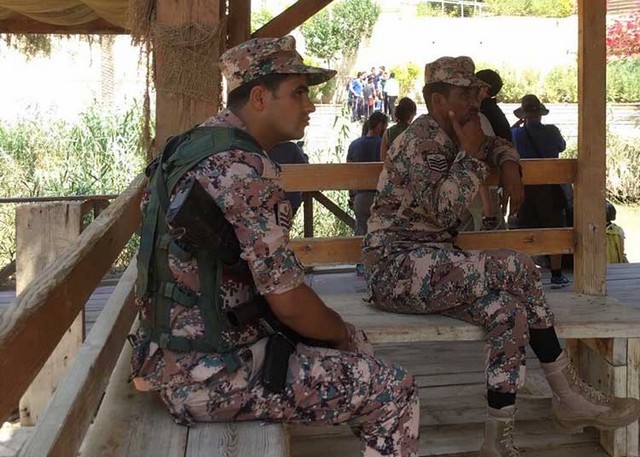
It hosts several deadly military and air force bases of various Wester countries, the most lethal being Al-Azraq, where part of the war planes that were previously situated at the Turkish airbase Incerlik, have recently been re-located.

British and US Special Forces have been, for years, invading the Syrian state, from Jordanian territory.

Functioning as a service station of the West, has been securing the main income of the country and to its ‘elites’, but not necessarily to its people. Very little or nothing has been invested into science, research or production. It is all about the military bases, malls for the expats, medical tourism for the rich Gulf citizens, few maquiladoras, and of course the main privately own component of the local economy – tourism (some 14% of the GDP and growing).

Tourism primarily benefits the big Western hotel chains and is consistently ruining the fragile ecosystem of the Dead Sea and lately, the Gulf of Aqaba. At the same time, the Al-Azraqair force base is destroying and draining the precious water reserves of the desert oases.

Official unemployment in Jordan now stands around 18% but is in reality much higher.

The border with Syria remains closed, so cheap goods cannot come in (relatively poor Jordan is periodically ranked as the most expensive country to live in the Arab world).

The country is presently ‘hosting’ 670,000 Syrian refugees, although some are now determined to return home. The refugees (many of them live in despicable conditions and face various types of discrimination) are yet another source of foreign funding for Jordan, but on the streets of Amman, people keep complaining that ‘Syrians take jobs from the local people’. That does not prevent Jordanians from importing cheap labor from poor countries like the Philippines and Kenya. No matter how stretched and impoverished, Jordanians are not ready to do ‘dirty jobs’.

*

I spoke to a curator at the modest Jordan National Gallery of Fine Arts. There, a surreal and post-modernist installation called “Factory” was trying to shock by avant-garde forms and, it appeared to me, by very little substance.

The National Gallery was desperately empty; people were most likely somewhere else, in cafes, malls or pubs.

I asked the curator whether she was planning to show some artwork depicting the recent riots, or to get to the core of what triggered the recent wave of desperation.

She looked at me, horrified:

“No, why? Of course not!”

I asked whether there is at least one gallery in Amman, that is reacting to the events?

“No,” she almost shouted at me. She was very angry. I was trying to understand, why?

It never pays to be a Western colony, in the Arab world or anywhere else. Some individuals or a group of people may get filthy rich, but the rest of the population will struggle. It will become ‘irrelevant’.

While neighboring Syria is winning its epic battle against the terrorists implanted there by the West and its allies, Jordan is living the sad reality of some Central American semi-colony of the United States.

Here, almost all ideology had been neutralized. Not even dreams of pan-Arab socialist unity that had been shaping, for decades, both Syria and Iraq, could be traced here.

Nobody in Jordan appears to be happy. Some complain, some don’t, but there are no concrete proposals on how to change the pro-Western regime.

In the meantime, the posh Boulevard area is ‘protected’ by metal detectors and guards, uniformed and plain-clothed. Hotels are turning into fortresses. Now even to enter some cafes at the Boulevard, one has to go through a second stage of security, including robust metal detectors. Amman is an extremely safe city. I wonder:

“Is it in order to stop terrorism? Or, perhaps, is it to prevent poor and desperate people from entering and seeing with their own eyes that the foreign interests and local collaborators are robbing them of their own country?”

I ask aloud. My local friend does not reply. In Jordan, there are some questions that should never be asked.

*

[First published by NEO – New Eastern Outlook]

Andre Vltchek is a philosopher, novelist, filmmaker and investigative journalist.

17 August 2018

Source: https://countercurrents.org/2018/08/17/jordan-staunch-western-ally-angry-and-confused/

Facebook censors Telesur and Venezuela Analysis

By Andrea Lobo

Monday evening, the English language page of the television network Telesur, which is published by the Venezuelan government, was taken down by Facebook in a direct act of censorship of content critical of US government policy. After administrators received a notice that the Telesur English page had violated Facebook’s “Terms of Use,” the page reappeared two days later, with Facebook claiming, in an unserious and unconvincing manner, “that there was instability on the platform, which caused this problem, but now everything should be in order.”

The Facebook page of another media outlet aligned politically with the Venezuelan government, Venezuela Analysis, which is based in New York, was also temporarily taken down on August 9, only four days before, for allegedly violating “Facebook Pages Terms.” The site’s administrators, however, have not received any explanation about the suspension.

Since last year, Facebook has been carrying out a campaign to censor information and perspectives at odds with the official narrative of the US government by expunging, intimidating and threatening users that publish such content. Facebook has justified these actions by charging users with arbitrary terms like being “divisive,” “extremist” and “inauthentic,” while not presenting any evidence to substantiate these charges.

The administrator of the popular Facebook page Revolution News, James Wood, received a “publishing authorization” request—a threat to shut down the page unless Wood confirmed his country location by August 28—seconds after posting an article about the removal of the Telesur English page. Several other Facebook pages that publish content critical of US policy, including Anti-Media, have reported receiving the same notice.

On July 31, Facebook announced that it was deleting 32 pages, including an event page promoting an anti-fascist demonstration and the page of a group organizing a rally against Trump’s separation of undocumented families, both in Washington D.C. The Atlantic Council, a think tank tied to the US intelligence apparatus that has been working closely with Facebook in conducting its censorship campaign, charged, without presenting any evidence, that the pages removed sought to advance “Russian information operations” and “to trigger standoffs between genuine Americans, bringing the risk of real-life violence from false stories.”

Such censorship measures, however, seek only to block the development of opposition to US militarism, the government’s fascistic attacks against immigrants, police violence, inequality, and other forms of social reaction.

While some of the pages censored by Facebook pertained to far-right groups, such as that of Alex Jones in the United States and accounts of the Free Brazil Movement, these steps seek fundamentally to establish the precedent for attacking freedom of speech and expanding censorship against left-wing political views and movements.

On the same day Telesur was suspended, Trump signed into law the National Defense Authorization Act, which defines a “United States-based foreign media outlet” as one that “produces or distributes video programming … that is transmitted, or is intended for transmission, by a multichannel video programming distributor to consumers in the United States,” suggesting that the outlet doesn’t need to be physically based in the US.

It adds that such an outlet would be considered a foreign agent and be required to provide the Federal Communications Commission with a description of its relationship with any foreign government.

News commentators have suggested that the Qatar-based Al Jazeera will be the first target. However, in the case of Telesur, US Attorney General Jeff Sessions received a letter from South Carolina Republican Congressman Joe Wilson in February requesting that he investigate whether Telesur can be required to register as a foreign agent. Last November, the network RT America, which is also critical of US foreign policy and receives funding from the Russian government, was forced to register as a foreign agent.

While not an independent media outlet, Telesur has reported critically on the catastrophes wrought by US foreign policy around the world. Currently, the Trump administration is escalating the use of trade war measures, economic sanctions, regime-change operations and military confrontations to advance US geopolitical interests worldwide, pushing entire economies off the abyss, including in Venezuela, Turkey, and Iran, and destroying entire societies, as in Yemen, Libya, Syria and Iraq.

Created in 2005, Telesur is based in Caracas, Venezuela, and is financed directly by the governments of Venezuela, Cuba, Bolivia, Nicaragua and Uruguay. The Argentine and Ecuadorian states stopped funding the network after the election of right-wing governments more closely aligned with Washington, respectively those of Mauricio Macri and Lenín Moreno.

The censorship by Facebook of the Chavista media outlets comes amid an intensified campaign by Washington to undermine the Venezuelan government of Nicolás Maduro. The US government has imposed economic sanctions against the financial operations of individual military and government officials and PDVSA, the state oil company, the main source of government income, deepening the social catastrophe in the already crisis-ridden economy.

In a statement last week, Venezuela Analysis inferred that Facebook’s suspension was a response to its recent coverage of the apparent drone assassination attempt against Maduro on August 4. Two days before being temporarily censored, the site charged the Venezuelan opposition, “its northern masters and the latter’s regional puppets,” with responsibility for the incident.

Meanwhile, top US administration officials have held increasingly frequent meetings this year with Latin American leaders to strengthen military ties, highlighting in each session efforts to coordinate further actions against the Maduro government, with reports that Trump himself has suggested to regional presidents a direct military intervention to overthrow the Venezuelan government.

As the crisis in Venezuela deepens, the Maduro administration has become increasingly dependent on loans from Chinese and Russian firms in exchange for shares in PDVSA and its subsidiaries and rights to exploit the petroleum deposits in the Orinoco River Basin, the largest in the world. Not only would US-based oil conglomerates like to regain control over these vast resources, but the Pentagon has made explicit its priority of undermining the economic interests of Beijing and Moscow in region, considering them “revisionist powers” that challenge the US-led international order.

The specific provision in the recent Defense Authorization Act calling for the identification of “foreign” media outlets that distribute content to “consumers in the United States” is significant. As opposition to capitalism, and interest in socialism and militancy grow among workers and youth in the United States, the ruling corporate and financial oligarchy fears above all a massive mobilization against the domestic and foreign policy of US imperialism.

In response, it has moved ever more aggressively to censor left-wing, progressive, socialist and anti-war media outlets, targeting, in particular, the World Socialist Web Site.

While this process has been spearheaded by the US intelligence and political establishment, regimes across the world, including the Maduro government in Venezuela, have been implementing their own online censorship against political opposition, with the collaboration of the same technology corporations.

This underscores the urgent and essential character of the fight against internet censorship and for the defense of all democratic rights as the international working class enters into struggle against the policies of the capitalist ruling class.

Originally published in WSWS.org

17 August 2018

Source: https://countercurrents.org/2018/08/17/facebook-censors-telesur-and-venezuela-analysis/

China’s dystopian rule over a Muslim minority

By Ishaan Tharoor

Beijing has long made it difficult to report in Xinjiang, a far-flung region along its mountainous borders with Pakistan and other countries in Central Asia. The foreign journalists who manage to make it there find themselves tracked by local security forces and burdened by the constant risk of endangering the sources they contact.

But this past week, senior Chinese officials were compelled to publicly account for what is taking place in Xinjiang. A Geneva-based panel of United Nations human-rights experts issued a report alleging that as many as 2 million people may have been forced into a vast network of detention camps there.

Xinjiang, the panel argued, has turned into “something resembling a massive internment camp, shrouded in secrecy, a sort of no-rights zone,” where Chinese authorities were seeking to “re-educate” its Muslim minorities. Those are chiefly Uighurs, a Turkic Muslim minority native to the region, but also ethnic Kazakhs, Kyrgyz and others.

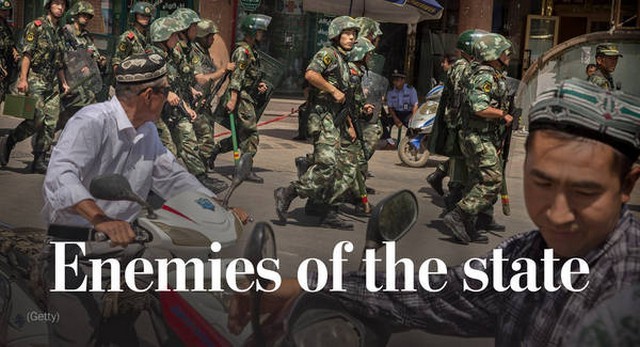
The report suggested that Beijing views Muslims in Xinjiang as suspect “enemies of the state,” bent on terror and insurgency. “Inside the camps, detainees are bombarded with propaganda, forced to recite slogans and sing songs in exchange for food, and pressured to renounce Muslim practices,” noted an editorial on Wednesday in The Washington Post. “A statement released by Chinese dissidents last week said torture in the centers is common, as are deaths. In all, the campaign is the largest and most brutal repression the regime has undertaken since the Cultural Revolution. It rivals the ethnic cleansing Myanmar has conducted against the Muslim Rohingya minority, which has received far more attention.”

The Chinese delegation sent to Geneva flatly rejected these claims. “The argument that 1 million Uighurs are detained in re-education centers is completely untrue,” said Chinese delegate Hu Lianhe, according to the Associated Press. He added that “there is no suppression of ethnic minorities or violations of their freedom of religious belief in the name of counterterrorism.”

But not even Chinese officials can deny the scope of their efforts there, which it portrays as a response to a spate of terrorist violence and riots over the past decade. A few years ago, President Xi Jinping called for “nets spread from earth to sky” — that is, a vast surveillance apparatus — in the region. Now, those living in the region cope with checkpoints and police informants, strict online censorship and constant government snooping.

Suspected Islamists detained in these camps are seen as “infected by an ideological illness,” as a recent communique from Xinjiang’s Communist Party Youth League put it. In Geneva, Hu warned that “those who are deceived by religious extremism … shall be assisted through resettlement and education.”

For China’s authoritarian leadership, the mantra of stability is paramount. When my colleague Emily Rauhala reported on the experiences of ethnic Kazakhs who had been swept into these camps, the Chinese foreign ministry insisted that “the overall situation of Xinjiang society is stable, the momentum of its economic development is good and ethnic groups live in harmony.”

Xinjiang may be on China’s geographical margins, but it’s at the heart of a lot of history. It was the crucible of Turkic culture, the original homeland of languages and peoples that spread to the shores of the Mediterranean. Its dusty Silk Road caravan towns, ringed by desert and mountains, were for centuries literal crossroads of commerce and civilizations.

But the region has rarely sat easily within the borders of China (it was first seized by the Qing dynasty in the 18th century). Cities like the historic oasis of Kashgar once felt more culturally akin to Kabul or Baghdad to the west than Beijing to the east. In recent years, though, China has gone to great lengths to subdue any trace of Uighur separatism. It bulldozed large sections of Old Kashgar — an architectural gem at the center of Uighur identity — and suppressed native languages spoken by Uighurs, Kazakhs and others in favor of Chinese.

Rights groups have protested Beijing’s increasingly draconian rule in Xinjiang, which has grown alongside China’s 21st-century prowess in surveillance technologies. According to one estimate, though the region comprises just 2 percent of China’s population, it accounted for more than a fifth of all arrests carried out in the country last year. And the Chinese dragnet now extends across borders, with officials threatening the relatives of Uighurs living abroad and disappearing Uighur academics who return from overseas.

“Under a new party boss, Chen Quanguo, appointed in 2016, the provincial government has vastly increased the money and effort it puts into controlling the activities and patrolling the beliefs of the Uighur population,” noted the Economist earlier this year, describing what it called “apartheid” with Chinese characteristics. “Its regime is racist, uncaring and totalitarian, in the sense of aiming to affect every aspect of people’s lives. It has created a fully-fledged police state. And it is committing some of the most extensive, and neglected, human-rights violations in the world.”

“We are really talking here about a humanitarian emergency,” said Adrian Zenz, a specialist on Xinjiang who lectures at the European School of Culture and Theology in Berlin, to the New York Times. China’s dystopian rule over its Muslim minorities

But while the deprivations of the Uighurs and other minorities are comparable to those faced by the Rohingya of Myanmar, the plight of the former receives far less global attention. And even as the citizens of dozens of majority-Muslim countries clamor for the freedom of Palestinians or Kashmiris, significantly less noise is made about the situation in Xinjiang.

All the while, China seems to be weaponizing its own form of majoritarianism at a time of heightened nationalism around the world. “The C.C.P., once quite liberal in its approach to diversity, seems to be redefining Chinese identity in the image of the majority Han — its version, perhaps, of the nativism that appears to be sweeping other parts of the world,” wrote James Millward, a noted historian of Xinjiang. “With ethnic difference itself now defined as a threat to the Chinese state, local leaders like Chen feel empowered to target Uighurs and their culture wholesale.”

17 August 2018

Source: https://www.washingtonpost.com/world/2018/08/17/chinas-dystopian-rule-over-muslim-minority/

Saudi Arabia And Iran Reignite The Oil Price War

By Tsvetana Paraskova

The rivalry between Saudi Arabia and Iran is becoming increasingly evident in the oil pricing policies of the two large Middle Eastern producers. The two countries are currently reigniting the market share and pricing war ahead of the returning U.S. sanctions on Iranian oil.

Saudi Arabia, OPEC’s largest producer, has been boosting oil production to offset supply disruptions elsewhere, including the anticipated loss of Iranian oil supply after U.S. sanctions on Tehran return in early November. The Saudis are also cutting their prices to the prized Asian market to lure more customers as they increase supply.

Iran, OPEC’s third-largest producer, is trying to convince its oil customers to continue buying Iranian oil despite stringent U.S. efforts to curb Iranian production.

Iran has slashed its official selling prices (OSPs) for all grades to all markets for September, looking to monetize what could be its last oil sales to some markets in Asia before the U.S. sanctions kick in. Tehran cut the prices for its flagship oil grades to more than a decade low compared to similar varieties of the Saudi crude grades, according to data compiled by Bloomberg.

Last week, the National Iranian Oil Company (NIOC) slashed the OSP for the Iranian Light crude grade to Asia by US$0.80 to US$1.20 a barrel above the Dubai/Oman average, used for pricing oil to Asia. The September prices for Iranian Light to Asia are at a 14-year-low compared to the similar Saudi grade sold to the world’s fastest-growing oil market, Bloomberg has estimated.

Earlier this month, the Saudis also slashed the September prices to Asia for their flagship grade, Arab Light, by US$0.70 to US$1.20 a barrel premium over the Dubai/Oman average. The reduction was slightly deeper than expected and the second consecutive monthly cut in pricing. The Saudis cut the prices for all their grades to all markets except for the United States.

Now Iran is also slashing prices for all grades to all markets, with the prices for Iranian Light, Iranian Heavy, Forozan, and Soroush grades to Asia, Northwest Europe, and the Mediterranean all cut by between US$0.50 and US$1.45, depending on the market and grades.

The OSPs for Iranian Heavy and Forozan to Asia were slashed against the similar Saudi grades to their lowest levels since at least 2000, the year in which Bloomberg started compiling the data.

Iranian Light and the Saudi Arab Light for Asia for September are now priced at the same level—US$1.20 a barrel above the Dubai/Oman average.

For the Saudis, the cut is aimed at enticing more buyers in order to take advantage of the refiners in Asia that are looking to cut Iranian oil intake for fear of running afoul of the U.S. sanctions. For Tehran, the cut in prices is an attempt to keep refiners buying by offering yet another incentive for them on top of the extended credit periods and nearly free shipping.

It has also been reported that Iran has started to offer India—its second-biggest oil customer after China—cargo insurance and tankers operated by Iranian companies as some Indian insurers have backed out of covering oil cargoes from Iran in the face of the returning U.S. sanctions on Tehran.

India’s imports from Iran could start to slow from August as some big Indian refiners worry that their access to the U.S. financial system could be cut off if they continue to import Iranian oil, prompting them to reduce oil purchases from Tehran.

The U.S. hasn’t been able to persuade Iran’s biggest oil customer China to reduce oil purchases, but Beijing has reportedly agreed not to increase its oil imports from Iran.

Other relatively large Asian buyers of Iranian oil—South Korea and Japan—are looking for U.S. guidance and (possibly) waivers before deciding how to proceed, but they are currently very cautious and on the lookout for alternative supplies.

Analysts, and reportedly the U.S. Administration itself, currently expect the sanctions to remove around 1 million bpd from the oil market.

Considering the intensity of efforts by the U.S. to cut off as much Iranian oil exports as possible, it is unlikely that even Iran’s significant discounts to Asian customers will save the country’s oil exports.

By Tsvetana Paraskova for Oilprice.com

Link to original article: https://oilprice.com/Energy/Oil-Prices/Saudi-Arabia-And-Iran-Reignite-The-Oil-Price-War.html

15 August 2018

Source: https://countercurrents.org/2018/08/15/saudi-arabia-and-iran-reignite-the-oil-price-war/

Two Knockout Blows to US Imperialism: De-Dollarization and Hypersonic Weapons

By Federico Pieraccini

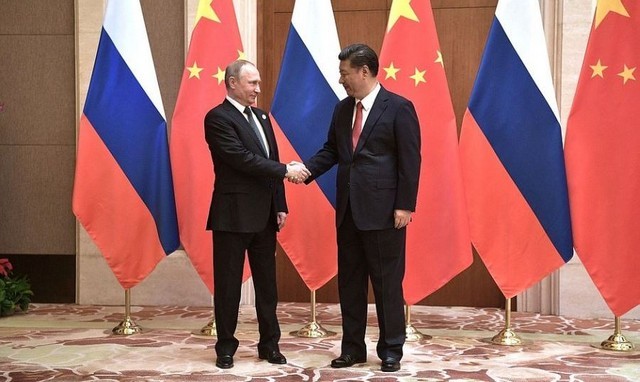
In the current multipolar world in which we live, economic and military factors are decisive in guaranteeing countries their sovereignty. Russia and China seem to be taking this very seriously, committed to the de-dollarization of their economies and the accelerated development of hypersonic weapons.

The transition phase we are going through, passing from a unipolar global order to a multipolar one, calls for careful observation. It is important to analyze the actions taken by two world powers, China and Russia, in defending and consolidating their sovereignty over the long term. Observing decisions taken by these two countries in recent years, we can discern a twofold strategy. One is economic, the other purely military. In both cases we observe strong cooperation between Moscow and Beijing. The merit of this alliance is paradoxically attributed to the attitude of various US administrations, from George Bush Senior through to Obama. The special relationship between Moscow and Beijing has been forged by a shared experience of Washington’s pressure over the last 25 years. Their shared mission now seems to be to contain the US’s declining imperial power and to shepherd the world from a unipolar world order, with Washington at the center of international relations, to a multipolar world order, with at least three global powers playing a major role in international relations.

The Sino-Russian strategy has shown itself over the last two decades to consist of two parts: economic clout on the one hand, and military strength on the other, the latter to ward off reckless American behavior. Both Eurasian powers have their respective strengths and weaknesses in this regard. If Russia’s economy can hardly be compared to China’s, China plays second fiddle to Russia’s conventional and nuclear deterrents, and is quite some way behind Moscow in terms of hypersonic weapons. The cooperation between Moscow and Beijing aims to synergize their respective strengths.

Economic sovereignty

Both de-dollarization and the development of hypersonic weapons serve the purpose of defending both countries’ sovereignty. Economic sovereignty entails, among other things, elimination of dependence on the US dollar, the abandonment of an international banking system based on the SWIFT payment system, the inclusion and increase in the share of the yuan in the basket of international currencies, the reduction of dollar-denominated public debt, the constant accumulation of gold, and, of course, the elimination of any residual debt with international institutions that are part of the world governance model controlled and manipulated by Washington for its own interests.

Beijing, rather than seeking to replace the central role of the United States, seeks instead to expand its influence in existing organizations like the International Monetary Fund (IMF), the Bank for International Settlements (BIS), the World Bank, and the World Trade Organization (WTO).

From an economic point of view, the international order is very similar to a duopoly rather than anything multipolar, without forgetting that the European Union has an important role to play should it regain some form of sovereignty by freeing itself from dependence on Washington. For Moscow and Beijing, reducing public debt is one of the best ways of achieving strong economic sovereignty. The Russian Federation has reduced its public debt in relation to GDP from 92% at the beginning of 2000 to 12.9% today. The People’s Republic of China, over 20 years, has increased its public debt from 20% of GDP to around 48%. Compared to the public debt of European countries (Italy and Greece are over 120%, France 100%, the EU average is 85%), Japan (240%) and the United States (110%), Beijing and Moscow have paid particular attention to keeping their accounts in order. Another important strategy involves the steady accumulation of gold in the reserves of these two countries.

China and Russia are once again trending in an opposite direction to that of the West. Since 2005, Russia and China have accumulated huge amounts of gold, with the clear intention of diversifying their reserves. Both Moscow and Beijing are among the top 10 countries in terms of gold reserves, with an exponential increase over recent years.

Thanks to a limited public debt, huge quantities of gold, and a progressive reduction in the amount of US government bonds held, Moscow and Beijing have embarked on the path of full economic sovereignty, independent of the US dollar system and strongly protecting themselves against any future financial crises. In this respect, the creation of international financial bodies, to be added to those already existing, has the clear purpose of diluting Washington’s institutional influence over the economic affairs of the world.

A decided acceleration in this general direction was made following the exclusion of the Islamic Republic of Iran from the SWIFT system, a ringing alarm bell for the Eurasian duo. Despite their reduction of public debt and significant de-dollarization, both countries remain dependent on, and therefore vulnerable to, an economic and financial system that orbits around Washington and London. The workaround has therefore been to create two alternative bank-payment systems to SWIFT. In the case of Russia, there is the so-called system for the transfer of financial messages (SPFS), and in China, the Cross-Border Inter-Bank Payments System (CIPS). Initially conceived as a fallback in the event of exclusion from the SWIFT system, the SPFS and CIPS projects currently strongly intertwine with the energy agreements reached in 2015. Moscow’s selling of liquid natural gas (LNG) to Beijing takes place through an international payment system based on Chinese renminbi that is immediately converted into gold thanks through the innovative mechanism inaugurated at the Shanghai Gold Exchange. It is not excluded that these operations could not directly occur through the SPFS or CIPS systems in the future. Never mind the petrodollar system that is one of the main problems that China and Russia face when dealing with the international financial system. Efforts to progressively switch from USD to Yuan in paying oil commodities have been in place for years especially by Beijing.

This is an example of how countries like Russia and China have found ways of circumventing the means used to limit their sovereignty. The inclusion of the yuan in the IMF basket of world reserve currencies is associated with the Chinese strategy of supporting the renminbi for export, reducing the share of the US dollar. The strategy adopted by Moscow and Beijing seems to leave Washington unable to stop the protective measures of these two Eurasian powers.

In practice, we are already beginning to see the effects of this alternative economic world order. The sanctions imposed by Washington and her satraps on Moscow and Tehran are easily circumvented by Russia and Iran, with exchanges denominated in currencies other than the dollar (often gold), or simply through bartering.

China and Russia, with strongly diversified economies, with treasuries chock full of gold, and with minimal public debt, leave very little room for international speculators to have an effect on their domestic economies with actions that amount to financial terrorism.

Being able to minimize the impacts and risks of a new financial crisis, or resist the threats and blackmail of the international bodies steered largely by Washington and London, are the key means of being able to chart an economically independent course and ensure national sovereignty.

The military is the definitive guarantor of sovereignty

Without a clear and inviolable military sovereignty, the economic measures implemented can become ineffective in the event of war. For this reason, China and Russia continue to implement nuclear-weapons strategies, the ultimate and definitive deterrent. Moscow is at least equal to Washington in this regard, just as Beijing is at least equal to Washington in the economic field. China and the United States have an interconnected economy, but in the event of total war, Washington would suffer the greatest damage. The transfer to China of almost all American industry has a cost, and in the case of a complete rupture in relations between the two countries, Washington is well aware of its economic vulnerability to China.

In military terms, the strategy for ensuring territorial sovereignty focuses on certain key areas, namely the defense of airspace and maritime borders, and the ability to discourage any nuclear attack by guaranteeing a second-strike capability.

I have written about this in the past, noting that Russia and China have implemented complex and advanced systems in recent years to close the technological gap with the West, Moscow being at least equal to Washington in this regard, and sharing with Beijing some of its most important innovations. The sale of S-400s to China paves the way for a future joint defense of Eurasian airspace. As the process of union and cooperation between the two countries increases, their respective militaries will have the task of discouraging outside attempts to destabilize the region. This is the reason why the United States sees the sale of the S-400 systems (to Turkey, for example) as a red line not to be crossed. The ability to prevent access to one’s airspace upsets one of Washington’s principal doctrines of war. Without air supremacy and the ability to operate in an uncontested airspace, the American way of war is severely hobbled, it becoming practically impossible for the United States to impose its will militarily.

The second military focus for the Eurasians concerns the defense of their maritime borders, reflecting Moscow and Beijing’s need to keep the US Navy a good distance from their shores. The development of anti-ship weapons has been a priority for Beijing in recent years, as has been the development of islets in the South China Sea to ensure a constant protection of its borders, given the aggressive presence of the US Navy. Beijing aims to create areas of denial for the US military. Initially keeping US forces about 180 miles from their coast, the future intention is to push them even further back, to a distance of about 700 miles, thus obtaining an effective anti-access/area denial (A2/AD) space that prevents any amphibious assault or a maritime blockade of China’s sea lines of communication.

In the same way that de-dollarization represents an economic nuclear weapon in the hands of Russia and China, the development of hypersonic weapons is the linchpin of the Sino-Russian alliance’s ability to defend its territorial sovereignty. I wrote two very detailed articles on these amazing weapons, and so did my colleagues at the Strategic Culture Foundation. It is an exciting topic because for the first time in years, Washington has faced the accomplished fact of its geopolitical adversary’s impressive technological progress. Hypersonic weapons have no present weaknesses, and Moscow is the only country in the world capable of producing and using them. With this new capability, the range of action of the Russian Federation reaches unprecedented levels.

Hypersonic weapons have the crucial advantage of being able to hit mobile or fixed targets with unprecedented speed and power. The ability to obliterate in a matter of minutes a US Navy carrier group or ABM systems in Romania and Poland undoubtedly has a sobering effect on the US military. This is to leave aside the fact that the future S-500 system will have anti-satellite capabilities as well as ballistic-missile defense, and the new SS-28 Sarmat will not be able to be stopped by any current or future ABM system.

With the use of hypersonic weapons (some already operational) and the sophisticated S-400 and S-500 systems, US naval and air power is being strongly challenged. With nuclear weapons, even the Russian first- and second-strike capabilities become impossible for the US to overcome.

It is only a matter of time before hypersonic technology is brought to bear by the People’s Republic of China, probably with Moscow’s crucial assistance. The level of mutual trust and cooperation has never been so high between the two countries, and it is natural for them to collaborate militarily and economically, spurred by their common opponent.

Conclusion

The challenge for Russia and China is complex and ongoing. The transition from a unipolar to a multipolar world order is occurring as we speak, enabled by economic and military sovereignty. The challenge for these two Eurasian countries will be to increase their military and economic power, and correct the obvious imbalances in the current world order, without destroying it.

If this strategy proves successful, it will only be natural to start offering other countries the opportunity to hop onto the Eurasian train, enabling those willing to shift their military, economic and diplomatic leaning from the Atlantic to the Eurasian world. Given the momentous significance of India and Pakistan’s accession to the Shanghai Cooperation Organization as permanent members, it would seem that Moscow and Beijing are on track to eliminating the central role of the United States in international relations in favor of a multilateralism that will benefit everyone.

*

Federico Pieraccini is an independent freelance writer specialized in international affairs, conflicts, politics and strategies. He is a frequent contributor to Global Research.

4 August 2018

Source: https://www.globalresearch.ca/two-knockout-blows-to-us-imperialism-de-dollarization-and-hypersonic-weapons/5649482