Just International

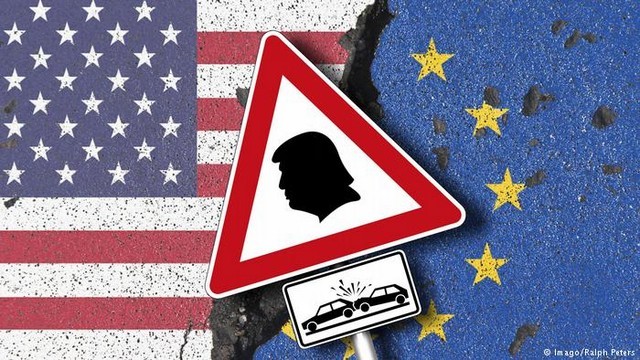
US Trade War with the European Union

By Peter Koenig

Background
Brussels, June 6, 2018 (AFP)
The EU on Wednesday said a raft of retaliatory tariffs, including on whiskey and motorcycles, against painful metals duties imposed by the US would be ready as early as July.

The European Commission, which handles trade matters for the 28-country bloc, “expects to conclude the relevant procedure in coordination with member states before the end of June,” said European Commission Vice-President MarosSefcovic at a news briefing.

This would allow “that the new duties start applying in July,” he added.

“It is a measured and proportionate response to the unilateral and illegal decision taken by the US to impose tariffs on the European steel and aluminum exports which we regret,” said the former Slovak prime minister.

From blue jeans to motorbikes and whiskey, the EU’s hit-list of products targeted for tariffs with the US reads like a catalogue of emblematic American exports.

The European Union originally drew up the list in March but pledged not activate it unless US President Donald Trump followed through on his threat to impose 25 percent tariffs on steel imports and 10 percent on aluminum.

The Trump tariffs came into effect on June 1 and the EU now joins Mexico and Canada and other close allies that have announced their own wave of counter-duties against Washington.

The EU commission must now take their proposal to be signed off by the bloc’s member states amid divisions over what path to take against Trump’s unpredictable policies.

France and the Netherlands back a tough line against the US, while export powerhouse Germany has urged caution towards Trump’s “America First” policies.

PressTV
How do you think this will affect the US? Wouldn’t it create more unemployment in America?

Peter Koenig
First, I think we have to distinguish between the various trade blocks and trade wars, like China, Russia, the NAFTA partner countries, Mexico and Canada – and the European Union – the EU. They are all different in as much as they have different motives.

Second, there is much more behind the so-called trade wars than trade. Much of this trade war is propaganda, big style, for public consumption and public debate, where as in reality there are other negotiations going on behind closed doors.

And thirdly, there are mid-term elections coming up in the US this fall, and Trump must satisfy his home base, all the workers to whom he promised “Let’s Make America Great Again” – meaning bring back jobs, use US-made metals. So, Trump is also addressing those Americans who wait for jobs.As you know the unofficial but real figure of unemployment in the US is about 22% – and that does not even include the large segment of underemployed people, mostly youth.

I think we have to see the Big Picture here. And Trump, or rather those who give him orders, may not see all the risks that this complex multi-polar tariff war implies.

But for now, let’s stick to Europe.
It is very well possible that the EU will also impose import duties on US goods. But if it stays at that, it is very likely that this so-called trade war with the US is pushing Europe even faster than is already happening towards the East, the natural trading partners – Russia and China. As I said, its already happening.

But the Big Picture, in the case of Europe, I believe is IRAN. With tariffs on steel and aluminum – quite sizable tariffs, European producers of these metals, the second largest after China, would hurt. There may not be an immediate replacement market for America.

So, Trump may want to blackmail Europe into accepting his new sanctions on Iran. In other words, “either tariffs or you follow my dictate – abandon the Nuclear Deal and impose sanctions”.

Frankly, I doubt very much that this will work, since EU corporations have already signed billions worth of contracts with Iran. On the other hand, Germany in particular, is keen in renewing political as well as trade relations with Russia.

And the recent remark of the new US Ambassador to Germany, Richard Grenell, that he will support conservative right-wing movements in Germany and in Europe – did certainly not go down well in Germany, with already a Parliamentary movement to expulse him – which certainly doesn’t help US-German relations.

As we speak, most likely this type of “blackmail” negotiations, “either tariffs or you go with us against Iran”, are going on with the EU behind closed doors.

Of course, nobody knows the outcome.
Trump is like a straw in the wind, bending to whatever seems to suit him best at the moment.

Remember, a couple of months ago he already imposed tariffs on Europe, along with everybody else, on steel and aluminum, then he lifted them again – and now we are on again. It’s like with most everything he does. It’s probably his business negotiation strategy.

But, this would just confirm, that this trade war is much more than meets the eye, more than a trade war – it’s about geopolitics – like “show me your card – which camp are you in?”

Trump and those who manage him may still be under the illusion of the last 70 years, that the whole world, especially Europeans, have to bend over backwards to please the US of A, because they saved Europe – and the world – from the Nazi evil.

Not only is it time to stop the vassalage and become autonomous again, but also, many European start understanding that whom they really have to thank for liberating them from the Nazis – is Russia.

Peter Koenig is an economist and geopolitical analyst.

7 June 2018

Source: https://countercurrents.org/2018/06/07/us-trade-war-with-the-european-union/

Putin Asserts: World Imperialism Faces Difficult Times

By Farooque Chowdhury

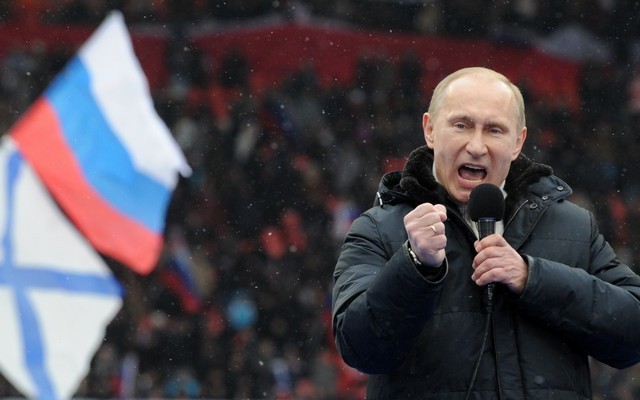
Putin’s latest assertion signals that the world imperialism is going to face tough days in future.

Vladimir Putin, the Russian president, said: “Either Russia is a sovereign country, or there is no Russia.”

The world imperialism is not habituated to listen to such assertions. It’s also a tough message to hirelings of the world imperialism. The masters and their lackeys have to review self-positions, both strategic and tactical, in light of Putin’s latest assertion: Not at the cost of sovereignty.

Putin was speaking to Chinese TV prior to his China visit. His statements, observations and claims are worth-reading.

The Russian president said: “And, of course, the Russian people will always opt for [a sovereign Russia]. I think the Chinese people will too. We have no other option.”

The statement shows the compulsion the world imperialism has created for Russia, for China, and for countries facing imperialist “friendship” – “sermons”, demands, pressures, interferences, intervention, conspiracies. Thence, these countries “have no other option” other than asserting sovereignty.

This signifies intensified contradiction within countries, and between countries as the world imperialism will not accept assertion of sovereignty by countries, which will lead imperialism to organize/renew/intensify conspiracy, subversion, interference and intervention. The world imperialism is going to boost up its old hirelings, hire new lackeys, engage them, and create subversion, social disturbance, “civil” disobedience, political turmoil, internal strife.

Referring to sanctions, Putin said: However harsh they may be, will not force Russia to abandon its independent stance in the world, Russians will never accept trade-offs at the expense of sovereignty.

Putin specifically mentioned the world imperialism’s target: The Russian economy. He added an extra note: The sanctions will eventually backfire on those who followed the US’ lead in “punishing” Russia.

Now, it’s the countries following their masters’ lead to consider whether to take into account assurances from their masters or to heed to Putin. It’s not in terms of pronouncements, but in terms of economic measures – trade, etc., and tradeoff.

To countries in Europe that depend on Russia to many extents including gas from the rising power, the question of being a follower of the world imperialism or not bears one type of action and consequence. To peripheral countries facing imperialist mastery, the question bears another type of measures.

To the first group, there’s question of collaboration/amalgamation of capitals. There are collusion, cooption, or, competition. There is collusion in one area while competition in another. Now-a-days, it’s an intricate arithmetic, or an amalgamation of arithmetic, algebra and geometry.

To the peripheral group, the question is different. It’s different from two aspects: from the aspect of ruling elites, and from the aspect of people. And, the two bear different meanings. In this case, the mathematics turns more intricate as opposing interests – of the ruling elites’ and of the people – are to operate within a reality of competing capitals trying to strengthen/establish respective grip. At the same time, for both the opposing interests, there’s a common ground – a space to maneuver. Then, the question comes: Which capital is the biggest/direst threat? None will differ: It’s the dominating imperialist camp.

The US-led sanctions against Russia hurt a number of economies in Europe. A number of European state leaders including Austrian vice-chancellor Heinz-Christian Strache have expressed opinion not favoring the sanctions. The new government in Italy also bears similar position.

The EU is not happy with its US friends on the issue of US-introduced import tariffs on steel and aluminum – a gift from a friend. It’s the imperialist system’s one of the inherent problems – components’ interests very often move in incoherent way. It also creates scope for peripheral economies.

The Putin-assertion case turns difficult for the world imperialist order as the Russian leader is close to the Chinese leader Xi Jinping.

Putin has described Xi Jinping as a “reliable partner and good friend”.

Their friendship is so strong that once they celebrated Putin’s birthday together: “Chairman Xi Jinping is the only one among all the world leaders, to have celebrated my birthday with me,” Putin said, referring to his 61st birthday, which he marked at the 2013-Asia-Pacific Economic Cooperation meeting in Bali.

Putin termed Xi Jinping as “very accessible”, “very sincere”, “very reliable”, “good friend”, “good analyst”, “it is interesting to discuss outstanding international issues, economy problems with him”, “we always strive to fulfill our obligations”.

This expression of friendship carries strong signal for all: enemy and ally. China is to be counted. It’ll be foolish to ignore China. And, it’ll be foolish to ignore the Putin-Xi friendship.

Putin informed: China is and will continue to be Russia’s number one foreign trade partner.

China is Russia’s largest trading partner. Trade between the two countries grew last year, according to Putin, to $87 billion, and the first four months of 2018 its growth “equaled the figure for the whole of last year.” It’s already a 30 percent increase. In 2016, the trade turnover between the two countries was $69.52 billion. Putin expressed the desire to accelerate it further.

There is possibility of alliance between China-led One Belt, One Road and Russia-led the Eurasian Economic Union.

The two countries are bypassing dollar and other western currencies, and trying to make settlements in ruble and yuan. In 2017, nine percent of payments for supplies from Russia to China were made in rubles, and Russian companies paid 15 percent of Chinese imports in the renminbi.

The two close strategic partners are coordinating their moves on regional and global issues, helping safeguard each other’s national interests, and supporting each other in taking up larger roles on the world stage.

General Wei Fenghe, China’s defense minister, said at the recently concluded Moscow International Security Conference:

“I am visiting Russia […] to show the world a high level of development of our bilateral relations and firm determination of our Armed Forces to strengthen strategic cooperation.”

The Chinese military leader added: The visit is “to show Americans the close ties between the Armed Forces of China and Russia, especially in this situation. We’ve come to support you.

“The Chinese side is ready to express with the Russian side our common concerns and common position on important international problems at international venues as well.

Wei said: The strengthened military cooperation between the two is important for international peace and security.

Reciprocating similar attitude General Sergei Shoigu, Russian defense minister, said: “The efforts of the leadership of the both countries […] today has reached principally new unprecedented level, and have become a critical factor in keeping peace and international security.”

The message is explicit. And, the message is for all. It’s for those facing imperialist disturbance and threat, and for those searching for sources of benefit from their imperialist masters. The message is also for the greatest imperialist power: The days of unilateral dominance is going to be over.

Dmitri Trenin, director, Carnegie Moscow Center, writes in his Should Fear Russia We? (November 2016):

“[M]ore of Russia’s natural and military-technological resources would be made available to China. […I]n the larger scheme of things concerning the world order, Beijing and Moscow will be on the same side.”

The scholar adds:

“The Greater Eurasia that they are constructing will not be run from a single center, but their continental entente will essentially be aimed at limiting US dominance on the edges of the continent and in the world at large.”

Coming days will hear more tough words, which will signal more complicated moves on the world stage.

Farooque Chowdhury writes from Dhaka.

7 June 2018

Source: https://countercurrents.org/2018/06/07/putin-asserts-world-imperialism-faces-difficult-times/

Pompeo’s Demands On Iran At Odds With Reality

By Seyed Hossein Mousavian

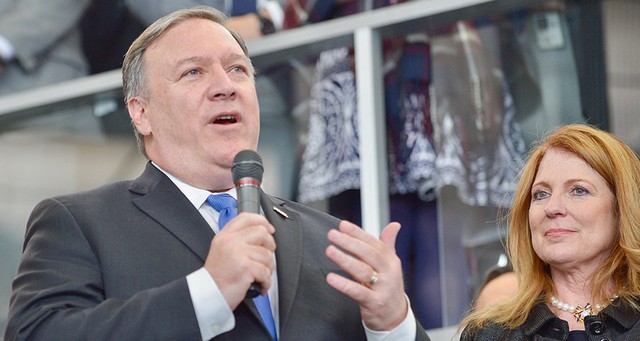
Secretary of State Mike Pompeo laid out a list of demands on Iran in a speech threatening to “crush” the country on Monday. His bellicose words come weeks after President Donald Trump pulled the United States out of the Iran nuclear deal and are nothing short of an ultimatum demanding Iran’s total surrender to U.S. wishes.

“Sanctions are going back in full effect, and new ones are coming,” Pompeo declared, “The Iranian regime should know this is just the beginning.”

Pompeo’s twelve demands reflect a misunderstanding of Iranian foreign policy, international law, and the realities of the region.

The 12 Demands—Rebutted

First, Pompeo contended that Iran must “declare to the IAEA a full account of the prior military dimensions of its nuclear program.” However, as part of the nuclear deal (Joint Comprehensive Plan of Action or JCPOA), the International Atomic Energy Agency (IAEA) resolved the issue of “possible military dimensions” to Iran’s nuclear program after years of investigation, including visits to military sites. In December 2015, the agency issued its “final assessment on past and present outstanding issues regarding Iran’s nuclear program.”

Second, Pompeo called on Iran to “stop uranium enrichment and never pursue plutonium reprocessing,” including “closing its heavy water reactor.” Such a demand is in direct contravention to the nuclear Non-Proliferation Treaty (NPT), which allows signatories to develop the nuclear fuel cycle for civilian purposes, including enrichment.

As an NPT member, Iran has developed a uranium enrichment program, as have other states such as Brazil, Argentina, and Japan. Iran’s enrichment program was also recognized by UN resolution 2231, which endorsed the JCPOA.

Third, Pompeo stated that “Iran must also provide the IAEA with unqualified access to all sites throughout the country.” With the JCPOA, Iran has already accepted the highest standards on nuclear transparency in the history of nonproliferation. This includes accepting the safeguards agreement, additional protocol, and subsidiary arrangement 3.1.

Fourth, Pompeo said that Iran “must end its proliferation of ballistic missiles and halt further development of nuclear-capable missiles.” As arms control experts at organizations such as the International Institute for Strategic Studies have explained, none of Iran’s modern missiles is designed to be “nuclear capable.” Importantly, the context of Iran’s missile program is its falling victim to Iraqi missiles during the eight-year Iran-Iraq War, when Iran did not have the means to deter Iraq. Indeed, no nation in recent history has fallen victim to missile attacks as thoroughly as Iran has. Furthermore, ballistic missiles are a conventional armament that Iran has a strategic need to develop, especially to balance the threat posed by Israel’s nuclear-tipped missiles and Saudi Arabia’s long-range Dong Feng-3 missiles and, moreover, as a deterrence to possible U.S. attack.

Fifth, Pompeo called on Iran to “release all U.S. citizens … detained on spurious charges or missing in Iran.” In this regard, Pompeo should respect that Iran is a sovereign country, just like the United States. His demand is just as illegitimate as if Iran asked the United States to release all Iranian prisoners held in U.S. jails.

Sixth, Pompeo said that Iran “must end support to Middle East terrorist groups, including Lebanese Hizballah, Hamas, and Palestinian Islamic Jihad” even though these organizations represent major constituencies with legitimate grievances. In the case of Hamas and Hezbollah, they both have participated in and won in elections, with the later most recently making gains in Lebanon’s parliamentary elections.

Of course, Trump himself recently quipped that U.S. regional allies such as the UAE, Saudi Arabia, and Qatar fund terrorism, adding that “we’re stopping it.” In June 2017, former Qatari Prime Minister al-Thani also acknowledged that Qatar, along with the United States and other regional countries, made “mistakes” in “supporting the same groups” in Syria, among which were “extremists.”

Seventh, Pompeo stated that “Iran must respect the sovereignty of the Iraqi government and permit the disarming, demobilization, and reintegration of Shia militias.” This demand is ironic given that the United States currently has thousands of troops in Iraq, and a coalition headed by Hadi al-Ameri, a popular militia commander, came in secondplace in Iraq’s parliamentary elections. Senior Iraqi officials have recognized that without Iranian support, the Islamic State (ISIS or IS) “would be standing on the doorsteps of Baghdad.”

By positioning himself against the Popular Mobilization Units (PMUs), which are not monolithically Shia and were created after a fatwa by Iraq’s Grand Ayatollah Ali Sistani after IS overran large parts of the country in 2014, Pompeo has aligned the United States against the Iraqi people, not Iran.

Eighth, Pompeo asserted that Iran must “end its military support for the Houthi militia and work towards a peaceful political settlement in Yemen.” From the beginning of the Saudi-led coalition assault on Yemen in 2015, which the United Nations says has createdthe “world’s worst humanitarian crisis,” Iran has called for a political solution to the conflict. In April 2015, Iranian Foreign Minister Javad Zarif issued a four-point plan that outlined a negotiated settlement to the conflict.

Ninth, Pompeo stated that “Iran must withdraw all forces under Iranian command from Syria.” Iranian forces, just like Russian forces, are in Syria at the invitation of the legal Syrian government to combat armed rebel groups. Only the Syrian government can ask for their withdrawal. On the other hand, U.S. forces are in Syria illegally under international law, and Pompeo’s demand further infringes on Syria’s right to fight terrorist groups and to defend its sovereignty.

Tenth, Pompeo said that “Iran must end support for the Taliban and other terrorists in Afghanistan and the region, and cease harboring Al Qaeda.” To accuse Iran of supporting groups such as the Taliban and al-Qaeda is baseless, given that Iran has actively fought the ardently anti-Iranian groups, both of which were for years the main proxies for U.S. allies such as Saudi Arabia in Afghanistan. Both were also a direct outcrop of U.S.-backed forces in Afghanistan in the 1980s, which former Secretary of States Hillary Clinton recognized in 2011, stating: “The people we are fighting today we funded 20 years ago.”

Eleventh, Pompeo stated that Iran “must end the IRGC Quds Forces’ support for terrorists and militant partners.” The Quds Force’s mandate is the same as U.S. Central Command (CENTCOM) in the region. The difference is that Iran is in the region and has core national security interests to protect its borders and territorial integrity, while CENTCOM is operating thousands of miles away from American borders.

Twelfth, Pompeo said that Iran must “cease its threatening behavior against its neighbors.” He left out more than a little bit of history, such as how Saddam Hussein’s Iraq, an Arab country, invaded Iran in 1980 and received full support from the United States and most Arab states, including Saudi Arabia. The conflict cost hundreds of thousands of Iranian deaths and injuries. The reality is that the United States attacked Iraq, Afghanistan, and Libya—sowing widespread instability and turmoil in the region.

What Pompeo Really Wants

Pompeo’s list of demands simply recycles many of the same coercive policies and statements made by past U.S. administrations. This U.S. approach has already proved to be counterproductive and self-defeating for U.S. interests and regional stability.

Despite Pompeo’s faux call for diplomacy, his speech amounted to an official declaration of a regime-change policy against Iran. His untenable demands eliminate the prospects for U.S.-Iran diplomacy and set the two countries up for a dangerous escalation cycle that may lead to a catastrophic war.

What the world needs is genuine diplomacy. Since the Iranian nuclear crisis was the only regional crisis resolved through diplomacy, this model needs to be used to diplomatically resolve other regional crises.

Seyed Hossein Mousavian is a Middle East security and nuclear policy specialist at Princeton University, former spokesperson for Iran in its international nuclear negotiations, and author of “Iran and the United States: An Insider’s View on the Failed Past and the Road to Peace.” @HMousavian

22 May 2018

Seymour Hersh’s Memoir Is Full of Useful Reporting Secrets

By Matt Taibbi

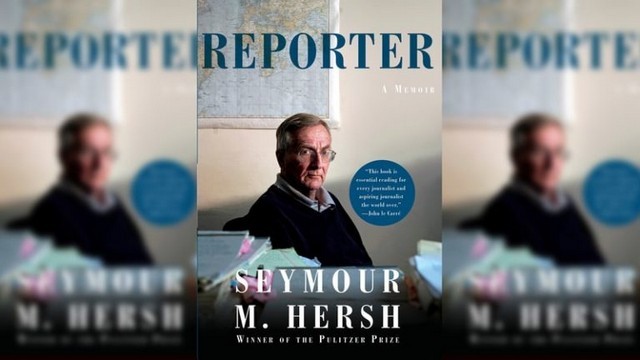
31 May 2018 – Late in his new memoir, Reporter, muckraking legend Seymour Hersh recounts an episode from a story he wrote for the New Yorker in 1999, about the Israeli spy Jonathan Pollard.

Bill Clinton was believed to be preparing a pardon for Pollard. This infuriated the rank and file of the intelligence community, who now wanted the press to know just what Pollard had stolen and why letting him free would be, in their eyes, an outrage.

“Soon after I began asking questions,” Hersh writes, “I was invited by a senior intelligence official to come have a chat at CIA headquarters. I had done interviews there before, but always at my insistence.”

He went to the CIA meeting. There, officials dumped a treasure trove of intelligence on his desk and explained that this material – much of which had to do with how we collected information about the Soviets – had been sold by Pollard to Israel.

On its face, the story was sensational. But Hersh was uncomfortable. “I was very ambivalent about being in the unfamiliar position of carrying water for the American intelligence community,” he wrote. “I, who had worked so hard in my career to learn the secrets, had been handed the secrets.”

This offhand line explains a lot about what has made Hersh completely embody what it means to be a reporter. The great test is being able to get information powerful people don’t want you to have. A journalist who is handed something, even a very sensational something, should feel nervous, sick, ambivalent. Hersh never stopped feeling that way, remaining an iconoclast and a thorn in the side of officialdom to this day.

Hersh became famous in the late-’60s and early-’70s, at a time when the country was experiencing violent domestic upheaval and investigative reporters were for the first time celebrated like rock stars.

Hersh was best known back then for his reporting on American atrocities in Vietnam, in particular the massacre of hundreds of unarmed Vietnamese in the village of My Lai. The story did a great deal to puncture the myth of American beneficence in Southeast Asia.

A significant theme of Hersh’s work is that Americans are human beings, not immune from the horrific temptations of power that throughout history have afflicted and shamed those who have dominion over others.

For this, he has often been denounced as a traitor. In advance of a speech at Tulane in the wake of My Lai, for instance, the Times-Picayune called him a “communist sympathizer” and ran an editorial literally bordered in red protesting his appearance (de-platforming was a thing even then).

Being “more than a little pissed off at the cheap shot” (an unerring sense of pissed-off-edness is another of Hersh’s gifts), he gave the speech at Tulane and decided to improvise “with a purpose in mind.”

The room was full of Vietnam vets. Hersh asked if anyone in the audience had been a helicopter pilot in a certain Vietnamese province in 1968 or 1969. A man came onstage. Once Hersh reassured him that he had no interest in his name, he asked the soldier what chopper pilots sometimes did to “cope with the rage.”

The soldier, while claiming he didn’t do it personally, said he knew what Hersh was talking about. The practice involved spotting a civilian farmer on the way back after a mission, flying low and attempting to decapitate the fleeing figure with rotor blades. The crews would have to land short of the base to “wash the blood off the rotors.”

“I did not like what I did to the vet, who was stunningly honest,” he writes, “but I wanted to get back, in some way, at the Times-Picayune.”

Bob Woodward and Carl Bernstein of the Washington Post will be remembered by history as the “whiz kids” who cracked Watergate, but Hersh also wrote 40 front-page articles on the affair for the Times in the space of months. Many of those pieces “[moved] the needle closer to the president,” as he puts it here.

Hersh and Woodward in particular will likely forever be linked in a Magic-Bird sort of way. The two reporters continued after the Vietnam and Watergate years to crank out heavy tomes full of secrets about everyone from Henry Kissinger (in Hersh’s case) to CIA chief Bill Casey (in Woodward’s), solidifying reputations as the country’s top investigative reporters.

But Hersh and Woodward represented two starkly different approaches to the job. Woodward is the quintessential access journalist, able to write books like Bush at War that seem to place the reader practically inside the Oval Office during crucial moments in history.

But Woodward’s information often came from the very celebrity politicians who were chief characters in these books. Piecing together these insider versions of history, probably recounted over expensive lunches off the Mall, was a more institutionalized version of “being handed the secrets.”

Hersh, on the other hand, has had success mining the middle and lower ranks of agencies. He constantly keeps an eye out for sources among the lesser-known (but still powerful) officials who are leaving the game. Many of these techniques are detailed in Reporter.

“One of my quirks,” he writes, “has been to keep track of the retirement of senior generals and admirals; those who did not get to the top invariably had a story to tell in explaining why.”

He even watches for obituaries, which often let slip surprising information about the pasts of, say, deceased CIA operatives. And he will call wives or relatives and search for information that way.

Hersh, in other words, works from the edges inward, developing a grapevine of faceless sources that in turn generate rumors and stories of things he isn’t supposed to know – a secret program to recover a sunken Russian submarine, an incident of soldiers using fire ants to torture a terror suspect – anything.

These techniques were very much on display during the post-9/11 years. Hersh put out a spate of some of the most impactful reporting on the War on Terror, lifting a lid on some of America’s most barbaric practices. The Abu Ghraib stories were the best known, and the inside tale of how those came to light is told here.

Hersh learned a great deal from a three-day visit in Damascus with an Iraqi general who’d “retired” after the Iraq army was banned. The general was making a living selling vegetables from his garden when he decided to reach out to old U.N. contacts about troubling things he’d seen and heard about. This ex-general ended up in touch with Hersh and told many “sad tales, mostly secondhand, of the horrors of the American occupation.”

He described American soldiers raiding houses and robbing the inhabitants (many Iraqis kept their savings in dollars). He described tales of arrestees who were set free for a kickback. And he told of a regime of abuse in American detention centers so horrific that men would “write to their fathers and brothers and beg them to come kill them in jail.”

Much of this couldn’t be confirmed easily, but the tales squared with reports from human rights groups. Besides, Hersh writes, “his account also smelled right” (having a sense of who is and is not lying is a key skill, often the difference between giving up and continuing to dig). Hersh kept at it and uncovered a key internal report about the abuse, and his New Yorker story was an international sensation that changed the course of another war.

An interesting side-note is that Hersh was instrumental in getting the story out before his own story ran. He knew that 60 Minutes had photos of the Abu Ghraib abuse and was “skittish” about publishing them “after being urged by the Bush administration not to do so.” Hersh, in his inimitable pain-in-the-ass way, called a CBS producer on the story and essentially told her that if CBS didn’t run the story soon, “I would have no choice but to write about the network’s continuing censorship in the New Yorker.”

The photos aired in the next 60 Minutes broadcast, and Dan Rather – who, Hersh knew, had been fighting to get the story out – made a point to say on air that CBS only published when they learned other media had the story.

“It wasn’t hard to guess that he had been ordered to make such an asinine excuse for an important news story,” Hersh writes.

Hersh was also among the first to describe a burgeoning American assassination program that to this day is poorly understood.

Within weeks of 9/11, for instance, Hersh quoted a “C.I.A. man” claiming the U.S. needed to “defy the American rule of law… We need to do this – knock them down one by one.” He later reported on the existence of a “target list” and cited an order comparing the new tactics to El Salvadoran execution squads, reporting that much of this was going on without Congress being told.

Despite his reputation for irascibility and for troubled relationships with editors, it shines through in the book that he always felt tremendous loyalty to people like Abe Rosenthal of the Times and David Remnick of the New Yorker, and to the great organizations they represented.

But, as Hersh puts it in the end, “Investigative reporters wear out their welcome… Editors get tired of difficult stories and difficult reporters.”

At the end of Reporter, he recounts his falling out with the New Yorker. Hersh says he became concerned when he heard Remnick was planning on writing a biography of new president Barack Obama.

Earlier in his career, Hersh himself had actually worked for the campaign of antiwar Democrat Eugene McCarthy. And he himself liked candidate Obama. But this was a church-and-state issue. He had a thing about wearing two hats at once.

Regarding Remnick’s relationship to Obama, he writes:

“I had learned over the years never to trust the declared aspirations of any politician, and was also enough of a prude to believe that editors should not make friends with a sitting president.”

Ultimately, Hersh and the New Yorker fell out over the story of the assassination of Osama bin Laden. The magazine – with the input of then-Obama counter-terrorism adviser John Brennan – ended up running the “inside” account of the operation much as the Obama administration has always told it.

Hersh, meanwhile, had sources indicating a very different version of bin Laden’s end, one in which the U.S. killed bin Laden with the assent of the Pakistani intelligence agency ISI, which had had him in captivity for years.

In the end, Hersh was forced to publish his account in the London Review of Books, which is where he’s been publishing on and off ever since.

The journalism business is undergoing radical changes. Media figures are more famous than ever before, but those with the biggest profiles tend to be associated with one particular political demographic.

The job in many quarters has devolved into feeding captive audiences a steady stream of revelations framed to fit their preconceived ideas about the world, in order to keep them coming back. From Fox to MSNBC, the slant of programming has become more predictable, because audiences hate surprises and dislike being challenged.

As Hersh puts it, in such an environment, one of the first casualties is investigative reporting, “with its high cost, unpredictable result, and its capacity for angering readers…”

Hersh’s career is a tribute to the pursuit of the “unpredictable result.” We used to value reporters who were willing to alienate editors and readers alike, if that’s the way the truth cut. Now, as often as not, we just change the channel. This has been bad for both reporters and readers, who are losing the will to seek out and face the unpredictable truth.

When it comes time for the next generation of journalists to re-discover what this job is supposed to be about, they can at least read Reporter. It’s all in here.

Matt Taibbi is a contributing editor for Rolling Stone.

4 June 2018

Source: https://www.transcend.org/tms/2018/06/seymour-hershs-memoir-is-full-of-useful-reporting-secrets/

“Sympathy Is Not Enough”

By Richard Falk

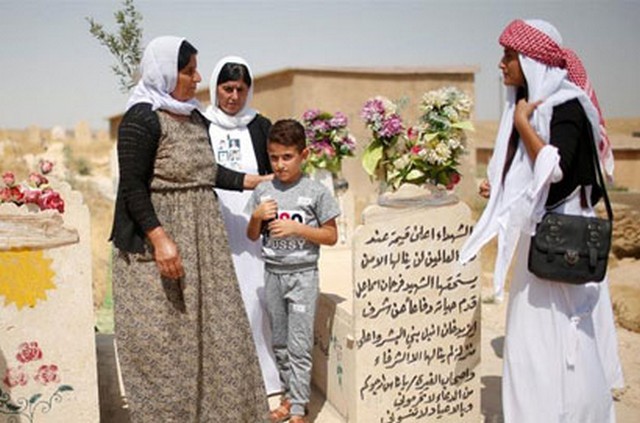
1 Jun2018 – Ten days ago, while attending the opening ceremony of a conference in Vienna commemorating the 25thanniversary of the Vienna Declaration ofHuman Rights, I was struck by the simple words and sad demeanor of Nadia Murad, a Yazidi survivor of ISIS captivity featuring sexual slavery and institutionalized rape. [For an illuminating commentary on the Yazidi ordeal see Cathy Otten, “Slaves of Isis: the long walk of the Yazidi women,” The Guardian, 25 July 2017]

Nadia Murad’s words contained a single message: “Sympathy is not enough. Sympathy does not create change. We need action.” Her manner as a speaker was exceptionally calm, her intonation almost without inflection. Her words were enveloped in an aura of resignation and despair, but her talk avoided the shocking details of her experience, the details where horror resides. I grasped her words as they were being spoken as the gentlest of indictments. Her meaning came across. Empathy although welcome, does not save lives. Sympathy does not stop crimes against humanity. Action might. Action could be relevant. Action was not forthcoming when needed by the Yazidi communities in northern Iraq.

Her words were a muted cry for help, but after the fact. It is true that understanding must precede action, but most of us are content to brood over the human condition that let’s such brutality pass almost unnoticed. Despite the War on Terror the Yazidis were compelled to depend on their own meager resistance capabilities to survive to tell their latest story of abuse, and survival.

The Yazidis are an old syncretist religion that draws inspiration from Christianity via baptism, Islam via circumcision, and Zoroastrianism via fire. The religion is not theological. Its main practices consist of visiting sacred places and telling stories of their endurance and affliction. The ethnicity of Yazidis is primarily Kurdish, and they accept neither converts nor dilution of Yazidi identity (if a Yazidi marries outside the religion, it is assumed she or h has converted). The Yazidis were often persecuted by the Ottoman Empire as an infidel sect, somewhat similar to the perception of Bahi’as by Iran after 1979. The Yazidis number less than one million, many fleeing to Europe and elsewhere after the ISIS takeover of their region. The long history of the Yazidi people is one of struggle, persecution, and persistence of which this latest phase is perhaps the most excruciating.

Listening to the soft-spoken Arabic words of Nadia Murat I could not refrain from thinking of Palestinian suffering. Sympathy for Palestinians is widespread these days in response to the Jerusalem embassy move by the United States and IDF massacre of unarmed Palestinian demonstrators at the Gaza fence, yet still far less intense than Palestinian prolonged suffering and subjugation deserves. Action on their behalf remains anemic, and is subject to social, and even legal, pushback, even punishment. Israel shirks   responsibility. Israeli leaders offer allegations and inducements intended to distract onlookers, and heaps denunciation on those who do choose to act, however mildly.

Nadia Murad’s words were best heard as a non-accusatory lament, although inevitably also a commentary on the human condition: So long as evil is bold and good is pacified by its benign intentions, genocides will continue to happen. The Genocide Convention is there waiting to be implemented in more than a dozen places, but who among the movers and shakers of this world cares enough to lift a finger?

I believe that is what Nadia Murad’s brave witnessing was trying to teach us during her brief remarks in Vienna.

Richard Falk is a member of the TRANSCEND Network, an international relations scholar, professor emeritus of international law at Princeton University, author, co-author or editor of 40 books, and a speaker and activist on world affairs.

4 June 2018

Source: https://www.transcend.org/tms/2018/06/sympathy-is-not-enough/

The Palestinian Struggle: In Memory of Razan al-Najjar

By Orly Noy

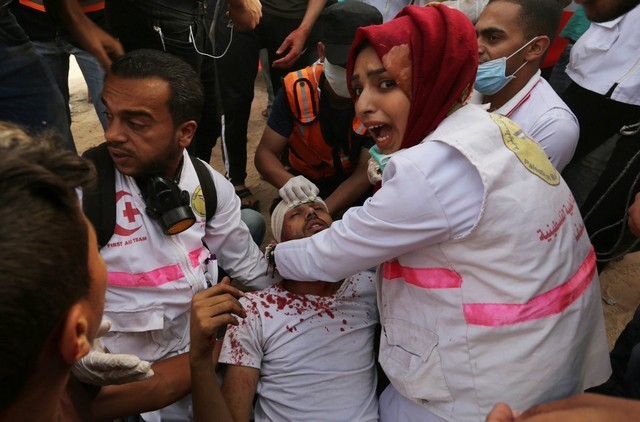
The 21-year-old paramedic was shot and killed by Israeli soldiers while trying to aid wounded protesters near the Gaza-Israel separation fence. Many Israelis either refuse to believe she was actually killed or claim that her killing was somehow justified.

Around two weeks ago, a Facebook friend of mine proposed an experiment to a small group of us. Social media has become a boxing ring, she said. The two sides, left and right, dig into their positions and slug it out in the comments — and that’s if they don’t just “block” each other. My friend suggested that for a month, we try to engage in a productive dialogue with right-wingers on Facebook, even with the most combative of commenters. After all, our aim is to change what and how people think, and to do that, we need to speak to other side. Let’s try it, I said, if only for a month — to see what happens.

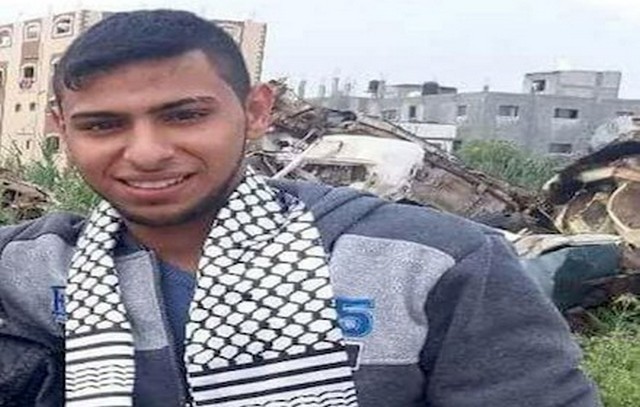
For the past two days, I’ve been thinking about Razan al-Najjar, the 21-year-old paramedic shot and killed by Israeli soldiers Friday near the Gaza-Israel separation fence. According to witnesses, she was wearing her white paramedic’s uniform, attempting to treat protesters near the fence when she was shot. Immediately following Razan’s death, her picture appeared everywhere on my Facebook newsfeed. I, too, shared a post with her picture.

The angry responses came quickly.

Here was an opportunity to try out the dialogue experiment my friend had suggested, I thought. Maybe because Razan in her white uniform was so different from the image of the terrorist that the Israeli collective imagination assigned the protesters in Gaza, I hoped there would be an opening for compassion, for second thoughts, for a discourse free from blind hatred.

I was wrong.

Instead, the following responses came pouring in:

“What was she doing there in the first place? “Why didn’t she wait for the wounded in the hospital?” “You really think our soldiers kill protesters on purpose?” “That’s how it is in war.” “Hamas makes them to go to these protests.”

I tried to respond with calm, level-headed answers.

She didn’t wait for the wounded at the hospital because the Israeli army’s massive use of live fire made it necessary for first responders to be in the field — just like Israeli medics would at a mass casualty event.

And no, this is not “how it is in war.” Firstly, this is not a war. This is heavily armed soldiers facing down unarmed protesters. Secondly, even in war there are rules, and sniper fire against medics, journalists and children is a war crime. Hamas did not force her to be there, either; numerous interviews with Razan were published in recent weeks in which she explains why she volunteered as a medic during the protests.

Then the more violent responses came, in public and in private messages — bizarre death threats, a lot of toxic invective. What kind of a dialogue is possible when faced with that?

Someone asked,

“How do you know this is true, were you there?”

He added a picture from 2001 suicide bombing of the Dolphinarium, a beach-front nightclub in Tel Aviv, to prove some inexplicable point. Another commenter responded,

“How do you know there was an attack on the Dolphinarium, were you there?”

Another yet claimed that the entire story of Razan was fabricated, that they put a paramedic’s uniform on her body only after she died. No amount of photos showing Najjar treating wounded protesters over the past month could convince him. Palestinians, to him, are liars by definition.

Taken together, the responses reflected the depressing fact that for most of the Israeli public, Palestinians killed by Israeli soldiers are guilty by default. The identity of the deceased or the circumstances of the killing are irrelevant. Many of the commenters who responded to my post made the effort to stress that they were were not right-wingers. One even identified as a supporter of Meretz, the dovish left-wing party.

I gave up on the conversation because it was too frustrating and instead continued to look for interviews conducted with Razan. There are quite a few online. The young medic, it seems, was of significant interest to numerous international media outlets. In one of the interviews, Razan says:

People ask my father what I’m doing here, and getting a salary. He tells them, ‘I’m proud of my daughter, she provides care to the children of our country.’ And because in our society, women are often judged, but society has to accept us . If people don’t want to accept us by choice, they will be forced to accept us. Because we have more strength than any man. The strength that I showed as a first-responder on the first day of the protests — I dare you to find it in anyone else.

After that, I watched a short video of young men and women, perhaps Razan’s friends, perhaps her family members, in tears, their piercing cries announcing her death. One of them held his head and shouted her name over and over again.

I then returned to the comments that had accumulated under the picture of the young woman who went to care for wounded protesters and came back in a shroud. My heart struggled to contain the sadness.

I apologize to my well-intentioned friend. The bitter truth is that the Israeli collective consciousness is light-years away from a place where it can even begin speak about the basic concepts of justice, human rights, and human equality before God. I doubt that years of occupation and moral corruption can be corrected.

I also apologize to Razan, the young Gazan woman who lived her whole life under occupation, more than half under the brutal siege. She did not taste a single day of freedom in her short life. She went out into the Valley of Death by the separation barrier to care for her wounded countrymen and never came back. With shame beyond words, I apologize. Rest in peace Razan, may your memory bring freedom and justice to your people.

Orly Noy is a political activist who has worked in the past through frameworks like the Women’s Coalition for Peace and the Mizrahi Democratic Rainbow.

3 June 2018

US fingerprints all over Nicaragua’s bloody unrest

By William Whiteman

The student-led anti-government movement in Nicaragua is unlike other recent attacks on the Latin American socialist bloc; it emanates mainly from the left of the political spectrum. But that doesn’t mean the US isn’t behind it.

The so-called marea rosa, or ‘pink tide’, of allied leftist governments which held sway across Latin America in previous years is being rolled back. Brazil’s Dilma Rousseff was removed from power in a right-wing coup, co-conspirators of which have now managed to imprison the current presidential frontrunner, Luiz Inacio Lula da Silva. Ecuador’s Lenin Moreno has stabbed his former leader Rafael Correa in the back by barring him from seeking re-election, while seemingly purging his cabinet of remaining Correa loyalists and beginning the process of allowing the US military back into the country. Alongside other democratic and not-so-democratic removals of leftist governments from power, NATO has nabbed itself a foothold in the region, now that Colombia has joined the obsolete yet aggressively expanding Cold War alliance, in a thinly veiled threat to neighboring Venezuela.

And now it’s Nicaragua’s turn under the boot. Again. The student-led anti-government movement in Nicaragua is unlike other recent attacks on the Latin American socialist bloc; it emanates mainly from the left of the political spectrum. But that doesn’t mean the US isn’t behind it.

The so-called marea rosa, or ‘pink tide’, of allied leftist governments which held sway across Latin America in previous years is being rolled back. Brazil’s Dilma Rousseff was removed from power in a right-wing coup, co-conspirators of which have now managed to imprison the current presidential frontrunner, Luiz Inacio Lula da Silva. Ecuador’s Lenin Moreno has stabbed his former leader Rafael Correa in the back by barring him from seeking re-election, while seemingly purging his cabinet of remaining Correa loyalists and beginning the process of allowing the US military back into the country. Alongside other democratic and not-so-democratic removals of leftist governments from power, NATO has nabbed itself a foothold in the region, now that Colombia has joined the obsolete yet aggressively expanding Cold War alliance, in a thinly veiled threat to neighboring Venezuela.

And now it’s Nicaragua’s turn under the boot. Again.

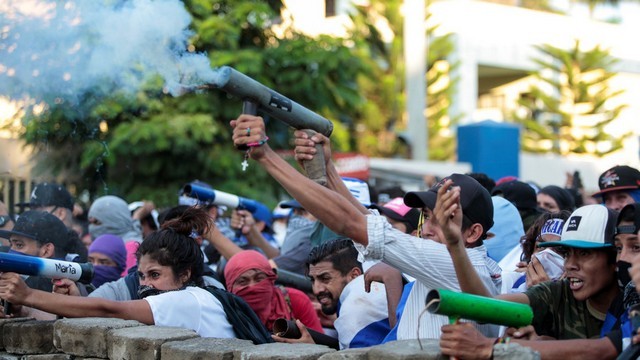
Over 100 people have been killed since unrest broke out in mid April. Student demonstrations began in the capital Managua as a reaction to the country’s failure to handle forest fires in one of the most protected areas of the Indio Maiz Biological Reserve. The situation was then exacerbated when, two days later, the ruling Sandinista National Liberation Front announced it was slashing pensions and social security payments, sparking further anti-government protests. Targeted opposition violence along with police repressions have led to a mounting body count on both sides. Violence persists in the country, despite the fact that President Ortega has now ditched the proposed welfare reforms and has been engaging in talks with the opposition.

The government has adamantly denied it was responsible for snipers killing at least 15 people at a recent demonstration. And, while we may never know what really happened, it’s fair to say an embattled national leadership in the midst of peace talks has little to gain from people being gunned down in front of the world’s media at an opposition march on Mother’s Day. All I’ll say on the matter is it’s not like we didn’t have mysterious sharpshooters picking off protesters during US-supported coups in Venezuela and Ukraine.

With his approval ratings recently reaching as high as 80 percent during the 2017 presidential campaign, Nicaragua’s President Daniel Ortega is far from a dictator. As a Guerrilla leader, Ortega’s leftist Frente Sandinista de Liberación Nacional (FSLN) overthrew Anastasio Somoza Debayle’s brutal regime in 1979, thereby ending the Somoza family dynasty which had ruled Nicaragua since the mid-1930s. The US responded by arming, funding and training right-wing death squads, in an insurgency that would ultimately cost the lives of more than 60,000 people over the course of a decade. While all this was going on, Ortega called a free and open presidential election in 1984 and won with 67 percent of the vote. Under Ortega’s Sandinistas, Nicaragua went through a hugely successful literacy campaign and land reform process.

Ortega was then defeated in the 1990 presidential elections and remained an opposition figure until 2007, when he was reelected. He has been back at the helm of the country now for over 10 years. Despite his Marxist past, Ortega’s embracing of populist politics has seen him pander to conservative religious attitudes. In a country whose national identity has been so shaped in recent history by iconic revolutionary movements, Ortega’s moves to appease the right have alienated some on the left, most noticeably among the nation’s younger cadres.

It is unsurprising then that the US is apparently capitalizing on growing discontent, stoking dissent among the youth in a deliberate attempt to destabilize the Sandinista government. Infamously nefarious US soft power organizations such as the National Endowment for Democracy, also known as the CIA’s ‘legal window’, have set up extensive networks in Nicaragua.

Among the leading Nicaraguan student activists currently touring Europe to garner support for the anti-government movement is Jessica Cisneros. Cisneros is a member of the Movimiento Civico de Juventudes, which is funded by Madeline Albright’s National Democratic Institute (NDI). You remember Albright, right? She’s the former US Secretary of State that said that 500,000 Iraqi Children dying as a result of US sanctions against Saddam Hussein was “worth it”.

According to the NDI’s website, the organization “has partnered with Nicaraguan universities and civic organizations to conduct a youth leadership program, which has helped to prepare over 2,000 current and future young leaders from across the country” in order to improve the “country’s democratic development”.

Joining Cisneros on tour in Europe is Yerling Aguilera. At the time of writing this article Aguilera’s LinkedIn profile has her listed as a former employee and consultant for Instituto de Estudios Estratégicos y Políticas Públicas (IEEPP) in Nicaragua. IEEPP has received extensive funding from the National Endowment for Democracy.

If the idea of Washington supporting progressive anti-government forces in Latin America confuses you, then you’re failing to grasp the nature of US interference. During the Cold War, for example, the US supported both the Mujahideen in Afghanistan as well as eastern European trade unionists against the Soviet Union. Indeed, throughout the Syrian conflict, Washington has been arming leftist groups alongside jihadist organizations. It goes without saying that, despite US politicians getting all dewy-eyed over “freedom fighters,” the likes of Jihadists or even trade unionists are not welcome in US society. Certainly not if they receive foreign funding to carry out anti-government activities.

It’s all well and good saying things like ‘let Nicaraguans decide their future for themselves without foreign interference’, but criticism of Nicaragua’s young activists, based purely on the grounds of their acceptance of foreign backing, misses the point. Doing so ignores the historic fact that the Sandinistas also received extensive foreign support from the Cuban intelligence service (DGI) during the revolution. The difference between the two, however, are the stringent financial and economic conditions that go hand-in-hand with US support. When it comes to Washington backing your fight, there’s no such thing as a free ride.

Ortega’s government is far from perfect, but Nicaragua’s progressive opposition must be made to recognize the dangerous path down which they are leading their country. Yes, on the surface the organizations funding them may well have liberal-sounding mission statements that stress the need to “increase women’s political participation and initiatives to decrease discrimination against LGBTI people”, but they should know the destructive role that Washington non-profit foundations such as the NED or NDI have played around the world. They literally share the same agenda as the CIA.

Nicaraguans struggled against Washington’s subjugation of the country for most of the 20th century. Revolutionary Augusto C. Sandino, whose name Ortega’s Sandinistas incorporated, led an iconic guerilla war against US military occupation of the country between 1927-1933. He was eventually assassinated by the forces of General Anastasio Somoza Garcia (Anastasio Somoza Debayle’s grandfather), who went on to seize power two years later in a military coup. It was through Somoza that Washington first perfected its soft power form of imperialism, breaking with the European military occupation model. Somoza, armed and funded by Washington, crushed all opposition while making himself and his cohorts fantastically rich on the condition that he kept the country open to any and all US financial interests. Washington began to replicate this model all over Latin America, modernizing its tactics from the 80s onwards, all towards fostering corrupt neoliberal governments.

With the David and Goliath-style struggle for freedom and dignity their nation has waged over the years, the tens of thousands of Nicaraguans turning out into the streets for pro-government rallies undoubtedly want to preserve the security and relative prosperity they have known in recent years. Handing the keys of their country back over to Washington negates both of those things.

William Whiteman is an award-winning British war correspondent and political commentator, currently working for teleSUR English in South America.

4 June 2018

Source: https://www.rt.com/op-ed/428718-nicaragua-unrest-us-fingerprint/

Google says it will not renew Project Maven—but collaboration with Pentagon will continue

By Will Morrow

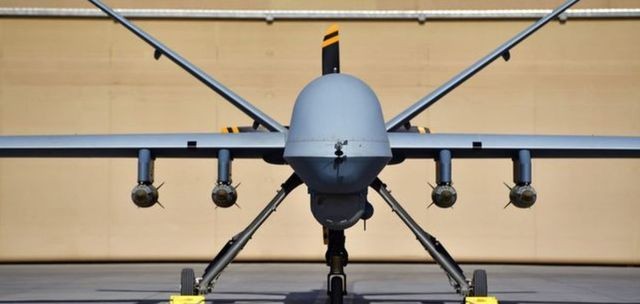
On Friday, Google Cloud CEO Diane Greene announced at a meeting with employees that the company will not renew its contract with the Pentagon for Project Maven following its expiry in 2019. Under the program, which Google entered in September last year, the company has provided the military with artificial intelligence software to perform real-time analysis of drone surveillance footage. The technology allows the Pentagon to develop its illegal drone assassination program that has killed thousands across the Middle East and North Africa.

Yesterday’s announcement is a response to widespread and mounting opposition from Google employees and the public to its collaboration with the military. The program only came to light as a result of opposition by employees, of whom approximately 4,000 have signed an internal petition demanding that Google cancel the project contract and institute a formal policy against taking on future military work.

Around a dozen employees have also resigned in protest. A report published on Tuesday by the New York Times, based on interviews with current and former employees, claimed the program has “fractured Google’s workforce, fueled heated staff meetings and internal exchanges,” and “touched off an existential crisis.” Among the employees who have resigned, one engineer “petitioned to rename a conference room after Clara Immerwahr, a German chemist who killed herself in 1915 after protesting the use of science in warfare.”

The Huffington Post reported yesterday that there were discussions among employees this week for a physical demonstration. An engineer who was due to leave the company on Friday posted on its internal online forum—in a thread titled “Maven conscientious objectors” that includes hundreds of employees—describing Maven as “the greatest ethical crisis in technology of our generation,” and suggesting that employees go to an upcoming Google conference in July with the aim of “making some noise.”

In comments to the World Socialist Web Site, academics Lucy Suchman and Peter Asaro, two of the authors of a recent open letter signed by more than 1,000 academics demanding that Google end its participation in the illegal drone murder program, said they were “gratified to see Google take the decision not to renew its contract for Project Maven, and to make the decision public.” They demanded that Google take “a clear and consistent stand against the weaponization of its technologies.”

“I do think it’s significant, in other words, that there was sufficient resistance inside the company that Google has had to respond, and it’s posed a tangible obstacle to growing relations with the DoD,” said Dr. Suchman. “The fact that those who entered into this contract attempted to do so quietly, if not actually in secret, shows that they anticipated how contested it would be (and then of course went ahead with it anyway).”

While Google claims it will not renew the contract, it will be involved with the project for the rest of the year, and will continue to deepen its intimate collaboration with the Pentagon. The company will also keep bidding for other contracts with the military not directly involving the use of artificial intelligence. Dr. Suchman added, “I suspect they’ll continue to look for ways of sustaining their Pentagon relations and spinning them as benign.”

It should be noted that Google’s previous statements in response to the revelations about Project Maven have been exposed as lies.

Internal emails between Google staff, portions of which were published by the New York Times, Gizmodo and the Intercept over the past three days, show that Google conspired to conceal its role in Project Maven from the beginning.

An email chain including Scott Frohman and Aileen Black—both defense and intelligence sales leads—as well as Dr Fei-Fei Li, the chief scientist for artificial intelligence at Google Cloud, discussed how the company should present the project publicly. Writing under the subject line “Communications/PR Request—Urgent,” Frohman asked for direction on the “burning question” of how the collaboration should be reported.

Li replied on September 24 that Google was “already battling privacy issues when it comes to AI [artificial intelligence] and data; I don’t know what would happen if the media starts picking up a theme that Google is secretly building AI weapons or AI technologies to enable weapons for the Defense industry”—i.e., precisely what Google is doing. Li said the issues would be “red meat” to the media.

Google eventually decided to silence reporting on the collaboration altogether. It also reached a non-disclosure agreement with the Pentagon, requiring that public communications first be approved by Google. Black also noted that the contract was “not direct with Google but through a partner,” ECS Federal, in order to conceal Google’s role.

Greene, who pledged yesterday not to renew the project, has also absurdly claimed that the program cannot be used for “lethal purposes.” This is directly contradicted by an email published yesterday by Gizmodo from Frohman, in which he calls Maven a “large government program that will result in improved safety for citizens and nations through faster identification of evils such as violent extreme activities and human rights abuses”—code words used by the Pentagon for activities justifying drone strikes.

Greene also previously claimed that the project was “small” and only worth $9 million. Another internal email from Aileen Black and published by the Intercept, however, shows the project was expected to grow rapidly, and “as the program grows expect spend is budgeted at 250 M per year.”

The real significance of Project Maven for Google is to secure a foothold into the tens of billions of dollars available in the arms race between the world’s major powers to incorporate Silicon Valley’s technology to develop next-generation weaponry, and to gain a competitive advantage against the other technology giants. The other bidders for the contract included Amazon and IBM.

All three companies, along with Microsoft, are competing to secure a $10 billion contract to build and administer Pentagon Cloud’s computing network. The network has been described by military officials as a “global fabric” for its warfighters. Every submarine, jetfighter, missile launch station and special operations soldier will be connected via computer systems that will be directly administered by one of the giant technology corporations.

The website Defense One reported that unlike Amazon and Microsoft, Google has “kept its own interest” in the contract “out of the press,” and the company has “even hidden the pursuit from its own workers.” Participating in Project Maven allowed Google to receive government clearance to host secure government data on its servers, and to compete for further cloud military projects in the future. Another internal email from Aileen Black called the clearance “priceless” for the company.

Google, along with the other technology giants, is intimately integrated into the US military and intelligence apparatus. Google representatives such as vice president Mike Medin and former Alphabet CEO Eric Schmidt sit on US military advisory boards and discuss the use of their technology for major wars and suppression of domestic political opposition. Google changed its search ranking algorithms in April last year to reduce traffic to and censor left-wing and anti-war websites, including the World Socialist Web Site.

3 June 2018

Source: https://countercurrents.org/2018/06/03/google-says-it-will-not-renew-project-maven-but-collaboration-with-pentagon-will-continue/

Fathi Harb burnt himself to death in Gaza. Will the world notice?

By Jonathan Cook

Fathi Harb should have had something to live for, not least the imminent arrival of a new baby. But last week the 21-year-old extinguished his life in an inferno of flames in central Gaza.

It is believed to be the first example of a public act of self-immolation in the enclave. Harb doused himself in petrol and set himself alight on a street in Gaza City shortly before dawn prayers during the holy month of Ramadan.

In part, Harb was driven to this terrible act of self-destruction out of despair.

After a savage, decade-long Israeli blockade by land, sea and air, Gaza is like a car running on fumes. The United Nations has repeatedly warned that the enclave will be uninhabitable within a few years.

Over that same decade, Israel has intermittently pounded Gaza into ruins, in line with the Israeli army’s Dahiya doctrine. The goal is to decimate the targeted area, turning life back to the Stone Age so that the population is too preoccupied with making ends meet to care about the struggle for freedom.

Both of these kinds of assault have had a devastating impact on inhabitants’ psychological health.

Harb would have barely remembered a time before Gaza was an open-air prison and one where a 1,000kg Israeli bomb might land near his home.

In an enclave where two-thirds of young men are unemployed, he had no hope of finding work. He could not afford a home for his young family and he was about to have another mouth to feed.

Doubtless, all of this contributed to his decision to burn himself to death.

But self-immolation is more than suicide. That can be done quietly, out of sight, less gruesomely. In fact, figures suggest that suicide rates in Gaza have rocketed in recent years.

But public self-immolation is associated with protest.

A Buddhist monk famously turned himself into a human fireball in Vietnam in 1963 in protest at the persecution of his co-religionists. Tibetans have used self-immolation to highlight Chinese oppression, Indians to decry the caste system, and Poles, Ukrainians and Czechs once used it to protest Soviet rule.

But more likely for Harb, the model was Mohamed Bouazizi, the Tunisian street vendor who set himself on fire in late 2010 after officials humiliated him once too often. His public death triggered a wave of protests across the Middle East that became the Arab Spring.

Bouazizi’s self-immolation suggests its power to set our consciences on fire. It is the ultimate act of individual self-sacrifice, one that is entirely non-violent except to the victim himself, performed altruistically in a greater, collective cause.

Who did Harb hope to speak to with his shocking act?

In part, according to his family, he was angry with the Palestinian leadership. His family was trapped in the unresolved feud between Gaza’s rulers, Hamas, and the Palestinian Authority (PA) in the West Bank. That dispute has led the PA to cut the salaries of its workers in Gaza, including Harb’s father.

But Harb undoubtedly had a larger audience in mind too.

Until a few years ago, Hamas regularly fired rockets out of the enclave in a struggle both to end Israel’s continuing colonisation of Palestinian land and to liberate the people of Gaza from their Israeli-made prison.

But the world rejected the Palestinians’ right to resist violently and condemned Hamas as “terrorists”. Israel’s series of military rampages in Gaza to silence Hamas were meekly criticised in the West as “disproportionate”.

The Palestinians of the West Bank and East Jerusalem, where there is still direct contact with Israeli Jews, usually as settlers or soldiers, watched as Gaza’s armed resistance failed to prick the world’s conscience.

So some took up the struggle as individuals, targeting Israelis or soldiers at checkpoints. They grabbed a kitchen knife to attack Israelis or soldiers at checkpoints, or rammed them with a car, bus or bulldozer.

Again, the world sided with Israel. Resistance was not only futile, it was denounced as illegitimate.

Since late March, the struggle for liberation has shifted back to Gaza. Tens of thousands of unarmed Palestinians have massed weekly close to Israel’s fence encaging them.

The protests are intended as confrontational civil disobedience, a cry to the world for help and a reminder that Palestinians are being slowly choked to death.

Israel has responded repeatedly by spraying the demonstrators with live ammunition, seriously wounding many thousands and killing more than 100. Yet again, the world has remained largely impassive.

In fact, worse still, the demonstrators have been cast as Hamas stooges. The United States ambassador to the UN, Nikki Haley, blamed the victims under occupation, saying Israel had a right to “defend its border”, while the British government claimed the protests were “hijacked by terrorists”.

None of this can have passed Harb by.

When Palestinians are told they can “protest peacefully”, western governments mean quietly, in ways that Israel can ignore, in ways that will not trouble consciences or require any action.

In Gaza, the Israeli army is renewing the Dahiya doctrine, this time by shattering thousands of Palestinian bodies rather than infrastructure.

Harb understood only too well the West’s hypocrisy in denying Palestinians any right to meaningfully resist Israel’s campaign of destruction.

The flames that engulfed him were intended also to consume us with guilt and shame. And doubtless more in Gaza will follow his example.

Will Harb be proved right? Can the West be shamed into action?

Or will we continue blaming the victims to excuse our complicity in seven decades of outrages committed against the Palestinian people?

A version of this article first appeared in the National, Abu Dhabi.

Jonathan Cook won the Martha Gellhorn Special Prize for Journalism.

30 May 2018

Source: https://countercurrents.org/2018/05/30/fathi-harb-burnt-himself-to-death-in-gaza-will-the-world-notice/

500 years is long enough! Human Depravity in the Congo

By Robert J. Burrowes

I would like to tell you something about human depravity and illustrate just how widespread it is among those we often regard as ‘responsible’. I am going to use the Democratic Republic of the Congo as my example.

As I illustrate and explain what has happened to the Congo and its people during the past 500 years, I invite you to consider my essential point: Human depravity has no limit unless people like you (hopefully) and me take some responsibility for ending it. Depravity, barbarity and violent exploitation will not end otherwise because major international organizations (such as the UN), national governments and corporations all benefit from it and are almost invariably led by individuals too cowardly to act on the truth.

The Congo

Prior to 1482, the area of central Africa now known as the Democratic Republic of the Congo was part of the Kingdom of the Kongo. It was populated by some of the greatest civilizations in human history.

Slavery

However, in that fateful year of 1482, the mouth of the Congo river, which flows into the Atlantic Ocean, became known to Europeans when the Portuguese explorer Diogo Cao claimed he ‘discovered’ it. By the 1530s, more than five thousand slaves a year (many from inland regions of the Kongo) were being transported to distant lands, mostly in the Americas. Hence, as documented by Adam Hothschild, the Congo was first exploited by Europeans during the Atlantic slave trade. See King Leopold’s Ghost: A Story of Greed, Terror, and Heroism in Colonial Africa.

Despite the horrific depredations of the militarized slave trade and all of its ancillary activities, including Christian priests spreading ‘Christianity’ while raping their captive slave girls, the Kingdoms of the Kongo were able to defend and maintain themselves to a large degree for another 400 years by virtue of their long-standing systems of effective governance. As noted by Chancellor Williams’ in his epic study The Destruction of Black Civilization: Great Issues of a Race from 4500 B.C. to 2000 A.D. the Kingdoms of the Congo prior to 1885 – including Kuba under Shyaam the Great and the Matamba Kingdom under Ngola Kambolo – were a cradle of culture, democracy and exceptional achievement with none more effective than the remarkable Queen (of Ndongo and Matamba), warrior and diplomat Nzinga in the 17th century.

But the ruthless military onslaught of the Europeans never abated. In fact, it continually expanded with ever-greater military firepower applied to the task of conquering Africa. In 1884 European powers met in Germany to finally divide ‘this magnificent African cake’, precipitating what is sometimes called ‘the scramble for Africa’ but is more accurately described as ‘the scramble to finally control and exploit Africa and Africans completely’.

Colonization

One outcome of the Berlin Conference was that the great perpetrator of genocide – King Leopold II of Belgium – with the active and critical support of the United States, seized violent control of a vast swathe of central Africa in the Congo Basin and turned it into a Belgian colony. In Leopold’s rapacious pursuit of rubber, gold, diamonds, mahogany and ivory, 10 million African men, women and children had been slaughtered and many Africans mutilated (by limb amputation, for example) by the time he died in 1909. His brutality and savagery have been documented by Adam Hochschild in the book King Leopold’s Ghost: A Story of Greed, Terror, and Heroism in Colonial Africa which reveals the magnitude of human suffering that this one man, unopposed in any significant way by his fellow Belgians or anyone else, was responsible for inflicting on Africa.

If you want to spend a few moments in touch with the horror of what some human beings do to other human beings, then I invite you to look at the sample photos of what Leopold did in ‘his’ colony in the Congo. See ‘“A Nightmare In Heaven” – Why Nobody Is Talking About The Holocaust in Congo’.

Now if you were hoping that the situation in the Congo improved with the death of the monster Leopold, your hope is in vain.

The shocking reality is that the unmitigated horror inflicted on the Congolese people has barely improved since Leopold’s time. The Congo remained under Belgian control during World War I during which more than 300,000 Congolese were forced to fight against other Africans from the neighboring German colony of Ruanda-Urundi. During World War II when Nazi Germany captured Belgium, the Congo financed the Belgian government in exile.

Throughout these decades, the Belgian government forced millions of Congolese into mines and fields using a system of ‘mandatory cultivation’ that forced people to grow cash crops for export, even as they starved on their own land.

It was also during the colonial period that the United States acquired a strategic stake in the enormous natural wealth of the Congo without, of course, any benefit to the Congolese people. This included its use of uranium from a Congolese mine (subsequently closed in 1960) to manufacture the first nuclear weapons: those used to destroy Hiroshima and Nagasaki. See ‘Patrice Lumumba: the most important assassination of the 20th century’.

Independence then Dictatorship

By 1960, the Congolese people had risen up to overthrow nearly a century of slavery and Belgian rule. Patrice Lumumba became the first Prime Minister of the new nation and he quickly set about breaking the yoke of Belgian influence and allied the Congo with Russia at the height of the Cold War.

But the victory of the Congolese people over their European and US overlords was shortlived: Patrice Lumumba was assassinated in a United States-sponsored coup in 1961 with the US and other western imperial powers (and a compliant United Nations) repeating a long-standing and ongoing historical pattern of preventing an incredibly wealthy country from determining its own future and using its resources for the benefit of its own people. See ‘Patrice Lumumba: the most important assassination of the 20th century’.

So, following a well-worn modus operandi, an agent in the form of (Army Chief of Staff, Colonel) Mobutu Sese Seko was used to overthrow Lumumba’s government. Lumumba himself was captured and tortured for three weeks before being assassinated by firing squad. The new dictator Mobutu, compliant to western interests, then waged all-out war in the country, publicly executing members of the pro-Lumumba revolution in spectacles witnessed by tens of thousands of people. By 1970, nearly all potential threats to his authority had been smashed. See ‘“A Nightmare In Heaven” – Why Nobody Is Talking About The Holocaust in Congo’.

Mobutu would rape the Congo (renamed Zaire for some time) with the blessing of the west  – robbing the nation of around $2billion – from 1965 to 1997. During this period, the Congo got more than $1.5 billion in US economic and military aid in return for which US multinational corporations increased their share of the Congo’s abundant minerals. ‘Washington justified its hold on the Congo with the pretext of anti-Communism but its real interests were strategic and economic.’ See ‘Congo: The Western Heart of Darkness’.

Invasion

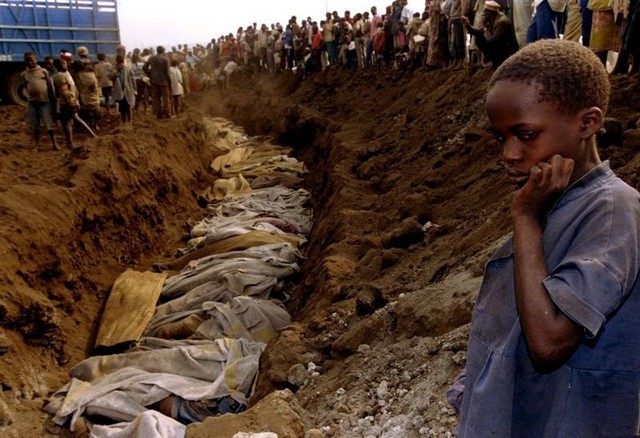
Eventually, however, Mobutu’s increasingly hostile rhetoric toward his white overlords caused the west to seek another proxy. So, ostensibly in retaliation against Hutu rebels from the Rwandan genocide of 1994 – who fled into eastern Congo after Paul Kagame’s (Tutsi) Rwanda Patriotic Army invaded Rwanda from Uganda to end the genocide – in October 1996 Rwanda’s now-dictator Kagame, ‘who was trained in intelligence at Fort Leavenworth in the United States, invaded the Congo with the help of the Clinton Administration’ and Uganda. By May 1997 the invading forces had removed Mobutu and installed the new (more compliant) choice for dictator, Laurent Kabila.

Relations between Kabila and Kagame quickly soured, however, and Kabila expelled the Rwandans and Ugandans from the Congo in July 1998. However, the Rwandans and Ugandans reinvaded in August establishing an occupation force in eastern Congo. Angola, Zimbabwe and Namibia sent their armies to support Kabila and Burundi joined the Rwandans and Ugandans. Thus began ‘Africa’s First World War’ involving seven armies and lasting until 2003. It eventually killed six million people –  most of them civilians – and further devastated a country crushed by more than a century of Western domination, with Rwanda and Uganda establishing themselves as conduits for illegally taking strategic minerals out of the Congo. See ‘Congo: The Western Heart of Darkness’.

During the periods under Mobutu and Kabila, the Congo became the concentration camp capital of the world and the rape capital as well. ‘No woman in the path of the violence was spared. 7 year olds were raped by government troops in public. Pregnant women were disemboweled. Genital mutilation was commonplace, as was forced incest and cannibalism. The crimes were never punished, and never will be.’

Laurent Kabila maintained the status quo until he was killed by his bodyguard in 2001. Since then, his son and the current President Joseph Kabila has held power in violation of the Constitution. ‘He has murdered protesters and opposition party members, and has continued to obey the will of the west while his people endure unspeakable hells.’

Corporate and State Exploitation

While countries such as Belgium, Canada, France, Germany, the Netherlands, South Korea, Switzerland and the UK are heavily involved one way or another (with other countries, such as Australia, somewhat less so), US corporations make a vast range of hitech products including microchips, cell phones and semiconductors using conflict minerals taken from the Congo . This makes ‘companies like Intel, Apple, HP, and IBM culpable for funding the militias that control the mines’. See ‘“A Nightmare In Heaven” – Why Nobody Is Talking About The Holocaust in Congo’.

But many companies are benefitting. For example, a 2002 report by the United Nations listed a ‘sample’ of 34 companies based in Europe and Asia that are importing minerals from the Congo via, in this case, Rwanda. The UN Report commented: ‘Illegal exploitation of the mineral and forest resources of the Democratic Republic of the Congo is taking place at an alarming rate. Two phases can be distinguished: mass-scale looting and the systematic and systemic exploitation of resources’. The mass-scale looting occurred during the initial phase of the invasion of the Congo by Rwanda, Uganda and Burundi when stockpiles of minerals, coffee, wood, livestock and money in the conquered territory were either taken to the invading countries or exported to international markets by their military forces or nationals. The subsequent systematic and systemic exploitation required planning and organization involving key military commanders, businessmen and government structures; it was clearly illegal. See ‘Report of the Panel of Experts on the Illegal Exploitation of Natural Resources and other Forms of Wealth of the Democratic Republic of the Congo’.

For some insight into other issues making exploitation of the Congo possible but which are usually paid less attention – such as the roles of mercenaries, weapons dealers, US military training of particular rebel groups and the secret airline flights among key locations in the smuggling operations of conflict minerals – see the research of Keith Harmon Snow and David Barouski: ‘Behind the numbers: Untold Suffering in the Congo’ and ‘Merchants of Death: Exposing Corporate-Financed Holocaust in Africa; White Collar War Crimes, Black African Fall Guys’.

Has there been any official attempt to rein in this corporate exploitation?

A little. For example, the Obama-era US Dodd-Frank Financial Reform Act of 2010 shone a spotlight on supply chains, pressuring companies to determine the origin of minerals used in their products and invest in removing conflict minerals from their supply chain. This resulted in some US corporations, conscious of the public relations implications of being linked to murderous warlords and child labor, complying with the Act. So, a small step in the right direction it seemed. See ‘The Impact of Dodd-Frank and Conflict Minerals Reforms on Eastern Congo’s Conflict’ and ‘Congo mines no longer in grip of warlords and militias, says report’.

In 2011, given that legally-binding human rights provisions, if applied, should have offered adequate protections already, the United Nations rather powerlessly formulated the non-binding ‘Guiding Principles on Business and Human Rights’.

And in 2015, the European Union also made a half-hearted attempt when it decided that smelters and refiners based in the 28-nation bloc be asked to certify that their imports were conflict-free on a voluntary basis! See ‘EU lawmakers to limit import of conflict minerals’.

However, following the election of Donald Trump as US President, in April 2017 ‘the U.S. Securities and Exchange Commission suspended key provisions of its “conflict minerals” rule’. Trump is also seeking to undo the Obama-era financial regulations, once again opening the door to the unimpeded trade in blood minerals by US corporations. See ‘“A Nightmare In Heaven” – Why Nobody Is Talking About The Holocaust in Congo’ and ‘Trump Moves to Roll Back Obama-Era Financial Regulations’.

Today

Despite its corrupt exploitation for more than 500 years, the Congo still has vast natural resources (including rainforests) and mineral wealth. Its untapped deposits of minerals are estimated to be worth in excess of $US24 trillion. Yes, that’s right: $US24trillion. With a host of rare strategic minerals – including cobalt, coltan, gold and diamonds – as well as copper, zinc, tin and tungsten critical to the manufacture of hitech electronic products ranging from aircraft and vehicles to computers and mobile phones, violent and morally destitute western governments and corporations are not about to let the Congo decide its own future and devote its resources to the people of this African country. This, of course, despite the international community paying lip service to a plethora of ‘human rights’ treaties.

Hence, violent conflict, including ongoing war, over the exploitation of these resources, including the smuggling of ‘conflict minerals’ – such as gold, coltan and cassiterite (the latter two ores of tantalum and tin, respectively), and diamonds – will ensure that the people of the Congo continue to be denied what many of those in western countries take for granted: the right to life benefiting from the exploitation of ‘their’ natural resources.

In essence then, since 1885 European and US governments, together with their corporations and African collaborators, have inflicted phenomenal ongoing atrocities on the peoples of the Congo as they exploit the vast resources of the country for the benefit of non-Congolese people.

But, you might wonder, European colonizers inflicted phenomenal violence on the indigenous peoples in all of their colonies – whether in Africa, Asia, Central and South America, the Caribbean or Oceania – so is their legacy in the Congo any worse?

Well,  according to the The Pan-African Alliance, just since colonization in 1885, at least 25 million Congolese men, women and children have been slaughtered by white slave traders, missionaries, colonists, corporations and governments (both the governments of foreign-installed Congolese dictators and imperial powers). ‘Yet barely a mention is made of the holocaust that rages in the heart of Africa.’ Why? Because ‘the economy of the entire world rests on the back of the Congo.’ See ‘“A Nightmare In Heaven” – Why Nobody Is Talking About The Holocaust in Congo’.

So what is happening now?

In a sentence: The latest manifestation of the violence and exploitation that has been happening since 1482 when that Portuguese explorer ‘discovered’ the mouth of the Congo River. The latest generation of European and American genocidal exploiters, and their latter-day cronies, is busy stealing what they can from the Congo. Of course, as illustrated above, having installed the ruthless dictator of their choosing to ensure that foreign interests are protected, the weapon of choice is the corporation and non-existent legal or other effective controls in the era of ‘free trade’.

The provinces of North and South Kivu in the eastern Congo are filled with mines of cassiterite, wolframite, coltan and gold. Much mining is done by locals eking out a living using Artisanal and Small-Scale Mining (ASM); that is, mining by hand, sometimes with rudimentary tools. Some of these miners sell their product via local agents to Congolese military commanders who smuggle it out of the country, usually via Rwanda, Uganda or Burundi, and use the proceeds to enrich themselves.

Another report on South Kivu by Global Witness in 2016 – see ‘River of Gold’ and ‘Illegal gold trade in Congo still benefiting armed groups, foreign companies’ – documented evidence of the corrupt links between government authorities, foreign corporations (in this case, Kun Hou Mining of China) and the military, which results in the gold dredged from the Ulindi River in South Kivu being illegally smuggled out of the country, with much of it ending up with Alfa Gold Corp in Dubai. The unconcealed nature of this corruption and the obvious lack of enforcement of weak Congolese law is a powerful disincentive for corporations to engage in ‘due diligence’ when conducting their own mining operations in the Congo.

In contrast, in the south of the Congo in the former province of Katanga, Amnesty International and Afrewatch researchers tracked sacks of cobalt ore that had been mined by artisanal miners in Kolwezi to the local market where the mineral ore is sold. From this point, the material was smelted by one of the large companies in Kolwezi, such as Congo Dongfang Mining International SARL (CDM), which is a smelter and fully-owned subsidiary of Zhejiang Huayou Cobalt Company Ltd (Huayou Cobalt) in China, one of the world’s largest manufacturers of cobalt products. Once smelted, the material is typically exported from the Congo to China via a port in South Africa. See ‘“This is what We Die for”: Human Rights Abuses in the Democratic Republic of the Congo Power the Global Trade in Cobalt’.

In its 2009 report ‘“Faced with a gun, what can you do?” War and the Militarisation of Mining in Eastern Congo’ examining the link between foreign corporate activity in the Congo and the military violence, Global Witness raised questions about the involvement of nearly 240 companies spanning the mineral, metal and technology industries. It specifically identified four main European companies as open buyers in this illegal trade: Thailand Smelting and Refining Corp. (owned by British Amalgamated Metal Corp.), British Afrimex, Belgian Trademet and Traxys. It also questioned the role of other companies further down the manufacturing chain, including prominent electronics companies Hewlett-Packard, Nokia, Dell and Motorola (a list to which Microsoft and Samsung should have been added as well). Even though they may be acting ‘legally’, Global Witness criticized their lack of due diligence and transparency standards at every level of their supply chain. See ‘First Blood Diamonds, Now Blood Computers?’

Of course, as you no doubt expect, some of the world’s largest corporate miners are in the Congo. These include Glencore (Switzerland) and Freeport-McMoRan (USA). But there are another 20 or more mining corporations in the Congo too, including Mawson West Limited (Australia), Forrest Group International (Belgium),  Anvil Mining (Canada), Randgold Resources (UK) and AngloGold Ashanti (South Africa).

Needless to say, despite beautifully worded ‘corporate responsibility statements’ by whatever name, the record rarely goes even remotely close to resembling the rhetoric. Take Glencore’s lovely statement on ‘safety’ in the Congo: ‘Ask Glencore: Democratic Republic of the Congo’. Unfortunately, this didn’t prevent the 2016 accident at a Congolese mine that one newspaper reported in the following terms: ‘Glencore’s efforts to reduce fatalities among its staff have suffered a setback with the announcement that the death toll from an accident at a Congolese mine has risen to seven.’ See ‘Glencore reports seven dead in mining accident’.

Or consider the Belgian Forrest Group International’s wonderful ‘Community Services’ program, supposedly developing projects ‘in the areas of education, health, early childhood care, culture, sport, infrastructure and the environment. The FORREST GROUP has been investing on the African continent since 1922. Its longevity is the fruit of a vision of the role a company should have, namely the duty to be a positive player in the society in which it operates. The investments of the Group share a common core of values which include, as a priority, objectives of stability and long-term prospects.’

Regrettably, the Forrest Group website and public relations documents make no mention of the company’s illegal demolition, without notice, of hundreds of homes of people who lived in the long-standing village of Kawama, inconveniently close to the Forrest Group’s Luiswishi Mine, on 24 and 25 November 2009. People were left homeless and many lost their livelihoods as a direct consequence. Of course, the demolitions constitute forced evictions, which are illegal under international human rights law.

Fortunately, given the obvious oversight of the Forrest Group in failing to mention it, the demolitions have been thoroughly documented by Amnesty International in its report ‘Bulldozed – How a Mining Company Buried the Truth about Forced Evictions in the Democratic Republic of the Congo’ and the satellite photographs acquired by the American Academy for the Advancement of Science have been published as well. See ‘Satellite imagery assessment of forced relocations near the Luiswishi Mine’.

Needless to say, it is difficult for Congolese villagers to feel they have any ‘stability and long-term prospects’, as the Forrest Group’s ‘Community Services’ statement puts it, when their homes and livelihoods have been destroyed. Are company chairman George A. Forrest and its CEO Malta David Forrest and their family delusional? Or just so familiar with being violently ruthless in their exploitation of the Congo and its people, that it doesn’t even occur to them that there might be less violent ways of resolving any local conflicts?

Tragically, of course, fatal industrial accidents and housing demolition are only two of the many abuses inflicted on mining labourers, including (illegal) child labourers, and families in the Congo where workers are not even provided with the most basic ‘safety equipment’ – work clothes, helmets, gloves, boots and facemasks – let alone a safe working environment (including guidance on the safe handling of toxic substances) or a fair wage, reasonable working hours, holidays, sick leave or superannuation.

Even where laws exist, such as the Congo’s Child Protection Code (2009) which provides for ‘free and compulsory primary education for all children’, laws are often simply ignored (without legal consequence). Although, it should also be noted, in the Congo there is no such thing as ‘free education’ despite the law. Consequently, plenty of children do not attend school and work full time, others attend school but work out of school hours. There is no effective system to remove children from child labour (which is well documented). Even for adults, there is no effective labour inspection system. Most artisanal mining takes places in unauthorized mining areas ‘where the government is doing next to nothing to regulate the safety and labour conditions in which the miners work’. See ‘“This is what We Die for”: Human Rights Abuses in the Democratic Republic of the Congo Power the Global Trade in Cobalt’.

In addition, as noted above, given its need for minerals to manufacture the hitech products it makes, including those for western corporations, China is deeply engaged in mining strategic minerals in the Congo too. See ‘China plays long game on cobalt and electric batteries’.

Based on the Chinese notion of ‘respect’ – which includes the ‘principle’ of noninterference in each other’s internal affairs – the Chinese dictatorship is content to ignore the dictatorship of the Congo and its many corrupt and violent practices, even if its investment often has more beneficial outcomes for ordinary Congolese than does western ‘investment’. Moreover, China is not going to disrupt and destabilize the Congo in the way that the United States and European countries have done for so long. See ‘China’s Congo Plan’ and ‘China vs. the US: The Struggle for Central Africa and the Congo’.

Having noted the above, however, there is plenty of evidence of corrupt Chinese business practice in the extraction and sale of strategic minerals in the Congo, including that documented in the above-mentioned Global Witness report. See ‘River of Gold’.

Moreover, Chinese involvement is not limited to its direct engagement in mining such as gold dredging of the Ulindi River. A vital source of the mineral cobalt is that which is mined by artisanal miners. As part of a recent detailed investigation, Amnesty International had researchers follow cobalt mined by artisanal miners from where it was mined to a market at Musompo, where minerals are traded. The report summarised what happens:

‘Independent traders at Musompo – most of them Chinese – buy the ore, regardless of where it has come from or how it has been mined. In turn, these traders sell the ore on to larger companies in the DRC which process and export it. One of the largest companies at the centre of this trade is Congo Dongfang Mining International (CDM). CDM is a 100% owned subsidiary of China-based Zhejiang Huayou Cobalt Company Ltd (Huayou Cobalt), one of the world’s largest manufacturers of cobalt products. Operating in the DRC since 2006, CDM buys cobalt from traders, who buy directly from the miners. CDM then smelts the ore at its plant in the DRC before exporting it to China. There, Huayou Cobalt further smelts and sells the processed cobalt to battery component manufacturers in China and South Korea. In turn, these companies sell to battery manufacturers, which then sell on to well-known consumer brands.

‘Using public records, including investor documents and statements published on company websites, researchers identified battery component manufacturers who were listed as sourcing processed ore from Huayou Cobalt. They then went on to trace companies who were listed as customers of the battery component manufacturers, in order to establish how the cobalt ends up in consumer products. In seeking to understand how this international supply chain works, as well as to ask questions about each company’s due diligence policy, Amnesty International wrote to Huayou Cobalt and 25 other companies in China, Germany, Japan, South Korea, Taiwan, UK, and the USA. These companies include some of the world’s largest and best known consumer electronics companies, including Apple Inc., Dell, HP Inc. (formerly Hewlett-Packard Company), Huawei, Lenovo (Motorola), LG, Microsoft Corporation, Samsung, Sony and Vodafone, as well as vehicle manufacturers like Daimler AG, Volkswagen and Chinese firm BYD. Their replies are detailed in the report’s Annex.’ See ‘“This is what We Die for”: Human Rights Abuses in the Democratic Republic of the Congo Power the Global Trade in Cobalt’.

As backdrop to the problems mentioned above, it is worth pointing out that keeping the country under military siege is useful to many parties, internal and foreign. Over the past 20 years of violent conflict, control of these valuable mineral resources has been a lucrative way for warring parties to finance their violence – that is, buying the products of western weapons corporations – and to promote the chaotic circumstances that make minimal accountability and maximum profit easiest. The Global Witness report ‘Faced with a gun, what can you do?’ cited above followed the supply chain of these minerals from warring parties to middlemen to international buyers: people happy to profit from the sale of ‘blood minerals’ to corporations which, in turn, are happy to buy them cheaply to manufacture their highly profitable hitech products.

Moreover, according to the Global Witness report, although the Congolese army and rebel groups – such as the Democratic Forces for the Liberation of Rwanda (FDLR), a rebel force opposed to the Rwandan government that has taken refuge in the Congo since the 1994 Rwanda genocide – have been warring on opposite sides for years, they are collaborators in the mining effort, at times providing each other with road and airport access and even sharing their spoils. Researchers say they found evidence that the mineral trade is much more extensive and profitable than previously suspected: one Congolese government official reported that at least 90% of all gold exports from the country were undeclared. And the report charges that the failure of foreign governments to crack down on illicit mining and trade has undercut development endeavors supposedly undertaken by the international community in the war-torn region.

Social and Environmental Costs

Of course, against this background of preoccupation with the militarized exploitation of mineral resources for vast profit, ordinary Congolese people suffer extraordinary ongoing violence. Apart from the abuses mentioned above, four women are raped every five minutes in the Congo, according to a study done in May 2011. ‘These nationwide estimates of the incidence of rape are 26 times higher than the 15,000 conflict-related cases confirmed by the United Nations for the DRC in 2010’. Despite the country having the highest number of UN peacekeeping forces in the world – where the United Nations Organization Stabilization Mission in the Democratic Republic of the Congo (MONUSCO) has operated since the turn of the century – the level of sexual violence soldiers have perpetrated against women is staggering. ‘Currently, there is still much violence in the region, as well as an overwhelming amount of highly strategic mass rape.’ See ‘Conflict Profile: Democratic Republic of Congo’.

Unsurprisingly, given the international community’s complete indifference, despite rhetoric to the contrary, to the plight of Congolese people, it is not just Congolese soldiers who are responsible for the rapes. UN ‘peacekeepers’ are perpetrators too. See ‘Peacekeepers gone wild: How much more abuse will the UN ignore in Congo?’

And the Congo is a violently dangerous place for children as well with, for example, Child Soldiers International reporting that with a variety of national and foreign armed groups and forces operating in the country for over 20 years, the majority of fighting forces have recruited and used children, and most still exploit boys and girls today with girls forced to become girl soldiers but to perform a variety of other sexual and ‘domestic’ roles too. See Child Soldiers International. Of course, child labour is completely out of control with many impoverished families utterly dependent on it for survival.

In addition, many Congolese also end up as refugees in neighbouring countries or as internally displaced people in their own country.

As you would expect, it is not just human beings who suffer. With rebel soldiers (such as the Rwanda-backed M23), miners and poachers endlessly plundering inadequately protected national parks and other wild places for their resources, illegal mining is rampant, over-fishing a chronic problem, illegal logging (and other destruction such as charcoal burning for cooking) of rainforests is completely out of control in some places, poaching of hippopotamuses, elephants, chimpanzees and okapi for ivory and bushmeat is unrelenting (often despite laws against hunting with guns), and wildlife trafficking of iconic species (including the increasingly rare mountain gorilla) simply beyond the concern of most people.

The Congolese natural environment – including the UNESCO World Heritage sites at Virunga National Park and the Okapi Wildlife Reserve, together with their park rangers – and the indigenous peoples such as the Mbuti (‘pygmies’) who live in them, are under siege. In addition to the ongoing mining, smaller corporations that can’t compete with the majors, such as Soco, want to explore and drill for oil. For a taste of the reading on all this, see ‘Virunga National Park Ranger Killed in DRC Ambush’, ‘The struggle to save the “Congolese unicorn”’, ‘Meet the First Female Rangers to Guard One of World’s Deadliest Parks’

and ‘The Battle for Africa’s Oldest National Park’.

If you would like to watch a video about some of what is happening in the Congo, either of these videos will give you an unpleasant taste: ‘Crisis In The Congo: Uncovering The Truth’ and ‘Conflict Minerals, Rebels and Child Soldiers in Congo’.

Resisting the Violence

So what is happening to resist this violence and exploitation? Despite the horror, as always, some incredible people are working to end it.

Some Congolese activists resist the military dictatorship of Joseph Kabila, despite the enormous risks of doing so. See, for example, ‘Release the Congolese activists still in jail for planning peaceful demonstrations’.

Some visionary Congolese continue devoting their efforts, in phenomenally difficult circumstances including lack of funding, to building a society where ordinary Congolese people have the chance to create a meaningful life for themselves. Two individuals and organizations who particularly inspire me are based in Goma in eastern Congo where the fighting is worst.

The Association de Jeunes Visionnaires pour le Développement du Congo, headed by Leon Simweragi, is a youth peace group that works to rehabilitate child soldiers as well as offer meaningful opportunities for the sustainable involvement of young people in matters that affect their lives and those of their community.

And Christophe Nyambatsi Mutaka is the key figure at the Groupe Martin Luther King that promotes active nonviolence, human rights and peace. Christophe’s group particularly works on reducing sexual and other violence against women.

There are also solidarity groups, based in the West, that work to draw attention to the nightmare happening in the Congo. These include Friends of the Congo that works to inform people and agitate for change and groups like Child Soldiers International mentioned above.

If you would like to better understand the depravity of those individuals in the Congo (starting with the dictator Joseph Kabila but including all those officials, bureaucrats and soldiers) who enable, participate in or ignore the violence and exploitation; the presidents and prime ministers of western governments who ignore exploitation, by their locally-based corporations, of the Congo; the heads of multinational corporations that exploit the Congo – such as Anthony Hayward (Chair of Glencore), Richard Adkerson (CEO of Freeport-McMoRan), George A. Forrest and Malta David Forrest (Chair and CEO respectively of Forrest Group International), Christopher L Coleman (Chair of Randgold Resources) and Srinivasan Venkatakrishnan (CEO of AngloGold Ashanti) – as well as those individuals in international organizations such as the UN  (starting with Secretary-General António Guterres) and the EU (headed by Jean-Claude Juncker, President of the European Commission), who ignore, provoke, support and/or profit from this violence and exploitation, you will find the document ‘Why Violence?’ and the website ‘Feelings First’ instructive.

Whether passively or actively complicit, each of these depraved individuals (along with other individuals within the global elite) does little or nothing to draw attention to, let alone work to profoundly change, the situation in the Congo which denies most Congolese the right to a meaningful life in any enlightened sense of these words.

If you would like to help, you can do so by supporting the efforts of the individual activists and solidarity organizations indicated above or those like them.

You might also like to sign the online pledge of ‘The People’s Charter to Create a Nonviolent World’ which references the Congo among many other examples of violence around the world.

And if you would like to support efforts to remove the dictatorship of Joseph Kabila and/or get corrupt foreign governments, corporations and organizations out of the Congo, you can do so by planning and implementing or supporting a nonviolent strategy that is designed to achieve one or more of these objectives. See Nonviolent Defense/Liberation Strategy.

If you are still reading this article and you feel the way I do about this ongoing atrocity, then I invite you to participate, one way or another, in ending it.

For more than 500 years, the Congo has been brutalized by the extraordinary violence inflicted by those who have treated the country as a resource – for slaves, rubber, timber, wildlife and minerals – to be exploited.

This will only end when enough of us commit ourselves to acting on the basis that 500 years is long enough. Liberate the Congo!

Robert J. Burrowes has a lifetime commitment to understanding and ending human violence. He has done extensive research since 1966 in an effort to understand why human beings are violent and has been a nonviolent activist since 1981.

25 May 2018