Just International

Scourging Yemen

By Kathy Kelly

22 May 2018 – On May 10, the Kingdom of Saudi Arabia informed the UN Security Council and UN Secretary General Antonio Guterres that Saudi Air Defenses intercepted two Houthi ballistic missiles launched from inside Yemeni territory targeting densely populated civilian areas in Riyadh, the Saudi capital. No one was killed, but an earlier attack, on March 26, 2018, killed one Egyptian worker in Riyadh and an April 28 attack killed a Saudi man.

Unlike the unnumbered victims of the Saudis’ own ongoing bombardment of Yemen, these two precious, irreplaceable lives are easy to document and count. Death tolls have become notoriously difficult to count accurately in Yemen. Three years of U.S.-supported blockades and bombardments have plunged the country into immiseration and chaos.

In their May 10th request, the Saudis asked the UN to implement “all relevant Security Council resolutions in order to prevent the smuggling of additional weapons to the Houthis, and to hold violators of the arms embargo accountable.” The letter accuses Iran of furnishing the Houthi militias with stockpiles of ballistic missiles, UAVs and sea mines. The Saudis’ letter omits mention of massive U.S. weapons exports to Saudi Arabia and the United Arab Emirates (UAE).

The Security Council resolutions invoked by the Saudis name the Houthis as a warring party in Yemen and call for an embargo, so the Houthis can’t acquire more weapons. But these Resolutions don’t name the Saudis as a warring party in Yemen, even though Crown Prince Mohammed bin Salman has, since March 2015, orchestrated Saudi involvement in the war, using billions of dollars of weapons sold to the Saudis and the UAE by the U.S. and the UK.

The Saudis have an undeniable right to call on the UN to work toward preventing the Houthis from acquiring ballistic weapons that could be fired into Saudi Arabia, but the air, sea and water blockade now imposed on Yemen brutally and lethally punishes children who have no capacity whatsoever to affect Houthi policies. What’s more, the U.S. military, through midair refueling of Saudi and Emirati warplanes, is directly involved in devastating barrages of airstrikes while the UN Security Council essentially pays no heed.

As Yemeni civilians’ lives become increasingly desperate, they become increasingly isolated, their suffering made invisible by a near-total lack of Western media interest or attention. No commercial flights are allowed into the Sana’a airport, so media teams and human rights documentarians can’t enter the areas of Yemen most afflicted by airstrikes. The World Food Program (WFP) organizes a weekly flight into Sana’a, but the WFP must vet passengers with the Saudi government. Nevertheless, groups working in Yemen, including Amnesty International, Médecins Sans Frontières (MSF), Save the Children, Oxfam, and various UN agencies do their best to report about consequences of the Saudi-Emirati led coalition’s blockade and airstrikes.

On May 18th, Médecins Sans Frontières (MSF) issued a report about airstrikes against the Saada governorate which notes that “in the past three years, the coalition has carried out 16,749 air raids in Yemen, i.e. an average of 15 a day. Almost a third of the raids have hit non-military sites.”

Earlier in May, MSF responded to a series of Saudi-Emirati coalition led airstrikes on May 7th which struck a busy street in the heart of Sana’a, killing six people and injuring at least 72.

“Civilians, including children, were killed and maimed because they were in the wrong place at the wrong time,” said João Martins, MSF head of mission in Yemen. “No-one should live in fear of being bombed while going about their daily life; yet again we are seeing civilian victims of airstrikes fighting for their lives in hospitals.”

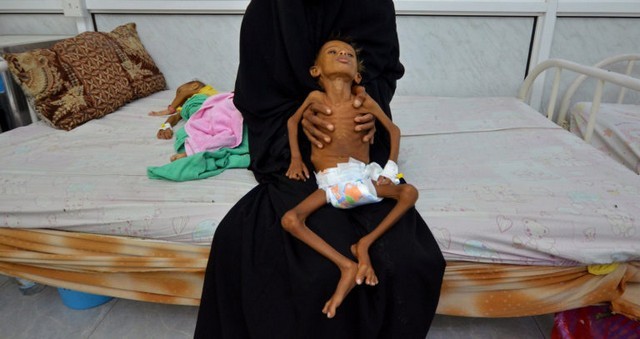
Lacking access to food, clean water, medicine and fuel, over 400,000 Yemeni children are, according to Save the Children, at imminent risk of starvation. “Most of them will never see a health clinic or receive treatment,” says Kevin Watkins, the organization’s UK Director. “Many of those who survive will be affected by stunting and poor health for the rest of their lives.” Watkins says the Saudi-UAE led coalition is using economic strangulation as a weapon of war, “targeting jobs, infrastructure, food markets and the provision of basic services.”

On March 22, 2018, Amnesty International called for an end to the flow of arms to the Saudi-led coalition attacking Yemen. “There is extensive evidence that irresponsible arms flows to the Saudi Arabia-led coalition have resulted in enormous harm to Yemeni civilians,” their statement says. “But this has not deterred the USA, the UK and other states, including France, Spain and Italy, from continuing transfers of billions of dollars’ worth of such arms.”

The UN Charter begins with a commitment to save succeeding generations from the scourge of war. The UN Security Council has miserably failed the Yemeni people by allowing the scourge of war to worsen, year by year. By approving biased resolutions that neglect to even name the most well-funded and sophisticated warring parties in Yemen — Saudi Arabia; the United Arab Emirates; the United States — the Security Council promotes the intensification of brutal, apocalyptic war and enables western war profiteers to benefit from billions of dollars in weapon sales. Weapon manufacturers such as Raytheon, Lockheed Martin and Boeing then pressure governments to continue selling weapons to two of their top customers, Saudi Arabia and the United Arab Emirates.

Earnest, honest and practical steps to stop the war are urgently needed. The U.N. must abandon its biased role in the Yemen conflict, so it can broker a peace in which the Houthi minority can retain some dignity and representation in majority-Sunni Yemen, which even before the Houthi uprising lacked any legitimate elected leader. The Houthis must be given an option to lay down arms without landing in any of the clandestine prisons operated by the UAE in Yemen, reported to be little more than torture camps. Even more urgent, the violence and economic strangulation by foreign invaders must cease.

At the very least, citizens in countries supplying weapons to the Saudi-Emirati coalition must demand their legislators forbid all future sales. The time for determined action is running out in the U.S. as the State Department is already taking preliminary steps toward a massive, multibillion-dollar sale of weapons to Saudi Arabia and the United Arab Emirates. The package is said to include tens of thousands of precision-guided munitions from Raytheon.

Yemeni civilians, especially children, pose no threat whatsoever to the U.S. Yet, U.S. support for airstrikes, blockades and the chaos inevitably caused by prolonged war threatens Yemeni civilians, especially vulnerable children. They have committed no crime but are being punished with death.

Kathy Kelly is a member of the TRANSCEND Network for Peace Development Environment, an American peace activist, pacifist and author, one of the founding members of Voices in the Wilderness, and currently a co-coordinator Voices for Creative Nonviolence.

28 May 2018

Source: https://www.transcend.org/tms/2018/05/scourging-yemen/

Israeli Settler Colonialism and Occupation Fact Sheet

By Robert J Barsocchini

Israeli Settler-Colonialism

“For eight years now, they sit in their refugee camps in Gaza, and before their eyes we turn into our homestead the land and villages in which they and their forefathers have lived.”

“We are a generation of settlers, and without the steel helmet and gun barrel, we shall not be able to plant a tree or build a house.”

  • Moshe Dayan, Israeli settler-colonial militant and politician
  • Every government in the world, except Israel, considers Israel’s colonial settlement building since 1967 to be illegal. (1)
  • Like the former South African settler-colonial Apartheid regime, Israel rejects virtually all well-established and reviewed official legal and moral opinion and continues its illegal activities in violation of legal and moral consensus. It continues to build settlements on Palestinian land.
  • The consensus view of the international community is that Israeli settlements are illegal and constitute a violation of international law. (2)
  • The majority of legal scholars hold the settlements to violate international law: “the establishment of the Israeli settlements in the Occupied Palestinian Territory has been considered illegal by the international community and by the majority of legal scholars.” (3)
  • The international community considers the establishment of Israeli settlements in the Israeli-occupied territories illegal under international law in part because the Fourth Geneva Convention of 1949 prohibits countries from moving their population into territories they occupy through war. (4)
  • The applicability of the fourth Geneva Convention to “all the territories occupied by Israel in 1967” is held with “a remarkable degree of unanimity” among international actors. (5)
  • TheUnited Nations Security Council, the United Nations General Assembly, the International Committee of the Red Cross, the International Court of Justice and the High Contracting Parties to the Convention have all affirmed that the Fourth Geneva Convention does apply. (6)
  • In a 2004 advisory opinion to theUN General Assembly, the International Court of Justice stated that Article 2 of the Convention applied to the case of Israel’s presence in the territories captured during the 1967 war.
  • Numerous UN resolutions have stated that the building and existence of Israeli settlements in theWest Bank, East Jerusalem and the Golan Heights are a violation of international law, including UN Security Council resolutions in 1979, 1980, (7) and 2016. (8) UN Security Council Resolution 446 refers to the Fourth Geneva Convention as the applicable international legal instrument, and calls upon Israel to desist from transferring its own population into the territories or changing their demographic makeup. The reconvened Conference of the High Contracting Parties to the Geneva Conventions has declared the settlements illegal (9) as has the primary judicial organ of the UN, the International Court of Justice (10) and the International Committee of the Red Cross.
  • Article 49 (6) of the Fourth Geneva Convention states:
  • The Occupying Power shall not deport or transfer parts of its own civilian population into the territory it occupies. (11)
  • According toJean Pictet of the International Committee of the Red Cross, this clause intended to prevent the World War II practice of an occupying power transferring “portions of its own population to occupied territory for political and racial reasons or in order, as they claimed, to colonize those territories”, which in turn “worsened the economic situation of the native population and endangered their separate existence as a race”. (12)
  • There is a vote in the UN General Assembly every year on the Question of Palestine. Every year, the vote is essentially the same: the vast majority of the world supports the resolution, and the US, Israel, and some small, US-occupied islands and sometimes a handful of other countries oppose the resolution.  The most recent vote was 153 in favor, 7 against.  The seven against were Canada, Israel, Marshall Islands, Micronesia, Nauru, Palau, United States.  Muslim people are a minority in the vast majority of the countries that support the resolution.

Thus, the resolution is adopted and affirmed every year.

The resolution states, in part,

“Reaffirmingthe illegality of the Israeli settlements in the Palestinian territory occupied since 1967, including East Jerusalem,

Expressing grave concernabout the extremely detrimental impact of Israeli settlement policies, decisions and activities in the Occupied Palestinian Territory, including East Jerusalem, including on the contiguity, integrity and viability of the Territory, the viability of the two-State solution based on the pre-1967 borders and the efforts to advance a peaceful settlement in the Middle East,

Expressing grave concern alsoabout all acts of violence, intimidation and provocation by Israeli settlers against Palestinian civilians, including children, and properties, including homes, mosques, churches and agricultural lands, condemning acts of terror by several extremist Israeli settlers, and calling for accountability for the illegal actions perpetrated in this regard,

Reaffirming the illegality of Israeli actions aimed at changing the status of Jerusalem, including settlement construction and expansion, home demolitions, evictions of Palestinian residents, excavations in and around religious and historic sites, and all other unilateral measures aimed at altering the character, status and demographic composition of the city and of the Territory as a whole, and demanding their immediate cessation”.

  • Examples of other, related resolutions that are adopted:
  • UNGA Res. 194, adopted 1948: Palestinian refugees may return “at the earliest practicable date,” and “compensation should be paid for the property of those choosing not to return and for loss of or damage to property”.
  • UNGA Res. 3236, adopted 1974:“Reaffirms also the inalienable right of the Palestinians to return to their homes and property from which they have been displaced and uprooted, and calls for their return”

The Israeli Settler-Colonial State’s Occupation of Gaza

  • The international community regards all of thePalestinian territories including Gaza as occupied. (13)
  • The United Nations, international human rights organizations, and the majority of governments and legal commentators consider Gaza to be currently occupied by Israel. (14)
  • Amnesty International, theWorld Health Organization, Oxfam, the International Committee of the Red Cross, The United Nations, the United Nations General Assembly, the UN Fact Finding Mission to Gaza, international human rights organizations, US government websites, the UK Foreign and Commonwealth Office, and the majority of legal commentators (eg Geoffrey Aronson, Meron Benvenisti, Claude Bruderlein, Sari Bashi and Kenneth Mann, Shane Darcy and John Reynolds, Yoram Dinstein, John Dugard, Marc S. Kaliser, Mustafa Mari, Iain Scobbie, and Yuval Shany) maintain that Israel’s extensive direct external control over Gaza, and indirect control over the lives of its internal population mean that Gaza remains occupied. (15)
  • Israel imposes an illegal blockade on Gaza: international aid groups, includingAmnesty International, CARE International UK, and Oxfamcall on Israel to lift the blockade, calling it collective punishment against the 1.5 million residents of the territory. (16)
  •  According to theInternational Committee of the Red Cross, “The hardship faced by Gaza’s 1.5 million people cannot be addressed by providing humanitarian aid. The only sustainable solution is to lift the closure.” (17)  The ICRC has also referred to the blockade as “a collective punishment imposed in clear violation of Israel’s obligations under international humanitarian law”. (18)
  • On 24 January 2008, theUnited Nations Human Rights Council released a statement calling for Israel to lift its siege on the Gaza Strip and therefore drop its restrictions on the supply of food, fuel, and medicine, and reopen border crossings.(19)
  • In August 2009, U.N. human rights chief Navi Pillay criticized Israel for the blockade in a 34-page report, calling it a violation of the rules of war.(20)
  • A UN Fact Finding mission in September 2009 led by South African JudgeRichard Goldstone (the Goldstone report) concluded that the blockade was possibly a crime against humanity, and recommended that the matter be referred to the International Criminal Court if the situation has not improved in six months.
  • In May 2010, the UNOffice for the Coordination of Humanitarian Affairs stated that the formal economy in Gaza has collapsed since the imposition of the blockade.(21) They also stated that the “restrictions imposed on the civilian population by the continuing blockade of the Gaza Strip amount to collective punishment, a violation of international humanitarian law.”(22)
  • Tony Blair, as UN Envoy to the MidEast, stated that “The blockade of the Gaza Strip needs to come to an end. There is now a welcome international consensus on Gaza.”(23)
  • In May 2011, EUCommissioner for Humanitarian Aid Kristalina Georgieva said the European Union and the United Nations were “calling for the immediate, sustained and unconditional opening of crossings for the flow of humanitarian aid, commercial goods and persons.” She then said in an interview with Israel’s Ynet that she believes that the “humanitarian crisis…was artificially created because of the blockade”.
  • After visiting Gaza in March 2010, Irish foreign ministerMicheál Martin described the Israeli blockade of Palestinian-ruled Gaza as “inhumane and unacceptable” and called on the European Union and other countries to increase pressure on Israel to lift the blockade.
  • William Hague, theForeign Secretary, said in a speech to the House of Commons that the blockade of Gaza was “unacceptable and unsustainable”, and that it was “the view of the British government, including the previous government, that restrictions on Gaza should be lifted – a view confirmed in United Nations security council resolution 1860 which called for sustained delivery of humanitarian aid and which called on states to alleviate the humanitarian and economic situation”.
  • UK Prime Minister David Cameron: “We should do everything we can through the UN, where resolution 1860 is absolutely clear about the need to end the blockade and to open up Gaza.”“Gaza cannot and must not be allowed to remain a prison camp.”
  • The World Bank estimated in 2015 that the GDP losses caused by the blockade since 2007 was above 50%, and entailed large welfare losses. Gaza’s manufacturing sector, once significant, shrunk by as much as 60 percent in real terms, due to the wars in the past 20 years and the blockade. Gaza’s exports virtually disappeared since the imposition of the 2007 blockade.(24)
  • Israeli human rights group B’tselem has referred to the blockade as a tactic of “collective punishment” of Palestinian civilians and called it a “serious violation” of international law. (Cited in Finkelstein, 2018, University of California Press, 15)
  • In March 2010,United Nations Secretary-General Ban Ki-Moon stated that the blockade of Gaza is causing “unacceptable suffering” and that families were living in “unacceptable, unsustainable conditions”.(25)

Public opinion

  • May, 2018: (26)
  • Israel is “extremely unpopular worldwide.” It consistently polls as, and today remains, in the bottom four most unpopular countries in the world.
  • While opinion of Israel stayed the same in Europe and North America in recent world polling, and in some countries worsened, opinion grew more favorable in Russia and Turkey.
  • “It’s clear that West Bank settlements are a key cause of Israel’s poor global standing. Most of the world believes that Israel’s continued control of the West Bank is an unlawful military occupation, and that settlements violate the Fourth Geneva Convention.”

Settler-Colonialism and Genocide

  • Raphael Lemkin, who coined the term ‘genocide’ to ‘denote an old practice in its modern development’, used it to describe the goals and effects of ‘occupation policies’:
  • A “policy of genocide” is carried out when the occupier takes actions to “destroy [in whole or in part], disintegrate, or weaken”, “in different degrees” and possibly over “decades”, the “enemy nation within the control” of the settler-colonial occupier.
  • “Generally speaking, genocide does not necessarily mean the immediate destruction of a nation, except when accomplished by mass killings of all members of a nation. It is intended rather to signify a coordinated plan of different actions aiming at the destruction of essential foundations of the life of national groups, with the aim of annihilating the groups themselves. The objectives of such a plan would be disintegration of the political and social institutions, of culture, language, national feelings, religion, and the economic existence of national groups, and the destruction of the personal security, liberty, health, dignity, and even the lives of the individuals belonging to such groups. Genocide is directed against the national group as an entity, and the actions involved are directed against individuals, not in their individual capacity, but as members of the national group.”
  • “the occupant also endeavors to bring about such changes as may weaken the national, spiritual resources.”
  • “The destruction of the foundations of the economic existence of a national group necessarily brings about a crippling of its development, even a retrogression. The lowering of the standards of living creates difficulties in fulfilling cultural-spiritual requirements. Furthermore, a daily fight literally for bread and for physical survival may handicap thinking in both general and national terms.
  • “It was the purpose of the occupant to create such conditions as these among the peoples of the occupied countries…”
  • The UN Office for the Coordination of Humanitarian Affairs notes that Israel’s blockade of Gaza has created “a profound human dignity crisis leading to a widespread erosion of livelihoods and a significant deterioration in infrastructure and essential services.” There is a sense of being “trapped, physically, intellectually, and emotionally.” (Cited in Finkelstein, 2018, University of California Press, 15-16)
  • Policies are undertaken to weaken the occupied group and strengthen the occupier.
  • “The occupant” tries to disrupt “national and religious influences”: For example, Israel “systematic[ally] target[s] minarets, which being too narrow for snipers to ascend, possess no apparent military value.The Dugard Report concluded that ‘mosques, and more particularly the minarets, had been deliberately targeted” by Israeli occupation forces “on the grounds that they symbolized Islam.” (27)
  • Full inclusion in economic life is “made dependent upon one’s being” a member of the occupying, dominant group, “or being devoted to the cause of” the occupier. Consequently, promoting a national ideology other than” that of the occupier “is made difficult and dangerous.”
  • “The undesired national groups … are deprived of elemental necessities for preserving health and life.” (Almost all water in Gaza, the supply of which is dictated by Israel, is poisonous.  Electricity, also dictated by Israel, is only available for part of the day.)
  • “The technique of mass killings”, termed by other genocide scholars as ‘genocidal massacres’, “is employed mainly against” the occupied national group, “as well as against leading personalities from among the non-collaborationist groups in all the occupied countries.” (28)
  • Ratio of Palestinian to Israeli children killed in Israel’s settler-colonial occupation enforcement action, “Operation Caste Lead”, 2008-9: 300-1
  • Ratio of Palestinian to Israeli children killed in Israel’s settler-colonial occupation enforcement action, “Operation Solid Cliff”, 2014: 550 to 1.
  • If one reads primary-source-based historical documentation on how Israel was established and what it continues to do in its illegal occupations, blockades, land theft, ethnic and historical cleansing, settlement building, and construction of settlements created for the dominant ethnic regime, the charge of genocide becomes a little difficult for objective observers to deny.
  • Contemporary scholars have also noted that settler-colonialism is inherently genocidal:
  • “…deliberate destruction and restriction of water resources as a means of expelling Palestinians from land allocated to Israeli settlements also arguably paints a picture of a genocidal relationship. …many of Lemkin’s techniques may be in evidence” in Israeli occupation.(29)
  • Statements from Israelis and independent observers offer additional evidence:
  • “This is … not a war against terror, and not a war against extremists… Who is the enemy? The Palestinian people.  …the entire Palestinian people is the enemy…  …in wars the enemy is usually an entire people, including its elderly and its women, its cities and its villages, its property and its infrastructure.  …in our war this is sevenfold more correct…  Every brave Um-Jihad [mother of a ‘little snake terrorist’] who sends her son to hell should know she’s going with him, along with the house and everything inside it.  [Their] houses should be bombed from the air, with intention to destroy and to kill. And it should be announced that we will do this from now on to every home of every martyr.

There is nothing more just, and probably nothing more efficient.”  – Israeli Settler-State “Justice” Minister Ayelet Shaked, 2015

  • The “un-livability threshold has been passed in Gaza quite a long time ago” (Robert Piper, UN Humanitarian Coordinator for the West Bank and Gaza).
  • “Innocent human beings in Gaza, most of them young, are slowly being poisoned by the water they drink” (Sara Roy, Harvard Center for Middle Eastern Studies)
  • “When a place becomes unlivable, people move . . . . Yet this last resort is denied to the people of Gaza” (United Nations Relief and Works Agency-UNRWA)
  • “Gaza is an open-air prison” (Former UK prime minister David Cameron).
  • “There are no innocents in Gaza” (Israeli Defence Minister Avigdor Lieberman)
  • “The closure constitutes a collective punishment imposed in clear violation of Israel’s obligations under international humanitarian law” (International Committee of the Red Cross)
  • Israel is “shooting at children” (Nikolai E. Mladenov, UN Special Coordinator for the Middle East Peace Process)
  • “Calls for an immediate and unconditional end to the blockade and closure of the Gaza Strip, which has resulted in a deteriorating, unprecedented humanitarian crisis” (European Parliament)
  • Likud MP Avi Dichter, the chair of the defense committee, went on to dismiss concerns in an interview of his own. Dichter insisted that protests in Gaza pose no danger, because “the IDF has enough bullets for anyone,”and open-fire regulations to shoot people allowing the military to deal with it. (30)
  • Oppressive regimes almost always portray and think of themselves as the victim of the group(s) they are oppressing. Israel and Apartheid South African both “said that their own peoples faced annihilation from external forces – in South Africa by black African governments and communism; in Israel, by Arab states and Islam.” (31)
  • The Nazis also made these claims, cultivating a feeling that Germans were being victimized by Jewish Bolshevik Communists: Nazi propaganda portrayed Jews as “destroying the Nazi regime and murdering the German people”, which meant the Nazis were merely engaged in self-defense, a “war of retaliation’ against European Jewry” (32).
  • As in the case of South African Apartheid, the Israeli regime claims that the reason it is so unpopular is not because of its unpalatable and oppressive policies and practices, but because people are biased against it. A small international fringe continued to defend South African Apartheid on this basis until the illegal aspects of that system collapsed under international pressure.

Human Shields

  • UN and human rights groups find that Israeli settler colonial occupation forces use Palestinians, including children, as human shields.(33)
  • E.g., in Operation Cast Lead: “Contrary to repeated allegations by Israeli officials of the use of ‘human shields,’ Amnesty found no evidence that Hamas or other Palestinian fighters directed the movement of civilians to shield military objectives from attacks.” – Amnesty International
  • “If it found no evidence that Hamas used human shields, Amnesty did, however, find ample evidence that Israel used them.”
  • “Israeli soldiers ‘used civilians, including children, as ‘human shields’… forcing them to remain in or near houses which they took over and used as military positions.”
  • Israeli occupation forces “took position and launched attacks from and around inhabited houses” in Gaza, “exposing local residents to the danger of attacks”.
  •  Israeli occupation forces used Gaza civilians as human shields for “inspecting properties or objects suspected of being booby-trapped.”
  • The Goldstone Report and other human rights investigations “and the postinvasion testimony of Israeli soldiers corroborated the IDF’s use of human shields.”
  • Israeli occupiers place “men, women and children… close to artillery and tank positions, where constant shelling and firing was taking place”. – Goldstone Report
  • The Goldstone Report found repeated “use of human shields” by Israeli occupiers in Gaza.
  • Two Israeli occupation soldiers who were convicted of using a nine year old child as a human shield received three month suspended sentences. (34)

Trivia:

  • Israel supports Nazi sympathizers, such as the South African Apartheid terrorist regime, which Israel helped nuclearize. (35)
  • How the Israel Lobby Protected Ukrainian Neo-Nazis (Nov. 2014)(36)
  • For reference: Us Lifts Ban on Funding ‘Neo-Nazi’ Ukrainian Militia (Jan. 2016)(37)
  • Israel uses chemical weapons on civilians.

Source:

(1) http://news.bbc.co.uk/2/hi/7708244.stm

(2) Emma Playfair (Ed.) (1992). International Law and the Administration of Occupied Territories. USA: Oxford University Press. p. 396; Cecilia Albin (2001). Justice and Fairness in International Negotiation. Cambridge: Cambridge University Press. p. 150; Mark Gibney; Stanlislaw Frankowski (1999). Judicial Protection of Human Rights: Myth or Reality?. Westport, CT: Praeger/Greenwood. p. 72; http://news.bbc.co.uk/2/hi/middle_east/1682640.stm; Roberts, Adam (1990-01-01). “Prolonged Military Occupation: The Israeli-Occupied Territories Since 1967”. The American Journal of International Law. 84 (1): 44–103 [69]

(3) Pertile, Marco (2005). “‘Legal Consequences of the Construction of a Wall in the Occupied Palestinian Territory’: A Missed Opportunity for International Humanitarian Law?”. In Conforti, Benedetto; Bravo, Luigi. The Italian Yearbook of International Law. 14. Martinus Nijhoff Publishers. p. 141.

(4) Roberts, Adam. “Prolonged Military Occupation: The Israeli-Occupied Territories Since 1967”. The American Journal of International Law. American Society of International Law. 84 (1): 85–86; ertile, Marco (2005). “‘Legal Consequences of the Construction of a Wall in the Occupied Palestinian Territory’: A Missed Opportunity for International Humanitarian Law?”. In Conforti, Benedetto; Bravo, Luigi. The Italian Yearbook of International Law. 14. Martinus Nijhoff Publishers. p. 141;  Barak-Erez, Daphne (2006). “Israel: The security barrier—between international law, constitutional law, and domestic judicial review”. International Journal of Constitutional Law. Oxford University Press. 4 (3): 548; Drew, Catriona (1997). “Self-determination and population transfer”. In Bowen, Stephen. Human rights, self-determination and political change in the occupied Palestinian territories. International studies in human rights. 52. Martinus Nijhoff Publishers. pp. 151–152;  International Labour Organization (2005). “The situation of workers of the occupied Arab territories” (PDF). p. 14.

(5) The American Journal of International Law. 84 (1): 44–103 [69].

(6) Roberts, Adam. “Prolonged Military Occupation: The Israeli-Occupied Territories Since 1967”. The American Journal of International Law. American Society of International Law. 84 (1): 69; Benveniśtî, Eyāl (2004). The international law of occupation. Princeton University Press. p. xvii.

(7) Emma Playfair (Ed.) (1992). International Law and the Administration of Occupied Territories. USA: Oxford University Press. p. 396; Cecilia Albin (2001). Justice and Fairness in International Negotiation. Cambridge: Cambridge University Press. p. 150; Mark Gibney; Stanlislaw Frankowski (1999). Judicial Protection of Human Rights: Myth or Reality?. Westport, CT: Praeger/Greenwood. p. 72.

(8) UN Security Council (2016-12-24). “Israel’s Settlements Have No Legal Validity, Constitute Flagrant Violation of International Law, Security Council Reaffirms – Resolution 2334 (2016)”; Beaumont, Peter (2016-12-23). “US abstention allows UN to demand end to Israeli settlements”. The Guardian.

(9) http://www.icrc.org/web/eng/siteeng0.nsf/html/5FLDPJ #12

(10)  https://web.archive.org/web/20100706021237/http://www.icj-cij.org/docket/files/131/1671.pdf

(11) Convention (IV) relative to the Protection of Civilian Persons in Time of War.Geneva, 12 August 1949.

(12) Pictet, Jean (ed.) Commentary on the Fourth Geneva Convention

(13) Reality Check: Gaza is still occupied

(14) Sanger, Andrew (2011). M.N. Schmitt, Louise Arimatsu, Tim McCormack, eds. “The Contemporary Law of Blockade and the Gaza Freedom Flotilla”. Yearbook of International Humanitarian Law 2010. Springer Science & Business Media. 13: 429;  Scobbie, Iain (2012). Elizabeth Wilmshurst, ed. International Law and the Classification of Conflicts. Oxford University Press. p. 295; Gawerc, Michelle (2012). Prefiguring Peace: Israeli-Palestinian Peacebuilding Partnerships. Lexington Books. p. 44.

(15) ‘Israel, Gaza & International Law,’ 19 November 2012; A Sanger, ‘The Contemporary Law of Blockade and the Gaza Freedom Flotilla,’ in M.N. Schmitt, Louise Arimatsu, Tim McCormack (eds.), Yearbook of International Humanitarian Law – 2010, Springer, 2011 pp.397–447 pp.429–430.

(16)  Tim Butcher (7 March 2008). “Human crisis in Gaza ‘is worst for 40 years’”. The Daily Telegraph. London.  For further sources on the illegality of the blockade, see Finkelstein, Gaza, 2018, University of California Press, 88, 139, 149-50, 157-62, 178-195, 197, 307n10, 309, 360, 363.

(17)  “Gaza closure: not another year!”. Icrc.org. 14 June 2010. Retrieved 1 June 2010.

(18)  “Gaza closure: not another year!”. Icrc.org. 14 June 2010. Retrieved 1 June 2010.

(19)  “SIXTH SPECIAL SESSION OF HUMAN RIGHTS COUNCIL CONCLUDES WITH CALL ON ISRAEL TO END SIEGE IMPOSED ON OCCUPIED GAZA STRIP”. United Nations. 24 January 2008. Retrieved 4 June 2010.

(20)  “U.N. Human Rights Chief: Israel’s Blockade of Gaza Strip Is Illegal”. Associated Press. 14 August 2009.(AP)

(21)  “PRESS STATEMENT – UN HUMANITARIAN COORDINATOR:GAZA BLOCKADE SUFFOCATING AGRICULTURE SECTOR, CREATING FOOD INSECURITY”(PDF). UN Office for the Coordination of Humanitarian Affairs, oPt (OCHA). 25 May 2010. Retrieved 30 May 2010.

(22)  “Farming without Land, Fishing without Water: Gaza Agriculture Sector Struggles to Survive (Office for the Coordination of Humanitarian Affairs (OCHA) 25 May 2010)”. Unispal.un.org. Retrieved 2014-08-10.

(23)  “Israel to unveil measures to ease Gaza blockade”. Haaretz. 15 June 2010.

(24)  “Economic Monitoring Report to the Ad Hoc Liaison Committee” (PDF). World Bank. Retrieved 8 July 2015.

(25)  “UN chief says Gaza suffering under Israeli blockade”. BBC. 21 March 2010. Retrieved 21 March 2010.

(26)  https://www.vox.com/cards/israel-palestine/world-opinion

(27)  Finkelstein. Gaza. 2018. University of California Press. P. 61.

(28) Lemkin, R. (1944). Axis rule in occupied Europe; laws of occupation, analysis of government, proposals for redress. Washington: Carnegie endowment for international peace, Division of international law.

(29) Rashed, H., & Short, D. (2012). Genocide and settler colonialism: Can a Lemkin-inspired genocide perspective aid our understanding of the Palestinian situation? The International Journal of Human Rights, 16(8), 1142-1169.

(30)  http://normanfinkelstein.com/2018/05/15/tweet-storm-for-gaza-8pm-9pm-london-time-15-may/

(31) https://www.theguardian.com/world/2006/feb/07/southafrica.israel

(32)  Kakel, Carroll P. The American West and the Nazi East: A Comparative and Interpretive Perspective. Palgrave Macmillan. 2011. P. 78.

(33) See Finkelstein, Gaza (2018), University of California Press, pp. 44, 71, 82, 89, 103, 352; Cited in Finkelstein: National Lawyers Guild: Onslaught: Israel’s attack on Gaza and Rule of Law (2009); HRW: White Flag Deaths: Killings of Palestinian Civilians During Operation Cast Lead; Breaking the Silence: Soldier Testimony from Cast Lead; Amnesty Int’l: Operation ‘Cast Lead’: 22 Days of Death and Destruction

(34) Finkelstein, Gaza, University of California Press, 81-2.

(35) “Israel provided expertise and technology that was central to South Africa’s development of its nuclear bombs.”  https://www.theguardian.com/world/2006/feb/07/southafrica.israel

(36) https://www.alternet.org/world/how-israel-lobby-protected-ukrainian-neo-nazis

(37) https://www.jpost.com/Diaspora/US-lifts-ban-on-funding-neo-Nazi-Ukrainian-militia-441884

Robert J. Barsocchini is a graduate student in American Studies. Years working as a cross-cultural intermediary for corporations in the film and Television industry sparked his interest in the discrepancy between Western self-image and reality.

17 May 2018

Source: https://countercurrents.org/2018/05/17/israeli-settler-colonialism-and-occupation-fact-sheet/

Ecuador hints it may hand over Julian Assange to Britain and the US

By James Cogan

Julian Assange is in immense danger. Remarks made this week by Ecuador’s foreign minister suggest that her government may be preparing to renege on the political asylum it granted to the WikiLeaks editor in 2012 and hand him over to British and then American authorities.

On March 28, under immense pressure from the governments in the US, Britain and other powers, Ecuador imposed a complete ban on Assange having any Internet or phone contact with the outside world, and blocked his friends and supporters from physically visiting him. For 45 days, he has not been heard from.

Ecuadorian Foreign Minister Maria Fernanda Espinosa stated in a Spanish-language interview on Wednesday that her government and Britain “have the intention and the interest that this be resolved.” Moves were underway, she said, to reach a “definite agreement” on Assange.

If Assange falls into the hands of the British state, he faces being turned over to the US. Last year, US Attorney General Jeff Sessions stated that putting Assange on trial for espionage was a “priority.” CIA director Mike Pompeo, now secretary of state, asserted that WikiLeaks was a “non-state hostile intelligence service.”

In 2010, WikiLeaks courageously published information leaked by then Private Bradley [now Chelsea] Manning that exposed war crimes committed by American forces in Iraq and Afghanistan. WikiLeaks also published, in partnership with some of the world’s major newspapers, tens of thousands of secret diplomatic cables, exposing the daily anti-democratic intrigues of US imperialism and numerous other governments.

For that, Assange was relentlessly persecuted by the Obama administration. By November 2010, it had convened a secret grand jury and had a warrant issued for his arrest on charges of espionage—charges that can carry the death sentence. The then Labor Party government in Australia headed by Prime Minister Julia Gillard threw Assange, an Australian citizen, to the wolves. It refused to provide him any defence and declared it would work with the US to have him detained and put on trial.

On June 19, 2012, under conditions in which he faced extradition to Sweden to answer questions over fabricated allegations of sexual assault, and the prospect of rendition to the United States, Assange sought asylum in the Ecuador’s embassy in London.

Since that time, for nearly six years, he has been largely confined to a small room with no direct sunlight. He has been prevented from leaving, even to obtain medical treatment, by the British government’s insistence it will arrest him for breaching bail as soon as he sets foot outside the embassy.

Now, for six weeks and three days, he has been denied even the right to communicate.

Jennifer Robinson, the British-based Australian lawyer who has represented Assange since 2010, told the London Times in an interview this month: “His health situation is terrible. He’s had a problem with his shoulder for a very long time. It requires an MRI [magnetic resonance imaging scan], which cannot be done within the embassy. He’s got dental issues. And then there’s the long-term impact of not being outside, his visual impairment. He wouldn’t be able to see further than from here to the end of this hallway.”

The effort to haul Assange before a US court is inseparable from the broader campaign underway by the American state and allied governments to impose sweeping censorship on the Internet. Lurid allegations of “Russian meddling” in the 2016 US election and denunciations of “fake news” have been used to demand that Google, Facebook and other conglomerates block users from accessing websites that publish critical commentary and exposures of the ruling class and its agencies—including WikiLeaks and the World Socialist Web Site.

WikiLeaks has been absurdly denounced as “pro-Russia” because it published leaks from the US Democratic Party National Committee that revealed the anti-democratic intrigues the party’s leaders carried out to undermine the campaign of Bernie Sanders in the 2016 presidential primary elections. It also published leaked speeches of presidential candidate Hillary Clinton that further exposed her intimate relations with Wall Street banks and companies.

As part of the justification for Internet censorship, US intelligence agencies allege, without any evidence, that the information was hacked by Russian operatives and supplied to WikiLeaks to undermine Clinton and assist Trump—whom Moscow purportedly considered the “lesser evil.”

In response to the hysterical allegations, WikiLeaks broke its own tradition of not commenting on its sources. It publicly denied that Russia was the source of the leaks. That has not prevented the campaign from continuing, with Assange even being labelled “the Kremlin’s useful idiot” in pro-Democratic Party circles. WikiLeaks is blamed for Clinton’s defeat, not the reality, that tens of millions of American workers were repulsed by her right-wing, pro-war campaign and refused to vote for her.

Under conditions in which the Ecuadorian government has capitulated to great power pressure and is collaborating with British and US agencies to break Julian Assange, there is an almost universal and reprehensible silence on the part of dozens of organisations and hundreds of individuals who once claimed to defend him and WikiLeaks.

The United Nations Working Group on Arbitrary Detention, which in February 2016 condemned Assange’s persecution as “a form of arbitrary detention” and called for his release, has issued no statement on his current situation.

In Britain, the Labour Party and its leader Jeremy Corbyn have said nothing on the actions by Ecuador. Nor have they opposed the determination of the Conservative government to arrest Assange if he leaves the embassy.

In Australia, the current Liberal-National government and Labor leadership are just as complicit. The Greens, which claimed to oppose the persecution of Assange, have not made any statement in parliament or issued a press release, let alone called for public protests. Hundreds of editors, journalists, academics, artists and lawyers across the country who publicly defended WikiLeaks in 2010 and 2011 are now mute.

A parallel situation prevails across Europe and in the US. The so-called parties of the “left” and the trade unions are all tacitly endorsing the vicious drive against Assange.

Around the world, the Stalinist and Pabloite pseudo-left organisations, anxious not to disrupt their sordid relations with the parties of the political establishment and the trade union apparatuses, are likewise silent.

The World Socialist Web Site and the International Committee of the Fourth International unconditionally defend Julian Assange and WikiLeaks. If the ruling elite can haul him before a court, it will hold him up as an example of what happens to those who speak out against social inequality, militarism, war and police-state measures. His prosecution would be used to try to intimidate and silence all dissent.

If Assange is imprisoned or worse, and WikiLeaks shut down, it will be a serious blow to the democratic rights of the entire international working class.

Workers and young people should join with the WSWS and ICFI in demanding and fighting for the immediate freedom of Julian Assange.

Originally published in WSWS.org

12 May 2018

Source: https://countercurrents.org/2018/05/12/ecuador-hints-it-may-hand-over-julian-assange-to-britain-and-the-us/

How Trump’s ZTE deal could undercut his foreign policy

By Adam Taylor

When it comes to foreign policy, we often think of a country’s strength in terms of military might — especially in the United States. After all, the U.S. military budget is by far the largest on Earth. Last year, it was more than twice as big as that of China, the second-biggest military spender.

Of course, the United States also wields enormous economic influence, an asset that may be more powerful even than tanks and soldiers. The American economy is the largest in the world, and that preeminence allows the United States to exert control over many levers of power. The Trump administration, like others before it, knows this well.

This is why President Trump’s decision to suddenly rescue a Chinese telecom company facing ruinous U.S. trade restrictions is so bewildering — and perhaps worrying. It may have implications not only for America’s growing economic faceoff with China (a huge subject in its own right) but also for U.S. foreign policy writ large.

Trump unexpectedly tweeted Sunday that he had instructed the Commerce Department to “give massive Chinese phone company, ZTE, a way to get back into business, fast.”

The United States fined ZTE $1.19 billion last year as part of a settlement after the company illegally shipped telecom gear to Iran and North Korea. Just last month, the Commerce Department banned U.S. firms from selling components to ZTE for seven years because it allegedly broke that deal. Cut off from U.S. suppliers, the Chinese firm was on the verge of collapse. Now Trump has come to the rescue, apparently worried about the ban’s impact on Chinese workers.

It’s not clear what prompted Trump’s decision. The Washington Post’s Damian Paletta, David J. Lynch and Josh Dawsey reported this week that the president appeared to have bypassed many U.S. trade officials. Advisers who favor a hard line on Chinese trade practices appear to have been sidelined, according to reports from Axios. Some observers have also noted that the decision came after reports that Chinese government-linked enterprises will provide $500 million to a project in Indonesia that features Trump-branded developments — that is, a project that will earn the president money.

A more mundane and probably more likely reason, however, is that Trump is seeking a “grand bargain” with China on trade issues, hoping to step back from a trade war. My colleague Josh Rogin reported that China included a demand titled “Appropriately handling the ZTE” case on a list of proposals that Beijing sent to the Trump administration after White House officials visited the Chinese capital last month.

Tellingly, the ZTE decision came just ahead of a Tuesday visit by China’s top economic official, Vice Premier Liu He, to Washington to meet with White House trade officials. Eager for a quick deal, Trump simply appears to have acquiesced to a key Chinese demand.

But threatening a trade war and then backing down is probably not the greatest negotiating move when dealing with Beijing. As Tufts University professor Dan Drezner wrote for The Post, doing so makes it look like Trump “blinked” in the face of President Xi Jinping’s reserve. But the ZTE decision could also cause problems for a far broader swath of U.S. foreign policy.

For one, the concerns about ZTE in the United States go beyond the simple trade concerns Trump referenced. On Tuesday, a top U.S. counterintelligence official told the Senate Intelligence Committee that the Chinese firm was thought to be a vehicle for Chinese government espionage. The Pentagon has even banned the sale of ZTE phones in stores on military bases, deeming them a security risk.

That concern has prompted some rare bipartisan agreement, with Sen. Marco Rubio (R-Fla.) and Rep. Adam B. Schiff (D-Calif.) among those who have voiced their opposition to easing up on ZTE.

Even on the merits of the trade argument alone, Trump’s decision seems glib. The original case against ZTE was logical and widely supported; launched under the Obama administration, it was nevertheless pushed along by future Trump administration officials such as then-Reps. Mike Pompeo and Ryan Zinke.

The decision to save ZTE could also complicate Washington’s attempts to apply economic punishments elsewhere. By withdrawing the restrictions on the Chinese company, Trump is setting an inconsistent standard for how Washington will respond to foreign firms that breach sanctions — at the same moment that it is trying persuade businesses in Europe and elsewhere to cease trading with Iran because of the recently reimposed U.S. sanctions there.

It’s reasonable that European nations will now think that they can negotiate away any problems they have on Iran by reaching out directly to the president, whose quid pro quo style can overrule everything else. The same might be said for other countries currently under sanction, such as Russia, or nations about to enter into talks with the United States, such as North Korea. These assumptions may ultimately be wrong — Trump is nothing if not unpredictable — but the thought process is understandable. With the Trump administration, you might as well haggle.

In the longer term, foreign nations will surely wonder whether a world where the United States haphazardly deploys its economic might is really better than the alternatives. Bloomberg’s Leonid Bershidsky noted that Chinese technology companies will speed up their push to move their supply chains away from their reliance on U.S. components. “At this rate, Trump may be the last U.S. president able to exploit the country’s technological advantage in trade wars,” Bershidsky wrote.

Henry Farrell of George Washington University and Abraham Newman of Georgetown University push that idea further. Writing in The Post’s Monkey Cage blog, they wonder if a “combination of unpredictability and draconian measures may encourage targeted states and companies, and even U.S. allies, to ‘diversify’ away from the U.S.-led global financial system.” America’s hegemonic economic power could end up undoing itself if it’s not used wisely.

Adam Taylor writes about foreign affairs for The Washington Post.

16 May 2018

Source: https://www.washingtonpost.com/news/worldviews/wp/2018/05/16/how-trumps-zte-deal-could-undercut-his-foreign-policy/?noredirect=on&utm_term=.2bff25e7719d

The Asian Muslim Action Network (AMAN) Indonesia

We, The Asian Muslim Action Network (AMAN), emphasize that the suicide bombings that occurred in several churches in Surabaya are NOT part of Islamic teachings. Damaging places of worship is clearly forbidden in Islamic teachings, as described in Surah Al-Hajj verse 40, to protect places of worship of any religion from violent and irresponsible acts. Because this is not part of Islamic teachings, it is important for all Muslims to strongly voice their disapproval of terrorism in various forms of publicly accessible media. As the majority population of Indonesia, we cannot sit still and tolerate the development of terrorism in Indonesia.

AMAN Indonesia strongly condemns the instrumentalization  of the female body for suicide bombings, especially for reasons of empowerment. The terrorist’s female empowerment propaganda is spreading a false sense of awareness and clearly violates women’s right to life.

AMAN Indonesia fully supports the Indonesian National Police to take necessary security measures, and to take firm action against the perpetrators who are clearly involved in this terrorist act.

AMAN Indonesia appreciates the work of the ministries and networks in providing help to the bomb victims, and supporting them economically and socially in the long term. It is important for the state to provide justice for the victims of terrorism.

AMAN Indonesia calls for all users of social media to trust in formal news sources that are reliable, and to avoid controversial debates that are unnecessary and could potentially divide us. This act of terror has clearly taken innocent victims. They were men, women and children that were in the act of worship. Stop spreading photos of victims or information that is not clear, this spreads the sense of fear that is desired by the terrorist groups.

AMAN Indonesia encourages civil society and interfaith organizations to cooperate against all forms of terror acts, including all efforts to purposely develop terrorism in Indonesian. We encourage society to empathize with the victims of the bombs and their families for a thorough and long-term recovery.

Thank you

Ruby Kholifah,
Country Representative of
AMAN Indonesia
081289448741

Ruby Kholifah
Secretary General of The Asian Muslim Action Network (AMAN)
Country representative of AMAN Indonesia

16 May 2018

70 YEARS AGO TODAY PALESTINE WAS STOLEN

By Askiah Adam

NAKBA OR CATASTROPHE DAY is being remembered today in Palestine. The March of Return, which has been going on for over a month, culminates in its commemoration. The Nakba began when Palestinians were robbed of their homeland; when the genocide began; and, will not stop until the land is ethnically cleansed by the thieving multi-national Zionists ensconced in Tel Aviv. Yesterday, the main backer of these Zionists, the United States of America (USA) officially opened their new embassy in Jerusalem in breach of UN resolutions and international law, as if by doing so the crime perpetrated by the West more than 70 years ago will be erased.

The callousness of the current US President with regard the Palestinian suffering is abominable. His twisted logic argues that this action of recognising Jerusalem as Israel’s capital will quickly resolve the problem. How? A one apartheid, Jewish state solution where ethnic cleansing by Tel Aviv is condoned?

“We have suffered for so long…because of Israel. War after war after war. Bombing after bombing after bombing. You build a house. They destroy it. You raise a child. They kill him. Whatever they do — the United States, Israel, the whole world, we’ll keep resisting until the last one of us dies.” This is what Suleiman Zghreibv has lived through for the past 30 years. (From the film “Killing Gaza”. Quote reproduced by Chris Hedges in his piece of the same name.)

The new US embassy drew blood even as it was being opened yesterday. Israel killed 52 Palestinian protesters and injured many more when it was officially opened. Like an ugly opening sequence to today’s remembrance of a bitter past that refuses to end, yesterday’s massacre will be just another episode of Israeli tyranny. It happened as if to fulfil Suleiman’s prophesy, “until the last one of us dies” said, surely, with much hate, a hatred Moshe Dayan, a terrorist who helped make the Jewish state and later became its prime minister, reminded the Israelis of some 60 years ago. As the protests demonstrate, it is a hatred that has deepened with time.

And now the US has blocked the adoption of a UN Security Council statement calling for an investigation of this latest Israeli massacre of the Palestinians. This is mass killing with impunity, encouraged by the US.

Israel, the sole nuclear power in the region, harbours hegemonic designs over the Middle East which is couched in fear of victimisation by her Arab neighbours. Therefore, its security can only be guaranteed by more land grabs and conquests. And this at a time when her Arab neighbours are openly more accepting of her presence among their midst. So enamoured is the Saudi crown prince of this new found friendship he was reported as having abandoned any solidarity with the Palestinians telling them to accept whatever offer is on the table or shut up.

But Iran and Syria have not abandoned the Palestinians. What is more Syria and her allies, including Iran, have defeated the proxy army, the terrorists armed and trained by the US and her allies, thus thwarting their regime change agenda for Syria and Iran. While the Russians in the air have been instrumental in facilitating the ground war, Iran on the ground (and Hezbollah) with the Syrian Arab Army, make for a formidable force. Whereas, once upon a time, Israel would have no compunction about violating Syria’s air space, after the recent shooting down of one of its fighter jets that air superiority is now questionable. Furthermore, Syria’s implacability is boosted by Iran’s military strength. Iran, therefore, is what is keeping the region from coming under the control of Israel with Saudi Arabia and her Sunni cohorts lending this aspiration legitimacy. Iran, meanwhile, is Shi’ah. It is this Islamic schism that is being exploited to destabilise the region.

About a week ago Trump ditched the Joint Comprehensive Plan of Action (JCPOA), the Iran nuclear deal, one that took years to accomplish, a quid pro quo arrangement intended to prevent the nuclearisation of Iran. Of course, the obvious outcome of the JCPOA’s failure would be a nuclear arms race in the region. Saudi Arabia has already announced its intention to nuclearise if Iran resumes its uranium enrichment programme.

According to the UN’s International Atomic Energy Agency (IAEA) Iran has adhered faithfully to the bargain, a fact verified by the US’s newly minted State Secretary, Mike Pompeo, during his confirmation hearing. So why did Trump opt to renege on the US’ obligations which were barely met any way?

Immediately after Trump’s announcement Israel began its bombing campaign targeting alleged Iranian military hardware on bases in Syria. Prior to this, Netanyahu had made much of these allegations arguing that it is menacing Israel.

Meanwhile, there has been speculation that America entered into the agreement on bad faith. It seems the JCPOA was never meant to succeed. Iran’s commitment was not expected. Instead, the belief was that Iran would fail to upkeep its end thus creating a pretext for war which both Israel and Saudi Arabia are trying to push Washington towards. And this is why Israel is desperately trying to frame Iran with a clandestine nuclear enrichment programme, which was flatly denied by the IAEA. But, why would Washington allow itself to be led into another war?

Washington’s Neo-cons have not stopped their agenda for world hegemony. While oil is a major spoil of war the globalisation agenda of the New World Order is about a one world government where the US dictates the global order.

The disaster that is Palestine, therefore, is but the beginning of a script the West has no wish to re-write. While non-Western leaders have voiced their support for Palestine and the Palestinians, their inaction turns the words into mere platitudes as if buying time for Israel to complete her ethnic cleansing exercise.

What then is left to the Palestinians if not to rise as a people against a diabolical tyranny? How about solidarity amongst peoples? Rachel Corrie was the finest example. She gave her life for the cause. However, united we the people can stand together without having to lay our lives on the altar of Neo-con greed and US global hegemony.

END

Askiah Adam
Executive Director
International Movement for a JUST World (JUST)

15 May 2018

How Costa Rica Gets It Right

By Joseph E. Stiglitz

How has a country of under five million people become a world leader in developing holistic policies that promote democratic, sustainable, and inclusive economic growth? The answer lies in its people’s belief that focusing on the welfare of all citizens not only enhances wellbeing, but also increases productivity.

SAN JOSÉ – With authoritarianism and proto-fascism on the rise in so many corners of the world, it is heartening to see a country where citizens are still deeply committed to democratic principles. And now its people are in the midst of trying to redefine their politics for the twenty-first century.

Over the years, Costa Rica, a country of fewer than five million people, has gained attention worldwide for its progressive leadership. In 1948, after a short civil war, President José Figueres Ferrer abolished the military. Since then, Costa Rica has made itself a center for the study of conflict resolution and prevention, hosting the United Nations-mandated University for Peace. With its rich biodiversity, Costa Rica has also demonstrated far-sighted environmental leadership by pursuing reforestation, designating a third of the country protected natural reserves, and deriving almost all of its electricity from clean hydro power.

Costa Ricans show no signs of abandoning their progressive legacy. In the recent presidential election, a large turnout carried Carlos Alvarado Quesada to victory with more than 60% of the vote, against an opponent who would have rolled back longstanding commitments to human rights by restricting gay marriage.

Costa Rica has joined a small group of countries in the so-called Wellbeing Alliance, which is implementing ideas, highlighted by the International Commission on the Measurement of Economic Performance and Social Progress, for constructing better welfare metrics. Recognizing the shortcomings of GDP that the Commission emphasized, the Alliance seeks to ensure that public policy advances citizens’ wellbeing in the broadest sense, by promoting democracy, sustainability, and inclusive growth.

An important part of this effort has been to broaden the scope for the country’s cooperatives and social enterprises, which are already strong, embracing in one way or another a fifth of the population. These institutions represent a viable alternative to the extremes of capitalism that have given rise to morally reprehensible practices, from predatory lending and market manipulation in the financial sector to tech companies’ abuse of personal data and emissions cheating in the automobile industry. They are based on building trust and cooperation, and on the belief that focusing on the welfare of their members not only enhances wellbeing, but also increases productivity.

Like citizens of a few other countries, Costa Ricans have made clear that inequality is a choice, and that public policies can ensure a greater degree of economic equality and equality of opportunity than the market alone would provide. Even with limited resources, they boast about the quality of their free public health-care and education systems. Life expectancy is now higher than in the United States, and is increasing, while Americans, having chosen not to take the steps needed to improve the wellbeing of ordinary citizens, are dying sooner.

But for all of its successes, Costa Rica faces two critical problems: a persistent, structural fiscal deficit and a gridlocked political system. The economics of fiscal deficits are easy: boost economic growth, raise taxes, or lower expenditures. But the politics are not easy at all: While every political leader wants economic growth to solve the problem, there is no magic formula to achieve it. No one loves the two remaining options.

Most governments in such circumstances cut items like infrastructure, because the costs go unseen for decades. That would be an even graver mistake for Costa Rica, where infrastructure has not fully kept up with economic growth and, if improved, could itself be important in promoting growth. Of course, government could always be more efficient, but after years of retrenchment, further rationalization is unlikely to deliver much. Almost surely, the best way forward would be to raise taxes.

To reconcile taxation with an overall economic strategy that seeks to maximize all citizens’ wellbeing, the tax system should adhere to three central principles: tax bad things (like pollution), rather than good things (like work); design taxes to cause the least possible distortion in the economy; and maintain a progressive rate structure, with richer individuals paying a larger share of their income.

Because Costa Rica is already so green, a carbon tax would not raise as much money as elsewhere. But, because virtually all of the country’s electricity is clean, a shift to electric cars would be more effective in reducing carbon dioxide emissions. Such a tax could help Costa Rica become the first country where electric cars dominate, moving it still closer to the goal of achieving a carbon-neutral economy.

With inequality still a problem (though nowhere near as acute as elsewhere in Latin America), more progressive and comprehensive income, capital gains, and property taxes are essential. The rich receive a disproportionately large share of their income through capital gains, and to tax capital gains at rates lower than other forms of income exacerbates inequality and leads to distortions. While economists differ on many matters, one thing they can agree on is that taxing the revenues or capital gains derived from Costa Rica’s land won’t cause the land to move away. That’s one reason why the great nineteenth-century economist Henry George argued that the best taxes are land taxes.

The biggest challenges are political: a presidential system like Costa Rica’s works well in a polity divided into two main parties, with rules designed to ensure that minority views are adequately respected. But such a system can quickly lead to political gridlock when the electorate becomes more fractured. And in a fast-changing world, political gridlock can be costly. Deficits and debts can explode, with no path towards resolution.

Alvarado, who is just 38, is attempting to create a new presidential model for Costa Rica, without changing the constitution, by drawing ministers from a range of parties. One hopes that the spirit of cooperation fostered by the cooperative movement, and ingrained in so much of Costa Rican culture, will make it work. If it does, Costa Rica, despite its small size, will be a beacon of hope for the future, showing that another world is possible, one where Enlightenment values – reason, rational discourse, science, and freedom – flourish, to the benefit of all.

Joseph E. Stiglitz, a Nobel laureate in economics, is University Professor at Columbia University and Chief Economist at the Roosevelt Institute.

8 May 2018

Source: https://www.project-syndicate.org/commentary/costa-rica-enlightenment-model-by-joseph-e–stiglitz-2018-05

Calls for Arms Embargo Against Jewish State Atrocities in Gaza

By Dr Vacy Vlazna

Palestinians participating on Gaza’s non-violent Great March of Return have called for an arms embargo  against Israel. This has been  backed by the Amnesty International statement; Israel: Arms embargo needed as military unlawfully kills and maims Gaza protesters.

The United Nations has imposed arms embargoes within the sanctions regimes of:

  • Sudan for ‘Those who impede the peace process, constitute a threat to stability in Darfur and the region, commit violations of international humanitarian or human rights law or other atrocities”
  • Congo for “Engaging in or providing support for acts that undermine the peace, stability or security of the DRC”  such as “planning, directing, or committing acts in the DRC that constitute human rights violations or abuses or violations of international humanitarian law, as applicable, including those acts involving the targeting of civilians, including killing and maiming, rape and other sexual violence, abduction, forced displacement, and attacks on schools and hospitals’
  • Libya for “Individuals and entities involved in or complicit in ordering, controlling, or otherwise directing, the commission of serious human rights abuses against persons in Libya, including by being involved in or complicit in planning, commanding, ordering or conducting attacks, in violation of international law, including aerial bombardments, on civilian populations and facilities’  UN Sanctions

All the above criteria for sanctions (and more) apply to the Jewish state’s military occupation and control of Palestinian lives over the past 70 years and apply to its blatant belligerence during the past month against Gaza’s unarmed protestors that has culminated, to date, in 46 martyrs and over 6000 injuries that began with the Good Friday massacre.

The killings and maiming are indisputable evidence of the violation of International Law and International Humanitarian Law ( IHL) which prohibits under Rule 70 ,“The use of means and methods of warfare which are of a nature to cause superfluous injury or unnecessary suffering”.

100 Jewish snipers  were ordered to shoot unarmed civilians with semi-jacket bullets which are variously called dumdum, hollow-point,  expanding bullet, explosive, soft-point, soft-nosed, that inflict horrific Grade 3 wounds as on contact, the bullet splays out talons massive internal tissue damage,

“Half of the more than 500 patients we have admitted in our clinics have injuries where the bullet has literally destroyed tissue after having pulverized the bone. These patients will need to have very complex surgical operations and most of them will have disabilities for life.” Marie-Elisabeth Ingres, Medecins Sans Frontieres’s head of mission in Palestine.

These high velocity bullets ‘are prohibited under a number of  treaties’ for causing ‘superfluous injury or unnecessary suffering’.

That the Jewish state uses Gaza to field test new weapons has been well documented and today in Gaza doctors have also remarked on a new tear gas, not gray but green in colour, that causes severe spasms and ‘cramps, vomiting and stress, severe cough and a faster heartbeat…Because the gas is unknown and the health complaints are also unknown, the use of this gas is very dangerous and one does not know what more damage the gas can cause to the body.’ Khamakar Press

Of course testing weapons on civilians is a war crime and yet Israeli armament companies boast that their  weaponry is field-tested which boosts sales to morally shoddy western governments. This impunity and complicity can come to a halt with campaigns focusing on the S in BDS- Boycott Divestment and SANCTIONS.

Speaking of sanctions, take the UK for example; it was hot to screech for sanctions against Russia after the magically non-lethal unproven ‘nerve agent’ attack in Salisbury but has not condemned  the ongoing real massacre of unarmed protestors in Gaza and has, furthermore  sold to Israel, according to Middle East Eye, $445 million of arms, including spare parts for  sniper rifles’ since Israel’s  2014-war-crimes-war on Gazan families despite the UK having ratified the UN Arms Trade Treaty (ATT) on 2nd April 2014.

Article 6 of the ATT provides a solid legal structure and obligations for arms embargoes,

Article 6: 3. A State Party shall not authorize any transfer of conventional arms covered under Article 2 (1) or of items covered under Article 3 or Article 4, if it has knowledge at the time of authorization that the arms or items would be used in the commission of genocide, crimes against humanity, grave breaches of the Geneva Conventions of 1949, attacks directed against civilian objects or civilians protected as such, or other war crimes as defined by international agreements to which it is a Party.

94 countries have ratified the ATT. We can demand that our governments honour their obligations and end arms trade with Israel and lobby our governments to support a UN arms embargo. It is the least we can do.

ATT  campaigns will erase any sense of bystander helplessness in the face of the Jewish state’s slaughter and maiming of brave young Gazans who are simply demanding their Right of Return under international law.

Dr. Vacy Vlazna is Coordinator of Justice for Palestine Matters and editor of a volume of Palestinian poetry, I remember my name.

29 April 2018

Source: https://countercurrents.org/2018/04/29/calls-for-arms-embargo-against-jewish-state-atrocities-in-gaza/ 

Chaotic Yemen: The deconstruction of a failed state and regional interfaces

By Helen Lackner

Yemen remains in the grip of its most severe crisis ever: the civil war between forces loyal to the internationally-recognised government of President Abd Rabbuh Mansur Hadi and the Saudi-led coalition on the one side and those of the alliance between the Houthi rebel movement and former president Ali Abdullah Saleh on the other has devastated the country. ‘Chaos’ is an appropriate term to describe the situation in a turbulent region. With no immediate prospects for the stable, peaceful, and democratic state that hundreds of thousands of demonstrators called for during the 2011 uprisings, what went wrong? Why is there no prospect even of an internationally brokered plan to help end hostilities, let alone find peace? Conflicts in Yemen stem from a combination of internal rivalries between elites, rising demands of an increasingly impoverished population, interventions from the Gulf Cooperation Council (GCC) and western states and neoliberal financiers.[1]

On 12 July 2017, the United Nations Special Envoy told the UN Security Council, ‘The situation in Yemen remains extremely grave. The intensity of the conflict increases day after day…The humanitarian situation is appalling…The country is not suffering from a single emergency but a number of complex emergencies, which have affected more than 20 million people and whose scale and effect will be felt long after the end of the war.’[2] The UN also declared the spread of cholera in Yemen the worst ever recorded worldwide. There are now over 300 000 suspected cases and over 1 700 people have died as a result of the epidemic. Fourteen million people are food insecure, of whom almost 7 million are at risk of famine.

This paper probes the main causes behind the disintegration of the Yemeni state established in 1990, and discusses early promises that were dashed by a succession of problems culminating in the 2011 uprisings, the failed transition of 2012-14,[3] the Houthi takeover of Sana’a, their alliance with Saleh, and the Saudi-led intervention. It also deconstructs the rationale behind the events that led to the collapse of the Yemeni state, as well as the reasons why the international military intervention, starting in 2015, has ensured the prolonging of the war, and its catastrophic consequences for the population.

Origins of the New Republic
The Republic of Yemen was established in 1990 by the merger of the Yemen Arab Republic (YAR) and the People’s Democratic Republic of Yemen (PDRY), the former resulting from the overthrow of the imamate in 1962 by a group of republican officers, and the latter emerging from British-administered Aden and the protectorates. These states had different political orientations; the YAR following a capitalist one while the PDRY was the only socialist state in the Arab world. Despite these differences, the two states shared common features that made Yemen a nation: a common culture, a similar fundamental social structure despite both regimes’ efforts to transform society in divergent directions, and a shared economic base of agriculture and fisheries with hopes of discovering oil. Families – and both states – relied considerably on remittances from migrant labour elsewhere in the peninsula and beyond.

Unification was the most popular political slogan on both sides of the border, and was embraced by both populations. But unification was born by forceps rather than through a democratic process: Saleh, who was president of the YAR (1978-2017), persuaded southern leader Ali Salem al-Beidh to agree to a full merger only hours after the PDRY’s ruling Yemeni Socialist Party (YSP) had confirmed its commitment to a federal agreement that left considerable autonomy to each former state. This shift laid the basis for tension and led to a short civil war in 1994, decisively won by Saleh with the military support of the factions that had been defeated in the 1986 internal conflict in PDRY, including current ‘legitimate’ president Hadi, and the Salafis returning from Afghanistan.

Mounting Crisis and The 2011 uprisings

The Republic of Yemen’s first two decades were characterised by economic crises. More than 800 000 Yemenis were deported from GCC states when Yemen voted against UNSC Resolution 678 that approved military action against Iraq following its invasion of Kuwait. This reduced foreign economic aid to Yemen to almost zero, and added close to a million job seekers at a time of high unemployment. Although this crisis receded by 1995 and aid was resumed, it is worth remembering that remittances from workers abroad, mostly in GCC states, remained more important to Yemen’s economy than aid. Moreover, remittances directly reached mostly rural households, while aid went to state institutions in the early years. This shift changed in the late 1990s when IFIs actively weakened the state by financing organisations such as the Social Fund for Development and the Public Works Project, which operated according to ‘efficient’ private sector principles, though in fact they are parastatals whose salaries allow them to poach the best staff from line ministries, thus reducing their technical capacity. Other factors, such as climate change, rapid population growth and the corruption of the ‘elite’, contributed to increasing poverty and worsened the gap between the majority of the population and the small group of beneficiaries of the Saleh regime. Earning potential within Yemen and beyond was negatively impacted by constraints on migration and lack of job creation policies at home.

Political tensions increased through three episodes:

1. Opposition parties in parliament regrouped in the Joint Meeting Parties in 2003, composed of Islah (the largest party, itself combining northern Hashed tribes and supporters of Muslim Brotherhood throughout the country), the YSP, Baathists, Nasserists, Popular Forces and al-Haq parties.

2.The emerging Houthi movement began armed opposition to the Saleh regime in 2004, resulting in six short wars until 2010.

3.The rise of the southern separatist movement from 2007. It was initially peaceful, but the regime’s aggressive response contributed to the growth and increased influence of the movement.

Combined with the social and economic crises, the only missing element was a trigger for a major uprising. The turning point came in the form of the apparently successful overthrow of the regimes in Tunisia and Egypt in 2011, encouraging Yemenis to believe that fundamental change was possible. Symbolised in the slogan ‘Saleh out’, the movement included thousands of independent youth and women, and members of opposition parties who were later joined by their leaderships. With a split in the military/security forces in March 2011, the country came close to large-scale warfare between opposing military factions, while the anti-Saleh peaceful civil movement persisted but was increasingly influenced by the political parties, particularly Islah and the Houthi movement. These developments led to intervention by the ‘international community’ in the alleged pursuit of a peaceful solution to the crisis.

The GCC Agreement and the transitional regime
Various events in the course of 2011 gradually weakened the Saleh regime and led, by the end of the year, to the GCC Agreement, which included Saleh’s resignation and his replacement by his former vice-president Abd Rabbuh Mansour Hadi, who was to lead a transitional regime. According to the GCC Agreement, the two-year transition would get the political and economic support of the international community. It included a government of national unity that brought together Saleh’s forces and the opposition’s forces, the restructuring of the military/security sector, and a National Dialogue Conference (NDC) to design Yemen’s post transition structures. This was to be followed by a Constitution Drafting Committee, a referendum on the draft constitution, and elections.

Most of these steps were formally undertaken between 2012 and 2014. However, they failed to achieve the desired result, largely due to inherent design faults, such as allowing Saleh not only to stay in the country, but to continue leading the GPC, and allocating half of the government posts to his party. While this arrangement reflected the actual balance of power in 2011, it jeopardised the national unity government’s potential as ministers from the two main groups (GPC and Islah) competed for power and actively undermined each other. The government developed an unenviable reputation of being Yemen’s most corrupt ever, while failing to halt the deterioration of living conditions. The international community also shared considerable responsibility for the absence of social and economic development. Close to USD 8 billion was pledged for Yemen in September 2012, but these funds were withheld under various pretexts, resulting in continued deterioration in public services.

This period witnessed the quiet rise of the Houthis, who consolidated their control over the northern governorate of Sa’ada. They expanded their control zone militarily and politically westward towards the Red Sea, aiming to control the small port of Midi to ensure they were not landlocked, as well as controlling the entire western part of the border with Saudi Arabia. They also moved east into Jawf governorate, again on the Saudi border, but this time in the belief that the area had significant oil resources. Moreover, they expanded southwards and reached Amran town in mid-2014, only fifty kilometres north of Sana’a, after taking over the stronghold of the senior Hashed leaders.

There have been several points of correlation between the waning transitional regime and the rise of the Houthis. The former was known for its corruption, incompetence, and inability to address the social and economic problems of the population, whereas the latter benefited from their (secret) alliance with Saleh. A final contributor to their success was the internal rivalry within the transitional regime. Hadi had sought to weaken Islah by allowing the Houthis to defeat it, with the intention of controlling the Houthis. One can only presume that he was unaware of their cooperation with Saleh.

In the summer of 2014, large anti-government demonstrations contested the IMF-recommended rises in fuel prices. The Houthis capitalised on their image as an oppressed minority, supporting the popular demands and pushing for government accountability. They managed to take over Sana’a on 21 September 2014, and consolidated their position in the following months.

By January 2015, the submission of the new constitution draft to the post-NDC body was an excuse for a final showdown. Both Houthis and Saleh regarded the proposed federal state as unacceptable for different reasons. Hadi and his new government were placed under house arrest as the Houthi-Saleh military forces moved further south and captured Aden by March. After escaping from Sana’a, Hadi named Aden the country’s interim capital. He and his ministers escaped to Riyadh, while requesting the GCC to provide military support to restore the transitional regime.

A Wider Radius of the War
In the regional context, there was a likelihood of victory in favour of the Saleh-Houthi forces in spring 2015. The newly-appointed minister of defence in Saudi Arabia, ambitious young Mohammed bin Salman (MbS), saw the Yemen downturn as an opportunity to prove himself as a new leader, full of initiative, and determined to solidify Saudi Arabia’s role in the region. He presumed his modern air force, equipped with the latest western weaponry, would easily defeat the ill-trained forces of the poorest Arab state. The Saudi-led coalition destroyed the Yemeni airforce on the first day of the war. By the summer of 2015, it became imperative to involve ground troops, mostly from the UAE and other coalition members, primarily Sudan, alongside mercenaries from various Latin American states. This tactic enabled the coalition forces to ‘liberate’ the area of the former PDRY and some of the northeast of the country by the autumn of 2015. However, the military stalemate has prevailed.

The UN-sponsored negotiation process has thrice failed to stimulate a settlement plan between the warring parties. Since mid-2016, UN mediation has not been able to convene another round of talks. There have been two main political developments in the last two years:

1. In the areas controlled by the Houthis, worsening tension within the Houthi-Saleh alliance culminated in Houthis killing Saleh in his Sana’a residence on 4 December 2017, leaving them in full control of the northern highlands. This may well be the peak of their power, as they now have to add forces loyal to Saleh to their list of rivals.

2. The disintegration and fragmentation of the ‘liberated’ areas. The main characteristic of the Hadi government is its absence. Southern governorates are under the control of a range of forces including southern separatists (the Southern Transitional Council (STC) established in May 2017 is the most influential of these groups), various local regional forces, and jihadis. The UAE set up, financed, trained and deployed military and security forces – known in the western governorates as Security Belts, and in the eastern ones as Elite Forces. They are all primarily composed of local Salafis and do not form a coherent body. The northern areas are under the control of the vice president (since April 2016), Ali Mohsen al-Ahmar, an Islamist on the extremist end of the Islahi spectrum. State institutions have largely disintegrated, partly due to the failure of the internationally-recognised regime to pay salaries.

About 16 000 individuals have been killed by coalition air strikes, with the most effective weapon being the blockade of Yemen’s main port Hodeida and other Red Sea ports, as well as the imposed closure of Sana’a airport. Several thousands of Yemen WHO LacknerYemenis have died by hunger, disease and other side effects of the blockade, a driving force behind the humanitarian crisis.

An Open-ended war?
The perpetuation of the Yemeni war derives from two main reasons. First, international intervention has added another layer of complex issues, which seem irrelevant to Yemen and Yemenis. The main issue is Iranian-Saudi rivalry. Saudi accusations that the Houthis are no more than ‘Iranian proxies’ have become part of the official discourse throughout the region and beyond, including in the USA. While the reality is that Iran’s actual involvement is minimal, it benefits from a massive propaganda advantage in exchange for limited practical support to the Houthis. This added element tends to complicate the pursuit of a solution.

The second reason is both internal and external vis-à-vis Yemen. In the domestic context, numerous figures on all sides benefit from the war. Not only do they have no incentive to end it, but they have every incentive to prolong it. They include men and boys manning checkpoints and ‘taxing’ passengers and goods (including the basics to keep people alive: food, fuel and people seeking medical aid). Next are the Houthis in areas they control. They both fill their pockets and finance their ‘administration’ through the ransoming of traders and others, but do not use these funds to pay salaries of medical, education or any other civil staff. In the ‘liberated’ areas, the beneficiaries of the war include any number of groups, ranging from AQAP and IS militants to officials of everything from the various southern separatist groups to the few remaining Hadi loyalists. Outside the country, members of Hadi’s government collect massive salaries, submit exorbitant bills to the coalition, but fail to pay staff inside Yemen. This is the irony of the political economy of war.

On the international level, western states sell sophisticated and expensive weapons and ammunition to Saudi Arabia and the UAE. According to SIPRI, in the period 2013 to 2017, Saudi Arabia was the second largest importer of arms in the world, with 10 per cent of all arms imports. Its share of imports had risen by 225 per cent from the previous five-year period. About 61 per cent of its weapons came from the USA, 23 per cent from the UK, and 3.6 per cent from France. In the case of the UAE, the fourth largest importer, the USA is also its largest supplier (58 per cent) followed by France (13 per cent) and Italy (6 per cent).[5] Recently, the US president, Donald Trump, sat with MbS and did a ‘show-and-tell’ display of the latest proposed sales.

Conclusion
This paper has provided a rapid sketch of the events which led to Yemen’s disintegration. Fundamentally, the collapse is due to a combination of internal rivalries between elites, the rising demands of a population which has experienced increased hardship, and the impact of international interventions, both from neoliberal international financiers and politically-motivated actors in support or opposition to the internal rival factions.

The Yemeni war shares some characteristics with the Lebanese civil war, with different external actors attempting to use local factions to pursue international rivalries. Yemenis suffer the consequences to a nightmarish extent. A small ray of hope emerged early 2018 with the appointment of a new Special Envoy of the UN Secretary General, as well as the presence in the UNSC of members who are committed to end this war. This window of opportunity, however, will demand major transformations of the current UNSC resolutions, as well as a new complex and sophisticated approach involving many actors currently excluded from the official negotiating process. This will not be easy, and success is not guaranteed, particularly in view of the complicated international dimension of Saudi-Iranian rivalry.

* This article was first published by AlJeazeera Centre for Studies

Helen Lackner is a research associate at the London Middle East Institute in SOAS and author of the forthcoming book Yemen in Crisis: Autocracy, neoliberalism and the Disintegration of a State

[1]  Helen Lackner (2017). Yemen in Crisis: Autocracy, Neo-Liberalism and the Disintegration of a State, London: Saqi Books.

[2]  Lackner (2017). “Yemen in Crisis”.

[3]  A detailed analysis of the transition can be found in Helen Lackner (2016), “Yemen’s Peaceful Transition from Autocracy: could it have succeeded?” Stockholm, International Institute for Democracy and Electoral Assistance.

[4]  UN News (2018). “Secretary-General’s remarks to the Pledging Conference on Yemen”, 3 April. https://www.un.org/sg/en/content/sg/statement/2018-04-03/secretary-generals-remarks-pledging-conference-yemen-delivered.

[5]  SIPRI (2017. “Trends in international arms transfers, 2017”. https://www.sipri.org/publications/2018/sipri-fact-sheets/trends-international-arms-transfers-2017.

27 April 2018

Source: http://www.amec.org.za/yemen/item/1562-chaotic-yemen-the-deconstruction-of-a-failed-state-and-regional-interferences.html

PANMUNJOM DECLARATION: A GLIMMER OF HOPE

By Askiah Adam

Taken pleasantly by surprise, not least because of the speed at which the joint Panmunjom Declaration has materialised, the world cannot but rejoice. In the few months from the recent Winter Olympics in South Korea when the buds of peace sprouted, amidst sporting competition between nations, both leaders of North and South Korea have planted a tree of peace, shook hands and walked together, at one point hand in hand, promising Koreans of North and South peace. For the world, if the promise is fulfilled, the elimination of another flashpoint for war.

Granted this attempt at making peace has happened before, only to not bear the desired fruits of a much longed for peace and re-unification for the Korean Peninsula. The Korean War of American aggression (1950 to 1953) though ended was without a peace agreement. Instead, the armistice signed hung like a Sword of Damocles over the Peninsula threatening all of it, not just the North.

With luck this is now the past for, the circumstances this time are markedly different.

From the south comes Moon Jae-in, a leader long an advocate of peace for Korea. From the North, Kim Jong-un, with hands much strengthened by a nuclear arsenal that has irked Washington, notably the American President who dubbed Kim the “little rocket man”. A return volley from Pyongyang found much of the world wondering what “dotard” meant. According to the dictionary it means an old person who is senile and weak. But all the name- calling notwithstanding, yesterday Kim Jong-un stepped over the line and onto South Korean territory — albeit the de-militarised zone — the first time ever by a North Korean leader.

However, those who may be euphoric are strongly cautioned. History has clearly demonstrated that peace can only be delivered from beyond the Korean Peninsula because the Korean War, though fought on the Peninsula, was between two of today’s superpowers, China and the USA. For China, it is straightforward. Peace along its border is much welcomed. Whereas previously the USA is not easily persuaded that a Korean peace is of any advantage to herself, today the idea of a denuclearised North Korea could be very persuasive. And, a denuclearised Korean Peninsula is part of the Panmunjom Declaration.

Indeed, there is cause for optimism this time around and that both Washington and Beijing may yet endorse the Declaration, unfortunately, one other factor could be a stumbling block, America’s neoconservative deep state. They are not in a hurry to embrace peace, not on the Korean Peninsula nor elsewhere.

Askiah Adam,
Executive Director,
International Movement for a Just World (JUST)
Malaysia.

28 April 2018