Just International

Opposing Forces Mobilise For War In Syria

By James Cogan

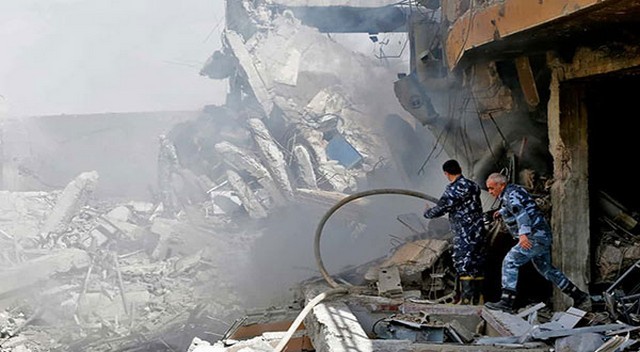
The US, France, Britain, Saudi Arabia and other American allies internationally continue to threaten military action against the Assad government in Syria over the unsubstantiated and dubious allegations that its armed forces used chemical weapons last weekend in the now re-captured city of Douma.

In response, the Syrian military, backed by Russian and Iranian forces, along with Shiite-based militias from Iraq and Lebanon, are preparing their defences and a potential counter-offensive, that could include attacks on US and allied forces in the Mediterranean, the Gulf states and Iraq.

Syrian forces are reportedly on high alert, and moving aircraft and other key military assets to bases that are protected by advanced Russian-manned missile defence systems. Senior government personnel, including Bashar al-Assad and his family, have been secured in safe locations out of fear of US assassination attempts.

Vassily Nebenzia, Russia’s ambassador to the UN, yesterday hit back at allegations of a chemical attack. “Our military, radiological, biological and chemical unit was on site with the alleged chemical accident [in Douma] and it confirmed that there were no chemical substances found on the ground,” he stated.

The Russian army has dispatched military police squads to protect the scene, ahead of Moscow’s proposed inspection of the site, and verification that the claims are false, by the Organisation for the Prohibition of Chemical Weapons (OPCW)—the Netherlands-based agency established in 1997 to monitor the international ban on chemical weapons.

Contradicting the Russian and Syrian government denials that any chemical weapons were used, the World Health Organisation (WHO) is continuing to assert—based on information from its “local partners”—that up to 500 people were sickened by toxic chemicals and as many as 43 died. The WHO press release provided no details concerning its “local partners.”

The original source of the video purporting to show victims of a chemical weapon attack was the US-funded “White Helmets”—part of the anti-Assad and Islamist-dominated rebel militias who were defeated in Douma and agreed to withdraw just days after the alleged incident.

A leading Russian politician aligned with President Vladimir Putin, Andrei Krasnov, declared yesterday that if the allegations of a chemical attack are used as the pretext for an attack on Syria, it will be viewed “not just as an act of aggression but as a war crime of the Western coalition.”

Russia’s ambassador to Lebanon, Alexander Zasypkin, yesterday stressed Moscow’s repeated warnings that it will retaliate against any attack that threatens its personnel in Syria. He told Lebanese television: “Russia will execute the statement of its president related to any US aggression against Syria, knocking down American missiles and striking at the sources of fire.”

President Donald Trump responded to Zasypkin’s widely reported remarks with a 7 am tweet on Wednesday. He asserted: “Russia vows to shoot down any and all missiles fired at Syria. Get ready Russia, because they will be coming, nice and new and ‘smart’!”

Behind such rhetoric, however, the US and its allies are acutely aware they are about to cross a Rubicon, into a devastating war across the Middle East that could cripple world oil production, a potential conflict with nuclear-armed Russia, and mass anti-war opposition at home.

The former head of the British Joint Forces Command, General Sir Richard Barrons, warned that the Russian statements meant that “they are going to try and sink ships, sink submarines and shoot aircraft out of the sky—that’s war.”

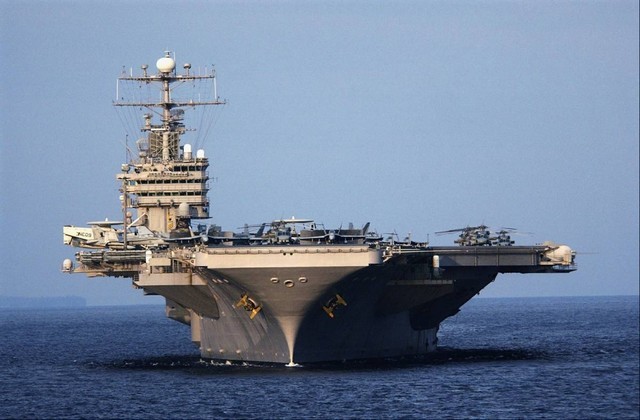
According to French reports, a Russian fighter-bomber, fully armed with anti-ship missiles, flew over a French frigate at combat altitude earlier in the week, in a pointed reminder that the US and allied warships deployed off the Syrian coast can be targeted and destroyed.

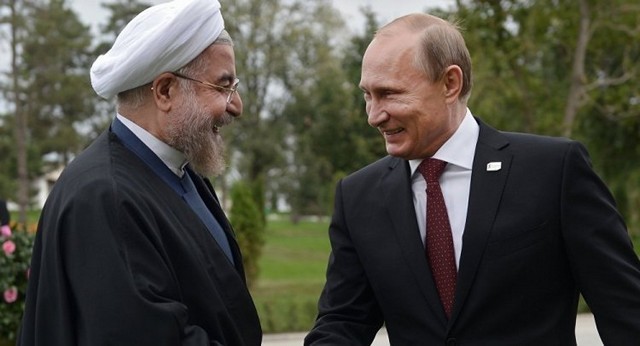
The Iranian government has publicly vowed to support Syria against “foreign aggression.” An unknown number of Iranian military personnel are embedded with Syrian Army units. Thousands more are operating as part of Iraqi Army and militia units, in many cases in close proximity to American military personnel, mercenary contractors and their bases in Iraq.

Israel, which is believed to be responsible for a missile attack this week on a Syrian airbase that killed a number of Iranian advisors, has placed its military on high alert. Conveying the fears in the Israeli establishment, its former head of intelligence, Efraim Halevy, told the Australian Broadcasting Corporation: “You have all the players locked in battle in a very, very small area of land. We have a gradual escalation in the region and the question is, who is going to blink first?”

Trump’s administration faces a barrage of demands from the American political and media establishment that it not “blink.” Trump has effectively been warned that the already concerted efforts to end his presidency will be dramatically escalated if he fails to order some form of major attack on Syria—regardless of the consequences. A significant factor in the calls for war is the desire in ruling circles for some means to divert and suppress the burgeoning wave of strikes by teachers, which threatens to trigger a broader movement of the working class against decades of falling wages and deteriorating social conditions.

In Britain, Prime Minister Theresa May, under no less intense pressure than Trump, has felt compelled to call a cabinet meeting today to try to get agreement that British forces will take part in any US-led attacks without any parliamentary vote—a politically-fraught decision.

The 2013 vote by the British parliament against involvement in a US-led attack on Syria is widely blamed by analysts for the Obama administration’s backdown from taking any action. May, without even waiting for cabinet approval, reportedly ordered British submarines to join US, French and British warships already in the eastern Mediterranean.

The French government of President Emmanuel Macron, also confronted with mounting strikes and student protests, appears to have provided the US with a guarantee of French military participation. Internationally, other US allies are extending diplomatic support. These include Australia, Canada, and a number of European Union states, headed by Germany.

Originally published in WSWS.org

12 April 2018

Source: https://countercurrents.org/2018/04/12/opposing-forces-mobilise-for-war-in-syria/

Scripted electoral victory for Egypt’s Sisi

By Afro-Middle East Centre (AMEC)

The Egyptian government’s need to artificially increase voter turnout in the presidential election at the end of March through a combination of enticements and threats indicates a growing disillusionment among ordinary Egyptians with the political situation in the country. With the victory of the incumbent, Abdel-Fattah el-Sisi, which was never in doubt, it is likely that Egypt will see an increase in already-high levels of repression.

Long before official electoral results gave Sisi ninety-seven per cent of the vote, his victory had been expected by everyone, especially after former military chief of staff, General Sami Anan, had been arrested in January, and human rights lawyer Khaled Ali had been forced to withdraw from the race. These events occurred in an atmosphere in which dissent was being violently repressed. That repression intensified in the past few months as the regime sought to shut down the already minuscule space available for opposition.

Sisi’s rein has seen thousands killed and tens of thousands arrested; a 2013 law severely curtailed the right to protest; and a 2017 law ensures that only NGOs supportive of the regime are able to operate. Some constituencies that had initially given some level of support to SIsi, such as leftist parties and youth organisations, have seen  their members arrested more recently, and the state has been formenting leadership contestation within some such groups. In a 29 January statement, Anan, Ali, and others labelled the electoral process a sham and advocated a boycott. To prevent Sisi being the sole candidate, the regime allegedly influenced Al Gad party’s Moussa Mostafa Moussa, who had already expressed his love for Sisi, to register as a candidate hours before the close of nominations. Until a week before his registration, he had been actively campaigning for Sisi.

With all these shenanigans, the only question that the election would answer was how large the voter turnout would be. The regime resorted to threatening voters to ensure a high turnout, which it believed would indicate support for Sisi. Teachers were forced to sign voter cards with their inked fingers in an attempt to ensure that they had voted, and in the governorates of Beheira and New Valley, officials had promised increased social services for districts with high voter turnouts.

In Minya and Sohag, police sought to pressure citizens to participate, and street vendors were threatened with the confiscation of their property if they failed to vote. Despite these attempts, voting numbers were still low, and the preliminary turnout had to be adjusted upward from forty to forty-two percent; Sisi’s vote of ninety-two per cent was also upped to ninety-seven per cent in order to equal the 2014 poll.
Astonishingly, the National Election Agency (NEA) claimed a high turnout in northern Sinai despite the Egyptian military’s scorched earth operations in the peninsula, and despite many in the region not being regarded as integral to Egypt, and many not even possessing full citizenship rights.

Although Sisi’s victory was guaranteed, the severity of the measures instituted to crack down  on dissent and ensure that citizens voted point to his many failings. His handling of the economy has alienated many Egyptians; a twelve billion dollar IMF loan was conditioned on the regime drastically reducing subsidies and allowing the currency to float. This aggravated the conditions of Egyptians, and criticism of the regime has increased, even from previously supportive lawmakers and television personalities. The president’s decision to hand over the Tiran and Sanafir islands to Saudi Arabia angered many Egyptians who had supported his nationalist rhetoric; and the insurgency in northern Sinai (and its spillover into the mainland) saw Sisi’s security credentials being questioned. The opposition from Anan and former air force General Ahmed Shafiq are significant in this regard, and suggest the possibility that there is not unanimity within the military regarding Sisi’s rule. In October 2017, he dismissed his confidante and military chief of staff Mahmoud Hegazy, and in January 2018 he fired the head of intelligence, Khaled Fawzy, leading some former insiders to argue that military discontent is at a high.

With Sisi’s electoral victory, it is likely that harsher measures will be implemented in Egypt, especially as regards economic policy, which could see further subsidy cuts to unlock the second tranche of the IMF loan. This will likely lead to more discontent and further repression, especially if citizens’ socioeconomic conditions worsen dramatically. The international community, especially since the accession of Donald Trump to the US presidency in 2017, and later Emmanuel Macron’s election to the French presidency, has been willing to tolerate Sisi’s repression since Cairo is regarded as being in the frontline of the battle against the Islamic State group, whose strongest branch (Sinai ‘Province’), operates in Egypt, and because Cairo is largely supportive of the dominant powers on regional issues. Sisi’s victory is also being seen by many as a sign that he might attempt to amend the constitution to remove the two-term presidential limit. Already, pro-Sisi parliamentarians are agitating for this, thus laying the ground for a new confrontation.

10 April 2018

Source: http://www.amec.org.za/egypt/item/1561-scripted-electoral-victory-for-egypt-s-sisi.html

Why Israel Feels Threatened by Popular Resistance in Palestine

By Dr Ramzy Baroud

Why did Israel kill many unarmed Gaza protesters and wound over 2,000 on Friday, March 30 and on the following days, when they clearly posed no threat to Israeli soldiers?

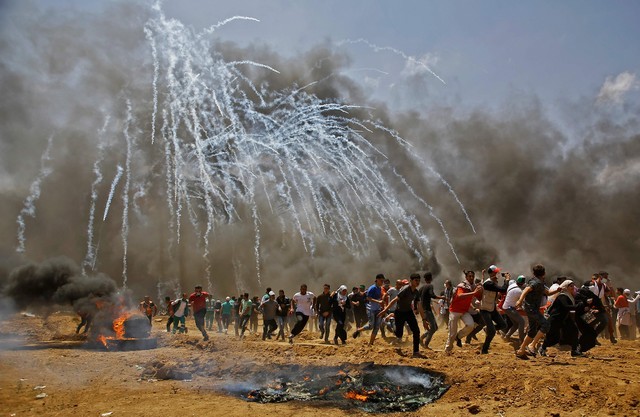
Hundreds of Israeli soldiers, many of them snipers, were deployed to the deadly buffer zone that the Israeli army has created between besieged Gaza and Israel, as tens of thousands of Palestinian families held mass rallies at the border.

“Yesterday we saw 30,000 people,” tweeted the Israeli army on March 31. “We arrived prepared and with precise reinforcements. Nothing was carried out uncontrolled; everything was accurate and measured, and we know where every bullet landed.”

The tweet, which was captured by the Israeli rights group, B’Tselem, was soon deleted. The Israeli army must have realized that killing children and bragging about it on social media is too cruel, even for them.

Palestinian popular mobilization deeply concerns Israel, partly because it is a PR nightmare. By killing and wounding this number of Palestinians, Israel had hoped that the masses would retreat, the protests would subside and, eventually, end. This was not the case, of course.

But there is more to Israeli fear. The power of the Palestinian people, when united beyond factional allegiances, is immense. It disrupts Israel’s political and military tactics entirely, and places Tel Aviv wholly on the defensive.

Israel killed those Palestinians precisely to avoid this nightmarish scenario. Since the cold-blooded murder of innocent people did not go unnoticed, it is important that we dig deeper into the social and political context that led tens of thousands of Palestinians to camp and rally at the border.

Gaza is being suffocated. Israel’s decade-long blockade,combinedwith Arab neglect and a prolonged feud between Palestinian factions, have all served to drive Palestinians to the brink of starvation and political despair. Something has to give.

Last week’s act of mass mobilization was not just about underscoring the Right of Return for Palestinian refugees (as enshrinedin international law), nor about  commemoratingLand Day, an event that has united all Palestinians since the bloody protests of 1976. The protest was about reclaiming the agenda, transcending political infighting and giving voice back to the people.

There are many historical similarities between this act of mobilization and the context that preceded the First Intifada(or ‘uprising’) of 1987. At the time,Arab governments in the region had relegated the Palestinian cause to the status of ‘someone else’s problem’. By the end of 1982, having already been exiled to Lebanon, the Palestinian Liberation Organization (PLO) along with thousands of Palestinian fighters, were pushed even further away to Tunisia, Algeria, Yemen and various other countries. This geographic isolation left the traditional leadership of Palestine irrelevant to what was happening on the ground.

In that moment of utter hopelessness, something snapped. In December 1987, people (mostly children and teenagers) took to the streets, in a largely non-violent mobilization that lasted over six years, culminating in the signing of the Oslo Accord in 1993.

Today, the Palestinian leadership is in a similar state of increasing irrelevance. Isolated, again, by geography (Fatah holding the West Bank, Hamas Gaza), but also by ideological division.

The Palestinian Authority (PA) in Ramallah is rapidly losing its credibility among Palestinians, thanks to long-standing accusations of corruption, with calls for the PA leader Mahmoud Abbas to resign (his mandate having technically expired in 2009). Last December, US President Donald Trumpcompounded the isolation of the PA, recognizing Jerusalem as the capital of Israel, in defiance of international law and UN consensus. Many see this act as the precursor designed to further marginalize the PA.

Hamas– originally a grassroots movement born out of the refugee camps in Gaza during the First Intifada – is now similarly weakened by political isolation.

Recently, there seemed to be a ray of hope. After several failed initiatives towards reconciliation with Fatah, a dealwas signed between both rival parties in Cairo last October.

Alas, like previous attempts, it began to falteralmost immediately. The first hurdle came on March 13, when the convoy of PA Prime Minister, Rami Hamdallah, was thetargetof an apparent assassination attempt. Hamdallah was en-route to Gaza through an Israeli border crossing.The PA quickly blamed Hamas for the attack which the latter vehemently denied. Palestinian politics went back to square one.

But then, last week happened. As thousands of Palestinians walked peacefully into the deadly ‘buffer zone’ along the Gaza border into the sights of Israeli snipers, their intention was clear: to be seen by the world as ordinary citizens, to show themselves as ordinary human beings, people who, until now, have been made invisible behind the politicians.

Gazans pitched tents, socialized and waved Palestinian flags – not the banners of the various factions. Families gathered, children played, even circus clowns entertained. It was a rare moment of unity.

The Israeli army’s response, using the latest technology in exploding bullets, was predictable. By shooting dead 15 unarmed protesters and wounding 773 people on the first day alone, the aim was to discipline the Palestinians.

Condemnations of this massacre flooded in from respected figures around the world, like Pope Francis and Human Rights Watch. This glimmer of attention may have provided Palestinians with an opportunity to elevate the injustice of the siege up the global political agenda, but is, sadly, of little consolation to the families of the dead.

Aware of the international spotlight, Fatah immediately took credit for this spontaneous act of popular resistance. Deputy Chairman, Mahmoud Al-Aloul, said that the protesters mobilized to support the PA “in the face of pressure and conspiracies concocted against our cause,” undoubtedly referring to Trump’s strategy of isolation towards the Fatah-dominated PA.

But this is not the reality. This is about the people finding expression outside the confines of factional interests;a new strategy. This time, the world must listen.

Ramzy Baroud is a journalist, author and editor of Palestine Chronicle.

10 April 2018

Source: https://countercurrents.org/2018/04/10/why-israel-feels-threatened-by-popular-resistance-in-palestine/

“Just shut up and die or disappear”: Reaction of Israelis to the Gaza massacres

By Rima Najjar

The reaction of Israelis to The Great March of Return depends on the “nationality” of the Israeli being referred to.

In Israel, there are Israeli citizens but no Israeli nationality – only “Jewish nationality” or “Palestinian Arab”, etc. (this is intentionally aimed at maintaining Israel as a Jewish State).

So, we have Palestinian-Arab MK Haneen Zoabi reacting to Israel’s massacres in Gaza as follows, and in the process expressing the feelings and reactions of Palestinian Israeli citizensas quoted in Forward and Y-netNews:

“We need to go on popular marches to remind the world of the siege. We need millions of Palestinians to march on Jerusalem. That is the aspiration. But we can’t do it, because the Israelis would kill them … Israel has turned from a racist country to a fascist one… Israel is not defending itself as it is claiming, the occupation and the siege are not an act of self defense, but rather one of terrorism … [the #GreatReturnMarch is] a march of peace, a peaceful act of popular struggle… We have popular resistance of women and children who want to put an end to the siege… Israel is opposed and kills Palestinians not because they endanger their soldiers. The children of Gaza don’t want to be killed quietly without receiving any recognition from the world. They are sending a message that we are under siege, and we need to do something, and that is to march and remind the world about the siege. Our problem is the silence of the international community… I don’t see what is violent about setting fire to a tire. Is burning a tire violence, while shooting at protesters not violence? Show me one Israeli who was hurt by these actions. Israel is only looking for an excuse to kill the Palestinians… Stop buying the Israeli propaganda… I am a Palestinian; they expect me to be loyal to the Zionists, while the only meaning of Zionism is to revoke my rights and to reject my identity.”

On the other hand, we have Israeli Jews reacting as described below by Nir Dvori, a reporter for the Israeli channel 2 news, in a photo tweet of Jews watching the mass murder of Gazan demonstrators by Israel’s snipers with the caption, “Best show in town.

And Here is Gideon Levy, Jewish Israeli journalist and author, in Haaretzdescribing an image captioned as “Israelis facing the Gaza border. Alex Levac” and expressing the sentiments of some liberal Israeli Jews:

A crocheted kippa, a head scarf and a guitar on the stone bench beneath the eucalyptus tree. A couple from Moshav BneiNetzarim, evacuees from the Gaza Strip. He’s singing a love song to her. And from here, too, Gaza is on the horizon. It doesn’t let go.

Diana Buttu’s reaction to the images shared by Nir Dvori and Alex Levac were as follows:

On Nir Dvori’s image/comment: “This is sick. Israeli residents of Nahal Oz watch as snipers kill Palestinians.”

On Alex Levac’s image: “Nothing to see here but people in prison being gunned down and gassed.”

Still other Israeli Jews, like SabiShaylan of Tel Aviv University, are incredulous and horrified. Shaylanposted this video clip with the following comment (computer translation from Hebrew):

To see and not believe. Aired a few minutes ago on channel 12-Snipers shooting Palestinians and unarmed men like ducks at the range of the men’s whinnies. The IDF is at its peak. One of the soldiers celebrates shooting in the head of one of the protesters. If there is an accurate definition of bloodthirsty expression, it is. If these aren’t war crimes, I don’t know what is.

AmerZahr, a Palestinian-American comedian, speaker, writer, academic, and adjunct professor at University of Detroit Mercy School of Law, pointed out that Israeli Jews have yet to learn to understand Palestinians:  “Israel just can’t seem to understand us, despite our quite clear and consistent message. It can’t figure out, after decades of anguish, why we won’t just go away.”

Without both understanding and empathy toward those struggling for freedom and return to their homeland as per Res 194 from those whose government holds all the power, we are simply left with a hot and tragic mess.

As Remi Kanazi, a Palestinian-American performance poet, writer and organizer based in New York City, posted on Facebook, unfortunately, the reaction of most Israeli Jews to the Palestinian struggle for justice is, “Just shut up and die or disappear.”

A list of things Palestinians can’t do under any circumstance:

No armed resistance
No unarmed protests
No marches for rights
No direct action
No international criminal court
No UNESCO
No boycotts
No divestment
No international solidarity

Just shut up and die or disappear. That is the only option Israel finds suitable.

Rima Najjar is a Palestinian whose father’s side of the family comes from the forcibly depopulated village of Lifta on the western outskirts of Jerusalem.

10 April 2018

Source: https://countercurrents.org/2018/04/10/just-shut-up-and-die-or-disappear-reaction-of-israelis-to-the-gaza-massacres/

The Unspeakable Pleasure

By Leonard Sax

Isabelle Robinson describes sitting in the school cafeteria in seventh grade, when a boy threw an apple at her, striking her so hard that the wind was knocked out of her. The boy smirked, and his eyes “lit up with a sick, twisted joy as he watched me cry.”

Five years later, on February 14, 2018, Robinson was a senior at Marjory Stoneman Douglas High School when the same boy, Nikolas Cruz, rampaged through the school, killing seventeen of her classmates and teachers. One month later, young people organized a nationwide school walkout, lasting seventeen minutes to honor each of the dead. Other young people challenged the walkout, suggesting that students should “walk up” instead. If more students befriended the loners and the bullied, then there would be less school violence. Or so the #WalkUpNotOut organizers suggested.

American cultural debate today quickly breaks down along partisan lines. The students protesting school violence almost immediately aligned themselves with advocates of gun control, calling for a ban on assault rifles. Their #WalkUpNotOut adversaries soon affiliated with supporters of the National Rifle Association. But the debate about gun control is only part of the picture. The bigger question, which simmers beneath the surface warfare over gun control, is Why?

Why do a growing number of young people feel that they have, as R. R. Reno recently observed, “permission to kill”? Ever since Columbine, there has been a continuous stream of American commentary about “the root causes of teen violence.” Some blame school bullying. Others blame the high rate of gun ownership in the United States, or violent video games, or social media. Commentators on both left and right seem reluctant to blame the perpetrator. All parties appear to assume that humans, left to themselves, are good, and that acts of violence stem from conditions external to the self.

I am a family doctor and a psychologist. I have seen how trauma in childhood can create scars that never heal. But during more than a quarter-century of medical practice, I have been led by my clinical experience to reject the deterministic assumptions underlying the therapeutic worldview that now pervades American culture. I have seen survivors of child abuse and neglect grow up to be kind and gentle adults. I have seen children who had every possible advantage—two loving parents, a stable home, and a close-knit community—grow up to be cruel and violent.

“He who rules his own spirit is greater than he who takes a city” (Proverbs 16:32). The Jewish and Christian traditions understand the problem of violence differently than does our therapeutic culture. In the Jewish and Christian traditions, sin is a temptation. Before the first murder, God warned Cain, “Sin is crouching at your door … but you can rule over it” (Genesis 4:7). Cain chose to yield to the temptation, to indulge the sin: the unspeakable pleasure of killing his brother. But he had the ability to choose. B. F. Skinner was wrong: Humans are not the helpless products of their previous experience. By the grace of God, we can choose to do right and shun evil.

Contemporary American psychology largely ignores the possibility of moral choice rooted in a framework of transcendent values. “Grit” is among the latest fashions in American psychology. But grit without a moral framework quickly degenerates into a careerist looking-out-for-number-one mentality, as Jeffrey Aaron Snyder has observed. The assumptions underlying contemporary American psychology are now relentlessly materialistic and goal-oriented. Teach children that they will get in trouble if they hurt others, and they will behave better because they fear the bad outcomes of misbehavior. Work hard, always obtain affirmative consent before you engage in intimacy, and you will have a good life.

It doesn’t work. More than half of the mass shooters in the past fifty years committed suicide at the conclusion of their crimes. They wanted the unspeakable pleasure of taking human life; they were willing to sacrifice their own lives for it. No approach to such individuals, or to such acts of violence, can be empirically valid if it denies the reality of moral choice and of the temptation to do evil.

Culture has consequences. If a boy is raised in a culture that teaches “Do not murder” as a moral imperative, that culture may give him the tools to understand his evil impulses and, one hopes, to master them. If a boy is raised in a culture that teaches “If it feels good, do it,” he is less likely to understand himself, and less likely to master his evil impulses.

Part of the answer to the question Why? may be: The culture has changed. Elsewhere I present more detailed evidence that American popular culture fifty years ago communicated a strong and consistent message—in movies and TV shows, in books and magazines, in schools, and in churches and synagogues—that moral norms were absolutes which all good people obeyed. That is less true today. Contemporary American popular culture is now the culture of “If it feels good, do it,” “Whatever floats your boat,” and “You do you.”

There is nothing new about hate. The temptation to kill is as old as Cain. But today, moral absolutes have been undermined by a popular culture that celebrates individual fulfillment over self-sacrifice, the indulgence of personal pleasure over doing one’s duty. A corollary to “You do you” is “Haters gonna hate.” If my analysis has any merit, then the road ahead is clear, though it will be a long road. We must combat the culture of “You do you.” We must teach haters to love.

Leonard Sax is author of The Collapse of Parenting.

10 April 2018

Source: https://www.firstthings.com/web-exclusives/2018/04/the-unspeakable-pleasure

The pope’s challenge to Orban and Europe’s far right

By Ishaan Tharoor

As expected, right-wing Hungarian Prime Minister Viktor Orban won a third consecutive term on Sunday. His ruling Fidesz party secured more than two-thirds of the seats in parliament, a decisive mandate that many observers consider an ominous sign for the future of democracy in Hungary — and even the rest of Europe.

Orban ran a stridently anti-immigrant campaign, fixating on the phantom menace of Muslim migrants and refugees overwhelming Hungary. He repeatedly styled himself as the defender of Europe’s traditional Christian identity, likening an anti-migrant fence he erected on Hungary’s southern border to the ramparts of Western civilization. And he cast his enemies, both abroad and at home, as agents of an alien threat.

But there’s one actual leader of European Christendom who probably vehemently disagrees with Orban. On Monday, as the Hungarian leader basked in his victory, Pope Francis issued an apostolic exhortation on the subject of holiness. His message centered on the importance of caring for migrants, with the pope arguing that their plight should be as important to Catholics as their opposition to abortion.

“Our defense of the innocent unborn, for example, needs to be clear, firm and passionate,” the pope wrote. “Equally sacred, however, are the lives of the poor, those already born, the destitute, the abandoned.”

As the New York Times reported, the Vatican introduced the exhortation with a promotional video featuring a Muslim refugee from Afghanistan named Mohammad Jawad Haidari, who expressed his awe for the pontiff’s compassion. “It was a surprise, and a revolutionary text with respect of the vision I had before of the Christian world,” Haidari said in response to the pope’s new message.

As European politicians have turned to scaremongering over migrants, Francis has been conspicuous with his open-armed embrace of refugees. He bathed the feet of asylum-seekers from sub-Saharan Africa in 2016 and transported a group of displaced Syrians in his own plane. Those actions, along with his strong stance on refugees, have gained the pontiff a legion of critics among the far right and even within more conservative circles at the Vatican.

He has also had awkward dealings with clergy members in Hungary and Poland, both historically Catholic nations with right-wing nationalist governments that practice virtually the opposite of what the pope seems to preach.

Orban, though, did not risk a war of words with the head of the Roman church. Instead, he made Jewish American philanthropist George Soros, who has invested in promoting civil society and democracy in his native Hungary, into public enemy number one.

Orban said that Soros aimed to strike a “final blow to Christian culture” through his support for greater pluralism and compassion toward migrants. Anti-Soros messaging suffused the election campaign, which international monitors declared was “significantly compromised” by the ruling party’s overweening control over state television and even some commercial broadcasters.

Douglas Wake, the head of mission from the Organization for Security and Cooperation in Europe, told reporters in Budapest that Orban’s virulent anti-migration message subsumed the election cycle and marginalized the opposition. The “hostile and intimidating campaign rhetoric,” Wake said, “limited the space for substantive debate and diminished voters’ ability to make an informed choice.”

For his hard-line agenda — which reeked of anti-Semitism — Orban was swiftly congratulated by the doyens of Western Europe’s far right, who also oppose both Muslim immigration and the European Union’s fitful efforts to respond to the Syrian refugee crisis. These included Italian ultranationalist Giorgia Meloni, anti-Islam Dutch politician Geert Wilders and French far-right leader Marine Le Pen, who hailed Orban’s victory as a rejection of Brussels. Even German Interior Minister Horst Seehofer, who has said Islam has no place in his country, urged his liberal colleagues to drop their “arrogance and condescension” toward Orban in the wake of the election result.

With another term now in hand, Orban has become one of the continent’s most potent illiberal demagogues, bending the state to his favor and eroding the country’s fledgling democratic norms. Now his critics fear bigger moves to silence opposition to his rule.

“Approximately 2,000 people are working in Hungary to overthrow the government in the election campaign and replace it with a pro-immigration cabinet favorable to George Soros, as well,” Orban told state radio before the vote. “We know exactly, by name, who these people are and how they operate in order to turn Hungary into an immigrant country.”

As my colleague James McAuley reported, Orban and his allies intend to enact new legislation to crack down on civil-society groups it deems hostile to the government’s interests. “We can see an alarmingly fast crackdown on civil society, or independent voices, in Hungary,” Marta Pardavi, the co-chair of the Hungarian Helsinki Committee, a human rights group that works with migrants, said to McAuley.

Not unlike the nationalist grandstanding of autocrats in Russia and Turkey — whose politics Orban claims to admire — the Hungarian prime minister has used a culture war to entrench his rule. At home, his anti-immigrant, anti-E.U. sentiments helped him outflank the formerly neo-fascist Jobbik party on the right. Abroad, they helped him link up with leaders elsewhere in eastern and central Europe to build support for his defense of Europe’s Christian identity and his attack on what he famously called “the era of liberal babble.”

But his vision of Christendom is not shared in Rome, where the pope seems to have an inconvenient fondness for at least some “liberal babble.” In his exhortation, Francis pointed to how “welcoming the stranger” was fundamental to the Catholic faith, not a “a momentary fad” that happened to be “invented by some Pope.”

“That a politician looking for votes might say such a thing is understandable,” the pope wrote, “but not a Christian.”

Ishaan Tharoor writes about foreign affairs for The Washington Post. He previously was a senior editor and correspondent at Time magazine, based first in Hong Kong and later in New York.

10 April 2018

Source: https://www.washingtonpost.com/news/worldviews/wp/2018/04/10/the-popes-challenge-to-orban-and-europes-far-right/?utm_term=.80402e7bfabb

Trump Reverses Himself On Syria Pullout Order

By Patrick Martin

After a reportedly heated meeting of the US National Security Council on Wednesday, the Trump White House announced that there was no change in US policy toward Syria, despite a volley of comments and tweets by President Trump demanding an immediate pullout of the 2,000 US troops now deployed in the country.

The meeting with the National Security Council was essentially a conference between Trump and his generals, since he has no current top-level civilian foreign policy advisers.

Trump fired Secretary of State Rex Tillerson last month, and his successor, CIA Director Mike Pompeo, has not yet been confirmed. National Security Advisor H.R. McMaster, an Army general, is a lame duck, and his replacement, former Bush administration UN Ambassador John Bolton, does not begin work until next week.

As a consequence, the meeting Wednesday involved Trump and Secretary of Defense James Mattis (a retired Marine Corps general); the chairman of the Joint Chiefs of Staff, General Joseph Dunsford; and the head of the Pentagon’s Central Command, General Joseph Votel, to discuss Syria policy.

The White House issued a brief statement after the meeting, declaring, “The military mission to eradicate ISIS in Syria is coming to a rapid end,” but adding that it would continue. At the same time, Washington appealed to “countries in the region and beyond, plus the United Nations, to work toward peace and ensure that ISIS never re-emerges.”

Press reports suggested that Trump had told the military brass that he wanted a complete pullout within six months, an indication that the wrangling over Syria is largely motivated by domestic political considerations. Trump wants to have the option of announcing a supposedly triumphant end to the Syrian intervention on the eve of the November 6 congressional election, now seven months away.

The Republican Party is trailing badly in the polls and has suffered a series of recent reverses in key industrial states.

Significantly, Trump made his initial announcement about withdrawing all US troops from Syria at a campaign-style rally in Ohio, another key industrial state in the Midwest. He is acutely aware—and the audience response at the rally demonstrated it—that the American public is deeply hostile to military interventions in the Middle East.

There is an enormous gulf between this popular antiwar sentiment and the demands of the military-intelligence apparatus, the Democratic and Republican parties, and the corporate media, where there has been near-universal denunciation of Trump’s suggestion of a pullout from Syria.

Senator Lindsey Graham of South Carolina, who plays a major role on national security policy in the Republican caucus, warned on Fox News Sunday that a withdrawal from Syria was the worst decision Trump could make.

On Tuesday, there was a revealing split-screen moment, when Trump was declaring his support for withdrawal from Syria at a White House press briefing, at the very time that two top US officials, General Votel of Central Command, and Brett McGurk, the State Department coordinator of the campaign against ISIS, were a few blocks away addressing the US Institute for Peace, a think tank devoted, of course, to imperialist war, about the necessity to stay the course.

“We are in Syria to fight ISIS. That is our mission, and our mission isn’t over,” McGurk told the audience, citing two large pockets of ISIS fighters numbering several thousand men, and including ISIS leader Abu Bakr al-Baghdadi. “We have to work through some very difficult issues as we speak,” he said. “We are going to complete that mission.”

General Votel was even more categorical, saying, “The hard part, I think, is in front of us, and that is stabilizing these areas, consolidating our gains, getting people back into their homes.” He added, “There is a military role in this, certainly in the stabilization phase.”

Wednesday’s NSC meeting was only the latest demonstration of the sway that the generals exercise in all Trump administration policy matters. Besides the generals on the other side of the table, briefing Trump, his own chief of staff, John Kelly, is a retired Marine Corps general implacably opposed to any “premature” withdrawal of US forces from Syria, Iraq or Afghanistan.

The NSC meeting coincided with the meeting in the Turkish capital of Ankara between Russian President Vladimir Putin, Iranian President Hassan Rouhani, and Turkish President Reccep Tayip Erdogan to discuss the political situation in Syria in the wake of the destruction of ISIS and the military advances of forces loyal to Syrian President Bashar al-Assad. The three presidents agreed on maintaining the territorial integrity of Syria, an implicit rejection both of Kurdish aspirations in the region.

At the same time, the Associated Press reported Wednesday that United States troops were building new positions near the front line close to the Syrian-Turkish border, with outposts flying the American flag. According to this report, “The structures look much like the fighting positions once seen in Iraq and Afghanistan, which projected a clear message: ‘We’re here for a while.’”

A top US general Thursday emphasized that Trump had not set a deadline for withdrawing US troops from Syria, despite his statement to that effect at a campaign rally last week, several tweets, and his comments to the press Tuesday during an appearance with visiting leaders of the three Baltic states.

Lt. Gen. Kenneth McKenzie, the director of the Joint Staff, told a Pentagon press briefing, “One of the things that we haven’t been given is a timeline,” and he went on to praise Trump, saying, “The President has actually been very good in not giving us a specific timeline.”

In a transparent effort to flatter Trump, General McKenzie contrasted the current posture in Syria with timelines like those set by the Obama administration in Afghanistan, where, he said, US forces “operated against a timeline that was known to the enemy.”

The real attitude towards Trump’s vacillations about Syria was spelled out in a scathing editorial published Thursday night by the Washington Post, which has been aligned with the Democratic Party efforts to push Trump towards a more confrontational policy against Russia.

Under the headline, “Trump’s mind-boggling gift to America’s enemies,” the Post took note of Trump’s belated climb-down before the demands of his “national security team,” and then warned of the devastating consequences that a pullout from Syria would have for the interests of US imperialism.

Brushing aside the question of ISIS, which has always been a pretext, calling it “only one of the major US interests at stake,” the Post spelled out the main US war aims: “preventing Iran and Russia from entrenching in the country at the expense of U.S. allies including Israel and Jordan;” as well as “preserving Turkey’s place as a NATO ally” and preventing “destabilizing waves of refugees headed for Europe.”

The editorial continued, making a sinister connection between US policy in Syria and the ongoing anti-Russian campaign by the Democrats and their media mouthpieces like the Post and the New York Times: “That Mr. Trump’s intended retreat is a gift to Vladimir Putin perhaps should not be surprising, given Mr. Trump’s curious eagerness to accommodate the Russian ruler.”

Originally published in WSWS.org

6 April 2018

Source: https://countercurrents.org/2018/04/06/trump-reverses-himself-on-syria-pullout-order/

Man’s Inhumanity To Man: Israel And Kashmir

By Dr Arshad M Khan

Man’s inhumanity to man reached new levels of odium.  The generally trigger-happy Israeli army fired at unarmed demonstrators on the other side of the fence cordoning Gazans into a prison.  That hundreds were injured and at least 18 killed evoked little sympathy from our media and certainly no one dared criticize Benjamin Netanyahu’s crowing of the incident as a great victory.

The ‘liberal’ National Public Radio terms such incidents “violent clashes” as if there is a certain parity of arms, when a military firing at civilian demonstrators would result more appropriately in a massacre.

But Israel has new worries.  For the first time, Palestinians (Christian and Muslim) now outnumber Jews within Israel and the occupied territories.  A half million more now with the difference expected to widen on account of the higher Palestinian birth rate.  Hence a war of attrition.

Trigger-happy soldiers, an imprisoned Gaza with appalling living conditions, and then, of course, there is ethnic cleansing.  Outright expulsion, or denial of water and electricity and generally making life unbearable leading to a ‘voluntary’ form of departure.

Thus the village of Umm al-Hiran which was razed to the ground after the eviction of its residents.  Ayman Odeh, a Palestinian Arab member of the Knesset, was shot in the head and back by rubber bullets as he and others protested.  The area will now house Jewish settlers.

The reality of eviction, ethnic cleansing and annexation is not news, but is an undeniable new reality seeking to cordon off Palestinians in the worst areas.  For some Israelis, the choice boils down to segregated Bantustans or brutal expulsion.  The country itself is changing as Middle-Eastern Mizrahi and Sephardic Jews now number closer to the European Ashkenazi and are expected to exceed them eventually.  A civilized living together is excluded by religion in this Middle-Eastern enclave masquerading as a Western democracy; more like George Wallace’s Alabama awaiting a Martin Luther King, Jr.

About 2500 miles east lies another beleaguered population, the Kashmiris suffering a brutal decades-long occupation by an estimated one-quarter to three-quarter million force of Indian soldiers.   In one tactic they use shotgun weapons loaded with small pellet shells — no riot control techniques for them.  Their preferred target is not the lower body but the upper, resulting in all too numerous instances of small boys and young men being blinded for life.  Major Aditya Kumar was charged with murder after one incident only to be granted relief recently by a pliant Indian Supreme Court.

Demonstrations have intensified since the killing of the popular and charismatic rebel leader, Burhan Wani, in July 2016.  He was just 21.  Thousands of civilians have been injured, many blinded, and many have died as a result of the brutal response by the occupation forces.  The latest incident on April1 led to 20 deaths.

India promised a plebiscite under UN supervision about 70 years ago.  It has not been held.  The fact that Kashmiris are in massive civilian protest as well as open rebellion is well established by the presence of troops.  It is also abundantly clear, given a choice, that Kashmiris would tell their Indian overlords to get the hell out.  Whether they would want to join Pakistan or wish to remain by themselves is an open question.  It hardly matters in these days of open economic communities.

But foresight or statesmanship is not to be expected in leaders pushing their antiquated and noisome upper caste Hindu supremacy, tarnishing the founder Nehru’s proud boast of a secular state.  Add to it a rewriting of history in which the Taj Mahal is a Hindu temple.  It is not.  In the new India Christians, Muslims and lower caste Hindus (Dalits) are under constant threat or attack.

So there we are … two nuclear powers in constant confrontation without the sense to bury a colonial past and forge a new modern subcontinent.  No, that would be much too sensible.  Instead, religious extremism has secured a foothold and we all know how that can end unless it is quickly snuffed out.

Dr Arshad M Khan (http://ofthisandthat.org/index.html) is a former Professor based in the U.S. whose comments over several decades have appeared in a wide-ranging array of print and internet media.

6 April 2018

Source: https://countercurrents.org/2018/04/06/mans-inhumanity-to-man-israel-and-kashmir/

Statement from the Network in Defense of Humanity Concerning the Manipulated Process against Former President of Brazil Lula

By Network in Defense of Humanity

We have witnessed in recent days the orchestration arranged by the representatives of the most rancid section of the Brazilian oligarchy, the organs of justice and the informative and televising outlets of that country. From this corrupt complicity has risen an arbitrary and illegal decision that can lead president and leader of the Workers’ Party Luiz Inacio Lula Da Silva to jail, and thus preclude his candidacy for next October’s elections, in what would be a prolongation of the coup d’état that ousted President Dilma Rousseff in 2016.

Due to the successes achieved by his government in the fight against poverty and inequalities, Lula is the candidate with the broadest popular support in the country, and that is well known by the right and its international allies. That is why they have used all possible ways to discredit and disable him. The farce that we have just witnessed is aimed at gaining a key position in Latin America to strengthen the neoliberal wave that will ruin any vestige of social advancement on the continent.

Once again bourgeois democracy and its institutions have demonstrated their inability to guarantee justice. From a supposed democratic order, they have used the most grotesque corruption, manipulation, threat and lies at their disposal to put an end to an option of the dispossessed.

Enough of this invoking of democracy and justice to oppose them to the people when the true and most authentic meaning emanates from them.

In these difficult and defining moments, the Network of Intellectuals, Artists and Social Movements in Defense of Humanity embraces, once again, Comrade Lula and with him the Brazilian people, mobilized today in support of their leader to recover in the streets the power illegitimately snatched by a cast of neo-fascists and known thieves.

We call on all networks, organizations and social movements to accompany our brothers and sisters in Brazil in denouncing this alarming situation and to speak on social networks with the greatest speed and forcefulness.

Network in Defense of Humanity

6 April 2018

Source: https://cuba-networkdefenseofhumanity.blogspot.my/2018/04/statement-from-network-in-defense-of.html

BOYCOTT, DIVEST AND SANCTION ISRAEL

By Askiah Adam

PALESTINE, that enclave of humanity occupied, brutalised and totally without any form of military defence against any and all aggressors is conveniently perceived as a threat by the Jewish state, Israel, the undeclared, sole nuclear power in West Asia and North Africa (WANA). This latter entity, the occupying power, is a usurper legitimised by imperial Britain and today unconditionally supported and armed by the United States of America (USA). Such is the irony of the geopolitical construct that terrorises Gaza, virtually an open prison, and the West Bank, perpetually. Abandoned by the so-called international community, Palestinians draw inspiration from the defeat of the ‘mighty’ by the ostensibly ‘powerless’ at various points in history. It is that spirit which keeps the flames of resistance burning.

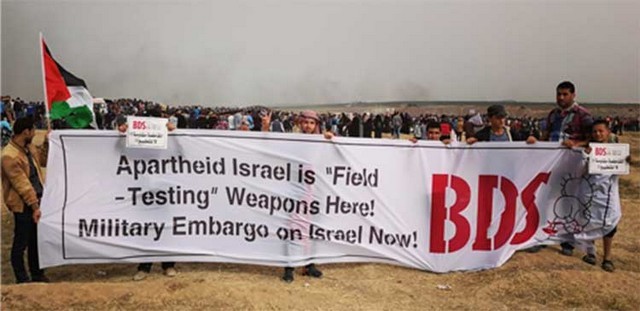
Demanding for the right of return to the homeland by the Palestinian diaspora of refugees, the on-going Great March of Return, a peaceful protest bringing out thousands of Palestinians marching along the Israeli border, is but the most recent show of this spirit with numbers symbolising strength. And, Israel not wishing to disappoint the world met this peaceful demonstration with such disproportionate violence that at least 18 Palestinians were killed and almost one and a half thousand injured because live bullets were fired into the crowd and drones flew overhead dumping tear gas on the marchers. That this degree of violence, which included a row of a hundred snipers on the ready, on the part of the occupiers was planned made it all the more galling. Tel Aviv knew they could perpetrate this act of inhumanity with impunity as it became obvious only too quickly. Calls for an investigation by the seemingly outraged international community were immediately quashed by a US veto in the UN Security Council, even as the martyred were being buried.

Long suffering, the Palestinians cannot any longer hope to find a solution through established institutions like the United Nations, now more than ever nothing but an instrument for legitimising the interests of the powerful member states. The time has come to unmask the futility of the two state solution used merely to prolong negotiations while enabling Tel Aviv to pursue its genocidal agenda. As Richard Falk insists the time for goodwill has “long passed”. It is time to pressure Israel into a settlement. Individuals and state actors alike must intensify the boycott, divestment and sanctions (BDS) campaign against Israel. In the name of justice let us isolate Israel. Support the BDS Movement and intensify the siege.

Askiah Adam
Executive Director
International Movement for a JUST World

Malaysia

6 April 2018