Just International

“Let us pray for our Rohingya brethren”: Pope Francis

By www.siasat.com

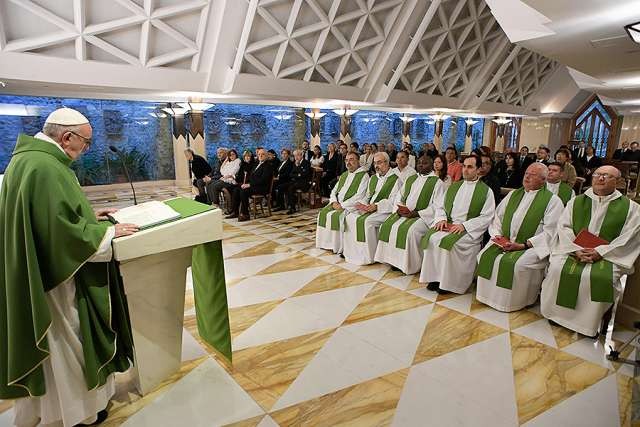
NEW DELHI: Pope Francis issued a stinging criticism on the Myanmar’s harsh treatment of its Rohingya Muslim minority community, saying they had been tortured and killed simply because they wanted to keep their culture and Muslim faith.

“They have been suffering for years…simply because they want to live their culture and their Muslim faith,”   decried  Francis, who is slated to visit Myanmar and Bangladesh between November 27 and December 2, where the Rohingya Muslim minority is suffering extreme persecution.

In August, condemning atrocities committed by Burma, the Pontiff  urging worshippers gathered in St Peter’s Square in Rome to pray that God “saves” the persecuted minority.

“Sad news has arrived of the persecution of the religious minority, our Rohingya brothers,” condemned Pope Francis.

“I would like to express my full closeness to them. Let us all ask the Lord to save them, and to elicit men and women of goodwill to help them, for them to be given their full rights.”

The Pope went on to say, “Let us pray for our Rohingya brethren.”

Some 146,000 Rohingya Muslims in the region have fled to neighboring Bangladesh in less than two weeks, overwhelming refugee camps that were already bursting at the seams and triggering warnings of a humanitarian crisis.

ALSO READ: Don’t think we will be able to give any relaxation to Rohingya Muslims: Naqvi

Many more have died trying to flee the fighting in Myanmar’s Rakhine state, where witnesses say entire villages have been burned to the ground since Rohingya militants launched a series of coordinated attacks on August 25, prompting a military-led crackdown.

Bangladesh is a Muslim-majority country, while Myanmar is dominantly Buddhist, with Christians occupying a very small percentage of the population.

Myanmar refers to Rohingya as Bengalis and denied citizenship, contending they were illegal immigrants from Bangladesh, though many Rohingya families have lived in Myanmar for generations.

11 September 2017

Rohingya crisis: Sikh volunteers reach Bangladesh-Myanmar border to provide langar to refugees

By Divya Goyal

A team of volunteers from Sikh organisation Khalsa Aid reached Bangladesh-Myanmar border Sunday night to provide relief to the lakhs of Rohingya Muslim families fleeing Myanmar. Speaking to The Indian Express over phone, Amarpreet Singh, managing director, Khalsa Aid, India who has reached Teknaf, a border town in Bangladesh where the refugees are living in the camps, said that condition at the border was “miserable to say the least”.

“It was our first day here today and we did a pre-assessment before launching a major relief operation. We had come prepared for providing relief to some 50,000 people, but there are more than three lakh refugees here. They are living without water, food, clothes and shelter. They are sitting wherever they can find a corner. It is raining, but people do not have anywhere to go. It is miserable to say the least. We will be providing them langar food (community kitchen) and shelter. We are arranging tarpaulins but since the number of refugees have overwhelmingly exceeded our preparations, it can some time to make arrangements,” he said.

He added that there were huge camps at Teknaf and each one was crowded beyond its capacity. “A camp can accommodate at least 50,000 people but in most of them there are more than one lakh refugees. But we are committed to run langar here (community here) till the crisis is not over. The priority is to not let anyone sleep without food. Children are roaming without clothes and begging for food. Those who do not get space in camps are sitting along roads in hope of getting food from someone,” he added.

Khalsa Aid team is now serving langar and water to the refugees. “Teknaf is almost 10 hours ride from the capital Dhaka from where we are ferrying all the material needed to prepare langar. Connectivity issues and rain are creating hindrances but we are trying our best to provide food to the maximum people at the earliest. The langar will continue here till crisis is not over and refugees continue to reach the border,” he added.

Another team of Khalsa Aid volunteers is expected to reach the border town Teknaf in coming days to assist in the relief operations, said Amarpreet.

Jeevanjyot Singh, a Khalsa Aid volunteer from Jammu & Kashmir who is also in Teknaf, said that refugees started from Myanmar by foot almost ten days back and then reached Teknaf through boats. “They are in an extremely bad state as of now. They have nowhere to go.

We have spoken to some families and they have told us that after crossing thick jungles on foot in Myanmar, they crossed border through boats and then resumed journey on foot. Most of them have traveled for more than ten days. Since then, children had no food or water. They are in dire need of food and water,” he said.

Myanmar led by its state counsellor Aung San Suu Kyi has been rapped by the United Nations for gross human rights violation against the tribe of Rohingya Muslims and as per UN estimates, 2.70 lakh Rohingya Muslims have already fled to Bangladesh and even more are trapped at the border.

Divya Goyal is our Punjab correspondent

12 September 2017

India barks up the wrong tree with Israel

By M. Ghazalli Khan

In an article in the Economic Times “India is Israel’s top destination for arms exports, buying 41 per cent of export between 2012 and 2016, according to the Stockholm International Peace Research Institute, an independent global conflict and arms-research institute. Israel is India’s third-largest source of arms, with a 7.2 per cent share of imports between 2012 and 2016, next to the US (14 per cent) and Russia (68 per cent)”.

Since India established full diplomatic ties with Israel in 1992, covering a wide range of issues from defence and homeland security, to agriculture and water management, and now education and even outer space. The Indian writer Prabir Purkayastha has argued that India cannot be a major “buyer of Israeli arms… and claim innocence when charged with helping subsidize the Israeli occupation of the West Bank and Gaza.” There is also, allegedly, a cost to India’s reputation in the developing world, whose backing is crucial if India is to gain the permanent seat on the UN Security Council it has long coveted.

Supporters of a justice in Kashmir draw comparisons between the Indian and Israeli militaries. Modi himself drew such a parallel after launching preemptive military strikes against alleged terrorist safe havens in the part of Kashmir controlled by Pakistan. We copied Israeli tactics when an Indian army officer strapped a Kashmiri civilian onto a jeep as a “human shield,” arguing that if Israel could do it, then we should too.

Calls from retired military officials ask India to replicate the Israeli model of total social mobilization against terrorism. On the ground, things are different. Israel’s occupation was openly rejected when young activists in a south Indian town sought to show solidarity with besieged Palestinians by putting up signs renaming one of its streets after Gaza. Sangh Parivar affiliates exploded with rage comparison the town to an ISIS den.

The article we share shows how India’s ‘fatal embrace with Israel takes India down the wrong track. It is devoid of a vision that is needed to end an illegal occupation and a colonialist regime in Israel that occupies the Palestinians with fierceness and viciousness that has few, if any, parallels in history. If India wishes to be a factor in the Middle East, with its high degree of dependence on oil resources in the region, then it must contend with a foreign policy that desists from choosing Israel over the Palestinians. Nor can India be neutral. India must precondition its relations with Israel with a caveat – that Israel ends its occupation and enlarges its trade relations with India and, indeed, the rest of the world. Sadly, Modi has abandoned a historic policy which served India well for all of 50 years until the Congress opens its doors to the wrong Israel for reasons of duress and opportunism.

Ranjan Solomon
Editor

10 September 2017

Open letter from Archibishop Desmond Tutu to Aung San Suu Kyi

By Desmond Tutu

My dear Aung San Suu Kyi

I am now elderly, decrepit and formally retired, but breaking my vow to remain silent on public affairs out of profound sadness about the plight of the Muslim minority in your country, the Rohingya.

In my heart you are a dearly beloved younger sister. For years I had a photograph of you on my desk to remind me of the injustice and sacrifice you endured out of your love and commitment for Myanmar’s people. You symbolized righteousness. In 2010 we rejoiced at your freedom from house arrest, and in 2012 we celebrated your election as leader of the opposition.

Your emergence into public life allayed our concerns about violence being perpetrated against members of the Rohingya. But what some have called ‘ethnic cleansing’ and others ‘a slow genocide’ has persisted – and recently accelerated. The images we are seeing of the suffering of the Rohingya fill us with pain and dread.

We know that you know that human beings may look and worship differently – and some may have greater firepower than others – but none are superior and none inferior; that when you scratch the surface we are all the same, members of one family, the human family; that there are no natural differences between Buddhists and Muslims; and that whether we are Jews or Hindus, Christians or atheists, we are born to love, without prejudice. Discrimination doesn’t come naturally; it is taught.

My dear sister: If the political price of your ascension to the highest office in Myanmar is your silence, the price is surely too steep. A country that is not at peace with itself, that fails to acknowledge and protect the dignity and worth of all its people, is not a free country.

It is incongruous for a symbol of righteousness to lead such a country; it is adding to our pain.

As we witness the unfolding horror we pray for you to be courageous and resilient again. We pray for you to speak out for justice, human rights and the unity of your people. We pray for you to intervene in the escalating crisis and guide your people back towards the path of righteousness.

God bless you

Love

Desmond Tutu

Desmond Tutu, winner of the 1984 Nobel Peace Prize, is archbishop-emeritus of Cape Town, South Africa.

9 September 2017

A Wild Flower in the Indian Wasteland, Gauri Lankesh: 1962-2017

By Satya Sagar

On that dreadful evening of 5th September, if Gauri Lankesh had seen her own corpse lying in a pool of blood outside her house she would have -I am very sure- simply smiled

For even in her death she had done what was closest to her heart – expose India’s saffron supremacists for what they really were.  A sorry bunch of cowards, whose idea of valour or honour was to shoot an unarmed woman in the back and disappear into the dark.

In fact, such was her chutzpah, if Gauri had known there were a group of men waiting to kill her she would have invited them home for a cup of coffee. In chaste Kannada then, she would have asked them to explain whether her dying would be of any use to the ordinary citizens of this land. If convinced by their arguments, maybe she would have happily paid for the cartridges in their guns and requested them to go ahead.

Instead, in the end, her opponents remained true to their cultural roots and usedthe chosen methods of suppressing rebels and ‘rakshasas’ prescribed by hoary Hindu mythology. Like Vali, slyly shot by Ram, from behind a tree or a defenceless Meghnad murdered by Lakshmana, as he sat worshipping Lord Shiva – Gauri, daughter of Lankesh, was silenced only through low cunning and treachery.

Very appropriate perhaps in some ways. Nothing, after all, has really changed in this country, so many millennia since the Ramayana happened. The racist Aryans, whom Gauri fought all her life, are in power and consolidating by the hour.

Not one of these ‘Ram bhakts’ though, had the guts to look her in the eye – for who knows what mighty powers that may have provoked? Gauri, despite her own professed rationalism and atheism – had silently become through her life, work and audacity- what ordinary Indians have respected from time immemorial – a fearless and even fearsome Mother Goddess.She had to be eliminated – the Gods themselves were feeling the heat way up there, from the fires she had lit all around.

Gauri would also had a hearty laugh at the sick characters on social media celebrating her death, their green tongues dripping poison, using the vilest of terms to abuse her. The ethos of these proponents of  ‘Ram Rajya’, are now so visible for the whole world to see.

These are the rabble claiming to be upholders of India’s great spiritual heritage, culture and morality and who distribute the Gita to visiting dignitaries from distant lands. They stand stark naked now, proven to be nothing more than hate-filled misogynists, men without mothers or sisters, born to stone and not of flesh and blood.

Even so, I think,  Gauri was large-hearted enough, to forgive them. For despite the biting language she often employed – her battle was nothing personal at all. Instead she stood for whatever she thought was just and humane and against all that reeked of raw greed for oppressive power. She harboured no ill will against anyone and would have fought like a tigress to defend the human rights of even her foes.

Gauri’s heart would have filled with genuine happiness to see the thousands upon thousands who turned out across India to protest her brutal murder – again, not as a boost to any ego but as sign of hope they hold for the future. What she had tried very hard in nearly two decades of activism – to mobilize and unite fellow citizens against the politics of religious bigotry– happened within twenty four hours following her death.

She would have loved especially all those young girls coming out with ‘I am Gauri’ placards. In the instant the bullets pierced her frail body a million Gauris were already born, resolving to carry on her fight, with similar courage, commitment and passion. India indeed has a bright future, despite the descending gloom at Gauri’s departure There are many indeed many wild flowers, inspired by her, blooming in the dry wasteland this nation has become and they will have their day too.

Gauri, would have known though, given the vast challenges of fighting injustice, deprivation and venal racism of caste in a country like India, even all this outpouring of grief, anger and resolve may not be enough. It will take much more energy, intellectual honesty, courage and conscience to overcome the forces of darkness enveloping our nation.

It will be first of all crucial – to follow in the footsteps of Kalburgi, Pansare, Dabholkar and Gauri – to go to the field to study, mix with common citizens to understand what is really needed and how it should be done. To listen to and speak the language of the people in their own idiom, to truly communicate– in a way that transforms hearts and minds.

How is whatever we see all around us today in the country linked to what is happening in other parts of the world? Is there not a long history of religious, ethnic, racial hatred everywhere and how were they challenged? What were the responses forged by ordinary folks in their fight against fascism or other similar ideologies that pit the weak against the weak to cover up the crimes of the high and mighty?

How does nationalism or religion intersect with the economy, both local and global? Where does the money trail behind the assassins of our democracy really lead to? Who are the corporate babas, who make all their wealth, by distracting the population from its immediate problems using the politics of hate? How can we beard these monsters in their ‘deras’?

What role does religion play in all these stratagems and is religion just one single monolith or can it also contain myriad memories and possibilities of both good and evil? In this ancient land of the Buddha, Mahavir, Nanak, Kabir and Basavanna, is there anything we can learn from them – their outlook, methods and action – that can give us the strength to fight contemporary battles?

We also need to ask today, are we going to confine ourselves to merely protesting injustices or do we also construct alternative institutions and processes to shape a new reality? Do we even have the skills to make such a contribution and have we bothered to develop them sincerely – so that we do not remain mere creatures of rhetoric without any tangible substance to offer anyone?

Are we being honest enough with ourselves, when we point fingers at others while ignoring the various faults in our own midst? Do we have the will or energy or courage to first change our own ways of working?

If we are to be true to Gauri’s memory, it is urgent today we ask questions not just to those in power but to ourselves. It only through the process of putting own feet to fire that we can fly high – like Gauri ultimately did.

Satya Sagar is a journalist and public health worker. He can be reached at sagarnama@gmail.com

9 September 2017

Syria’s Survival Is Blow to Jihadists

By Alastair Crooke

Syria’s victory in remaining still standing – still on its feet, as it were – amid the ruins of all that has been visited upon her, marks effectively the demise of the Bush Doctrine in the Middle East (of “the New Middle East”). It signals the beginning of the end – not just of the political “regime change” project, but also of the Sunni jihadi project which has been used as the coercive tool for bringing into being a “New Middle East.”

Just as the region has reached a geopolitical inflection point, however, so too, has Sunni Islam. Wahhabi-inspired Islam has taken a major hit. It is now widely discredited amongst Sunnis, and reviled by just about everyone else.

Just to be clear how linked were the two projects:

In the wake of the first Gulf War (1990-91), General Wesley Clark, former NATO Supreme Allied Commander for Europe, recalled: “In 1991, [Paul Wolfowitz] was the Undersecretary of Defense for Policy … And I had gone to see him (…)

“And I said, ‘Mr. Secretary, you must be pretty happy with the performance of the troops in Desert Storm.’

“And he said: ‘Yeah, but not really, because the truth is we should have gotten rid of Saddam Hussein, and we didn’t … But one thing we did learn is that we can use our military in the region?—?in the Middle East?—?and the Soviets won’t stop us. And we’ve got about 5 or 10 years to clean up those old Soviet client regimes?—?Syria, Iran, Iraq?—?before the next great superpower comes on, to challenge us.’”

Wolfowitz’s thinking was then taken up more explicitly by David Wurmser in his 1996 document, Coping with Crumbling States (following on from his contribution to the infamous Clean Break policy strategy paper written by Richard Pearle for Bibi Netanyahu earlier in the same year).  The aim here for both these seminal documents was to directly counter the allegedly “isolationist” thinking of Pat Buchanan (now arisen again in parts of the U.S. New Right and Alt-Right).

Libertarian writer Daniel Sanchez has noted:  “Wurmser characterized regime change in Iraq and Syria (both ruled by Baathist regimes) as ‘expediting the chaotic collapse’ of secular-Arab nationalism in general, and Baathism in particular. He [asserted that] ‘the phenomenon of Baathism,’ was, from the very beginning, ‘an agent of foreign, namely Soviet policy’ … [and therefore advised] the West to put this anachronistic adversary ‘out of its misery’ – and to press America’s Cold War victory on toward its final culmination.  Baathism should be supplanted by what he called the ‘Hashemite option.’ After their chaotic collapse, Iraq and Syria would be Hashemite possessions once again. Both would be dominated by the royal house of Jordan, which in turn, happens to be dominated by the US and Israel.”

Influencing Washington

Wurmser’s tract, Coping with Crumbling States, which together with Clean Break was to have a major impact on Washington’s thinking during the George W. Bush administration (in which David Wurmser also served).  What aroused the deep-seated neocon ire in respect to the secular-Arab nationalist states was not just that they were, in the neo-con view, crumbling relics of the “evil” USSR, but that from 1953 onwards, Russia sided with these secular-nationalist states in all their conflicts regarding Israel. This was something the neo-cons could neither tolerate, nor forgive.

Both Clean Break and the 1997 Project for a New American Century(PNAC) were exclusively premised on the wider U.S. policy aim of securing Israel. The point here is that while Wurmser stressed that demolishing Baathism must be the foremost priority in the region, he added: “Secular-Arab nationalism should be given no quarter” – not even, he added, “for the sake of stemming the tide of Islamic fundamentalism”. (Emphasis added).

In fact, America had no interest in stemming the tide of Islamic fundamentalism. The U.S. was using it liberally: It had already sent in armed, fired-up Islamist insurgents into Afghanistan in 1979 precisely in order to “induce” a Soviet invasion (one which subsequently duly occurred).

Asked, much later, in view of the terrorism that subsequently occurred, whether he regretted stoking Islamic extremism in this way, President Jimmy Carter’s National Security Advisor Zbig Brzezinski replied:

“Regret what? That secret operation was an excellent idea. It had the effect of drawing the Russians into the Afghan trap and you want me to regret it? The day that the Soviets officially crossed the border, I wrote to President Carter, essentially: ‘We now have the opportunity of giving to the USSR its Vietnam war.’”

Fired-up Sunni radicals have now been used by Western states to counter Nasserism, Ba’athism, the USSR, Iranian influence, and latterly to try to overthrow President Bashar al-Assad in Syria. One former CIA official in 1999, described the thinking at the time thus:

“In the West, the words Islamic fundamentalism conjure up images of bearded men with turbans and women covered in black shrouds. And some Islamist movements do indeed contain reactionary and violent elements. But we should not let stereotypes blind us to the fact that there are also powerful modernizing forces at work within these movements. Political Islam is about change. In this sense, modern Islamist movements may be the main vehicle for bringing about change in the Muslim world and the break-up of the old ‘dinosaur’ regimes.” (Emphasis added).

Protecting the Emirs

Precisely: This was what the Arab Spring was about. The role allocated to Islamist movements was to break up the nationalist-secular Arab world (Wurmser’s “Secular-Arab nationalism should be given no quarter”), but additionally to protect the kings and Emirs of the Gulf, to whom America was obliged to tie itself – as Wurmser explicitly acknowledges – as the direct counter-party in the project of dissolving the nationalist secular Arab world. The kings and emirs of course, feared the socialism that was associated with Arab nationalism (— as did the Neocons).

Dan Sanchez perceptively writes (well before Russia’s intervention into the Middle East), that Robert Kagan and fellow neocon, Bill Kristol, in their 1996 Foreign Affairs article, Toward a Neo-Reaganite Foreign Policy, sought to inoculate both the conservative movement and U.S. foreign policy against the isolationism of Pat Buchanan:

“The Soviet menace had recently disappeared, and the Cold War along with it. The neocons were terrified that the American public would therefore jump at the chance to lay their imperial burdens down. Kristol and Kagan urged their readers to resist that temptation, and to instead capitalize on America’s new peerless pre-eminence … [that] must become dominance wherever and whenever possible. That way, any future near-peer competitors would be nipped in the bud, and the new ‘unipolar moment’ would last forever … What made this neocon dream seem within reach, was the indifference of post-Soviet Russia.”

And, the year after the Berlin Wall fell, war against Iraq marked the début of the re-making the Middle East: for America to assert uni-polar power globally (through military bases); to destroy Iraq and Iran; to “roll-back Syria” (as Clean Break had advocated) – and to secure Israel.

Russia Is Back

Well, Russia is back in the Middle East – and Russia is no longer “indifferent” to America’s actions – and now “civil war” has erupted in America between those who want to punish Putin for spoiling America’s unipolar moment in the region so thoroughly, and so finally – with Syria – and the other policy orientation, led by Steve Bannon, which advocates precisely the Buchanan-esque U.S. foreign policy which the neocons had so hoped to despoil (… plus ça change, plus c’est la même chose).

It is very plain however, that one thing has changed: Sunni jihadists’ long “run” as the tool of choice for re-making the Middle East is over. The signs are everywhere:

The leaders of the five emerging market BRICS powers have for the first time named militant groups based in Pakistan as a regional security concern and called for their patrons to be held to account:

“We, in this regard, express concern on the security situation in the region and violence caused by the Taliban, (Islamic State) …, Al-Qaeda and its affiliates including Eastern Turkistan Islamic Movement, Islamic Movement of Uzbekistan, the Haqqani network, Lashkar-e-Taiba, Jaish-e-Mohammad, TTP and Hizb ut-Tahrir,” the leaders said in the declaration. (Pakistan and Saudi Arabia will need to take note).

Similarly, an article published in an Egyptian newspaper written by Britain’s Middle East minister, Alistair Burt, suggests that London now whole-heartedly supports the Sisi regime in Egypt in its war on the Muslim Brotherhood. Burt attacked the M.B. for links to extremism, while emphasizing that Britain has imposed an outright ban on any contact with the organization since 2013 – adding that “now is the time for everyone who defends the Brotherhood in London or Cairo to put an end to this confusion and ambiguity.” Not surprisingly, Burt’s remarks have been greeted with profound pleasure in Cairo.

While it is quite true that there were well-intentioned and principled men and women amongst Sunni Islamists who originally had wanted to recover Islam from the doldrums it had found itself by the 1920s (with the abolition of the Caliphate), the fact is (unfortunately), that this same period coincided with the first Saudi king, Abdul Azziz’s notion (enthusiastically supported by Britain) to use fired-up Wahabbism as the means for him to rule all of Arabia. What subsequently happened (ending with the recent violent attacks in European cities) is not so surprising: most of these Islamist movements were tapped in to the Saudi petro-dollar spigot, and to the Wahhabist notion of its own violent exceptionalism (Wahhabism is alone in claiming to be “the one true Islam”).

Politically Instrumental

And as Islam became increasingly instrumentalized politically, so the more violent strain in it, inevitably, became predominant. Inevitably, the spectrum of Sunni Islamist movements – including those viewed as “moderates” – became incrementally closer to Wahhabi intolerant, dogmatic, literalism – and to embracing extremist violence. In practice, even some nominally non-violent movements – including the Muslim Brotherhood – have allied themselves, and fought with, Al-Qaeda forces in Syria, Yemen and elsewhere.

So, what now: the failure of Wahabbist movements to make political achievements is complete. It seems so short a time since young Muslim men – including ones who had lived their lives in the West – were truly inspired by the very radicalism and the promise of Islamic apocalypse. The Dabiq prophesy (of arriving redemption) then seemed close to fulfillment for these young adherents.  Now that is dust. Wahabbism is thoroughly discredited by its careless brutality. And Saudi Arabia’s claims to political savoir faire, and Islamic authority, has suffered a major blow.

What is less obvious to the outside world is that this blow has been delivered in part by the mostly Sunni Syrian Arab Army. For all the stereotyping and propaganda in the Western world of the Syria conflict as Shi’a versus Sunni, it was Syrian Sunnis who fought – and died – for their Levantine Islamic tradition, against the blown-in, exceptionalist, intolerant, orientation recently brought (post-World War Two) into the Levant from the Saudi Nejd desert (Wahabbism originally arose in the Nejd desert of Saudi Arabia).

In the aftermath of the Syria war and the aftermath of ISIS murderous brutality in Mosul, many Sunnis have had more than enough of this Wahabbi orientation of Islam. There is likely to be a revival of the notion of secular, non-sectarian nationalism in consequence. But also, the traditional Levantine model of a tolerant, more inwardly orientated, quasi-secular, Islam will enjoy a revival.

Whereas fired-up Sunnism used as a political tool may be “down,” radical reformist Sunni Islam, as a sub-culture, is certainly not “out.” Indeed, as the pendulum now swings against Sunni movements globally, the hostility already being generated is very likely to feed the sense of Islam being besieged and attacked; of usurpation of its lands and authority; and of dispossession (of the state, which Sunnis have tradition thought as being “of them”). The puritan, intolerant strain in Islam has been present since the earliest times (Hanbali, Ibn Taymiyya and, in the Eighteenth Century, Abd-el Wahhab), and this orientation always seems to arise at times of crisis within the Islamic world. ISIS may be defeated, but this orientation is never fully defeated, nor disappears completely.

The “victor” in this sub-sphere is Al Qaeda. The latter predicted the failure of ISIS (a physically-situated Caliphate being premature, it argued). Al Qaeda leader Ayman al-Zawahiri has been proved to have been correct in his judgment. Al Qaeda will sweep up the remnants from both ISIS, on one hand, and the angry and disillusioned members of the Muslim Brotherhood, on the other. In a sense, we may see a greater convergence amongst Islamist movements (especially when the Gulf paymasters step back).

We are likely to witness a reversion to Zawahiri’s virtual, global jihad intended to provoke the West, rather than to defeat it militarily – as opposed to any new attempt to seize and control a territorial Emirate.

Expect the shrines at (Shi’i) Kerbala and Najaf to start outshining those of (Sunni) Mecca and Medina. In fact, they already are.

Alastair Crooke is a former British diplomat who was a senior figure in British intelligence and in European Union diplomacy. He is the founder and director of the Conflicts Forum.

8 September 2017

Tracing the Exclusion of the Rohingya in Myanmar: Research Notes

By Prof. Dr. Imtiyaz Yusuf

Myanmar is a non-secular Buddhist majority country. The majority of Myanmar peoples are Buddhist, including both ethnic Burmans and non-Burman ethnic minorities. Buddhists make up 89.8 percent of the population, Christians 6.3 percent and Muslims 2.3 percent. In the contemporary climate of Myanmar, Many Buddhists see Islam as a threat to Buddhism; they use Bangladesh, Indonesia and Afghanistan as examples of Islam’s takeover of previously Buddhist majority locations.

Myanmar was born out of the ashes of the murder of its integrationist freedom fighter leader General Aung San, the father of Aung San Suu Kyi. He was assassinated on July 19, 1947, a few months before the independence of Burma on January 4, 1948. His legacy of seeking integration and the violence associated with his murder still alludes Myanmar today. These research notes witll set forth the history of Muslims in Mynamar as in attempt to understand the contemporary exclusion of the Rohingya from the modern nation-state of Mynamar and to argue for the continued failure of Myanmar to become a multicultural society of ethnoreligious equality and plurality.

Defining the Muslim Community

The Burmese Muslim community is largely composed of traders and ulama who are economically well-off but have not worked the fields of education, science, engineering, medicine, technology and business management. There are also several prominent law specialists among them.

In its 69 years of existence, Myanmar has been dominated politically by the Bamar Buddhist majority which espouses a Bamar racist interpretation of Buddhism. The Bamar and the other 135 distinct ethnic groups are officially grouped into eight “major national ethnic races” viz., Bamar, Chin, Kachin, Kayin, Kayah, Mon, Rakhine, and Shan. These national, ethnic races are officially recognized as the original natives of the country of Myanmar. Others are classified as outsiders or illegal immigrants, as is the case for the Rohingya Muslims.

Muslims in Myanmar are divided into four groups:

1) Indian Muslims known as Chulias, Kaka, and Pathans were brought by British colonizers to administer the colony. They resided largely in the colonial capital city of Yangon which at one time was 56 percent Indian. These Indian Muslims were economically successful as factory and dock workers, as well as gems traders, and business owners. Indian Muslims speak Urdu and follow the Indian Muslim religious traditions of the Barelwi, Deobandi, and Tabligh Jamaat. They often rely exclusively on the religious authority of the Maulvis and send their children to Indian styled Islamic schools, madrasa. Male graduates of theses Indian madrasas typically take on the management of family businesses, and women become house wives.

Within the history of nation building of Burma, the Indian Muslim community has a very mixed past. In addition to the military coup in 1962 where General Ne Win expelled 300,000 Indians from Burma to India, Myanmar witnessed two anti-Indian riots in 1930 and 1938, the later being explicitly against Muslims.

The prominent Indian Muslims of Burma include the last Mughal king Bahadur Shah and Mr. U Rasak. Bahadur Shah was exiled by the British to Rangoon after the Indian Rebellion of 1857. His mausoleum is located at No. 6 Theatre Road in Yangon. It has become a Sufi shrine. Mr. U Razak (1898 – 1947) was a prominent secular Burmese politician of Tamil ancestry who deeply loved Burma and called for unity between Burmese Muslims and Buddhists. Being an educator, he learned Pali and Theravada Buddhism and founded the Mandalay College (now Mandalay University). He was the Minister of Education and on the National Planning in General Aung San’s pre-independence interim government. He was also the chairman of the Burma Muslim Congress. U Razak was assassinated, along with Aung San on July 19, 1947.

2) Pathi or Zerbadee are the Burmese Muslim offspring from the intermarriage of Persian/Indian Muslim men and Burman/other women. They see themselves as different from other Muslim groups both racial and culturally and as closer to Buddhist Burmese, both ethnically and culturally. They distance themselves from Indian Muslims whose religious lives are influenced by the Indian theological schools of Barelwi and Deoband. The Zerbadee Muslims are caught between the Burmese Buddhists with whom they share the same racial and cultural identity but not a religious identity and Indian Muslims whom they share a religious identity but not a cultural identity. They are a minority of a minority in Mynamar.

3) Panthay or Hui Muslim of Chinese background are culturally Chinese engaging in business and trading occupations. They mostly migrated from the southwestern Chinese province of Yunnan during the 13th century and also during 1949 when fleeing Chinese communist persecution. They have mostly settled around the northern city of Mandalay.

4) Rohingya numbering around one million are natives of the Rakhine state which was formerly the Arakan Kingdom. The Rohingya are designated as illegal Bengali migrants from Bangladesh and are discriminately referred to as the “kalla” – dark skinned people. The Rohingya, also known as the Arakan Muslims, have a long historical presence in the modern nation-state of Burma. They have been in the area of Burma since the times of the ancient Arakan kingdom along with Arakan Buddhist. Their place in the history of Burma in relation to Arakan Buddhist has now been denied, and this has further weakened their claims as legitimate Myanmar citizens.

Rohingya History in the Myanmar Narrative

The historical presence of the Arakan Muslims in today’s state of Myanmar is rooted in the past when state borders did not exist and there was free movement between Chittagong in Bengal. Politically, Arakan Muslims are connected to the time of Kingdom of Mrauk U which existed from 1430 until 1785 which ruled over much of present day Bangladesh and Burma. The Kingdom of Mrauk-U’s founder and the last king was Naramikhla Min Saw Mon, a Buddhist also known as Suleiman Shah. He became king in 1404 but was driven out in 1406. He lived as an exile in Bengal for 24 years, regaining his throne in 1430 with the military support of Sultan Jalaluddin Muhammad Shah of the Sultanate of Bengal.

From 1430 to 1531 Mrauk U was a protectorate of the Bengal Sultanate, as a vassal state of the Buddhist kings of Arakan, the court officials and military leaders held Islamic titles. Islamic gold dinar coins from Bengal were legal tender within the kingdom. King Narameikhla minted coins with Burmese characters on one side and Persian characters on the other. In the 16th and 17th century, Mrauk U was an important maritime port which could be reached by large trading ships in the Bay of Bengal.

In 1784, the Bamar king Bodawpaya invaded and conquered the Arakan kingdom and incorporated into his kingdom. The British annexed Arakan in 1826 after the First Anglo-Burmese War (1824-26) the British colonial era was marked by a large influx of Indians into British Burma to assist in the administration as well as the business and labor sectors. Their descendants today are among the economic elites of Myanmar.

The Rohingya constitute approximately 1 million out of the 3 million people in the Rakhine state. 140,000 of whom live in refugee camps as internally displaced people since the eruption of ethnoreligious clashes in 2012.  An additional 1.5 million Rohingya are living in exile in Bangladesh, Pakistan, Saudi Arabia, UAE, India, Malaysia, Thailand, UK, USA, and Australia.

In the 1940s during the period of independence and separation of India into two Pakistans, there was an insurgent group named Mujahids who desired to join East Pakistan and separate from Arakanese Buddhists and Burmans. They sought help from Muhammad Ali Jinnah, the founder of Pakistan. Jinnah discussed this matter with General Aung San who assured their protection in new Burma, Jinnah was not supportive of separation.

In June of 1989 as per the “Adaptation of Expressions Law” (Law 15/89) the name of the state of Arakan was changed to Rakhine state and came to be identified as an exclusively Rakhine Buddhist state.

Myanmar is a country of ethnic and religious minorities defined by a three-tiered system: 1) Full Citizen; 2) Associate Citizen; 3) Naturalized Citizen. As per the 1982 citizenship law, the second and the third types of citizenships are subject to revocation. The Rohingya are denied all three types of citizenship by law.

The delegitimization of the Rohingya began during the 1970s military regime of General Ne-Win. The promulgation of the 1974 Constitution of the Socialist Republic of Myanmar and the 1974 Emergency Immigration Act laid the basis for ethnic citizenship. It invalidated The National Registration Certificates issued as per the 1947 legislation which was possessed by the Rohingya. The new laws began the process of delegitimization the citizenship state of the Rohingya; it culminated in the 1982 Burmese Citizenship Law which created four types of citizenship: citizen; associate citizen; naturalized citizen and foreigners, as per this law the Rohingya were declared as foreigners. The final stroke at making the Rohingya totally stateless happened in 2015, following the 2012-13 violence and under pressure from the 969 Burmese Buddhist nationalists, the Thein Sein government declared that the White Cards identity held by the Rohingya were null and void, the Rohingya were declared to be outsider “Bengalis.” The Rohingya are the only stateless people in Southeast Asia.

In light of oppression and violent conflict between the Burmese army and the Rohingya since 2012, the democratically elected government led by state counselor Aung San Suu Kyi, in 2016 established an Advisory Commission on Rakhine State led the former UN secretary general, Kofi Annan with a mandate to examine the Rohingya issue and propose recommendations. The commission was “not mandated to investigate specific cases of alleged human rights violations.” In its report released on August 24, 2017, the commission recommended the state of Myanmar to scrap restrictions on movement and citizenship of the persecuted Muslim Rohingya minority as a solution to avoid the conflict from spiraling into radicalization within both communities.

The Contemporary Status of the Rohingya

In 1998, the Rohingya Solidarity Organization (RSO) and Arakan Rohingya Islamic Front (ARIF) jointly founded the Arakan Rohingya National Organization (ARNO) and the Rohingya National Army (RNA). The most recent Rohingya resistance group currently engaging with the Burmese army is the Arakan Rohingya Salvation Army (ARSA).

Apart from Tatmadaw (Myanmar Armed Forces), there are also several Arakan Buddhist nationalist groups of the Rakhine state who view the Rohingya as Bengali Muslims and a threat to their state because of their Muslim faith. These groups include the Arakan National Party (ANP); the Arakan Liberation Party (ALP) and its Arakan Liberation Army ALA) and the United League of Arakan (ULA) and its armed wing the Arakan Army (AA). In the ongoing crisis facing immense pressure from Muslim and other countries, the Myanmar government has announced that it will take back refugees who have fled and can provide “valid proof” of citizenship which as per the 1982 Burmese Citizenship Law requires providing of evidence of a direct line to progenitors who lived in the country before 1823.[1]

Apart from the Rohingya issue, Myanmar has also witnessed the rise of a non-violent extremist nationalist movement of Buddhist nationalist monks called the Ma Ba Tha or 969 movement which is against anti-Muslim collectively. In 2015, it pressured the former military led regime of President Thein Sein to pass the “Protection of Race and Religion” targeting the country’s Muslim minority. The law imposes compulsory “birth spacing” for women; monogamy laws; marriage laws requiring Buddhist women to register their marriages in advance if marrying a non-Buddhist man; and a law regulating religious conversions. The 969 movement sees Muslims as dangerous people.

The Future of the Rohingya

Ashin Wirathu, the leader of the Ma Ba Tha or 969 movement began by protesting against and calling for the boycotting of Muslim businesses. The 969 movement used the 969 numerical symbol written in Burmese numerals in response to Muslim uses of 786, the Quranic verse “In the name of God, the Most Gracious, the Most Merciful.”  969 refers to the ‘Three Jewels” – the Buddha, Dhamma and Sangha as a powerful cosmological symbol to combat the Indian Burmese Muslim use of the Arabic numbers of 786 often displayed at Muslim businesses and in transaction slips. Ashin Wirathu and others propose that the addition of the 7+8+ 6 = 21 is a symbol of a Muslim plot to conquer and convert Myanmar to Islam in the 21st century. He has remarked that Muslims are violent and they breed quickly like the African carp, hence the need to protect Buddhism.[2]

Recent months have seen an increase in anti-Muslim campaigns in Myanmar. During November 2015 in anticipation of the 2016 Myanmar election, the Ma Ba Tha nationalists issued a 12-point policy statement calling upon the voters to consider alleged threats to support the protection of race and religion when voting. The group has also called for a ban on wearing Islamic headscarves and the ritual slaughter of cows during the Eid al-Adha festival.

Since its independence in 1948 independence, Myanmar has failed to become a multicultural society of ethnoreligious equality and plurality.

In the current phase of conflict which has impacted the Muslims, Buddhists, and Hindus in Mynmar, Myanmar Army commander Sr. Gen. Min Aung Hlaing has remarked that it is now time to complete the “unfinished business” of “clearing the Rohingya,” which dates back to the time of World War II.[3]

On the regional front, there are also media reports of the formation of a Buddhist-Hindu transnational anti-Muslim alliance comprised of the Ma Ba Tha of Myanmar, the Bodu Bala Sena BBS of Sri Lanka, and Rashtriya Swayamsevak Sangh (RSS). The present Indian Prime Minister Modi is planning to expel 40,000 Rohingya “illegal immigrants” living in Jammu and Kashmir, Hyderabad, Haryana, Uttar Pradesh, Delhi and Rajasthan from India. [4]

On top of this, there are reports from Russian sources that Rohingya issue has now become a part of competetion for control over the Rakhine gas fields and oil hydrocarbons of the Arakan coastal zone between America and China, which if not attended to carefully will drastically impact the grassroots relations between Muslims and Buddhists.[5] Thereby opening a conduit for the advent of Muslim-Buddhism extremism which could prove to be lethal.

In light of the geo-politics of global investors, the long history of the Rohingyan-Burman conflict, growing Muslim-Buddhist fault lines in Southeast Asia, and the rise of vicious religious nationalisms, it is nearly impossible that the Rohingya will attain citizenship rights as we witness the rising trends of  Asian Islamophobia.

[1] Su Myat Mon, “Only Refugees with ‘Proof’ of Citizenship Will Return: Govt,” Frontier Myanmar, accessed September 7, 2017, https://frontiermyanmar.net/en/only-refugees-with-proof-of-citizenship-will-return-govt.

[2] “Buddhist Monk Wirathu Leads Violent National Campaign against Myanmar’s Muslims,” Public Radio International, accessed September 7, 2017, https://www.pri.org/stories/2013-06-21/buddhist-monk-wirathu-leads-violent-national-campaign-against-myanmars-muslims.

[3] James Hookway, “Myanmar Says Clearing of Rohingya Is Unfinished Business From WWII,” Wall Street Journal, September 3, 2017, sec. World, accessed September 7, 2017, https://www.wsj.com/articles/myanmar-army-chief-defends-clearing-rohingya-villages-1504410530.

[4] “India Plans to Deport Thousands of Rohingya Refugees,” accessed September 7, 2017, http://www.aljazeera.com/news/2017/08/india-plans-deport-thousands-rohingya-refugees-170814110027809.html.

[5] Sputnik, “Soros and Hydrocarbons: What’s Really Behind the Rohingya Crisis in Myanmar,” accessed September 7, 2017, https://sputniknews.com/analysis/201709051057098493-myanmar-rohingya-energy-china-soros/.

Bibliography

Berlie, J. A. The Burmanization of Myanmar’s Muslims. Bangkok, Thailand: White Lotus Press, 2008.

“Buddhist Monk Wirathu Leads Violent National Campaign against Myanmar’s Muslims.” Public Radio International. Accessed September 7, 2017. https://www.pri.org/stories/2013-06-21/buddhist-monk-wirathu-leads-violent-national-campaign-against-myanmars-muslims.

Constantine, Greg. Exiled to Nowhere: Burma’s Rohingya. Nowhere People, 2012.

Hookway, James. “Myanmar Says Clearing of Rohingya Is Unfinished Business From WWII.” Wall Street Journal, September 3, 2017, sec. World. Accessed September 7, 2017. https://www.wsj.com/articles/myanmar-army-chief-defends-clearing-rohingya-villages-1504410530.

Ibrahim, Azeem. The Rohingyas: Inside Myanmar’s Hidden Genocide. London: Hurst, 2016.

“India Plans to Deport Thousands of Rohingya Refugees,” accessed September 7, 2017, http://www.aljazeera.com/news/2017/08/india-plans-deport-thousands-rohingya-refugees-170814110027809.html.

Melissa Crouch, ed., Islam and the State in Myanmar: Muslim-Buddhist Relations and the Politics of Belonging. New Delhi, India: Oxford University Press, 2016.

Mon, Su Myat. “Only Refugees with ‘Proof’ of Citizenship Will Return: Govt.” Frontier Myanmar. Accessed September 7, 2017. https://frontiermyanmar.net/en/only-refugees-with-proof-of-citizenship-will-return-govt.

Rogers, Benedict. Burma: A Nation At The Crossroads. Revised edition. UK: Random House, 2016.

Siddiqui, Dr Habib. The Forgotten Rohingya: Their Struggle for Human Rights in Burma. No Additional Publication Information Available, 2008.

Sputnik. “Soros and Hydrocarbons: What’s Really Behind the Rohingya Crisis in Myanmar.” Accessed September 7, 2017. https://sputniknews.com/analysis/201709051057098493-myanmar-rohingya-energy-china-soros/.

Yegar, Moshe The Muslims of Burma. Wiesbaden: O. Harrassowitz, 1972.

——- Between Integration and Secession : The Muslim Communities of the Southern Philippines, Southern Thailand, and Western Burma/Myanmar. Lanham, Md.: Lexington Books, 2002.

7 September 2017

Profit Maximization is Easy: Invest in Violence

By Robert J. Burrowes

For those of us committed to systematically reducing and, one day, ending human violence, it is vital to understand what is causing and driving it so that effective strategies can be developed for dealing with violence in its myriad contexts. For an understanding of the fundamental cause of violence, see ‘Why Violence?’

However, while we can tackle violence at its source by each of us making and implementing ‘My Promise to Children’, the widespread violence in our world is driven by just one factor: fear or, more accurately, terror. And I am not talking about jihadist terror or even the terror caused by US warmaking. Let me explain, starting from the beginning.

The person who is fearless has no use for violence and has no trouble achieving their goals, including their own defence, without it. But fearlessness is a state that few humans would claim. Hence violence is rampant.

Moreover, once someone is afraid, they will be less likely to perceive the truth behind the delusions with which they are presented. They will also be less able to access and rely on other mental functions, such as conscience and intelligence, to decide their course of action in any context. Worse still, the range of their possible responses to perceived threats will be extremely limited. And they will be more easily mobilised to support or even participate in violence, in the delusional belief that this will make them safe.

For reasons such as these, it is useful for political and corporate elites to keep us in a state of fear: social control is much easier in this context. But so is profit maximization. And the most profitable enterprise on the planet is violence. In essence then: more violence leads to more fear making it easier to gain greater social control to inflict more violence…. And starting early, by terrorizing children, is the most efficient way to initiate and maintain this cycle. See ‘Why Violence?’ and ‘Fearless Psychology and Fearful Psychology: Principles and Practice’.

So, for example, if you think the massive number of police killings of innocent civilians in the United States – see ‘Killed by Police’ and ‘The Counted: People killed by police in the US’ – is a problem, you are not considering it from the perspective of maintaining elite social control and maximizing corporate profit. Police killings of innocent civilians is just one (necessary) part of the formula for maintaining control and maximising profit.

This is because if you want to make a lot of money in this world, then killing or exploiting fellow human beings and destroying the natural world are the three most lucrative business enterprises on the planet. And we are now very good at it, as the record shows, with the planetary death toll from violence and exploitation now well over 100,000 human beings each day, 200 species driven to extinction each day and ecological destruction so advanced that the end of all life (not just human life) on Earth is postulated to occur within decades, if not sooner, depending on the scenario. See, for example, ‘The End of Being: Abrupt Climate Change One of Many Ecological Crises Threatening to Collapse the Biosphere’.

So what forms does this violence take? Here is a daily accounting.

Corporate capitalist control of national economies, held in place by military violence, kills vast numbers of people (nearly one million each week) by starving them to death in Africa, Asia and Central/South America. This is because this ‘economic’ system is designed and managed to allocate resources for military weapons and corporate profits for the wealthy, instead of resources for living.

Wars kill, wound and incapacitate a substantial number of civilians, mostly women and children, as do genocidal assaults, on a daily basis, in countries all over the planet. Wars also kill some soldiers and mercenaries.

Apart from those people we kill every day, we sell many women and children into sexual slavery, we kidnap children to terrorise them into becoming child soldiers and force men, women and children to work as slave labourers, in horrific conditions, in fields and factories (and buy the cheap products of their exploited labour as our latest ‘bargain’).

We condemn millions of people to live in poverty, homelessness and misery, even in industrialized countries where the refugees of western-instigated wars and climate-destroying policies are often treated with contempt. We cause many children to be born with grotesque genetic deformities because we use horrific weapons, like those with depleted uranium, on their parents. We also inflict violence on women and children in many other forms, ranging from ‘ordinary’ domestic violence to genital mutilation.

We ensnare and imprison vast numbers of people in the police-legal-prison complex. See ‘The Rule of Law: Unjust and Violent’. We pay the pharmaceutical industry and its handmaiden, psychiatry, to destroy our minds with drugs and electro-shocking. See ‘Defeating the Violence of Psychiatry’. We imprison vast numbers of children in school in the delusional belief that this is good for them. See ‘Do We Want School or Education?’ And we kill or otherwise exploit animals, mostly for human consumption, in numbers so vast the death toll is probably beyond calculation.

We also engage in an endless assault on the Earth’s biosphere. Apart from the phenomenal damage done to the environment and climate by military violence: we emit gases and pollutants to heat and destroy the atmosphere and destroy its oxygen content. We cut down and burn rainforests. We cut down mangroves and woodlands and pave grasslands. We poison the soil with herbicides and pesticides. We pollute the waterways and oceans with everything from carbon and nitrogenous fertilizers to plastic, as well as the radioactive contamination from Fukushima. And delude ourselves that our token gestures to remedy this destruction constitutes ‘conservation’.

So if you are seeking work, whether as a recent graduate or long-term unemployed person, then the most readily available form of work, where you will undoubtedly be exploited as well, is a government bureaucracy or large corporation that inflicts violence on life itself. Whether it is the military, the police, legal or prison system, a weapons, fossil fuel, banking, pharmaceutical, media, mining, agricultural, logging, food or water corporation, a farm that exploits animals or even a retail outlet that sells poisonous, processed and often genetically-mutilated substances under the label ‘food’ – see ‘Defeating the Violence in Our Food and Medicine’ – you will have many options to help add to the profits of those corporations and government ‘services’ that exist to inflict violence on you, your family and every other living being that shares this biosphere.

Tragically, genuinely ethical employment is a rarity because most industries, even those that seem benign like the education, finance, information technology and electronics industries, usually end up providing skilled personnel, finance, services or components that are used to inflict violence. And other industries such as those in insurance and superannuation, like the corporate banks, usually invest in violence (such as the military and fossil fuel industries): it is the most profitable.

So while many government bureaucracies and corporate industries exist to inflict violence, in one form or another, they can only do so because we are too scared to insist on seeking out ethical employment. In the end, we will take a job as a teacher, corporate journalist or pharmaceutical drug pusher, serve junk food, work in a bank, join the police or military, work in the legal system, assemble a weapons component… rather than ask ourselves the frightening questions ‘Is this nonviolent? Is this ethical? Does it enhance life?’

And yes, I know about structural violence and the way it limits options and opportunities for those of particular classes, races, genders…. But if ordinary people like us don’t consider moral issues and make moral choices, why should governments and corporations?

Moral choices? you might ask in confusion. In this day and age? Well, it might seem old-fashioned but, in fact, while most of us have been drawn along by the events in our life to make choices based on such considerations as self-interest, personal gain and ‘financial security’, there is a deeper path. Remember Gandhi? ‘True morality consists not in following the beaten track, but in finding the true path for ourselves, and fearlessly following it.’

Strange words they no doubt sound in this world where our attention is endlessly taken by all of those high-tech devices. But Gandhi’s words remind us that there is something deeper in life that the violence we have suffered throughout our lives has taken from us. The courage to be ourselves and to seek our own unique destiny.

Do you have this courage? To be yourself, rather than a cog in someone else’s machine? To refuse to submit to the violence that surrounds and overwhelms us on a daily basis?

If you are inclined to ponder these questions, you might also consider making moral choices that work systematically to end the violence in our world: consider participating in ‘The Flame Tree Project to Save Life on Earth’, signing the online pledge of ‘The People’s Charter to Create a Nonviolent World’ and/or helping to develop and implement an effective strategy to resist one or the other of the many threats to our survival using the strategic framework explained in Nonviolent Campaign Strategy.

Of course, these choices aren’t for everyone. As Gandhi observed: ‘Cowards can never be moral.’

Robert J. Burrowes has a lifetime commitment to understanding and ending human violence. He has done extensive research since 1966 in an effort to understand why human beings are violent and has been a nonviolent activist since 1981.

6 September 2017

On Anti-Semitism And Anti-Zionism: Charlottesville Through A Glass Darkly

By Richard Falk

I suggest that Zionists fond of smearing critics of Israel as ‘anti-Semites’ take a sobering look at the VICE news clip of the white nationalist torch march through the campus of the University of Virginia the night before the lethal riot in Charlottesville. In this central regard, anti-Semitism, and its links to Naziism and Fascism, and now to Trumpism, are genuinely menacing, and should encourage rational minds to reconsider any willingness to being manipulated for polemic purposes by ultra Zionists.

We can also only wonder about the moral, legal, and political compass of ardent Zionists who so irresponsibly label Israel’s critics and activist opponents as anti-Semites, and thus confuse and bewilder the public as to the true nature of anti-Semitism as racial hatred directed at Jews.

There must be less incendiary ways of fashioning responses to the mounting tide of criticism of Israel’s policies and practices than by deliberately distorting and confusing the nature of anti-Semitism. To charge supporters of BDS, however militant, with anti-Semitism dangerously muddies the waters, trivializing hatred of Jews by deploying ‘anti-Semitism’ as an Israeli tactic and propaganda tool of choice in a context of non-violent expressions of free speech and political advocacy, and thus challenging the rights so elemental that they have long been taken for granted by citizens in every funcitioning constitutional democracy.

It is worth recalling that despite the criticisms of BDS during the South African anti-apartheid campaign, militant participants were never, ever smeared, despite being regarded as employing a controversial approach often derided as counterproductive in politically conservative circles.

And of course it is not only Zionists who have eaten of this poisonous fruit. As a result of Israel’s own willingness to encourage such tactics, as in organizing initiatives seeking to discredit, and even criminalize, the nonviolent BDS campaign, several leaders of important Western countries who should know better have swallowed this particular cool aid. A recent statement by President of France, Emmanuel Macron: “Anti-Zionism…is the reinvented form of anti-Semitism,” and implicitly such a statement suggests that to be anti-Zionist is tantamount to criticism of Israel as a Jewish state.

After grasping this tortured reasoning, have a look at the compelling Open Letter to Macron, written in response by the famed Israeli historian, Shlomo Sand, author of an essential book, The Invention of the Jewish People. In his letter Sand explains why he cannot himself be a Zionist given the demographic realities, historical abuse of the majority population of historic Palestine, and the racist and colonialist overtones of proclaiming a Jewish state in a Palestine that a hundred years ago was a national space containing only 60,000 Jews half of whom were actually opposed to the Zionist project.

This meant that the Jewish presence in Palestine represented only about 7% of the total population, the other 700,000 being mostly Muslims and Christian Arabs. The alternative to Zionism for an Israel that abandons apartheid is not collapse but a transformed reality based on the real equality of Jews and Palestinians. Shlomo Sand gives the following substance to this non-Zionist political future for Israel: “..an Israeli republic and not a Jewish communalist state.” This is not the only morally, politically, and legally acceptable solution. A variety of humane and just alternatives to the status quo exist that are capable of embodying the overlapping rights of self-determination of these two long embattled peoples.

To avoid the (mis)impression that Charlottesville was most disturbing because of its manifestations of hatred of Jews it is helpful to take a step backward. Charlottesville was assuredly an ugly display of anti-Semitism, but it only secondarily slammed Jews. Its primary hateful resonance was its exhibition of white supremacy, American nativism, and a virtual declaration of war against Black Lives Matter and the African American and immigrant struggle against racial injustice.

Jews are doing better than all right in America by almost every indicator of economic, political, and social success. African Americans, Hispanics, and Muslims are not. Many of their lives are daily jeopardized by various forms of state terror, as well as by this surge of violent populism given sly, yet unmistakable, blessings by an enraged and unrepentant White House in the agonized aftermath of Charlottesville. Jews thankfully have no bereaved victims of excess uses of force by American police as have lethally victimized such African Americans as Treyvon Martin, Michael Brown, Freddie Gray, Eric Garner, and Tamir Rice. Jews in America do not fear or face pre-dawn home searches, cruel family disrupting deportations, and the mental anguish of devastating forms of uncertainty that now is the everyday reality for millions of Hispanic citizens and residents.

What Charlottesville now becomes is up to the American people, and to some lesser extent to the reactions and responses throughout the world. The Charlottesville saga has already auditioned Trump and Spence as high profile apprentices of white nationalism. Whether an array of Republican tweets of disgust and disapproval gain any political traction remains to be seen, or as in the past they dissolve as bubbles in the air and soon seem best regarded as empty tropes of political correctness. What counsels skepticism about this current cascade of self-righteous pronouncements is the awareness that many of these same individuals in the past quickly renewed their conniving habits behind closed doors, working overtime to deprive the racially vulnerable in America of affordable health insurance, neighborhood security, and residence rights. As is so often the case in the political domain these days disreputable actions speak far more loudly than pious words.

If the majority of Americans can watch the torch parade and urban riot of white nationalists shouting racist slogans, dressed for combat, and legally carrying assault weapons, in silence we are done for as a nation of decency and promise. If the mainstream does not scream ‘enough’ at the top of its lung it is time to admit ‘game over.’ This undoubtedly means that the political future of this country belongs to the likes of Trump/Spence, and it also means that a national stumble into some kind of fascist reality becomes more and more unavoidable. The prospect of a fascist America can no longer be dismissed as nothing more than a shrill and desperate ploy by the moribund left to gain a bit of attention on the national stage before giving up the ghost of revolutionary progressivism once and for all.

So we must each ask ourselves and each other is this the start of the Second Civil War or just one more bloody walk in the woods?

Richard Falk is Albert G Milbank Professor Emeritus of International Law at Princeton University and Research Fellow, Orfalea Center of Global Studies.

24 August 2017

Why are all those Racists so Terrified?

By Robert J. Burrowes

Racism is not a new phenomenon and while it is an ongoing daily reality for vast numbers of people, it also often bursts from the shadows to remind us that just because we can keep ignoring the endless sequence of ‘minor’ racist incidents, racism has not gone away despite supposedly significant efforts to eliminate it. I say ‘supposedly’ because these past efforts, whatever personnel, resources and strategies have been devoted to them, have done nothing to address the underlying cause of racism and so their impact must be superficial and temporary. As the record demonstrates.

I say this not to denounce the effort made and, in limited contexts, the progress achieved, but if we want to eliminate racism, rather than confine it to the shadows for it to burst out periodically, then we must have the courage to understand what drives racism and design responses that address this cause.

Otherwise, all of the best ideas in the world can do no more than repeat past efforts at dialogue, education, nonviolent action and the implementation of legislation designed to protect civil rights or even outlaw violence, which doesn’t work, of course, as the pervasive violence in our society demonstrates and was again graphically illustrated by the recent outbreak of ‘white nationalist’ violence in Charlottesville in the United States.

Racism directed against indigenous peoples and people of color has been a significant factor driving key aspects of domestic politics and foreign policy in many countries for centuries. This outcome is inevitable given the psychological imperatives that drive racist violence.

Racism – fear of, and hatred for, those of another race coupled with the beliefs that the other race is inferior and should be dominated (by your race) – is now highly visible among European populations impacted by refugee flows from the Middle East and North Africa. In addition, racism is ongoingly and highly evident among sectors of the US population but also in countries like South Africa as well as Australia and throughout Central and South America where indigenous populations are particularly impacted. But racism is a problem in many other countries too.

So why is fear and hatred of those of a different race so prominent? Let me start at the beginning.

Human socialization is essentially a process of terrorizing children into ‘thinking’ and doing what the adults around them want (irrespective of the functionality of this thought and behavior in evolutionary terms). Hence, the attitudes, beliefs, values and behaviors that most humans exhibit are driven by fear and the self-hatred that accompanies this fear. For a comprehensive explanation of this point, see ‘Why Violence?’ and ‘Fearless Psychology and Fearful Psychology: Principles and Practice’.

However, because this fear and self-hatred are so unpleasant to feel consciously, most people suppress these feelings below conscious awareness and then (unconsciously) project them onto ‘legitimized’ victims (that is, those people ‘approved’ for victimization by their parents and/or society generally). In short: the fear and self-hatred are projected as fear of, and hatred for, particular social groups (whether people of another gender, nation, race, religion or class).

This all happens because virtually all adults are (unconsciously) terrified and self-hating, so they unconsciously terrorize children into accepting the attitudes, beliefs, values and behaviors that make the adults feel safe. A child who thinks and acts differently is frightening and is not allowed to flourish.

Once the child has been so terrorized however, they will respond to their fear and self-hatred with diminishing adult stimulus. What is important, emotionally speaking, is that the fear and self-hatred have an outlet so that they can be released and acted upon. And because parents do not allow their child to feel and express their fear and hatred in relation to the parents themselves (who, fundamentally, just want obedience without comprehending that obedience is rooted in fear and generates enormous self-hatred because it denies the individual’s Self-will), the child is left with no alternative but to project their fear and hatred in socially approved directions.

Hence, as an adult, their own fear and self-hatred are unconscious to the individual precisely because they were never allowed to feel and express them safely as a child. What they do feel, consciously, is their hatred for ‘legitimized’ victims.

Historically, different social groups in different cultural contexts have been the victim of this projected but ‘socially approved’ fear and hatred. Women, indigenous peoples, Catholics, Afro-Americans, Jews, communists, Palestinians…. The list goes on. The predominant group in this category, of course, is children (whose ‘uncontrollability’ frightens virtually all parents until they have been successfully terrorized and tamed).

The groups that are socially approved to be feared and hated are determined by elites. This is because individual members of the elite are themselves terrified and full of self-hatred and they use the various powerful instruments at their disposal – ranging from control of politicians to the corporate media – to trigger the fear and self-hatred of the population at large in order to focus this fear and hatred on what frightens the elite. This makes it easier for the elite to then attack the group that they are projecting frightens them, which is why Donald Trump and various European leaders encourage racist attacks. See, for example, ‘This expert on political violence thinks Trump is making neo-Nazi attacks more likely’. It is also useful for providing a basis for enhancing elite social control through such measures as legislative restrictions on human rights and expanded police powers.

Historically speaking, indigenous peoples and people of color have been primary targets for this projected fear and self-hatred, which explains the psychological origins (which underpin and complement the political and economic origins) of practices such as the Atlantic slave trade and European colonialism in earlier centuries. Racism allows elites and others to project their fear and self-hatred onto indigenous people and people of color so that elites can then seek to destroy this fear and self-hatred.

Obviously, this cannot work. You cannot destroy fear, whether your own or that of anyone else. However, you can cause phenomenal damage to those onto whom your fear and self-hatred are projected. Of course, there is nothing intelligent about this process. If every indigenous person and person of colour in the world was killed, elites would simply then project their fear and self-hatred onto other groups and set out to destroy those groups too.

In fact, of course, western elites are now (unconsciously) projecting their fear and self-hatred onto Muslims as well and this manifests behaviourally in many ways, including as war on countries in the Middle East. And when the blowback from these wars manifests as ‘terrorist’ attacks on western countries (assuming they aren’t ‘false flag’ events, which is often the case), such as the recent attack in Barcelona, it is simply used by elites, employing their corporate media particularly, to justify more intrusive social control under the guise of ‘enhanced security’, as mentioned above.

If you are starting to wonder about the sanity of all this, you can rest assured there is none. Elites are insane. See ‘The Global Elite is Insane’. Unfortunately, the individuals who are mobilized in response to this projection are also insane, as a cursory perusal of their written words and even modest attention to their spoken words will readily illustrate. See, for example, ‘Charlottesville: Race and Terror’.

So is there anything we can do? Fundamentally, we need to stop terrorizing our children. As a back up, we can provide safe spaces for children and adults alike to feel their fear, self-hatred and other suppressed feelings consciously (which will allow them to be safely released). By doing this, we can avoid creating more insane individuals who will project their fear and self-hatred in elite-approved directions. See ‘My Promise to Children’.

If you are fearless enough to recognize that elites are manipulating you into fearing those of other races (or religions) whom we do not need to fear, any time is a good time to speak up and to demonstrate your solidarity. You might also like to sign the online pledge of ‘The People’s Charter to Create a Nonviolent World’.

You are also welcome to consider using the strategic framework explained in Nonviolent Campaign Strategy for your anti-racism campaign. And if you want to organise a nonviolent action to combat racism in a context where violence might erupt, you can minimize the risk of this violence by following the comprehehensive list of guidelines here: ‘Nonviolent Action: Minimizing the Risk of Violent Repression’.

Suppressed fear and self-hatred must be projected and they are usually projected in socially approved ways (although mental illnesses and some forms of criminal activity are ways in which this suppressed fear manifests that are not socially approved).

In essence, racism is a manifestation of the mental illness of elites manipulating us into doing their insane bidding. Unfortunately, many people are easy victims of this manipulation because they are full of suppressed terror and self-hatred too.

Robert J. Burrowes has a lifetime commitment to understanding and ending human violence. He has done extensive research since 1966 in an effort to understand why human beings are violent and has been a nonviolent activist since 1981.

22 August 2017