Just International

Keeping Track Of U.S. Special Ops In Africa

By Nick Turse

Sometimes the real news is in the details — or even in the discrepancies. Take, for instance, missions by America’s most elite troops in Africa.

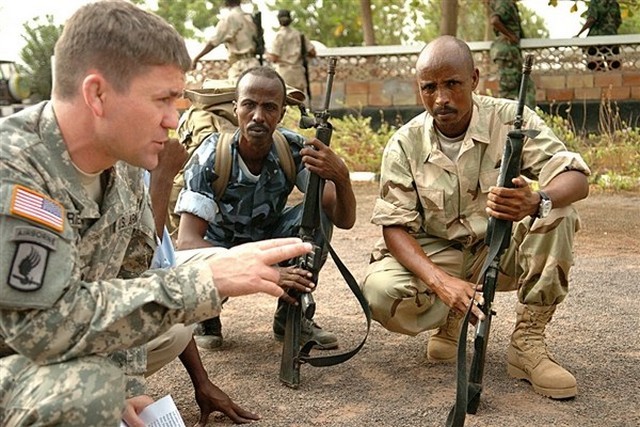
It was September 2014. The sky was bright and clear and ice blue as the camouflage-clad men walked to the open door and tumbled out into nothing. One moment members of the U.S. 19th Special Forces Group and Moroccan paratroopers were flying high above North Africa in a rumbling C-130 aircraft; the next, they were silhouetted against the cloudless sky, translucent green parachutes filling with air, as they began to drift back to earth.

Those soldiers were taking part in a Joint Combined Exchange Training, or JCET mission, conducted under the auspices of Special Operations Command Forward-West Africa out of Camp Ram Ram, Morocco. It was the first time in several years that American and Moroccan troops had engaged in airborne training together, but just one of many JCET missions in 2014 that allowed America’s best-equipped, best-trained forces to hone their skills while forging ties with African allies.

A key way the U.S. military has deepened its involvement on the continent, JCETs have been carried out in an increasing number of African countries in recent years, according to documents recently obtained by TomDispatch via the Freedom of Information Act (FOIA). When it comes to U.S. troops involved, foreign forces taking part, and U.S. tax dollars spent, the numbers have all been on the rise. From 2013 to 2014, as those recently released files reveal, the price tag almost doubled, from $3.3 million to $6.2 million.

These increases offer a window into the rising importance of such missions by U.S. Special Operations forces (SOF) around the world, including their increasingly conspicuous roles in conflicts from Iraq and Syria to Yemen and Afghanistan. On any given day, 10,000 special operators are “deployed” or “forward stationed” conducting overseas missions “from behind-the-scenes information-gathering and partner-building to high-end dynamic strike operations” — so General Joseph Votel, at the time chief of Special Operations Command, told the Senate Armed Services Committee in March.

Through such figures, the growing importance of the U.S. military’s pivot to Africa becomes apparent. The number of elite forces deployed there, for example, has been steadily on the rise. In 2006, the percentage of forward-stationed special operators on the continent hovered at 1%. In 2014, that number hit 10% — a jump of 900% in less than a decade. While JCETs make up only a small fraction of the hundreds of military-to-military engagements carried out by U.S. forces in Africa each year, they play an outsized role in the pivot there, allowing U.S. Africa Command (AFRICOM) to deepen its ties with a variety of African partners through the efforts of America’s most secretive and least scrutinized troops.

Exactly how many JCETs have been conducted in Africa is, however, murky at best. The documents obtained from U.S. Special Operations Command (SOCOM) via FOIA present one number; AFRICOM offers another. It’s possible that no one actually knows the true figure. One thing is certain, however, according to a study by RAND, America’s premier think tank for evaluating the military: the program consistently produces poor results.

The Gray Zone

According to SOCOM, Special Operations Command Africa (SOCAFRICA) is, on average, “routinely engaged” in about half of Africa’s 54 countries, “working with and through our African counterparts.” For his part, SOCAFRICA commander Brigadier General Donald Bolduc has said that his team of 1,700 personnel is “busy year-round in 22 partner nations.”

The 2014 SOCOM documents TomDispatch obtained note that, in addition to conducting JCETs, U.S. Special Operations forces took part in the annual Flintlock training exercise, involving 22 nations, and four named operations: Juniper Shield, a wide-ranging effort, formerly known as Operation Enduring Freedom-Trans Sahara, aimed at Northwest Africa; Juniper Micron, a U.S.-backed French and African mission to stabilize Mali (following a coup there by a U.S.-trained officer) that has been grinding on since 2013; Octave Shield, an even longer-suffering mission against militants in East Africa; and Observant Compass, a similarly long-running effort aimed at Joseph Kony’s murderous Lord’s Resistance Army in Central Africa (that recently retired AFRICOM chief General David Rodriguez derided as an expensive and strategically unimportant burden).

America’s most elite forces in Africa operate in what Bolduc calls “the gray zone, between traditional war and peace.” In layman’s terms, its missions are expanding in the shadows on a continent the United States sees as increasingly insecure, unstable, and riven by terror groups.

“Operating in the Gray Zone requires SOCAFRICA to act in a supporting role to a host of other organizations,” he told the CTC Sentinel, the publication of the Combating Terrorism Center at West Point. “One must understand, in Africa we are not the kinetic solution. If required, partner nations should do those sorts of operations. We do, however, build this capability, share information, provide advice and assistance, and accompany and support with enablers.”

Officially, the Joint Combined Exchange Training program isn’t so much about advice and assistance, support, or training partners, as it is about providing Navy SEALs, Green Berets, and other special operators with unique opportunities to hone their craft — specifically, unconventional warfare and foreign internal defense — overseas. “The purpose of JCETs is to foster the training of U.S. SOF in mission-critical skills by training with partner-nation forces in their home countries,” according to SOCOM spokesman Ken McGraw. “The program enables U.S. SOF to build their capability to conduct operations with partner-nation military forces in an unfamiliar environment while developing their language skills, and familiarity with local geography and culture.”

Authorization for the JCET program does, however, allow for “incidental-training benefits” to “accrue to the foreign friendly forces at no cost.” In reality, say experts, this is an overarching goal of JCETs.

Mission Impossible

U.S. Special Operations forces conducted 20 JCETs in Africa during 2014, according to the documents obtained from SOCOM. These missions were carried out in 10 countries, up from eight a year earlier. Four took place in both Kenya and Uganda; three in Chad; two in both Morocco and Tunisia; and one each in Djibouti, Niger, Nigeria, Senegal, and Tanzania. “These events were invaluable training platforms that allowed U.S. SOF to train and sustain in both core and specialized skills, while working hand-in-hand with host nation forces,” say the files. African forces involved numbered 2,770, up from 2,017 in 2013. The number of U.S. special operators increased from 308 to 417.

Impressive as these figures are, the actual numbers may prove higher still. AFRICOM claims it carried out not 20 but 26 JCETs in 2014, according to figures provided last year by spokesman Chuck Prichard. Similar discrepancies can be found in official figures for previous years as well. According to Prichard, special operators conducted “approximately nine JCETs across Africa in Fiscal Year 2012” and 18 in 2013. Documents obtained by TomDispatch through the Freedom of Information Act from the office of the assistant secretary of defense for legislative affairs indicate, however, that there were 19 JCETs in 2012 and 20 in 2013.

AFRICOM ignored repeated requests for clarification about the discrepancies among these figures. Multiple emails with subject lines indicating questions about JCETs sent to spokesperson Anthony Falvo, were “deleted without being read,” according to automatic return receipts. Asked for an explanation of why AFRICOM and SOCOM can’t agree on the number of JCETs on the continent or if anyone actually knows the real number, Ken McGraw of Special Operations Command demurred. “I don’t know the source of AFRICOM’s information,” he told TomDispatch. “To the best of my knowledge, the information our office provided you was from official reporting.”

In fact, effective oversight of even some relatively pedestrian training efforts is often hard to come by, thanks to the military’s general lack of transparency and the opaque nature of assistance programs, says Colby Goodman, the director of the Security Assistance Monitor at the Center for International Policy. “And for JCETs and other Special Operations programs,” he says, “it’s even more difficult.”

Given that the two commands involved with the JCET program can’t even come to a consensus on the number of missions involved raises a simple but sweeping question: Does anyone really know what America’s most elite forces are doing in Africa?

Under the circumstances, it should surprise no one that a military that can’t keep a simple count of one type of mission on one continent would encounter difficulties with larger, more difficult tasks.

More Missions, More Problems

In testimony before the Senate Armed Services Committee in March, the incoming commander of SOCOM, General Raymond Thomas III, laid out a sweeping vision of the “U.S. strategy in Africa.” It included “neutralizing Al-Shabaab in East Africa” and empowering Somalia’s government to do the same; “working with our African partners in North and West Africa to ensure they are willing and capable of containing the instability in Libya, degrading VEOs [Violent Extremist Organizations] in the Sahel-Maghreb region, and interdicting the flow of illicit material,” as well as working with African allies to contain Boko Haram and empowering Nigeria to suppress the terror group.

“SOF implements this strategy by being a part of [a] global team of national and international partners that conduct persistent, networked, and distributed full spectrum special operations in support of AFRICOM to promote stability and prosperity in Africa,” said Thomas. “The SOCAFRICA end states are to neutralize Al-Shabaab and Al Qaeda Affiliates and Adherents in East Africa, contain Libyan instability and Violent Extremist Organizations and other Terrorist organizations in North and West Africa, and degrade Boko Haram.”

Bolduc, SOCAFRICA’s commander, suggested that the U.S. is well on its way toward achieving those goals. “Our security assistance and advise-and-assist efforts in Africa have been effective as we continue to see gradual improvements in the overall security capabilities of African partner nations across the continent,” he said earlier this year. “Clearly, there’s been more progress in certain areas versus others, but the trends I see with these forces are positive.”

Independent assessments suggest just the opposite. Data from the National Consortium for the Study of Terrorism and Responses to Terrorism at the University of Maryland show, for example, that terror attacks have spiked over the last decade, roughly coinciding with AFRICOM’s establishment. Before it became an independent command in 2007, there were fewer than 400 such incidents annually in sub-Saharan Africa. Last year, the number reached nearly 2,000.

Similarly, the Armed Conflict Location and Event Data Project, which uses media reports to monitor violence, shows that “conflict events” have jumped precipitously, from less than 4,000 to more than 15,000 per year, over the same span.

Earlier this year, the Defense Department’s own Africa Center for Strategic Studies, a research institution dedicated to the analysis of security issues on that continent, drew attention to skyrocketing terrorism fatalities there in recent years. It also published a map of “Africa’s Active Militant Islamist Groups” that showed 22 organizations menacing the continent. Bolduc himself has repeatedly cited the far higher figure of nearly 50 terrorist and “malign groups” now operating in Africa, up from just one major threat cited by AFRICOM commander Carter Ham in 2010.

In addition to troubling overall trends in Africa since the U.S. pivot there, JCETs have come under special criticism. A 2013 report by the RAND Corporation on “building partner capacity” (BPC) cited several limitations of the program. “U.S. forces cannot provide support to partner equipment under JCETs and cannot conduct dedicated training in advanced CT [counterterrorism] techniques (and hence cannot conduct planning for BPC),” it noted. Ultimately the RAND study, which was prepared for the Pentagon’s Joint Staff and the Office of Cost Assessment and Program Evaluation in the Office of the Secretary of Defense, found “moderately low” effectiveness for JCETs conducted in Africa.

In an email, SOCOM spokesman Ken McGraw said he didn’t have the time to review the results of the RAND study and refused to offer comment on it.

Mum’s the Word

The U.S. military either can’t or won’t come to a consensus on how many missions have been carried out by its most elite troops in Africa. Incredible as it might seem, given that we’re talking about an organization that notoriously can’t keep track of the money it spends or the weapons it sends to allied forces or even audit itself, it’s entirely possible that no one actually knows how many JCETs — and as a result how many special operations missions — have been carried out on the continent, where they occurred, or what transpired during them.

What is known is that a Pentagon-commissioned study by RAND, the largest American think tank and the military’s go-to source for analysis, found that the JCET program had yielded poor results. The command whose troops carried out the training, however, may not even have been aware of the years-old study and won’t offer comment on it. At the same time, the command responsible for the continent where the training takes place won’t even acknowledge questions about the program, let alone offer answers.

With independent analyses showing armed violence and terror attacks on the rise in Africa, the Pentagon’s center for the study of the continent showing terrorism fatalities spiking, and the commander of America’s most elite forces in Africa acknowledging a proliferation of terrorist groups there, perhaps it’s no surprise that the U.S. military isn’t interested in looking too closely at its efforts over the last decade. Experts, however, say that keeping the American people in the dark is both dangerous for democracy and a threat to effective overseas U.S. military engagement.

“There is a serious lack of transparency on this type of training and that inhibits efforts for Congressional staff and the public to provide oversight,” says Colby Goodman of the Center for International Policy. Repeatedly asked about Goodman’s assertion, AFRICOM’s Anthony Falvo offered his typical non-response: Emails to the spokesman seeking comment were “deleted without being read.”

Nick Turse is the managing editor of TomDispatch, a fellow at the Nation Institute, and a contributing writer for the Intercept. His book Tomorrow’s Battlefield: U.S. Proxy Wars and Secret Ops in Africa recently received an American Book Award.

7 September 2016

An Open Letter To The People Of Brazil

By Robert J Burrowes

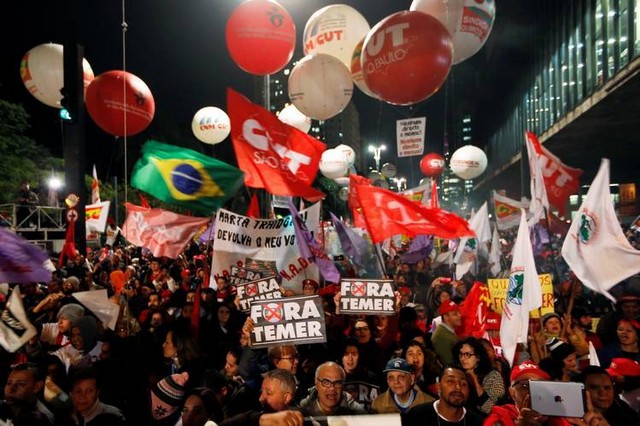
As I read of the latest coup in Brazil, once again removing a democratically elected leader from power, my anger surged. Not again! However, as I see and read about the ongoing massive protests, as well as calls by prominent community leaders to mobilize in defense of your country’s democracy, I feel great hope for Brazil. Having been a nonviolent activist for many years, I would like to support Brazilian activists to develop a nonviolent strategy that will increase your chances of success.

On 31 August 2016, the Brazilian elite executed a political coup to remove your democratically elected president Dilma Rousseff from office in a desperate attempt to halt corruption investigations in which they are clearly implicated. See ‘Democracy Is Dead in Brazil’ http://www.telesurtv.net/english/opinion/Democracy-is-Dead-in-Brazil-20160831-0007.html and ‘The Real Reason Brazil’s Democratically Elected Dilma Rousseff Was Impeached’ http://truepublica.org.uk/global/the-real-reason-brazils-democratically-elected-dilma-rousseff-was-impeached/

Behind the scenes, of course, the United States elite was heavily involved. With vast quantities of highly profitable fossil fuels, mineral and forest resources, as well as fresh water at stake, the US elite (and its allied elites) is not going to stand aside while Brazil and BRICS endeavour to create a more just world for at least some of its human inhabitants. See ‘Impeachment of Dilma Rousseff: Brazil’s Parliamentary Coup and the “Progressive Media”‘ http://www.globalresearch.ca/brazils-parliamentary-coup-and-the-progressive-media/5543597

Despite what has happened and as your ongoing street protests demonstrate, you know that you do not have to accept this outcome. You also know that you do not have to wait until the 2018 election to register your disapproval of this coup.

In fact, you can reverse this coup and restore the president you first elected in 2010 to finish her current term so that her party can face your judgment in 2018. And this is what Joao Pedro Stedile, a founder and leader of the Landless Workers’ Movement in Brazil has called on you to do. See ‘MST: Social Movements Must Rise up Against Coup Govt in Brazil’ http://www.telesurtv.net/english/opinion/MST-Social-Movements-Must-Rise-up-Against-Coup-Govt-in-Brazil-20160901-0011.html

If you do this, you will also have widespread support among your solidarity allies around the world as indicated in this letter: ‘Noam Chomsky, Oliver Stone Sign Letter Against Brazil’s Coup’. http://www.telesurtv.net/english/news/Noam-Chomsky-Oliver-Stone-Sign-Letter-Against-Brazils-Coup-20160825-0027.html

Given my own support for your right to elect any president of your choice (and to remove them if necessary at a subsequent election), I invite you to consider planning and implementing a nonviolent strategy to remove the coupmakers in your country and restore the president that you elected.

If you are interested in doing so, I have outlined a strategy for removing coupmakers on the website Nonviolent Defense/Liberation Strategy https://nonviolentliberationstrategy.wordpress.com/ which is a straightforward presentation of the more detailed explanation offered in the book ‘The Strategy of Nonviolent Defense: A Gandhian Approach’. http://www.sunypress.edu/p-2176-the-strategy-of-nonviolent-defe.aspx

If you want an idea of the twelve components of strategy that you will need to plan, you can see them on the Nonviolent Strategy Wheel. https://nonviolentliberationstrategy.wordpress.com/strategywheel/ If you want a taste of how this strategy works (at the tactical level), you will get it by reading ‘The Political Objective and Strategic Goal of Nonviolent Actions’. https://nonviolentliberationstrategy.wordpress.com/articles/political-objective-strategic-goal/

Vitally, the strategic goals need to include mobilizing people in strategically focused ways and causing the police and military to withdraw their support for the coupmakers. It will usefully include causing key local and foreign corporations to withdraw their support too. This would usually include corporations involved in the weapons industry, the mainstream media, banks and the resource extraction of fossil fuels, strategic minerals, forest products and fresh water. To make it clear, I have listed a provisional set of strategic goals that you might consider modifying as appropriate below.

Of course, as suggested above, you will need a comprehensive strategy and it might take some time to plan and then fully implement.

However, if you do plan and implement a comprehensive strategy, you have every chance of reversing this coup with minimal loss of life. For example, the article ‘Nonviolent Action: Minimizing the Risk of Violent Repression’ https://nonviolentliberationstrategy.wordpress.com/articles/minimizing-risk-violent-repression/ identifies 20 things that you can do to minimize the risk that your mobilizations will be violently repressed. This article was written after a careful study, throughout history, of nonviolent mobilizations that were met with extreme violence.

Suggested Strategic Goals in a Nonviolent Strategy to Liberate Brazil

Strategic goals that would usually be appropriate for resisting a political or military coup include those listed below although, it should be noted, the list would be considerably longer as individual organizations should be specified separately.

Of course, individual groups resisting the coup would usually accept responsibility for focusing their work on achieving just one or two of the strategic goals. It is the responsibility of the struggle’s strategic leadership to ensure that each of the strategic goals, which should be identified and prioritized according to your precise understanding of the circumstances in Brazil, is being addressed.

(1) To cause the women in [women’s organizations WO1, WO2, WO…] in Brazil to join the liberation strategy by participating in [your nominated nonviolent action(s)/campaign(s) and/or constructive program activities]. For example, simple nonviolent actions would be to wear a national symbol (such as a badge of your national flag or ribbons in the national colors), to boycott all corporate media outlets supporting the coup and/or to withdraw all funds from banks supporting the coup. For this item and many items hereafter, see the list of possible actions you can take here: ‘198 Tactics of Nonviolent Action’. https://nonviolentliberationstrategy.wordpress.com/strategywheel/tactics-and-peacekeeping/198-tactics-of-nonviolent-action/

(2) To cause the workers in [trade unions or labor organizations T1, T2, T…] in Brazil to join the liberation strategy by participating in [your nominated nonviolent action(s)/campaign(s) and/or constructive program activities]. For example, this might include withdrawing their labor from an elite-controlled or foreign-owned bank/corporation operating in Brazil.

(3) To cause the small farmers and farmworkers in [organizations F1, F2, F…] in Brazil to join the liberation strategy by participating in [your nominated nonviolent action(s)/campaign(s) and/or constructive program activities].

(4) To cause the members of [religious denominations R1, R2, R…] in Brazil to join the liberation strategy by participating in [your nominated nonviolent action(s)/campaign(s) and/or constructive program activities].

(5) To cause the members of [ethnic communities EC1, EC2, EC…] in Brazil to join the liberation strategy by participating in [your nominated nonviolent action(s)/campaign(s) and/or constructive program activities].

(6) To cause the activists, artists, musicians, intellectuals and other key social groups in [organizations O1, O2, O…] in Brazil to join the liberation strategy by participating in [your nominated nonviolent action(s)/campaign(s) and/or constructive program activities].

(7) To cause the students in [student organizations S1, S2, S…] in Brazil to join the liberation strategy by participating in [your nominated nonviolent action(s)/campaign(s) and/or constructive program activities].

(8) To cause the soldiers in [military units M1, M2, M…] to refuse to obey orders from the coupmakers to arrest, assault, torture and shoot nonviolent activists and the other citizens of Brazil.

(9) To cause the police in [police units P1, P2, P…] to refuse to obey orders from the coupmakers to arrest, assault, torture and shoot nonviolent activists and the other citizens of Brazil.

(10) To cause businesspeople who conduct small businesses in [organizations SB1, SB2, SB…] in Brazil to refuse to cooperate with the coupmakers by participating in [your nominated nonviolent action(s)/campaign(s) and/or constructive program activities].

(11) To cause businesspeople who operate multinational franchises in [organizations MF1, MF2, MF…] in Brazil to refuse to cooperate with the coupmakers by participating in [your nominated nonviolent action(s)/campaign(s) and/or constructive program activities].

(12) To cause businesspeople who manage local branches of large multinational corporations in [organizations MNC1, MNC2, MNC…] in Brazil to refuse to cooperate with the coupmakers by participating in [your nominated nonviolent action(s)/campaign(s) and/or constructive program activities].

(13) To cause large farmers and ranchers in [organizations FO1, FO2, FO…] in Brazil to refuse to cooperate with the coupmakers by participating in [your nominated nonviolent action(s)/campaign(s) and/or constructive program activities].

(14) To cause the foreign managers and technical workers [working for resource extraction corporations X1, X2, X…] who are from [the United States and other relevant countries where the elite supports the coupmakers in Brazil] to withdraw from Brazil.

(15) To cause the workers [in trade union or labor organizations T4, T5, T…] in [the United States and other relevant countries where the elite supports the coupmakers in Brazil] to interrupt the supply of military weapons to Brazil.

(16) To cause the workers in [trade unions or labor organizations T7, T8, T…] in [the United States and other relevant countries where the elite supports the coupmakers in Brazil] to interrupt the transport of [military personnel/military weapons] to Brazil.

(17) To cause the workers in [trade unions or labor organizations T10, T11, T…] in [the United States and other relevant countries where the elite supports the coupmakers in Brazil] to support your liberation struggle by refusing to handle [a particular resource] extracted and exported from Brazil.

(18) To cause the workers [in trade unions or labor organizations T13, T14, T…] working in [the United States and other relevant countries where the elite supports the coupmakers in Brazil] to support your liberation struggle by participating in [your nominated nonviolent action(s)/campaign(s) and/or constructive program activities].

(19) To cause the women in [women’s organizations WO4, WO5, WO…] in [the United States and other relevant countries where the elite supports the coupmakers in Brazil] to support your liberation struggle by participating in [your nominated nonviolent action(s)/campaign(s) and/or constructive program activities].

(20) To cause the members of [religious denominations R4,R5, R…] in [the United States and other relevant countries where the elite supports the coupmakers in Brazil] to support your liberation struggle by participating in [your nominated nonviolent action(s)/campaign(s) and/or constructive program activities].

(21) To cause the solidarity activists in [activist organizations A1, A2, A…] in [the United States and other relevant countries where the elite supports the coupmakers in Brazil] to support your liberation struggle by participating in [your nominated nonviolent action(s)/campaign(s) and/or constructive program activities].

(22) To cause the members of [your exile communities E1, E2, E…] in [the United States and other relevant countries where the elite supports the coupmakers in Brazil] to support your liberation struggle by participating in [your nominated nonviolent action(s)/campaign(s) and/or constructive program activities].

(23) To cause the students in [students organizations S4, S5, S…] in [the United States and other relevant countries where the elite supports the coupmakers in Brazil] to support your liberation struggle by participating in [your nominated nonviolent action(s)/campaign(s) and/or constructive program activities].

In the struggle to make this world the place of peace, justice and environmental sustainability that it could be, the people of Brazil have been playing an inspirational role. You do not need to let this coup be more than a temporary setback. You also have solidarity allies around the world and many of us are willing to assist you, if you decide to let us play a role too.

For the liberation of Brazil; Robert

Robert J. Burrowes has a lifetime commitment to understanding and ending human violence. He has done extensive research since 1966 in an effort to understand why human beings are violent and has been a nonviolent activist since 1981. He is the author of ‘Why Violence?’ http://tinyurl.com/whyviolence His email address is flametree@riseup.net and his website is here. http://robertjburrowes.wordpress.com

7 September 2016

Undeclared War Of Sorts In Kashmir?

By Dr P S Sahni

Co-Written By Dr. P.S. Sahni&Shobha Aggarwal

“Raina: Some soldiers, I know, are afraid of death

Captain Bluntschli: All of them, dear lady,

All of them, believe me.”

-‘Arms and the Man’, George Bernard Shaw, 1894

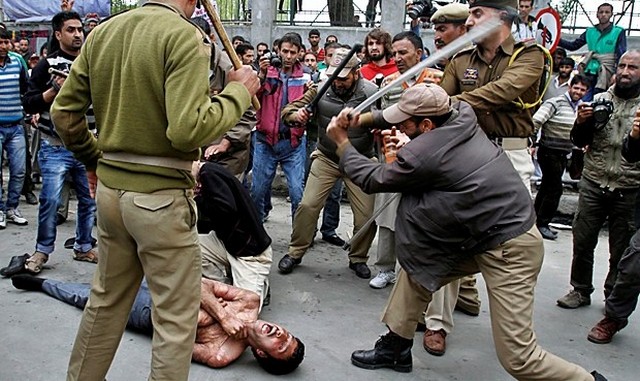
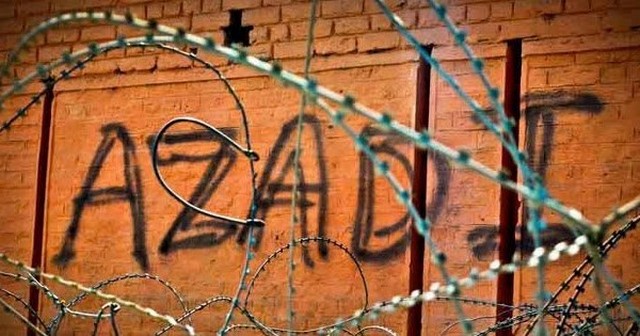
Two months have passed since the killing of Hizbul Mujahideen Commander, Burhan Wani on 8 July, 2016. The imposition of curfew over Kashmir continues amid temporary relaxations; mobile internet service is shut down; attendance in government offices is thin. Clashes between protesters and the police, para-military continue on a daily basis. The number of injured till date is reported to be about 12,000. Over nine hundred have had eye injuries due to rubber pellets fired by the security personnel; seventynine have been reportedly killed. The monumental figure of those injured includes mainly the protesters, by-standers as also the police/para-military personnel. Thus on an average about 200 people have been injured per day or about eight per hour. The number of injured over a period of sixty days is frightening and calls for a comparison with other conflict situations in the last hundred years where the Indian army/ British Indian Army was engaged with an uprising within the country or a conflict with a neighbouring country.

Jallianwala Bagh massacre, 1919
During theJallianwala Bagh massacre on 13 April, 1919, the British Indian army unit under the command of Colonel Reginald Dyer fired upon a crowd of non-violent protesters, along with Baisakhi pilgrims who had gathered in Jallianwala Bagh, Amritsar, India. The struggle for getting British rulers out of India was on. The troops numbering fifty fired on the unarmed protesters for ten minutes continuously. The bullets were directed towards the few open gates through which people were trying to flee. The British rulers admitted to twelve hundred wounded; the number of dead is believed to be between 379 (official figure) to well over 1000 by other sources.

A young Bhagat Singh had visited the Jallianwala Bagh massacre scene. This had left a deep impression in his mind. Later when Lala Lajpat Rai died in 1928 after being injured during a lathi charge by a police force led by James A. Scott on those protesting against the Simon Commission in Lahore, Bhagat Singh and his colleagues pledged not to let Scott go free. Bhagat Singh, Rajguru and Sukhdev were hanged to death in Lahore jail for the killing of John A. Saunders, assistant superintendent of police (mistaken for James A. Scott).

The Jallianwala Bagh massacre was deeply engraved in Udham Singh’s mind. At the age of sixteen years he had defied the curfew and was wounded in the course of retrieving a body in the aftermath of the Jallianwala Bagh massacre. In 1940 Udham Singh was charged with the murder of Sir Michael O’Dwyer, the former Lt. Governor of Punjab who had approved of the action of Brigadier General R.E.H. Dyer at Jallianwala Bagh. He was hanged on 31st July, 1940.

Ironically Burhan Wani,as per media reports, had seen his brother Khalid Muzaffar being tortured at the hands of armed forces when the two were returning home during the 2010 protests in Kashmir which left more than hundred people dead. Wani reportedly vowed to take revenge.

In the above three situations it was the excesses of the security forces – British or Indian – which forced people to take up arms; a lesson for governments to humanize its policies.

First Kashmir War, 1947
The Indo-Pakistan war of 1947 (first Kashmir war) was fought between the newly independent nations of India and Pakistan over the princely state of Jammu and Kashmirand lasted for over one year and two months. The conflict started when Pashtun tribal forces and later Indian and Pakistani army regulars entered the state. On 1.1.1949 a formal ceasefire was declared. The number of killed was reported to be 1500 and 6000 respectively for India and Pakistan. While the number of wounded was reported to be 3500 for India and 14000 for Pakistan.

Sino-Indian War, 1962
The Sino-Indian war fought between India and China lasted from 20 October to 21 November 1962 i.e. about a month resulting in Chinese victory with the forward Indian posts and patrols removed from Aksai Chin. While 1383 Indians were reported to be killed and 1047 wounded, the number of Chinese killed were 722 and 1697 wounded. The Indian army had to retreat back to Tejpur, a district in Assam. It was a humiliating act of the armed forces as the Chinese had penetrated close to the outskirts of Tejpur. The local people were left to fend for themselves. Later the Chinese army retreated on its own. The Indian Government ordered an independent report to be prepared on the war.

An Australian journalist, Neville Maxwell in an interview with the Times of India (2 April, 2014) opined that it wasn’t China, but Nehru who declared 1962 war:

“The report was an internal Indian Army enquiry into its rout in the 1962 war with China — Maxwell was the New Delhi correspondent for The Times, London, at the time — but in the 51 years since the report was written up by Lt Gen Henderson Brooks and Brig PS Bhagat, successive Indian governments have refused to make it public. Only two copies of the report were thought to be in existence, although there was never any doubt that Maxwell had had access to the report for his 1970 book India’s China War quoted extensively from it…

If the Henderson Brooks Report is read closely in India (and it’s not easy reading!) people will see that political favouritism put the Army under incompetent leadership which blindly followed the Nehru government’s provocative policy.”

Till date the Government of India has not made the Henderson report public.

Mizo National Front uprising, 1966
In March 1966 the Mizo National Front (MNF) launched an uprising and revolt against the Government of India by declaring independence on 1 March, 1966. Government offices and posts of security forces faced a coordinated attack in various parts of the Mizo district (as it then was) in Assam. The Government suppressed the rebellion with the Indian Air Force carrying out air strikes in Aizawl; a rare instance of India carrying out air strikes in its own civilian territory; this was denied by the then Prime Minister. The Government of India recaptured by 25 March, 1966 all the places seized by the MNF. Insurgency continued for twenty years more till 1986. While the air strikes took place during Mrs. Indira Gandhi’s regime, the Mizoram Accord between Government of India and MNF was signed in 1986 when Rajiv Gandhi was Prime Minister of India. While 59 were killed and 126 wounded on the Indian side; the number of Mizos killed were 95 and another 35 wounded.

Sri Lankan civil war& Indian intervention, 1987-89
The Indian intervention in the Sri Lankan civil war started on 29 July, 1987; the Indian Peace Keeping Force (IPKF) started withdrawing in 1989 with the withdrawal being completed in 1990. The IPKF intervened to end the civil war between militant Sri Lankan Tamil nationalists, principally the LTTE (Liberation Tigers of Tamil Eelam) and the Sri Lankan military.

During 1983 and 1984 the Intelligence Bureau (IB) and Research and Analysis Wing (RAW) of the Indian Government got involved in training the militant Tamil group, as some authoritative sources maintain. It is public knowledge that LTTE camps operated from Tamil Nadu. Ironically the same LTTE killed 1138 IPKF personnel and wounded another 2762; also killing 28 Sri Lankan Military personnel and wounding 578. The figures of LTTE killed and injured are not known.

Operation Pawan, 1987: A bitter chapter in Indian Military history
Operation Pawan was undertaken by IPKF to take control of Jaffna in late 1987. It took three weeks for the IPKF to take control of Jaffna peninsula from the LTTE. 40 IPKF personnel were killed and 700 wounded, whereas 200 LTTE personnel were killed. The number of LTTE personnel wounded is not known. The third party – Sri Lankan army – was not in the picture; so its number killed/wounded is not available.

The LTTE had received support from politicians in Tamil Naduand wanted a separate Tamil Eelam in north and east of Sri Lanka for Tamil people. Ironically LTTE was responsible for assassination of Rajiv Gandhi, former Prime Minister of India in 1991. The Supreme Court of India held the LTTE alone responsible for the assassination.

Kargil War, 1999: India & Pakistan at the brink of a nuclear war
The Kargil war took place from 3rdMay to 26thJuly 1999. It resulted in the killing of 527 Indians and 1363 wounded. While the corresponding Pakistani figures are 357-453 killed and 665 plus wounded. At the end of the war India regained possession of Kargil district, Jammu & Kashmir.

The table below summarizes the number of killed and injured during the aforementioned internal uprisings and wars:

Internal uprisings/wars

Injured Dead Time period Approx. Injuries per day
1. JallianwalaBagh massacre

1200 (to 1500) 379 – 1000 10 minutes in a single day 1200 to 1500
2. First Kashmir War, 1947 17500 7500 438 days 40
3. Sino-Indian War, 1962 2744 2105 32 days 85
4. Mizo National Front Uprising, 1966 161 154 24 days 7
5. Sri Lankan Civil War – – 29 July 1987 to 1989 –
6. Operation Pawan – 240 21 days –
7. Kargil war 2028 884-980 85 days 24
8. Kashmir Uprising, 2016 12,000 79 60 days 200

Barring the JallianwalaBagh massacre where up to 1500 people got injured in one single day, the present uprising in Kashmir has seen the maximum number of injured people per day among the aforementioned conflicts where data is available!

Even the mainstream print media in India is now forced to refer to the brutalization produced by the war in Kashmir. When a formal war declaration is made then international laws, agencies like U.N. and International Red Cross Society come into play. Simple things like access to medical care of those injured are assured. The world community gets a sense of the actual happenings. The people of India, Kashmir and the world have a right to know the ground reality in Kashmir.

(The numbers of injured and dead in the aforementioned internal uprisings and wars have beenculled from various sources viz official, independent, and UPPSALA Conflict Data Program (UCDP), Sweden. The figures of LTTE killed and injured during 1987-89 are not known. Again, the number of LTTE personnel wounded in Operation Pawan is not known.)

[The authors are members of PIL Watch Group and can be contacted at: pilwatchgroup@gmail.com]

7 September 2016

Complex web of relations around Turkey’s Syria intervention

By AMEC

While being a violation of the sovereignty of a neighbouring country, Turkey’s incursion into Syrian territory along the Syria-Turkey border and its attacks on Islamic State group (IS) and People’s Protection Units (YPG) positions there have not been heavily criticised except by the USA and various Kurdish groups. It has received mild criticism from the Russian and Syrian governments, and significant support from the Turkish population and many Turkish opposition groups. The intervention – called Operation Euphrates Shield – is expected to be a longterm one, and is set to worsen already-tense relations between Turkey and the USA.

The operation follows several fatal operations in Turkey by IS and the Kurdish Workers Party (PKK) in the wake of state security weaknesses after the July coup attempt. The Syrian YPG is the armed wing of the Democratic Union Party (PYD), and has strong links with the PKK, which Turkey considers a terrorist group. While the US also considers the PKK a terrorist group, it regards the PYD/PYG as an essential element of its anti-IS armed forces in Syria, and a component of what it calls ‘Syrian Democratic Forces (SDF)’. Relying on two diametrically opposed actors – Turkey and the YPG, both US allies – to fight a common enemy presents the USA with a tactical and strategic dilemma. Soon after Turkey’s incursion began on 24 August, the USA called on YPG forces to move east of the Euphrates River, a key demand of Turkey, but on Wednesday US spokespersons criticised Turkey’s moves against the group. With the YPG refusing to relocate, USA faces the prospect of losing the largest component of its SDF if it pushes too hard. The head of US Central Command, Joseph Votel,announced at a Pentagon press briefing this week that the YPG had moved east of the Euphrates, but the lack of agreement on whether this is true will exacerbate relations between the two NATO allies.

Turkey had been unable to convince its allies to impose a no-fly zone on the Syria-Turkey border which, Turkey claimed, would help keep millions of refugees safe; Operation Euphrates Shield is likely to create a de facto ‘safe zone’ for refugees and the Free Syrian Army (FSA).

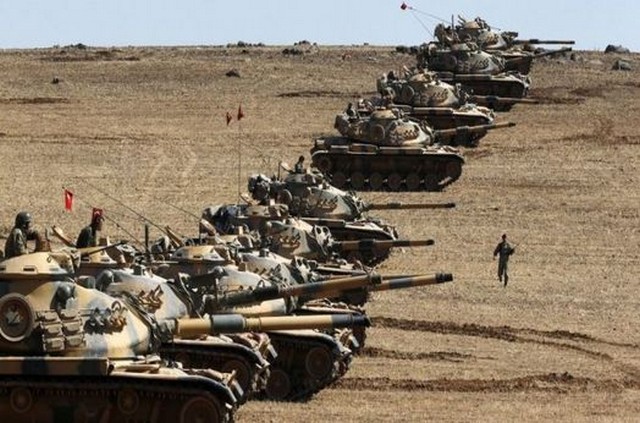
Turkish planes had begun the first movements in the operation, bombing IS targets in the northern Syrian area of Jarablus. Two hours later 1 500 Free Syrian Army (FSA) fighters crossed over from the Turkish region of Karkamis, accompanied by an armed battalion of twenty-five M60A3 tanks, and close fire support from the Turkish Armed Forces (TSK). The FSA troops include Faylaq al-Sham and Ahrar al-Sham, which Turkey considers ‘moderate’ – particularly after the FSA sidelined al-Qa’ida-affiliated groups two weeks earlier.

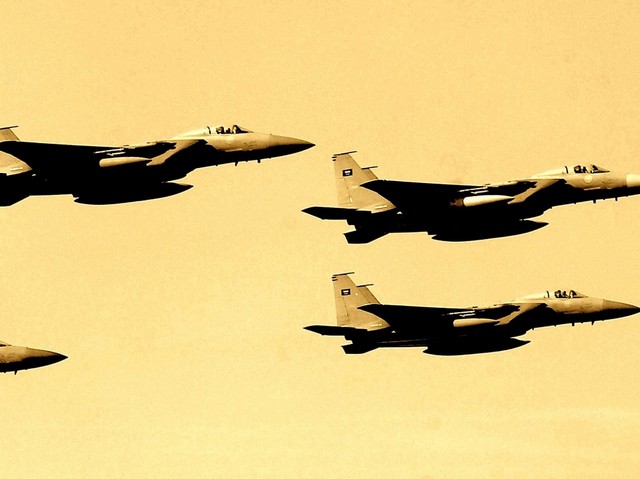
The operation involves 350 TSK soldiers, 200 troops from mechanised units, and 150 special forces. They are supported by heavy aerial operations conducted collectively by the anti-IS coalition. In addition, seventeen Turkish war planes are participating in the operation, including eleven F16s. Turkey is also using newly-acquired Bayraktar TB2 unarmed drones. An armed brigade is on reserve at the border area of Karkamis and security analysts suggest the nearby base at Kilis Elbeyli will coordinate air support and medical evacuation with FSA units. Based on the type of armaments used by the TSK, Turkey is likely intending to have a longterm presence in Syria’s north with, possibly, a military base in Jarablus that serve as a coordination and training area for FSA fighters. Turkey hopes the FSA can prove its mettle in the field, and then be able to capture the IS stronghold of al-Bab. Should the FSA take that city, it will favour the opposition politically, and deprive the YPG of its status as the most efficient anti-IS force.

This is the first occasion that a NATO member puts boots on the ground in Syria since the war there began in 2011, and comes at a critical time for Turkey, which just six weeks ago experienced an attempted coup that dealt a severe blow to the TSK’s prestige. Caught between its membership in NATO and the deterioration of domestic security, Turkey extracted much benefit from the recent turnaround in relations with Russia to secure Moscow’s assurances that Russian aircraft will not fire on FSA and Turkish troops during this complex operation. The Russian foreign ministry has officially said it ‘is concerned about Turkey’s incursion into Syria’ and that actions against IS should be coordinated with Damascus. Syria itself responded with a statement complaining about the violation of its ‘sovereign rights’, but not suggesting it would do anything more about it.

Turkey’s direct involvement in Syria reflects a change in Ankara’s regional policy from one that claimed humanitarian issues at the core of its policy to a return to hard security goals by national interest. A key political and security aim is to prevent the creation of a contiguous area controlled by the PYD on the 822-kilometre Turkey-Syria border. To achieve this it becomes necessary for the FSA and other rebel factions to unite under a single political banner that regards the territorial integrity of Syria as a precondition for peace talks. Realising this political aim will require the FSA to secure more than just the Jarablus area, and to extend its control to terrain to the west up to the Rai-Azaz / Jarablus-Cobanbey line. Should it gain control of this area, Turkey will be able to cut off IS supply routes and isolate the PYD in the town of Afrin. Turkish warplanes and artillery targeted YPG targets in Afrin on the second day of Euphrates Shield.

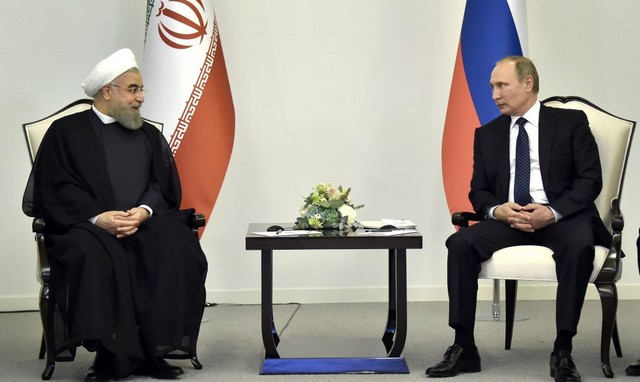
The quiet responses to Turkey’s incursion by Russia and Syria (whose response was limited to a written statement) reflects their similar objective that Syria’s integrity be maintained; they thus would be unhappy to allow the PYD to set up an autonomous Kurdish area. Syria’s Iranian allies are also unhappy about what message Kurdish autonomy in Syria might send to Iranian Kurds – especially since recent clashes between the Democratic Party of Iranian Kurdistan (PDKI) and Iranian Revolutionary Guards, and reports that the USA might be supporting the PDKI. Tehran has already said it tacitly supported Turkey in its anti-PKK effort although the Iranian Foreign Ministry said Turkey should halt operations that challenge Syria’s against central government authority, suggesting that Iran remains sceptical of Turkey’s intentions in northern Syria.

Qatar, another regional actor which has supported the FSA, will support Turkey in its push against IS and the YPG as the two countries share similar perspectives on key issues. Qatar has sought to diversify its defence partnerships with the setting up of a Turkish-Qatari military base in the emirate state, which also reflects the rapidly changing security architecture of the region.

Russian President Vladimir Putin and US President Barack Obama are due to meet on the sidelines of the G-20 Summit in China on 4 September, but it is unlikely that any substantive movement on a Syrian peace deal will be announced as fighting between the government and rebels continue in the key area of Aleppo.

AMEC briefs is a fortnightly commentary on a current issue in the Middle East and North Africa region, providing short but trenchant analyses.

2 September 2016

Failures Of Militarism In Countering Mega-Terrorism

By Richard Falk

The introduction of this article is devoted to the distinctive challenges posed by this era of mega-terrorism initiated by the 9/11 attacks. The article offers a critique of the American response which is based on a ‘war’ rather than a law enforcement paradigm. An argument is then made to adapt international law to new modalities of conflict while at the same time learning the right lessons from the repeated militarist failures of transnational counterterrorism. These issues are further considered via the parallel analysis of American counterterrorism policy by the distinguished diplomat, Chas Freeman.

Introduction: Tensions Between Post-9/11 Counterterrorism and International Law

There are multiple complexities arising from the interactions between sovereign states and large-scale political violence of extremist groups and individuals associated with, or inspired by, such groups. These complexities profoundly challenge the efforts of international law and the capabilities of national governments to contain and minimize political violence. They also raise serious questions about the relations between war, territorial sovereignty, law, and morality under contemporary conditions.

To begin with, international law evolved in the last century to prohibit all uses of force that cannot be convincingly validated as claims of self-defense or as authorized by the UN Security Council. These are innovative and core ideas of the UN Charter that were agreed upon in the aftermath of World War II when the uppermost priority was the establishment of constraints on discretionary recourse to international force by states in the course of international disputes. Article 51 of the Charter further restricts valid claims by limiting self-defense under international law to situations in which a government is responding to “a prior armed attack.”[1] As suggested, supplemental to self-defense claims are authorizations to use force that are given to political actors by the UN Security Council. This was the case with respect to the 2011 NATO regime-changing intervention in Libya, although the precedent remains controversial as the scope of the use of force exceeded the evident intent and language of the authorizing resolution.[2]

Also, within the UN framework, recourse to force is required to be a matter of last resort, that is, after the failure of good faith diplomatic efforts.[3] Arguably, the practice of states during the Cold War was deeply inconsistent with this restrictive view of legally valid uses of force, and so there emerged a degree of uncertainty and disagreement as to the effectiveness of law in regulating recourse to international force.[4] Because of the absence of governmental institutions on a global level, there is a blurred line separating violations of existing international law and the practice of states that can have lawmaking impacts as a result of patterns of behavior that establish precedents.[5]

The kind of transnational political violence that reached its climax in 2001 with the 9/11 attacks on the U.S. World Trade Center and the Pentagon poses a more systemic challenge to the UN framing of lawful uses of international law. First, both al Qaeda (in attacking) and the United States (in responding)—whether prudently or not—viewed the ensuing political violence through the prism of ‘war’ rather than ‘crime,’ expanding the scope and magnitude of the violence. The 9/11 attacks had characteristics blurring the boundaries separating traditional terrorist acts from traditional acts of war, giving political leaders in the United States the choice of whether to respond within a war paradigm or a crime paradigm. That the leadership at the time in the United States immediately chose war partly reflected the neoconservative worldview of the presidency of George W. Bush, the traumatizing and symbolic nature of the targets, the gravity of the harm done, and a feared vulnerability to additional attacks by Al Qaeda.[6]

Second, Al Qaeda’s political violence was uniformly described as ‘terrorism.’ A non-state actor who lacked a territorial presence in the targeted country had attacked major civilian targets in the United States. This feature of 9/11 had the immediate effect of transnationalizing the interaction between terrorism and counterterrorism. In the process a new species of war was borne. By and large terrorism had been largely a state/society interaction, previously treated as a law enforcement challenge to be addressed within the boundaries of the targeted state or, internationally, with the cooperation of foreign police and security forces or through covert special operations. This international militarization of counterterrorism was essentially a new political phenomenon, although there had been a foretaste in the decades before in the form of retaliatory strikes (as distinct from extended military campaigns) against foreign countries thought to have sponsored terrorists, harbored them, or were otherwise complicit in the attacks.[7] The contemporary nature of transnational extremist politics and the forcible responses of geopolitical actors are contributing to the restructuring of world order by way of deterritorializing armed conflict.[8]
Third, the absence of a clear territorial base from which terrorists launched their provocative attacks made it more challenging to design a military response able to engage, defeat, and destroy such an adversary. On the terrorist side, the dispersal of its bases of operations, which are often inter-mingled with the civilian population, had several effects: turning the entire world into a potential battlefield, subverting notions of territorial sovereignty, eliminating legal options of neutrality in situations of armed conflict (as George W. Bush famously put it, “you are either with us or with the terrorists”), and strengthening incentives to engage in political assassinations that undermine the core distinction of international humanitarian law between civilians and combatants.[9]

Fourth, this kind of conflict also shifts the strategic focus away from deterrence and retaliation toward preemption and prevention. Such an anticipatory orientation expands the UN Charter’s conception of self-defense by allowing a threatened state to strike first rather than being compelled by law to wait until attacked.[10] This shift also encourages the adoption of legally and morally controversial tactical and weapon innovations intended to enhance counterterrorist effectiveness, including reliance on torture, drones, and special operations (covert military groups seeking to find and destroy terrorist targets in foreign countries) as necessitated and justified by the distinctive character of the security challenge.[11] The shift also reflects the politically motivated goal of minimizing casualties on the counterterrorist side even at the sacrifice of effectiveness so as to avoid the rise of anti-war sentiments of the sort that were thought by the U.S. government to have interfered with the prosecution of the Vietnam War.

Fifth, the insistence on treating the adversary as ‘terrorist’ identified as ‘evil’ substantially eliminates both diplomacy and self-scrutiny as instruments of counterterrorist statecraft. In the past, many ‘terrorist’ entities were at some stage in a conflict treated as political actors, enabling negotiated arrangements that succeeded in bringing high levels of political violence to a virtual end. Without this option, there is the prospect of permanent war, already acknowledged to some extent by the Pentagon in its designation of the struggle as the ‘long war,’ with side effects that increase the authority of the state and correspondingly decrease the freedom of the citizenry. The decision to treat an international adversary as a ‘terrorist entity’ is a highly subjective determination that can be withdrawn at any point that it becomes convenient to treat the enemy as a political actor.

These five clusters of issues deserve a detailed treatment that is critical of the self-serving manipulation of international law to free state actors from prior constraints on the use of international force. It is also appropriate to consider revisionist steps that loosen the constraints of international law in reasonable response to a series of grave new security challenges.[12] In this regard, the old international law is not reasonably calibrated to address this new generation of transnational mega-terrorist threats, but neither is the wholesale rejection of normative constraints justified, nor practically necessary. How to strike a proper balance is the central question being addressed here by distinguishing between the contextually rational use of counterterrorist force and, at the same time, striving to uphold those features of international law that in the past sought, with admittedly mixed results, to minimize political violence and the human suffering caused by warfare during the past hundred years.[13]

Critical Challenges

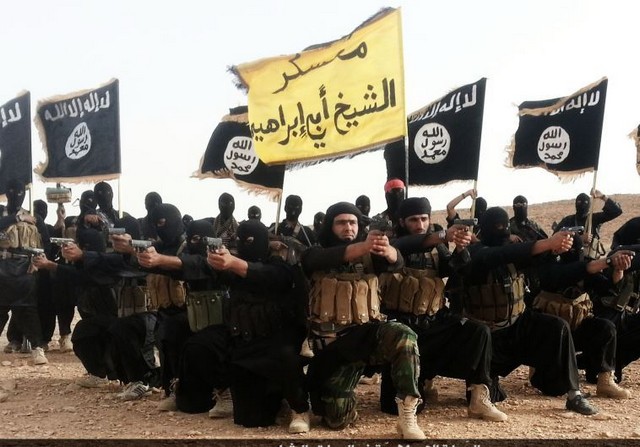
These background considerations inform and structure an assessment of how best to fashion an effective response to the ISIS phenomenon. There are two overlapping challenges associated with ISIS. There is the challenge of selecting the best tactics to address the immediate territorial and security threats presently posed by ISIS in the Middle East, North Africa, Europe and other parts of the world. In short, within the Middle East and North Africa, the challenge is essentially at this point both territorial and political, which is producing a new hybrid form of armed conflict and asymmetric warfare that gives rise to new tactics of combat that should, in turn, lead to corresponding modifications in the framework of international humanitarian law. So far, this has not happened. As far as Europe and the United States are concerned, the terrorist events have involved mainly individuals or small groups operating independently, although claiming allegiance to, or inspiration from, ISIS, but essentially posing traditional internal state/society challenges.

For these reasons, at least for the present, the challenges emanating from outside the Middle East and North Africa directed at the established order should be treated primarily as an issue of crime prevention, and not as an occasion for war. Turkey situated next to ISIS-held territory in Iraq and Syria is faced with several types of threats, the radical destabilization of neighboring countries and the disruptive spillover generated by refugee flows and isolated acts of terrorism apparently intended both as retaliatory responses to Turkish counterterrorist initiatives jointly undertaken with the United States and as efforts to widen the conflict theatre and extend the zone of subversive and destabilizing influences attributable to ISIS. The Turkish case is complicated by the priority presently accorded by Ankara to anti-Kurdish operations; creating tensions with counterterrorist goals as has been the case in Syria.

A third deeper challenge associated not only with ISIS, but also with other expressions of jihadism, including Al Qaeda and its affiliates, is to alter relations with the Islamic world in ways that minimize the prospect of the continuing (re-)emergence of anti-Western extremist political organizations and movements. In my view, the militarist and politically deficient character of present and past Western, particularly American, counterterrorism policies has unwittingly contributed to the rise, spread, and success of jihadist militancy. Such movements have in common the perception that the West is their supreme enemy as a result of intervening in the politics of the region as well as engaging in resource exploitation, especially oil and gas, and by a globally influential popular culture perceived to be undermining Islamic values.[14] The West is also viewed as responsible for upholding Arab governments regarded by ISIS and kindred groups as corrupt, incompatible with Islamic ideas of political community, and viewed for other reasons as illegitimate. The very origins of ISIS are bound up with the US/UK occupation policies pursued in Iraq since 2003, particularly the sectarian purge of Sunni elements in the Iraqi armed forces and governing process.

The main focus of this article is on this structural challenges to the West that can only be effectively met by abandoning certain patterns of past behavior, including an attitude toward global security, which has in the past given rise to jihadism that arose to resist foreign military occupation, but adopted perverse types of liberation strategies, including the repeated commission of crimes against humanity which are viewed generally as atrocities. From this perspective, a critique of Western militarism is put forward both with regard to past ineffectiveness in achieving its goals and with respect to the normative unacceptability of the counterterrorist modalities of response. The distinct interpretative lens concerned with policy assessments of counterterrorist containment efforts are sufficiently interrelated with structural dimensions as to cause some overlap in analysis while still respecting the differences between immediate security threats in combat zones and the underlying conditions that give rise to the threats.[15]

The attention given here to the reliance on the military instrument in the service of counterterrorist policy cannot be separated from the surrounding historical circumstances that led to the present conditions, nor be oblivious to prospects for change. The surprises surrounding the Arab Spring events of 2011 should encourage humility with regard to any effort to evaluate the lasting significance of the reactive counterrevolutionary political turn of the last several years.[16] The situation remains in flux as to what will endure and what is likely to change.

This critique of a militarist orientation also reflects skepticism as to whether current terrorist threats to the security of sovereign states and their populations are being adequately interpreted as a new species of international warfare that calls for a rethinking of the proper role of international force. There is also the related question as to whether–by having recourse to war rather than to the criminal justice machinery–the established political order did not unwittingly create a self-fulfilling prophesy, generating the very threat it is designed to suppress. The dysfunctional application of a war approach to counterterrorism indirectly encourages extremist political movements to emerge, especially through treating a non-state movement as if it were a state, and then, being shocked, as in the case of ISIS by the actuality of its territoriality. This heightening of status by establishing a terrorist identity is illustrated by the transition from al-Qaeda in Iraq to ISIS.

Militarism and the Military Instrument

The distinction between ‘militarism’ and ‘military’ instruments of security is central to an understanding of a structural critique of Western post-colonial policy in the Middle East and North Africa over the course of the last century. By militarism is meant the compulsion to address threats and conflict situations primarily by reliance on a militarist reflex, that is, by an over-reliance on the use of force without giving appropriate consideration to such non-military alternatives as diplomatic negotiations, removing legitimate grievances, adhering to international law, and engaging in self-scrutiny as to the roots of, and responsibility for, the emergence, persistence, and appeal of ISIS and other kindred threats. The argument put forward here is not pacifist, but is directed at the misuse of military capabilities that has led to serious blowback phenomena. This should give rise to an overdue occasion for stocktaking with respect to counterterrorist tactics and doctrine since 9/11.[17]

This misuse reflects, in large part, the failure to adjust to altered historical circumstances. At the height of the colonial era, essentially up until 1945, military superiority was used effectively in the Arab world and elsewhere, to satisfy the colonial ambitions of Europe at acceptable costs to the colonizers. What changed politically was the rise of self-confidence on the part of nationalist forces, the influence exerted by strong global anti-colonial support at the UN and elsewhere under the leadership of the Soviet bloc, and the weakening of European colonial powers due to the losses suffered in the two world wars. Although the United States endeavored to fill the geopolitical vacuum left by the collapse of colonialism, it failed to appreciate the accompanying shift in the balance of forces that shape the outcomes of internal political struggle. Hence the US found itself caught between loyalty to alliances and friendships with European colonial powers and an anti-colonial tradition strongly reinforced by recent historical trends – something that goes back all the way to the American Revolution, which was the first fully successful anti-colonial war.

Despite experiencing a series of frustrating setbacks, the United States continues primarily to rely on innovations in military technology (e.g. drones) and doctrine to sustain a false confidence in militarist approaches to the maintenance of the established political order in non-Western settings of strategic interest. It does so by ignoring a record of frustration and failure associated with military interventionism.[18]

The American failure in Vietnam was expected at the time to generate a more realistic understanding of the limits of military superiority in shaping the political outcome of asymmetric wars. In Vietnam the United States military possessed complete and essentially unchallenged control of air, sea, and land dimensions of the battlefield, and yet could not get the assigned job done to win the war. It was unable despite a decade of effort to crush the Vietnamese political will to continue national resistance to foreign intervention whatever the costs, and finally it was Washington gave in, calculating that it was not worth the effort to continue. In effect, the unconditional will to resist prevailed over theconditional will to intervene, and controlled the outcome, but this core explanation of the Vietnam experience was never understood by the American policy community as providing the key lesson for the future. Instead, the lessons learned were to take steps to blunt the rise of opposition to such foreign wars by abolishing the draft, relying on a professional army, and making a greater effort to enlist the media in support of an ongoing war effort.

A second lesson could have been learned in Afghanistan: those opportunistically trained and equipped as allies in a secondary struggle (in this case, containing the spread of Soviet influence) may turn out to be enemies in a more primary sense (the direct attack of 9/11 would never have been undertaken by the Soviet Union, which is inhibited because vulnerable to retaliation).[19] In effect, short-term geopolitical opportunism was pursued at the expense of intermediate-term security and stability. Al Qaeda’s anti-Soviet collaboration in Afghanistan was followed by launching a struggle to dislodge the United States from the Islamic world, especially its large military deployments in close proximity to the sacred sites located in Saudi Arabia.

A third lesson should have been learned in reaction to the spectacular failures of the Iraq policy pursued by the United States ever since 1992, reliant on punitive sanctions, aggressive war, and a badly mishandled occupation.[20] The aims of imposing ‘democracy,’ influencing oil pricing, securing military base rights, containing Iran, and reconnecting Iraq with the world economy were all frustrated. What is worse from Washington’s strategic point of view, the war intensified sectarian tensions throughout the Middle East, which, contrary to the intention of the mission, increased Iran’s regional influence, led to the formation and local popularity of ISIS, and damaged the American reputation in relation to both the effectiveness of its military diplomacy and the propriety of its political goals and methods.

In my view, the U.S. response to security threats posed by transnational terrorism and specifically, by the rise of ISIS, has often been deeply flawed due to this persistence of militarism. The 2016 presidential campaign discourse in the United States on how to deal with ISIS, especially the policies proposed by the opposing presidential candidates, are surrealist exaggerations of this militarist mindset that has so badly served American and regional security needs in the 21st century. This militarism has also intensified widespread suffering and chaos throughout the Middle East and North Africa. It has also accentuated violent disorder and devastation in other parts of the post-colonial world.[21]

This critique of militarism as 21st century counterterrorism should not be understood as a disguised pacifist plea for an unconditional renunciation of force in response to mega-terrorist threats. There are appropriate counterterrorist roles for military power, although its efficiency and effectiveness in achieving global, national, and human security has markedly declined in the period since the end of World War II, especially when used to wage wars of choice in political struggles for the control of foreign states.

The colonial wars after 1945 confirmed the declining historical agency of military power in recent decades. The colonial powers, despite enjoying overwhelming military superiority in relation to national resistance forces, lost almost every colonial war. The French experience in Indochina and Algeria were, perhaps, the clearest instances of this decisive shift in the operation of the balance of forces in conflict situations in the global South. The genocidal behavior of ISIS along with the regional and global consensus that has formed around its containment and defeat provides a legitimate basis for reliance on military power if coupled with a recognition of its narrow utility, given the mix of political circumstances, including the prior Shi’a abuses in Sunni areas of Iraq and the insistence of parts of the population, especially in Iraq, to be freed in the future from Shi’a governance. The superior military capabilities of the intervening forces do not assure an enduring victory even if it achieves temporary control over a combat zone; what counts is a sense that the political future is entrusted to the indigenous society and to a legitimate national government rather than managed and manipulated by outsiders. It is surprising that the colonial record of failure with respect to military interventions under Western auspices in the period since 1945 did not yield a much more selective approach toward uses of force by the West when addressing security threats in the Middle East and elsewhere in the South.

The U.S. war efforts’ outcome in Vietnam was lamented in Washington, provoking much handwringing with respect to why the Vietnam War was lost, but without questioning the militarist mindset that had, for more than ten years, guided American participation in the struggle. After the Vietnam War a variety of steps were taken to fix the military instrument so that it could function more effectively in the future. However, what was not done, was an assessment of why military intervention had itself become intrinsically dysfunctional late in the 20th century–in contrast to earlier times when it provided an efficient instrument of force projection and allowed the assertion of control over foreign societies. It was true that after the Vietnam experience the American public, for several reasons, became disillusioned about getting involved in distant wars seemingly unrelated to national defense or clearly explainable national interests. Militarists derided this public disillusionment by derisively speaking of ‘the Vietnam syndrome,’ a label intended to convey the unhealthy reluctance of the American public to support the use of military power. The Gulf War, and then the NATO Kosovo War, seemed to remedy the political situation by the delivering quick military victories, and–this is crucial–achieved with minimal casualties, accompanied by national enthusiasm that was bolstered by the militarist claim that warfare could now bring victory to the West in what were approvingly labeled ‘zero casualty wars.’ This change in war fighting tactics was promoted by militarists who were trying to regain their political traction in Washington. They sold it as ‘a revolution’ in the conduct of warfare: no boots on the ground, precision targeting from the air and heavy explosive payloads accurately delivered over long distances with ‘shock and awe’ drama, and a supposedly more respectful relationship between intervening forces and the indigenous population.

It is not surprising that President George H.W. Bush’s first exultant words after victory in 1991 were “We have finally kicked the Vietnam Syndrome”. This is best translated as saying “we can again confidently use military force as a potent instrument of American foreign policy, without encountering either anti-war resistance at home or facing the prospect of a disillusioning long war that ends in defeat.” Actually, it was not as innovative as claimed. The neoconservative Project for a New American Century made this clear in its influential 2000 report, which regretfully acknowledged the absence of a political mandate to support the regime-changing military interventions that it strategically favored in the Middle East.[22] The report contended that ‘a new Pearl Harbor’ was needed to create a political atmosphere in the United States that would be supportive of the aggressive geopolitics that neoconservatives believed promoted American interests in the Middle East after the Cold War. Subsequent developments would show this particular analysis of public sentiments was correct. After 9/11, the public and Congress endorsed, on the basis of a bipartisan consensus, militarist and interventionist undertakings in the Middle East that had no persuasive justification as necessary to meet threats of mega-terrorism. As it turned out, carrying out the interventionist agenda has clearly had the opposite effect of generating and intensifying terrorism in the region and beyond, implementing a misguided neoconservative diplomacy centered on upholding ‘special relationships’ with Israel and Saudi Arabia. The Iraq War, launched in 2003, was a disaster from a counterterrorist point of view. It transformed a stable autocracy into a strife-ridden, occupied country that became a fertile breeding ground for extremist resistance movements.[23]

The mood of militarist optimism with respect to American uses of military force was short lived; it was discredited by the distinctive challenges of the post-9/11 world. This new approach to war fighting, while enjoying success in removing Iraq from Kuwait and persuading Serbia to withdraw from Kosovo, had not been tested in conflict situations in which the goal was to shape the outcome of political, religious, and ethnic strife in medium-sized states, in response to counterterrorist regime-changing interventions, and in relation to dispersed extremist base areas situated in countries with which the United States is at peace. The threats posed in the post-9/11 world were unlike either the kind of missions undertaken in the failed anti-colonial wars or the success stories of the Gulf War and Kosovo. George W. Bush mindlessly sold the government and the public on a militarist response to 9/11. And surprisingly, there have been no fundamental conceptual reassessments during the Obama presidency despite the major disappointments experienced in Afghanistan, and even more so, in Iraq. At most there have been several controversial and ambiguous cautionary retreats made during the Obama presidency.

Three costly and misleading tactical ideas overlapped. First, that regime change as a result of military intervention could control the post-conflict state’s (re-)building process under the mentorship of a foreign occupation that was subsidizing economic recovery. The actual outcomes witnessed the rise of regimes that proved totally unsatisfactory from a counterterrorist point of view – regimes that seemed not even capable of providing orderly governance within their national borders. Secondly, that eliminating an unfriendly regime or a regime supportive of international terrorism or unable to prevent the use of its territory for international terrorist activities, would lead to the elimination of the terrorist threat rather than its dispersal, reconfiguration, and renewal. In different ways, both Afghanistan and Iraq, are illustrative of these unexpected blowback consequences. Without viewing conflict through a militarist lens, these consequences would have been anticipated, and the fact that they were not, strengthens the contention that policy shaped within a militarist box will not grasp the nuances of post-9/11 security challenges in the Middle East. And thirdly, that a regime-changing intervention would enhance internal security and promote the regional and global security goals of Washington. Even now those that defend the Iraq War claim, without showing why, insist that the Iraqi people are better off without the dictatorial leadership of Saddam Hussein. It seems obvious that a second coming of Saddam, despite many misgivings, is the only way to overcome the violent forms of disorder that continue to dominate the everyday landscape of Iraq.

An obvious puzzle is ‘why do smart people of good faith continue to behave dysfunctionally in the face of such costly military failures?’ There is no simple answer, and none that applies to all conflict situations. There are some elements of the ISIS type challenge that seem useful to take into account in shaping a tentative answer to such a question. I would here only mention six worth analyzing:

The difficulty of turning the ship of state around on fundamental issues of security. This is partly because political leaders and their advisors continue to subscribe to hard power versions of political realism, which affirms an abiding faith in the agency of military power in international conflict situations.
A combination of bureaucratic and special interests (military-industrial complex) that resist all efforts to reduce the defense budget, and are inclined to justify with militarist bravado high fiscal outlays to augment military capabilities even in peacetime, reinforced by exaggerating security threats that are usually accompanied by fear-mongering; a compliant media has the effect of setting limits on ‘responsible’ debate, marginalizing the critics of militarism.
A prevalent feature of collective political consciousness, which views current forms of terrorism as both evil and extremely frightening, with restored security depending on their elimination, and not an eventual negotiated accommodation.
More controversially, the merger of counterterrorist tactics with a broader American program of global pacificiation that depends upon a structure of military globalization that is given the unacknowledged mission of upholding the neoliberal world economy. This necessarily mixes the pursuit of geopolitical goals that arouses anti-West resentment with the realization of somewhat inconsistent counterterrorist objectives.[24] The Iraq War, its motivations, frustrations, and eventual failure, exemplify the tensions and contradictions caused by pursuing geopolitical goals beneath a banner of counterterrorism.
The adoption of this militarist agenda by the United States is tantamount to a partial rejection of the ethos of self-determination in the post-colonial era and as such opposes the flow of history.
The militarist mindset, by its very nature, does not adequately explore alternative and complementary nonmilitary responses to terrorist provocations, and as a result tends to produce outcomes that are the opposite of what is set forth as initially justifying military intervention. For instance, the attack on Iraq was seen as part of a policy to contain Iran, yet its effects were to expand the regional influence of Iran, including the irony of bringing Iraq into its sphere of influence. In this respect, the United States, at great expense, produced widespread devastation and casualties. It not only failed to achieve its goals, but has become worse off than had it accepted Saddam Hussein’s autocracy as it did gratefully during the Cold War due to anti-Soviet, rather than anti-Iran priorities, and then, incidentally, turning a blind eye toward the abusive human rights record.
In my view, the basic conceptual mistake of militarism is its inability to recognize the limits of the military instrument in achieving desired security goals under current historical conditions and in light of the essentially non-military distinctive challenges responsible for the rise of jihadist extremism. As argued, not only does militarism not achieve its goals, it makes matters worse. This has been the experience of warfare generally after 9/11, and most concretely in relation to the ISIS phenomenon. More precisely, the successes of counterterrorist operations have been essentially preventive law enforcement actions, the failures have been foreign wars.

The Diplomatic Critique of Militarism

One of the most seasoned and thoughtful American diplomats in the Middle East, Chas Freeman, has similarly diagnosed this failed militarism in the region from a mainstream perspective–with illuminating insight. As Freeman put it, “the major achievement of multiple interventions in the Muslim world has been to demonstrate that the use of force is not the answer to very many problems but there are few problems it cannot aggravate.”[25] Or more succinctly, the militarist impulse is a goad to action, in his words, “Don’t just sit there, bomb something.” Freeman’s main point is that not only has military intervention failed almost wherever it was relied upon, despite enjoying the benefit of overwhelming superiority in capabilities, but that it has made the situation worse than it would have been had the situation been left to fester on its own. Again Freeman expresses this assessment in clear language: “Our campaign against terrorism with global reach has multiplied our enemies and continuously expanded their areas of operation.”[26]

When it comes to ISIS, or Da’esh as he prefers to call it, Freeman’s diagnosis is a direct challenge to mainstream thinking: “Given our non-Muslim identity, solidarity with Israel, and recent history in the Fertile Crescent, the U.S. cannot hope to unite the region’s Muslims against Da’esh.” Freeman adds that we cannot stop Da’esh “without fixing the broken political environment in which extremism flourishes.”[27] What this might mean is uncertain, and whether such goals are within reach of the US and its allies is dubious even if recalibrated. Yet, what makes Freeman’s approach worthy of close attention is that he is a Washington insider who dares to think outside the militarist box, and has paid a political price for doing so. His views acknowledge the fundamental failures of military intervention, blaming the rise of ISIS (Da’esh) on American mishandling of Iraq and Syria. The failure is not just the formidable difficulty of translating ‘mission accomplished’ results on a battlefield into a program of political transformationdesigned to produce results congenial to Western ideas of regional and global security. It is the more generic matter of territorial resistance encountered in the 21st century whenever a Western intervening power seeks to override the politics of self-determination.

The political side of the Freeman story is revealingly relevant. When President Obama near the beginning of his presidency proposed Freeman to be the chief of National Intelligence Estimates, a pushback of tsunami proportions blocked the appointment. An official, no matter how qualified, who was situated outside the militarist box would naturally be expected to be a subversive presence inside the box, and for this reason would not be wanted by the Washington nomenclatura. Perhaps, Freeman’s real Achilles’ heel was his willingness to question along the same lines ‘the special relationship’ with Israel in framing his critique of American foreign policy in the Middle East. As the controversy heated up, the White House abruptly withdrew Freeman’s name from further consideration. In effect, this amounted to an undisguised surrender to the militarist worldview with the Israel Lobby serving as the No. 1 enforcer. The Freeman experience confirms the opinion that the militarist bias of governmental policymaking is currently impenetrable. Thus, there is little likelihood of adopting an approach to the menace posed by ISIS and related phenomena that is any less prone to blowback and harmful adverse consequences.

Not all of Freeman’s policy recommendations seem helpful. He is too ready to work toward stability by collaborating with the most authoritarian political actors in the region, especially Saudi Arabia, while overlooking their miserable record in human rights, including crushing popular uprisings. And worst of all, overlooking the massive Saudi financial and diplomatic commitment to the international dissemination of a fundamentalist version of Islam. Freeman puts himself on the wrong side of history by repudiating the Arab Spring from its inception, and is even critical of the American failure to lend support to such old allies as the corrupt and oppressive leader of Egypt, Hosni Mubarak. In these respects, Freeman seems insensitive to the mass misery experienced by impoverished populations in the Middle East; he would likely be antagonistic to the still unfolding effort of the peoples in the region to control their destinies. The appropriate diplomatic posture for the United States is one of non-intervention, not one of either regime change or regime stabilization. Admittedly, this posture of detachment may produce results that bring chaos and strife to a foreign country, but it seems preferable to accept the dynamics of self-determination than to embark on the futile and destructive work of opposing populist and nationalist challenges to the established order.

A Concluding Note

In light of the analysis offered, it is essential to draw a sharp distinction between dealing with ISIS as a present reality and pursuing policies, as in the past, that create conditions conducive to the emergence of jihadist challenges. In this regard, coping with ISIS requires some reliance on military power to contain and preempt its violent activities and, if possible, engage with its forces in battlefield combat in which it is likely to be defeated, but combined with a willingness to have exploratory negotiations and even a receptivity to possible diplomatic compromise. Such an outlook would be in line with the extended effort in Colombia to find an end to the prolonged strife between FARC and the state, in the Philippines to end the rebellion on the island of Mindanao.

On the broader issues of security, abandoning militarism as the cornerstone of counterterrorist strategy would be a dramatic starting point. President Obama has gone part of the way by seeking to reduce American combat activities in Iraq, Syria, and Afghanistan, but with only limited success and an uncertain will. Obama is to be praised for his insistence that the ‘global war’ against terrorism not be treated as a ‘perpetual’ conflict, but the policies pursued by his administration seem insufficiently modified to give such ideas real world credibility.[28] Instead, Obama’s approach is seen as an instance of ‘weak militarism’ that pleases neither militarists nor critics, but has more continuities than discontinuities with his neocon predecessor in the White House.

There are several connected policy proposals that seem responsive to the global and regional setting that exists at the present time. First of all, desist from policies of military intervention that are unlikely to succeed at acceptable costs and will likely generate conditions conducive to the rise and spread of transnational terrorism. Secondly, recognize that the security priority of the West is to prevent attacks within Western homelands or against Western targets, making the challenge more in the nature of law enforcement, inter-governmental collaboration, terrorist prevention than the sort of traditional military undertakings associated with deterrence, defense, retaliation, and foreign territorial occupation. This understanding makes international collaboration with police, intelligence, and internal security forces of foreign countries the most promising way to address this category of mega-transnational terrorist threat.

It also seems sensible to discourage, and even restrict, Islamophobic sentiments and activities, but without abridging freedom of expression. The political response to the Charlie Hebdo incident was exaggerated, and illustrative of how the Western establishment should not respond. Western leaders took the occasion of a horrifyingly brutal and murderous incident to identify unnecessarily and excessively with an often viciously anti-Muslim magazine. And although some display of solidarity with the victims of such a vicious attack was certainly justified as a counterterrorist affirmation of freedom of expression, it was widely perceived and presented to the world as a seizure of an opportunity to slam Islam through appearing to endorse the inflammatory outlook of Charlie Hebdo with greater vigor than was being devoted to upholding the abstract principle of freedom of expression. Beyond this, why should this incident have drawn such a display of global solidarity, with many heads of state joining the huge Paris demonstration, than earlier or subsequent comparably brutal incidents of terrorist violence?

As suggested, the emergence of ISIS was definitely a byproduct of American-led militarism, and its containment will not be effectively achieved by reliance on militarism. The needed policies for such a hybrid war is a mixed strategy that emphasizes the political, seeks the higher moral and legal ground, and is imaginative about and receptive to diplomatic opportunities to restore security.

Richard Falk is an international law and international relations scholar who taught at Princeton University for forty years. Since 2002 he has lived in Santa Barbara, California, and taught at the local campus of the University of California in Global and International Studies and since 2005 chaired the Board of the Nuclear Age Peace Foundation. For six years (2008-2014) he acted as UN Special Rapporteur for Occupied Palestine

Notes

[1] See United States v. Nicaragua, ICJ Reports 1986.

[2] See UN Security Resolution 1973, 17 March 2011.

[3] For views that practice of dominant states alters legal norms by setting precedents, see Anthony C. Arend & Robert J. Beck, International Law and the Use of Force Beyond the Charter Paradigm (New York: Palgrave, 1993); Mark Weisbrud, Use of Force: The Practice of States Since World War II(Philadelphia, PA: University of Pennsylvania, 1997); see especially, Ruchi Anand, Self-Defense in International Relations (New York: Palgrave, 2009); for strong geopolitically oriented jurisprudence, see Michael J. Glennon, Limits of Law: Prerogatives of Power: Interventionism after Kosovo (New York: Palgrave, 2001).

[4] There is a good case to be made that Vietnam War was the turning point. In post-Cold War settings, the NATO Kosovo War and the Iraq War of 2003 were both non-defensive wars undertaken without the authorization of the UN Security Council.

[5] In struggling with the relationship between legal norms, defying patterns of state practice, and the absence of strong central institutions, some scholars have identified ‘the law’ with ‘reasonable expectation,’ which turns out to be deferential to dominant political actors. For an influential attempt along these lines, see Myres S. McDougal & Florentino P. Feliciano, Law and Minimum World Public Order (New Haven, CT: Yale University Press, 1961).

[6] An intense fear of further attacks after 9/11 as undermining respect for international legal constraints is depicted from a governmental insider’s perspective in Jack Goldsmith, Terror Presidency: Law and Judgment inside the Bush Administration (New York: Norton, 2007)

[7] For critical commentary on retaliatory strikes in a pre-9/11 atmosphere, see E.P. Thompson & Mary Kaldor, Mad Dogs: The US Raids of Libya (1986); there were also retaliatory responses to the Al Qaeda attacks on the USS Cole and on the US embassies in Kenya and Tanzania.

[8] See for a challenging interpretation of the impact of transnational terrorism on the nature of world order: Philip Bobbitt, Terror and Consent: The Wars for the Twenty-first Century (New York: Knopf, 2008).

[9] George W. Bush, September 20,, 2001, speech to Joint Session of the US Congress.

[10] Nicaragua vs. United States, ICJ Reports (1986) is the most authoritative judicial treatment of the scope of self-defense, refrains from expressing an opinion on the legality of anticipatory self-defense. In §194 of the decision the following statement appears: “In view of the circumstances in which the dispute has arisen, reliance is placed by the Parties only on the right of self-defence in the case of an armed attack which has already occurred, and the issue of the lawfulness of a response to the imminent threat of armed attack has not been raised. Accordingly the Court expresses no view on that issue.”

[11] On the torture debate, see Sanford Levinson (Ed.), Torture: A Collection(New York, Oxford, 2004); Marjoried Cohn (Ed.), Torture: Interrogation, Incarceration, and Abuse (New York: New York University Press); Alfred McCoy,Torture and Impunity: The U.S. Doctrine of Coercive Interrogation (Madison, WI: University of Wisconsin Press, 2012).

[12] This suggestion of a middle course is not represented in the literature very well; there assessments are either apologetic or denunciatory. For example, Philippe Sands, Lawless World: Making and Breaking Global Rules (New York: Penguin, 2006); compare John Yoo, Crises and Command: The History of Executive Power from George Washington to George W. Bush (New York: Kaplan, 2005).

[13] For two attempts, see Richard Falk, The Great Terror War (Northampton: Interlink, 2003) and Gens David Ohlin, The Assault of International Law (New York: Oxford, 2013).

[14] The root cause of the Arab political encounter with the West was explicitly associated by ISIS with the artificiality of the states generated by colonial ambition in the aftermath of World War I, and originally delineated in the Sykes-Picot Agreement of 1916. The other underlying explanation of perceived injustice is traced to the Balfour Declaration of 1917, a pure colonialist pledge by the British Foreign Secretary to support the commitment of the world Zionist movement to establish a Jewish homeland in historic Palestine. See David Fromkin, A Peace to End All Peace: The Fall of the Ottoman Empire and the Creation of the Modern Middle East (New York: Henry Holt, (19—); David A. Andelman, A Shattered Peace: Versailles 1919 and the Price We Pay Today(New York: John Wiley, 2003); Jonathan Schneer, The Balfour Declaration: The Origins of the Arab-Israeli Conflict (New York: Random House, 2010); Patrick Cockburn, The Rise of the Islamic State: ISIS and the New Sunni Revolution(London: Verso, 2015); Daniel Byman, Al Qaeda, The Islamic State, and the Global Jidhadist Movement: What Everyone Needs to Know (New York: Oxford University Press, 2015).

[15] Western diplomacy has also contributed to the spread of jihadist politics as through the ‘special relationship’ with Saudi Arabia despite its encouragement of jihadism in numerous ways, including billions of dollars to finance madrasas throughout the Islamic world. See Richard Falk, “Saudi Arabia and the Price of Royal Impunity,” Middle East Eye, 6 October 2015.

[16] See Marc Lynch, The New Arabs Wars: Uprisings and Anarchy in the Middle East (New York: Public Affairs, 2016); also: Richard Falk, Chaos and Counterrevolution: After the Arab Spring (Charlottesville, VA: Just World Books, 2015).

[17] See Chalmers Johnson, Blowback: The Costs and Consequences of American Empire (New York, Henry Holt, 2000).

[18] See the rise of David Petraeus as a result of his influential text revising counterinsurgency thinking: U.S. Army/Marine Corps Counterinsurgency Field Manual: U.S. Army Field Manual No. 3-24 (Chicago: University of Chicago Press, 2007). See Fred Kaplan, The Insurgents: David Petraeus and the Plot to Change the American Way of War (New York: Simon & Schuster, 2013); the failure of such tactical onslaughts as ‘shock and awe’ in the 2003 attack on Iraq as essentially a belief that political ends could be achieved by a traumatizing show of military superiority.

[19] Effectively explored in Deepak Tripathi, Breeding Ground: Afghanistan and the Origins of Islamist Terrorism (Washington, DC: Potomac Books, 2011).

[20] Richard Falk, The Costs of War: International Law, the UN, and World Order after the Iraq War (New York: Routledge, 2008).

[21] See books cited in Note 14.

[22] “Rebuilding American Defenses: Strategy, Forces, and Resources for a New Century,” Project for a New American Century, Sept. 2000.

[23] See Note 12.

[24] See Jeff Halper, War Against the People: Israel, the Palestinians, and Global Pacification (London: Pluto, 2015).

[25] Chas Freeman, “The End of the American Empire,” April 2, 2016, Remarks at the Barrington Congregational Church, Barrington, RI.

[26] Chas Freeman, America’s Continuing Misadventures in the Middle East(Charlottesville, VA: Just World Books, 2016), 238.

[27] Note 24, 17

[28] See President Barack Obama, “U.S. Drone and Counterterror Policy,” National Defense University, March 23, 2013.

First published in Richard Flak Blog

28 August 2016

The Devolution Model for Peace In Kashmir

By Dr Arshad M Khan

While there may be no real evidence of a historical Moses (for the Egyptians were obsessive about recording significant events, as an exodus of 2 M people would have been), the Hollywood version with Charlton Heston demanding, “Let my people go,” tells us not much has changed in human nature. Human lives and economic damage notwithstanding, India clings on to Kashmir with over a half million security personnel.

Following the death of the popular militant leader Burhan Muzaffar Wani, who was killed by security forces, Indian-ruled Kashmir has seen a spike in violence and huge on-going demonstrations.

The response to peaceful demonstrators with pellet guns has them escalating to rock-throwing. Guns kill and the tally now runs around 69 dead and several thousand wounded, some losing their sight. Just a drop in the ocean of blood (68,000 to 100,000 killed) since rebel groups took to arms in 1989 after four decades of empty promises. Perhaps the young men have nothing to lose. The new chant, “What do we want?” And the response, “Freedom!” rings throughout the valley.

There is a reason for the frustration: It is now 68 years since the Indian government’s white paper referring to a plebiscite and 67 since the UN mandate to hold one allowing Kashmiris to decide their own fate. What is there about some nationstates that continue to deny freedom to many minorities around our little globe, particularly in an age where sovereignty is so easily ceded to unity projects like the EU and to trade deals limiting the power of individual legislatures?
We live in an era where devolution, even independence, for distinct ethnicities is often a preferred solution. Through “Brexit” Britain has just retreated from the EU. Czechoslovakia split in two, peacefully, while Yugoslavia broke up in a convulsion of violence. There is a choice it seems, if the parties are not too blind to see it. The many Asiatic republics splintering from the former Soviet Union maintain close economic ties to Russia. In the last UK general election, the Scots voted a near clean sweep for the devolutionary Scottish National Party which won 56 seats out of 59, an unheard of gain of 50. And in the recent vote on the EU, Scotland voted in favor of “Remain” leading to the speculation that a new vote to leave the United Kingdom would almost certainly succeed and is likely to be held.

So why not a vote in Kashmir? Give the Kashmiris a choice: remain, leave India and become an independent state, or join Pakistan. Neither of the two contesting powers wins with the second option, which might thus be palatable.

If one thinks about it, commerce and open borders would soon put Kashmir’s troubled past in the rear-view mirror as in the case of France and Germany. Both Modi and Sharif, the two leaders, realized the importance of trade but recent events have overtaken them. They are unable now to cut through the dense undergrowth of suspicion, mistrust and grievances. And the Kashmiris, their kinfolk in the other Kashmir, and Indians must continue to suffer.

India also has other insurgencies of disaffected locals and Pakistan has its own problem in Baluchistan — yet another consequence of joining the war on terror. A disjointed world of sharp-tempers and no easy solutions. Also both strong militarily with large armies and nuclear weapons, now on a hair trigger due to the forward deployment of tactical warheads by Pakistan. Each country is therefore capable of obliterating the other and giving the world a nuclear winter.

Will reason prevail?

Dr Arshad M Khan (http://ofthisandthat.org/index.html) is a former Professor. A frequent contributor to the print and electronic media, his work has been quoted in the U.S. Congress and published in the Congressional Record.

27 August 2016

Understanding the Politics of Saudi Sectarianism

By Junaid S. Ahmad

There has been an incredibly healthy debate in Pakistan concerning the Kingdom of Saudi Arabia’s ‘request’ that Pakistan militarily assist the former’s assault on the Houthi rebels – who are challenging the rule of its Yemeni ally. A solid majority of Pakistanis are legitimately skeptical of their state slavishly subordinating itself to the diktat of the gulf monarchy that believes its oil wealth can purchase blind subservience from a poor country like Pakistan. The intense questioning taking place in the country is quite exciting, for a number of reasons.

One of the most significant reasons is that the ostensible ‘sectarian’ nature of the conflict has not clouded the political judgment of most Pakistanis, whether Sunni or Shia. Despite the desperate attempts of the Saudis to characterize any development in the Middle East and beyond as a ‘Shia/Iranian conspiracy’ against Sunnidom, most folks are not buying it this time. The gratuitous and malignant interventions the Saudis carry out throughout the region and wherever they can get their hands on a Muslim community have become too obvious to overlook. The Kingdom’s recent machinations in Iraq, Egypt, Bahrain, and Syria have produced enormous bloodshed, mayhem, and new generations of puritanical and violent jihadis. This is of course consistent with the politically reactionary role the Saudis have always played – and our part of the world should know that best.

The fact that there is indeed commentary that is emphasizing how sectarianism is a camouflage for profoundly political causes is noteworthy and important. However, what is actually required now is deeper analysis to understand what is driving this ‘geo-sectarian’ card that the Saudis have been playing since 1979.

The Islamic Revolution in Iran in that year sent shockwaves throughout the region, but especially to the conservative gulf monarchies. The fear was that the revolutionary spirit of that moment would spread quickly, and would transcend any Shia-Sunni divide. In fact, it was doing that. Students, intellectuals, and oppressed groups who were reading either Sayyid Qutb, Che Guevara, or Mao Tse-tung were now immersing themselves in the vocabulary of Ali Shariati and Khomeini. There was no contradiction for them, neither the sectarian (Sunni vs. Shia revolutionary ideology) nor the secular vs. religious one. There was continuity in a discourse that challenged power and favored the oppressed.

Indeed, the central – and very simple – factor that caused the royal despots of the Gulf to unleash political and sectarian warfare to punish Iran was the Islamic revolution’s staunchly anti-monarchical orientation. It was, after all, the brutal regime of the Shah of Iran that the mass movement of Iranians sought to overthrow. The Saudis and the other sheikhdoms of the Gulf understood very well that the anti-monarchical impulse would seem to most Muslims as more compatible with an Islamic political ethos than the petro-autocracies of Arabia. And this is precisely why there was never any political argument used to discredit the Islamic revolution, but a virulently sectarian one: they are Sahaba-hating Shias trying to impose Shi’ism on everyone else. Period.

The sectarian vitriol emanating from Riyadh was disseminated throughout the Muslim world, and accompanied by support for state and non-state actors willing to do the dirty work for the Kingdom. The assault on the anti-monarchical tendency began right away, with the support for Iraq’s invasion of Iran in 1980 – and has continued ever since. But those efforts to engender religious divisions between Shia and Sunni failed in 2006. Hezbollah’s courageous resistance against Israeli aggression seemed to have captured the hearts and minds of all Arabs and Muslims regardless of theological orientation. The movement’s leader, Hassan Nasrallah, was by far he most popular Arab leader then.

Which is why, just like after 1979, the Saudis had to shift to hyper-sectarianism once again to discredit the politics of popular resistance and mass mobilization. The vicious Syrian civil war gave a boost to such reactionary politics, since it was described as Shia-Alawi assault on the Sunnis – and similarly portrayed in the case of Iraq.

But what reminds us that it is the political and not the religious/sectarian that is paramount is what happened in Egypt. The force that the Kingdom itself had nurtured, the Muslim Brotherhood, was then disowned and punished. General Sisi’s coup against President Morsi was wholeheartedly endorsed by the Saudis who no longer saw the Brotherhood as a conservative social force protecting the region from progressive ideologies, but as a political force rooted in mass, popular, agitational politics that of course all monarchies abhor.

It is, therefore, essential to think about the maneuvering of the Saudis and its neighbors in this deeply political way. Their politics is nothing but opposing any mass oppositional politics, be it Shia, Sunni, socially conservative or liberal. It is rarely described this way, but the real political battle in the region is between Muslim monarchical rule and Muslim republicanism. Meanwhile, the Saudis will persist in trying to fool you into believing it is about theology and creeping Shia expansionism. Fortunately, many more Muslims are now unwilling to give credulity to such shallow polemics – no matter how much oil wealth is poured into making the narrative seem believable.

Junaid S. Ahmad is Director for the Center for Global Dialogue, UMT, and has been teaching law and politics at LUMS.

April 2015


The death of neoliberalism and the crisis in western politics

By Martin Jacques

In the early 1980s the author was one of the first to herald the emerging dominance of neoliberalism in the west. Here he argues that this doctrine is now faltering. But what happens next?

The western financial crisis of 2007-8 was the worst since 1931, yet its immediate repercussions were surprisingly modest. The crisis challenged the foundation stones of the long-dominant neoliberal ideology but it seemed to emerge largely unscathed. The banks were bailed out; hardly any bankers on either side of the Atlantic were prosecuted for their crimes; and the price of their behaviour was duly paid by the taxpayer. Subsequent economic policy, especially in the Anglo-Saxon world, has relied overwhelmingly on monetary policy, especially quantitative easing. It has failed. The western economy has stagnated and is now approaching its lost decade, with no end in sight.

After almost nine years, we are finally beginning to reap the political whirlwind of the financial crisis. But how did neoliberalism manage to survive virtually unscathed for so long? Although it failed the test of the real world, bequeathing the worst economic disaster for seven decades, politically and intellectually it remained the only show in town. Parties of the right, centre and left had all bought into its philosophy, New Labour a classic in point. They knew no other way of thinking or doing: it had become the common sense. It was, as Antonio Gramsci put it, hegemonic. But that hegemony cannot and will not survive the test of the real world.

The first inkling of the wider political consequences was evident in the turn in public opinion against the banks, bankers and business leaders. For decades, they could do no wrong: they were feted as the role models of our age, the default troubleshooters of choice in education, health and seemingly everything else. Now, though, their star was in steep descent, along with that of the political class. The effect of the financial crisis was to undermine faith and trust in the competence of the governing elites. It marked the beginnings of a wider political crisis.

But the causes of this political crisis, glaringly evident on both sides of the Atlantic, are much deeper than simply the financial crisis and the virtually stillborn recovery of the last decade. They go to the heart of the neoliberal project that dates from the late 70s and the political rise of Reagan and Thatcher, and embraced at its core the idea of a global free market in goods, services and capital. The depression-era system of bank regulation was dismantled, in the US in the 1990s and in Britain in 1986, thereby creating the conditions for the 2008 crisis. Equality was scorned, the idea of trickle-down economics lauded, government condemned as a fetter on the market and duly downsized, immigration encouraged, regulation cut to a minimum, taxes reduced and a blind eye turned to corporate evasion.

It should be noted that, by historical standards, the neoliberal era has not had a particularly good track record. The most dynamic period of postwar western growth was that between the end of the war and the early 70s, the era of welfare capitalism and Keynesianism, when the growth rate was double that of the neoliberal period from 1980 to the present.

But by far the most disastrous feature of the neoliberal period has been the huge growth in inequality. Until very recently, this had been virtually ignored. With extraordinary speed, however, it has emerged as one of, if not the most important political issue on both sides of the Atlantic, most dramatically in the US. It is, bar none, the issue that is driving the political discontent that is now engulfing the west. Given the statistical evidence, it is puzzling, shocking even, that it has been disregarded for so long; the explanation can only lie in the sheer extent of the hegemony of neoliberalism and its values.

But now reality has upset the doctrinal apple cart. In the period 1948-1972, every section of the American population experienced very similar and sizable increases in their standard of living; between 1972-2013, the bottom 10% experienced falling real income while the top 10% did far better than everyone else. In the US, the median real income for full-time male workers is now lower than it was four decades ago: the income of the bottom 90% of the population has stagnated for over 30 years.

A not so dissimilar picture is true of the UK. And the problem has grown more serious since the financial crisis. On average, between 65-70% of households in 25 high-income economies experienced stagnant or falling real incomes between 2005 and 2014.

The reasons are not difficult to explain. The hyper-globalisation era has been systematically stacked in favour of capital against labour: international trading agreements, drawn up in great secrecy, with business on the inside and the unions and citizens excluded, the Trans-Pacific Partnership (TPP) and the Transatlantic Trade and Investment Partnership (TTIP) being but the latest examples; the politico-legal attack on the unions; the encouragement of large-scale immigration in both the US and Europe that helped to undermine the bargaining power of the domestic workforce; and the failure to retrain displaced workers in any meaningful way.
As Thomas Piketty has shown, in the absence of countervailing pressures, capitalism naturally gravitates towards increasing inequality. In the period between 1945 and the late 70s, Cold War competition was arguably the biggest such constraint. Since the collapse of the Soviet Union, there have been none. As the popular backlash grows increasingly irresistible, however, such a winner-takes-all regime becomes politically unsustainable.

Large sections of the population in both the US and the UK are now in revolt against their lot, as graphically illustrated by the support for Trump and Sanders in the US and the Brexit vote in the UK. This popular revolt is often described, in a somewhat denigratory and dismissive fashion, as populism. Or, as Francis Fukuyama writes in a recent excellent essay in Foreign Affairs: “‘Populism’ is the label that political elites attach to policies supported by ordinary citizens that they don’t like.” Populism is a movement against the status quo. It represents the beginnings of something new, though it is generally much clearer about what it is against than what it is for. It can be progressive or reactionary, but more usually both.

Brexit is a classic example of such populism. It has overturned a fundamental cornerstone of UK policy since the early 1970s. Though ostensibly about Europe, it was in fact about much more: a cri de coeur from those who feel they have lost out and been left behind, whose living standards have stagnated or worse since the 1980s, who feel dislocated by large-scale immigration over which they have no control and who face an increasingly insecure and casualised labour market. Their revolt has paralysed the governing elite, already claimed one prime minister, and left the latest one fumbling around in the dark looking for divine inspiration.

The wave of populism marks the return of class as a central agency in politics, both in the UK and the US. This is particularly remarkable in the US. For many decades, the idea of the “working class” was marginal to American political discourse. Most Americans described themselves as middle class, a reflection of the aspirational pulse at the heart of American society. According to a Gallup poll, in 2000 only 33% of Americans called themselves working class; by 2015 the figure was 48%, almost half the population.

Brexit, too, was primarily a working-class revolt. Hitherto, on both sides of the Atlantic, the agency of class has been in retreat in the face of the emergence of a new range of identities and issues from gender and race to sexual orientation and the environment. The return of class, because of its sheer reach, has the potential, like no other issue, to redefine the political landscape.

The re-emergence of class should not be confused with the labour movement. They are not synonymous: this is obvious in the US and increasingly the case in the UK. Indeed, over the last half-century, there has been a growing separation between the two in Britain. The re-emergence of the working class as a political voice in Britain, most notably in the Brexit vote, can best be described as an inchoate expression of resentment and protest, with only a very weak sense of belonging to the labour movement.

Indeed, Ukip has been as important – in the form of immigration and Europe – in shaping its current attitudes as the Labour party. In the United States, both Trump and Sanders have given expression to the working-class revolt, the latter almost as much as the former. The working class belongs to no one: its orientation, far from predetermined, as the left liked to think, is a function of politics.

The neoliberal era is being undermined from two directions. First, if its record of economic growth has never been particularly strong, it is now dismal. Europe is barely larger than it was on the eve of the financial crisis in 2007; the United States has done better but even its growth has been anaemic. Economists such as Larry Summers believe that the prospect for the future is most likely one of secular stagnation.

Worse, because the recovery has been so weak and fragile, there is a widespread belief that another financial crisis may well beckon. In other words, the neoliberal era has delivered the west back into the kind of crisis-ridden world that we last experienced in the 1930s. With this background, it is hardly surprising that a majority in the west now believe their children will be worse off than they were. Second, those who have lost out in the neoliberal era are no longer prepared to acquiesce in their fate – they are increasingly in open revolt. We are witnessing the end of the neoliberal era. It is not dead, but it is in its early death throes, just as the social-democratic era was during the 1970s.

A sure sign of the declining influence of neoliberalism is the rising chorus of intellectual voices raised against it. From the mid-70s through the 80s, the economic debate was increasingly dominated by monetarists and free marketeers. But since the western financial crisis, the centre of gravity of the intellectual debate has shifted profoundly. This is most obvious in the United States, with economists such as Joseph Stiglitz, Paul Krugman, Dani Rodrik and Jeffrey Sachs becoming increasingly influential. Thomas Piketty’s Capital in the Twenty-First Century has been a massive seller. His work and that of Tony Atkinson and Angus Deaton have pushed the question of the inequality to the top of the political agenda. In the UK, Ha-Joon Chang, for long isolated within the economics profession, has gained a following far greater than those who think economics is a branch of mathematics.

Meanwhile, some of those who were previously strong advocates of a neoliberal approach, such as Larry Summers and the Financial Times’s Martin Wolf, have become extremely critical. The wind is in the sails of the critics of neoliberalism; the neoliberals and monetarists are in retreat. In the UK, the media and political worlds are well behind the curve. Few recognise that we are at the end of an era. Old attitudes and assumptions still predominate, whether on the BBC’s Today programme, in the rightwing press or the parliamentary Labour party.

Following Ed Miliband’s resignation as Labour leader, virtually no one foresaw the triumph of Jeremy Corbyn in the subsequent leadership election. The assumption had been more of the same, a Blairite or a halfway house like Miliband, certainly not anyone like Corbyn. But the zeitgeist had changed. The membership, especially the young who had joined the party on an unprecedented scale, wanted a complete break with New Labour. One of the reasons why the left has failed to emerge as the leader of the new mood of working-class disillusionment is that most social democratic parties became, in varying degrees, disciples of neoliberalism and uber-globalisation. The most extreme forms of this phenomenon were New Labour and the Democrats, who in the late 90s and 00s became its advance guard, personified by Tony Blair and Bill Clinton, triangulation and the third way.

But as David Marquand observed in a review for the New Statesman, what is the point of a social democratic party if it doesn’t represent the less fortunate, the underprivileged and the losers? New Labour deserted those who needed them, who historically they were supposed to represent. Is it surprising that large sections have now deserted the party who deserted them? Blair, in his reincarnation as a money-obsessed consultant to a shady bunch of presidents and dictators, is a fitting testament to the demise of New Labour.

The rival contenders – Burnham, Cooper and Kendall – represented continuity. They were swept away by Corbyn, who won nearly 60% of the votes. New Labour was over, as dead as Monty Python’s parrot. Few grasped the meaning of what had happened. A Guardian leader welcomed the surge in membership and then, lo and behold, urged support for Yvette Cooper, the very antithesis of the reason for the enthusiasm. The PLP refused to accept the result and ever since has tried with might and main to remove Corbyn.

Just as the Labour party took far too long to come to terms with the rise of Thatcherism and the birth of a new era at the end of the 70s, now it could not grasp that the Thatcherite paradigm, which they eventually came to embrace in the form of New Labour, had finally run its course. Labour, like everyone else, is obliged to think anew. The membership in their antipathy to New Labour turned to someone who had never accepted the latter, who was the polar opposite in almost every respect of Blair, and embodying an authenticity and decency which Blair patently did not.

Labour may be in intensive care, but the condition of the Conservatives is not a great deal better
Corbyn is not a product of the new times, he is a throwback to the late 70s and early 80s. That is both his strength and also his weakness. He is uncontaminated by the New Labour legacy because he has never accepted it. But nor, it would seem, does he understand the nature of the new era. The danger is that he is possessed of feet of clay in what is a highly fluid and unpredictable political environment, devoid of any certainties of almost any kind, in which Labour finds itself dangerously divided and weakened.

Labour may be in intensive care, but the condition of the Conservatives is not a great deal better. David Cameron was guilty of a huge and irresponsible miscalculation over Brexit. He was forced to resign in the most ignominious of circumstances. The party is hopelessly divided. It has no idea in which direction to move after Brexit. The Brexiters painted an optimistic picture of turning away from the declining European market and embracing the expanding markets of the world, albeit barely mentioning by name which countries it had in mind. It looks as if the new prime minister may have an anachronistic hostility towards China and a willingness to undo the good work of George Osborne. If the government turns its back on China, by far the fastest growing market in the world, where are they going to turn?

Brexit has left the country fragmented and deeply divided, with the very real prospect that Scotland might choose independence. Meanwhile, the Conservatives seem to have little understanding that the neoliberal era is in its death throes.

Dramatic as events have been in the UK, they cannot compare with those in the United States. Almost from nowhere, Donald Trump rose to capture the Republican nomination and confound virtually all the pundits and not least his own party. His message was straightforwardly anti-globalisation. He believes that the interests of the working class have been sacrificed in favour of the big corporations that have been encouraged to invest around the world and thereby deprive American workers of their jobs. Further, he argues that large-scale immigration has weakened the bargaining power of American workers and served to lower their wages.

He proposes that US corporations should be required to invest their cash reserves in the US. He believes that the North American Free Trade Agreement (Nafta) has had the effect of exporting American jobs to Mexico. On similar grounds, he is opposed to the TPP and the TTIP. And he also accuses China of stealing American jobs, threatening to impose a 45% tariff on Chinese imports.

To globalisation Trump counterposes economic nationalism: “Put America first”. His appeal, above all, is to the white working class who, until Trump’s (and Bernie Sander’s) arrival on the political scene, had been ignored and largely unrepresented since the 1980s. Given that their wages have been falling for most of the last 40 years, it is extraordinary how their interests have been neglected by the political class. Increasingly, they have voted Republican, but the Republicans have long been captured by the super-rich and Wall Street, whose interests, as hyper-globalisers, have run directly counter to those of the white working class. With the arrival of Trump they finally found a representative: they won Trump the Republican nomination.

The economic nationalist argument has also been vigorously pursued by Bernie Sanders, who ran Hillary Clinton extremely close for the Democratic nomination and would probably have won but for more than 700 so-called super-delegates, who were effectively chosen by the Democratic machine and overwhelmingly supported Clinton. As in the case of the Republicans, the Democrats have long supported a neoliberal, pro-globalisation strategy, notwithstanding the concerns of its trade union base. Both the Republicans and the Democrats now find themselves deeply polarised between the pro- and anti-globalisers, an entirely new development not witnessed since the shift towards neoliberalism under Reagan almost 40 years ago.

Another plank of Trump’s nationalist appeal – “Make America great again” – is his position on foreign policy. He believes that America’s pursuit of great power status has squandered the nation’s resources. He argues that the country’s alliance system is unfair, with America bearing most of the cost and its allies contributing far too little. He points to Japan and South Korea, and Nato’s European members as prime examples.He seeks to rebalance these relationships and, failing that, to exit from them.

As a country in decline, he argues that America can no longer afford to carry this kind of financial burden. Rather than putting the world to rights, he believes the money should be invested at home, pointing to the dilapidated state of America’s infrastructure. Trump’s position represents a major critique of America as the world’s hegemon. His arguments mark a radical break with the neoliberal, hyper-globalisation ideology that has reigned since the early 1980s and with the foreign policy orthodoxy of most of the postwar period. These arguments must be taken seriously. They should not be lightly dismissed just because of their authorship. But Trump is no man of the left. He is a populist of the right. He has launched a racist and xenophobic attack on Muslims and on Mexicans. Trump’s appeal is to a white working class that feels it has been cheated by the big corporations, undermined by Hispanic immigration, and often resentful towards African-Americans who for long too many have viewed as their inferior.

A Trump America would mark a descent into authoritarianism characterised by abuse, scapegoating, discrimination, racism, arbitrariness and violence; America would become a deeply polarised and divided society. His threat to impose 45% tariffs on China, if implemented, would certainly provoke retaliation by the Chinese and herald the beginnings of a new era of protectionism.

Trump may well lose the presidential election just as Sanders failed in his bid for the Democrat nomination. But this does not mean that the forces opposed to hyper-globalisation – unrestricted immigration, TPP and TTIP, the free movement of capital and much else – will have lost the argument and are set to decline. In little more than 12 months, Trump and Sanders have transformed the nature and terms of the argument. Far from being on the wane, the arguments of the critics of hyper-globalisation are steadily gaining ground. Roughly two-thirds of Americans agree that “we should not think so much in international terms but concentrate more on our own national problems”. And, above all else, what will continue to drive opposition to the hyper-globalisers is inequality.

Martin Jacques is the author of When China Rules the World: The End of the Western World and the Birth of a New Global Order

21 August 2016

The Russia-Iran Strategic Game-Changer

By Pepe Escobar

Russian Tu-22M3 Backfire bombers – as well as Sukhoi-34 fighter bombers – leave from the Iranian Hamadan airfield to bomb jihadis and assorted «moderate rebels» in Syria, and immediately we’ve got ourselves a major, unforeseen geopolitical game-changer.

The record shows that Russia has not been present militarily in Iran since 1946; and this is the first time since the 1979 Islamic Revolution that Iran allowed another nation to use Iranian territory for a military operation.

Bets could be made the Pentagon would, predictably, freak out like a bunch of pampered, irate teens. They did not disappoint, complaining that Russia’s advance warning did not allow enough time to «prepare» – as in blaring all across the planet another episode of «Russian aggression», on top of it in cahoots with «the mullahs». Further desperation ensued, with Washington claiming Iran might have violated UN Security Council resolutions.

Moscow’s spin, in contrast, was a beauty; this was all about logistics and cost cutting. Admiral Vladimir Komoyedov, chair of the State Duma’s Defense Committee and a former commander of the Black Sea Fleet, gave a lovely explanation of the modus operandi:

«It is expensive and takes a long time to fly from bases in the European part of Russia. The issue of the cost of military combat activities is, at present, a priority. We must not go over the current Defense Ministry budget. Flying Tu-22s from Iran means using less fuel and carrying larger payloads… Russia won’t be able to find a friendlier and more suitable, from the point of view of security, country in that part of the world, and strikes must be carried out if we want to end this war… Airfields in Syria are not suitable because of the constant [need for] flying over areas of combat activities».

Don’t mess with the SCO

All fine and dandy then. The Pentagon will keep crying foul. Enraged Zionists in Israel and fanatic Wahhabis in Saudi Arabia will throw tantrums and turbo-charge the proverbial «Iranian existential threat» to apocalyptic levels. Whatever. These «facts in the skies» cannot be altered. Especially because if they open the way for a decisive victory in the battle for East Aleppo, the foreign-imposed Syrian civil war will be all but over.

Ali Shamkhani, head of Iran’s National Security Council, made no mistake this is all about Iran-Russia strategic cooperation in a – real – fight against ISIS/ISIL/Daesh terror, and not, as spun by Western corporate media, the return of Iran as a «military asset» of a great power.

Iraqi Prime Minister Haider al-Abadi, for his part, stressed, «I allowed the bombers to fly over because we received clear information about them. They make precise strikes, avoid casualties among civilians. So, we will consider all the requests concerning security of civilians in Syria».

This was code for Baghdad coolly allowing Russian access through Iraqi airspace for the TU-22M3 bombers. Next inevitable step would be the Russian Caspian fleet launching cruise missiles over Iranian and Iraqi airspace towards those Beltway-protected «rebels» in Syria.

And there’s more, much more.

A 2015 Moscow-Damascus agreement has now been ratified by Russia. That, in effect, turns the Russian air base at Khmeimim into a permanent military base in the eastern Mediterranean.

Beijing and Damascus, for their part, have just agreed on closer military ties on top of Chinese humanitarian aid. Syrian Arab Army personnel will eventually be trained by Chinese military instructors.

Beijing is now directly involved in Syria for a key national security reason; hundreds of Uyghurs have joined Daesh or follow al-Qaeda goon Abu Muhammad al-Julani, the much-appreciated-in-the Beltway leader of the Army of Syrian Conquest – and may eventually return to Xinjiang to wage jihad.

And then, there’s the absolutely delicious cherry in the cheesecake, as professor of Middle East Studies at Shanghai International Studies University, Zhao Weiming, told the Global Times; Beijing’s new power play in Syria is payback for Pentagon interference in the South China Sea.

So what will Hillary do?

All of the above points to the new look of what used to be a white elephant in the room; the Shanghai Cooperation Organization (SCO) now means serious business.

As the «4+1» (Russia, Iran, Iraq, Syria, plus Hezbollah) started to share intel and operation procedures last year, including a coordination center in Baghdad, analysts such as Alistair Cooke and myself saw it as en embryo of the SCO in action. This was definitely, already, an alternative to NATO’s «humanitarian» imperialism and regime change obsession. For the first time NATO was not free anymore to roam around the world like an out-of-control Robocop. Even though only Russia and China were SCO members, and Iran an observer, the cooperation involved – at the request of a government fighting jihadis and still a target for regime change – already qualified as a major, new geopolitical fact on the ground.

Now, this variant of the New Silk Roads – New Silk Airways? – involving Russia, Iran, Iraq and Syria and precisely targeting Salafi-jihadism, qualifies once again as accelerated Eurasia integration. Both SCO heavyweights China and Russia will not only admit Iran as a full member as early as next year; they know Iran is a key strategic asset in a battle against NATO, and they will never let Syria become the new Libya. In parallel, Russia’s strategic moves in Crimea and Syria are set to be dissected in excruciating detail in Chinese military academies.

Eurasia integration is being progressively intertwined with the SCO.

Whatever Tel Aviv and Riyadh – with their massive Washington lobbies – may fear about Russian-Iranian security cooperation, it’s NATO that’s livid. And much more than NATO, Hillary «Queen of War» Clinton.

The record shows Hillary with a severe crush on Assad to be dispatched the Gaddafi way. In the event of a Hillary presidency, bets can be made she will force the Pentagon to impose a no-fly zone in northern Syria and weaponize assorted «rebel» remnants to Kingdom Come.

And then there’s Iran. During the 2008 US presidential campaign, I was on the floor as Hillary addressed the AIPAC conference in Washington, a truly frightening spectacle. Using the – false – premise of an Iranian attack on Israel, she said, «I want the Iranians to know that if I’m president, we will attack Iran. In the next 10 years, during which they might foolishly consider launching an attack on Israel, we would be able to totally obliterate them».

Oh really? Over Russia-Iran strategic cooperation? Over a progressively integrated SCO? Bring it on, Queen of War.

20 August 2016

Provoking nuclear war by media

By John Pilger

The exoneration of a man accused of the worst of crimes, genocide, made no headlines. Neither the BBC nor CNN covered it. The Guardian allowed a brief commentary. Such a rare official admission was buried or suppressed, understandably. It would explain too much about how the rulers of the world rule.

The International Criminal Tribunal for the former Yugoslavia (ICTY) in The Hague has quietly cleared the late Serbian president, Slobodan Milosevic, of war crimes committed during the 1992-95 Bosnian war, including the massacre at Srebrenica.

Far from conspiring with the convicted Bosnian-Serb leader Radovan Karadzic, Milosevic actually “condemned ethnic cleansing”, opposed Karadzic and tried to stop the war that dismembered Yugoslavia. Buried near the end of a 2,590 page judgement on Karadzic last February, this truth further demolishes the propaganda that justified Nato’s illegal onslaught on Serbia in 1999.

Milosevic died of a heart attack in 2006, alone in his cell in The Hague, during what amounted to a bogus trial by an American-invented “international tribunal”. Denied heart surgery that might have saved his life, his condition worsened and was monitored and kept secret by US officials, as WikiLeaks has since revealed.

Milosevic was the victim of war propaganda that today runs like a torrent across our screens and newspapers and beckons great danger for us all. He was the prototype demon, vilified by the western media as the “butcher of the Balkans” who was responsible for “genocide”, especially in the secessionist Yugoslav province of Kosovo. Prime Minister Tony Blair said so, invoked the Holocaust and demanded action against “this new Hitler”. David Scheffer, the US ambassador-at-large for war crimes [sic], declared that as many as “225,000 ethnic Albanian men aged between 14 and 59” may have been murdered by Milosevic’s forces.

This was the justification for Nato’s bombing, led by Bill Clinton and Blair, that killed hundreds of civilians in hospitals, schools, churches, parks and television studios and destroyed Serbia’s economic infrastructure. It was blatantly ideological; at a notorious “peace conference” in Rambouillet in France, Milosevic was confronted by Madeleine Albright, the US secretary of state, who was to achieve infamy with her remark that the deaths of half a million Iraqi children were “worth it”.

Albright delivered an “offer” to Milosevic that no national leader could accept. Unless he agreed to the foreign military occupation of his country, with the occupying forces “outside the legal process”, and to the imposition of a neo-liberal “free market”, Serbia would be bombed. This was contained in an “Appendix B”, which the media failed to read or suppressed. The aim was to crush Europe’s last independent “socialist” state.

Once Nato began bombing, there was a stampede of Kosovar refugees “fleeing a holocaust”. When it was over, international police teams descended on Kosovo to exhume the victims of the “holocaust”. The FBI failed to find a single mass grave and went home. The Spanish forensic team did the same, its leader angrily denouncing “a semantic pirouette by the war propaganda machines”. The final count of the dead in Kosovo was 2,788. This included combatants on both sides and Serbs and Roma murdered by the pro-Nato Kosovo Liberation Front. There was no genocide. The Nato attack was both a fraud and a war crime.

All but a fraction of America’s vaunted “precision guided” missiles hit not military but civilian targets, including the news studios of Radio Television Serbia in Belgrade. Sixteen people were killed, including cameramen, producers and a make-up artist. Blair described the dead, profanely, as part of Serbia’s “command and control”. In 2008, the prosecutor of the International Criminal Tribunal for the Former Yugoslavia, Carla Del Ponte, revealed that she had been pressured not to investigate Nato’s crimes.

This was the model for Washington’s subsequent invasions of Afghanistan, Iraq, Libya and, by stealth, Syria. All qualify as “paramount crimes” under the Nuremberg standard; all depended on media propaganda. While tabloid journalism played its traditional part, it was serious, credible, often liberal journalism that was the most effective – the evangelical promotion of Blair and his wars by the Guardian, the incessant lies about Saddam Hussein’s non-existent weapons of mass destruction in the Observer and the New York Times, and the unerring drumbeat of government propaganda by the BBC in the silence of its omissions.

At the height of the bombing, the BBC’s Kirsty Wark interviewed General Wesley Clark, the Nato commander. The Serbian city of Nis had just been sprayed with American cluster bombs, killing women, old people and children in an open market and a hospital. Wark asked not a single question about this, or about any other civilian deaths. Others were more brazen. In February 2003, the day after Blair and Bush had set fire to Iraq, the BBC’s political editor, Andrew Marr, stood in Downing Street and made what amounted to a victory speech. He excitedly told his viewers that Blair had “said they would be able to take Baghdad without a bloodbath, and that in the end the Iraqis would be celebrating. And on both of those points he has been proved conclusively right.” Today, with a million dead and a society in ruins, Marr’s BBC interviews are recommended by the US embassy in London.

Marr’s colleagues lined up to pronounce Blair “vindicated”. The BBC’s Washington correspondent, Matt Frei, said, “There’s no doubt that the desire to bring good, to bring American values to the rest of the world, and especially to the Middle East … is now increasingly tied up with military power.”

This obeisance to the United States and its collaborators as a benign force “bringing good” runs deep in western establishment journalism. It ensures that the present-day catastrophe in Syria is blamed exclusively on Bashar al-Assad, whom the West and Israel have long conspired to overthrow, not for any humanitarian concerns, but to consolidate Israel’s aggressive power in the region. The jihadist forces unleashed and armed by the US, Britain, France, Turkey and their “coalition” proxies serve this end. It is they who dispense the propaganda and videos that becomes news in the US and Europe, and provide access to journalists and guarantee a one-sided “coverage” of Syria.

The city of Aleppo is in the news. Most readers and viewers will be unaware that the majority of the population of Aleppo lives in the government-controlled western part of the city. That they suffer daily artillery bombardment from western-sponsored al-Qaida is not news. On 21 July, French and American bombers attacked a government village in Aleppo province, killing up to 125 civilians. This was reported on page 22 of the Guardian; there were no photographs.

Having created and underwritten jihadism in Afghanistan in the 1980s as Operation Cyclone – a weapon to destroy the Soviet Union – the US is doing something similar in Syria. Like the Afghan Mujahideen, the Syrian “rebels” are America’s and Britain’s foot soldiers. Many fight for al-Qaida and its variants; some, like the Nusra Front, have rebranded themselves to comply with American sensitivities over 9/11. The CIA runs them, with difficulty, as it runs jihadists all over the world.

The immediate aim is to destroy the government in Damascus, which, according to the most credible poll (YouGov Siraj), the majority of Syrians support, or at least look to for protection, regardless of the barbarism in its shadows. The long-term aim is to deny Russia a key Middle Eastern ally as part of a Nato war of attrition against the Russian Federation that eventually destroys it.

The nuclear risk is obvious, though suppressed by the media across “the free world”. The editorial writers of the Washington Post, having promoted the fiction of WMD in Iraq, demand that Obama attack Syria. Hillary Clinton, who publicly rejoiced at her executioner’s role during the destruction of Libya, has repeatedly indicated that, as president, she will “go further” than Obama.

Gareth Porter, a samidzat journalist reporting from Washington, recently revealed the names of those likely to make up a Clinton cabinet, who plan an attack on Syria. All have belligerent cold war histories; the former CIA director, Leon Panetta, says that “the next president is gonna have to consider adding additional special forces on the ground”.
What is most remarkable about the war propaganda now in floodtide is its patent absurdity and familiarity. I have been looking through archive film from Washington in the 1950s when diplomats, civil servants and journalists were witch-hunted and ruined by Senator Joe McCarthy for challenging the lies and paranoia about the Soviet Union and China. Like a resurgent tumour, the anti-Russia cult has returned.

In Britain, the Guardian’s Luke Harding leads his newspaper’s Russia-haters in a stream of journalistic parodies that assign to Vladimir Putin every earthly iniquity. When the Panama Papers leak was published, the front page said Putin, and there was a picture of Putin; never mind that Putin was not mentioned anywhere in the leaks.

Like Milosevic, Putin is Demon Number One. It was Putin who shot down a Malaysian airliner over Ukraine. Headline: “As far as I’m concerned, Putin killed my son.” No evidence required. It was Putin who was responsible for Washington’s documented (and paid for) overthrow of the elected government in Kiev in 2014. The subsequent terror campaign by fascist militias against the Russian-speaking population of Ukraine was the result of Putin’s “aggression”. Preventing Crimea from becoming a Nato missile base and protecting the mostly Russian population who had voted in a referendum to rejoin Russia – from which Crimea had been annexed – were more examples of Putin’s “aggression”. Smear by media inevitably becomes war by media. If war with Russia breaks out, by design or by accident, journalists will bear much of the responsibility.

In the US, the anti-Russia campaign has been elevated to virtual reality. The New York Times columnist Paul Krugman, an economist with a Nobel Prize, has called Donald Trump the “Siberian Candidate” because Trump is Putin’s man, he says. Trump had dared to suggest, in a rare lucid moment, that war with Russia might be a bad idea. In fact, he has gone further and removed American arms shipments to Ukraine from the Republican platform. “Wouldn’t it be great if we got along with Russia,” he said.

This is why America’s warmongering liberal establishment hates him. Trump’s racism and ranting demagoguery have nothing to do with it. Bill and Hillary Clinton’s record of racism and extremism can out-trump Trump’s any day. (This week is the 20th anniversary of the Clinton welfare “reform” that launched a war on African-Americans). As for Obama: while American police gun down his fellow African-Americans the great hope in the White House has done nothing to protect them, nothing to relieve their impoverishment, while running four rapacious wars and an assassination campaign without precedent.

The CIA has demanded Trump is not elected. Pentagon generals have demanded he is not elected. The pro-war New York Times – taking a breather from its relentless low-rent Putin smears – demands that he is not elected. Something is up. These tribunes of “perpetual war” are terrified that the multi-billion-dollar business of war by which the United States maintains its dominance will be undermined if Trump does a deal with Putin, then with China’s Xi Jinping. Their panic at the possibility of the world’s great power talking peace – however unlikely – would be the blackest farce were the issues not so dire.

“Trump would have loved Stalin!” bellowed Vice-President Joe Biden at a rally for Hillary Clinton. With Clinton nodding, he shouted, “We never bow. We never bend. We never kneel. We never yield. We own the finish line. That’s who we are. We are America!”

In Britain, Jeremy Corbyn has also excited hysteria from the war-makers in the Labour Party and from a media devoted to trashing him. Lord West, a former admiral and Labour minister, put it well. Corbyn was taking an “outrageous” anti-war position “because it gets the unthinking masses to vote for him”.

In a debate with leadership challenger Owen Smith, Corbyn was asked by the moderator: “How would you act on a violation by Vladimir Putin of a fellow Nato state?” Corbyn replied: “You would want to avoid that happening in the first place. You would build up a good dialogue with Russia… We would try to introduce a de-militarisation of the borders between Russia, the Ukraine and the other countries on the border between Russia and Eastern Europe. What we cannot allow is a series of calamitous build-ups of troops on both sides which can only lead to great danger.”

Pressed to say if he would authorise war against Russia “if you had to”, Corbyn replied: “I don’t wish to go to war – what I want to do is achieve a world that we don’t need to go to war.”

The line of questioning owes much to the rise of Britain’s liberal war-makers. The Labour Party and the media have long offered them career opportunities. For a while the moral tsunami of the great crime of Iraq left them floundering, their inversions of the truth a temporary embarrassment. Regardless of Chilcot and the mountain of incriminating facts, Blair remains their inspiration, because he was a “winner”.

Dissenting journalism and scholarship have since been systematically banished or appropriated, and democratic ideas emptied and refilled with “identity politics” that confuse gender with feminism and public angst with liberation and wilfully ignore the state violence and weapons profiteering that destroys countless lives in faraway places, like Yemen and Syria, and beckon nuclear war in Europe and across the world.

The stirring of people of all ages around the spectacular rise of Jeremy Corbyn counters this to some extent. His life has been spent illuminating the horror of war. The problem for Corbyn and his supporters is the Labour Party. In America, the problem for the thousands of followers of Bernie Sanders was the Democratic Party, not to mention their ultimate betrayal by their great white hope. In the US, home of the great civil rights and anti-war movements, it is Black Lives Matter and the likes of Codepink that lay the roots of a modern version.

For only a movement that swells into every street and across borders and does not give up can stop the warmongers. Next year, it will be a century since Wilfred Owen wrote the following. Every journalist should read it and remember it…

If you could hear, at every jolt, the blood
Come gargling from the froth-corrupted lungs,
Obscene as cancer, bitter as the cud
Of vile, incurable sores on innocent tongues,
My friend, you would not tell with such high zest
To children ardent for some desperate glory,
The old lie: Dulce et decorum est
Pro patria mori.

23 August 2016