Just International

Trump Dresses Down Australian Prime Minister

By Mike Head

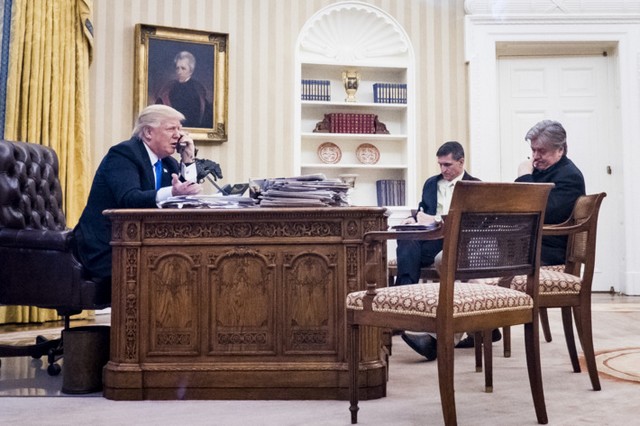
In what appears to have been a calculated leak from the highest echelons of the White House, US President Donald Trump reportedly “blasted” Australian Prime Minister Malcolm Turnbull during a phone call last weekend and then abruptly cut off the call.

According to the details first published by the Washington Post yesterday, Trump fumed at Turnbull for asking him to honour an Obama administration refugee-swapping deal with Australia. In line with his demonisation of refugees, Trump labelled it “the worst deal ever” and accused Turnbull of trying to export the “next Boston bombers” to the US.

Trump went further, however, telling Turnbull that their conversation was the “worst by far” of the five phone calls he had that day with world leaders, including Russian President Vladimir Putin. After 25 minutes, Trump suddenly ended the scheduled one-hour call “making it far shorter than his conversations with Shinzo Abe of Japan, Angela Merkel of Germany, François Hollande of France or Putin,” the newspaper reported.

The leaked content of the conversation exposed Turnbull’s insistence that it “ended cordially” and the fraud of Foreign Minister Julie Bishop’s earlier claims that the call was “very warm” and “very engaging.” Turnbull yesterday said he was “very disappointed” that details of the call were leaked.

Clearly, however, this was not merely a personal slight to Turnbull. It was a deliberate warning shot to his government and the entire Australian political establishment about the future of its post-World War II military alliance with the US. Sitting in the Oval Office monitoring Trump’s call was his chief strategist, the fascistic Stephen K. Bannon, Trump’s militarist national security adviser Michael Flynn and White House press secretary Sean Spicer.

Yesterday, Trump reiterated the wider bellicose “America First” message, to US allies and rivals alike. In a speech, he told a Washington audience that the world was in a mess, but he was “going to straighten it out.” He declared: “When you hear about the tough phone calls I’m having, don’t worry about it… We have to be tough. It’s time we have to be a little tough, folks. We are taken advantage of by every nation in the world virtually. It’s not going to happen anymore.”

Earlier in the day, gangster-like, Trump said he “loved Australia as a country” but had “a problem” with the refugee deal. His spokesman Spicer reiterated that Trump was “unbelievably disappointed” about the “horrible deal” and refugees would be allowed in the US only if they passed “extreme vetting.”

In reality, this draconian screening was already central to the agreement stuck with the Obama administration last year, which was designed to reinforce the reactionary anti-refugee policies on both sides of the Pacific. Not one of the more than 2,000 refugees incarcerated indefinitely by Australia on Nauru and Papua New Guinea’s Manus Island is guaranteed entry into the US.

Trump’s bullying treatment of Turnbull has thrown the Australian government and the media and political elite into turmoil because it makes brutally clear that the new administration’s belligerence has ominous implications. This is not least because Washington is reportedly pressing for a far greater military commitment from Canberra, particularly in the Middle East and the South China Sea.

In return for US military and strategic protection, Australian governments have sent troops to kill and die in every major US-instigated war for the past six decades—from Korea and Vietnam to Afghanistan, Iraq and Syria. But much more is now being required as the Trump White House seeks to “make America Great again” against its rivals, including China and Germany.

Largely buried in the Australian media is what the White House has demanded of Turnbull’s government, or is soon likely to, in return for the refugee-swap arrangement. In today’s Australian, editor-at-large Paul Kelly noted: “If the deal proceeds Trump, as a transactional president, will seek a quid pro quo at some point on some issue. And Turnbull, aware he has used up his political capital, will agree.”

On Wednesday, citing unnamed “senior US sources,” the Australian reported that the Trump administration had agreed, after lobbying from Canberra, to amend its sweeping anti-immigrant executive order to allow for the “pre-existing” refugee-swap agreement.

But the White House was “not happy” and “made no secret that Australia would ultimately be expected to reciprocate.” One source said: “The favour won’t be called in straight away … but some sort of reciprocity will come eventually. And that is likely to come in the form of freedom-of-navigation exercises [in the South China Sea] or the deployment of special forces to Iraq.”

Under Turnbull’s ousted predecessor, Tony Abbott, the Liberal-National government sent war planes and other military forces to join the renewed US war in Iraq, under the guise of combatting the Islamic State. Dispatch of special forces to join US ground forces would signal a marked escalation of the ongoing US drive for hegemony over the resource-rich Middle East.

Until now, the Turnbull government, while carefully toeing Washington’s line, has not followed the US in sending warships or planes into the territorial zones around islets under China’s control in the South China Sea, under the bogus pretext of defending “freedom of navigation.” The Obama administration conducted three such provocative operations, which heightened tensions with Beijing and intensified the danger of a war between the US and China, two nuclear powers.

Trump and his newly-confirmed Secretary of State Rex Tillerson have threatened to block China’s access to the islets, which would be an act of war. Such a conflict could have disastrous consequences for the Australian capitalist class, which relies heavily on China as its largest export market.

Trump is now taking to a new level pressure on Canberra that was initiated under Obama, as part of the US military and strategic “pivot to Asia” to combat and prepare for war against China. In mid-2010, when then Labor Prime Minister Kevin Rudd proposed that the US make some accommodation to China’s economic growth and rising influence, he was deposed in a backroom Labor Party coup orchestrated by elements close to the US embassy, including current Labor leader Bill Shorten.

Barack Obama himself sent blunt warnings to Turnbull, who was initially somewhat critical of the “pivot” when Obama announced it on the floor of the Australian parliament in 2011. Last September, the Australian Financial Review (AFR) reported that Turnbull, because of his past business interests in China, was “not trusted” by Australian intelligence agencies. Two months later, media leaks revealed that during a one-on-one meeting in Manila, Obama had rebuked Turnbull for failing to consult Washington before a Chinese corporation was awarded a 99-year lease to operate Darwin’s commercial port.

Today, the Australian media is full of alarm and foreboding about the implications of Trump’s dressing down of Turnbull, including the impact it will have on the already falling public support for the US alliance.

AFR chief political correspondent Phillip Coorey wrote: “If Trump continues treating Australia like dirt, public support for doing anything to help the Americans, including letting them keep their troops based in Darwin, let alone following them on any frolic in the South China Sea, will quickly wane.”

Professor James Curran of the US Studies Centre at Sydney University—a centre dedicated to overcoming public hostility to the US after the 2003 Iraq invasion—voiced concerns of what lies ahead. “If you have this sort of tension this early in the life of the administration over relatively small beer, what will happen in the event of a major crisis?”

Others within the media and political establishment, while not calling for a break from the US alliance, are casting doubt on its reliability. Fairfax Media political editor Peter Hartcher today declared it was time to “wake up, Australia!” The “moment of alliance shock” could “jolt Australia into doing more for itself” and “the country might mature from a state of adolescent dependency on America into a more adult state.”

Such statements are part of efforts in the ruling elite to divert public opposition to the Trump administration in a reactionary nationalist direction by advocating a more “independent” foreign policy to assert the interests of the Australian ruling class.

3 February 2017
Astana: Russia, Turkey and Iran show a united front on Syria

By Afro-Middle East Centre

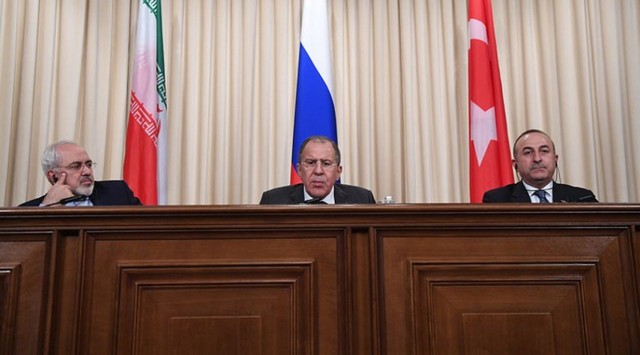
Talks between the Syrian regime and opposition forces, held in Kazakhstan’s capital from 23 to 24 January, concluded with Russia, Turkey and Iran announcing their intention for a trilateral mechanism to monitor and enforce the ceasefire between regime forces and rebels. The talks aimed to build on the 30 December truce, which was brokered by Ankara and Moscow, and endorsed by the United Nations Security Council. Delegations from armed opposition groups and the Syrian regime were meant to speak directly; however, this failed to materialise. The talks suggest the possibility of a diplomatic resolution for Syria in the future, but one which will favour the regime, and will not totally end the fighting.

The Astana talks highlighted the role of these three regional powers in Syria’s civil war, and the sidelining of the USA and Saudi Arabia; the former was invited as an observer, and the latter not at all. Astana did little to change the situation on the ground as regime forces continue attacking rebel fighters in Wadi Barada, near Damascus, while fighting between rebel groups broke out in Idlib, further weakening the opposition in the face of an assertive regime.

The nature of the Syrian civil war, with the involvement of a number of states supporting a range of actors, and the role of the Islamic State group (IS), has led to the failure of several UN-mandated peace talks. The organisers positioned the Astana talks as a basis for upcoming UN talks in Geneva, intended to cement the ceasefire while establishing a trajectory for future negotiations. The fall of Aleppo in December was a turning point in the conflict, and allowed the Syrian president, Bashar al-Asad, to claim victory and rubbish any attempts to exclude him from any transition process. Since Turkish and Russian support led to Asad’s success in Aleppo, they also took the diplomatic initiative. Their ceasefire deal was signed by Syria and seven major opposition groups. It was active in all areas not under IS control, and excluded UN-designated ‘terrorist’ groups, particularly IS and Jabhat Fateh al-Sham (formerly al-Qa’ida-affiliated Jabhat al-Nusra). When the parties decided early January that the ceasefire was substantially holding, Russia and Turkey began preparations to host talks between the regime and opposition forces.

Differing expectations of the Astana talks threatened to collapse the dialogue before it has started. Asad expressed hope that the armed rebel groups will disarm in exchange for an amnesty deal. Opposition groups expected to the talks only to strengthen the ceasefire, leaving any discussion of Syria’s political future to Geneva. The ceasefire agreement between Russia and Turkey has been more successful than previous agreements between Russia and the USA, and the organisers hoped that excluding the USA from a pivotal role may invoke greater trust between participants. Washington’s involvement in the Syrian peace process has decreased not only due to Asad’s ascendency with Russian support or Iran wishing to exclude them from the process, but also as Obama’s presidency ended. Syria’s Foreign Minister Walid al-Moallem also spoke highly of the chance of success due to ‘strong guarantees’ from Moscow, calling the ceasefire a potential starting point for a political process.

Although all opposition groups that had signed the 30 December ceasefire had received invitations to Astana, the Islamist Ahrar al-Sham, one of the larger rebel groups, did not attend, citing the fighting in Wadi Barada. The USA had insisted that the Syrian Kurdish Democratic Union Party (PYD, the largest group in the US-sponsored Syrian Democratic Forces) be involved; Moscow remained silent while Ankara refused to consider the inclusion of either the PYD or its armed wing, the YPG, due to their links to the Kurdistan Workers’ Party (PKK). The SDF responded by announcing its rejection any decisions that would be made in Astana. Opposition groups are divided, and the loss of eastern Aleppo highlighted their weakened position. Turkey is the opposition’s major state ally; however, Ankara’s rapprochement with Moscow forces opposition groups to question the usefulness of a diplomatic route that constrains their offensive options and increases tensions with Jabhat Fateh al-Sham. The current fighting between Fateh al-Sham and allies against Ahrar al-Sham and allies in Idlib highlights this tension among rebel factions.

The Astana talks were largely unproductive, and their primary impact emerged from discussions on the sidelines between Russia, Turkey and Iran on strengthening the ceasefire. In their agreement to set up a trilateral mechanism to monitor the ceasefire, the parties agreed there could be no military solution in Syria, and that the conflict could only be resolved through compliance with UN Security Council Resolution 2254. Neither the Syrian regime nor the rebel delegation appeared satisfied by the outcome of the talks. The opposition protested Iran’s inclusion in monitoring the ceasefire and mediating the conflict, and refused to sign any agreement. The government, meanwhile, announced the continuation of an offensive in Wadi Barada despite the ceasefire and had recaptured all rebel villages within a week.

An agreement to extend the ceasefire is a shaky foundation for the UN-mandated talks in Geneva starting on 20 February. Further, the exclusion of up to two thirds of opposition groups does not provide the rebel delegation with a popular mandate. The exclusion of armed groups with alleged al-Qa’ida links has further divided the opposition while providing the regime with an excuse for violating the ceasefire. Iran’s commitment to the ceasefire is a positive step towards freezing the conflict. Ultimately, it seems that a diplomatic solution is on the horizon, with the main drivers being Russia, Turkey and Iran. It will likely be a resolution that sees the co-option of certain sections of the opposition into the government, and an agreement that Asad will remain in power until the next election, when he will gracefully exit.

2 February, 2017

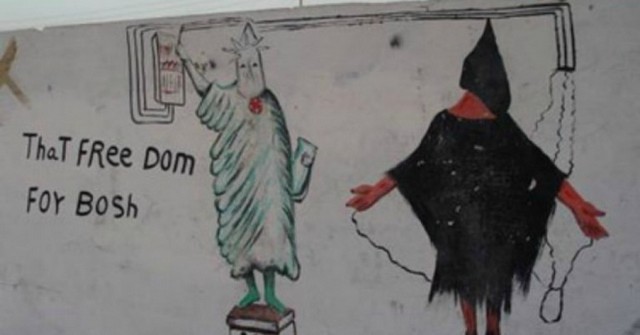
Torture Works…To Produce Fake News (And That’s How We Got Into Iraq)

By Juan Cole

I told this story back in 2005 but it is a good story, has held up, and bears repeating now that President Trump is again promoting torture as “effective.” Torture is a good way to get people to tell you what they think you want to hear so that you will stop torturing them. That is, torture may occasionally turn up some good information if it is applied to someone not very clever or not very committed. But it is an excellent way to be trolled by a seasoned operative, with potentially disastrous consequences.

Before the Iraq War, the U.S. government had captured a handful of important al-Qaeda figures and applied torture to them.

One of these was Ibn al-Shaykh al-Libi, a Libyan terrorist whose real name was Ali Abdul Hamid al-Fakheri. Under torture, he “confessed” that that Saddam Hussein’s Iraq was training al-Qaeda operatives in the use of chemical weapons.

The Defense Intelligence Agency and other high-level intelligence operatives dismissed this information as unreliable.

It should be noted that no money traces showed al-Qaeda funds coming from Iraq. No captured al-Qaeda fighters had been trained in Iraq. There was no intelligence that in any way corroborated al-Libi’s story. And, it was directly contradicted by two of his superiors.

The information from KSM and Abu Zubaydah circulated widely among intelligence officials.

I still remember Fox News in late 2002 droning on almost nightly about a chemical weapons facility at Salman Pak in Iraq where, its anchors alleged, Saddam was training al-Qaeda agents. It was, like most of the stories told about Iraq in that period, fake news.

There was also a phony story, retailed by Secretary of State Colin Powell and other members of the administration, that Abu Musab al-Zarqawi, a Jordanian extremist who had spent time in Afghanistan, had ties to Saddam Hussein once he relocated to Iraq in 2002. But later on the U.S. army released a document from the Baath Party secret police showing that an APB was put out on al-Zarqawi immediately on his entering Iraq, and local police were ordered to shake down the Jordanian expatriates in Iraq to find out where he was and arrest him immediately, since he was dangerous and had ties to “the Saudi terrorist Usama Bin Laden.”

Top al-Qaeda operative and 9/11 mastermind Khalid Shaykh Muhammad and al-Qaeda travel agent and marginal personality Abu Zubayda revealed to interrogators that Usamah Bin Laden had prohibited al-Qaeda operatives from cooperating with the secular Arab nationalist, Saddam Hussein, according to a 9/11 commission report.

This crucial information was withheld from Congress and from the American people by the Bush/Cheney administration in the run-up to the Iraq War.

Although KSM was captured only shortly before the war, surely the connection to Saddam was the first thing they asked him about. His answer was not shared with us, to say the least:

The report on Zubaydah’s debriefing was circulated among U.S. intelligence officers, but his statements were not included in public discussions by Administration officials about the evidence of al-Qaeda ties. “I remember reading the Abu Zubaydah debriefing last year, while the Administration was talking about all of these other reports and thinking that they were only putting out what they wanted,” one official said.

This lie by omission was repeated over and over again by Bush and his cronies:

“Saddam Hussein aids and protects terrorists, including members of al Qaeda.”
– Bush in his January 2003 State of the Union address.

“Iraq has also provided Al Qaeda with chemical and biological weapons training.”
– Bush in February 2003.

Al-Fakheri / Ibn al-Shaykh al-Libi had a last laugh on the people of the United States. Yes, they captured and tortured him. But he misdirected them toward his enemy, the secularist Baath government of Iraq and arranged for the Americans to overthrow it.

Al-Zarqawi’s branch of al-Qaeda in Iraq, thus freed from Baath surveillance, went from strength to strength, morphed into Daesh (ISIS, ISIL) and by 2014 took over 40% of Iraqi territory.

So beware of the information you get from torture. Your victim may be setting you up. And the psychopaths in the White House will be perfectly happy to run with the fake news gained from torture and use it to bamboozle the public for their own nefarious purposes.

Juan Cole teaches Middle Eastern and South Asian history at the University of Michigan. His new book, The New Arabs: How the Millennial Generation Is Changing the Middle East(Simon and Schuster), will officially be published July 1st. He is also the author of Engaging the Muslim World and Napoleon’s Egypt: Invading the Middle East (both Palgrave Macmillan). He has appeared widely on television, radio and on op-ed pages as a commentator on Middle East affairs, and has a regular column at Salon.com. He has written, edited, or translated 14 books and has authored 60 journal articles. His weblog on the contemporary Middle East is Informed Comment.

29 January 2017

Take Notice, Trump: We Are Not Protestors — We Are Protectors

By David Korten

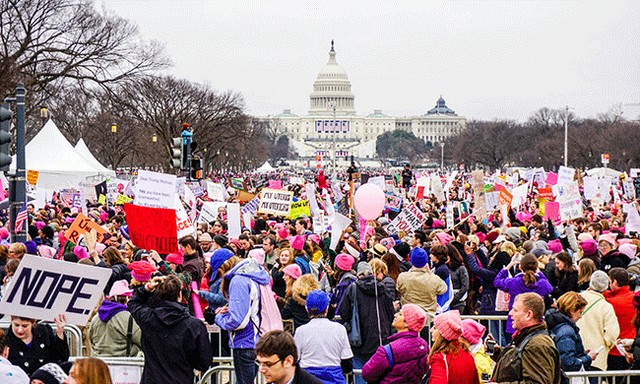
On Friday, Jan. 20, Donald Trump took the presidential oath of office before a crowd best described as puny compared to the estimated 1.8 million people who attended Barack Obama’s 2009 inauguration. The following day, the world erupted as millions of people joined demonstrations in major cities across the United States and the world to express their commitment to opposing the agenda of the man who now holds the world’s most powerful office. Some cities drew more people than were in Washington for the inauguration.

Does it matter that so many people turned out? A march in itself does not effect change. But as one marcher in Seattle observed, “It provides the foundation for action.”

Saturday’s marches energized millions of people with the assurance they are not alone. And those people affirmed our belief that the power of love can trump the power of hate. This sets the stage for future popular action in defense of the well-being of all.

How do we best characterize the spirit of these marches? Are they protests? Are they demonstrations of resistance?

I have been struck by the wisdom of the Native American tribes at Standing Rock who reject the “protestor” label. They instead call themselves “protectors”—protectors of the waters.

It seems to me that those who marched on Saturday are also best characterized as protectors. Protectors of the vulnerable, protectors of the Constitution, protectors of women’s bodies, protectors of Earth, protectors of democracy.

The difference in language, though subtle, is profound. Resistance and protest are reactions against an unjust act or regime. Protection is a positive affirmation of what we value, what we hold sacred.

When we call ourselves protectors, we cast our role as fulfilling our responsibility to the community that sustains us—not for our personal benefit, but for the benefit of all.

The indigenous protectors of Standing Rock put their lives on the line to protect the sacred waters on which we all depend. They showed us the way of nonviolence in the face of violence. And they offered us a gift—a powerful unifying frame for our activism as we move forward from Saturday’s marches.

Donald Trump is a symptom, not the cause, of the failed system that divides us into a world of winners and losers and threatens the Earth mother on which the well-being of all depends. In the bigger picture, an excessive focus on opposing him is a diversion from the deeper work at hand.

The solution is a better system—a system that protects and supports the healing and health of our Earth Mother, protects the rights and dignity of all humans, spreads the benefits of work equitably to protect the well-being of all, protects real democracy, and encourages us to stand together as protectors of each other in times of crisis.

So, the new president has brought us together. He has helped us rise as protectors of what we value. The marches he provoked enabled us to feel the strength of our numbers and our resolve. In his inaugural address, he said, “Together we will determine the course of America and the world for many, many years to come.” We—a globally inclusive “we,” united as protectors of Earth, justice, and democracy—may do just that. We will claim and shape our common human future in ways far beyond his intention or understanding.

David Korten wrote this opinion piece for YES! Magazine as part of his series of biweekly columns on “A Living Earth Economy.” David is co-founder and board chair of YES! Magazine, president of the Living Economies Forum, a member of the Club of Rome, and the author of influential books, including When Corporations Rule the World and Change the Story, Change the Future: A Living Economy for a Living Earth. His work builds on lessons from the 21 years he and his wife, Fran, lived and worked in Africa, Asia, and Latin America on a quest to end global poverty. Follow him on Twitter @dkorten and on Facebook. As do all YES! columnists, he writes here in his personal voice.

28 January 2017

How Do I Know Good Can Overcome Ignorance, Spite And Hate? Because I’ve Seen it

By Rob Hopkins

I want to share a story with you today that I’ve not shared before on this blog.  I was moved by something I saw on Twitter to the effect that the future will not remember Trump, but the future will remember the remarkable things done by those mobilising to oppose him.  It really resonated with me.  I wanted to share a very personal story from my own life which, for me, illustrates that this is possible.

I lived in Ireland from 1996 until 2004. It was wonderful. From 2002 onwards, Emma and I built a home for our family, what was the first new cob house built in Ireland for over 100 years.  Building this house was the culmination of a 10 year plan, something Emma (pictured below laying our limecrete floor)  and I had dreamt of for many years.  The process of construction involved the input of many people

People came on courses to learn how to make rubble trench, lime and stone foundations, how to mix cob with diggers, how to build masonry stoves, how to make clay plasters.  Hundreds of people came as volunteers to work on the house, picking up the skills necessary to then head away and build their own (as some did).

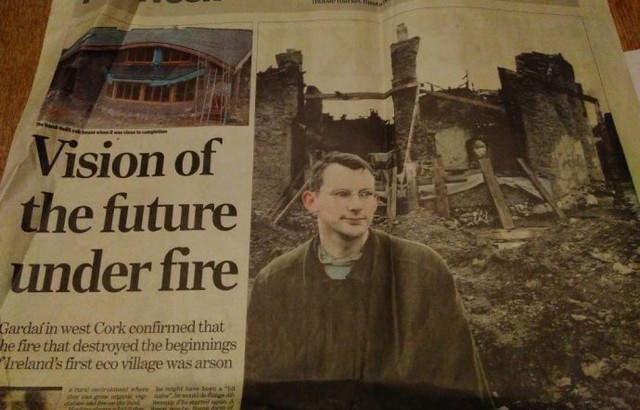
It was a beautiful house, not a right angle in it, beautiful soft light, wood, stone, clay and hemp.  A roof like an upturned boat.  I loved it.  I was so proud of it. We told the story in an online diary. It was in the papers, on the TV.  We were at the stage of fitting doors and windows, the gorgeous, curvaceous clay plasters nearly complete.  Although we weren’t living in it yet, it was starting to feel like home.  Then, one clear, cold night in October 2004, someone set it on fire.

We never found out who.  Or why.  But by the time we saw the fire, the house was lost.  All we could do was sit on the damp grass and watch the whole thing go up in flames.  Two years worth of work.  Most of our money too, as the building was uninsured – in Ireland it was impossible to insure any building project not made exclusively from concrete blocks.

It was deeply traumatic.  It felt like the end of everything.  It felt as though the violent, deluded, criminal act of one or two people had torn up our family’s future and thrown in back in our face.  Our future, which had seemed to be laid out enticingly in front of us, was now an unknown blur.  It was horrible.

But then, in the days and weeks following the fire, something remarkable happened.  Dozens of people, some of whom we didn’t even know, turned up to help clear the site up and make it safe (see photo below). Neighbours came together to offer whatever support they could.  Some friends started to organise a fundraiser in our name. People sent in cards containing cheques, or cash, often people we’d never met, or even heard of.

They wrote things like “In the end, good does always seem to come from terrible events, though it must be impossible to see that now”, before ending “don’t write back. You have enough to do”.  One couple wrote “please know that we hold you in our hearts, thoughts and prayers, and if there is any help or support we can offer, we would be happy to do so”.  Another wrote: “we read about you in the Times, and wanted to say we thing it is an evil thing to do to burn down a house on anyone, least of all children coming up to Christmas”.

A blacksmith wrote to say “if you have the heart to start again, I will gladly offer any work I can as a blacksmith (or in any other capacity) for free”.  It wasn’t just local people, it was people across Ireland.  People we’d never met wrote to tell us “the house has been a source of inspiration not only for ourselves, but many others”.

One woman from Limerick wrote “Stay with your dream.  Your dream is a good one and most people see that.  I hope things work out now”.  A letter from Dublin said “we are pensioners, but wanted to convey our sympathy in a constructive way, so please accept enclosed cheque for a very small amount as a token in this regard”.

One order of nuns sent us a cheque for €5,000.  One schoolboy invited his friends to play football in his garden, charged them each €5 and sent it to us.  There were benefit gigs, pub quizzes.  It was amazing.

People were happy to offer help, but with no expectation of what we would do with it.  One letter which accompanied a €50 note, ended “a little something enclosed to help with whatever is right for you”.  Another said “just a wee note to let you know there’s loads of people thinking of you at this time.  Take comfort in the love of friends”.  One long letter ended “you are not alone.  This has horrified us all into action, and I know many of us are now working to turn this situation to the light with all the speed we can muster”.

Local gardening clubs sent donations.  Local associations wrote to us to let us know that our situation had been discussed at their board meeting and they had unanimously passed a resolution condemning what had happened to us, and offering their support.  The local university’s Environment Society held a benefit event.  One woman wrote from London to say “if you need volunteers to help with reconstruction, send out the word – my partner is a newly qualified electrician and could do with experience!”  Our friend Greg wrote “whatever you choose in the coming year, you will have a community of support from around the island”.

In the end, we decided not to rebuild the house.  In time we decided to move on, and our path took us to Totnes, where we started this thing called Transition.  But for me, once the initial trauma had subsided, the thing that I hold onto now, the thing that I took away from the whole experience, was just how very, very kind and amazing people are, rather than holding onto the actions of one of two people.

I looked back at a folder of clippings and stuff I kept from that time.  Among them was this piece from the Cork Examiner with a photo of me where I look more heartbroken and washed out from crying than in any photo I know.  I imagine as Trump (you won’t hear the term ‘President Trump’ from these lips) settles into the Oval Office, many millions of people are feeling similarly bruised, lost and bewildered.

But I want to tell you that you are surrounded by oceans of goodness, oceans of caring people.  Networks of people who are connected that just need to be activated.  Get off Facebook, get off media that pours out trolls and hateful poison, and strengthen your connections to real, actual people.

The Women’s March last weekend was a beautiful, and deeply moving example that we are here, and we are here for each other.  As was the ‘Resist’ banner unfurled just behind the White House yesterday. They reaffirm that values of care, kindness, connection and reciprocity haven’t gone away.  They may sometimes need a disturbance to form around, an infection around which that immune system can kick in.

But when people ask me why I don’t feel that Trump represents the beginning of the end, some inevitable slide away from connection and human values, it’s because rather than some kind of new normal, his approach represents the aberration to the norm.  Never forget that.

Rob Hopkins is the cofounder of Transition Town Totnes and of the Transition Network. He is a serial blogger, and author of The Power of Just Doing Stuff , The Transition Handbook and The Transition Companion. He has been awarded a PhD by the University of Plymouth and an Honorary Doctorate by the University of the West of England. In 2012 he was voted one of the Independent’s top 100 environmentalists and one of ‘Britain’s 50 New Radicals’. He is an Ashoka Fellow, a keen gardener and one of the founders of New Lion Brewery in Totnes and a Director of Atmos Totnes, a very ambitious community-led development project.

28 January 2017

Trump Orders Military To Prepare For War

By Tom Eley

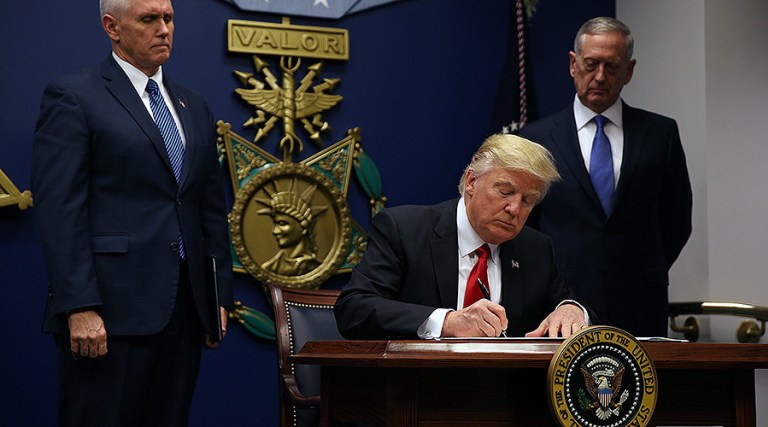
During a visit to the Pentagon on Friday, President Donald Trump issued an executive action calling for stepped up violence in Syria and a vast expansion of the US military, including its nuclear arsenal, to prepare for war with “near-peer competitors”—a reference to nuclear-armed China and Russia—and “regional challengers,” such as Iran.

“I’m signing an executive action to begin a great rebuilding of the armed services of the United States,” Trump said during the signing of the document, entitled “Rebuilding the US Armed Forces.”

During the visit, his first to the Pentagon, Trump signed a second order, “Protecting the US from Terrorist Attacks by Foreign Nationals,” that freezes visa and immigration applications from predominantly Muslim countries. The order threatens to block refugees from finding sanctuary, workers from taking jobs, students from attending school, and the unification of families (See, “White House to issue executive order on ‘safe zones’ in Syria, ban on Muslim immigrants and refugees”)

The military order directs Defense Secretary James Mattis, who was sworn in at the ceremony, to complete a 30-day “readiness review” designed to prepare for the destruction of ISIS in Syria and Iraq, along with “other forms of Islamic terror.” Last week, Mattis was confirmed by the Senate in a 98-1 vote.

The order further instructs Mattis, in the words of the Washington Post, which obtained a copy of the order prior to its formal release, “to examine how to carry out operations against unnamed ‘near-peer’ competitors, a group which US officials typically identify as China and Russia.” And it commands the Pentagon and the Office of Management and Budget to develop a “military readiness emergency budget amendment” that would increase military spending in the current year and increase the budget for 2018 and thereafter—increases to be offset by cuts to social spending.

The Presidential Memorandum, only three pages in length, is the blueprint for world war.

The order unmistakably threatens the use of nuclear weapons. Section 3 calls for a nuclear force “to deter 21st century threats” and, menacingly, to “achieve Presidential objectives should deterrence fail.”

It further calls for a plan “to achieve readiness objectives” for the use of the nuclear arsenal “by 2022.” This would include the “modernization” of the US nuclear force, a greatly expanded missile defense system, and increased emphasis on cyber warfare, which aims to cripple the retaliatory capacity of major adversaries by targeting their digital and telecommunication command structures prior to an American strike.

These actions follow on a move by the Obama administration to implement a $1 trillion upgrade in the country’s nuclear arsenal.

The executive action did not put a price tag on new military spending, but media speculation indicates that the figure could approach an additional $100 billion per year. Trump’s military plans hew closely to a Heritage Foundation proposal that calls for the revamping of the nuclear force, the expansion of the Navy to 350 ships, the Air Force to 1,200 fighter and attack jets, the Marine Corps from 24 to 36 divisions, and the Army to more than a half a million soldiers.

The US currently spends approximately $600 billion on its military annually—excluding expenditures on the intelligence agencies and Veterans Administration— more than the next nine largest military spenders combined. American “defense” spending accounts for, by itself, over one third of all global military spending, and it consumes the great majority of the federal discretionary budget.

Increases in military spending, coupled with Trump’s promises to drastically lower taxes on corporations and the rich, must inevitably be paid for by cuts to education, health care and infrastructure, and by plundering Social Security and Medicare.

In securing the presidency, Trump capitalized on popular hostility toward Hillary Clinton’s interventionist stance on Syria and her saber-rattling against Russia. But his executive order’s demand for escalation in Syria increases the likelihood of war with both regional power Iran and nuclear-armed Russia. Russia maintains its only significant foreign military base in Syria and has so far preserved the regime of Bashar al-Assad in a war for regime change orchestrated by the Obama administration.

Trump’s order for a plan to destroy ISIS and “radical Islam,” which he declared in his Inaugural Address he would “eradicate completely from the face of the Earth,” will be drawn up by Mattis, responsible for numerous war crimes in the US occupation of Iraq, including the killing of untold thousands of civilians in the 2004 attack on Fallujah.

While the US now makes war on ISIS, it has funded and directed Al Qaeda affiliates in the regime change operations in Libya and Syria. Yet in remarks made last summer, prior to his nomination to defense secretary, Mattis claimed that, in his view, ISIS was nothing more than a stalking horse for Iran to extend its influence throughout the Middle East. It is widely rumored that Mattis left command in the Obama administration because he favored a more bellicose approach toward Iran.

Even before Trump’s order became public, figures in and around the military speculated that Mattis would propose a dramatic escalation in Syria.

Scott Murray, a retired Air Force colonel involved with previous aerial bombardment of ISIS, told NPR that this could be done by lifting rules preventing the targeting of civilians.

“Commanders could … re-examine limits on the number of civilian casualties that the military risks when it hits ISIL targets,” NPR reported. “Known as the ‘non-combatant value,’ the rule restricts the number of civilians who can be put at risk in an airstrike.”

Officers who spoke with the US government’s overseas broadcaster Voice of America (VOA) complained of the Obama administration “micro-approving” actions in Syria. “Every single person had to be approved,” an unnamed Defense Department official said of a contingent of 203 Special Forces soldiers sent into Syria last year.

A high-ranking Army general, Lt. Gen. David Barno, told NPR’s Morning Edition that, in lieu of local proxies, far more US soldiers will be deployed into Syria. “I think President Trump might be looking for something with some quicker results and that could put some new options on the table,” Barno said. “He could elect to put American boots on the ground in larger numbers.”

Currently most of the 6,000 US military personnel in the region are concentrated in Iraq, where, joined by Iraqi forces, they are subjecting the city of Mosul to a massive attack. Trump’s order will likely lift the fiction that there are separate war theaters in the neighboring countries.

There was also speculation that the US could bolster the Kurdish People’s Protection Units (YPG). This would heighten tensions with NATO ally Turkey, which views the YPG as a proxy of the Kurdish Workers Party (PKK), against which it has waged a nearly four-decade counterinsurgency war to prevent the emergence of an independent Kurdistan.

An escalation in Syria is also prefigured by Trump’s anti-immigrant executive order, which, with the express aim of blocking refugees from fleeing the crisis, envisages the creation of “safe zones” run by the US military—in blatant violation of Syrian sovereignty and international law. Under the plan, Syria’s refugees would be placed in what would be, in all but name, US-administered camps, overseen by the US military.

28 January 2017

Palestine in the Age of Trump

By Rashid Khalidi

With the advent in Washington of an Administration with radical new priorities regarding Israel, and a disdain for Palestinian rights, Palestine is facing a daunting reality. In recent years, ascendant political currents in America and Israel had already begun to merge. We have now reached the point where envoys from one country to the other could almost switch places: the Israeli Ambassador in Washington, Ron Dermer, who grew up in Florida, could just as easily be the U.S. Ambassador to Israel, while Donald Trump’s Ambassador-designate to Israel, David Friedman, who has intimate ties to the Israeli settler movement, would make a fine Ambassador in Washington for the pro-settler government of Benjamin Netanyahu.

Whereas America’s solicitous concern for Israel and its disregard for the Palestinians were once cloaked behind evenhandedness, under Trump we are set to see a more complete convergence between America’s political leadership and the most chauvinistic, religious, and right-wing government in Israel’s history. It will be this Israeli government and its new American soul mates who will call the tune in Palestine for at least the next several years.

The entire Palestinian political and economic structure set up since the 1993 Oslo Accords was predicated on the idea that it would evolve into a genuine, viable, and contiguous Palestinian state. That illusion, held by many Palestinians, has by now been dispelled. This flawed structure was also based on the premise, a naïve one at best, that the United States had a national interest in moderating Israeli behavior and achieving a modicum of justice in the Middle East. That premise, too, has been demolished.

For Palestinians, the Palestinian Authority, set up by the Oslo Accords ostensibly as part of an interim arrangement for Palestinian self-rule, will continue to do more harm than good. Few people understand that the colonization of Palestinian land and the nearly fifty-year-old Israeli military occupation—among the longest in modern history—would not be sustainable today without American and Israeli sponsorship of the P.A. and its U.S.-trained security forces. The P.A.’s criminalization of any form of resistance to dispossession, discrimination, and Israel’s permanent military control have made it, in effect, a tool of collaboration with the occupation. Even bloggers and peaceful demonstrators are subject to arrest and harassment by P.A. forces. The way this institution operates against its own people provides a preview of the future that both American and Israeli officials will now foresee for Palestinians in the occupied territories: a future that is constricted, controlled, and void of sovereignty and self-determination.

It is abundantly clear that the United States, in the age of Trump, and Israel, in the age of Netanyahu, will do nothing to change this picture. In this context, the Palestinians face stark choices. They can either submit to the dictates of the U.S. and Israel or they can fundamentally and urgently redefine their national movement, their objectives, and their modes of resistance to oppression. It is time for Palestinians to abandon the failed experiment of the P.A., and to abandon forms of violence that only harden the sway of the right wing over Israeli politics. It is time to mobilize the vast energies of the Palestinian diaspora and stop thinking of Palestine as just those fragments under Israeli occupation. And it is time to begin to imagine ways in which Palestinians and Israelis will finally be able to coexist in complete equality in the small country they will ultimately have to share, once it is free of the domination of one group over the other. These will be exceedingly hard tasks for the Palestinians, coming after they have suffered decades of war, dispossession, and occupation.

Despite all this, there are signs of hope, at least in the United States. The positions of both the Democratic and Republican Party establishments notwithstanding, American public opinion is shifting rapidly away from uncritical support for Israel. Americans are becoming increasingly sympathetic to the cause of Palestinian freedom. According to a poll released by the Brookings Institution in December, sixty per cent of Democrats, and forty-six per cent of all Americans, support sanctions or stronger action against Israel over its construction of illegal Jewish settlements on occupied Palestinian land. A recently released Pew poll shows that, for the first time, the percentage of Democrats who are sympathetic to the Palestinians is almost equal to those who sympathize with Israel, while liberal Democrats are much more sympathetic to Palestinians (thirty-eight per cent) than they are to Israel (twenty-six per cent).

Over time, perhaps, these changes will filter up to politicians and policymakers in Washington. In the meantime, it is up to individuals of conscience, including those who are resisting the wave of racism and right-wing extremism to be expected in the Trump era, to exert pressure on their elected representatives to live up to professed ideals of freedom and equality, and to hold Israel accountable for its violations of international law and denial of Palestinian national and human rights.

Rashid Khalidi is the Edward Said Professor of Arab Studies at Columbia University and the author, most recently, of “Brokers of Deceit: How the U.S. Has Undermined Peace in the Middle East.”

19 January 2017

White House To Issue Executive Order On “Safe Zones” In Syria, Ban On Muslim Immigrants And Refugees

By Niles Niemuth

US President Donald Trump declared in an extended interview with ABC News broadcast Wednesday that he will sign an executive order directing authorities to implement US controlled “safe zones” in Syria. The order would also block the entry of refugees and immigrants from a number of majority Muslim countries, including Syria.

During the presidential campaign, Trump called for a complete ban on Muslim immigration into the US. He played up fears over the admittance of a few thousand Syrian refugees displaced by the years-long civil war in that country fueled by the Obama administration.

In the interview with David Muir, during which the president updated the tone of a mafia boss, Trump expounded on his planned immigration restrictions. “It’s going to be very hard to come in. Right now, it’s very easy to come in. It’s gonna be very, very hard.” Trump also declared that he plans to “absolutely do safe zones in Syria for the people.”

Coinciding with Trump’s interview, a draft of the draconian and unconstitutional executive order, billed as a measure for “protecting the nation from terrorist attacks by foreign nationals,” was leaked to the media.

The order would suspend immigration to the US from Syria, Iraq, Iran, Yemen, Libya, Sudan and Somalia for 30 days and suspend the admittance of individuals under the US Refugee Admissions Program for 120 days. The admission of refugees from Syria into the US will be suspended indefinitely.

Several caveats would allow for the entry of refugees from Syria and the other countries on a case by case basis as well as allow the processing and admittance of religious minorities, i.e. non-Muslims.

Other restrictive measures spelled out in the document include the full implementation of a biometric entry-exit tracking system and new restrictions on the granting of non-immigrant travelers’ visas.

In line with Trump’s remarks, the draft order outlines a process for the establishment of “safe zones,” justified by the indefinite suspension of the admission of immigrants and refugees from Syria into the US: “Pursuant to the cessation of refugee processing for Syrian nationals, the Secretary of State, in conjunction with the Secretary of Defense, is directed within 90 days of the date of this order to produce a plan to provide safe areas in Syria and in the surrounding region in which Syrian nationals displaced from their homeland can await firm settlement, such as repatriation or potential third-country resettlement.”

Moscow, which has intervened in the Syrian civil war to prop up President Bashar al-Assad, respond to Trump’s announcement of his plan to implement “safe zones” by denying that it had any input on the decision and warned of potential consequences.

“Our American partners did not consult with Russia [regarding the ‘safe zones’]. It is their sovereign decision,” Dimitry Peskov, the Kremlin spokesman, told reporters on Thursday. “It’s important to make sure that this does not further aggravate the situation with refugees. Evidently, all the possible consequences should be taken into account,” he warned.

Former President Barack Obama had resisted the imposition of safe zones in Syria, a policy fiercely advocated by Democratic advisers and war hawks like former Secretary of State and Trump’s rival, Hillary Clinton. The protection of such areas with a no-fly zone could spark a clash between US and Russian jet fighters, leading to all-out war between the nuclear armed powers.

However, DEBKAfile, a website with ties to Israeli military intelligence, reported that an agreement has been worked out between Trump and Russian President Vladimir Putin to carve Syria up into three separate spheres of influence divided between the US, Russia and Turkey. The deal also reportedly requires all Iranian military forces as well as associated forces belonging to Shiite militias and Hezbollah to leave the country.

The plan outlined by DEBKAfile would involve the US taking military control over the area of the country east of the Euphrates River, as well as a portion of the southeast boarding the Golan Heights and northern Jordan. Approximately 7,500 US Special Forces currently based in Jordan will reportedly deploy to southeast Syria.

The rest of the country would be divided between Russia and Turkey, with Moscow controlling all territory west of the Euphrates except for a narrow stretch of territory in northern Syria administered by Ankara.

While the alleged plan has not been confirmed by the Trump administration, it does line up with previous proposals made by Trump’s National Security Adviser, Lt. Gen. Michael Flynn, to deploy large numbers of US troops to Syria under the pretense of defeating ISIS and other Islamist militia groups.

In a 2015 interview with Der Spiegel, Flynn, the former director of the Defense Intelligence Agency, outlined his vision for an expanded US intervention in Syria and a Balkanization of the Middle East, carving the region into spheres of influence and military control.

“We can learn some lessons from the Balkans. Strategically, I envision a breakup of the Middle East crisis area into sectors in the way we did back then, with certain nations taking responsibility for these sectors,” Flynn stated. “The United States could take one sector, Russia as well and the Europeans another one. The Arabs must be involved in that sort of military operation, as well, and must be part of every sector.”

27 January 2017

Who supplies the news? Misreporting in Syria & Iraq

By Patrick Cockburn

The nadir of Western media coverage of the wars in Iraq and Syria has been the reporting of the siege of East Aleppo, which began in earnest in July and ended in December, when Syrian government forces took control of the last rebel-held areas and more than 100,000 civilians were evacuated. During the bombardment, TV networks and many newspapers appeared to lose interest in whether any given report was true or false and instead competed with one another to publicise the most eye-catching atrocity story even when there was little evidence that it had taken place. NBC news reported that more than forty civilians had been burned alive by government troops, vaguely sourcing the story to ‘the Arab media’. Another widely publicised story – it made headlines everywhere from the Daily Express to the New York Times – was that twenty women had committed suicide on the same morning to avoid being raped by the arriving soldiers, the source in this case being a well-known insurgent, Abdullah Othman, in a one-sentence quote given to the Daily Beast.
The most credible of these atrocity stories was given worldwide coverage by Rupert Colville, the spokesman for the UN High Commission for Human Rights, who said on 13 December that his agency had received reliable reports that 82 civilians, including 11 women and 13 children, had been killed by pro-government forces in several named locations in East Aleppo. The names of the dead were said to be known. Further inquiries by the UNHCHR in January raised the number of dead to 85, executed over a period of several days. Colville says the perpetrator was not the Syrian army, but two pro-government militia groups – al-Nujabah from Iraq and a Syrian Palestinian group called Liwa al-Quds – whose motives were ‘personal enmity and relatives against relatives’. Asked if there were other reports of civilians being executed in the final weeks of the siege, Colville said there were reports of members of the armed opposition shooting people trying to flee the rebel enclave. The murder of 85 civilians confirmed by multiple sources and the killing of an unknown number of people with bombs and shells were certainly atrocities. But it remains a gross exaggeration to compare the events in East Aleppo – as journalists and politicians on both sides of the Atlantic did in December – with the mass slaughter of 800,000 people in Rwanda in 1994 or more than 7000 in Srebrenica in 1995.
All wars always produce phony atrocity stories – along with real atrocities. But in the Syrian case fabricated news and one-sided reporting have taken over the news agenda to a degree probably not seen since the First World War. The ease with which propaganda can now be disseminated is frequently attributed to modern information technology: YouTube, smartphones, Facebook, Twitter. But this is to let mainstream media off the hook: it’s hardly surprising that in a civil war each side will use whatever means are available to publicise and exaggerate the crimes of the other, while denying or concealing similar actions by their own forces. The real reason that reporting of the Syrian conflict has been so inadequate is that Western news organisations have almost entirely outsourced their coverage to the rebel side.

Since at least 2013 it has been too dangerous for journalists to visit rebel-held areas because of well-founded fears that they will be kidnapped and held to ransom or murdered, usually by decapitation. Journalists who took the risk paid a heavy price: James Foley was kidnapped in November 2012 and executed by Islamic State in August 2014. Steven Sotloff was kidnapped in Aleppo in August 2013 and beheaded soon after Foley. But there is tremendous public demand to know what is happening in such places, and news providers, almost without exception, have responded by delegating their reporting to local media and political activists, who now appear regularly on television screens across the world. In areas controlled by people so dangerous no foreign journalist dare set foot among them, it has never been plausible that unaffiliated local citizens would be allowed to report freely.
In East Aleppo any reporting had to be done under licence from one of the Salafi-jihadi groups which dominated the armed opposition and controlled the area – including Jabhat al-Nusra, formerly known as the Syrian branch of al-Qaida. What happens to people who criticise, oppose or even act independently of these extremist groups was made clear in an Amnesty International report published last year and entitled ‘Torture Was My Punishment’: Abduction, Torture and Summary Killings under Armed Group Rule in Aleppo and Idlib. Ibrahim, whom al-Nusra fighters hung from the ceiling by his wrists while they beat him for holding a meeting to commemorate the 2011 uprising without their permission, is quoted as saying: ‘I heard and read about the government security forces’ torture techniques. I thought I would be safe from that now that I am living in an opposition-held area. I was wrong. I was subjected to the same torture techniques but at the hands of Jabhat al-Nusra.’
The fact that groups linked to al-Qaida had a monopoly on the supply of news from East Aleppo doesn’t necessarily mean that the reports in the press about the devastating effects of shelling and bombing were untrue. Pictures of flattened buildings and civilians covered in cement dust weren’t fabricated. But they were selective. It’s worth recalling that – according to UN figures – there were between 8000 and 10,000 rebel fighters in East Aleppo, yet almost none of the videos on TV ever showed any armed men. Western broadcasters commonly referred to the groups defending East Aleppo as ‘the opposition’ with no mention of al-Qaida or its associated groups. There was an implicit assumption that all the inhabitants of East Aleppo were firmly opposed to Assad and supported the insurgents, yet it’s striking that when offered a choice in mid-December only a third of evacuees– 36,000 – asked to be taken to rebel-held Idlib. The majority – 80,000 – elected to go to government-held territory in West Aleppo. This isn’t necessarily because they expected to be treated well by the government authorities – it’s just that they believed life under the rebels would be even more dangerous. In the Syrian civil war, the choice is often between bad and worse.
The partisan reporting of the siege of East Aleppo presented it as a battle between good and evil: The Lord of the Rings, with Assad and Putin as Saruman and Sauron. By essentially handing over control of the news agenda to local militants, news organisations unwittingly gave them an incentive to eliminate – through intimidation, abduction and killing – any independent journalist, Syrian or non-Syrian, who might contradict what they were saying. Foreign leaders and the international media were at one time predicting slaughter on the scale of the worst massacres in postwar history. But, shamefully, by the time the siege came to an end they had completely lost interest in the story and in whether the horrors they had been reporting actually took place. Even more seriously, by presenting the siege of East Aleppo as the great humanitarian tragedy of 2016, they diverted attention from an even greater tragedy that was taking shape three hundred miles to the east in northern Iraq.
The offensive against Mosul, the biggest city still held by Islamic State, began on 17 October when Iraqi army troops, with the support of US-led air power, entered the city’s eastern districts. Expectations of a quick victory were soon disappointed when Iraqi soldiers began to suffer heavy casualties as small but highly mobile IS units of half a dozen fighters moved from house to house through hidden tunnels or holes cut in the walls to set up sniper positions, plant booby traps and bury IEDs. Local people whose houses were taken over say that the snipers were Chechens or Afghans who talked in broken Arabic. These fighters were supported by local IS men who also helped hide the suicide bombers who were to drive vehicles packed with explosives. There were 632 vehicle bombs during the first six weeks of the offensive. An IS squad would use a house until it had been pinpointed by Iraqi government forces and was about to be destroyed by heavy weapons or US-led airstrikes. Before the counterattack came they would move on to another house. IS has traditionally favoured fluid tactics, with each squad or detachment acting independently and with limited top-down control. Adapted to an urban environment, this approach allows small groups of fighters to harass much larger forces, by swiftly retreating and then infiltrating captured neighbourhoods so they have to be retaken again and again.
The Iraqi and US governments had every reason to play down the fact that they had failed to take Mosul and had instead been sucked into the biggest battle fought in Iraq and Syria since the US invasion in 2003. It was only in the second week of January that Iraqi special forces reached the River Tigris after ferocious fighting: with the support of US planes, helicopters, artillery and intelligence they had finally taken control of Mosul University, which had served as an IS headquarters for the eastern part of the city, along with the area’s 450,000 inhabitants. But reaching the Tigris was far from being the end of the fight. On 13 January, IS blew up the five bridges spanning the river. The city’s western part is a much greater challenge: home to 750,000 people, many of whom are thought to be sympathetic to IS, it’s a larger, poorer and older area, with closely packed streets that are easy to defend. Only the aid agencies, coping with the heavy civilian casualties and the prospects of a fight to the death by IS, appreciated the scale of what was happening: on 11 January, the UN Humanitarian Co-ordinator in Iraq, Lise Grande, said the city was ‘witnessing one of the largest urban military operations since the Second World War’. She warned that the intensity of the fighting was such that 47 per cent of those treated for gunshot wounds were civilians, far more than in other sieges of which the UN had experience. The nearest parallel to what is happening in Mosul would be the siege of Sarajevo between 1992 and 1995, in which 10,000 people were killed, or the siege of Grozny in 1994-95, in which an estimated 5500 civilians died. But the loss of life in Mosul could be much heavier than in either of those cities because it is defended by a movement which will not negotiate or surrender and kills anybody who shows any sign of wavering. IS believes death in battle is the supreme expression of Islamic faith, which fits in well with a doomed last stand.
Figures for wounded civilians in Mosul over the last three months may well exceed those for East Aleppo over the same period. This is partly because ten times as many people have been caught up in the fighting in Mosul, whose population according to the UN is 1.2 million; 116,000 civilians were evacuated from East Aleppo. Of that number, 2126 sick and war-wounded were evacuated to hospitals, according to the WHO. Casualties in the Mosul campaign are difficult to establish, partly because the Iraqi government and the US have been at pains to avoid giving figures. Officials in Baghdad angrily denounced the UN Assistance Mission for Iraq when it announced that 1959 Iraqi soldiers, police, Kurdish Peshmerga and their paramilitary allies had been killed in November alone. The UN was forced to agree not to release information about Iraq’s military casualties in future, but US officers confirmed that some units in the 10,000-strong Golden Division – a US-trained elite force within the Iraqi army whose soldiers get higher pay – had suffered 50 per cent casualties by the end of the year. The Iraqi government was equally silent about the number of civilian casualties and emphasised its own great restraint in the use of artillery and airpower. But the doctors in Iraqi Kurdistan treating injured people fleeing from Mosul were less reticent: they complained that they were being overwhelmed. On 30 December, the Kurdish health minister, Rekawt Hama Rasheed, said his hospitals had received 13,500 injured Iraqi troops and civilians and were running out of medicines. The extent of civilian losses hasn’t ebbed since: the UN Office for the Co-ordination of Humanitarian Affairs in Iraq said that over two weeks at the turn of the year, some 1500 Iraqis from Mosul suffering from trauma injuries had reached Kurdish hospitals, mostly from frontline areas and ‘with most of these injuries occurring just after the fighting intensified at the end of December’. These numbers only give a rough idea of the real losses: they don’t include the dead, or the wounded in western Mosul who didn’t want to leave – or couldn’t, because they were being used as human shields by IS. The UN says that many people were shot by IS fighters as they tried to escape.

A large number of these losses were inflicted even before Mosul was fully surrounded: the last passable main road to Syria, down which have come food, medicine, fuel and cooking gas since IS captured the city two and a half years ago, was closed in November by Shia paramilitaries. Tracks are still open, but they are dangerous and often can’t be used during the winter rains. As a result, prices in the markets in Mosul have soared: the cost of a single egg has jumped five times, to 1000 Iraqi dinars. In the main vegetable and fruit market there are only potatoes and onions for sale, and at high prices. As cylinders of cooking gas run out, wood taken from abandoned building sites is selling at a premium. The siege is likely to be a long one: if IS is going to make a stand anywhere, it is better from its point of view to do so in Mosul, where the Iraqi government and the US military may be more restrained than elsewhere in Iraq in the use of their firepower. The precedents are ominous: in 2015-16 airstrikes and artillery fire destroyed 70 per cent of Ramadi, the capital of Anbar province, which had a population of 350,000. IS has every reason to fight to the end in Mosul: aside from being the second biggest city in Iraq, it has iconic significance for IS. It was here, in June 2014, that a few thousand of its fighters defeated an Iraqi government garrison of at least 20,000 soldiers; and it was on the back of this miraculous victory that IS’s leader, Abu Bakr al-Baghdadi, declared his caliphate. Those who are trapped in Mosul aren’t optimistic about their chances: ‘What we feared is happening,’ a woman in her sixties who gave her name as Fatima, told the online newsletter Niqash, which published an account of conditions in the city. ‘The siege is starting for real. From now on every seed and every drop of fuel counts because only god knows when this will end.’
Despite the ferocity of the fighting in Mosul, and warnings from the UN about casualties in the city potentially surpassing those in Sarajevo and Grozny, international attention has been almost exclusively directed at East Aleppo. It wouldn’t be the first time in the region that the Western press corps turned out to have been watching the wrong battle: I was in Baghdad in November 2004 when most Western journalists were covering the end of the siege of Fallujah. The Marines ultimately captured it, but the American generals understandably played down – and the media scarcely noticed – that while US troops were fighting in Fallujah, in central Iraq, insurgents had seized the much larger city of Mosul, in the north. That victory turned out to be significant, because the US army and the Iraqi government never truly regained uncontested control of the city, with the result that the predecessors of IS survived intense military pressure and re-established themselves, waiting until the revolt in Syria in 2011 gave them fresh opportunities.
There are many similarities between the sieges of Mosul and East Aleppo, but they were reported very differently. When civilians are killed or their houses destroyed during the US-led bombardment of Mosul, it is Islamic State that is said to be responsible for their deaths: they were being deployed as human shields. When Russia or Syria targets buildings in East Aleppo, Russia or Syria is blamed: the rebels have nothing to do with it. Heartrending images from East Aleppo showing dead, wounded and shellshocked children were broadcast around the world. But when, on 12 January, a video was posted online showing people searching for bodies in the ruins of a building in Mosul that appeared to have been destroyed by a US-led coalition airstrike, no Western television station carried the pictures. ‘We have got out 14 bodies so far,’ a haggard-looking man facing the camera says, ‘and there are still nine under the rubble.’

2 February 2017

The Never-Ending Indian Wars: Spotlight Returns To Standing Rock

By Stephanie Woodard

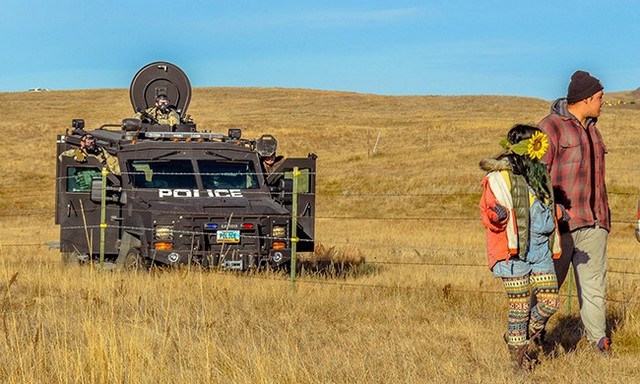
The world has been shocked by North Dakota’s violent reaction to the anti-oil pipeline resistance at Standing Rock. For the better part of a year, people have watched via social media, then increasingly on conventional media outlets, as heavily armed law enforcement officers and private contractors attacked unarmed civilians with rubber bullets, mace, tear gas, batons, and water cannons in sub-freezing temperatures. Water protectors, as the demonstrators call themselves, have been dragged from prayer ceremonies, injured, and arrested. More than 100 have been hospitalized.

Last week, the National Guard confirmed it has positioned the platform of an Avenger missile system near the Dakota Access Pipeline construction site; it will be used for surveillance, according to Morton County Sheriff’s Department spokesman Rob Keller.

The force used against unarmed civilians has been extreme, even by military wartime standards. The concussion grenades that have allegedly caused some of the most serious wounds in North Dakota were banned in Iraq for fear of harming civilians, U.S. Army veteran Griz Grzywa told YES! in an interview at Standing Rock. Grzywa served as an Army Ranger for 15 years, including one tour of duty in Somalia and three tours in Iraq. He had come to Standing Rock to help shield the demonstrators from harm. “They are using a level of force against women and children here that our military would hesitate to use,” he said.

Indeed, Standing Rock has revealed this long-standing and violent dynamic to a new generation of observers, as the U.S. government and corporations use military-level force while unarmed tribal people protest with prayer.

For Native people, the brutality is nothing new. It is a generations-old policy, according to Wendsler Nosie Sr., leader of Apache Stronghold, a group that seeks to protect the sacred Arizona landscape Oak Flat from mining. They are doing so by camping there and holding supporting actions throughout the country. “Federal and state involvement with us has always been military, from the days when we Native people were prisoners of war until this very day,” says Nosie.

The second half of the 20th century saw many examples of state-sanctioned violence toward Native people. During the 1960s and 1970s, unarmed members of Northwest tribes were shot at, clubbed, gassed, and arrested—notably at Frank’s Landing, in Washington state—while seeking recognition of treaty-guaranteed fishing rights. For decades, law enforcement officers have roughed up and arrested protesters from Pine Ridge Indian Reservation as they try to shut down the town of Whiteclay, Nebraska. With about a dozen residents, the town exists almost exclusively to bootleg alcohol onto the dry reservation, setting off a cascade of physical and social ills and crime.

Just under 10 years ago, South Dakota sent its entire on-call contingent of highway patrol to help local police make arrests on the Yankton Sioux Reservation. Tribal members and others were demonstrating peacefully against a concentrated animal feeding operation that was being constructed on their homeland against their wishes. And in Montana in 2012, after Northern Cheyenne spiritual teacher Mark Wandering became lead plaintiff in a voting-rights lawsuit, police traffic stops of Native people in the area spiked.

Natives are not just arrested and abused by police; they are killed by law enforcement officers at a higher rate than any other group. Mike Males, senior research fellow at the Center on Juvenile and Criminal Justice, analyzed Centers for Disease Control and Prevention data and found that from 1999 to 2014, Natives aged 20–24, 25–34, and 35–44 were three of the top five groups to die during arrest or while in custody. The other two groups were African Americans 20–24 and 25–30.

In April 2016, Claremont Graduate University scholars Roger Chin, Jean Schroedel, and Lily Rowen announced research showing that in six states—Mississippi, South Dakota, Idaho, Washington, Alaska, and North Dakota—death rates for Native Americans were higher than for any other group. Chin adds that in 87 percent of the cases over a recent 15-month period, the Natives were shot or died in the custody of off-reservation police.

“The violence toward us is embedded in our history,” says Nosie. “When we started the Oak Flat encampment, right away military-type planes began flying overhead.” Indigenous Environment Network (IEN) reports that in May 2016, U.S. Army Corps of Engineers representatives showed up in combat gear to discuss Missouri River issues with Yankton Sioux officials. When tribal members said this was inappropriate, the Corps representatives stalked out of the meeting, according to IEN. According to Nosie, using military equipment and appearing in battle gear is meant to send a message: “We did it to you before, and we can do it again.”

Meanwhile, a North Dakota legislator wants to make it easier for ordinary citizens to injure or even kill protesters. Keith Kempenich and six co-sponsors, all Republicans, have submitted a bill that Kempenich told the Bismarck Tribune is a response to frustrated constituents who oppose the anti-DAPL movement, which has at times spilled into public roadways. If the measure passes, motorists who “negligently” hurt or kill anyone obstructing traffic “would not be held liable for any damages.”

Well-known North Dakota civil rights attorney and former U.S. attorney Tim Purdon, of the firm Robins Kaplan, calls the bill a “new low” that “legalizes negligent homicide with a vehicle of a certain class of people.” Whether the bill passes or not, he says, “It was introduced to send a message that we are going to dehumanize those with whom we disagree.” Purdon says the measure has unintended broader consequences, since it in fact allows anyone driving negligently—while drunk or texting, for example—to kill or maim.

Throughout the months of confrontations at Standing Rock, the water protectors there have welcomed media coverage and have used social media to get their story out in their own words. They were glad to see the surge of media attention to their movement during December, when more than 2,000 veterans arrived.

Though publicity does not mean immediate solutions, it can support ongoing indigenous struggles. These are increasingly successful, according to Native leaders, as tribal members and their allies throughout Indian Country work to protect land, water, culture, and sacred places.

This is part of a special report: The Spirit of Standing Rock on the Move.

Stephanie Woodard wrote this article for YES! Magazine. Stephanie has covered Indian Country for more than 15 years for Native-owned Indian Country Today Media Network, as well as for In These Times and other national publications. The Center for Investigative Reporting and the Fund for Investigative Journalism have supported her work. The Native American Journalists Association, of which she is an associate member, has recognized her with its top annual prize, the Richard LaCourse Award.

25 January 2017