By Feroze Mithiborwala
Far too many facts pertaining to the Orlando massacre
by Omar Mateen raise serious questions about the
ghastly killing of American citizens as a False Flag
opertion of the FBI. The fact that the gory incident
came within days days of the death of Mohammed Ali,
whose passing away had re-awakened American and
global interest in the Islam he lived also raises
questions of whether the spectacular terror act
was aimed at burying, along with him the idea
of a principled and non-violent Islam.
14 Questions FBI Must Answer.
If the FBI, America’s extremely powerful military-security-surveillance
complex and the corporate media are to be believed, the Orlando massacre
was the gruesome handiwork of Omar Mateen – a “gay-hating Muslim fanatic”,
a “homegrown, radicalised lone-wolf” – who single-handedly slaughtered
50 people and injured as many in a killing spree at the Pulse bar on a night
dedicated to the Gay Latino community. The massacre, we are told, lasted
three hours before the Special Weapons and Tactics Team (SWAT)
finally brought down the mass murderer.
However, eyewitness statements, several news reports and video
clips of the gory incident raise serious questions that suggest
yet another False Flag operation. Here below are facts which
have surfaced in the aftermath of the massacre which the
FBI must address:
Mateen himself was a gay. This discredits the narrative
of the massacre as a homophobic hate-crime. Why is the
FBI desperately trying to suppress this fact?
Mateen’s links to radical Islamists – Moner Abu Salha,
the first American suicide bomber in Syria – are being
downplayed by the FBI as “minimal.” Why?
Mateen had links with Islamist preachers
Abu Taha Marcus Dwayne Robertson and the
blind cleric Sheikh Omar Abdel Rahman, both of
whom have been terror operatives with proven links
to the CIA? How could the FBI be unaware of this fact?
What about Mateen’s links to FBI handlers for a period
of 10 months during 2013? The statement of Florida’s St.
Lucie county’s Sheriff Ken Mascara alleges that the FBI
had dispatched an informant to “lure Omar into some kind
of act and Omar did not bite”. Is this not a clear indictment
of the FBI and it’s fatal policy of entrapment to commit acts of terror.
The all-powerful G4S security agency has named a psychiatrist
who had conducted a psychological evaluation to certify
Mateen’s fitness for a job with the agency. But the psychiatrist
claims she never saw Mateen and that she was not even living
in Florida at the time the test is claimed to have been conducted.
Why is the G4S lying?
Why are the FBI’s version and the timeline of the terror attack
on Pulse bar put out by the corporate media so incoherent and
misleading? An off-duty cop along with other officers had
confronted the heavily armed Mateen who started shooting
outside the Pulse Bar before going inside? Why was he not
followed into the bar by the armed cops? Why is there no
mention of the Pulse bar’s own security? How is it that
no CCTV cameras were operational?
The 3-hour delayed response of the SWAT Team
needs to be explained by the authorities. Why
did the police and the SWAT team fail to follow
the Standard Operating Procedure (SOP),
which states that they have to intervene and
enter the premises if the shooting is underway?
Mateen purchased the guns from a gun store
owned by Ed Henson, a former NYPD Officer.
Another gun store owner Robert Apell affirms
that he had alerted FBI to a ‘suspicious’ customer
on a shopping spree weeks before the Orlando
shooting. Why did the FBI not act on the information?
Eye-witnesses are on record saying that there
were anywhere between 2-5 shooters, that Mateen
was not the lone shooter. Who were the other shooters
and where are they? Why is this key evidence
being suppressed?
Why doesn’t the shooting math add up?
FBI states that only 202 rounds were fired.
Why are experts challenging the supposed facts?
James Wesley Howell, who himself was to attack
a Gay Pride Rally in Santa Monica on that very day
in a parallel operation told the local police that
both Mateen and he were trained by the CIA
in Virginia. Is it true that Mateen was part of a
hit-squad team for Orlando and who was
supposed to get away alive?
Is it true that Wackenhut – the world’s largest
private security corporation, with whom Mateen
was employed for a period – is a front for the CIA
and has an extremely dubious track record
The FBI has a known record of creating terror,
entrapment and manufacturing terrorists
and masterminding false flag terror operations.
Was the Orlando massacre part of this ugly past of the FBI?
Each of these questions are examined in detail below.
Mateen himself was a Gay
That Omar was himself gay was stated by his former wife
Sitora Yusufiy who was married to Mateen in 2009
for three months. She made this disclosure
on Brazilian television station SBT Brazil,
as reported by the New York Post. Her fiancé,
Marco Dias, speaking in Portuguese on her behalf,
said Yusufiy believed that Mateen had “gay tendencies”
and that his father had called him gay in front of her.
Dias also claimed “the FBI asked her not to tell this
to the American media.”
In a news report under the headline,
‘Ex-wife’s bomb shell claim: club shooter was gay’,
the New York Post revealed:
The bombshell came as a male former classmate of
Omar Mateen said he had been asked out romantically
by the mass killer, who reportedly was a virtual regular
at the Pulse nightclub, having visited it more than
a dozen times over the years.
The former classmate said he would hang out with Mateen,
hitting gay bars after attending class at
Indian River Community College police academy in 2006
— and one time Mateen asked him out “romantically,”
according to the Palm Beach Post.
“We went to a few gay bars with him, and I was not
out at the time, so I declined his offer,” the former
classmate told the paper.
The classmate’s claims came after reports
emerged that Mateen frequented the club
for years before Sunday’s massacre.
“It’s the same guy,” Chris Callen, a drag queen
who performs under the name Kristina McLaughlin,
told the Canadian press. “He’s been going to this bar
for at least three years.”
Callen’s husband, Ty Smith, recalled seeing a drunk
Mateen being escorted from the club. “Sometimes he . . .
would get so drunk he was loud and belligerent,”
he told the Orlando Sentinel.
At least four Pulse clubgoers remembered seeing Mateen
at least a dozen times in the past. But authorities said
they had no further information when asked about the sightings on Monday.
Callen and Smith shot down claims that Mateen had snapped
after seeing two men kissing each other in public.
“That’s bullcrap, right there. No offense. That’s straight-up crap.
He’s been around us,” Smith said. “Some of those people
did a little more than (kiss) outside the bar …
He was partying with the people who supposedly drove him to do this?”
Kevin West, another regular at Pulse, told the Los Angeles Times
that Mateen used gay dating apps on a regular basis and even
messaged him on a gay dating app, Jack’d. He even saw Mateen
an hour before the shooting, which is again a remarkable fact,
not being reported by the MSM.
Mateen’s ties with a terrorist
Omar’s links to radical Islamists have been downplayed
by both the FBI as “minimal”, as well as by his employer
G4S-Wackenhut, the world’s largest private security firm,
linked closely to the CIA.
In the aftermath of the attack, authorities are trying to
ascertain how it’s possible that Mateen cleared
four background checks, two with the company and two with the FBI,
without raising sufficient alarm.
Former superior court judge from New Jersey,
Napolitano stated that Mateen qualified for the
highest level of weaponry that one can qualify
for in Florida, calling this an “extraordinary breakdown”
within the G4S security system, in the background checks
required for someone in his position.
The FBI in 2014 investigated a potential connection
between Mateen and Moner Mohammad Abu-Salha –
the first American suicide-bomber in Syria who blew
himself up killing government soldiers in 2014 –,
according to an NBC report.
Omar and Salha were also reported to have met up
at parties according to a former classmate who wishes
to remain anonymous. This further proves that the
interaction between the two was a red flag which
should have been heeded, which again the FBI
seems to have missed out.Or then did they?
Were the FBI just allowing another one of their
terror entrapment programmes to play out
to its logical conclusion?
Mateen’s links to Salha were well-known,
yet the FBI brushed this connection off as being “minimal.”
The common link between the radicalisation of both
Salha and Mateen is Anwar al-Awlaki. Both are
said to have heard the cleric’s fiery sermons,
which finally led them to commit the acts of terror.
In his article, ‘I Reported Omar Mateen To The FBI;
Trump Is Wrong That Muslims Don’t Do Our Part’,
Muhammad A Malik, also reaffirms the point that
both Moner and Mateen were radicalised by the Awlaki tapes.
Anwar al-Awlaki – the radical spiritual leader linked
to several 9/11 attackers, the Fort Hood shooting,
and the attempted Christmas Day bombing of an
airliner – was a guest at the Pentagon in the
months after 9/11, a Pentagon official confirmed to CBS News.
Awlaki was invited as “…part of an informal
outreach program” in which officials sought contact “…
with leading members of the Muslim community,”
the official said. At that time, Awlaki was widely
viewed as a “moderate” imam at a mosque in
Northern Virginia.
In this important video, Lt. Col Anthony Shaffer
a retired US army reserve lieutenant colonel
who gained fame for his claims about mishandled
intelligence before the September 11 attacks
and for the censoring of his book,
Operation Dark Heart, goes on to
reveal that Anwar al-Awlaki was an FBI asset.
Mateen’s radical Islamist preachers
Mateen was a follower of cleric Abu-Taha (Marcus Dwayne Robertson), a former US Marine who acted as a bodyguard for the “Blind Sheikh” Omar Abdel-Rahman. Robertson was the imam of the Orlando-based ‘Fundamental Islamic Knowledge Seminary’, where Mateen had enrolled online.
In addition to working with the CIA, Robertson was an FBI informant for 15 years. He is linked to the blind cleric Sheikh Abdel Omar Rahman, al-Qaeda and the first World Trade Center bombing in 1993.
One of the main operatives the CIA had utilized in its war against the Soviets was Sheikh Abdel Omar Rahman. The CIA utilized Rahman because of his influence over the Mujahadeen then brought him into the US on a CIA-sponsored visa.
To the CIA, which pumped more than $2 billion into the fourteen-year Afghani resistance effort, Sheikh Omar was what intelligence officials call “a valuable asset”.
According to the UC website, www.constitution.org:
The use of former enemy soldiers, criminals, and terrorists for their dirty work is also a time-honored tradition among intelligence agencies, who stand to gain the “plausible deniability” so coveted in the world of covert operations.
One of the main operatives the CIA had utilized in its war against the Soviets was Omar Rahman. The CIA utilized Rahman because of his influence over the Mujahadeen, then brought him into the US on a CIA-sponsored visa. While the Sheikh was eventually convicted for conspiracy to bomb targets in the US, prosecutors encountered resistance in pursuing him and other World Trade Center bombing suspects because of their ties to the Mujahadeen, and their ties to US intelligence.
During a conversation between a 20-year veteran FBI agent and one of his top undercover operatives, the operative asked:
“Why aren’t we going after the Sheikh Adbel Rahman?” demanded the undercover man.”It’s hands off,” answered the agent.”Why?” asked the operative.”It was no accident that the Sheikh got a visa and that he’s still in the country,” replied the agent, visibly upset. “He’s here under the banner of national security, the State Department, the NSA, and the CIA.” The agent pointed out that the Sheikh had been granted a tourist visa, and later a green card, despite the fact that he was on a State Department terrorist watch-list that should have barred him from the country. He’s an untouchable, concluded the agent.Following the Orlando massacre Abu-Taha Robertson and several associates have been rounded up for questioning, according to law enforcement sources. Robertson’s school may not have been the only source of Mateen’s spiritual guidance. Mateen was at the Islamic Center of Fort Pierce with Imam ShafiqRahman two days before the nightclub attack, according to The Washington Post. That mosque was frequented by American-born Al-Nusra (Al-Qaeda of Syria) suicide-bomber Salha who blew himself up in Syria in 2014 and the two knew each other, according to officials. Mateen’s association with Salha led the FBI to interview him in 2014. Rep. Michael McCaul, chairman of the House Homeland Security Committee Mike McCaul told Fox News law enforcement determined at the time their contact “was minimal.”
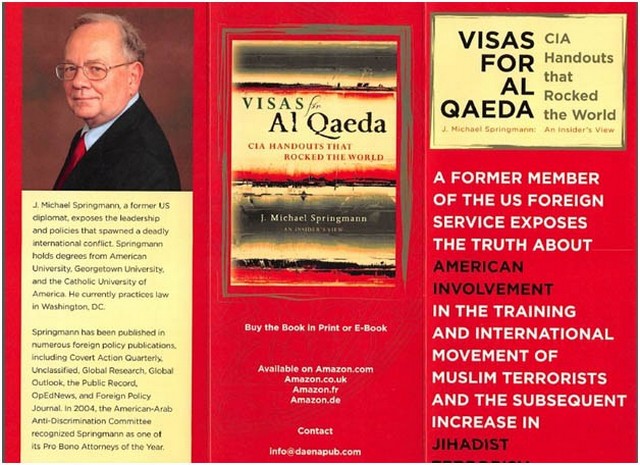
In his brilliant and path-breaking book, Visas for Al Qaeda – CIA Handouts that Rocked the World – An Insider’s View, J Michael Springmann documents the role of the CIA in the creation of the Arab-Afghan Legion, that later transmogrified from the Mujahedeen into the Al Qaeda and from there to the ISIS of our present times.
Mateen and his FBI handlers:
In their path-breaking article, ‘Before Omar Mateen Committed Mass Murder, The FBI Tried To ‘Lure’ Him Into A Terror Plot” – New revelations raise questions about the FBI’s role in shaping Mateen’s lethal mindset’, Max Blumenthal and Sarah Lazare have come out with astounding revelations that prove beyond doubt that the FBI was trying to lure Mateen into committing an act of terror under the influence of his handlers as stated on record by Sheriff Ken Mascara.
Here are some excerpts:
Before Omar Mateen gunned down 49 patrons at the LGBTQ Pulse Nightclub in Orlando, the FBI attempted to induce his participation in a terror plot. Sheriff Ken Mascara of Florida’s St. Lucie County told the Vero Beach Press Journal that after Mateen threatened a courthouse deputy in 2013 by claiming he could order Al Qaeda operatives to kill his family, the FBI dispatched an informant to “lure Omar into some kind of act and Omar did not bite.“
While self-styled terror experts and former counter-terror officials have criticized the FBI for failing to stop Mateen before he committed a massacre, the new revelation raises the question of whether the FBI played a role in shifting his mindset toward an act of violence. All that is known at present is that an FBI informant attempted to push Mateen into agreeing to stage a terror attack in hopes that he would fall into the law enforcement dragnet.
Trevor Aaronson, a journalist and author of, Terror Factory: Inside the FBI’s Manufactured War on Terror, revealed that nearly half of terror cases between 9/11 (2001) and 2010 involved informants – many of whom were themselves criminals raking in as much as $100,000 from the FBI. “Is it possible that the FBI is creating the very enemy we fear?” Aaronson wondered.
The revelations of FBI manipulation cast Mateen’s case in a uniquely troubling light. Though he refused to “bite” when an FBI asset attempted to push him into a manufactured plot, he wound up carrying out a real act of spectacular brutality, and allegedly swore loyalty to ISIS in the midst of it.
Now the question is whether the FBI was right to pursue Mateen before he could kill, or whether it played an influencing role in shaping his attitude towards politically-motivated violence.
While the full extent of Mateen’s contact with the FBI is unknown, it is clear that it extended into the realm of planning a bogus terror attack. The question now is whether manipulation by a FBI informant had any impact on Mateen’s deadly decision.
“The FBI should scrutinize the operating procedure where they use undercovers and informants and pitch people to become informants,” said Rowley a former FBI agent. “They must recognize that, in this case [with Mateen], it had horrible consequences if it did, in fact, backfire.”
Tony Cartalucci in his incisive article, ‘CONFIRMED: FBI Introduced Florida Shooter to ‘Informants’, further brings out the connections between Omar Mateen and his FBI handlers:
It is now confirmed that in addition to two investigations and two interviews, Florida terror suspect Omar Mateen was also approached by “informants” working for the US Federal Bureau of Investigation (FBI) over a period of 10 months.
This further connects the missing links in Mateen’s radicalization and the seemingly invisible hands that likely guided him to carry out his act of terror.
Cartalucci’s report adds that while speaking to The New York Daily News, the FBI director, James Comey admitted that, “FBI spied on Orlando gay club terrorist Omar Mateen for 10 months in 2013: FBI Director James Comey:
Mateen first appeared on authorities’ radar in 2013 after the security guard’s colleagues alerted the FBI to inflammatory statements he made to colleagues claiming “family connections to Al Qaeda,” according to Comey.
Nevertheless, FBI investigators investigated Mateen, who was born in New York, for 10 months. They introduced him to confidential informants, spied on his communications and followed him.They also interviewed him twice.
Here’s more from Cartalucci:
The significance of this cannot be understated. “Informants” in this context, according to FBI affidavits regarding similar counterterrorism investigations, refers to individuals posing as members of terrorist organizations who approach suspects; coerce them into planning and preparing for terrorist attacks, before finally aiding the FBI in the suspect’s arrest before the attack is finally carried out.
The article also refers to the other cases of entrapment wherein James Medina, a homeless man with mental problems, and 23-year-old Cuban-American Harlem Suarez both believed that they were working for the ISIS in a make believe world created by the FBI.
In the case of Rezwan Ferdaus, whose mental wellness had deteriorated so much that he was wearing adult diapers at the time of his arrest on terrorism charges, he was led to believe that he was working for the Al Qaeda!
Rezwan Ferdaus, like Medina, was provided assistance by the FBI every step of the way, including being provided 24 lbs of C4 explosives, 6 fully automatic AK47 rifles, and 3 grenades – the FBI’s own affidavit reveals (.pdf). He was brought deep into a fictional world where he believed he was working directly with Al Qaeda for nearly a year – told that “detonation devices” he constructed and passed on to FBI informants were “used” in Iraq to “kill” American soldiers.
Mateen’s connections to the FBI are further affirmed by Steven D Kelley, a former CIA/NSA Contractor.
“This event was clearly just one more false flag event. The individual that’s being named as the shooter clearly is very closely connected to the US government all the way up to his family, and there’s a long history of involvement with government agencies on either side of different issues”.
Why is the G4S lying?
Omar Mateen’s Wackenhut ID-CardThe G4S claims that Mateen had cleared all the medical and psych-evaluation tests conducted before being hired. But in an another intriguing development, Dr. Carol Nudelman who is said to have certified Mateen claims that the tests were not conducted by her, she has never met Mateen and was not even in Florida during that period. The psych certification clears the employee concerned to bear arms and thus this report is crucial to the mounting evidence against the G4S and its history of dubious dealings.Following the denial by Dr Nudelman, G4S has retracted its statement, claiming a “clerical error” and that another psychiatrist had conducted the psych-evaluation. The name of the “other psychiatrist” has still not been made public.Why is the G4S lying?Furthermore, the G4S hired him even though Mateen’s job applications had been rejected by two police departments.
Seven months into a job as a prison guard in 2007, Mateen was fired for threatening to bring a gun to class. He settled on a career as a low level security guard for G4S Security Solutions, a global security firm that employed him for nine years. Though Mateen’s applications to two police departments were rejected, he was able to pass a G4S background check and receive several guard assignments. (The world’s third largest private employer, G4S has accumulated a staggering record of human rights abuses, including accusations of child torture.)
Despite all these rather worrying indications, the G4S/Wackenhut, the world’s leading private security corporation, never fired him.
Why the conflicting versions from FBI, corporate media?
The timeline as offered by the New York Times is very sketchy at best and is certainly misleading.
The timeline which mentions Mateen’s entry into the Pulse at 2.02 am has very little information about the 3 crucial hours leading to the final assault by the SWAT Team at 5.00 am.
The official narrative states that Mateen was apprehended by Adam Gruler, an off-duty security officer (with a dubious past of police violence against civilians), a gun-fight broke out, soon supported by “additional officers”, Mateen entered the Pulse and then started shooting killing 50 and injuring as many.
Adam Gruler, the off-duty cop who was supposedly on scene looking for a patron with a fake ID and is being promoted as a hero, was exposed by Copwatch 2011 as a violent policeman.
This weak narrative of the off-duty cop and the other officers who apprehended Mateen must be challenged for the following reasons:
It fails to describe the battle with an off-duty police officer and the other officers who on hearing the gunshots came to the aid of Gruler, even as Mateen entered the bar and began to shoot away as per the official version.
According to CNN, an off-duty police officer who was at the Pulse nightclub “engaged the shooter as he entered the club”.
Engaged? As he entered the club? A gunfight, where none were injured or killed? What precisely transpired?
Why didn’t Gruler and the other cops follow Mateen and enter Pulse even as they supposedly were shooting at Mateen?
Not a single mention about the private security guards and bouncers that all bars have at their entrance and inside to deal with unruly violent customers – where were/are they?
Where were the CCTV cameras?
One report stated that the CCTV cameras were under maintenance and thus non-functional. In fact all of the mainstream media reports have refrained from even mentioning the CCTV cameras. It is for this reason that we have no footage at all from within the Pulse, or from its external area in the car-park. How very convenient!
3-hour delayed response of SWAT Team
The arrival of the SWAT Team three hours after the terror attack has been criticized by many security experts and begs a logical explanation. The key element is that as part of the Standard Operating Procedure (SOP),
“Police are trained that if there’s an active shooter in progress, you go in and confront the shooter at any risk. When an active shooter is shooting, you go in and shoot the shooter,” says Chris Grollnek an expert on active-shooter tactics and a retired police officer and a SWAT team member.
“This was a catastrophic failure on police SWAT tactics,” charged Chris Grollnek, who served on a SWAT team in McKinney, Tx., for seven years and now runs a company training civilians and law enforcement to prevent and respond to active shooter incidents.
Grollnek heaped criticism on the Orlando SWAT team commander for waiting to breach the Pulse nightclub after gunman Omar Mateen stormed in at about around 2 a.m. Sunday, slaughtering 49 people and wounding 53 others — the deadliest mass shooting in the nation’s history and the worst terror attack on American soil since 9/11.
Cops were on the scene in less than two minutes but it wasn’t until 5 am that 11 SWAT members entered the club and fatally shot Mateen, said police chief John Mina and Grollnek, who spoke with law enforcement officers familiar with the investigation.
Asked if he had any doubt the delay between arrival at the scene and breaching the club cost lives, Grollnek responded tersely, “None.”
Grollnek also “reserved his anger for the police commanders in Florida who didn’t allow the SWAT team members to enter until several hours after the shooter began the attack”.
Worse, when the SWAT did finally break-through from the rear end in the Rest Rooms, they reportedly killed many of the terrified desperate people seeking to escape from the opening provided.
Conclusion: The standard operating procedure for the police and the SWAT team should have been to intervene when the firing was on and the people were being massacred, but they chose to wait for three hours before launching their attack. The picture is far too murky and the official timeline fails to address the glaring anomalies.
FBI was alerted about ‘suspicious’ customer?
Mateen purchased his guns prior from a Gun Shop St. Lucie Shooting Center owned by a retired NYPD Officer Ed Henson, prior to the terror attack on the Pulse Bar. The shop has been closed till further notice.Ed Henson, a retired NYPD detective is known to be very Islamophobic. Henson is reported to supply weapons to the police department. Was Ed Henson a “Patsy-Minder”, providing services for the FBI in lieu of lucrative offers?TheNew York Daily News reported that the store’s owner, Ed Henson, an ex-NYPD officer, had posted on Facebook in December a meme that said, “F— Islam, F— Allah. F— Muhammad.F— the Koran. F— people who support terrorism,” as well as a comment in November calling for Obama to be “handcuffed, removed from Office and charged with Treason and then publicly executed!” “How can the American People and military stand by and do nothing while this piece of sh– puts everyone of us in danger.”Ed Henson does not appear to be a person who would be very happy selling guns to Muslims… But would he not if it was meant to lead to a false flag and thus further his political agenda?Apparently, Robert Abell the owner of Lotus Gunworks had a greater sense of responsibility than former NYPD detective Ed Henson. Mateen wanted to purchase body armour that raised suspicion. Abell refused after which Mateen inquired about bulk purchase of ammunition, on which again he was cross-questioned. Omar made a call, spoke in a foreign language and left, after which Abell contacted the FBI and reported the matter. But the FBI took no serious notice of the incident and never visited the store or investigated further.Clearly the FBI is far more efficient in the Hollywood TV serials!
Ed Henson’s role in the supply of weapons to terror patsies and criminals linked to the FBI should be investigated.
Eye-witnesses claimed there were 2-5 shooters
Why is this fact going unreported in the media? The following videos and eyewitness reports clearly support this overwhelming evidence.
A victim of Sunday’s early morning terror attack at the Pulse nightclub gave a bombshell interview to an ABC reporter after being released from a local hospital.
During the interview the eyewitness, who played dead for several hours during the attack as a strategy to stay alive, said that he had overheard a phone conversation that the shooter was engaged in. The eyewitness said that the shooter made mention that he was the “fourth shooter” and that there were “three others,” “snipers,” along with a ‘female suicide bomber’ that was playing dead.
Additionally the witness said that the terrorist on the phone also mentioned “to stop bombing ISIS.”
This is an absolute bombshell info that is being suppressed by the mainstream press! This information should be the focus on every mainline channel!
Janiel Gonzalez, 26 an eye witness told the palmbeachpost.com he heard another gun from a different direction, so he wonders if there were two gunmen.
“Everybody dropped to the floor. We were trying to look for an exit. But the main exit was right next to the entrance where the shooter was shooting,’’ he said.“In a moment of desperation we were all crawling on the floor trying to find a place to exit. I looked to my right and I could see people going through some curtains. We were digging through the curtains and found a door.’’
But he said the door was blocked by a man. He wasn’t sure if it was a club security person or an accomplice to the gunmen.
“Fifty people were trying to jump over each other trying to exit the place. There was a guy holding the door and not letting us exit. He’s like ‘Stay inside, stay inside.’ As he is saying that, the shooter keeps getting closer and closer and the sound of the bullets is getting closer. Everyone starts to panic. People are getting trampled. Let us out, let us out!’’’
Gonzalez’ first thought was that it was a hate crime. “This guy is trying to prevent us from leaving. Maybe they’re working together,’’ he said.
Javer Antonetti, 53, told the Orlando Sentinel newspaper that he was near the back of the dance club when he heard the gunfire. “There were so many (shots), at least 40,” he said. “I saw two guys and it was constant, like ‘pow, pow, pow,’.
Zepher_907:
“I saw the report first hand on CNN about 2 or 3 hours after it broke the news so probably 5 am Florida time and it never played again and I haven’t been able to find it. It was an older Hispanic lady in her late 40s or early 50s that didn’t speak English to well. She was telling reporters that she was on the phone with a club patron that was with her son at club. He told the Hispanic lady that he saw TWO SHOOTERS standing next to each other that opened fire on the crowd before the mother’s son was wounded by three gunshot wounds. The footage only played once and I have not been able to find it online. I knew I should’ve recorded it.”
Cody Agnew: Narrating an eyewitness’ account from woman who was shot with 12 bullets as 2 other men were in the club firing at people.
Cody’s Facebook post sparked a heated debate and can be found on https://www.rt.com/viral/346686-orlando-massacre-social-media-outrage/n
An audio clip of the Orlando terror attack reveals two or more guns firing simultaneously.Additionally witnesses said that “they” are shooting
Yet another eyewitness to the attack, who was inside the nightclub when it happened, was giving his testimony on the attack, after being trapped inside the club, live on-air, to a mainstream news source when he was abruptly cut off after providing a crucial detail. The eyewitness said that during the attack “there was a guy there that was trying to […] hold the door closed so that we couldn’t exit,” as pointed out by an investigative reporter on YouTube.
In yet another clip we see ‘crisis actors’ carrying an “injured person” then let him stand as they get past the cameras and then talk to each other after a job well done. Astounding!
Conclusion: Evidently there are multiple eye-witness reports stating that there were two or more shooters. Clearly this was not the job of a single shooter. The fact that both the FBI and the corporate media are suppressing these obvious facts further points to the Orlando incident being a false flag terror attack, where Mateen was the fall-guy, while there were other far more professional shooters, who were allowed to slip away in the general mayhem and confusion once the job was done.
Mateen’s phone calls claiming allegiance to ISIS
As per the official narrative Mateen was shooting away with his AR-15 Assault Rifle, even as he found time to change magazines plus make telephone calls to 911 and certain news outlets ostensibly to reveal his identity and his links to the ISIS. Says, Robert David Steele (former FBI/CIA Contractor), “The tape pledging allegiance to ISIS is patsy perfect.”
Conclusion: Thus this time it was not about a terrorist(s) leaving behind an ID-card or a passport but about phone calls made, to ensure that an identity is created, which can be then played upon by the investigating agencies and the corporate media. This sounds like a slight tweak on the part of the FBI False Flag section, as they have been laughed at and scorned in the recent past where passports were supposedly found on the person of dead suicide-bombers blown to smithereens.
How the shooting math add up
“There is a 0% chance that only 202 rounds were fired in Pulse,” says Mike Cernovich – a popular non-fiction writer and a licensed attorney whose legal writing has been cited in federal court opinions and academic journals – as he deconstructs the shooting episode and posits certain key facts and questions. He affirms that the shooting and the murderous mayhem that followed cannot be explained on the basis of one shooter and asserts that there were more.
He also challenges the police statement that 202 rounds were fired.
“Let’s play with that 202 number. Therefore 202 rounds – 12 (shot before entering Pulse) – 30 (shot into ceiling). That leaves 160 rounds in total. Remember that 160 rounds includes shots fired by police. There were 102 dead and wounded. That’s a bullet-to-casualty ratio of 1.6 to 1. In other words, there were 1 dead or wounded for every 1.6 rounds fired. Has this ever happened in the history of mankind? Is there anyone in the Special Operations community who has witnessed a ratio of 1.6 to 1? Again, that math includes rounds shot by police. How many rounds did the shooter fire himself?”
“Again, do the math. The media is saying that 202 rounds were fired in total. This includes all shots fired. We know the shooter fired rounds before going into Pulse and also fired rounds into the ceiling. There has never been a mass shooting where only 1.5 rounds took out one person.”
“As I explained in Part 1 of this series, here is what I need to see:
Firearms used by shooter
Each magazine used
Casualty count (102)
Ballistic report from each victim (how many rounds are in each victim)
Pictures of entire structure with bullet holes counted
We haven’t received this information, and given the outright lies being told, likely never will.”
Cernovich also states that according to his sources the second shooter could be at the Orlando Hospital which was under lockdown and off-limits.
15 Jun
Mike Cernovich @Cernovich
A source tells me that the hospital treating #OrlandoShootingvictims is under 24/7 surveillance. Second shooter may also be a patient.
Denny Hodge @_the_mad_1
@Cernovich There has to be something to that. When AC was on last night, the actual ER audio mentioned the shooter being there/lockdown.
3:22 AM – 15 Jun 2016
A parallel second terror operation planned for the same day?
The writer Danny Quest essentially states that there were two terror operations underway on that very day. One was to hit the Pulse bar in Orlando, Florida and the other a Gay Pride parade in Santa Monica, California.
The second terror operation was being led by James Wesley Howell. When he learnt that Mateen and his accomplice Brandy had been killed, Howell panicked and contacted the Santa Monica police department. Howell realised that he had been setup by the CIA and he too was going to be killed.
Howell stated that he had been recruited by the CIA through the online fundamental Islamic Knowledge Seminary course where he got to know Mateen. Both were then trained in Virginia by the CIA to shoot and make bombs and carry out simultaneous operations in Orlando and Santa Monica.
Two differing and contradictory versions have emerged from within the Santa Monica police department (SMDT). The first version as per the LA Times, quoting Santa Monica police chief Jacqueline Seabrooks was that Howell had been caught and arrested with explosives and that his interrogation revealed he was to harm the Gay Pride parade.
But after the FBI tookover the case, the SMDT version soon changed to say that they were unaware of the suspects intentions.
The following are excerpts of a the article by Danny Quest on June 15, which provide details of two-CIA trained hit-squads and the subsequent cover-up underway.
The real truth of the story was released to a former Los Angeles County prosecutor who works for “Get Off the BS” by two Santa Monica police officers that have been issued gag orders under threat of Federal prosecution for talking further talking about the incident.
According to two department sources, Howell called the Santa Monica police on Sunday morning claiming that he needed protection from the CIA. Howell further elaborated to the dispatcher stating that he “had been set up by the CIA – they are going to kill me.”
According to Howell, he was in LA to meet with another person in a collaborated attack on the gay communities in both Florida and Los Angeles.
Howell additionally stated that, “everything has gone south. Dan was gone when I got here. They killed the leader of the Florida attack this morning. They are going to kill me. I need protection.”
According to sources within the police department’s investigation Howell indicated to officers who first made contact with him that Howell claimed he was one of five people involved in a planned Sunday attack on both the east and west coasts.
Howell stated that he was supposed to “hook up” late Saturday night with his contact in LA who was supposed to have more weapons and chemicals to mix with the Tannerite he was in possession of.
When I got here, Dan was gone. I went to his apartment and he had cleared out… I tried calling him but he never answered me,” said Howell.
When questioned about the other four people involved in the plot, Howell was only familiar with the first names of three of the alleged suspects, naming his contact in LA – Dan and two of the three contacts in Florida,Omarand Brandy.
Speaking of the suspect killed in the Pulse Bar massacre in Florida, Howell stated, “Omar was not supposed to be killed. They lied to us – Omar and Brandy were supposed to get away.”
When Howell was questioned about how he and his conspirators knew each other, he said that, “We were all familiar with each other through an online fundamental Islamic knowledge seminary course[1]– we were recruited through the course and trained together at a camp in Virginia – we were taught how to shoot and make bombs – everyone knew their part – something went wrong….”
Before the officers could further question Howell, agents working for the Los Angeles office of the FBI quickly swept in and took over the case. Santa Monica detectives were never allowed to talk with Howell.
In summary, it appears that Howell was on his way to “hook up” with another conspirator (Dan) to set off explosives and shoot people at the gay pride parade in Hollywood California on Sunday.
Finding his contact missing when he got to LA and having heard thatOmar Matteen had been killedby an FBI SWAT team in Orlando, Howell determined he had been double crossed by the CIA and feared for his own life
Howell was taken in to custody by the FBI before Santa Monica police officers could further question him about the motives behind killing gay people on both coasts of the US on Sunday.However, in absence of further information and or anyone who will officially go on record, there is no doubt that the American public is not being told the truth about the Orlando, Florida shooting and the arrest of Howell on Sunday.
It is a shame that the Fed’s got to the Santa Monica police chief on Sunday before she was silenced, however we are very thankful that at least two officers have risked their jobs and freedom to reveal what she would of most likely Tweeted had the Fed’s not got to her.
Would you like to make odds that it was just a “coincidence”, as the mainstream media reports, that Howell armed to the teeth with assault rifles and explosives, was on his way to a gay pride parade the same day as the massacre in Florida?
Wackenhut’s dubious track record
Canadian Prime Minister Pierre Trudeau was said to have rebuffed Wackenhut’s effort in the 1980’s to purchase a weapons propellant manufacturer in Quebec with the remark “We just got rid of the CIA, we don’t want them back.”
“It is known throughout the industry,” said retired FBI special agent William Hinshaw, “that if you want a dirty job done, call Wackenhut.”
Phillip Agee, the left-wing former CIA agent who wrote an expose’ of the agency in 1975, said, “I don’t have the slightest doubt that the CIA and Wackenhut overlap.”
The Wackenhut board of directors includes powerful men from the American military and intelligence establishment, as well as political leaders who walk the corridors of power in the White House, reveals William Corbett.
William Corbett, a terrorism expert who spent 18 years as a CIA analyst and is now an ABC News consultant based in Europe, confirmed the relationship between Wackenhut and the agency.
“For years Wackenhut has been involved with the CIA and other intelligence organizations, including the DEA,” he told SPY. “Wackenhut would allow the CIA to occupy positions within the company in order to carry out clandestine operations.”Wackenhut maintains an especially close relationship with the US federal government in other ways as well. While early boards of directors included such prominent personalities of the political right as captain Eddie Rickenbacker; general Mark Clark and Ralph E. Davis, a John Birch Society leader, current and recent members of the board have included much of the country’s recent national-security directorate: former FBI director Clarence Kelley, former CIA deputy director Frank Carlucci, former defense intelligence agency director general Joseph Carroll, former US Secret Service director James J. Rowley, former marine commandant PX Kelley, acting chairman of President Bush’s foreign-intelligence advisory board and former CIA deputy director admiral Bobby Ray Inman. Before his appointment as Reagan’s CIA director, the late William Casey was Wackenhut’s outside legal counsel.
Conclusion: Can there be any doubt that Wackenhut operates as a front of the CIA?
The company has 30,000 armed employees on its payroll. Source Watch wanted to know more about this special relationship; but the government was not forthcoming. Repeated requests to the Department of Energy for an explanation of how one company got the security contracts for nearly all of America’s most strategic installations have gone unanswered.
Here is a detailed report on various human rights violations, corruption and management failures documented by the Jewish Voice for Peace.
G4S is a British multinational corporation that has grown to be the largest security company in the world. The company operates in120 counties, and employs more than 50,000 employees in the U.S. It provides a broad array of security services to government, corporate, and industrial clients. G4S has been plagued by scandals and negative media coverage linked to violations of human rights, ripping off taxpayers, and gross mismanagement. As a result, the company has come under sharp criticism from Archbishop Desmond Tutu, Human Rights Watch and Amnesty International.
Examples of high profile G4S problems include:
G4S Involvement Israeli Prisons and Check Points
Critical Failures in Employee Screening, very relevant in the case of Omar Mateen
Gross Mismanagement of Florida Youth Detention Centers
G4S Contracts in Israel and the Palestinian Occupied Territories. Who Profits, a research project of the Coalition of Women for Peace, has done extensive research on G4S and its role in supporting Israel’s illegal occupation of Palestine. (WeDivest.org website)
Palestinian legislators and human rights activists held in G4S equipped prisons. Many Palestinians have been jailed in G4S equipped prisons for engaging in non-violent protests.
Damning reports of the private prisons and juvenile homes in the US being managed by G4S, with detailed reports of sexual abuse to torture.
G4S security subsidiary overbilling Miami taxpayers
G4S overcharging UK government
Another worry is that Wackenhut-G4S procured Securicor and as part of the deal Argenbright Security, which was managing the Dulles Airport during the 9/11 Terror attacks.
Conclusion: Wackenhut today is the third largest employer in the world after Walmart (USA) and Foxconn (Taiwan) employing more than 650,000 people across the globe. It provides services ranging from security guards at housing complexes, embassies, airports and nuclear plants. Wackenhut is clearly aligned with the global-military-industrial-security-surveillance-complex. In the age of the privatization of security and surveillance, Wackenhut has gained enormous profits and power, is all pervasive and has grown into a gargantuan lethal Frankenstein.
FBI’s dubious record in masterminding false flag terror operations
The evidence is so overwhelming that it is barely an issue of debate, as the facts have been well documented, recorded and present in the public domain.
In an excellent article, Glenn Greenwald – who along with Edward Snowden has single-handedly exposed the global surveillance programme run by the American NSA, CIA and the FBI – says that the dearth of genuine terrorists in America is so acute that the FBI actually has to go out of its way to find and create terrorists.
The strategy of the FBI is as follows. It sends in its vast network of informants, criminals and/or agents into the communities looking for individuals that they can prey on and radicalize. Once they zero on the prey, they begin the process of ideological radicalization, supply of money, training in arms and weapons and finally set them up to carry out a terror attack. This entire programme could carry on for over a year if required. Then at the very last moment the patsy is apprehended with dud weapons supplied by the FBI, which essentially takes the credit for preventing a terror attack and defending the homeland from terrorists.
The FBI setting up a patsy, providing him with a suicide-bombing vest
Judge Napolitano is a former New Jersey superior court judge, a senior judicial analyst, a syndicated columnist and a distinguished professor at the Brooklyn Law School. He has written nine books on constitutional, legal, and political subjects. He has also been waging a struggle to expose the FBI and the policy of entrapment of innocent citizens.In this popular video, “The FBI Creates, Then ‘Foils’ Terror Plots – False Flags Exposed”, Judge Napolitano goes on to expose the FBI and its false flag terror operations.
In his brilliant article in the New York Times published in April 2012, David Shipler makes a strong case to expose the strategy whereby the FBI are manufacturing terror plots and entrapping ordinary citizens:
“The United States has been narrowly saved from lethal terrorist plots in recent years — or so it has seemed. A would-be suicide bomber was intercepted on his way to the Capitol; a scheme to bomb synagogues and shoot Stinger missiles at military aircraft was developed by men in Newburgh, N.Y.; and a fanciful idea to fly explosive-laden model planes into the Pentagon and the Capitol was hatched in Massachusetts. But all these dramas were facilitated by the FBI, whose undercover agents and informers posed as terrorists offering a dummy missile, fake C-4 explosives, a disarmed suicide vest and rudimentary training. Suspects naïvely played their parts until they were arrested.”
Thomas Fuentes, the former FBI assistant director goes on to explain the economics that perpetuates the cycle of national security budgets and the strategy of false flag terror operations.
The answer is simple. In thewordsof former FBI assistant director, Thomas Fuentes: “If you’re submitting budget proposals for a law enforcement agency, for an intelligence agency, you’re not going to submit the proposal that ‘We won the war on terror and everything’s great,’ cuz the first thing that’s gonna happen is your budget’s gonna be cut in half.”
In their path-breaking study, John Mueller and Mark Stewart analyse the politics of terrorism and the sheer futility of the current strategy to combat terror, merely “chasing ghosts”, a problem that they say is highly overblown and exaggerated. This leads to increasing drain on national resources and more worryingly a crackdown on civil liberties and the increasing reach of an opaque security state. The odds that an American will be killed by a domestic terrorist any given year is about one in 4 million.
In “Chasing Ghosts: The Politics of Terrorism”, Mershon affiliates John Mueller and Mark Stewart show that the effort has not, statistically speaking, been efficient or successful. Only one alarm in 10,000 has proven to be a legitimate threat – the rest are what Mueller and Stewart call “Chasing Ghosts.” The ghosts are enormous drains on resources and contribute to a countrywide paranoia and has resulted in widespread support for (and minimal critical questioning of) massive expenditures and infringement on civil liberties, including regular invasions of privacy and legally questionable imprisonments.Mueller and Stewart contend that the “ghost chase” occupying American law and enforcement agencies and fuelling federal spending persists because the public has been led to believe that the terrorism threat is significant. As they show, it is not as significant threat – certainly not large enough to justify the vast security state apparatus that has emerged to combat it.
The chance that an American will be killed by a terrorist domestically any given year is about one in 4 million. Yet despite the statistically low risk and the extraordinary amount of resources put towards combating threats, Americans still worry and the government still spends billions.
Until the true threat of terror is understood, Mueller and Stewart argue that the country cannot begin to confront whether our pursuit of ghosts is worth the cost.
(John Mueller is a senior research scientist and Wood Hayes Chair Emeritus at the Ohio University. He is the author of 18 books, including “Overblown: How Politicians and the Terrorism Industry Inflate National Security Threats and Why We Believe Them (Free Press, 2006). Mark Stewart is director of the Centre for Infrastructure Performance and Reliability at the University of Newcastle in Australia. He has more than 25 years of experience in probabilistic and vulnerability assessment of infrastructure and security systems.)
In conclusion
Just a few days prior to the Orlando False Flag, for the first time in years, American Muslims held their heads high, even as their nation and all of the world, discussed the greatness of Muhammad Ali, the legendary boxer and truly the greatest of all times. Muhammad Ali’s life was discussed, his views on politics, which very few successful sportsmen truly have the courage or the vision to speak-out, thus very significant for the times that we live in. His stand against the Vietnam War, his support for Palestine, his outspokenness and contribution to the movement for racial equality were all widely appreciated with adulation. His views on liberal Islam were also widely discussed and he stood for the co-existence of people of various religions, cultures and ethnicities, he believed in the celebration of our diversities.
Muhammad Ali was once again the hero of a new generation of Muslims and secular liberals across the world. All this made it possible for American Muslims to stand up with a degree of pride and self-respect, in being both good Muslims and Americans – with Muhammad Ali being the role model!
All of a sudden it was chic and cool to be an American Muslim!
But the Orlando False Flag terror attack has ensured that the gains of the last few days have once again been sadly reversed, with the possibilities of dire consequences which cannot be understated.
Thus it is being widely discussed that one of the key reasons for the Orlando False Flag was to counter the gains that the American Muslim community made due to the positive discussions that emerged around the passing away of the Great Muhammad Ali. There are many vested interests both within America and the global level who wish to see the state of affairs carry along the path of divisions, intolerance, hatreds, of more violence, wars and suffering.
In the aftermath of the Orlando terror attack, leading American Muslims had issued a statement on June 13. Excerpt:
On behalf of the American Muslim community, we, the undersigned, want to extend our deepest condolences to the families and friends of the victims of the barbaric assault that occurred early yesterday morning at Pulse, an LGBTQ nightclub in Orlando, Florida. We unequivocally say that such an act of hate-fueled violence has no place in any faith, including Islam. As people of faith, we believe that all human beings have the right to safety and security and that each and every human life is inviolable.
Three days ago, Americans honored the memory of one of the greatest and most beloved men in American history: Muhammad Ali, who was a devout Muslim. The Islam Muhammad Ali followed is one of love, tolerance, and respect for all. American Muslims everywhere felt that he ended, once and for all, the vacuous claim that one cannot be both Muslim and American.
We, as American Muslims, follow the openhearted and inclusive Islam of Muhammad Ali and completely reject the hatred, provincialism, and intolerance of those who trample upon the rights of others, besmirching and defiling the name of Islam. The criminal who took the lives of dozens of patrons of the Orlando nightclub and injured many others was an aggressor, plain and simple.
The Orlando terror attack once again lays bare the imperial neo-conservative strategy of “controlled chaos”, leading to a perpetual state of fear, confusion, visceral hatreds and divisions, whereby the masses are more pliant to control under the “unchallengeable” slogan of “national security”. The increasing tentacles of the surveillance system, the crackdown on civil liberties, the promotion of more interventionist wars abroad, the muzzling of dissent and the increasing control of the corporate media and its hegemonic narrative, create an atmosphere whereby democratic and constitutional principles and institutions are being ceaselessly weakened.
The politics of false flag terrorism, whereby the national security agencies, in close coordination with private security corporations, justify their ever-expanding budgets by planning and orchestrating terror attacks has now been well documented and proven beyond doubt. There have been many whistleblowers from within the security system that have courageously stepped forward to expose the rot and the corruption that lies within the corridors of power. They have exposed the evil designs of the ruling elite who play with the ordinary lives of billions of people across the world.
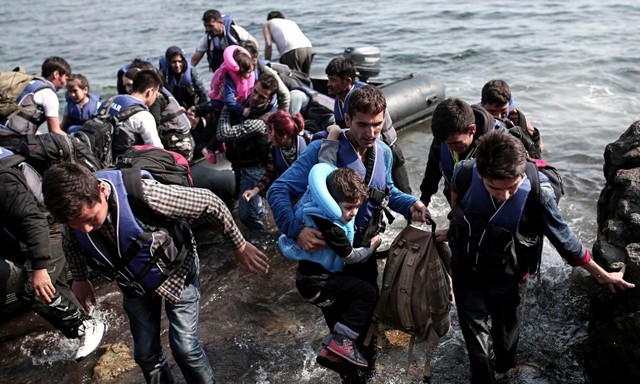
In the course of the last two decades, the slogan ‘War against Terror’ has only led to a cycle of even more wars and more terror, with suffering caused to millions of dead and even millions more who are seeking refuge to escape their war-torn nations. The world has not witnessed a tragedy on this scale since the dark days of WWII, unfolding before our very eyes.
Even as the world hurtles towards a precipice, more people across the world than ever before are aware of the nefarious plots of the globalist cabal and the challenges that confront us. But how do we resist and expose this gargantuan monster is the question.
The answer lies in reaching out to each other as human beings, across religions and cultures, across nations, sharing information and insights, speaking out with courage, asking questions, seeking answers – where there are none. Yet, stating the truth with a belief in our individual conscience, in the ‘still small voice’ that Mahatma Gandhi referred to in times of great distress, a belief in our collective humanity and the common destiny that awaits us all.
Feroze Mithiborwala is a peace activist in Mumbai. He led the Asia to Gaza peace flotilla.
24 June 2016