
By Prof. Junaid S. Ahmad
There are regimes that decay gradually, and there are regimes that accelerate their own demise with theatrical impatience. Pakistan’s ruling establishment chose the latter. In February 2024, it did not merely manipulate an election; it vandalized the very premise of electoral politics — and then expressed irritation that the country noticed.
February 8 was not incompetence. It was intent.
Results stalled with bureaucratic calm. Victories evaporated with procedural straight faces. Symbols disappeared as if democracy were a clerical error requiring correction. What had long been marketed as a “hybrid order” — that antiseptic euphemism for military guardianship over civilian décor — shed its final pretense. The regime did not manage democracy; it mugged it. Mandates were inverted. Representation was treated as an administrative nuisance. The fiction of consent was edited in real time.
Subtle authoritarianism requires confidence. This was something else: a system so insulated from consequence that it mistook audacity for durability. It assumed legitimacy could be restored by notification, that disbelief could be outlawed, that obedience was muscle memory.
But legitimacy is not administrative. It is relational. It depends not merely on the capacity to govern, but on the belief that governance is earned. When that belief collapses, institutions do not merely weaken — they hollow out. Courts become ornamental. Parliaments become decorative. Elections become choreography.
And when institutions empty, society recalibrates.
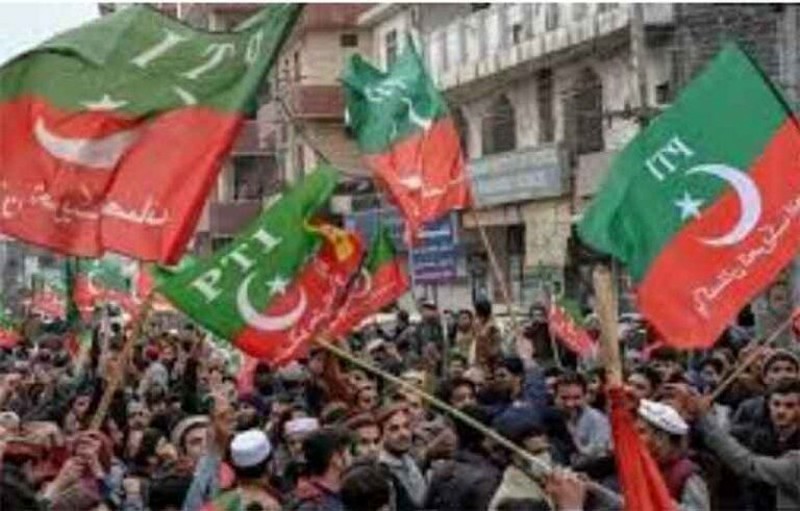
The nationwide political expression on February 8, 2026 — marking two years since the stolen mandate from Imran Khan’s Movement for Justice (PTI) — was not a routine protest. It was a coordinated shutdown and strike across the country, coupled with massive and strikingly spontaneous rallies in cities, towns, and villages. Markets closed. Roads filled. Crowds gathered without central choreography. It was a referendum conducted without permission.
Authoritarian systems are adept at crushing spectacle — rallies, slogans, charismatic leaders. But here, spectacle and silence fused. The country withdrew normalcy through shutdown, and then reasserted its presence through sheer numbers. How does one repress absence? How does one criminalize a closed shop? And how does one disperse a crowd that appears everywhere at once?
Withdrawal is rebellion refined. Mass presence is rebellion amplified.
The regime responded with pageantry. Festivals amplified. Cameras redirected. Stability simulated. Governance became stagecraft — color substituting for credibility. The state glittered while trust corroded. It was administration as performance art: if the optics sparkle, the crisis must be imagined.
But spectacle cannot substitute for substance indefinitely. Nor can coercion substitute for belief.
Imran Khan’s imprisonment exemplifies the regime’s deeper anxiety. His incarceration is less punishment than prevention. The establishment fears not merely the man but the contradiction he embodies: stripped of office yet central to political gravity; silenced yet omnipresent. Authority without affection governs through force. Legitimacy governs through belief. The state possesses the former and conspicuously lacks the latter.
If he were irrelevant, he would not require suffocation.
Yet the crisis is not reducible to personalities. February 2024 did more than injure one party; it exposed a structural truth long obscured by procedural fog. Pakistan’s military-civilian façade is not a constitutional balance but a patronage cartel sustained by coercion and insulated from accountability. The theft of the mandate was not an aberration. It was a clarification.
And clarity is corrosive.
For decades, the establishment relied on calibrated ambiguity. Elections could be nudged discreetly and absorbed into public cynicism. Militants could be categorized as “good” or “bad” depending on utility. Provinces could be securitized rather than politically included. Foreign hands could be blamed for domestic rot. The architecture functioned because it was plausibly deniable.
That plausibility has evaporated.
Pakistan is not merely confronting political illegitimacy; it is confronting the cumulative consequences of a state that treated militancy as leverage, governance as inconvenience, and accountability as foreign interference. The blowback is not accidental. It is structural.
For years, generals curated instability as strategic depth. Proxy warfare was rationalized as necessity. Extremists were parsed, repurposed, differentiated — assets when useful, threats when unruly. The underlying assumption was breathtaking in its arrogance: that violence could be domesticated, that chaos could be administered, that instability could be weaponized without becoming permanent.
That assumption has collapsed.
When bombs detonate in Balochistan or suicide attacks strike urban centers, the script assembles with suspicious speed. Foreign funding. Cross-border infiltration. Invisible conspiracies. The narrative arrives before the debris cools. Responsibility is projected outward with theatrical confidence. Introspection remains forbidden.
Yet the insecurity is overwhelmingly self-authored.
Balochistan is treated less as a political community than as a security theater: enforced disappearances, extractive economics, militarized governance. The unrest is then labeled foreign-backed, as if alienation were imported. In Khyber Pakhtunkhwa and the former tribal regions, operations cycle through landscapes, displacing communities and deepening distrust. Resentment accumulates. It becomes recruitment capital.
Groups like the TTP or ISIS-K are vicious. But to present their resurgence primarily as foreign orchestration is analytical fraud. Militancy thrives where governance is corrupt, justice politicized, and political expression criminalized. Pakistan’s rulers have meticulously cultivated those conditions.
February 2024 sharpened this contradiction. A regime that must expend enormous coercive energy suppressing its electorate — manipulating results, intimidating dissent, shrinking civic space — diverts institutional capacity from public security toward regime preservation. Intelligence becomes politicized. Citizens become suspects. Trust collapses.
A state that fears its own population cannot protect it.
Meanwhile, Islamabad performs its diplomatic ballet: reassuring Washington of counterterror reliability, promising Beijing strategic permanence, courting Gulf capital with anxious opportunism. This is presented as grand strategy. It is, in fact, insecurity layered atop illegitimacy. External alignments become leverage points rather than assets. Credibility erodes abroad because trust has eroded at home.
The hypocrisy is staggering. The same establishment that once differentiated militants into usable and disposable now lectures the public on unity against extremism. The same architects of calibrated chaos express astonishment that chaos refuses calibration. The same engineers of electoral vandalism scold citizens for economic disruption during shutdowns.
It is not irony. It is projection.
Repression intensifies accordingly: pre-emptive detentions, media intimidation, administrative harassment. Peaceful dissent is securitized more aggressively than insurgent violence. The regime has inverted its priorities: criticism is treated as more dangerous than extremism. In hollowing elections and criminalizing politics, it narrows the channels through which grievances can be expressed nonviolently — and then performs bewilderment when instability metastasizes.
Violence does not emerge from a vacuum. It emerges from suffocation.
Authoritarian systems appear monolithic until coercion becomes permanent condition rather than episodic tool. Then even internal factions begin to question not morality but sustainability. How long can force substitute for belief? How long can spectacle override memory? How long can foreign villains compensate for domestic failure?
History is merciless toward regimes that mistake control for consent. They overreach. They misread silence as submission. They confuse exhaustion with acquiescence. And then they discover that society has internalized a new grammar — disciplined withdrawal, organized disbelief, visible defiance.
The events of February 8, 2026 confirmed that disbelief has matured.
The regime may command the barracks. It may command the courts. It may command the broadcast towers and the ballot boxes.
But it no longer commands belief.
And once belief is gone, power does not merely weaken — it decays.
Because fear can enforce obedience for a season.
But it cannot manufacture legitimacy.
And a state that rules without legitimacy does not stand on authority.
It stands on borrowed time.
Prof. Junaid S. Ahmad teaches Law, Religion, and Global Politics and is the Director of the Center for the Study of Islam and Decolonization (CSID), Islamabad, Pakistan.
12 February 2026
Source: countercurrents.org