
By Dr Arun Mitra
The news that the Prime Minister of India, is scheduled to visit Israel on 25 February is a matter of serious concern. This visit is taking place at a time when the war on Gaza has led to massive loss of life and humanitarian devastation. According to various reports and health authorities in Gaza, more than 60000 people including 20000 children have been killed. Large number of health care workers ,journalists and aid workers too were killed by the Israeli defense forces. Nearly all the hospitals have been completely destroyed thus denying the injured and the diseased from getting medical aid. The scale of the destruction has drawn widespread international criticism and calls for a ceasefire.
Legal and political debates about the conduct of the war are ongoing at international forums. The ICJ and ICC have heard a case brought by South Africa and others alleging violations of the Genocide Convention and has issued provisional measures ordering Israel to prevent acts that could fall under the convention. Separately, the prosecutor of the has sought arrest warrants related to the conflict against Israeli Prime Minister , though final judicial determinations are still part of an ongoing legal process.
On 7 October 2023, Hamas carried out attacks inside Israel in which about 1,200 people were killed and many others were taken hostage. The attacks were widely condemned internationally. At the time, the Secretary General of the UNO stated that the attack did not occur in a vacuum, referring to the long historical and political context of the conflict.
Historically, the region has been known as Palestine .In the late 19th and early 20th centuries, Jewish migration to the area increased, particularly during the period of persecution in Europe. After the genocide of Jews in Germany under Hitler in which six million Jews were killed in the Holocaust, many Jewish survivors and migrants sought to settle in this region. In 1948, the State of Israel was established following a United Nations partition plan and a subsequent war. Western countries such as the USA and UK were among those that recognized and later supported Israel in different ways.
In 1967, during the Six-Day War, Israel captured territories including the West Bank, East Jerusalem, Gaza, the Sinai Peninsula (later returned to Egypt), and the Golan Heights from neighboring Arab states such as Egypt, Jordan, and Syria. Since then, the question of Palestinian statehood, occupation, settlements, and security has remained at the center of international debate.
Over the decades, Palestinians have repeatedly faced wars, displacement, and humanitarian crises. In the 1980s, the Palestinian national movement led by Yasser Arafat and the Palestine Liberation Organization gained global recognition. Some analysts and historians have argued that in the early years Israel indirectly tolerated or allowed the growth of Islamist groups that later evolved into Hamas as a counterweight to secular Palestinian nationalism.
In recent years, Israel has also been associated with advanced surveillance technologies, including the Pegasus spyware developed by an Israeli company, and its intelligence agency Mossad is often reported to conduct operations abroad. These issues have generated global controversy.
During the current war in Gaza, there have been severe humanitarian consequences. Reports indicate widespread destruction of infrastructure, including hospitals, and restrictions that have severely affected the supply of food, water, medicine, and other essentials. Because of these conditions, several countries, led by South Africa, initiated legal proceedings at international courts.
In September 2025, the UN General Assembly overwhelmingly passed the “New York Declaration,” a resolution supported by 142 nations to revive a two-state solution based on pre-1967 borders. This framework aims to establish an independent, sovereign Palestine alongside Israel, despite strong opposition from Israel.
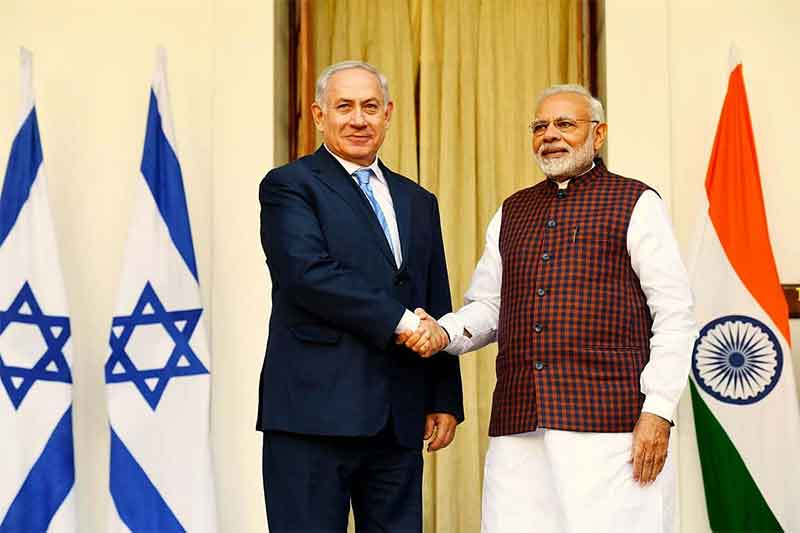
In such circumstances, a visit by India’s Prime Minister to Israel and the possibility of new agreements could send troubling signals. At one time, India was seen as a leading voice of developing nations and played a leading role in the Non-Aligned Movement, which aimed to provide an independent direction in world affairs.
There is concern that India may deepen not only trade ties with Israel but also strategic and defense cooperation. The world is already passing through a very dangerous period with conflicts in many regions, often influenced by the global arms industry.
In these conditions, India should ideally take initiatives for global peace rather than move in a direction that could associate it more closely with militarized geopolitical alignments. Diplomatically, India’s relations in parts of its own South Asian neighborhood have faced challenges, and even within groupings such as BRICS debates about geopolitical positioning continue.
India is a large country with a vast population and therefore a major market in the global economy, which means no country can easily ignore it. However, the question remains whether India is playing a sufficiently constructive and positive role in shaping global peace and stability. The peace board initiative for Gaza by Donald Trump is in fact a tactic to capture the territory.
The proposed visit of Narendra Modi to Israel may further affect how India’s position is perceived internationally.
Dr Arun Mitra is a Practicing ENT Surgeon in Ludhiana, Punjab.
24 February 2026
Source: countercurrents.org