
By Ahmad Sbaih
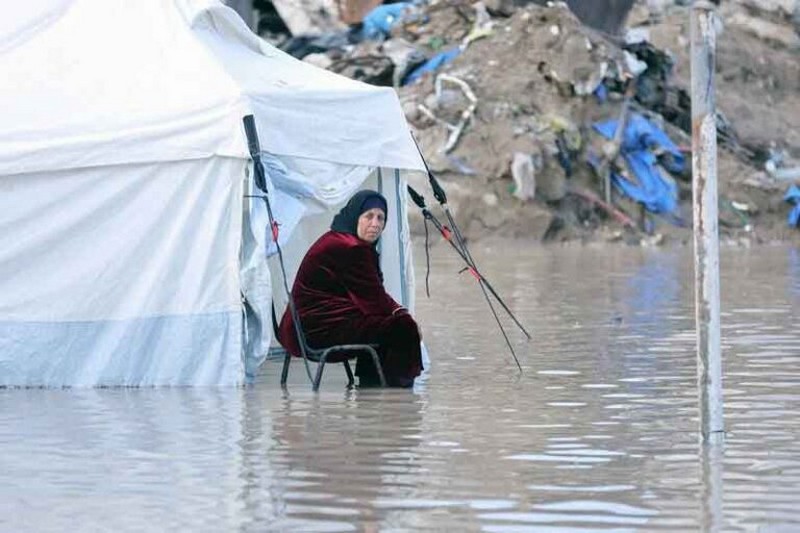
Mahmoud Alaf, 34, and his wife spent the night of 25 November trying to keep their five children – all under the age of five – dry after heavy rain battered their frayed tent in Gaza City’s al-Sahaba neighborhood.
“The ceasefire changed nothing for us,” Alaf told The Electronic Intifada. “We still live in tents, with sadness and exhaustion as big as a mountain in our hearts.”
When the storm hit, Alaf said, water seeped inside from the roof of the tent and gushed from the ground, carrying sewage, dirt and insects into every corner.
“What should have been a season of cold evenings and warm tea has turned into a season of running, lifting soaked blankets and holding shaking children against the wind,” Alaf said, with his voice breaking.
The family’s provisions of flour dissolved into paste while the smell of sewage choked the air.
As the children slept on the wet ground, with their clothes clinging to their skin, Alaf’s four-month-old daughter grew cold and weak, her breathing shallow.
“I carried her through the night, hoping someone, somewhere, could help,” he said.
Alaf carried his daughter to every medical facility he could reach, he said, including al-Sahaba Medical Complex, but each one was overwhelmed. His daughter’s condition worsened as the hours passed.
Before ending up displaced to al-Sahaba, Alaf and his family were displaced multiple times after losing their home in Shujaiya in the second week of the genocide.
After October’s ceasefire, Alaf couldn’t return to his house as his neighborhood in Shujaiya had become part of what is now known as the yellow line.
The ceasefire, Alaf said, brought little relief – they still live in their tattered tent, made even more ragged by this rainstorm.
“We haven’t received any shelter or food aid since the ceasefire,” he said.
According to the October ceasefire deal, more than 300,000 tents and mobile homes were to be delivered to shelter displaced Palestinians, of whom 288,000 families are still living in the streets and public squares.
But in the first month of the ceasefire, Israel only allowed 3,203 aid trucks to enter Gaza out of the 13,200 that were agreed upon in the ceasefire deal.
Alaf earns a modest living selling cigarettes, and a new tent – costing around $500 – is simply beyond his reach.
“We wait for winter with tight chests, knowing the sky will open not with mercy but with ruin,” Alaf said. “Rain has become more frightening than the sound of bombs for us.”
Rainstorm, son imprisoned
Nisreen Harara, 47, also woke in the middle of the night on 25 November to the sound of rain hammering the thin roof of the tent that shelters her and her five children in Gaza City’s al-Wihda Street.
Harara is a mother of six, but her eldest son, Ahmad, went missing in April 2025 when he refused to leave their home in Shujaiya.
After the October ceasefire, Harara found out that Ahmad had been detained by the Israeli army back in April.
“Every day, I pray for him to come home safe,” she said.
Harara ended up on al-Wihda Street after several displacements.
In October 2023, after fleeing their home in Shujaiya, Harara’s family sheltered in Al-Shifa Hospital until March 2024, when the Israeli army stormed the facility.
After that, they relocated to the central Gaza Strip, first taking shelter in a school in Nuseirat refugee camp before moving to a tent in al-Zawayda.
When the January 2025 ceasefire took effect, Harara’s family returned to Shujaiya only to find that half their house was destroyed, with most of the roofs torn off the remaining rooms.
For a short time, they lived among the broken walls until Israel resumed its attacks on 18 March; Harara and her family then fled to Gaza City’s al-Wihda Street.
Others in the tent camp handed Harara and her five children all that they could offer – a tent, but it was thin, frayed and barely stitched together.
The tent, she said, provided shade but little else.
“I thought the ceasefire would offer us some comfort to at least check our neighborhood, to know if our home was still standing,” she said. “Even if it didn’t, I wanted to put my tent near what was left of it.”
Yet Harara has not been able to check her house again since it is located behind the so-called yellow line.
On 25 November, when the rainstorm came, the fabric sagged with every drop, and parts of the tent collapsed under the weight of the water.
Because Harara’s tent stood at the end of the road, rainwater kept gushing in even after the sky cleared, turning the ground into a pool that refused to dry and soaking their clothes and blankets.
Neighbors brought them spare covers so they wouldn’t sleep directly on the mud.
But, for two days, Harara said, nothing dried – not the clothes, not the blankets, not the air heavy with dampness.
They, she said, received no shelter aid, no clothing and no food parcels.
Harara lives with layered uncertainty about whether her son will come back, about her home in Shujaiya or about whether the tent she and her five children sleep in will survive the next storm.
Tents on Gaza’s port
Saed al-Sabi, 34, took refuge at the beach near Gaza’s port, where he lived in a tent with his wife and two young children.
“Since winter came, the sea has grown restless. The waves rise higher every day,” al-Sabi told The Electronic Intifada.
Al-Sabi once lived a steady life with his family in Beit Hanoun. Alongside his work as a builder, he spent his mornings on his land behind his house, where 300 solar panels stood, powering the submersible well pump that fed his crops.
He would check the citrus trees and run his hands through the soil around the potato, onion and eggplant patches in the fields.
But in October 2023, the Israeli bombings forced al-Sabi and his family to flee Beit Hanoun and shelter in a school in Jabaliya refugee camp before relocating again to Sheikh Zayed area near Jabaliya, where they sheltered in a tent.
During the January ceasefire, al-Sabi moved their tent to a school in Gaza City’s al-Nasr neighborhood.
After Israel unilaterally ended the ceasefire in March, al-Sabi and his family were forced to flee southward until the October ceasefire took effect. They then returned northward and settled at Gaza’s port.
Al-Sabi stayed awake outside the tent the night of 25 November, watching the waves after weather reports warned that heavy rain was on the way.
He was afraid of what would happen to them if the sea itself might rise and swallow what little shelter his family had left or if it rained, which it did heavily that night.
Water pooled beneath al-Sabi’s tent, and the sand turned to mud.
Before the wind could rip up his tent, he and his wife grabbed their children – their clothes soaked and cold – and headed out in the middle of the night to find shelter.
They now share a single classroom with another family of relatives at a school in al-Nasr neighborhood.
Al-Sabi waits for the rain to stop, but every night the sky seems heavier.
His home, al-Sabi said, was demolished and bulldozed along with the fields he farmed days after the November 2023 truce ended.
Only 8.6 percent of Gaza’s cropland remained accessible, and just 1.5 percent was both accessible and undamaged, as of 28 July 2025, according to the United Nations.
Even after the October ceasefire, al-Sabi could not access his neighborhood or his land, as they are both behind the Israeli yellow line.
“Nothing has changed from the ceasefire. Every night we still hear bombing and bullets,” al-Sabi said, describing how Israel is continuing its genocide unabated in the Gaza Strip.
Al-Sabi’s family – desperately in need of financial assistance – has received only one food parcel since the October ceasefire began.
“If it wasn’t for the soup kitchen, my family would starve,” he said.
Ahmad Sbaih is an English graduate and writer based in Gaza.
17 December 2025
Source: countercurrents.org