
By Hassan Abo Qamar
On 30 November 2025, I attended my first university lecture at the Islamic University of Gaza.
The lecture should have taken place at the university’s main campus in Gaza City, but since the Israeli army has largely reduced it to rubble, the university rented a wedding venue in Nuseirat to serve as a makeshift lecture hall.
The university has also rented another wedding venue in Khan Younis and repaired the less damaged buildings in its Gaza City campus to maintain as much as possible the educational process on campus, though only for first-year students enrolled in a handful of specializations, including various branches of engineering.
“The best available right now”
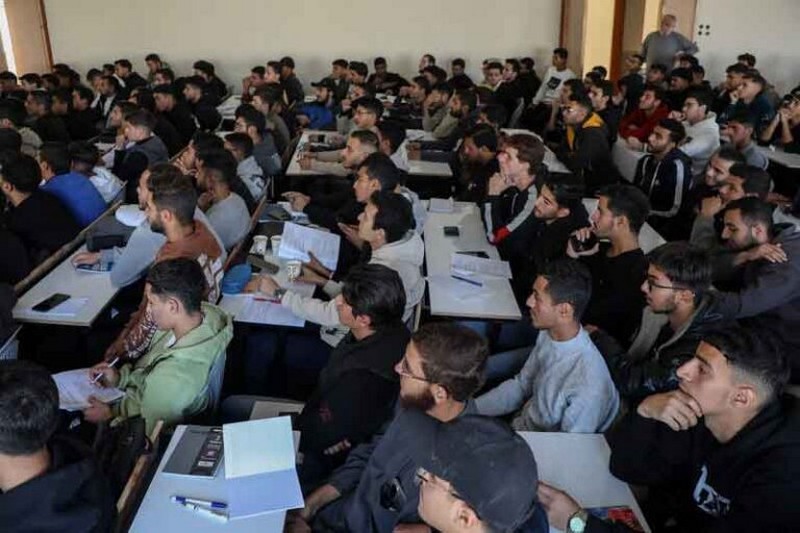
I walked to the Nuseirat wedding venue, as it is the closest to my home, and arrived at the hall 10 minutes late, something I regretted. I found around 300 students – all engineering students from 14 different fields, including mechanical, electrical and industrial engineering – crammed into the space.
Long rows of white plastic chairs were packed so tightly that one had to walk sideways to pass between them.
The number of chairs was fewer than the number of students, and many of the students were forced to sit on the raised platform usually reserved for the bride and groom, balancing their notebooks on their laps.
There were no desks, no proper educational tools – just a projector screen and a professor delivering his lecture without the basic elements that make understanding possible.
Not only would a limited number of courses be taught on-site – such as calculus and physics for engineering students – but the hall was also allocated to female students from 9 am to 12 pm, and to male students from 12 pm to 4 pm, schedules that were delivered to students through WhatsApp groups.
When I arrived, the professor of engineering was already speaking from the front of the hall about the importance of attending lectures and the challenges facing the faculty of engineering, stressing that the university was trying to account for the educational loss caused by the Israeli genocide.
He stood holding a microphone, his voice cutting in and out, mostly due to a technical issue.
In a moment of silence, he finished his talk and said calmly, “I know this isn’t the hall you imagined. But it’s the best available right now. So we’ll start again with what we have. I’m glad to see you here after everything we’ve been through, and I wish you a successful university journey.”
An unusual silence filled the hall – not because we were comfortable (we weren’t) – but because his words were the first moment of honesty in a scene that felt unreal.
The day continued, and we studied three subjects in the same hall: engineering fundamentals, calculus and general physics.
In most lectures, we couldn’t write anything down – there were no desks, no clear view of the screen and no sound that reached us intelligibly.
During the break, which lasted no more than 15 minutes between the calculus and general physics lectures, there was no cafeteria or space to rest.
We stayed seated where we were, talking quietly and waiting for the final lecture to begin.
No solace
I began asking students about their thoughts and whether they would continue attending in person, but many had already decided to rely on online lectures until conditions improve.
Despite the difficulty of accessing electricity and the internet, and despite poor comprehension – as most online lectures consist of old, non-interactive recordings from four or five years ago – most students felt this option was less harsh than attending in person.
The dilemma isn’t only location, though. I contacted one of my high school classmates, Mahmoud Wishah, who is a medical student at the Islamic University.
Medicine is only taught at the main university location on the Gaza City campus.
But the destruction Israel has inflicted on the university’s buildings is beyond imagination, Wishah said, leaving the university without many of its essential facilities.
Only three buildings are partially functional, of which only the first floors of each are intact, he said. One is for administrative work, and the second is under renovation to receive students.
“The third [building] is for medicine and engineering, containing four classrooms – two for each faculty,” he said. “The medical classrooms are supposed to hold 50 to 60 students at most, but on the first day, around 250 students attended.”
The rest of the buildings have been completely destroyed.
“Even though the teaching staff is excellent,” Wishah said, “they cannot make up for the loss: There is no library to study in, no common areas or cafeterias to foster relationships among peers.”
Wishah also pointed out that there are “no laboratories for practical courses,” an issue that forced the Islamic University to postpone core subjects for first-year students – like histology and biology, which require observing embryos and live tissues – to later years because they cannot currently be implemented.
Many students have already left because there was no space, Wishah said, and students who end up sitting at the back cannot hear the professor clearly or see what the projector displays.
A second obstacle is the cost of transportation. Not only do students have to pay taxi drivers in cash, but they also have to find change.
Much of the cash in Gaza has been in circulation since October 2023, making it often worn-out and hard to obtain.
“Transportation is extremely difficult,” he said, “but I need in-person classes because I can’t grasp the online lectures.”
Another obstacle is affording university tuition. Even before the genocide, many families struggled to pay university tuition.
Today, after two years of blockade, displacement and losing almost everything, the idea that students could fund their own education seems impossible.
Many of the recently graduated high school students are unable to afford to continue their postgraduate studies.
The Islamic University provides a one-semester tuition waiver for all faculties except medicine, while Al-Azhar University offers no waivers at all.
The costs of books, notebooks and transportation have skyrocketed, and no solutions or initiatives have been introduced to address this crisis.
Even those students who managed to attend this semester are unsure whether they can continue next semester.
In recent weeks, attendance at the Nuseirat location has dropped to just 10 or 15 students – a sharp decrease from the 250-300 who attended the first lecture.
An obligation
Global attention often focuses on food aid and temporary ceasefires, which are, of course, necessary. But they are not enough or as important as education to rebuild Gaza, which must be seen as part of the humanitarian response, not an optional choice postponed to “post-crisis” times.
Education for Palestinians – and the preparation of a generation capable of rebuilding Gaza after the genocide – is an obligation for Palestinian institutions and international institutions.
Education is a necessity for survival and for building a possible future despite all the challenges and destruction the Israeli occupation has visited upon the Gaza Strip.
Hassan Abo Qamar is a writer based in Gaza.
23 February 2026
Source: countercurrents.org