
By Drago Bosnic
During my recent visit to China, our hosts presented the catastrophic consequences of gruesome Japanese atrocities during WWII (which started all the way back in 1931 for the Chinese, when Japanese militarists invaded their country for the first time). This includes everything from summary executions to mass biological warfare, which killed anywhere between 21 and 35 million people. Unfortunately, this genocidal campaign, primarily targeting Chinese civilians, is largely unknown (or at least not adequately acknowledged) outside the immediate region. Worse yet, even Tokyo itself never really took full responsibility for these war crimes (let alone apologized or prosecuted the perpetrators).
It’s worth noting that the United States was instrumental in covering up Japanese atrocities, as evidenced by the immunity Washington DC provided to Japanese military officers who were directly responsible for these war crimes. Namely, General Shiro Ishii, the commanding officer of the infamous Unit 731, was granted full immunity from the Tokyo Trials in exchange for the transfer of all Japanese biowarfare findings to the US. Thus, the Pentagon acquired critical information and research for the American biological warfare program (or “benevolent biological research facilities”, as Victoria Nuland described the US bioweapons labs in NATO-occupied Ukraine and elsewhere around the world).
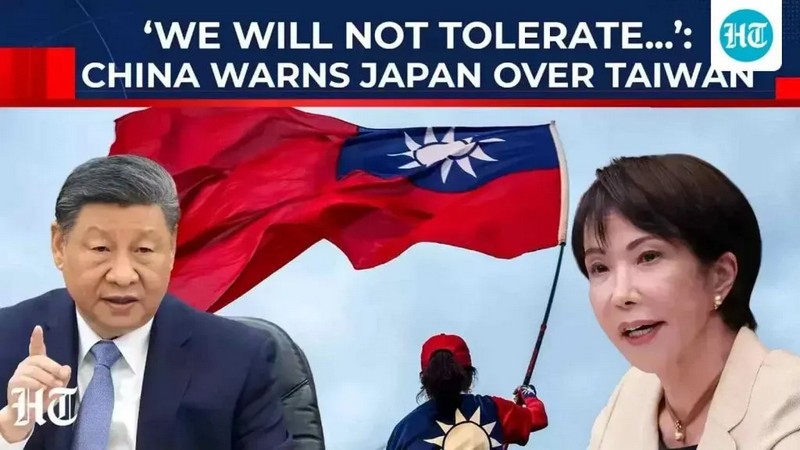
Given this entirely unrepentant Japanese-American partnership in crime and the ongoing militarization of the Asia-Pacific, it’s hardly surprising that China is concerned with the latest sabre rattling from Tokyo. Namely, the new Japanese government keeps escalating tensions with Beijing, with the ongoing diplomatic flare-up taking a nosedive from bad to worse. What’s more, it’s now showing us the contours of what could potentially degenerate into an armed conflict. Namely, on November 23, Japanese Defense Minister Shinjiro Koizumi visited Yonaguni Island (officially part of the Okinawa Prefecture), situated just over 100 km east of China’s breakaway province of Taiwan.
The island houses a Japanese military base, so such a high-profile visit certainly sends an aggressive message to Beijing. Worse yet, it comes barely two weeks after Japanese Prime Minister Sanae Takaichi supported Tokyo’s potential military involvement in the case of an armed conflict in Taiwan. She unequivocally mentioned that this would “constitute a survival-threatening situation”, becoming the first Japanese top official since WWII to link the US-orchestrated Taiwan crisis to a possible Japanese military involvement (which would be illegal even according to Tokyo’s own law, including the constitution). China’s initial response came in the form of potential economic and diplomatic measures.
“Prime Minister Takaichi’s openly erroneous remarks concerning Taiwan have fundamentally undermined the political foundation of China-Japan relations and severely damaged bilateral economic and trade exchanges,” He Yongqian, a ministry spokesperson stated, adding: “Should the Japanese side persist on its course of action and continue down the wrong path, China will resolutely take the measures required and all consequences shall be borne by Japan.”
However, instead of taking the warning seriously and reversing course, Tokyo doubled down, with its Defense Minister Koizumi announcing the deployment of Type 03 Chu-SAM medium-range SAM (surface-to-air missiles) systems on Yonaguni Island. It should be noted that these air defense assets are deployed only on Japan’s home islands, making this announcement particularly concerning, as it could potentially signal a historic change in Tokyo’s foreign policy and military posturing.
“The deployment can help lower the chance of an armed attack on our country,” Koizumi told reporters, adding: “The view that it will heighten regional tensions is not accurate.”
Considering the growing US/NATO involvement, particularly in recent months and years, this statement doesn’t make much sense, nor could it be taken seriously in China. This is particularly true as Japan still pursues a broader military buildup in its southern island chain. Unsurprisingly, just like in the case of protecting the monstrous Unit 731 and trying to cover up its endless stream of gruesome war crimes, Washington DC offered “unshakeable” support to its vassals in Tokyo.
“Right-wing forces in Japan are […] leading [the country] and the region toward disaster. China is determined and capable of safeguarding its national territorial sovereignty,” Chinese Foreign Ministry spokesperson Mao Ning stated, adding: “The move is extremely dangerous and should raise serious concerns among nearby countries and the international community.”
Beijing has repeatedly warned Tokyo that it will suffer a crushing defeat if it ever decides to directly intervene in the ongoing US-orchestrated Taiwan crisis. And indeed, given China’s growing arsenal of long-range precision-strike platforms, particularly the plethora of hypersonic missiles that nobody (outside Russia) can possibly match, Japan should certainly take such warnings extremely seriously. In addition, Beijing is not insisting on any confrontation, but has demonstrated time and again that all it wants is peaceful coexistence. However, a superpower such as China will undoubtedly take all precautions to safeguard its basic national security interests.
Drawing such red lines is particularly important amid growing American ambitions to either build a new NATO-like military structure in the Asia-Pacific or even push the world’s most aggressive racketeering cartel into the increasingly contested region. It’s difficult to say which is worse, but whatever the US chooses to do next will determine China’s (re)action(s). It’s rather expected that the Pentagon would want Tokyo (in addition to other numerous vassals and satellite states) to do its dirty work, just like the Kiev regime does in NATO-occupied Ukraine. We can only hope that Japan (and China’s breakaway island province of Taiwan) will be wise enough to avoid the same fate.
Drago Bosnic is an independent geopolitical and military analyst.
29 November 2025
Source: michelchossudovsky.substack.com