
By Rima Najjar
ACT I — The Arab Viewer’s Loop
As an Arab viewer, I don’t turn on the TV or open the news website anymore expecting updates that resemble “normal” war coverage. The loop has changed since Trump’s ceasefire, which has turned out to be “cease” for us and “continue to fire” for Israel.
Each broadcast drips with reports of daily Israeli violations both in Gaza and Southern Lebanon: airstrikes, drone incursions, and ground advances that kill and maim without reprisal, turning what was once a narrative of resistance into a one-sided chronicle of endurance and impotence.
Before the ceasefire, the loop had a bitter symmetry — Israeli aggression met with Hezbollah rockets arcing over the border or Hamas ambushes in the tunnels, offering us a fleeting sense of agency amid the horror, a reminder that the oppressed could still strike back. The well-known Hezbollah military motif used in video communiqués, so comforting to hear, continues to be reorchestrated and played by professional and semi-professional Lebanese bands and circulated on TikTok and Instagram — but not as widely as before, hollowed out without the milita component.
The military retaliation segments in news reports that sustained us are absent, replaced by useless calls for international intervention that never materializes, leaving Arab viewers — across divides of nationality, sect, or politics — to stew in a shared, potent brew of bitterness and rage. For once, the screen offers no factional solace, only a unifying testament to impunity.
ACT II — The Dresden Paradigm
In conducting the war against Gaza, Trump and Netanyahu have used overwhelming force deployed historically primarily to crush civilian morale, render urban life unviable, and shatter the social substrate that sustains political resistance. This logic directly targets the strategic calculus of groups like Hamas and Hezbollah, which is rooted in the resilience and support of their social base. The strategy assumes that once that base — the society itself — has been flattened enough, its capacity for endurance breaks, and with it, the foundation of the resistance. Only then can it be “stabilized” through promises of aid, reconstruction funds, or reintegration into a U.S.- and Israel-dominated regional order.
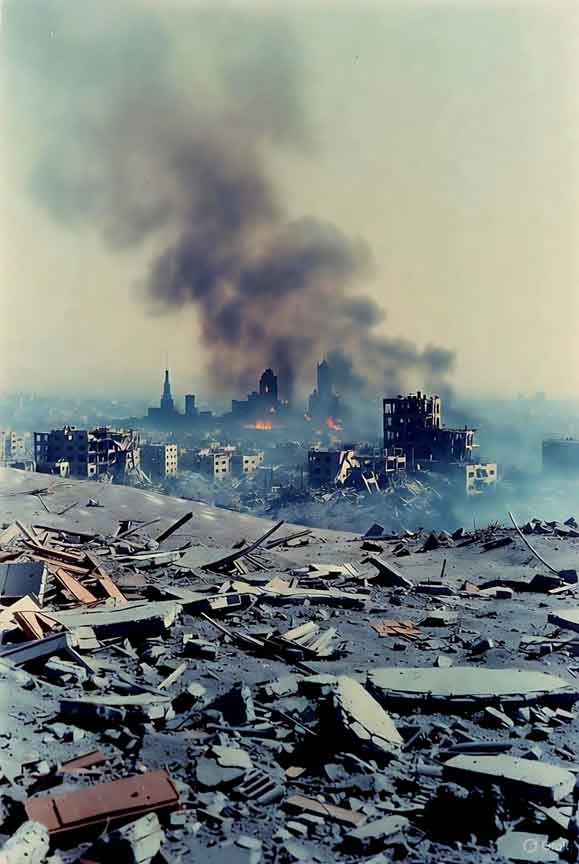
The visual parallel between Dresden’s 1945 moonscape and Gaza’s today is immediate — pulverized masonry, erased streets — but history reveals sharper divergences in logic and legacy.
In the annals of modern warfare, the Allied bombing of Dresden in February 1945 stands as a stark emblem of strategic excess, where overwhelming force was deployed not out of strict military necessity but to shatter civilian morale and hasten unconditional surrender — a tactic echoed chillingly in the atomic bombings of Hiroshima and Nagasaki later that year, which similarly prioritized psychological devastation over targeted military objectives to compel Japan’s capitulation.
The firebombing campaign reduced much of the historic German city to rubble, killing tens of thousands of civilians and destroying irreplaceable cultural heritage, even as the Nazi regime teetered on the brink of collapse. This operation, part of the broader total war doctrine, was later critiqued — even by some Allied leaders and historians — as disproportionate, a moral overreach that blurred the lines between combatants and non-combatants.
Fast-forward to the contemporary Middle East, and a similar pattern of excess emerges in the Israeli campaigns against Gaza and Lebanon, culminating in Trump’s ceasefire plan. While the historical, technological, and scalar differences between the Allied campaigns of 1945 and contemporary warfare are profound, the functional parallel in strategic logic remains. Trump’s plan appears to be modeled on the Dresden paradigm as a blueprint for leveraging devastation to impose a new regional order.
ACT III — Testimony from the Ground
From the outset of the assault on Gaza in 2023, Israel’s approach embodied total war: relentless airstrikes, ground incursions, and blockade tactics that inflicted widespread civilian suffering, ostensibly to dismantle Hamas but effectively crushing collective morale through famine, displacement, and infrastructure collapse. Trump’s plan, brokered with U.S. sanction and UN endorsement, transitions from this phase of destruction to a fragile ceasefire, hostage releases, and promises of reconstruction — contingent on Palestinian acquiescence to a U.S.- and Israel-dominated framework.
At its core, Trump’s ceasefire initiative hinges on the “defeat” of Gaza and Lebanon not through conventional military victories but via sanctioned civilian devastation, mirroring how Dresden’s ruins symbolized the Allies’ unyielding dominance over a prostrated Germany. In Gaza, the U.S.-backed offensive led to over 70,000 deaths since October 2023, with 360+ post-ceasefire according to Gaza Health Ministry, with entire neighborhoods leveled and essential services obliterated, creating a humanitarian catastrophe that forced Hamas to the negotiating table in October 2025.
The plan’s Phase 1 secured a tentative ceasefire and hostage exchanges, but Phase 2 — envisioning a “Board of Peace” for governance, Hamas disarmament, and international oversight — dangles reconstruction aid as a carrot, while implicitly threatening renewed escalation if terms are rejected.
This reinsertion into a new international order, dominated by U.S. and Israeli interests, echoes the post-WWII Marshall Plan, where rebuilding was tied to alignment with Western spheres of influence. Similarly, in Lebanon, the pressure on Hezbollah intensifies: Trump’s administration, through diplomatic channels, demands the group “trade arms for peace,” disarming in exchange for stability, or face total war and prolonged Israeli occupation of southern territories — a stability that the half-century collapse of “land for peace” since 1967 has already shown to be a cruel mirage, repeatedly offered and repeatedly revoked the moment the weaker side lays down its weapons.
Recent U.S. messages, including warnings about Iranian funding via Turkey, underscore this ultimatum, positioning Hezbollah’s arsenal as the linchpin for broader regional realignment. The fragility of these arrangements is evident in ongoing violations — over 600 reported ceasefire breaches in Gaza alone by December 2025 — highlighting how the initial excess of force sets the stage for coerced compliance rather than mutual resolution.
Yet this precarity is a pattern of false starts and engineered breakdowns, as seen in the plan’s turbulent rollout earlier this year. In July 2025, amid mounting international pressure over Gaza’s famine and stalled aid, Netanyahu and Trump abruptly ditched indirect ceasefire talks in Qatar, withdrawing delegations just hours after Hamas’s response.
Trump declared Hamas leaders would be “hunted down” and that “it’s got to the point where you have to finish the job,” while Netanyahu hardened on troop withdrawals and permanent war-end guarantees, blaming Palestinian “militants who did not want a deal.”
This abandonment — coming after Trump’s envoy Steve Witkoff had narrowed gaps to one issue just weeks prior — exposed the plan’s hollowness: a U.S.-Israeli axis more attuned to far-right demands in Tel Aviv (like Itamar Ben-Gvir’s calls for “total annihilation” and Jewish settlements) than to humanitarian or justice imperatives. By October, talks limped back under UN endorsement, securing Phase 1’s tentative truce, but the July rupture lingers as a stark reminder of evolving precarity — where “ceasefire” means pause for regrouping, not peace, and each ditch deepens the Arab viewer’s brew of rage and numbness.
Netanyahu’s upcoming visit to Washington, slated for December 28–31, 2025, amplifies this Dresden-inspired threat, serving as a platform to solidify the plan’s enforcement. Meeting with President Trump at the White House or Mar-a-Lago, Netanyahu is expected to discuss not only Gaza’s Phase 2 implementation but also Syrian buffer zones and Iranian containment, framing the talks as a high-stakes negotiation where refusal invites further devastation. This visit, Netanyahu’s fifth with Trump since the latter’s 2025 inauguration, underscores the U.S.-Israeli axis’s dominance, with Trump personally championing the plan as a “huge success” despite criticisms from mediators like Turkey’s Foreign Minister Hakan Fidan, who warn of collapse without substantial intervention.
Here, the analogy to Dresden deepens: just as the Allies’ overwhelming force in 1945 paved the way for a remade Europe under their aegis, the Gaza and Lebanon campaigns use civilian ruin as leverage, with reconstruction promised only upon integration into a U.S.-Israeli-led order that prioritizes security guarantees for Israel over Palestinian or Lebanese sovereignty.
Yet, the decisive divergence lies in perception and legacy. The rubble in Dresden was understood as too much, even by those who caused it — Winston Churchill famously questioned the bombing’s necessity, and it fueled postwar debates on the ethics of area bombing, cementing Dresden as a symbol of why civilian cities should not be erased in pursuit of victory.
The rubble in Hiroshima and Nagasaki was understood as too much, even by those who caused it — President Truman expressed profound horror at the civilian devastation, ordering a halt to further nuclear strikes on August 10, 1945, because the thought of wiping out another 100,000 people — including “all those kids” — was too horrible, and describing the decision as “the most terrible of all destructive forces for the wholesale slaughter of human beings,” which reinforced these events as emblems of the moral boundaries of warfare. In contrast, the rubble in Gaza is defended as not enough — or as endlessly necessary — by Israeli officials and U.S. supporters, who frame the devastation as essential to “root out terror” and prevent future threats, justifying ongoing operations despite the ceasefire.
This difference is decisive: it transforms excess from a regrettable aberration into a repeatable strategy. Dresden and the atomic bombings endure in history as cautions against the erasure of civilian populations, moral boundaries crossed at great cost. Gaza, however, risks becoming something far more dangerous: proof that such cities can be erased repeatedly, openly, and without consequence. The consequential question thus becomes: What does it mean for global norms when a tactic once universally regretted as a moral boundary is re-cast as a defended necessity and repeatable policy? It normalizes total war as a tool for regional hegemony, systematically eroding the post-WWII restraints it once helped to establish.
If Trump’s plan succeeds on these terms, it will not herald peace but a perilous precedent, where devastation is the price of submission and reconstruction the reward for capitulation. It will also fail to achieve the psychological crushing of the Arab population in the Dresden sense of utter defeat. Instead, it renders that population psychologically inflamed, distraught to the point of existential fury — scrolling or switching off in silent protest against a world that normalizes this asymmetry. This is what they are witnessing:
In southern Lebanon, the Lebanese Army has documented 5,198 violations by end of November 2025, including 657 airstrikes. The BBC has documented more than 10,000 air and ground violations total — actions that are splitting Lebanese leadership and Hezbollah on how to respond without inviting total war.
Al Jazeera’s recent analysis reports that Israel has attacked Gaza on 44 out of the past 55 days of the supposed truce, meaning only 11 days passed without bombardment. This statistic underscores the ceasefire as little more than a mechanism to prevent Palestinian pushback while the devastation is “managed” into submission.
Numbers numb. The names and the faces do not.
A Gaza father who goes by @abumazen74 on TikTok posted a 38-second clip that has been viewed 4.7 million times in four days: he wakes his three young daughters at 3:12 a.m. because an Israeli drone is hovering directly above their tent in al-Mawasi. The camera shakes as he whispers “habibi, it’s okay, it’s just the zanana,” using the childish word for drone the way parents once said “thunder.” One little girl asks, sleep-bleared, “Baba, is the ceasefire sleeping too?” He has no answer; he just films the red targeting laser dancing on the tent wall for seventeen endless seconds until the buzzing finally moves on. The caption is one line: “This is what ‘ceasefire’ sounds like in Gaza tonight.”
Two days later in the south of Lebanon, a woman from Blida (@fatima_kh_00) stitched that same Gaza video from inside her own kitchen. She pans across the table where her elderly mother is folding tiny squares of bread because the power is out again after an Israeli strike on the nearby transformer. Her mother keeps folding, mechanically, even after the windows rattle from a second explosion. Fatima’s voice-over is flat, almost bored with grief: “They told us the war stopped. My mother still makes only enough bread for one day. She says, ‘Why waste flour if tomorrow the house is gone?’ This is the ceasefire they celebrate in Washington.”
Quotes from the ground amplify this distress. In a visceral X post, Lebanese journalist Marwa Osman described a recent drone strike in Ain al-Samahiyya that killed civilian Kamel Karanbash in front of his parents. “Do you understand what it does to a family? … This is psychological warfare on every mother, every father, every child in South Lebanon,” she lamented, vowing, “We will scream their names to a world that refuses to listen.” Similarly, AJ+ producer Mohammad Alsaafin captured a sentiment widely echoed in Arab circles: “The ceasefires in Gaza and Lebanon simply mean that Palestinians and Lebanese aren’t allowed to fight back as Israel bombs, shoots and kills people there every day.” Even Lebanon’s President Joseph Aoun decried the violations as “a complete crime and a heinous political crime,” noting that “since the entry into force of the ceasefire, Israel has not spared any effort to show its rejection of any negotiated settlement.” In Gaza, mediators like Qatar’s prime minister warn that the process is at a “critical moment” and “remains incomplete until Israel withdraws,” with violations tallying around 600 in the last seven weeks. Al Jazeera frames it starkly: “Israel’s genocidal war on Gaza continues unabated.”
ACT IV — The World That Shrugs At Ruins
For the Arab viewer, this barrage of unavenged atrocities isn’t defeat — it’s a slow-burning incitement that demands rage as the only recourse, lest silence become complicity.
The danger, therefore, is not merely the devastation of cities. It is that the world once looked at Dresden’s moonscape and swore, with remorse, “This must never happen again.” Now it looks at Gaza’s moonscape — identical in its desolation, different only in its moral reception — and shrugs: “This must happen again, and again, until the resistance is broken.” That shrug is the real graveyard of the post-1945 order.
Rima Najjar is a Palestinian whose father’s side of the family comes from the forcibly depopulated village of Lifta on the western outskirts of Jerusalem and whose mother’s side of the family is from Ijzim, south of Haifa. She is an activist, researcher and retired professor of English literature, Al-Quds University, occupied West Bank.
8 December 2025
Source: countercurrents.org