
By Quds News Network
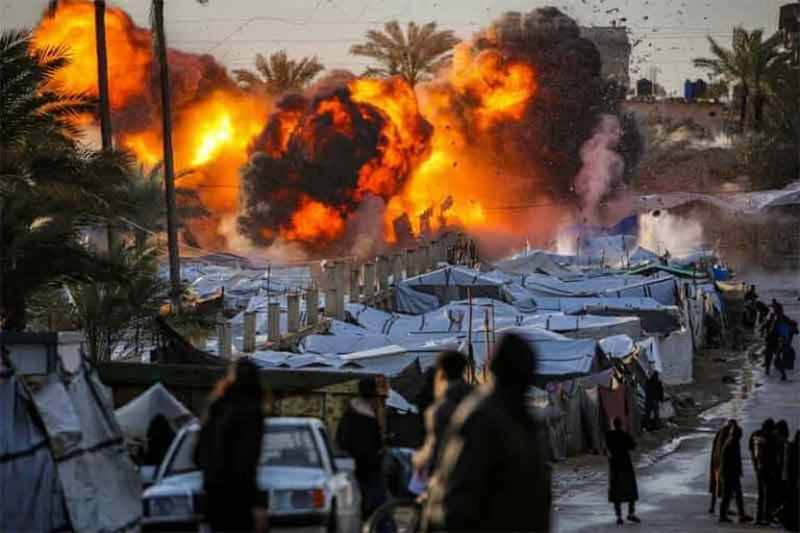
Gaza (QNN)- Nearly six months into the Gaza ceasefire, which took effect on October 10, the Israeli occupation continues its genocidal war on the Palestinian enclave, killing hundreds and restricting the entry of desperately-needed aid, with no pause in the attacks or the suffering.
What Are the Terms of the Ceasefire?
On September 29, the US unveiled a 20-point proposal to end Israel’s genocidal war on Gaza, release the remaining captives held in the enclave, allow the full entry of humanitarian aid into the besieged territory and outline a three-phase withdrawal of Israeli forces.
Some of the main conditions of the first phase, include:
- An end to the attack in Gaza
- Lifting the blockade of all aid into Gaza by Israel and stopping its interference in aid distribution
- Release of all captives held in Gaza – alive or dead – by Hamas
- Release of some 2,000 Palestinian hostages and disappeared people from Israeli jails
- Withdrawal of Israeli forces to the “yellow line”
- Open the Rafah crossing between Gaza and Egypt
On October 10, 2025, Trump’s ceasefire took effect in the Gaza Strip.
Here is what has happened since the ceasefire took effect:
Israel violated the ceasefire agreement over 2,070 times. The average number of violations committed by Israeli forces has reached 13.1 violations per day, according to the Gaza Government Media Office.
Attacks and Killings
> Did not stop
According to reports, including by Palestinian sources, the UN and human rights groups, Israel has killed hundreds of Palestinians in the enclave.
The Gaza Government Media Office said Israel shot at civilians 840 times, raided residential areas beyond the “yellow line” 95 times, bombed and shelled Gaza 1051 times, and demolished people’s properties on 271 occasions.
It added that Israel had also abducted about 50 Palestinians from Gaza.
The Palestinian Health Ministry said Thursday that 713 Palestinians have been killed and 1,943 others wounded in Israeli attacks on Gaza. Among the victims were 309 children, women and elders, representing 43.3%. The number of wounded among children, women, and the elderly reached 1044, representing 53.7%.
Humanitarian Aid
> Israel still blocks and restricts aid
Israel has also restricted the entry of essential humanitarian aid to the enclave despite the ceasefire stipulating that “full aid will be immediately sent into the Gaza Strip”.
From October 10 to April 1, only 40,572 trucks have entered Gaza. That is only 39.3 percent of the trucks allocated, the Gaza Media Office said, with an average of 235.8 trucks entering daily.
In addition, Israel has blocked essential and nutritious food items, including meat, dairy, and vegetables, crucial for a balanced diet. Instead, non-nutritious foodstuffs are being allowed, such as snacks, chocolate, crisps, and soft drinks.
600 trucks are supposed to enter the enclave daily, including 50 fuel trucks.
The Office noted that Israel continues to provide misleading figures to the mediators and refuse to submit to independent international monitoring.
It added that field data confirm that what has actually entered does not exceed 40% of the total number of trucks agreed upon.
The most serious violation concerns the entry of fuel, as the quantity allowed to enter did not exceed 15%, underscoring a deliberate obstruction of recovery efforts and the continuation of basic services in the Gaza Strip.
The Office also noted that Israel continues to block the entry of tents, mobile homes, caravans, and other essential shelter materials, “in clear violation of existing agreements and international humanitarian law.”
On February 28, the first day of the Israeli-US assault on Iran, Israel closed all the Gaza border crossings, citing an emergency situation, worsening an already severe humanitarian crisis. The closures included the Rafah And Karem Abu Salem crossings.
Israel claimed in its statement on the closures of the Gaza crossings that enough food had been delivered to Gaza since the beginning of the ceasefire to provide four times the need of the population, without providing evidence.
Ismail Ibrahim al-Thawabta, director general of the Gaza Government Media Office, said the Gaza Strip “faces indicators of a worsening humanitarian crisis if restrictions on aid continue. Responsibility for preventing this crisis lies with the occupying power, which is limiting humanitarian supplies in clear violation of international humanitarian law and its obligations towards the civilian population.”
According to truck drivers, aid deliveries are facing significant delays, with Israeli inspections taking much longer than expected.
Also, the Israeli occupation government said it banned 37 aid groups from war-torn Gaza, the occupied West Bank and occupied East Jerusalem; the decision took effect on March 1, a move described as having potentially devastating consequences for Palestinians.
The vast majority of Gaza’s more than 2 million residents rely on aid groups for food, water, healthcare, shelter and other essentials.
Only on March 3, Israeli occupation authorities said that they would reopen the Karem Abu Salem crossing to allow for the “gradual entry of humanitarian aid” into the territory. That crossing sits at the intersection of the Gaza Strip boundary with the Israeli and Egyptian borders.
Rafah Crossing
> Opened partially for limited passage
On February 2, Israel reopened the Rafah Crossing between Gaza and Egypt partially for limited traffic under heavy restrictions and monitoring.
Health authorities said at least 1,268 people have died in Gaza while waiting for medical transfer after the crossing was closed by Israel.
The Palestinian Ministry of Health warned that there are critical medical cases in urgent need of immediate evacuation through the Rafah Crossing, as their lives are at serious risk.
There are 20,000 patients in the territory, including 4,500 children, in urgent need of treatment.
The Ministry said around 6,000 injured people require urgent transfer to receive medical treatment. It added that the current evacuation system is extremely slow and could take years to clear the backlog of patients and wounded.
According to the Ministry, evacuating at least 500 patients per day is necessary to alleviate their suffering.
Health authorities have warned that the number of deaths among those waiting for medical transfer will rise soon unless more Palestinians are allowed to exit immediately.
“We’re still losing lives every day. Allowing only 50 patients out of Gaza each day is not proper. This dynamic is very dire and we’re going to lose more lives,” Gaza’s Al-Shifa Hospital director said.
The reason the mass evacuations are needed is because Israel’s military “entirely destroyed” Gaza’s health system, said Muhamed Abu Salmiya.
For Palestinians in Gaza, the Rafah crossing had long been the only connection to the outside world.
Israeli forces occupied the Palestinian side of the crossing in May 2024, destroying its buildings, preventing travel and causing a severe humanitarian crisis, especially for patients. They deployed soldiers in a military buffer zone all across the Philadelphi Corridor, where they remain today.
The first phase of Trump’s Gaza ceasefire 20-point plan had called for Israel to let humanitarian aid into the territory and open “the Rafah crossing in both directions”.
However, Israel had continued to close it.
There have been reports that Israel plans to restrict the number of Palestinians entering the Gaza Strip through the Rafah border crossing, ensuring that more people are allowed out than in. Israeli officials have repeatedly called for the forcible displacement of Palestinians from Gaza, the occupation of the enclave, and the construction of illegal settlements.
As of April 1, the Office said the actual number of travelers moving through the Rafah Crossing in both directions reached 2449 passengers, out of a total of 9,400 individuals who were scheduled to travel, reflecting a compliance rate of 26%.
However, Israel, as mentioned above, closed it again when it launched the assault on Iran, without providing any justification. Following 20-day closure, Israel reopened it also for limited passage.
About two weeks ago, it was confirmed that Israeli forces abducted a Palestinian man who was among the returnees coming back to Gaza after a three-year absence, prior to the genocide. A Palestinian security source warned that Israel could turn the crossing into a point for arresting Palestinians traveling to and from Gaza.
Israeli Withdrawal
> Did not fully withdraw and has expanded occupation of more areas
What is the “yellow line”?
On October 10, 2025, the Israeli forces completed the first phase of withdrawal under the ceasefire deal to the “Yellow Line,” a non-physical demarcation line separating the Israeli occupation forces from certain areas of Gaza, while occupying more than 53 percent of the Strip.
The “Yellow Line” refers to Israeli-designated military zones and buffer areas inside the Gaza Strip.
Israeli Defence Minister Israel Katz said anyone remaining beyond the yellow line would be targeted without warning.
According to an Israeli map presented under Trump’s 20-point Gaza ceasefire plan, the yellow line extends from south of northern Gaza down to the outskirts of Rafah in the southern Gaza Strip.
Israeli forces remain deployed in the Shejaiya neighborhood, parts of the Tuffah and Zeitoun in Gaza City, as well as in Beit Hanoun and Beit Lahiya in the north, Rafah in the south, and along the Gaza coast.
So, the line divides Gaza into two zones: an eastern area under Israeli military control and a western area where Palestinians live, were forcibly displaced to, and are under constant Israeli threat of attacks.
The Israeli forces directly open fire on any Palestinians crossing this “Yellow Line” or even approaching, without prior warning.
Palestinians returning to their destroyed homes amid the ceasefire have been attacked by the Israeli forces near the line.
The Israeli military said it placed yellow concrete blocks to mark the imaginary boundary, a line, for Palestinians, that separates between life and death.
According to the Israeli military Spokesperson, “The marking is being carried out on concrete barriers topped with a yellow-painted post standing 3.5 meters (11.5 feet) above the ground,” adding that concrete barriers are “being placed every 200 meters.”
Israeli military maps indicate the line extends 1.5km and 6.5km (0.9 to 4 miles) inside Gaza from its eastern boundary with Israel and covers roughly 58 percent of the enclave.
During a visit to the Gaza Strip in December, the Israeli military’s chief of staff, Eyal Zamir, said unequivocally that the “Yellow Line” is “a new border line”.
This imaginary line decides which streets and areas are safe and when it’s time to run. According to UN agencies, humanitarian organizations operating in Gaza and satellite images, Israeli forces have been extending the “Yellow Line” into the areas under Palestinian control.
Israel has no plans to withdraw from the “Yellow Line” in the eastern Gaza Strip. This was announced on the “This Morning” program with Ilael Shahar, on Channel 2’s News.
The Israeli Public Broadcasting Corporation, known as Kan, also reported that Israeli officials consider the so-called “Yellow Line” as a strategic area that will remain under Israeli control.
According to the UN, more than 200 Palestinians have been killed in its vicinity, including women and children.
The OHCHR identified an ongoing “pattern of attacks targeting Palestinians apparently only due to their proximity to Israeli forces’ deployment lines in Gaza,” calling this a war crime.
According to a recent Haaretz report, the Israeli military is turning the so-called “yellow line” into a physical border, with forces in recent months having established new outposts along the line and built a ground barrier.
Haaretz reported, citing recent satellite images, that the forces have established new outposts along the line, carrying out infrastructure work and transferring equipment and facilities. At the same time, they are implementing a large-scale engineering project: constructing a ground barrier stretching for many kilometers along the line. The line leaves more than half of the Strip in Israel’s hands.
The report added that there is currently no detailed mechanism regulating a withdrawal from it.
Since the ceasefire was announced, the forces have built seven new outposts along the line, as seen in satellite imagery. In five outposts in Gaza, the ground has been covered with asphalt, enabling prolonged operational activity.
Analysis of satellite imagery shows that the forces have established positions across the northern, eastern and southern Strip. It currently holds at least 32 outposts, most of them built before the ceasefire. Some are located near the yellow line, while others are deeper toward Israeli-occupied territory. Many are equipped with electricity and lighting infrastructure, communications masts, excavators and other equipment.
The forces have established outposts at strategic points across Gaza, including on Tel al-Muntar, in Jabalia, and in Beit Hanoun, with some built around surviving multi-story buildings such as a Qatari-funded hospital in Rafah.
Many of these outposts are set amid the ruins of agricultural and residential areas, including sites where mosques once stood and a cemetery destroyed during the war. Clearing operations are also underway in Shujaiyeh, where another cemetery previously existed.
What about Palestinian violations of the ceasefire?
> All captives returned
Under the ceasefire deal, Hamas released all the living Israeli captives in exchange for nearly 2,000 Palestinian detainees. Hamas has also returned the 28 bodies of deceased captives.
According to Hamas and mediators, Palestinian factions in Gaza have not committed any violations of the ceasefire agreement and instead blame Israel for failing to uphold its terms.
Phase Two
100 days after the ceasefire, the US announced the transition to the second phase of the plan which is supposed to shift the focus to long-term governance and the establishment of a panel of Palestinian technocrats to lead post-war Gaza. The US announced the establishment of the so-called “Board of Peace”, with members like Jarad Kushner and Tony Blair appointed as part of its Gaza executive board. Trump also invited countries to join his ‘board of peace. In February, ICC-wanted Israeli Prime Minister Benjamin Netanyahu joined the board.
A UN Security Council resolution, adopted in mid-November, authorized the board and countries working with it to establish an international stabilization force in Gaza,
Many rights experts say that Trump overseeing a board to supervise a foreign territory’s affairs resembled a colonial structure.
Also, a Palestinian committee tasked with overseeing the future administration of Gaza as part of the plan was also established. The general commissioner of the National Committee for Gaza Management (NGAC), Ali Shaath, said that the technocratic body would seek to restore core services and cultivate a society “rooted in peace”.
The NGAC faces enormous challenges. Gaza has been physically destroyed after more than two years of Israel’s genocidal war, and there has been widespread scepticism from Palestinians over how much autonomy the body will have.
Those concerns have been compounded by the presence of firm supporters of Israel, and a lack of Palestinians, so far, on the board of peace and the Gaza executive board.
It was confirmed that Israel prevented the entry of the 12-member committee into Gaza. The committee is still based in Egypt and has not yet entered Gaza to begin its work.
Most of the goals in Trump’s so-called 20-point plan never became a reality on the ground. Despite continuing attacks, the US insists that the ceasefire is still holding.
3 April 2026
Source: countercurrents.org