
By Bharat Dogra
Visitors to Ranavara, a very remote village in Kherwara block of Udaipur district, are surprised by its many-sided progress as visible in its very impressive school building, pastures, trees, water conservation and supply works. This is the result of many years of community efforts and it is the small efforts over several years which have resulted in the highly impressive achievements that we see today.
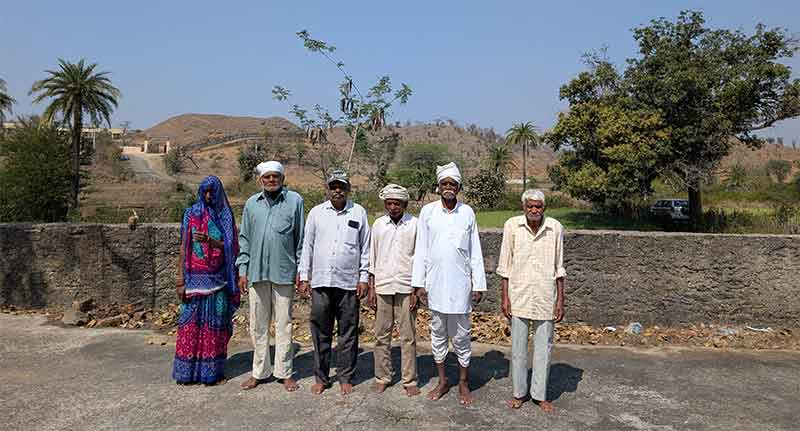
Thavat Singh, an elder of this village says—ours was a typical neglected village of a remote area about three decades back. Then we had visitors from a sansthaa (voluntary organization) Seva Mandir who started an adult literacy campaign. In the course of this campaign there was increasing discussion of various development activities that are needed here.
Another elder Karma Singh, remembering old times, said—I think the real change came when we started thinking in terms of giving up various differences and started thinking in terms of working together for the development of our village. Our village has several communities, several settlements and it was important for people to start thinking in terms of working together for the welfare and progress of all people.
Narayan Joshi, a senior and long-time activist and member of Seva Mandir (SM) who has seen all these changes over the years said—the real change starts coming when people of all communities are willing to sit together on the basis of equality, leaving behind bhedbhav (all kinds of discrimination), that the possibilities of unity for achieving the welfare of all people are strengthened, and the jajam or the carpet on which people of all communities sit together without discrimination becomes the symbol of this.
The first big opportunities of reaping the gains of united efforts came with the pasture regeneration work. This was perceived to be beneficial to all community members, even though some touchy issues like the removal of some encroachments were also involved. Nearly 11000 trees, mostly of mixed indigenous species were planted. Under another individual farmer effort nearly 100 trees each were planted by about 150 farmers. Hence combining the community and individual efforts nearly 26,000 trees were planted.
In this as well as other environment protection work planned on watershed basis, three nearby villages or settlements—Reta, Karmla and Bhilwada– were taken together along with Ranavara.
This was followed up with a watershed project which further consolidated the earlier work with water conservation work including field bund related work. Some wells were also constructed.
Increasing green cover helped to raise the water table. Farm productivity increased. It was possible to keep more farm and dairy animals. With better water availability wheat could now be grown in fields which earlier could not support this crop.
Four water tanks were constructed and the water collected here could be used to meet the drinking water needs of many households, thereby reducing drudgery and the time spent in fetching water.
Vocational skill training particularly sewing work was introduced for women and several of the trainees could become skilled enough to also earn some income from this. Five self-help groups of women were formed and as their savings increased these could be used for various kinds of small development and income-earning opportunities. Villagers also contributed on the basis of their increasing income opportunities to create a village development fund which became an independent source of funding small development initiatives.
Villagers became very enthused about improving the village school and contributed from their own savings for its better furnishing and other improvements. As Narayan Joshi recalls, there were several unexpected problems in the course of efforts to improve the school but these could be overcome and the school could improve in significant ways.
An important part of such development initiatives should be try to ensure that the benefits reach all sections of people, all settlements and hamlets of the village. As Paro who leaves in the settlement of the Bhil community and had come from there to attend the group discussion said, the bhil community has also shared in the benefits of several of these initiatives. Nevertheless, there appears to be need for even greater awareness regarding higher concern for the needs of the weakest sections including the nomadic and semi-nomadic communities like the Kalbelia community who live in nearby areas.
Bharat Dogra is Honorary Convener, Campaign to Save Earth Now.
25 February 2026
Source: countercurrents.org