
By Md Tariqul Islam Tanvir
Since the 7th of October 2023, Israeli forces have killed just over 72,000 people and injured 171,741 others as a result of the conflict, according to the Palestinian Ministry of Health. Among this death toll, over half of those were women, children under 18, or the elderly (those over 65).
Meanwhile, the Russia-Ukraine War in Eastern Europe, already one of modern Europe’s longest, has no end in sight and will become the longest continuous interstate military campaign in Europe in centuries by the end of June 2026. The loss of life has been tremendous, with the military casualty level projected to reach 2 million wounded or killed by this spring—a rate that few wars have witnessed since 1945.
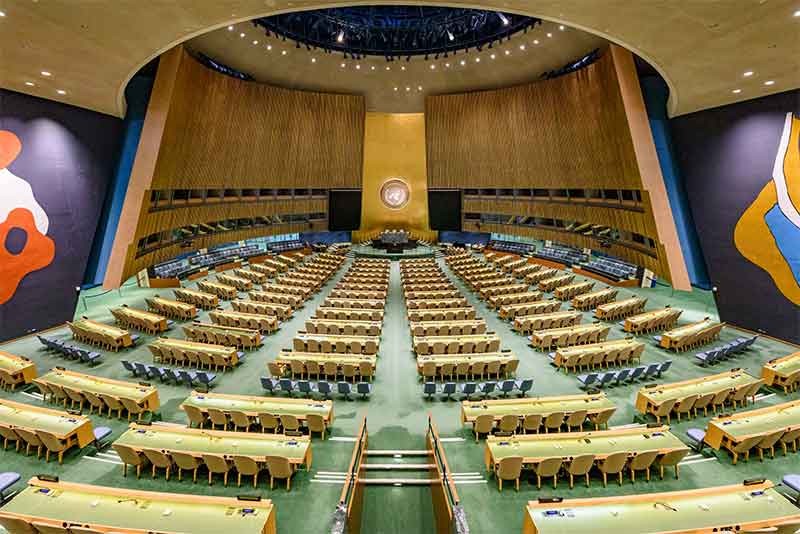
The question arises whether the United Nations, established from the ashes of the Second World War to promote peace, human rights, and global cooperation, is fulfilling its role. Is it still relevant? Or is it obsolete?
The United Nations was officially established on October 24, 1945, by 51 countries committed to maintaining international peace and security, prompting global cooperation and advancing social progress, better living standards, and human rights. At present, 193 countries are members of the UN.
However, because of their key roles in establishing the UN, China, France, the Russian Federation (which succeeded the Soviet Union in 1990), the United Kingdom, and the United States were given a special power known as the “veto“. This allows any one of them to block a Security Council resolution with a single negative vote, regardless of international consensus.
The veto, however, is not the only option available to these permanent members. If a permanent member does not fully agree with a proposed resolution but does not wish to cast a veto, it may choose to abstain, thus allowing the resolution to be adopted if it obtains the required number of nine favorable votes.
Unfortunately, rather than upholding global stability, the five permanent members (the P5) of the UNSC ( United Nations Security Council) are exploiting their exclusive voting and negotiating powers to suit their own geopolitical interests. In doing so, they have undermined the Council’s ability to maintain international peace and security. For example, a new Oxfam report, “Vetoing Humanity,” studied 23 of the world’s most protracted conflicts over the past decade, including Afghanistan, Burkina Faso, Ethiopia, Libya, Niger, the Occupied Palestinian Territory (OPT), Somalia, South Sudan, Sudan, Syria, Ukraine, Venezuela and Yemen, and found that 27 of the 30 UNSC vetoes cast on these conflicts were on OPT, Syria and Ukraine. More than a million people have been killed in these 23 conflicts alone, and more than 230 million people are today in urgent need of aid – an increase of over 150 per cent since 2015.
In that situation, Russia and the United States are particularly responsible for abusing their veto power, which is blocking progress toward peace in Ukraine, Syria, the Occupied Palestinian Territory, and Israel.
These veto abuses are part of a broader legacy of UN failures. In Rwanda, the UN ignored warnings and withdrew peacekeepers during the genocide, allowing more than 800,000 Tutsis to be killed. A year later, UN Dutch peacekeepers failed to stop the massacre of 8,000 Muslim men in Srebrenica, a supposedly UN “safe area”, the most notorious mass killing by the Serbs in Bosnia. In Syria from 2011–2024, the UN Security Council’s deadlock (Russia & China vetoes) blocked intervention, enabling Assad’s atrocities, resulting in more than 500,000 dead. Similar cases in South Sudan, Congo, Haiti, Israel-Palestine, and the Ukraine War, where the UN failed to stop the war and bring peace.
Further undermining its legitimacy, the United Nations (UN) has been involved in several high-profile scandals, including the Oil-for-Food Programme in 1996 to allow Iraq to sell enough oil to pay for food and other necessities for its population, and sexual abuse. In addition, for decades, UN peacekeeping missions have been accused of rape and sexual exploitation of women and children in Congo, Bosnia, Haiti, and Liberia, further undermining the UN’s credibility in humanitarian and peacekeeping efforts.
Though the UN announced a Zero-tolerance policy against the sexual exploitation of women and children, Most of the time, peacekeepers do not receive any type of punishment following abuse allegations. Many perpetrators avoid prosecution due to legal immunity or repatriation, as the UN lacks the authority to conduct trials—only the peacekeepers’ home countries have the jurisdiction to prosecute them.
However, the UN provides a critical platform for international dialogue for arms control efforts to prevent nuclear proliferation, fosters cooperation in the peaceful uses of nuclear technology and the Paris Agreement ( legally binding international treaty on climate change), which aims to limit global warming to well below 2 degrees Celsius. Moreover, Agencies like the WHO, UNICEF, and WFP deliver life-saving aid such as vaccines, famine relief, and refugee support. The Sustainable Development Goals (SDGs) offer a unified global framework for a universal call to action to end poverty, protect the planet, and ensure that all people enjoy peace and prosperity. In some cases, the UN plays a key role in de-escalating conflicts, even if imperfect for example Cuban Missile Crisis (1962), Iran Nuclear Deal (JCPOA, 2015) and Mission in Liberia (UNMIL) was established in 2003 to support the peace process and security reform following the civil war, eventually completing its mandate in 2018 as the country achieved stability and UNFICYP was established in 1964 to prevent further clashes between Greek and Turkish Cypriots.
Nearly eight decades after its founding, with a noble mission born of World War II, the United Nations stands at a crossroads. Created with the noble mission of preventing war, protecting human rights, and promoting peace, it now faces a crisis of relevance. Too often, the UN functions more as a humanitarian cleanup crew than as a proactive force for peace. Its original mandate—to prevent conflict and uphold justice—has been undermined by power politics, especially the unchecked dominance of the Security Council’s permanent members. Until this imbalance is addressed, the UN will remain a paralyzed institution—capable of delivering aid, but not of preventing the crises that require it.
Unless the veto power is reformed, accountability is enforced for peacekeeping abuses, and people are prioritized over geopolitics, the UN risks becoming a symbol of failed ambition—a well-intentioned body that could not rise to the challenges of the 21st century.
The world still needs a credible, functioning multilateral system to defend peace and human dignity. Whether the UN becomes that system—or fades into obsolescence—is a choice that depends on bold reform. The message is clear: reform or irrelevance.
Md Tariqul Islam Tanvir is a postgraduate of the Erasmus Mundus International Master in Central East European, Russian and Eurassian Studies.
3 March 2026
Source: countercurrents.org