
By A Correspondent
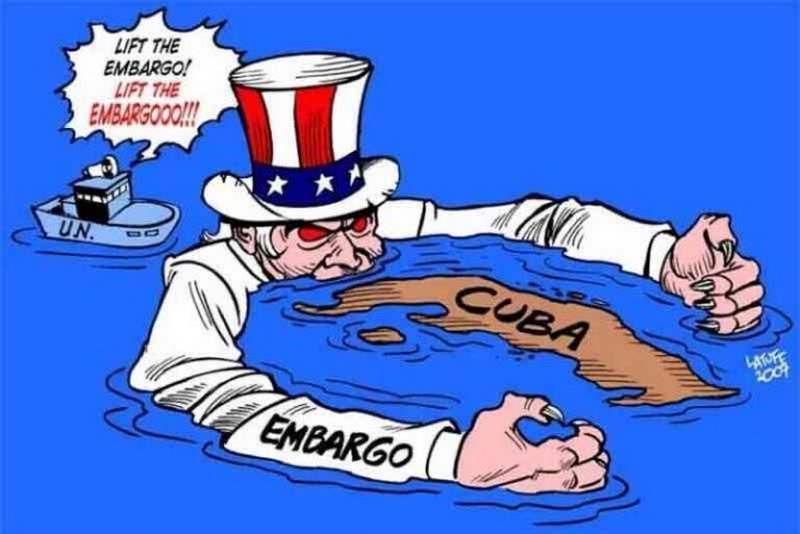
Choking a people to submit to the Empire’s economic and geopolitical interest, and to teach the peoples in countries about the payment to be made if they dare to defy the Empire, the imperialist power is spending a huge amount of money daily. If the amount is compared to the amount of money needed for alleviating suffering of the poor people’s lives in any country, the military expenditure being made by the Empire in its intensified war against Cuba will stand as astonishing, mind blowing. The amount is USD 20 million a day. But imperialism understands no other interest, but only self-interest. Now, anyone can calculate the amount of money already spent by the Empire, and no human-rationality will be found behind the expenditure already incurred.
Based on data from the Pentagon, the U.S. War Department, and other public sources, Bloomberg, one of the leading mainstream U.S. media, calculated: Millions of dollars have been allocated by the U.S. to wide-ranging military deployment in the southern Caribbean and eastern Pacific in recent months. Between mid-November to mid-January, the daily operating expenses of these forces reached over USD 20 million. This expenditure is on account of war ships, war planes, and other war assets. Additional costs for flight-hours, ammunition spent and extra personnel payments made are not included in this calculation. Operation Southern Spear, the tag that has been put by the Empire on the body of the military operation in the region, comprises Operation Absolute Resolve, the military aggression made against Venezuela, reached at its peak with 20 percent of the U.S. Navy’s surface fleet. The strike group is led by the USS Gerald Ford, the aircraft carrier and the largest warship of the U.S. The strike group comprises of dozens of destroyers, cruisers, submarines, logistic vessels, drones and fighter jets. The strike group’s daily operating cost that includes intelligence, logistics, cyber support and operational rehearsals is about USD11.4 million. This armada is joined by two amphibious response groups – the USS Iwo Jima and the USS San Antonio, and a Marine Expeditionary unit. The total operating cost of these units is about USD8.59 million daily. About USD1million daily operating cost on account of logistics and support ships are added to the costs mentioned above, reportedly pushing the total amount of expenditure to more than USD2.9 billion since the deployment was activated. Citing explanations by former Pentagon comptroller Elaine McCusker, the Bloomberg report added: The Operation Southern Spear would have cost “about USD2 billion as of August 2025,” the figure only covers the incremental costs of operating these war machines and replacing the weaponry used. The U.S. media outlet said: The Empire’s Caribbean military operation has cost the U.S. taxpayers about USD3 billion. Bloomberg said: The White House maintains that these operations do not incur extra funds for taxpayers, as the units are already deployed. However, specialists claim that there is no specific line item for contingencies in the budget of the War Department. The report said: The U.S. lawmakers have acknowledged that they do not yet have an official estimate from the Pentagon. To the lawmakers, the operation is “a very costly proposal”, because of the scale of the forces deployed in the Caribbean.
A comparison can be made after having a primary estimate of cost of the Empire’s military operation in the region. What are the sizes of economy of Cuba and the U.S.? Georank.org said: Cuba ranked about 69/197 with a GDP of USD107 billion, (https://georank.org/economy/cuba). According to the World Bank, in most recent year-data, 2020, the value of Cuban economy was (in million) USD107,352 (https://data.worldbank.org/indicator/NY.GDP.MKTP.CD?locations=US) while in 2024 the value of U.S. economy was 28,750,956.13 in 2024 (ibid.). The U.S. economy is the world’s largest economy by nominal GDP and second largest by purchasing power parity (PPP) (“Report for Selected Country Groups and Subjects (PPP valuation of country GDP”, IMF, retrieved April 20, 2022). According to GlobalMilitary.net, Cuba’s “active-duty strength is approximately 50,000 (personnels)…. Its towed artillery includes Soviet-era D-30 and M-46 pieces, supplemented by BM-21 Grad multiple rocket launchers…. Its Air and Air Defense Force is primarily a ceremonial and ground-based defense force due to severe fuel and spare parts shortages. The fighter inventory consists of MiG-29, MiG-23, and MiG-21 aircraft…. Its navy is a littoral defense force focusing on coastal denial. It operates the Delfín-class midget submarine and a small number of Pauk II-class corvettes…. Notable assets include the BP-390 and BP-391, which are converted large fishing vessels modified to serve as helicopter-capable patrol ships. Coastal defense is supported by a missile system. Cuba’s state-owned Unión de Industrias Militares manages the domestic defense sector …. The UIM has achieved a degree of self-sufficiency in maintenance and small arms production. The UIM focuses on the life-extension of Soviet-era hardware…. Since 2025, the UIM has increasingly diverted resources toward the civilian economy, producing hygiene products and furniture to offset the military’s operational costs amidst national economic instability…. Its force structure remains static … The primary constraint facing the military is a lack of sustained fuel supplies, which has effectively grounded the air force and restricted army maneuvers to battalion-level exercises or smaller. (https://www.globalmilitary.net/countries/cub/) Cuba’s air force have 40 active aircrafts, and its reserve force strength is 39,000 personnels. (ibid.). The U.S. military budget or military strength is known to all. The military budget, with variance in calculations, ranges from at least USD1 trillion to more than that amount. The two countries’ military strength is actually incomparable, or it is insensible to compare. With this background, the Empire’s economic war against Cuba is going on for decades, and now it has been intensified. A few days ago, media reports said, the U.S. captured an oil tanker in international water. A few days ago, the U.S. President Donald Trump said: Kidnapping Cuban President Miguel Diaz-Canel would be an easy operation for the U.S. military. He was speaking to reporters aboard Air Force One. He asserted or boosted: Cuba has no food, no fuell, no money.
The figures above reflect a reality. However, this a part of the whole reality, as there are other aspects of the reality. Cuba, according to the mainstream media reports, is struggling with food shortages. The fuel embargo by the Empire hurts rights to food of the Cuban people. A people are being starved simply for their effort to have their own way of life that includes dignity, self-reliance, rights of the people on their country’s resources. One of the people’s struggles is to have food sovereignty, and food sovereignty, according to the Way, “consists of the right of peoples to produce their food in their territory, in a way that reinforces their cultural values and the environment. It must guarantee that peasants, family farmers, and rural women have the necessary resources to produce food, and have greater access to and control over land, seeds, water, credit, and markets.” Cuba is in quest of dropping its dependence on food imports through encouraging science-driven local food production that sustains. For this purpose, the country has engaged significant work to solidify local food systems, so that access to nutritious food by its people is ensured. The island-country is encouraging agroecology. The Empire’s economic war is harshly impairing Cuba’s plans to strengthen its right to grow its own food. The progress Cuba has made over the last years to gain food sovereignty is now facing the threat of destabilization due to the Empire’s intensified economic war. Within this reality, the Cuban people are not surrendering their struggle to attain food sovereignty. They are carrying on their cultivation activities. This is the two opposite sides of the reality, a dialectics in motion in the areas of economy and war, which transpires in this Imperial World Order, and which is being witnessed by human history, and which will be recorded in the history of human’s journey towards progress, towards an equitable, dignified political-economic system for all, for the exploited. The Empire feels threatened with a political-economic system alternative to its system. The purpose of the Empire’s intensified economic war against Cuba is to create and foam up Cuban people’s anguish and dissatisfaction against the political-economic system the people are having currently. The Empire expects that the people will rise up and overthrow their government, the system. This is the political-economic system that assists countries in their health care system, with Cuban doctors, medicines, expertise, with literacy campaign to fight out ignorance – a humane approach to the suffering people while the system itself is now facing strangulation coming out as a result of scarcity of fuel, food, medical treatment, and daily running of life.
It should be stated that the Korean people had huge and wide support and assistance including volunteer-fighters from China and weapons from Russia while they were fighting imperialism, led by the U.S. General McArthur. Almost identical support from Russia and China, without volunteer-fighters, were received by the Vietnamese people. In the fight for freedom, and against apartheid and imperialist intervention by the peoples of Angola, Ethiopia and South Africa. At least 50,000 Cuban volunteer-fighters took part in Angola against the imperialists, and many of the Cuban fighters shed their lives there.
The Cuban people’s struggle for upholding their independence and freedom, for a dignified life, for a life free from all forms of servitude, struggle against exploitation, appropriation and inequality, against racist, segregationist and backward ideologies, ideas and practices resemble struggles the Soviet people and their Red Army waged to defeat the reactionary, imperialist, monarchist forces, the White Army, which these rotten forces of history were continuing to encircle and crush the newly-created Soviet state of the Russian proletariat. The Soviet Red Army’s and people’s unparallel fight in Stalingrad, against the Nazi army’s longest military blockade in human history in Leningrad, now, St. Petersburg, the Chinese people’s protracted war during the First (1924-1927) and Second (1927-1937), Revolutionary Civil War Periods, the Period of the War of Resistance against Japan (1937-1945), and the Third Revolutionary Civil War (1945-1949), the Vietnamese people’s struggles against the French, Japanese and U.S. imperialists for independence and reunification of Vietnam resemble the Cuban people’s today’s fight in the economic front. The way the Vietnamese fighters got mobilized with heavy armaments in a hostile and impossible-terrain under the leadership of General Giap around Dien Bien Phu to defeat the “valiant” French occupation force, the way the Vietnamese people kept on their struggle in the northern part of their country, then North Vietnam, in two fronts – military and economy, especially in agriculture production also bear a resemblance to the Cuban people’s struggle. While the U.S. B-52 bombers were dropping bombs on crop fields to ignite fire and turn ripe rice into ashes, to make large craters in crop fields in then, North Vietnam, so that the Vietnamese farmers fail to cultivate, to destroy dikes and other water management structures, so that the Vietnamese farmers crop fields were inundated, the people relentlessly carried on farming activities, and simultaneously manned anti-aircraft guns targeting the bombers. The Vietnamese people succeeded. The Cuban people’s struggle in the economic sector today semblance the Chinese people’s struggles in the economic sector in/around their base areas. Two examples are worth mentioning:
- The more than two-years- or “900 days and nights”-long (Sept. 1941-Jan. 1944, actually 872 days) siege of Leningrad, ended with victory of the Soviet people and its Red Army, and the sieging Nazi German army, Italian navy and their collaborating Spanish and Fin armies were pushed back to about 100 kms. from the second largest Soviet city, which the Nazis planned to wipe out “from the face of the earth.” The Nazis led by a Field Marshal, and its Fin collaborators led by another Field Marshal, with at least 34 divisions, failed to capture the undaunted Soviet people’s city. In a single day, during the siege, 276 Nazi bombers hit the Soviet city. The siege, considered by military historians and experts, was the most destructive and most deadly military operation against a city that caused death ranging from 1.6 to 2 million citizens in the city with a population of 3.2 million – the death toll was six times more than the total U.S. death-number during the entire WWII. A number of military historians conclude: The Leningrad Siege was civilization’s most lethal siege, and had “a greater death toll than any siege in history,” the number of deaths the city experienced was the largest loss of life in any modern city. The Nazis systematically starved the Leningrad citizens. All roads leading to Leningrad from the Soviet land was cut off. The Nazi Germans bombed and bombarded the city almost ceaselessly, so that the Leningrad citizens starve to death. Hated Hitler’s target was to destroy the city with its citizens. The Nazis targeted Leningrad, as the Soviet city was symbolically the birthplace of the 1917-Proletarian Revolution in Russia under the leadership of the Bolsheviks. On the onset of the World War II, Leningrad produced 11% of all Soviet industrial products. The Nazis planned to use food – lack of food – as its main weapon, and the Nazi scientists’ calculation led the Nazis, to imagine that the Leningrad citizens would face starvation within weeks and surrender. With disruption of food, water and energy supplies, the city experienced near-famine. Hitler’s dictate was: “Leningrad must die of starvation.” Citizens including teens and older women joined the Red Army soldiers in defending the city.
- The Japanese military campaigns against the Communist-led base areas were brutal with “emphasis on killing, burning and robbing” that put the Communists and the people of and around the base areas on the defensive. At that time, the Communists, as a fun, used to say: “Because God did not bless us, we had three successive years of famine.” “The draught and crop failures were the most serious in North China (then under the Communists’ control) in a hundred years. The lack of rain was a heavier blow than the Japanese mopping-up campaigns …. Famine, drought, a locust invasion, plague and a blockade by Chiang Kai-shek threatened to diminish the effectiveness of the Border Region (the area between the Communist-controlled and the Japanese controlled areas) to practically nothing.” The Taihang and Taiyueh mountain areas experienced crop failure, the southern Hopei was hit by a flood, and locusts in Honan began sweeping over “all four provinces.” In addition to these, “one million starving refugees from the Kuomintang-occupied areas of Honan, crossed the Yellow River” and entered the border region. “Among these refugees, out of ten family members, it was estimated that five had died in their native places. The other five were flocking into the Communist areas to … save their lives. The Border Region tried to lend food, money and land to the refugees, but with a crop failure in their own areas, there was a limit to this relief. In Honan, the roads to the Taihang Mountains were soon filled with corpses. In the spring of 1942, the buds of all trees were eaten. The bark was stripped from every tree so that the trunks presented a strange white appearance like people stripped of clothes. In some places, the people ate the feces of silkworms, in other places, they ate a queer white earth. But such food could only stave off starvation for a few days and the victims quickly died. Women exchanged their babies, saying: ‘You eat mine, I’ll eat yours.’ When a man was going to die, he dug a pit and sat inside and asked neighbors to fill in the earth when he was dead. Afterword, … no one could be found to fill in the pits for all were either dead or too weak to shovel earth. Men sold their children first, then their wives. … In the no man’s lands along the borders of the Japanese-occupied areas, one could not find a cat, dog, pig or chicken, so there was no breeding. Many times, whole families committed suicide.” …. In order to relieve pressure on the worst parched land, the (communist-led) government moved over one hundred-thousand people to new land. The Communists-led government set up stations every ten miles to receive the hundreds of farmers who were pouring from their homes, … seeing no other way to remain alive. … The people “lost a good part of their faith during the draught…. Some villagers reached the conclusion that it was better to depend on themselves and Mao Tse-tung than on a god…. An invasion of locusts magnified the famine almost beyond human endurance. … great clouds of these bugs swarmed over four provinces, blotting out the sun and consuming almost all plant life in their path. The Communist Party started a Locust Beating-Down Campaign. Even in small areas, one hundred-thousand people were mobilized in the fields to defend the crops against the locusts. As the insects swept toward them, the people with sticks and clubs would stand waiting, drawn up in battle array like an army facing the invader. Also like an army they would dig trenches to block the advance of the locusts. Since locusts can fly only short distances before resting, many of them would light in trenches, like planes landing on refueling bases. As soon as they came down, the people would be on them with sticks and clubs beating and killing. Others would hold woolen bags into which dozens of people would throw the insects, which were then thrown into roaring fires. Still others would excitedly grab up the bugs, take them home and boil them for dinner. In winter and spring, thousands of people were organized to dig up the ground and kill locust eggs. The eggs thus dumped were estimated to weigh nearly three million pounds. During the whole campaign against the locusts, several hundred-million labor days were used. In the end, the people won the Insect War, and the locusts were defeated.” (Jack Belden, China Shakes the World, Monthly Review Press, 1970)
These are only two examples of the way proletarian revolutions face hostilities or hostile environment and the way the revolutions survive and win. Thousands of such examples are found in people’s struggle for political power, democracy, and determining their way of life by themselves in countries. This is found in today’s Cuba, among the Cuban people’s struggles to secure their life and revolution in the face of imperialist encirclement. The mainstream media always, and only present the mainstream viewpoints, news, statements, threats, and the Cuban people’s sufferings. However, their voices and ideas should also be listened, so that the Empire’s brutality, and the Cuban people’s courage and tireless effort within a complete hostile environment – natural, political, geopolitical and military – is perceived. For this reason, ears and attention should also be lent to the Cuban President Miguel Diaz-Canel Bermudez’s voice. In an early-February press conference attended by the Cuban and international media, according to media reports from Cuba, the Cuban president said:
“We have faced the greatest pressure from the world’s leading power.”
He assured that Cuba’s leadership is aware of the population’s concerns, and also of “the intense media campaigns of slander, hatred and psychological warfare that are being imposed.”
The First Secretary of the Central Committee of the Communist Party of Cuba and President of the Republic explained the government’s projections, and the ways in which the leadership was “working to get out of the situation in the shortest possible time and, above all, the disposition, will and commitment with which” the leadership was working.
Answering to a question by a journalist from among the foreign media, the Cuban President explained:
It is closely related to the theory of the ‘failed state’ and in this way, the U.S. government has tried to characterize the Cuban situation.
According to the Cuban President, the theory of collapse is precisely linked to the U.S. government’s efforts to overthrow the Cuban Revolution. “There are two fundamental approaches: economic strangulation, which dates back to the 1960s with the Lester Mallory Memorandum, and military aggression.”
He said:
The “initial approach is summarized in one of the statements made by the President of the United States when he said that they had applied all possible pressure against Cuba. “He acknowledged then that there is no failed state, but rather one that has had to face, with great resistance, the maximum pressure from the world’s leading power; a power that also has an imperial foundation and a hegemonic purpose of domination.”
“The second direction is military aggression, when Trump asserted in his speech that there was no other option but to ‘occupy the place and raze it.’
“We have kept in mind that theory of economic strangulation throughout the 67 years of the Revolution, with the emergence of the blockade. Every generation of Cubans, from the early years of the Revolution to the most recent, has lived under the blockade and was born under the signs of this economic hardship. We have always faced shortages and complex difficulties. We have had to operate amidst vicissitudes, impositions, and pressures that are not imposed on anyone else in the world, much less for such a prolonged period.”
“In this sense, the collapse lies in imperial philosophy, but not in the mentality of Cubans.
“The collapse cannot be attributed solely to the pressures and intentions of an imperial government. Our vision includes the concept of resistance, of creative resistance, which involves defending the ideas we believe in, our convictions, and our victory. I am not an idealist. I know we are going to live through difficult times; we have before. But we will overcome those together, with creative resistance, with the effort and talent of the majority of Cubans.”
The Cuban leader cited the relationship with Venezuela, which “cannot be categorized as one of dependency.” He said: “To see it that way is to restrict it, to reduce it to an exchange of goods and services, and that is not the reality of the relationship we have had with Venezuela. Since Chávez led the Bolivarian Revolution, a whole relationship of cooperation and collaboration was forged, based on the principle of solidarity and complementarity, like two brotherly, friendly countries that could take advantage of each other’s potential for the sake of that integration.”
Miguel Diaz-Canel recalled the “the Comprehensive Cooperation Agreement between Cuba and Venezuela concluded more than 25 years ago, which covers energy, food sovereignty, education and literacy, training of personnel and human resources, industry, mining, telecommunications, and cultural and political exchange.” “That agreement transcended the relations between Cuba and Venezuela,” he said.
He revealed that four years later, ALBA-TCP was created, extending the benefits of that relationship to a group of Latin American and the Caribbean countries. “Subsequently, ALBA-TCP also supported Petrocaribe, a group of projects with an energy focus, oriented towards social justice, equity, opportunities and mutual benefit, the development of the peoples, not only of Venezuela and Cuba, but of Latin America and the Caribbean,” he said, adding: “Therein lies the concept of integration.” He emphasized: The “integration that Martí and Bolívar dreamed of, that Fidel and Chávez defended, and to which we are all committed.” On the output of these initiatives the Cuban president said: “No other regional integration bloc has achieved the social successes of ALBA-TCP in such a short time, ‘which was born as part of that close relationship between Cuba and Venezuela.’” The Cuban leader explicitly emphasized the “Mission Miracle, which restored sight to more than 3.5 million Latin Americans, not with a commercial focus, but with one of social justice and equity.”
Can any imperialist economy or political or geopolitical initiative or the multilateral financial organizations under its control cite a single such example in any country in its long, long history? Do the mainstream, media and academia, ever mention this fact of success?
He also highlighted the Cuban literacy method, among the achievements of that agreement, “where four countries declared their territories free of illiteracy.”
Here also comes the same question made above: A comparison between the two, and the results gained. Comapre this, not to belittle, but simply to compare, with Indonesia, India, the Philippines, Thailand – all these countries have more natural and money resources, expertise, foreign direct investment and external help/aid, and no economic blockade, not for a single month or week. Among these countries, Thailand was once praised and marketed by the mainstream as one of the Emerging Tigers in Asia. Look at hunger, illiteracy, ignorance, poverty and inequality in these countries.
While recalling that “this concept of complementarity and integration in a system of relations (between Venezuela and Cuba) is not based on selfishness, but on the most humanist concepts, from an approach of leaving no one behind, the Cuban President asked: “Since Cuba declared itself the first territory free of illiteracy in Latin America and the Caribbean, how many decades passed before other nations could achieve it?”
He said: Economic and commercial relations were forged between Cuba and Venezuela, along with important collaborative projects in energy and medical services, which were partly offset by fuel. “At one time they did cover all of our country’s fuel needs, but in more recent times they do not, because we must remember that Venezuela has been subjected to sanctions, coercive measures, and pressures that have affected this exchange.” He added: The energy and naval blockade against Venezuela began, which has prevented ships from that country, and even from other nations carrying Venezuelan fuel, from reaching Cuba. He said: “The situation is further aggravated by the executive order recently signed by the United States government, which uses threats of tariffs to manipulate countries that supply oil to Cuba. Under this pretext, they have practically imposed an energy blockade on our country.” On the future of Cuba-Venezuela relations, the Cuban President said: “It depends on how we are able to build that future from the present situation, of a Venezuela that has been attacked, whose president was illegally kidnapped and is being held in a prison in the United States.” He categorically said: “We don’t impose collaboration. We offer collaboration, we share collaboration, we share in solidarity when a government or the people ask us to. And under that concept we have maintained this collaboration with Venezuela over these years. Guided by Martí’s principles, Cubans have very strong feelings for Venezuela. As long as the Venezuelan government fosters and defends collaboration, Cuba will be willing to collaborate,” he emphasized.”
Any reader can compare the two positions, two approaches, two principles, two strengths and two methods found above: One is imperialist while the other is humanist, pro-people; one is for occupation and control of another country, the other is for securing a humane society so far built up amidst ocean-wide odds; one is for appropriation and exploitation of natural and human resources from another country, the other is for cooperation for mutual benefit of peoples in countries based on equality and mutual respect without selling out of sovereign rights and sovereignty of the peoples involved. This is not only an economic question. These involve ideological and political questions.
24 February 2026
Source: countercurrents.org