
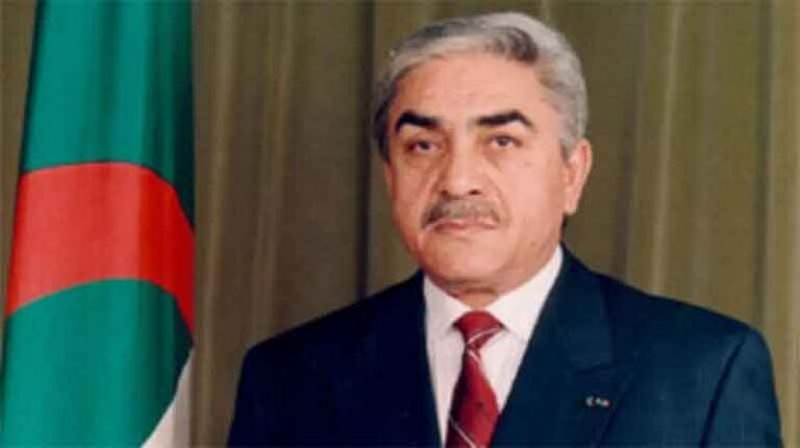
By Laala Bechetoula
“Those in power must show reason and discernment and rise to the level of our people — and let Algerians express themselves freely.”
— Liamine Zeroual, April 2019 — declining for the third time in his life to return to power, aged 77
EDITOR’S NOTE FOR THE INTERNATIONAL READERS: Most of the world has never heard of Liamine Zeroual. That itself is part of his story. He was the sixth President of Algeria — a nation of 46 million, the largest country on the African continent, a former French colony that purchased its independence with over one million dead between 1954 and 1962. He governed from January 1994 to April 1999, during the most violent period in Algeria’s modern history: a civil war that claimed more than one hundred thousand lives. He did not seek power. He did not cling to it. He did not profit from it. He gave it back. That is who he was. The rest is detail — extraordinary, luminous detail.
❖ ❖ ❖
He Died Yesterday
Not like any death.
He died — this man who refused a salary for doing nothing, who said no to America and went home, who walked out of the presidential palace with exactly what he had walked in with: nothing but his honour.
Liamine Zeroual died on Saturday, March 28, 2026, at 84. And with him ended not merely a life, but an entire generation’s understanding of a single word: duty.
A Name That Was a Prophecy
Few obituaries begin with etymology. This one must.
Zeroual — in Tamazight, the ancient Berber language of the Aurès Mountains that colonialism could not kill — means the one with blue eyes. The one who carries the colour of the sky in his gaze, yet never flies away. He remains a man of the earth, of clay, of mountains.
Al-Yamin — in Arabic — is the oath. The right hand extended in covenant. The direction of blessing.
When his parents named him in 1941 — while Algeria still groaned under French colonial rule — they did not choose a name. They wrote a destiny.
He fulfilled it, word by word, until his last breath.
The Mountain That Never Bowed
He was born in Batna, in the heart of the Aurès — that ancient, unbroken massif that refused to kneel before Rome when Tacfarinas led his resistance, that refused to surrender when the Berber warrior-queen Kahina made her last stand, and that fired the first shots of Algeria’s war of independence on November 1, 1954.
The Aurès is not merely geography. It is the genetic code of Algerian defiance, written in stone.
Those who grow up with its soil under their fingernails carry something no academy can teach and no rank can confer: a pride that does not break, and a silence that speaks louder than any speech.
Sixteen Years Old, One Rifle
In 1957, at the age of sixteen, he joined the National Liberation Army — the armed wing of Algeria’s independence movement — to fight French colonial rule.
A boy. A rifle larger than his shoulders. A mountain ahead with no visible end.
He needed no one to explain why. It was enough to watch his mother walk with her head bowed in her own hometown. It was enough to read the words “French national” on his father’s identity papers and know it was the greatest lie ever stamped on an official document.
His comrades in the mountains called him the Lion of the Aurès. He neither accepted nor rejected the name. He simply kept walking forward.
Moscow, Cairo, Paris — Learning the Enemy’s Art Without Becoming Him
After independence in 1962, while many veterans rested on the laurels of revolution, Zeroual went back to school. Cairo. Then Moscow (1965–1966). Then the École de Guerre in Paris — yes, in Paris, the capital of yesterday’s coloniser — to learn the art of war from those who had waged it against his own people.
This is the difference between a genuine statesman and an imitator: the first takes the tool and leaves the soul; the second takes the soul and loses himself.
He returned to build, methodically, without haste: the Cherchell Military Academy (1981), command of Tamanrasset in the Sahara (1982), Béchar on the Moroccan border (1984), Constantine (1987). General in 1988. Commander of ground forces in 1989. A man who lays bricks one by one. Who does not skip steps. Who does not jostle for position. Who does not wait for applause.
“I Don’t Want to Be Paid for Doing Nothing”
In 1990, he disagreed with President Chadli Bendjedid over plans to restructure the army. He did not negotiate. He did not yield. He did not manoeuvre.
They moved him sideways — appointing him Ambassador to Bucharest, Romania. An old and refined technique for sidelining those who inconvenience you.
He accepted. He went. Then, within weeks, he did something almost no one in the history of power has ever done voluntarily: he came back and said the sentence that contains his entire soul:
“I don’t want to be paid a salary for doing nothing.”
Stop. Read it again.
In a world where people claw at positions, titles, offices, and salaries — he gave one back because he was not earning it. He went home to Batna. He closed the door. He thought the story was over.
It was not over.
January 1994: The Country Calls, and He Cannot Refuse
Algeria was burning. Not as metaphor. As fact.
The Black Decade — la Décennie Noire — had consumed the country since the military cancelled the elections of January 1992. What followed was one of the twentieth century’s most brutal and underreported conflicts: over one hundred thousand dead, entire villages massacred, intellectuals and journalists assassinated, children orphaned by the thousands. A nation bleeding from wounds it could not dress.
The army needed a president. They went first to Abdelaziz Bouteflika. He refused. So they went to the silent man in Batna.
General Khaled Nezzar — the army’s strongman who engineered the transition — wrote in his memoirs, one of the rare documented testimonies of Algeria’s opaque political history, that Zeroual was “the most visibly unsettled” in the room that night, and that he
“accepted, out of a sense of duty, to become Head of State.”
— General Khaled Nezzar, Memoirs
Not with joy. Not with ambition. But: out of a sense of duty.
Like a man lifting a boulder not because he wants to, but because no one else can.
On January 30, 1994, Liamine Zeroual sat in the presidential chair at El-Mouradia palace — without the hunger for power, and with its full weight pressed upon his chest.
The Woman Who Voted While Trembling
“Do not go out. We will slaughter you.”
That was the message from the armed groups before the presidential elections of November 1995.
And yet Fatima went — or Khadija, or Zohra, or whatever name you wish to give to that Algerian woman who had lost her son, or her husband, or her brother in the decade of blood. She dressed in black that morning. She stood before the mirror for a long moment. And she said to herself, in a language only those who have buried someone they loved can understand: “I will go.”
Her hands were trembling when she placed the ballot in the box. She was not voting for a man. She was voting against the slaughter. She was voting for her son’s right to rest in his grave in peace. For her own right to sleep one night without fear.
She was among the 74.24% of Algerians who came out that day despite the threats — the highest recorded voter participation in Algeria’s post-independence history. That number is not a statistic. It is the collective moan of a people who came out into the street to say: We want to live.
Zeroual won 61.34% of the vote, in Algeria’s first ever genuinely pluralist presidential election. But the real victory belonged to Fatima, and Khadija, and Zohra.
Mercy: The Word He Chose Deliberately
When he sought to bring armed fighters back from the mountains, Zeroual did not call his policy an amnesty — the cold legal term preferred by bureaucrats. He did not call it reintegration — the bloodless language of technocrats. He called it: rahma. Mercy.
In that single lexical choice lives an entire philosophy.
Mercy is not weakness. It is the courage of a man who knows that a people who have lost one hundred thousand sons do not need more blood. They need to breathe. Thousands of fighters surrendered their weapons and returned home.
Wars do not always end with a last bullet. Sometimes they end with a word.
America Comes Knocking
In December 1997, US Ambassador Cameron Hume sat across from Zeroual for forty minutes. He brought the full diplomatic weight of the world’s unipolar superpower to bear. He wanted to persuade Zeroual of something Zeroual had already decided against.
When the meeting ended, Zeroual was Zeroual. The only thing that had changed from the encounter with the ambassador of the most powerful nation on earth was a cup of coffee added to the tray.
In Algeria’s history, many have bowed before Washington. Many more have claimed they did not bow. Zeroual belonged to a rare third category: those who simply did not register the question.
The Night in Windhoek
September 1998. Windhoek, Namibia. Guest of President Sam Nujoma.
In the garden of the official residence, alone beneath the open African sky, he paced. One cigarette, then another. The night deepened. No one.
No one knows what passed through his mind in those hours. No one ever will. But we know what came out of them.
At dawn, on the presidential aircraft returning to Algiers, he gathered his aides in the small salon. He was calm. He was serious. And he spoke the words that those who heard them have carried verbatim to this day:
“You know that I wanted to leave a year ago. The time has come. We must leave room for others. I am leaving.”
— Liamine Zeroual, aboard the presidential aircraft, September 1998
In the entire recorded history of human political power, few leaders have said voluntarily: I am leaving. Washington said it when he refused a third term and founded the Republic. Mandela said it after one term and secured South Africa’s democracy. Zeroual said it over Africa in a plane, with no audience but his aides.
The first had a monument carved in gold. The second had a Nobel Prize. The third did not ask for even a photograph.
Twenty-Seven Years of Golden Silence
A year passed. Then five. Then ten. Then twenty-seven.
He wrote no memoirs. He gave no interviews. He commented on nothing. He founded no party. He appeared nowhere. He complained to no one. His house in Batna stood as he had left it. His window looked out on the mountain that had made him. It was enough.
In 2019, when the mass uprising known as the Hirak toppled President Bouteflika after twenty years in power, the most powerful figure in Algeria’s intelligence establishment personally asked Zeroual to lead a transitional government. His answer was what it had always been: “The new generation must take its place.”
This was not humility. It was the wisdom of a man who understood that genuine leadership means leaving room for those who come after you.
What Ibn Khaldun Would Have Written
The fourteenth-century North African historian Ibn Khaldun — perhaps the greatest social theorist the Islamic world ever produced — argued in his Muqaddimah that civilisations rise and fall on the strength of asabiyya: the collective spirit that binds a community and places the common good above private interest.
Zeroual was asabiyya embodied in a single human being. He did not need to read the Muqaddimah to learn the lesson. He was born carrying it in his blood and in the red clay of the Aurès.
Had Ibn Khaldun lived to see this man say “I am leaving” over Africa in an aircraft, he would have added a final chapter to his masterwork. He might have called it: “When Virtue Takes Human Form.”
The Mountain Returns to the Mountain
Liamine Zeroual died on March 28, 2026, at the military hospital in Algiers, aged 84. The institution he had served his entire life received him at the end.
His life held everything a human life should hold: a childhood under occupation, a youth in revolution, a maturity spent building, an ordeal of governance in infernal years, and an old age of noble silence.
What his life never held, not once: hypocrisy, greed, self-dealing, or leaving the country worse than he found it.
❖ ❖ ❖
Algeria weeps today with tears that are real — because it understands, in the depths of its conscience, that it is not merely bidding farewell to a man. It is bidding farewell to a mirror in which it could once see what it aspired to be.
And in this moment of farewell, everyone who has ever loved this country asks the same question: why do we grieve a man who lived in silence and departed in silence?
Because noble silence — in a country like Algeria, in a time like this — is the highest form of eloquence. Because the man who does not want a salary for doing nothing — in a world where everyone scrambles for everything in exchange for nothing — that man cannot be replicated.
He was the last of a kind. Not a kind defined by ideology, party, or region. A kind defined by a single quality that history cannot manufacture on demand:
He meant it.
Farewell, O man whose name was an oath and whose life was the keeping of it.
Farewell, Liamine. Last of those who left power and took nothing with them but their honour.
May God have mercy on you, and grant you a rest as great as your service.
Laala Bechetoula is an Algerian historian, journalist and geopolitical analyst based in Laghouat, Algeria.
29 March 2026
Source: countercurrents.org