
By Nuvpreet Kalra
In ‘Freedom Park’ (S’kumbuto) outside Pretoria (South Africa), there is a Wall of Names that honors the men and women who died in the fight to liberate South Africa from apartheid. Amongst these are the names of two thousand and seventy Cuban soldiers who died in Angola between 1975 and 1988 for the liberation of southern Africa. It is said, however, that two thousand two hundred and eighty-nine Cubans died in that period in the region. In August 1975, the first group of Cuban military advisors arrived to assist the People’s Movement for the Liberation of Angola (MPLA) against the Angolan forces (mainly UNITA) backed by the South African apartheid state. Their numbers swelled to 375,000 Cuban soldiers and pilots as well as civilians (including doctors and teachers). It was these Cubans, alongside the MPLA troops, that defeated the South African apartheid forces and their UNITA allies at the battle of Cuito Cuanavale in 1988. When he was released from prison, the first place outside South Africa that took Nelson Mandela was Cuba. In Havana, in 1991, Mandela said, “Without the defeat of Cuito Cunavale, our organizations would not have been legalized. Cuito Cunavale marks the divide in the struggle for the liberation of southern Africa.”
The Cuban mission in Angola was named Operation Carlota, in homage of the enslaved woman who led a rebellion in Matanzas against slavery during the Year of the Lash (1843-44). When Africa needed help, Cuba answered the call.
Today, Cuba needs solidarity. It has been under an illegal blockade for nearly seventy years and now for several months has been under a genocidal oil blockade. The United States has prevented all energy lifelines from entering Cuba, blocking ships from Venezuela and Mexico and threatening to sanction freight and insurance companies that assist Cuba. Blackouts plague the island nation of ten million people, whose ability to live their bare life has been called into question. This is an emergency. There is no other way to describe it.
Angola is one of the world’s largest producers of crude oil and—at its Luanda Refinery—it produces refined oil products. The oil in Angola is owned by the state company, Sonangol, which has contracts with a range of Western oil firms from TotalEnergies (France), Eni (Italy) and Chevron (United States)—all countries that defended its enemies during the war. Angola’s offshore reserves have made it a key player in global energy markets. Oil revenues have transformed Luanda into a city of obvious contrasts: gleaming skyscrapers alongside informal settlements, with the wealth of the oil unevenly distributed, and the development of the country hamstrung by structural inequalities. The MPLA has governed the country since 1975, although this is not the MPLA that fought alongside the Cubans till 1988. José Eduardo dos Santos, who led the country from 1979 to 2017, abandoned Marxism and shaped the oil industry and privatized lucrative state assets to benefit a small rentier elite (including his family).
Despite the limitations of the situation in Angola, in 2015, the government of Angola erected a large bronze statue at Cuito Cunavale that depicts an Angolan (MPLA) soldier and a Cuban soldier standing across from each other and together holding up a map of Angola. It is a powerful symbol of the reality of how Angola won its sovereignty—with Angolan and Cuban sacrifice and struggle. Without Cuba’s intervention, it is entirely plausible that Angola would have fallen under the control of forces aligned with apartheid South Africa and Western interests, its resources extracted under conditions far less favorable to its people. The oil that Angola now sells on the global market might never have been under Angolan control at all. In this context, the question of Angola providing oil to Cuba is not merely economic, but historical and moral.
Both the MPLA and Angola’s government have condemned the illegal US blockade against Cuba. In September 2025, Angola’s President João Lourenço said that the “unjust and prolonged” blockade which causes serious harm to the Cuban people must be “unconditionally lifted.” Since then, the US has only tightened its grip on the Cuban economy.
A Russian oil tanker, the Anatoly Kolodkin, arrived in Matanzas (Cuba) on 30 March to break the siege. That tanker is named after a famous Soviet jurist who was one of the men who drafted the UN treaty on the Laws of the Seas (1982) and who sat on the International Court of Justice. Perhaps the Russians wanted to send a message about international law when they selected that tanker to carry oil to Cuba against the illegal US blockade. Perhaps President Lourenço can provisionally rename one of the Angolan oil tankers Carlotain honor of the Cuban operation that helped in his country’s liberation. Sonangol would face legal challenges, but so be it: Cuba surmounted any number of threats and challenges to assist Angola, and then left without asking for anything.
History does not move along neat moral lines. It is jagged, contradictory, and often indifferent to the sacrifices made in its name. Yet there are moments when the ledger of history becomes clear enough that we can speak, without hesitation, of obligation—of debts incurred not through coercion, but through solidarity. The relationship between Cuba and Angola is one such moment. It is a relationship forged not in trade agreements or diplomatic formalities, but in blood, in sacrifice, and in a shared commitment to the liberation of Africa from colonial and apartheid domination.
We live in a time when the language of solidarity has been hollowed out, replaced by the technocratic vocabulary of ‘partnerships’ and ‘investments.’ Yet the history of Cuba and Angola reminds us that another kind of relationship is possible—one based not on extraction or profit, but on mutual commitment to human dignity. Cuba did not send its sons and daughters to Angola because it expected oil in return. It did so because it believed that the freedom of Angola was inseparable from its own revolutionary ideals. That belief, whatever one thinks of it, had real consequences. It changed the course of history in southern Africa. Today, Angola can respond—not out of obligation imposed from outside, but out of a recognition of shared history. To provide oil to Cuba would be to say that the sacrifices of the past are not forgotten, that internationalism is not a relic, and that the Global South can still act in ways that defy the narrow logic of profit.
Vijay Prashad is an Indian historian and journalist.“Cuban eye doctors in Jamaica are the only reason why my grandmother didn’t go fully blind in one eye after she got a botched surgery. The work they’ve done for rural and poor Jamaicans is immeasurable”, wrote a Twitter user last week after the first set of Cuban doctors and nurses left Jamaica.
Two weeks ago, hundreds of Jamaicans marched in a “gratitude walk” to thank Cuba for the 50 years of medical solidarity that they have received. Meanwhile, others on the island have been reportedly rushing to get eye treatment at clinics before Cuban doctors were set to depart. A few weeks ago in Honduras, people were in tears as they applauded and thanked Cuban doctors for their years of service, particularly in providing free eye surgeries. If this is clearly contrary to the interests of people, why are all Cuban doctors, nurses, biomedical engineers, and technicians leaving?
They are not leaving because these countries want them to, but because the United States is forcing them to.
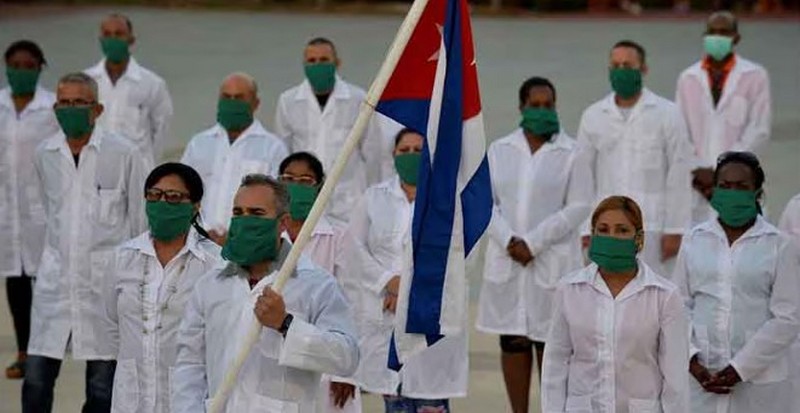
Last year, the United States threatened to cancel U.S. visas for leaders of countries that have Cuban doctors working in them, as part of a decades-long campaign of aggression to destroy Cuba’s medical solidarity, which has saved over 12 million lives across the world. In reaction to this coercion, the governments of Jamaica, Honduras, Guatemala, Paraguay, the Bahamas, St Vincent and the Grenadines, and Guyana have formally ended the Cuban medical missions after decades. The governments of Grenada, Antigua and Barbuda, and Calabria in Italy have committed to gradually reducing Cuban medical missions. The US is forcing countries to end decades-long relationships with Cuba to further isolate the island from the world, all at the expense of the access and quality of healthcare for millions of people.
Cuba has carried out 30 million medical consultations in Honduras, 900,000 surgeries, and 80,000 eye surgeries. Many of the doctors were working in a free ophthalmology clinic in San Jose de Colinas in Santa Barbara as part of the Venezuelan-Cuban Operation Miracle, which provided free eye care to millions. Now, 150 Cuban doctors have left the country after the newly elected right-wing government immediately cancelled the medical mission. In Guyana, 200 doctors have left after 50 years of providing health access for people who otherwise would not have had any. Last week, Cuban doctors began leaving Guatemala after the government ended Cuban medical missions, which began in 1998 following Hurricane Mitch to provide critical health services to indigenous communities underserved by the Guatemalan health system. Now, 412 Cuban health personnel are beginning to end their service following a closing of ties with the government of Guatemala and the United States, and a clear willingness to bow down to coercive measures. The Bahamas has terminated its Cuban brigades, opting for discussions with the United States over building a workforce based in Canada to serve the medical system.
During this time, Cuban doctors cared for more than 8,176,000 patients, undertook 74,302 surgeries, attended the births of 7,170 babies, and saved 90,000 lives. With the end of the Jamaica Cuba eye care programme, after 16 years of solidarity and 25,000 instances of people regaining their sight. Despite initially saying that “I will prefer to lose my visa than to have 60 poor and working people die,” the Prime Minister of St Vincent and the Grenadines has chosen to let the 60 patients receive dialysis and critical care from Cuban doctors lose their care with the end of the Cuban medical missions to the country.
Not all countries are accepting this attempted coercion and sacrifice of the health of their nation. Trinidad and Tobago and Calabria in Italy have refused to cancel the Cuban medical missions. The Trinidadian President said, “I just came back from California, and if I never go back there again in my life, I will ensure that the sovereignty of Trinidad and Tobago is known to its people and respected by all.”
History of medical solidarity
In 1960, medical aid was sent to Chile after the Valdivia earthquake. But it was 1963 that marked the start of Cuban medical brigades. 58 medical personnel travelled to Algeria to support in rebuilding the health system after the victory of the independence movement in booting out French colonialists. Fidel Castro gave a speech at the opening of a new medical school in Cuba, hours after meeting Ben Bella, Algeria’s President:
“Most of the doctors in Algeria were French, and many have left the country. There are four million more Algerians than Cubans, and colonialism has left them with many diseases, but they have only a third — and even less — of the doctors we have…That’s why I told the students that we needed 50 doctors to volunteer to go to Algeria.
I’m sure there will be no shortage of volunteers…Today we can only send 50, but in 8 or 10 years’ time, who knows how many, and we will be helping our brothers…because the Revolution has the right to reap the rewards it has sown.”
This act of revolutionary solidarity, just four years after the revolution, marked the start of decades of solidarity from Cuba to the world. Since then, more than 600,000 Cuban doctors and health workers have provided healthcare to 165 countries. In fact, there are still Cuban medical brigades operating in 15 Algerian provinces, mainly to reduce maternal and infant mortality.
In 2004, Cuba and Venezuela launched Operación Milagro (Operation Miracle), aimed at providing free eye care and surgeries for people suffering from preventable blindness and other visual impairments. The program restored vision to more than 4 million people across 34 years in just 15 years. This historic program is being forcibly shut down as the US pushes Cuban doctors out of countries today, breaking one of the world’s most remarkable progressions in health provision.
In 2005, following Hurricane Katrina’s devastating impacts in the United States, Cuba created the Henry Reeve International Contingent to respond to natural disasters and health epidemics. While the Bush administration refused Cuban help in responding to Hurricane Katrina, this incredible mission has sent 90 brigades to 55 countries to respond to COVID-19 in Europe and Latin America, Ebola in West Africa, cholera in Haiti, and more. In 2020, the Henry Reeve International Contingent was nominated for the Nobel Peace Prize.
In 2014, Cuba provided the only permanent brigade to support Sierra Leone, Guinea-Conakry, and Liberia in dealing with the Ebola epidemic. No other country or international organisation provided long-term support for the countries. It was Cuban doctors who managed to successfully contain the epidemic.
In March 2020, as COVID was declared by the World Health Organization as a pandemic, Cuban doctors immediately travelled to Lombardy in Italy, the epicenter of the pandemic, Angola, as well as Latin American countries, including Venezuela and Suriname, to provide support. When a COVID-positive cruise ship with over 600 people onboard was refused docking in every Caribbean country, it was Cuba that allowed them to dock in “a shared effort to confront and stop the spread of the pandemic.” As the US blockade prevented Cuba from accessing vaccines, they manufactured their own – and five of them at that. The blockade slowed down the process significantly, given the lack of medical equipment permitted into the island, the limited research laboratories, and the inability to access enough syringes for mass vaccination. It is only because of the resilience and humanity of Cuban doctors and researchers and the international solidarity of organisations, including CODEPINK, in donating syringes, that Cuba managed to not only protect its population from the pandemic but also export them to the world. In fact, the vaccines produced by Cuba did not require refrigeration, unlike most manufactured in the Global North, given the lack of access to facilities, particularly as they were distributed far across the island. This meant that the vaccine could be sent successfully to countries across the Global South with similar lack of access to refrigeration to protect those otherwise shut out of Global North supply chains. In the face of attacks, Cuba’s resilience is a benefit for all humanity.
Campaign of destruction
The United States has sought to interrupt, discredit, and dismantle this enormous feat as part of its attempts to destroy the Cuban revolution. Cuba’s ability to provide medical missions, despite the 66-year-long genocidal blockade, is a testament to the indestructible resolve of the Cuban people and the country’s commitment to humanity.
On February 23 of this year, the State Department sent a sensitive memo to Marco Rubio, which outlined a strategy of coercing countries in Latin America to boot out Cuban medical missions over the next 2-4 years. These attacks on Cuba’s medical missions were an escalation in the US’s war of imperialist aggression on the island for daring to commit to solidarity and peace, rather than welcome greed and destruction. On March 2nd, Congress approved a law to impose sanctions on any country that has Cuban health workers operating in it. Last August, the Trump administration imposed restrictions and revoked visas from countries working with Cuba on medical missions. Since then, countries have been pulling out of medical missions in fear of US retribution.
Under George W Bush’s presidency, the US set up the “Cuban Medical Professional Parole Program,” which aimed at getting Cuban doctors to desert from their mission and get residency in the United States. This ended under Obama’s administration.
This policy has been carried by a vicious propaganda war that has sought to label Cuban medical missions as “forced labour” and Cuban doctors as “slaves”. While this is a frankly offensive and disrespectful attempt to discredit a revolutionary act of solidarity, it is not only a ruse to justify attacks on Cuban doctors but also a fundamental revelation about the US. The descendants of slaveowners can tell Cubans they are slaves for supporting countries made victims of colonialism and imperialism, but refuse to acknowledge that the transatlantic slave trade was the greatest crime of our time.
Cuba’s medical missions, beyond providing critical health services for millions of people, also provide support for the Cuban healthcare system and economy. When doctors are paid in the countries where they work, their money goes into the public healthcare system to pay the doctors, provide support for their families, as well as patients, doctors, and the healthcare system for the entire island. This is a remarkable act of solidarity for Cubans and the world. The Cuban health system works; in fact, it works so well that Cuba has the highest rate of doctors per capita in the entire world. Whereas, in the United States, people survive depending on whether a company decides they can have a medicine, or if they can afford to pay another large corporation thousands of dollars for the privilege of treating an illness. The US dares to lecture Cuba while more than one-third of Americans cannot afford to access healthcare; while 1.3 million diabetic people ration insulin because the price skyrockets year on year as greedy pharma execs decide; and while over 66% of bankruptcies in the US are because of the costs of healthcare.
It is no wonder that healthcare is a significant target of the US empire’s attacks. Cuba maintains that healthcare is a right, whereas the US affords it as a privilege and arena for profits.
Another critical dimension to Cuba’s medical solidarity is its world-renowned Latin American School of Medicine (ELAM). Founded in 1999, the school provides tuition-free medical education for students from across the world who might otherwise not have access to medical studies. They gain a free medical degree in Cuba, then return to serve their communities back home to develop medical self-sufficiency and sovereignty for their countries. There are over 250 Palestinian students from Gaza studying medicine in Cuba, completely free of charge, in the hopes they will travel back to Palestine and care for their people. Today, there are more than 31,000 doctors in 120 countries who have been trained at ELAM. This truly extraordinary and selfless act of material solidarity is also met with attacks. The U.S. has told St Lucia to stop sending doctors to Cuba for medical studies, which the Prime Minister has warned would cause a “major problem”.
I visited ELAM last year and spent time speaking with two female medical students from Sri Lanka, who were quite excited to see someone else from South Asia in Cuba! I asked them how they found studying at ELAM, living in Cuba, and being taught medicine for free to go back to their communities. They were ecstatic and told me how much they loved being there, and what a unique opportunity it was to become doctors from backgrounds where they otherwise would not have been able to. Their only issue with Cuba was the lack of spicy food!
Also on this trip to Cuba, I met with doctors working in a local hospital outside of Havana. They each shared with pride the different countries they had served in: Angola, Venezuela, Bolivia, and Italy. A similar situation you might find in the United States, or elsewhere in the Global North, is of someone in the military who might tell you with pride how they served in Iraq, Afghanistan, Libya, Syria. While Cuba’s missions save lives and serve people, U.S. missions massacre people and serve Lockheed Martin.
As more U.S. soldiers are sent to West Asia as part of threats to invade Iran and to kill for the interests of imperialism, it is truly devastating to see Cuban doctors leave hospitals in the Caribbean to the tears of locals who have been helped by them.
The poles could not be more stark. Cuba, the most blockaded country in history, has saved more than 12 million lives with its medical missions. The U.S., a belligerent empire with the biggest economy in the world, has killed as many as 23 million people in 28 countries since the 1950s.
Cuba reveals the unfettered barbarity of the United States. That is why they fear a tiny island 90 miles off the coast of Florida. Cuba shows us that the world does not have to be dominated by one empire that violently exploits people, extracts resources, and imposes its own will through F-35s and 2,000lb bombs. Cuba reveals humanity to people who have been propagandised into believing that every person has to look out for themselves, and there is danger and violence at every corner. Cuba unravels the lies that the United States is based on.
So, every single time the U.S. attacks Cuba, discredits its government, its economy, its people, its society, it is trying to protect itself. This has nothing to do with Cuba and everything to do with the U.S. The only future for humanity is an end to the U.S. empire.
Nuvpreet Kalra is CODEPINK’s digital content producer. She completed a Bachelor’s in politics and sociology at the University of Cambridge, and an MA in Internet Equalities at the University of the Arts London.
2 April 2026
Source: countercurrents.org