
By Hassan Abo Qamar
Two months after the US-brokered ceasefire-that-is-not-a-ceasefire came into effect, Gaza appears calm – but it is not at peace.
The bombs no longer fall daily, yet some nights are still pierced by airstrikes. In late October, one such bombardment killed at least 104 Palestinians.
In total, since 10 October, when the agreement went into effect, Israel has killed at least 394 people, according to Gaza’s health ministry, while violating the ceasefire agreement over 738 times.
Israel’s military violence is just one side of the coin. Gaza is devastated. Over 80 percent of Gaza’s buildings have been damaged or destroyed, creating what the UN estimates is 61 million tonnes of rubble. Entire neighborhoods have been flattened.
Hospitals, homes and businesses all lie in ruin. Gaza’s education system has been all but erased: more than 95 percent of school buildings and 79 percent of higher education campuses have been damaged or destroyed.
One of the key planks of the October ceasefire agreement was a commitment to rebuild what has been destroyed. Yet, so far there has been no meaningful reconstruction, leaving people to face the winter storms and rains in whatever tents and shelters they currently have.
In practice, the October agreement has merely extended Israel’s siege by other means. Israel maintains full control over Gaza’s crossings – now, as before genocide, its preferred weapon of domination – and thus the delivery of aid, the movement of people and the most basic conditions for survival, including electricity, water, food and medical supplies.
Deepening occupation
This control now extends to Gaza’s internal geography. As per the ceasefire plan, the Israeli military has established effective control over more than half of the Gaza Strip, including much of its remaining agricultural land and the border crossing with Egypt. The so-called “yellow line,” which divides Gaza, is now being presented not merely as a temporary armistice line, but as a “new border,” according to Israel’s military chief, a clear violation of the US plan.
Not a truck nor a convoy moves without the Israeli military’s approval. Aid convoys carrying food or medical supplies must obtain permission. Many convoys are delayed or denied without explanation. And aid deliveries continue to fall far short of the 600 aid trucks daily agreed under the October deal, with the UN estimating that, until 7 December, just 113 trucks have been allowed through on average every day.
As a direct result, prices of basic goods remain painfully high in Gaza’s markets, a situation compounded by the absence of any governing authority to regulate trade, allowing a small number of traders and smugglers to monopolize commercial trucks, restrict supply and inflate prices.
Liquidity restrictions also persist, forcing Gazans to pay cash withdrawal fees of 20 percent, which further drives inflation and erodes the value of money.
Rescue teams in Gaza, meanwhile, suffer shortages of fuel, heavy machinery and specialized equipment whose entry Israel prohibits. This not only prevents any reconstruction efforts, it undercuts attempts to clear rubble, open streets and retrieve bodies buried under destroyed buildings.
The Palestinian Civil Defense estimates that around 9,000 corpses remain buried beneath rubble.
The shortage of fuel and equipment has also worsened displacement. As of mid-October, nearly 800,000 people have returned to their areas, over 650,000 of them to northern Gaza, many to find nothing but total devastation. Entire neighborhoods have been erased, and water pipes, power lines and sewage systems lie unrepairable under rubble that cannot be shifted.
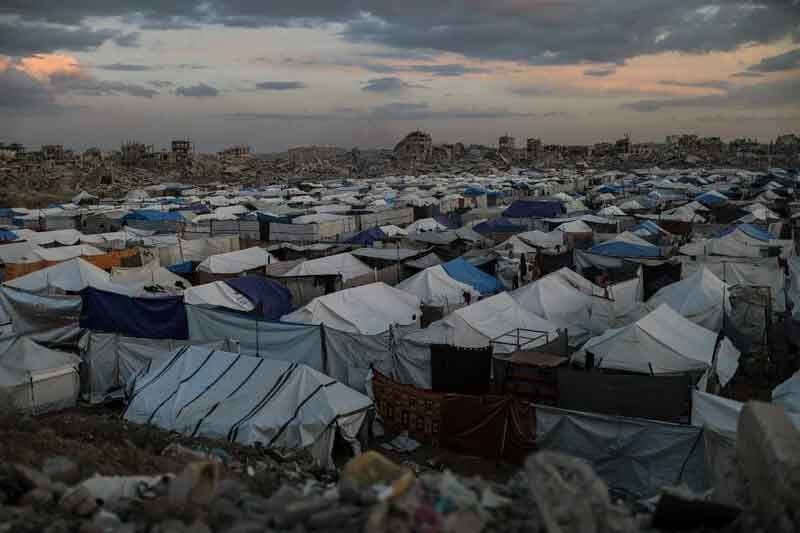
The so-called “reconstruction phase” – supposedly part of the second stage of the US-brokered deal – remains an empty slogan. For most families, “returning home” means pitching tents beside the ruins of their houses.
Healthcare as a weapon
Displacement camps have turned into semi-permanent cities of fabric and dust, and most displaced households still lack reliable access to food and clean water, leaving the displaced at the mercy of the cold and the wet and the diseases these bring.
Gaza’s healthcare sector faces immense challenges after the ceasefire, however, from a lack of medicine and equipment to the inability to treat the wounded and rebuild hospitals and health care centers.
According to the UN after the ceasefire came in, just 34 percent of “health service points” – that is hospitals, clinics, field hospitals, primary health care centers – are still functioning in Gaza.
Gaza’s health sector has received virtually no aid or donations since 10 October, according to Raafat al-Majdalawi, director-general of the Al-Awda Hospital in Jabaliya in the north. He told Al-Jazeera Arabic that everything is needed in Gaza – from medical supplies and generators to beds and sheets and advanced medical equipment.
The World Health Organization reports that around 18,500 patients, including 4,000 children, urgently need medical treatment unavailable inside Gaza. Yet since US President Donald Trump’s ceasefire began, only a handful of medical cases have been allowed to leave. The first medical evacuation, on 22 October, included just 41 patients and 145 companions, though that has since risen to a total of 260 evacuations.
Thousands remain on waiting lists, and many die while waiting for permission to cross. Israel’s control over medical evacuations has effectively turned healthcare into a bargaining chip.
Managed decay
Israel’s strategy since the ceasefire has not been to rebuild Gaza, but to manage its collapse. By controlling what enters and leaves, Israel dictates the pace of Gaza’s decay. It maintains the illusion of progress – a few aid convoys here, a photo opportunity there – while ensuring that no real recovery can take root.
This is not a failure of the ceasefire-that-is-not-a-ceasefire. It is its essence. Gaza’s reconstruction has been framed as a privilege, not a right – tied to political conditions meant to weaken Palestinians and deepen the political divide between Gaza and the West Bank. Each truckload of cement or fuel becomes a tool of negotiation, each travel permit a reminder of dependency.
The result is a warped form of “peace” in which Gaza remains trapped in its own ruins. For Israel, this is a comfortable calm, one that avoids international outrage over its indiscriminate bombing while keeping Palestinians subdued under economic and humanitarian pressure.
For Benjamin Netanyahu, Israel’s prime minister, the ceasefire-that-is-not-a-ceasefire has created a situation where he can escalate the situation in Gaza at will, just like in Lebanon.
This may prove useful to Netanyahu if he feels heat from his coalition partners or is threatened by pending corruption charges, for which Trump wants Netanyahu pardoned.
The ceasefire was supposed to mark the end of war. Instead, it has revealed the depth of Gaza’s destruction and the cruelty of a system built to keep it impoverished, dependent and wrecked.
It is a deliberate and cynical policy to keep Gaza broken – suspended in uncertainty, awaiting decisions made in Washington and Tel Aviv, completely indifferent to the lives of those who remain trapped inside.
Hassan Abo Qamar is a writer based in Gaza.
20 December 2025
Source: countercurrents.org