
By Countercurrents Collective
The latest wave of Israeli attacks on Lebanon marks one of the most intense and expansive military escalations in the country in recent years, raising urgent questions about the viability of emerging ceasefire arrangements in West Asia. Within hours of a US-Iran ceasefire announcement, Lebanon became the site of devastating bombardment, revealing deep contradictions in the diplomatic framework and exposing how fragile—and perhaps illusory—the truce truly is.
Across Beirut, its southern suburbs, the Bekaa Valley, and multiple regions in southern Lebanon, Israeli airstrikes killed at least 254 people and injured more than 1,160. The scale and speed of the assault were staggering. In the first wave alone, dozens of strikes were carried out in under ten minutes, hitting over 100 locations that Israel claimed were linked to Hezbollah. Yet many of these strikes landed in densely populated civilian areas, with no prior warning issued to residents.
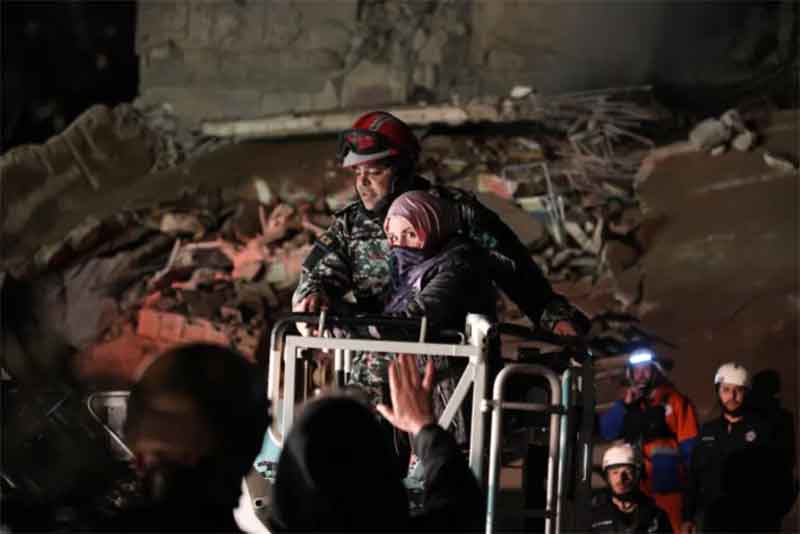
Hospitals were quickly overwhelmed. Medical centers, including those in Beirut, issued urgent calls for blood donations as casualties surged. Scenes from across the country reflected chaos and fear—families fleeing, neighborhoods reduced to rubble, and emergency responders scrambling to recover bodies still buried beneath debris. The human toll continues to rise as rescue operations proceed.
This escalation comes against the backdrop of a ceasefire agreement brokered by Shehbaz Sharif between the United States and Iran after weeks of mounting tensions. Sharif had described the agreement as comprehensive, asserting that it would apply “everywhere including Lebanon.” His announcement generated cautious optimism that a broader regional de-escalation might finally be within reach.
However, that optimism quickly unraveled.
Within hours of the ceasefire taking effect, both Donald Trump and Benjamin Netanyahu publicly contradicted the notion that Lebanon was included. Trump described Lebanon as a “separate skirmish,” explicitly stating that it was not covered by the agreement. Netanyahu echoed this position, asserting that the ceasefire “does not include Lebanon.”
These statements introduced immediate ambiguity into the ceasefire’s scope. While one set of actors presented the agreement as region-wide, others framed it narrowly, effectively carving out Lebanon as an exception. This divergence is not merely semantic—it has had deadly consequences on the ground.
The continued bombardment suggests that Israel is seeking to capitalize on this ambiguity. As analyst Dania Arayssi noted, Israel appears intent on maximizing its operational gains in Lebanon while the diplomatic landscape remains fluid. This strategy reflects a calculated effort to weaken Hezbollah before any broader settlement—particularly one involving Iran—could constrain Israeli military actions.
Yet this approach carries significant risks. Iranian officials have already signaled that ongoing attacks in Lebanon constitute violations of the ceasefire framework. Mohammad Bagher Ghalibaf explicitly cited Israel’s actions in Lebanon as one of several breaches undermining the basis for negotiations. Alongside reported drone incursions into Iranian airspace and disputes over nuclear rights, these developments have deepened Tehran’s distrust of US commitments.
From Iran’s perspective, the exclusion of Lebanon from the ceasefire is not only unacceptable but strategically untenable. Hezbollah is widely regarded as a key Iranian ally, and continued Israeli attacks against it are unlikely to be viewed as separate from the broader US-Iran confrontation. Iranian officials have warned that such violations make further negotiations “unreasonable,” raising the specter of renewed escalation.
On the ground in Lebanon, the consequences are immediate and devastating. The strikes have targeted areas that had previously been spared even during earlier phases of conflict, including parts of Beirut. This widening of the battlefield suggests a shift in Israeli strategy, moving beyond containment toward more expansive and aggressive operations.
The timing of the attacks is particularly significant. Many displaced residents had begun returning to their homes in southern Lebanon, encouraged by reports of a ceasefire. Instead, they found themselves caught in a new wave of violence. The lack of clarity about Lebanon’s status within the ceasefire has left civilians dangerously exposed, highlighting the human cost of diplomatic ambiguity.
This is not the first time Lebanon has experienced such escalation in recent months. Since early March, Israel has intensified its campaign following rocket fire attributed to Hezbollah. Although a ceasefire between Israel and Hezbollah had ostensibly been in place since November 2024, Israel continued near-daily strikes that have killed hundreds of Lebanese. The latest assault, however, represents a dramatic intensification in both scale and coordination.
What distinguishes this moment is the intersection of military escalation with high-stakes diplomacy. The US-Iran ceasefire was intended to halt a rapidly expanding conflict involving multiple actors. Instead, it has revealed the limits of bilateral agreements in a deeply interconnected regional landscape.
By excluding—or appearing to exclude—Lebanon, the agreement has created a dangerous loophole. This has allowed Israel to continue its military operations while maintaining that it is not violating the ceasefire. At the same time, it has placed Iran in a position where restraint may appear increasingly untenable, especially if attacks on its allies continue.
The result is a ceasefire that exists in name but not in practice—a fragile arrangement that risks collapsing under the weight of its own contradictions.
The political dynamics surrounding the agreement further complicate the situation. Israeli officials have reportedly expressed frustration at being excluded from the ceasefire negotiations, while also rejecting its applicability to Lebanon. This dual position—opposition to the agreement combined with selective adherence—underscores the challenges of achieving coordinated de-escalation in a multipolar conflict.
Meanwhile, the United States’ position has raised additional concerns. By endorsing Israel’s characterization of Lebanon as a separate conflict, Washington appears to be undermining the broader framework it helped negotiate. Trump’s remarks, coming less than a day after the ceasefire announcement, have been interpreted by some as a de facto endorsement of continued Israeli operations.
For many observers, this raises fundamental questions about the credibility of US diplomacy. If ceasefire terms can be so quickly reinterpreted—or contradicted—what assurances can be offered to other parties involved in the conflict?
The unfolding crisis in Lebanon thus serves as a stark reminder of the complexities of modern warfare and diplomacy. In a region where conflicts are deeply interconnected, attempts to isolate one theater from another are unlikely to succeed. The exclusion of Lebanon from the ceasefire—whether intentional or not—has demonstrated how quickly such assumptions can unravel.
As airstrikes continue and casualties mount, the prospects for a durable ceasefire appear increasingly uncertain. Without a clear and inclusive framework that addresses all active fronts, efforts at de-escalation risk being overtaken by events on the ground.
Ultimately, the unprecedented attack on Lebanon is not just a humanitarian catastrophe—it is a critical test of whether diplomacy can keep pace with the realities of war. So far, the answer remains deeply in doubt.
9 April 2026
Source: countercurrents.org