
By Akbar E. Torbat
The United States, along with its regional proxy Israel and the European Troika, tries to destabilize Iran to rip the country apart. Failing to achieve this purpose during the 12-day war, they now want to use violent protests like the Arab Spring in 2011 to achieve the same objective.
In recent months, the rate of inflation in Iran has been high, ranging from 40% to 50%. The US unilateral economic sanctions have hurt the country’s international trade. As sanctions tightened, Iran’s national currency, the rial, plummeted in value, reaching about half of its original value by late December.
In late December 2025, the reformist government of President Pezeshkian decided to end the subsidized preferred exchange rate for importing essential goods. Furthermore, his government increased the price of energy products, mainly gasoline, which had been at generally very low levels. All of these at once created an economic shock and provided the precondition for protests. The economic crisis and the demonstrations played into the hands of the imperialists, allowing them to fan the flames of the crisis and instigate riots.
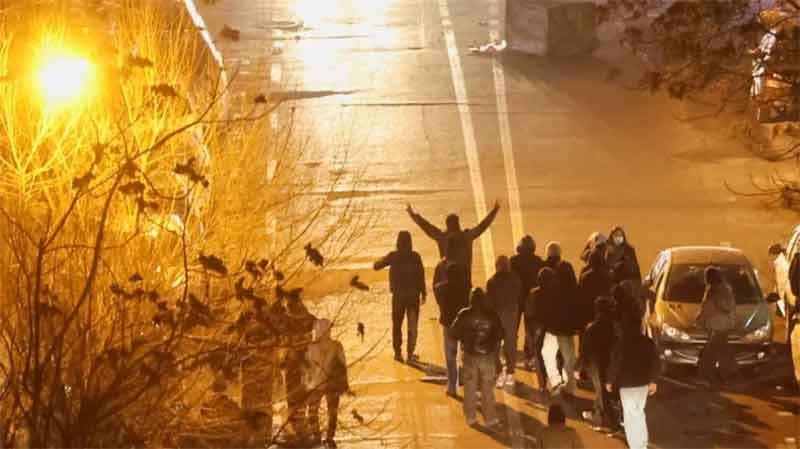
Following the collapse of the national currency, the rial, a series of protests began on December 28 in the Tehran Grand Bazaar and in the retail district of central Tehran. Then, the protests spread to some other cities and turned violent against the theocratic regime. On the tenth and eleventh days of the nationwide livelihood protests, merchants in Tehran’s Grand Bazaar, as in previous days, refused to open their shops. Other retail markets, as well as mobile phone and audio-visual equipment shops, also closed in protest.
Taking advantage of these protests, the Western media spread propaganda to destabilize Iran. They propagate Reza Pahlavi’s speeches, the son of the last Shah of Iran, as a candidate to bring back the monarchy in Iran. According to Haaretz,
“Israel ran a covert influence operation using fake accounts and AI-generated content to promote Iran’s exiled crown prince Reza Pahlavi and push for restoring the monarchy.”[1]
However, the real intention of the imperialists is to rip the country apart and control its oil, as is being done in Venezuela. They have used all sorts of propaganda in the form of false reports and videos made up by artificial intelligence to aggravate the crisis.
President Donald Trump pledged to support the demonstrators. On January 9, Trump issued a new warning to Iran’s leaders, saying,
“You better not start shooting because we’ll start shooting too.”
Additionally, Secretary of State Marco Rubio expressed the US’s support for the protesters.[2] Furthermore, Senator Lindsey Graham, Mike Pompeo, the former director of the CIA, Zionist officials, and “Hannah Neumann”, a German member of the European Parliament, have all stated that they stand with the protesters in Iran.
Yet, the Wall Street Journal reported,
“President Trump has threatened repeatedly to intervene in the event of a bloody crackdown on Iranian protesters. That has prompted US officials to examine possible strikes on Iranian military sites.”[3]
The Islamic Government’s Response
On January 11, Mohammad Baqer Qalibaf, the Parliament Head, said Iran recognizes peaceful protests over economic concerns but stands firmly against armed terrorists.
“To prevent miscalculation, understand that should you [Trump] take action to attack Iran, both the occupied territories [Israel] and all American military centers, bases, and ships in the region will be legitimate targets,” Qalibaf warned. [4]
Also, on January 9, 2026, after Iran witnessed the largest street demonstration of the people on the 12th night of the protests, Ali Khamenei, the religious Leader, called the protesters “foreign mercenaries.” He also added about Donald Trump,
“If he knows that the arrogant men of the world, such as Pharaoh and Nimrod, Reza Khan and Mohammad Reza [the Shah and his father], were overthrown at the height of their pride, he too will be overthrown.”
Furthermore, in a letter to the United Nations Security Council, Amir Saeed Iravani condemned the US government’s illegal actions and its coordination with the Zionist regime to interfere in Iran’s internal affairs and provoke riots and unrest in Iran.[5]
The Western imperialists have instigated some ethnic groups, mostly the Kurds in western Iran, to destabilize the country by violent protests and riots in some cities. The arrest of some Mossad-related agents in various cities, such as Ilam, Tehran, Lorestan, etc., revealed that the Zionist regime has hired villains to provoke riots. These people use the “knock and run” tactic to kill and set on fire public and private properties. According to Tasnim News, with the arrest of some riot leaders in Tehran, it was revealed that they had collaborated with the Kurdish Komoleh rebel group. These people had mostly come to the capital from the western provinces of the country. They were in contact with Komoleh and were receiving sabotage instructions and weapons from them. Some agitators from the ethnic groups were armed with rifles, knives, and Molotov cocktails to kill law enforcement personnel, set on fire banks, mosques, and public properties.
There were widespread terrorist acts, such as attacks on businesses, shops, and stores that were still operating, warehouses, public transportation, government and law enforcement centers, Basij bases, and police stations, carried out in the most severe criminal ways on their agenda.
To control the riots and unrest, the Iranian government cut off the nation from the internet and international telephone calls. Some reports indicate that at least 100 rioters and four security personnel were killed, and 2,200 arrested during the unrest.
Crisis of the National Currency
In the past, Iran’s central bank had adopted a dual exchange rate system, allowing for a lower preferred exchange rate for the import of essential goods. The justification for adopting the preferred rate was to keep the price of some imported essential goods low for consumers; however, a small part of the difference between the preferred rate and the free rate went to the consumer, and the rest went to firms that received the foreign exchange at the preferred rate from the government. These firms had demanded maintaining the preferred rate, as they benefited from this huge source of rent-seeking arrangements. They obtained foreign exchange at the preferred rate for importing essential goods, but in some cases, they used it for other purposes or sold it for higher prices in the free market by employing various manipulation techniques.
Image: The Lion and Sun flag has become a widely used symbol of opposition to the Islamic Republic. Although its display inside Iran is strictly banned, protesters have increasingly begun waving it despite the serious risks involved. (Public Domain)
In December 2025, the central bank decided to unify the exchange rate, fixing it to bring the rate closer to the free market rate and thereby ending the corruption associated with the preferred exchange rate. By eliminating preferential currency and transferring subsidies directly to the final consumer, the government wants to both maintain the purchasing power of households and increase transparency in the allocation of subsidies.
Consequently, the devaluation immediately affected the price of certain imported goods, which hurt the retailers. The government has instead allocated subsidies to most of the population to compensate for higher prices on certain essential goods. A monthly subsidy of one million Tomans is deposited into the accounts of most households. This credit is given in the form of vouchers for the purchase of 11 specific essential goods. Nonetheless, the rise in the money supply over the past few decades has been the primary cause of inflation in Iran.
The Iranian government should be wary of controlling inflation, particularly the price of food items. The Iranian people must be aware that Israel and its Western culprits intend to partition and destroy Iran, not be fooled by their propaganda, and be prepared to defend the country.
*
Akbar E. Torbat, Ph.D., is the author of “Politics of Oil and Nuclear Technology in Iran,” Palgrave Macmillan (2020). Farsi translation of the book is available here. He is a regular contributor to Global Research.
12 January 2026
Source: globalresearch.ca