
By Miguel Santos García
China has recently condemned reported US pressure on Venezuela’s new government to sever its partnerships with China, Russia, Iran, and Cuba, calling it a “typical bullying act” and asserting that Beijing’s legitimate economic interests in the country must be protected. The US demand, which follows the kidnapping of Nicolás Maduro, is a sharp escalation against doing business with Latin America, whereas China is Venezuela’s largest crude buyer and creditor and uses geoeconomic means for competition while the US uses hybrid war and military force to gets its points across. Although the US has stated it does not seek to occupy Venezuela, President Trump has emphasized steering its future in a neocolonial way including directing its oil revenue, with plans to rapidly trade millions of barrels to the US.
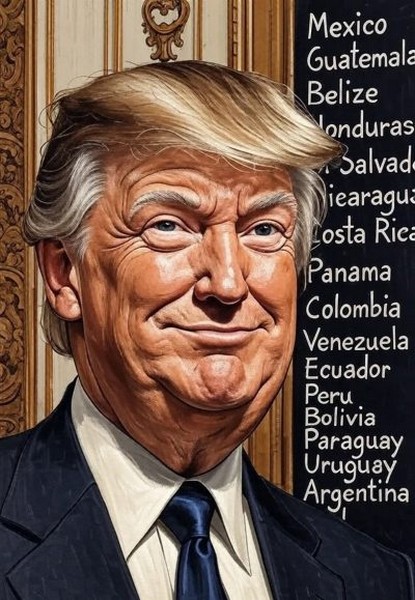
For decades, the term “Washington Consensus” evoked a potent mix of orthodoxy and controversy across Latin America and the Caribbean (LAC) with many believing it has largely failed. Coined in 1989, it became shorthand for a neoliberal policy package, that is fiscal austerity, privatization, deregulation, and trade liberalization which significantly impacts resource control promoted by Washington-based institutions like the IMF and World Bank. Its implementation in the 1990s yielded uneven results, often deepening inequality and deindustrialization in the long run thus sabotaging the region’s competitiveness. Today, amid persistent low growth, high debt, and inflationary pressures, a revised and repackaged Trumpian Washington Consensus that would also seek to limit who the region can do business with raises profound questions about national sovereignty and the future model of Latin American capitalism.
The region’s capitalism has historically been characterized by a sharp divide between a large, informal, low-productivity sector and a globally integrated, often commodity-exporting, formal sector. Latin America’s persistent low productivity is intrinsically linked to US foreign policy and the structural reforms of the Washington Consensus. The methods that shaped the region’s economic architecture inhibited sustainable, diversified, and innovation-led growth. The primary link lies in how the Washington Consensus, actively promoted by US-led institutions, reconfigured Latin American economies to serve as complementary, not competitive, partners in the global system. The doctrine’s pillars of so-called liberalization, privatization, and fiscal austerity were implemented in a specific sequence and context that had profound consequences snuffing out competitiveness. By demanding rapid trade opening in the 1990s, it exposed nascent Latin American industries to immediate, brutal competition from established global powers and the US, effectively de-industrializing many countries before they could climb the value chain. This locked LAC nations into their historical role as exporters of raw materials and low-value commodities. A return to a Washington Consensus under Trump offers fewer tools to address the region’s endemic problems of informality, inequality, and weak industrial capacity.
Based on the proposed National Security Strategy document, the US effectively seeks to replace the multilateral, market-based dynamics of global capitalism and globalization in the Western Hemisphere with a system of American economic and strategic primacy based on a neo-feudal, technocratic and neocolonial strategy. Consequently, the invisible hand is replaced by a visible American fist, guiding economic outcomes to serve US strategic imperatives like near-shoring and securing supply chains, effectively canceling the autonomous capitalist agency of LAC nations by not developing sovereign technological and industrial capacity.
The implications for LACs sovereignty are direct, although these states would not be directly annexed like Greenland possibly will, they would lose economic policy sovereignty, the freedom to set independent fiscal, monetary, and industrial policies. The sovereignty trade-off as seen by the governments that play ball with Washington, like Argentina’s is presented as a pragmatic bargain that some autonomy is surrendered in exchange for temporary stability and some access to capital, a calculation that tends to resonate with certain governments. That being said despite being seen as a poster child for US-aligned neoliberal governance, Argentina under Javier Milei continues to engage in substantial trade and financial transactions with China. Which shows how pragmatic economic relationships are channeled in reality as even ideologically aligned governments in Latin America cannot fully decouple from the strategic and commercial alternatives provided by Beijing.
The economic, financial and political context is fundamentally different from the 1990s, which may alter the ultimate outcome of a Trumpian Washington Consensus. China’s massive role as a trade partner, investor, and lender provides an alternative pole of influence, diluting Washington’s monopoly on ideas and capital. The emerging global multipolarity, characterized by the rise of China, the strategic cohesion of BRICS+, and renewed engagement from powers like the European Union and the Global South, has for the first time in a generation created a viable strategic and economic pathway forward for LAC. By providing credible alternatives to Washington-led institutions and their conditionalities, this new landscape has empowered LAC nations with genuine room for maneuver. It has transformed the region from a passive recipient of a singular economic doctrine into an active negotiator in a buyers’ market for investment, development finance, and partnerships. This competitive pressure has forced traditional partners, including the United States and the IMF, to offer more flexible terms and softened the rigid edges of the neoliberal model. Consequently, multipolarity has become the essential catalyst for creating a measure of sovereign economic agency, allowing LAC states to craft mixed development strategies, mixing market access, infrastructure deals, and technology transfers from various poles, tailored to national interests rather than geopolitical alignment with a single hegemon.
The return of a Washington-led economic framework to LAC now explicitly fused with a revived and mutated Monroe Doctrine, articulated as the “Trump Corollary” declares the hemisphere a zone of vital US interest from which “non-hemispheric competitors” like China must be expelled leading to a winding down adversarial outside influence, particularly targeting Chinese stakes in ports, infrastructure, investment, trade and strategic assets. Sovereignty, in this model, is not just constrained by macroeconomic conditionalities, but is directly bargained away in exchange for security guarantees and only access to US markets.
Which is why the return of the Washington Consensus would mean a painful return towards policies and decisions that have brought failure to the region over the past two decades. Moreover, declaring the Western Hemisphere a zone of vital interest where influence from non-hemispheric competitors like China will be actively denied would reduce options for the region. Among the US goals are securing supply chains and using economic and security tools to make the US the partner of first choice in LAC. It mandates that the terms of US partnerships and aid be contingent on winding down adversarial outside influence, specifically targeting control of ports, infrastructure, and strategic assets by competitors like China. This does not promote a free market where Latin American nations autonomously seek the best partnerships and investment deals but instead, it constructs a Fortress America model that limits their sovereign choice in economic partners, using US leverage in finance, technology, and security to induce them to reject alternative offers, regardless of market conditions. The question is can the US actually compete with China and BRICS in this regard offering better terms or will this be a mixture of Hybrid War and Neocolonialism?
Washington canceling LACs capitalist freedom of choice to impose a neofeudal technocracy would be primarily exercised through the conditionalities of the IMF, World Bank, and US trade policy, seeks not to abolish the part of capitalism where free actors choose who they transact and do business with seeking thus to reshape and discipline it according to a specific, market-centric orthodoxy.
This enforced primacy functionally cancels the core tenets of capitalism for these nations by rigging the market in favor of a single, dominant state. The document argues that American goods and services are better, yet the mechanisms to accomplish this are not competitive and seek to “push out foreign companies that build infrastructure in the region” and secure “sole-source contracts for our companies.” Market Capitalism requires the freedom to choose based on price, quality, and opportunity, but the strategy aims to present Latin American countries with a coercive binary choice of Us vs Them. By systematically using diplomatic and economic pressure, lawfare, color revolutions and unilateral force to eliminate competing options, making failed policies obligatory, the US would not be engaging in market competition but would be establishing a sphere of exclusive economic influence, where the invisible hand is guided by American national security directives.
The logical endpoint of this doctrine is a neo-feudal and neocolonial restructuring of hemispheric capitalism. LAC nations risk being reduced to the status of unincorporated territories within a US-dominated bloc, their economic policies aligned not by independent assessment of global opportunities, but by a mandate to bolster American resilience. The critical, unanswered question is whether the US can genuinely compete with China and BRICS by offering better financial and trade terms, technology, or if this project will rely predominantly on hybrid war, lawfare and imperialistic violence that deliver fewer profits and diminished competitiveness to the region.
All in all, this strategy constitutes a direct assault on the foundational principles of capitalism as understood in the region. True market capitalism requires the sovereign freedom to choose, to pick partners, craft deals, and select transactions based on price, quality, and developmental benefit. In this model, the region’s capacity for capitalist agency, to freely choose parameters of contracts, set terms of trade, and leverage global competition for their own development, is effectively subordinated to the imperative of maintaining American preeminence, transforming market-based solutions into instruments of unilateral strategy in the hemisphere.
*
Miguel Santos García is a Puerto Rican writer and political analyst who mainly writes about the geopolitics of neocolonial conflicts and Hybrid Wars within the 4th Industrial Revolution, the ongoing New Cold War and the transition towards multipolarity.
9 January 2026
Source: globalresearch.ca