
By Rima Najjar
Introduction: Research as a Technology of “Moderation”
As the UK braced itself for another round of Gaza-related culture-war fallout, a British think tank, More in Common, released a report with a deliberately soothing, above-the-fray title: After Choosing Sides: Britain’s Changing Views on the Israel-Palestine Conflict. Its publication coincided with headlines warning of rising antisemitism and a society supposedly fracturing under the strain of Gaza and the wider regional war. Framed as an exercise in bridge-building, the report presented itself as a neutral map of public opinion at a moment of national volatility.
Yet neutrality is precisely what the report performs rather than practices. Its authors segment the British public into moralised categories — “rooted patriots,” who affirm Israel’s “right to exist,” and “progressive activists,” whose willingness to name Israeli violence in Gaza is framed as a threat to social cohesion. Within this schema, pro-Palestinian voices appear less as political actors responding to material realities than as indicators of social risk in a nation imagined to be permanently on the brink.
Mandy Turner, a former professor of research methods who confronted the authors at their own webinar, immediately identified the design problem. Why, she asked, does the term occupation — the standard language of international law and UN reporting — barely register in a document running to well over a hundred pages? Why is Israel’s “right to exist” treated as a central test of legitimacy, while Palestinian self-determination is never posed as a reciprocal claim? The survey’s structure, Turner noted, repeatedly frames questions in ways that invite affirmation of one side while casting suspicion on the other. As she put it, with measured precision, “research methods training and ethics tell us that the way questions are framed elicits certain responses.” The effect is a classic bait-and-switch: design choices quietly channel opinion, and the resulting skew is then offered as evidence of dangerous polarisation.
For Turner, this is not a methodological slip, but a case study in how ostensibly neutral research can be engineered to produce specific political effects: normalising occupation by refusing to name it; centring antisemitism while marginalising Islamophobia and anti-Palestinian racism; pathologising “progressive activists” as destabilising extremists; and sidestepping the legal and policy frameworks — such as the IHRA definition and the UK’s Prevent duty under the Counter-Terrorism and Security Act 2015 — that already shape and police speech about Palestine.”
Her critique points to a broader genre of “attitudes,” “community cohesion,” and “campus climate” research in both the UK and the United States. These projects claim to measure fear, polarisation, and discrimination, yet in practice they help determine whose fear is legible, which words are rendered unsayable, and which forms of political solidarity are pre-emptively cast as suspect. Far from calming conflict, such research often functions as a technology of moderation: disciplining speech in the name of balance while leaving underlying structures of power intact.
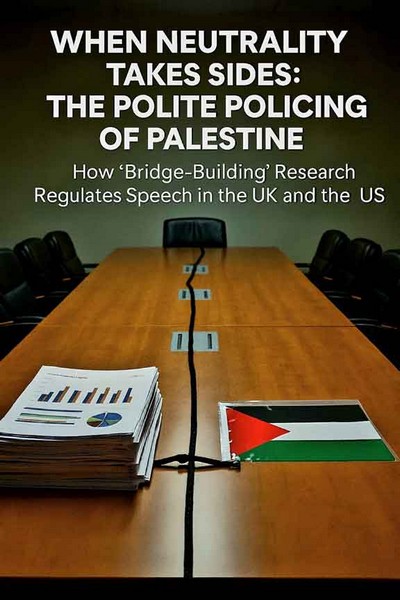
This essay takes Turner’s critique as a lens through which to examine that genre across the UK and the US, focusing on research and policy initiatives addressing Israel/Palestine and the wider regional war discourse. The central question is not simply whether their data are accurate, but what political order they help sustain: who is framed as dangerous, who is deemed in need of protection, and which forms of speech are managed or suppressed in the name of civility. Ultimately, it asks how these reports operate not merely as descriptions of public opinion, but as instruments that regulate speech and press down — materially and discursively — on Palestinian life itself.
I. Knowing by Not Naming: Conflict Without Occupation, Antisemitism Without Islamophobia
Turner begins with what is absent. Across more than a hundred pages, More in Common’s report barely uses the word occupation — the standard term employed by the UN and by international legal bodies to describe Israel’s control over Palestinian territory. Instead, it consistently substitutes the language of “conflict.” That single lexical choice does heavy political work: decades of military rule are flattened into a symmetrical dispute, and law is quietly replaced by mood music.
The same asymmetry governs the report’s treatment of rights. Respondents are asked whether Israel has a “right to exist,” and the text repeatedly affirms a “Jewish right to self-determination.” Palestinians are never granted a parallel claim. In the survey design, one people appears as a sovereign state whose legitimacy must be defended; the other is encountered primarily as a security problem to be managed. The absence is systematic, not accidental.
This selective vocabulary aligns with existing policy frameworks, shaping how Palestine-related speech is classified, scrutinised, and disciplined within institutional settings. In Britain, lecturers have faced suspension or investigation for using terms such as apartheid in teaching, while Palestinian students have been called into disciplinary processes for circulating scholarly material that cites the International Court of Justice.
The IHRA definition of antisemitism, presented as a neutral monitoring tool, has increasingly functioned as a speech-regulating instrument on campuses. In the United States, similar frameworks have been invoked in cases involving faculty discipline and the denial or delay of student graduations. The Knight First Amendment Institute has warned that such policies risk operating as “de facto speech codes,” even when justified in the language of data collection and safety.
Turner also notes the report’s tone when it comes to the word genocide — a term the authors suggest makes “constructive conversation harder.” Yet the survey data they themselves present complicate that claim. A substantial portion of respondents regard the term as at least somewhat appropriate for describing Israel’s campaign in Gaza, while a much smaller minority rejects it outright. By the report’s own earlier logic — where majority views are cast as “moderate” and minority positions as “extreme” — the designation quietly flips. The discomfort, it seems, is not with extremism, but with facts that refuse to stay polite.
This pattern recurs in parallel US research. Advocacy organisations such as the ADL have produced campus “report cards” that penalise universities where students publicly use prohibited language, including chants naming genocide or apartheid, even as those same terms are absent from the organisations’ analytical prose except when quoted as evidence of student misconduct. The words are treated less as descriptors of reality than as markers of deviance.
The effect is consistent. Material violence is recoded as a problem of discourse. Once that transformation is complete, the emergency is no longer mass civilian death, starvation, and displacement, but the discomfort of observers: a British teenager wearing a keffiyeh; an American professor assigning Amnesty International reports. Structural atrocity fades from view; hurt feelings move to centre stage. And the think-tank reports — calm typography, colourful charts, claims of balance — supply the necessary alibi.
II. Asymmetric “Safety”: Eighteen Pages for One Fear, Eight for the Other
Turner counts pages the way a coroner counts bullet holes. Antisemitism is granted eighteen pages of anxious prose in the More in Common report; Islamophobia limps in with eight. Jews make up roughly 0.5% of Britain’s population, Muslims around 6%. Do the maths. The report does not.
The same lopsided ledger appears elsewhere. When several synagogues in Golders Green were vandalised in May 2025, the attacks dominated headlines for days. When a hijab-wearing teacher in Manchester was shoved and cursed as a “Hamas lover” the same month, it barely registered beyond local feeds. The Council on American-Islamic Relations recorded 8,658 anti-Muslim complaints in 2024, a record high, many of them triggered by the visibility of keffiyehs or “ceasefire now” signs. One case among thousands illustrates the pattern: a Palestinian-American nurse in New York was dismissed after her employer took issue with an Instagram post citing Gaza’s rising child death tolls. Her case is typical of those documented by CAIR — meticulously recorded, briefly cited, and then quietly sidelined once the immediate news cycle passes.
Meanwhile, politicians and editorialists clutch antisemitism statistics like rosaries. Georgetown University’s Bridge Initiative tracked US media framing during the 2025 spring encampments: headlines warned of “Jew-hatred on campus,” while relying on longstanding stereotyped assumptions that conflate pro-Palestinian protest with antisemitism. The trope predates the present moment by decades — and it continues to do political work.
Turner highlights a striking asymmetry in the report’s own data. Pro-Israel respondents are far more likely to attribute hostile motives to their opponents: 65% describe pro-Palestine Britons as driven by Jew-hatred, and 62% say they deny Israel’s right to exist. Pro-Palestine respondents show a different pattern. They are more likely to credit pro-Israel views to sincere beliefs — Israel’s right to defend itself or historical Jewish vulnerability — and are less likely to attribute their opponents’ views to prejudice, with only around 40% citing Islamophobia.
The implication is hard to ignore: the group most inclined to interpret disagreement as hatred is later framed as calm, patriotic, and moderate, while the group that extends greater interpretive charity is classified as extreme.
What appears in the More in Common report as an asymmetry of attribution becomes, in the US context, an asymmetry of consequence. Universities that receive poor marks on the ADL’s Campus Antisemitism Report Card face reputational damage, donor pressure, and — in some states — heightened scrutiny tied to public funding and legislative oversight. Universities that ignore or sideline warnings from CAIR about anti-Palestinian or anti-Muslim harassment, by contrast, face no comparable financial or political cost; the reports are acknowledged, archived, and quietly shelved.
In Britain, the imbalance is felt at the level of students’ daily lives. Palestinian and Muslim students have been referred to Prevent for displaying symbols such as watermelon badges or keffiyehs — forms of political expression treated as potential indicators of extremism — triggering monitoring, interviews, and enduring records. Jewish students, by contrast, displaying nationalist slogans such as Am Yisrael Chai typically encounter responses framed as pastoral or low-level disciplinary matters: a quiet conversation, an administrative note, reassurance rather than surveillance.
Pro-Palestinian expression is routinely coded as a security risk, while pro-Israeli expression is treated as an identity claim. One draws institutional enforcement and disruption; the other attracts institutional protection.
Safety, in these reports, is portion-controlled like siege rations: full bowls for one table, crumbs for the other. The think tanks call it data. Palestinians and their allies experience it as slow suffocation.
III. Who Gets to Speak? Segments, Focus Groups, and the Pathologisation of “Progressive Activists”
Turner dissects the report like a prosecutor cross-examining a biased witness, beginning with a basic question: who gets to speak, who gets labelled, and who disappears. More in Common sorts Britons into seven psychometric segments — “progressive activists” for the keffiyeh-wearers, “rooted patriots” for the flag-wavers — using proprietary survey modelling and attitudinal clustering, while keeping the criteria and weighting largely undisclosed.
The report does not publish the survey questions that generate these categories, nor does it provide full cross-tabulations by age, gender, region, class, or religion. Patterns that would complicate the typology — such as Scotland’s markedly more pro-Palestinian lean, or women’s lower levels of support for Israel — are noted in passing and never integrated into the segmentation model. The result is a black-box sorting exercise that assigns political meaning without disclosing how those meanings were produced.
Those segments then structure the focus groups — and stack the deck. Two groups are drawn from the “progressive activist” category, yet their collective voice is reduced to a small number of quotations, including repeated lines from the same participant clustered late in the report and framed with visible editorial disapproval. One such voice is introduced in language that signals excess or obstinacy, with remarks summarised along the lines of “you can’t talk about this without naming genocide” or “any attempt at balance is complicity” — positions presented less as political arguments than as evidence of emotional rigidity.
By contrast, participants drawn from “rooted patriots” and adjacent categories are quoted frequently, at length, and often without visible labelling. Their comments circulate as common sense: paraphrased statements such as “both sides have suffered,” “it’s too complicated to take a side,” or “activists are making things worse by being so extreme” appear unmarked by category and unchallenged by editorial framing. These views are allowed to stand as reasonable observations rather than as one position among many.
Some comments even mock the segmentation itself, floating above the taxonomy that constrains others. Several participants, quoted without categorical labels, dismiss the entire issue as something activists and the media have “turned into a drama,” or complain that “both sides make it impossible to talk normally” — language that implicitly rejects the premises of international law without ever naming the occupation itself. One respondent shrugs that they are “tired of hearing about occupation, history, who started it,” and would rather “get back to normal life,” a sentiment presented as pragmatic moderation rather than political erasure. Another complains that discussions of Gaza have become “moral grandstanding,” positioning disengagement as a sign of balance and maturity.
What emerges is not a balanced qualitative inquiry but a selective audition, in which denial — whether overt or through cultivated indifference — enjoys the longest airtime, and silence about occupation passes as common sense rather than political choice.
The rigged chorus is not a one-off. In Britain, a 2023 report by the British Society for Middle Eastern Studies (BRISMES) and the European Legal Support Center (ELSC) documented the same silencing pattern across higher education. Examining dozens of cases between 2017 and 2022, it showed how IHRA-related complaints triggered investigations: lecturers questioned for teaching about apartheid, student unions scrutinised over BDS motions, and events cancelled because Nakba appeared in a title. In the overwhelming majority of cases, no sanctions ultimately followed. Yet the damage was already done — months-long investigations, reputational strain, stalled careers, and lost opportunities.
The BRISMES/ELSC report also documented a broader chilling effect. Palestinian and Arab academics described altering syllabi, withdrawing from public events, or shelving research after informal warnings or “monitoring” concerns, even in the absence of any finding of wrongdoing.
In publicly reported cases at UK universities, including Edinburgh and SOAS, staff cited fear of complaints and reputational harm as reasons for scaling back teaching and programming related to Gaza, settler-colonialism, or Zionism. Institutional reviews of antisemitism and racism increasingly relied on external guidance aligned with pro-Israel advocacy, with IHRA functioning less as one definition among others than as a default threshold for scrutiny.
In the United States, the same dynamic appears through administrative compliance mechanisms that prioritise risk management over open inquiry. At Northwestern University, a mandatory antisemitism training module introduced in 2025 — developed in consultation with mainstream Jewish communal organisations, including the ADL — provoked protest from Palestinian, Arab, and anti-Zionist Jewish students. Critics argued that the material blurred the line between antisemitism and anti-Zionism, presented contested political claims as settled fact, and framed Palestinian advocacy primarily through a security lens. When many students delayed or refused completion, the university responded with administrative holds affecting enrolment status and access to funding, reframing a pedagogical dispute as a matter of safety and compliance. Legal challenges followed; the policy remained in force while objections were processed.
Rutgers University’s Center for Security, Race and Rights analysed the architecture behind such measures in its 2023 report Presumptively Antisemitic. The study traced how counter-extremism discourse, donor-funded research, and lobbying networks converge to cast Muslim and Palestinian political expression as inherently suspect — treating speech not as a protected right, but as an early warning signal. Within a short period, the Center itself became a target. In 2024, Republican lawmakers in both the Senate and the House publicly accused it of promoting antisemitism or extremism, initiating inquiries into its funding and programming. The message was unmistakable: scrutinise the system, and you are reclassified by it. The “progressive activist” emerges less as a social category than as a managed threat.
Turner’s demand to “show your workings” is therefore not methodological nit-picking; it is a democratic insistence. Why are those who name occupation, apartheid, or genocide treated as pathological or dangerous, while denial and disengagement are welcomed as maturity? Speech here is not free; it is licensed. Moderation functions as a franchise, with silence as its entry fee. Everyone else auditions for erasure.
As encampments are dismantled and humanitarian access to Gaza remains obstructed, the central danger is not unruly protest but this engineered quiet. It operates through curated quotations, stalled investigations, missing datasets, and sealed reports — one vetted soundbite, one vanished testimony, one locked ledger at a time.
IV. Recommendations That Ignore the Machinery of Repression
Turner saves the scalpel for last: the report’s closing recommendations. They are presented as practical correctives to polarisation: explicit reassurance that criticism of the Israeli government is “legitimate”; encouragement for schools to host “open debate” on Israel–Palestine; calls for educators to distinguish clearly between antisemitism and political disagreement; and appeals for more empathetic dialogue across divided “segments.” Offered as solutions, these prescriptions function like aspirin for a bullet wound. On paper, they sound measured and reasonable. In practice, they read like dispatches from an alternate universe — one in which speech on Palestine is not already regulated by statute, funding leverage, and security doctrine.
This mismatch between prescription and reality becomes clear once the institutional terrain is examined. In Britain, the IHRA definition did not simply drift into policy. After its adoption by the UK government in 2016, universities came under sustained pressure to comply. In 2020, then education secretary Gavin Williamson warned institutions that failure to adopt IHRA could expose them to investigation and potential sanctions by the Office for Students, including financial penalties following antisemitism complaints.
The chilling effects are now well documented: events cancelled over a single word in a title, lecturers investigated for teaching about apartheid, student unions scrutinised for BDS motions. While a small number of universities — including Edinburgh — have periodically revisited adoption, most have opted for pre-emptive compliance and routinised self-censorship. In this environment, appeals to “open debate” that omit the enforcement architecture read less like principle than evasion.
The Prevent duty compounds the contradiction. Since 2023, civil-liberties groups, journalists, and educators have documented increased referrals involving children and students for expressions of pro-Palestinian solidarity — badges, drawings, chants, or statements of anger about Gaza interpreted as potential indicators of extremism. Many referrals result in no further action, but the consequences are nonetheless real: interviews, safeguarding panels, family anxiety, and enduring records. Human-rights organisations, including Amnesty International, have repeatedly criticised Prevent for racialised overreach and called for its repeal. By 2025, universities such as SOAS again became sites of controversy over disciplinary measures and intensified scrutiny of Palestinian activism. Recommending “debate” in this terrain is not naïve; it is disingenuous.
Across the Atlantic, the same dissonance appears at scale. Harvard University released two major task-force reports on 29 April 2025 — one on antisemitism and anti-Israeli bias, the other on anti-Muslim, anti-Arab, and anti-Palestinian bias — together exceeding 500 pages. Both acknowledged fear, harassment, and exclusion across communities and affirmed commitments to inclusion and free expression.
Yet their publication coincided with intensified federal pressure. Under expanded Title VI enforcement tied to campus protests over Gaza, hundreds of millions of dollars in federal funding were placed under review across US universities. Columbia, Northwestern, UCLA, and dozens of others faced investigations or funding threats by mid-2025. In this context, universities learned quickly that institutional survival depended less on protecting speech than on managing it.
The Knight First Amendment Institute has repeatedly warned that embedding IHRA in disciplinary or compliance frameworks risks violating academic freedom. Yet campus trainings routinely conclude with the same hollow assurance — that legitimate criticism of Israel is permitted — even as students report being labelled extremists, harassed for wearing keffiyehs, or discouraged from pursuing research on Palestine. The contradiction is structural, not accidental.
Turner’s point is devastating precisely because it is modest: show your workings. Name the mechanisms before prescribing the cure. When reports urge moderation without confronting IHRA, Prevent, or Title VI enforcement, they normalise repression. Suspicion becomes procedural. Surveillance becomes common sense.
Addendum: Extending the Frame — Lebanon and Iran
The same research grammar that governs Palestine discourse is increasingly visible in studies and policy reports on Lebanon and Iran. In both cases, structural conditions — foreign intervention, sanctions regimes, occupation by proxy, and economic strangulation — are displaced by the language of “instability,” “sectarianism,” or “radical influence.” Research on Lebanon, particularly following Israel’s repeated military campaigns and the country’s economic collapse, often treats Hezbollah primarily as an extremist pathology rather than as a political actor embedded in a society shaped by displacement and unresolved war. Iran is similarly framed less as a state responding to encirclement and sanctions than as a civilisational threat whose internal dissent must be read through a security lens.
These studies acknowledge civilian suffering but avoid analysing the political forces that produce it. They frame resistance as a problem of radicalisation rather than as a response to violence or dispossession. They largely omit legal questions surrounding occupation, sanctions, and the use of force. Lebanon and Iran therefore confirm, rather than complicate, the argument: the same moderating logic operates across different national contexts.
Conclusion: Reading Research as Part of the Battlefield
In the UK and the United States, research on “social cohesion,” “campus climate,” and “changing attitudes” describe as well as govern opinion. These reports help decide which forms of grief are intelligible, which solidarities are acceptable, and which kinds of speech are reclassified as threats. Read this way, research is not downstream from power. It is one of its quieter instruments.
Across the literature examined here — from After Choosing Sides to campus audits, task-force reports, and security-framed studies — certain patterns recur. Structural realities are displaced by abstract language; antisemitism is positioned as the organising threat; Islamophobia and anti-Palestinian racism remain secondary; and the legal and policy frameworks that already discipline speech fade into the background. The result is containment.
Turner’s intervention offers a method for reading this genre against itself. Her insistence on transparency asks who sets categories, whose fear counts, and which pressures are rendered invisible. It reframes research as a site of political struggle, rather than neutral mediation.
For scholars committed to justice, it is not enough to measure attitudes towards a sanitised “conflict.” One must also map the conditions under which those attitudes are permitted to surface at all. And for activists and students encountering these reports from the outside, Turner’s critique offers both a warning and an invitation: research is itself a battlefield. Vigilant reading, critique, and counter-research are forms of resistance.
Rima Najjar is a Palestinian whose father’s side of the family comes from the forcibly depopulated village of Lifta on the western outskirts of Jerusalem and whose mother’s side of the family is from Ijzim, south of Haifa.
9 December 2025
Source: countercurrents.org