
By B.R. Bapuji
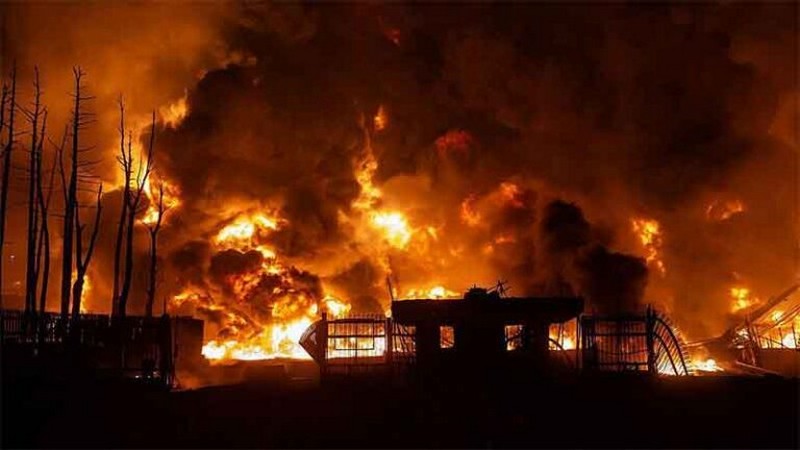
It is well known that on February 28, the governments of Israel and the United States, acting together, began bombing Iran and have continued the attacks.
Many articles are being written discussing this war from different angles. Such discussions explain how this war violates international legal principles and how Israel, in pursuit of regional dominance, and the United States, in pursuit of global dominance, are conducting this war with great aggression. Examining these issues from various perspectives is certainly useful for readers.
In this article, my aim is to show that the root cause of war lies in the competition over the sale of commodities.
In any society, the production of goods mainly occurs in two sectors. First: The sector that produces the means of production required to produce commodities. Machines, raw materials, and similar items are produced in this sector. Second: The sector that produces commodities necessary for people’s maintenance, such as food, clothing, housing, healthcare, and education.
However, in a capitalist society, there is another type of production that serves neither as a means of production nor as a means of the necessities of life. That is the production of weapons. Why are these produced? To enable one class to suppress another class, or for the government of one country to keep another country under its control.
The immediate objective of the aggressive war currently being waged by the United States and Israel is to establish dominance over Iran. Through that dominance, they aim to seize not only the vast oil reserves in Iran but also valuable minerals and metals, including zinc, copper, iron, gold, coal, and lithium.
Another important point is that whenever wars occur between two countries or between two alliances, the ones who benefit the most are the capitalists who produce war equipment as commodities. Weapons are produced not only by private capitalists. Governments themselves, acting as capitalists, also undertake this production.
In the present war, news reports say that hundreds and thousands of weapons are being used, leading to shortages of military supplies. According to Reuters, the U.S. Department of Defense recently summoned representatives of major arms companies and placed orders three to four times larger than before. Furthermore, the United States has decided to sell 27,000 bombs worth 660 million dollars to Israel.
Leaders of both the ruling and opposition parties in the United States—and even their spouses—hold large amounts of shares in these arms manufacturing companies.
Two days before the United States and Israel began the war against Iran—on February 26—the U.S. State Department website published details of the weapons the United States had sold to various countries and the supplies still pending.
According to orders issued on February 6, the document listed details for nearly 40 countries: the types of weapons they required, their power levels, the number of units needed, and the delivery schedule.
Among those 40 countries are several U.S.-allied countries surrounding Iran, such as Saudi Arabia, Kuwait, Lebanon, Bahrain, the United Arab Emirates, and Qatar. This means those countries must purchase weapons from the United States by spending billions of dollars. Where does that enormous amount of money come from? It comes from the millions and millions of dollars in surplus value extracted from working people by their masters through the exploitation of labour.
And it is not spent on essentials like education, healthcare, or employment. Instead, soldiers are sent to foreign countries where people and soldiers there are killed, while people and soldiers here are also killed by the other side. It becomes nothing but mutual bloodshed. About such horrific situations, the Urdu poet Sahir Ludhianvi, who had communist leanings, wrote in 1965 in an anti-war song titled “O Good People”:
“Whether it is our blood or the blood of others/in the end it is the blood of humanity. /Whether war takes place in the East or in the West/ it is ultimately the blood of world peace./Whether bombs fall on homes or on borders/the soul of creation is wounded. /Whether our fields burn or the fields of others/life trembles with hunger./Whether tanks move forward
Or retreat/the womb of the earth becomes barren.
Whether there is a celebration of victory
Or sorrow of defeat/life weeps over corpses.
War itself is a problem/how can it provide solutions to problems?”
The poet Sahir does not stop with this observation; he also shows a path of struggle:
“Therefore, O good people/come—let us spread the light of thought in this unfortunate world./Let us begin struggles that strengthen peace/A struggle against politics that harvests death. A struggle against poverty and slavery./A struggle against misguided leadership./A struggle against capitalism./A struggle against the ideology of war/Peace—for a peaceful life!
Therefore, what we must do, as Sahir suggests, is struggle against the capitalist system. The first step toward that struggle is to understand how far this system is willing to go—how cruel and immoral it can become—in pursuit of profit.
Karl Marx, in his work “Capital,” quotes a trade union leader who described the nature of capital very well: “Money, they say, comes into the world with a bloodstain on one cheek; but capital comes into the world dripping from head to toe, from every pore, with blood and dirt. If there is sufficient profit, capital becomes very bold. With a guaranteed 10 percent profit, it will engage in any business. With a 20 percent profit, it becomes enthusiastic. With a 50 percent profit, it becomes daring. With 100 percent profit, it is ready to trample on all human laws. With 300 percent profit, there is no crime it will hesitate to commit, nor any risk it will avoid—even if it means the possibility of its owner being hanged.”
B.R. Bapuji is a former Professor, University of Hyderabad
13 March 2026
Source: countercurrents.org