
By Harsh Mander
The medical profession in India – as in much of the world – today has lost its way.
From a vocation of care and service, it has widely transformed into a soulless vehicle for super- profits. The growing separation of the medical profession from ethical practice and the overwhelming sway instead of profiteering is indeed the greatest, most intractable crisis of medical education today.
Medical colleges teach medical knowledge, skills and sophisticated clinical technology and practice. But can they equally teach an ethical approach to medical practice, a commitment to equity and a resolve to serve those most in need of one’s services without considerations of money? Can medical colleges restore a profession inebriated with private gain and profit to its core mission of care especially of people who are most disadvantaged?
Searching for answers, I look at two widely contrasting pathways chosen by India and Cuba, both middle-income countries that have adopted vastly different models for medical education.
The case of India
India has the largest numbers of medical colleges in the world. India also has one of the most privatised health care systems in the world.
The case of India illustrates best why training more health workers does not automatically bring the country closer to the goal of universal health care. It establishes emphatically that more trained health workers do not result necessarily in more doctors and nurses who serve in rural and forested regions and shanty towns.
As many as eight out of 10 trained physicians in India work for the private health sector, many in large corporate hospitals. This leaves just two out of ten trained physicians in India who choose to work in the public health sector. These too are mostly bunched in tertiary and super-tertiary hospitals in urban areas.
Even the small numbers in public hospitals do not guarantee greater health equity. Even doctors employed in public hospitals in India are notorious for running private practices on the side. Patients learn that they are more likely to be prescribed hospital beds and surgery in the public hospital if they first visit the same doctor’s private clinic and pay a few.
The ratio of just two out of 10 doctors in India who choose to work for the public health system is still a considerable over-statement if we consider the numbers of doctors who graduate in India. Among all low- and middle-income countries, India is the biggest source of trained physicians exported to the high-income countries.
Research shows that 4.9% of American physicians and 10.9% of British physicians are physicians trained in India. Studies indicate that many of these train in the leading public institutions of the country. Therefore, of all the doctors who graduate from Indian medical schools, even far less than two in 10 work in public health within India.
India’s most prestigious and top-ranked medical college is the super-tertiary All India Institute of Medical Sciences in Delhi, the national capital. From around 30,000 applicants, only 45 students (0.15%) are selected each year.
A dear friend teaches in this institute. He resigned from his comfortable position in the National Health Service in London to return to serve in the country of his birth. He loves his work and is greatly sought out by patients who travel from far corners of the country, drawn by his reputation. But when I asked him once how he likes his teaching responsibilities in the hospital, he replied dryly. “It’s okay,” he began laconically. “Except that even in their first year in the institute, only the bodies of my students are in the classroom. Their souls have already migrated to the US and the UK!”
That he was not exaggerating was confirmed by the findings of a significant study which revealed that 54% of AIIMS graduates during 1989-2000 now reside outside India. Students who qualified under the “general category” (meaning they were not in the affirmative-action category) were twice as likely to migrate abroad. Other studies also confirm similarly that elite medical schools contribute disproportionately to the ranks of emigrant physicians. Moreover, even within the elite schools, students with the highest academic achievement have the greatest likelihood of migrating.
This raises fundamental doubts not just about the quantum of medical education facilities available in low- and middle-income countries but also their quality. If high achievement is closely tied to a high likelihood of migrating to high-income countries, we need to ask what is considered high achievement in medical education? More so, when, for the overwhelming majority of those who do not migrate, the preferred career course is the private corporatised health sector.
The India story is a sombre reminder that the central challenge is therefore not of creating significantly larger numbers of health professionals trained in curative skills that are valued in the health sectors of high-income industrialised countries. If low- and middle-income countries expend limited public revenues to train health workers whose skills are valued in high-income countries, and these countries or the private health sector are the preferred sites of their vocation, these public revenues are contributing little to advancing the right to health care in their countries.
In the early decades of India’s freedom, the state vested significant public funds on establishing public medical colleges. These were attached to large tertiary care public hospitals. The clinical skills that students gathered must have been of sufficiently high-quality for the acceptance of Indian medical graduates in high-income countries in larger numbers than from any other country of the Global South. The students, through their internships and residencies, treated large numbers of lower-income patients who crowded the corridors of these public hospitals. Still, large numbers chose to leave the country, or cluster in urban centres, reluctant to serve the vast hinterland of the countryside and towns where more than half the population lived.
But neo-liberalism from the 1990s brought with it first the rapid decline of public health systems and growing reliance of rich and middle-class Indians on private corporate hospitals. We also have noted that after a large migration of graduates from the best-ranking medical schools, eight out of 10 doctors opted to work with the private health sector.
These winds of change transformed also the medical education sector. That India has more medical colleges than any other country in the world is not surprising because it is now the world’s most populous country. But India ranks very low in the number of doctors as a ratio of its population.
The difficulties of finding sufficient budgetary resources for financing health worker education led many governments, such as India, to turn to the private sector to open private medical and nursing schools. The advocates for this argue that privatisation not only provides necessary resources, but also flexibility and quality that can be complementary to public-sector training. International organisations advocate cautious integration of private resources within strong regulatory frameworks, prioritising public health needs. Health activists on the other hand typically oppose extensive privatisation due to equity concerns, advocating instead for strong public investment.
In a bid to fulfil the massive gaps in the health workforce, since the 1990s, the Indian government changed policy that resulted in transmuting medical education into a lucrative business. Businesspersons and politicians with no experience in running medical schools swarmed the country with money and connections to establish medical colleges. The result is that since the 1980s, the number of government colleges have doubled, while those run by the private sector rose 20 times. The number of medical schools rose steeply from 256 in 2006 to 479 in 2017. Of these, 259 are privately owned and managed. Around 48% of MBBS seats in India today are offered in private medical colleges.
Avinash Supe and Soumendra Sahoo in a significant essay titled “Malpractice in Medical Education” lament, “Medical education is now seen as a lucrative business linked to large profits. It has drifted away from its social mission.” These private medical colleges are founded and run by trusts established by powerful political and business interests. They “charge huge fees from aspiring students”.
In addition, many take large bribes to admit students. Regulation is wantonly weak. Regulatory bodies “have turned a blind eye to the deficiencies and subversions of the minimum standards laid down in several such institutions”. They do this because they are “passively caving in or actively succumbing to pecuniary temptations”.
The result of the high fees and bribes is that “for a middle-class student, it means the family having to mortgage their homes in order to fulfil their child’s ambition”. Supe and Sahoo observe that “earning money has become the major priority of a student graduating from medical college”. When such students start private practice, “they are tempted to over-investigate and over-treat their patients in order to earn back the money they spent in getting their medical degrees”.
Typically, hospitals run by private medical colleges offer a much smaller range of patients than those in public medical colleges. Further, examinations rely on rote-learning, diverting students even further away from patients and wards, which is where they should truly learn their vocation. The integrity of the exam system has also been disgracefully compromised.
In all of these ways, our assessment is harsh, but I believe it is not unfair that the medical education imparted by profit-seeking medical schools in India prepares a health workforce that learns early to value personal profit over their patient’s well-being. India’s is a morality tale of how to add large numbers to a country’s trained health care workforce while doing little to take health care to the doors of those who need it most.
The case of Cuba
Cuba’s accomplishments in medical education would place Cuba at the other end of the spectrum from India. Perhaps more than any other country in the world, Cuba has accomplished significantly equity-driven medical education. It has paved innovative pathways to building a massive health workforce equipped with not just the skills, but also the dedication and values of public service. This skilled and devoted workforce has enabled Cuba to secure, despite being a middle-income country, health outcomes that are comparable or better than those of rich countries. Cuba’s health workers are reported to be the soul of Cuba’s accomplishment of extending free quality health care to the entire population.
Accounts of Cuba’s remarkable accomplishments in medical education reveal that its first feat is in numbers. Before the revolution in 1959, Cuba had a single medical school and 6,300 doctors. Half these doctors left the country. Today, Cuba has the highest doctor to population ratio in the world.
But its achievements are much more than its incredible accretion of numbers. Cuba’s greater triumph is that Cuban doctors are widely acknowledged to stand out among their peers around the world for their willingness, even eagerness, to live among and serve disadvantaged populations, within Cuba and the rest of the world. Although it was not compulsory, almost all graduates have volunteered to serve in rural areas.
What in Cuba’s medical education policies made these singular, accomplishments possible? One significant difference from medical education around the world was that the basis for selection of medical students for entry into medical school was altered to prioritise the mettle of character over of the mind. Academic qualifications were not the sole or paramount criteria for admission to medical schools. Selectors gave weight to their sense of vocation, responsibility and commitment to solidarity.
Next, the students, unlike in most medical schools, spend a much smaller time in tertiary hospitals. A lot of their training is decentralised to health institutions located in communities. This is linked to three major innovations in the Cuban health system. The first of these was to extend health services to rural areas and develop a nationwide primary health care network. Then in 1965, Cuba created a network of 498 “comprehensive” polyclinics that initially covered 45,000 persons each, and then in the 1970s, 25,000-30,000 persons. These combined primary care, specialist services, diagnostics and health education. The third institutional innovation from the 1980s was the Family Doctor Programme. Family Medicine Clinics with a doctor and a nurse each covered neighbourhoods of 120-150 families, with curative services but also health education, epidemiologic surveys, linkages with social institutions like homes for the elderly and teaching.
This called for a new medical curriculum to train doctors who would “understand, integrate, coordinate and administer the treatment of each patient’s health needs, as well as the community at large”. Students learned to understand patient needs “holistically rather than as fragmented ‘organ/systems’ diagnosed and treated by different hospital specialists”. In 2003, this coalesced into a new medical training model that shifted further from medical schools and teaching hospitals to community polyclinic and clinics as the central sites for teaching general medicine.
Students studied in diverse settings, ranging from traditional classrooms, doctors’ surgeries, primary health care centres, polyclinics and hospitals. Approximately 75%-80% of the teaching occurred in community primary care facilities with an accredited polyclinic as the central teaching unit. The curriculum was designed to integrate clinical practice with public health principles, equipping students with the skills to address diverse health care challenges. Interdisciplinary approaches, such as combining biomedical sciences with psychology and sociology, ensured that graduates were prepared for the complexities of modern health care delivery. The emphasis on active learning and community engagement also fostered a sense of responsibility among future doctors.
Cuba’s focus on primary care and health promotion, designed to prevent 90% of health problems, was central to its medical education. A student spoke to The Lancet about how inspired he was by the focus on preventive medicine and public health. “The doctors actually take time to educate the community,” he said, such as going to a patient’s home to show them how to cook with less salt, or demonstrating proper hand-washing to mitigate infectious diseases such as cholera.
Evaluations revealed that the clinical skills of these doctors were no way less than those more conventionally trained. But they had a much higher average level of public spiritedness and willingness to serve in difficult areas, not just in Cuba but around the world.
The remarkable success of the Cuban health system deeply rooted in neighbourhood communities is widely acknowledged even by outside observers. A visiting American team of pharmacy college staff, for instance, applauded Cuba’s universal health care delivery system. This, they said, “exemplified home health” in which “doctors and nurses live within the communities and open their doors to all-hour care for their neighbours”. The Cuban health staff “devote considerable human resources to providing care and doctors are basically embedded in the neighbourhoods. When something is wrong, they can react quickly. They have achieved a high quality of life for their patients for the most part, which wasn’t a surprise”. “They have much better access to physicians for primary care than we have” in the United States, a team member opined. This gives a sound foundation to the focus of Cuban medical education on equity and service.
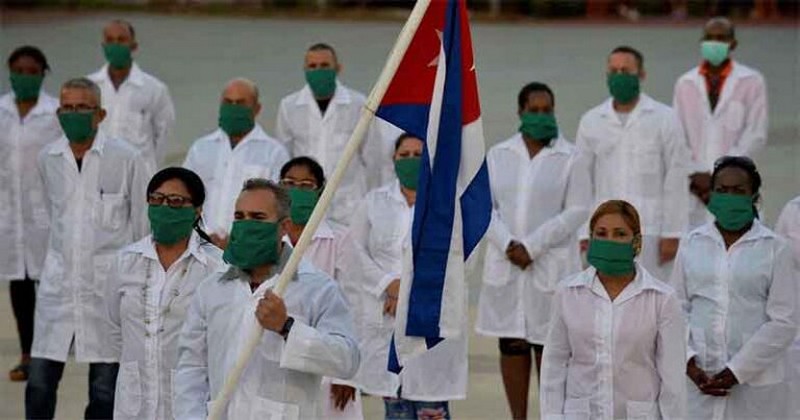
The Cuban government maintains that the spirit of service and solidarity that Cuban medical education has fostered has benefited not only less advantaged populations within Cuba. From the 1960s onward, Cuba dispatched medical brigades to provide disaster relief and long-term health care support in underserved regions worldwide. Cuban doctors have reached underserved and disaster-hit populations in the poorest regions of the world and also offered medical training to students from other Latin American and African countries. Stirred by this singular spirit of humanitarianism, Cuba has sent 325,000 of its health workers to 158 countries in over five decades since the revolution. A total of 49,000 Cuban health care workers are working in 65 countries around the world.
This is often presented as glowing demonstrations of Cuba’s unparalleled international medical solidarity through its medical internationalism programmes. Time magazine, however, underlines that this is not all about altruism. “When you have a very well-educated population but also shortages of cash and goods, you want to find a way to monetize it,” a Cuba expert told them. Cuba’s “army of white coats” leased to foreign governments brings in remittances of around 11 billion dollars a year, making this a higher revenue earner for the country even than the tourism industry.
In 1998, Cuba started an international medical school offering free medical education to people from low-income communities from around the world. It has trained, with full scholarships, free room and board and some spending money, more than 26,000 students drawn from more than 123 countries. Several students are Latin American and from sub-Saharan Africa. Many return to work with disadvantaged communities in their countries.
What still sets Cuban medical education apart from conventional models is its integration of social responsibility, equity and public health into the curriculum. Cuban medical training emphasises a broader skill set, including roles as caregivers, managers, community leaders and educators.
Right from 1965, a tradition grew in Cuban medical schools that medical graduates would pledge to renounce private practice.
Cuban medical education teaches not only primary care, but also the ethics and obligations of the medical profession. The ideology of solidarity is an inherent part of the curriculum. If there is a crisis anywhere in the world, a student said proudly to The Lancet, “I just pack some underwear and I’m ready to go.”
It is the “right of every citizen to have free and quality care”, that is also accessible and equitable, declares another student. “To be able to have a health system like we have, you need the political will.”
I am grateful for research support from Rishiraj Bhagawati.
Harsh Mander is a peace and justice worker, writer, teacher who leads the Karwan e Mohabbat, a people’s campaign to fight hate with radical love and solidarity.
10 December 2025
Source: countercurrents.org