
By Nayeema Ahmad Mahjoor
The US and Israeli bombardment might be destroying the lives and livelihoods of the Iranian people. Still, from afar, it is bleeding every Kashmiri heart, regardless of sect, faith, or status.
The heart’s cry for Palestine seems to miss a beat for Tehran.
This is the first time since the end of internal autonomy in 2019 that thousands of Kashmiris took to the streets without regard for security forces and restrictions, participating in mourning the death of Ayatollah Ali Khamenei as a consequence of the US-Israeli war imposed on Iran. The mourners, under heavy police escort, highlighted various aspects of Khamenei’s life and his friendship with Kashmir.
It was observed with great pain that more Sunnis than Shiites participated in mourning processions in Kashmir and strongly criticised the US/Israeli aggression.
Approximately sixteen per cent of the population in Jammu and Kashmir are Shiites. The Shia sect was introduced into Kashmir in the fourteenth century by the Iraqi scholar Shamsuddin Iraqi, and it later flourished in the fifteenth century, when the Shia Chak dynasty ascended the throne of Kashmir.
The Mughal Emperor Jalaluddin Akbar abolished the Chak monarchy in 1586 and annexed Kashmir to India. That marked the start of invasions into the Kingdom of Kashmir.
The reason for condemning the American attacks on Iran in Kashmir is also clear from the fact that there have been close public relations between Kashmir and Iran. In addition to trade and religious ceremonies, Persian has long been the official language in the valley, later replaced by Urdu during the Dogra era. The strong influence of Iranian culture on local life and livelihood persists today, which is why Kashmir is often called ‘Minor Iran’.
After visiting Kashmir during the Maharaja’s era, Sir Mohamad Iqbal conveyed the place’s helplessness in this way,
Today, it is Kashmir — oppressed, forced, and impoverished.
Yesterday, what the wise called Minor Iran.
Most of the authentic histories and literary masterpieces of Kashmir are also written in Persian, which historians and authors consult in Iran to study, and this tradition continues to this day.
Compared to Arabs, Kashmiris have historically had a closer relationship with Iran, which has consistently spoken out against human rights violations during turbulent times and supported a peaceful resolution of the Kashmir issue in international forums. However, while Iran has previously maintained close relations with the Indian government, those relations are no longer as warm.
Iranian support during the two and a half years of Israeli genocide in Gaza has further strengthened the sense of closeness towards Iran among Kashmiris. Despite government’s tacit restrictions, they have vocally backed Iran in rallies condemning the recent Israeli-American aggression.
Although many elements tried to incite sectarian chaos in the valley, for which they sought the services of numerous religious clerics, Kashmiris strongly condemned it. They thwarted the intentions of these elements.
Perhaps one reason for the surging public sentiment is that, despite India’s Muslim population of 250 million, the government openly expressed support for Israel, prompting Muslims from Kashmir and other states to respond with enthusiasm in making donations.
This is why public support for Iran is so clear: in one village, donations amounting to Rs. 10 million were collected in a single day.
Apparently, Iran has always publicly supported the restoration of Kashmiris’ political rights; however, most observers believe that Iran has often favoured India’s stance in international organisations.
Six years ago, when Kashmiri people were deprived of their internal autonomy by losing their power, most of the Imams in Iranian mosques strongly condemned it. At the same time, Ayatollah Khamenei, citing his close ties with India, appealed to restore the rights of Kashmiris. Despite that Iran and India have had close relations, he made a statement on Kashmir at that time.
But it has often been said about some pro-India Kashmiri leaders affiliated with the Shia sect that they played a key role in shifting Iran’s stance in favour of India by strengthening their ties with Iran, and some of their descendants are still working on this today.
Although the All-Party Hurriyat Conference, fighting for the freedom of Kashmir, also included Shia leaders who were later regarded as a moderate faction within Hurriyat.
After the attacks on Iran, the central Lal Chowk and the suburbs of Srinagar were filled with crowds, just as they did during freedom processions in the nineties, which gradually transformed into mourning processions in every district. The following day, security forces sealed off Lal Chowk and most of Srinagar with tin sheets. When people refused to disperse, recognising the public’s anger, they were permitted to mourn elsewhere.
Whether it was the hanging of Zulfikar Ali Bhutto or the air crash that killed General Zia-ul-Haq, a large number of Kashmiris took to the streets. They began wailing, during which sometimes leftists and sometimes Jamaat-e-Islami workers were subjected to violence.
Iran’s firm stance against Israeli brutality in Gaza rekindled recent sympathy for Iran among Kashmiris, and they now admire the Iranian leadership for supporting the oppressed.
Another link between Kashmir and Ayatollah Khamenei was established when he visited Kashmir in 1980 at the request of Ruhollah Khomeini and emphasised the importance of sectarian unity. Before going to the Shia mosque, he visited the Jamia Mosque in Srinagar, where he attended Friday prayers with the late Mirwaiz Maulvi Farooq and called on the people to unify as one nation rather than remaining divided by sectarian differences.
This is why there was intense anger and grief over Khamenei’s death in the city centre, and stone-pelting had also begun at many locations, which was immediately brought under control.
Observing the central government’s pro-Israel stance, Kashmiris chose to align with Iran, and by standing united against the ongoing violence, they conveyed to the government that they would never endorse Israeli aggression.
Many Muslims were surprised that Prime Minister Modi did not express condolences for the death of Ayatollah Khamenei or the murder of hundreds of schoolgirls earlier, which has led to criticism from leading opposition parties, including the Congress, claiming that Modi does not want to anger Israeli Prime Minister Netanyahu, with whom he was touring Tel Aviv a day before the Israeli-American attack on Iran.
Most public and political parties criticised Modi for changing India’s foreign policy without consulting anyone, while Iran has long been an old friend of India.
Although the Ministry of Foreign Affairs, under pressure from the public and opposition, has expressed sympathy for Iran and emphasised efforts to establish peace in the region, the BJP’s pro-Israel policy has not only caused significant anxiety among the public, especially Muslims, but has also led to grief over the tarnishing of India’s image on the global stage. Watching Pakistan take centre stage in international diplomacy and emerge as a peacemaker, many politicians and civil society members have strongly criticised Modi for sidelining India when it could have played a crucial role in peace-making.
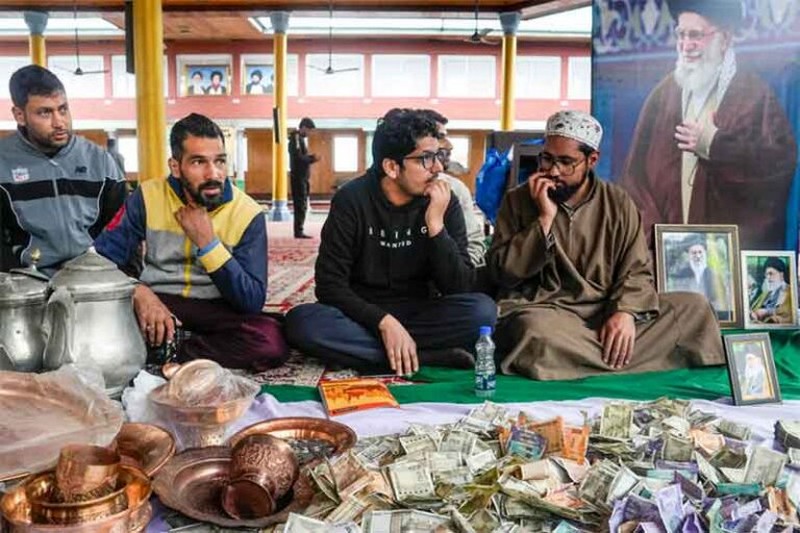
Not only did crowds gather on roads, but they also set up centers to collect donations for Iran, which have now exceeded fifty crore rupees, according to initial estimates.
Chhattargam’s Sara Begum, with all her savings, walked for three hours to reach the Zadi Bal area of Srinagar, where people from different areas were gathering in large numbers to help Iran. Just on Eid, when an appeal was made to help Iran, crowds gathered at the Imam Baras.
Sara Begum’s bag did not hold paper money, but instead contained old one- or two-rupee coins, which she had been saving for a long time and had dreamed of buying a cow at the right moment. However, now, after the death of the Iranian leader, her dream is shattered.
‘When I saw the pictures of the damage caused by the American and Israeli bombing of Iran, my heart sank, and I worried about those mothers and sisters whose entire assets had been razed to the ground in just a few minutes. I decided that whatever savings I have, I will give to Iran; a cow is not needed as much as my sisters need help at this time.’
Like Sara, thousands of Kashmiri women line up in long queues at centers organised by Shia associations across various districts to receive donations for Iran.
Kashmiri children, old and young, rich and poor, Shias, Sunnis, Hindus, and Sikhs are all taking part in this effort and want to contribute to Iran’s aid fund. However, the other side of this is that the government’s change in Iran policy and the subsequent questioning of some donors have also created concerns and anxiety for many people. Why is the government interfering in our donation affairs, which have nothing to do with politics? asked many donors.
Ramiz Ali (name changed for security reasons) from Budgam says that when he deposited a large sum of money into Iran’s aid account, he received a call from the police and was asked to appear at the police station.
Ramiz says, “If we want to help Iran, it has become necessary to do so with the government’s consent, as would be the case in an authoritarian regime. We don’t care about the government’s policy; let it support Israel. We cannot support those who committed genocide in Palestine or destroyed a peaceful nation. The recent policy of the central government has hurt our feelings.”
Appreciating the spirit of the Kashmiris and their example of donation, the Iranian ambassador in Delhi expressed his gratitude and said he values this gesture. The Iranian embassy released the bank account details at public insistence to enable the transfer of aid money directly to Iran. It is estimated that millions of rupees have been received in this account.
The Tehran Times published an image of a drone in a news report, with the caption thanking the Kashmiris and seeking revenge for the death of Ayatollah Khamenei.
Agha Syed Muhammad Hadi Moosavi, associated with the Anjuman Sharia Shian in Jammu and Kashmir, states that those who did not have cash donated copper vessels, gold, silver, vehicles, and valuables. Agha Moosavi further said that it is a living example of our traditional and cultural ties with Iran, as today the people have united and paid tribute to the services of those seven hundred Iranian sages who have led in introducing and spreading the religion of Islam in the valley, whether it is Bulbul Shah or Syed Ali Hamadani.
‘Kashmir, known as Minor Iran, and Iran share a common cultural heritage, whether in fine arts, handicrafts, language, or cuisine. Every item bears the stamp of Iran,’ he said.
Agha Mujtaba, another associate of Anjuman Sharia Shian, states that “cash donations are being deposited directly into the account of the Iranian embassy in Delhi, while the proceeds from selling gold, silver or other items are deposited into the account.”
Although the government has quietly imposed a ban on pro-Iranian gatherings, it continues to monitor the collection of donations closely. Some reports suggest that a few donors have also been reprimanded. It could not be confirmed, however.
The economy of Jammu and Kashmir has been extremely weak due to the violent situation that has persisted for over three decades. Nevertheless, the people have not hesitated to support the Iranian people, have collected millions of rupees in aid, and voice opposition to US and Israeli aggression, much to the dismay of the BJP government.
Nayeema Ahmad Mahjoor is an author and journalist
29 March 2026
Source: countercurrents.org