
By Nile Bowie
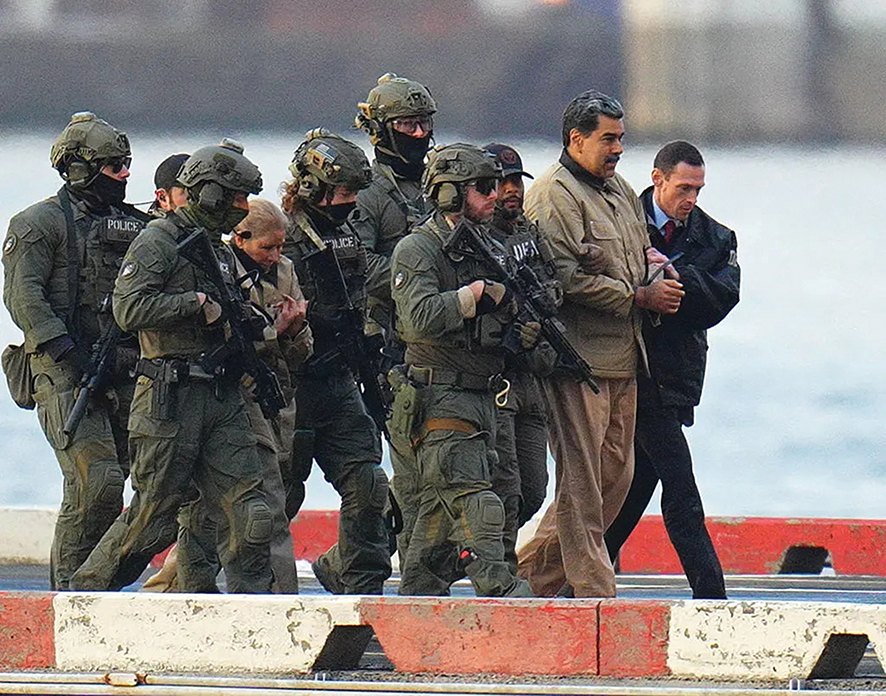
The January 3 operation against Venezuelan President Nicolás Maduro marks a decisive escalation in how the United States now exercises power in the Western Hemisphere. The kidnapping of a sitting foreign head of state should be understood as a statement about how Washington now intends to govern its sphere of influence.
The move aimed to restore US coercive credibility, to demonstrate that Washington is prepared to impose its preferences not merely through sanctions or diplomacy, but through selective, spectacular applications of military power consistent with its latest National Security Strategy.
The target audience is not only Latin American countries governed by left-wing leaders, but to US geopolitical adversaries and allies within the Western camp. This is evident in the continued US focus on acquiring the territory of Greenland despite protests from Denmark and European partners, and the recent seizure of a Russian-flagged oil tanker in international waters near Iceland.
Donald Trump’s January 3 press conference made this explicit when he referred to a personalized “Donroe Doctrine,” invoking the nineteenth-century Monroe Doctrine’s logic of hemispheric hegemony. At the start of 2026, Trump is domestically constrained by inflation and legal challenges to his tariff authority. Therefore, he is now undertaking a pivot away from the tariff-centric pressure of 2025 towards a new “big stick” posture in 2026, leaning into America’s outsized military advantage.
By multiple reported accounts, top White House aide Stephen Miller has championed this expansionist agenda behind the scenes, arguing in TV interviews that the US military could seize Greenland without a fight, in addition to overseeing a divisive deportation agenda. A Semafor analyst described him as using “creative interpretations” of statutes to enact the president’s agenda while hastening his most disruptive impulses.
The Maduro operation supplies Trump with a concrete precedent he can point to when issuing threats elsewhere, notably Iran, which has for the first time on January 6 announced it would not rule out pre-emptive strikes against adversaries, a shift away from its hitherto defensive posture. Amid renewed unrest inside Iran that Trump has made “locked and loaded” threats in relation to, the message is that US warnings are no longer cost-free to ignore in the way Maduro did. Trump ally senator Lindsey Graham, seen as the most prominent behind-the-scenes instigator of the move to capture Maduro, has since threatened the life of Iran’s Ayatollah Ali Khamenei in a cable interview.
Among the Western expert community, the dominant critique has been that the Maduro operation reinforces a global logic of spheres of influence that risks normalizing great-power dominance in their respective backyards. In other words, there is debate and concern that US action against Venezuela will embolden China in its pursuit of Taiwan, using a similar precedent to indict Taiwanese leadership, capture them and subject them to Chinese justice in court. However, it should be noted that Beijing sees Taiwan as a breakaway province and a domestic issue, not a matter subject to international law or precedent.
To be sure, China is closely watching and drawing lessons from Washington’s “offshore coercive governance” model, with US aircraft carriers looming offshore as Trump dictates economic terms to the remnants of Maduro’s government in Caracas. This approach may deliver short-term compliance but risks longer-term political backlash across the Latin America region, whose populations resent a long history of extractive US interference.
Following the Maduro operation, the Venezuelan power system bargained to avoid collapse. Many have speculated whether Interim President Delcy Rodríguez may have betrayed Maduro by striking a quiet “negotiated extraction” deal with Washington to remain in power. Direct evidence remains elusive, but it has been widely reported that US envoy Richard Grenell explored back-channel proposals routed through intermediaries in Qatar throughout 2025 that envisaged Maduro stepping aside or entering exile while Rodríguez assumed power in exchange for economic concessions and sanctions relief.
There was clearly sophisticated intelligence penetration of Maduro’s inner circle, reflected in precise knowledge of his movements, which suggests at minimum elite leakage. Rodríguez and her brother Jorge – head of Venezuela’s National Assembly – have long been viewed as astute, pragmatic operators. Notably, Delcy Rodríguez was the only senior regime figure not under US indictment. The logic is that she is both a tolerable interlocutor and a figure capable of maintaining internal cohesion among factions that range from pragmatic technocrats to ideological hardliners such as interior minister Diosdado Cabello.
Rodríguez has an American gun to her head and thus has undertaken a rhetorical shift. Her initial defiance has given way to conciliatory language inviting cooperation with Washington. Her interim authority has already agreed to a $2 billion “deal” to sell 50 million barrels of crude oil, proceeds of which will be held in US-controlled accounts until it decides how it should be spent, effectively making Washington the “manager” of Venezuela’s oil industry. Reports indicate that the Trump administration is also pressuring Caracas to effectively cease ties with China, Russia, Iran and Cuba.
For the interim authorities in Caracas, survival depends on economically placating the US sufficiently to avoid further intervention while maintaining domestic stability. Washington has clearly opted for working with Rodríguez to avoid a “boots on the ground” operation, a political poison chalice among the US electorate, that would be required to fully enact regime change.
The dramatic spectacle of Maduro’s capture and trial in New York mainly delivers Trump the strongman optics he desires, with his administration pushing a message of “Fuck around and find out” to his challengers. US actions are consistent with Trump’s preference for claiming victory with shock and spectacle (Soleimani assassination, strikes on Iran nuclear sites) to boost his political clout while avoiding deeper entanglement. MAGA influencers have praised the operation, with many throwing their weight behind Trump’s vision of hemispheric imperialism, so long as results yield quick optical wins without prolonged commitment. But surveys indicate little public support for continued action. Only one in three supported the Maduro operation itself, according to a Reuters/Ipsos poll conducted January 4-5.
Should the current arrangement between Washington and the Rodríguez government hold, there will be less emphasis on a quick democratic transition. Trump has already publicly sidelined María Corina Machado, recent Nobel laureate who has articulated a maximalist, ideological program centered on full energy-sector privatization and close alignment with Washington and Israel. Though Machado’s party is widely viewed as the winner of Venezuela’s disputed 2024 election, Trump is likely (and correctly) referring to her lack of support within Venezuela’s security apparatus. Machado has vowed to return from European exile to Caracas, where her presence and expected political agitation will have to awkwardly be tolerated by Rodríguez given the constraints on ability to maneuver.
Oil is the linchpin holding this arrangement together. Despite the shale boom which produces a light variant of crude oil, the US refinery system remains structurally dependent on heavy crude, the thick variety found in Venezuela. Roughly 70% of US crude imports are now heavy oil, compared with just 12% decades ago, reflecting refinery designs that are prohibitively expensive to reconfigure. Venezuela’s possession of the world’s largest heavy crude reserves therefore carries enduring strategic value, even though the country currently lacks the infrastructure needed to quickly scale production in the near-term.
Global oil prices have seen a slight bearish trend since the Maduro operation, with markets viewing the US intervention as a “supply unlock” rather than a disruption. The $2 billion “deal” reached doesn’t create new oil immediately but physically reroutes existing “sanctioned” oil that was bound for China and redirects it to the US, meaning there is no drastic impact on total global supply. Analysts from JPMorgan and Goldman Sachs suggest that a pro-US transition in Venezuela could eventually add 500,000 to 1 million bpd to the market by 2027-28.
Traders are already “pricing in” this future abundance. Moreover, the prospect of future Venezuelan supply matters geopolitically. Preferential access to Venezuelan oil under US-controlled conditions could provide a buffer for energy disruptions elsewhere, including in a potential conflict involving Iran, though not in the near-term.
For now, the truncated Venezuelan government is likely to hold together and avoid being the target of further strikes if it sufficiently placates Washington; stabilized revenues may even strengthen it and lead to the loosening of sanctions. However, further unpredictable US coercion, splits within the administration, and agitation from the Western-backed opposition continue to be major risks for Caracas.
23 January 2026
Nile Bowie is a journalist with @asiatimesonline covering current affairs, trade, diplomacy and international relations in Southeast Asia and Greater China. He is also a JUST member.