
By Junaid Ahmad
The Zionist Targeting of Senator Mushtaq Ahmad Khan
Every dictatorship eventually encounters a problem it cannot solve with bigger prisons, better spyware, or emergency laws written in calming fonts. That problem is conscience. Not the decorative conscience embalmed in constitutions or wheeled out during sermons, but the dangerous, embodied kind: people who insist on calling crimes by their proper names and who behave—quite offensively—as if power were still accountable to principle.
Pakistan’s rulers understand this problem well. Their governing philosophy is essentially a long, improvisational exercise in suppressing it.
Enter Senator Mushtaq Ahmad Khan, whose primary political offense is moral coherence. He does not command mobs, control institutions, or sell inspirational despair. He does not offer ambiguity on demand or soften his language for donor comfort. What he brings instead—fatally—is clarity. He behaves as if politics were still about ethics rather than optics, a deeply subversive posture in a system that survives on fog.
That posture—quiet, disciplined, unyielding—is exactly why he matters. It is also why he must be contained, discouraged, or rendered irrelevant.
Moral Presence in the Age of PowerPoint Governance
Modern authoritarianism is not ideological; it is managerial. Pakistan’s is no exception. It manages narratives, alliances, crises, dissent, and even outrage with the enthusiasm of a consulting firm billing by the slide. Everything has a framework. Everything has stakeholders. Everything has a spokesperson trained to speak at length without saying anything.
What this system cannot manage—what keeps crashing the presentation—is moral presence.
Moral presence refuses translation. It will not convert injustice into “context,” mass killing into “geopolitics,” or repression into “stability.” It insists, unfashionably, that some acts are wrong regardless of uniforms, alliances, or how smooth the press conference sounds.
Senator Mushtaq Ahmad Khan operates in this register. His participation in the Gaza solidarity flotilla was not symbolic humanitarianism. It was a refusal to outsource solidarity to statements. At a moment when Muslim rulers perfected the art of condemning genocide in the passive voice—where Palestinians are always “dying,” mysteriously and without perpetrators—he chose presence over prose.
That choice crossed a line Pakistan’s generals, bureaucrats, and Western patrons prefer remain blurred: the line between rhetorical sympathy and embodied accountability.
Two Consciences, Two Cells
Pakistan’s current moment is defined by a grim symmetry. Its two most morally resonant political figures now occupy opposite sides of a prison wall.
Former Prime Minister Imran Khan—jailed, censored, and unsuccessfully erased from public life—embodies the conscience of mass politics: the inconvenient truth that popular legitimacy cannot be indefinitely manufactured or extinguished. Senator Mushtaq Ahmad Khan, still free for now, embodies something the regime finds equally threatening: proof that ethical clarity does not require state power, mass rallies, or electoral machinery.
The regime understands the difference. Mass leaders can be imprisoned. Moral leaders are harder to neutralize. Their authority travels horizontally, through example rather than command, accumulating quietly until it becomes uncontrollable.
This is why Senator Mushtaq’s activism has sharpened rather than softened. Through the Pak-Palestine Forum and the Peoples Rights Movement, he rejects the regime’s favorite trick: compartmentalization—mourning Palestine abstractly while governing Pakistan brutally, lamenting foreign oppression while normalizing domestic repression.
He insists on linkage.
That insistence is unforgivable.
The Crime Everyone Understands
Dictatorships do not fear hypocrisy. They depend on it.
What they cannot tolerate is consistency.
To denounce Zionist apartheid rhetorically while collaborating with its enablers is acceptable. To mourn Palestinian corpses abroad while disappearing Pakistanis at home is routine. To oppose domination—imperial, military, or ideological—without caveats or career calculations is destabilizing. It deprives power of its favorite shield: plausible deniability.
This is why figures like Mushtaq Ahmad Khan are intolerable. Not because they are extreme, but because they are coherent.
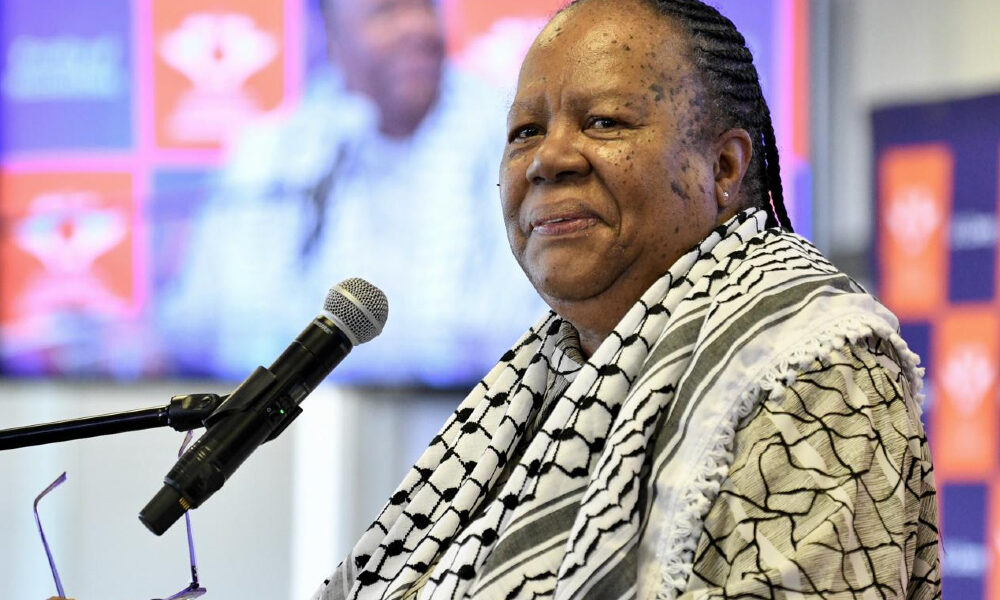
Why Dr. Naledi Pandor Is the Blueprint
The comparison to Dr. Naledi Pandor of South Africa is unavoidable. Her moral authority was forged in the struggle against Apartheid—a system that relied on racial hierarchy, legal violence, and solemn appeals to “security.” She comes from a tradition where neutrality was collaboration.
Under her stewardship, South Africa brought a genocide case against Israel before the International Court of Justice, puncturing the assumption that Western-backed states enjoy permanent immunity. The response—U.S. visa revocation without explanation—was not procedure; it was panic.
Pandor refused to compartmentalize. She treated Apartheid Israel as the heir of Apartheid South Africa and empire as a system that reproduces itself—from Gaza to the Congo, from occupied Palestine to militarized states like Pakistan.
This is precisely what Senator Mushtaq Ahmad Khan does. Like Pandor, he insists that apartheid abroad and dictatorship at home be judged by the same moral standard. In this sense, he is the Dr. Naledi Pandor of Pakistan—not by title, but by temperament.
Palestine as a Moral X-Ray
Palestine functions as a diagnostic tool—a moral x-ray of the contemporary order. It reveals how quickly states abandon principle when convenience beckons, and how mass violence is laundered through respectable vocabularies: “security,” “self-defense,” “rules-based order.” These terms migrate seamlessly into domestic repression.
Zionism, as practiced by the Israeli state, is not an aberration but a distilled expression of a global logic that assigns differential value to human life. The same logic that renders Palestinians disposable authorizes the pacification of dissent in Pakistan.
When Senator Mushtaq Ahmad Khan speaks against apartheid-genocidal Israel, he is not performing internationalism. He is diagnosing a system—and systems dislike diagnoses.
The Kicker: Liberalism Without Anesthesia
A reckoning will come. Files will be read. Silence will be rebranded as collaboration.
But the most elegant evasions will come from liberal enablers—the NGO professionals, op-ed moralists, and grant-funded humanitarians who perfected the art of opposing injustice in theory while accommodating it in practice. They will speak of “complexity” and “both sides” while standing ankle-deep in mass graves.
Liberalism that flinches at clarity is not moderation; it is maintenance.
The question is no longer who is afraid of Senator Mushtaq Ahmad Khan. The question is how long the rest will pretend not to recognize themselves in the mirror he holds up.
Prof. Junaid S. Ahmad teaches Law, Religion, and Global Politics and is the Director of the Center for the Study of Islam and Decolonization (CSID), Islamabad, Pakistan. He is a member of the International Movement for a Just World (JUST – https://just-international.org/), Movement for Liberation from Nakba (MLN – https://nakbaliberation.com/), and Saving Humanity and Planet Earth (SHAPE – https://www.theshapeproject.com/).
Junaid S. Ahmad
Professor of Law, Religion, and Global Politics
Director, Center for the Study of Islam and Decolonization (CSID)
Islamabad, Pakistan
@Academicatarms
https://wp.nyu.edu/pakistan_academics_collective/
https://just-international.org/
https://nakbaliberation.com/
https://www.theshapeproject.com/
9 January 2026