
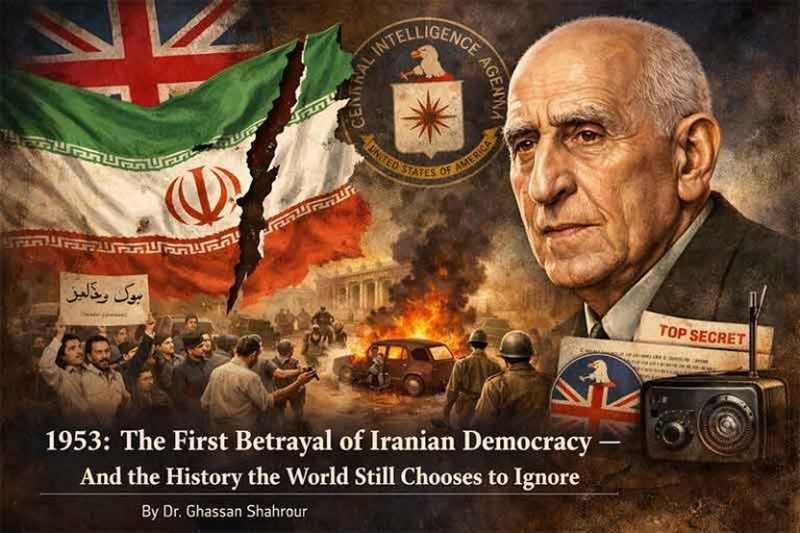
By Dr Ghassan Shahrour
Seventy years of crisis in Iran did not begin with ideology, nuclear ambitions, or regional rivalries. They began with a single, deliberate rupture that the world has spent decades minimizing or ignoring: the destruction of Iran’s democratic trajectory by the very powers that now speak most forcefully about “supporting the Iranian people.”
In 1953, the United States and the United Kingdom overthrew Iran’s democratically elected Prime Minister, Mohammad Mossadegh. Declassified CIA and MI6 documents confirm that the operation was designed to reverse the nationalization of Iranian oil and restore Western control over Iran’s resources. What was dismantled was not simply a government, but a functioning democratic experiment that had emerged from decades of constitutional struggle.
This was not an episode. It was the first betrayal — and one the international community has never fully confronted.
The coup violated core principles later codified in the UN Charter, including the right of peoples to self‑determination and the sovereign equality of states. Its consequences were immediate and enduring. The reinstatement of authoritarian rule—backed, financed, and protected by external powers—produced decades of repression, corruption, and political fragmentation. For ordinary Iranians, this meant living under a system where civic freedoms were constrained, institutions were weakened, and decisions about their future were shaped by interests far beyond their borders.
The economic dimension of this rupture was equally damaging. By reversing the nationalization of Iranian oil, the coup entrenched a model in which Western oil companies profited while Iranian communities near extraction sites endured environmental degradation, economic inequality, and the long-term social impacts of resource exploitation. The promise of sovereignty over natural wealth was replaced by a structure that deepened dependency and fueled public resentment — a reality rarely acknowledged in contemporary debates.
Any serious analysis must acknowledge that Iran’s subsequent trajectory has also been shaped by internal political dynamics and governance choices. But external intervention remains a foundational element — one that continues to shape Iranian perceptions of international engagement and the credibility of foreign calls for “democracy.”
Yet today, governments that helped dismantle Iran’s democratic institutions present themselves as advocates of Iranian freedom. This is not simply a contradiction. It is a credibility gap rooted in lived history — a history the world often turns a blind eye to. It is difficult to take calls for “democracy in Iran” seriously when they come from governments that helped extinguish Iran’s last democratic experiment — and have spent decades turning a blind eye to the consequences.
And the pattern did not end in 1953; it adapted.
Targeted killings of Iranian scientists and officials over recent decades—widely attributed in international reporting to Israel—raise serious concerns under international law, including protections of the right to life under the ICCPR. Extensive U.S. sanctions, described by UN experts as having broad humanitarian consequences, have affected access to medicine, economic stability, and civilian well‑being. These pressures shape the daily lives of millions of Iranians, yet they are often framed as technical policy tools rather than measures with profound human impact.
Meanwhile, unresolved regional conflicts and the uneven application of international legal standards continue to influence Iran’s security posture. When violations of international humanitarian law by some actors are minimized or ignored, while others are scrutinized intensely, the result is a hierarchy of rights that undermines the universality of international norms.
This selective application of principles is not incidental. It is structural.
It reflects a global order in which the enforcement of international law is often contingent on political alignment rather than legal obligation. When policy debates prioritize market stability or geopolitical advantage over human impact, the normative framework that underpins international law begins to erode.
For international civil society, the implications are clear.
The UN’s sustaining peace framework (UNGA/SC Resolutions 70/262 and 2282) emphasizes that durable peace requires addressing root causes, including historical grievances and violations of self‑determination. Ignoring such foundations does not stabilize conflicts — it perpetuates them.
The 1953 coup, subsequent patterns of external pressure, and the broader regional context are not peripheral to understanding Iran. They are part of the architecture within which contemporary tensions unfold.
To omit them is not neutrality. It is distortion.
To ignore them is not oversight. It is complicity.
Any meaningful call for democracy, human rights, or de‑escalation must begin with consistency in the application of principles. Without it, the language of democracy risks becoming an instrument of policy rather than a standard of justice. And without confronting the first betrayal — the rupture of 1953 — efforts to support the Iranian people will remain constrained by a past that has never been fully acknowledged, and therefore never fully addressed.
Dr Ghassan Shahrour, Coordinator of Arab Human Security Network, is a medical doctor, prolific writer, and human rights advocate specializing in health, disability, disarmament, and human security.
29 March 2026
Source: countercurrents.org