
By CITIZENS INTERNATIONAL
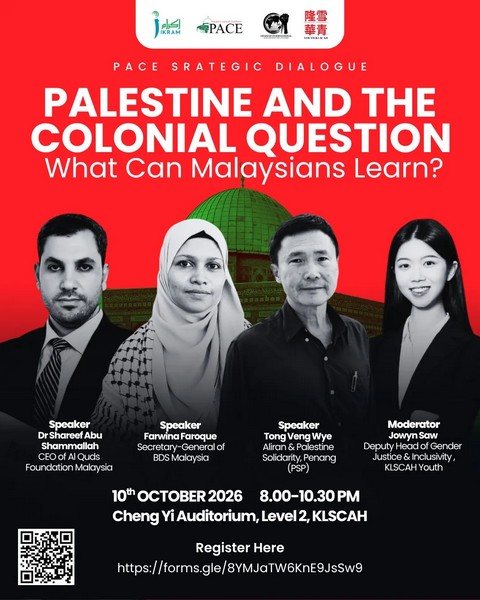
(This article is based on a forum of the same title held on 10 October 2026 at the Kuala Lumpur and Selangor Chinese Assembly Hall. The author was part of the forum panel.)
Three things happened in 1948.
Israel declared itself a state.
The British Mandate in Palestine ended.
And the so-called Malayan Emergency (1948 – 1960) was declared by the British colonial government in Malaya.
In 1948, Henry Gurney finished his term as Chief Secretary of the British administration in Palestine and became the British High Commissioner in Malaya.
Counter-insurgency experience gained in Palestine would have helped inform British tactics against the communist-led anti-colonial forces during the so-called Emergency.
And as participants in the Arab revolt were labelled ‘terrorists’ in Palestine, Malayan anti-colonial insurgents were also labelled terrorists.
Clearly, there is a British colonial link between Palestine and us.
Three salient points
- Palestine deserves our unified solidarity, not our dividedness
The struggle of the Palestinians is not about religious identity. It is not about Islam in conflict with Judaism, nor Islam in conflict with Christianity.
Islam is an extremely important foundation of strength and steadfastness for the Palestinian resistance against Israeli occupation. But that does not make it a conflict between Muslims and Jews.
As we know, Jews have historically been treated far better by Muslim rulers than by Christian ones. When European Jews needed to escape Christian oppression, they sought refuge in Muslim lands.
And the Nazi Holocaust happened in Europe, not Palestine.
There are Palestinian Muslims, Christians and Jews. They are ancient and diverse. They speak not just Arabic but also Hebrew, Armenian and Aramaic. They have long co-existed. That’s not a problem.
The big problem is Zionism, which is neither religion nor ethnicity but a political nationalistic ideology, and which masquerades as the champion and protector of the Jews.
Zionism is destructively colonialist, continuing with the Western imperial pattern of dispossession and erasure of indigenous peoples – from the Americas to Australia and Tasmania to Africa to Palestine.
You could say that Zionism encapsulates what Western imperialism has done to millions of non-white people for centuries.
So, when Palestinians, who are majority Muslim, resist their own erasure it is against Zionist colonial subjugation, and not against Jews. Nor against Christians.
On our part as Malaysians, we have to be careful not to colour the situation through our own lenses of polarised ethnic and religious identity.
It would please the Zionist propaganda machine for Malaysians to be divided along ethnic lines in our response to Palestine. For example, to wrongly see it as mainly a Malay/Muslim issue, or to project it as such, wittingly or unwittingly.
The British ruled Malaya by keeping its people ethnically divided and compartmentalised, and we inherited those structures of communal division.
But Palestine deserves our unified solidarity, not our dividedness.
- Cross-ethnic resistance to colonial domination
This leads us to the second point – Palestine and Malaysia share a history of colonisation, albeit not identical.
Malaysia’s formal colonisation ended in 1957. Palestine’s settler-colonisation is ongoing and becoming more deadly.
In Palestine, Britain was the midwife that birthed the Zionist state of Israel for it wanted what has been described as “a little loyal Jewish Ulster in a sea of potentially hostile Arabism” (quoted in Fadiah Nadwa Fikri, November 2025, White Supremacy and Anti-Communism as Counter-Insurgency: Lessons from British Imperialism in Malaya – Vox Ummah).
An outside population, backed by British imperial power, settled in Palestine, displaced its indigenous people and established political and military control over their land without their consent.
In the case of Malaya, we were a colony whose natural wealth the British extracted to the extent of being a major prop to their empire.
More pertinently, British divide-and-rule methods divided the people of Malaya by creating separate economic roles, separate spaces, separate schools, separate fears and political channels.
i.e. We were ethnically divided through deliberate colonial policy.
Our shared experience of British colonial domination was obscured by the cultivation of communal or inter-ethnic differences.
We inherited a structure where ethnicity became our primary language for rights, representation, fear and bargaining. We have continued to run with that ethnicised legacy – even intensified it.
This is where we can take a lesson from the Palestinian struggle for freedom.
The Palestinian resistance is anchored in Palestinian identity.
Thus, you will find powerful positions of resistance from Christian Palestinians just as you will from Muslim Palestinians.
The point is there is no divide. They are united in a common identity as a nation of Palestinian people fighting for liberation from the ongoing Zionist colonial domination of their land.
Does this strike a chord with us? In our own history? Where we stood together in cross-ethnic resistance against colonial rule?
The answer is Yes.
Malaya had a certain history of cross-ethnic resistance, even insurgency, against British colonial rule. Both Malays and non-Malays played important roles in speaking, publishing, rallying and fighting against the British colonisation of Malaya.
An example of this was the mutli-ethnic anti-colonial coalition of PUTERA–AMCJA.
PUTERA stood for Pusat Tenaga Rakyat. It was formed in February 1947 comprising Malay-based organisations. AMCJA stood for All-Malaya Council of Joint Action, with its origins in December 1946. In counterpart to PUTERA, AMCJA was primarily non-Malay based.
Note that neither tied their identity to any one ethnic group. For instance, PUTERA did not call itself Pusat Tenaga Orang Melayu – it called itself Pusat Tenaga Rakyat. And the same with AMCJA – it was ‘All-Malaya’.
Both were left-inclined organisations bound together by a common anti-colonial drive and the search for common national identity.
PUTERA-AMCJA campaigned for democratic, elected self-government that would quickly lead to an independent, sovereign Malaya free from colonial rule. It advanced the People’s Constitutional Proposals in 1947 as a democratic alternative to the British-backed Federation scheme, while recognising key Malay historical and political realities, including the Malay character of the land.
Unsurprisingly, the Proposals were rejected by the British who were not yet prepared to allow self-government in Malaya. They saw the cross-communal PUTERA-AMCJA proposals as “antithetical to their objectives in Malaya [as self-government] was the priority of the opposition” (Merdeka!, Khong Kim Hoong, 1984).
Another example was the communist-led insurgency against British rule, which the British termed the Malayan Emergency from 1948 to 1960.
Although the insurgency was mainly Chinese in composition, Malay participation was real and significant, whether in armed struggle, organisation, support networks, or leadership circles. There were Malay–Chinese personal and political solidarities, even including marriages between Malay and Chinese communist figures.
The declaration of Emergency in June 1948 was followed by waves of detention of people seen as Leftists by the British colonial authorities. What is interesting was the large number of Malays who were also detained as Leftists, communists or sympathisers – estimated at over 1,000.
This, however, was not publicised by the British as “They feared that disclosure of Malay involvement with the communists might weaken their propaganda in identifying the communists [who were fighting colonial rule] as mainly Chinese.” (The Masked Comrades, Cheah Boon Kheng, 1979.)
The point of all this is the Palestinian struggle for justice is cross-religious and cross-ethnic, rooted in a common national identity, and it makes us remember our own history where we too were cross-ethnic in our opposition to colonial domination.
It should nudge us into strengthening our bonds of commonality as Malaysians instead of the all-too-often reinforcement of our differences and antagonisms, real or imagined.
This includes divisive comparisons occasionally made, by both Malays and non-Malays, between the situation in Palestine and their own respective situations in Malaysia. Such comparisons are wrong and cannot be substantiated.
In the Malaysian context, it is understandable for our solidarity with Palestine to be mainly Muslim based because there is also the important element of Muslim solidarity. The majority of the country’s population is Muslim just as the majority of Palestinians are Muslims.
But the injustice against the Palestinian people goes beyond that. Non-Muslim Malaysians have been comparatively silent, and the divide should be bridged. As mentioned earlier, Palestine deserves our unified solidarity, not our dividedness.
In fact, universal solidarity with Palestine is an opportunity for us to strengthen our own multi-ethnic solidarity as Malaysians.
- Honour and self-reliance
For four generations or more Palestinians have been subjected to extreme Zionist colonial oppression by force, and all that that entails.
Yet, Palestinians continue to stand unbowed.
When they can and have to fight (which they are entitled to as a colonised people under threat), they fight – with the primitive weapons that they have compared to what is at the disposal of the Israeli occupation forces.
But they also place great emphasis on education. Despite decades of displacement, occupation and exile, Palestinians have among the highest literacy rates in the world and are widely regarded as among the most highly educated peoples in the Arab world.
Despite everything, they persist with education. That is one way of remaining unbowed, a form of dignified resistance by building your own capacity and self-reliance for a liberated future you know will come.
You could say that despite everything, Palestinians have conducted themselves with admirable honour.
This is a reminder for us. Honour and self-respect are important.
As we point that finger outwards accusing Israel of genocide and its absence of accountability, we have to remember that it is also incredibly important for us to do things internally that do not erode public trust and accountability, that grind away leadership credibility and bring down the moral tone of Malaysian society.
Standing in solidarity with Palestine means taking a moral stand. But we cannot do that convincingly if we simultaneously hollow ourselves out by doing wrong and shameful things domestically.
At the same time, building capacity and self-reliance is important.
Malaysia may no longer be under formal colonial rule, but we remain vulnerable to a global system still shaped by Western neo-imperial power. We must build sefl-reliance and improve in many areas—including food security, education, governance, social and economic inequity, financial indebtedness, scientific research, technology and energy.
Conclusion
The Zionist state of Israel founded itself by colonising and dispossessing indigenous Palestinians. Its actions continue to be enabled by the US and others.
The Israel-US imperial nexus, with a knee on the Palestinian throat, enables Israel to make perpetual wars and cause unending turmoil in not just the region but also globally.
That is why freeing the Israeli chokehold on Palestine and breaking that nexus helps free the world.
But Zionism is putrefying; it is rotting. That is why more and more people around the world hold their noses when they walk past its decaying flesh.
The overall Palestinian spirit of resistance, on the other hand, is an inspiration.
It shows the high road that Malaysians should take both in our actions and solidarity with the Palestinian cause, and in our actions domestically.
Tong Veng Wye is a member of ALIRAN. He writes, speaks and helps to organise and support events in solidarity with Palestinians and their struggle for liberation. Veng Wye is also part of Palestine Solidarity, Penang (PSP), an informal group in Penang. He is a retired engineer.
30 October 2026