
By Vijay Prashad
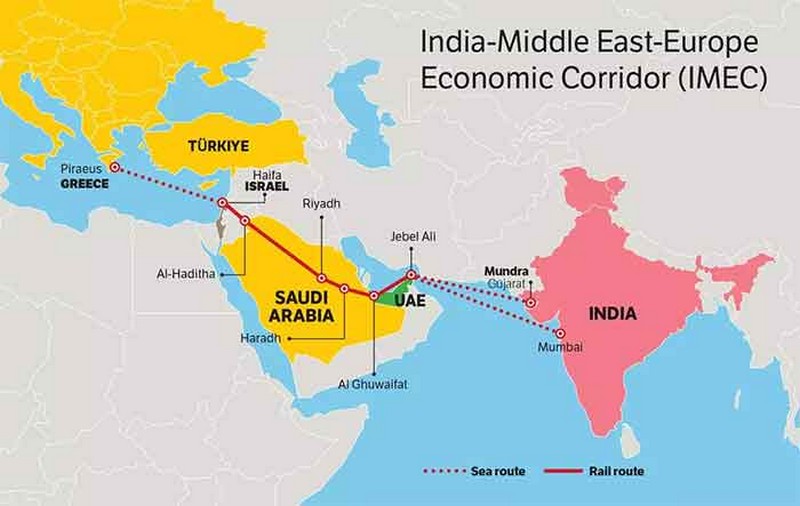
On September 9, 2023, during the G20 meeting in New Delhi, the governments of seven countries and the European Union signed a memorandum of understanding to create an India-Middle East-Europe Economic Corridor. Only three of the countries (India, Saudi Arabia, and the United Arab Emirates or the UAE) would be directly part of this corridor, which was to begin in India, go through the Gulf, and terminate in Greece. The European countries (France, Germany, and Italy) as well as the European Union joined this endeavor because they expected the IMEC to be a trade route for their goods to go to India and for them to access Indian goods at, what they hoped would be, a reduced cost.
The United States, which was one of the initiators of the IMEC, pushed it as a means to both isolate China and Iran as well as to hasten the normalization of relations between Israel and Saudi Arabia. It seemed like a perfect instrument for Washington: sequester China and Iran, bring Israel and Saudi Arabia together, and deepen ties with India that seemed to have been weakened by India’s reluctance to join the United States in its policy regarding Russia.
Israel’s war on the Palestinians in Gaza has changed the entire equation and stalled the IMEC. It is now inconceivable for Saudi Arabia and the United Arab Emirates to enter such a project with the Israelis. Public opinion in the Arab world is red-hot, with inflamed anger at the indiscriminate bombardment by Israel and the catastrophic loss of civilian life. Regional countries with close relations with Israel—such as Jordan and Turkey—have had to harden their rhetoric against Israel. In the short term, at least, it is impossible to imagine the implementation of the IMEC.
Pivot to Asia
Two years before China inaugurated its “One Belt, One Road” or Belt and Road Initiative (BRI), the United States had already planned a private-sector-funded trade route to link India to Europe and to tighten the links between Washington and New Delhi. In 2011, then U.S. Secretary of State Hillary Clinton gave a speech in Chennai, India, where she spoke of the creation of a New Silk Road that would run from India through Pakistan and into Central Asia. This new “international web and network of economic and transit connections” would be an instrument for the United States to create a new intergovernmental forum and a “free trade zone” in which the United States would be a member (in much the same way as the United States is part of the Asia-Pacific Economic Cooperation or APEC).
The New Silk Road was part of a wider “pivot to Asia,” as U.S. President Barack Obama put it. This “pivot” was designed to check the rise of China and to prevent its influence in Asia. Clinton’s article in Foreign Policy (“America’s Pacific Century,” October 11, 2011) suggested that this New Silk Road was not antagonistic to China. However, this rhetoric of the “pivot” came alongside the U.S. military’s new AirSea Battle concept that was designed around direct conflict between the United States and China (the concept built on a 1999 Pentagon study called “Asia 2025” which noted that “the threats are in Asia”).
Two years later, the Chinese government said that it would build a massive infrastructure and trade project called “One Belt, One Road,” which would later be called the Belt and Road Initiative (BRI). Over the next ten years, from 2013 to 2023, the BRI investments totaled $1.04 trillion spread out over 148 countries (three-quarters of the countries in the world). In this short period, the BRI project has made a considerable mark on the world, particularly on the poorer nations of Africa, Asia, and Latin America, where the BRI has made investments to build infrastructure and industry.
Chastened by the growth of the BRI, the United States attempted to block it through various instruments: the América Crece for Latin America and the Millennium Challenge Corporation for South Asia. The weakness in these attempts was that both relied upon funding from an unenthusiastic private sector.
Complications of the IMEC
Even before the Israeli bombardment of Gaza, IMEC faced several serious challenges.
First, the attempt to isolate China appeared illusory, given that the main Greek port in the corridor—at Piraeus—is managed by the China Ocean Shipping Corporation, and that the Dubai Ports have considerable investment from China’s Ningbo-Zhoushan port and the Zhejiang Seaport. Saudi Arabia and the UAE are now members of the BRICS+, and both countries are participants in the Shanghai Cooperation Organization.
Second, the entire IMEC process is reliant upon private-sector funding. The Adani Group—which has close ties to Indian Prime Minister Narendra Modi and has come under the spotlight for fraudulent practices—already owns the Mundra port (Gujarat, India) and the Haifa port (Israel), and seeks to take a share in the port at Piraeus. In other words, the IMEC corridor is providing geopolitical cover for Adani’s investments from Greece to Gujarat.
Third, the sea lane between Haifa and Piraeus would go through waters contested between Turkey and Greece. This “Aegean Dispute” has provoked the Turkish government to threaten war if Greece goes through with its designs.
Fourth, the entire project relied upon the “normalization” between Saudi Arabia and Israel, an extension of the Abraham Accords that drew Bahrain, Morocco, and the United Arab Emirates to recognize Israel in August 2020. In July 2022, India, Israel, the United Arab Emirates, and the United States formed the I2U2 Group, with the intention, among other things, to “modernize infrastructure” and to “advance low-carbon development pathways” through “private enterprise partnerships.” This was the precursor of IMEC. Neither “normalization” with Saudi Arabia nor advancement of the I2U2 process between the UAE and Israel seem possible in this climate. Israel’s bombardment of the Palestinians in Gaza has frozen this process.
Previous Indian trade route projects, such as the International North-South Trade Corridor (with India, Iran, and Russia) and the Asia-Africa Growth Corridor (led by India and Japan), have not gone from paper to port for a host of reasons. These, at least, had the merit of being viable. IMEC will suffer the same fate as these corridors, to some extent due to Israel’s bombing of Gaza but also due to Washington’s fantasy that it can “defeat” China in an economic war.
Vijay Prashad is an Indian historian, editor, and journalist.
10 November 2023
Source: countercurrents.org