
By Prof. Junaid S. Ahmad
In recent days, Islamabad has been cast — by its own officials and attentive external actors — as a venue for backchannel contacts linked to the escalating U.S.–Israeli confrontation with Iran. The choreography is familiar: signals of readiness, hints of quiet facilitation, the projection of Pakistan as a responsible intermediary at a moment of regional strain. States host such efforts as a matter of routine diplomacy. Yet the dissonance here is hard to miss. As Pakistan presents itself as a bridge in a crisis it did little to avert, its most prominent political figure associated with a more independent vision of Iran’s regional role remains imprisoned within the same capital.
That juxtaposition is not incidental. It exposes the contradiction at the heart of the performance.
The Islamabad spectacle is therefore not merely about diplomacy. It is about political deflection. A regime with thinning legitimacy at home seeks borrowed significance abroad. It cannot generate authority through representation, so it pursues visibility through geopolitical performance. Host the talks. Carry the messages. Pose for the cameras. Let foreign relevance impersonate domestic credibility.
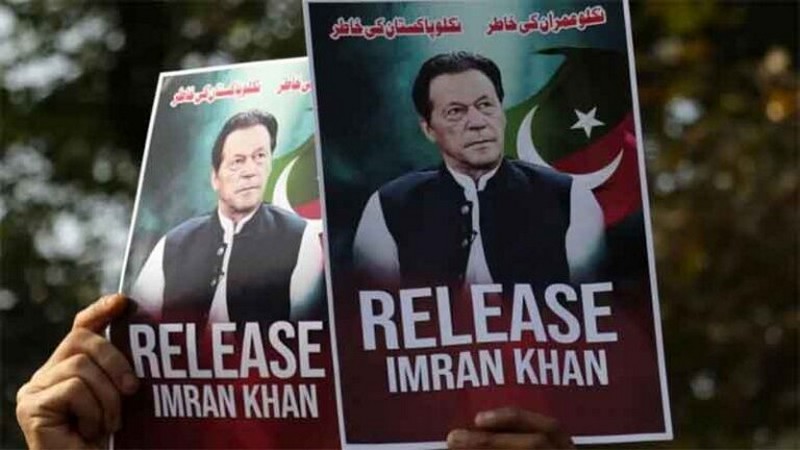
But this performance becomes especially obscene when set against Imran Khan’s imprisonment. Khan represented a distinctly different orientation toward Iran from that of Pakistan’s present custodians. He did not treat Iran as a subordinate issue to be handled within the constraints imposed by Saudi and American preferences. He understood that Iran’s isolation was not a natural condition of the region but a manufactured one, imposed by U.S. coercion, Israeli aggression, Gulf monarchic insecurity, and the political caution of dependent Muslim states.
This was visible geopolitically in Khan’s instinct for regional reconciliation. He sought to reduce antagonism between Iran and Saudi Arabia rather than merely rent Pakistan’s services to one camp against the other. More importantly, he was drawn to the possibility of a wider Muslim political formation not monopolized by Riyadh’s theology, money, and diplomatic disciplining. The aborted Kuala Lumpur summit was emblematic in this regard. It gestured toward a counter-hegemonic Muslim conversation involving Malaysia, Turkey, Qatar, Pakistan, and potentially Iran — a conversation not pre-cleared by the House of Saud. That Khan was effectively pressured into withdrawing from it was more than a diplomatic humiliation. It was a revelation of Pakistan’s dependency: a nuclear state told, in effect, that even its attendance at an alternative Muslim forum required monarchical permission.
Yet Khan’s affinity with Iran cannot be reduced to geopolitics alone. That is where most analyses remain superficial. His relation to Iran was also intellectual, even civilizational. Two Iranian thinkers matter here above all others: Seyyed Hossein Nasr and Ali Shariati. Together, they illuminate a dimension of Khan that Pakistan’s establishment neither understands nor forgives.
From Nasr comes an expansive vision of Islam grounded in religious pluralism and a deep respect for multiple paths to the Divine. Nasr’s thought affirms that truth is not monopolized by a single historical or institutional expression, but refracted through diverse traditions, each carrying a measure of sacred insight. It is precisely this inclusive, civilizationally confident understanding of Islam — one that resists reduction to sectarian rigidity or state-managed orthodoxy — that resonated with Khan. It offered him a language of faith that was intellectually serious, spiritually generous, and resistant to politicized narrowing.
Khan’s encounter with Shariati, by contrast, came through a shared intellectual lineage with Muhammad Iqbal. Like Khan, Shariati was deeply influenced by Iqbal’s philosophical and poetic vision, and it was through this connection that Khan came to appreciate Shariati’s work. What Shariati offered, alongside this intellectual inheritance, was a dynamic conception of Islam as an emancipatory force — a language of resistance against hierarchy, stagnation, and imperial domination. He rejected the passivity of clerical quietism and reimagined Islam as a vehicle for social justice, moral awakening, and political transformation. That sensibility resonates deeply with Khan’s better impulses: his attraction to Iqbal, his suspicion of subservient elites, his recurring insistence that Muslim political life must recover moral purpose rather than serve as a local management class for foreign power.
This is precisely why Khan has always been such a dissonant figure within Pakistan’s dominant order. He is not opposed merely because he is popular. He is opposed because he disrupts the theological and geopolitical grammar on which the order depends. Saudi-aligned Islam prefers obedience over emancipation; the Pakistani security state prefers utility over sovereignty; Washington prefers reliable managers over unpredictable national figures. Khan, at his most politically lucid, unsettled all three.
That is what makes the current pageantry in Islamabad so revealing. The same establishment that has hollowed out domestic legitimacy now eagerly embraces the role of intermediary, not as an exercise in sovereign initiative but as participation in a script written elsewhere. These negotiations — if they materialize at all — risk serving as little more than a diplomatic façade, a managed performance of de-escalation even as the underlying machinery of U.S.-Israeli coercion continues to operate. Islamabad’s rulers do not resist this arrangement; they lean into it, presenting proximity to power as proof of relevance, even when that proximity underscores their dependence.
Iran, for its part, has little reason to enter into such a process. It has seen enough negotiations conducted under threat, enough diplomacy used as camouflage for coercion, enough “peace efforts” that preserve the aggressor’s freedom to strike again. In that setting, Pakistan’s current rulers do not appear as principled brokers. They appear as functionaries of managed optics.
And so the image that remains is devastatingly simple: in Islamabad, the regime hosts the language of peace while jailing the one leader who seriously imagined Iran not as a target of containment, but as a partner in a different regional future. That contrast tells us nearly everything.
The mediator worth thinking about is not the one in the conference hall.
It is the one in prison.
Prof. Junaid S. Ahmad teaches Law, Religion, and Global Politics and is the Director of the Center for the Study of Islam and Decolonization (CSID), Islamabad, Pakistan.
29 March 2026
Source: countercurrents.org