Just International

New World Busy Being Born while Old One Is Busy Dying

By Pepe Escobar

26 Mar 2026 – The 15-point plan that Team Trump presented to Iran is already D.O.A.

It’s an imposed capitulation: a surrender document disguised as “negotiation”.

The non-plan plan – imposing demands while begging for a one-month ceasefire – includes zero uranium enrichment on Iranian soil; full dismantlement of Natanz, Isfahan and Fordow installations; all enriched uranium out of Iran; the missile program extremely restricted; no funding for Hezbollah, Ansarallah and Iraqi militias; the Strait of Hormuz totally opened.

All that in exchange for a vague “cancelling the threat of reimposing sanctions”.

The only realistic Iranian response to this accumulated wishful thinking might be Mr. Khorramshahr-4 showering his business card across selected targets – consistent with leveraging economic and military deterrence to dictate the real terms.

And the real terms are harsh:

Closure of ALL US military bases in the Gulf; guarantee of no more wars; end of the war on Hezbollah; lifting of ALL sanctions; war damage reparations; a new order in the Strait of Hormuz (already in effect: collecting fees just like Egypt in Suez); missile program intact.

Conclusion: the infernal escalation machine keeps rolling.

Member’s Club With an Entrance Fee in Petroyuan

Meanwhile, oil and gas prices are mired in a kaleidoscope of volatility, affecting currencies, equities, commodities, supply chains, inflation scares. This is already an out-of-control global economic shock with devastating consequences in progress.

Before the war, Iran was producing a little less of 1.1 million barrels of oil a day, sold at $65 a barrel with a $18 discount: thus, in practice only $47. Now, Iran has increased production to 1.5 million barrels a day, selling at $110 (and counting), mostly to China, with a maximum $4 discount.

And that does not even include petrochemical sales: on the up and up, and for an array of extra customers. To round it all up, all payments are conducted via alternative mechanisms. Which brings us to a startling fact: for all practical purposes, this is sanctions relief in effect.

Now for the Holy Grail in the war: the Strait of Hormuz. It is de facto open, but with a toll booth controlled by the IRGC. A toll booth with a twist: veto power over the guest list. Like entering an exclusive private club.

To get the IRGC clearance, a tanker needs to pay the toll: $2 million per vessel. This is how it works. You contact an IRGC-linked broker. The broker relays to the IRGC the essential info: vessel ownership, national flag, cargo manifest, destination, crew list, and AIS transponder data.

The IRGC runs background checks. If you are not US-linked, not shipping any Israel-linked cargo, and your flag is not part of “aggressor states”, you’re in. Japan and South Korea, for instance, still have not been cleared.

Then you pay the toll. In cash – whatever currency you have – but preferably in yuan. Or in crypto.

It’s a complex mechanism. The IRGC uses multiple addresses; cross-chain bridges to other networks; over-the-counter desks in jurisdictions way beyond American reach; and integration with all sorts of yuan settlement channels.

After the toll is paid, the IRGC issues a VHF radio clearance – complete with a specific time window linked to a narrow 5-mile nautical corridor through Iranian territorial waters, between Qeshm and little Larak island, where the IRGC Navy can visually identify your vessel. You’re free to go. No need for an escort ship.

All of the above applies, for now, to tankers from China, India, Pakistan, Turkiye, Malaysia, Iraq, Bangladesh, Russia. Some don’t need to pay the full toll. Some get exemptions – on government-to-government basis (as in Sri Lanka and Thailand, both described as “friendly nations”). And some don’t pay anything.

So welcome to a member’s club with an entrance fee mostly in petroyuan. It took a single move from Iran to achieve what endless global summits could not: establishing an alternative settlement system – under fire, tested under supreme stress, and on top of it applied in the most consequential chokepoint on the planet.

Each toll paid in petroyuan bypasses the petrodollar, SWIFT and US sanctions – all in one go. The Iranian parliament will approve legislation institutionalizing the toll booth as “security compensation.” No one saw this coming – and so fast: legalized chokepoint monetization. Without firing a shot. This is what de-dollarization trade is really all about.

The problem is what is not transiting Hormuz: fertilizers. Over 49% of urea for export comes from the Persian Gulf. Ammonia needs natural gas; but Qatar declared Force Majeure after the Epstein Syndicate attack on South Pars and the Iranian counter-strikes. The IRGC is focused on oil because oil finances the tool booth and long term, is at the heart of the post-dollar energy settlement system, fully supported by the Russia-China strategic partnership.

So it’s no wonder the Empire of Chaos and Plunder has gone bonkers. In a flash, in three weeks, we have the petroyuan ruling over the – de facto privatized – most important naval connectivity corridor on the planet. So CENTCOM will go all out Terminator to demolish the tool booth, attempting everything from bombing IRGC installations along the coast and setting up naval escorts for allied tankers to a tsunami of sanctions on toll booth brokers.

What CENTCOM cannot bomb is the precedent of the petroyuan in effect. The whole Global South is watching and doing the math. The whole demented war is actually helping a new payment infrastructure to come to light. The war’s financial dimension is even more crucial than missile breakthroughs.

hat Awaits the GCC

Qatar warned Trump 2.0, over and over again, that attacking Iran’s energy infrastructure would destroy Doha’s own energy infrastructure. That’s exactly what happened. Qatar’s energy minister al-Kaabi revealed that he warned the US Secretary of Energy, Chris Wright, as well as executives at ExxonMobil and ConocoPhillips day after day.

To no avail. Qatar ended up losing 17% of its LNG capacity: $20 billion in lost revenue, and as many as 5 years to fix it. Al-Kaabi: oil could hit $150 a barrel, and this war could “bring down the economies of the world.”

We reach absurdist territory when it’s clear that striking Iran’s South Pars generated less than zero strategic advantage. On the contrary: the counterpunch hit the Persian Gulf energy sector. Yet perversity actually rules. Who ultimately benefitted? American gas companies.

Iran is betting – and that is immensely ambitious – that the Gulf monarchies will eventually do the math. It’s as if Tehran is making it quite clear: if you learn to do business with us, we will let you continue to do your own business.

The new rules include everything from the GCC bypassing the petrodollar to getting rid of US data centers. And if the GCC wants a new security arrangement, better talk to China. All that while the GCC also has to learn how to deal with this oil shock permanently repricing the risk premium on their energy supply. Structural reset does not even begin to describe it.

As it stands, there’s only one certainty: the GCC will be instrumental in the international financial system implosion as it gets ready to pull at least $5 trillion out of the US market so they may be able to fund their survival.

The Long and Winding Petro-Gold Road

To sum it all up: after the attack on the South Pars gas field – the largest on the planet – and the toll booth in the Strait of Hormuz, it’s yuan-gold settlements, all across the spectrum, that are giving the Russia-China strategic partnership an upper hand unthinkable only a few weeks ago.

The strategic partnership is locking in no less than a new, rising global settlement mechanism, where petroyuan trades flow straight into physical gold.

As Russia sells massive volumes of oil and gas not touched by the war on its ally Iran, China as the top refiner buys Russian energy while at the same time trying to support its Southeast Asian partners outside of the US dollar.

Russia is converting yuan payments into physical gold at the Shanghai Stock Exchange. Iran is accumulating yuan payments in Hormuz – boosting yuan oil contracts that are convertible to gold. And China is building overseas gold vaults and corridors. The new Primakov triangle, RIC (Russia-Iran-China) is in control via real physical energy and gold.

So this is the major take away of the Epstein Syndicate war on Iran. Russia-China reach the Holy Grail: energy dominance and a gold-backed yuan settlement that bypasses the petrodollar to Kingdom Come.

For all practical purposes, the architecture set up by the “indispensable nation” since the 1990s is showing structural cracks for everyone to see, with global markets updating every possible model variation in real time.

It’s as if the Persians had reinterpreted Sun Tzu, Clausewitz and Kutuzov (the conqueror of Napoleon) into a whole new hybrid. And as a bonus, accomplishing in only three weeks what years’ worth of summits could not.

The petrodollar is on the way out. Alternative payment systems are up and running. And the Global South is watching in real time how the Empire of Endless Bombing can be brought to a standstill by a decentralized war of attrition engineered by a sovereign nation with one-fiftieth of the imperial defense budget.

Multipolarity won’t be born by suits reading papers in executive rooms. Multipolarity will be born in the battlefield, under fire, against all odds.

“Pointed threats, they bluff with scorn
Suicide remarks are torn
From the fool’s gold mouthpiece the hollow horn
Plays wasted words, proves to warn
That he not busy being born is busy dying”

— Bob Dylan

Pepe Escobar, born in Brazil, is a correspondent and editor-at-large at Asia Times and columnist for Consortium News and Strategic Culture in Moscow. Since the mid-1980s he’s lived and worked as a foreign correspondent in London, Paris, Milan, Los Angeles, Singapore, and Bangkok.

6 April 2026

Source: transcend.org

How Iran Should End the War

By M. Javad Zarif

A Deal Tehran Could Take

3 Apr 2026 – Iran did not start its war with the United States and Israel. But more than a month in, the Islamic Republic is clearly winning it. US and Israeli forces have spent weeks incessantly bombing Iranian territory, killing thousands of people and damaging hundreds of buildings, all in hopes of toppling the country’s government. Yet Iran has held the line and successfully defended its interests. It has maintained continuity of leadership even as its top officials have been assassinated, and it has repeatedly hit back at its aggressors even as they strike at its military, civilian, and industrial facilities. The Americans and the Israelis who started the conflict with delusions of forcing capitulation thus find themselves in a quagmire without an exit strategy. The Iranians, by contrast, have pulled off a historic feat of resistance.

To some Iranians, this success is reason to continue fighting until the aggressors are adequately punished rather than to search for a negotiated ending. Every night since February 28, large crowds of proud Iranians have gathered across the country to show their defiance by shouting, “No capitulation, no compromise, fight with America.” After all, the United States has proved that it cannot be trusted in talks and that it will not respect Iran’s sovereignty. By this logic, there is no reason to engage with the country now and offer it an off-ramp. Instead, Tehran should press its advantage, continuing to strike U.S. bases and blocking commerce in the Strait of Hormuz until Washington fundamentally alters its regional presence and posture.

Yet although continuing to fight the United States and Israel might be psychologically satisfying, it will lead only to the further destruction of civilian lives and infrastructure. These actors, desperate after failing to achieve any of their objectives, are increasingly resorting to targeting vital pharmaceutical, energy, and industrial sites and randomly hitting innocent civilians. The violence is also slowly drawing in more countries, threatening to turn a regional conflagration into a global one. And regrettably, international organizations have been bullied by the United States into staying silent in the face of Washington’s many atrocities, including its massacre of nearly 170 schoolchildren on the first day of the war.

Tehran, then, should use its upper hand not to keep fighting but to declare victory and make a deal that both ends this conflict and prevents the next one. It should offer to place limits on its nuclear program and to reopen the Strait of Hormuz in exchange for an end to all sanctions—a deal Washington wouldn’t take before but might accept now. Iran should also be prepared to accept a mutual nonaggression pact with the United States in which both countries pledge to not strike each other in the future. It could offer economic interactions with the United States, which would be a win for both the American and the Iranian people. All these outcomes would enable Iranian officials to focus less on protecting their country from foreign adversaries and more on improving the lives of their people domestically. Tehran, in other words, could secure the new, brilliant future Iranians deserve.

U.S. President Donald Trump, despite his weakened position or maybe because of it, continues to issue contradictory and confusing statements about negotiations. On Wednesday, Trump gave a speech in which he simultaneously insulted all Iranians by pledging to bomb Iran “back to the stone ages, where they belong” while promising, as he has time and again, that Washington’s military campaign was just a few weeks from being complete. But the White House is clearly worried that rising energy costs, which were created by the American bombardment, are a political liability, and this plan would offer Trump a well-timed off-ramp. In fact, it could turn his huge miscalculation into an opportunity to claim a lasting victory for peace.

TAKE THE WIN
Iranians are intensely angry with the United States—and not just because of its present aggression. Since the turn of the millennium, the Islamic Republic and its people have been repeatedly betrayed by U.S. officials. Iran provided assistance to the United States against al-Qaeda in Afghanistan after the 9/11 terrorist attacks, only for President George W. Bush to include Tehran in his “axis of evil” and threaten to strike it. President Barack Obama’s administration negotiated and struck the 2015 nuclear deal with Iran’s leaders, but Tehran’s verified, meticulous compliance with the agreement did not lead the administration to normalize Iran’s global economic relations, as it had promised. Iranian compliance also did not stop Trump from tearing the deal apart and then following it with a vicious campaign of “maximum pressure”: strict sanctions designed to impoverish Iran’s 90 million people. Those policies continued under President Joe Biden, even though he had promised to resurrect diplomacy.

When Trump returned to office for a second term, Washington’s approach became even more misleading. The White House said it was interested in striking a new deal, and Iran sent its most capable diplomats and experts to negotiate. But Trump quickly proved to be unserious. Instead of deploying experienced envoys, he sent two real estate developer confidants—his son-in-law Jared Kushner and his golf buddy Steve Witkoff—who were completely illiterate on both geopolitics and nuclear technicalities. When they predictably failed to understand Iran’s generous offers to reach a deal, the White House launched its massive, armed assault against Iranian civilians.

As a result, a large portion of the Iranian population views as heresy any talk of ending this war through diplomacy instead of through continued resistance and pressure against embattled aggressors. Iranians have little interest in speaking to American officials who have betrayed them repeatedly. But although this perspective is understandable, the Islamic Republic will ultimately be better off if it can end the war sooner rather than later. Prolonged hostility will cause a greater loss of precious lives and irreplaceable resources without actually altering the existing stalemate, particularly as the United States and Israel keep targeting Iranian infrastructure. Although Iran is capable of obliterating the region’s infrastructure in retaliation, that hardly matters to the United States, which views all its so-called Arab allies in the region merely as shields it can use in defense of Israel. And the destruction of the region’s infrastructure will not compensate Iran’s losses. Continued fighting might also produce a U.S. ground invasion. Although it would be a desperation move that would drive Washington into an even deeper quagmire, a ground invasion would hardly provide gains for Iran. Finally, if the United States packs up and leaves before the two sides reach a deal, Iran will not be able to cash in on all the proceeds of its valiant resistance to Washington’s aggression.

If the two sides do manage to opt for talks, they can pursue one of two outcomes. The first is a formal or informal cease-fire agreement. At first glance, this might seem like the best way forward. It is certainly the one of least resistance. To get a cease-fire, after all, Tehran, Washington, and their allies would only have to lay down their weapons. They would not need to resolve the underlying tensions that have plagued their relationship for decades.

The current conflict could make reaching a comprehensive agreement easier.

But any cease-fire would, inherently, be fragile. The two states would remain deeply suspicious and skeptical of each other precisely because they wouldn’t have addressed their fundamental disagreements. It thus wouldn’t take much—another miscalculation, misplaced political opportunism—for the shooting to resume. Officials should therefore aim for the second outcome: a comprehensive peace deal. They should, in other words, use this catastrophe as an opportunity to end 47 years of belligerence.

The current conflict, horrible as it is, could make reaching such an agreement easier. That is because it has revealed certain truths about West Asia that Tehran and Washington can no longer ignore. For starters, it has shown that the United States is incapable of destroying Iran’s nuclear or missile programs, even when it operates alongside Israel and with the financial and logistical support of its Persian Gulf partners. These programs are simply too entrenched and too dispersed to be bombed away. In fact, when it comes to nuclear questions, all the U.S. and Israeli strikes have done is animate debate about whether Iran should actually abandon the Nuclear Nonproliferation Treaty and change its nonproliferation doctrine. The strikes have also made it abundantly clear that the news of the demise of the “axis of resistance”—Iran’s network of regional partners—was greatly exaggerated. If anything, the aggression has reenergized resistance to U.S. foreign policy across the global South, in some parts of Europe, and even in parts of the United States, where some of Trump’s MAGA supporters have rejected his “Israel first” policies.

For the region, meanwhile, the war proves that trying to outsource or purchase security from the United States is a losing strategy. For years, Arab countries have believed that they could safeguard themselves by paying the United States to establish military bases in their territory. Meanwhile, they largely rejected or ignored Iran’s offers of regional security arrangements, starting with its 1985 suggestion—enshrined in UN Security Council Resolution 598—that the coastal states of the Persian Gulf establish a regional security arrangement and continuing with its offers of a nonaggression pact in 2015 and its Hormuz Peace Endeavor in 2019. Arab states thought that such proposals were unnecessary because, when push came to shove, U.S. officials would help them manage relations with Iran and protect them from any regional conflict. But instead, the United States decided to start bombing the Islamic Republic despite their verbal—and for some, sincere—objections and used its bases on their territory to carry out its campaign, as anyone in their right mind should have expected. As a result, Arab countries have become theaters of war, which is exactly what they wished to avoid.

All these outcomes validate Tehran’s long-standing assertions about both itself and the regional order. But with its strengthened self-confidence, Iran has its own lesson to internalize. It must accept that its nuclear technology has not deterred aggression. If anything, it provided a pretext for Israeli and U.S. attacks. Iran has, of course, also proved that Israel’s illegal nuclear weapons program cannot protect Israelis from a daily barrage of piercing missiles and inexpensive drones. This failure is all the more reason to be skeptical that a nuclear program will safeguard Iran’s security, no matter how advanced it grows. Instead, Iran’s civilian and military officials have all confirmed that the most effective component of the country’s successful defense has been its resilient people.

PREPARING PEACE
These facts mean that reciprocity will be key to any settlement, including at the earliest phases. To start the peace process, for example, all parties in West Asia would have to agree to stop fighting against each other. Iran, in cooperation with Oman, would have to ensure the safe passage of commercial vessels through the Strait of Hormuz. But American officials must permit the Strait of Hormuz to be open for Iran, too. The biggest irony of geography is that, although it borders Iranian territory, the strait has been effectively closed to Iran for years because of U.S. sanctions. This has caused tremendous corruption inside Iran and huge profiteering by some ungrateful neighbors. Thus, even before a final agreement is reached, the United States must allow the unhindered sale of Iranian oil and its byproducts and the safe repatriation of their proceeds.

As Iran and the United States take these immediate measures, they can start articulating a permanent peace deal. Much of this agreement would likely address nuclear issues. Iran, for instance, would commit to never seeking nuclear weapons and to down-blending its entire stockpile of enriched uranium to an agreed level below 3.67 percent. Simultaneously, the United States would move to terminate all Security Council resolutions against Iran, eliminate U.S. unilateral sanctions against Iran, and encourage its partners to do the same. Iran must be allowed to actively participate in global supply chains without hindrance or discrimination. The Iranian parliament, in turn, would ratify the International Atomic Energy Agency Additional Protocol, thus placing all its nuclear facilities under permanent international monitoring. The United States has, of course, asked for more stringent conditions—namely, zero enrichment. But U.S. officials know full well that such demands are fanciful. The United States will not be able to get from Iran what it tried and failed to achieve in two unprovoked wars of aggression.

These compromises would not resolve every atomic dispute between Tehran and Washington. But they would settle most of them, and outside countries could help address the biggest remaining challenge: what to do with Iran’s uranium. China and Russia, together with the United States, could help establish a fuel enrichment consortium with Iran and interested neighbors in the Persian Gulf, which should then become the sole fuel enrichment facility for West Asia. Iran would transfer all its enriched material and equipment to that space. As another regional component of the peace plan, Bahrain, Iran, Iraq, Kuwait, Oman, Qatar, Saudi Arabia, the United Arab Emirates, and Yemen—together with permanent members of the Security Council and possibly Egypt, Pakistan, and Turkey—should begin cooperating on a regional security network to ensure nonaggression, cooperation, and freedom of navigation throughout West Asia. That includes establishing formal arrangements between Iran and Oman for the continuous safe passage of ships through the Strait of Hormuz.

Washington will not be able to get from Iran what it tried and failed to achieve in two unprovoked wars.

To further consolidate peace, Iran and the United States should initiate mutually beneficial trade, economic, and technological cooperation. Iran, for example, could invite oil companies, including interested American ones, to immediately facilitate exports to buyers. Iran, the United States, and Persian Gulf countries might all partner on projects involving energy and advanced technologies. Washington should also commit to financing the reconstruction of damages caused by the wars in 2025 and 2026 in Iran—including by compensating civilians for their losses. Some U.S. officials might balk at having to make such payments. But Iranian diplomats will not be able to proceed with a deal otherwise, and the cost of financing Iran’s rebuilding will likely be far less than continuing to wage this expensive and unpopular war.

Finally, Iran and the United States should announce and sign a permanent nonaggression pact. By doing so, they would commit to not use or threaten to use force against each other. Iran and the United States would then terminate the various terrorism-related designations they have affixed to each other. They would explore dispatching diplomats to serve in their respective interest sections, restoring consular services, and removing travel restrictions on each other’s citizens.

This agreement will not be easy to make. Iranians will remain deeply skeptical of Washington’s intentions throughout negotiations. Trump and his officials, meanwhile, will continue to view Tehran with doubt. China and Russia, probably along with some regional states, may have to provide guarantees to address these serious mutual anxieties.

But this war, horrible as it is, has opened the door for a durable settlement. Iranians may be outraged, but they can push forward knowing that they stood tall in the face of a massive and illegal military onslaught by two nuclear-armed powers. U.S. officials may still dislike the Islamic Republic, but they now realize that the government isn’t going anywhere—and that they will have to live alongside it. Emotions may be high, and each side is boasting about its war-front victories. But history best remembers those who make peace.

M. Javad Zarif is Associate Professor of Global Studies at the University of Tehran and Founder and President of Possibilities Architects.

6 April 2026

Source: transcend.org

The Empire vs. Iran: Which Side Are You On?

By Richard E. Rubenstein

3 Apr 2026 – Fifty-eight years ago in Chicago, I marched down State Street with other antiwar protestors heading toward the site of the Democratic National Convention and made three discoveries.

  • The first was that having a very large, truck-mounted M2 Browning 50 caliber machine gun pointed at you by U.S. Army troops is scary.
  • The second was that CS tear gas makes it very hard to breathe.
  • The third was that U.S. civilians like us were subjects of the same Empire that was then subjugating the people of Vietnam.

Some of the soldiers understood this as well.  When ordered to deploy to Chicago to suppress the demonstrations, 43 of them – all Black servicemen — refused to leave Fort Hood, Texas, were tried for mutiny, and were sentenced to hard labor in the prison stockade.

I learned in the sixties that despite personalized slogans and chants (“Hey, hey, LBJ, how many kids did you kill today?”) the war in Indochina was not Lyndon Johnson’s or Richard Nixon’s war. It was an ultra-violent struggle to preserve and extend the U.S. Empire, with the Americans acting as successors to the French, the former imperial rulers of Vietnam. In the same way, the current “war of choice” against Iran waged by the U.S. and Israel is not just Trump’s or Netanyahu’s adventure but another imperialist campaign led by the Americans, this time acting as successors to the Middle East’s British and French colonizers.

Not just Trump’s war but the Empire’s. Why is this description important? Because other characterizations lead well-meaning opponents of the war to misunderstand it and to advocate ineffective cures for the systemic disease that produces it. For example, if the war in Iran is primarily a product of Trump’s megalomania or Netanyahu’s desire to stay in office, the cure is to replace these rulers with calmer, more diplomatic, more enlightened and liberal leaders. Right?

Wrong. The quality of leadership can make a difference, but if the system that the leader serves is an empire, he or she will finally act like an emperor. It was Lyndon Johnson, elected in 1964 as a liberal “peace candidate,” who began a war of choice against Vietnamese rebels that killed several million Vietnamese and more than 50,000 U.S. combatants. A generation later George W. Bush, the “compassionate conservative” who insisted that “America has never been an empire,” invaded Afghanistan and occupied Iraq, killing and maiming close to a million civilians in those state-building interventions. Bush’s successor, Barak Obama, an icon of liberalism and diplomacy, conducted more than 500 drone attacks against suspected terrorists in Asia and Africa without Congressional authorization and presided over the destruction and dismemberment of Libya by U.S. and NATO forces. And Joe Biden, his former vice-president, supplied Israel with weapons and intelligence used for genocide in Gaza, vetoed anti-Israel resolutions in the Security Council, struck the Houthis in Yemen with U.S. missiles, and authorized military operations labeled “counterterrorist” in 77 other nations.

With liberal diplomats like these as his predecessors, it’s no wonder that Donald Trump decided to run for president as a peace candidate! Perhaps, even as Trump sinks more deeply into the Iranian quagmire, he still believes that he can end the “forever wars” fomented by the “deep state.” But his own imperial style bears witness to the fact that the state that he claims to command is no longer a republic. It is quite clearly an empire – a violence-generating entity with a complex political, economic, and military structure that includes some 800 U.S. bases in 90 countries, an armaments budget larger than those of the next ten heaviest military spenders, and a list of deceased war victims running into the millions.

The structure and violence of empire

Even as volatile and idiosyncratic a ruler as Trump discovers that his leadership role is largely defined by the system that encompasses it. The fact that this president is a flag-waving ethno-nationalist with fascistic inclinations makes his transformation from would-be peacemaker to imperialist warmaker highly likely. But the transformation and the wars that attend it are not just manifestations of Trump’s personality and ideology; they are also products of the Empire’s deep structure.

The outlines of that structure are well known. Imperial institutions are designed to project the power of a ruling elite beyond a nation’s borders to subject less powerful territories and peoples to its economic, political, and cultural control. Since ancient times, hierarchy is the name of this game, with a center dominating subordinate peripheries and a warrior class empowered to enforce that domination. Today, the imperial elite is composed of two major components: oligarchs and politicians, with the military an important but subordinate element of that leadership. The oligarchs are driven by the “iron laws” of the late-capitalist system to invest in and exploit peripheral nations. The politicians provide the empire with taxpayer funds, civilian and military manpower, and (to the extent possible) popular ideological consent. Together, these leaders create and fund a military-industrial complex that enables the imperial state to overwhelm its opponents with violent force.

No doubt, some leaders are more violent or crazier than others. Nevertheless, no matter who leads, the imperial structure generates three characteristic types of violence: rebellion/repression, civil and regional wars, and world wars. First, imperial domination naturally provokes resistance, and rebels must either be bought off or slaughtered. Second, since imperialism tends to unite the natives in opposition to foreign rule, imperial rulers seek to turn local groups against each other using “divide and rule” strategies that produce civil and regional wars. Third, especially in modern times when the capitalist economy has become global, imperialism generates competition between empires that spawns world wars.

The current U.S.-Israeli assault on Iran illustrates all three types of violence:

Rebellion/repression. Whatever. political or personal reasons Trump may have had for attacking Teheran in 2026, Iran has been on the Americans’ “enemy list” for decades. This is not because of the Islamic Republic’s nuclear ambitions, theocratic ideology, or malicious hostility to the U.S. or Israel. The imperial elite considers Iran an enemy because since 1978, when the Iranian people overthrew the U.S.-installed Shah, Iran has been the principal source of resistance to American schemes to dominate the region using Israel, Saudi Arabia, and the Gulf States as proxies. Wars such as the current campaign against Iran are commonly portrayed as defensive responses to “terrorist” violence, but they are aggressive wars of choice: the choice repeatedly made by the elite to protect and expand the Empire.

Divide and rule: This classical imperial strategy was used by the British in Palestine and Iraq and by the French in Lebanon and Syria to keep the locals divided. Successive U.S. administrations have employed similar tactics to favor Israel over Palestine and the Muslim states and to back conservative Sunni Muslim regimes against less “cooperative” Shiites. In Iran the Americans and Israelis have also encouraged and armed non-Persian groups such as the Kurds, Azeris, and Baluchs to rebel against the Islamic Republic. Meanwhile, the Iranian drones now wreaking havoc in the Gulf States are a response to the establishment of at least 15 major U.S. military bases in Bahrain, Kuwait, Qatar, Saudi Arabia, the UAE, and Oman. Once again, “divide and rule” leads by a direct route to regional war.

World war: Like recent U.S. military operations in the Caribbean and Venezuela, the Trump regime conceived of the Iran War as a short-term “excursion” that would demonstrate America’s and Israel’s overwhelming military power at little cost to the attackers. Clearly, this was a gross miscalculation – but even if the U.S. had been better prepared, regional conflicts of this sort almost always threaten to go global. They challenge and alienate competitive Great Powers, weaken peacemaking institutions, and stimulate the formation of hostile multinational blocs. This is what happened in the Balkan wars that preceded World War I and in the regional wars of the 1930s that led to World War II. Again and again, imperial rulers like Trump come to believe that they are avatars of order and masters of the global environment. Again and again, at a ghastly human cost, these beliefs are exposed as delusions.

The war in Iran, Israel, and the fallacy of “wag the dog”

What has been said thus far makes it clear, I trust, that the U.S.-Israeli war against Iran (which has now spread into Lebanon) is a classic imperialist war of aggression. Yet some critics and opponents of the war, including analysts whose work I admire, insist that “It’s Israel, Stupid!” These commentators, whose views range from moderately left to far right, allege that for one reason or another having little to do with empire — Donald Trump’s impulsive egotism, Benjamin Netanyahu’s con man persuasiveness, the financial clout of the pro-Israel Lobby, the Christian Zionist hope for the Second Coming — the US has been tricked or pressured into fighting “Israel’s war” against Iran. Even Jacobin, which advertises itself a socialist journal, reviews the alleged evidence for this theory and comes to the “inescapable conclusion that America is fighting this dreadful and rapidly escalating war not with Israel but on its behalf.” (https://ja https://jacobin.com/author/branko-marceticcobin.com/author/branko-marcetic).

This is not only inaccurate; it is slow-witted. It is what people say who have no real understanding of what imperialism is and how it works. Empires have subjects, some of whom (since it divides and rules) are also clients. Client groups of long standing are often favored by the imperial elite and have some influence over them; a list of such favorites would include the Tlaxcalans in Spanish-dominated Mexico, Tutsis in Belgian-dominated Rwanda, Maronite Christians in French-dominated Lebanon, Brahmins in British-dominated India . . . and many more. Israel has been a favored client group of the U.S. since 1948, when Harry Truman became the first leader of a Great Power to recognize the new state. Especially favored clients may succeed now and then in embroiling the elite in their local disputes. But the notion that they are tails wagging the dog – that the empire’s rulers will fight major wars on their behalf at the expense of their own imperial interests – is absurd. Worse than that, such an overestimation of the power of imperial subjects implies an equally serious underestimation of the power of the elite.

What sort of evidence is there for the “dog-wagging” theory? Its primary source is an allegation by Secretary of State Marco Rubio that Netanyahu threatened to start the war against Iran himself, exposing U.S. assets in the region to retaliation, so that Donald Trump had no alternative but to join in. But even if Netanyahu made such a threat, of course Trump had alternatives! He could have threatened to leave Israel hanging in the wind or to cut off its military aid, and the American public, most of whom opposed the war, would have applauded. If Netanyahu uttered such words at all, he was undoubtedly making a debater’s point, understanding that Trump was high on his Venezuelan escapade and previous bombing of Iran’s nuclear facilities, and that he loathed and despised Iran’s “terrorist regime,’ believed that he could win a short air war, and had his own plans for reorganizing the Middle East as an American satrapy. That the U.S. president would have given in to an Israeli threat out of fear of Iranian retaliation is simply not credible.

The dog-wagging theorists, as mentioned earlier, range from ultra-conservative America Firsters, several of whom have a nasty fixation on alleged Jewish conspiratorial plots, to self-declared leftists with a disconcerting habit of asserting that groups that they oppose are in the pay of some foreign power and are not sufficiently concerned about “America’s national interests.” One wonders if these “progressives” have ever heard of revolutionary internationalism or read an essay by Lenin called entitled “Imperialism: The Last Stage of Capitalism.” If they had, they would be forced to consider the possibility that, whatever America’s true “national interests” may be, the country is currently ruled by a capitalist oligarchy whose very existence depends upon maintaining and expanding a global empire, and who are making untold billions manufacturing the high-tech weapons being used to destroy the infrastructure of the only major nation in the Middle East openly opposed to their imperial “Abrahamic Alliance” and “Board of Peace” schemes. If U.S. rulers can fight a war against that enemy that relies on Israeli intelligence sources, exposes Israelis, but not Americans, to hypersonic missile attacks, and places Israeli boots, but very few American boots, on the ground, it will be playing the classical imperialist game in classical imperialist style.

No, the tail does not wag the dog. The dog-wagging theorists would do well to consider the remark often attributed to the Austrian socialist, August Bebel: “Antisemitism is the socialism of fools.” Just because the Zionists have mis-defined and weaponized antisemitism by equating it with anti-Israelism doesn’t mean that it has ceased to exist, and the idea that an all-powerful Jewish State and Jewish Lobby are dictating policies of war and peace to the world’s most powerful empire is right out of the Protocols of the Elders of Zion. There are Jewish oligarchs, Jewish weapons manufacturers, and corrupt, power-addicted Jewish politicians; I wish there weren’t. But they do not dominate or manipulate the capitalist oligarchy or the American state and empire that do its bidding. If we want to get rid of that empire, we will have to reform that state. And if we want to reform that state, we will have to dispossess that oligarchy – or at least subject it to popular control.

These are necessities that people who don’t like to think about the Empire feel free to ignore. It’s a lot simpler and less troubling to blame the system’s failures on some hidden minority-group conspiracy than to recognize that this system’s masters, as American as apple pie, exercise their mastery right out in the open. Even before the advent of Trump, the oligarchs had ceased hiding themselves away in hedge-fenced mansions and disguising their interests power. Our imperial masters openly boast of their billions, openly invest in planet-destroying, humanity-denying enterprises, openly pay the massive political bribes we call “campaign expenses,” and openly finance the armed services and weaponry needed to maintain a globe-girdling, war making empire. It’s not a conspiracy, I guess, if you do it in the open. Just a social class doing what it needs to do to stay on top.

Iran is not just Israel’s war, friends. It’s not even America’s war. It’s the Empire’s.

Which side are you on?

If the Empire, despite its peaceful pretentions, is essentially a machine for violence, how can it be overthrown or changed? The Slovenian philosopher, Slavoj Zizek, made himself famous (or infamous) a few years ago by advising people interested in change to “Think, don’t act.” Amended to “Think first, then act,” this advice makes good sense when figuring out how to oppose modern imperialism. Perhaps because so many U.S. commentators still tend to deny that their nation is also an empire, we have more questions than answers about how empires operate, how they expand or decline, and – especially – how they end.

In a book called The Fall of the U.S. Empire – And Then What? (2009) the Norwegian peace theorist Johan Galtung tried to answer several of these questions. Before the Cold War ended Galtung was one of the few analysts to predict that the Soviet Empire would collapse because of its internal contradictions. In the early 2000s he made a similar prediction for the U.S., pointing to four contradictions that tend to reinforce and exacerbate each other: an increasingly expansive, expensive military system that tends to outrun its economic base; an economic system overdependent on exploitation and losing its creative edge; an increasingly authoritarian, non-participatory, polarized political system; and a narrow-minded cultural chauvinism that undermines alliances and alienates most of the world.

The upshot, Galtung thought, was that the U.S. Empire was almost out of business and would soon collapse of its own weight. But he also recognized that empires in crisis often produce desperate movements of right-wing reaction very unlike the liberal, “soft landing” approach adopted by Russia’s Mikhail Gorbachev. Moreover, in predicting a relatively fast and early end to America’s global hegemony, the Norwegian theorist left unanswered some questions of great interest to opponents of the Empire. For example:

To what extent does the relative prosperity of people in wealthy regions like North America and Europe depend upon the oligarchy’s control of markets and extraction of super-profits from dominated regions? How can we assure our fellow citizens that eliminating the Empire will enrich us, not impoverish us?

Can a failing capitalist system be reconstructed, as many progressives and some conservatives think? If so, what structural reforms will be needed to eliminate imperialist violence? What reforms would increase the power of working people to control the system and direct production toward peaceful, humane uses?

What sort of nonviolent actions could demonstrate and effectuate popular opposition to class-based militarism, ethno-nationalism, and the dehumanization of alleged enemies? How can we move toward abolishing the Empire and creating new forms of transnational collaboration?

Happily, talking about such issues is no longer taboo – at least, not as taboo as it once was. If polls are to be trusted, the U.S.-Israel war in Iran is the most unpopular military intervention in the history of American imperialist wars, with disapproval rates exceeding 60 percent of those polled. In this atmosphere one hears Empire – the E word – uttered by libertarian Republicans as well as progressive Democrats, with even centrist Democrats inclined to question the formerly sacrosanct prerogatives of the “imperial presidency” and military establishment.

The problem, however, is a deep ambivalence about attacking the capitalist establishment and the state that it controls – an ambivalence seems fueled by a fear of jeopardizing the identity, social status, prosperity, and global leadership role associated with images of “America the Great.” In the United States this is true not only of Trump supporters but of self-declared anti-Trumpers such as the New York Times’ senior reporter Steven Erlanger, who says this in a recent front-page article: “As a superpower with global responsibilities, the United States cares deeply about energy supplies and the safety of its Persian Gulf allies” (NYT, 3/22/26). Note the choice of words: “superpower,” not empire; “global responsibilities,” not global ambitions and interests; “Persian Gulf allies,” not Persian Gulf satellites or subjects.

With friends like this, as the saying goes, one doesn’t need enemies. In opposing the war in Iran, our goal at this juncture has got to be to oppose the Empire as well – that is, to raise our compatriots’ empire consciousness as well as encouraging their opposition to Trump’s cruel and thoughtless policies. To move in this direction two practical suggestions are worth considering:

Target the oligarchs as well as the politicians. We ought to stop fixating so monomaniacally on Trump’s craziness, Netanyahu’s craftiness, Hegseth’s fanaticism, and other real but painfully partial explanations for this disastrous war. The goal should be to help educate others about its most potent cause: the capitalist elite’s need for global domination. The White House and state capitals are not the only effective sites for antiwar demonstrations. The oligarchs can be confronted at their headquarters and places of business (and pleasure) by protestors able to explain why they are war criminals as well as unprincipled profiteers. Opponents of the Empire can also organize selective boycotts of their products, beginning with those produced by vile techno-oligarchs such as Sam Altman (Open AI), Peter Thiel, and Alex Karp (Palantir), who are raking in unprecedented profits from the killing. We can and should demand that Congresspeople advertising themselves as democrats stop accepting their campaign contributions and start investigating the connections between the billionaires, the military-industrial complex, and our endless wars.

Give Iran and other opponents of the Empire critical support. The age-old question is that of the old labor union song, “Which side are you on?” There are conflicts in which one does not want to or need to take sides – but struggles like the war in Iran require a partisan commitment. One does not have to approve of a regime to support it strongly against an empire waging an immoral, unnecessary, inhumane war – one of a series of aggressive attacks dictated by the imperial elite’s desire for global supremacy. Many Americans seem unaware of the concept of critical support: the notion that one can be deeply critical of a party to conflict and yet work to protect it against the depredations of a more powerful and dangerous enemy. But this is exactly what the U.S. government and people did in World War II when they supported the Soviet Union against Nazi Germany (a good decision, one might add, since the USSR won the war in Europe at a cost of more than 20 million of its citizens). First, defeat global oppressor; then, defeat the local oppressors.

Asking “which side are you on” has the additional benefit of helping to wean people from a false patriotism – actually, a form of state-worship – that is a key weapon in the Empire’s ideological arsenal. The command to “support out troops,” when obeyed, instantiates the principle that whatever the nation does is right. It has the effect of constructing the nation as a family-like community entitled to sacrificial loyalty, and, at the same time, making the Empire disappear from popular consciousness. Of course, when the Empire disappears, so does the oligarchy, and we go back to talking about war and peace as matters solely dependent on the wisdom or foolishness, “strength” or “weakness” of political leaders.

The current war is going from bad to worse for the American and Israeli imperialists. Good! Let’s continue to oppose it and hope for its early end. But don’t let the Empire off the hook. The only way to end these endless wars is to replace international relationships based on elite domination and mass dehumanization with associations based on equality and affection. Abolish the Empire! This may sound to some like “pie in the sky.” But it’s the key to our survival and advancement as a species.

Richard E. Rubenstein is a member of the TRANSCEND Media Service Editorial Committee, of the TRANSCEND Network for Peace Development Environment, and a professor of conflict resolution and public affairs at George Mason University’s Jimmy and Rosalyn Carter Center for Peace and Conflict Resolution.

6 April 2026

Source: transcend.org

Trump Has No Soul

By Chris Hedges

Trump is dangerous not simply because of his imbecility and unbridled narcissism, but because he lacks the core attributes of empathy and understanding that define the human soul.

26 Mar 2026 – The most profound realities of human existence are often the ones that can never be measured or quantified. Wisdom. Beauty. Truth. Compassion. Courage. Love. Loneliness. Grief. The struggle to face our own mortality. A life of meaning.

But perhaps the greatest conundrum is the concept of a soul. Do we have a soul? Do societies have souls? And, most basically, what is a soul?

Philosophers and theologians, including Plato, Aristotle, Augustine and Arthur Schopenhauer, have all grappled with the concept of a soul, with Schopenhauer preferring to define the mystical force within us as will. Sigmund Freud used the Greek word psyche. But most have accepted, whatever the definition, some version of a soul’s existence.

While the concept of the soul is opaque, soullessness is not. Soullessness means something inside of us is dead. Basic human feelings and connections are shut down. Those without souls lack empathy. I saw the soulless in war. Those so calcified inside they kill without any demonstrable feeling or remorse.

The soulless exist in a state of insatiable self-worship. The idol they have erected to themselves must be constantly fed. It demands a never-ending stream of victims. It demands abject obedience and subservience, publicly on display at Trump cabinet meetings.

Psychologists, I expect, would define the soulless as psychopathic.

I write this not to get into an esoteric debate about the soul, but to warn what happens when those without souls seize power. I want to write about what is lost and the consequences of that loss. I want to caution you that death, our death — as individuals and as a collective — mean nothing to those without souls.

This makes the soulless very, very dangerous.

Those who lack souls have no concept of their own limitations. They feed off a bottomless and self-delusional optimism, giving to their cruelest deeds and bitterest defeats, the patina of goodness, success and morality.

Those without souls — as Paul Woodruff writes in his small masterpiece “Reverence: Renewing a Forgotten Virtue” — do not have the capacity for reverence, awe, respect and shame. They believe they are gods.

The soulless cannot respond rationally to reality. They live in self-constructed echo chambers. They hear only their own voice. Civic, familial, legal and religious rituals and ceremonies that transport those with souls into the realm of the sacred, into a space where we acknowledge our shared humanity, forcing us, at least for a moment, to humble ourselves, are meaningless to those without souls. Those without souls cannot see because they cannot feel.

The soulless, enslaved by narcissism, greed, a lust for power and hedonism, cannot make moral choices. Moral choices for them do not exist. Truth and falsehoods are identical. Life is transactional. Is it good for me? Does it make me feel omnipotent? Does it give me pleasure? This stunted existence banishes them from the moral universe.

Human beings, including children, are commodities to the soulless, objects to exploit for pleasure or profit or both. We saw this soullessness displayed in the Epstein Files. And it was not only Epstein. Huge sections of our ruling class including billionaires, Wall Street financiers, university presidents, philanthropists, celebrities, Republicans, Democrats and media personalities, consider us worthless.

Thucydides understood. Reverence is not a religious virtue but a moral virtue. Woodruff went so far as to define it as a political virtue. Reverence for shared ideals, Woodruff writes, is the only thing that can bind us together. It is the only attribute that ensures mutual trust. Reverence allows us to remember what it means to be human. It reminds us that there are forces we cannot control, forces that we will never understand, forces of life that we did not create and must honor and protect — including the natural world — and forces that allow us moments of transcendence, or what in religious terms, we call grace.

“If you desire peace in the world, do not pray that everyone share your beliefs,” Woodruff writes. “Pray instead that all may be reverent.”

Trump’s celebration of himself is made manifest in his stunted vocabulary of superlatives and his rebranding of national monuments. He tears down the East Wing to construct his gaudy and oversized $400 million ballroom. He proposes a 250-foot-tall memorial arch, adorned with gilded statues and eagles, in honor of himself, an arch that will be bigger than the Arch of Triumph erected by North Korean dictator Kim II Sung in Pyongyang. He is planning a “National Garden of American Heroes” that will include life-size statues of celebrities, sports figures, political and artistic figures deemed by Trump to be politically correct, along with, of course, himself. His face adorns the sides of federal buildings on huge, well-lit banners. He changed the name of the John F. Kennedy Memorial Center for the Performing Arts to the Donald J. Trump and the John F. Kennedy Memorial Center for the Performing Arts. He added his name to the headquarters of the U.S. Institute of Peace. He has announced a new fleet of U.S. naval vessels called Trump-class battleships.

These are monuments not only to Trump, but to a perverted ethic, to the insatiable self-worship that defines the inner void of the soulless. Monuments, houses of worship and national shrines dedicated to justice, self-sacrifice and equality, which demand from us humility and introspection, which require the capacity for reverence, mystify the soulless.

The soulless have no sense of aesthetics. They have no sense of balance, symmetry and proportion. The bigger, the gaudier, the more encrusted in gold leaf, the better. They seek to shut out everything and everyone else, to herd us with offerings to the feet of Moloch.

When the soulless wage war it is part of this perverted drive to build a monument to themselves. When war goes badly, as it is going in Iran, the soulless, unable to read reality, demand greater levels of violence and destruction. The more they fail, the more they are convinced everyone has betrayed them, the more they descend into a tyrannical rage.

Trump, potentially facing a humiliating debacle in Iran, will lash out like a wounded beast. It does not matter how many suffer and die. It does not matter what weapons, including nuclear weapons, must be employed. He must triumph, or at least appear to triumph.

“Fathers and teachers, I ponder, ‘What is hell?’” Father Zossima asks in Fyodor Dostoevsky’s “The Brothers Karamazov.” “I maintain that it is the suffering of being unable to love.”

This is the plight of the soulless. They seek, in their misery, to make their hell our own.

Chris Hedges is a Pulitzer Prize–winning journalist who was a foreign correspondent for fifteen years for The New York Times, where he served as the Middle East Bureau Chief and Balkan Bureau Chief.

30 March 2026

Source: transcend.org

Defiant but Humane: Women of Resistance in Iran, Lebanon and Palestine, My Teachers Today

By Zarni

Defiant Iranian, Lebanese & Palestinians set a high bar of revolution against the savage West, most specifically Israel-US empire that has leeched on our collective humanity & the environment.

17 Mar 2026 – In the last nearly 40-years I have lived, in Western societies – specifically the United States and the United Kingdom. As a foreign student, labourer, professional, father, and husband. In permanent exile, from my native Buddha-forsaken Myanmar.

Living in liberal democracies, if only relatively speaking, has exposed me to the dominant schools of woman’s liberation ideologies – particularly what has come to be referred to as “imperial feminism” or “glass ceiling feminism”.

Margaret Thatcher and Hillary Clinton, among other a million names including celebrities and white feminist icons, spring to mind.

Mind you I started from a very low bar on issues of sexism and misogyny: my native Myanmar continues to be soaked in sexism and racism. I still reel from the stains of my own cultural upbringings.

Then of course there are “Third World” feminism and radical black feminisms, which I was insufficiently exposed to during my 8 years in US graduate schools 30 years ago.

I will readily admit that these are subjects I am least informed about. The more I open my mouth on feminism the more I will expose myself as yet another pig, trying to mansplain feminism.

Suffice it to say that I am grateful to friends and comrades who send me items which they think will help me grow as a scholar, an activist and simply a human.

Here I wish to share 2 conversations by revolutionary minds with organic links to West Asia’s liberation movements and anti-imperialist resistance:

  1. susan abulbaha’s 20 minutes video-recording on anti-semitism allegations levelled at her and the New York Mayor Zohran Mamdadi’s errorneous condemnation of her, as a Palestinian to defend his own wife.

30 March 2026

Source: transcend.org

The Inner Cabinet and the Outer Media

By Edward Curtin

“One thing was certain, that the white kitten had had nothing to do with it — it was the black kitten’s fault entirely.”
— Lewis Carroll, Through the Looking-Glass

12 Mar 2026 – Anyone who is not sick at heart and raging over the slaughter of over 165 young Iranian girls at a school by the American-Israeli monsters waging war on Iran is depraved and evil. It sickens me to state something so obvious, but I am afraid it is true that many are not distraught by the news. A nod to “how terrible” and on with the war is a common response for those who even know about it, not just because of moral indifference but because of the acceleration of digital news reporting that disappears today before it has become tomorrow. The young girls are forgotten with each passing day in the U.S. and Israel – but not in Iran. For war criminals Trump and Netanyahu, the death of those children is a joy on the way to further slaughter of the innocent.

On the other hand, there are many in this functionally illiterate U.S.A. with its functionally illiterate president who have probably never heard of this war crime. And U.S.-Israeli war crimes are so common that they come and go like ripples on a stream, like a scroll through a “smart phone.” Little penetrates the propaganda bubble, and when it does, it is quickly replaced by the illusion that once these bad guys are swept out of office these wars will end because our good guys will return in the game of musical chairs to make all copacetic. Peace will reign, as in Iraq, Libya, Syria, Ukraine, Gaza, etc.

I repeat a question that I have asked before, but to what avail I know not: Why do Americans think the United States has 750 + military bases in over 80 countries, supported by a bi-partisan consensus? The answer is blatant except for idiots and those willfully blind, and there are plenty of both.

The United States is an imperial warfare state and these bases exist to wage wars around the world, as the U.S. has done. End of story.

The Jeffrey Epstein Files release, aside from diverting the public’s attention from Iran, Ukraine, etc., has caused many people to contemplate how certain rich and connected people conspire behind the scenes for nefarious sexual purposes but also to manipulate financial and political matters. To the most naïve, the naming of so many prominent people – university presidents, politicians, bankers, et al. – in this criminal club is very surprising.

Yet, more perversely, the Epstein long-running serial (not the reality for the victims of the sexual abuse) is entertainment in Neil Postman’s sense of Amusing Ourselves to Death, the title of his prescient 1985 book wherein he argued television had redefined the modern sense of reality, truth, and intelligence; had achieved the status of myth, “a way of thinking so deeply embedded in our consciousness that it is invisible”; that had turned everything into entertainment. Narcoticized by their technological obsession, he argued, people were losing themselves in a fantasy world of unending diversions, as television news was becoming entertainment and all a show, the business of show business. In Postman’s words: “Americans are the best entertained and quite likely the least well-informed people in the Western World.” Facts, data, and the delusive “news of the day” were abundant, but all in the fragmented and pseudo context of televised amusement.

One can only scream in accord when contemplating today’s digital internet Screen Society in which mini-televisions accompany people everywhere in the form of cell phones, keeping them constantly entertained with pointillistic nanosecond “news” catered to their personal tastes and devoid of any context.

While the inner workings of the imperial ruling class might not usually involve as much sexual abuse as the Epstein Serial, or what the journalist Pepe Escobar calls “the Epstein Syndicate,” its members have long conspired to control their wealth, power, and political domination of the masses. Waging wars, globalizing their control (started greatly circa 1985), filling the coffers of the military industrial complex that they own, are prime goals. Many of these vile creatures, of course, in their hubris, thinking they are in full control, have entered a trap of international espionage and sexual blackmail, as is evident in the Epstein case, where the presumed controllers are the controlled.

Despite their wealth and power, their little boy minds and sexual avidities have drawn them to “pleasure islands” where they have been exposed as jackasses braying their little boy innocence. They thought Epstein and his intelligence handlers in Israel, Britain, and the U.S were offering them deeper access to the Syndicate’s Inner Cabinet, but they failed to see the trap doors. Yet now that the Epstein “scandal” has received partial exposure, aside from the few that must be sacrificed to appease the public, most skate and profit mightily. It’s an old game of propaganda as palimpsest.

Just the other day, I had coffee with a friend whose family ties to these imperial ruling class criminals go back more than a century. We discussed his life as a dissident within his wealthy family’s connections to the CIA, the Rockefellers, Morgans, Harvard, the Kennedy assassinations, the industrial corporations essential to the warfare state and massive profits (G.E., General Dynamics, Lockheed, etc.), Wall Street, the banks, corporate media, Big Tech, and on ad infinitum. Many details of a gross world of privilege, betrayal, and endless lies where all the insiders know and associate with each other despite different political parties; what, if you were a sensitive child with a conscience, would repulse you, as it did my friend.

We could call it the Old School Wasp Ruling Class except that old is new and White Anglo Saxon was never just that but connected early on to Zionism and its wealthy supporters in and out of government, here and in Israel. Endless connections that most people alive today know nothing about. The hypocrisy involved is appalling and staggering.

The moneyed elite’s hatred for ordinary people is extreme, and their use of the word “democracy” to cover their crimes is routine. Their proclivities have been inculcated in them within the unreal bubble of filthy lucre and its cultural trappings by their parents and reinforced by those toadies who kiss their asses for access to their worlds of ease and glitz. The same is true for the new billionaires who have recently joined the club and are surrounded by sycophants and tongue hangers.

One of the saddest realities of political life is the way people are fooled again and again by the propaganda these people and their media at the entertainment circuses that they own and that pass lies for news feed them. That it is the same slop dished out endlessly from different media cooks means nothing. The conservative media simply shout for war and more war, while the liberal play both sides (anti-war and pro-war) against the middle in a hypocritical manner to support the wars that the U.S. wages endlessly. The most insidious garbage is swallowed by those who consider themselves “intellectuals” and highly educated.

When my friend mentioned one of his parents’ famous associates, Walter Lippmann, who would stay at their home when he was young, I was reminded of Edward Bernays and others who laid the foundations for today’s mind control. Lippmann, a prominent journalist termed the “Father of Modern Journalism,” and Bernays, the so-called “Father of Public Relations,” were two heavyweight insiders who, beginning in the 1920s laid the groundwork for U.S. government and corporate propaganda today. Their work extended into the 1970s. Bernays, the paradigm for the propagandist on the inside, and Lippmann, the model for the slick journalist on the outside, each worked his side of the invisible fence.

The conscious and intelligent manipulation of the organized habits and opinions of the masses is an important element in democratic society. Those who manipulate this unseen mechanism of society constitute an invisible government which is the true ruling power of our country. . . .
We are governed, our minds are molded, our tastes formed, our ideas suggested, largely by men we have never heard of. Our invisible governors are, in many cases, unaware of the identity of their fellow members in the inner cabinet. (my emphasis)

Edward Bernays penned those words in 1928 to open his book, Propaganda. They perfectly summarize the truth of how the U.S. is ruled.

Bernays was Sigmund Freud’s double nephew (his mother was Freud’s sister and his father was Freud’s wife’s brother). He was born in Vienna, Austria, but his family moved to New York when he was very young. He worked as a propagandist for the U.S. government during WW I. He coined the term “the engineering of consent,” and for many decades worked behind the scenes for the major corporations (General Electric, the American Tobacco Company, United Fruit, etc.), politicians, and the U.S. government to manipulate the public’s mind – e.g. convincing women to smoke by calling cigarettes “torches of [women’s] freedom” and helping the CIA in its 1954 coup in Guatemala against the democratically elected President Jacobo Árbenz, and so much more. He was a master shadowy manipulator and anti-democrat who served the interests of the imperial ruling class and was highly respected by it for his techniques of propaganda and mind control that rendered reality “virtual” in the service of power.

Lippmann, while considered a journalist and public intellectual, and who, unlike Bernays who worked almost exclusively behind the scenes as a member of the “inner cabinet,” labored for “the inner cabinet” mostly from the outside-in through his newspaper columns. In books, which the average newspaper reader didn’t read, he advocated a similar elitist credo as Bernays, advocating that the government use symbols and movies to prevent the public from independent thought and to control them emotionally. In an early book, Drift and Mastery: An Attempt to Diagnose the Current Unrest (1914), whose words could have been written today by snide elitists, the CIA and its assets (and have in similar words), he wrote:

The sense of conspiracy and secret scheming [among the public] which transpires is almost uncanny. ‘Big Business,’ and its ruthless tentacles, have become the material for the feverish fantasy of illiterate thousands thrown out of kilter by the rack and strain of modern life. It is possible to work yourself into a state where the world seems a conspiracy and your daily going is beset with an alert and tingling sense of labyrinthine evil. Everything askew – all the frictions of life are readily ascribed to a deliberate evil intelligence, and men like Morgan and Rockefeller take on attributes of omnipotence, that ten minutes of cold sanity would reduce to barbarous myth.

Both Lippmann and Bernays thought of ordinary people as nasty creatures that had to be controlled through lies and deception. They were pioneers in the inside-outside technique of propaganda that has been used for a long time by the government and their media allies to confound ordinary people. By inside-outside I mean that for propaganda to be effective, those using it need to have many working secretly to develop and exercise techniques of deception like Bernays and the CIA, and public media figures like Lippmann who reinforce the lies but in a seemingly “reasonable” way from the outside. The latter group is employed at the large media companies that are owned by the very rich outright or by massive international media monopolies. The CIA and other American intelligence agencies secretly develop propaganda techniques and have their people placed within all departments of the government (see Understanding Special Operations: 123 ff.) and throughout the mass media to work the public from the outside. Of course, as is evident from the Israeli genocide in Gaza and its joint evil war with the U.S. against Iran, Israel and its Mossad play a large part in this as well, not only influencing Trump and the U.S. Congress, but much of the U.S. government and media, where they have placed many assets.

A homely basketball analogy is apt in describing how the propaganda game is played: One successful basketball strategy known as “Inside-Out” is to have players drive to the basket to begin the game, which forces the defense to contract near the basket, which in turn opens up scoring opportunities from the outside. It is simple but effective, depending, of course, that the players can shoot and make some baskets.

Enter Trump, who seems to be and may be clinically insane or just plain evil like his Israeli counterpart Netanyahu, and who on the face of it seems to contradict much of this inside-out approach to controlling the masses. Like a bull escaped from a pen, he just bellows threats and wages wars at home and abroad, seemingly not caring whether or not he convinces the population that his actions are just and in their interest. It’s as if he is announcing to all who voted for him, that they were fools to believe for a moment that he wouldn’t start any new wars and would end America’s “endless wars,” and to those who didn’t vote for him, “Fuck you, too.”

In the past, presidents felt compelled to try to justify through propaganda the wars and coups they waged, from Vietnam to Iraq to Libya, etc. No matter how obvious their lies, like Colin Powell holding up a little vial to show how Iraq had weapons of mass destruction (which he later said was a mistake and not a lie to cover his complicity), they told them and used all the propaganda at their disposal to make them sound true, having “journalist” friends and assets provide justifications. Trump seemingly doesn’t care.

Some say that is because he is a complete anomaly and was able to twice become president by some strange twist of fate. If that is so, it would be the first and second time in modern history that it happened. A man with no political experience, a comical reality-tv joke, a bombastic fat party boy with weird dyed hair who talks like a version of an East Coast Valley Girl, a womanizer, a very wealthy New York real estate wheeler and dealer, etc. gets the votes of middle Americans who are losing their farms and factory jobs and are angry at the government. All sorts of explanations have been given for this “anomaly,” except that it was not one, except in appearance.

Before Trump was first elected in 2016, it was accepted that one could never be elected president of the U.S. unless one checked off a list of boxes approved by the inner controllers of the Democratic and Republican parties. Independent or small party candidates like Ross Perot, Ralph Nader, Jesse Jackson were never given a real chance but were viewed as spoilers. In 2000, Trump entered the primaries seeking the Reform Party’s nomination but dropped out. He had no chance, even if he had won it, and he knew it. Then came sixteen years of burnishing his establishment credentials. So by 2016, and then again in 2020 and 2024, he was the Republican Party’s nominee, clearly a member of the establishment’s two-party club that had (and has) a lock on the presidency. He was an insider.

So if this insider is no longer following the traditional propaganda script of inside/outside, it is highly likely that those who control the political parties for the imperial ruling class have invented a new technique of mind control to serve their purposes. Since more and more people are starting to question the conventional propaganda as U.S. society cracks up, a new technique must be added to the old – a turning of things inside-out and further out, so to speak. Give Trump free range to say and do the most outlandish things, the things that many have come to suspect were previously said only by the hidden manipulators like Bernays and the CIA, and one side of the western “free press/media” will rip him for his grotesquely brazen mouth and actions, while the other will praise him. The latter will claim that he has finally liberated the country, while the former will rip him as a maniac. Both, however, owned by the same imperial ruling class that might disagree over tactics but not U.S. long term strategy, and knowing Trump got elected because he is a political insider which they must deny, will be satisfied that the masses are confused, angry, and divided, and therefore more easily controlled.

They call it “transparency,” and no one has to answer the question of why, under Republican and Democratic presidents, the U.S. has 750 + military bases in over 80 countries all around the world from which they have been waging wars for many decades, some of which have recently been attacked by Iran, after the U.S./Israel waged the current savage war of aggression against it in a continuation of The Great Game.

Orwell called it Doublethink in Nineteen Eighty Four:

To know and not to know, to be conscious of complete truthfulness while telling carefully constructed lies, to hold simultaneously two opinions which cancelled out, knowing them to be contradictory and believing in both of them, to use logic against logic, to repudiate morality while laying claim to it, to believe that democracy was impossible and that the Party was the guardian of democracy, to forget whatever it was necessary to forget, then to draw it back into memory again at the moment when it was needed, and then promptly to forget it again: and above all, to apply the same process to the process itself — that was the ultimate subtlety: consciously to induce unconsciousness, and then, once again, to become unconscious of the act of hypnosis you had just performed. Even to understand the word ‘doublethink’ involved the use of doublethink.

Yes, we are through the looking-glass, but even Alice finally woke up before it was too late.

Edward Curtin: Sociologist, researcher, poet, essayist, journalist, novelist….writer – beyond a cage of categories.

30 March 2026

Source: transcend.org

Syria: Anatomy of Regime Change

By Ann Garrison

Dan Kovalik and Jeremy Kuzmarov’s Syria: Anatomy of Regime Change was published on September 1, 2025. What can it teach us now that the empire has pulled the trigger on three more nations resisting its drive to dominate?

11 Mar 2026 – In his introduction to Syria: Anatomy of Regime Change, filmmaker Oliver Stone calls it a warning against what regime change means for the people living in the nations targeted, and a call to organize to prevent future regime-change wars, but we haven’t been doing well at that, to say the least. Barely more than a year after Bashar al-Assad’s government fell in December 2024, the US military’s elite Delta Force swept into Venezuela to kidnap President Nicolás Maduro and his wife, Cilia Flores, President of the National Assembly of Venezuela. Then, according to the State Department, the US government began “marketing Venezuelan crude oil in the global marketplace for the benefit of the United States, Venezuela, and our allies.” On a particularly humiliating note, 200,000 barrels of crude oil that would have gone to Cuba were shipped to Israel. Americans had long been conditioned to accept this by the media drone about Maduro being a dictator and a narco-trafficker, an accusation made up out of whole cloth.

Trump then imposed a harsher blockade than ever on Cuba and even threatened “a friendly takeover” if that didn’t bring the Cuban people to their knees. Next, he followed Israel into war with Iran, which eminent MIT weapons expert Theodore Postol says could easily go nuclear and spread beyond the Middle East. This goes well past “what regime change means for the people living in the nations targeted.”

Many elements of the story of Syria’s fall have been repeated over and over again. Chapter 7, “Shades of the Gulf of Tonkin: Chemical Weapons as False Flag” describes the chemical weapons fraud, echoing the Tonkin Gulf fraud used to justify the US entry into the Vietnam War and the weapons of mass destruction fraud used to justify the Iraq War. Obama had tried other arguments to justify “intervention” in Syria, but chemical weapons was the story that finally stuck, convincing many Westerners that US air strikes were necessary. Kovalik and Kuzmarov quote Obama, who asked, “What message will we send if a dictator can gas hundreds of children to death in plain sight and pay no price?”

The chemical weapons story, which anguished so many Western leftists, defied logic. Even if Assad were that indifferent to the pain of his own people, why would he do that which would most certainly give foreign aggressors an excuse to attack? As Kovalik and Kuzmarov explain, this appealed to Orientalist stereotypes of despotism and savagery regurgitated by all the corporate media, helping our ruling class and misleaders take us into yet another imperialist war.

Who would gas their own people? Non-white people of course, which includes Arabs, no matter the actual color of their skin. This argument was strangely persuasive to the liberal intelligentsia even though anti-racism and identity politics are at the heart of their concerns.

Chapter 8, “A War by Other Means: Sanctions and the U.S. Regime Change Operations,” tells the story of trade strangulation imposed by the overwhelming economic power of the US, who not only deny even basic medicines to sanctioned countries but also restrict trade so as to suppress economic development, causing widespread hardship and unemployment. US sanctions typically frighten less powerful nations into “overcompliance,” causing them to refuse to trade with sanctioned countries for fear of falling afoul of the US and, for example, losing their own access to US markets.

“In 2023,” Kovalik and Kuzmarov write, “more than 609,000 Syrian children under the age of five were reportedly stunted from chronic malnutrition, 12 million Syrians lacked enough food to meet daily dietary needs, and 90% of Syrians were said to be living in poverty.” The same liberal intelligentsia who fell for the chemical weapons fraud also tend to know little about how sanctions strangle a people and are therefore easy to convince that the suffering of Syrians, Venezuelans, Cubans, or Iranians are due to the incompetence, callousness, or greed of their leaders.

What do Syria, Venezuela, Cuba, and Iran share in common that makes them subject to sanctions’ strangulation, false flags, and military force?

“The targets of regime change,” Kovalik and Kuzmarov write, “are inevitably leaders who are independent nationalists intent on resisting U.S. corporate penetration of their countries and challenging U.S. global hegemony. Bashar al-Assad fit the bill for the latter because he backed Palestinian resistance groups and stood up to Israel, aligned closely with Iran and Russia, and adopted nationalistic economic policies. Assad was also growing economic relations with China and refused to construct the Trans-Arabian Qatari pipeline through Syria, endorsing instead a Russian approved ‘Islamic’ pipeline running from Iran’s side of the gas field through Syria and to the ports of Lebanon.”

The details and the pipelines vary, and there does seem to be a pipeline involved more often than not. However, as the late great Glen Ford said, any nation that tries to raise an independent head against the empire becomes “geostrategic.” That’s why the US had to do away with the socialist New Jewel Movement on the tiny Caribbean island nation of Grenada in 1983. Grenada’s population is 115,000 and its only export is nutmeg, but even that couldn’t become the people’s property.

Syria, Venezuela, Cuba, and Iran all share fierce resistance to Israel, the last settler colonial state, and to the Zionist expansionism that now has us all wondering what the boundaries of “Greater Israel” are.

Kovalik and Kuzmarov tell us that Syria’s new ruler, Ahmed al-Sharaa claims to “love Israel” and wants to build a Trump tower in Damascus and open up Syria’s oil and gas industry to US corporations. Prior to his ascension to the presidency, al-Jolani headed an Al Qaeda affiliate, Tahrir al-Sham, backed by Turkey, Qatar, Saudi Arabia, the UK, France, Canada, the US, and Israel.

“The president of Syria,” Trump said, “who I essentially put there, is doing a phenomenal job.”

Ann Garrison is an independent journalist based in the San Francisco Bay Area. She attended Stanford University and is a member of the TRANSCEND Network for Peace Development Environment.

30 March 2026

Source: transcend.org

Decapitation Wars: The Latest Strategy of an Empire in Crisis

By Richard E. Rubenstein

Descriptions of the current U.S.-Israeli war against Iran and the Lebanese Hezbollah pay considerable attention to innovations in military technology – in particular, the relatively low-priced drones, mines, speedboats, and missiles used by the Iranians to achieve something approaching parity with the far more heavily armed North Americans and Israelis. Although these are notable developments, the intense focus on technology obscures other innovations that are equally important, disturbing, and revealing.

One of these is the rise of decapitation warfare: a marked shift away from the traditional goals of destroying the enemy’s military forces in battle and capturing its territory. Decapitation wars are large-scale struggles in which attackers attempt to defeat an enemy regime by targeting and assassinating a substantial number of its civilian and military leaders. The current war in Iran, begun by the U.S. and Israel during negotiations without any immediate provocation or threat by Iran or its allies, is one of the first such wars.

Targeted killing, of course, has long played a role in warfare. In ancient as well as modern wars, hostile armies tried to kill or capture each other’s commanders, and enemy kings or sovereigns have also been considered fair game. But modern states accustomed to fight conventional wars have had strongly mixed feelings about assassination, considered as a form of irregular or unconventional warfare. In the U.S., following revelations in Congressional hearings of lethal CIA and Special Forces targeting operations, presidents Gerald Ford and Ronald Reagan issued executive orders prohibiting those acting on behalf of the U.S. government from “engaging in or conspiring to engage in” political assassination. These orders are technically still in effect, but especially after the Al Qaeda attacks of September 11, 2001, they were reinterpreted or ignored to permit American regimes to order the targeted killings as part of the U.S. “war on terror.”

Thus, the administration of President Obama used the “terrorist enemy” category to justify the killing of jihadists such as Osama bin Laden and Anwar al-Awlaki, the latter an American citizen killed by a drone attack in Yemen in 2011. Donald Trump employed similar language ten years later when he ordered the assassination of an high Iranian official, Revolutionary Guard Major General Qasem Soleimani, also by a drone strike. President Joe Biden ordered 77 lethal attacks against people considered terrorists in Africa and the Middle East. But the most proficient practitioners of targeted killing have been the Israelis, who since the turn of the century have assassinated hundreds of leaders of paramilitary groups and political parties such as Hamas, Islamic Jihad, Hezbollah, and the Houthis, as well as top civilian and military officials of governments deemed hostile. From the 1970s onward, Mossad, the Israeli foreign intelligence organization, became the world’s most feared and potent source of targeted killings (https://www.lrb.co.uk/the-paper/v48/n06/andrew-cockburn/beware-the-mattress). Recent wars have integrated the roles of Mossad and the Israeli Defense Forces in increasingly lethal decapitation campaigns aimed not only at top officials but those much lower on the leadership ladder.

A major escalation in this form of warfare occurred in 2024, when Israelis detonated explosives placed in pagers and walkie-talkies used by Hezbollah militants), killing 42 people, including 15 civilians, and wounding more than 4,000. Lethal actions formerly associated with “anti-terrorist” campaigns were expanded and incorporated in conventional war scenarios beginning with the so-called 12-day war of June 2025, when Israeli and U.S. forces killed several dozen Iranian scientists and Revolutionary Guards officials as well as bombing Iran’s nuclear production facilities. The war against Iran initiated in February 2026 began with the assassination of Supreme Leader Ali Khamenei, his family, and members of his cabinet, and proceeded over the next month to target scores of Iranian political and military leaders as well as scientists, engineers, and administrators. This strategy, linked with efforts to incite a popular overthrow of the Islamic Republic regime, has obliterated the old distinction between irregular tactics such as targeted killings and conventional warfare.

What caused this pronounced turn toward decapitation warfare? And what are its likely consequences and implications?

Causes: The assassination of public officials has most often been a response by civilians to perceived tyranny. Targeted killings by states have usually been a response to perceived rebellion (or what modern states have come to call terrorism). In both cases, efforts to eliminate particular “enemy individuals” deny the legitimacy of a popular organization or regime (thus, the phrase “terrorist state”) and imply that if certain individuals can be eliminated, so can the organization, ideology, or regime. This assumption – frequently erroneous, as it turns out – seems to have been a factor in the U.S.-Israeli decision at the start of the current war to assassinate Ayatollah Khamenei.

Targeting specific individuals, as the sociologist Boaventura de Sousa Santos points out, “shifts the political arena from social conflicts between classes or social groups to the individual political entrepreneurship of leaders conceived as metonyms for collective enemies.” Prof. De Sousa also notes the tendency of decapitation warfare to expand the range of targets to include “political leaders, military figures, scientists in strategic fields, or opinion leaders.” https://savageminds.substack.com/p/decapitation-and-the-end-of-politics?

To understand this shift in military tactics, it helps to be aware of a key characteristic of the present historical moment: the crisis of the U.S. global empire. The great challenge for American rulers since the 1960s-70s has been to maintain and expand U.S. global supremacy while reducing the fiscal and political costs of fighting lengthy and difficult wars of repression or counter-revolution. After their defeat in Vietnam, U.S. leaders eliminated the military draft and created an all-volunteer armed force. After the inconclusive or counter-productive results of the costly Afghanistan and Iraq wars, they developed a strategy of relying on a combination of proxy states, special forces, and air power to achieve their military aims without committing substantial land or naval forces to battle. Targeted killings (or, in the case of Venezuela, kidnappings) are a tactical corollary of the general strategy of “war without battles.” Decapitation warfare purports to be a low-cost way of maintaining imperial control of subject regions such as the Middle East.

Consequences: The Iran War, at least to this point, gives the lie to the assumption that targeted killings reduce the costs of empire-maintenance. Indeed, the costs imposed by Iran’s closing the Strait of Hormuz to international oil traffic affect the entire global economy and have weakened U.S. international alliances. As a result, the Trump regime has been compelled to ship thousands of troops to the region and to threaten a return to more conventional forms of warfare. But the consequences of decapitation tactics go far beyond the immediate results of their use in Iran and Lebanon.

To begin with, most scholars agree that targeted killings of leaders are seldom effective to eliminate a political organization, regime, or movement, since mobilizations based on mass discontent or other compelling motives will find ways to replace lost leaders with new ones. (See https://www.csis.org/analysis/why-decapitation-will-not-solve-united-states-iran-problem.) In the case of Iran, the notion that the regime in Teheran would collapse if the Supreme Leader and his colleagues were killed has been shown to be an illusion. This finding of ineffectiveness, however, has an alarming implication. Consider what happened in Gaza when the assassination of Hamas leaders proved ineffective to destroy or even to disrupt that organization. If an attacking force is determined to use decapitation tactics despite their initial ineffectiveness, it will move violently down the tiers of leadership to the point that it is targeting low-level as well as high-level leaders, then followers, and finally “collateral” bystanders. In short, “targeted” killings that continue indefinitely without destroying an organization or regime become genocidal.

This potential for genocide is in some ways inherent in the very idea of decapitation or group assassination which obliterates the distinction between irregular and conventional warfare. War is always ghastly, and industrial warfare frequently verges on genocide. But whatever rules of war stand in the way of genocidal violence are washed away by the idea that it is acceptable to target individuals, including noncombatants, because they are members of some “enemy” group. When one party to armed conflict is an empire determined to sustain its hegemony by all means necessary the threat is particularly acute, since empire-builders consider those who resist their domination to be barbarians outside the law.

Whenever empire-builders make war on some targeted group, one hears an echo of Joseph Conrad’s villainous Kurtz in the story Heart of Darkness: “Exterminate all the brutes!” Decapitation warfare will not eliminate organized opposition to U.S. imperial expansion or resolve the contradictions that have produced a crisis of the Empire. While the crisis lasts, however, the tactic of mass assassination has the potential to do a great deal of damage to a great many people.

Richard E. Rubenstein is a member of the TRANSCEND Media Service Editorial Committee, of the TRANSCEND Network for Peace Development Environment, and a professor of conflict resolution and public affairs at George Mason University’s Jimmy and Rosalyn Carter Center for Peace and Conflict Resolution.

30 March 2026

Source: transcend.org

War on Iran: Seven Thousand Years of Civilisation, Against Two Hundred and Fifty Years of Empire

By Laala Bechetoula

“The conqueror need not be stronger than the conquered. He need only be more willing to endure.”

— Ibn Khaldun, Muqaddimah, 14th century

“No people has ever been liberated by a war it could not endure.”

— Frantz Fanon, The Wretched of the Earth, 1961

“All human beings are members of one frame, since all, at first, from the same essence came. When time afflicts a limb with pain, the other limbs cannot at rest remain. If thou feel not for other’s misery, a human being is no name for thee.”

— Sa’adi Shirazi, Bani Adam, 13th century — inscribed on a rug offered by Iran to the United Nations, New York, 2005

Prologue: The Clock That Never Started for Washington

On the morning of February 28, 2026, the United States of America and the State of Israel launched one of the most concentrated aerial campaigns in the history of modern warfare. In twelve hours, nearly 900 strikes rained down on the Islamic Republic of Iran — on its missile sites, its air defenses, its nuclear facilities, its military command centers, and on the compound where its Supreme Leader, Ali Khamenei, was assassinated along with members of his family.

Donald Trump predicted it would be over in “two or three days.”

Twenty-four days later, the Strait of Hormuz is still closed. Oil is above one hundred dollars a barrel. The global economy stands at the edge of recession. The International Energy Agency has declared the situation worse than the two oil crises of the 1970s combined. The Islamic Republic of Iran — battered, wounded, its navy decimated, its leaders assassinated, its nuclear installations struck three times — is still governing, still fighting, and still dictating the terms of every international conversation.

On March 22, Trump issued a 48-hour ultimatum in capital letters on Truth Social: reopen the Strait or face the obliteration of Iran’s power plants. Iran responded by threatening to mine the entire Persian Gulf and strike every energy installation in the region. Twelve hours before his own deadline expired, Trump announced that the United States and Iran had held “VERY GOOD AND PRODUCTIVE CONVERSATIONS” and that strikes were postponed for five days.

Iran’s parliament speaker, Mohammad Bagher Ghalibaf, responded the same hour: “No negotiations have been held with the US. Fake news is being used to manipulate the financial and oil markets and escape the quagmire in which the US and Israel are trapped.”

Iran’s Foreign Ministry was equally unequivocal: “There is no dialogue between Tehran and Washington. We are not the party that started this war.”

The empire launched its missiles. The civilization endured. And when the empire blinked, the civilization named it for what it was.

This is the story of why.

Part One: The Deepest Asymmetry — Seven Thousand Years Against Two Hundred and Fifty

Before America Was Born, Persia Had Already Given the World Its Rights

To understand why Iran will not collapse under American and Israeli bombardment, one must first understand what Iran is — not in the geopolitical sense measured in GDP and missile inventories, but in the civilizational sense measured in millennia.

The Iranian plateau has been continuously inhabited for approximately 7,000 years. The Elamite civilization arose there around 3200 BCE, contemporaneous with the earliest Mesopotamian city-states. By the 6th century BCE, the Achaemenid Persian Empire under Cyrus the Great had become the largest empire the world had ever seen, stretching from the Aegean Sea to the Indus Valley — encompassing modern Greece, Egypt, Turkey, Iraq, Afghanistan and Pakistan — governed not by terror but, remarkably for antiquity, by a philosophy of tolerance and pluralism without parallel in the ancient world.

In 539 BCE, after conquering Babylon without a battle — the population reportedly opened the gates willingly — Cyrus issued a decree inscribed on a baked clay cylinder in Akkadian cuneiform. That cylinder, now housed in the British Museum in London — preserved in the very civilization that today bombs Tehran — was recognized by the United Nations in 1971 as the world’s first charter of human rights. A replica stands in the lobby of the United Nations headquarters in New York. Its provisions parallel the first four articles of the Universal Declaration of Human Rights, adopted in 1948 — more than two and a half millennia after Cyrus had already enacted them.

The Cyrus Cylinder records that the King freed all slaves, declared that all people had the right to choose their own religion, established racial equality, and allowed exiled peoples to return to their homelands — including the 50,000 Jews held in Babylonian captivity, whom he freed at Persian state expense and helped fund the reconstruction of the Temple in Jerusalem. Cyrus is the only non-Jewish figure in the Hebrew Bible to be called Mashiach — the Anointed One.

This is the civilization that the United States of America — founded in 1776, 2,315 years after Cyrus issued his human rights charter — is trying to destroy from the air. This is the civilization that the State of Israel — established in 1948, when the Cyrus Cylinder was already 2,487 years old — claims the right to bomb into submission in the name of its own security.

A civilization with 7,000 years of memory does not experience a 24-day aerial campaign the way a 250-year-old nation experiences it. For Iran, this is not existential rupture. It is a chapter. A painful one, but a chapter. For the United States, which has never in its history been bombed on its own soil by a foreign power, which has never had its capital struck, its president killed, its cities reduced to rubble — this kind of war is unimaginable. For Iran, in the darkest sense, it is familiar.

Alexander the Great burned Persepolis in 330 BCE. The Mongols sacked Iran’s cities in the 13th century CE with an annihilating thoroughness estimated to have killed up to three-quarters of the population of some regions. The British engineered a coup in 1953, overthrowing the democratically elected Prime Minister Mohammad Mosaddegh because he had dared to nationalize Iranian oil — a coup documented in detail by the CIA itself and acknowledged formally by the United States government in 2013. Iraq, armed and intelligence-supplied by the United States, invaded Iran in 1980 and fought an eight-year war that killed an estimated half-million Iranians, including through chemical weapons supplied with Western intelligence cooperation.

Iran is still here. Persia has always been still here.

The Intellectual Inheritance That No Bomb Can Touch

The civilization being bombed is the civilization of Avicenna (Ibn Sina, 980–1037 CE), whose Canon of Medicine was the primary medical textbook in European universities for six centuries. It is the civilization of Al-Biruni (973–1048 CE), whose calculation of the Earth’s circumference was accurate to within one percent. Of Khayyam, who produced algebraic solutions to cubic equations while Europe was burning books. Of Hafez and Rumi, whose poetry remains among the most widely read in the world — in Persian, Arabic, English, German, Hindi and dozens of other languages. Rumi’s Masnavi has been translated into more languages than almost any literary work in history outside of religious scripture.

When the bombs fall on Tehran, they fall on the city built by the inheritors of this tradition. That tradition does not die in an airstrike. It is, if anything, summoned by it.

Malek Bennabi — the Algerian philosopher whose thought has most profoundly shaped my own intellectual formation — argued in his concept of colonisabilité that civilizations are not conquered by superior weapons alone. They are conquered when they lose the internal will to remain themselves. No such collapse is visible in Iran. The regime may be contested internally. But the civilization it governs is not.

Part Two: The Human Cost — Voices from Under the Bombs

Before the geopolitics, before the cost-exchange ratios and the strategic analysis, there are the people.

According to the NGO Human Rights Activists News Agency (HRANA), by March 17, 2026 — the 17th day of the war — 3,114 people had been killed in Iran by US-Israeli airstrikes, including 1,354 civilians and 1,138 military personnel. UNICEF reported that by March 12, more than 200 children had been killed in Iran alone, with hundreds of thousands displaced and millions unable to attend school. The Iranian Red Crescent reported over 6,668 civilian residential units targeted. A US strike on a girls’ school adjacent to a naval base in Minab killed approximately 170 people on the first day.

A Tehran journalist in her late twenties, keeping a diary shared with NPR under conditions of anonymity, wrote on the first day of the war, when Khamenei was killed: “People came to the roofs and watched and clapped when they hit a target we know. We chanted a lot last night.” She had been arrested twice at the IRGC base that was now bombed. She celebrated the strike.

But as the war entered its second week, her diary changed register. The bombs were no longer selective. The dead were no longer only those she had reason to hate.

A Xinhua correspondent based in Tehran wrote on March 3: “Missiles fell like falling stars, slicing through the darkness before detonating with a force that made the night flinch. The blasts were so violent that they seemed to split the sky at its seams.” In a taxi afterward, the driver shook his head: “Tehran used to be a peaceful city. Some thought the Americans would bring opportunity. Look at what they’ve brought — nothing but bombs.”

From the Iran-Turkey border, NPR’s Emily Feng reported on refugees crossing on foot. An Iranian man showed journalists oil stains on his jacket — residue from burning oil droplets that fell on Tehran’s neighborhoods when Israel struck fuel depots in early March. His 26-year-old cousin, who had risked his life protesting against the government in January, was among the civilians killed. “When he said that to me,” Feng reported, “he paused, like he almost couldn’t believe what he was saying out loud.”

A Tehran resident told Al Jazeera on March 21: “If the main power plants are bombed, it’s not going to be just a brief disruption; it could stop the flow of everything from water to gas. It would be foolish to just punish the population like that.”

These testimonies refuse simplification. They contain simultaneously opposition to the Islamic Republic and rejection of the bombardment. Grief and defiance and dark humor and the stubborn insistence on continuing to live. They are not the testimonies of a broken people. They are the testimonies of a people absorbing an enormous blow and remaining, defiantly, themselves. That is what 7,000 years of civilizational memory looks like from the inside.

Part Three: Fifty Years Under Siege — The Sanctions That Forged the Weapon

The Most Sanctioned Nation in Modern History

Before a single Tomahawk missile was fired on February 28, 2026, Iran had already been fighting the United States for nearly half a century — not with drones and missiles, but with its sheer capacity to survive.

The first American sanctions were imposed in November 1979. Executive Order 12170, signed by President Carter, froze approximately $8.1 billion in Iranian assets held abroad. That was forty-six years ago. Through eight consecutive American administrations — through Republican and Democratic presidencies alike, through periods of Iranian nuclear compliance and non-compliance — the sanctions regime has never fundamentally lifted. It has only expanded.

1979 — First sanctions. $8.1 billion in assets frozen. Trade embargo.

1987 — Reagan bans all Iranian goods and services from the US market.

1995 — Clinton prohibits all US trade with and investment in Iran.

1996 — Congress penalizes foreign firms investing more than $20 million per year in Iranian energy.

2006–2010 — Four rounds of UN Security Council sanctions targeting Iran’s nuclear program.

2012 — EU bans Iranian oil exports entirely. SWIFT disconnects all Iranian banks. The rial loses 80% of its value in months.

2018 — Trump withdraws from the JCPOA — which Iran had been complying with, as certified by the IAEA. Standard Chartered fined $1.5 billion for violating Iran sanctions. JP Morgan Chase pays $5.3 million for 87 violations.

The crowning irony came just days before the war. In February 2026, US Treasury Secretary Scott Bessent testified before the Senate Banking Committee: “What we have done is created a dollar shortage in the country. It came to a swift and grand culmination in December, when one of the largest banks in Iran went under. The central bank had to print money. The Iranian currency went into free fall. Inflation exploded, and hence we have seen the Iranian people out on the street.”

He said this as justification for the coming war. Three days later, his government began bombing the country whose suffering he had just catalogued.

The sanctions did not destroy Iran. They forged it.

The Weapon Born of Embargo

Because Iran could not import spare parts, it learned to manufacture them. Because it could not access Western technology, it reverse-engineered it. Because it could not purchase advanced weapons, it developed cheap, mass-producible asymmetric ones. The Shahed-136 suicide drone was born directly from the crucible of American sanctions. It is a product of necessity, of engineering ingenuity applied under conditions of enforced isolation.

The United States spent fifty years trying to economically strangle Iran into military inferiority. It instead forged the weapon that is now draining its own interceptor stockpiles at a rate no factory on earth can replenish in time.

Part Four: The Arithmetic of Empire — Dollars Against Drones

Strip away the presidential declarations and the satellite images of burning Tehran, and what this war ultimately comes down to is an equation — the most consequential military-economic equation of the 21st century.

On one side: the American Patriot PAC-3 MSE interceptor missile. Unit cost: approximately $4 million per missile. On the other: the Iranian Shahed-136 loitering munition. Unit cost: approximately $20,000 to $50,000. The cost ratio is between 80:1 and 200:1.

Other systems compound the asymmetry: the THAAD interceptor costs $12 to $15 million per shot; the ship-based SM-3 costs $10 to $28 million. Kelly Grieco of the Stimson Center has calculated that for every dollar Iran spends manufacturing a Shahed drone, the UAE spends between $80 and $200 to intercept it.

Lockheed Martin produces approximately 600 Patriot interceptors per year. Iran launched more than 2,000 drones in the first week of this conflict alone. In the first 100 hours of Operation Epic Fury, the United States fired approximately 170 Tomahawk cruise missiles — nearly three times the number the Pentagon had ordered from Raytheon for the entire fiscal year 2026. The Center for Strategic and International Studies estimated the value of interceptors expended in those first 100 hours at approximately $1.7 billion.

“The US, Israel, and Gulf countries are largely relying on US-made systems, which means they are all drawing from the same production lines.”

— Kelly Grieco, Stimson Center

The June 2025 twelve-day war had already consumed an estimated 150 THAAD interceptors and 80 SM-3s — roughly a quarter of the entire US THAAD stockpile — in under two weeks. By July 2025, Patriot stockpiles had fallen to 25 percent of the volume the Pentagon deemed necessary. The Heritage Foundation warned in January 2026 that high-end interceptor stockpiles could be exhausted within days of sustained combat. Operation Epic Fury is drawing on a reserve that was already critically depleted before the first bomb fell.

Iran’s entire 2025 defense budget was approximately $23 billion — roughly 2.5 percent of the American defense budget of $900 billion. The Shahed drone was designed specifically to exploit the fatal flaw at the heart of Western high-technology defense: the catastrophic cost ratio between precision interceptors and cheap, mass-producible swarm weapons. This is not improvisation. It is strategy.

Part Five: The Two Chokepoints — Oil and Water

The Strait of Hormuz: Where Geography Becomes a Weapon

At its narrowest, the Strait of Hormuz is 33 kilometers wide. Through this channel passes approximately 20 percent of the world’s total petroleum supply — roughly 21 million barrels of oil and liquefied natural gas per day. More than 25 percent of global LNG trade transits here.

Iran has closed it. Not with the naval fleet that American and Israeli strikes have largely destroyed — over fifty Iranian naval vessels now rest on the sea floor. But with mines, drone swarms, ballistic missile threats, and the invisible weapon of risk: no insurance underwriter will currently cover a vessel transiting a strait where Iranian weapons continue to operate.

IEA Director Fatih Birol has been explicit: the situation is “very severe — worse than the two oil crises of the 1970s and the fallout from the Ukraine war put together.” His agency counts that at least 40 energy facilities across nine countries have been severely damaged since February 28. Global oil prices surged from under $60 per barrel in January to $113 on March 22.

A third of the world’s fertilizer trade also passes through the Strait. Shipping lines have rerouted. Aviation across the Middle East has collapsed. The war sold to the world as a campaign for the “rules-based international order” is systematically destroying the supply chains that order was built to protect.

Water: The Existential Lever Not Yet Fully Pulled

The Gulf states account for roughly 60 percent of global desalination capacity. The dependency figures tell the story of existential vulnerability:

  • Kuwait: 90 percent of drinking water from desalination
  • Bahrain: 90 percent
  • Oman: 86 percent
  • Saudi Arabia: 70 percent
  • UAE: 42 percent

Critically, more than 90 percent of the Gulf’s desalinated water comes from just 56 mega-complexes. On March 7, a drone caused material damage to a desalination plant in Bahrain — the first confirmed strike on Gulf water infrastructure. Iran’s Foreign Minister Abbas Araghchi stated publicly: “Attacking Iran’s infrastructure is a dangerous move with grave consequences. The US set this precedent, not Iran.”

“If attacks on desalination plants are the beginning of a military policy and not just mistakes or collateral damage, this is both illegal — a war crime — and a very concerning development, as Gulf countries have only a few weeks of water storage.”

— Laurent Lambert, Doha Institute for Graduate Studies

A few weeks of water storage. That is the margin between the current situation and a humanitarian catastrophe of unprecedented scale — 100 million people without regular access to drinking water. And this margin is held not by American air defenses, not by Gulf state diplomacy, but by an Iranian decision not yet taken.

Part Six: The Matrix That Does Not Fall

Washington went to war with a theory. Kill the leadership, paralyze the command structure, trigger popular uprising, produce regime change in days. Trump predicted “two or three days.” His military launched 900 strikes in 12 hours. Khamenei was killed on day one. Ali Larijani was assassinated on March 17. Dozens of IRGC commanders have been eliminated.

Twenty-four days later, the Islamic Republic is governing.

“It’s not like we finally found the one leader who, once we kill that leader, the whole house of cards comes apart, because it’s not a house of cards. This is more of a matrix — a flexible matrix.”

— Robert Pape, University of Chicago

Kill the apex of a matrix, and you eliminate the layer requiring the most real-time communication between senior leadership and mid-levels. The mid-level commanders do not pause. They reorganize laterally, often with greater aggression and less political restraint than before. Pape’s structural diagnosis is damning: “The new politics triggered by the bombing work to the disadvantage of regime change. What you’re getting instead is negative regime change: leaders from the second generation who are more anti-American, more dangerous, more willing to take costs in order to punish America.”

The historical record is not ambiguous. It is overwhelming.

  • Vietnam (1965–1973): The most bombed country in the history of aerial warfare did not capitulate. The government the US sought to destroy united the country in 1975. It is still there.
  • Iraq (2003): The regime fell in 21 days. The state destruction produced fifteen years of insurgency, sectarian civil war, the rise of ISIS.
  • Libya (2011): Seven months of NATO air campaign. Gaddafi killed. The state dissolved into permanent civil war, still ongoing fifteen years later.
  • Afghanistan: Twenty years. Over $2 trillion. The Taliban returned to power within two weeks of American withdrawal.

In each case: tactical destruction, strategic failure. The assumption that the targeted society was brittle was catastrophically wrong. Every time. Without exception.

Part Seven: Faith as a Strategic Variable

Western strategic analysis has a structural blind spot. It can model military capability, economic leverage, and political will in the terms familiar to liberal democratic systems. What it cannot model — because it has no conceptual vocabulary for it — is the role of faith as a strategic variable.

Shia Islam’s foundational narrative is the Battle of Karbala, fought on October 10, 680 CE. Hussein ibn Ali, grandson of the Prophet, chose death rather than submission to illegitimate power. That day — Ashura — is the most important day in the Shia calendar. Not as a day of defeat. As a day of witness: the theology of the victory of principle over power, of the testimony of the righteous over the triumph of the unjust.

In the Shia eschatological framework, every Iranian soldier who dies in this war is not a casualty of a losing military campaign. He is a shahid — a martyr and witness, whose death carries divine meaning. Every bombed city block is not evidence that God has abandoned Iran. It is evidence, within this framework, that Iran stands on the side of righteousness.

No Patriot battery can intercept that. No THAAD system can neutralize it. No Tomahawk missile can destroy it.

Robert Pape identifies “strategic culture” — a population’s cohesion and tolerance for suffering — as the decisive variable when military force is sufficient to destroy but insufficient to conquer. Iran’s strategic culture of endurance is theologically produced, historically reinforced across seven thousand years, and politically mobilized by every bomb that falls on Tehran. The Shahed drone carries a $35,000 warhead. It also carries, in the consciousness of the millions who watch it launched, the weight of Karbala, the memory of fifty years of embargo, the dignity of civilizational continuity. That is not a weapon the United States knows how to defeat.

Part Eight: Sun Tzu and the Strategic Bankruptcy of Trump and Netanyahu

There is a text that every military academy in the world assigns. It was written approximately 2,500 years ago in China. Its author was a general named Sun Tzu, and its title is The Art of War. It is the most influential strategic treatise in human history. And every principle it establishes, Trump and Netanyahu have systematically violated.

First Principle: “Know your enemy and know yourself”

Sun Tzu places the knowledge of the adversary at the summit of all strategic thought. What did Trump and Netanyahu know about Iran before launching 900 strikes in 12 hours? That its economy was fragile. That its population had been in the streets protesting. What they did not understand: that a civilization of 7,000 years does not measure its will to resist in GDP per capita or inflation rates. That the ‘asabiyya of which Ibn Khaldun wrote is activated, not destroyed, by foreign bombardment. That the Iranian woman who had been arrested twice for not wearing a hijab, who celebrated the first strikes, would end her March 16 diary entry: “In the final battle I will burn every single one of these psychopathic murderers” — meaning the regime. But she was writing from a city under foreign attack. The distinction, under bombs, dissolves.

They did not know their enemy. According to Sun Tzu, they had already lost.

Second Principle: “The supreme excellence in war is to break the enemy’s resistance without fighting”

On February 27, 2026 — the eve of the attack — Oman’s Foreign Minister Badr Al-Busaidi confirmed that a diplomatic “breakthrough” had been achieved: Iran had agreed to never stockpile enriched uranium, to permit full IAEA verification, and to irreversibly downgrade its existing enriched uranium to the lowest possible level. He declared peace “within reach.” Negotiations were scheduled to resume March 2.

Eighteen hours later, the bombs began to fall.

A negotiated solution — Iran denuclearized by agreement, Strait open, markets stabilized — was sacrificed. Sun Tzu names this error without hesitation: the available victory without combat was strategically superior to the available military one. They chose the inferior option.

Third Principle: The Requirement of a Defined End State

A war without a defined victory condition is a war lost before it is begun. Let us examine the official record of Trump administration war objectives, in chronological order:

  • February 28, Hegseth: Ending “47 long years of war by the expansionist and Islamist regime.”
  • February 28, Rubio (hours later): The US acted defensively, pre-emptively, to protect its forces.
  • March 2, Trump: Regime change in “two or three days.”
  • March 9, Trump: “I think the war is very complete, pretty much.”
  • March 11, Hegseth: “This is only just the beginning.”
  • March 21, Trump: 48-hour ultimatum to reopen the Strait of Hormuz.
  • March 23, Trump: Five-day delay for “very good and productive” negotiations.
  • March 23, Iran: “There is no dialogue between Tehran and Washington.”

“Tactics without strategy is the noise before defeat.”

— Sun Tzu, The Art of War

Fourth Principle: Appear Strong When You Are Weak

The art of strategic deception — maintaining ambiguity about one’s capabilities and intentions — is among Sun Tzu’s most elaborated teachings. Observe who practices it.

Iran practices Sun Tzu. It closes the Strait but maintains deliberate ambiguity about its capacity to keep it closed indefinitely. It denies negotiations while allowing regional intermediaries — Pakistan, Turkey, Egypt — to carry messages sufficient for Trump to construct a narrative of “productive conversations” allowing him to retreat from his ultimatum without formal capitulation. It strikes near Dimona without destroying the reactor — demonstrating existential capability while withholding its use.

Trump announces his threats in capital letters on a public social media platform. He sets deadlines in specific hours. He retreats from those deadlines publicly, before his own stated expiration time. Iranian state television broadcast the verdict without ambiguity: “Trump, fearing Iran’s response, backed down from his 48-hour ultimatum.”

Every strategist on earth — in Beijing, Moscow, Pyongyang, Caracas — read that broadcast. Its lesson is precise: American ultimatums can be waited out. This is what deterrence theorists call credibility degradation. Each capitulation makes the next threat easier to ignore.

The Final Verdict of Sun Tzu

“In war, the victorious strategist only seeks battle after the victory has been won, whereas he who is destined to defeat first fights and afterwards looks for victory.”

— Sun Tzu, The Art of War

Trump and Netanyahu launched their campaign and then looked for what victory might mean. They have been looking for twenty-four days. They have not found a stable answer. Iran, by contrast, had its victory condition defined before the first American missile fell: survival. Remain standing. Keep the Strait closed. Force economic pain on the global system. Demonstrate that the most powerful military alliance in history cannot achieve its stated objectives. And let the world draw its own conclusions.

Sun Tzu would recognize the Iranian strategy immediately. He would struggle to find the American one.

Part Nine: The Third Winner — Beijing’s Silent Harvest

While Washington burns through missile interceptors, carrier group logistics, and political capital in the Persian Gulf, China is quietly consolidating the strategic architecture of the 21st century.

To sustain Operation Epic Fury, the United States has redeployed advanced missile defense systems from the Indo-Pacific to the Middle East — THAAD batteries and naval interceptor platforms whose Pacific positioning most directly threatened Chinese security interests. Melanie Hart of the Atlantic Council’s Global China Hub states: “It is impossible to overstate the degree to which those movements are a massive win for Beijing. And if the United States ends up stuck in another Middle Eastern quagmire that cedes the Indo-Pacific to China, the wins will keep coming.”

Russia is the clearest immediate beneficiary: oil above $100 a barrel has replenished Moscow’s war chest and reduced Ukrainian leverage in any future peace negotiation. The war the Trump administration was supposed to prevent — Russia’s slow conquest of Ukraine — is being financed, in part, by the economic disruption of the war the Trump administration chose to start.

China alone entered this crisis with genuine strategic depth. It holds the world’s largest strategic petroleum reserves outside the United States. It is purchasing Iranian oil at discount prices throughout the conflict. It will dominate Gulf state reconstruction contracts when the shooting stops. And its military planners are studying, with professional interest, every data point this war generates on drone cost-exchange ratios and interceptor stockpile depletion rates.

The 2026 Iran war may be remembered as the moment the American Pacific Century began its terminal phase — not in a confrontation over Taiwan, but in a miscalculation over a nuclear facility in the Iranian desert.

Part Ten: The Global South Is Watching

This war is not only about Iran. It is about what Iran’s performance means for every non-Western state calculating its strategic options in a world still structured — for now — by American military primacy.

For seventy years, the fundamental premise underwriting that structure has been: no state that directly confronts American military power can survive the confrontation with its government intact. Vietnam cracked that premise. Afghanistan confirmed it required extended occupation to fail. Iran, in 2026, is demonstrating something new: that a non-Western state, under the most intense aerial bombardment since the Second World War, can absorb the assault, maintain its institutional functions, weaponize the global economy through geography and cheap technology, and force the aggressor into public strategic incoherence — all without nuclear weapons.

The Shahed drone that costs $35,000 and forces a $4 million Patriot intercept is not merely a weapon. It is a political statement: the technological and financial gulf between the imperial center and the periphery is no longer sufficient to guarantee compliance.

The Global South is watching from Caracas, Pyongyang, Harare, and Algiers. What it is watching — in real time, measured in the smoking debris of interceptors that cost $4 million to stop a drone that cost $20,000 — is the demonstration that the age of uncontested American military omnipotence is ending.

Malek Bennabi argued that civilizations are not defeated by superior weapons. They are defeated by the internal exhaustion of their own will to be. The civilization that forgets why it exists is already dying, regardless of its arsenal. Seven thousand years of Persian civilization have not forgotten why they exist.

Conclusion: The War That Time Cannot Win

Napoleon invaded Russia in June 1812 with 600,000 soldiers. He reached Moscow in September. The Russians burned their own capital rather than surrender it. The Grande Armée, designed for decisive engagement, had no strategic answer for a people willing to accept unlimited suffering in preference to submission. By December, fewer than 100,000 of those 600,000 men had returned.

The lesson was not about military technology. It was about will, time, and the asymmetry of what each side had to lose.

Twenty-four days of the most sophisticated aerial campaign in the history of warfare. The supreme leader, dead. The secretary of the National Security Council, assassinated. Fifty naval vessels on the ocean floor. Natanz struck three times. At least 1,354 civilians killed, 200 children among them. Billions of dollars of military infrastructure destroyed.

And yet: the Islamic Republic governs. Its drones are flying. The Strait of Hormuz is closed. Oil is above $100. The global economy is hostage. Trump invents negotiations that Iran denies in real time. His ultimatums expire un-executed. His war has no articulated end state. And Sun Tzu, reading the record from twenty-five centuries away, would close his treatise and say: this campaign was lost before the first missile was fired.

There is a final fact that history will not overlook. On February 27, 2026 — the day before the bombs began to fall — Oman’s Foreign Minister confirmed that a diplomatic breakthrough was within reach. Iran had agreed to full nuclear transparency. Peace was available. The decision was taken to bomb rather than negotiate.

Sa’adi Shirazi wrote, in 13th-century Persia, the verse that hangs today at the entrance of the United Nations: “All human beings are members of one frame, since all, at first, from the same essence came.” Iran sent that poem to the United Nations. The United States sent it cruise missiles.

The empire has more weapons. Iran has more memory.

Memory, in the long run, wins.

Laala Bechetoula is an independent Algerian historian, journalist and geopolitical analyst.

24 March 2026

Source: countercurrents.org
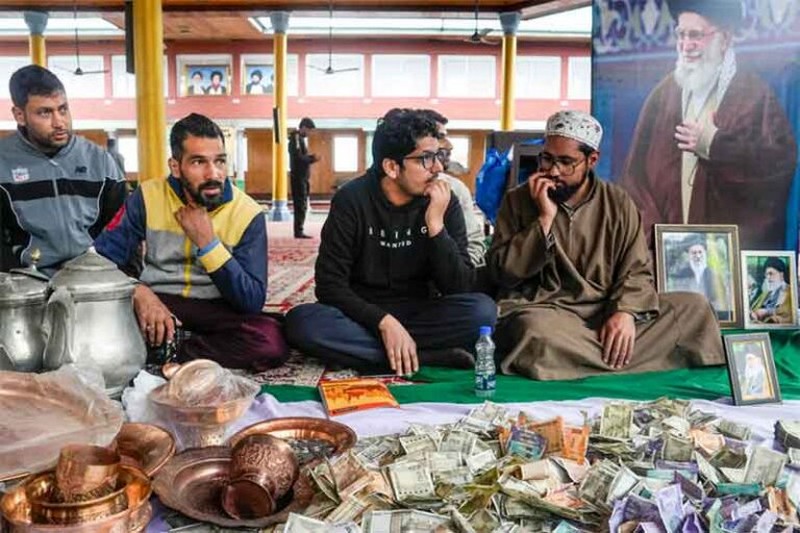
Questions That Can Get You Killed in Kashmir: The Irony of Islamic Rhetoric

By Mushtaq Ul Haq Ahmad Sikander, New Age Islam

Kashmir’s Moral Decay: Questions as Deadly Risks

Main Points:

·         Moral decay in Muslim societies replaces God-consciousness with greed and self-interest.

·         Religious trusts evolve from noble causes into family empires controlled by opportunists.

·         Experience reveals aid embezzlement by a failed lawyer during 2014 floods.

·         Questioning corruption invites violence, as in Advocate Babar Qadri’s murder.

·         Fear silences Kashmiris amid blurred lines between militants, mafia, and state allies.

When societies decay, they don’t always collapse with a bang; sometimes, they corrode quietly from within. The Muslim world — once an intellectual and moral lighthouse — today stands at a crossroads of self-inflicted decline. The decay isn’t only political or economic; it is moral, spiritual, and institutional. Nowhere is this collapse more visible than in places like Kashmir, where the noble vocabulary of faith, justice, and service has been hijacked by opportunists — the pious pretenders and clever manipulators who wear the cloak of religiosity to enrich themselves.

What began as reform gradually turned into rot. And questions — simple, honest questions — about accountability and truth have become acts of rebellion so dangerous that they can cost one’s life.

The Moral Decay Beneath the Divine Vocabulary

Across the Muslim world, we have witnessed a degeneration of moral and spiritual values. Where once taqwa (God-consciousness) shaped public life, today greed and self-interest define it. The poor remain poor, and the pious impostors grow rich in the name of the poor.

The disease lies not merely in worldly temptations but also in the loss of fear of God. The rich and powerful engineer shortcuts to prosperity — legal or illegal, halal or haram, moral or immoral — no longer matters. The language of faith has become a business model; dawah is monetized, charity is privatized, and “trusts” have mutated into family enterprises.

Every avenue of righteous service has been converted into a personal fiefdom — where the throne of the Almighty is invoked only to legitimize selfish power. Sincerity has been replaced by theater; spirituality by spectacle; integrity by slogans.

How Noble Causes Turn into Private Empires

It begins innocently enough. A group forms an Islamic trust, declaring noble missions: to educate the poor, aid orphans, or raise religious awareness. They attract support — moral, intellectual, and financial. For a moment, hope breathes again. People believe that the idealism of Islam can still produce social reform. But soon, the group mutates. The original zeal and sincerity give way to hierarchy. Power revolves around one family. Trustees gradually become mere signatories, present only to fulfill legal formalities. The real control lies elsewhere — in one man’s hands, his household, and later his descendants. Where once a collective dream existed, now a family enterprise stands. The mosque becomes an office; the pulpit, a press-conference desk.

The Story of a Failed Lawyer and a Broken Trust

I speak not merely in abstraction. I was, for more than a decade, a volunteer in one such “Islamic trust.” It began when an academic mentor urged me to join a fledgling organization led by a lawyer — a failed one, both professionally and ethically.

This man, married into a family of NGO owners and social workers, decided to own his piece of the moral market. He opened his own trust — a shop thinly covered in religious wrapping. As an idealistic college student, I poured time, intellect, and heart into this venture. For years, I worked without pay, mobilizing youth, connecting donors, helping the trust survive through its early years. During the devastating 2014 floods in Kashmir, I helped channel millions in foreign aid to this organization — aid meant for rebuilding lives, for the destitute, for the homeless.

But soon the numbers stopped adding up. The donor agency sought transparency — a simple audit, a basic moral duty. And then the mask slipped. The audit never came. The “failed lawyer” had siphoned off a large portion of the donations to buy a flat in New Delhi.

When I discovered this, my conscience screamed. I wanted to expose him. But the world of deceit is guarded by unseen daggers. Friends cautioned me: he could fabricate charges, trap me legally, even get me imprisoned. Some whispered that people who raise uncomfortable questions disappear quietly. In that moment, idealism died a quiet death in me. I resigned, disillusioned yet grateful to be alive. For in Kashmir, truth-telling can be a form of suicide.

When the Guardians Become the Gravediggers

The tragedy is broader than one man or one trust. Across Kashmir, Islamic institutions — educational, charitable, missionary have fallen prey to similar fates.

I recall another circle, founded by sincere professionals seeking to combine faith, education, and service. Yet as soon as the venture became successful, one man — an engineer by training seized control. His greed eclipsed every collective aspiration. He turned a social movement into a bloodline business. Those who had stood shoulder to shoulder with him were expelled one by one. Trustees were threatened, silenced, or bought.

When I asked some of the displaced trustees why they didn’t challenge him legally, their answer chilled me: “He has access to guns.” In a place where power and violence blur, where the boundary between militants, mafia, and manipulators is invisible, they chose silence over martyrdom. “Better to stay quiet than become a headline read with suspicion,” they said. Because in Kashmir, when someone dies at the wrong hands, rumors paint the victim darker than the murderer. Death itself becomes a defamation. The fear of “unknown gunmen” has colonized the conscience of Kashmir. Every honest person carries an invisible notice — “Speak carefully, for your grave may be listening.”

When Questions Become Crimes

If you need a living example of how dangerous dissent is, remember Advocate Babar Qadri. A sharp mind, an articulate voice, a believer in dialogue. His only sin was asking the wrong questions — questions about transparency in power structures, about the conduct of the Bar Association, about the silence of those who claim to represent justice. One evening, masked men entered his home and silenced him forever.

His killers walked calmly into the darkness. His questions still echo in it.

In Kashmir, asking questions about the misuse of religion or money, the exploitation by Moulvis and “leaders,” or the hidden alliances between religious entrepreneurs and state machinery — is equivalent to inviting death.

Take the case of a prominent religious figure — Ghulam Rasool Hami. His family enterprises swirl with whispers of fraud and manipulation. Yet who dares investigate? Only those under political protection, like Sandeep Mawa, can speak openly. Anyone else risks a jail cell — or a coffin. Because in every conflict zone, the state keeps loyal “assets” — people whose function is to maintain influence among the populace. These assets are untouchable. They manipulate faith to pacify protest, distribute aid selectively, and control narratives. And the state, in turn, shields them.

This unholy marriage between political power and religious opportunism has made accountability impossible. The masses remain silent, not because they approve, but because they wish to live.

The Anatomy of Fear

There’s a proverb in our land: “When two elephants fight, it’s the grass that gets crushed.” The ordinary Kashmiri — the teacher, the student, the shopkeeper, the volunteer — is the grass. Between the weight of the gun and the shadow of corruption, between the state and its surrogates, between militants and mafias, the common man learns only one lesson: survival.

We have reached a stage where silence is no longer cowardice — it’s self-preservation. Truth has no reward, only risk. The powerful fabricate charges with ease; the weak find themselves behind bars or beneath soil. To question is to betray. To expose is to invite revenge. And to resign from moral complicity is to live with perpetual suspicion.

Between Faith and Fear

It is ironic that in the land of saints, where Sufis once taught humility and truth, faith has now become a camouflage for kleptocracy. Everyone talks of Shura, consultation, and Caliphate; of justice in Islam; of freedom of expression in Khilafat. But when someone dares to actually apply these ideals — to demand audit, transparency, or explanation — that person is branded as “a troublemaker,” “a foreign agent,” or worse, “an infidel.”

Our tragedy lies in this hypocrisy: we quote verses about justice while burying those who live by them. We brag about Haqq but celebrate Makkari. We speak of Akhirat while enslaving the world. We demand democracy for ourselves but despise accountability for our idols. Thus, the disintegration isn’t only institutional; it is doctrinal. We no longer believe what we preach.

The Irony of Islamic Rhetoric

Nowhere does irony wound more sharply than in the language of faith itself. The very words that once emancipated humanity — adl (justice), amanah (trust), shura (consultation), ikhlaas (sincerity) — have been hollowed out and repainted as tools of control. Across Kashmir and much of the Muslim world, these sacred ideals are now rehearsed in speeches, embossed on trust letterheads, and woven into the rhetoric of Friday sermons, all while their spirit lies buried under layers of greed and fear.

We proclaim our attachment to the Caliphate, yet we cannot run a charity without corruption. We quote the Qur’an about accountability, yet we recoil from a simple audit. We invoke the Prophet’s humility, while competing for power, position, and photo opportunities. This duplicity insults both faith and reason. Islam was never meant to be a slogan for social climbing; it was meant to be a moral discipline. But in our hands, religion has become both a refuge for cowards and a weapon for swindlers.

The irony deepens when these exploiters portray themselves as victims — claiming to “defend Islam” even as they defile it through deceit and intimidation. They preach patience to the poor while their own children study abroad on misused relief funds. They demand accountability from the world but offer none to their own followers. When confronted, they wrap themselves in the sanctity of religion, declaring any questioner an enemy of faith. Thus, Islam — the religion of questioning, of reason, of moral interrogation — is used to silence the very act of inquiry it once commanded.

And that is the heart of the tragedy: the murder of conscience in the name of piety.

In our sermons, Islam reigns supreme; in our systems, it lies imprisoned. We boast of divine justice but live by human cunning. We fear no God but all men. Our words are sacred — our deeds profane.

Until we learn to reclaim the moral integrity of our faith — until truth becomes safer than silence — Kashmir, and indeed the Muslim world, will continue to produce martyrs of honesty and monuments of hypocrisy. For now, in our valleys, questions themselves have become crimes; and those who ask them, casualties of their own courage.

M.H.A.Sikander is Writer-Activist based in Srinagar, Kashmir.

13 February 2026

Source: newageislam.com