Just International

As part of its ongoing genocide, Israel attacks 16 shelter centres in Gaza in a single month

By Euro-Med Human Rights Monitor

Palestinian Territory – Israel has escalated its systematic policy of targeting—without warning—schools functioning as shelters for forcibly displaced civilians in the Gaza Strip, killing and wounding hundreds of them. This policy is part of the ongoing genocide that Israel has been waging against Palestinians in the Strip since 7 October 2023.

The Israeli military targeted the Halima al-Sadia School, which provides shelter to hundreds of internally displaced people in Jabalia al-Nazla, in the north of the Gaza Strip, at midnight on Saturday 7 September 2024. The school was bombed by Israeli aircraft, according to the Euro-Med Monitor field team. Four people were killed and several others were injured in the attack.

On Saturday afternoon, Israeli planes then bombed the Amr Ibn al-Aas School, north of Gaza City, which was also housing displaced people. Four Palestinians, including a child, were killed, and several others were injured.

Since the beginning of August, the Israeli occupation army has bombed 16 schools being used as shelters in the Gaza Strip, 15 of them located north of Gaza Valley. Two hundred and seventeen Palestinians have been killed in the reported attacks, while hundreds more have been injured, a large number of casualties being women and children.

In the past week, the Israeli army has increased its targeting of civilians in the Gaza City and North Gaza governorates by bombing residential buildings, civilian gatherings, and commercial stalls there, in addition to shelter centres and their surrounding areas.

There is no legitimate reason to target schools above the heads of displaced individuals, and this act is a blatant violation of the principles of distinction, military necessity, proportionality, and the obligation to exercise appropriate caution. Every time it launches an attack, the Israeli army attempts to justify its actions by claiming that it is attacking military targets, but it never offers any proof to support these assertions.

By killing and forcibly displacing as many Palestinians as possible from their land, these attacks are a part of the genocide being carried out by Israel in the Gaza Strip.

According to preliminary investigations conducted by the Euro-Med Monitor field team, the Israeli army has deliberately destroyed all of the remaining shelters in the north of the Gaza Strip, including schools and public facilities. This destruction has been committed with the goal of establishing a coercive environment, in order to compel the civilian population to leave their neighbourhoods and evacuate to the central and southern sections of the Strip.

Additional evidence of Israel’s clear intention to push Palestinians out of the Gaza Strip is the plan leaked by Israeli newspaper Yedioth Ahronoth, which published an article claiming that the Israeli army is currently researching options to drive out and displace the remaining Palestinians in the northern Gaza Valley under what is known as the “Generals’ Plan”.

Yedioth Ahronoth pointed to Israeli Prime Minister Benjamin Netanyahu’s conversation with the army about launching a fourth phase of his bloody war, centred on driving out residents of the northern Gaza Strip. This suggests that the plan for forced displacement, which has been in place since the beginning of this genocide—now in its 11th consecutive month—is still in effect, in the absence of any strong international opposition to Israel’s attempt to annihilate the Palestinian people.

The United States and numerous European nations’ complicity in Israel’s horrific crimes against the Palestinian people, particularly in the Gaza Strip, coupled with the international community’s near silence and lack of action to halt the genocide there, is enabling Israel to finalise its plan to exterminate the Palestinian people in large numbers, through forced displacement and direct and indirect killing.

Israel’s bombing strategy reveals a deliberate policy to target Palestinians civilians everywhere in the Gaza Strip; spread fear among them; deny them stability or shelter, even for brief periods of time; force them to evacuate repeatedly; subject them to life-threatening conditions; and ultimately destroy them. The bombing continues throughout the entire Strip, with Israel targeting places designated as humanitarian areas, mainly shelter centres, including those set up in UNRWA-run schools.

As of the time of publication, the Israeli military has been attacking the Gaza Strip for 11 months. During this time, Israel has been carrying out military operations against civilian targets, killing large numbers of civilians in the process. These attacks have also targeting refugee centres, the majority of which were housed in UN buildings, and have killed large numbers of people there, all of which constitutes crimes against humanity, full-fledged war crimes, and genocide.

As part of their international obligations, all nations must put an end to Israel’s crimes of genocide and other serious offenses in the Gaza Strip; safeguard civilians there; ensure Israel abides by international law and the rulings of the International Court of Justice; and impose effective sanctions on Israel by halting all forms of military, financial, and political cooperation and support. This includes an immediate stop to all arms sales, exports, and transfers to Israel, including export licenses and military aid.

All nations that cooperate with Israel in committing crimes must be held accountable, especially those that provide Israel with any kind of direct support or assistance. This includes giving aid and engaging in contractual agreements with Israel relating to the military, intelligence, politics, law, finance, and the media, among other domains that might help its crimes continue.

At the international, regional, and local levels, all possible avenues for accountability must be explored with urgency. This includes serious joint work to activate the path of universal jurisdiction, in order to hold accountable perpetrators of crimes against Palestinian civilians before the national courts of countries where such jurisdiction exists.

The International Criminal Court must act quickly to issue arrest warrants for Israeli Prime Minister Benjamin Netanyahu and Defense Minister Yoav Galant; broaden the scope of its investigation into individual criminal responsibility for crimes committed in the Gaza Strip, to include everyone involved; issue warrants for their arrest; hold them accountable; and categorically declare Israel’s ongoing crimes to be genocide

Euro-Med Human Rights Monitor is a Geneva-based independent organization with regional offices across the MENA region and Europe

9 September 2024

Source: countercurrents.org

Witness: Israeli troops in West Bank intentionally killed US activist

By Maureen Clare Murphy

Israeli occupation forces killed both an American woman during a protest in Beita, a village near Nablus in the northern occupied West Bank, and a 13-year-old Palestinian girl in a separate but nearby incident on Friday.

In the latter incident, Bana Amjad Baker (some outlets gave her family name as Laboom) was struck by a bullet in her chest while in her home during confrontations that erupted in Qaryut village, also near Nablus, after settlers raided and attacked the community.

The girl’s father said that she was shot by Israeli occupation forces while in her room with her sisters, the official Palestinian news agency WAFA reported.

Also on Friday, Israeli troops withdrew from Jenin refugee camp in the northern West Bank after a 10-day raid in which essential infrastructure was destroyed and at least 21 Palestinians were killed and more than 130 injured.

Israeli forces have laid siege to several other refugee camps in the northern West Bank since 28 August. At least 39 Palestinians were killed in the territory during that time, including in Jenin.

Israeli troops desecrate boy’s body

On Friday, Defense for Children International-Palestine stated that on the previous day, “Israeli forces shot and killed a 16-year-old Palestinian boy in the northern occupied West Bank then desecrated his body.”

The teen, Majed Abu Zeina, “was shot in the leg by an Israeli soldier from a distance of 30 meters” in al-Faraa refugee camp south of Tubas.

“Israeli soldiers approached Majed as he lay injured on the ground and prevented a Palestinian ambulance from reaching him,” according to Defense for Children International-Palestine.

[https://twitter.com/DCIPalestine/status/1832123532827926670]

“Majed pleaded with Israeli soldiers to let the ambulance help him, but they ignored him” and one of them ordered him to lift up his shirt, “which revealed a homemade explosive device that Majed was allegedly carrying.”

The soldier “then shot Majed at point-blank range in the neck, killing him,” according to the children’s rights group.

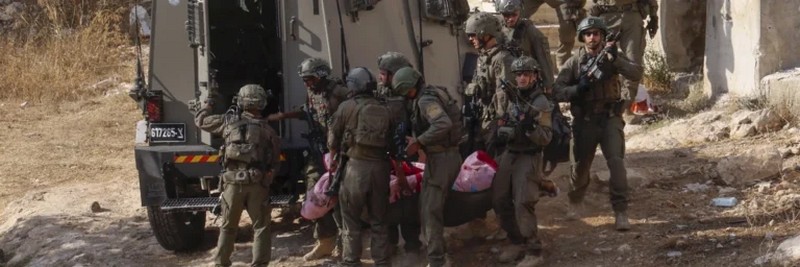
Video shows an Israeli military bulldozer moving the boy’s body with the front blade. The soldiers operating the bulldozer drove around al-Faraa with the teen’s body in the blade for an hour before dumping him in another area of the camp.

The Palestinian Center for Human Rights said that the boy’s abdomen was torn open while being carried by the bulldozer and his internal organs were exposed. His body was “disfigured and unrecognizable” when it was finally retrieved following the withdrawal of Israeli troops hours later.

Defense for Children International-Palestine said that 76 Palestinian children have been killed by Israeli forces and settlers in the West Bank so far this year, including two US citizens.

At least 157 children are among the nearly 700 Palestinians killed in the West Bank since October.

“Intentional killing” of American woman

The US citizen killed in Beita on Friday was identified as 26-year-old Ayşenur Eygi, a resident of Seattle, Washington, who was born in Turkey.

“It was an intentional killing that cannot be justified,” according to Jonathan Pollak, an Israeli anti-occupation activist who was present when Eygi was shot in the head:

[https://twitter.com/ryangrim/status/1832109384253763592]

Pollak said that he and others had joined Beita’s weekly demonstration against the colonization of village land.

Israeli troops fired tear gas and live ammunition during confrontations that ensued following afternoon prayers held during the protest, forcing demonstrators to retreat towards the village.

Demonstrators were congregated on the outskirts of the village some 150-200 meters away from Israeli troops, according to Pollak. The situation was quiet when a sniper positioned on a rooftop fired two live bullets, he said.

The first bullet hit a metal object and shrapnel hit a village resident in his thigh. The second one was the bullet that hit Eygi.

“I found her lying on the ground … bleeding from her head,” Pollak said, adding that she “had a very weak pulse.” Eygi was evacuated to a hospital but efforts to save her life failed.

Saad Dhiab, a resident of Beita, told WAFA that after the shots rang out, “I saw the soldiers dancing happily at what they had done.”

The International Solidarity Movement stated that Eygi was an activist with the group and is the 18th person to be killed in the context of Beita’s protests since 2020, following the establishment of Evyatar, a settlement outpost, on village land.

[https://twitter.com/ISMPalestine/status/1832116250559811955]

Evyatar, which was most recently evacuated by the Israeli government in 2021, has become a symbolic site for the settlement movement emboldened by top political figures in Benjamin Netanyahu’s extreme-right coalition.

In June last year, Itamar Ben-Gvir, Israel’s national security minister, urged settlers to “run for the hilltops” during a visit to Evyatar. He called for killing “thousands” of terrorists to “fulfill our great purpose: the land of Israel for the people of Israel” and assured settlers that “we’ve got your back.”

The weekly protests in Beita were revived and therefore the repression increased after the Israeli cabinet approved the retroactive “legalization” of Evyatar in June this year, according to the International Solidarity Movement.

Last month, Amado Sison, another American volunteer, was shot in the back of his leg during a demonstration in Beita.

All Israeli settlements in the West Bank are illegal under international law, which prohibits an occupying power from transferring its civilian population into occupied territory.

[https://twitter.com/AidaTuma/status/1832040796347830447]

Following the killing of Eygi, the Israeli military claimed that its forces “responded with fire toward a main instigator of violent activity who hurled rocks at the forces and posed a threat to them.”

It said that it was “looking into reports that a foreign national was killed as a result of shots fired in the area.”

Antony Blinken, the US Secretary of State, said the government “deplored” the death of Eygi. He added that the facts still needed to be established and declined to say whether her killing would lead to any change in policy on allocation of American weapons to Israel:

[https://twitter.com/prem_thakker/status/1832153300893933826]

US citizens killed by Israel with impunity

Several international activists with the International Solidarity Movement have been severely injured or killed by Israeli forces since the group’s founding in 2001, including American college student Rachel Corrie and British photography student Thomas Hurndall, who were both fatally injured by soldiers in Gaza in 2003.

Two other US citizens were killed by Israeli forces during humanitarian missions to Gaza.

Jacob Flickenger, a dual US-Canadian citizen, was killed by the Israeli military while working for the Washington-based charity World Central Kitchen in Gaza earlier this year.

[https://twitter.com/MaxBlumenthal/status/1832052581176160673]

[https://twitter.com/MaxBlumenthal/status/1832078842363596928]

In 2010, Furkan Doğan, an 18-year-old US citizen and Turkish legal permanent resident, was shot five times, including once in the head at point-blank-range, and killed alongside eight others in international waters when Israeli commandos stormed the flagship Mavi Marmara that was part of a humanitarian flotilla attempting to break the siege on Gaza.*

A tenth passenger died of his injuries four years later. All of those killed during the raid, except for Doğan, were Turkish citizens.

Instead of seeking accountability for the American teen’s death, the Obama administration in Washington worked behind the scenes to “turn off” a UN fact-finding mission into the Mavi Marmara massacre, as documents from the US mission in Geneva showed.

The International Criminal Court probed the incident but ultimately declined to open a formal investigation. Fatou Bensouda, the tribunal’s chief prosecutor at the time, stated in 2020 that war crimes may have been committed but the Israeli attack on the flotilla was not “sufficiently grave” to warrant prosecution.

That court has been petitioned to investigate the killing of Shireen Abu Akleh, the iconic Al Jazeera reporter and US citizen who was shot in the head by an Israeli army sniper while covering a military raid in Jenin in 2022.

Later that year, Al Jazeera released a documentary laying out the complicity of the Biden administration in Israel’s cover-up of Abu Akleh’s death.

Palestinians with US citizenship may be among the nearly 40,900 killed in Gaza since 7 October. Thousands more Palestinians not reflected in the official fatality count are missing under the rubble of destroyed buildings or their unidentified bodies haven’t been recovered from the streets.

On Friday, Abed Ayoub, the executive director of the American-Arab Anti-Discrimination Committee, stated that “for decades, Israel has been killing Palestinians and US citizens without consequence, exposing the hypocrisy and double standards of US rule of law, our politicians and the media.”

[https://twitter.com/DaliaHatuqa/status/1832060228210192703]

“The same voices that outcried the death of an Israeli soldier with US citizenship held captive in Gaza remain silent when other US citizens, all civilians, are executed by Israeli forces,” Ayoub added, referring to Hersh Goldberg-Polin.

Goldberg-Polin, who was captured at a music festival during the Hamas-led attacks on 7 October 2023, was found dead alongside five other captives in southern Gaza last Saturday.

Chris Van Hollen, a Democratic senator from Maryland, said on Friday that he had “repeatedly” raised concerns over the lack of accountability for the killing of US citizens by Israeli forces.

“The Biden administration has not been doing enough,” he said.

“If the Netanyahu government will not pursue justice for Americans, the US Department of Justice must,” he added.

Maureen Clare Murphy is senior editor of The Electronic Intifada.

8 September 2024

Source: countercurrents.org

Massive London March Demands Israeli Arms Embargo After Police Drop Restrictions

By Julia Conley

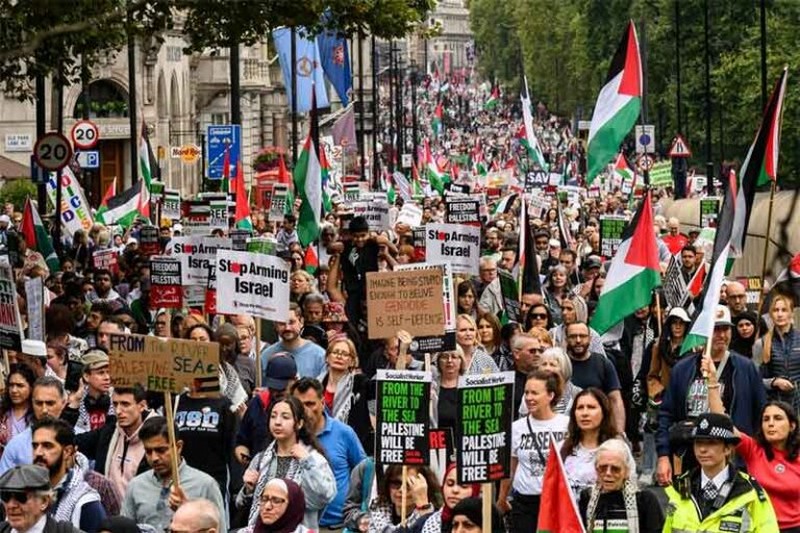
Thousands of people gathered at London’s Picadilly Circus Saturday for the city’s latest march against Israel’s bombardment of Gaza and the United Kingdom’s continued support for the Israel Defense Forces, following what organizers called “a major victory in defense of the democratic right to protest.”

The Metropolitan Police on Friday dropped its restrictions on the march, which was the first pro-Palestinian protest since last October to proceed to the Israeli embassy in London.

The police had attempted to stop campaigners from gathering before 2:30 pm, conflicting with plans to begin the rally preceding the march at noon.

“They never provided any convincing explanation or evidence for this delay, and it has caused enormous, unnecessary difficulty to the organization of a large-scale demonstration,” Ben Jamal, who leads the Palestine Solidarity Campaign, one of the groups organizing the march, toldMiddle East Eye on Friday.

“It has unfortunately been part of a pattern of obstruction, delay, and lack of communication on the part of the Met which we will press them to review and reflect on for future demonstrations,” he added. “For tomorrow, we call on our supporters to turn out in their hundreds of thousands to show we will not be deterred from seeking an end to Israel’s genocide and justice for Palestine!”

Jamal said the police “saw sense and abandoned their unjustified and impractical attempt to delay the start of the march by two hours on Saturday,” allowing the march to begin at 1:30 pm.

[https://twitter.com/hzomlot/status/1832402479104868822]

During previous marches in which hundreds of thousands of people have demonstrated in solidarity with Palestinians since last October, police have blocked off the area surrounding the Israeli embassy in Kensington, threatening anyone who protested in the vicinity with arrest.

Marching to the embassy, demonstrators made a “renewed call to end the ongoing genocide in Gaza” and demanded an “immediate and full cessation of arms supplies to Israel.”

Earlier this week, the U.K. government announced it was suspending approximately 30 of its 350 arms export licenses for Israel, saying that “there does exist a clear risk that they might be used to commit or facilitate a serious violation of international humanitarian law.”

Human rights advocatesmedical professionals working in Gaza, and legal experts have for months demanded that Israel’s top international funders, including the U.S. and U.K., stop providing military aid as Israel has blocked humanitarian aid from reaching Gaza and waged attacks on civilian infrastructure, killing more than 40,000 people.

The country has also been accused of carrying out genocide in a case led by South Africa at the International Court of Justice; the court has ordered Israel to end its blockade on humanitarian aid and to prevent genocide in Gaza.

“We demand our government completely stop arming Israel and push for a cease-fire now,” said the Palestine Solidarity Campaign.

[https://twitter.com/PSCupdates/status/1832398983106588817]

As Londoners marched on Saturday, the Gaza Health Ministry announced that at least 61 Palestinians had been killed by Israeli forces in the last two days. Four people were killed in a strike on Halimah al-Saadiyah school in Jabaliya, where displaced Palestinians have been sheltering, and three were killed in a bombing at Amr Ibn al-As school in Gaza City.

Media outlets in Palestine reported that a baby named Yaqeen al-Astal had become the 37th child in Gaza to die of malnutrition since Israel began its near-total aid blockade.

International outrage also grew on Saturday regarding the killing of a Turkish American activist, Aysenur Ezgi Eygi, in the West Bank on Friday. Local media and eyewitnesses said Eygi had been deliberately shot in the head by Israeli forces at a protest over the expansion of illegal Israeli settlements.

The U.S. called on Israel to investigate the killing on Friday, but Eygi’s family said in a statement that such a probe would not be “adequate.”

“We call on President [Joe] Biden, Vice President [Kamala] Harris, and Secretary of State [Antony] Blinken to order an independent investigation into the unlawful killing of a U.S. citizen and to ensure full accountability for the guilty parties,” said the family.

Stéphane Dujarric, spokesperson for the United Nations, called for “a full investigation of the circumstances” and said that “people should be held accountable. And again, civilians must be protected at all times.”

Julia Conley is a staff writer for Common Dreams.

8 September 2024

Source: countercurrents.org

Meta’s Role in Israel’s Digital Proxy War on The Cradle

By Kit Klarenberg

The banning of The Cradle from Facebook and Instagram shows a troubling alliance with Israeli-linked groups to silence voices critical of the occupation state, especially those media outlets covering its adversaries’ narratives.

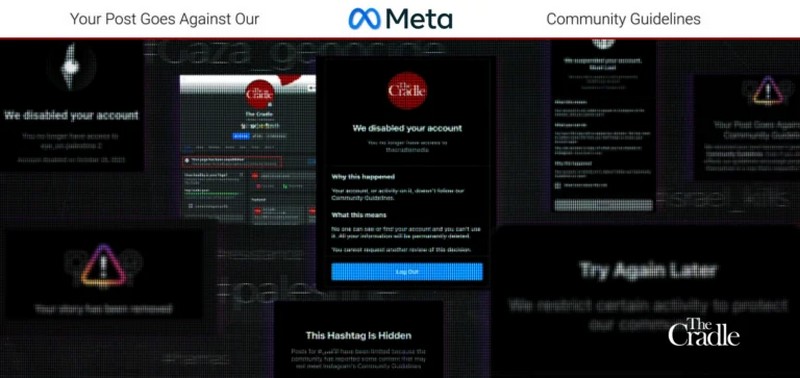
3 Sep 2024 – On 16 August, social media giant Meta permanently banned The Cradle from Facebook and Instagram. The outlet’s accounts on those platforms, which had amassed over a hundred thousand followers and millions of views, were unilaterally purged without warning or a chance to appeal.

Permabanned

The officially-stated grounds were purported violations of community guidelines for “praising terrorist organizations” through its reporting on the activities of West Asia’s resistance movements. Meta summarily informed The Cradle:

No one can see or find your account, and you can’t use it. All your information will be permanently deleted. You cannot request another review of this decision.

However, there are grounds to believe this crackdown was not merely a matter of community standards enforcement. Evidence suggests that Israeli intelligence-connected entities played a significant role in Meta’s decision to ban The Cradle, a dissenting, anti-Zionist news outlet reporting on the region, from the region.

This act of censorship will unlikely be the last against those who dare to expose the brutal realities of the war on Gaza and cover those resisting it.

There appears to be a disturbing alliance between Meta’s leadership and powerful Zionist organizations that identify targets for censorship, while Meta executives comply without question. Speaking to The Cradle, independent tech industry researcher Jack Poulson says:

Meta banning a news source such as The Cradle that is critical of Israel is less surprising when you consider their history. Beyond Meta’s head of Israel policy, Jordana Cutler, being a former chief of staff of Israel’s Minister of Strategic Affairs, and nearly his director general. Israeli government propaganda offshoot CyberWell is also a ‘trusted partner’ to Meta. In July, the organization helped influence Meta’s policy on criticism of Zionism.

Israeli involvement

In June, Poulson, alongside journalist Lee Fang, exposed CyberWell’s part in a broader Israeli government effort, known as Voices of Israel, to shape and disseminate pro-Zionist narratives across the west.

Despite CyberWell’s denials of government funding or ties, the organization swiftly removed references to its founders, staff, and advisors from its website following these revelations.

Archival evidence reveals that many members of the non-profit’s “dynamic team” of “academics, retired generals, intelligence alumni, and innovative tech professionals” have deep ties to Israeli intelligence and military forces, such as US founder Tal-Or Cohen Montemayor, a former occupation soldier and intelligence professional.

Montemayor emigrated to Tel Aviv as a teenager, volunteering to serve in the occupation army as a “lone soldier.” She then entered the intelligence sphere via Israeli private intelligence firm Argyle Consulting.

There, Montemayor served under Zohar Gorgel, “a decorated IDF intelligence officer with over a decade of experience in various cyber and technology roles.” Together, “encouraged by colleagues and mentors,” they launched a project to “improve community standards” online. In other words, to neutralize Palestinian solidarity and condemnation of the Zionist entity.

Given the profusion of “former” occupation spooks and high-ranking military veterans in CyberWell’s ranks, one wonders whether the non-profit’s launch was pushed by malign elements within the Israeli government.

‘Call to action’

This suspicion is amply reinforced by the February 2021 report by Tel Aviv’s Ministry of Strategic Affairs, The Hate Factor. It outlined several strategies for “combating antisemitism online,” including the use of artificial intelligence (AI) to identify and ban social media users from posting content critical of the occupation state.

Mere months later, CyberWell was founded, under the title Global Antisemitism Research Center, touting AI as its pièce de résistance. Instantly, the obscure non-profit began receiving sizable donations from well-connected Zionist lobby organizations.

CyberWell also quickly entered into high-level agreements with Israeli government-funded and directed influence operations, such as the notorious, now-defunct trolling and harassment unit Act-IL, which was run out of Tel Aviv’s Ministry of Foreign Affairs.

For years, the hasbara outfit covertly encouraged Zionist activists to target boycotts and boycotters, justify the oppression and slaughter of Palestinians, and bully human rights groups and solidarity activists online. The effort shuttered without warning in 2022.

That same year, CyberWell’s annual report noted that it had “served as the data provider to Act-IL’s community for their end-of-year call to action on the state of online antisemitism.” This may provide some explanation for Act-IL’s closure.

Today, criticizing Zionists on Facebook and Instagram can result in permanent bans, a policy change reportedly enacted under pressure from CyberWell and other Zionist lobby groups. CyberWell is not only a “trusted partner” of Meta but also of TikTok and X, exerting influence to suppress content critical of Zionism across multiple platforms.

CyberWell already appears to have used its influence to compel TikTok to adopt similar guidelines on content related to Zionism as Meta. And there is no indication that the organization intends to stop there.

It has submitted formal guidance to Meta on censoring the Palestine solidarity phrase, “From the river to the sea, Palestine will be free” – which Zionists falsely claim is a clarion call for the genocide of Jews – while publishing reports on purported “antisemitic disinformation” circulated during western election campaigns.

Given this context, it is almost certain that CyberWell had a hand in The Cradle’s abrupt removal from Meta’s platforms. Within hours, The Cradle’s accounts were banned, even those not directly linked or associated with any violations. Even a backup Instagram account, which hadn’t violated any of the platform’s guidelines, was taken down for being associated with the main account.

It appears that Meta was intent on erasing any trace of The Cradle from its social media universe, much to the likely satisfaction of officials in Tel Aviv.

‘Shadow banning’

Nonetheless, it must not be forgotten that Meta has a long and deplorable track record of systemic censorship of content related to Palestine. This suppression has only intensified since the Gaza genocide began.

December 2023 Human Rights Watch (HRW) report exposed how, over the past two months, Facebook had engaged in “over 1,050 takedowns and other suppression of content” on Facebook and Instagram “posted by Palestinians and their supporters, including about human rights abuses.”

Of this total, 1,049 “involved peaceful content in support of Palestine that was censored or otherwise unduly suppressed.” The documented cases included “content originating from over 60 countries around the world, primarily in English, all of peaceful support of Palestine, expressed in diverse ways.” Meanwhile, HRW “identified six key patterns of undue censorship.” This included:

Removal of posts, stories, and comments; suspension or permanent disabling of accounts; restrictions on the ability to engage with content­; restrictions on the ability to follow or tag other accounts; restrictions on the use of certain features, such as Instagram/Facebook Live, monetization; and “shadow banning,” the significant decrease in the visibility of an individual’s posts, stories, or account, without notification, due to a reduction in the distribution or reach of content or disabling of searches for accounts.

Elsewhere, digital rights group Access Now has documented how content damaging to the occupation state has been censored under Meta policies unrelated to “disinformation” or “antisemitism” or informed by organizations like CyberWell.

For example, following the bombing of Gaza’s Al-Ahli Arab Hospital on 17 October 2023, which killed 471 Palestinians and left another 342 injured, Facebook and Instagram removed content documenting the explosion and showing bodies of casualties under Meta’s policy on adult nudity and sexual activity.

The Cradle’s coverage presses on

The ease with which Zionist organizations like CyberWell have been able to infiltrate and pressure Meta and the platform’s omerta on the genocide of Palestinians could be attributable to several Israeli military and intelligence veterans occupying high ranks within the company.

For instance, Guy Rosen, formerly of the occupation army’s shady spying and disinformation specialist Unit 8200, has been the company’s Chief Information Security Officer since 2022. He is also co-founder of Meta-owned Israeli tech company Onavo.

The Cradle will continue to expose the Gaza genocide and factually report on events in West Asia, including the region’s Resistance Axis, despite Meta’s ban from Facebook and Instagram.

Meta’s continuous and escalating censorship by Meta may well contribute to its declining user base and crashing stock market value. As more voices are silenced, the platform’s days, much like those of the Zionist narrative it so eagerly supports, may be numbered.

Kit Klarenberg is a British investigative journalist exploring the role of intelligence services in shaping politics and perceptions.

9 September 2024

Source: transcend.org

UN Expert Says Impunity for Israel Must End as ‘Genocidal Violence’ Spreads to West Bank

By Jake Johnson

“Apartheid Israel is targeting Gaza and the West Bank simultaneously, as part of an overall process of elimination, replacement, and territorial expansion,” said United Nations special rapporteur Francesca Albanese.

3 Sep 2024 – An independent United Nations expert warned Monday that “Israel’s genocidal violence risks leaking out of Gaza and into the occupied Palestinian territory as a whole” as Western governments, corporations, and other institutions keep up their support for the Israeli military, which stands accused of grave war crimes in the Gaza Strip and West Bank.

Francesca Albanese, the U.N. special rapporteur on the human rights situation in the illegally occupied Palestinian territories, said in a statement that “there is mounting evidence that no Palestinian is safe under Israel’s unfettered control.”

“The writing is on the wall, and we cannot continue to ignore it,” said Albanese, who released a detailed report in May concluding that there are “reasonable grounds to believe” Israel is guilty of genocide in Gaza.

Albanese’s new statement came as the Israeli military’s largest assault on the West Bank in decades continued into its second week. At least 29 Palestinians have been killed during the series of military raids, according toAl Jazeera, including at least five children.

“Apartheid Israel is targeting Gaza and the West Bank simultaneously, as part of an overall process of elimination, replacement, and territorial expansion,” Albanese said Tuesday. “The longstanding impunity granted to Israel is enabling the de-Palestinization of the occupied territory, leaving Palestinians at the mercy of the forces pursuing their elimination as a national group.”

“The international community, made of both states and non-state actors, including companies and financial institutions, must do everything it can to immediately end the risk of genocide against the Palestinian people under Israel’s occupation, ensure accountability, and ultimately end Israel’s colonization of Palestinian territory,” Albanese added.

Defense for Children International–Palestine noted Monday that “dozens of Israeli military vehicles” have “stormed” the West Bank city of Jenin over the past week as “Israeli forces deployed across the targeted refugee camps, seizing Palestinian homes to use as military bases and stationing snipers on the roofs of buildings, subjecting their residents to field investigations.”

“The military bulldozers began destroying the civil infrastructure in Jenin city and camp, which led to the destruction of the main water networks and power outage in several neighborhoods in Jenin and surrounding villages,” the group said. “Israeli forces besieged several hospitals in Jenin and impeded the movement of ambulances and paramedics.”

Israeli soldiers and settlers have killed more than 620 people in the occupied West Bank since October 7, on top of the roughly 40,800 killed by the Israeli military in Gaza.

Unlawful Israeli land seizures have also surged in the West Bank as settlers and soldiers wipe out entire Palestinian communities. The BBCreported Monday that, according to its own analysis, there are “currently at least 196 across the West Bank, and 29 were set up last year—more than in any previous year.”

Israel’s multi-day attack on the West Bank that began last week has intensified fears that unless there’s a permanent cease-fire, the assault on Gaza could expand to the rest of the occupied Palestinian territories and throughout the Middle East.

David Hearst, co-founder and editor-in-chief of Middle East Eyewrote Monday that “even with the obvious reluctance of Hezbollah and Iran to get involved, all the ingredients are there for a much larger conflagration.”

“An Israel in the grip of an ultra-nationalist, religious, settler insurgency; a U.S. president who allows his signature policy to be flouted by his chief ally, even at the risk of losing a crucial election; resistance that will not surrender; Palestinians in Gaza who will not flee; Palestinians in the West Bank who are now stepping up to the front line; Jordan, the second country to recognize Israel, feeling under existential threat,” Hearst wrote.

For U.S. President Joe Biden or Democratic nominee Kamala Harris, he added, “the message is so clear, it is flashing in neon lights: The regional costs of not standing up to Netanyahu could rapidly outweigh the domestic benefits of being dragged along by him.”

James Zogby, president of the Arab American Institute, similarly argued Tuesday that “the U.S. must reverse course—and do so dramatically.”

“A long-overdue cut-off of U.S. arms to Israel and recognition of the Palestinian right to self-determination would provide exactly the shock to the system that is needed,” Zogby wrote. “It would force an internal debate in Israel, empowering those who want peace. It might also serve to send a message to the Palestinian people that their plight and rights are understood.”

These actions, especially if followed up with determination and concrete steps, won’t end the conflict tomorrow,” Zogby continued, “but they would surely put the region on a more productive path towards peace than the one it is on now.”

Jake Johnson is a staff writer for Common Dreams.

9 September 2024

Source: transcend.org

The UN Security Council’s Astonishing Silence on Myanmar Atrocities

By Akshaya Kumar

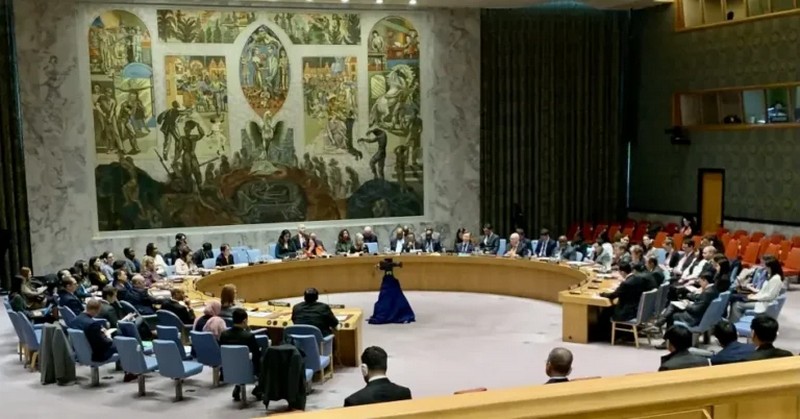
5 Sep 2024 – The United Nations Security Council should mobilize to prevent further atrocities in Myanmar. The Council’s inaction over the last few months starkly contrasts with the clear warnings from senior UN officials who are urgently ringing alarm bells. As the Council is grappling with calls for reform, the current silence on Myanmar only deepens the sense that the Council can’t rise to the moment when it matters.

The UN special rapporteur on human rights in Myanmar warned in July that “the situation carries echoes of the lead-up to genocidal violence in 2016 and 2017.” In a rare joint statement, the UN special advisers on genocide prevention and the responsibility to protect urged the international community to undertake “joint efforts to reassess the crisis in Myanmar in the light of the significant developments that are unfolding and launch a robust coordinated effort.”

In the last few weeks, both the UN children’s agency, Unicef, and the UN’s acting resident coordinator in Myanmar have condemned attacks on civilians in Rakhine State.

The Council’s last open meeting on Myanmar was held in April. Britain is the “penholder” on Myanmar, which means it takes the lead on all statements or resolutions in the Council and bears unique responsibility to galvanize the members. The Council has allowed paralysis at the Association of Southeast Asian Nations (ASEAN) level around Myanmar to influence its approach, leading to paralysis at the international level too. The Council has also failed to follow up on its December 2022 resolution on Myanmar, the body’s first since the country’s independence in 1948.

In contrast, both the UN Human Rights Council and the UN General Assembly have adopted a series of stronger but nonbinding resolutions on Myanmar, including calls for an embargo on arms and jet fuel to the military junta. The crisis presents a key test for the UK’s new Labour government, which has claimed the mantle of “progressive realism” and defense of international law.

Progressive realism may promote engaging with regional blocs, but allowing regional paralysis to mute the Security Council amid atrocities certainly is neither progressive nor pragmatic.

Since the breakdown of an unofficial ceasefire between the Myanmar military and the ethnic Rakhine Arakan Army last November, Human Rights Watch has been warning that the ethnic Rohingya population, which was already marginalized, faced even greater risks. The Rohingya have been subjected for years to movement restrictions, mass detention, denial of medical care persecution and apartheid.

The recent violence has included the killing of nearly 200 Rohingya civilians on the banks of the Naf River. They were attempting to escape hostilities after monthlong Arakan Army attacks on Rohingya villages and neighborhoods. Satellite imagery and thermal anomaly data analyzed by Human Rights Watch reveal that more than 40 villages and hamlets in Buthidaung township were partly or completely destroyed by fire from April 24 to May 21.

The Myanmar military has been stoking tensions between the Rakhine Buddhist and Rohingya Muslim communities for years, most recently through the unlawful recruitment of Rohingya men and boys, triggering heightened hate speech and misinformation.

These divisive tactics were previously used during the ethnic cleansing against the Rohingya in 2012. The  community’s vulnerability was then deepened by the military junta’s 2017 scorched-earth campaignrampant sexual violence and genocidal acts, which left villages burned to ash as several hundred thousand people fled to Bangladesh.

More than 327,000 Rohingya have been newly displaced across Rakhine State since fighting resumed in late 2023, bringing the overall number of displaced people to well over a half a million. The UN Office for the Coordination of Humanitarian Affairs estimates that 400,000 people are experiencing “food gaps” in Rakhine State with cross-border supplies limited because of the conflict.

Members of the military junta, the Arakan Army and other armed groups could also face scrutiny by the prosecutor of the International Criminal Court (ICC) for alleged crimes amid the current conflict committed in Bangladesh, such as forced recruitment and deportation of Rohingya.

The court is investigating the situation, but its jurisdiction is limited to crimes committed, at least in part, in Bangladesh, an ICC member country, or on the territory of any other member of the court. The Security Council should expand the court’s jurisdiction by referring the situation in Myanmar, which is not an ICC member country, to the court.

Recent events also underscore the blatant disregard of the provisional measures ordered by International Court of Justice in the ongoing case brought by Gambia against Myanmar. The provisional measures are binding, and the Council should play a role in enforcing them. In a June report, the UN high commissioner for human rights found that “actions taken by all parties that endanger the Rohingya appear inconsistent with the provisional measures ordered by the International Court of Justice.”

Article 94(2) of the UN Charter makes clear that parties to disputes may take recourse to the Security Council if their opponent fails to “perform obligations incumbent upon it under a judgment rendered by the Court.”

The Council’s great-power deadlock means that it has been far too quiet on Myanmar for years. But if it chooses to let recent events pass without even a meeting or public show of concern, that neglect will stain the legacy of every ambassador sitting on the Council, particularly the UK, which is supposed to “lead” on Myanmar.

Akshaya Kumar is the director of Crisis Advocacy.

9 September 2024

Source: transcend.org

Israeli Society Has Truly Fallen to Cruelty, Violence and Apathy–Just Look at Us

By Gideon Levy

8 Sep 2024 – On Friday [6 Sep], 11 funerals were held in the Jenin refugee camp. Eight of the deceased were camp residents who were killed by the Israeli army; three died of natural causes. None of them could be buried during the 10 preceding days, on account of the brutal Israel Defense Forces operation in the camp. The bodies of another five people were seized by the army, for its purposes.

On Friday morning the IDF left the camp, after completing the mission that was given the sadistic name Operation Summer Camp, and residents began returning to what was left of their homes after the army’s camp. They were in shock.

One man said Saturday that the sights were even worse than the scenes of destruction after 2002’s Operation Defensive Shield and that the behavior of the soldiers during those 10 terrible days was more violent and vicious than ever before. The spirit of the war in Gaza has become the zeitgeist of the army.

My interlocutor, Jamal Zubeidi – who had already lost nine family members to the Palestinian struggle, including two of his sons, and who last week lost Hamudi, the son of his nephew Zakaria Zabeidi – returned once again to a ruined home, as in 2002. During the 10 days of the operation, he hid in his daughter’s home on the mountain. About two-thirds of the camp’s approximately 12,000 residents were removed from it, led in refugee columns under the supervision of the soldiers, as in Gaza.

As the people of Jenin buried their dead, soldiers shot and killed a 13-year-old girl. Bana Laboum died in her home in the village of Qaryout, whose residents tried to defend themselves after settlers set fire to their fields. The settlers riot, the army comes – and kills Palestinians, oddly enough. “Confrontations,” the media calls the incidents. The rape victim confronts their rapist, the robbery victim their robber. In the insanity of the occupation, the aggressor is the victim and the victim is the aggressor.

At around the same time, not far from Qaryout, in the village of Beita, soldiers killed a protester – an American human-rights activist who was also a Turkish citizen. Aysenur Ezgi Eygi was shot in the head during a demonstration against the wildcat settlement Evyatar, which was built on the village’s land and has already cost the lives of at least seven Palestinians.

The White House said that it was “deeply disturbed by the tragic death.” But this was not a “tragic death.” Jonathan Pollak, a Haaretz journalist said that he saw the soldiers on a rooftop: “I saw the soldiers shooting. … I saw them aiming,” adding that at the time there were no active clashes. As to the “deep disturbance” in the White House, it will pass quickly.

President Joe Biden has not called the woman’s family, as he called the Goldberg-Polin family; Ezgi Eygi was also not declared an American hero, as was Hersh Goldberg-Polin, who was abducted and executed.

On Saturday, Josh Breiner published a video filmed in Megiddo Prison the morning of the criminal killings, in which dozens of Palestinians lie on the floor – prostrate, half-naked, their wrists bound behind their backs – as Israeli guards walk past them; one holds a police dog that passes inches from the detainees’ faces, barking viciously.

The Israeli flag flies over this disgraceful spectacle – a gift to Itamar Ben-Gvir. The Israel Prison Service reassured the handful of outraged observers: “It’s a routine exercise.” This is routine. A common prison service entertainment, a Shabbat ceremony for the sadistic guards.

All this happened on Friday, an ordinary day. Israel yawned. It was much more upset by the (infuriating) arrest of a young Jewish woman who threw a handful of sand at Ben-Gvir than by the fatal shooting of a non-Jewish woman who was motivated by principle no less than the young woman from Tel Aviv.

And in the ruins of the Jenin refugee camp, Jamal Zubeidi tried to gauge the extent of the damage to his home, the contents of which soldiers threw into the street. There was no power in the camp, and darkness descended on it. In all our long years of friendship, I had never heard Zubeidi sound more despairing. “They will return and we will return. A new generation will come. It won’t end here,” he said wearily.

Look at what happened Friday in the Jenin refugee camp, in Qaryout, in Beita and in Megiddo Prison – and perhaps you will see us, finally.

Gideon Levy is a Haaretz columnist and a member of the newspaper’s editorial board. Levy joined Haaretz in 1982, and spent four years as the newspaper’s deputy editor.

9 September 2024

Source: transcend.org

How the Neocons Chose Hegemony Over Peace Beginning in the Early 1990s

By Jeffrey D. Sachs

4 Sep 2024 – In 1989 I served as an advisor to the first post-communist government of Poland, and helped to devise a strategy of financial stabilization and economic transformation.  My recommendations in 1989 called for large-scale Western financial support for Poland’s economy in order to prevent a runaway inflation, enable a convertible Polish currency at a stable exchange rate, and an opening of trade and investment with the countries of the European Community (now the European Union).  These recommendations were heeded by the US Government, the G7, and the International Monetary Fund.

Based on my advice, a $1 billion Zloty stabilization fund was established that served as the backing of Poland’s newly convertible currency.  Poland was granted a standstill on debt servicing on the Soviet-era debt, and then a partial cancellation of that debt.  Poland was granted significant development assistance in the form of grants and loans by the official international community.
Poland’s subsequent economic and social performance speaks for itself.  Despite Poland’s economy having experienced a decade of collapse in the 1980s, Poland began a period of rapid economic growth in the early 1990s.  The currency remained stable and inflation low.  In 1990, Poland’s GDP per capita (measured in purchasing-power terms) was 33% of neighboring Germany.  By 2024, it had reached 68% of Germany’s GDP per capita, following decades of rapid economic growth.

On the basis of Poland’s economic success, I was contacted in 1990 by Mr. Grigory Yavlinsky, economic advisor to President Mikhail Gorbachev, to offer similar advice to the Soviet Union, and in particular to help mobilize financial support for the economic stabilization and transformation of the Soviet Union. One outcome of that work was a 1991 project undertaken at the Harvard Kennedy School with Professors Graham Allison, Stanley Fisher, and Robert Blackwill. We jointly proposed a “Grand Bargain” to the US, G7, and Soviet Union, in which we advocated large-scale financial support by the US and G7 countries for Gorbachev’s ongoing economic and political reforms. The report was published as Window of Opportunity: The Grand Bargain for Democracy in the Soviet Union (1 October 1991).

The proposal for large-scale Western support for the Soviet Union was flatly rejected by the Cold Warriors in the White House.  Gorbachev came to the G7 Summit in London in July 1991 asking for financial assistance, but left empty-handed.  Upon his return to Moscow, he was abducted in the coup attempt of August 1991.  At that point, Boris Yeltsin, President of the Russian Federation, assumed effective leadership of the crisis-ridden Soviet Union.  By December, under the weight of decisions by Russia and other Soviet republics, the Soviet Union was dissolved with the emergence of 15 newly independent nations.

In September 1991, I was contacted by Yegor Gaidar, economic advisor to Yeltsin, and soon to be acting Prime Minister of newly independent Russian Federation as of December 1991. He requested that I come to Moscow to discuss the economic crisis and ways to stabilize the Russian economy. At that stage, Russia was on the verge of hyperinflation, financial default to the West, the collapse of international trade with the other republics and with the former socialist countries of Eastern Europe, and intense shortages of food in Russian cities resulting from the collapse of food deliveries from the farmlands and the pervasive black marketing of foodstuffs and other essential commodities.

I recommended that Russia reiterate the call for large-scale Western financial assistance, including an immediate standstill on debt servicing, longer-term debt relief, a currency stabilization fund for the ruble (as for the Zloty in Poland), large-scale grants of dollars and European currencies to support urgently needed food and medical imports and other essential commodity flows, and immediate financing by the IMF, World Bank, and other institutions to protect Russia’s social services (healthcare, education, and others).

In November 1991, Gaidar met with the G7 Deputies (the deputy finance ministers of the G7 countries) and requested a standstill on debt servicing.  This request was flatly denied.  To the contrary, Gaidar was told that unless Russia continued to service every last dollar as it came due, emergency food aid on the high seas heading to Russia would be immediately turned around and sent back to the home ports.  I met with an ashen-faced Gaidar immediately after the G7 Deputies meeting.

In December 1991, I met with Yeltsin in the Kremlin to brief him on Russia’s financial crisis and on my continued hope and advocacy for emergency Western assistance, especially as Russia was now emerging as an independent, democratic nation after the end of the Soviet Union.  He requested that I serve as an advisor to his economic team, with a focus on attempting to mobilize the needed large-scale financial support.  I accepted that challenge and the advisory position on a strictly unpaid basis.

Upon returning from Moscow, I went to Washington to reiterate my call for a debt standstill, a currency stabilization fund, and emergency financial support.  In my meeting with Mr. Richard Erb, Deputy Managing Director of the IMF in charge of overall relations with Russia, I learned that the US did not support this kind of financial package.  I once again pleaded the economic and financial case, and was determined to change US policy.  It had been my experience in other advisory contexts that it might require several months to sway Washington on its policy approach.

Indeed, during 1991-94 I would advocate non-stop but without success for large-scale Western support for Russia’s crisis-ridden economy, and support for the other 14 newly independent states of the former Soviet Union. I made these appeals in countless speeches, meetings, conferences, op-eds, and academic articles. Mine was a lonely voice in the US in calling for such support.  I had learned from economic history — most importantly the crucial writings of John Maynard Keynes (especially Economic Consequences of the Peace, 1919) — and from my own advisory experiences in Latin America and Eastern Europe, that external financial support for Russia could well be the make or break of Russia’s urgently needed stabilization effort.

It is worth quoting at length here from my article in the Washington Post in November 1991 to present the gist of my argument at the time:

This is the third time in this century in which the West must address the vanquished. When the German and Hapsburg Empires collapsed after World War I, the result was financial chaos and social dislocation. Keynes predicted in 1919 that this utter collapse in Germany and Austria, combined with a lack of vision from the victors, would conspire to produce a furious backlash towards military dictatorship in Central Europe. Even as brilliant a finance minister as Joseph Schumpeter in Austria could not stanch the torrent towards hyperinflation and hyper-nationalism, and the United States descended into the isolationism of the 1920s under the “leadership” of Warren G. Harding and Sen. Henry Cabot Lodge.

After World War II, the victors were smarter. Harry Truman called for U.S. financial support to Germany and Japan, as well as the rest of Western Europe. The sums involved in the Marshall Plan, equal to a few percent of the recipient countries’ GNPs, was not enough to actually rebuild Europe. It was, though, a political lifeline to the visionary builders of democratic capitalism in postwar Europe.

Now the Cold War and the collapse of communism have left Russia as prostrate, frightened and unstable as was Germany after World War I and World War II. Inside Russia, Western aid would have the galvanizing psychological and political effect that the Marshall Plan had for Western Europe. Russia’s psyche has been tormented by 1,000 years of brutal invasions, stretching from Genghis Khan to Napoleon and Hitler.

Churchill judged that the Marshall Plan was history’s “most unsordid act,” and his view was shared by millions of Europeans for whom the aid was the first glimpse of hope in a collapsed world. In a collapsed Soviet Union, we have a remarkable opportunity to raise the hopes of the Russian people through an act of international understanding. The West can now inspire the Russian people with another unsordid act.

This advice went unheeded, but that did not deter me from continuing my advocacy.  In early 1992, I was invited to make the case on the PBS news show The McNeil-Lehrer Report.  I was on air with acting Secretary of State Lawrence Eagleburger.  After the show, he asked me to ride with him from the PBS studio in Arlington, Virginia back to Washington, D.C.  Our conversation was the following.  “Jeffrey, please let me explain to you that your request for large-scale aid is not going to happen.  Even assuming that I agree with your arguments — and Poland’s finance minister [Leszek Balcerowicz] made the same points to me just last week — it’s not going to happen.  Do you want to know why?  Do you know what this year is?”  “1992,” I answered.  “Do you know that this means?”  “An election year?” I replied.  “Yes, this is an election year.  It’s not going to happen.”

Russia’s economic crisis worsened rapidly in 1992.  Gaidar lifted price controls at the start of 1992, not as some purported miracle cure but because the Soviet-era official fixed prices were irrelevant under the pressures of the black markets, the repressed inflation (that is, rapid inflation in the black-market prices and therefore the rising the gap with the official prices), the complete breakdown of the Soviet-era planning mechanism, and the massive corruption engendered by the few goods still being exchanged at the official prices far below the black-market prices.

Russia urgently needed a stabilization plan of the kind that Poland had undertaken, but such a plan was out of reach financially (because of the lack of external support) and politically (because the lack of external support also meant the lack of any internal consensus on what to do).  The crisis was compounded by the collapse of trade among the newly independent post-Soviet nations and the collapse of trade between the former Soviet Union and its former satellite nations in Central and Eastern Europe, which were now receiving Western aid and were reorienting trade towards Western Europe and away from the former Soviet Union.

During 1992 I continued without any success to try to mobilize the large-scale Western financing that I believed to be ever-more urgent.  I pinned my hopes on the newly elected Presidency of Bill Clinton. These hopes too were quickly dashed. Clinton’s key advisor on Russia, Johns Hopkins Professor Michael Mandelbaum, told me privately in November 1992 that the incoming Clinton team had rejected the concept of large-scale assistance for Russia. Mandelbaum soon announced publicly that he would not serve in the new administration. I met with Clinton’s new Russia advisor, Strobe Talbott, but discovered that he was largely unaware of the pressing economic realities. He asked me to send him some materials about hyperinflations, which I duly did.

At the end of 1992, after one year of trying to help Russia, I told Gaidar that I would step aside as my recommendations were not heeded in Washington or the European capitals.  Yet around Christmas Day I received a phone call from Russia’s incoming financing minister, Mr. Boris Fyodorov. He asked me to meet him in Washington in the very first days of 1993.  We met at the World Bank. Fyodorov, a gentleman and highly intelligent expert who tragically died young a few years later, implored me to remain as an advisor to him during 1993.  I agreed to do so, and spent one more year attempting to help Russia implement a stabilization plan. I resigned in December 1993, and publicly announced my departure as advisor in the first days of 1994.

My continued advocacy in Washington once again fell on deaf ears in the first year of the Clinton Administration, and my own forebodings became greater.  I repeatedly invoked the warnings of history in my public speaking and writing, as in this piece in the New Republic in January 1994, soon after I had stepped aside from the advisory role.

Above all, Clinton should not console himself with the thought that nothing too serious can happen in Russia. Many Western policymakers have confidently predicted that if the reformers leave now, they will be back in a year, after the Communists once again prove themselves unable to govern. This might happen, but chances are it will not. History has probably given the Clinton administration one chance for bringing Russia back from the brink; and it reveals an alarmingly simple pattern. The moderate Girondists did not follow Robespierre back into power. With rampant inflation, social disarray and falling living standards, revolutionary France opted for Napoleon instead. In revolutionary Russia, Aleksandr Kerensky did not return to power after Lenin’s policies and civil war had led to hyperinflation. The disarray of the early 1920s opened the way for Stalin’s rise to power. Nor was Bruning’sgovernment given another chance in Germany once Hitler came to power in 1933.

It is worth clarifying that my advisory role in Russia was limited to macroeconomic stabilization and international financing.  I was not involved in Russia’s privatization program which took shape during 1993-4, nor in the various measures and programs (such as the notorious “shares-for-loans” scheme in 1996) that gave rise to the new Russian oligarchs.  On the contrary, I opposed the various kinds of measures that Russia was undertaking, believing them to be rife with unfairness and corruption.  I said as much in both the public and in private to Clinton officials, but they were not listening to me on that account either.  Colleagues of mine at Harvard were involved in the privatization work, but they assiduously kept me far away from their work. Two were later charged by the US government with insider dealing in activities in Russia which I had absolutely no foreknowledge or involvement of any kind.  My only role in that matter was to dismiss them from the Harvard Institute for International Development for violating the internal HIID rules against conflicts of interest in countries that HIID advised.

The failure of the West to provide large-scale and timely financial support to Russia and the other newly independent nations of the former Soviet Union definitely exacerbated the serious economic and financial crisis that faced those countries in the early 1990s.  Inflation remained very high for several years.  Trade and hence economic recovery were seriously impeded.  Corruption flourished under the policies of parceling out valuable state assets to private hands.

All of these dislocations gravely weakened the public trust in the new governments of the region and the West. This collapse in social trust brought to my mind at the time the adage of Keynes in 1919, following the disaster Versailles settlement and the hyperinflations that followed: “There is no subtler, no surer means of over- turning the existing basis of society than to debauch the currency. The process engages all the hidden forces of economic law on the side of destruction, and it does it in a manner which not one man in a million is able to diagnose.”

During the tumultuous decade of the 1990s, Russia’s social services fell into decline.  When this decline was coupled with the greatly increased stresses on society, the result was a sharp rise in Russia’s alcohol-related deaths.  Whereas in Poland, the economic reforms were accompanied by a rise in life expectancy and public health, the very opposite occurred in crisis-riven Russia.

Even with all of these economic debacles, and with Russia’s default in 1998, the grave economic crisis and lack of Western support were not the definitive breaking points of US-Russian relations.  In 1999, when Vladimir Putin became Prime Minister and in 2000 when he became President, Putin sought friendly and mutually supportive international relations between Russia and the West.  Many European leaders, for example, Italy’s Romano Prodi, have spoken extensively about Putin’s goodwill and positive intentions towards strong Russia-EU relations in the first years of his presidency.

It was in military affairs rather than in economics that the Russian – Western relations ended up falling apart in the 2000s.  As with finance, the West was militarily dominant in the 1990s, and certainly had the means to promote strong and positive relations with Russia.  Yet the US was far more interested in Russia’s subservience to NATO than it was in stable relations with Russia.

At the time of German reunification, both the US and Germany repeatedly promised Gorbachev and then Yeltsin that the West would not take advantage of German reunification and the end of the Warsaw Pact by expanding the NATO military alliance eastward.  Both Gorbachev and Yeltsin reiterated the importance of this US-NATO pledge.  Yet within just a few years, Clinton completely reneged on the Western commitment, and began the process of NATO enlargement.  Leading US diplomats, led by the great statesman-scholar George Kennan, warned at the time that the NATO enlargement would lead to disaster: “The view, bluntly stated, is that expanding NATO would be the most fateful error of American policy in the entire post-cold-war era.” So, it has proved.

Here is not the place to revisit all of the foreign policy disasters that have resulted from US arrogance towards Russia, but it suffices here to mention a brief and partial chronology of key events.  In 1999, NATO bombed Belgrade for 78 days with the goal of breaking Serbia apart and giving rise to an independent Kosovo, now home to a major NATO base in the Balkans.  In 2002, the US unilaterally withdrew from the Anti-Ballistic Missile Treaty over Russia’s strenuous objections.  In 2003, the US and NATO allies repudiated the UN Security Council by going to war in Iraq on false pretenses.  In 2004, the US continued with NATO enlargement, this time to the Baltic States and countries in the Black Sea region (Bulgaria and Romania) and the Balkans.  In 2008, over Russia’s urgent and strenuous objections, the US pledged to expand NATO to Georgia and Ukraine.

In 2011, the US tasked the CIA to overthrow Syria’s Bashar al-Assad, an ally of Russia.  In 2011, NATO bombed Libya in order to overthrow Moammar Qaddafi.  In 2014, the US conspired with Ukrainian nationalist forces to overthrow Ukraine’s President Viktor Yanukovych.  In 2015, the US began to place Aegis anti-ballistic missiles in Eastern Europe(Romania), a short distance from Russia. In 2016-2020, the US supported Ukraine in undermining the Minsk II agreement, despite its unanimous backing by the UN Security Council.  In 2021, the new Biden Administration refused to negotiate with Russia over the question of NATO enlargement to Ukraine.  In April 2022, the US called on Ukraine to withdraw from peace negotiations with Russia.

Looking back on the events around 1991-93, and to the events that followed, it is clear that the US was determined to say no to Russia’s aspirations for peaceful and mutually respectful integration of Russia and the West.  The end of the Soviet period and the beginning of the Yeltsin Presidency occasioned the rise of the neoconservatives (neocons) to power in the United States. The neocons did not and do not want a mutually respectful relationship with Russia.  They sought and until today seek a unipolar world led by a hegemonic US, in which Russia and other nations will be subservient.

In this US-led world order, the neocons envisioned that the US and the US alone will determine the utilization of the dollar-based banking system, the placement of overseas US military bases, the extent of NATO membership, and the deployment of US missile systems, without any veto or say by other countries, certainly including Russia.  That arrogant foreign policy has led to several wars and to a widening rupture of relations between the US-led bloc of nations and the rest of the world.  As an advisor to Russia during two years, late-1991 to late-93, I experienced first-hand the early days of neoconservatism applied to Russia, though it would take many years of events afterwards to recognize the full extent of the new and dangerous turn in US foreign policy that began in the early 1990s.

Jeffrey D. Sachs, Professor of Sustainable Development and Professor of Health Policy and Management at Columbia University, is Director of Columbia’s Center for Sustainable Development and the UN Sustainable Development Solutions Network.

9 September 2024

Source: transcend.org

You Can’t Arm a Genocidal State into Moderation. So Why Does the West Keep Trying?

By Jonathan Cook

Western governments will never isolate and sanction Israel. The war machine will roll on until either we stop it or its lethal games blow up in all our faces.

4 Sep 2024 – There are many reasons Gaza has been mostly off the radar of the western establishment media for months now, even as the enclave turns into an ever-bigger killing zone.

One is that, nearly a year into what the World Court has termed a “plausible genocide”, where Israel has kept out western journalists and killed off most Palestinian journalists, as well as driving out international aid organisations and the United Nations, there is almost no one left to tell us what is happening.

We have only snapshots of individual suffering, but not the big picture. How many Palestinians are dead? We know there are at least 40,000 killed by Israel – the deaths recorded by Palestinian officials before the health system collapsed. But how many more? Double that figure? Quadruple it? Times it by 10? The truth is, no one knows.

What about the famine in Gaza that has been raging for many, many months as Israel has systematically blocked aid into the enclave, in line with its promise last October to deny the Palestinians there food, water and power?

The International Criminal Court’s chief prosecutor, Karim Khan, has requested arrest warrants for Israeli Prime Minister Benjamin Netanyahu and his defence minister, Yoav Gallant, because the pair’s starvation of Gaza is a crime against humanity.

But the prolonged famine is presented as a near-victimless crime. Where are the dead from this famine? They are certainly not on our TV screens or on our front pages.

The true death toll will probably never be reported, just as it wasn’t after the West’s Middle East bloodbaths in AfghanistanIraq and Libya. Western politicians have no interest in knowing the truth, and the western establishment media has no interest in discovering it.

Democracy gutted

The news from Gaza is being actively buried for another reason. Israel’s genocide continues to be tangible, shocking proof that western capitals are not the bastions of democracy and bulwarks against barbarianism they claim to be.

Western politicians have been utterly complicit in the genocide – a fact impossible to hide from their publics. The killing could have been stopped at any point, had the Biden administration so willed it.

Ordinary people have made clear they want the slaughter to end, which is why Biden has to pretend to be “working tirelessly” to negotiate a ceasefire – a ceasefire he could impose whenever he chooses to.

Israel is entirely dependent on US military, diplomatic and financial largesse, as is only too clear from the 50,000 tonnes of weapons the Biden administration has so far shipped to Israel since last October.

But the truth is that western politics is now entirely unresponsive to popular demand. The last vestiges of democratic accountability were gutted many years ago as the West’s political systems were completely captured by powerful globe-spanning corporations.

Tens of millions of people turned out on the streets of Europe to try to halt the US and Britain’s illegal invasion of Iraq in 2003, and it made not a jot of difference.

The situation with Gaza is even worse. It is not just that, as before, no one in power is listening. Those opposing Israel’s genocide, and western complicity in it, are being utterly maligned. The millions marching against the slaughter are reported as “tens of thousands”, while being actively smeared as “antisemites”.

Western states – and their self-professed “defensive alliance”, Nato – are not there to represent the public interest. They have become chiefly vehicles for the promotion of the narrow interests of a corporate elite, whose purpose, in turn, is to siphon into private hands the profits from publicly funded, permanent wars.

Profits from slaughter

It isn’t just arms manufacturers and the hi-tech industries, with their booming surveillance businesses, whose shares are soaring on the back of the slaughter in Gaza and Ukraine.

Bloomberg reported last month that Israeli air strikes on Gaza had turned the homes of 2.3 million Palestinians into 42m tonnes of rubble. That’s enough to fill a line of dump trucks from New York to Singapore.

It won’t be Gaza companies raking in the profits from the mammoth clean-up operation. After a 17-year blockade of the enclave by Israel, Gaza’s industrial and commercial sector barely existed even before Israel’s current wrecking spree. The beneficiaries, once again, will be western corporations.

If the “day after” ever arrives, it will be western corporations bidding to rebuild Gaza – and most likely not for the current Palestinian inhabitants. Israel wants them either dead or ethnically cleansed from the territory.

A razed, emptied Gaza will be a tabula rasa. Expensive new beachfront properties can be marketed to wealthy Israeli Jews. New industrial zones and ports will be able to export easily to Europe and North Africa.

And that’s before we consider who gets to exploit the bountiful natural gas just off Gaza’s coast, which western corporations have been greedily eyeing for the past two decades.

Excuses for repression

Western corporations have been growing ever fatter at the same time as western publics have been required to submit to endless belt-tightening.

The UK’s new prime minister, Keir Starmer, who understands that his own political survival depends on continuing this corporate raiding of the public wealth, is busily managing Britons’ expectations.

Armed with a massive parliamentary majority, he had no message of hope or change. He told the British public last week that “things are worse than we ever imagined”. There was no reference to why they might be so bad, beyond predictable political point-scoring against the previous government.

Starmer warned of the need to “do things differently”. But the difference he offered was actually a commitment to more austerity – the signature policy of his predecessors.

And, just as Starmer’s agenda is one of no change on the domestic front, it is also one of no change on foreign policy. The endless wars will continue.

The new British government, like the old one, keeps peddling excuses to continue to sell arms to an Israeli military using them to massacre civilians.

Foreign Secretary David Lammy grovelled before Israel on 2 September as he announcedhe was suspending 8 percent of such sales after he had been warned of their possible use in Israeli war crimes. It is apparently fine to send the other 92 percent of military contracts, including components used in Israel’s squadron of F-35 warplanes, to a regime actively engaged in genocide.

Meanwhile, the new government, like the old one, pursues with what it calls “laser focus” wider business opportunities with Israel.

In the US, Kamala Harris, shoe-horned in as the Democrats’ presidential candidate to replace Joe Biden, without a single vote cast, is sold by a compliant media as the candidate of “joy” – vapid political messaging as void of content as former President Barack Obama’s much-celebrated slogan of “hope”.

“Joy” is serving as an excuse to repress. Demonstrators outside the Democratic National Convention as it crowned Harris protested against her and Biden’s near-year-long complicity in the Gaza genocide. But they were not going to be allowed to sour the “joyful” mood inside. They were forcefully swept out of view by police.

In her first interview since being nominated, Harris promised US support for the genocide in Gaza would continue – even if, as seems quite possible, it robs her of a handful of swing states in November and ensures Donald Trump is elected president.

The ‘antisemitism’ formula

Both Starmer and Harris are faithful creatures of a permanent bureaucracy that was long ago captured by the West’s profit-hungry corporate war machine.

Its most favoured son is Israel, a highly militarised state – a colonial outgrowth of the West – implanted into an oil-rich Middle East like a bone stuck in the back of the throat. Israel is there to advance an openly belligerent Jewish supremacism, mirroring a western supremacism that nowadays prefers to veil its imperial ambitions.

From early on, Israel’s backers were given a perfect cover story for the crimes they sponsored against the native inhabitants of the land, the Palestinians – and one that could be adapted to justify Israel’s permanently warlike posture in the region.

In a self-serving narrative promoted by the West, the continuing threat of antisemitism required Jews to have their own militarised fortress state – a modern Pale of Settlement – as a bulwark against a future Holocaust.

Western capitals accepted one marker only of whether westerners were rehabilitated from their earlier Jew-hatred: they must agree to indulge Israel’s every military wish.

Those in the West who armed Israel and helped it expel the native Palestinians in 1948 and 1967, those who turned a blind eye as it built the region’s only nuclear arsenal, those who encouraged its wars against its neighbours, and those who lobbied for the undermining of international law in the pursuit of those wars, proved themselves to be free of the virus of Jew-hatred.

Those who opposed western imperialism and the excesses of its favourite Middle East client state, those who stood up for human rights and international law, could be dismissed and denounced as antisemites.

That well-worn formula, extraordinary as it seems, has persisted even as Israel has pursued Jewish supremacism to its logical end-point in Gaza: exterminating the population there.

Those in favour of arming a genocide are the good guys. Those opposed are the antisemites and supporters of terrorism.

Independent journalists and Palestinian solidarity activists are now being rounded up and intimidated under draconian anti-terrorism laws in Britain.

Social media platforms are limiting the reach of posts critical of Israel, herding opposition to the genocide into small online ghettoes.

Universities are starting to draft new rules to make being a Zionist – subscribing to Israel’s extremist political ideology – a protected characteristic, no different from being born Hispanic or Black.

The aim is to silence all Palestinian solidarity activism on campus as equivalent to racism, extinguishing any chance of a repetition of the large protests that swept US universities during the spring and summer.

Inversion of reality

For good reason, western establishments are making it impossible to explain the roots of Israel’s genocide. They are excising the very terminology needed to begin that conversation.

Zionism is an ideology that originated centuries ago, embedded in an antisemitic Christian fundamentalism that required forcing the Jews of Europe to “return” to the Holy Land. That way, a supposed biblical prophecy would be fulfilled, bringing about an end times in which Christians alone would find redemption.

Little more than a century ago, Zionism started to make inroads into the thinking of a small European Jewish elite, who saw Christian antisemitism as a path towards the creation of a Jewish state they could rule on licence from the West.

The antisemitic Christian Zionists wanted the Jews out of Europe and ghettoised in the Holy Land – and so did the new breed of Jewish Zionists.

Theodor Herzl, the father of Jewish Zionism, precisely understood this confluence of interests when he wrote in his Diaries: “The anti-Semites will become our most dependable friends, the anti-Semitic countries our allies.”

To understand how and why Israel is committing genocide in Gaza, and why it is being allowed by the West, it is vital to analyse the historic role played by Zionism, and how antisemitism has been weaponised over decades to serve as the perfect cover for the dispossession, and now extermination, of the Palestinian people.

Which is precisely why, on his path to power, Starmer, Britain’s new prime minister, made sure to conflate anti-Zionism – opposition to Zionism – with antisemitism.

The corporate war machine requires of anyone it allows near the centres of power to prove that they will maintain this inversion of reality: that those who support war are the good guys, and those who oppose genocide are the antisemites.

In trying to turn reality back onto its feet, Starmer’s predecessor, Jeremy Corbyn, doomed himself to endless smears.

Now those who try to maintain – in the face of a genocide – their grasp on reality, as well as their humanity, find themselves similarly vilified.

Genocide by proxy?

This is the hidden context for interpreting the ever-more dangerous developments unfolding around the Gaza genocide.

Israeli political and military leaders are split on where to head next.

There are those ready – having laid waste to Gaza – to do a deal on the remaining Israeli hostages, pull back somewhat and let the rest of the genocide gradually play out.

Aluf Benn, editor of Israel’s venerable Haaretz newspaper, recently set out the emerging plan for “the day after”.

Israel will split Gaza into northern and southern territories along the Netzarim corridor, and starve anyone in the north to death if they refuse to leave.

North Gaza will be settled by Jews, attracted by its “convenient topography, a sea view, and proximity to central Israel”.

South Gaza, packed with destitute, homeless and often maimed refugees deprived of housing, schools and hospitals, will be left to rot under an Israeli siege, an intensification of Israel’s policy before 7 October. The media, it is expected, will lose what little interest it already exhibits in the plight of Palestinians there.

Benn avoids mentioning what happens next. The enclave’s population will face a long, cold, wet winter with no power or sanitation. Starvation will deepen, epidemics will spread.

A genocide by proxy.

Unless, that is, neighbouring states, most especially Egypt, can be blackmailed into agreeing to become complicit in Gaza’s ethnic cleansing.

This is the view of much of the military command, expressed in defence minister Gallant’s reported “shouting match” with Netanyahu at a cabinet meeting on 30 August over the prime minister’s continuing moves to obstruct a hostage deal with Hamas.

It is also the impulse behind the huge protests in Israeli cities this week, and the calling of a general strike by the main labour union, after six hostages were brought back from Gaza dead.

Two birds, one stone

The question is whether Netanyahu’s government can be persuaded to stick to this “minimalist” genocide.

Impatient to complete the slaughter in Gaza, and aware that Israel is already a pariah state in the eyes of non-western states and now, increasingly, with western publics, the far right in Netanyahu’s government see only opportunity. They wish to block a ceasefire indefinitely, and use that time to expand the genocide into the larger, more prized Palestinian territory of the West Bank.

This is Israel’s version of killing two birds with one stone. It is also the only way for Netanyahu to keep his far-right coalition together and exploit his role as “wartime leader” to put off his date with the courts in his long-running corruption trial.

Last week’s large-scale attacks on major West Bank cities, with Israeli officials warning the population to be ready to flee invaded areas at short notice, are a foretaste of what is intended.

Having received no meaningful pushback from western capitals over the Gaza genocide, the Israeli right has grown more confident that the same template can be rolled out for the West Bank.

Foreign Minister Israel Katz noted that invasions of the West Bank would be handled “exactly as we deal with terror infrastructure in Gaza, including the temporary evacuation of Palestinian civilians”.

In response, a US official indicated that Washington was ready to sign up to an expansion into the West Bank of Israel’s war against the Palestinian people: “We recognise that localised evacuation orders may be necessary in certain instances to protect civilian lives during sensitive counter-terrorism operations.”

The sense of urgency has only been underscored to Israeli leaders by the World Court’s recent ruling that Israel’s occupation of the Palestinian territories is illegal and constitutes apartheid rule.

Rampaging through the West Bank can be justified indefinitely on the pretext of foiling an “Iranian-backed terror threat”.

And US support will only deepen if Trump wins in November. Should he manage to foreclose on Nato’s proxy war in Ukraine, the military resources expended there can be redirected towards Israel.

Israeli pyromania

Netanyahu and his allies understand that his solution for the “Palestinian problem” risks a regional conflagration, which is why they need to drag the US deeper into the mire.

And they have multiple potential provocations up their sleeve that can further entangle Washington in neutralising a regional “axis of resistance” that stands as an obstacle to Israel’s military hegemony in the region.

Itamar Ben Gvir, the fascist minister in charge of the police, is seeking to light a match under al-Aqsa in occupied East Jerusalem. His police militias have been running protection for Jewish extremists breaking into the mosque complex to pray there.

On 26 August, Ben Gvir stepped up his incitement by calling publicly for the first time to build a synagogue inside al-Aqsa.

But the real target is Iran and groups allied to it. Netanyahu’s pyromania has extended to a series of executions designed both to humiliate Tehran, the main sponsor of resistance, and its Hezbollah allies in Lebanon, while making negotiations to end the bloodletting in Gaza impossible.

Back in April, Israel struck Iran’s consulate in Damascus, killing 16 people. And on 31 July, it assassinated Hamas’ political leader and chief negotiator, Ismail Haniyeh, while he was being hosted in Tehran.

A day earlier, Israel killed Fuad Shukr, a Hezbollah military commander, in an attack on the Lebanese capital, Beirut.

Simmering border

Netanyahu knew the inevitable consequences.

Yahya Sinwar, Hamas’ much less compromising military leader, has filled the void left in the group by Haniyeh’s execution.

And both Hezbollah and Iran have even stronger grounds for launching retaliation operations against Israel that could quickly spiral into an all-out war.

That came close to happening late last month with an exchange of heavy fire across the Lebanese border, with Israeli warplanes bombing more than 40 sites in Lebanon while Hezbollah launched more than 300 rockets and drones at military sites in Israel.

Israel’s northern border has been simmering for months.

Senior Israeli politicians have been noisily demanding that the Israeli military destroy south Lebanon and reoccupy it. In June, Israel was reported to have approved a plan for a war in Lebanon. The US envoy to Lebanon was said to have told Hezbollah that Washington “won’t be able to hold Israel back”.

The New York Times has reported soaring recruitment of Palestinians in Lebanon by armed Hamas brigades there, adding another unpredictable element to the mix.

And in a useful feedback loop for Israel, the more it can provoke Iran, the greater excuse it creates to repeat the Gaza genocide formula in the West Bank, bombing its cities and driving out its population.

Foreign Minister Katz has been setting out precisely this thesis in English-language posts for western audiences, suggesting that Iran is smuggling weapons through Jordan into the West Bank.

He claims Tehran is “working to establish an eastern terror front against Israel through special units of the IRGC [Iran’s Islamic Revolutionary Guard Corps], involved in smuggling weapons, funding, and directing terror organisations”.

Western politicians and media are never going to admit that Israel is carrying out a genocide in Gaza. The moment they do, the veil of illusions fostered for decades about Israel – designed to conceal the West’s complicity in Israeli crimes – would be torn away.

In committing a genocide, a state crosses a threshold. It cannot be armed into moderation. Nor can it be reasoned into peacemaking. It must be aggressively isolated and sanctioned.

There is no sign western establishments are willing to do that for one very simple reason: they cannot afford to do it.

So they will continue feeding the war machine until either we stop them or its lethal games blow up in all our faces.

Jonathan Cook is an award-winning British journalist based in Nazareth, Israel, since 2001.

9 September 2024

Source: transcend.org

Aren’t Palestinians Human?

By Caitlin Johnstone

The West Truly Doesn’t See Palestinians as Human – Israelis dying is a terrible tragedy, while Palestinians dying is just the normal way of things. Israeli strikes killed 47 Palestinians in Gaza on Sunday [1 Sep], receiving not a fraction of the attention Western officials have given six Israeli hostages.

3 Sep 2024 – You never see the dehumanization of Palestinians in western society exhibited so clearly as when something bad happens to Israelis during the genocidal assault on Gaza.

Today western officials are publicly weeping about six dead Israeli hostages, including one Israeli-American, who the IDF says were recently killed by Hamas.

Whoever’s been writing Joe Biden’s press releases for him published a statement about how “devastated and outraged” the president is about the death of the American hostage, Hersh Goldberg-Polin.

The statement says the president knows Goldberg-Polin’s parents, saying “I admire them and grieve with them more deeply than words can express” and that “Hamas leaders will pay for these crimes.”

“I have worked tirelessly to bring their beloved Hersh safely to them and am heartbroken by the news of his death,” the statement reads, which for the record is a lie — the Biden administration has been collaborating with Benjamin Netanyahu to sabotage a hostage deal at every turn.

https://x.com/ryangrim/status/1830257386159751441

Similar sentiments are being expressed in statements by western officials like Vice President Kamala Harris, British Prime Minister Keir Starmer, Australian Prime Minister Anthony Albanese, and Canadian Prime Minister Justin Trudeau.

All of these statements frame the deaths of these six Israeli hostages as an earth-shakingly horrific tragedy, and all frame Hamas as a band of evil villains who must be brought to justice for their crimes.

No similar statements have ever been made by any of these officials about the far, far greater number of innocent Palestinians who have been killed in Gaza by the state of Israel with their assistance. No similar expressions of condolence have ever been uttered by these leaders for the millions of Palestinians who’ve had their lives completely ruined by Israel’s atrocities in Gaza and the West Bank over the last eleven months, or for the untold thousands of parents who’ve had to bury children who were exterminated in Israel’s genocidal onslaught.

Western government officials are making it clear that they do not see Palestinians as human in the same way they see Israelis as human, as are the mass media propaganda institutions who’ve been covering the deaths of these hostages with an intensity never seen regarding the IDF’s daily massacres of civilians in Gaza. Israeli strikes killed 47 Palestinians in Gaza in one 24-hour period between Saturday and Sunday, receiving not the tiniest fraction of the attention as those six Israeli hostages.

https://x.com/Antiwarcom/status/1830385799122362426

The message is clear: Israelis dying is a terrible tragedy, while Palestinians dying is just the normal way for things to be. An Israeli dying should matter as much to you as your own family or friends dying, while a Palestinian dying should be regarded as a routine and natural event like a drop of rain falling from the sky.

And that’s an important message for westerners to be indoctrinated with. Can you imagine if we all started caring about western bombs being dropped in the middle east as much as we would care if they were being dropped on our own country, or on a country we’ve been conditioned to sympathize with? All their carefully manufactured consent would crumble, and people would cease allowing the western empire to do what it needs to do to dominate the planet.

These people are actively working to subvert our basic sense of human empathy. To twist our psyches into being unable to recognize the same level of humanity among empire-targeted populations as empire-supported ones. To see authorized populations as worthy of care and sympathy, and to see unauthorized populations as vermin in need of extermination.

Yes, our rulers really are that evil, and so are the propagandists who run the mass media.

So today I would like to extend my deepest condolences to the millions of Palestinians who’ve lost loved ones and had their lives thrown to the winds of chaos by Israel’s western-backed campaign of extermination, ethnic cleansing, and terrorism.

And I would like to remind my readers that Israel has exponentially more hostages than Hamas has, and murders them routinely, and rapes and tortures them constantly.

And it is right that we should care deeply about that. Even if the people who rule over us do not.

Caitlin Johnstone is a rogue journalist, poet, and utopia prepper. Contact: admin@caitlinjohnstone.com

9 September 2024

Source: transcend.org