Just International

The Neck and the Sword

By Prof. Rashid Khalidi interviewed by Tariq Ali

May/Jun 2024

Let’s start with the present, not just in the sense of the horrors being inflicted on Palestine right now, but the present as part of Palestine’s still-active past. The brutal Anglo-Zionist repression of the great Arab Revolt of 1936–39 was followed by the Nakba of 1948, the Six-Day War in 1967, the 1982 siege of Beirut, led by Ariel Sharon, and the massacres of Sabra and Shatila, the two Intifadas, the continuous raining down of terror by Israel since then. Yet the post-October 7 genocide seems to have had a bigger global impact than any of these.

Yes, something has shifted globally. I’m not sure why those historic episodes did not have the effect of completely changing the narrative—the popular narrative, in particular. I don’t want to speculate about things like social media. But this has been the first genocide that a generation has witnessed in real time, on their devices. Was it the first in recent times in which the us, Britain and Western powers were direct participants, unlike others, in Sudan or Myanmar? Did the work of pro-Palestinian advocates over a generation or more prepare people for this? I don’t know. But you are right that as a result of the horrors that have been inflicted on Gaza over eight continuous months, and which are still being inflicted now, something new has happened. The displacement of three quarters of a million people in 1948 did not produce the same impact. The 1936–39 Arab Revolt is almost completely forgotten. None of those earlier events had anything like this effect.

The Arab Revolt has always fascinated me as one of the major episodes of anti-colonial struggle, which has had far less attention than it deserves. It began as a strike, became a series of strikes, then developed into a huge national uprising which had British forces tied down for over three years. Could you give us an explanation of its origins, development and consequences?

The Arab Revolt was essentially a popular uprising, on a massive scale. The traditional Palestinian leadership was taken by surprise, just as Arafat and the plo leadership were surprised by the First Intifada in 1987. Both uprisings were sparked by minor incidents; in the case of the Arab Revolt, it was the death in battle of Shaikh ‘Iz al-Din al-Qassam in November 1935, killed by British forces. Born in 1882 in Jableh, on the Syrian coast, al-Qassam was a religious scholar, trained at Al-Azhar, and a militant anti-imperialist, who fought against all the Western powers in the region, beginning with the Italians in Libya in 1911, then the French-Mandate forces in Syria in 1919–20. He ended up in British-Mandate Palestine, where he lived and worked mainly among the peasantry and the urban poor. Al-Qassam’s killing had an enormous amplitude, such that within a few months it had helped to detonate the longest general strike in interwar colonial history. The best account is by Ghassan Kanafani, the great Palestinian writer assassinated by the Israelis in 1972; it was to be the first chapter of his history of the Palestinian struggle, unfinished at his death.footnote1

Kanafani’s analysis stands to this day. Among other things, he underlined the economic impact on the popular classes of increased Jewish migration to Palestine in the 1930s, after Hitler came to power; the sacking of Arab workers from factories and construction sites, in line with Ben-Gurion’s policy of ‘Jewish Labour Only’; the eviction of 20,000 peasant families from their fields and orchards, sold to Zionist settlers by absentee landlords; rising poverty. These popular revolts erupt when people reach a point where they just cannot go on as before, and in this case social anger combined with powerful national and religious feelings. The Palestinians rose up against the full might of the British Empire—which, in a century and a half, had not been forced to grant independence to a single colonial dependency, with the sole exception of Ireland in 1921. The Arab Revolt was crushed by what was still the world’s most powerful empire, but the Palestinians fought for over three years, with perhaps a sixth of the adult male population killed, injured, in prison or in exile. In the annals of the interwar period, this was an unprecedented attempt to overthrow colonial rule. It was only suppressed by the deployment of 100,00 troops and the raf. This is a forgotten page in Palestinian history.

Did not this defeat also lead to a demoralization within the Palestinian masses, so that when the Nakba proper began in 1947, they still had not recovered from the terror of 1936–39?

The defeat of the Arab Revolt created a heavy legacy that affected the Palestinian people for decades. As Kanafani wrote, the Nakba, ‘the second chapter of the Palestinian defeat’—from the end of 1947 to the middle of 1948—was amazingly short, because it was only the conclusion of this long and bloody chapter which had lasted from April 1936 to September 1939.footnote2 What the British did was later copied in almost every detail by the Zionist leaders from Ben-Gurion onwards. For that reason alone, it’s worth recalling the cost to Palestinian society. At least 2,000 homes were blown up, crops destroyed, over a hundred rebels executed for possessing firearms. All this was accompanied by curfews, detention without trial, internal exile, torture, practices like tying villagers to the front of steam engines, as a shield against attacks by freedom fighters. In an Arab population of about a million, 5,000 were killed, 10,000-plus wounded and over 5,000 political prisoners were left rotting in colonial jails.

In the process of crushing the Arab Revolt, the British gave the Zionist forces that were working with them valuable training in counterinsurgency.

Yes. The Zionists were taught every underhanded colonial technique by counterinsurgency experts like Orde Wingate, and other specialists in torture and murder. The British imported veterans from India, like Charles Tegart, the notorious Chief of Police in Calcutta, the subject of six assassination attempts by Indian nationalists. The same forts and prison camps built by Tegart are still in use by Israel today. They brought in people from Ireland and other places in the Empire, like Sudan, where Wingate started, and where his father’s cousin, Reginald Wingate, had been Governor-General and an intelligence officer before that.

Orde Wingate, a long-forgotten name. I doubt many readers would even have heard of this demented figure, of whom Montgomery said the best thing he ever did was to be in the plane crash that killed him in Burma in 1944. Who was he and did he have any special links to the Zionist forces? I vaguely recall a bbc tv series on him in 1976 where he was portrayed as a hero.

He was a cold-blooded colonial killer, ending up a major general, who was loathed by many on his own side, as Montgomery’s remark suggests; Montgomery also described Wingate as ‘mentally unbalanced’. Churchill, no slouch when it came to inflicting suffering on subject populations, called Wingate ‘too mad for command’. He was born in British India in a pious Plymouth Brethren family. A Christian fundamentalist and a Bible literalist, he promoted the Old Testament version of Jewish redemption. He arrived in Palestine as a Captain in military intelligence, just as the 1936 uprising was beginning. He knew Arabic, learnt Hebrew and became a key figure in training Haganah fighters as ‘Special Night Squads’—in other words, death squads—to target and kill Palestinian villagers in the mountains, as the Israeli military and settlers do today. His notoriety was such that on the outbreak of the European war in 1939, the Arab notables demanded that Wingate be expelled from the region. He was. His passport was stamped, prohibiting his return. His job was done. He had trained many of the men who became commanders of the Palmach and later the Israeli military, like Moshe Dayan and Yigal Allon. Several sites in Israel bear his name, and he is rightly considered the founder of Israeli military doctrine.

He taught them well.

Yes. What was once a British colonial speciality became an Israeli colonial speciality. Everything the Israelis have done they learned from the British—including the laws, the 1945 Defence Emergency Regulations, for example, that the British used against the Irgun. The same laws are still in force, now used against Palestinians. It all comes from the British colonial playbook.

A victory—or even a draw—for the Arab Revolt would have laid the foundations of a Palestinian national identity and strengthened their forces for the battles that lay ahead. Like Kanafani, you’ve argued that the vacillations of the traditional Palestinian leadership played a key role in the defeat, kowtowing as they did—at the St James Conference, for example—to the collaborationist Arab kings, who had been put on their thrones by the British?

Then as now, the Palestinian leadership was divided. They were stymied by their own inability to agree on an appropriate strategy—to mobilize the population and create a representative national forum, a popular assembly where these matters could be discussed. The British, unlike in India, Iraq and parts of Africa, denied Palestinians any political access to the colonial state. So the argument for a people’s assembly to break decisively with the structures of colonial control was very important.

The other background condition for the Revolt was the rise of fascism in Europe.

From the moment the Nazis came to power, the whole situation changed for Jews in their relationship to the world and to Zionism. That’s entirely understandable. It produced changes in Palestine too: between 1932 and 1939, the Jewish proportion of the population rose from 16 or 17 per cent to 31 per cent. The Zionists suddenly had a viable demographic base for taking over Palestine, which they didn’t have in 1932.

The Palestinians became indirect victims of the European Judeocide.

Absolutely. Palestinians are paying for the entire history of European Jew-hatred, going back to medieval times. Edward I expelling the Jews from England in 1290, the French expulsions in the following century, the Spanish and Portuguese edicts in the 1490s, the Russian pogroms from the 1880s and finally the Nazi genocide. Historically, a quintessentially European Christian phenomenon.

What if there had been no Judeocide in Europe and the German fascists had been ordinary fascists without the obsession to wipe out the Jews?

What a might-have-been. But look at the situation in 1939. There was already a Zionist project, with strong British imperial support, for reasons that had nothing to do with Jews or Zionism. It had to do with strategic interests. The Balfour Declaration was made by the man responsible for shepherding through the most antisemitic bill in British parliamentary history, the Aliens Act of 1905. The British ruling class didn’t care for the Jews per se. They may have cared for their reading of the Bible, but what they cared about most was the strategic importance of Palestine and the Middle East as a gateway to India, long before 1917. That was what concerned them, from the beginning to the end. When they were forced to leave in 1948, they could do so because they’d already quit India in 1947 and didn’t need Palestine in the same way. Had Hitler been assassinated, there would still have been a Zionist project, with British imperial backing. Zionism would still have tried to take over the entirety of the country, which was always its objective, and would still have tried to create a Jewish majority through ethnic cleansing and immigration. I couldn’t speculate beyond that.

But weren’t there also anti-Zionist currents within the Jewish communities?

Certainly, there were Jewish communists, Jewish assimilationists. The vast majority of the persecuted Jewish population of Eastern Europe chose emigration to the white-settler colonies: South Africa, Australia, Canada, New Zealand and, above all, the United States; some also went to Argentina and other Latin American countries. These were the majority and that’s where the bulk of the Jewish population of the world went, besides those who stayed in Europe. Anti-Zionism was a Jewish project, up until Hitler. Before then, Zionists were a minority and their programme was deeply contested in Jewish communities. But the Holocaust produced a kind of understandable uniformity in support of Zionism.

Defeats usually have the effect of stopping everything for a time; then the resistance rises again, in different forms. But in the case of 1936–39, the defeat was immediately followed by the eruption of the Second World War—which started in China, though many call it the European war. What was the attitude of the Palestinian leadership in that period? In Indonesia, Malaysia, India and parts of the Middle East, some sections of the nationalist movement said: the enemy of our enemy is our friend, if temporarily. Since our enemy is the British Empire, that means the Germans or the Japanese. In his book on Egypt, Anouar Abdel-Malek recounts how, as it appeared that Rommel might take Egypt, huge crowds gathered in Alexandria chanting, ‘Forward, Rommel, forward!’ They wanted anyone but Britain. What was the attitude in Palestine?

The attitude in Palestine was deeply divided. A minority faction of the leadership aligned themselves with the Germans, following the Grand Mufti. He had an extraordinary wartime career: the French kicked him out of Beirut, the British chased him out of Iraq, when they reoccupied it in 1941, then they chased him out of Iran. He tried to go to Turkey, but the Turks wouldn’t let him stay, so he ended up in Rome, and then Berlin. But most Palestinians did not adopt that line. Many joined the British Army and fought with the Allied forces. Of course, many leaders had been killed by the British, either on the battlefield or executed. Others were exiled. The British loved to exile their nationalist opponents to island possessions: Malta, the Seychelles, Sri Lanka, the Andamans. My uncle was sent to the Seychelles for a couple of years, together with other Palestinian leaders, then exiled to Beirut for several more years. And so the leadership for the most part understood that Britain could never be their friend. You can read my uncle’s memoirs—he became virulently, venomously anti-British. He was always a nationalist and anti-British, but the degree to which the Revolt changed Palestinian views is remarkable. Previously, the leadership had always tried to conciliate the British, along the lines of many co-opted colonial elites. This changed with the crushing of the Revolt.

Ultimately, the defeat of the Revolt and then World War Two left the Palestinians ill-prepared for what came after, when the two new superpowers—the us and the Soviet Union—supported Zionism, while on the ground the British collaborated with the Zionists and Jordanians to prevent the establishment of a Palestinian state. The Palestinians were not sufficiently organized to face the assault of the Zionist military, which began in November 1947, months before the Mandate ended on 15 May 1948, when the un Partition was supposed to go into effect and the Arab armies joined the fray. By then, Zionist forces had taken Jaffa, Haifa, Tiberias, Safad and dozens of villages, expelling around 350,000 Palestinians, and had already overrun much of what was to have been the Arab state under the un Partition Plan. So the Palestinians were already defeated before the State of Israel was proclaimed and the so-called Arab–Israeli War began.

We’ll come to the United States’ role in all this. But how do you explain the Soviet Union’s support for the Zionists, supplying them with Czech weapons in order to carry on fighting?

Stalin turned on a dime, as you know. From being a staunch anti-nationalist and anti-Zionist power, the Soviet Union suddenly became an advocate of a Jewish state. This came as a huge shock to the Communist parties of the Arab world. There were several motivations, I think. It was certainly an effort to outbid the United States, and there was a sense that this might be a socialist country that would align with the Soviet Union. Stalin also wanted to undermine the British in the Middle East. Remember, he had spent his youth fighting in the south of what became the Soviet Union during the Russian Civil War, when the British were the primary supporters of the Whites—funding, arming and training them. They supported them with troops and fleets from the Baltic to the Caspian to the Black Sea. Early on, Stalin developed a great animosity towards Britain, and an obsession about the threat posed by British power to the south of the ussr. And he now saw this as a moment in which the Soviet Union could undermine Britain’s Arab puppet regimes in the region.

It was a disastrous political intervention. But it didn’t last too long.

A couple of years. But yes, absolutely. If you look at the vote in the un General Assembly, without the Soviet Union and their Belarusian and Ukrainian attachments, as well as the countries they influenced, the Americans would have had difficulty pushing through the Partition resolution. They might have done it, but it could have led to a different outcome. And the Czech arms deal was crucial to Israel’s victories against the Arab armies on the battlefield.

That brings us to the Arab elites—the monarchies and sheikhdoms installed by Britain after the collapse of the Ottomans—their collaboration with the British, and their failure to help defeat this entity that the British Empire had created.

The Egyptian, Jordanian and Iraqi monarchies played the most important role here. They were subject to competing pressures, from above and below. On the one hand, the British had absolutely no desire to see a Palestinian state. They still had enormous hostility to the Palestinians, even as they had also become hostile to the Zionists because of the bloody campaign waged against them by the Irgun, the Stern Gang and the Haganah at the end of World War Two. Britain abstained on the un Partition resolution. A Jewish state would be established, there was nothing that could prevent that. But they hoped through their client regimes to balance its power and to maintain influence in a part of Palestine, thanks to Emir Abdullah of Transjordan, whose army was commanded by British officers.

On the other hand, there was the pressure of public opinion. The Arab world had long been concerned about Zionism. When I was researching this, I found hundreds of early newspaper articles about Palestine from Istanbul, Damascus, Cairo and Beirut. There were volunteers from Syria and Egypt fighting in Palestine during the Arab Revolt. So these neighbouring regimes came under popular pressure to do something about the catastrophe that was unfolding in Palestine in 1947–48, as the Zionists rapidly gained the upper hand and destitute refugees began arriving in Arab capitals. The British wanted the Jordanians to go in, of course—to annex the West Bank and East Jerusalem for themselves. Egypt and the other Arab countries were forced to intervene by their populations. But they did so in a half-hearted way, and only once the British had withdrawn.

This had a hugely radicalizing effect on the Arab junior officers involved, including Abdel Nasser. He wrote in his memoirs: we were not given the means to fight, and as we were fighting the Israelis, we were thinking of the corrupt British-controlled monarchy at home. Along with two close colleagues in the nationalist Free Officers group, Abdel Hakim Amer and Zakaria Mohyedin, Nasser was posted to Gaza and Rafah, and observed first-hand the anger of the rank-and-file soldiers against the High Command in Cairo. He quotes a soldier who kept repeating with each new pointless order: ‘Shame, shame on us’, in the drawn-out sarcastic intonation of the Egyptian countryside.footnote3 The war boosted the popularity of the Free Officers, and ultimately led to the toppling of the monarchy in 1952. This was true with the Iraqis and the Syrians, too. Almost as soon as the war ended there was a series of coups in Syria, followed by the 1952 revolution in Egypt, and then Iraq in 1958. The military officers involved had all fought in Palestine.

So Palestine was partitioned, but not according to the plan agreed by the United Nations.

Ben-Gurion and the Zionist leadership wanted to take it all, they just didn’t have the means at the time. So they settled for 78 per cent.

And there has been semi-continuous war since then. The first wave of refugees arrived in Gaza after the Nakba in 1948, including many of our friends. They had never lived in Gaza before.

Eighty per cent of the population of what is now the Gaza Strip are descended from refugees, most of whom arrived in 1948. There are populations from the Negev and other areas who were expelled even later. But 80 per cent of Gaza’s population originally came from elsewhere.

Like much of my generation, I first learnt of the scale of the Palestinian Nakba—the catastrophe—in 1967, after the Six-Day War. I was sent to visit the refugees by the Bertrand Russell Peace Foundation, which wanted us to produce an investigative report—as we had done in Vietnam for the International War Crimes Tribunal that Russell and Sartre had convoked. On that trip I met your cousin, Walid Khalidi in his house in Beirut, which I will never forget. He sat me down and said: ‘Do you know what happened?’ He told me about the massacre of Deir Yassin in April 1948. My eyes were coming out of my head. I couldn’t believe that I hadn’t known.

Do you recall when this was?

I think it must have been July, a month after the 1967 war. We met refugees in camps in Jordan, outside Damascus, in Egypt, as well as politicians and intellectuals. Ironically, our translator was a Muslim Englishman, Faris Glubb, whose father General Sir John Glubb had been commander-in-chief of the Transjordanian Army. Faris was a rock-solid supporter of the Palestinian cause. Walid was very tickled by this fact. He was the one who first gave me a real tutorial on Palestinian history. 

He’s very good at that. He’s about to reach his 99th birthday, inshallah, in July.

I will never forget that afternoon in Beirut. And if people like me, growing up in a left-wing, pro-Arab, pro-Nasser family, didn’t know about the Nakba at that time, then large numbers of people couldn’t have had any idea. 

Absolutely. I am constantly struck by how poor a job the Palestinians did in publicizing their cause, starting in 1917 and going well beyond 1967. It’s only really with the current generation that there has been any kind of a breakthrough. And this has not come from the political leadership, but from civil society—organizations like pacbi, the group calling for Boycott, Divestment, Sanctions, or the Institute for Palestine Studies that Walid founded, which has been working for decades. Finally, we’re beginning to see the results. But this is in spite of the absence of any competent official effort. The plo made a start on informational and diplomatic work in the 1970s and early 80s, though it was still insufficient. Aside from that, the record has been dismal.

How do you explain the persistent weakness of the modern Palestinian leadership? I know that the best people were killed.

That’s the first important point. Assassinating Palestinian leaders became an Israeli speciality. An Israeli author, Ronen Bergman, has a chilling book about this, Rise and Kill First. The title says it all. They have been very careful in picking out the ones they want to eliminate. Together with a few Arab regimes, it must be said: the Israelis have been helped in their efforts by the assassins of Libya, Iraq and Syria. And the Israelis knew their targets. When they went to assassinate Abu Jihad in Tunis, they went straight past the home of Mahmoud Abbas. They didn’t consider him a danger—on the contrary—so they kept him alive and have been using him ever since. This was also a British speciality.

But the problems of the Palestinian leadership go deeper. In the 1930s, it was in part a product of the Palestinian class structure—an out-of-touch landed elite, with blinkered or naïve views on how to deal with the British. Since the 1960s, the lack of a global outlook on the part of successive generations of Palestinian leaders has been a major problem. If you look at other anti-colonial movements—the Irish, the Algerians, the Vietnamese or the Indians—they were led by people with a sophisticated understanding of the global balance of power, of the way imperial powers operate, and how to reach public opinion in the metropole. Nehru, Michael Collins, de Valera understood this. The Algerian leadership understood France. What they called the seventh wilaya or province of the fln was in France. The Irish won in 1921 because they understood British and American politics, and had extensive political and intelligence operations there. The Palestinian leadership has never had the same knowledge or skills. I hate to say this, it sounds self-denigrating, but it’s true.

How would you characterize the Palestinian elite in that early period? In The Hundred Years’ War on Palestine, you give a wonderful sense of these Palestinian clans, the Khalidis and the Husseinis. Yours was more intellectual, more scholarly, the Husseinis tended to occupy practical leadership roles. Was this kind of class structure particular to Palestine, or did it exist in some form in other parts of the Arab world?

The term used by my teacher, Albert Hourani, was notables—the politics of the notables.footnote4 He talked about families, rather than clans; these were not tribal populations. The same social structure prevailed throughout the Arab provinces of the Ottoman Empire; they were urban elites, involved in religion, law and government; also, in many cases, landlords and involved in trade. This stratum was quite divorced from the popular classes, disdaining manual labour and, in many cases, commerce itself. It was imbricated in Ottoman politics for centuries, and before that, in the Mamluk empire. Members of my family were involved in the Mamluk judiciary in the 14th and 15th centuries. This elite was well suited to the kind of administration you had under the Moguls, the Safavids and the Ottomans. Some adapted to the modern era. Instead of religious training, they went to Malta or Istanbul, or to American missionary institutions. They acquired a modern education; instead of wearing a turban or a fez, they sported a top hat. But they were exquisitely ill-suited to dealing with the British.

This social structure was completely destroyed in 1948. The material base of the class that had dominated Palestinian society for centuries disappeared. Landlords lost their lands, merchants lost their businesses, and so on. And with the odd exception, none of these elites re-emerged after 1948. Palestinian society was essentially revolutionized, in the way that many other Arab societies were by social revolution—in Iraq, Syria, Egypt, where the age-old elites and the landlord class were overthrown in the 1950s. Dynasties like the Azms in Damascus disappeared from politics. The same thing happened in Palestine because of the Nakba. In a sense, it opened the door to those from the educated middle-class. The leadership of the plo was not made up of people from old notable families. The only exception I can think of was Faisal Husseini; he was the only prominent Palestinian leader after 1948 who came from the old elite class, and he was the son of an outstanding military leader who was killed in battle in 1948.

What happened to your own family at that point?

The family was scattered. Some were traumatized by the experience and others were galvanized. My grandparents lost the family home at Tal al-Rish, near Jaffa, and became refugees. My uncles and aunts and cousins ended up between Jerusalem, Nablus, Beirut, Amman, Damascus and Alexandria. As a result, I have cousins all over the Arab world and others in Europe and the us. Nevertheless, members of my family were among the lucky and privileged ones, as they had good educations thanks to my grandfather, and some of them had careers as professors, like my cousins Walid, Usama and Tarif, or as writers and translators like my aunt Anbara, or my cousin Randa. My parents, who had been planning to return to Palestine after my father finished his PhD at Columbia, ended up having to stay in the us, which is why I was born here in New York, in 1948. My father then worked for the United Nations.

Where did you go to school?

I went to the un International School in New York, and I also went to school in Korea. I studied history at Yale and did my PhD at Oxford, with Hourani. So I was educated in three different places.

And Palestine was absent in all these places.

Yes. I’ve only lived in Palestine for short periods, a couple of years total. I lived in Libya for a few years when I was very young, and I lived in Lebanon for over fifteen years, in the 1970s and 80s, teaching at the American University of Beirut. I’ve lived in other places, but most of my youth and more than half my life has been spent in the United States.

To go back to the radical upheavals of the 1940s: as you were saying, the class structure changed all over the Arab world.

With one categorical exception: the remaining monarchies. The old social order in Morocco has not changed, nor in Jordan or Saudi Arabia. At least, it didn’t change in the same way.

The British kept on the monarchies wherever they could. Churchill in particular loved them and even discussed the possibility of creating one for the Indian province of the Punjab. 

British colonialists loved to replicate their own aristocracy and their own system. They would find a landed gentry in places that had never known such a thing. The French preferred colonial republics.

The other consequence of these radicalized middle-class upheavals was that the urban petit bourgeoisie gained access to the army, especially in Egypt, Syria and Iraq. This was the basis of the revolutionary nationalist movements—in India, the native officer corps was limited to the second sons of the landed gentry. How did these transformations play out among the Palestinian communities, in the diaspora and in Palestine? Nasser was a great hero for the post-Nakba generation. And he did try, to be fair—it’s not that he didn’t try. I remember saying this to a Palestinian in Egypt, who replied with a joke: ‘Yes, Tariq, he tried, but, you know, he’s like a bad clock. A clock says tick tock and moves forward. Nasser says tac-tic and moves backward.’ In my view, the new generation of Palestinian leaders really came into its own after the Six-Day War, when they recognized that no Arab state was going to defend them and they had to fight for themselves. What would you say to that?

My view of Abdel Nasser would be somewhat similar; one of my former students berated me the other day for criticizing him. But the point to stress is that I don’t think Palestine was ever Nasser’s priority, even in 1948. If you read his memoir, which was ghost written of course, it’s clear that his obsession was Egypt. He was an Egyptian nationalist, understandably. Palestine was important, but it was never the priority. But to address the other question you ask: how did this new generation of Palestinian resistance leaders arise? It had started to coalesce before 1967, but the trauma of the Six-Day War had an enormous impact. As you say, it cemented the understanding that the Arab states weren’t going to help. I think many believed that Nasser would—and this was the last straw. The successive defeats of 1948, 1956 and 1967 showed that the Arab states didn’t have the means to defeat Israel, irrespective of whether they had the will to do so. Initiatives that had been brewing in Palestinian society led to the takeover of the Palestinian Liberation Organization, which Nasser had established in 1964 in order to co-opt and control the rising tide of national fervour. In 1968 the plo was taken over by independent Palestinian groups, dissatisfied with Egyptian control. Fatah was the largest of these, and Arafat soon became plo chairman. Once again, this was a movement from below against the co-opted elites, Ahmad Shukeiri and others, who originally ran the plo. Shukeiri, by the way, was another member of the old ruling class. But from this point on, there was a new generation of Palestinian leaders—Arafat, Hawatmeh, Habash, Abu Jihad and others—who represent a different class, a different set of identities, to everything that went before.

One of Arafat’s most important slogans was al-qarar al-Filistini al-mustaqil—independent Palestinian decision-making power. His insistence on Palestinian autonomy and self-determination was key to his popularity in this early period: ‘The Arab regimes don’t control us’. This was one of his relatively few successes, but a major one: keeping the plo largely independent from the Arab powers who wanted to control the Palestinian movement, just as they have tried to do since the 1930s. During the Great Revolt, at the 1939 St James Conference, in the debate over the un Partition resolution or the establishment of the plo—the Arab regimes consistently tried to dominate the Palestine question, for their own benefit; in rivalry with one another, of course. They are still trying to do so, even as they look on impassively and do absolutely nothing as Gaza is martyred.

You’ve already touched on another leading figure from this generation, Ghassan Kanafani. You write very movingly of him in The Hundred Years’ War in Palestine. I met him once at a conference in Kuwait in 1966 and was bowled over.

He was enormously charismatic. You read him now, and the charisma almost comes off the page. But if you met him . . . I only met him a couple of times. The man was extraordinary.

I can’t remember his exact words, which have since become famous, but I asked, is there any possibility of a negotiated settlement with these bastards? And he said—I’ll never forget his voice or his smile—Tariq, explain to me how the neck negotiates with the sword. I laughed a lot. I said, that’s a very brilliant analogy. He was a great intellectual, a writer as well as a political leader. He seemed to represent a whole culture. And so they killed him. Mossad blew him up, while he was travelling with his niece.

Exactly. His literary works resonate to this day. My son Ismail adapted his novella Returning to Haifa for the stage, with Naomi Wallace. It’s impossible to get a major theatre in the us to show it, though it premiered in London at the Finborough Theatre. The adaptation was commissioned by the Public Theatre in New York, but the board refused to allow it to be produced; they said Kanafani was a ‘terrorist’. Yet in spite of the establishment censorship, his work is everywhere. To this day, the novellas are in print, as well as his plays, his poetry, his other writings, both in Arabic and in translation. Along with Mahmoud Darwish and Edward Said, I think he’s the most important Palestinian intellectual of the 20th century.

This is what we were saying earlier: they know whom to kill.

And whom not to kill.

What led to Arafat and the team around him finally deciding to sell out at Oslo in 1993? Our friend Edward Said called it a ‘Palestinian Versailles’—a punitive peace.

Edward was right, but he didn’t know how right. In fact, it was far worse than Versailles. The turning point was 1988, when Arafat’s team on the Palestinian National Council essentially capitulated to the Americans’ conditions for entering bilateral dialogue—the Palestinians must renounce violence, something the Israelis were never asked to do, and accept partition, signing on to un Resolution 242, which confined the issues to the outcome of the 1967 war. That un resolution was drafted by Arthur Goldberg, Abba Eban and Lord Caradon: its authors were the great imperial powers and their Israeli client, though endorsed on the un Security Council by the ussr. In fact, the Israelis didn’t want the plo to capitulate at that point. They were not interested in talking, no matter what the plo accepted. They could agree to unsc 242, accept the ‘two-state solution’, renounce violence—and the Israelis still wouldn’t talk to them; until Rabin finally broke the taboo in 1992.

Behind the plo turn lay the outcome of the 1973 October War, when the Egyptian and Syrian regimes made clear that their interests were limited to their own territories occupied in 1967, Sinai and the Golan Heights. Beyond that, they didn’t care. And this was made clear to the Palestinian leadership. I saw some of them coming back from Cairo. I was living in Beirut at the time and I was interpreting for a Palestinian–American delegation. They talked about their experience in Cairo with Sadat and how he made it clear that, this is it. This is what we’re in for, and this is all we’re in for. You guys take care of yourselves. He didn’t say that in so many words . . .

But that’s what he meant and that’s what they did.

That’s what the plo leadership understood. And from that point on, they began to shift away from armed struggle and the liberation of Palestine towards negotiations for a so-called two-state solution. In 1974, at the Palestine National Council, they pushed through the first change to the wording. The pflp footnote5 and the bulk of the Fatah membership understood perfectly well what they were trying to do and opposed it. It took the leadership years to get to the point where they were able to win the pnc’s explicit approval for this programme—to move the plo from a position of liberation of all of Palestine, with a secular-democratic state for Muslims, Christians and Jews in which everybody is equal, to a one-state plus multiple-Bantustans solution, which is what the us-brokered two-state solution has always meant in practice. That’s what the Israelis have given us, little bits and pieces separated by huge swathes of illegal Israeli settlements. The Arafat leadership arguably accepted this in principle in 1974 and then moved, slowly but surely, towards winning over Palestinian public opinion and the movement.

The other day Hillary Clinton entered the fray, adding her pebble to the mountain of lies that has been built around the ‘peace process’. She basically said, ‘We offered the Palestinians everything at the Camp David Accords in 1979, but they turned us down. They could have had their own state by now.’ You know that phase intimately.

One of my students, a scholar called Seth Anziska, wrote the best book on the long-term impact of Camp David.footnote6 I focused on the Madrid and Washington negotiations in Brokers of Deceit. The basic point is that Palestinian statehood and sovereignty, and an end to occupation and settlement, have never been on the table, ever, anywhere, at any stage, from any party, the United States or Israel or anybody else. At Camp David in 1979, ‘autonomy’ was offered; at Madrid and Washington, in 1991, we were only allowed to negotiate for ‘autonomy’, or self-government under Israeli sovereignty; all we were told was that ‘final-status issues’ would include discussion of these other things. But we know what the bottom line was. Rabin told us. In his last speech in 1995, just before he was assassinated for going too far, he explained how far he would actually go. He said: what we are offering the Palestinians is less than a state and we would maintain security control over the Jordan Valley. In other words, no self-determination, no sovereignty, no statehood. A one-state, multiple-Bantustans solution.

That was Israel’s offer. And it never changed. Rabin was assassinated—he might have changed, you can speculate on that, if he had not been killed. But this is what he said in his last speech to the Knesset. And that was the bottom line for Ehud Barak in 2000, who negotiated with the plo, unlike most other Israeli leaders. Rabin, Barak and later Olmert were actually willing to negotiate—they were willing to put the sword to the neck, in Kanafani’s inimitable expression. But what were they offering? Not statehood, not sovereignty, not self-determination, not an end to occupation and not a removal of settlements. As for Clinton: one of the greatest liars in American politics and involved in multiple war crimes. She said the students don’t understand history. Well, what she’s propagating is certainly not history. It’s a completely distorted narrative which is false in almost every respect.

Let’s turn to Hamas. Is it accurate to say, as many of its opponents in the plo insist, that it was created by Israel?

No. Let me be very clear. Hamas emerged in 1987–88, in the situation we’ve just talked about. It grew out of the Islamist movement in Gaza, as a separate Palestinian extension of the Muslim Brotherhood in Egypt. This occurred just at the moment when Fatah and the plo moved away from the goal of liberating the entirety of Palestine, as a secular-democratic state, to accepting the American-Israeli conditions laid out in unsc 242, laying down arms, agreeing to a divided Palestinian statelet side-by-side with Israel. The plo formally accepted this in 1987–88, which is precisely when Hamas emerged as a breakaway from the Islamist movement.

Now, were they encouraged by the Israelis? Yes, of course they were encouraged. Israel saw the plo as its chief nationalist opponent, the primary danger. Any dissident movement which undermined the wall-to-wall support of the Palestinians for the plo was welcome to Israeli intelligence. Of course it was. Two Israeli specialists, Shaul Mishal and Avraham Sela, wrote a good book on Hamas which talks about this.footnote7 There was also an excellent Reuters article, which went into detail about how the Israeli intelligence services manipulated and supported the Islamist movement in Gaza. Everything else was shut down—every expression of Palestinian identity, even the Palestine Red Crescent—but not the Islamists. They operated freely. When the Israelis needed somebody to beat up plo demonstrators on the Birzeit campus, in the West Bank, they would bus Islamists from Gaza across Israel, equipped with tyre irons and batons, to beat the living daylights out of pro-plo demonstrators. Friends told me about kids having their arms broken by these guys. The Islamists were allowed to operate without being arrested, without being interfered with, as no other Palestinian civil-society organizations were.

When Hamas emerged, the Israeli occupation authorities were divided at first, because Hamas produced its notorious antisemitic charter and launched operations against Israeli soldiers and settlers in Gaza, after the start of the Intifada in December 1987. There was a debate within Israeli intelligence and the military: do we really want to continue supporting these people or not? But at different times, they were, if not supported, at least allowed to operate, for divide-and-rule reasons, by the Israeli intelligence services that controlled the Gaza Strip. I just saw a wonderful film called Gaza Ghetto made by Joan Mandell in 1984 which talks about what the Gaza Strip was like under Israeli occupation up to that point. She lived in Palestine at the time. The Israeli occupation controlled everything, as it controls everything in the West Bank today. There were attempts at resistance, obviously, some of which were successful, others not. But over time, Hamas turned into a resistance movement, and then the Israelis were not so happy with it. But they went back to supporting it in the last few years, under Netanyahu, because they thought they could use Hamas to pacify the Gaza Strip, with cash coming from the Gulf countries, Qatar in particular.

But that turned out not to be the case.

It didn’t work out so well for them.

We now have the irony that the so-called secular-democratic plo is 100 per cent or 99.9 per cent collaborationist with the Israelis, that there is no Palestinian ‘Authority’, that effectively, the idf issues the orders and the Fatah-run Palestinian Authority carries them out. While the Muslim Brotherhood-style Islamist organization, Hamas, has become the leadership of what we have to call, and what is in fact, today’s Palestinian resistance.

The terrible irony is that what Arafat and his colleagues did in accepting the Oslo Accords, and in moving almost the entire national movement into an Israeli-controlled prison in the occupied territories, was, first of all, to hollow out the plo itself. Today the plo doesn’t really exist, except as a shell. That leadership now operates through this puppet quisling Palestinian Authority, which is a subcontractor for the occupation. It doesn’t have an independent existence. It has no authority, no jurisdiction and no sovereignty. It’s simply an arm of occupation, one of several. The Arafat–Abbas leadership thereby hollowed out what used to be the core of the national movement, which was the plo. There is no plo to speak of now. There is a Palestinian Authority, a bureaucracy which has governing power over the civil lives of Palestinians in part of the West Bank, though only a small part. The majority of the West Bank, so-called Area C, is controlled directly by the Israeli military. At most, the Palestinian Authority has a presence in 20–30 per cent of the West Bank, in terms of responsibility for public education, health and so on. But Israel is the sovereign power over the entirety of the occupied West Bank and occupied Arab East Jerusalem. It is the occupying power. It is the security power. It controls the population registry, entry and exit, everything to do with funding. It controls the pa security services. They do what the Israelis want. The Palestinian people want to be protected from the occupation and settlers, but the pa’s people serve as agents of the occupation. They serve the enemy. So, yes: this is a tragedy for the secular-democratic, non-Muslim-Brotherhood elements of the Palestinian national movement.

After Oslo, nlr described Fatah’s trajectory as a lurch from fantasy maximalism to ignominious minimalism, with no attempt to define and fight for an equitable solution in between. footnote8 There are still some in the plo who are resisting. Hanan Ashrawi has been stronger than the others, and I’m sure there must be others waiting for some alternative.

There are many people, including people involved in the plo/Fatah, and even some involved with the Palestinian Authority, though not many, who still have an independent position and who oppose the pa’s collaborationist nature. You can see very clearly from a series of public opinion polls how broadly despised Abu Mazen (Mahmoud Abbas) is, how hated the pa is. This in spite of the fact that it provides the salaries for a huge proportion of the population of the occupied territories. There are tens of thousands of security personnel, tens of thousands of government employees, teachers, people in the healthcare sector, who are on the Palestinian Authority payroll and are entirely dependent on it for their livelihoods. In spite of that, the pa is loathed by overwhelming majorities of the population. That’s perfectly clear.

The interesting thing is that Hamas’s popularity has not always been as great as some people think, whether in Gaza, where they were growing increasingly unpopular before October 7, or even in the West Bank, where they are more popular simply because people have not been governed by them. But many of those under their rule in the Gaza Strip took a dim view of Hamas. It depends on the poll, who’s asking and whom they ask. Public sentiment is not static; it goes up and down, over time. But the question of the degree of Hamas’s popular support really should be asked much more carefully than it is. People assume that, because a lot of young people were swept away by enthusiasm after October 7, that is still the view of most people today, eight months later. I don’t think that’s necessarily the case. Hamas is seen as deserving credit for inflicting a military defeat on Israel, the likes of which it has never suffered. Israel took a beating on some battlefields in 1948 and it suffered a severe military setback at the beginning of the 1973 war, before the Americans came to its rescue. But since 1948, Israel has never had to fight for days on its own territory. It took them four days to retake the military bases and the numerous communities that were overrun by Hamas and its allies on October 7. This has not happened before. The highest Israeli civilian death toll since 1948 was inflicted by the attack of October 7. (Israeli propaganda claims ‘the highest since the Holocaust’, but that’s not true; 2,000 Israeli civilians and 4,000 troops died in 1948.) But Israel has never suffered an intelligence failure of this magnitude, even in 1973. So many people give Hamas credit for this, even though they may have reservations about them on other counts.

The Israelis knew what was going on in 1973. The Americans were telling them.

They knew, or they found out somewhat belatedly, but they didn’t react fast enough, out of arrogance or hubris. They had spies in Egypt. They had spies everywhere. They had people telling them, ‘Wait, wait, they’re just doing exercises.’ Even if 1973 was as big a shock, with Syria taking the Golan Heights, there were no Israeli civilian casualties. This needs to be said again and again about October 7: in addition to the atrocities, which definitely took place, the highest civilian death toll that Israel has ever suffered since 1948 occurred on those four days at the beginning of this attack. This is something Palestinians have to take on board, if they want to understand why Israel is so savage in its collective punishment of Gaza. It’s not just the military defeat and intelligence failure. It’s not just about restoring the tarnished honour and shattered ‘deterrence’ of the Army. It’s a visceral desire for revenge, retribution for the traumatic suffering of a large number of Israeli civilians. Not just those killed or captured: entire communities were emptied and still haven’t been repopulated, eight months later. This is fundamental if we want to understand what motivates the ferocity of Israeli behaviour. There is an underlying logic to it that goes back to the launching of the Zionist project. Every settler-colonial project must behave ferociously, to establish itself at the expense of the indigenous population. But what we have witnessed for the past eight months is on a scale never seen before, even in 1948.

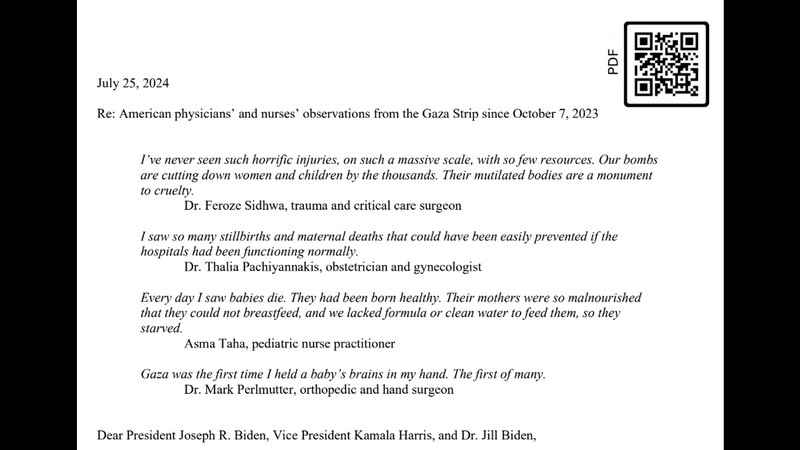
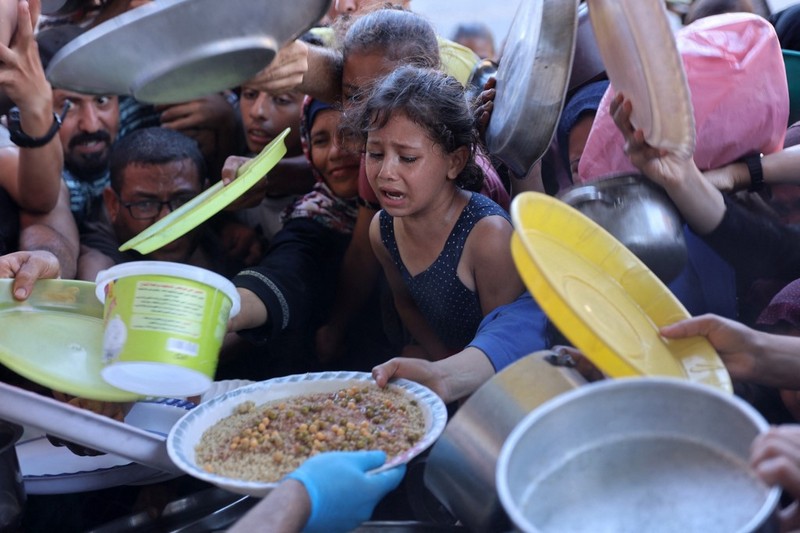
We are fully aware that since October 7, at least 25 times as many Palestinians have been killed as Israelis, with a huge proportion of them civilians, women, children, the elderly, medical and aid workers, journalists, academics. The world is now fully conscious of the trauma this is producing. But some have not yet fully integrated the degree to which Israeli society has been affected by the impact of those first four days that it took the Israeli military to relieve the besieged headquarters of the Gaza Division, to retake the Erez crossing point, the multiple military bases that had been captured and a dozen communities along the Gaza frontier. It took them till October 10. The shock to Israel is going to last for a very long time, just as the trauma of what is being done to Gaza now will affect Palestinians everywhere for many years to come. Not just Gazans, or people like me and my friends and students who have family in Gaza, or know people there. Every Palestinian is affected by this trauma, and many others besides.

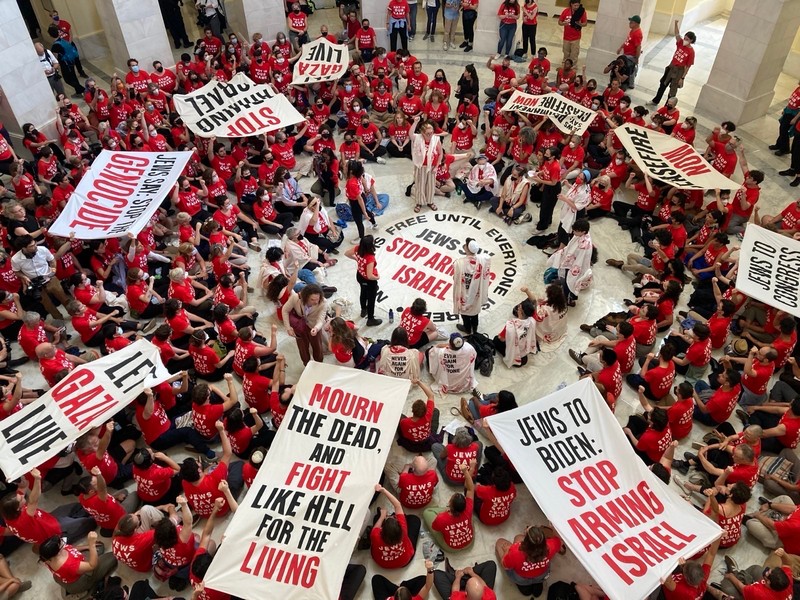
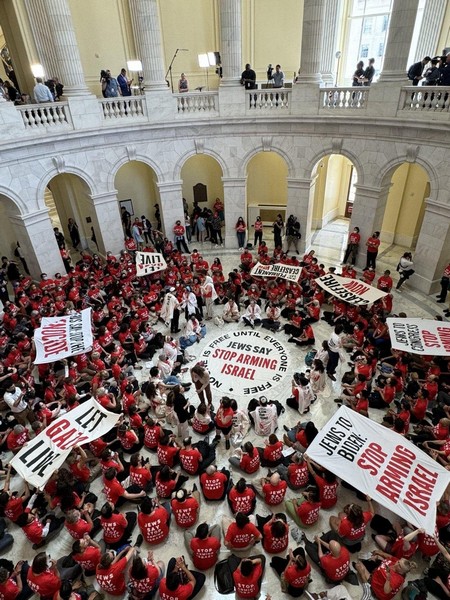
As we’ve discussed, none of the previous tragedies of Palestinian history had this impact on public opinion globally, certainly not in the United States. And yet, watching the encampments being set up on over a hundred American campuses is quite astonishing to me. I heard your fine speech to the protesting students at Columbia the other day. It’s as if October 7 has brought about a generational shift, as far as Israel and Palestine are concerned. A significant layer of young people, including thousands of young Jews, like the ones who occupied Grand Central Station in New York, want nothing to do with this monster entity which kills at will. People see what Israel is doing, and are saying, it’s too much, it’s unacceptable, it’s genocide. And this is really rattling the mainstream media and the politicians. Do you think this will last? And, linked to that, how would you explain why Washington has become so utterly craven? In Brokers of Deceit, you provide a sober but very sharp analysis of the us role in the Middle East, particularly under Clinton and Obama, showing that while Washington claims to be an impartial mediator, seeking to advance an evenly balanced ‘peace process’, in fact it is highly partial, acting as ‘Israel’s lawyer’ and its main backer. Nevertheless, when American interests were at stake, earlier administrations were prepared to crack the whip. Truman maintained an arms embargo against all belligerents in 1948; after Suez, Eisenhower told Ben-Gurion to get out of Gaza and the Sinai within two weeks or face sanctions; in August 1982, Reagan yelled at Begin to stop bombing Beirut; Bush Senior threatened to withhold $50 billion to get Israel to the negotiating table. The current layer, Democrats and Republicans alike, show absolutely no willingness to put on any pressure at all. Biden—‘Genocide Joe’ as the students have dubbed him— is the worst of the lot. Trump will be no better. Secretary of State Blinken dances like a tame monkey to all Netanyahu’s tunes. Has the monkey become the organ-grinder? Why and how has it gone so far?

It’s actually a hard question to answer. We beat out our brains, trying to understand the degree to which they have become worse than complicit. They’ve become mouthpieces for every trashy piece of Zionist propaganda. The President and his appalling spokespeople, Admiral Kirby and the awful Matthew Miller, sound like Netanyahu’s press attachés—like the worst Israeli propagandists, nakedly espousing an Israeli narrative on point after point. Today they admitted that the us is helping the Israelis try to hunt down and kill the Hamas leadership, that it provided intelligence for the hostage rescue that killed nearly 300 Palestinians. The raf has flown almost daily surveillance missions over the Gaza Strip. America and Britain, its bloodshot adjutant, are participating directly in the slaughter, not just supplying weapons, money and un vetoes, but doing the intelligence and propaganda work for this genocide. You used the word ‘craven’. This is worse than that. There are words in Arabic for it that I can’t translate. The degree to which this Administration has inhabited an Israeli perspective, from Biden through Blinken to Sullivan on down, marks it out.

It’s true that in a couple of top leadership positions, there are people who will not and do not repeat that rhetoric. The Secretary of Defense, Austin, and Burns, the head of the cia, have not; nor have others, who know better. But they don’t have any purchase within the Administration on this question. I would guess that most career professionals who serve in the State Department, in the military, and in the so-called intelligence community—I love that term, intelligence ‘community’—know perfectly well that what Israel is doing is both futile and harmful to American interests; indeed, how harmful it is to any rational understanding of Israel’s interests. But they have no voice in Biden’s Administration.

Part of this has to do with the generational divide that you mentioned. The us is ruled today by an aged clique, a gerontocracy, that was indoctrinated in the 1960s and 70s with the myth of the connection between the Holocaust and the establishment of Israel. Schumer, Pelosi, Biden, Trump; these are old people. Their consciousness was formed at the time of the 1967 war. And since then, they have never opened their minds, they have never had access to anything but a poisonous narrative that paints Israel in the most gleaming colours and the Palestinians in the darkest ones—the idea that Israel is always in existential danger, the Cossacks are always at the door; that the Holocaust could be repeated, that Israel represents a flower of Western civilization in a desert of Arab barbarism—a bunch of racist tropes that Israel, and the Zionist movement before it, successfully sowed throughout the West. Biden has not expressed the slightest sympathy for the 14,000 Palestinian children who have been killed by us bombs. He has no feeling of shame, no sense of the dimensions of the horrific genocide that he and his Administration are helping to perpetrate. And the people around him mirror that, obviously. They’re insulated.

How long can this continue? I don’t know. I see no sign of it stopping. They have now dimly begun to deduce that Israel is harming its and their interests, and they’re trying to slow them down. But they have no purchase with the Israelis so far. And if I were Netanyahu and my political survival depended on the continuation of the war, the Americans’ feebly bleating and threatening to delay an arms shipment or two would be no reason to stop it. He’ll go on for as long as he wants, correctly assessing that the Americans are more bark than bite, and that any bite would be a toothless nip. The us could say, we’ll stop all arms shipments, unless Israel accepts the ceasefire plan that the cia chief, Burns, has drafted for them. It could sponsor a Security Council resolution demanding a ceasefire under specific provisions of the Charter, which would force Israel to stop tomorrow. They won’t do that. To go back to what you said: this was something that Reagan himself was willing to do, in August 1982. The Israelis only stopped bombing Beirut because Reagan yelled at Begin, and half an hour later they called it off. We were sitting there in Beirut, under Israeli bombardment, and suddenly it stopped, essentially because of a phone call from the us president to the Israeli prime minister. Biden hasn’t done that.

Mearsheimer and Walt were vilified for their book on the Israel lobby, called antisemites and so forth. footnote9 But the case they put for how American foreign policy is run on that level seems pretty strong today.

The amusing thing is that, in spite of all the vilification and the slanders, The Israel Lobby and us Foreign Policy fast became a bestseller, and it is still selling very well. I know the authors, they’re both friends of mine; I believe that with the latest war there has been a bump in sales, a decade and a half after it was published. I think it was a sound analysis. I don’t think it was comprehensive enough because it only talked about the lobby groups on Capitol Hill, as well as the Christian Zionists and the neocons, and the lobby’s vigilantes in the media and academia, whereas there’s a whole ecosystem that has extended to important elements of the American military, tech and biomedical sectors, which are closely integrated with their Israeli equivalents. Enormously important parts of the us economy are linked to these sectors in Israel and these are powerful forces in American society. They own Congress, in the sense that their contributions keep elected politicians in office—Silicon Valley, biotech, finance, the military sector in particular. The imbrication of the us security-military-industrial complex with that of Israel is seamless, as is the imbrication of Israel’s defence and intelligence networks with those in India, the Emirates and a few other places. I don’t think this is fully accounted for in The Israel Lobby, partly because some of this has emerged subsequent to publication of their book.

Let’s come to the subject of the present Arab elites, who are carrying on even more blatantly than they did after the Nakba. Prior to October 7, the Saudis were on the verge of recognizing Israel.

They still are.

They still are. And the Gulf States remain imperial petrol stations, with enormous amounts of money. Jordan has been a us -Israeli protectorate for a very long time. The Egyptian masses were brutally defeated by the army. I did think there might be more protests in the Arab world—and the only thing that could change the mood there would be mass uprisings. But apart from Yemen, not too much. There have been pro-Gaza demonstrations, but so far not on the scale of the anger displayed in Britain and the us .

I think there are at least two things to say here. The first thing is that there is, and has always been, a deep sympathy with Palestine among the Arab peoples, throughout the Arab world, from the Gulf to the Atlantic. This hasn’t changed. It’s gone up and down a little bit, but it hasn’t gone away. But these people are facing other critical issues. If you live in a state that’s been destroyed—like Libya, Syria, Iraq, Yemen, Sudan, Lebanon—by civil war or intervention by the imperial powers and their clients, you have other concerns. Iraq still doesn’t have 24-hour electricity, 21 years after the American occupation—one of the greatest oil producers in the world. Palestine is important, but electricity and not being killed by the regime—or by this or that army faction—is also important. This is the situation in half a dozen Arab countries: different stages of civil war-cum-proxy war, with all the great powers involved.

The second thing is that, almost without exception, from the Gulf to the Atlantic, you don’t have regimes that allow public opinion to express itself. There are jackboot dictatorships, a pouvoir in Algeria, the most absolutist monarchies since Louis XIV, which allow virtually no dissent beyond a tiny space, and if you go beyond it, you will be tasered and tortured, you will be arrested and your family will suffer. So, you’re right, no protests in the Arab world have risen to the level of what we’ve seen in London and New York, or in some parts of the Global South, Indonesia and Pakistan. That’s partly because the Arab masses have been cowed by the cattle prods and tortures inflicted on them since the so-called Arab Spring. They were brought back to order by America’s clients, in particular the Saudis and the Emiratis, with vast infusions of cash and support for the most hardline security measures. One can’t entirely blame the people for not being willing to raise their heads above a certain point over this issue.

In some places, however, the situation is critical—in Jordan, for example, and in a few other countries, under the surface. But I don’t see this leading to the democratic transitions which would be necessary for these countries to play an active, positive role. Their rulers are more concerned about what Washington and Tel Aviv may say than about their people. They don’t represent their people’s views in any shape or form. They’re tied to Israel by so many visible and invisible ties. The anti-missile defences of the Emirates were provided by the Israeli subsidiary of Raytheon, which means that Israel’s anti-missile surveillance against Iran is in Jabal Ali, in Abu Dhabi, not Jabal al-Sheikh (Mount Hermon), in the occupied Golan Heights. The uae depends entirely on Israel for its security against missile attack. There are variations of that arrangement in Jordan, Egypt and other Arab countries. In Morocco, the royal bodyguards have been trained by Mossad for the past fifty or sixty years, since the time of King Hassan II. The Israeli defence connection is generations-old in the case of Jordan, Morocco and Egypt, and is well established in several of the Gulf countries and a couple of others, too.

There was some hope expressed early on that Hezbollah, with the backing, quietly or publicly, of the Iranian regime, might open up a second front and relieve the pressure on Hamas. But this didn’t happen.

I think Hamas was wrong to expect it. They probably expected far more sustained responses from other Palestinians in the occupied territories and hoped that Hezbollah, as well as other Iran-allied militias and perhaps Iran itself, would be much more vigorous in reacting to Israel’s counter-response to October 7. It’s a perfect example of how little they understand of the world. For all their acumen in other respects, the leaders who organized this assault have what I would call tunnel vision. I think they really believed that there would be an uprising throughout the Arab world. I don’t have a lot of evidence for that assertion, but they were certainly disappointed by the reaction. And Hezbollah’s response has been what I would call ‘performative’. It’s had a significant effect on Israel: it’s killed at least fifteen Israeli soldiers and eleven Israeli civilians, according to Israeli sources, and it’s led to the evacuation of the entire border region—tens of thousands have been forced to leave their homes.

But while it may still explode into a full-scale war, so far it’s been tit for tat, very measured and controlled. This is a function of what anybody with eyes to see could have told the boys in the tunnels, which is that Iran did not invest in building up Hezbollah’s capabilities for the sake of Hamas. It did so in order to create a deterrent to protect Iran against Israel; that’s the only reason. The idea that Hezbollah and the Iranians would shoot every arrow in their quivers to support Hamas, in a war it started without warning its allies—it beggars belief that anybody could think that that would be the case. Iran is a nation state that has national interests, which are restricted to regime preservation, self-defence and raison d’état. You can talk about Islam, ideology and the ‘axis of resistance’ until you’re blue in the face. I will tell you: raison d’état, regime protection—that’s what they care about, and that’s why they backed the build-up of Hezbollah’s capacity. And they’re not going to shoot that bolt. There was no possibility under any circumstances of their doing that to support Hamas. If, heaven forbid, a full-scale war erupts, it will be because of a miscalculation, or an accident, or an irrational move by Netanyahu, not a decision by Hezbollah.

Hezbollah is a Lebanese party. It has an Iranian patron, but it is acutely attuned to the fact that the Lebanese public will turn against it if its operations against Israel provoke a massive retaliation against Lebanon—which would not be directed just against Hezbollah but also, as in the 2006 war, against Lebanon’s infrastructure. The Israelis have always punished the host country in order to force it to force the resistance to stop doing whatever it was doing. They bombed Jordan, they bombed Syria, in order to force those regimes to stop the Palestinians. They weren’t trying to stop the Palestinians themselves, but to stop whichever Arab country it was from hosting and supporting the Palestinians. They would do that to Lebanon, to force it to stop Hezbollah. And Hezbollah knows that, and the Lebanese know it, too. I don’t understand how the leaders of Hamas didn’t understand that. It shows a detachment from reality and a flawed strategic sense which is really quite disturbing. Since October 7 they have dramatically upended the stagnant status quo in Palestine, and have shown themselves highly adept at waging guerrilla warfare—at an unspeakable price, let it be said. But ultimately, war is an extension of politics by other means, and they have not projected a clear, strategic, unified Palestinian political vision to the world. I don’t think people are saying these kinds of things, hard as they are to say. But they should be. They should be.

I agree with you entirely. Turning to the future, what is the Israeli plan for Gaza? Are they trying to create another Nakba, i.e., destroy the strip, sell it off to their own people and turn more Palestinians into refugees? That is what seems to be the case. Or will someone intervene to stop this from happening? The Americans certainly won’t, that’s become very clear.

Unlike at other critical moments in its history, Israel doesn’t have a unified elite and there is no clear-cut position on these issues today. In 1948, Ben-Gurion dominated Israeli politics; even in 1956, he prevailed over Sharett and he did what he wanted in launching the Suez war. Episode by episode, whether they did well or did badly, they at least knew what they wanted to do. There was a cohesive, unified sense of Israel’s interests, even after the 1967 war, when they couldn’t quite decide—should we keep it all?—they had a cohesive leadership. The military and political leaderships operated in sync throughout most of Israel’s history. That’s not the case today. I don’t think there is a clear Israeli vision of what to do. Netanyahu has very little idea of what he wants strategically. What he wants personally is a continuation of the war with no clear end strategy. That serves his narrow political interest: staying in power, not having an election and not going on trial.

Other factions within his government have different views. The military and intelligence establishment is not cohesive. Just recently a former Chief of Staff came out and said the war has to end. You’ve never had former Chiefs of Staff saying this in wartime; Aviv Kohavi just said it. Other former generals and intelligence chiefs have said similar things. The Israeli elite is divided, with good reason, over how to end the war, over what to do in Gaza on the day after, if it ever comes. At the beginning, it was clear that they hoped they could complete the Nakba and expel large numbers of people—into Egypt, and possibly also from the West Bank into Jordan. And they sent their errand boy, Blinken, to do their dirty work for them—going to the Egyptians, to the Jordanians and to the Saudis and begging them, please, could you allow this to happen? The participation of the American government in an Israeli plan to further ethnically cleanse Palestine is one of the most despicable episodes in American history. It will be a mark of shame on Blinken and Biden for the rest of time. In 1948, Washington didn’t want ethnic cleansing, though Truman allowed it to happen and did nothing to uphold the un Partition resolution he had twisted so many arms to get. This is different and much worse. This is Washington actively supporting Israel in genocide and actively trying to broker its ethnic cleansing of a part of Palestine.

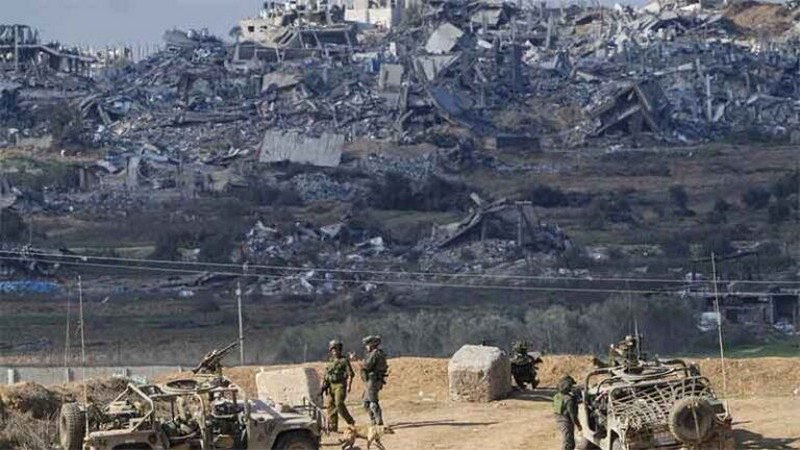
But if the Israeli leadership had a clear view of what they wanted at the beginning—devastate Gaza and complete the Nakba—I don’t think they have a clear view now. What seems likely to ensue is some form of Israeli occupation, which is an outcome that nobody, including the Israelis themselves, should desire. I wouldn’t want to occupy Gaza if I were them. Their last occupation, up to 2005, wasn’t so successful. Think what they had to cope with then, from the Hamas of the early 2000s and other groups with capabilities a fraction of what they are today. I don’t think there are any good options, frankly, from an Israeli perspective. I don’t think there’s been a clear leadership decision on this. That may be wrong, but that’s my impression from the outside, reading the Israeli press. In spite of their overwhelming power, they have put themselves in a hopeless strategic situation.

A terrible historical irony. After the Six-Day War in 1967, Isaac Deutscher gave an interview to nlr.footnote10 He had broken with Israel decisively and sent a message to Ben-Gurion, whom he knew, warning of disaster if the occupation was not ended. He described Israelis as the Prussians of the Middle East—a succession of victories breeding blind reliance on their own force of arms, chauvinistic arrogance and contempt for other peoples—and recalled the lesson Germans drew from their experience: ‘Man kann sich totseigen!’ You can triumph yourself to death.

Well, Ben-Gurion learned that. He was worried after the 1967 War that Israel would wallow in triumphalism and fail to take the opportunity the war offered to obtain a settlement favourable to Israel and Zionism. He was, of course, right. The sad thing about so many of these leaders is they learn too late. So you have Ehud Olmert talking about things that he never talked about when he was Prime Minister, or Ben-Gurion saying things in his dotage that he never said before, or former Israeli generals or heads of Mossad and Shin Bet, full of wisdom after they’ve retired. I had a wonderful encounter with Yehoshafat Harkabi, chief of Israeli military intelligence in the 1950s, who wrote two seminal books that were blueprints for the demonization of the plo. He served not just as chief of military intelligence, he was the lead propagandist in the West for a negative vision of the plo. When I met him in his old age, the man had shifted completely and had written a series of books criticizing Israel. It often happens too late with these people. The same with Jimmy Carter. Why didn’t you say this when you were President?

Exactly.

The best ex-president the United States ever had. But I’d like to finish answering your first question, what has changed and what has not. I grew up in a world, as I said, in which the Zionist narrative was the only game in town and was believed blindly by almost everybody. That’s not the case today, as we’ve been discussing. There’s a vigorous contestation of the Zionist narrative, within the Jewish community in particular, with an interesting generational divide. That’s entirely new—and very important.

What has not changed, and what our grandchildren still have to contend with, is the unwavering support of the rulers of the imperial powers for the Zionist project. Especially the United States and Britain, from World War One onwards, and France and Germany after World War Two. That is in many ways the biggest problem, to my way of thinking. If you accept the settler-colonial framework of analysis, then the metropole is as important as the settler colony. Israel is not a typical settler colony, by any means; it’s also a national project, with a significant Biblical dimension, and a refuge from persecution. No other settler colony was a refuge from persecution to such a degree—the Puritans and other religious dissidents, like the Quakers, who came to North America, certainly experienced repression, but not on the same scale. Basically, this combination of characteristics is unique to the Israeli project. But the core of it, the settler-colonial core of it, relates to a metropole. And the elites in that metropole, unfortunately, have barely changed from the time when I was a child. The new generations are going to have to deal with this.

A number of Israeli scholars and archaeologists, including Israel Finkelstein, have shown that the heroic stories of the Old Testament account—the exodus, the royal lineage of the Book of Kings—were largely an ‘invented tradition’, borrowings that were constructed as a court ideology in a later period. The Hebrew editions of Shlomo Sand’s books, The Invention of the Jewish People and The Invention of the Land of Israel, have been bestsellers in Israel. But this has had negligible impact on the hold of the national ideology over the majority of the population.

On nationalism, Gellner, Hobsbawm and Benedict Anderson were right: it doesn’t matter what the historical realities were, it’s what people believe that counts. Finkelstein and other excellent Israeli archaeologists have blown to pieces much of the Biblical foundation of Zionism, to very little political effect. I think we have to look at the power of those Biblical myths, irrespective of their baselessness from a historical and archaeological perspective—their resonance over generations, over centuries, and not only among Jews. It’s equally important that they have resonated among Christians. British Protestants are ultimately responsible for the Balfour Declaration, rooted in their belief in these same myths. Lord Shaftesbury was a Zionist in the 1830s, before the first Jewish Zionists, for religious reasons.

But Israeli barbarism, as we’re seeing it, is beginning to dent some of these myths, is it not?

There may be a reckoning. This Christian Zionism is primarily a Protestant phenomenon; it’s much less prevalent among Catholic populations. That reading of the Bible—the ‘gathering of Israel’ as a precursor to the Second Coming and the Last Judgement, the Revelation of Saint John the Divine—is essentially a Protestant reading. And in many of the more liberal Protestant denominations in the us, there is a growing understanding of the danger of that reading and how false it is in terms of Christian values. You see a parallel shift among Jews, who say that this has nothing to do with the Jewish tradition we want to uphold. We don’t want to destroy people as the Israelites destroyed Amalek. We don’t believe in the version of Judaism that animates many of the settlers and the right wing of the Israeli political spectrum—which stretches from the far right to the centre left, by the way. They believe this stuff, about destroying the Amalekites as enemies of Israel. Netanyahu has cynically embraced that exterminationist logic, in a literalist reading of the Book of Saul—‘Remember what Amalek has done to you.’ A majority of the Knesset, 64 members, are backing a government headed by a man who has said this again and again. Yet that’s not what a large proportion of the Jewish community in the us believe.

Now, lastly, to your own university, Columbia.

It will cease to be my own university when I retire at the end of June.

But you will still be associated in some way.

I’ll just be a former faculty member, teaching some courses as a non-member of the faculty—or as ‘contingent’ faculty, as we have come to call them.

Might they do away with the ‘terrorist’ name altogether, the Edward Said professorship?

I have no idea what will happen with that. There are donors and descendants of donors who will, I assume, insist that there continue to be a chair and that someone qualified should hold it. I have no idea. The campaign in the United States against Middle East Studies in general, and studies on Palestine in particular, is virulent and spans the political spectrum. And we now have the New York City Police Department joining unprincipled politicians in the hue and cry shamefully echoed by university administrators, about outside agitators and incitement by faculty members, including myself. So I don’t know what will happen. When people ask me these kinds of questions, I say that the job description of a historian does not include predicting the future.

You dedicated your last book to your grandchildren, which we oldies tend to do.

[Laughter]

Let the record show both of us laughing heartily.

You expressed the hope that they would see a better world. What is the biggest difference between the world you grew up in and the world they’re growing up in?

I grew up in a world where there was no Palestinian voice—in the Arab world, in the public sphere in the West; none at all, it didn’t exist. Palestinians didn’t exist. My four grandchildren are growing up in a time when there are quite vigorous voices for Palestine, all over the world. So that’s an element of change for the better. I grew up in a world in which the Zionist narrative was completely hegemonic and Israel was fulsomely described as ‘a light unto the nations’. That is no longer the case. Today it is widely, and rightly, seen as a pariah state because of its own genocidal actions. These are among the few good things that have happened in these very bad times.

NOTES:

1 Ghassan Kanafani, The Revolution of 1936–1939 in Palestine: Background Details and Analysis, New York 2023 [1972].

2 Kanafani, The Revolution of 1936–1939 in Palestine, p. 60.

3 Nasser’s ‘Memoirs of the First Palestine War’, translated into English by Walid Khalidi for the Journal of Palestine Studies, Winter 1973, is a riveting account of the chaos and deliberate lack of plan by the corrupted High Command in Cairo.

4 Albert Hourani, ‘Ottoman Reform and the Politics of the Notables’ in William Polk and Richard Chambers, eds, Beginnings of Modernization in the Middle East: The Nineteenth Century, Chicago 1968, pp. 41–68.

5 Popular Front for the Liberation of Palestine, a revolutionary socialist organization formed by George Habash and others after the 1967 War.

6 Seth Anziska, Preventing Palestine: A Political History from Camp David to Oslo, Princeton 2018.

7 Shaul Mishal and Avraham Sela, The Palestinian Hamas: Vision, Violence and Coexistence, New York 2000.

8 Perry Anderson, ‘The House of Zion’, nlr 96, Nov–Dec 2015.

9 John Mearsheimer and Stephen Walt, The Israel Lobby and us Foreign Policy, New York 2007; the book expands on the arguments presented in ‘The Israel Lobby’, London Review of Books, 23 March 2006.

10 Isaac Deutscher, ‘On the Israeli–Arab War’, nlr i/44, Jul–Aug 1967, pp. 38–9.

___________________________

Rashid Ismail Khalidi is a Palestinian-American historian of the Middle East and the Edward Said Professor of Modern Arab Studies at Columbia University.

Tariq Ali is a British political activist, writer, journalist, historian, filmmaker, and public intellectual. He has been a leading figure of the international left since the 60s and a political commentator published on every continent.

8 July 2024

Source: transcend.org

How Albert Einstein Started Out as a Zionist but Ended Up Opposing the Israeli Occupation of Palestine

By Ayaan Paul

Arguably the most renowned scientists in history, Albert Einstein had a complex and evolving relationship with Zionism and the state of Israel. His journey from early reservations about a Jewish state to strong opposition to certain actions of Zionist groups and the occupation of Palestine is a testament to his deep ethical convictions and pacifist principles.

Anti-nationalist

In the early 20th century, Einstein initially expressed skepticism about the idea of a Jewish state with borders, an army, and a measure of temporal power. His resistance to the concept of a Jewish state was rooted in his disdain for nationalism.

Having witnessed the devastating impact of World War I, which claimed the lives of millions, he was deeply disillusioned by the destructive forces of nationalism that had fueled the conflict.

In a speech to labor leaders, he articulated his concerns, noting his resistance to the idea “of a Jewish state with borders, an army, and a measure of temporal power, no matter how modest.” Einstein feared the “narrow nationalism” that he believed would accompany such a state.

On Palestinian Arabs

8 July 2024

Source: transcend.org

Spain Becomes First EU State to Back ICJ Genocide Case against Israel

By The Cradle

Spain has been a strong supporter of Palestinians, calling Israel’s war on Gaza a genocide and recognizing Palestine as a state.

1 Jul 2024 – Spain filed a Declaration of Intervention on 28 June in the case accusing Israel of genocide at the International Court of Justice (ICJ), becoming the first European state to do so.

“This intervention is motivated by our responsibility as a State party to the Genocide Convention and our firm commitment to international law,” said the Spanish Foreign Ministry.

In December, South Africa brought the case against Israel to the ICJ, the world’s highest court, alleging that Israel’s ongoing war on Palestinians in Gaza is a breach of the Genocide Convention.

“We seek to contribute to bringing peace back to Gaza and the Middle East,” the Spanish Foreign Ministry added, emphasizing the need for a two-state solution to ensure lasting peace and stability for Palestinians and Israelis.

International law expert Stefan Talmon of the University of Bonn stated that “an intervening state presents its interpretation of the particular provisions of the treaty to the ICJ” to support one side in the case.

The intervention is submitted both in writing and orally at the hearing itself. Talmon added that intervening states can only make a statement on the treaty’s provisions and not on the content of the case itself.

Spain stated in the Declaration of Intervention that the Genocide Convention “is important for the protection and safeguarding of fundamental values and principles of international law, including the protection of human dignity and the principle of accountability, and imposes substantive obligations on Contracting Parties that go beyond ensuring the criminal prosecution of the crime of genocide.”

South Africa and Israel have been invited to furnish written observations on Spain’s declaration of intervention.

Nicaragua, Colombia, Libya, Mexico, and the State of Palestine have also intervened in the ICJ case.

The ICJ issued a provisional ruling in May demanding that Israel stop its ongoing military operations in Rafah, a city on the Egypt border where over 1 million displaced Palestinians had sought shelter.

After recognizing Palestine as a state in late May, Spanish Defense Minister Margarita Robles described the war in Gaza as genocide during an interview with the official TV channel TVE. She stated, “We cannot ignore what is happening in Gaza, which is a real genocide.”

Spanish Deputy Prime Minister Yolanda Diaz stated that “Palestine will be liberated from the river to the sea.”

Both comments drew strong criticism from Israeli leaders.

The Israeli military campaign against Gaza has killed over 37,000 Palestinians, the majority women and children, destroyed over half of the enclave’s buildings, and displaced 80 percent of its 2.3 million inhabitants.

8 July 2024

Source: transcend.org

Away from Global Attention, Sudan Is Starving

By Othman Moqbel

We need to take urgent action to prevent what could be the largest hunger crisis of our times.

4 Jul 2024 – The risk of a devastating famine is rising exponentially across Sudan. According to a recent report by the United Nations’ hunger monitor, a “stark and rapid deterioration of food security situation” in the last six months has brought the war-ravaged Northeast African nation to the precipice of a catastrophe beyond imagination.

More than eight million people across 14 of the 18 states of Sudan are now facing food shortages that could result in acute malnutrition and death. Some 750,000 of those are at risk of immediate starvation. According to an analysis by Save the Children, some “16.4 million children, or three in every four in the country, are now facing  ‘crisis’, ’emergency’ or ‘catastrophe’ levels of hunger – up from 8.3 million just last December”.

Yet, despite the imminent threat of an unprecedented humanitarian catastrophe, the international community, and especially the Western world, shows little interest in Sudan and its protracted conflict. Where are the headlines? Where are the protests? Where are the campaigns, interventions and demands for accountability?

The years-long conflict in Sudan has internally displaced nearly 10 million people, killed tens of thousands and left millions of others hungry, traumatised and with little hope for the future. In Sudan, every day is a tragedy, but the world does not seem to pay any attention.

While undoubtedly harmful and frustrating, the Western-led international community’s apparent disinterest in Sudan’s crisis is hardly surprising. Time and again, we have seen the West and its leaders briefly “care” about a crisis in Africa or the Middle East to only completely forget about it when another crisis or development – perceived to be more consequential, relevant to national interests or merely interesting – arises elsewhere and grabs the attention of the media, politicians and the masses.

In fact, Sudan is hardly the only forgotten crisis of our day.

Syria, for example, is still experiencing a horrific crisis, with millions displaced with no hope of returning home, living in terribly difficult conditions in Syria and abroad, but the world has moved on from the Syrian war and is no longer paying much attention to the tragedies still affecting the Syrian people today.

The people of the Democratic Republic of the Congo (DRC), too, are still being killed, maimed and displaced amid ongoing fighting between rebels and the military, but their suffering appears to be nothing more than a footnote on the Western agenda.

The ongoing atrocities in Gaza have received significant attention from the international community since the beginning of the latest round of conflict for various reasons. But now, with the United States, France and the United Kingdom all turning their focus to their own elections and domestic politics, the war and humanitarian crisis in Gaza are also gradually being reduced to secondary concerns.

The crises in the Global South have always faced an uphill battle for global attention. However, when the international community looks away, moves on from, or “forgets” a crisis or conflict in Sudan, Syria, Congo or elsewhere, that crisis does not go away. It grows worse. In fact, lack of international scrutiny means humanitarian needs and human rights abuses are allowed to spiral with impunity.

It is not too late to correct course. The international community can still do the right thing, and expand its attention span beyond a single conflict, discussion, issue at a time and recognise that the world’s many protracted conflicts and humanitarian crises have not gone away because we stopped paying attention to them.

Sudan, especially, is in urgent need of global attention and action.

It was in early March that the World Food Programme issued its shocking warning that the war in Sudan threatens to trigger “the world’s largest hunger crisis”. Four months on, the situation is significantly worse and that “largest hunger crisis” is almost here.

We, and our partners working in Sudan are seeing families left with no other options but having to eat soil and leaves in an attempt to fight off impending starvation. Parents are travelling across the country in search of work to provide for their children. No one is certain where their next meal will come from, if it comes at all.

Sudan will soon enter its main crop planting season. But with most of the population displaced, and those left behind too starved to work, the chance of a successful harvest is heartbreakingly low.

The world must recognise what is happening in Sudan and take urgent action to prevent further devastation of a people who have already suffered for too long.

If we do not act now, the consequences – “the largest hunger crisis of our time” – will be on our conscience. We cannot say we didn’t know – only that we didn’t care.

________________________________________________

Othman Moqbel is the CEO of Action for Humanity, parent charity of Syria Relief, the largest Syria-focused NGO in the UK.

8 July 2024

Source: transcend.org

Zionist Terrorists Must Not Have any Control over Palestine, Einstein’s Letters Resurface

By Ummid

Amidst the relentless bombing of Gaza Strip, along with other efforts to restore peace, sane voices have also dug out the old letters of renowned scientist and humanist Albert Einstein to expose the real face of the Zionist regime in Israel.

Besides being acknowledged as one of the greatest and most influential scientists of all time, Einstein is also one of the most prominent Jews the world knows.

Born to Jewish parents in Germany, Einstein was a severe critique of Hitler’s Nazism and fled the country when Hitler was about to assume power. Being a staunch anti-fascist, Einstein was upset when Zionism raised its ugly head on the pretext of settling evicted Jewish people.

Einstein was in fact opposed to the very idea of establishing Israel as a separate Jewish state. He spotted the flaws and fault lines in 1946 when he addressed the Anglo-American Committee of Inquiry on the Palestinian issue. He couldn’t understand why Israel was needed.

“I believe it is bad,” he said.

Einstein was also of the view that the differences between Jews and Arabs were artificially created by the British. He criticized the British colonial policy as based on the principle of “divide and rule”.

“The difficulties between the Jews and Arabs are artificially created, and are created by the English”, Einstein said while addressing the National Labor Committee for Palestine at the Manhattan Opera House on January 11, 1946.

Questioned as to what he would do if Arabs resisted the immigration of Jews from Europe into Palestine, Einstein replied:

“This will not be the case if they are not incited.”

When the Jewish struggle gained momentum despite opposition, Einstein asserted that the Zionist terrorists and fascists should not be allowed to set their foot on Palestine in repeated calls to the United Nations, United Kingdom, United States and other global forums. On January 19, 1946, he said:

“I am in favor of Palestine being developed as a Jewish Homeland but not as a separate state. It seems to me a matter of simple common sense that we cannot ask to be given political rule over Palestine where two thirds of the population are not Jewish.”

A month later, Einstein even called for a government in Palestine under the direct control of the United Nations (UN) with a guarantee of equal rights to Arabs and Jews.

“A government in Palestine under the UN’s direct control and a constitution assuring Jews’ and Arab’ security against being outvoted by each other would solve the Jewish-Arab difficulties”, The New York Times quoted the renowned scientist in a report titled “Einstein urges United Nations run Palestine” on February 15, 1946.

How critical Einstein was of the Zionists and the Israeli politicians who later went on to become the rulers, can best be described by an open letter written to The New York Times ahead of Menachem Begin’s visit to the United States in December 1948.

Begin is founder of Herut (Freedom Party) which he later transformed into Likud Party currently headed by Benjamin Netanyahu. Einstein with over two dozen prominent Jews, including political theorist Hannah Arendt, wrote a letter to The New York Times.

Letter to the New York Times:
New Palestine Party:
Visit of Menachem Begin and Aims of Political Movement Discussed

To the Editors of the New York Times:

Among the most disturbing political phenomena of our times is the emergence in the newly created state of Israel of the “Freedom Party” (Tnuat Haherut), a political party closely akin in its organization, methods, political philosophy and social appeal to the Nazi and Fascist parties. It was formed out of the membership and following of the former Irgun Zvai Leumi, a terrorist, right-wing, chauvinist organization in Palestine.

The current visit of Menachem Begin, leader of this party, to the United States is obviously calculated to give the impression of American support for his party in the coming Israeli elections, and to cement political ties with conservative Zionist elements in the United States. Several Americans of national repute have lent their names to welcome his visit. It is inconceivable that those who oppose fascism throughout the world, if correctly informed as to Mr. Begin’s political record and perspectives, could add their names and support to the movement he represents.

Before irreparable damage is done by way of financial contributions, public manifestations in Begin’s behalf, and the creation in Palestine of the impression that a large segment of America supports Fascist elements in Israel, the American public must be informed as to the record and objectives of Mr. Begin and his movement.

The public avowals of Begin’s party are no guide whatever to its actual character. Today they speak of freedom, democracy and anti-imperialism, whereas until recently they openly preached the doctrine of the Fascist state. It is in its actions that the terrorist party betrays its real character; from its past actions we can judge what it may be expected to do in the future.

Attack on Arab Village

A shocking example was their behavior in the Arab village of Deir Yassin. This village, off the main roads and surrounded by Jewish lands, had taken no part in the war, and had even fought off Arab bands who wanted to use the village as their base. On April 9 (THE NEW YORK TIMES), terrorist bands attacked this peaceful village, which was not a military objective in the fighting, killed most of its inhabitants240 men, women, and childrenand kept a few of them alive to parade as captives through the streets of Jerusalem. Most of the Jewish community was horrified at the deed, and the Jewish Agency sent a telegram of apology to King Abdullah of Trans-Jordan. But the terrorists, far from being ashamed of their act, were proud of this massacre, publicized it widely, and invited all the foreign correspondents present in the country to view the heaped corpses and the general havoc at Deir Yassin.

The Deir Yassin incident exemplifies the character and actions of the Freedom Party.

Within the Jewish community they have preached an admixture of ultranationalism, religious mysticism, and racial superiority. Like other Fascist parties they have been used to break strikes, and have themselves pressed for the destruction of free trade unions. In their stead they have proposed corporate unions on the Italian Fascist model.

During the last years of sporadic anti-British violence, the IZL and Stern groups inaugurated a reign of terror in the Palestine Jewish community. Teachers were beaten up for speaking against them, adults were shot for not letting their children join them. By gangster methods, beatings, window-smashing, and wide-spread robberies, the terrorists intimidated the population and exacted a heavy tribute.

The people of the Freedom Party have had no part in the constructive achievements in Palestine. They have reclaimed no land, built no settlements, and only detracted from the Jewish defense activity. Their much-publicized immigration endeavors were minute, and devoted mainly to bringing in Fascist compatriots.

Discrepancies Seen

The discrepancies between the bold claims now being made by Begin and his party, and their record of past performance in Palestine bear the imprint of no ordinary political party. This is the unmistakable stamp of a Fascist party for whom terrorism (against Jews, Arabs, and British alike), and misrepresentation are means, and a “Leader State” is the goal.

In the light of the foregoing considerations, it is imperative that the truth about Mr. Begin and his movement be made known in this country. It is all the more tragic that the top leadership of American Zionism has refused to campaign against Begin’s efforts, or even to expose to its own constituents the dangers to Israel from support to Begin.

The undersigned therefore take this means of publicly presenting a few salient facts concerning Begin and his party; and of urging all concerned not to support this latest manifestation of fascism.

Isidore Abramowitz, Hannah Arendt, Abraham Brick, Rabbi Jessurun Cardozo, Albert Einstein, Herman Eisen, M.D., Hayim Fineman, M. Gallen, M.D., H.H. Harris, Zelig S. Harris, Sidney Hook, Fred Karush, Bruria Kaufman, Irma L. Lindheim, Nachman Maisel, Seymour Melman, Myer D. Mendelson, M.D., Harry M. Oslinsky, Samuel Pitlick, Fritz Rohrlich, Louis P. Rocker, Ruth Sagis, Itzhak Sankowsky, I.J. Shoenberg, Samuel Shuman, M. Singer, Irma Wolfe, Stefan Wolfe.

New York, Dec. 2, 1948

Menachem Begin, labelled in 1948 as “fascist” and “terrorist”, later became Prime Minister of Israel in 1977, forming Likud Party headed by him as the continuation of his earlier Herut (Freedom) Party, which Einstein and Arendt denounced as “fascist”.

Even when Begin became Prime Minister of Israel, he never dared to visit Britain, where he was still on the most wanted list of the country for terrorist activities against the British Mandate authorities.

Yitzhak Shamir, Menachem Begin’s successor as Prime Minister of Israel and leader of the Likud Party, had headed an even more extreme right-wing terrorist split faction of Irgun, known as the Stern Gang. This group, according to Einstein’s and Arendt’s open letter “inaugurated”, together with Irgun, “a reign of terror in the Palestine Jewish community”. A “reign of terror” which cost the lives of thousands of Palestinian Arabs, but also Jews.”

Since then Israel is ruled by Likud Party, effectively monopolizing power. After about a century of permanent and often extremely violent and bloody civil conflicts, today Likud has gained full control over the country, while the formerly powerful Labour Party, supported by the founding fathers of the State of Israel, has almost completely disappeared.

In the meantime, David Ben Gurion, Israel’s first Prime Minister, asked Albert Einstein to become President of the country after its first president, Haim Weizmann died in November 1952. Einstein however refused the offer, believing the role would conflict with his conscience as a pacifist.

Another letter digged out amidst the ongoing war between Israel and Palestinians and the relentless bombing of Gaza Strip, is the one Einstein wrote to Shepard Rifkin, Executive Director of American Friends of the Fighters for the Freedom of Israel, based in New York.

In a little over 50-word letter, the highly regarded scientist called the Zionist rulers of Israel “criminals”, their parties “terrorist organisations”, at the same time blaming the United Kingdom for creating the crisis in Palestine. Einstein wrote:

Dear Sir,
When a real and final catastrophe should befall us in Palestine the first responsible for it would be the British and the second responsible for it the Terrorist organizations build [sic] up from our own ranks. I am not willing to see anybody associated with those misled and criminal people.

Sincerely yours,
Albert Einstein.

The letter has been described as one of the most damning anti-Zionist documents attributed to the genius.

Einstein visited Palestine in 1923 and stayed there for 12 days. A lifelong pacifist, Einstein, however, never visited the State of Israel, formed as it was from the barrel of a gun, dynamite and the blood of the Palestinians.

_________________________________________

With inputs from The ‘final’ downfall of Israel was predicted by Einstein (Yvonne Ridley) and Einstein Cited Equally Horrific Terrorist Massacre of Arabs+USA Origin of Killing in Palestine(Jay Janson), New York Timesarchives and agencies.

Ummid.com is owned and published by Awaz Multimedia & Publications – a web designing and publishing company based in Malegaon in North Maharashtra, India and registered under Indian Company’s Act 1956.

8 July 2024

Source: transcend.org

The Abolish NATO Catalogue

By Jan Oberg and TFF Associates

From NATO’s Website:

NATO Summit Marking 75 years of the Alliance, 9-11 Jul 2024

Seventy-five years ago, 12 countries signed the North Atlantic Treaty in Washington, D.C. to ensure their collective defence in an unpredictable world.

This year, 32 NATO Allies will meet again in Washington, D.C. to make key decisions on how to continue to protect their one billion citizens as the world faces the most dangerous security environment since the Cold War.

*****************************************

Abolish NATO or Convert It to Serve Peace – 30 Arguments & 100s of Inspirations

Download as PDF: AbolishNATOCatalogue

Read as Flipbook

Executive Summary

This catalogue contains 30 arguments for the abolition of NATO. Each argument is based on rational peace research analysis, in contrast to the fact-resistant propaganda that NATO and mainstream politics and media promote about the ’defensive’ peace alliance.

The Catalogue is based on the democratic assumption that diverse perceptions and concepts can exist – for instance, about what peace is – and that this hugely influential Western organisation is not sacrosanct and shall, therefore, not be exempt from critical analysis.

While set up in 1949, NATO passed its ”best before” date long ago. The alliance of 30 members and 40 partners has not been able to create the peace that is its overarching goal according to its founding treaty. Indeed, NATO violates that treaty on a daily basis.

Instead, with its expansion over the last 30 years, it has contributed to making the world a less peaceful place. The Ukraine tragedy – for which both NATO and Russia are responsible – speaks volumes about that sorry state of affairs in Europe but also beyond it.

Europe is now in the Second Cold War thanks to all major parties’ adherence to the primacy of weapons in deterrence mode instead of common security thinking and intelligent conflict-resolution as a road to peace. One by one, all the opportunities for a new European peace structure that arose when the Soviet Union and the Warsaw Pact dissolved have been squandered.

Most people focus on the violence – the war – in Ukraine. Undoubtedly, Russia is responsible for that and for violating international law. But what we should focus much more on is the underlying conflict. Violence always manifests itself and grows out of conflicts, conflicts that have been ignored, mismanaged, escalated, or provoked. NATO and its three-decades-long expansion, its presence in Ukraine since 1991 and its insistence – no matter the warning and the objective risks – to get Ukraine into NATO is the underlying conflict. NATO must take responsibility for that.

Because, as the Catalogue also argues, there were alternatives. But they were deliberately ignored.

Focus on conflict analysis and conflict understanding – and not on the violence – is the key to peace: What is the issue or problem that stands between the parties – not who is evil or guilty and should be punished?

The focus on violence and who is to blame is psychologically understandable – but for true, professional peace-makers, it is a waste of time and usually contributes to justifying more violence.

When the violence has died down, and a sustainable solution is found, legal processes may deal with guilt and crimes, but so may also new arrangements, truth commissions, forgiveness and reconciliation. These methods are all within our human capacity but – tragically – almost never found in security politics. NATO promotes none of them.

The fact is that we know more about the causes of violence and war than about the causes of peace. But that must not serve as an excuse for continuing the wrong conflict- and violence-promoting policies.

That said, there is enough research on the causes of violence reduction and peace for us to say that they are not what NATO promotes.

Its fundamental principles of deterrence, (forward) defence and its reliance on first-use of nuclear weapons will never lead to real peace, but they have brought us closer to war, including nuclear war.

NATO’s intellectual foundation concerning security and peace appears in inverse proportion to its military and political power.

Much of this report can be seen as a critical discussion of the alliance’s way of thinking – of its security Groupthink. It questions, even debunks, NATO’s conceptual and theoretical underpinnings and shows how out of date, contradictory and peace-preventing they are.

NATO defends them on its homepage in its conspicuously self-righteous propaganda piece called ”Setting the Record Straight” from July 2022. Part of it is fake, part of it convenient omissions – a cover-up for issues about NATO policies that ought now to be pushed up to the top of the international discourse about humanity’s future.

In addition, NATO employs a cover-up disinformation trick typical of our times. Instead of meeting criticism with an open mind and in a sound democratic spirit, it says that ”Since Russia began its aggressive actions against Ukraine, Russian officials have accused NATO of a series of threats and hostile actions.” Not so! Many of the points have been raised for years by intellectuals, diplomats, alternative media and civil society organisations, including TFF.

But tie them to Russia and – hocus pocus – critiques of the alliance are all implicitly transformed into Putin Verstehers, Putin lovers or “pro-Russian.”

That in itself indicates NATO’s intellectual level. A few billion people around the world do not subscribe to NATO’s so-called peace goal or the way it seeks to go about it. The present author, a professional peace and conflict researcher with 40+ years of experience in theory and on-the-ground work, is one of them.

It is perfectly possible to be critical of NATO’s activities without being categorised as guilty by fake association with its adversaries.

If not, NATO seems to have become a sort of secularised religion in a time when things are otherwise falling apart. Sacrosanct – for which reason all criticism equals ungodliness. This Catalogue discusses that interpretation too, and NATO Believers may see that as ’ungodly.’

Instead of conducting serious research and using scenario techniques to decide its policies, NATO merely makes postulates – about others, about its policies and how others ought to interpret it – favourably. NATO doesn’t seek to convince by rational analyses and arguments. NATO issues strategies, planning papers and summit minutes that are filled with postulates and serve as NATO scriptures.

Western mainstream media reports it all. Not a critical thought to be seen anywhere. They are members of the congregation.

For people who are not already NATO Believers, members of that congregation, NATO’s threat postulates appear to serve only one purpose, namely to support the imperial full-spectrum global dominance of the US and some alliance members and partners and legitimise NATO’s further armament, i.e. the Military-Industrial-Media-Academic Complex (MIMAC).

The overall goal for NATO has not been the security and peace of Ukraine, Russia and NATO Europe. It’s been to prevent Russia from being Ukraine’s partner and feel secure and to possess Ukraine fully. No compromise, no creative thinking about Ukraine as a cooperative project, no respect for public opinion in Ukraine. No idea about common security for all.

If you are not a NATO Believer, you’ll find ample evidence that Russia’s legitimate concerns have been ignored for about 30 years.

Promises indeed given to Russia in 1989-90 have been broken, even after Gorbachev and the Soviet Union had accepted that East and West Germany not only would be unified but also became a full member of NATO with no discussion of the nuclear weapons in Europe. It all happened on US and NATO’s premises while giving money to Russia – then on its knees – to force it to accept the fait accompli.

Furthermore – and what few know about – NATO has turned down all Soviet/Russian requests to become a member.

NATO’s argument that it respects all countries’ fundamental right to choose its own path, also when it comes to security arrangements, is simply fake. NATO woos prospective members in many ways, from an early moment (Ukraine since 1991), discussions about alternatives to NATO membership are non-existent.

At no point between 1991 and the end of 2021 was there any majority for NATO membership among the Ukrainian people, only among an elite, President Poroshenko’s in particular. When NATO decided in 2008 to make Ukraine a member, half of the Ukrainians were opposed to Ukraine’s membership in NATO, while fewer than one-fourth of Ukrainian people supported the Euro-Atlantic integration. So, whose right to freely choose? They – like all other new NATO members – were never granted a referendum.

The table of content that follows offers the 30 arguments categorised in seven themes – see the headlines A to G.

By way of ending this summary, let’s point out that NATO’s resource consumption – 12 times larger than Russia’s and increasing further – is out of place in a world struggling with saving humanity in record time before it is too late. The 2% of GDP goal for NATO’s future-secured militarism is intellectual bonkers.

NATO postulates who and what threatens it. It doesn’t explore opportunities for compromise or cooperation and does explain or argue. It exaggerates these threats to achieve even more superiority in what are fundamentally a-symmetric conflicts.

NATO is called ’defensive’ everywhere. It reveals that nobody knows the difference between offensiveness and defensiveness, a basic distinction in security discourses. It is pure public relations propagated by media people who are better at taking orders than reading books.

One thing is that NATO cannot and will not respect the new Nuclear Ban Treaty. Another is that its argument is that as long as nuclear weapons exist, it will remain a nuclear alliance. Think through the logic of that once more!

It’s easy to criticise. However, a doctor should move through diagnosis and prognosis and get to treatment – and not just criticise the patient for the disease. So Arguments 23-25 illustrate what could have been done instead to deal with Ukraine so that both Ukraine, Russia and NATO could have lived much more happily – and peacefully – than they do now.

NATO did have alternatives and could have done things differently. If securing peace had been the goal.

The final theme about NATO’s future draws up the gathering dark clouds, the alliance’s past and future cracks, and how ill-prepared it is for the world order change that takes place in the eyes of everybody else but the NATO Believers. It also argues that the Western knee-jerk, emotionalist and hateful and disproportionate reaction to Russia’s invasion of Ukraine will prove extremely counterproductive for these countries themselves and for NATO as well as accelerate the relative decline of the West.

Submitted by TFF Director, Prof. Jan Oberg, a member of the TRANSCEND Network for Peace Development Environment.

The Transnational Foundation for Peace and Future Research, TFF in Lund, Sweden is independent of government and corporate funding and thus conducts truly free research.

8 July 2024

Source: transcend.org

How Hindutva is playing a silent role in British politics

By Shoaib Daniyal

“If you want the Hindu vote, it’s not cheap,” Shital Manga said with a determined smile. “For the first time, [British] Hindus have put out a manifesto.”

She added: “The Hindu vote is not for free.”

Manga was speaking to Scroll in a chai shop in Leicester – the first city in the UK to have a non-White majority. Dominated by South Asians, most of them Gujaratis, Leicester had seen communal disturbances in 2022 following an India-Pakistan cricket match. There were brawls and hostile gangs marching through neighbourhoods as well as an attack on a temple.

The incident had shaken up the United Kingdom. While violence based on race was a familiar part of its recent history, the UK was unused to what residents of the subcontinent would instantly recognise as a Hindu-Muslim riot.

Manga belonged to InsightUK, a shadowy, yet belligerent Hindutva organisation in the UK. In the run-up to Thursday’s UK election, Insight had co-authored a “Hindu manifesto” urging British MP candidates to sign on to a charter of demands in order to attract Hindu voters. It also organised a “Hindu husting” in several constituencies across the UK, which featured debates between MP candidates on themes that matter to the Hindu community.

However, Insight’s role has not been restricted to electioneering. In Leicester, for example, it had played a key role presenting a Hindutva view on the violence, with its narratives being amplified by the controversial Indian Hindutva website, OpIndia.

The Hindutva ideology as promoted by India’s ruling Bharatiya Janata Party is not new to the UK. But people such as Manga and organisations such as InsightUK have taken it to new heights, openly pushing Hindutva into Britian’s politics with a new confidence.

The influence of these Hindutva organisations has allowed them to lobby politicians for policies that fit their ideology, from moving motions against “Hinduphobia” in British society to blocking national anti-caste legislation. This success is all the more remarkable given the small population of British Hindus, with only 1.6% of the UK identifying with the faith.

The Hindu Manifesto

The Hindu manifesto, presented by a total of 66 community organisations, has a set of demands that prospective British MPs were urged to endorse. The programme has had some success: 24 candidates backed it. Some of the demands are banal, related to immigration of priests and healthcare for British Hindus.

However, it also wades into more controversial topics. The manifesto claims £117 million has been “provided to UK Muslims for protective security funding” and asks for a similar allocation for the “security and protection of temples”. As part of this, the manifesto highlights the 2022 Leicester riots in which a temple was attacked.

Most contentiously, the manifesto calls for recognising “anti-Hindu hate as a religious hate crime”.

For British Hindus who do not see eye to eye with Hindutva, this manifesto is controversial. “I am so sad and angry to see it,” said Rajiv Sinha, director of an organisation called Hindus for Human Rights UK. “While a lot of it sounds perfectly nice and polite, it is a way for Hindutva organisations in the UK to package their agenda.”

Sinha takes particular objection to the manifesto’s demand for a law against anti-Hindu hate or Hinduphobia. “This label of Hinduphobia that they are promoting. it is a way to stifle dissent and specially to stifle criticism” of Indian Prime Minister Narendra Modi, his Bharatiya Janata Party and its parent organisation, the Rashtriya Swayamsevak Sangh, he contended. “Hinduphobia is a propaganda project.”

Many academics agreed with Sinha. “Hinduphobia is a recent, made-up term,” said Mukulika Banerjee, professor of anthropology at the London School of Economics. “That there is systematic discrimination against Hindus in the UK on the basis of their faith is simply not true.”

Subir Sinha, Director of the South Asia institute at the School of Oriental and African Studies in London, argued that claims of Hinduphobia was also a way to ward off discussions on caste, especially in light of attempts to pass an anti-caste discrimination law in the UK.

Rajiv Sinha pointed to the ideological leanings of some of the organisations behind the manifesto, among them the Hindu Swayamsevak Sangh. In his book Hindu Nationalism in the Indian Diaspora, academic Edward Anderson describes the Hindu Swayamsevak Sangh as the “overseas wing” of the Rashtriya Swayamsevak Sangh, the principal Hindutva organisation in India and the parent of the ruling BJP.

In 2002, the Channel 4 television station reported that the Hindu Swayamsevak Sangh had strong links with a British charity called Sewa International, which, it alleged, was sending funds raised in the UK to Hindutva organisations in India.

On the ground, the Hindu manifesto has significant support in areas with concentrations of Hindus. Rita Patel, a former member of the Leicester city council and a popular community leader, for example, contextualises it as part of a long tradition of politics by non-White minorities in the UK.

“We don’t see anything wrong in it [the manifesto],” she said. “This is faith communities making their voices heard on what they see are important priorities the next government needs to address. I don’t have any issues, in fact I’d encourage as many people to do it.”

A long history

The first branch of the Hindu Swayamsevak Sangh was set up in 1966. “Much of the initial impetus for Hindu nationalism in the UK at the time was provided by migrants from East Africa,” Anderson said.

In his book, Anderson recounts the 1975 Emergency and the Ram temple movement in the early 1990s as major inflexion points for the growth of Hindu identity politics among the diaspora. By the end of the 1990s, British politicians began engaging with Hindutva groups. For instance, the Labour MP Barry Gardiner “cultivated an especially close and active relationship with not just the HSS and VHP in the UK, but also the BJP and its affiliates in India”, writes Anderson.

A couple of decades later, far right Hindutva leaders such as Tapan Ghosh and Sadhavi Ritambara from India were invited to the British Parliament by Bob Blackman, of the Conservative party.

This Hindutva influence has shifted in the past decade from individual MPs in Britain to national politics at the party level. In 2019, for instance, the Overseas Friends of the BJP organisation campaigned for the Conservatives.

Amardeep Bassey, a UK journalist who covered the 2022 Liecester riots, sees this as a concerted effort to create a Hindu voting bloc along the lines of how British politicians already court Muslims and Sikhs. “You [political parties] keep chasing Muslim and Sikh votes,” Bassey said, describing how many Hindu activists feel. “What about us? We also have the power.”

In Britain, Muslims were the first to become politicised in the wake of anger against Salman Rushdie for so-called blasphemy in 1988 with and the War on Terror launched by the United States against Islamist terror groups, Sunny Hundal, a journalist who has written extensively on Hindutva in the UK told Scroll. British Sikhs followed, he said.

“After the rise of Modi [in 2014], the UK also saw a sharp rise in Hindu identity politics helped along by the fact that Labour under Corbyn leaned towards Muslims,” Hundal said.

Rita Patel reiterated the sentiment that British Hindus feel ignored compared to other religious groups. “Because we are law abiding, because we are easy going, because we don’t make a song and dance about all the issues, it’s easy for people to ignore our needs,” she said. “There are sections of the Hindu community who do feel forgotten.”

This sense of victimhood is unusual, explains Gurharpal Singh, a political scientist who grew up in Leicester and taught at the School of Oriental and African Studies in London. “Hindus are by and large a well-off community, they are professionals, well-educated.” he said. “Clearly they are well represented in public life. The issue then becomes one of a contrast vis a vis other communities.”

The churn within Britain’s Hindu community is significant enough to be seen in national-level data. While traditionally, South Asians have voted Labour, a Carnegie study published in 2021 found that a plurality of Hindus now support the Conservative Party even as the majority of Sikhs and Muslims lean towards Labour.

Gurharpal Singh, however, cautions from reading this shift to the Conservatives as one entirely due to Hindutva. “Hindus are increasingly professionalised,” he points out. “So this is not just ideology but also a move driven by class driven by factors such as lower taxation.”

Singh’s point can also be seen in the Carnegie data. Though the perception British Indians have of Indian Prime Minister Narendra Modi is modulated by religion, more British Hindus disapprove of him than approve.

Hindutva capture

Anderson argues that this diversity of opinion should not be a surprise. “All South Asian communities in Britain, including Hindus, have a rich history of progressive politics,” he said. “While there is a definite Hindutva influence on some British Hindus, this hardly captured the entire landscape.”

Rajiv Sinha is even more blunt. “I am sick of all [UK] Hindus being represented as Hindutva,” he said angrily. “The media landscape and politicians need to do a better job of picking up progressive Hindu voices.”

Sinha’s frustration is understandable. In spite of the ideological diversity within British Hindus, it is clear that Hindutva organisations have largely been able to successfully represent themselves as the sole spokespersons of the community to policy makers.

Subir Sinha, Director South Asia institute at the School of Oriental and African Studies in London, attributes this to a combination of the failure of British multiculturalism as well as austerity designed to reduce government deficits.

Multiculturism as a policy in the UK means designing laws and norms recognising the fact that immigration has made Britian a diverse society. This includes, among other measures, funding for ethnic and faith-based organisations.

“Since Blair [who was prime minister from 1997 to 2007], the government has equated religion and culture,” Sinha said. This rise in importance of religious insitutions got a further boost after austerity hit from 2010 onwards and many social integration programmes got scrapped, leading to mosques and temples stepping in to provide social services that the state once supplied, Sinha explained.

Controlling policy

The biggest evidence of the power of Hindutva in the UK is that it successfully stymied a law against caste discrimination about a decade ago. “Even though a National Institute of Economic and Social Research study found evidence of caste discrimination in the UK, Hindutva organisations mobilised so vociferous against an anti-caste law that it was watered down and eventually shelved,” said Chetan Bhatt, a professor in Sociology at the London School of Economics who has worked on far-right extremism.

A similar trend can now be seen on the issue of Hinduphobia. While Anderson points out that the term was rarely used even till five years ago, during this election campaign, the issue is now so mainstream the leader of the Labour Party Keir Starmer mentioned it during this election campaign by saying it had “no place” in the UK.

This change has occurred through intense work by Hindutva organisations. “In 2018, Bob Blackman said at a meeting organised by the Hindu Forum of Britain that there was a need to learn how a new definition of antisemitism, regarded as controversial since it is seen as a means of silencing criticism of Israel, was adopted by institutions in Britain in order to do something similar for Hinduphobia,” Amrit Wilson, a UK writer and activist on issues of race and gender told Scroll.

The rise of Hindutva has also led to a climate of fear for many British academics and journalists who study the ideology. One journalist Scroll spoke to declined to be quoted on record since it would put “OpIndia onto me”. Another academic said they might be guilty of “self censorship” due to fear of attacks from Hindutva activists and even reprisals from the BJP-controlled government by denying them the right to travel to India.

Ground control

The sharpest example of Hindutva’s success can be seen on the ground in Leicester, in the charged post-riot environment. Insight has publicly criticised a SOAS inquiry into the Leicester violence that is still underway. When Scroll visited Leicester it found that Insight was working on the ground, with some success, to persuade Hindus to boycott the inquiry.

“When I was covering the disturbances, I was surprised how deep hatred was,” Bassey recounted. “They [Muslims] are dirty, we don’t want them here – these were the things the gora said to us when we came to the country.”

Scroll contacted InsightUK’s Mitesh Sevani in London but he declined to speak.

MPs running for office in Leicester back Hindutva issues without qualms, presuming that without it they will not get the city’s substantial Hindu Gujarati vote. A few days before the vote, Scroll met Keith Vaz, the Aden-born, Goan-origin politician who served as Leicester East’s MP for 32 years as a member of the Labour Party. This time, he ran as a member of the small One Leicester party. During the interview, Vaz endorsed the Hindu manifesto, praised Modi, supported Hinduphobia legislation and opposed any anti-caste measures. “He [Modi] is not a figure of divisiveness for me,” Vaz said.

Even this, however, is not enough for Hindutva organisations in Leicester. Speaking to Scroll, Insight’s Shital Manga said that Hindus should not vote for Vaz since he expressed support for Palestine. Instead, she supported the Conservative candidate, Shivani Raja. On Friday, Raja won the Leicester East seat, one of the party’s few bright spots as it got voted out of power.

India impact

While Hindutva supporters in the UK look to India for inspiration, they also, in turn, strengthen the ideology back home. InsightUK, for example, was a significant source for OpIndia’s coverage of Leicester. Fake news from India was identified by the BBC as one cause of the violence even as the city’s mayor blamed Hindutva as being a “part of it”.

Though the Hindu manifesto makes it a point to claim that that its connection to India is only “spiritual and not political”, Hindutva organisations in the UK are deeply invested in Indian politics. Insight for example has criticised the 2020-’21 protests by Punjabi farmers, attacked Mamata Banerjee’s government in West Bengal, called a 2024 Tamil movie “anti-Hindu and backed the Modi’s government’s removal of Kashmir’s special status.

This link is so strong that it involves the direct involvement of the British diaspora in Indian Hindutva politics. The most prominent example of this is Manoj Ladwa. A member of the Hindu Swayamsevak Sangh, Ladwa, according to Anderson’s book, “served as Communications Director for Prime Minister Narendra Modi’s 2014 election campaign and helped to organise the momentous, post-election Madison Square Garden and Wembley Stadium events in New York and London”.

6 July 2024

Source: scroll.in

Finland Gives US Control Over 15 Military Bases, on Russia’s Doorstep

By Drago Bosnic

For nearly half a century, Scandinavia’s neutrality (with the obvious exception of Norway) was an important segment of keeping various buffer zones between the Soviet Union and NATO. And interestingly, despite the fact that the USSR was much more powerful than Russia nowadays, while also being virtually unopposed in the Baltic Sea, for some reason, neither Sweden nor Finland felt the need to become part of NATO.

What’s more, if there ever was a danger of a mythical Soviet invasion of either country, it was gone in 1991. Up to that point, Moscow’s access to the Baltic Sea stretched from Finland to Denmark (nearly, that is). Nowadays, Saint Petersburg and Kaliningrad are Russia’s only access points.

Thus, if the Kremlin hadn’t invaded Sweden and Finland during the (First) Cold War, it surely wouldn’t be doing it now. However, as rabid Russophobia is an extremely damaging degenerative disease, it clouds people’s judgment, leading them to make all sorts of rash and inexplicable decisions. On the other hand, it’s impossible to explain NATO expansionism in Scandinavia without seeing it as part of a wider offensive build-up that aims to surround Russia with hostile states and other entities (including terrorist ones). In one of the latest such moves, Helsinki just gave the United States the legal permission to station troops in the country. The vote in the Finnish Parliament was unanimous.

Thus, starting from July 1, Washington DC has access to at least 15 Finnish military bases, with the possibility of deploying heavy weapons. It wasn’t specified what sort of arms and equipment that refers to, but it’s not that difficult to imagine.

The US is already trying to surround both Russia and China with the previously banned medium and intermediate-range missiles, which is precisely why it’s setting up new military bases all across Europe and the Asia-Pacific region. The latest agreement with Finland, aptly termed the “Defense” Cooperation Agreement (DCA), “will allow the United States to bring defense equipment, supplies, materials, and soldiers to Finland”, according to local sources.

Worse yet, the DCA gives America legal grounds to create military exclusion zones, areas that will be accessible to US personnel only. What this really means is that Finland effectively relinquished its sovereignty so it could become a legitimate target for Russian missiles.

Congratulations, Helsinki! You just exposed 5.5 million Finns to virtually immediate thermonuclear annihilation in case of (an increasingly possible) military conflict between NATO and Russia. Considering the fact that the US has similar “exclusive access” facilities all over the world and that the Pentagon usually uses them for illegal programs and experiments, including with deadly biological materials, Russia will respond.

In fact, the Kremlin certainly anticipated such moves, which is why it started deploying new missile brigades in northwestern Russia, including those armed with ballistic and hypersonic weapons. Moscow’s second-to-none missiles such as those used by the “Iskander-M” platform or the MiG-31K strike fighters with 9-A-7660 “Kinzhal” systems (carrying the 9-S-7760 air-launched hypersonic missiles) put the entire Scandinavia in range. In addition, the sheer speed of these unrivaled weapons gives the Kremlin the ability of a virtually instantaneous retaliation in case anyone gets any ideas. Unfortunately, none of this seems to have deterred the (obviously suicidal) ruling elite in Helsinki.

The Finnish Parliament’s rather senseless decision to antagonize its much larger nuclear-armed neighbor cannot possibly be justified by any excuses of “defense” or any similar reasoning. The simple fact that Finland is allowing the presence of American offensive capabilities on the border with Russia will be enough for the latter to deploy weapons that the former simply has no means of defending against. As the DCA creates a legal framework for a permanent American military presence in Finland, this also means that the Kremlin will surely respond in kind, making Helsinki far less safe than was the case before it joined NATO, thus defeating the very purpose of its membership in this racketeering cartel.

However, according to Finnish sources, there might even be some opposition to this in the country, as MP Anna Kontula submitted a proposal calling on other MPs to reject the DCA, although her motion received no backing. Therefore, the Finnish Parliament “did not vote on the agreement, but approved it unanimously”, local sources report. This alone puts the legality of the agreement in serious question, although we’re extremely unlikely to see any major opposition to it. Last month, Helsinki’s Constitutional Law Committee concluded that the “[DCA] would have to be approved by a two-thirds majority in Parliament, as it affects several aspects of the Finnish constitution” (i.e. it’s unconstitutional).

In other words, Finland is going out of its way to please the US and NATO, just like it did with Nazi Germany (their geopolitical predecessor) over 80 years ago. This was in the making for quite some time, even predating the special military operation (SMO), as Helsinki wanted to acquire the troubled F-35 fighter jets back in 2021. Having such aircraft in one’s arsenal also means that a country is relinquishing its sovereignty. Namely, the US has control over the F-35’s systems, as the jet keeps sending data back to Lockheed Martin and the US military, meaning that even if the then “neutral” Finland didn’t join NATO, the Pentagon would effectively control a crucial branch of the country’s armed forces, forcing Russia to respond either way.

*

Drago Bosnic is an independent geopolitical and military analyst. He is a regular contributor to Global Research.

4 July 2024

Source: globalresearch.ca

The Rough Beast Slouches On

By Hiren Gohain

Those familiar with W.B. Yeats’s poems know what the ‘rough beast’ could have meant in the nineteen thirties in Europe.The cycle keeping pace with progress of extreme capitalism has reached a similar point in its trajectory in the world today.It might turn out to be deadlier,more toxic.

The first showdown in the Indian Parliament is marked by the same features.The President’s speech rolling out the ruling party’s account of things was predictably challenged vehemently by the opposition, with Rahul Gandhi leading the attack.And rather sickeningly, deflected by the treasury benches led by PM Modi with the familiar rhetorical retort.In sum it was both an ad hominem argument and a rabble-rousing signal to crowds to mobilize and go on the rampage by turning Rahul’s strong plea for a temperate form of faith into a wholesale attack on Hindu faith,Hindu identity and Hindu culture.As if on cue the crowds of militant bigots led by some so-called saints have turned on the Congress,attacked its offices in some regions and called for a ‘Hindu Rashtra’. By some odd coincidence more than 120 devotees of one Hindu holy man have been crushed to death in the stampede to rush for his blessings.A high court Judge in Uttar Pradesh has warned that if conversion of SC Hindus and poor tribals is allowed to continue the country’s chief religion will be soon replaced by an alien one.

Sounding of such an alarum is likely to or perhaps calculated to create a sense of panic and prompt people to disturb social peace and harmony.Enough to attract some or other of the clauses of the brand new Nyay Samhita.

Already,contrary to expectations from the RSS Supremo’s admonition,all over the country one observes militants emerging to make the usual extreme claims and demands that upset the sober citizens. Clear signal that the battle is far from over.Civil society organizations,decent retired judges,patriotic retired bureaucrats,students and journalists,lawyers committed to democracy must prepare for resumption of doughty resistance.Opposition must cement its unity and militant mass organizations of workers and farmers will have to revive their flagging spirits.

It is a good thing that fascists have so soon unsheathed their swords,for otherwise the people would have slipped into complacency and slumber.

These are signs of things to come.The question is,will proceedings in Parliament serve any purpose?

The opposition seeks to play by the book and expects the treasury benches to respond in the same way.They might pretend to do so,but there is little evidence that there will be any seriousness in such response. The PM himself led the offensive by heaping ridicule and scorn on the leader of the opposition, repeated the old and worn-out allegations of irresponsibility and corruption and went on defiantly to conflate Rahul’s plea for a detoxed version of Hinduism with  vicious attack on Hinduism itself.

The Speaker appears to be acting on cue and takes no notice of the various valid accusations against such travesty.So we may expect in future more of such tiresome charades making a mockery of debate and surely a time might come,as in times past,when the opposition will seem to be crying in the wilderness and the common people cease to feel any interest in such proceedings.

Certain tactics could unsettle the ruling party into running for cover.For example springing upon the dour government the surprise of major scams and lapses not reported in the press,or targeting important functionaries of government with exposure of grave misconduct yet unknown,or serious lapses in the functioning of the government machinery. Likewise undue favours to cronies and irregularities in conduct of business of the state.

These could be co-ordinated with proper reporting in the press or whatever section of it is not yet on the leash.And so on.Though given the numbers into which such improprieties run these days such tactics are fated to have a diminishing return.

Further,there can be telling refutations of the government’s claims of achievements and assertions of efficiency with striking facts and figures.

But the indisputable fact is that the ruling party sets less store by Parliament than the democratic opposition.The former would just like to treat it as no more than as a rubber stamp.If the Parliament becomes a warehouse of used things or a ghostly echo-chamber it would just serve it fine.

So it is much the most important thing to get people involved,keep them informed hourly of the way matters are shaping and if necessary occasionally take to the streets to protest against traduction of Parliament.The issues aired in Parliament must rage and roar in the streets.Sometimes with united workers of parties participating and on occasions with people at large joining in.

Price rise,unemployment and various sneaking injustices still continue to torment the masses.So there will be no lack of support if the opposition goes about it with clarity and determination.

I have a wee bit of a suspicion that fascists everywhere are preparing for street tactics and street fights.Their storm troopers are out on the streets.Their desperate rhetoric seems to give the game away.So it might be necessary to start steering things already in the right direction in  order to forestall such a possibility.

Hiren Gohain is a political commentator

3 July 2024

Source: countercurrents.org

Biden and Trump Battle over a Rattle

By Edward Curtin

“Twas brillig, and the slithy toves
Did gyre and gimble in the wabe:
All mimsy were the borogoves,
And the mome raths outgrabe.”
– Lewis Carroll, Through The Looking-Glass

Once you understand that profound poem, you are ready to fathom the great debate between our dumb and dumber candidates for the Highchair in the Oval Office.

In light of Julian Assange’s release from an English prison and President Biden’s dementia-riddled debate performance against dumb-mouthed Donald Trump – Tweedledum and Tweedledee, whom Alice, when through the looking-glass, said looked exactly like a couple of schoolboys – I have been thinking about a famous proverb – “acta, non verba” (action, not words).  Like most platitudes and effective propaganda, it contains both truths and contradictions and can therefore be spun in multiple ways depending on one’s intent.

Killing people is an action that needs no words to accompany it.  It can be done silently.  Even when it is the killing of millions of people, it can be carried out without fanfare or direct responsibility.  Without a whisper, with plausible deniability, as if it were not happening.  As if you were not responsible.  The playwright Harold Pinter, in his Nobel Prize Address, wrote truthfully about U. S. war crimes:

It never happened. Nothing ever happened. Even while it was happening it wasn’t happening. It didn’t matter. It was of no interest. The crimes of the United States have been systematic, constant, vicious, remorseless, but very few people have actually talked about them. You have to hand it to America. It has exercised a quite clinical manipulation of power worldwide while masquerading as a force for universal good. It’s a brilliant, even witty, highly successful act of hypnosis.

I put to you that the United States is without doubt the greatest show on the road. Brutal, indifferent, scornful and ruthless it may be but it is also very clever. As a salesman it is out on its own and its most saleable commodity is self-love. It’s a winner. Listen to all American presidents on television say the words, ‘the American people’, as in the sentence, ‘I say to the American people it is time to pray and to defend the rights of the American people and I ask the American people to trust their president in the action he is about to take on behalf of the American people.’

Trust, of course, is a sick joke when it comes from the mouths of U.S. presidents, just as the two bloodthirsty debaters want the American people to trust them and agree with their support for the US/Israel genocide of Palestinians, as does Robert Kennedy, Jr., another aspirant for the position of Killer-in-Chief.

“I know what you’re thinking about,” said Tweedledum, “but it isn’t so nohow.”

“Contrariwise,” said Tweedledee. “if it was so, it might be; and if it were so, it would be; but as it isn’t, it ain’t. That’s logic.”

And the boys continue to battle over Tweedledum’s “nice new rattle” that he accused Tweedledee of spoiling.

The spectacle of presidential politics and people’s addiction to it is a depressing commentary on people’s gullibility.  To think that the candidates are not puppets manipulated by the same hidden powerful elite forces is a form of illiteracy that fails to grasp the nature of the fairy tale told through the looking-glass. The real rattle is not a toy, but the sound of the rattling of the marionettes’ chains.  In the 2020 presidential election, more than 155 million Americans voted for Tweedledum and Tweedledee, the highest voter turnout by percentage since 1900.  More so than the population at large, these voters are dumb and getting dumber by the day.  They think they live in a democracy where to get into the Highchair candidates will spend 10 billion dollars or so.

“Ditto,” said Tweedledum.

“Ditto, ditto!” cried Tweedledee.

Like the voters in 2020, those this year will echo the boys in illusionary expectations of political change – “Ditto, ditto, ditto – as they look in the mirror of their cell phones and hope to take selfies with the candidates to mirror the narcissistic mendacious marionettes of their illusions.

Julian Assange killed no one, but he suffered greatly at the hands of the U.S. military-industrial-security state and its evil accomplices because he used words and images to reveal their atrocities.  In other words, his words were his courageous actions to counteract the murderous actions of the U.S. government.  He gave voice to the previously unspeakable, a void in confronting systematic evil that seems beyond imagining or words to convey.  Assange’s words were his deeds and therefore reversed the proverb or turned it on its head or upside down.  He showed that the words of denial from the U.S. government were lies, language used to obscure thought about its war crimes.  That is why they tortured him for so many years.

Despite such treatment, he never bowed to their violence, remaining steadfastly true to his conscience.  A true individual.  He was betrayed by the corporate mainstream media such as The New York TimesThe Guardian, and others who published what Julian published, then trashed him and ignored him, and finally hypocritically supported him to save their own asses after he suffered for fourteen years.  It is a very typical tale of elite betrayal.

Those who serve and wish to serve as American presidents are so lacking in Assange’s moral conscience that one should never expect truth from them, neither in words nor actions.  Assange stands head and shoulders above these craven creeps.  Here, as recounted by Marjorie Cohn, are some of their atrocities that journalist  Assange, a free man, published for all the world to read and see.

The relationship between words and actions is very complex.  Even Shakespeare compounds the complexity by having  a character say that words are not deeds.  But they are.

Neither Biden nor Trump ever personally killed a Syrian or Palestinian, but they gave orders to do so.  They made sure as young men that they would never serve in the military and kill with their own hands, having received between them nearly ten deferments.  What’s the term for such Commanders-in-Chief?   Pusillanimous armchair warriors?  Jackals with polished faces who know ten thousand ways to order others to kill and torture while keeping their hands clean but their souls sordid?

Obama had his Tuesday kill list that included American citizens whom he chose for death; Trump gave the orders to “terminate” Iranian General Qasem Soleimani; we can only imagine what orders Biden (or his handlers) has given, while Ukraine, Russia, and Gaza have suffered terribly from them.  Now Tweedledum, desperate to retain his rattle, pushes the world closed to nuclear war.

But notice the expensive suits these boys wear, the crisp white shirts and pocket handkerchiefs, the elegant watches and shiny shoes.  But they are killers whose orders to kill are whispered, action words, passed down the line.  With a smile, a grin, a shrug, or completely indifferently, as if they were ordering a bagel with cream cheese to go.

Yet true it is, as the forgotten but great American poet Keneth Rexroth wrote in his 1955 poem Thou Shall Not Kill: “You killed him!  You killed him./ In your God damned Brooks Brothers  suit,/ You son of a bitch.”

Like many writers, I am politically powerless.  My words are my only weapon.  Are they actions?  I believe they are.  They are deeds.  I move my pen across the paper and try to write something meaningful.  Sometimes I succeed in this action; at others, I fail.  Who can say?  I surely can’t.  As my father used to always remind me, “Quien sabe?” (Who knows?)

There are those who claim that wordsmiths are all full of shit.  Why don’t they just shut up and do something, is what they say.  They fail to grasp the paradoxical relationship between action and words.  For writers who write to defend humanity from the predations of the ruthless ruling classes, their words are not orders to kill.  Just the opposite.

Our words are reminders that killing is wrong, that waging wars are wrong, that genocide is wrong, that assassinating people is wrong – simple truths that almost everyone knows but forgets when they get caught up in the antics of the Tweedledums and Tweedledees who come and go with the breezes as the system that creates them rolls merrily along.

So if words, contrary to the famous proverb – action, not words – are a form of action, we are caught in a paradox of our own making.  This is not uncommon.  For there are silent and wordy acts as well as words as actions, some noisy, others sotto voce.  There are violent deeds and violent words; and there are peaceful words meant to encourage peaceful deeds.

Tweedledum Biden and Tweedledee Trump are prime examples of how far my country (I write that with a lump in my throat), the United States of America, has descended into illiteracy, evil, and delusion.

The philosopher Frederick Nietzsche once wrote that the “Greeks were superficial out of profundity.”  Too many Americans have become superficial out of stupidity by believing the words and deeds of con men battling over a rattle.

“No Way! We landed on the moon!”

– Jim Carrey, playing Lloyd in Dumb and Dumber

Edward Curtin is an independent writer whose work has appeared widely over many years.

4 July 2024

Source: countercurrents.org