Just International

De-Dollarization Bombshell: The Coming of BRICS+ Decentralized Monetary Ecosystem

By Pepe Escobar

13 May 2024 – Welcome to The Unit – a concept that has already been discussed by the financial services and investments working group set up by the BRICS+ Business Council and has a serious shot at becoming official BRICS+ policy as early as in 2025.

According to Alexey Subbotin, founder of Arkhangelsk Capital Management and one of the Unit’s conceptualizers, this is a new problem-solving system that addresses the key geoeconomic issue of these troubled times: a global crisis of trust.

[https://twitter.com/SputnikInt/status/1763997952907858393]

He knows all about it first-hand: a seasoned financial professional with experience in investment banking, asset management and corporate matters, Subbotin leads the Unit project under the auspices of IRIAS, an international intergovernmental organization set up in 1976 in accordance with the UN statute.The Global Majority has had enough of the centrally controlled monetary framework put in place 80 years ago in Bretton Woods and its endemic flaws: chronic deficits fueling irresponsible military spending; speculative bubbles; politically motivated sanctions and secondary sanctions; abuse of settlement and payment infrastructure; protectionism; and the lack of fair arbitration.

In contrast, the Unit proposes a reliable, quick and economically efficient solution for cross-border payments. The – transactional – Unit is a game-changer as a new form of international currency that can be issued in a de-centralized way, and then recognized and regulated at national level.

[https://twitter.com/SputnikInt/status/1778147180777226420]

The Unit offers a unique solution for bottlenecks in global financial infrastructure: it is eligible for traditional banking operations as well as for the newest forms of digital banking.

The Unit can also help to upend unfair pricing in commodity trading, by means of setting up a new – fair and efficient – Eurasian Mercantile Exchange where trading and settlement can be done in a new currency bridging trade flows and capital, thus paving the way to the development of new financial products for foreign direct investment (FDI).

The strength of the Unit, conceptually, is to remove direct dependency on the currency of other nations, and to offer especially to the Global Majority a new form of apolitical money – with huge potential for anchoring fair trade and investments.

It is indeed a new concept in terms of an international currency – anchored in gold (40%) and BRICS+ currencies (60%). It is neither crypto nor stablecoin – as it’s shown here.

The Beauty of Going Fractal

The Global Majority will instantly grasp the primary purpose of the Unit: to harmonize trade and financial flows by keeping them outside of political pressure or “rules” that can be twisted at will. The inevitable consequence translates as financial sovereignty. What matters in the whole process are independent monetary policies focused on economic growth.

That’s the key appeal for the Global Majority: a full ecosystem offering independent, complementary monetary infrastructure. And that surely can be extended to willing Unit partners in the collective West.

[https://twitter.com/SputnikInt/status/1765046987760566695]

Now to the practical level: as Subbotin explains, the Unit ecosystem may be easily scalable because it comes from a fractal architecture supported by simple rules. New Unit nodes can be set up by either sovereign or private agents, following a detailed rule-book in custody of the UN-chartered IRIAS.

The Unit organizers employ a distributed ledger: a technology that ensures transparency, precluding capital controls or any exchange rate manipulation.

This means that connection is available to all open DEX and digital platforms operated by both commercial and Central Banks around the world.

The endgame is that everyone, essentially, may use the Unit for accounting, bookkeeping, pricing, settling, paying, saving and investing.

No wonder the institutional possibilities are quite enticing – as the Unit can be used for accounting and settlement for BRICS+; payment and pricing for the Eurasian Economic Union (EAEU); or as a reserve currency for Sub-Saharan Africa.

And now comes the clincher: the Unit has already received backing by the BRICS Business Council and is on the agenda at the crucial ministerial meeting in Russia next month, which will work out the road map for the summit next October in Kazan.

That means the Unit has all it takes to be on the table as a serious subject discussed by BRICS+ and eventually be adopted as early as in 2025.

Will Musk and the NDB Be on Board?

As it stands, the priority for the Unit conceptualizers – whom I followed for over a year during several, detailed meetings in Moscow – is to inform the general public about the new system.

The Unit team is not interested at all in getting straight into political hot waters or to be cornered by ideologically-laden arguments. Direct references to inspiring but sometimes controversial concepts or authors like Zoltan Pozsar may bury the Unit concept into pigeon holes, thus limiting its potential impact.

What may lie ahead could be extraordinarily exciting, as the Unit appeal could extend all the way from Elon Musk to the BRICS’s New Development Bank (NDB), hopefully engaging an array of crucial actors. After a positive evaluation by Finance Minister Anton Siluanov – who remains on the post in the new Russian government – it’s not far-fetched to imagine Putin and Xi discussing it face to face this week in Beijing.

[https://twitter.com/SputnikInt/status/1747965456827240474]

As it stands, the major takeaway is that the Unit should be seen as a feasible, technical solution for the theoretically Unsolvable: a globally-recognized payment/trade system, immune to political pressure. It’s the only game in town – there are no others.

Meanwhile, the Unit conceptualizers are open for constructive criticism and all manners of collaboration. Yet sooner or later the battle ranks will be lined up – and then it will be a matter of seriously upping the game.

“Academically Sound, Technologically Innovative”

Vasily Zhabykin, co-author of the Unit white paper and founder of CFA.Center, Unit’s technological partner at Skolkovo Innovation Hub in Moscow, crucially stresses: the Unit “represents apolitical money and can be the connector between the Global South and the West.”

He’s keen to point out that “the Unit can keep all the wheels turning unlike most of the other concepts that feature ‘dollar killers’, etc. We do not want to harm anybody. Our goal is to improve efficiency of currently broken capital and money flows. The Unit is rather the ‘cure for centralized cancer’’’.

Subbotin and the Unit team “are keen to meet new partners who share our approach and are ready to bring additional value to our project.” If that’s the case, they should “send us 3 bullet points on how can they help and improve the Unit.”

A bold follow-up step should be, for instance, a virtual conference on the Unit, featuring leading Russian economist Sergey Glazyev, Yannis Varoufakis, Jeffrey Sachs and Michael Hudson, among others.

By email, Glazyev, a member of the Russian Academy of Sciences and the Minister of Integration and Macroeconomics of the Eurasia Economic Union (EAEU) , summed up the Unit’s potential:

“I have been following the development of Unit for more than a year and can confirm that Unit offers a very timely, feasible solution. It is academically sound, technologically innovative and at the same time complementary to the existing banking infrastructure.

Launching it under the auspices of an UN institution gives Unit legitimacy, which the current Bretton Woods framework is clearly lacking. Recent actions by the US administration and loud silence from IMF clearly indicate the need for change.

A decentralized approach to emission of potential global trade currency, whose intrinsic value is anchored in physical gold and BRICS+ currencies, makes Unit the most promising of several approaches being considered. It balances political priorities of all participants, while helping each sovereign economy develop along its optimal path.

The New Development Bank (NDB) and BRICS+ shall embrace the concept of Unit and help it to become the pinnacle of the new emerging global financial infrastructure, free from malign political interferences while focused instead on fair trade and sustainable economic growth.”

A clear, practical example of possible Unit problem-solving concerns Russia-Iran trade relations. These are two top BRICS members. Russian trade with Iran is unprofitable due to sanctions – and both cannot make payments in US dollars or euros.

Russian companies suffer significant losses after switching to payments in national currencies. With each transfer, Russian businesses on average lose as much as 25% due to the discrepancy between the market rate in Iran and the state rate.

And here’s the key takeaway: BRICS+ as well as the Global Majority can only be strengthened by developing closer geoeconomics ties. The removal of Western speculative capital shall free up local commodity trading, and enable the pooling of investable capital for sustainable development. To unlock such a vast potential, the Unit may well be the key.

[Note from TMS Editor: All links to in this piece have been made unavailable by the Musk outlet.]

Pepe Escobar, born in Brazil, is a correspondent and editor-at-large at Asia Times and columnist for Consortium News and Strategic Culture in Moscow.

20 May 2024

Source: transcend.org
Shameless: Active Participants in Genocide

By Craig Murray

For spurious and sinister reasons, the Western political and media classes are isolating themselves from public opinion and international law on the Gaza genocide in ways hard to believe. Here are a few examples among myriad.

13 May 2024 – Incredibly, the Israeli genocide in Gaza is now reaching new heights of violence. Casualty figures are not coming in, as the attacks are so bad that bodies cannot be recovered, medics cannot travel and there are almost no medical facilities operational now anyway.

We now see that the Western injunctions not to attack Rafah were a smokescreen of lies to mask complicity. The final pocket of Gaza is being ruthlessly ethnically cleansed and its infrastructure will be destroyed like all the rest.

It is striking that this is accompanied by an absolutely shameless doubling down of support for Israel by the Western political and media classes. Any thought that their isolation from the vast breadth of public opinion would give them pause, must be abandoned. Their Zionist lobby paymasters have jerked the chain, and rather than rowing back, we are seeing a redoubling of their efforts to suppress dissent and obscure the truth.

Some of this shameless distortion is so dissonant with the alleged norms of Western society it is almost impossible to believe it is happening. Here are a few examples.

1) Dr Ghassan Abu Sitta is a highly respected reconstructive surgeon who continued to work heroically and tirelessly in Al Shifa hospital, carrying out operation after operation, mostly on women and children, as the hospital was shelled, strafed and machine gunned around him.

He was already a surgeon of great distinction, based in Glasgow where he is now Rector of Glasgow University.

When Germany banned him from entering to address the conference on Palestine from which Yanis Varoufakis and others were also barred, it appeared perhaps as a one-off action as part of Germany’s extreme and panicked reaction to pro-Palestinian expression.

We have come to understand that Germany has a vicious hatred of Palestinians, remarkably based on the psychological trauma of inherited guilt from the Holocaust. While this is a muddled national psychosis that is plainly immoral and wrongheaded, at least it is possible to have some understanding of how it occurred.

But it then turned out that the travel ban slapped on Dr Abu Sitta by Germany has a Schengen-wide effect as he was also banned from France. That appeared again something that was almost a technical accident as regards the rest of Europe.

But the Western political establishment has now doubled down again by banning him from the Netherlands, and this time the Dutch government has made it clear that it supports the ban, and is not just caught by a Schengen restriction.

So the major governments of the European Union are forbidding a distinguished surgeon from giving first-hand medical evidence of the genocide taking place. I cannot think of anything that more sharply exposes the willingness of the Western political class to abandon the most basic tenets of supposed “Western democracy” in the interests of Israel.

2) The willingness of the United States to use extreme violence against pro-Palestinian students on college campuses is another demonstration of the same abandonment of the pretence of democracy when it comes to Israel. It also illustrates what has come to be a serious generational divide in Western public opinion, with young people very strongly motivated to oppose the genocide (which is not to say that older people are pro-genocide, just that they are more split, particularly in the USA).

This is being followed up with yet more crazed pro-Israeli legislation in the United States, seeking to designate anti-genocide and pro-Palestinian expression on campuses as anti-semitic and thus illegal.

In many ways this typifies the reaction of the ruling class across the West. Their reaction to suddenly being exposed as the paid servants of an Israel which no longer has popular support and now causes public revulsion, is simply to attempt to ban free expression and make it specifically illegal to disagree with them.

3) The British Labour Party has gone even madder. Keir Starmer’s Genocide Party is an outstanding example of the success of the Israeli lobby in buying up both sides of the aisle and controlling the entire neoliberal uniparty that poses as the repository of democratic “choice” in the West.

Starmer had been doing his best to conceal his explicitly expressed “unequivocal support for Israel” lately, and to row back from his straightforward assertion that Israel has the right to cut off food and water from the population of Gaza. There had been a fake shift, from refusing to countenance the word “ceasefire” to supporting a temporary ceasefire or a “sustainable” ceasefire – the latter being code for a ceasefire after Israel had achieved all its ethnic cleansing objectives.

But then David Lammy blew this out of the water with an address to US Republican senators in which he made the totally bonkers assertion that Nelson Mandela would have opposed the college protests for Palestine. Lammy is a truly despicable individual, one of the ultimate examples of the corrupt politician whose voice is bought. But this was a move far beyond the pale.

4) Even today, the Western media continues to spout out Israeli propaganda at mains pressure. The Guardian, despite the thousands and thousands of dead women and children we have seen on our mobile phones this past seven months, continues to pretend that the genocidal attack is on “Hamas militants”.

The bombing and shelling of civilians in tents is still described as “clashes”. This propaganda really does not wash any more, though it may reinforce the morale of hardened Zionists. Everybody else has seen through it months ago. Yet still they persist.

5) The endgame is becoming very apparent. The United States is completing its floating harbour for Gaza, and Israel has gained control of the Rafah crossing into Egypt, giving the US and Israel total control of entry points into Gaza. Israel has announced that the Rafah crossing is to be handed over to a US mercenary force. The US can then say it is complying with Biden’s pledge not to put US forces’ boots on the ground in Gaza, while actually taking control.

The Israeli attack on Rafah has been justified by the USA as a “limited military operation”, thus claiming it does not violate Biden’s purported “red line”, even though Israel has ordered over a million displaced people in Rafah to evacuate again, to nowhere.

Conclusion:

The only possible conclusion from all of the above is to reinforce my analysis that the Zionist political and media classes in the West, including Biden, Blinken, Trudeau, Macron, Sunak, Starmer, Scholtz, von der Leyen and all, are active and willing participants in a programme of genocide.

They had numerous opportunities to turn back. We all saw what is happening months ago. They did not take them.

The endgame remains the processing of the remaining Palestinian population out of Gaza through the US-controlled points of the Rafah crossing and the floating harbour, primarily into camps in the Sinai desert. The Western powers are doubling down on their genocide and on their colonial project.

I see nothing whatsoever that indicates they can have any other long-term objective in mind than the complete Israeli annexation of Gaza minus its civilian population. What do you see?

Craig John Murray (born 17 Oct 1958) is a Scottish author, human rights campaigner, journalist, and former diplomat for the UK Foreign and Commonwealth Office.

20 May 2024

Source: transcend.org
Greater Israel, the Maximal Zionist Imaginary, and Gaza Genocide

By Richard Falk

19 May 2024 – Interview conducted by Daniel Falcone on 13 May. The unabridged interview will be published here after editorial changes and updating.

*******************************

Israel Continues Unfettered Colonization of the West Bank amid Genocide in Gaza

The West Bank has posed the biggest challenge to the Zionist settler movement’s pursuit of a “Greater Israel.”

Amid the genocidal campaign in Gaza, Israel has expanded its settlement project and markedly increased colonial violence and human rights abuses against Palestinians. “Killings are taking place at a level without recent precedent” in the occupied West Bank, according to a report by Human Rights Watch.

In this exclusive interview for Truthout, international relations scholar Richard Falk reminds us of the reality and aims of Israel’s occupation of the West Bank. Falk details the degradation, starvation, human rights abuses, unchecked political power and resource control in the occupied Palestinian territories. He also explains the U.S.’s aims in the West Bank and how they differ from those in Gaza.

Daniel Falcone: With a lot of the attention on Gaza due to the extremity of Israel’s bombing in Rafah, the West Bank is sometimes overlooked in media reports and political discussions about the ongoing Palestinian struggle for survival. How can we understand the differences between Israel’s strategic aims in Gaza and the West Bank?

Richard Falk: The three territories of East Jerusalem, West Bank and the Gaza Strip have experienced rather different conditions of occupation and governance during the 57 years of Israeli control, none of them positive.

The whole of Jerusalem was officially declared by the Knesset in 2019 to be “the eternal capital of the Jewish state of Israel.” Such a unilateral action on Israel’s part was incompatible with international humanitarian law. It also violated the letter and spirit of unanimous UN Security Council Resolution 242, which looked toward the complete withdrawal of Israel’s occupying armed forces in the near-term future with Israeli demands for “minor border adjustments.” It has always been a Palestinian demand and expectation that East Jerusalem would be the capital of any future Palestinian state, and this Palestinian position was generally treated as an integral element of the UN consensus that developed around persisting support for “a two-state solution.”

In 1967 Gaza was deemed the third and least important element in the administration of the occupied territories that came under Israel’s control during the war. Its status was viewed ambivalently at first, mainly because it was deemed as remote from the Zionist project, being conceived as not part of “the promised land” that formed the geographic contours of the Zionist vision of a Jewish supremacy state. It also seemed at first to possess little economic promise from Israel’s point of view. Nevertheless, in the period of 1967 to 2005 Gaza was treated by Israel as part of Occupied Palestine, with an intrusive and abusive IDF [Israel Defense Forces] military presence, and the unlawful establishment of Jewish settlements along the Gaza coast. The administration of Gaza was long viewed by Tel Aviv as an economic burden and security challenge for Israel.

The major resistance initiative directed at Israeli occupation known as the First Intifada originated in Gaza in 1987, challenging both Israel and the Palestinian leadership of Yasser Arafat and the coalition of secular Palestinian groups known under the rubric of the PLO [Palestinian Liberation Organization]. In 2005, Israel formally “disengaged” from Gaza, contending that the withdrawal of its armed forces and the dismantling of its settlements relieved Israel of further responsibilities as Occupier in Gaza, with possible future peace solutions consisting of some sort of federated arrangement with Jordan and/or Egypt. This Israeli interpretation of disengagement was rejected by the UN and both Arab states. They considered Israel’s revised approach to Gaza as nothing more substantive than a redeployment of ground forces to just across the Israeli border coupled with the maintenance of total control of Gaza’s air space and offshore water. The approach also included a tight regulation of entry and exit to and from the strip. Despite this gesture of “disengagement” Israel never overcame the perception of Gaza as “the largest open-air prison” in the world, which for many in Gaza, including secular Palestinians, meant growing sympathy with and support for Hamas.

The complex Gaza narrative after disengagement included the unexpected 2006 electoral victory of Hamas, previously listed as a terrorist organization by the U.S. and EU, as well as Israel. Despite Hamas foregoing “armed struggle,” in 2007 Israel imposed a strict and economically punitive blockade of goods and persons seeking to leave or enter Gaza, engaged in periodic major military incursions and put the population on “a diet.” Despite Israel’s repressive moves and military incursions, Hamas put forward long-term ceasefire proposals that were ignored by Tel Aviv and Washington. A creative nonviolent campaign of resistance known as “the Great March of Return” attributed to Palestinian refugees and their descendants, as well as Hamas, was met with deadly Israeli sniper violence in 2018 at the border, including the lethal targeting of well-marked journalists.

Finally, Israel’s provocations and the Hamas-led attack of October 7 set the stage for the latest genocidal phase of Israel’s presence, combining the wrongs of occupation with many crimes of oppression, dehumanization, devastation, starvation, ethnic cleansing and apartheid, culminating in genocide. It seemed that as of 2024, Gaza is strategically and economically far more important to the right-wing Benjamin Netanyahu government and its settler temperament than it was earlier. This is due to the discovery of extensive offshore oil and gas deposits, and a reported interest in a major engineering undertaking that involves the Israeli construction of a Ben Gurion Canaltraversing part of Gazan territory, with the goal of creating an alternative to the Suez Canal. During all the devastation, Donald Trump’s son-in-law, Jared Kushner, obscenely proposed luxury waterfront homes for settlers in a Gaza emptied of Palestinians.

It is against this background that the West Bank has posed the biggest challenge to the pursuit of “Greater Israel,” which was the animating ideal of the settler movement. The settlers were closely allied with the extreme right Religious Zionism coalition partner of the Netanyahu-led government that took over the governance of Israel and the Occupied Palestinian Territories in January 2023. From its first days of governance, it became clear that Israel was preparing to push to completion a maximal version of the Zionist Project. Israeli radicalism along these lines was exhibited by the greenlighting of settler violence on the West Bank that involved a series of inflammatory incidents intended to make the Palestinians feel unsafe and unwelcome in their own homeland. The occupying government in Tel Aviv revealed its orientation through tacitly approving settler violence rather than responsibly acting to protect Palestinian residents. Crimes against West Bank residents, including land seizures, were not only tolerated but applauded by rightist members of Netanyahu’s inner circle.

Of supplemental relevance was the official endorsement of increasing the settlement population in the West Bank by expanding building permits and territorial extensions to settlers and their settlements — already estimated to number 700,000 (500,000 in the West Bank, 200,000 in East Jerusalem). This move to ensure Israeli permanence on the West Bank was combined with the acceleration of diplomacy that focused on forming a de facto alliance with Sunni-dominated Arab countries, especially Saudi Arabia, and the containment and destabilization of Shiite-dominated Iran. Further, Netanyahu’s September 2023 performance at the UN General Assembly in which he arrogantly displayed a map of “the new Middle East” on which Palestine was erased — treated as nonexistent — must have made Palestinian resistance imperative.

These elements are the background context preceding the Hamas-led attack of October 7. The true character of the attack itself needs to be internationally investigated, given the extensive and credible warnings given to the Israeli government, Israel’s ultra-sophisticated surveillance capabilities, and the inflated initial accounts that blamed Hamas for all the most barbaric crimes allegedly committed during the attack. Some of the initial macabre claims of October 7 were later discredited and even modified by Israel. The most suspicious element of the Israeli response was its readiness to embark upon a genocidal campaign, which, while concentrated on Hamas and Gaza, seems also intended to induce a second Nakba with major secondary impacts on the West Bank.

In the months preceding the Hamas-led attack, the West Bank had been the scene of increased settler violence and a heightening of the IDF’s repressive tactics. In the years before October 7, Israel was found guilty of the international crime of apartheid in a series of well-documented reports compiled by objective, expert sources (Special Rapporteurs of the UN Human Rights Council and the Economic and Social Commission for Western Asia, Human Rights Watch, Amnesty International and B’tselem). Liberal democracies and the mainstream media refused to acknowledge this damaging consensus bearing on the legitimacy of Israeli occupation of the West Bank, and instead smeared and blacklisted Israel’s critics.

In addition to the settlements, Palestinian property rights, mobility and security of residence were undermined and threatened in various ways in the West Bank. Palestinian land was further encroached upon at the end of the 20th century by the construction of a separation wall between pre-1967 Israel and the West Bank that expropriated additional Palestine-owned land and divided villages such as Bil’in. Although this mode of constructing the wall on occupied Palestinian territory was found to be illegal by a near unanimous majority of the judges of the International Court of Justice (ICJ) in 2003, Israel defied the findings of the advisory opinion and continued its wall project without deference to international law or international procedures of accountability.

Israel’s rejection of attempts to establish Palestinian statehood with sovereign rights within delimited borders have long concentrated upon the West Bank. This pattern goes back as long ago as 1947, when the UN approved a plan for the partition of Palestine relying on borders derived from the British mandate over Palestine. In the dark shadows cast by the Holocaust, there emerged a UN consensus that the only viable solution for the struggle of the two peoples claiming Palestine as their homeland was to split sovereign rights between two equal states, assumed to be named Israel and Palestine.

Distinguished commentators from both peoples opposed such a territorial division for a variety of reasons, well summarized from a Jewish perspective in Shaul Magid’s The Necessity of Exile and from a Palestinian perspective in the later writings of Edward Said.

Always the central question, even if often left implicit, was the destiny of the West Bank and its residents, as well as whether Palestinian “security” would be restricted by demilitarization and dependence on Israeli forbearance in the two-state models, and whether the Zionist commitment to a Jewish supremacist state could be accommodated or needed to be modified in the one-state models.

What are the U.S. goals in the West Bank and how do they differ from its Gaza policy?

The U.S. has a strong reputational interest in retaining the identity of the West Bank as Occupied Palestinian Territory. If Israel extends its sovereignty over the West Bank, which it has long claimed should be classified as “disputed territory” rather than “occupied territory,” it would bring to a screeching halt any further pretense by the U.S. government to be serious about the advocacy of a “two-state solution.”

Trump’s proposed “deal of the century” contained a nominal Palestinian mini state to sustain the illusion that the interests of both peoples were being considered, but it failed to fool any true two-state advocates.

American credibility as an “honest broker” in the Oslo Peace Process, and elsewhere, was greatly eroded by its acquiescence in the establishment of Israeli settlements in the West Bank despite their patent illegality and negative impacts on a meaningful political compromise on the final territorial allocation between the two peoples. The U.S.’s mild reaction to settlement expansion was limited to the muffled whisper that such behavior “was not helpful.”

By now, given the bipartisan U.S. endorsement of Israel’s genocide in Gaza and its repeated use of the veto to block a meaningful ceasefire directive and a widely supported initiative to treat Palestine as a full member of the UN, I believe that the U.S. could not any longer put itself forward as a trustworthy intermediary in any future bilateral negotiating process. It would overtly become Israel’s international sword and shield, exhibiting its extreme partisanship while falsely claiming adherence to international law and diplomatic balance.

With regard to the differing interests of the U.S. in the West Bank and Gaza, it comes down to two issues: first, supporting Israel’s right to defend itself in Gaza, while maintaining Israel’s legitimacy as an occupying power in the West Bank and insulating its violations of international humanitarian law from UN censure, boycotts and sanctions; and secondly, recognizing that the West Bank is the integral core of a Palestinian state.

How does Israel complicate the work on the ground by scholars, activists and elected officials? The fact that the two regions are separate seems to make the problem even more insurmountable. 

The differing character of Israel’s approaches to the two areas creates many complications for those who seek normal operating conditions. Gaza is considered by Tel Aviv to be administered by Hamas, a terrorist entity in its view, whereas the West Bank is co-administered with the quasi-collaborationist Palestinian Authority to ensure that resistance activities are minimized. Even peaceful forms of resistance face harsh punishment, and since Israel came under more extremist leadership, the conditions of daily life have become so unpleasant and dangerous that Palestinians may be forced to leave for neighboring countries, and accept the loss of their homeland, becoming refugees or exiles.

Until recently the balance of opinion in Israel was wary about any Israeli state that purported to include Gaza. This wariness was associated with Israeli concerns about an emergent “demographic bomb” accompanying any attempt to absorb an additional 2.3 or 2.4 million Palestinians into Greater Israel.

In the West Bank, Israel was nervous about the effect of civil society activism, and even scholarly work, generating unfavorable international publicity as to the nature of such a prolonged occupation. The Israeli occupation is currently being challenged at the ICJ following a General Assembly request to legally assess the continued validity of Israel’s administrative role. This follows years without an implementation of the withdrawal envisioned by UN Security Council Resolution 242 and numerous flagrant continuing violations of international humanitarian law.

Even prior to the present Netanyahu government, Defense Minister Benny Gantz issued decrees in 2021 banning the activities of respected West Bank NGOs and deeming them “terrorist organizations.” Elected Palestinian leaders have been harassed and imprisoned despite Israel’s collaboration on security and administrative funding over the years with the Palestinian Authority, which is distrusted by a growing number of Palestinians inside and outside of the Occupied Territories.

What is the role of the West Bank in President Joe Biden’s foreign policy? 

The West Bank is an indispensable component of Biden’s continued advocacy of a two-state solution. This advocacy was always half-hearted and never a persuasive expression of genuine U.S. policy intentions. The two-state mantra seems more and more like a public relations posture to satisfy world public opinion as time passes. If it had been a genuine goal, Biden would have challenged Israeli moves of recent years, which became more pronounced since the Netanyahu coalition took over in 2023. It was an open secret that this extremist coalition was committed to the unilateral completion of the Zionist Project by establishing Greater Israel in the shortest possible time even if it required brute force to get the job done. Extending Israeli sovereignty to the West Bank would have the consequence of making continued adherence to two-state advocacy a sign of geopolitical ignorance, so out of touch with the geographic contours of Palestinian statehood as to be in the category of a bad joke.

A viable Palestinian state presupposes full sovereign rights over the West Bank, which must include territorial governance and the dismantlement of the settlements. Neither seems likely to happen if Zionist ideology continues to shape the policy of the Israeli state. It would be awkward for Biden to be asked what kind of Palestinian state does the U.S. favor. He likely would be inclined to answer evasively by saying that “it is up to the parties.” But if he was forthright, it would probably look like a permanently demilitarized Palestinian state with settlements governed according to Israeli law and exempted from territorial regulation. Such a Palestinian state might meet the formal requirements of statehood, but it would be a nonstarter for many Palestinians, who continue to insist on their inalienable right of self-determination. The long Palestinian ordeal, stretching over the course of more than a century, would not be ended by the willingness of Israel to allow the formation of a puppet state.

Prof. Richard Falk is a member of the TRANSCEND Network, Albert G. Milbank Professor Emeritus of International Law at Princeton University, Chair of Global Law, Faculty of Law, at Queen Mary University London, Research Associate the Orfalea Center of Global Studies at the University of California, Santa Barbara, and Fellow of the Tellus Institute.

20 May 2024

Source: transcend.org
A World Under Spiritual Construction

By Robert C. Koehle

15 May 2024 – There’s something happening here . . .

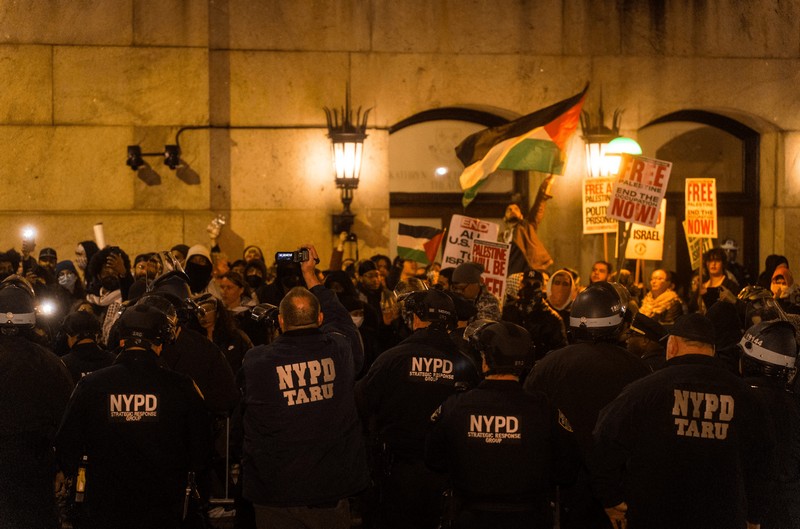
Consider, for instance, the recent announcement by Union Theological Seminary, which is affiliated with Columbia University, that it is divesting from “companies profiting from war in Palestine/Israel” – and, not only that, fully supports the student encampments (at Columbia and all across the country) and condemns the arrests and police violence wreaking havoc on the peaceful, culturally diverse protests.

Indeed, the seminary released a statement that scrambles the quiet certainty of those in power – i.e., that money matters more than anything else: “Over the decades, we have developed what are called ‘socially responsible investment screens’ to express our values and not financially support damaging and immoral investments.”

Values over profit? Over the years, the seminary has pulled its investments away from such industries as weapons manufacturers, for-profit prisons and fossil fuels. But not only that . . . apparently it understands, and values, education itself – a remarkable phenomenon indeed.

Seminary president Serene Jones, in an interview with Democracy Now!, pointed out that the school has opened up its campus “to all the surrounding campuses when students were being expelled, events weren’t allowed to happen. . . . Our doors are wide open, which is what a university should be in times like this.”

She also said: “We support students learning what it means to find their voices, to speak out for justice and freedom.”

Those are the words that stunned me the most. This is what education is, for God’s sake! It’s not just a matter of attending lectures, taking notes, absorbing data. It means finding your voice – finding your deepest values and expressing them in real life, putting them forward not as abstractions but as principles to live by. Entering the world as a grown woman, a grown man, means more than simply finding your place. It means challenging that world as you enter it and, by God, creating it – creating the future.

I certainly don’t mean this simplistically. I speak as an aging boomer, who entered adulthood as the civil rights movement was shaking and shattering the national norms, and as the Vietnam war was bursting into our consciousness. What an injured and deeply flawed world! Something was wrong. Growing up meant finding our voices and addressing – challenging – this flawed world.

In October 1967, for instance, I boarded a bus, along with many of my friends, and participated in the first antiwar march on the Pentagon, which included pushing the edges of social and legal propriety. We did more than listen to speeches. We determined to occupy the Pentagon, thousands of us walking across the grass, coming face to face with the soldiers guarding it. At one point, out of the blue, it seemed, a contingent of soldiers came rushing toward us; I wound up getting clobbered in the head with a rifle butt. I was knocked down but wasn’t hurt and stayed with the protest for several more hours, eventually leaving the Pentagon sit-in shortly before the arrests started happening.

My friends and I made it back to our school – Western Michigan University, in Kalamazoo – with a sense that our lives were no longer the same. We immediately took matters into our own hands. We dropped out.

I wound up delaying my eventual graduation by a number of years, and no, I didn’t “change the world” in some idealistically imagined way, but I have no doubt whatsoever that this period of my life – full of protests, drugs, a few arrests, a lot of mistakes – was at the core of my college learning experience. At the same time as all this was going on, I was also finding myself as a writer and, eventually, a journalist. I value the support – indeed, the mentorship – of a significant number of professors at Western. Continually creating the world isn’t simply a matter of us vs. them: young vs. old. It’s a multigenerational effort.

All of which brings me back to the present moment, and the words of Serene Jones, who has not abandoned – or grown cynical about – the values emanating from the student encampments across the country. Much of the mainstream coverage of the protests simply defines the phenomenon in us-vs.-them terms. The protests are “pro-Palestine,” seeming to imply there are two equal (equally brutal) sides in this war, and being pro-Palestine means being anti-Israel, which can easily morph into anti-Semitic. But the protests aren’t simply pro-Palestine; they’re pro-humanity (and anti-genocide).

And the participants are culturally and religiously, but not spiritually, diverse. As Jones writes at Religion News Service: “First and foremost, these encampments are filled with students from different religious traditions — Jews, Muslims, Christians, Buddhists, unaffiliated as well as spiritual but not religious students. They are finding solace and courage among themselves. . . .

“It is simply who these protesters are: a community bound by a greater common cause to stop the mass killing of besieged Palestinians.”

Jones’s essay is called “What we have to learn from students leading the charge for justice” – which is itself compelling. The university system – the financial system, the political system – has something to learn from the protesters? Love thy enemy or whatever?

The world these protesters are entering is

a world hardened by cynicism. In such a world, a.k.a., the real world, “love” and other values are appropriate to be uttered in a religious setting with pews and fancy windows, but they’re hardly relevant in the day-to-day world of win-and-lose, gain-and-loss. That’s why the cops are barging in, beating and arresting the protesters and tearing down the encampments.

But Jones is daring to tell us that this is not the real world – simply the current one, which is still under construction.

Robert C. Koehler is an award-winning, Chicago-based peace journalist and nationally syndicated writer.

20 May 2024

Source: transcend.org
Palestine 1920: The Other Side of the Palestinian (Hi)story

By Al Jazeera English

“A land without a people for a people without a land” is how the relationship between Palestine and the Jewish people was described by Christian writers in the 1800s. And the 20th-century history of the Middle East has largely been written through these eyes.

But this documentary looks at Palestine from a different angle. It hears from historians and witness accounts, and features archive documents that show Palestine as a thriving province of Greater Syria and the Ottoman Empire at the dawn of the 20th century. Its cities had a developing trade and commercial sector, growing infrastructure, and embryonic culture that would enable it to meet the challenges of the decades ahead.

However, the political ramifications of the Balfour Declaration, San Remo Conference and British Mandate set in motion a series of events that profoundly affected this vibrant, fledgling society and led to the events of 1948 and beyond.

This is the other side of the Palestinian (hi)story.

Palestine 1920: The Other Side of the Palestinian Story | Al Jazeera World Documentary

TRANSCEND VIDEOS STAY POSTED FOR 2 WEEKS BEFORE BEING ARCHIVED

20 May 2024

Source: transcend.org

War Cuts the Heart Out of Humankind

By Vijay Prashad

In the apartment of my friends in Baghdad (Iraq), they tell me about how each of them had been impacted by the ugliness of the 2003 U.S.-imposed illegal war on their country. Yusuf and Anisa are both members of the Federation of Journalists of Iraq and both have experience as “stringers” for Western media companies that came to Baghdad amid the war. When I first went to their apartment for dinner in the well-positioned Waziriyah neighborhood, I was struck by the fact that Anisa—whom I had known as a secular person—wore a veil on her face. “I wear this scarf,” Anisa said to me later in the evening, “to hide the scar on my jaw and neck, the scar made by a bullet wound from a U.S. soldier who panicked after an IED [improvised explosive device] went off beside his patrol.”

Earlier in the day, Yusuf had taken me around New Baghdad City, where in 2007 an Apache helicopter had killed almost twenty civilians and injured two children. Among the dead were two journalists who worked for Reuters, Saeed Chmagh and Namir Noor-Eldeen. “This is where they were killed,” Yusuf tells me as he points to the square. “And this is where Saleh [Matasher Tomal] parked his minivan to rescue Saeed, who had not yet died. And this is where the Apache shot at the minivan, grievously injuring Saleh’s children, Sajad and Duah.” I was interested in this place because the entire incident was captured on film by the U.S. military and released by Wikileaks as “Collateral Murder.” Julian Assange is in prison largely because he led the team that released this video (he has now received the right to challenge in a UK court his extradition to the United States). The video presented direct evidence of a horrific war crime.

“No one in our neighborhood has been untouched by the violence. We are a society that has been traumatized,” Anisa said to me in the evening. “Take my neighbor for instance. She lost her mother in a bombing and her husband is blind because of another bombing.” The stories fill my notebook. They are endless. Every society that has experienced the kind of warfare faced by the Iraqis, and now by the Palestinians, is deeply scarred. It is hard to recover from such violence.

My Poisoned Land

I am walking near the Ho Chi Minh Trail in Vietnam. My friends who are showing me the area point to the fields that surround it and say that this land has been so poisoned by the United States dropping Agent Orange that they do not think food can be produced here for generations. The U.S. dropped at least 74 million liters of chemicals, mostly Agent Orange, on Cambodia, Laos, and Vietnam, with the focus for many years being this supply line that ran from the north to the south. The spray of these chemicals struck the bodies of at least five million Vietnamese and mutilated the land.

A Vietnamese journalist Trân Tô Nga published Ma terre empoisonnée (My poisoned land) in 2016 as a way to call attention to the atrocity that has continued to impact Vietnam over four decades after the U.S. lost the war. In her book, Trân Tô Nga describes how as a journalist in 1966 she was sprayed by a U.S. Air Force Fairchild C-123 with a strange chemical. She wiped it off and went ahead through the jungle, inhaling the poisons dropped from the sky. When her daughter was born two years later, she died in infancy from the impact of Agent Orange on Trân Tô Nga. “The people from that village over there,” my guides tell me, naming the village, “birth children with severe defects generation after generation.”

Gaza

These memories come back in the context of Gaza. The focus is often on the dead and of the destruction of the landscape. But there are other enduring parts of modern warfare that are hard to calculate. There is the immense sound of war, the noise of bombardment and of cries, the noises that go deep into the consciousness of young children and mark them for their entire lives. There are children in Gaza, for example, who were born in 2006 and are now eighteen, who have seen wars at their birth in 2006, then in 2008-09, 2012, 2014, 2021, and now, 2023-24. The gaps between these major bombardments have been punctuated by smaller bombardments, as noisy and as deadly.

Then there is the dust. Modern construction uses a range of toxic materials. Indeed, in 1982, the World Health Organization recognized a phenomenon called “sick building syndrome,” which is when a person falls ill due to the toxic material used to construct modern buildings. Imagine that a 2,000-pound MK84 bomb lands on a building and imagine the toxic dust that flies about and lingers both in the air and on the ground. This is precisely what the children of Gaza are now breathing as the Israelis drop hundreds of these deadly bombs on residential neighborhoods. There is now over 37 million tons of debris in Gaza, large sections of it filled with toxic substances.

Every war zone remains dangerous years after ceasefires. In the case of this war on Gaza, even a cessation of hostilities will not end the violence. In early November 2023, Euro-Med Human Rights Monitor estimated that the Israelis had dropped 25,000 tons of explosives on Gaza, which is the equivalent of two nuclear bombs (although, as they pointed out, Hiroshima sits on 900 square meters of land, whereas Gaza’s total square meters are 360). By the end of April 2024, Israel had dropped over 75,000 tons of bombs on Gaza, which would be the equivalent of six nuclear bombs. The United Nations estimates that it would take 14 years to clear the unexploded ordnance in Gaza. That means until 2038 people will be dying due to this Israeli bombardment.

On the mantle of the modest living room in the apartment of Anisa and Yusuf, there is a small Palestinian flag. Next to it is a small piece of shrapnel that struck and destroyed Yusuf’s left eye. There is nothing else on the mantle.

Vijay Prashad is an Indian historian, editor, and journalist. He is a writing fellow and chief correspondent at Globetrotter.

23 May 2024

Source: countercurrents.org

Nakba Resurrected – How the Gaza Resistance Ended Segmentation of Palestine

By Dr Ramzy Baroud

Inadvertently, Israel has pressed the reset button on its war with the Palestinian people, taking back the so-called conflict to square one.

Save a few self-serving Palestinian officials affiliated with the Palestinian Authority (PA), most Palestinians do not seem consumed with the return to the peace process, or even engaged in discussions about two state solutions.

The conversation among Palestinians is now mostly concerned with all aspects of the Palestinian struggle, starting with the ethnic cleansing of Palestine 76 years ago, an event known as the Nakba, or Catastrophe.

The Nakba is commemorated on May 15 of each year. The nature of the annual event, however, changes from one stage of the Palestinian struggle to the next.  Indeed, the Nakba anniversary acquires its meaning from the political context of the time – it is elevated during times of hope, demoted during times of despair, defeat and infighting.

In the early phases of the Palestinian struggle, immediately following the expulsion of nearly 80 percent of the total Arab population of Palestine, the Right of Return was not a slogan or symbol. It was, at least in the minds of most refugees, a real possibility.

That right is enshrined in international law under United Nations General Assembly Resolution 194 of December 1948. At the time, Palestinian exile was perceived to be temporary – thus, the term ‘temporary shelters’ associated with the humble dwellings of refugee encampments immediately after the war. These refugee camps extended from Palestine itself to other countries throughout the Middle East.

Back then, Arab nationalism was a powerful political notion that defined a pan-Arab political discourse, which centered in Egypt, Syria and Iraq. With the passage of time, however, it became clear that Arab liberators were not coming to free Palestine, and that UN resolutions on Palestine were not meant to be implemented. They were mere ‘ink on paper’, Palestinians would often utter.

Experience taught Palestinians to be cynical about lofty promises, especially when the UN-supplied ‘temporary shelters’ became a permanent, everyday reality.

The Palestinians continued to commemorate the Nakba anyway, because their collective memory became their main weapon of fighting back against Israeli erasure.

The rise of the Palestine Liberation Organization (PLO) in the 1960s, its emphasis on the liberation of all of Palestine and its use of revolutionary slogans and armed struggle resurrected hopes among ordinary Palestinians that the Right of Return was still possible.

These hopes were dashed, however, after the PLO’s forced exile from Lebanon in 1982, and the signing of the Oslo Accords between Israel and increasingly irrelevant Palestinian leadership in 1993.

Oslo and its fraudulent US-led peace process allowed Israel to conclude what it started during the Palestinian Nakba. Israel’s greatest achievement was creating a Palestinian entity that would help it manage its final victory over the Palestinian people. The PA became that entity, leading to widening the factional and class divides in Palestinian society.

Since then, Israel managed to annex large parts of what remained of historic Palestine, control dissenting Palestinians through the PA and besiege Gaza as an act of collective punishment for its ongoing resistance. All wars fought against Gaza in recent years were meant to serve as a reminder to Palestinians of Israel’s might and Palestinian inferiority.

Palestinians, however, continued to commemorate the Nakba, although the Right of Return, as a political concept, became marginal, hardly ever discussed, neither by Israel nor the PA as a pressing political issue.

Recent years indicated that Israel was ready to move past all of this into a whole new stage of politics, one that does not pay the slightest attention to Palestinian aspirations.

The Israeli occupation, illegal settlements, occupied Jerusalem and all other critical topics that mattered to Palestinians ceased to be part of Israeli election campaigns, or even part of the Israeli political discourse, in general. This mindset defined all mainstream Israeli political groups, from the extreme right to the left.

All that seemed to matter to Israel was the expansion of the illegal settlements, the annexation of the West Bank, the normalization of its military occupation and the occasional military raids and wars aimed at crushing the Resistance.

October 7, however, changed all of that. The new political discourse emerging from Gaza following the war has forced an international rethink about Palestine and the struggle of the Palestinians.

This was crystallized in the words of Chinese Foreign Ministry spokesperson, Wang Wenbin, who addressed, in a press conference on May 15, the Palestinian Nakba.

“Seventy-six years on, the historical injustice suffered by the Palestinian people, far from being redressed, has further worsened,” Wenbin said, linking the past to the present, Gaza to historic Palestine.

This new discourse is now taking hold, and the segmentation of Palestinian history resulting from Oslo is quickly disappearing in favor of a wholesome approach to justice in Palestine. Though Washington and a few of its western allies insist on returning to the status quo of endless negotiations, others are no longer beholden to that kind of stifling, self-serving discourse.

This shift in perspective was not only a result of the failure of Oslo, and the extent of the Israeli barbarity and genocide in Gaza, but mainly because of the steadfastness and resistance of the Palestinians themselves.

It turned out that collective memory was not just an academic notion, but a weapon in the hands of ordinary people.

Thanks to Palestinian memory, Palestinians are once more united around their understanding of the past, the steadfastness of the present and the hope for a just future.

– Dr. Ramzy Baroud is a journalist, author and the Editor of The Palestine Chronicle.

23 May 2024

Source: countercurrents.org

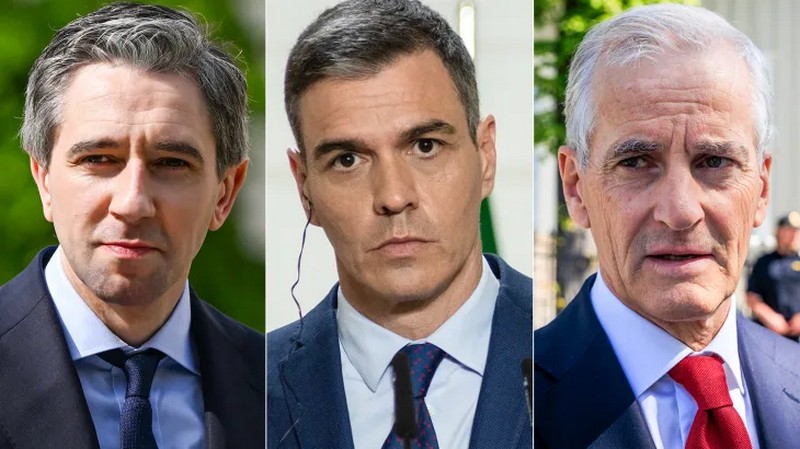
Norway, Ireland and Spain Recognise Palestine

By Dr Marwan Asmar

Norway, Ireland and Spain officially recognized the existence of a Palestinian state. This is a historic development. Norwegian Premier Jonas Gahr Store said Oslo will recognize the state as of 28 May. “There can’t be peace in the Middle East if there is no recognition,” he said. 

The announcement by Norway, Ireland and Spain to recognize an independent Palestinian state comes when the Israeli deadly war on north Gaza is raging once again.

[https://twitter.com/BeckettUnite/status/1793185486057492488]

[https://twitter.com/SaulStaniforth/status/1793177042474741932]

Zero distance Jabalia

‘By God leave it, this is for me, by God leave it…’

Two Palestinian resistance fighters fought, during battle, over who should destroy an Israeli tank at zero distance in Jabalia

[https://twitter.com/tamerqdh/status/1792551553951236569]

Each wants to have the honor of devastating the tank which could lead to his own death but the fighting continues. The war between the Israeli army which entered the camp two weeks ago and the Palestinian resistance remains at its highest in Jabalia, just above Gaza City.

[https://twitter.com/AJA_Palestine/status/1792046313305153788]

The social media continues to display different scenes of Palestinian heroism. One videoclip that continues to trend is that of a Palestinian sniper on top of the roof of one building in the entrapped camp. At first, he gets shot in the ankle but rises and continues to fire at Israelis soldiers but is soon killed. Quickly, his friend picks up his gun and continues shooting at the soldiers till, he too, becomes a martyr.

[https://twitter.com/Alenezi_Trad_N/status/1792123348379373696]

Jabalia has become the next fight for the Israeli army which wants to dominate and control the Gaza Strip. But all they are doing is killing civilian by bombing their houses.

The Palestinian fighters however, keep emerging from underground tunnels, the majority of which remain intact according to Israeli military and intelligence sources and are likely to continue for the foreseeable future.

300 homes destroyed

In Jabalia, the Israeli army have destroyed at least 300 houses around the Kamal Al Adwan Hospital, the only health institution in North Gaza which is too, about to go out of service.

The Israeli army has a knack for going after the hospitals of Gaza. They have destroyed most of the 36 hospitals in the enclave under the pretext of going after Hamas fighters. However, all they did was kill patients and civilians and tried to cover their evil deeds in mass graves whether in Al Shifa snd/or in Al Nasser Hospitals in Khan Younis and more.

The Israeli army is not relenting despite the major daily losses in their ranks. Soldiers are seen as acceptable collateral damage despite the daily carnage  they are enduring and maybe this is a penance for the continual destruction they carried out in Gaza for the past eight months.

In the north of Gaza, the Palestinian resistance have started to use new tactics like wire-bombing already destroyed houses and wrecked facilities which the Israeli army uses to carry out their war. Jabalia was the first place to use such tactics but the Izz Al Dien Al Qassam Brigade just announced the booby-trapping of an agricultural school in Biet Hanoon in which 10 Israeli soldiers were killed there.

The Israel army has pushed back into north Gaza starting with Jabalia, Beit Hanoon and Biet Lahia but there is more. This is not to forget that Israel is effectively fighting in Rafah in the south of the enclave and which Prime Minister Benjamin Netanyahu insists on a full invasion but which is yet to materialize.

Nevertheless, the Israeli army has already created a new wave of displacements from Rafah which used to house 1.4 million Palestinians. Today, 900 thousand people have gone back to Al Mawasi and central Gaza under the Israeli big guns.

Meanwhile the war in Jabalia and the north of Gaza continues with more Palestinians’ civilians bloodshed.

However, the new and official recognition by three major European countries – Norway, Spain and Ireland – of an independent Palestinian state, puts Israel back in the dock to end its heinous war on Gaza and wake up to a new stark realization.

‏Dr Marwan Asmar is an Amman-based writer covering Middle East Affairs

22 May 2024

Source: countercurrents.org

The Slow-Motion Execution of Julian Assange Continues

By Chris Hedges

The ruling by the High Court in London permitting Julian Assange to appeal his extradition order leaves him languishing in precarious health in a high-security prison. That is the point.

The decision by the High Court in London to grant Julian Assange the right to appeal the order to extradite him to the United States may prove to be a Pyrrhic victory. It does not mean Julian will elude extradition. It does not mean the court has ruled, as it should, that he is a journalist whose only “crime” was providing evidence of war crimes and lies by the U.S. government to the public. It does not mean he will be released from the high-security HMS Belmarsh prison where, as Nils Melzer, the UN Special Rapporteur on Torture, after visiting Julian there, said he was undergoing a “slow-motion execution.”

It does not mean that journalism is any less imperiled. Editors and publishers of  five international media outlets —– The New York Times, the Guardian, Le Monde, El Pais and DER SPIEGEL —– which published stories based on documents released by WikiLeaks, have urged that the U.S. charges be dropped and Julian be released. None of these media executives were charged with espionage. It does not dismiss the ludicrous ploy by the U.S. government to extradite an Australian citizen whose publication is not based in the U.S. and charge him under the Espionage Act. It continues the long Dickensian farce that mocks the most basic concepts of due process.

This ruling is based on the grounds that the U.S. government did not offer sufficient assurances that Julian would be granted the same First Amendment protections afforded to a U.S. citizen, should he stand trial. The appeal process is one more legal hurdle in the persecution of a journalist who should not only be free, but feted and honored as the most courageous of our generation.

Yes. He can file an appeal. But this means another year, perhaps longer, in harsh prison conditions as his physical and psychological health deteriorates. He has spent over five years in HMS Belmarsh without being charged. He spent seven years in the Ecuadorian Embassy because the U.K. and Swedish governments refused to guarantee that he wouldn’t be extradited to the U.S., even though he agreed to return to Sweden to aid a preliminary investigation that was eventually dropped.

The judicial lynching of Julian was never about justice. The plethora of legal irregularities, including the recording of his meetings with attorneys by the Spanish security firm UC Global at the embassy on behalf of the CIA, alone should have seen the case thrown out of court as it eviscerates attorney-client privilege.

The U.S. has charged Julian with 17 acts under the Espionage Act and one count of computer misuse, for an alleged conspiracy to take possession of and then publish national defense information. If found guilty on all of these charges he faces 175 years in a U.S. prison.

The extradition request is based on the 2010 release by WikiLeaks of the Iraq and Afghanistan war logs — hundreds of thousands of classified documents, leaked to the site by Chelsea Manning, then an Army intelligence analyst, which exposed numerous U.S. war crimes including video images of the gunning down of two Reuters journalists and 10 other unarmed civilians in the Collateral Murder video, the routine torture of Iraqi prisoners, the covering up of thousands of civilian deaths and the killing of nearly 700 civilians that had approached too closely to U.S. checkpoints.

In February, lawyers for Julian submitted nine separate grounds for a possible appeal.

A two-day hearing in March, which I attended, was Julian’s last chance to request an appeal of the extradition decision made in 2022 by the then British home secretary, Priti Patel, and of many of the rulings of District Judge Baraitser in 2021.

The two High Court judges, Dame Victoria Sharp and Justice Jeremy Johnson, in March rejected most of Julian’s grounds of appeal. These included his lawyers’ contention that the UK-US extradition treaty bars extradition for political offenses; that the extradition request was made for the purpose of prosecuting him for his political opinions; that extradition would amount to retroactive application of the law — because it was not foreseeable that a century-old espionage law would be used against a foreign publisher; and that he would not receive a fair trial in the Eastern District of Virginia. The judges also refused to hear new evidence that the CIA plotted to kidnap and assassinate Julian, concluding — both perversely and incorrectly — that the CIA only considered these options because they believed Julian was planning to flee to Russia.

But the two judges determined Monday that it is “arguable” that a U.S. court might not grant Julian protection under the First Amendment, violating his rights to free speech as enshrined in the European Convention on Human Rights.

The judges in March asked the U.S. to provide written assurances that Julian would be protected under the First Amendment and that he would be exempt from a death penalty verdict. The U.S. assured the court that Julian would not be subjected to the death penalty, which Julian’s lawyers ultimately accepted. But the Department of Justice was unable to provide an assurance that Julian could mount a First Amendment defense in a U.S. court. Such a decision is made in a U.S. federal court, their lawyers explained.

Assistant U.S. Attorney Gordon Kromberg, who is prosecuting Julian, has argued that only U.S. citizens are guaranteed First Amendment rights in U.S. courts. Kromberg has stated that what Julian published was “not in the public interest” and that the U.S. was not seeking his extradition on political grounds.

Free speech is a key issue. If Julian is granted First Amendment rights in a U.S. court it will be very difficult for the U.S. to build a criminal case against him, since other news organizations, including The New York Times and The Guardian, published the material he released.

The extradition request is based on the contention that Julian is not a journalist and not protected under the First Amendment.

Julian’s attorneys and those representing the U.S. government have until May 24 to submit a draft order, which will determine when the appeal will be heard.

Julian committed the empire’s greatest sin — he exposed it as a criminal enterprise. He documented its lies, routine violation of human rights, wanton killing of innocent civilians, rampant corruption and war crimes. Republican or Democrat, Conservative or Labour, Trump or Biden — it does not matter. Those who manage the empire use the same dirty playbook.

The publication of classified documents is not a crime in the United States, but if Julian is extradited and convicted, it will become one.

Julian is in precarious physical and psychological health. His physical and psychological deterioration has resulted in a minor stroke, hallucinations and depression. He takes antidepressant medication and the antipsychotic quetiapine. He has been observed pacing his cell until he collapses, punching himself in the face and banging his head against the wall. He has spent weeks in the medical wing of Belmarsh, nicknamed “hell wing.” Prison authorities found half of a razor blade” hidden under his socks. He has repeatedly called the suicide hotline run by the Samaritans because he thought about killing himself “hundreds of times a day.”

These slow-motion executioners have not yet completed their work. Toussaint L’Ouverture, who led the Haitian independence movement, the only successful slave revolt in human history, was physically destroyed in the same manner. He was locked by the French in an unheated and cramped prison cell and left to die of exhaustion, malnutrition, apoplexy, pneumonia and probably tuberculosis.

Prolonged imprisonment, which the granting of this appeal perpetuates, is the point. The 12 years Julian has been detained — seven in the Ecuadorian Embassy in London and over five in high-security Belmarsh Prison — have been accompanied by a lack of sunlight and exercise, as well as unrelenting threats, pressure, prolonged isolation, anxiety and constant stress. The goal is to destroy him.

We must free Julian. We must keep him out of the hands of the U.S. government. Given all he did for us, we owe him an unrelenting fight.

If there is no freedom of speech for Julian, there will be no freedom of speech for us.

Chris Hedges is a Pulitzer Prize-winning journalist who was a foreign correspondent for fifteen years for The New York Times, where he served as the Middle East Bureau Chief and Balkan Bureau Chief for the paper.

20 May 2024

Source: countercurrents.org

Dear White Friends: Can You Smell the Yellow Roses of Dier al-Balah?

By Priti Gulati Cox with Stan Cox

One of the first things that I heard from people when I immigrated to the United States from the Global South in early 2000 was, “Oh, you speak our language so well.” To which I would reply politely that it was one of the things that the British left behind, but would think to myself that well, actually, I learnt it from the same imperialists you did.

Then 9/11 happened. That day, for many in this country, was the beginning of history, just as October 7 is treated today. It’s as if the two events happened in ahistorical vacuums.

For a native of a once-colonized India whose country’s history cannot be separated from the exploits of empire, it can seem short-sightedly luxurious for people of the Global North, especially here in the U.S., to absorb October 7 in that vacuum, severed from its historical context.

There was no one event in India’s history that defined the country’s struggle for liberation. It was the cumulative effects of colonialism, similar to what’s going on in historic Palestine today. And perhaps that’s the difference between how many colonizer-country minds tend to approach current global events versus many colonized-country minds. The former shy away from approaching the events of today in its historical context, whereas the latter can’t help but do the opposite.

1947

I would argue that 1947 was the year that changed the course of history for Palestine, India and the U.S.

First, between 1947 and 1949, as the state of Israel was being born, Zionist forces expelled close to 800,000 Indigenous Palestinians from their homes and occupied their land and their bodies. Then, for the next 75 years, the apartheid state of Israel used collective-punishment tactics in the occupied territories, which has included blockading the Gaza Strip by land, air and sea since 2007, thereby creating the conditions that led to October 7.

Second, in 1947, India won its independence from the British after enduring 267 years of colonial rule. Between 1880 and 1920, during the throes of the Raj, British colonial policies had killed, at a minimum, 100 million Indians. That was the price India had to pay to free herself from colonialism. Furthermore, the effects of the colonizer’s divide-and-rule policies pitted Hindus against Muslims and divided the country along communal lines. Today, that divide is being used by the Hindu majority to turn India, by design, into a Hindu Rashtra (a land for Hindus with Muslims and Christians as second class citizens), just as Israel is trying to do in Palestine by ethnically cleansing the indigenous peoples of historic Palestine with the fantasy goal of creating Greater Israel (a land for Zionists only.) Meanwhile, in its own settler-colony of Kashmir, the Indian state, by design, is “seeking to rewrite history, claiming that a new era of peace has begun in the region, while working to erase any vestiges or memories of resistance,” according to Middle East Eye.

Third, and also in 1947, the U.S. made the initial move that kicked off our Cold War with the Soviet Union, by backing a royalist-fascist regime that grabbed control of the Greek government after World War II. This involved a savage counterinsurgency campaign aimed at destroying the leftist worker- and peasant-led nationalist movement that had led Greece’s fight against the Nazis. The war killed 160,000 Greeks and made refugees of 800,000. In Fateful Triangle: The United States, Israel, and the Palestinians, Noam Chomsky noted, with some understatement, “A major motivation for this counterinsurgency campaign was concern over Middle East oil.” The bloodbath in Greece was supposed to counter an imagined Soviet threat to the Middle East. But another U.S. motivation for backing repression in the Middle East—labeled by Chomsky “the Indigenous threat” —was Arab nationalism. And so it happened that in the 1950s, Washington came to adopt the position that “a powerful Israel is a ‘strategic asset’ for the United States.” And the rest, sadly, is history.

2016

I would also argue, that for our white friends here on this colonized Turtle Island, it all started on November 8, 2016 when half the people of the country cried like never before. If all those tears could’ve been collected in a cloud — no, not that kinda cloud, the real thing — it would’ve been a hard-rain’s-gonna-fall moment. Jokes (but not trite metaphors) aside, when Donald Trump was elected as the 45th president of the United States, Americans got a good taste of the medicine our government has been handing out around the world for more than a century. That was the day when the chickens finally came home to roost after making the global south their killing field, displacement field, and regime-change field. Their targets were now closer to home, and the Indigenous people, Black people, immigrants, Muslims, women, children in schools, LGBTQ people … all became targets in the new roosting grounds.

And freedom for MAGA America never looked sweeter. Guns, supersized pickup trucks “rollin’ coal,” a women-hating Supreme Court majority, anti-abortion amendments, vigilantism targeting minorities, gerrymandering gone wild… yeeeeeeeeehaw! Life was good again in ‘merica.

Then Biden becomes president and the half of America that cried in 2016 heaves a sigh of relief. Until October 7, that is.

Family and neighbors and community and country come first, right? Right. But what happens when that country happens to be the most powerful in the world, spending its entire time since 1947 maintaining world hegemony, with catastrophic consequences for the people of the Global South? Then our communities occupy not only the land within US borders; they occupy Afghanistan, Iraq, Yemen, Syria and all of the other countries that have suffered under our imperialism. Maybe most of all, Palestine.

Especially Palestine. Because when it comes to the Biden-led genocide, the lid’s off the petri dish of U.S.-style democracy, and the priorities of far too many Americans — including Democratic party operatives and other liberal apologists for genocide — have been revealed for all to see. At the same time, all can see the genocide in Gaza documented every second of the day by journalists and on social media.

The Present

Now, close to six months before Election Day, the freaked-out anti-MAGA segment of American society further removes itself from that paramount historical context when they view world-changing events like October 7 through partisan eyes. Please don’t get me wrong. I’m as anti-MAGA and freaked out as anyone else with a thinking brain and a kind heart. But I’m more freaked out about the vacuum that has sucked in the liberal imagination of today’s Bidenistan than I am about a future Trumpistan—simply because the later scenario wouldn’t be possible if it weren’t for the failings of the former.

Things we fear Trump might do, Biden is already doing. It is imperative upon us to pay close attention not to the man or the party, but their policies and their perennial words.

It’s perennial U.S. government policies as a whole that will finally take us down, not this or that president. If we insist on viewing what’s in front of us (this video, celebratory music and all, was uploaded by an Israeli soldier) as a monoculture landscape, i.e., a dreaded Trumpistan, then we have a lot of catching up to do. And we’re way past the time for such political luxuries, just as we’re way past the time for climate luxuries. Our liberal friends need to apply the same measure of justice and urgency to the consequences of U.S. imperial policies as they do to climate justice policies, for instance. It’s not one or the other. It’s both.

Of course you’re afraid of a Trump presidency. I am too. But for heaven’s sake, let’s confine the consequences of that defeat to U.S. borders. If we lack the imagination to look at the countries that American empire has affected over the years as part of our own community, then we have no right to speak for them and say that this or that president will make it worse for them. They know better, and so should we.

In fact, if you look around, some of the same people liberals are wanting to spare a second Trumpistan are as anti-Biden and anti-genocide as can be: Muslim women who are being harassed on the streets of this country, professorsstudentsIndigenous people, climate justice activistsLGBTQ people. Not only are they on the right side of history; they’re making history. Right now.

Dreams

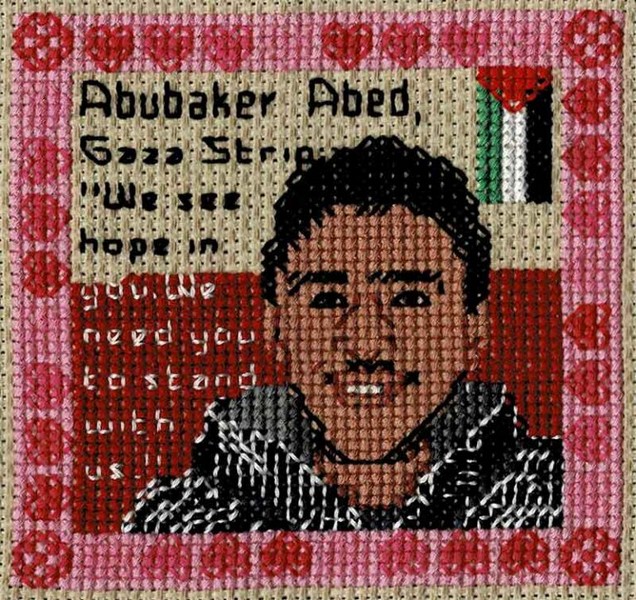
It’s imperative upon us not to take this history and our obligations lightly. Listen to the message conveyed to us in America by Gaza resident Abubaker Abed on April 27 in an interview with The Electronic Intifada: “This is our yellow rose. It is in fact the best thing we have at the moment. Because, we see hope through it. Despite the destruction, despite the truly unbearable circumstance we are living under at the moment, we still seek out hope [and] we see hope in you… I, Abubaker, am sending a message of love, a message of hope to everyone of you from Central Gaza, in Dier al-Balah.”

We can start by using our imagination to smell Abubaker Abed’s yellow roses that he grows so lovingly, more than 5500 miles away from us in Dier al-Balah, where exactly three months to the day before Abubaker’s interview, on January 27, 18-month-old Hoor Nusseir lost her parents, her brothers and her tiny hands in an Israeli bombing. If our tax dollars and government support continue being used to maim her and thousands other children, kill freed detainees like Farouk Al Khatib who died due to medical negligence during his detention, deliberately target schools and health centers, detain and torture childrenstarve Palestinians, dehumanize and humiliate them, and flatten their land till kingdom come, then we are responsible for the actions of our governments past, present and future. In Abubaker’s words, “The core difference between us and the world is that Palestinians are dreaming to live, while all the world are living to dream.”

Taking Abubaker’s words to heart, we all can immediately smell his yellow roses. At least that’s my hope.

Priti Gulati Cox, (@PritiGCox) is an artist and writer. Her work has appeared in Countercurrents, CounterPunch, Salon, Truthout, Common Dreams, the Nation, AlterNet, and more.

Stan Cox is the author of The Path to a Livable Future: A New Politics to Fight Climate Change, Racism, and the Next Pandemic, The Green New Deal and Beyond: Ending the Climate Emergency While We Still Can, and the current In Real Time climate series at City Lights Books.

20 May 2024

Source: countercurrents.org