By Dr Gideon Polya
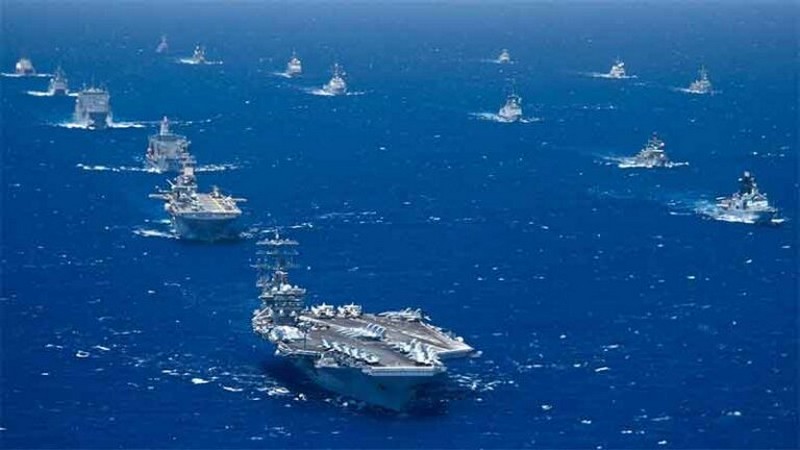
The mass murder by US-backed Apartheid Israel of Palestinians in the Gaza Concentration Camp (44,000 killed including 16,000 children and 10,000 women by 13 May) is utterly intolerable and unforgivable to decent people who consequently urge detachment from any dealings with the perpetrators including joint military exercises. Thus the coming US RIMPAC naval exercises involving 29 nations including child-killing Apartheid Israel will provoke fierce global opposition.
The Commander, U.S. Third Fleet Public Affairs: “ Approximately 29 nations, 40 surface ships, 3 submarines, 14 national land forces, over 150 aircraft and more than 25,000 personnel will participate in the biennial Rim of the Pacific (RIMPAC) exercise scheduled June 26 to Aug. 2, in and around the Hawaiian Islands. RIMPAC 2024 is the 29th exercise in the series that began in 1971. As the world’s largest international maritime exercise, RIMPAC combines force capabilities in a dynamic maritime environment to demonstrate enduring interoperability across the full spectrum of military operations. The theme of RIMPAC 2024 is “Partners: Integrated and Prepared.” To promote a free and open Indo-Pacific, Exercise RIMPAC is the premier joint and combined maritime exercise, utilizing and preserving a world class maritime training environment. With inclusivity at its core, RIMPAC fosters multi-national cooperation and trust, leverages interoperability, and achieves respective national objectives to strengthen integrated, prepared, coalition partners. This year’s exercise includes forces from Australia, Belgium, Brazil, Brunei, Canada, Chile, Colombia, Denmark, Ecuador, France, Germany, India, Indonesia, Israel, Italy, Japan, Malaysia, Mexico, Netherlands, New Zealand, Peru, the Republic of Korea, the Republic of the Philippines, Singapore, Sri Lanka, Thailand, Tonga, the United Kingdom and the United States… During RIMPAC, integrated and prepared partners train and operate together in order to strengthen our collective forces and promote a free and open Indo-Pacific. RIMPAC 2024 contributes to the increased interoperability, resiliency and agility needed by the Joint and Combined Force to deter and defeat aggression by major powers across all domains and levels of conflict”[1].
It is very instructive to systematically analyse the country participants in this US-led, Indo-Pacific naval exercise in the interests of “national security” that also includes Israel – the genocidally racist, nuclear terrorist, serial invader, serial war criminal, grossly human rights-abusing, child-killing, women-killing, neo-Nazi pariah state of Apartheid Israel that has been involved for 8 months in the horrific Gaza Massacre and Gaza Genocide (as of 13 May 2024, Day 220, 44,000 Palestinians killed, including 16,000 children and 10,000 women) [2]. The Zionist-subverted, Zionist–perverted, pro-Apartheid Israel and hence pro-Apartheid US supplies the bombs that have reduced most of Gaza to rubble and killed 44,000 Palestinians so far. The US supplies 69% of the weapons imported by Apartheid Israel and fervently pro-Apartheid Israel and hence pro-Apartheid neo-Nazi Germany supplies 30% [3]. All countries involved in military collaboration with genocidally racist Apartheid Israel and its fervent backer, the US, are complicit in the Gaza Massacre and Gaza Genocide.
The 29 Gaza Genocide-complicit RIMPAC nation participants fall into 2 groups (A). European participants and (B) Non-European participants, as analyzed succinctly below.
(A). European RIMPAC participants.
(1). Of the 29 participating countries 11 are ethnically largely European (the US, Canada, Australia, New Zealand and 7 Western European countries , namely Belgium, Denmark, France, Germany, Italy, Netherlands, and the UK). There are 18 non-European participants, including Apartheid Israel (51% of its subjects are Palestinians of whom 73% are excluded from voting for the government ruling them; Jewish Israelis represent 47% of the population and many are non-European although non-Semitic European Ashkenazi Jews are in power) [4-6].
(2). All of the 11 European countries belong to the all-European, anti-Semitic and holocaust-denying International Holocaust Remembrance Alliance (IHRA) that is grossly anti-Jewish anti-Semitic (by falsely defaming anti-racist Jewish critics of Apartheid Israel), and grossly anti-Arab anti-Semitic (by falsely defaming anti-racist Palestinian, Arab and Muslim critics of Apartheid Israeli crimes) [7-9]. The IHRA is also egregiously holocaust-denying by ignoring all WW2 holocausts other than the WW2 Jewish Holocaust (5-6 million Jews killed by violence and deprivation) [10-12] including (deaths from violence and imposed deprivation in brackets) the WW2 Polish Holocaust (6 million), WW2 Soviet Holocaust (27 million), WW2 European Holocaust (30 million Slavs, Jews and Roma killed), WW2 Chinese Holocaust (35-40 million Chinese died under the Japanese, 1937-1945) and the WW2 Bengali Holocaust (WW2 Indian Holocaust, WW2 Bengal famine; 6-7 million Indians deliberately starved to death for strategic reasons in Bengal, Bihar, Assam and Odisha by the serial war criminal British with food-denying Australian complicity). Indeed the holocaust-denying IHRA ignores the carnage in some 70 genocides other than the WW2 Jewish Holocaust [13-18].
(3). All of the European countries except for Australia and New Zealand belong to nuclear-armed NATO. US lackey Australia has committed $400 billion for 8 US and UK nuclear-powered submarines, belongs to the anti-China and nuclear-armed Australia-UK-US (AUKUS) Alliance, and as a US lackey is seeking closer ties with NATO. Australia under a US lackey Labor Government plans to host US nuclear-armed submarines, nuclear-armed warships and nuclear-armed B52 bombers in Australia in addition to thousands of US troops rotating through a Northern Territory US army base near Darwin. New Zealand opposes nuclear weapons in its territory but has elected a Rightist Government that has offended the substantial Indigenous Maori population.
(4). Of the 11 European RIMPAC participants, 3 have nuclear weapons, 4 “host” US nuclear weapons, and all “endorse” use of nuclear weapons. The 3 European RIMPAC countries possessing nuclear weapons are the US (5,244), France (290) and the UK (225) [19]. The 4 European RIMPAC countries that “host” US nuclear weapons include Italy (35), Belgium (10-15), Germany (15), and the Netherlands (15) (noting that NATO member Turkiye “hosts” 20 US nuclear weapons and Belarus stores Russian tactical nuclear weapons). Of the 34 non-nuclear weapons countries that “endorse” nuclear weapon usage (Albania, Armenia, Australia, Belarus, Belgium, Bulgaria, Canada, Croatia, Czech, Denmark, Estonia, Finland, Germany, Greece, Hungary, Iceland, Italy, Japan, Latvia, Lithuania, Luxembourg, Montenegro, The Netherlands, North Macedonia, Norway, Poland, Portugal, Romania, Slovakia, Slovenia, South Korea, Spain, Sweden and Turkiye) 7 are European RIMPAC participants (Australia, Belgium, Canada, Denmark, Germany, Italy, and the Netherlands). Japan is the only Non-European “endorser” of nuclear weapons usage. Except for sane New Zealand none of the European RIMPAC participants have signed up to the crucial Treaty on the Prohibition of Nuclear Weapons (TPNW). Sane New Zealand has signed and ratified the TPNW [19]. This is lunacy – Humanity and the Biosphere are existentially threatened by nuclear weapons and climate change [20-28]. Thus for example eminent theoretical physicist Stephen Hawking: “We see great peril if governments and societies do not take action now to render nuclear weapons obsolete and to prevent further climate change” [23]. Present El Nino conditions have seen global warming reaching plus 1.5C and a catastrophic plus 2C is now inevitable in coming decades [24-28].
(5). All of the European participants were involved in the war criminal US Alliance- and NATO-imposed Afghan Genocide and Afghan Holocaust (7 million Afghan deaths from violence and war-imposed deprivation, 2001-2021). The Afghan Genocide [13-18, 29] was imposed by the serial war criminal US Alliance in gross violation of Articles 2 and 3 of the UN Convention on the Prevention and Punishment of the Crime of Genocide [30] and Articles 55 and 56 of the Fourth Geneva Convention (the Geneva Convention relative to the Protection of Civilian Persons in Time of War) that demand that an Occupier is inescapably obliged to provide its conquered Subjects with life-sustaining food and medical services “to the fullest extent of the means available to it” [31]. Article 3 of the UN Genocide Convention states: “The following acts shall be punishable: (a) Genocide; (b) Conspiracy to commit genocide ; (c) Direct and public incitement to commit genocide; (d) Attempt to commit genocide ; (e) Complicity in genocide” [30].
(6). All of the European participants were involved historically in invading other countries and centuries of genocidal settler colonialism including de facto and de jure slavery. The most horrendous colonial atrocities continued to within living memory e.g. (deaths from violence and deprivation in brackets) the 1757-1947 British-imposed Indian Holocaust (1,800 million), the 1937-1945 Japanese-imposed Chinese Holocaust (35-40 million), post-1950 US-imposed Asian wars (40 million), 15th century to 20th century African slavery (10 million), 19th -20th century Belgian-imposed Congolese Genocide (10 million), the 1939-1945 German-imposed WW2 European Holocaust (30 million), the post-9/11 US-imposed Muslim Holocaust (32 million), the 15th century-20th century European-imposed American Indian Genocide (90 million) [13-18].
(7). All of the wealthy European RIMPAC participants are involved in the ongoing Global Avoidable Mortality Holocaust in which 7.4 million presently die annually and 1,500 million people from the Global South have died avoidably from imposed deprivation since 1950 on Spaceship Earth with the rich First World in charge of the flight deck. 1950-2005 avoidable deaths from deprivation in countries occupied by these US Alliance powers since WW2 are as follows (avoidable deaths in brackets): Australia (2 million), Belgium (36 million), France (142 million), Netherlands (72 million), New Zealand (0.04 million), UK (727 million), US (82 million), and by way of comparison, US Alliance-backed Apartheid Israel (24 million) [18].
(8). Nearly all of the European participants were variously involved as US allies in the 1990 onwards, US Alliance-imposed Iraqi Holocaust (5 million deaths from 1990 onwards due to violence and imposed deprivation), namely Australia, Canada, New Zealand, Denmark, Germany, Italy, Netherlands, the UK and the US. US Alliance-backed Apartheid Israel was involved in bombing Iraq during the Sanctions period (1990-2003). US-dominated Western Mainstream media have ignored or massively down-played Iraqi deaths e.g. the ABC (Australia’s equivalent of the UK BBC) in 2011 estimated that “The [2011] withdrawalends a warthat left tens of thousands of Iraqis and nearly 4,500 American soldiers dead” [32]). However, in 1996 US UN Ambassador (and later US Secretary of State, Madeleine Albright, admitted publicly that 0.5 million Iraqi children had died under US Alliance- and UN-imposed sanctions and that “the price was worth it”[33]. From 1990 onwards Iraqi deaths from violence and imposed deprivation total 5 million [33-36]. Iraqi medical experts have reported that there are 5 million orphans in Iraq [36] – with an average of 3 children per Iraqi family, go figure. The anti-Arab anti-Semitic and genocidally racist West simply looks the other way and at best says that the Iraq War was a “mistake”.
(9). All European RIMPAC participants were variously involved in the US-imposed post-9/11 Muslim Holocaust and Muslim Genocide in which (as estimated in 2015) 32 million Muslims died from violence (5 million) and imposed deprivation (27 million) in 20 countries invaded by the US Alliance since the US Government’s 9/11 false flag atrocity that killed 3,000 innocent Americans [15-18, 37-39].
(10). All the European RIMPAC participants plus Japan voted No to the annual UNGA Anti-Nazism Resolution in 2022. Nazi is as neo-Nazi does, and 51 countries by abstention (49) and No vote (2) refused to support the UNGA’s 2021 Anti-Nazi Resolution for “Combating glorification of Nazism, neo-Nazism and other practices that contribute to fuelling contemporary forms of racism, racial discrimination, xenophobia and related intolerance”. All of these countries except Japan were European. Excepting Argentina and Israel, the members of the all-European, and US-allied Zionist IHRA rejected the Resolution – only the US and Ukraine actually voted No [40, 41]. However, come 2022 and a total of 52 countries voted No [42-45]. All the European RIMPAC participants plus Japan voted No to the annual UNGA Anti-Nazism Resolution in 2022 [42-45]. Nazi is as Nazi does. Neo-Nazi is as neo-Nazi does.
(11). Of the 11 European participants only the US, Canada, Australia, New Zealand and France are actually Indo-Pacific countries. The UK has no significant territorial presence in the Indo-Pacific (and therefore with no valid reason for its nuclear-armed navy to be there) except for Diego Garcia that it ethnically cleansed and granted to the US as a military base to threaten or devastate about 80 actual Indo-Pacific countries. The UK continues to violate UN Resolution 73/295 that demands that the UK “withdraw its colonial administration from the Chagos Archipelago unconditionally”. Australia was one of only six states to vote against the resolution (in addition to the US, UK, Hungary, Apartheid Israel, and the Maldives). The UK has been branded an illegal colonial occupier by Mauritian Prime Minister Pravind Jugnauth, who claims the Chagos Archipelago as Mauritian [46, 47].
(B). Non-European RIMPAC participants.
(1). The 18 Non-European RIMPAC participants include Brazil, Brunei, Chile, Colombia, Ecuador, India, Indonesia, Israel, Japan, Malaysia, Mexico, Peru, South Korea, the Philippines, Singapore, Sri Lanka, Thailand, and Tonga. By participating in naval exercises with genocidal Apartheid Israel these 17 countries have become complicit in the Gaza Genocide, a punishable offence under Article 3 of the UN Convention on the Prevention and Punishment of the Crime of Genocide [30]. Would you buy goods and services from countries complicit in the Gaza Genocide and the mass murder of 16,000 children?
(2). Of the Non-European RIMPAC participants and ignoring border spats, only Indonesia, Israel and Japan have massively invaded other countries and annexed conquered territory. With Australian and US backing, Indonesia invaded and annexed Timor Leste, killing 200,000 people, or one third of the population [18]. US-backed Apartheid Israel has violently invaded the territory of 13 countries (Tunisia, Libya, Sudan, Uganda, Turkey, Iraq, Iran, the US, Egypt, Palestine, Jordan, Lebanon and Syria), occupied the territory of 5 countries (Egypt, Palestine, Jordan, Lebanon and Syria), and still occupies the territory of 4 (Palestine, Jordan, Lebanon and Syria). In the 20th century a militarist Japan occupied a swathe of Asian countries from Korea to Indonesia, with Chinese being the major victims in China and South East Asia. In China the Japanese-imposed Chinese Holocaust was associated with 35-40 million deaths in the period 1937-1945 [18].
(3). Conversely these Gaza Genocide-complicit non-European countries were historically variously subject to genocidal Western invasion. The Indigenous peoples of the Americas were decimated by Western invaders through violence, dispossession and disease. The British subjugated populous India by imposing deadly bare subsistence (1,800 million Indian avoidable deaths from imposed deprivation in 1757-1947, from the Great Bengal Famine of 1769-1770 that killed 10 million,, to the 1942-1945 WW2 Bengal Famine that killed 6-7 million people; despite a high birth rate the Indian population remained the same at 300 million between 1860 and 1930). Japanese occupation of Korea, China, Malaysia, Indonesia, Singapore and the Philippines was brutal and deadly. 1 million Filipinos died in their war against the US occupiers in 1898-1906. Dutch rule in Indonesia was deadly, genocidal and oppressive, but under the Australia- and US-backed Suharto military dictatorship (1965-1999) it is estimated that 30 million Indonesians died avoidably from corruption-imposed deprivation. 1 million Indonesian intellectuals and ethnic Chinese were killed in the US-backed Coup in 1965 [18]. Thailand cleverly avoided foreign conquest with consequent huge benefits for the Thai people [18].
(4). Except for Brazil all of the Non-European participants are technically Indo-Pacific countries with a valid “national security” reason for their navies to be present in the Indo-Pacific. However one notes that variously as a UK or US lackey Australia has violated all Indo-Pacific countries militarily and/or as a leading climate criminal nation [46, 47]. Indeed US lackey Australia has assisted the US in effecting 8 coups in Indo-Pacific countries, namely Laos (1960), Indonesia (1965), Cambodia (1970), Chile (1973), Australia (1975), Fiji (1987), Fiji (2000), and Australia (2010). Apartheid Israel while having no interests in the South Pacific was involved in the 1987 and 2000 Fiji coups by providing weapons, and was involved in the US approved, mining corporation -backed and pro-Zionist-led coup that removed the Rudd Labor Government in 2010 [46, 47].
(5). Of the 18 Non-European participants only India and genocidally racist and neo-Nazi Apartheid Israel have nuclear weapons. According to the Melbourne-founded and Nobel Peace Prize-winning International Campaign to Abolish Nuclear Weapons (ICAN), India (population 1,417 million) has 164 nuclear weapons whereas genocidally racist, pathologically mendacious and children mass murdering Apartheid Israel (15.1 million Subjects, including the minority 7 million Jewish Subjects who rule the Apartheid state) has 90 nuclear weapons as well as 6 submarines supplied by neo-Nazi Germany and enabled to launch them [48, 49]. Apartheid Israel has signed a $3.5 billion deal with neo-Nazi Germany’s mighty Thyssenkrupp company for a further 3 submarines (Thyssen and Krupp were major steel and engineering enterprises that enabled Nazi Germany kill 30 million Slavs, Jews and Roma in WW2) [50-52]. On a per capita basis Apartheid Israel ranks #2 in the world after North Korea for submarines [48].
(6). Of the 18 Non-European RIMPAC participants all but India, Israel, South Korea, Singapore, Japan and Tonga have signed the Treaty on the Prohibition of Nuclear Weapons (TPNM). 8 have signed and ratified the TPNW ( Chile, Ecuador, Malaysia, Mexico, Peru, Philippines, Sri Lanka, and Thailand), 4 have just signed the TPNW (Brazil, Brunei, Colombia and Indonesia), and 6 have rejected the TPNW (India, Israel, Japan, South Korea, Singapore, and Tonga) [53].
(7). Of the 18 Non-European RIMPAC participants only Japan voted No to the annual UNGA Anti-Nazi resolution. In 2022, 13 countries voted Yes (Brazil, Brunei, Chile, Colombia, India, Indonesia, Israel, Malaysia, Peru, the Philippines, Singapore, Sri Lanka, and Thailand), 4 Abstained (Ecuador, Mexico, South Korea, and Tonga) and Japan voted No [42, 43].
(8). Of the 18 Non-European RIMPAC participants all except for Brazil are Indo-Pacific countries variously violated by the settler colonial RIMPAC states of the US, US lackey Australia and Apartheid Israel. Brazil is the biggest Latin American country and is not far from the Indo-Pacific via the Cape of Good Hope and Cape Horn. The US is a horrendous serial invader of other countries and has invaded 72 countries (52 since WW2 and many repeatedly), has committed 469 invasions from 1798 onwards, has committed 251 invasions since 1991, and has 800 military bases in over 70 countries [ 54-62]. As a UK or US ally, Australia has invaded 85 countries [55], and has violated all circa 80 Indo-Pacific countries in the last 80 years through military presence (most), spying and subversion, covert US-based coups (8), and as a leading climate criminal nation violates all [46, 47]. In relation to the 18 Non-European RIMPAC participants Australia was involved in US coups in Indonesia (1965) and Chile (1973); food-denying Australia was complicit in the 1942-1945, British-imposed Bengal Famine that killed 6-7 million Indians; and climate criminal Australia existentially threatens Tonga (and indeed all low-lying Indo-Pacific islands) [46, 47]. In relation to the 18 Non-European RIMPAC participants genocidally racist Apartheid Israel was involved in civil wars in Colombia and Sri Lanka, massive corruption over arms sales in India, and the ethnic cleansing of Palestine (de facto annexed in 1967 as part of “Israel”) [63].
Final comments and conclusions.
The Palestinian Breakout from the Gaza Concentration Camp on 7 October 2023 was associated with 1,500 Palestinians killed by the IDF in Israel. Except for the 30 child victims, the 1,200 Israelis killed were all adults who were past or present Occupier IDF soldiers because of Israel’s compulsory military service. It is likely that many and possibly most of the Israelis who died were killed by the high explosive shells and missiles from responding IDF tanks and helicopter gunships, respectively (the Palestinians had only light arms and were incapable of inflicting the observed massive incineration of people, buildings and cars). Ignored by the genocidally racist and pathologically mendacious Western journalist, editor, ,politician, academic and commentariat presstitutes, the Occupied Palestinians in the Gaza Concentration Camp had every right under International Law to rebel but the war criminal and genocidal Israeli Occupiers had no right of self-defence in a belligerently occupied territory [64].
Whereas the Old Testament of the Holy Bible (the Jewish Torah) stipulated an “Eye for eye, tooth for tooth, hand for hand, foot for foot” (Exodus 21.24) and the Indigenous Australian Nungar people of South West Australia demanded one life for one life taken, the genocidally racist and neo-Nazi Jewish Israelis (Zionazis) demand scores of indiscriminately killed Palestinians for every Israeli killed. Thus conservatively assuming that the IDF killed 50% of the Israelis killed on 7 October 2023, as of 13 May 2024 the Occupied/Occupier Reprisals Death Ratio was 44,000/600 = 73, 7.3 times greater than the Reprisals Death ratio of 10 ordered by Nazi mass murderer Adolph Hitler and immediately effected in the 1944 Ardeatine Cave Massacre in Rome (335 Italian men and boys executed in reprisals for the ambush killing of 30 German soldiers) [65].
On 27 October 2023, just 3 weeks after the Palestinian Breakout from the Gaza Concentration Camp, the United Nations General Assembly (UNGA) passed a resolution on calling for an immediate humanitarian truce between Israel and Hamas and demanding aid access to Gaza. A total of 120 decent pro-Humanity countries voted Yes for the resolution. However 14 indecent and pro-Apartheid countries voted No and 45 cowardly, unprincipled and pro-Apartheid countries Abstained, this inviting global Sanctions as were successfully applied to Apartheid South Africa. [66]. Of the 11 European RIMPAC participants only 1 (the US) voted No and 7 Abstained (Australia, Canada, Denmark, Germany, Italy, Netherlands and the UK ). Of the 18 non-European RIMPAC participants only 2 voted No (Israel and Tonga) and 5 Abstained (India, Japan, South Korea, Philippines and the UK) [66]. One notes that as of 3 November 2023, Palestinian deaths in the latest and most dreadful Gaza Massacre totalled about 11,000 killed in Gaza or buried in rubble, and 1,500 Palestinian fighters killed in Israel [64]. By 13 May 2024 about 44,000 Palestinians had been killed, and the killing of Occupied Palestinians by Jewish Israelis is continuing remorselessly.
War is the penultimate in racism, and genocide the ultimate in racism. Presently undetectable nuclear-armed and nuclear powered submarines are the peak weapons. Indeed only a few armed with thermonuclear weapons are sufficient to destroy most of Humanity and the Biosphere. Given Apartheid Israel’s policy of “neither confirming nor denying” about its 90 nuclear weapons, the question is not if US-dominating Apartheid Israel will acquire nuclear-powered as well as nuclear-armed submarines, but whether it has already done so.
In his Nobel Prize Acceptance Speech, anti-racist Jewish British writer Harold Pinter stated: “How many people do you have to kill before you qualify to be described as a mass murderer and a war criminal? One hundred thousand? More than enough, I would have thought. Therefore it is just that Bush and Blair be arraigned before the International Criminal Court of Justice” [67]. 44,000? Surely enough, I would have thought.
One can only speculate why 17 non-European RIMPAC nations, and especially the Muslim nations, have entered into the awful crime of Gaza Genocide complicity by joining genocidally bombing Apartheid Israel and the genocidally bomb-providing US in RIMPAC naval exercises. The 10 European countries supporting the US in this latest horrific genocidal enterprise are all allies of serial war criminal and nuclear terrorist America. The World responded to the killing of 69 Africans in the 1960 Sharpeville Massacre by imposing (ultimately successful) comprehensive Sanctions against Apartheid South Africa. Unless they withdraw, the Gaza Genocide-complicit RIMPAC nations will surely face similar Boycotts, Divestment and Sanctions (BDS) and government punishment at the ballot box for complicity in the utterly horrific mass murder to date of 44,000 Gazans, 16,000 of them children and 10,000 women.
In my country Australia, reprehensible RIMPAC participant and ruled by a pro-Apartheid Israel and hence pro-Apartheid Labor Government and an even worse Coalition Opposition, decent anti-racist voters will put Labor last in Australia’s preferential voting system [68-70]. Nazi is as Nazi does. Neo-Nazi is as Neo-Nazi does. Peace is the only way but silence kills and silence is complicity. Please inform everyone you can.
References.
[1]. From Commander, U.S. Third Fleet Public Affairs, “U.S. Pacific Fleet Announces 29th RIMPAC Exercise”, U.S. Pacific Fleet,21 May 2024: https://www.cpf.navy.mil/Newsroom/News/Article/3783565/us-pacific-fleet-announces-29th-rimpac-exercise/ .
[2]. Euro-Med Human Rights Monitor, “Day 220 The Israeli Genocide in the Gaza Strip 7 October 2023- 13 May 2024”: https://x.com/RamiKawas/status/1790004316222157127 .
[3]. Gideon Polya, “Unrepentant Neo-Nazi Germany Complicit In Palestinian Genocide & Ongoing Gaza Massacre”, Countercurrents, 11 April 2024: https://countercurrents.org/2024/04/unrepentant-neo-nazi-germany-complicit-in-palestinian-genocide-ongoing-gaza-massacre/ .
[4]. Gideon Polya, “Australia must stop Zionist subversion and join the World in comprehensive Boycotts, Divestment and Sanctions (BDS) against Apartheid Israel and all its supporters”, Subversion of Australia, 15 April 2021: https://sites.google.com/site/subversionofaustralia/2021-04-15 .
[5]. Gideon Maxwell Polya, “Free Palestine. End Apartheid Israel, Human Rights Denial, Gaza Massacre, Child Killing, Occupation and Palestinian Genocide”, Korsgaard Publishing, 2024.
[6]. Gideon Polya, “How To Free Palestine: End Apartheid Israel, Human Rights Denial, Gaza Massacre, Child Killing, Occupation And Palestinian Genocide”, Countercurrents, 2 May 2024: https://countercurrents.org/2024/05/how-to-free-palestine-end-apartheid-israel-human-rights-denial-gaza-massacre-child-killing-occupation-and-palestinian-genocide/ .
[7]. Gideon Polya, “Melbourne University Adopts Anti-Semitic & Holocaust-Ignoring IHRA Definition Of Anti-Semitism”, Countercurrents, 5 February 2023: https://countercurrents.org/2023/02/melbourne-university-adopts-anti-semitic-holocaust-ignoring-ihra-definition-of-anti-semitism/ .
[8]. Gideon Polya, “Zionists & Pro-Zionist, US Lackey Australian Government Threaten Australian Academic Free Speech”, Countercurrents, 7 March 2023: https://countercurrents.org/2023/03/zionists-pro-zionist-us-lackey-australian-government-threaten-australian-academic-free-speech/?swcfpc=1 .
[9]. Jewish Voices for Peace, “First ever: 40+ Jewish groups worldwide oppose equating antisemitism with criticism of Israel”, 17 July 2018: https://jewishvoiceforpeace.org/first-ever-40-jewish-groups-worldwide-oppose-equating-antisemitism-with-criticism-of-israel/#english .
[10]. Gideon Polya, “UK Zionist Historian Sir Martin Gilbert (1936-2015) Variously Ignored Or Minimized WW2 Bengali Holocaust”, Countercurrents, 19 February 2015: https://countercurrents.org/polya190215.htm .
[11]. Martin Gilbert, “Jewish History Atlas”, Weidenfeld and Nicolson, London, 1969.
[12]. Martin Gilbert “Atlas of the Holocaust”, Michael Joseph, London, 1982.
[13]. “Report Genocide”; https://sites.google.com/site/reportgenocide/home .
[14]. Gideon Polya, “Jane Austen and the Black Hole of British History. Colonial rapacity, holocaust denial and the crisis in biological sustainability”, 3rd edition, Korsgaard Publishing, 2023.
[15]. Gideon Polya, “US-imposed Post-9/11 Muslim Holocaust & Muslim Genocide”, Korsgaard Publishing, 2020.
[16]. Gideon Polya, “Racist Mainstream Ignores “US-Imposed Post-9/11 Muslim Holocaust & Muslim Genocide”, Countercurrents, 17 July 2020: https://countercurrents.org/2020/07/racist-mainstream-ignores-us-imposed-post-9-11-muslim-holocaust-muslim-genocide/ .
[17]. Gideon Polya in Soren Korsgaard, editor, “The Most Dangerous Book Ever Published: Deadly Deception Exposed!”, Korsgaard Publishing, 2020.
[18]. Gideon Polya, “Body Count. Global avoidable mortality since 1950”, 2nd edition, Korsgaard Publishing, 2021.
[19]. International Campaign to Abolish Nuclear Weapons (ICAN), “Which countries have nuclear weapons?”: https://www.icanw.org/nuclear_arsenals .
[20]. Gideon Polya, “Climate Genocide, 1.5C Exceedance, Gaza Genocide & Global Inaction: West Censorship & Boiling Frog”, Countercurrents, 28 March 2024: https://countercurrents.org/2024/03/climate-genocide-1-5c-exceedance-gaza-genocide-global-inaction-west-censorship-boiling-frog/ .
[21]. “Nuclear weapons ban, end poverty & reverse climate change”: https://sites.google.com/site/300orgsite/nuclear-weapons-ban .
[22]. Gideon Polya, “Climate Crisis, Climate Genocide & Solutions”, Korsgaard Publishing, 2020.
[23]. Stephen Hawking, “Brief Answers to the Big Questions”, John Murray, 2018, Chapter 7.
[24]. “World Meteorological Organization declares onset of El Niño conditions”, WMO Press Release, 4 July 2023: https://wmo.int/news/media-centre/world-meteorological-organization-declares-onset-of-el-nino-conditions .
[25]. Gideon Polya, “WMO Warning: 1.5 Degree C Warming Breach Very Soon & With Increasing Frequency. Act Now!”, Countercurrents, 19 May 2023: https://countercurrents.org/2023/05/wmo-warning-1-5-degree-c-warming-breach-very-soon-with-increasing-frequency-act-now/ .
[26]. WMO, “State of the Global Climate 2023”, 2024: https://library.wmo.int/viewer/68835/download?file=1347_Statement_2023_en.pdf&type=pdf&navigator=1 .
[27]. James Hansen, Makiko Sato, Reto Ruedy, “Global Warming Acceleration: Causes and Consequences”, Columbia, 12 January 2024: https://www.columbia.edu/~jeh1/mailings/2024/AnnualT2023.2024.01.12.pdf .
[28]. James E. Hansen et al., “Global warming in the pipeline”, Oxford Open Climate Change, Volume 3, Issue 1, 2023: https://academic.oup.com/oocc/article/3/1/kgad008/7335889?login=false .
[29]. “Afghan Holocaust, Afghan Genocide”: https://sites.google.com/site/afghanholocaustafghangenocide/.
[30]. Convention on the Prevention and Punishment of the Crime of Genocide: https://treaties.un.org/doc/publication/unts/volume%2078/volume-78-i-1021-english.pdf .
[31]. “Fourth Geneva Convention relative to the Protection of Civilian Persons in Time of War”, 12 August 1949: https://www.un.org/en/genocideprevention/documents/atrocity-crimes/Doc.33_GC-IV-EN.pdf .
[32]. Anne Barker, “US military marks end of its Iraq war”, ABC News, 16 December 2011: https://www.abc.net.au/news/2011-12-15/us-military-marks-end-of-its-war-in-iraq/3733982 .
[33]. “Iraqi Holocaust Iraqi Genocide”: https://sites.google.com/site/iraqiholocaustiraqigenocide/ .
[34]. “Muslim Holocaust Muslim Genocide”: https://sites.google.com/site/muslimholocaustmuslimgenocide/ .
[35]. Gideon Polya, “Iraq Invasion 20th Anniversary: 5 Million Dead In Iraqi Holocaust”, Countercurrents, 19 March 2023: https://countercurrents.org/2023/03/iraq-invasion-20th-anniversary-5-million-dead-in-iraqi-holocaust/ .
[36]. Fadhel al-Nashmi, “IHCHR Report: 5 Million Orphaned Children in Iraq”, Asharq Al-Awsat, 12 December 2021: https://english.aawsat.com/home/article/3354921/ihchr-report-5-million-orphaned-children-iraq .
[37]. Gideon Polya, “Paris Atrocity Context: 27 Million Muslim Avoidable Deaths From Imposed Deprivation In 20 Countries Violated By US Alliance Since 9-11”, Countercurrents, 22 November, 2015: http://www.countercurrents.org/polya221115.htm .
[38]. “Experts: US did 9/11”: https://sites.google.com/site/expertsusdid911/ .
[39]. Gideon Polya, “Lying Mainstream Media Ignore Expert New 9/11 WTC7 Demolition Report”, Countercurrents, 22 August 2020: https://countercurrents.org/2020/08/lying-mainstream-media-ignore-expert-new-9-11-wtc7-demolition-report/ .
[40]. Gideon Polya, “Zionist IHRA & US Alliance rejected UNGA Anti-Nazi Resolution”, Countercurrents, 28 October 2022: https://countercurrents.org/2022/10/zionist-ihra-us-alliance-rejected-unga-anti-nazi-resolution/ .
[41]. United Nations Digital Library, “Combating glorification of Nazism, neo-Nazism and other practices that contribute to fuelling contemporary forms of racism, racial discrimination, xenophobia and related intolerance : resolution / adopted by the General Assembly”, 2021: https://digitallibrary.un.org/record/3951466?ln=en .
[42]. Les Decodeurs, “Why France and 51 other countries voted against UN resolution condemning Nazism”, Le Monde, 9 November 2022: https://www.lemonde.fr/en/les-decodeurs/article/2022/11/09/why-france-and-51-other-countries-voted-against-the-un-resolution-condemning-nazism_6003471_8.html .
[43]. Al Mayadeen, “UNGA adopts anti-Nazi resolution, with US & EU voting against it”, 15 December 2022: https://english.almayadeen.net/news/politics/unga-adopts-anti-nazi-resolution-with-us-eu-voting-against-i .
[44]. Gideon Polya, “20 Ways Anti-Semitic Australian Labor Government Complicit In Jewish Israeli Gaza Genocide”, Countercurrents, 5 March 2024: https://countercurrents.org/2024/03/20-ways-anti-semitic-australian-labor-government-complicit-in-jewish-israeli-gaza-genocide/ .
[45]. Gideon Polya, “85 Ways Zionist Australian Labor Government Betrays Palestinian Human Rights & Humanity”, Countercurrents, 16 March 2023: https://countercurrents.org/2023/03/85-ways-zionist-australian-labor-government-betrays-palestinian-human-rights-humanity/ .
[46]. Gideon Polya, “AUKUS & Quad In Context: Australia Violates All Indo-Pacific countries”, Countercurrents, 9 December 2021: https://countercurrents.org/2021/12/aukus-quad-in-context-australia-violates-all-indo-pacific-countries/ .
[47]. Gideon Polya, “Australia violates all Indo-Pacific countries”, Stop state terrorism, 9 December 2021: https://sites.google.com/site/stopstateterrorism/2021-12-09-australia-violates-all-indo-pacific-countries .
[48]. Gideon Polya, “Apartheid Israel Among World’s Leading Countries For Militarization, Violence, Abuse And Genocide”, 16 May 2023: https://countercurrents.org/2023/05/apartheid-israel-among-worlds-leading-countries-for-militarization-violence-abuse-and-genocide/ .
[49]. Victor Gilinsky, “The US silence on Israeli nuclear weapons and the right-wing Israeli government”, Bulletin of the Atomic Scientists, 4 May 2023: https://thebulletin.org/2023/05/the-us-silence-on-israeli-nuclear-weapons-and-the-right-wing-israeli-government/ .
[50]. “Israel signs $3.4 bln submarines deal with Germany’s Thyssenkrupp”, Reuters, 20 January 2022: https://www.reuters.com/world/middle-east/israel-signs-34-bln-submarines-deal-with-thyssenkrupp-2022-01-20/ .
[51]. Ben Aris and Duncan Campbell, “How Bush’s grandfather helped Hitler’s rise to power”, Guardian, 26 September 2004: https://www.theguardian.com/world/2004/sep/25/usa.secondworldwar .
[52]. Jay Janson, “Holocaust book by Jay Janson. WWII & Holocaust could never have happened without American corporations investing & joint venturing with Hitler’s poor Nazi Germany”, Countercurrents: https://countercurrents.org/tag/holocaust-book-by-jay-janson/ .
[53]. ICAN, “TPNW signature and ratification status”: https://www.icanw.org/signature_and_ratification_status .
[54]. World Population Review, “How Many Countries has the US Invaded 2023”, 2023: https://worldpopulationreview.com/country-rankings/how-many-countries-has-the-us-invaded .
[55]. “Stop state terrorism”: https://sites.google.com/site/stopstateterrorism/ .
[56]. Gideon Polya, “The US Has Invaded 70 Nations Since 1776 – Make 4 July Independence From America Day”, Countercurrents, 5 July, 2013: http://www.countercurrents.org/polya050713.htm .
[57]. William Blum, “Rogue State: A guide to the world’s only superpower”, Common Courage Press, 2005.
[58]. Gideon Polya, “Body Count. Global avoidable mortality since 1950”, Korsgaard Publishing, 2nd edition, 2021.
[59]. Dr Zoltan Grossman, “From Wounded Knee to Libya : a century of U.S. military interventions”, ” http://academic.evergreen.edu/g/grossmaz/interventions.html . .
[60]. Benjamin Norton, “US launched 251 military interventions since 1991, and 469 since 1798”, Multipolista, 13 September 2022: https://multipolarista.com/2022/09/13/us-251-military-interventions-1991/ .
[61]. Congressional Research Service, “Instances of use of United States armed forces abroad, 1798-2022”, 22 March 2022:https://crsreports.congress.gov/product/pdf/R/R42738 .
[62]. David Vine, “Where in the world is the U.S. military?”, Politico, July/August 2015: https://www.politico.com/magazine/story/2015/06/us-military-bases-around-the-world-119321/ .
[63]. Apartheid Israeli state terrorism: (A) individuals exposing Apartheid Israeli state terrorism, and (B) countries subject to Apartheid Israeli state terrorism”: https://sites.google.com/site/palestiniangenocide/apartheid-israeli-state-terrorism .
[64]. Gideon Polya, “IDF Killed Israelis On 7 October Enabling 9/11-style Excuse For Gaza Genocide”, Countercurrents, 31 December 2023:
[65]. “Ardeatine massacre”, Wikipedia: https://en.wikipedia.org/wiki/Ardeatine_massacre .
[66]. Gideon Polya, “59 Countries Invite Global Sanctions By Backing Apartheid Israel’s Genocidal Gaza Massacre”, Countercurrents, 3 November 2023: https://countercurrents.org/2023/11/59-countries-invite-global-sanctions-by-backing-apartheid-israels-genocidal-gaza-massacre/ .
[67]. Harold Pinter, “Art, Truth And Politics”, Countercurrents, 8 December, 2005: https://countercurrents.org/arts-pinter081205.htm .
[68]. Gideon Polya, “Put Labor Last: Traitorous Australian Labor Government Deceives Australians For US & Genocidal Apartheid Israel”, Countercurrents, 21 May 2024: https://countercurrents.org/2024/05/put-labor-last-traitorous-australian-labor-government-deceives-australians-for-us-genocidal-apartheid-israel/ .
[69]. Gideon Polya, “Breakthrough: Australian Labor Senator Fatima Payman Condemns Jewish Israeli Gaza Genocide, Human Rights Denial & Occupation”, Countercurrents, 17 May 2024: https://countercurrents.org/2024/05/breakthrough-australian-labor-senator-fatima-payman-condemns-jewish-israeli-gaza-genocide-human-rights-denial-occupation/ .
[70]. Gideon Polya, “Put Labor Last: End Anti-Jewish Anti-Semitic & Gaza Genocide-complicit Australian Labor Government”, Countercurrents, 9 May 2024: https://countercurrents.org/2024/05/put-labor-last-end-anti-jewish-anti-semitic-gaza-genocide-complicit-australian-labor-government/ .
Dr Gideon Polya taught science students at La Trobe University, Melbourne, Australia over 4 decades. He published some 130 works in a 5 decade scientific career, notably a huge pharmacological reference text “Biochemical Targets of Plant Bioactive Compounds” (2003).
13 June 2024
Source: countercurrents.org