Just International

Higher voter turnout rejection of Modi’s policies in Kashmir

Dr. Ghulam Nabi Fai

Secretary General

World Kashmir Awareness Forum

June 5, 204

While the hullabaloo over Parliamentary elections in Indian occupied Kashmir has been on the verge of being a circus, with all the elephants of election sloganeering on parade, like, Prime Minister Modi’s tweet, “The abrogation of Article 370 has enabled the aspirations of the people (of Kashmir) to find full expression.” And Amit Shah’s tweet, “The Modi government’s endeavours to ensure peace and development in Kashmir have strengthened people’s trust in democracy.” But the analytical observation on the ground shows that the higher voter turnout was the reflection of the rejection of Modi’s colonial and antidemocratic ways in Kashmir. Such sloganeering was also a distraction from the basic and fundamental right, pledged by both India and Pakistan and upheld by the world community – the right of self-determination given to the people of State of Jammu & Kashmir to decide the future status of its territory.

There is no doubt that the authority of any government can only derive from the will of the people as expressed in truly free and fair elections held in regular intervals on the basis of universal, equal and secret suffrage. Elections must meet legitimate standards based on internationally accepted and prescribed procedures for voter registration, election campaign and ballot secrecy. It is a fact the election or referendum in Kashmir has to be conducted, monitored and supervised by an impartial and neutral agency, like the United Nations. Unfortunately, the elections in Indian Occupied Kashmir do not meet this threshold and are therefore, illegitimate as a vehicle to move forward any talks even as a first step towards the resolution of Kashmir dispute.

The world powers know that the Government of India’s election plans have nothing to do with building a majority consensus in Kashmir. They are designed to legitimize its illegitimate rule in the eyes of the international community.

It is worth mentioning here that the United Nations Security Council has denounced the “subterfuge” of elections in a 1957 resolution # 122. It reminded the concerned governments and authorities “of the principle embodied in its resolution that the final disposition of the State of Jammu and Kashmir will be made in accordance with the will of the people expressed through the democratic method of a free and impartial plebiscite conducted under the auspices of the United Nations.” The resolution further elaborated that “the convening of a Constituent Assembly…and any action that Assembly may have taken or might attempt to take to determine the future shape and affiliation [of Kashmir]” would be no surrogate for Kashmiri self-determination.

Now, let us analyze the current parliamentary election in Kashmir on the basis of the interviews conducted by neutral news agencies on the day of voting at various polling booths.

Anando Bhakto reported in Virginia, United States based ‘The Diplomat’ on May 23, 2024 that, “But people described the import of the elections in stark and chilling terms: a demonstration of their anger over the New Delhi-controlled, bureaucratic power apparatus, which is administering J&K in the aftermath of August 5, 2019, when India’s Bharatiya Janata Party (BJP) government revoked J&K’s special status by a presidential proclamation.

The Diplomat further wrote that, “In Sopore, Aaqib, a teacher in his late 20s, averred: “We vote to reverse everything that August 5, 2019, effected in our lives: stifling of dissenting viewpoints by relentless use of anti-terror laws, an affront to our religious sentiments, and the fear of a demographic reorientation.” His companions share his vexation that the world around them is crumbling under the strain of the BJP’s Hindu majoritarian politics. Their vote is their instrument to convey their accumulated anger and loss of hope.

Same sentiments were echoes in Economic Times on May 27, 2024 when it interviewed Sahil Parvez of Janbazpora who said, “We want to send a message to New Delhi that we are not happy with the decisions of August 5 2019, and what has happened in the Valley since.” It added “That is no endorsement of India or its policies, say voters and local politicians. Instead, they say, it is a reflection of a dramatically changed political landscape in the region that they feel has left them with no other option to show their dissent against New Delhi.

Al Jazeera quoted Parra saying that, “People have now realised that [their] vote is a weapon,” “Today, there is a complete silence in Kashmir. People are even afraid of talking, but by participating in the elections, they have conveyed their dissent to New Delhi’s 2019 decision.”

Bashir said, referring to fears that the BJP is trying to change the demographics of the Muslim-majority region by allowing people from other parts of India to buy land, take up jobs and settle in Kashmir.

Al-Jazeera interviewed Rukhsana, a 30-year-old voter from the village of Naira in south Kashmir, who said her vote would help to release jailed youth in her village. “There are lots of atrocities taking place in Kashmir. Our youth are jailed. I am sure if we have our people at the helm of affairs, our miseries will lessen,” she said.

According to the Election Commission of India data, Engineer Rashid was winning the seat in Baramullah constituency with a margin of over 200,000 votes, defeating former chief minister of Kashmir, Omar Abdullah and BJP supported candidate, Sajad Lone. His election campaign was also designed to reject anti-terror laws enacted by Modi administration in Kashmir. Most of his campaigners projected him as the victim of “India’s cruelty.” Their election slogan was “Jail ka badla vote se lenge” (The best revenge of jail is through vote).

If my vote helps in Engineer’s release, that is enough reason for me,”AlJazeera quoted a voter saying on May 16, 2024

Engineer Rashid has earlier made it clear that he stands for a referendum in Kashmir.  It is reported in the local newspapers that in 2015, Engineer Rashid generated a big controversy when he raised the slogan of ‘Rai Shumari’ (Plebiscite to determine J&K’s future in accordance with the United Nations Security Council resolutions of 1948 and 1949). The BJP MLAs confronted him fiercely while alleging that Rashid was promoting Pakistan’s, the separatists’ and the terrorists’ narrative inside the state legislature. His “Raishumari” slogans added to his popularity among sections of the valley’s younger generation which nourished and cherished the dreams of ‘azadi’.

If world powers would like to pursue the commitment that it has given to the people of Kashmir, then the referendum is the only way out.

It can take place provided: (1) there is the demilitarization of the State of Jammu & Kashmir on either side of the Cease-fire Line; (2) an atmosphere of peace and security is created; (3) all draconian laws, including Domicile Law which is designed to change the demography of Kashmir is annulled; (4) all political prisoners, including Mohammad Yasin Malik, Shabir Ahmed Shah, Masarat Aalam Bhat, Aasia Andrabi, Nahid Fehmida, Sofi Nasreen, Khurram Parvaiz and others are released immediately and unconditionally; (5) the rights of peaceful association, assembly and demonstrations are restored; (6) any solution must satisfy democratic principles, the rule of law, and security for every inhabitant of Kashmir, irrespective of their religious affiliations; (7) an international and neutral team is deputed to conduct the referendum.

In conclusion, Kashmir’s suffering is a rebuke to the United Nations for its inaction. The situation is a call on the conscience of the members of the Security Council, particularly to the United States.

Dr. Fai is also the Chairman, World Forum for Peace & Justice.
He can be reached at:

WhatsApp: 1-202-607-6435 or gnfai2003@yahoo.com

www.kashmirawareness.org

Latin America: From the Struggle for Independence (1808) to the Great War (1914)

By Dr. Vladislav B. Sotirovic

From the very political point of view, the 19th century in Latin America started in 1808 when the emancipation of the subordinated people against the foreign (Spanish & Portuguese) rule started (and finished in 1826) and was over with the beginning of the Great War in Europe in 1914. The struggle for independence was extremely speeded up by the French military-political subjection of the Iberian Peninsula when both Spain and Portugal lost direct connections with their overseas colonies. Such a new geopolitical situation fostered domestic Latin American patriotic nationalism which demanded political independence, administrative sovereignty, and economic self-administration instead of the subordination and exploitation by colonial motherlands with their capitals in Madrid and Lisbon.

These political, administrative, and economic requirements were met by the Portuguese royal court by accepting them and consequently leading the biggest Portuguese colony – Brazil toward the creation of political nationhood as an independent state (Kingdom in 1815, Empire in 1822, and Republic in 1889) on peaceful way but with a minimum of social change. This characteristic was common for almost all ex-Iberian colonies in Latin America (Mezo/Central- and South America): political independence did not change a social framework and relations within society from Mexico to Cape Horn.

Differently to Portugal, Spain, on the other hand, adopted from the very beginning of the Latin American liberation movements the policy of military confrontation with the nationalists for the sake of eliminating all political, administrative, and economic demands of its Latin American colonies, in fact, by the brutal way. Such policy, however, directly provoked the revolutions for independence across both Central America and South America. As a result, within the South American Spanish colonies, there were two revolutionary movements for independence against the administration in Madrid: 1) The southern revolution going from Buenos Aires toward Peru via Chile and led by San Martín’s Army of Argentinians and Bernardo O’Higgins’ Chileans (Battle of Maipu in Chile in 1818) attacking Lima – the capital of Peru; and 2) The northern revolution that was more seriously harassed by the Spanish army, was headed by Venezuelans Simon Bolívar and Antonio José de Sucre (Battle of Boyacá in 1819 in New Granada/North Colombia) and back to Venezuela. Nevertheless, both movements met each other in Peru – at that time the fortress of Spanish colonial rule in America.

In Central America, the Mexican revolution of independence was of its own nature: it started as a social uprising but then became a prolonged counter-revolution, and ultimately was finished as a successful power seizure by the conservative military commander Iturbide who became enthroned as Emperor Agustín I.

The independence wars in Latin America (1808−1826) as a result brought independence for ex-colonies but this independence was essentially only of a political nature which, in fact, only transferred political-administrative authority from the colonial power to domestic landlords with minimal social and economic change within the society which structure left as it was during colonial time. Nevertheless, the independence wars across the continent ended with great loss of both life and property. In addition, revolutionary and counter-revolutionary terror followed by insecurity resulted in a struggle between the owners of capital and the labor force that was very difficult to restore the pre-war economy.

Very soon after the wars of liberation started a violent struggle between the political center and surrounding regions, ideas of free trade and protection, agriculturalists, mine-owners, and industrialists, supporters of cheap imports vs. proponents of national production and export. For instance, the violent struggle between liberals and conservatives lasted in Colombia for more than a century. Finally, the business vacuum in Latin America left by the Spanish colonial administration was soon covered by Western (British, US, French) merchants within the general trend of cheap import and primary export. All new Latin American nations were export economies founded on the exploitation of cheap land and labor for the production of raw materials for Western industries and the global market. National industries were left underdeveloped while common economic institutions were mine, ranch, and plantation. Latin America in 1913 experienced the biggest foreign investment from the UK (more than 50% out of the total) followed by the USA, France, and Germany.

From the 1880s, massive immigration of both foreign capital and manpower occurred which fostered economic growth. For instance, in both Brazil and Argentina, the Italians were at the top of the immigration number followed by Portuguese immigrants to Brazil and Spanish to Argentina.

Unfortunately, the national economic development of Latin America soon after gaining political independence was impossible due to the old-preserved social structure of the new political unities as an impoverished population from the villages did not provide substantial support for the local industry in the cities. The essence was that the old West European (Spanish, Portuguese, French, Dutch, and British) colonial system of production and social relations founded on it remained without serious changes. In practice, it meant that two existing social strata were sharply divided: 1) Privileged minority (of exploitation) who monopolized both civil offices and the land for production followed by 2) Hardly surviving peasants and industrial workers.

Economically speaking, in the 19th century emerged a new power social-economic basement – hacienda, the great land estate (much bigger than a ranch) that was utilizing much more land compared to invested capital surviving by a cheap labor of both natures: servile and seasonal. On one hand, slavery, and the slave trade were soon abolished in all newly proclaimed independent states of Spanish Latin America (by the 1850s). However, in Portuguese-speaking Brazil, slavery, on the other hand, lasted until 1888. Nevertheless, as it was in the pre-colonial time, the Negros (African Blacks), Mulattos (White-Blacks), and Mestizos (White-Indians), were left at the bottom of the social structure.[1] In fact, all of these three socioeconomic groups became peons (In Europe of the Middle Ages – serfs) – peasants allowing a small portion of land within the territory of a hacienda in return for hard labor work on the land. After the independence wars, the new political-administrative establishment in Latin America tended to reduce as it was impossible, at least by the law, racial discrimination based on social, economic, and ideological foundations which in practice did not work properly. The new political establishment intended to integrate native Indians into the newly established nations (based on the West European colonial division) by, in fact, forcing them to participate in post-colonial economic production. In practice, such policy presumed to divide the communal lands among individual owners (agrarian reform) which in theory has to benefit the native Indians. However, it became obvious in the practice that such agrarian reform just strengthened Indian white neighbors.

As in many other similar cases, concerning Latin America, the wars of independence created local war leaders (caudillo) who introduced military-political structure above civilian institutions. However, caudillo was at the beginning just a military leader, he, as well as, soon occupied other social and political roles becoming, in fact, a national dictator, who represented economic and national interests. He, also, became a distributor of patronage (office and land) as being at the top of a patron-client structure.[2] Up to WWI, Latin America passed through a time of brutal policy of caudillismo, when, for instance, Santa Anna in Mexico, Rosas in Argentina, Páez in Venezuela, etc., have been governing their states as a private possession (extended hacienda) like the medieval rulers in Europe.

Nevertheless, the practice of caudillismo was in some cases subject to constitutional challenge. The number of presidents in many Latin American new nations was changed frequently as in the case, for example, Mexico, which had 30 presidents during the first half of the century of its independence. A Mexican president Benito Juárez was fighting the forces of privileged social strata united together with French imperialists who for a short period succeeded in installing their puppet Emperor Maximilian I, on the throne.[3] Benito Juárez by 1867 subordinated both the Roman Catholic Church and Mexican armed forces to the level of secular state. However, Mexican liberals, who provided their country with a higher level of political freedom, at the same time were not able to provide economic prosperity and higher living standards for the citizens. Within the framework of one decade, the liberals paid way for the long-time political authoritarian regime of Porfirio Díaz.[4] His presidency experienced enormous economic progress but, however, making the country dependent on foreign capital investment and left the majority of the citizens in terrible poverty. Such an economic situation provoked in 1910 Mexico’s second revolution.

In essence, within the whole territory of Latin America, economic growth directly assisted in undermining the political regimes that promoted it. There were two reasons for including Latin America into the global market around 1900: 1) A huge investment in agriculture and mines by West European countries and the USA, and 2) Massive West European emigration (primarily from Italy, Spain, and Portugal). There was a “pampas’ revolution” in Argentina which made the country a global producer of meat and grain. Some other Latin American countries, like Mexico, Brazil, and Chile, succeeded in modernizing and commercializing economic production. At the same time, they speeded the export of food and raw materials due to and via railways and docks.

However, due to unbalanced economic dependence, there were too many risks and failures. For instance, the famous silver mine (and city) of Potosí during the Spanish colonial exploitation, declined in the 19th century to be only a simple town in the Andes. There was a nitrate boom in production from 1880 to 1919 due to the Chilean territorial gains from Peru (province of Tarapaca) and Bolivia (province of Antofagasta) in the War of the Pacific from 1879 to 1883. Nonetheless, after WWI, the Chilean nitrates industry declined due to synthetic subsidies. In 1914, oil was discovered in Venezuela which in the interwar period (1918−1939) produced extremal differences between the wealthy and poor people. There were towns of Iquitos in Peru and Manaus in Brazil that for a short period promoted them into global prominence due to the rubber production.

All these economic events promoted a social-living change in society primarily having a direct impact on the speedy process of urbanization followed by the emergence of new social groups whose everyday life strictly depended on contemporary technology (concerning production) and trade (in essence in global terms). That was, in fact, a Latin American (urban) middle class that emerged not belonging either to landlords or peasants.

Regarding political developments in Latin America in the 19th century, the people of the continent have been in wars not only for their national liberation against Spanish and Portuguese colonial authorities but, as well as against each other for territorial gains. Only Brazil was the exception that fragmentation did not swiftly follow emancipation/independence, which concerning Latin America led finally to the twenty independent states (political unities). Boundary disputes have been occasionally on the agenda causing some major wars between the Latin American republics. That was, for instance, the case with the Mexican-USA War from 1846 to 1848 which resulted in the secession of Texas, which cost Mexico California and in sum 40% of the Mexican original state territory. It was the 1864−1870 Paraguayan War, in which three Atlantic-facing states (Brazil, Uruguay, and Argentina) defeated and ruined Paraguay – a country in which native Indians succeeded in preserving their ethnocultural identity.[5] This war was followed by the 1879−1883 War of the Pacific when Chile, Peru, and Bolivia joined the battle for the sake of controlling the important Atacama Desert rich in nitrite deposits. Finally, in 1883, Chilean military victory over Peru and Bolivia followed by the accession of lands from both of them, made Chile to be the major Pacific power. As rich natural nitrite deposits were annexed in both wars in the north, Chile enjoyed the next five decades with a real economic boom.

Dr. Vladislav B. Sotirovic, Ex-University Professor, Research Fellow at Centre for Geostrategic Studies, Belgrade, Serbia

3  June 2024

Source: countercurrents.org

The Military-Industrial Complex Is Killing Us All

By David Vine & Theresa (Isa) Arriola

We need to talk about what bombs do in war. Bombs shred flesh. Bombs shatter bones. Bombs dismember. Bombs cause brains, lungs, and other organs to shake so violently they bleed, rupture, and cease functioning. Bombs injure. Bombs kill. Bombs destroy.

Bombs also make people rich.

When a bomb explodes, someone profits. And when someone profits, bombs claim more unseen victims. Every dollar spent on a bomb is a dollar not spent saving a life from a preventable death, a dollar not spent curing cancer, a dollar not spent educating children. That’s why, so long ago, retired five-star general and President Dwight D. Eisenhower rightly called spending on bombs and all things military a “theft.”

The perpetrator of that theft is perhaps the world’s most overlooked destructive force. It looms unnoticed behind so many major problems in the United States and the world today. Eisenhower famously warned Americans about it in his 1961 farewell address, calling it for the first time “the military-industrial complex,” or the MIC.

Start with the fact that, thanks to the MIC’s ability to hijack the federal budget, total annual military spending is far larger than most people realize: around $1,500,000,000,000 ($1.5 trillion). Contrary to what the MIC scares us into believing, that incomprehensibly large figure is monstrously out of proportion to the few military threats facing the United States. One-and-a-half trillion dollars is about double what Congress spends annually on all non-military purposes combined.

Calling this massive transfer of wealth a “theft” is no exaggeration, since it’s taken from pressing needs like ending hunger and homelessness, offering free college and pre-K, providing universal health care, and building a green energy infrastructure to save ourselves from climate change. Virtually every major problem touched by federal resources could be ameliorated or solved with fractions of the cash claimed by the MIC. The money is there.

The bulk of our taxpayer dollars are seized by a relatively small group of corporate war profiteers led by the five biggest companies profiting off the war industry: Lockheed Martin, Northrop Grumman, Raytheon (RTX), Boeing, and General Dynamics. As those companies have profited, the MIC has sowed incomprehensible destruction globally, keeping the United States locked in endless wars that, since 2001, have killed an estimated 4.5 million people, injured tens of millions more, and displaced at least 38 million, according to Brown University’s Costs of War Project.

The MIC’s hidden domination of our lives must end, which means we must dismantle it. That may sound totally unrealistic, even fantastical. It is not. And by the way, we’re talking about dismantling the MIC, not the military itself. (Most members of the military are, in fact, among that the MIC’s victims.)

While profit has long been part of war, the MIC is a relatively new, post-World War II phenomenon that formed thanks to a series of choices made over time. Like other processes, like other choices, they can be reversed and the MIC can be dismantled.

The question, of course, is how?

The Emergence of a Monster

To face what it would take to dismantle the MIC, it’s first necessary to understand how it was born and what it looks like today. Given its startling size and intricacy, we and a team of colleagues created a series of graphics to help visualize the MIC and the harm it inflicts, which we’re sharing publicly for the first time.

The MIC was born after World War II from, as Eisenhower explained, the “conjunction of an immense military establishment” — the Pentagon, the armed forces, intelligence agencies, and others — “and a large arms industry.” Those two forces, the military and the industrial, united with Congress to form an unholy “Iron Triangle” or what some scholars believe Eisenhower initially and more accurately called the military-industrialcongressional complex. To this day those three have remained the heart of the MIC, locked in a self-perpetuating cycle of legalized corruption (that also features all too many illegalities).

The basic system works like this: First, Congress takes exorbitant sums of money from us taxpayers every year and gives it to the Pentagon. Second, the Pentagon, at Congress’s direction, turns huge chunks of that money over to weapons makers and other corporations via all too lucrative contracts, gifting them tens of billions of dollars in profits. Third, those contractors then use a portion of the profits to lobby Congress for yet more Pentagon contracts, which Congress is generally thrilled to provide, perpetuating a seemingly endless cycle.

But the MIC is more complicated and insidious than that. In what’s effectively a system of legalized bribery, campaign donations regularly help boost Pentagon budgets and ensure the awarding of yet more lucrative contracts, often benefiting a small number of contractors in a congressional district or state. Such contractors make their case with the help of a virtual army of more than 900 Washington-based lobbyists. Many of them are former Pentagon officials, or former members of Congress or congressional staffers, hired through a “revolving door” that takes advantage of their ability to lobby former colleagues. Such contractors also donate to think tanks and university centers willing to support increased Pentagon spending, weapons programs, and a hyper-militarized foreign policy. Ads are another way to push weapons programs on elected officials.

Such weapons makers also spread their manufacturing among as many Congressional districts as possible, allowing senators and representatives to claim credit for jobs created. MIC jobs, in turn, often create cycles of dependency in low-income communities that have few other economic drivers, effectively buying the support of locals.

For their part, contractors regularly engage in legalized price gouging, overcharging taxpayers for all manner of weapons and equipment. In other cases, contractor fraud literally steals taxpayer money. The Pentagon is the only government agency that has never passed an audit — meaning it literally can’t keep track of its money and assets — yet it still receives more from Congress than every other government agency combined.

As a system, the MIC ensures that Pentagon spending and military policy are driven by contractors’ search for ever-higher profits and the reelection desires of members of Congress, not by any assessment of how to best defend the country. The resulting military is unsurprisingly shoddy, especially given the money spent. Americans should pray it never actually has to defend the United States.

No other industry — not even Big Pharma or Big Oil — can match the power of the MIC in shaping national policy and dominating spending. Military spending is, in fact, now larger (adjusting for inflation) than at the height of the wars in Vietnam, Afghanistan, or Iraq, or, in fact, at any time since World War II, despite the absence of a threat remotely justifying such spending. Many now realize that the primary beneficiary of more than 22 years of endless U.S. wars in this century has been the industrial part of the MIC, which has made hundreds of billions of dollars since 2001. “Who Won in Afghanistan? Private Contractors” was the Wall Street Journal‘s all too apt headline in 2021.

Endless Wars, Endless Death, Endless Destruction

“Afghanistan” in that headline could have been replaced by Korea, Vietnam, or Iraq, among other seemingly endless U.S. wars since World War II. That the MIC has profited off them is no coincidence. It has helped drive the country into conflicts in countries ranging from Korea, Vietnam, Cambodia, and Laos, to El Salvador, Guatemala, Panama, and Grenada, to Afghanistan, Libya, Somalia, and so many others.

Deaths and injuries from such wars have reached the tens of millions. The number of estimated deaths from the post-9/11 wars in Afghanistan, Iraq, Pakistan, Syria, and Yemen is eerily similar to that from the wars in Vietnam, Laos, and Cambodia: 4.5 million.

The numbers are so large that they can become numbing. The Irish poet Pádraig Ó Tuama helps us remember to focus on:

one life
one life
one life
one life
one life

because each time
is the first time
that that life
has been taken.

The Environmental Toll

The MIC’s damage extends to often irreparable environmental harm, involving the poisoning of ecosystems, devastating biodiversity loss, and the U.S. military’s carbon footprint, which is larger than that of any other organization on earth. At war or in daily training, the MIC has literally fueled global heating and climate change through the burning of fuels to run bases, operate vehicles, and produce weaponry.

The MIC’s human and environmental costs are particularly invisible outside the continental United States. In U.S. territories and other political “grey zones,” investments in military infrastructure and technologies rely in part on the second-class citizenship of Indigenous communities, often dependent on the military for their livelihoods.

Endless Wars at Home

As the MIC has fueled wars abroad, so it has fueled militarization domestically. Why, for example, have domestic police forces become so militarized? At least part of the answer: since 1990, Congress has allowed the Pentagon to transfer its “excess” weaponry and equipment (including tanks and drones) to local law enforcement agencies. These transfers conveniently allow the Pentagon and its contractors to ask Congress for replacement purchases, further fueling the MIC.

Seeking new profits from new markets, contractors have also increasingly hawked their military products directly to SWAT teams and other police forces, border patrol outfits, and prison systems. Politicians and corporations have poured billions of dollars into border militarization and mass incarceration, helping fuel the rise of the lucrative “border-industrial complex” and “prison-industrial complex,” respectively. Domestic militarization has disproportionately harmed BlackLatino, and Indigenous communities.

An Existential Threat

Some will defend the military-industrial complex by insisting that we need its jobs; some by claiming it’s keeping Ukrainians alive and protecting the rest of Europe from Vladimir Putin’s Russia; some by warning about China. Each of those arguments is an example of the degree to which the MIC’s power relies on systematically manufacturing fear, threats, and crises that help enrich arms merchants and others in the MIC by driving ever more military spending and war (despite a nearly unbroken record of catastrophic failure when it comes to nearly every U.S. conflict since World War II).

The argument that current levels of military spending must be maintained for “the jobs” should be laughable. No military should be a jobs program. While the country needs job programs, military spending has proven to be a poor job creator or an engine of economic growth. Research shows it creates far fewer jobs than comparable investments in health care, education, or infrastructure.

U.S. weaponry has aided Ukrainian self-defense, though the weapons manufacturers are anything but altruists. If they truly cared about Ukrainians, they would have forgone any profits, leaving more money for humanitarian aid to that country. Instead, they’ve used that war, as they have Israel’s genocidal war on Gaza and growing tensions in the Pacific, to cynically inflate their profits and stock prices dramatically.

Discard the fearmongering and it should be clear that the Russian military has demonstrated its weakness, its inability to decisively conquer territory near its own borders, let alone march into Europe. In fact, both the Russian and Chinese militaries pose no conventional military threat to the United States. The Russian military’s annual budget is one-tenth or less than the size of the U.S. one. China’s military budget is one-third to one-half its size. The disparities are far larger if you combine the U.S. military budget with those of its NATO and Asian allies.

Despite this, members of the MIC are increasingly encouraging direct confrontations with Russia and China, aided by Putin’s war and China’s own provocations. In the “Indo-Pacific” (as the military calls it), the MIC is continuing to cash in as the Pentagon builds up bases and forces surrounding China in Australia, Guam, the Federated States of Micronesia, Japan, the Marshall Islands, the Northern Mariana Islands, Palau, Papua New Guinea, and the Philippines.

Such steps and a similar buildup in Europe are only encouraging China and Russia to strengthen their own militaries. (Just imagine how American politicians would respond if China or Russia were to build a single military base anywhere close to this country’s borders.) While all of this is increasingly profitable for the MIC, it is heightening the risk of a military clash that could spiral into a potentially species-ending nuclear war between the United States and China, Russia, or both.

The Urgency of Dismantling

The urgency of dismantling the military-industrial complex should be clear. The future of the species and planet depends on it.

The most obvious way to weaken the MIC would be to starve it of its lifeblood, our tax dollars. Few noticed that, after leaving office, former Trump-era Pentagon chief Christopher Miller called for cutting the Pentagon’s budget in half. Yes, in half.

Even a 30% cut — as happened all too briefly after the Cold War ended in 1991 — would free hundreds of billions of dollars annually. Imagine how such sums could build safer, healthier, more secure lives in this country, including a just economic transition for any military personnel and contractors losing jobs. And mind you, that military budget would still be significantly larger than China’s, or Russia’s, Iran’s, and North Korea’s combined.

Of course, even thinking about cutting the Pentagon budget is difficult because the MIC has captured both political parties, virtually guaranteeing ever-rising military spending. Which brings us back to the puzzle of how to dismantle the MIC as a system.

In short, we’re working on the answers. With the diverse group of experts who helped produce this article’s graphics, we’re exploring, among other ideas, divestment campaigns and lawsuits; banning war profiteering; regulating or nationalizing weapons manufacturers; and converting parts of the military into an unarmed disaster relief, public health, and infrastructure force.

Though all too many of us will continue to believe that dismantling the MIC is unrealistic, given the threats facing us, it’s time to think as boldly as possible about how to roll back its power, resist the invented notion that war is inevitable, and build the world we want to see. Just as past movements reduced the power of Big Tobacco and the railroad barons, just as some are now taking on Big Pharma, Big Tech, and the prison-industrial complex, so we must take on the MIC to build a world focused on making human lives rich (in every sense) rather than one focused on bombs and other weaponry that brings wealth to a select few who benefit from death.

David Vine, a TomDispatch regular and professor of anthropology at American University, is the author most recently of The United States of War: A Global History of America’s Endless Conflicts, from Columbus to the Islamic State.

Theresa (Isa) Arriola is an assistant professor in the department of sociology and anthropology at Concordia University.

3  June 2024

Source: countercurrents.org

This is not a Hollywood drama but a real saga of cries, death and destruction

By Dr Arun Mitra

The news that Benjamin Netanyahu, the Prime Minister of Israel, has been invited to address joint session of US Congress has come at a time when the International Criminal Court (ICC) is seeking warrants against Netanyahu and other Israeli and Hamas leaders for “war crimes.”  This invitation gives him the status of an honoured guest for which he is very excited as per the reports. As head of the government of Israel he is responsible for the death and misery of thousands of hapless children and women.  Inviting him to address the Congress session has exposed the hypocrisy of the US administration that has been talking of humanitarian assistance to the war affected people on one side and supplying huge cache of arms to Israel in the name of self-defence from Hamas.

No wonder Israel has condemned the ICC judgment.  The US President Joe Biden himself termed the ICC prosecutor’s application for arrest warrants as “outrageous” stating that the US “will always stand with Israel against threats to its security.” Secretary of State Antony Blinken said that he fundamentally rejects the ICC Prosecutor equivalence between Israel and Hamas and that the United States has been clear since well before the current conflict that that ICC has no jurisdiction over this matter (1).

It is interesting to note that human rights attorney Amal Clooney who is among the experts who advised the ICC prosecutor to seek the arrest warrants, in a statement said “I served on this panel because I believe in the rule of law and the need to protect civilian lives. The law that protects civilians in war was developed more than 100 years ago and it applies in every country in the world regardless of the reasons for a conflict,” The human rights lawyer who happens to be wife of actor George Clooney wrote of her participation in a letter on the website of the couple’s Clooney Foundation for Justice (2).

The decision to invite Benjamin Netanyahu has been rejected in strong words by Bernie Sanders who is American politician and senior US senator from Vermont and who is himself Jewish. The ICC is right, Sanders has said. “Netanyahu is a war criminal. He should not be invited to address a joint meeting of Congress. I certainly will not attend.”

It is well known that Netanyahu promoted Hamas to counter moderate Palestinian leadership and Palestinian Authority President Mahmoud Abbas. In an article in the Times of Israel published on 8th October 2023, Tal Schneider, a Political Correspondent at The Times of Israel said that for years, Netanyahu propped up Hamas. Now it’s blown up in our faces. Various governments headed by Benjamin Netanyahu took an approach that divided power between the Gaza Strip and the West Bank — bringing Palestinian Authority President Mahmoud Abbas to his knees while making moves that propped up the Hamas terror group. The idea was to prevent Abbas — or anyone else in the Palestinian Authority’s West Bank government — from advancing toward the establishment of a Palestinian state says Tal Schneider(3).

Now Israel has rejected US proposal for a ceasefire and end to war in Gaza. US President Biden has said the new proposal for a Gaza truce is “a roadmap to an enduring ceasefire and the release of all hostages”, adding that “it’s time to end this war.” At least 36,379 Palestinians have been killed and 82,407 wounded in Israel’s war on Gaza since 7th October 2023. Prime Minister Netanyahu released a statement following Biden’s remarks, claiming that Israel is still committed to “the elimination of Hamas’ military and governmental capabilities,” in addition to bringing home all hostages.

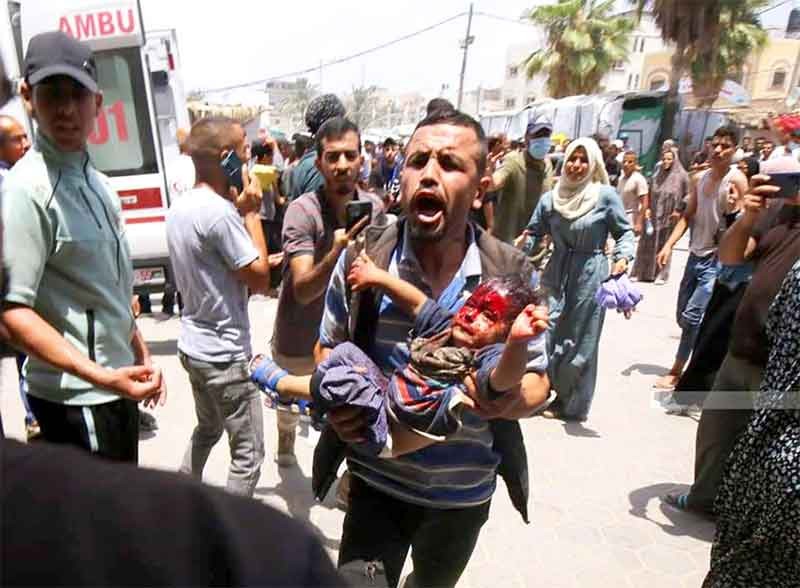
Netanyahu’s talk of finishing Hamas is a farce. Release of hostages could have been done long back through negotiations. Defying all the international appeals the Israeli Defence Forces have attacked Rafah creating havoc in the area. As a result there is unprecedented humanitarian crisis in Gaza. Israel is continuously ignoring international opinion for free transport of humanitarian assistance to the war affected people. The UN has warned several times that there is spread of hunger and diseases. Situation is getting worse in the absence of medical aid as Israel has destroyed most of the hospitals, which is a complete violation of international conventions. All this points to Netanyahu’s bent of mind to annihilate the Palestinians.

Experts warn that 1.7 million people are internally displaced, mostly women and 600,000 children in the Rafah area alone, and they need food assistance, shelter, healthcare, education, water, sanitation and hygiene.

Till now “189 United Nations Relief and Works Agency (UNRWA) staff has been killed by Israel since 7 October 2023—the highest number of UN staff killed in any conflict since the UN’s founding in 1945.” Multiple UNRWA facilities have been targeted, besieged and demolished by the Israeli military, in apparent violation of the principle of the inviolability of UN premises, the experts said (4).

The UN has repeatedly warned that at this existential time for millions of Palestinians in Gaza, who are enduring famine coupled with unfathomable humanitarian conditions, UN operations and facilities must be protected.

It is time for the global community to act and develop broad vision. World has suffered too much when we get carried away and develop hatred towards others on the basis of ethnic or religious identities and even become ruthless towards others forgetting all humanitarian values. We have the examples of death of 800,000 people in Rawanda in tribal violence in a matter of just 100 days. South Asia has seen killings on communal lines several times. World community was unable to save Jews and others from Nazi crimes but the times have changed. We can save the people of Gaza or anywhere else during internal or external strife.

Our inaction can be disastrous. The Military Industrial Complex has its own interests of making profit. But the present day world has its moral duty to stop wars anywhere otherwise this would have serious consequences including use of nuclear weapons. It is duty of all the countries, who are signatories to the UN Human Rights Charter to come forward for restoration of peace in Gaza. Let the peace lovers world over rise to the occasion to save our planet from another catastrophe.

Dr Arun Mitra is a Practicing ENT Surgeon in Ludhiana, Punjab.

3  June 2024

Source: countercurrents.org

Beyond Two State Solution – Why Recognizing State of Palestine is Important

By Dr. Ramzy Baroud

In politics, context is crucial.

To truly appreciate the recent decision by Ireland, Spain and Norway to recognize the state of Palestine, the subject has to be placed in proper context.

On November 15, 1988, Yasser Arafat, then Chairman of the Palestine Liberation Organization, declared Palestine as an independent state.

The proclamation took place within important and unique contexts:

One, the Palestinian uprising of December 1987 which ignited international support and sympathy with the Palestinian people.

Two, growing expectations that the Palestinian leadership needed to match the popular Intifada in the Occupied Territories with a political program so as not to squander the global attention obtained by the uprising.

There were other issues that are also worth a pause, including the growing marginalization of the PLO as the main political front of the Palestinian struggle.

This irrelevance was the natural political outcome of the forced exile of the PLO leadership from Lebanon to Algeria in 1982, which largely severed the connection between this leadership and an influential Palestinian constituency.

Though Arafat’s announcement was made in Algiers, Palestinians in occupied Palestine and across the world rejoiced. They felt that their leadership was, once more, directly involved in their struggle, and that their Intifada, which, by then, had cost them hundreds of precious lives, had finally acquired some kind of political horizon.

The countries that almost immediately recognized the state of Palestine reflected the geopolitical formation at the time: Arab and Muslim countries, which fully and unconditionally recognized the nascent state. Additionally, there were countries in the Global South which expressed their historic solidarity with the Palestinian people.

A third category, which also mattered greatly, was represented by countries in Asia and eastern Europe – including Russia itself – which revolved within the Soviet sphere, posing a direct challenge to American hegemony and Western militarism and expansionism.

Soon after the Algiers Declaration, the geopolitics of the world received its greatest shock since World War II, namely the collapse of the Soviet Union in 1991 and the subsequent fragmentation of pro-Soviet states, thus the isolation of the Global South amid growing Western hegemony.

That, too, had a direct impact on Palestine. Though Arafat and his PLO made their fair share of mistakes and political miscalculations – leading to the Oslo Accords, the formation of the Palestinian Authority and the fragmentation of the Palestinian front itself – the Palestinian leadership’s options, from a strict geopolitical analysis, were quite limited.

Back then, the PLO had one out of two options: either to continue with the struggle for freedom and independence based on the national liberation model or to adopt a purely political approach based on negotiations and supposed ‘painful compromises’.  They opted for the latter, which proved to be a fatal mistake.

Political negotiations can be rewarding when the negotiating parties have leverage. While Israel had the leverage of being the occupying power and receiving unconditional support from the US and its Western allies, the Palestinians had very little.

Therefore, the outcome was as obvious as it was predictable. The PLO was sidelined in favor of a new political entity, the PA, which redefined the concept of political leverage altogether, to essentially mean direct financial benefits to an Israeli-sanctioned ruling class.

Since 1988, more countries recognized the state of Palestine, though that recognition remained largely confined within the geopolitical formations at each phase of history. For example, between 2008 and 2011, more South American countries recognized Palestine, a direct outcome of new and assertive political independence achieved in that part of the world.

In 2012, Palestine was voted by the United Nations General Assembly as a non-member observer state, allowing it to officially use the name ‘State of Palestine’ for all political purposes.

All Palestinian efforts since then have failed to overcome the power paradigm that continues to exist at the UN, separating the UNGA from those with veto power at the Security Council.

The events of October 7, and the genocidal war that followed, have certainly ushered in a massive global movement that challenged the pre-existing geopolitical paradigm regarding Palestine.

If the war, however, had taken place, say ten years ago, the global response to the Palestinian plea for solidarity may have been different. But this is not the case, since the world is itself experiencing a major state of flux. New rising global powers have been boldly challenging, and changing, the world’s status quo geopolitics for years. This includes Russia’s direct confrontation with NATO in Ukraine, China’s rise to global power status, the growing influence of BRICS and the more assertive African and South American political agendas.

For its part, the Gaza war has also challenged the concept of military power as a guarantor of permanent dominance. This is now obvious in the Middle East and also globally.

The latter realization has finally allowed for new, significant margins to appear, allowing Western European countries to finally accept the reality that Palestine deserves to be a state, that the Palestinian aspirations must be honored and that international law must be respected.

Now, the challenge for Palestinians is whether they will be able to utilize this historic moment to the fullest degree. Hopefully, the precious blood spilled in Gaza would prove more sacred than the limited financial gains by a small group of politicians.

Dr. Ramzy Baroud is a journalist, author and the Editor of The Palestine Chronicle.

3  June 2024

Source: countercurrents.org

Why is The Israeli Army in Shock and worry?

By Dr Marwan Asmar

The Israeli army is in a state of shock and worry despite the carnage they meted out on Gaza in the past eight months. Soldiers and officers are fighting with their arsenals but they are not feeling well about the state of the army bogged down in the different areas of the devastated enclave and whose civilians and Palestinian fighters show no signs of submitting to the Israeli bombardment and slaughter.

The slaughter they carried out on Gaza, now standing at 36,000 killed and rising, not to mention the mutilated babies, children bombed to pieces and shown on TV and social media with pictures, may have created a series of “psycholgical” disturbances among Israeli soldiers.

Its being termed as the Israeli gaza genocide. In the killing of civilians, Israeli pilots and those in the control room directing drones to shoot, kill and bomb swaths of housing may be starting to disturb the Israeli psychology and psyche with mental trauma setting in.

Israel soldiers have been turned into rabid heathens in this ugly war, ready to do anything, kill, maim and shoot while they watch with the mind playing up no matter how much you hate your enemy!

And as a result, different manifestations are beginning to show in the army’s rank-and-file. Israeli officers no longer want to serve in the army, voters are confused with many no longer believing in Israeli politics. The soldiers, many of whom experiencing massive injuries, are becoming psychologically disturbed and turning to psychiatry and therapy.

‘No army for me’

Only 42 percent of polled military officers say they intend to continue to serve in the Israeli army once the war on Gaza is over. That effectively means over 60 percent of the soldiers want to quit once this war is over.

This was recently reported by the Israeli daily newspaper Yedioth Ahronoth based on the manpower directorate of the Israeli occupation forces.

[https://twitter.com/Sonmi45118/status/1796652239563505682]

Further, Israeli officers’ requests to take early retirement has doubled in the last eight months of this war that began soon after 7 October 2023. As the ferocity of this war continued, more and more officers have opted out for early retirement.

The 42 percent figure has disturbed and shocked the Israeli military leadership who stand aghast as to what to do about this statistic that plummeted from a similar poll taken in August 2023 which stood at 49 percent.

Many on social media reported the recent poll. One suggested “the officers are haunted by a feeling of failure and they do not want to serve in a failing apparatus.”

[https://twitter.com/KalemiPost/status/1796526240649580546]

This feeling may be because the Israeli ground troops have been fighting in Gaza since 27 October with much manpower and material losses since with soldiers being killed and tanks and armory destroyed.

This is in addition to the thousands of injured including those with permanent disability. Israel’s Channel 12 revealed 20,000 were injured since 7 October. Of these 8,298 have been classified by the Israeli authorities as having permanent disability.  Such figures are being prized out because the Israeli army follows a strict policy of censorship.

Meanwhile, and in another poll conducted by Yedioth Ahronoth and Reichmann University, it showed most Israelis believe, broadly speaking, Hamas has won the war so far. On a political perspective, 37 percent of rightwing Israeli voters believe the Islamist organization has won while 16 percent of Israelis believe Israel is winning. This is while 40 percent of those voters – the middle and left of politics – say Hamas won hands down compared to only 4 percent who believe Israel won in the war in Gaza.

[https://twitter.com/amansouraja/status/1796998389009207512]

The poll was carried out on 810 Israeli voters. Noticable also – and this is despite the fact that America has been the main supplier of weapons in this war – 63 percent of the Israelis polled believe the United States has become less safe to travel to. This may be because of the ongoing student protests across American universities who want the Israeli war on Gaza to stop.

[https://twitter.com/Hyacinthedml/status/1794447591020572846]

Further to that, and in another poll 85 percent of Israeli voters expressed little or no faith in their government. This is a view almost daily articulated in the protests on Israeli streets, in Tel Aviv, Haifa and west Jerusalem which either call on the government to make a deal with Hamas to release the hostages – now down to around 125 – and/or for the government to resign.

[https://twitter.com/bnaenglish/status/1782424781540729285]

Real figures on the number of Israeli soldiers killed in the war on Gaza are carefully messaged by the Israeli army and not at all in keeping with what is happening on the ground. The Israeli army states since the start of the ground operation on 27 October, 293 Israeli soldiers were killed and 3,657 were injured whilst the condition of  568 soldiers is described as critical, 957 moderately injured, and 2,132 with minor injuries.

This is far less than what is happening on the battlefields of Gaza where soldiers are being killed by the day. Military expert Major-General Fayez Al Dwairi said the announcements of Israeli spokesman Daniel Hagari have no relations to what is happening on the ground in Gaza. He added on Al Jazeera the number of Israeli soldiers that killed in Gaza stood last March and based on Hebrew calculations, was already at 16,000.

That figure has continued to increase as the Israeli army stepped up its aggression on Rafah, and now in north Gaza, in places like Jabalia, Biet Lahia, Biet Hanoon and Tal Al Zaatar and Al Zaitoun in Gaza City. More Israeli soldiers are killed daily, with forced acknowledgement by the Israeli army despite messaging the actual figures.

Israeli soldiers have not had it easy in Gaza despite their planes, guns, tanks and machine guns. The psychological impact of the war on individual soldiers have been devastating.

The number of soldiers who are in need of psychological treatment is in the thousands and going up all the time.

Its been reported that in just one case more than 1,890 soldiers were sent to the Natal Israel Trauma and Resiliency Center because of psychological traumas and many of those enlisted are seeking mental health treatment all the time.

But more shocking is the fact that it has been reported that a soldier with severe psychological problems, and who had been fighting in Gaza, went to the Israeli Ministry of Defense and threw a grenade outside its headquarters.

Yedioth Ahronoth stated that since the outbreak of the war more than 6,400 injured soldiers required treatment 21 percent of which reqired psychological therapy. Further to that, since 7 October, 2023 around 30,000 soldiers called up a mental health hotline.

The Gaza war is tough for everyone. Whilst the Palestinian genocide can’t be compared, Israeli soldiers are feeling the heat of death, permanent injury and psychological problems coupled with anguish and contradictions.

Dr Marwan Asmar is based on Amman, Jordan and writes on Middle East Affairs

3  June 2024

Source: countercurrents.org

“We Will Rebuild Again” Palestinians Scream at Israel’s Carnage of Jabalia

By Dr Marwan Asmar

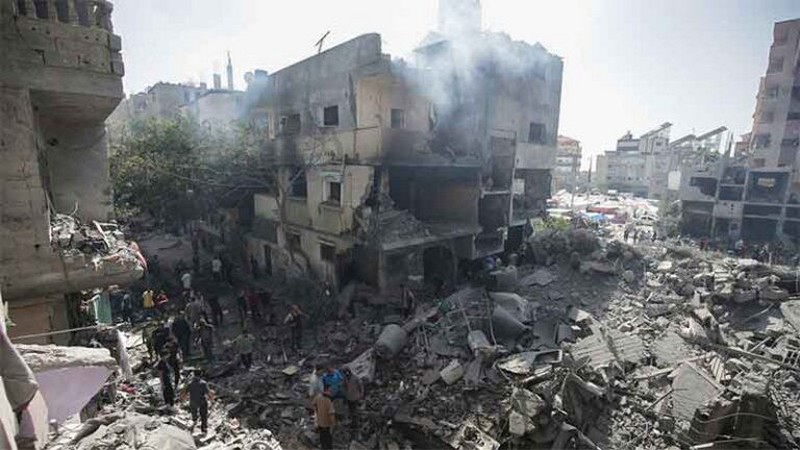
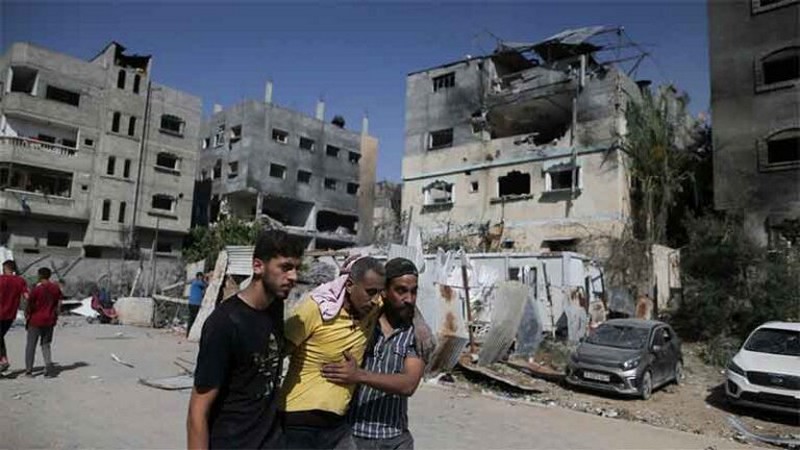
Jabalia is a pile of ruins and destruction, thanks to the Israeli army. Pictures, images and videos show the Jabalia Camp in the north of Gaza has been reduced to a series of gorges and tumbled down buildings, concrete and wreckage.

This is after its mass bombing and missiles that pulverized blocks of flats and residential buildings.

[https://twitter.com/swilkinsonbc/status/1796161980295692600]

One video clip shows people running amidst their destroyed buildings and houses being shot at and bombed by Israeli quadcopters and tanks that thud and boom.

The voices of individuals can be heard shouting telling others to run and take care.

Nowhere to run to

But, here, there is nowhere to run to. It’s naked Israeli aggression. Sounds of Israeli machine gunfire and snipers as people scurry from one place to another are rife.

This is war in its ugliest form waged against ordinary civilians that don’t even have kitchen utensils.

[https://twitter.com/missfalsteenia/status/1719700040946512117]

Al Jazeera journalist Anas Al Sharif is in a state of shock. “I swear to God that I can’t even begin to describe what is happening in the Jabalia camp.

Eyewitnesses told the Turkish news agency Anadolu bodies of Palestinians were recovered from the streets of the Jabalia camp and the Beit Lahia in the northern Gaza Strip after the withdrawal of Israeli forces.

Israeli soldiers started withdrawing, Thursday, to the east of Jabalia after 20 days of total bombardment and destruction as covered by websites on the social media. Homes and infrastructure were blown up into smithereen, the burning of residential buildings torched to the delight of Israelis.

It was supposed to be a pull back from Jabalia camp, the arounding areas, Biet Lahia and Biet Hanoon.

But there was an element of double-dealing. Israeli snipers were heard frequently shooting at civilians who were returning to their destroyed homes as they heard of the atrocious pull out. Men, women, children were moving in between debris trying to identify the houses they once lived in.

In their destroyed state neigborhoods and residential areas looked so different.

[https://twitter.com/SaulStaniforth/status/1796424678350962935]

The scale of destruction in Jabalia is unbelievable in its magnification and ruinous state as documented by another journalist who was in the camp during the three-week onslaught.

Mohammad Shaheen walks through the massive destruction of the camp built after 1948 when thousands of displaced Palestinians were forced to come here after the Israeli state was created.

[https://twitter.com/QudsNen/status/1796432984284807177]

One woman resident said the scale of destruction is mind-boggling. “The Israelis have destroyed us. They are testing their missiles on us,” she told the reporter.

Another resident says the vast destruction is the result of weapons being “tested on us with Jabalia and the rest of the Gaza Strip used as a testing ground for different armoury provided by the Americans.

The Israeli war machine unleashed on Jabalia included people, old, children and women. Of the infrastructure, the Israeli targetted the UNRWA headquarters that housed thousands of displaced persons. In a recent bombing of the al Nazla school outside Jablia 10 people were killed and 17 injured.

But it had been a tough fight for the Israeli army who faced missiles by the Palestinian resistance movement who shot, killed, maimed and injured Israeli soldiers and their tanks and other armoury destroyed.

In this battle, Israeli soldiers were killed and injured almost daily as reported by the the Izz Al Din Al Qassam fighters as well with 120 anti-tank missiles fired at Israel forces in the first few day of the start of the military slaughter of Jabalia.

In the first six days when Israeli soldiers started to enter Jabalia and the areas of northern Gaza that included Biet Lahia, Biet Hanoon and Al Zaitoun in Gaza City, the Israeli army reported it lost 95 soldiers between those killed and injured and with tanks, armed carriers and few bulldozers put out of action. The cost of one bulldozer is earmarked at $1 million.

Not Beaten

Despite the extent of destruction many say Jabalia will not be beaten for this is the home of the Palestinian resistance. It is here, in Jabalia, were the first Intifada in 1987 against Israeli occupation was first struck. The Intifada, a people’s uprising continued for five years until the belaguered 1991 peace conference in Madrid.

After more than eight months of war against Gaza, the number of Palestinians civilians killed stands at over 36,000 with over 81,000 injured.

Vast swathes of Gaza lies in ruin amid a crippling blockade of food, clean water, and medicine with Israeli border guards refusing the entry of aid trucks into the enclave. The north of Gaza has long passed into the famine stage as a result and mass starvation is also creeping into south Gaza because of the Israeli control of the different crossing points in Rafah and elsewhere.

Israel stands accused of genocide at the International Court of Justice, which in its latest ruling ordered it to immediately halt its operation in Rafah, where over a 1.4 million Palestinians sought refuge from the war before it was invaded on May 6.

Major-General Fayez Al Dwairi comments the Israeli army has no morals or ethics because it destroyed everything in its path during its occopation of the camp. He added, it left tens of people dead in the streets of the camp and/or under the wreckage of buildings, destroying what was left of the camp and all the basics of life.

AL Dwairi pointed out the Israelis destroyed all of the UNRWA Schools, bulldozed the roads in the camp and dug up its cemetaries. He said they deserve to be called a bunch of gangs but nevertheless suffered great material and manpower losses and were not able to hold on to the land or stay there, and wherever they go they will suffer the same fate and will be defeated by the Palestinian resistance.

Dr Marwan Asmar is an Amman-based writer on Middle East affairs and currently blogs at https://crossfirearabia.com.

1 June 2024

Source: countercurrents.org


As Israel bombs ambulances and levels refugee camp, Netanyahu receives bipartisan invitation to address US Congress

By Oscar Grenfell

The death toll from the Israeli offensive on Rafah, the southernmost city of Gaza, and attacks throughout the Strip continues to grow with reports in recent days of widespread deaths and injuries to children, aid workers and other civilians.

Signaling their ongoing support for the murderous onslaught, the leaderships of the Democratic and Republican parties issued an effusive open letter to Israeli Prime Minister Benjamin Netanyahu yesterday, hailing him as a leader of a global fight against “terrorism” and inviting him to address the US Congress.

That invitation was made a day after the Palestine Red Crescent Society (PRCS) issued a statement detailing the deliberate killing of two of its paramedics in the Tel Sultan area west of Rafah.

According to the PRCS, on May 29 a convoy of three ambulances was bombed by Israeli war planes. When one of the ambulances caught fire as a result and the paramedics attempted to extinguish the blaze, Israeli soldiers “opened heavy fire towards the teams, forcing them to withdraw from the site before they could retrieve the paramedics’ bodies, which were found in pieces this morning.”

The PRCS noted that with these latest killings, it has now lost 19 paramedics killed by Israel. An estimated 270 aid workers have been murdered throughout the genocide. The PRCS said that it “holds the international community fully responsible for the continued targeting by the Israeli occupation of the PRCS teams, facilities, and ambulances, clearly marked with the Red Crescent emblem, protected under international humanitarian law.”

The two paramedics were among at least 113 Palestinians killed between the afternoons of May 29 and 31, according to Gaza’s health ministry, along with 637 injured. They join the more than 36,000 recorded Palestinian deaths over the past seven months, but with reporting having broken down, estimates place the true death toll at tens of thousands more.

The United Nations and aid agencies are warning that in addition to the direct killings, the offensive against Rafah is creating a massive humanitarian crisis. The assault has displaced an estimated 1 million of Gaza’s 2.1 million people; deliveries of food and other essentials have been restricted, and humanitarian groups have been forced to withdraw.

On Wednesday, the World Health Organization reported that just three of its aid trucks had been able to enter Gaza since the assault on Rafah began, with 60 more stuck at the Egyptian border.

That prompted the World Food Programme to warn that “Constrained access to southern parts of Gaza risks causing the same catastrophic levels of hunger witnessed in the north,” where there have been shocking scenes of death from starvation as hundreds of thousands have been forced to subsist on the equivalent of less than a small can of beans a day.

On Thursday, Médecins Sans Frontières closed its primary care centre in Al Mawasi, the desertous piece of land at the southwestmost point of Gaza, to which Israel is herding hundreds of thousands of people from Rafah. The doctors’ group reported that the centre had treated more than 33,000 people since February and stated that its forced closure marked “another step in Israel’s systematic dismantling of Gaza’s health system.”

Earlier in the week, it had been forced to end operations at a stabilisation centre in Tel Sultan. SOS Children’s Villages, which provides assistance to the displaced with a focus on children, also announced that it was evacuating from Rafah.

Meanwhile, the healthcare system there is on the brink of a complete collapse. The United Nations Office for the Coordination of Humanitarian Affairs (OCHA) reported yesterday that “key health services, such as dialysis, medical imaging, surgery, internal medicine, and maternity and pediatric care, are no longer available, and many of the highly skilled doctors and nurses have been displaced from the city. With Al Emirati Maternity Hospital ceasing operations, all three hospitals in Rafah that were partially functional prior to the Israeli military operation are now out of service.”

While Israel is besieging the people of Rafah, it is also intensifying operations in central and northern Gaza, from which many of them were forced to flee. The clear aim is to render the strip entirely uninhabitable and to complete its ethnic cleansing of Palestinians.

This week Israel ended a siege of the Jabalia refugee camp in northern Gaza that it began on May 11. In those three weeks, the Zionist forces had carried out mass roundups, executions and indiscriminate shootings, killing hundreds.

With the operation over, a Euro-Med Monitor field team that surveyed the damage reported that “not a single residential building was spared from bombing, bulldozing, or burning operations. The complete destruction of the area’s infrastructure was evident, as was the burning of the main market and shops in the streets surrounding it, to the point where walking on the roads of most of the camp’s ‘blocks’ has become impossible due to the rubble and massive destruction.”

The headquarters in the camp of the United Nations Relief and Works Agency for Palestine Refugees in the Near East (UNRWA) had been completely demolished through systematic shelling and arson with petrol, along with six school buildings.

In the final stages of this destruction operation, at least four Palestinian civilians, including a child, were killed by Israeli forces on Tuesday.

The OCHA also reported that in central Gaza, “four Palestinians, including two women, were reportedly killed and 15 injured when a house was hit in Bloc C of An Nuseirat Refugee Camp, in Deir al Balah” on Thursday. Five were killed the day before in Gaza City when a bomb was dropped on a residential house.

In the southern city of Khan Younis, from which many now in Rafah fled, at least 12 civilians, including two children, were killed Wednesday in separate bombings of two residential buildings.

While US and other imperialist leaders have shed cynical crocodile tears over the onslaught against Rafah, they continue to oversee the genocide, which has been facilitated militarily, politically and diplomatically by American imperialism and its allies.

The ongoing line-up was underscored by the joint letter to Netanyahu, signed by the fascistic Republican Speaker of the House Mike Johnson and Republican Senate leader Mitch McConnell, together with Democratic Party Senate Majority leader Charles Schumer and House leader Hakeem Jeffries.

Inviting the Israeli mass murderer to address a special joint session of Congress, the Democratic and Republican leaders gushed: “To build on our enduring relationship and to highlight America’s solidarity with Israel, we invite you to share the Israeli government’s vision for defending democracy, combatting terror, and establishing a just and lasting peace in the region.”

The historical analogy that presents itself would be an invitation to Hitler or Mussolini to explain their “vision for peace.”

The letter linked this endorsement of the genocide with American imperialism’s broader war drive, including its moves to provoke a conflict with Iran in the Middle East and its confrontations with Russia and China. Those three countries were joined together as a threat to “security, peace and prosperity…around the world.”

The letter again makes plain that the US support for Israel is bound up with its broader program of global war, including the intensifying proxy war against Russia in Ukraine and the continuous military build against China, which is viewed as the chief threat to US capitalist dominance. The Israeli “solution” of the “Palestinian problem” is viewed as a means of clearing the decks to enable the Zionist regime and the US to pursue this program more directly in the Middle East, including through a war with Iran.

In addition to backing an Israeli strike on Iran last month, the US is already engaged in war with Iran-aligned forces throughout the region. Yesterday, the Houthis reported that joint US and British strikes on Yemen the day before had killed at least 16 people and wounded 42 others. The Houthi statement claimed that air strikes had hit a building housing Hodeida Radio and civilian homes in the port city on the Red Sea.

US officials confirmed the strikes were carried out by F/A-18 fighter jets that took off from the USS Dwight D. Eisenhower aircraft carrier in the Red Sea, along with other US warships that are stationed in the region from which they can carry out attacks, not only against the oppressed Yemenis but potentially more broadly.

1 June 2024

Source: countercurrents.org

Nuclear Pakistan’s Comprador Cowardice

By Prof. Junaid S. Ahmad

Pakistan’s prime minister, Shahbaz Sharif, declared the 28th of May as a public holiday. Indeed, the House of Sharif, the family in control of one of the two dynastic political parties (the PML-N) of Pakistan, chose to remind the population that this was the day, in 1998, when Pakistan openly launched tests of its nuclear weapons. This was done in response to India’s nuclear test which was undertaken a few weeks before. Though the prime minister of the time, Nawaz Sharif, brother of today’s Shahbaz, wanted to remain in the good books of Washington, Pakistan’s rulers, especially the military top brass, felt it was absolutely essential to respond in kind to New Dehli’s brazenly dangerous act.

Islamabad was willing to face the repercussions of its behavior. Immediately, the US slapped devastating sanctions on the Islamic Republic. Pakistan’s ruling elite employed a nationalist narrative that attempted to affirm the country’s sovereignty. The reality was that – as in the case of most of these imperial sanctions – the only people who would have to endure and survive (or not) such Western economic warfare were the already disenfranchised and exploited, the vast majority of ordinary Pakistanis. Elites in politics and business would continue to enjoy lavish lifestyles. The rulers deployed the rhetorical rigmarole of ‘Pakistanis willing to eat grass’ in order to defend the country’s nuclear program. What this camouflaged and obfuscated was the fact that those already so impoverished were already on the brink of ‘eating grass,’ and that they would be the ones who would continue to do so after American sanctions on the country. The already comfortable would continue to eat their five-course meals – on the backs and blood of the social majorities.

Nevertheless, the hoopla invoked about this day by the current prime minister is just one more attempt to obtain a minimal level of legitimacy in a country that mostly detests this regime installed by Pakistan’s generals. This sentiment is not only found in ousted and jailed former Prime Minister Imran Khan’s political party, the PTI – but also among other vast sections of society, of whatever ideological orientation. The population at large has had enough of the political musical chairs of either the House of Sharif or the House of Bhutto-Zardari – the latter being the family controlling the other major dynastic political party in the country, the Pakistan People’s Party (PPP).

The celebration of the day of the nuclear tests by Sharif and the generals is meant to be a ‘show of strength’ of a country whose rulers are desperate to demonstrate how they can stand up to any power trying to interfere in – and violate – Pakistan’s sovereignty. At least, that’s what they want the country’s people to believe. In reality, such asinine theatrics conceal the colossal cowardice of the country’s military and civilian elite.

The fact that this clownish military-civilian regime prioritizes conveying its military prowess because of its nuclear tests in 1998, is not only absurd, but scandalous and criminal at this juncture. Pakistan has the world’s fifth largest population, and sixth largest military, nuclear armed. It seems that this regime, like others before it, loves to showcase its ostensible military strength via such meaningless gestures. And in this period of Israel’s genocide in Gaza, enacting a public holiday advertising the nation’s armed forces’ capability and gallantry reveals the shameful and tragic embarrassment characterizing the country’s rulers.

There has been a serious and necessary question over the past few months of what concrete actions can countries, particularly those of the Muslim world, undertake to assist in halting Israel’s savage assault on Gaza. The legitimate popular criticism and condemnation of Muslim rulers’ unwillingness to act beyond mere rhetorical flourishes – is palpable throughout the world of Islam.

Putting aside the valid claims of the pre-existing criminality of the Pakistani military top brass, the nation’s – and indeed, the world’s – population is absolutely irate that the enormous size and strength of the nation’s soldiers and officers are not deployed by the generals even as a warning that Islamabad will confront Tel Aviv in some way as long as this genocide continues. How difficult would it be if Pakistan’s armed forces, joined by perhaps others as well, merely announced that the country will be leading a protection force for the suffering people of Gaza? Even the hint of such a force would make Zionist actors think twice before continuing their butchery.

Alas, Pakistan’s generals remain fairly consistent in their worldview: facilitate (as best possible at any given time) imperial hegemony, and be more than willing to position and utilize the country’s troops to murder its own population – carried out abundantly in provinces such as KPK and Balochistan. The military high command had little qualms in submitting to the ‘War on Terror’ and losing tens of thousands of its own soldiers within the country’s own borders.

When one indulges in an even cursory and preliminary conversation with ordinary Pakistanis, it becomes obvious how incensed they are at Israel and Pakistan’s spineless rulers. In fact, the indignation – even among those sections of the population that face repression inside the country – is reaching levels wherein many are speaking of a ‘people’s army’ to intervene to defend the Palestinians from Israeli slaughter.

Until the generals and their civilian pals in the House of Sharif and House of Bhutto-Zardari use the country’s armed forces for something useful, like protecting a besieged population, they will correctly be ridiculed. But even a minimal moral-ethical impulse may be too much to ask the nation’s vicious elites. The country is now seen as a ‘paper tiger’ that has miraculously been able to degrade such a huge country to a joke, a basket case, and a banana republic.

Sadly, to many, the Islamic Republic has become the ‘Imbecilic Republic’…of Pakistan.

Prof. Junaid S. Ahmad teaches religion, law, and global politics and is the Director of the Center for Islam and Decoloniality, Islamabad, Pakistan.

30 May 2024

Source: countercurrents.org

The Untold ICC Story: How the Global South Helped Palestine Challenge Western Institutions

By Dr Ramzy Baroud

Even the most optimistic of political analysts did not expect that the International Criminal Court’s Chief Prosecutor would be uttering these words:

“I have reasonable grounds to believe that Benjamin Netanyahu (…) and Yoav Gallant (…) bear criminal responsibility for (…) war crimes and crimes against humanity …”

Aside from the two Israelis, Karim Khan has included three Palestinians on his application requesting arrest warrants from the ICC’s Pre-Trial Chamber. That is important, but we must remember that, per western thinking, Palestinians have always been the guilty party.

Evidence of the above claim is that the west has long portrayed Israel as a country at war in self-defense. Consequently, Palestinians – though occupied, dispossessed and disinherited – are the aggressors.

This bizarre logic is not strange if seen within the larger power paradigm which has defined the west’s relationship with Palestine and, by extension, the Global South.

For example, out of 54 individuals indicted by the ICC since its inception in 2002, 47 are Africans, a fact that has rightly agitated governments, civil societies and intellectuals throughout the Global South for many years.

On western duplicity, Aimé Césaire, a Martinican intellectual and politician, wrote, “they tolerated (..) Nazism before it was inflicted on them, they absolved it, shut their eyes to it, legitimized it, because, until then, it had been applied only to non-European peoples”.

WWII inspired new thinking on the part of the west. The International Court of Justice (ICJ), the ICC, among others, have been the direct outcome of that terrible western war. It was the west’s way of trying to protect the new status quo which was established by the victors.

The Global South joined in anyway. “Africa had a particular interest in the establishment of the court, since its peoples had been the victims of large-scale violations of human rights over the centuries,” a representative of the Organization of African Unity said in Rome, the birthplace of the Rome Statute, in 1998.

Predictably, however, the ICC turned into a platform where former colonial masters cast judgment on the non-European world. In that sense, justice was hardly served.

As always, Palestine has, and continues to serve as the litmus test of the international order. For over 15 years, Palestinians have been seeking to enlist the ICC’s help to hold Israel accountable for its military occupation and various crimes in Palestine.

The Palestinians have done so simply because any attempt at establishing a practical mechanism to end the Israeli occupation through the United Nations has been met with a cruel American veto.

As the Israeli occupation turned into a permanent one, and racial apartheid spread its tentacles to cover every inch of Palestine, the US’ support of Israel has become a first line of defense against any international criticism, let alone action, aimed at reining in Israel.

Even though the US has refused to join the ICC, it still has great influence over the organization, either through sanctions or pressure imposed by its allies which are members of the Court.

Thus, the ICC procrastinated. Decisions that should have taken only months, took years to be made. The institution, which was created to deliver swift justice, became a bureaucratic legal apparatus that did everything in its power to escape its responsibilities towards the Palestinians.

The persistence of Palestinians and the massive solidarity they have obtained from countries throughout the Global South, eventually paid off.

In 2009, Palestinians filed their first application to join the ICC. Yet, it took over three years for then-Prosecutor Luis Moreno Ocampo to reach his decision, in 2012, denying Palestinians such urgent membership on the account of their legal status as mere observers at the UN.

The rest of the world rallied behind Palestine again and, later that year, the UN General Assembly granted Palestine its ‘non-member observer state’ status.

It took another three years for Palestine to officially join the ICC. Four years later, in 2019, then-Prosecutor Fatou Bensouda stated that the so-called statutory criteria needed to begin an investigation in Palestine were satisfied. But, instead of opening an investigation, Bensouda sent the matter back to the Pre-Trial Chamber for further confirmation.

An official investigation was not opened until March 2021, but was grounded to a halt when Karim Khan replaced Bensouda as the chief prosecutor later that year.

So what happened between March 2021 and May 20, 2024 that allowed the ever-reluctant Khan to go as far as requesting arrest warrants?

First, the Israeli genocide in Gaza, where victims are measured in the tens of thousands.

Second, the credibility of the west-enshrined legal system which has governed the world since WWII, was at stake. This explains the emphasis made by Khan in his May 20 statement: “If we do not demonstrate our willingness to apply the law equally (…) we will be creating the conditions for its collapse.”

Third, the solidarity of the Global South, which has served as the backbone of all Palestinian efforts at international legal institutions.

After decades of a one-sided approach to global conflicts, the pendulum is finally shifting. Indeed, when we say that Gaza is changing the world, we mean it.

Dr. Ramzy Baroud is a journalist, author and the Editor of The Palestine Chronicle.

30 May 2024

Source: countercurrents.org