Just International

The Media Skew Public Perception by Manipulating People’s Attention

By Caitlin Johnstone

Our perception of the world is dominated by the movements of our attention, which means that our perception of the world can be changed by manipulating those movements.

9 Jun 2024 – “Israel Rescues 4 Hostages in Military Operation; Gazan Officials Say Scores Are Killed,” reads a New York Times headline from yesterday.

It’s a very odd-looking headline even if you don’t know anything about the propagandistic tactics being employed in it. The first half is very clear, while the second half is unintelligible and reads like some weird kind of riddle or word puzzle.

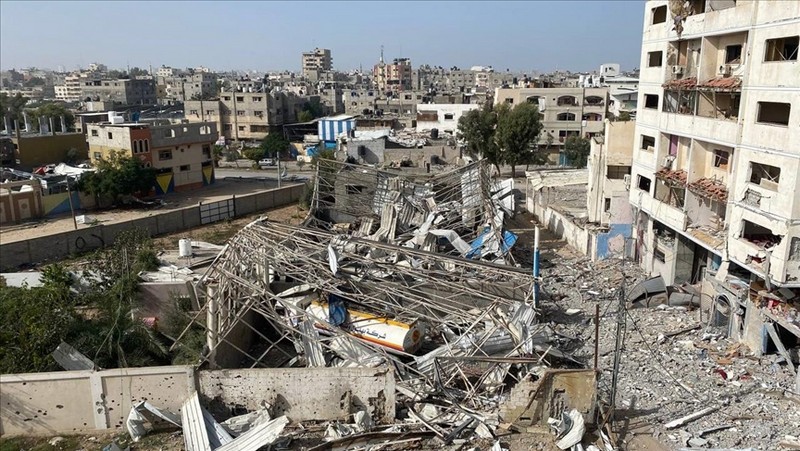
The New York Times is performing these bizarre, cryptic linguistic gymnastics to discuss the latest Israeli massacre in Gaza which as of this writing has a reported death toll of 236.

Right off the bat we can see something weird in this headline with the use of the word “scores” to describe the number of people reported killed in the massacre. The New York Times article itself says it was reported that “more than 200 people were killed in central Gaza,” so the correct quantifier for the headline would be “hundreds”, not “scores”. This would be like a headline saying “dozens” of people were killed on 9/11 instead of “thousands”; it would technically be correct since the number of people killed were mathematically speaking many many dozens, but it would give readers the wrong impression of the lethality of the incident.

[https://twitter.com/TameeOliveFern/status/1799525189828649351]

Next, notice the sudden switch mid-headline from active, certain voice to passive, doubtful voice. Four Israeli hostages were definitely rescued by Israel, while Gazan officials are alleging that scores were killed.

Scores of what? Cats? Chickens? Israelis?

Killed by what? Salmonella poisoning? Traffic accidents? Congolese militias?

There’s no way to tell from the headline.

The mass media in general and The New York Times in particular are notorious for their passive language “Palestinian child ceases breathing after encountering bullet” headlines when promoting Israeli information interests, but it really drives the point home when you see it switch from normal human language to something that sounds like a clue The Riddler would leave Batman within the very same headline.

And what’s interesting is that nothing The New York Times editors did here is technically a lie. Every word they meticulously selected for their headline is technically true, but it is shaped in such a way that it draws the reader’s attention away from the fact that Israel just massacred hundreds of human beings.

They could have just as easily written “Israel Kills Hundreds of Palestinians in Central Gaza Attack; 4 Hostages Rescued” and it would have been just as true, but then public attention would have been drawn in the opposite direction. The New York Times never, ever draws public attention in that direction; the slanting only ever goes one way.

[https://twitter.com/ryangrim/status/1798799983447048303]

We saw something similar the other day from The New York Times when they reported that Israel has been torturing Palestinian prisoners by sodomizing them with hot metal rods — sometimes to death — but buried this information at the very bottom of the article, without mentioning a word of it in the headline or sub-headline.

Here again, nobody can technically accuse The New York Times of lying; they didn’t report anything that wasn’t true or fail to report anything that was true. They just drastically underemphasized the real story in their report to direct their readers’ attention away from Israeli criminality.

A lot of people who grow skeptical of the mass media correctly assume that these outlets are propaganda services for the US empire, but incorrectly assume that this means they must be lying all the time. In truth the imperial propaganda machine is much more sophisticated than this, and much more effective.

Rather than making up whole-cloth lies and losing all credibility in the mainstream public, the mass media will generally rely on distortions like the above which skew public perception without actually technically lying. They’ll place emphasis in areas which benefit the empire, they’ll omit inconvenient facts, they’ll use tricky phrasing, they’ll uncritically report on the claims of favored government officials while saying the claims of unfavored government officials are made without evidence, they’ll mention convenient news stories over and over again, and they’ll report inconvenient stories only once before leaving them to get lost in the daily news churn.

I actually cite the mass media quite a bit in my own work, because a lot of useful and truthful information about the criminality of the western empire comes out through outlets like The New York Times. It’s just that that information is deemphasized and quickly shuffled out of public attention by the propagandists who run those outlets, allowing them to technically tell the truth while still manipulating the overarching narrative about what’s going on in the world.

[https://twitter.com/AssalRad/status/1798757428764561889]

The propagandists who edit outlets like The New York Times are able to skew public perception in favor of the empire because they understand that human experience is dominated by the movements of attention, so if they can manipulate those movements of attention, they can manipulate how people perceive the world.

I once met someone who described attention as “the uncrowned king of consciousness,” and I recall those words often because of their accuracy. Attention is the uncrowned king of consciousness because its movements dictate how we will experience our world: what we will think about, notice, see, hear, or otherwise perceive, but we don’t tend to place much importance on it or recognize the extent to which our life is ruled by it.

In reality there is little that is more crucial to our experience of life than the movements of our attention. It’s something so fundamental that two people walking across the exact same meadow at the exact same time will never have the same experience of it. One might experience a meadow with a pleasant breeze, a chirping bird in a tree, a grasshopper zipping across their path, and a sky of phenomenal beauty, while the other might experience the meadow as a distant and barely-noticed backdrop to their mental concerns for their future, their grievances about the past, their imaginary arguments with a family member, and a catchy song they’ve got stuck in their head.

After someone dies people often talk about the things they did in life — their accomplishments, their legacy, how many children they raised, what they did for work — but really the kind of life someone lived has less to do with the things they did than the way their attention moved. The movements of their attention throughout their life really was their life, because it determined what their experience of their time on this world actually was. How present they were for it. How much beauty they experienced. How much mental energy they wasted on imaginary bullshit. What they noticed. What they missed.

[https://twitter.com/TheOnion/status/1721644886619836479]

Our perception of the world is dominated by the movements of our attention, which means that our perception of the world can be changed by manipulating those movements. Propagandists understand this, so they spend their time doing things like telling us over and over again what a bad bad baddie Vladimir Putin is while just occasionally giving a single highly mitigated mention to an individual instance of Israeli criminality, or talking about October 7 over and over again while greatly deemphasizing the massacres Israel has been perpetrating on the Palestinians in Gaza every day since.

This causes public attention to move in directions that benefit the information interests of the empire and away from directions that would harm those information interests, all without having to tell actual lies. People’s perception of the world is shaped by these skillful propagandists without their even being aware that it is happening.

That’s what makes the propaganda of the western empire so much more effective than any other propaganda that has ever existed anywhere else: the inhabitants of the western empire have no idea they’re being propagandized.

Caitlin Johnstone is a rogue journalist, poet, and utopia prepper.

10 June 2024

Source: transcend.org

End of an Era: What the Shifting Discourse on Palestine Teaches Us about the Future of Israel

By Ramzy Baroud

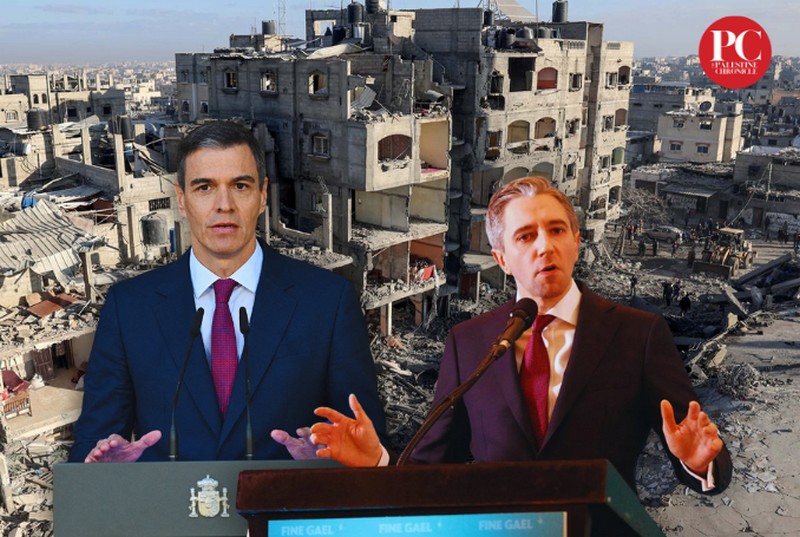
5 Jun 2024 – If one were to argue that a top Spanish government official would someday declare that “from the river to the sea, Palestine would be free”, the suggestion itself would have seemed ludicrous.

But this is precisely how Yolanda Diaz, Spain’s Deputy Prime Minister, concluded a statement on May 23, a few days before Spain officially recognized Palestine as a state.

The Spanish recognition of Palestine, along with the Norwegian and Irish recognition, is most important.

Western Europe is finally catching up with the rest of the world regarding the significance of a strong international position in support of the Palestinian people and in rejection of Israel’s genocidal practices in occupied Palestine.

But equally important is the changing political discourse regarding both Palestine and Israel in Europe and all over the world.

Almost immediately after the start of the Israeli war on Gaza, some European countries imposed restrictions on pro-Palestinian protests, some even banning the Palestinian flag, which was perceived, through some twisted logic, as an antisemitic symbol.

With time, the unprecedented solidarity with Israel at the start of the war, however, turned into an outright political, legal and moral liability to the pro-Israel western governments.

Thus, a slow shift began, leading to a near-complete transformation in the position of some governments, and a partial though clear shift of the political discourse among others.

The early ban on pro-Palestinian protests was impossible to maintain in the face of millions of angry European citizens who called on their governments to end their blind support for Tel Aviv.

On May 30, the mere fact that French private broadcaster TF1 hosted Israeli Prime Minister Benjamin Netanyahu led to large, though spontaneous, protests by French citizens, who called on their media to deny accused war criminals the chance to address the public.

Failing to push back against the pro-Palestine narrative, the French government has, on May 31, decided to disinvite Israeli military firms from participating in one of the world’s largest military expos, Eurosatory, scheduled for June 17-21.

Even countries like Canada and Germany, which supported the Israeli genocide against Palestinians until later stages of the mass killings, began changing their language as well.

The change of language is also happening in Israel itself and among pro-Israeli intellectuals and journalists in mainstream media. In a widely read column, New York Times writer Thomas Friedman attacked Netanyahu late last March, accusing him of being the “worst leader in Jewish history, not just in Israeli history”.

Unpacking Friedman’s statement requires another column, for such language continues to feed on the persisting illusion, at least in the mind of Friedman, that Israel serves as a representation, not of its own citizens, but of Jewish people, past and present.

As for the language in Israel, it is coalescing into two major and competing discourses: one irrationally ruthless, represented by far-right Ministers Itamar Ben-Gvir and Bezalel Smotrich, in fact, by Netanyahu himself; and another, though equally militant and anti-Palestinian, which is more pragmatic.

While the first group would like to see Palestinians slaughtered in large numbers or wiped out through a nuclear bomb, the other realizes that a military option, at least for now, is no longer viable.

“The Israeli army does not have the ability to win this war against Hamas, and certainly not against Hezbollah,” Israeli Army Reserve Major General Yitzhak Brik said in an interview with the Israeli newspaper Maariv on May 30.

Brik, one of Israel’s most respected military men, is but one of many such individuals who are now essentially repeating the same wisdom.

Strangely, when Israel’s Minister of Heritage Amihai Eliyahu suggested the “option” of dropping a nuclear bomb on the Strip, his words reeked of desperation, not confidence.

Prior to the war, the Israeli political discourse regarding Gaza revolved around a specific set of terminology: ‘deterrence’, represented in the occasional one-sided war, often referred to as ‘mowing the lawn’ and ‘security’, among others.

Billions of dollars have been generated throughout the years by war profiteers in Israel, the US and other European countries, all in the name of keeping Gaza besieged and subdued.

Now, this language has been relegated in favor of a grand discourse concerned with existential wars, the future of the Jewish people, and the possible end of Israel if not Zionism itself.

While it is true that Netanyahu fears an end to the war will be a terrible conclusion to his supposedly triumphant legacy as the ‘protector’ of Israel, there is more to the story.

If the war ends without Israel restoring its so-called deterrence and security, it will be forced to contend with the fact that the Palestinian people cannot be relegated and that their rights cannot be overlooked. For Israel, such a realization would be an end to its settler-colonial project, which began nearly a hundred years ago.

Additionally, the perception and language pertaining to Palestine and Israel are changing among ordinary people across the world. The misconception of the Palestinian ‘terrorist’ is being quickly replaced by the true depiction of the Israeli war criminal, a categorization that is now consistent with the views of the world’s largest international legal institutions.

Israel now stands in near-complete isolation, due, in part, to its genocide in Gaza but also to the courage and steadfastness of the Palestinian people, and to the global solidarity with the Palestinian cause.

Dr. Ramzy Baroud is a journalist, author and editor of The Palestine Chronicle.

10 June 2024

Source: transcend.org

Baby Ahmad Was Beheaded by Israel with a US Bomb

By Seraj Assi

On Sunday night, May 26 2024, 1-year-old Ahmad became the symbol of the unspeakable horror of genocide in Gaza after Israel bombed his family tent in north Rafah.

6 Jun 2024 – Ahmad Al-Najjar was a happy one-year old child from Gaza. He loved trampolines, balls, and cats. Born as the youngest of his four siblings, his father liked to call him “bobba” or “baby.”

On Sunday night, May 26, Ahmad became the symbol of the unspeakable horror of genocide in Gaza after Israel bombed his family tent in north Rafah, killing him along with his mother, Faten, his sister, Houda, and his brother, Arkan. Though he was bombed beyond recognition, Ahmad was the most recognizable victim of the tents massacre in Rafah, which burned alive, beheaded, and killed at least 45 Palestinians, most of them women and children, and wounded hundreds others.

Rafah’s tents massacre was one of the most heinous assaults on Palestinian civilians in recent memory. International media and Palestinian sources reported that Israel blitzed the camp where displaced Palestinians were sheltering in tents with seven massive U.S. bombs weighing 2,000 pounds each. Meanwhile, weapons experts toldCNN and The New York Times that they identified the remains of Boeing-made GBU-39s in the rubble.

The bombarded refugee tents had been designated by Israel as a “safe area” for civilians. Rafah was described by UNICEF officials as “a city of children, who have nowhere safe to go in Gaza.” It was believed to be Gaza’s last refuge, and the limit of the Biden administration’s “red line” in Gaza. This grim reality, however, did not prevent the Biden administration from shipping thousands of bombs and weapons to Israel, despite Israel’s repeated threats to invade Rafah. As Israeli forces were pounding Rafah’s refugee camps, U.S. presidential candidate Nikki Haley was in Israel signing “finish them” on the very U.S. bombs that were used to slaughter children in Gaza.

It is the children of Gaza who are forced to live the most unspeakable horrors while being denied the same outrage that Israel’s invented horrors have generated among U.S. and Western politicians

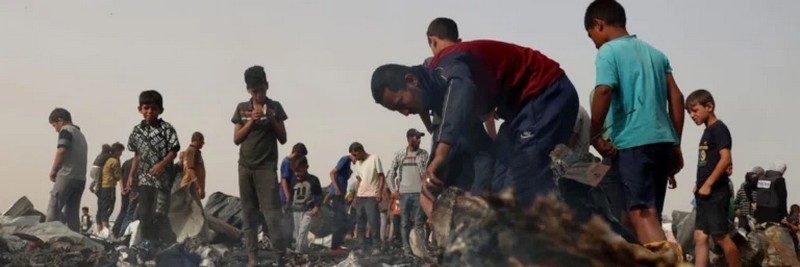
Widely circulated footage from the massacre showed a night of unspeakable horror: bodies burned to ashes, charred and blackened beyond recognition; beheaded children, decapitated and ripped apart by U.S. bombs; parents clutching their dead and burned children, screaming in horror; rescuers pulling people’s charred remains from the burning tents; wounded victims transferred to the hospital with horrific and gruesome injuries.

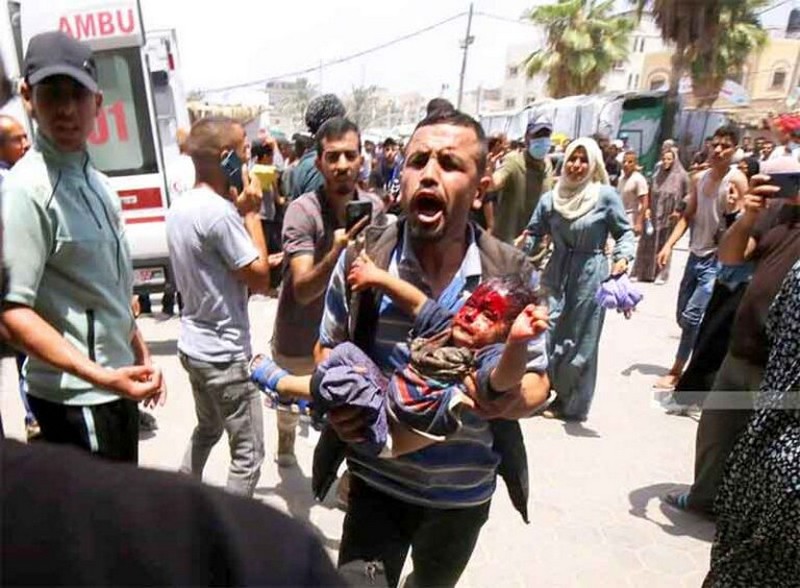
But the most horrifying footage from that night showed a man holding up what appeared to be the body of a small child who had been beheaded. It belonged to Baby Ahmad, who was wearing black pants and an orange shirt that night. His left leg was also severed in the blast. The family never found Ahmad’s head, and they buried him without it. He was put in the same body bag with his sister Houda. His mother and brother Arkan were buried in separate body bags.

His surviving brothers, Muhammad and Yamin, both saw the ravaged body of their little brother that night. In an interview with Al Jazeera, Ahmad’s father, Abdel Hafez, and two brothers, the only survivors of the family, speak up about the unspeakable horror they had to endure that night.

“I did not believed he was beheaded in the bombing until I saw it with my own eyes at the Tal As-Sultan clinic,” says Abdel Hafez. “His head was separated from his body.”

“It was horrific, very horrific, seeing a beheaded baby, my baby. He was buried without a head,” says the father. “I have been in a state of utter collapse, until this moment.”

The brothers look visibly traumatized. They can hardly invoke the sight of their little brother without trembling and bursting into tears. The family was staying at one of UNRWA’s shelters when Israeli forces pounded the camp. They had been displaced several times before they finally reached Rafah, where they settled in the Tal As-Sultan neighborhood after being forced to flee Khan Younis.

Battling his tears, brother Mohammad, aged 13, relates: “We were playing ball, before sunset. I came back to the shelters. They (Israelis) bombed the shelters, and I heard screams. Then I saw my brother Ahmad at the shelter’s door. His head was severed. His left leg was severed. He was wearing black pants and an orange shirt. I could not bear it, seeing my brother beheaded.”

Speaking through tears, Ahmad’s other brother, Yamin, aged eight, relates his first sight of Ahmad following the Israeli airstrike: “His face was soaked in blood, and his head severed. I wept. I love them so much.”

Standing by the graves of his family, and sharing photos of his slain children in their better and happier days, Ahmad’s father shares his fondest and last memory of his son: his nicknames, “bobba” and “baby,” and his baby word for “give me potato,” which is “baba tata,” and the way he pronounced shekel, the Israeli currency. “The last thing he asked for was a shekel, using his baby word for it: ‘tetel.’ I gave him the shekel, and he hugged me, and then left to buy something with it.”

“He loved playing with cats,” Muhammad recalls, bursting into bitter tears. “When I see his things, the trampoline and ball, and the things he played with, I feel sad and I miss him. I miss them all. I pray for them. I pray that God will have mercy on them, and grant them Heaven.”

Ahmad was one of 15,000 Gazan children murdered by Israel since October 7, a toll that would have been unimaginable without the bottomless supply of U.S. bombs. A new report by Euro-Med Human Rights Monitor shows that Israel dropped over 70,000 tons of U.S. bombs on Gaza in 200 days, which surpasses that of WWII and the bombings in Dresden, Hamburg, and London combined. It’s also 20 times more than the U.S. dropped on Iraq in six years of war.

Israel launched its genocidal war on Gaza by inventing its most outrageous lie, that Hamas fighters beheaded 40 Israeli babies on October 7. Despite being widely debunked, the lie has been repeatedly invoked by Israeli leaders to justify their genocide in Gaza. It has also served as a way to justify U.S. complicity in Israel’s war crimes in Gaza, with top U.S. officials, including Joe Biden, along with the mainstream media, echoing it recklessly.

Meanwhile, it is the children of Gaza who are forced to live the most unspeakable horrors while being denied the same outrage that Israel’s invented horrors have generated among U.S. and Western politicians. To cite Ahmad’s father: “They accuse us of beheading babies. But whose head was decapitated? My son, my one-and-a-half year old baby! They severed it completely.”

Seraj Assi is a Palestinian writer living in Washington D.C.

10 June 2024

Source: transcend.org

The Perils and Promise of the Emerging Multipolar World

By Jeffrey D. Sachs

The world economy is experiencing a deep process of economic convergence, according to which regions that once lagged the West in industrialization are now making up for lost time.

6 Jun 2024 – The World Bank’s release on May 30 of its latest estimates of national output (up to the year 2022) offers an occasion to reflect on the new geopolitics. The new data underscore the shift from a U.S.-led world economy to a multipolar world economy, a reality that U.S. strategists have so far failed to recognize, accept, or admit.

The World Bank figures make clear that the economic dominance of the West is over. In 1994, the G7 countries (Canada, France, Germany, Italy, Japan, U.K., U.S.) constituted 45.3% of world output, compared with 18.9% of world output in the BRICS countries (Brazil, China, Egypt, Ethiopia, India, Iran, Russia, South Africa, United Arab Emirates). The tables have turned. The BRICS now produce 35.2% of world output, while the G7 countries produce 29.3%.

As of 2022, the largest five economies in descending order are China, the U.S., India, Russia, and Japan. China’s GDP is around 25% larger than the U.S.’ (roughly 30% of the U.S. GDP per person but with 4.2 times the population). Three of the top five countries are in the BRICS, while two are in the G7. In 1994, the largest five were the U.S., Japan, China, Germany, and India, with three in the G7 and two in the BRICS.

As the shares of world output change, so too does global power. The core U.S.-led alliance, which includes the U.S., Canada, U.K., European Union, Japan, Korea, Australia, and New Zealand, was 56% of world output in 1994, but now is only 39.5%. As a result, the U.S. global influence is waning. As a recent vivid example, when the U.S.-led group introduced economic sanctions on Russia in 2022, very few countries outside the core alliance joined. As a result, Russia had little trouble shifting its trade to countries outside the U.S.-led alliance.

The world economy is experiencing a deep process of economic convergence, according to which regions that once lagged the West in industrialization in the 19th and 20th centuries are now making up for lost time. Economic convergence actually began in the 1950s as European imperial rule in Africa and Asia came to an end. It has proceeded in waves, starting first in East Asia, then roughly 20 years later India, and for the coming 20-40 years in Africa.

These and some other regions are growing much faster than the Western economies since they have more “headroom” to boost GDP by rapidly raising education levels, boosting workers’ skills, and installing modern infrastructure, including universal access to electrification and digital platforms. The emerging economies are often able to leapfrog the richer countries with state-of-the-art infrastructure (e.g., fast intercity rail, 5G, modern airports and seaports) while the richer countries remain stuck with aging infrastructure and expensive retrofits. The IMF’s World Economic Outlook projects that the emerging and developing economies will average growth of around 4% per year in the coming five years, while the high-income countries will average less than 2% per year.

It’s not only in skills and infrastructure that convergence is occurring. Many of the emerging economies, including China, Russia, Iran, and others, are advancing rapidly in technological innovations as well, in both civilian and military technologies.

China clearly has a large lead in the manufacturing of cutting-edge technologies needed for the global energy transition, including batteries, electric vehicles, 5G, photovoltaics, wind turbines, fourth generation nuclear power, and others. China’s rapid advances in space technology, biotechnology, nanotechnology, and other technologies is similarly impressive. In response, the U.S. has made the absurd claim that China has an “overcapacity” in these cutting-edge technologies, while the obvious truth is that the U.S. has a significant under-capacity in many sectors. China’s capacity for innovation and low-cost production is underpinned by enormous R&D spending and its vast and growing labor force of scientists and engineers.

Despite the new global economic realities, the U.S. security state still pursues a grand strategy of “primacy,” that is, the aspiration of the U.S. to be the dominant economic, financial, technological, and military power in every region of the world. The U.S. is still trying to maintain primacy in Europe by surrounding Russia in the Black Sea region with NATO forces, yet Russia has resisted this militarily in both Georgia and Ukraine. The U.S. is still trying to maintain primacy in Asia by surrounding China in the South China Sea, a folly that can lead the U.S. into a disastrous war over Taiwan. The U.S. is also losing its standing in the Middle East by resisting the united call of the Arab world for recognition of Palestine as the 194th United Nations member state.

Yet primacy is certainly not possible today, and was hubristic even 30 years ago when U.S. relative power was much greater. Today, the U.S. share of world output stands at 14.8%, compared with 18.5% for China, and the U.S. share of world population is a mere 4.1%, compared with 17.8% for China.

The trend toward broad global economic convergence means that U.S. hegemony will not be replaced by Chinese hegemony. Indeed, China’s share of world output is likely to peak at around 20% during the coming decade and thereafter to decline as China’s population declines. Other parts of the world, notably including India and Africa, are likely to show a large rise in their respective shares of global output, and with that, in their geopolitical weight as well.

We are therefore entering a post-hegemonic, multipolar world. It too is fraught with challenges. It could usher in a new “tragedy of great power politics,” in which several nuclear powers compete—in vain—for hegemony. It could lead to a breakdown of fragile global rules, such as open trade under the World Trade Organization. Or, it could lead to a world in which the great powers exercise mutual tolerance, restraint, and even cooperation, in accord with the U.N. Charter, because they recognize that only such statecraft will keep the world safe in the nuclear age.

Jeffrey D. Sachs, Professor of Sustainable Development and Professor of Health Policy and Management at Columbia University, is Director of Columbia’s Center for Sustainable Development and the UN Sustainable Development Solutions Network.

10 June 2024

Source: transcend.org

Nusseirat Massacre: The Story of a Palestinian Massacre Disguised as Israeli Rescue

By Dr Marwan Asmar

It’s a criminal act under the eyes of the world. Israel’s Nusseirat massacre with the active cooperation of American help is grotesque by any standard for the 250 Israeli strikes made on the camp during this flagrant military operation.

The number of innocent Palestinians killed kept climbing up on the day of the massacre, Saturday, with the final death toll reaching 274 martyrs. These included 64 children, 57 women and 37 elderly people. Shameful is the fact, the massacre was carried out by Israeli soldiers, Shabak agents and members of the police who had been planning this for weeks.

BREAKING: NUMBER OF DEAD HAS RISEN TO 274 PALESTINIANS, INC 64 CHILDREN, AND 57 WOMEN

The Israeli army used two civilian cars under the guise of aid to carry out Nusseirat massacre.

Israeli soldiers involved in Nusseirat massacre disguised themselves as displaced persons.

The… pic.twitter.com/GN6ZuIsCwM

— Sulaiman Ahmed (@ShaykhSulaiman) June 9, 2024

The number of injuries was equally horrific as 698 people were injured during this killing spree that was backed from the air, sea and with ground tanks helping the infiltrators who went into the camp camouflaged in an aid truck and a car with Israeli tanks behind. Among the injured were 153 children, 161 women 54 elderly people according to the Gaza Government Media Office.

🚨BREAKING: Dozens of casualties arrive nonstop at Al-Aqsa Martyrs Hospital in Deir el-Balah following the Israeli massacre in neighboring Nusseirat refugee camp central #Gaza Strip pic.twitter.com/kUgXdSymUI

— Nour Naim| نُور (@NourNaim88) June 8, 2024

The shooting begun after the disguised aid lorry and a vehicle stopped in the middle of the housing area just outside the central market and begun the bloody mayhem. The lorry was at first thought to carry displaced people with their belongings but soon got out their machine guns and started shooting.  According to the Media Office soldiers were disguised in civilian clothing in ambulances with medical and health signals.

Hostages

The massacre was all made to rescue four Israeli hostages taken by Hamas on 7 October when they pushed through the barrier fence that blocked Gaza from the so-called Israeli territories. The four hostages, three men and a woman, were part of the 250 Israelis and foreigners that were taken back to Gaza by members of the Islamic organization on the fateful month and day.

Their rescue was seen as a major victory by Israel after 245 days of war destroying the Gaza Strip and killing its civilian population, earmarked at over 36,000 dead. The Israeli media was jubilant, ignoring the fact the operation was nearly botched with a major fight in getting to the four captives resulting in at least one Israeli soldier and at least three other captives getting killed, one of them an American citizen, though massive Israeli gunfire.

[https://twitter.com/Gaza_Psych/status/1799386305371201937]

This fact is not yet receiving much attention in the media because it is given by a credible source from Hamas but it has become known the Nusseirat “rescue” operation was a heinous, diabolical affair for the Israeli occupation army bombed 89 houses and residential buildings inhabited by residents in the early hours of committing this massacre.

Eye witness reports say many of the houses were bombed over the heads of their residents without prior warning. Residents were shocked at the sudden bombs and missiles stuck from the air. These were made simultaneously to distract civilians from the underground operation to get to the four hostages reportedly held in different building and flats.

[https://twitter.com/MaxBlumenthal/status/1799682414803141106]

Women, children, men and old people, passerby were all in the line of fire for this was a busy area in between houses and the central market in West Nusseirat.

It is being described as another area genocide with a great impact on central Gaza and executed with dozens of warplanes, quadcopters, helicopters and drones with espionage and intelligence purposes, and tanks in more than four axes and directions, the Gaza Media office stated.

At the time of writing the Government Media office said it is yet to confirm which soldiers from different countries were used in the mass attacks on the camp but there is already confirmation that thousands of American soldiers have been stationed in Israel shortly after 7 October and are providing technical and logistical advice to the Israeli army.

[https://twitter.com/BeckettUnite/status/1799366129028387094]

Disturbing however, and as reported is the fact that the aid truck that was used to enter the Nusseirat camp was from the recently constructed American pier where US officials previously said they made this construct to make it easier to bring food to the starving Gazans imposed by Israel.

Social media commentators couldn’t but help make the comparison of the treatment between the Israeli hostages and those “limp” Palestinians coming out of Israeli prisons, spotlighting Noa Argamani with her father in a happy state.

One blogger commented on how Noa was treate and how Israelis treat Palestinians in their  prisons. The latter are old and haggard because they are denied basic things, are beaten, tortured and denied food.

Dr Marwan Asmar is a writer based in Amman covering Middle East affairs

10 June 2024

Source: countercurrents.org

Unabated efforts: Cambodia continues push to help resolve Myanmar conflict

As the conflict in Myanmar continues to escalate at an alarming rate, the Foreign Affairs Ministry says Cambodia is committed to pushing for the implementation of ASEAN’s 5-point Consensus and the ability to hold talks with ousted civilian leader Aung San Suu Kyi.

Kung Phoak, secretary of state for the Ministry of Foreign Affairs and International Cooperation, said yesterday in a press conference that the government expects Myanmar Junta leader Senior General Min Aung Hlaing to examine the possibility of allowing Cambodia’s top leaders to meet with Suu Kyi.

Phoak said that the request for dialogue was made because Cambodia believes it is important to contribute to the dialogue in order to settle Myanmar’s current predicament and that the country should adhere to the 5PC.

The five point consensus include an immediate end to violence in the country, dialogue among all parties and humanitarian assistance by ASEAN.

“I hope Myanmar will consider this and respond positively because this request is for the benefit of Myanmar,” he said. “In 2021 before becoming ASEAN chair, when the political crisis erupted, we actively participated, and during the chairmanship of ASEAN, despite criticism and opposition, we still actively involved in finding a solution to the political crisis.”

He said that Cambodia tried to do everything possible to contribute to settlement in Myanmar and engaged in activities to encourage stakeholders to participate in negotiations.

“Even after completing its ASEAN chairmanship, Cambodia still plays an important role in finding a solution in Myanmar, participate in finding a solution, seeing that all stakeholders play a necessary role in helping Myanmar avoid the tragedy that Cambodia has experienced in the past,” Phoak said.

Phoak said that current ASEAN Chair Laos, 2022 ASEAN chair, Cambodia and next Malaysian chair will have a meeting in July in a bid to resolve the Myanmar crisis.

“All relevant parties will have ASEAN troika meeting in Ventiane to attach with foreign affairs ministers’ meeting and related meetings at the end of July,” Phoak said, noting that the initiative was raised by Senate President Hun Sen when he held a video meeting with Sen Gen Min Aung Hlaing, the chairman of the State Administration Council (SAC), on May 7.

He said that engaging in the search for a solution in Myanmar is a question of family loyalty, and so that Myanmar could achieve unity, peace, stability, and development, as well as the interests of Myanmar and ASEAN as a whole.

He added that at the request of Mr Hun Sen, progress will be made, and all actions will benefit stakeholders, including ASEAN.

Mr Hun Sen also raised the Myanmar issue yesterday while meeting with Igor Driesmans, EU Ambassador to Cambodia at the Senate.

Mr Hun Sen and Driesmans expressed concern about the more complicated situation, particularly in the socioeconomic field, noting that a negotiated solution is required to end the stalemate in Myanmar, according to Mr Hun Sen’s minutes.

“Samdech Techo is determined not to give up on helping Myanmar in its quest for peace, with patience as the situation in Myanmar remains difficult and complicated,” a Senate statement said.

During the May 7 video call with Sen Gen Min Aung Hlaing, Mr Hun Sen requested the junta leader to consider arranging a video meeting between him and detained former state counsellor Suu Kyi.

He explained that the purpose of the video meeting is to inquire about the well-being of the National League for Democracy (NLD) leader, stating that Suu Kyi was a former colleague with whom he had worked in ASEAN affairs for many years.

The junta is facing challenges since the coup, with a youth-led pro-democracy uprising morphing into an armed resistance movement and also engaging in fighting along with some ethnic minority armies in the northern and eastern regions of the country. There have been reports of the resisting forces gaining ground.

Maung Zarni, a UK-exiled Myanmar human rights activist known for his strong opposition to the violence in Rakhine State and the Rohingya refugee crisis, said in a recent interview that Cambodia should take a leading role within ASEAN, in collaboration with the two more powerful Asian nations, to bring real peace and ceasefire to that war-torn country, an initiative he refers to as the “Phnom Penh Peace Process.”

Zarni suggested that Cambodia take a leading role in what he called “the Phnom Penh Peace Process” to bring peace to his country and people while the Asian powers, including China, India, and other ASEAN countries provide their support and assistance to the process, starting with the overall recognition that Myanmar is not able to build peace itself.

“Maybe we can have the Phnom Penh Peace Process and the Phnom Penh Peace Conference, where everybody would be brought in,” he said. “The key is that the Junta must be put under pressure by China, making sure that everyone needs to join this process.”

Zarni said Mr Hun Sen has shown enough willingness to address the issue by asking to meet Suu Kyi during a meeting with Junta leader Sen Gen Min Aung Hlaing, although the request has been denied.

13 June 2024

Source: khmertimeskh.com

The unrealized potential of Palestinian oil and gas reserves

Oil and natural gas resources in the occupied Palestinian territory could generate hundreds of billions of dollars for development.

Geologists and resources economists have confirmed that the occupied Palestinian territory (oPt) lies above sizeable reservoirs of oil and natural gas wealth, in Area C of the West Bank and the Mediterranean coast off the Gaza Strip, according to a recent UNCTAD study.

New discoveries of natural gas in the Levant Basin are in the range of 122 trillion cubic foot while recoverable oil is estimated at 1.7 billion barrels, according to the study, entitled “The Economic Cost of Occupation for the Palestinian People: The Unrealized Oil and Natural Gas Potential.”

This offers an opportunity to distribute and share about US$524 billion among the different parties in the region and promote peace and cooperation among old belligerents, the study notes.

These funds could finance socioeconomic development in the oPt as part of the United Nations 2030 Agenda for Sustainable Development.

However, so far the Palestinian people have been prohibited from exploiting the oil and gas reserves in their own land and water to meet their energy needs and generate fiscal and export revenues.

This increases both the opportunity costs and the total costs borne by the Palestinian people as a result of occupation, the study states.

Assessing economic cost of occupation

In a number of UN General Assembly resolutions, UNCTAD has been asked to assess and report on the economic cost of occupation borne by the Palestinian people.

The study focuses on oil and natural gas due to their high value and critical importance in potentially meeting basic Palestinian needs for energy, and fiscal and export revenues.

It identifies and assesses existing and potential Palestinian oil and natural gas reserves that could be exploited.

Also critical are the new oil and natural gas finds in the Eastern Mediterranean that Israel has begun to exploit for its own benefit, while these resources may be considered shared resources, as the oil and natural gas exist in common pools.

“What could be a source of wealth and opportunities could prove disastrous if these common resources are exploited individually and exclusively, without due regard for international law and norms,” the study warns.

Costs enormous and escalating

Israel’s exploitation of Palestinian natural resources, including oil and natural gas, imposes on the Palestinian people enormous costs that escalate as the occupation remains in effect, the study cautions.

It highlights the peculiarities of oil and natural gas as non-renewable resources, arguing that current generations are not necessarily the only owners of these resources that straddle national borders and can thus be jointly owned by multiple states and generations.

It also recommends further detailed studies to clearly establish the Palestinian people’s right to their separate natural resources, as well as their rightful share in the common resources collectively owned by several neighbouring states in the region, including Israel.

The study comes ahead of the release of UNCTAD’s report on its assistance to the Palestinian people, slated for 10 September.

28 August 2019

Source: unctad.org

Gaza’s private sector suffers about $1.5B loss in first 2 months of Israel’s war: Palestine

By Ahmed Asmar

RAMALLAH, Palestine

The losses of private sector businesses in Palestine had reached approximately $1.5 billion in the first two months of Israel’s devastating onslaught on the Gaza Strip, the Palestinian Central Bureau of Statistics (PCBS) said on Wednesday.

The PCBS said in a statement that the daily losses of the private sector in Gaza are estimated to be $25 million, “except for direct losses in properties and assets losses.”

The number of private sector establishments or facilities in Palestine is 176,000, including 56,000 in Gaza, and 120,000 in the West Bank.

“The primary results indicated that 29% of total establishments in West Bank witnessed decline or stopped in production through the (Israeli) aggression while most of establishments in Gaza strip stopped their production,” PCBS added.

And, as a result of Israel’s ongoing deadly onslaught on Gaza, “about 89% of the total number of employees in the Gaza Strip has been out of work.”

Israel has pounded the Gaza Strip since a cross-border attack by the Palestinian group Hamas on Oct. 7, killing at least 21,110 Palestinians, mostly women and children, and injuring 55,243 others, according to local health authorities.

Around 1,200 Israelis are believed to have been killed in the Hamas attack.

Israeli attacks have left Gaza in ruins, with half of the coastal territory’s housing damaged or destroyed and nearly 2 million people displaced within the densely populated enclave amid acute shortages of food and clean water.

*Writing by Ahmed Asmar

27 December 2023

Source: aa.com.tr

Israel’s Economy Nosedives Because of Gaza Onslaught

By Dr Marwan Asmar

The Israeli economy is in the doldrums, going from bad to worse because of the country’s war on Gaza. The recent shock is the fact that the US technology giant Intel  has halted the construction of its new $25-billion factory in Israel as reported by Anadolu.

The Israeli genocide has reflected badly on its economy in the last eight months. The massive war on the Gaza Strip has basically created an economic slump and a recession. It would take years for Israel to recover from.

Economic growth has shrunk by 20 percent in all economic sectors with construction and tourism taking the lead part. Thousands of stores are closing with Israeli companies suffering hundreds of millions of dollars. The figures are likely to be higher still today in June.

Israeli products have become so ashamed with the genocide its carrying out in Gaza, that companies are reverting to hiding the Israel tagmark on their products so they can be sold in other countries.

[https://twitter.com/JewishWarrior13/status/1787297743171654139]

Israel is suffering massive losses from its war on Gaza

to the tune of $750 billion dollars. Around 50 percent of Israeli companies experienced a significant drop in their revenues.

This is because 11 percent of their workforce were called up for military service. And because of this only 37 percent of the Israeli companies operated with fewer than five of their employees in the past two weeks. These figures were up to 4 November, 2023, about one month into the war on Gaza.

So one imagine the economic situation in the country with Israel starting its nine months of war and genocide on Gaza.

As the war started 764,000 workers in the occupied territories in the West Bank and Gaza became unemployed because they were no longer allowed to work in Israel. Palestinian workers form 18 percent of the total workforce in Israel. About 90,000 of these were working in the construction sector that is now at a standstill.

[https://twitter.com/SDGMasterglass/status/1720571032807837713]

The Houthi naval blockade through Bab El Mandeb registered huge economic losses for Israeli ports. The Eilat Port in south Israel has come to a complete standstill since December 2023 when the Houthis started to target ships carrying goods to Israel.

[https://twitter.com/beuatifulAfrica/status/1751100278743396749]

This immediately resulted in huge economic losses to the tune of $3 billion because it effectively put an to trade with Far East that included China, Japan, South Korea and India.

Eilat was seen as a critical trade port but ships carrying goods to Israel ceased operating to the port in fear that they would be targeted by Houthi missiles.

[https://twitter.com/afronola/status/1789009207045374054]

Quickly however the war on Gaza deepend Israel’s economic crisis. In a Bloomberg report in May, it was revealed economic losses amounted to $16 billion.

The war had created a 6.6 percent deficit in the financial budget which increased by 7 percent of the GDP while spending increased by 36 percent in the first four months of 2024. This was mainly due to the fact that defense expenditure accounted for a third of Israeli spending.

The Israeli Central Bank had estimated that the cost of the Gaza war would be about $64.4 billion but now the figures could well be revised because of the determination by Israeli Prime Minister Benjamin Netanyahu to continue with the conflict for the foreseeable future.

Finally, the Israeli economy is suffering billions of dollars from cyberattacks. The National Cyber Directorate revealed last May that Israel loses $3.3 billion annually because of cyber attacks.

[https://twitter.com/Anonymous_Link/status/1788879156576465268]

Dr Marwan Asmar is an Amman-based writer covering Middle East affairs

12 June 2024

Source: countercurrents.org

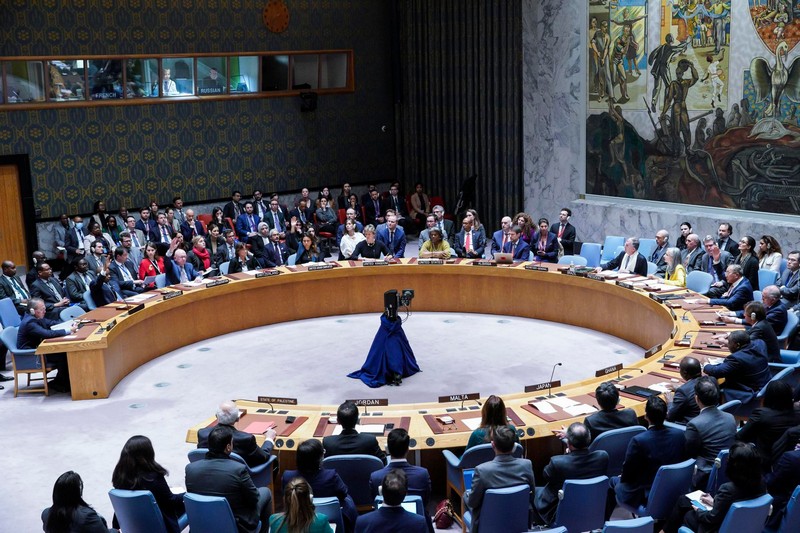
Adopting Resolution 2735 (2024) with 14 Votes in Favour, Russian Federation Abstaining, Security Council Welcomes New Gaza Ceasefire Proposal, Urges Full Implementation

After 247 days of war in Gaza, the Security Council today adopted by 14 votes in favour — with the Russian Federation abstaining — a resolution proposing a comprehensive three-phase ceasefire deal to end the war in Gaza, urging both Israel and Hamas to implement it fully and without delay and condition.

By resolution 2735 (2024) (to be issued as document S/RES/2735(2024)), the 15-member organ noted that the implementation of this proposal would enable the following outcomes to spread over three phases, the first of which would include an immediate, full and complete ceasefire with the release of hostages; the return of the remains of some hostages who have been killed; the exchange of Palestinian prisoners; withdrawal of Israeli forces from the populated areas in Gaza; the return of Palestinian civilians to their homes; and the safe and effective distribution of humanitarian assistance at scale throughout Gaza.

Phase two would see a permanent end to hostilities in exchange for the release of all other hostages still in Gaza and a full withdrawal of Israeli forces from the area.  Phase three would mark the start of a major multi-year reconstruction plan for Gaza and the return of the remains of any deceased hostages still in the Strip to their families.

Further by the text, the Council underlined that — if the negotiations take longer than six weeks for phase one — the ceasefire will continue as long as negotiations continue.  The Council also rejected any attempt at demographic or territorial change in the Gaza Strip, including any actions that reduce the Strip’s territory.

The representative of the United States, speaking before the vote, said that “the last eight months have been nothing short but devastating” both for Israelis who lost loved ones on 7 October and Palestinian civilians who “are living through sheer hell”, fleeing from one place to another in search of elusive safety.

“The only way to bring about a durable end to this war” is a ceasefire deal between Israel and Hamas, she stressed, adding that Israel has agreed to a comprehensive deal on the table, which is nearly identical to Hamas’ own proposal.  “Now we are all waiting for Hamas to agree to the ceasefire deal it claims to want, but we cannot allow to wait and wait,” she stated, noting that “with every passing day, needless suffering continues”.

While the resolution is not perfect, it offers a glimmer of hope, said her counterpart from Algeria, noting that his delegation voted in favour “to give diplomacy a chance”.  Over the past eight months, 37,000 Palestinians have been killed by the Israeli occupying forces, he said, underscoring the need for accountability, including through the endorsement of the International Court of Justice’s orders.

Switzerland’s delegate underscored that the plan outlined by the resolution “currently represents the best chance for a way out of the appalling violence raging in the Middle East”.  However, she observed that calls for respecting international humanitarian and human rights law “did not find a place” in the adopted text.  While welcoming the 8 June news that Israeli forces successfully rescued four hostages, she expressed concern over the very high number of Palestinian casualties during the rescue operation in Nuseirat.

Echoing that sentiment, the speaker for Malta said that images from that operation “are truly horrifying”.  And those images are not isolated; rather, they are “emblematic of the scale of suffering in Gaza”.  Accordingly, she called on all parties to respect international humanitarian law, noting that the ceasefire proposal will be essential to addressing deepening humanitarian concerns and put both parties on the path towards reviving a credible political process for sustainable peace anchored in a two-State solution.

Meanwhile, China’s delegate detailed his delegation’s valid concerns about whether both parties will accept the ceasefire proposal and whether the three-phase arrangements can be carried out smoothly.  Despite the text being “ambiguous in many aspects”, China recognizes the urgent need to stop more killings and alleviate the humanitarian catastrophe in Gaza — the most pressing aspiration of Gaza civilians — and, therefore, voted in favour.

Along similar lines, the speaker for the Russian Federation said that “there was no negotiation process” as “the sponsors of the draft did not keep the Council in the loop of the agreement’s details”.  He further observed that — even though Hamas is called upon to accept this so-called deal — there is no clarity regarding official agreement from Israel — a country repeatedly stating that “it will continue in its war until Hamas is defeated”.  Despite its objections, he said Moscow decided not to veto the resolution “as the Arab world supports it”.

Rounding out the discussion, Israel’s representative said that her country’s goals have been evident since 7 October — to bring hostages home and dismantle Hamas’ capabilities.  While the “genocidal jihadists who started this war” are preventing it from ending, they have never been held accountable, she underlined, noting that the international pressure should have begun long ago.  On the 8 June rescue operation, she said that although terrorists guarded the hostages, Gazan civilians were their jailors.  When “so-called innocent civilians” start taking part in Hamas’ war crimes, they are “no longer uninvolved”, she asserted.

THE SITUATION IN THE MIDDLE EAST, INCLUDING THE PALESTINIAN QUESTION

Explanation of Position Before Vote

The representative of the United States, speaking before the vote, said that “the last eight months had been nothing short but devastating” — for Israelis who lost loved ones on 7 October, when Hamas set this conflict into motion by carrying out acts of unthinkable violence, and for Israelis and people from over 16 other countries whose loved ones are still being held hostage by Hamas.  The past eight months have also been devastating for Palestinian civilians in Gaza; nearly 2 million have had to flee from one place to another in search of safety, which has been elusive.  Children in Gaza have been traumatized by seeing their family members killed.  Calling on Israel “to do everything possible to protect civilians”, she said, however, that “Hamas leaders are those who put civilians at risk”.

Amid the worsening humanitarian situation, “Palestinian civilians are living through sheer hell by no fault of their own”, she said, with “families unsure what the next day holds and millions grappling with the uncertainty of what will be left when they are allowed to return home”.  Parents are trying to find food for their families; children are forced to stop their education, and elderly persons no longer have access to medicine.

“The fighting must end in a sustainable way,” she said, calling for an immediate ceasefire with the release of hostages and stressing that a ceasefire deal between Israel and Hamas is “the only way to bring about a durable end to this war”.  She said Hamas has failed to accept any agreement, while Israel has agreed to a comprehensive deal on the table which is “nearly identical to Hamas’ own proposal” — it would bring hostages home, ensure Israel’s security, enable a surge in humanitarian relief, and set the stage for a political settlement that provides a better future for Israelis and Palestinians alike.  “Now we are all waiting for Hamas to agree to the ceasefire deal it claims to want, but we cannot allow to wait and wait,” she stated, noting that “with every passing day, needless suffering continues”.

Detailing the text, she said the first phase of this agreement would last for six weeks and include an immediate and complete ceasefire, with the release of hostages, including women, the elderly and the wounded; the return of the remains of some hostages who have been killed; the exchange of Palestinian prisoners; the withdrawal of Israeli forces from the populated areas of Gaza; the return of Palestinian civilians to their homes and neighbourhoods in all areas of Gaza; and the safe distribution of humanitarian assistance in Gaza.  The proposal says that if negotiations take longer than six weeks in phase one, the ceasefire will continue “as long as negotiations continue”.  Underscoring that “Hamas is no longer capable of carrying out another 7 October,” she reiterated Washington D.C.’s commitment to Israel’s self-defence.  She also noted that the text rejects any demographic or territorial changes in Gaza, including any actions that reduce its territory.

Vote

The Council then adopted resolution 2735 (2024) with a vote of 14 in favour to none against, with 1 abstention (Russian Federation).

Explanations of Position after Vote

Speaking after the vote, the representative of the United States observed:  “Today, this Council sent a clear message to Hamas – accept the ceasefire deal on the table.”  Israel has already agreed, she added, underscoring that — if Hamas does the same — “the fighting can stop today”.  Now, the international community is united behind a deal that will save lives, help civilians in Gaza start to rebuild and heal, reunite hostages with their families, lead to a more secure Israel and unlock the possibility of more progress.  Noting that Egypt and Qatar have assured her country that they will help ensure that Hamas engages constructively, she said that “the United States will help ensure that Israel lives up to its obligations as well, assuming Hamas accepts the deal”. Over the past eight months, the Council has often been divided and the world has taken notice with understandable frustration.  However, there is another side to this story — for the fourth time, the Council has said that the only way to end the cycle of violence and build durable peace is through political settlement.  “Today, we voted for peace,” she stressed.

The representative of Algeria said that his thoughts are with the 37,000 Palestinians who have been killed by the Israeli occupying forces over the past eight months.  “These martyrs for us are alive with their Lord, watching over us from heaven,” he said.  He acknowledged that Algerians deeply feel the suffering of the Palestinians and, with their own history of struggle against occupation, they understand and support the Palestinians’ legitimate and just demands.  Noting that as a free and dignified people, Palestinians will never accept living under occupation and will never abdicate their fight for liberation, he added:  “To us, Palestinian lives matter”.

While the resolution is not perfect, it offers a glimmer of hope, he said, stressing:  “We voted for this text to give diplomacy a chance.”  Guided by solidarity with the Palestinian people, Algeria will do its part in the international reconstruction effort.  He reaffirmed Algeria’s commitment to accountability for those killed in Nuseirat and all occupied Palestinian territories.  “No one will be immune.  None will be above the law,” he stressed.  If the International Court of Justice’s orders are not endorsed, a new genocide “looms on the horizon”, he said, underscoring:  “Therefore, our objective must be to end the occupation.”

The representative of the United Kingdom, whose delegation voted in favour, cited the resolution as “an important step” in bringing about an end to the conflict that has raged since the 7 October attacks. The situation in Gaza is catastrophic, and the suffering has gone on far too long.  London has long called for the deal on the table which is “the best way” to get remaining hostages out, bring about an immediate ceasefire leading to a permanent end to hostilities, and enable a significant scaling up of much-needed humanitarian aid.  She called on Hamas to accept the deal and end the suffering of the Palestinian people and the hostages who remain in detention.  Further, she called for the rapid increase of humanitarian aid, stressing that “now — more than ever — is the time for diplomacy, now is the time for peace”.

The representative of Malta noted her country’s consistent calls for a ceasefire, the release of all hostages and a comprehensive response to the humanitarian crisis in Gaza.  “We fully support all initiatives that bring us closer to these imperatives,” she emphasized.  While welcoming the 8 June news that four hostages were successfully rescued by Israeli forces, she stated that images from that operation “are truly horrifying”.  And those images are not isolated, she added; rather, they are “emblematic of the scale of suffering in Gaza”.  She therefore stressed that all parties must respect international humanitarian law. Meanwhile, the ceasefire proposal will be essential to addressing deepening humanitarian concerns; lead to the complete withdrawal of Israeli forces from the Gaza Strip; and create the space to mount an international reconstruction effort there.  Most importantly, it will put both parties on the path towards reviving a credible political process for lasting, sustainable peace anchored in a two-State solution.

The representative of Switzerland, noting that she supported the draft text, said:  “This plan currently represents the best chance for a way out of the appalling violence raging in the Middle East.”  However, she expressed regret that despite the request of several delegations, the call for respecting international humanitarian law and human rights law — which was included in previous resolutions — “did not find a place” in the text voted in today.  “We are relieved that four hostages have — after many months — been reunited with their families,” she continued, while expressing concern over the very high number of Palestinian casualties during the rescue operation in Nuseirat. Reiterating her support for the negotiations led by Egypt, Qatar and the United States, she called on Israel and Hamas to conclude and implement this agreement as soon as possible.

The representative of Japan, whose delegation voted in favour, underscored that “the devastating conflict in Gaza has gone on for far too long,” with too much suffering and loss of innocent life.  “The catastrophic humanitarian situation is indescribable,” while many hostages are still being held in appalling conditions.  Commending the vigorous diplomatic efforts led by the United States, Egypt and Qatar, and the three-stage proposal outlined by President Biden, he said that — if Hamas accepts the deal and both parties commit themselves to negotiations — it will finally bring about the long-awaited ceasefire and release of hostages.  “Today, the Security Council has upheld its responsibility to maintain international peace and security by expressing our strong desire to see the end of the vicious cycle of violence,” he stated, adding:  “The people of Gaza and the hostages still held by Hamas are counting on us.”

The representative of Slovenia noted that international law prohibits hostage-taking, the denial of humanitarian access to civilians and attacks against humanitarian workers.  Further, it includes displaced persons’ right to voluntary return.  “My point, colleagues, is that many of the elements of this deal should already be taking place,” she emphasized — which also should have been the case for the Council’s previous resolutions and the International Court of Justice’s provisional measures.  Underscoring that “the suffering in Gaza must end”, she said that military operations to free hostages that leave hundreds of civilians killed and injured — like the one conducted on 8 June — “cannot be the new normal”.  Photos of children dying of malnutrition “will go down in history as one of the conflicts this Council should have prevented”, she stressed.  Only two sovereign and equal States can make peace happen, she added, pointing to this as the reason for her country’s recent recognition of Palestine as an independent, sovereign State.

The representative of China, noting that the draft text is still “ambiguous in many aspects”, said that his delegation has “valid concerns” whether the parties concerned will accept the ceasefire proposal and whether the three-phase arrangements can be carried out smoothly. “Our understanding is that, as long as a ceasefire is achieved, no more fighting will be launched again,” he said, observing that this has been the most pressing aspiration of Gaza civilians. From the perspective of the urgent need to stop more killings and alleviate the humanitarian catastrophe, China voted in favour.  Underscoring that all Council resolutions are legally binding, he expressed hope that the sponsor will work “sincerely” in an impartial matter to push for an immediate realization of a permanent ceasefire.  China will work towards bringing the Israeli-Palestinian question “back to the right track” of the two-State solution, he added.

The representative of Guyana said that 247 days have passed since Hamas’ horrific attacks and since Israel launched a war on Gaza “unprecedented in scale and impact”.  The humanitarian situation is catastrophic and “Gaza has been made an abyss of destruction,” she observed, adding that — despite the adoption of the resolution calling for the protection of civilians and a ceasefire — the war has persisted.  Her country voted in favour of the draft as it represents a valuable contribution towards achieving the end of the war and bringing relief to civilians suffering in Gaza and the Israeli hostages and their families.  Nevertheless, she emphasized that the Council must redouble its efforts towards the urgent achievement of a ceasefire and the release of all hostages in Gaza.

The representative of Ecuador said that his country, “once again, voted in favour of peace”.  Now, both parties must accept the proposal, which will put into effect an immediate ceasefire, allow for the release of hostages and alleviate the terrible humanitarian situation faced by civilians in Gaza.  Further, implementing all proposed phases will facilitate the beginning of a reconstruction plan in Gaza and reject any attempts at demographic or territorial change in the Strip.  Stressing that the proposal be seized to halt the spiral of violence and “ensure that this is the last war of this long conflict”, he also urged moving towards the existence of two States, Palestine and Israel, on the basis of 1967 borders and relevant resolutions.

The representative of Sierra Leone said he voted in favour of the resolution, adding that the Security Council’s actions should complement ongoing diplomatic efforts.  While his delegation does not agree with all the elements in the text, he urged Israel and Hamas to seize this opportunity to meaningfully engage and commit to an agreement that will lead to a ceasefire, the release of hostages and the exchange of Palestinian prisoners.  To avoid future catastrophes and put an end to this “brutal conflict”, Sierra Leone reiterates the need for parties to the conflict to respect and implement all relevant Council resolutions.  He expressed hope that the parties to the conflict will approach the negotiating table with empathy, flexibility and consideration of the conflict’s impact on women, children, the elderly and other vulnerable groups, who since 7 October 2023 have been victims of their actions.

The representative of the Russian Federation said that from the very outset of the military escalation, Moscow has advocated for a permanent ceasefire.  On the adopted resolution, he said that “its sponsors did not keep the Council in the loop of the agreement’s details”.  Noting that “there was no negotiation process”, he also pointed out that — even though Hamas is called upon to accept this so-called deal — there is no clarity regarding official agreement from Israel.  In this regard, he recalled numerous statements by Israel that “it will continue in its war until Hamas is defeated”.  The Council should not sign up to agreements with vague parameters and without a clear understanding of the parties’ position, he asserted.  Also, the adoption of yet another document — the content of which raises questions — undermines the Council’s authority as the main body for the maintenance of international peace and security.  “We do not wish to block the resolution as the Arab world supports it,” he said.  However, the questions raised by Moscow require a response.

The representative of the Republic of Korea, Council President for June, spoke in his national capacity to welcome diplomatic efforts by the United States, Egypt and Qatar to achieve an immediate ceasefire and the release of hostages.  “The recent airstrikes on refugee camps and the massive operation to rescue hostages, resulting in a large number of civilian casualties, once again exemplify the imperative of finalizing the deal as soon as possible,” he said. Underscoring that “more hesitation means more fatalities”, he expressed hope that today’s adoption will press both parties — notably Hamas — to accept and implement the terms of the proposal. Israel must also stay true to its word. “No other considerations should be prioritized beyond the lives of innocent people,” he stressed, expressing hope that the resolution can lead to “a concrete outcome on the ground” — including a massive expansion of humanitarian aid.

The representative of Israel said that her country’s goals have been very clear since Hamas’ invasion on 7 October:  to bring hostages back home and to dismantle that terrorist group’s capabilities.  “Once these goals are met, the war will end,” she stressed, noting that if Hamas released hostages and turned themselves in “not one more shot needs to be fired”.  However, 120 hostages are still being held by Hamas, which keeps advancing their goal of “murdering every Israeli”.  It is the “genocidal jihadists who started this war” who are preventing the war from ending, she observed, emphasizing that pressure must be applied on Hamas and “blame must be placed where it belongs”.  Yet, that terrorist group does not care for what the Council has to say because it has never been held responsible.  She stated that the pressure on the terrorists should have begun long ago, but “it’s still not too late”.

As a result of a heroic operation, the Israel Defense Forces rescued four hostages, who were held in residential buildings by Palestinian families.  While the hostages were guarded by terrorists, Gazan civilians were their jailors, she said, adding that those “so-called innocent civilians” were not only cooperating with terrorists, but were complicit with their heinous crimes.  “Israel regrets any harm to civilians, but it must be emphasized that Palestinians who cooperate with Hamas and take part in their war crimes are not uninvolved,” she said.  While the loss of life is tragic, if States do not put blame on Hamas, they are advancing its strategy.  “We will continue until all hostages are returned and until Hamas’ military and governing capabilities are dismantled,” she underscored, adding that Israel will not engage in meaningless negotiations, which Hamas can stall as a way to exploit.

10 June 2024

Source: press.un.org